CARS! CARS!
WOMAN & HEALTH TUESDAY
HIGH 82ºF LOW 75ºF
The Tribune L AT E S T
N E W S
CLASSIFIEDS TRADER
O N
T R I B U N E 2 4 2 . C O M
Biggest And Best!
Volume: 124 No. 2, Tuesday, November 24, 2026
THE PEOPLE’S PAPER: PRICE–$1
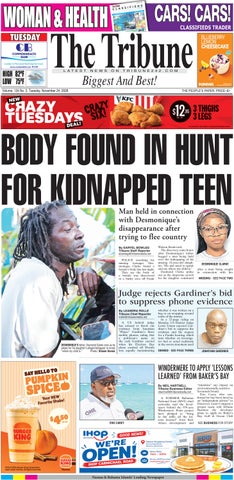
BODY FOUND IN HUNT FOR KIDNAPPED TEEN Man held in connection with Desmonique’s disappearance after trying to flee country
By EARYEL BOWLEG Tribune Staff Reporter ebowleg@tribunemedia.net POLICE searching for missing teenager Desmonique Clarke found a female’s body late last night. They say the body of a female was discovered in a bushy area off Frank
Watson Boulevard. The discovery came hours after Desmonique’s father begged a man being held over the kidnapping of his missing 18-year-old daughter: “He just need to speak and say where my child is.” Desmond Clarke spoke out as the desperate search for his daughter continued
DESMONIQUE CLARKE after a man being sought in connection with her MISSING - SEE PAGE TWO
Judge rejects Gardiner’s bid to suppress phone evidence By LEANDRA ROLLE Tribune Chief Reporter lrolle@tribunemedia.net
DESMONIQUE’S father, Desmond Clarke cries as he pleads for his daughter’s alleged kidnapper to reveal “where my child is.” Photo: Shawn Hanna
A US federal judge has refused to throw out evidence from Jonathan "Player" Gardiner's three mobile phones, ruling that a politician's name on the cash Gardiner carried when his Election Day plane crashed off Florida was equally incriminating
whether it was written on a bag or on wrapping around some of the money. In a 22-page ruling on Monday, US District Judge Lewis Liman rejected Gardiner's bid to suppress the evidence and his request for a Franks hearing, which tests whether an investigator lied or acted recklessly in the sworn statement used DENIED - SEE PAGE THREE
JONATHAN GARDINER
WINDERMERE TO APPLY ‘LESSONS LEARNED’ FROM BAKER’S BAY By NEIL HARTNELL Tribune Business Editor nhartnell@tribunemedia.net
ERIC CAREY
A FORMER Bahamas National Trust (BNT) chief yesterday said the developers behind the 976-acre Windermere Point project have pledged to “bring to the table all the lessons learned” from their Abaco development and
Nassau & Bahama Islands’ Leading Newspaper
“minimise” any impact on environmentally-sensitive Savannah Sound. Eric Carey, who confirmed he has been hired as an “independent adviser” to Discovery Land Company’s project team, told Tribune Business the developer plans to apply its Baker’s Bay Golf & Ocean Club SEE BUSINESS FOR STORY
PAGE 2, Tuesday, November 24, 2026
THE TRIBUNE
Father’s anguish as kidnapped daughter remains missing
A TEARFUL father (left) pleads for the whereabouts of his missing daughter Desmonique Clarke (above) after police arrest a man in connection with her disappearance. Photos: Shawn Hanna MISSING from page one disappearance was arrested as he allegedly tried to flee the country Mr Clarke recalled his last words to Desmonique was “I coming now” before she was snatched outside the family home on Gladstone Road at 11.30pm on Monday night. Police said a man known to the second-term business student at the University of The Bahamas allegedly drove his vehicle into hers and then forced her into his car. Mr Clarke said his daughter had obtained a restraining order against her former partner, a 39-year-old man, about one or two weeks before she was taken. As well as being a
student, Desmonique ran her own business, Luxuri Styles, selling customised self-defence keychains with items such as pepper spray and tasers. In a TikTok video promoting them, she spoke about people who will not respect boundaries. “Have you ever came across an individual that just don’t understand what the word ‘no’ means? No matter how much times you tell them no, they just can’t comprehend,” she said. “I have the perfect tools for you to carry to help them understand what the word no means.” Her father said she did not start the business because of her former relationship. The 39-year-old was arrested yesterday in connection with the
investigation. Despite extensive searches, police have not found Ms Clarke. Her car was recovered in the Gladstone Road area, and the suspect’s vehicle was found at a gas station on Carmichael Road. Despite speculation that a body had been found, police said no remains had been discovered in connection with the case. “He just need to speak and say where my child is, because we don’t been out the road there. She ain’t there. He know where she is because he take her from here,” Mr Clarke said. The 49-year-old spoke to The Tribune yesterday afternoon after relatives spent hours searching the Gladstone Road area. They returned to the family home in tears.
“Everybody freaking out because it ain’t supposed to be like this, man,” he said. Mr Clarke said his daughter had been sitting in her boyfriend’s car outside their home when her former partner appeared and began damaging the young man’s car. When her boyfriend drove off, Ms Clarke went after his car in her own vehicle to get her mobile phone, which she had left inside, Mr Clarke said. “She wasn’t going behind him. She was going behind to get her phone from her boyfriend car,” he said. He alleged that the man followed her, struck her vehicle from behind and dragged her into his car, and said others had witnessed it. “The man grab her from the back and drag her inside the car. Who do something like that?” he said. He was in the bath and had been getting ready to go out to her when it happened. “All she had to do was let me put on my clothes and then he wasn’t gonna been around here,” he said. Mr Clarke said he had confronted the man about three weeks earlier because he kept following
his daughter after their relationship ended. “I meet him just basically three weeks ago because he keep following her, and then I had a conversation with him,” he said. “I told him, ‘You need to stop following my daughter. You need to leave her alone.’” He said the man replied: “All right, Mr Clarke, this the last time. I won’t follow her no more. I wouldn’t bother her no more.” “Whenever I go someplace or when I come back, he here,” Mr Clarke said. “If you leave someone, don’t know why you keep coming around the place.” He said he believed police had gone as far as they could in dealing with the matter before she was taken. He also alleged that the suspect was caught on the dock trying to board a mail boat. Reports suggested he has an airline ticket for a flight out of the country. With tears in his eyes, Mr Clarke questioned how anyone could pursue someone so relentlessly after being told to stay away. “They just running you down like you was some kind of animal or something. Forget people have people too, you know,” he said. Mr Clarke said he only
learned of his daughter’s relationship with the man after it ended, and did not know whether there had been any physical abuse. “I didn’t know what the relationship until they break up,” he said. “You still have the right to choose. I can’t just control your life or dictate to you what you should do from what you shouldn’t do.” A father of six, Mr Clarke said he has been Desmonique’s primary caregiver since she was three weeks old, although she also has a relationship with her mother. “I always had her. Her mother don’t keep her. I keep her. That’s my baby,” he said. “I stop going out, stop fooling with people for my children. Anybody who know me could tell you my children first.” He described his daughter as sweet, genuine and pure-hearted, with an entrepreneurial spirit, and said she had been thinking about launching another business. The case has sparked debate online about violence against women, with many people describing the 21-year age gap between Ms Clarke and her former partner as inappropriate and predatory.
THE TRIBUNE
Tuesday, November 24, 2026, PAGE 3
US judge rules search warrant established ‘ample probable cause’ DENIED from page one to obtain a search warrant. The judge also refused to order prosecutors to set out more details of the charges in a bill of particulars, finding the defence already had enough information “to prepare for trial, prevent surprise, or interpose a double jeopardy claim.” Gardiner, 58, a convicted drug trafficker, is charged in the Southern District of New York with conspiring to import cocaine from The Bahamas into the United States and with firearms possession and firearms conspiracy offences linked to that conspiracy, charges he has denied, and he is due to stand trial on March 1, 2027. At the centre of his challenge was the roughly $30,000 in Bahamian currency found in a crossbody bag he was carrying when the US Coast Guard pulled him and ten others from the sea on May 12, after the plane they were travelling in crashed into the water. The search warrant affidavit, sworn by Drug Enforcement Administration Special Agent Michael Coleman, described a brown paper bag containing $30,000 “labeled with the handwritten name of Politician-1”, but the defence said photographs of the seizure show the name only on torn wrapping around part of the cash. Politician-1 has not been named or charged, though prosecutors described him in a filing earlier this month as an incumbent male MP who was re-elected on May 12. Gardiner’s lawyers also argued that the affidavit should have told the magistrate that May 12 was Election Day in The Bahamas, that the country does not limit political contributions, and that Gardiner had withdrawn about $20,000 in cash the day before the crash that could have been used for campaign contributions. Judge Liman said the cash mattered because Gardiner was carrying enough money to serve
as a bribe, marked with the name of a politician accused of taking bribes to protect a trafficking organisation’s shipments. “That remains true whether the name appeared on the bag itself or on wrapping around some of the currency,” the judge said. He said it would have made no difference had the affidavit included what he called Gardiner’s “self-serving, innocent explanation for the cash,” because a magistrate “is not required to accept defense counsel’s unsupported rationalizations made after the fact.” The judge said the election explanation was first given by defence counsel at Gardiner’s detention hearing on June 25, nearly a month after Agent Coleman swore the affidavit, and that Judge Gregory Woods had heard that explanation and still concluded that “the weight of the evidence against the defendant as proffered by the government is very strong.” The defence also attacked the timeline in the affidavit, which in one place wrongly gave Gardiner’s arrest date as May 16, arguing that it should have stated that he was rescued and his bag, phones and notebook first seized on May 12, that he was charged on May 14 and that he first appeared in court on May 15. His lawyers said those errors prevented the magistrate from judging whether the seizure of his belongings, and any access to them before the warrant was issued, were lawful, and they questioned whether officers had looked into the phones early, pointing to photographs that record the phones’ IMEI identification numbers. “Corrected as Gardiner proposes, the Search Warrant Affidavit still establishes ample probable cause,” Judge Liman said, finding that nothing in the case for the warrant turned on the dates of Gardiner’s rescue, arrest or court appearance, or on when his property was first seized. The judge found no sign
that any error was deliberate or reckless, noting that “defense counsel conceded that there is no evidence that SA Coleman acted intentionally or recklessly, and the record confirms as much.” He described the wrong arrest date as an inadvertent mistake, since Agent Coleman gave the correct date elsewhere in the affidavit, and said the agent would have had no reason to say the bag bore Politician-1’s name unless he believed it. Gardiner also argued that the affidavit failed to link the phones to any number he used in crime and relied only on the general idea that phones store data, but the judge said carrying several phones can point to drug trafficking and that the evidence here went further. He cited text messages that the criminal complaint says a co-conspirator sent Gardiner during a February 2023 cocaine shipment to a Georgia-based trafficking organisation, including one asking whether he needed to “buy more time” and another thanking him once the deal was done. “The Government need not establish that Gardiner used his phones to engage in illegal activity,” the judge said. “It is sufficient that there be a ‘fair probability’ that evidence of criminal activity would be found on the phones.” He also rejected arguments that a statement about Gardiner from co-defendant Luis Fernando Orozco-Toro was unreliable because it was not based on direct contact with him, and that claims Gardiner used his construction business to launder drug money required specific transactions to be identified. Prosecutors confirmed at a hearing on November 20 that they intend to use Gardiner’s alleged dealings with the Georgia organisation, including a nine-kilogram cocaine shipment he is accused of sending from The Bahamas to Miami in February 2023, as part of the New York conspiracy case, the ruling said. Judge Liman also found
JONATHAN ‘PLAYER’ GARDINER no unreasonable delay in the 15 days between the DEA taking custody of the phones on May 14 and the warrant application on May 29, noting that five of those days were weekends or the Memorial Day holiday and that Gardiner, held in custody throughout, never asked for his property back. The judge denied without prejudice Gardiner’s request for prosecutors to hand over more records, including documents about his rescue and arrest, saying the two sides’ filings did not show they had discussed which materials were still outstanding and noting that the defence had not filed an affidavit required by the court’s local rules. He said some requests, such as photographs of the seized cash and phones and chain-of-custody records, appeared to fall well within prosecutors’ disclosure duties, while others, including
maintenance records and the legal operating status of the aircraft, what officers knew when they arrested Gardiner and how the other rescued passengers were treated, appeared at first glance to go beyond them. Defence lawyers must confer with prosecutors by November 24 and file any renewed request by November 30. Gardiner’s separate bids to have the $30,000 returned and for a hearing over the seized money were treated as withdrawn after his lawyer dropped them at the November 20 hearing. Prosecutors told the court, without dispute from the defence, that they had already handed over full extractions of Gardiner’s three phones, material from co-defendants’ devices and accounts, confidential-source debriefings, video and audio recordings of informants’ meetings
with the accused, and recordings of Gardiner’s jailhouse calls. The wider case stems from a November 2024 indictment, later expanded, of 13 men accused of smuggling cocaine through The Bahamas into the US with the protection of corrupt Bahamian officials, including high-ranking police and defence force officers. That indictment alleges that former police officers Elvis Curtis and Prince Symonette carried firearms while wearing their Royal Bahamas Police Force uniforms and meeting purported drug traffickers, conduct the judge said gave Gardiner notice of the firearms allegations against him. Gardiner was held by US Customs and Border Protection after his rescue and arrested by the DEA on May 14, and he also faces a separate drug indictment in Atlanta, Georgia.
“QUESTIONS ABOUT GOVT TIES TO GARDINER REMAIN UNANSWERED” By LEANDRA ROLLE Tribune Chief Reporter lrolle@tribunemedia.net OPPOSITION Leader Michael Pintard has demanded that Prime Minister Philip "Brave" Davis say whether he spoke to anyone allegedly involved in the sprawling Jonathan ‘Eric’ Gardiner drug trafficking case, and what was discussed, after a US defence lawyer told a New York court that a telephone call to "the Prime Minister of The Bahamas" is among the prosecution's surveillance evidence. There is no suggestion that Mr Davis has done anything wrong or is in any way connected to the case. No details were given about where the surveillance device was deployed or which country's network was used. Mr Pintard said questions about the government's ties to Gardiner remained unanswered, and that the government's failure to strengthen anti-corruption reforms undermined efforts to hold public officials accountable. He spoke out Susy Ribero-Ayala, who represents accused Bahamian drug trafficker Gardiner, on Friday told the US federal court that prosecutors
had included the call in their evidence. She referred “We’re not surprised about to it while any communication, because discussing "multiple we suspected whether pen registers", directly or indirectly that they devices law are very very concerned and enforcement very nervous.” agencies use to log calls. Some involved "officials," she said, though none of the logs concerned her client. Her comments formed part of an application asking the judge to exclude parts of the evidence against Gardiner. "We're not surprised about any communication," Mr Pintard told The Tribune yesterday, "because we suspected whether directly or indirectly that they are very very concerned and very nervous." He said the opposition had little confidence in the government's promises to root out wrongdoers and OPPOSITION LEADER MICHAEL PINTARD identify "Politician-1", an unnamed politician referred to in the US are still in our jurisdiction the government and the coming across as defense case against Gardiner, who were not arrested by prime minister who said attorneys, it gives a strong and accused the Davis the government since their he would shake every impression of corruption administration of being names have been called tree to remove the bad and collusion." and investigated," he said. apples so when you do Attorney General unserious. "We have had no sig- not have robust investiga- Wayne Munroe appeared "You have persons who have been named who nificant updates from tions and you have them sceptical of the claim. He
said that even as a member of Cabinet, he had never been able to call the Prime Minister and have him answer the phone. Mr Munroe said the claims would be tested at trial, where any audio recordings or other evidence would be presented. "If they say there is a call logging where they claim this call is to the prime minister, it would be interesting to know," he said. "Is it a land line, is it a cellphone, all of these will be details that we would need to know." Gardiner faces drug trafficking charges in New York after he was arrested in waters off Florida following an Election Day plane crash. He also faces a separate indictment in Georgia and remains in custody. His New York case is linked to the November 2024 indictment of former police Chief Superintendent Elvis Curtis and others. The trial is due to start on March 1. The Office of the Prime Minister has previously said the government received no official information identifying any public official in relation to the matter and would seek further information from US authorities.
PAGE 4, Tuesday, November 24, 2026
THE TRIBUNE
Faith, fellowship and Christmas lights go up but female empowerment costs remain in the dark By JADE RUSSELL Tribune Staff Reporter jrussell@tribunemedia.net
SOCIAL Services Minister Senator Barbara Cartwright, FOCOL executives and Ministry of Social Services officials and staff attended a church service at Mount Tabor on November 22, 2026, to mark National Women’s Week. Pastor Delton Ellis delivered a message on the power of using one’s voice and encouraged a partnership between FOCOL and the ministry to support women across The Bahamas. Photo: Chappell Whyms Jr.
THE government will not say how much it is spending on this year's Christmas decorations, even as one contractor says the elaborate displays are giving Family Islanders work and bringing business to local vendors. Mark Hanna, a senior engineer at the Ministry of Works, declined to disclose the cost when contacted by The Tribune. He confirmed that islands including Andros, Grand Bahama, Abaco, Cat Island and Eleuthera will be lit up for Christmas. The displays are a multi-agency effort involving several people working behind the scenes. The cost of the annual displays has been unclear since 2023, the last time a figure was made public. In November that year, then Ministry of Works and Utilities Permanent Secretary Luther Smith told The Tribune that more than $500,000 had been budgeted for decorations across New Providence and several Family Islands. At the time, he said Island Pearls International had been contracted to decorate Pompey Square, Downtown and the Fish Fry, while Kasimu "Kazi" Ellis was contracted to oversee displays in southern New Providence. The spending came under scrutiny again in July 2025, when Opposition Leader Michael Pintard accused the Davis administration of awarding nearly half a million dollars in no-bid contracts for Christmas decorations. He questioned the Ministry of Finance's role in managing the contracts and said the arrangements raised concerns about compliance with the Public Procurement Act. The government rejected the criticism, saying the more than $500,000 budgeted in 2023 had provided Christmas lighting and decorations in New Providence and several Family Islands, while supporting Bahamian vendors and creating a festive atmosphere for residents and visitors. Mr Ellis, owner of Think Tank, is widely known for his light displays for
2025’s Christmas tree at Rawson Square on Bay Street. Independence and Christmas. He said people often admire the displays without realising the countless hours of work behind them, and that he makes a point of employing residents on the Family Islands to install them. "So it's an impact to the Family Island. It's not just Nassau g coming to the island and taking over us because we employ four or five guys. We rent cars, hotel rooms, we feed everybody. So, the Family Island, they benefit from it," he said. "I don't think anyone's ever touched on, the offspring from the whole project." He said government projects do not always pay right away, and that he funds some activities himself, including movie nights for families at the lighting parks.
Jumbey Village has become a Christmas staple for families over the years, its decorations turning the cultural centre into a winter wonderland. Mr Ellis said families come to open their Christmas presents and take family photos there, some of them in their pyjamas. Asked what motivates him to keep investing in the display each year, he said: "I've had families literally say they can't afford to go to Fusion. They can't afford to go out, but here it is they can walk here, drive there, and sit here and have an entire experience without having to pay for it. That's what motivates me." One of his proudest moments, he said, was watching bikers make a U-turn just to see his lights again.
Children go without lunch as mailboat delays hit Mayaguana By JADE RUSSELL Tribune Staff Reporter jrussell@tribunemedia.net STUDENTS at Mayaguana Comprehensive School went without lunch and residents watched their groceries spoil aboard a stalled mailboat after the island went more than three weeks without service, residents say. The Tribune understands the last mailboat trip to Mayaguana was on October 31. Transport Minister Leon Lundy said the service resumed its regular schedule on Sunday. He said the vessel had been out of operation for a scheduled week of maintenance, and that bad weather last week caused further delays. One mother said she had spent more than $1,300 on groceries ordered from New Providence, and feared much of the meat and fresh produce had spoiled after weeks on board the vessel. She said the shortage had hit the government's school breakfast programme, leaving students with few choices. "The breakfast lady she brought oats, and she's like the food is running out," she said. The school's lunch vendor, who is paid by the government to prepare
students' meals, also depends on the mailboat for supplies. She said the vendors were unable to provide lunch for students yesterday, so parents had to find other ways to make sure their children ate. Residents' cupboards and refrigerators emptied as supplies failed to arrive, and stores ran short of some essentials. Business owners were frustrated at being unable to meet customers' needs. "We have to just scrap whatever we can scrap from there, and it's like everybody just trying to get something from the store because the wait was so long," the mother said. "Now there's certain things we even can't find in the store, so now we have to start growing our own vegetables here." Residents, who spoke on condition of anonymity, said unreliable mailboat service had been a problem for decades. They accused the operator of the Lady Rosalind mailboat of failing to put the wellbeing, livelihoods and needs of the Mayaguana community first. Several said they were afraid to criticise the operator publicly because they feared being victimised and losing access to mailboat services. Despite repeated appeals to successive administrations,
residents believe Mayaguana continues to be overlooked. Mayaguana is not the only Family Island to complain about unreliable mailboat service. Long Island residents have also complained about delays that disrupted access to groceries, medication, vehicle parts and other essentials. Speaking at the Long Island Business Outlook last week, Mr Lundy acknowledged complaints about reduced sailings, schedule changes without proper notice and vessels being shared between routes. He said the government was writing stricter service standards into its agreements with mailboat operators, including published sailing schedules, minimum sailing requirements and timely notice of delays. Public financial support would be tied to operators' performance against those standards, he said. He also announced that regular monthly sailings to South Long Island would resume in December through Madrick S Company. The government is reviewing whether Long Island needs a vessel dedicated solely to the island, with the assessment expected to be finished by the end of November.
THE TRIBUNE
Tuesday, November 24, 2026, PAGE 5
MOW enlists nine contractors to tackle New Providence potholes By KEILE CAMPBELL Tribune Staff Reporter kcampbell@tribunemedia.net NINE contractors are now patching potholes across New Providence after periods of heavy rain, and Works Minister Clay Sweeting says the ministry is turning to historical rainfall data to predict when roads will break down. Mr Sweeting, the Minister of Works and Family Island Affairs, said the contractors started work about two weeks ago. Along with crews from the Ministry of Works and Bahamix, that brings the number of patching operations to about 12, covering nine zones across the island. "We've had a challenge over the past few months, of course, with the amount of rainfall, the amount of potholes throughout New Providence, and the ministry is aware of the conditions of the roads," he said. He said the contractors were chosen because they were "known to the ministry to be effective", as officials try to fix as many potholes as quickly as possible. The ministry has also begun studying past rainfall patterns to anticipate the seasonal damage, which Mr Sweeting described as a problem going back decades. He said complaints
about potholes usually rise in October and November, after heavy rain in August and September. "There's a challenge in October with potholes, so we understand now that there, for decades, has been a problem during this month," he said. "We have put in the data in to see that during rainfall in August and September, puddles start to rise October, November." He said the information would help the ministry prepare for the months when roads are most vulnerable, rather than relying only on repairs after the damage is done. He was confident it would improve the ministry's approach to paving and pothole repairs over the next six months. The pattern is a familiar one. In November 2022, then Works Minister Alfred Sears announced a pothole "blitz", with contractors covering 12 zones of New Providence. In July 2023, after heavy rain worsened the roads, the ministry invested a further $2m and renewed contracts for all 12 zones. In December 2023, Mr Sweeting announced a $98m programme to repave more than 55 miles of roads in New Providence and the Family Islands, with Bahamix as the main contractor.
RECENT rainfall has led to an increase in potholes.
Stabbing victim leaves hospital 67-year-old sentenced to two before police can question him years for housebreaking offences A 47-YEAR-OLD man who was stabbed several times during a fight with a relative in Nassau Village on Sunday left hospital without being discharged before detectives could speak to him, and police have not been
able to find him. Police were told shortly after 7pm that the man had been involved in an altercation with a family member and had suffered multiple stab wounds to the body. He was taken to hospital in a private vehicle, where
his condition was initially listed as guarded. When detectives went to the hospital, medical staff told them he had left without being officially discharged. Checks at his home also failed to find him.
Man dies after flagpole comes into contact with live wire A 57-YEAR-OLD man died and another man was hospitalised on Monday after a flagpole they were moving touched a live electrical wire. Police were told around 11.45am that the two men had been hurt when the pole accidentally came into contact with the wire. Emergency Medical
Services took both men to hospital. The 57-yearold died while being treated, and the 54-yearold remains in hospital in stable condition. Police are investigating the circumstances of the death. The death is at least the third electrocution this year. In July, a 68-year-old
man died after reportedly coming into contact with a high-voltage electrical transformer while painting at a business on Kings Highway in Bimini. That same month, a Bahamas Power and Light employee was electrocuted while working on a utility pole in Grand Cay, Abaco.
By PAVEL BAILEY Tribune Staff Reporter pbailey@tribunemedia.net A 67-YEAR-OLD man who told a magistrate he had fallen on hard times since his mother died was sentenced to two years in prison for breaking into a home on Marine Drive and being caught with housebreaking tools last week. Tyrone Woodside pleaded guilty to unlawful entry
by night and possession of housebreaking implements by night before Senior Magistrate Kendra Kelly-Burrows. He unlawfully entered the home around 11.30pm on November 19. Later that night, he was arrested and found with a large yellow bolt cutter, a black and grey ski mask and an eight-inch knife. Woodside told the court he had fallen on tough times
since his mother died earlier this year. The magistrate expressed her sympathy but reprimanded him, telling him that gave him no right to break into other people's homes. The court heard he had prior theft charges. Woodside was sentenced to two years at the Bahamas Department of Correctional Services. Inspector Vernon Pyfrom prosecuted.
To advertise in The Tribune, contact 502-2394
PAGE 6, Tuesday, November 24, 2026
THE TRIBUNE
The Tribune Limited NULLIUS ADDICTUS JURARE IN VERBA MAGISTRI “Being Bound to Swear to The Dogmas of No Master”
LEON E. H. DUPUCH,
Publisher/Editor 1903-1914
SIR ETIENNE DUPUCH,
Kt., O.B.E., K.M., K.C.S.G., (Hon.) LL.D., D.Litt . Publisher/Editor 1919-1972 Contributing Editor 1972-1991
RT HON EILEEN DUPUCH CARRON,
C.M.G., M.S., B.A., LL.B. Publisher/Editor 1972-
Published daily Monday to Friday
Shirley & Deveaux Streets, Nassau, Bahamas N3207 TELEPHONES News & General Information Advertising Manager Circulation Department Nassau fax Freeport, Grand Bahama Freeport fax
(242) 502-2350 (242) 502-2394 (242) 502-2386 (242) 328-2398 (242)-352-6608 (242) 352-9348
WEBSITE, TWITTER & FACEBOOK www.tribune242.com
@tribune242
tribune news network
The Caribbean was right to say no THERE are worse things for a small country than leaving a negotiating table without an agreement. One is putting its name to an agreement that leaves its people to pick up the bill. That was the choice facing the Caribbean in Antalya. When the United Nations climate talks closed on November 22, negotiators had made progress on several items but could not agree on an overall pact. Prime Minister Philip Davis said the proposed text omitted any mention of fossil fuels and dropped a proposed annual target of US$120 billion to help vulnerable countries adapt. CARICOM, negotiating as a bloc at a climate summit for the first time, declined to accept it. The Bahamas was right to stand with its neighbours. The Prime Minister’s verdict was blunt: “Antalya has failed future generations.” He could fairly have included the present one. A family rebuilding a home has to find the money now. So does a government raising a coastal road or protecting a freshwater supply against saltwater. The word used at these conferences is adaptation. In a Bahamian budget it means deciding which settlement gets its road raised this year and which one must wait. There is a reasonable case for taking what can be won at any international meeting and coming back for the rest. The work completed in Antalya should continue. But three years ago in Dubai, countries had already agreed to transition away from fossil fuels in their energy systems. Asking island states to endorse a text that could no longer name those fuels, while removing the proposed figure for adaptation, was asking rather a lot of the people with the most to lose. CARICOM should carry that habit of acting together into the less public business of securing the money. There is little sense in one Caribbean government paying to find out what another has already learned about protecting a coastal water supply. If a regional
neighbour has secured a grant for work we need here, ask to see the application, the engineering and, just as importantly, the terms. A government with a small public works department should not have to begin at a blank page every time it seeks help. Before the next summit in Addis Ababa, Ethiopia, the Government should identify the Bahamian projects it intends to seek climate funding for and explain why they should come first. Name the communities. Show what each project would protect, what it would cost and how soon work could begin. Let the people who live there have a say in the order. An engineer in Nassau can price the work on a coastal road; the nurse who uses it can explain what happens to her patients when that road goes under. A road serving a few hundred people may look like a low priority on a national spreadsheet. If it is the only road to the clinic, the people who depend on it would put it rather higher. Bahamians should also be told which work can begin with money already available. Cleaning a drain, keeping an existing pump in service or refusing permission to build across a natural drainage channel need not await another round of international negotiations. Doing our part strengthens the case for asking others to do theirs. It does not oblige us to borrow every dollar required to protect these islands from a danger we did little to create. The Prime Minister has said The Bahamas will return to the table. When our delegation does, it should be able to put one Bahamian project in front of a prospective funder and say: here is the community, here is the cost, here is what we have committed, and here is the gap. Then ask whether the offer is a grant, a loan our children must repay, or another promise to be discussed next year. Bahamians deserve to know which answer comes back.
MP talking about flooding is a waste of energy EDITOR, The Tribune. I WATCHED with amusement MP White’s statements and concerns regarding the constant flooding in areas throughout New Providence. While I understand and feel Mr White’s passion and heartache with the flooding issue at hand, I hope he realizes he’s just flapping his gums or maybe a little naïve thinking this government cares. If you think this first class travels the world, corrupt, incompetent, parasitic government is going to do one iota or have an ounce of care regarding the torrential flooding on
this island, you need to seek psychiatric help. Unless it involves Premium VIP class travel, no-bid contracts to companies which they are the major/minor shareholders, direct and indirect kickbacks, using funds to monopolize Bahamian real estate, taxing Bahamians to homeless and hopelessness; it’s just not going to happen. And your short-term memory has faded you. Remember the people voted for this in an absolute landslide a few short months ago. This is just the beginning my friend. It’s a walk on the beach compared to what’s coming.
Your time will be far more productive in starting a charity to conduct swimming and diving lessons, scuba certification, sculling, and dingy building for your constituents to survive events like the past 24 hours. If you think this government has the competence, honor, integrity, and inspiration to provide just a subpar way of life for the Bahamian people, well there is a far better shot of these Ministers flying basic economy. Mr. White Sir, we are on our own, now more than ever. CHRISTOPHER ARMALY Nassau, November 20, 2026.
A salute to the memory of James H Smith EDITOR, The Tribune. PERMIT me please to salute the memory of the late Hon. James Smith, former Minister of State in the Ministry of Finance, former Governor of the Central Bank of The Bahamas and Honorable Senator in your most valuable columns. James’s death last week has left a void in his circle of friends and the charitable and social causes he so advertently supported. It is to these occasions I wish to write. James’s boyhood friends called him “TroMo”. He and Stan Davis grew up together in the same neighborhood south of Gregory’s Arch and Lewis Street thinking they were actually brothers. James’s passing stung Stan and me hard. It was at the original world-famous Banana Boat Club, Farrington Road, ran by the American Businessman Frank Miniyah in the late 50s and early 60s, that my friendship with James was cemented. “The Boat”, as we called it back then, was the matinee dance hall for teenagers. As the years blew by, our careers and business paths continued to bring us into the same social circles. It was no surprise when a pioneering group formed the Banana Boat Reunion Club over two decades ago, which started the annual Banana Boat Reunion themed party usually held between December and the first week of January. James immediately signed on and I can’t recall him ever missing any of the events. He was the consummate dancer and trusted confidante and advisor.
LETTERS letters@tribunemedia.net Despite his many scholarly accreditations and the prestigious public offices he held, James, the Legislator, the Economist, Financial Planner, Central Banker, remained a common, ordinary, no –nonsense person; an affable soul. Nothing stuffy! He spoke with distinction and clarity. Along with Jayson “Pegs” Moxey, we formed a spinoff organization from the Banana Boat Reunion Club called “Nostalgia”. I became the Chairman. James joined us in Nostalgia. James knew that the public roles in which he served demanded a peculiar decorum and discipline and he always brought out his very best… effortlessly. His presence ensured a standard and transparency. James was as dapper a gentleman as any top model on a New York Fashion Week runway. Whether he wore a formal tuxedo, a business suit, casual or evening suit; everything about his presentation was flawless and unpretentious. Last year’s Nostalgia Party, start of the 2026 New Year is how we will choose to remember our friend. James did not want to get off the dance floor into the morning. Even as we were shutting down, he remained as we sat reminiscing over the eventful evening and making plans for this year. I suppose James knew this year we would have to go on; without him. Sigh! Every year, for many years, the kickoff for the
holiday season for us was James’s annual Christmas Eve party at his Westridge residence. It sat the mood, re-set friendships and brought the extended families of the original Banana Boat crew and James’s friendship circle together. James had the best decorated Christmas tree imaginable and the favorite music of our generation. Carla Thomas’ “Gee Whiz it’s Christmas”, Otis Redding’s “Santa Came down the Chimney and the velvet voices of Johnnie Mathis, Jerry Butler and Nat King Cole with the Christmas anthems of “Oh Holy Night, Silent Night, Silver Bells” gave us the reason for the season. So, there we were, old friends retelling the story of our lives, the roads less taken and the roads which overtook us, enjoying the companionship of families, talking about our health, joking about our pet peeves, and in our child-like innocence of “Twas the night before Christmas”, basking in the warmth and joy when the clock ticked us into Christmas morn. The moment when we, the survivors, would wish each other “Merry Christmas”. This is what we came to James’s place for. Stan and I say goodbye to James, our Friend. To his children, Nicola, Jason, Kimani and his family, we too share your grief. Nostalgia will cherish James’s memory. May he Rest in Peace. Sincerely PAT MORTIMER Chairman Nostalgia Club.
China or US? The cost of choosing a side EDITOR, The Tribune. IN 2025, U.S. President Donald Trump claimed that China was effectively controlling the Panama Canal and vowed that the United States would take it back. Shortly afterward, Panama withdrew from China’s Belt and Road Initiative. By January 2026, Panama’s Supreme Court revoked the concession of the Hong Kong-based firm that had operated the ports at both ends of the canal since 1997, transferring control to European shipping operators—a move that prompted the Hong Kong company to demand $2 billion in compensation. The economic fallout was swift: China’s largest shipping line halted operations at the Pacific-side port, and Chinese ports began detaining vessels flying the Panamanian flag. Facing mounting financial losses, Panama was forced to send a delegation to Beijing to plead for the company’s return. This geopolitical tug-ofwar is no longer confined to Central America; CARICOM nations are now caught directly in the crossfire. Belize exemplifies this delicate diplomatic balancing act. In October, Beijing imposed sanctions
on Belize’s Foreign Minister, Francis Fonseca, over Belize’s continued recognition of Taiwan. Just weeks later, Washington revoked the U.S. visa of former Belizean Foreign Minister and Eastern Caribbean Supreme Court judge Godfrey Smith, a vocal advocate for cutting ties with Taiwan in favor of Beijing. Caught between two superpowers, Belizean officials are being penalised by China for supporting Taiwan, and by the United States for advocating a pivot toward Beijing. Jamaica faces a similar high-stakes tightrope. In March, Foreign Affairs Minister Senator Kamina Johnson Smith affirmed that Jamaica remains open to Chinese foreign investment despite escalating U.S.-China tensions. Yet the economic reality is stark: the United States buys 40 percent of Jamaica’s exports, supplies roughly 70 percent of its tourists, and serves as its primary source of remittances. In June, U.S. Ambassador-designate to Jamaica Kari Lake told the U.S. Senate that countering China’s growing influence—less than 500 miles from American shores—would be a core part of her mandate. While China’s ambassador to Jamaica defended
Kingston’s sovereign right to choose its commercial partners on November 15, Prime Minister Andrew Holness has championed a pragmatic, “Jamaica-first” foreign policy aimed at balancing both powers. Still, signs of Washington’s leverage are showing: Jamaica was among three CARICOM nations that recently abstained—rather than voted against, as they traditionally do—on a UN resolution calling for an end to the U.S. embargo on Cuba. Ultimately, the irony is hard to miss: while Washington pressures smaller nations to decouple from Beijing, the United States itself maintains massive diplomatic ties with China and remains its largest trading partner. Small states are told they are “free to choose,” yet absolute freedom is an illusion when every choice carries severe economic and diplomatic consequences. The defining question for the region now is clear: will we bear the heavy burden of true sovereign independence, or retreat into a shell of submission? BRIAN ELLIS PLUMMER Nassau, November 19, 2026.
Advertise today in The Tribune Contact 502-2394
THE TRIBUNE
Tuesday, November 24, 2026, PAGE 7
Crown urges conviction on DNA WAR VETERANS MEMORIALISED evidence in stepdaughter sex case By PAVEL BAILEY Tribune Staff Reporter pbailey@tribunemedia.net THE prosecution urged a jury yesterday to convict a 42-year-old man accused of sexually assaulting his 15-year-old stepdaughter, pointing to DNA evidence it said linked him to semen on her jeans, while his lawyer insisted the girl was lying and asked for an acquittal. Both sides gave closing addresses before Justice Loren Klein in the trial, in which the man is charged with unlawful sexual intercourse with a dependent child. His name is being withheld to protect the girl's identity. He is alleged to have committed the offence in New Providence on September 9, 2023. Prosecutor Tennielle Bain said the Crown had proved its case, and that the DNA was there because events had unfolded as the complainant described. DNA analyst Kirk Deleeuw, formerly of DNA Labs International in Florida, found that the defendant could not be excluded as a possible contributor to the DNA in a semen sample taken from the complainant's jeans. He
said the results gave strong support that the defendant was one of the contributors to the mixed DNA profile. He put the chance of a man from outside the sample having contributed to the semen stain at one in 320 octillion — a number with 29 digits, many trillions of times larger than the world's population. Defence attorney David Cash maintained his client's innocence, telling the jury the evidence against him was flimsy and that the complainant was lying. Ms Bain said the defendant married the girl's mother in 2017, and that his actions on the night in question were "not that of a guardian but of a predator". She recounted the complainant's evidence that her mother was on another island for a funeral that night, leaving the defendant the only adult in the home. The girl testified that the defendant asked her to watch the news with him and brought her what he said was apple cider from the kitchen. She said it tasted off, but that he rushed her to drink it. She said he then made her play a drinking game and brought another drink. When she initially refused,
he allegedly called her a baby, and the two played the game and drank. The girl said she felt dizzy, and that the defendant began asking her personal questions, such as whether she had a boyfriend, and told her she was pretty. She said they kept playing after he brought out a Cuba libre. The prosecution said the defendant was at "peak predatory mode" once the drinks began to affect her. It alleged that once she was tipsy, he gave her butterfly kisses over her body and began to rub her private parts. The girl tried to leave but could not because she was dizzy, and told the defendant she wanted to go to bed. The pair then allegedly went to her room, where the defendant is alleged to have put his private parts in her mouth until he ejaculated. The girl said she spat the semen onto her jeans. Afterwards, she said, she slept holding her siblings because she was afraid. She and her mother reported the matter to police the next day. The trial concludes later this week. Shaneka Carey was also a prosecutor.
Man accused of attempted murder over Turtle Drive shooting By PAVEL BAILEY Tribune Staff Reporter pbailey@tribunemedia.net A 29-YEAR-OLD man has been accused of trying to kill a man who was shot in the shoulder outside a home last week. Prosecutors allege that Kristoff Edgecombe fired multiple shots at Anthony Pierre Jr on Turtle Drive around 1.30pm on November 17. Mr Pierre was taken
to hospital and treated for a gunshot wound to his right shoulder. Edgecombe was allegedly found later that day with a black Glock Recover GR26 handgun and six .40 rounds. He was charged with attempted murder, possession of a firearm with intent to endanger life, possession of an unlicensed firearm and possession of ammunition. Edgecombe was not
required to enter a plea before acting Chief Magistrate Ancella Evans. He was told his case would go to the Supreme Court by voluntary bill of indictment (VBI) and that he could apply for bail there. He was remanded to the Bahamas Department of Correctional Services until his VBI is served on March 25, 2027. Inspector Deon Barr prosecuted.
Three remanded over Blake Road armed robbery of Lexus driver By PAVEL BAILEY Tribune Staff Reporter pbailey@tribunemedia.net THREE men have been charged over the armed robbery of a man whose Lexus, iPhone and AirPods were taken at gunpoint outside an educational institution on Blake Road earlier this month. Prosecutors allege that Leo Symonette, 20, and Shavargo Major, 19, wearing black hoodies and armed with a handgun, robbed Anthony Meyers of his champagne-coloured 2023 Lexus NH350, an iPhone 17 Pro Max and Apple AirPods around 6pm on November 9. The robbers are said to have fled south on Blake Road and John F Kennedy Drive. Symonette and Major were charged with armed robbery. Ricky Jean was charged with abetment to armed robbery for allegedly aiding the pair. Symonette faced an additional charge of fraud by false pretences, accused of defrauding Lawrence Cartwright of $40 worth of gas.
To advertise in The Tribune, Contact 502-2394
The three were not required to enter a plea before acting Chief Magistrate Ancella Evans. They were told their case would go to the Supreme Court by voluntary bill of indictment (VBI) and that they could
apply for bail there. They were remanded to the Bahamas Department of Correctional Services until their VBI is served on March 25, 2027. Inspector Deon Barr prosecuted.
THE British Legion Bahamas Branch launched its Open Air World War II Exhibit on November 23, 2026, at the Six-Legged Roundabout at the junction of John F Kennedy Drive and Farrington Road. The exhibit, which marks the culmination of Veterans’ Month, features a 13ft soldier figure at the centre of the roundabout, surrounded by displays honouring war veterans and commemorating their service and sacrifice. Photos: Shawn Hanna
PAGE 8, Tuesday, November 24, 2026
THE TRIBUNE
World View • Sir Ronald Sanders
Why consensus does not always serve small countries: The COP experience WHAT are small states to do when the very system of international cooperation in which they have placed their faith cannot deliver the measures necessary for their survival? That question arises yet again at the 31st United Nations Climate Change Conference (COP31) in Antalya, Türkiye, where governments have spent much of the past two weeks negotiating over issues whose urgency has long been established by science. As negotiations entered their final days, divisions persisted over adaptation financing, the transition away from fossil fuels, and measures to contain global warming. By 18 November, announced pledges to the Adaptation Fund amounted to approximately US$50 million, compared with US$135 million at last year’s conference. These pledges represent only part of international adaptation financing, but the shortfall sends a troubling signal. Nearly three years after governments agreed in Dubai to contribute to transitioning away from fossil fuels in energy systems, a revised negotiating text issued in Antalya on 19 November omitted references to fossil fuels. The text remains subject to negotiation, but the omission illustrates how even agreed progress can come under pressure. For small island states, even the benchmark against which action is judged must be defended. Antigua and Barbuda’s Minister Michael Joseph explained why his country opposed weakening the 1.5°C target: “We can’t move the benchmark, because it means that it opens that doorway for even greater overshoot.” He also called for a science-guided approach to minimise the duration of any overshoot and bring temperatures back down as quickly as possible. Whatever emerges from Antalya, small states must confront a fundamental weakness in climate negotiations: the prevailing practice of decision-making by consensus. Consensus offers small states considerable protection. It gives them a voice that their economic size,
THE DESTRUCTION left by Hurricane Dorian in Abaco in 2019 illustrates the vulnerability of Caribbean nations to catastrophic storms.
DELEGATES at COP31 in Antalya, Türkiye, where disagreements over climate finance and fossil fuels exposed divisions between nations. military strength, and political influence would not otherwise afford them. But it can also protect those determined to delay, allowing governments defending their economic interests to dilute collective action, even when the consequences for others are grave. Because governments
have never agreed the general voting rule, climate decisions ordinarily depend on consensus, generally understood as agreement without formal objection. This does not confer an unqualified legal veto on every country, but when countries have vastly unequal capacities to withstand
delay, they negotiate from vastly unequal positions. Wealthy industrialised countries can leave a climate conference dissatisfied and still command substantial resources to protect their populations and economies. Small island states have fewer options. For Caribbean countries,
another devastating hurricane could destroy much of their economic infrastructure, displace thousands of people and accumulate debt that burdens generations. Nonetheless, the concerns of fossil-fuel-producing countries cannot be dismissed. Their revenues, employment, and development programmes depend, in varying degrees, on those resources. With powerful political interests behind them, they remain a formidable force in negotiations. But why should those interests be protected at the expense of other countries’ survival and development? Developing countries ought not to be denied legitimate opportunities to industrialise, reduce poverty and improve living standards. Yet their ability to secure support is constrained by the imbalance of political power. The financing gap exposes that imbalance most strikingly. UNEP’s 2026 Adaptation Gap Report estimates developing countries’ adaptation needs at US$305 billion annually by 2035. International public adaptation finance from developed to developing countries reached only US$28.2 billion to US$31.7 billion in 2024. The report also finds that flows to small island developing states and least developed countries, while higher than in 2019, had declined from their 2022 peak. Vulnerable countries face immense costs to protect themselves against a problem to which they contributed little. Where, then, do small states go? They should certainly not abandon UN climate negotiations. The process remains indispensable for making their case, mobilising support, and holding governments to their commitments. But participation cannot be their only recourse. One avenue they have already pursued is international law. In May 2024, the International Tribunal for
the Law of the Sea determined that greenhouse gas emissions resulting from human activity constitute pollution of the marine environment under the UN Convention on the Law of the Sea. It clarified states’ obligations to prevent, reduce, and control that pollution. In July 2025, the International Court of Justice clarified states’ obligations to protect the climate system. It confirmed that breaches can entail legal responsibility, including reparation where the necessary conditions are established. Compensation requires a sufficiently direct and certain causal connection between wrongful conduct and injury. These advisory opinions do not themselves award compensation or compel emissions reductions, but they strengthen the legal foundation on which small states can pursue accountability. A second avenue is stronger cooperation with countries willing to act without waiting for universal agreement. Governments prepared to cut emissions more deeply, accelerate renewable energy or provide accessible climate financing can advance those efforts together. Cooperation with multilateral development banks, regional financial institutions and private investors could help reduce financing costs for resilience and renewable energy projects. Caribbean countries should also strengthen their collective action by pooling demand for renewable energy equipment, reducing dependence on imported fossil fuels and improving regional disaster insurance arrangements. They would also benefit from speaking consistently with a unified voice in every relevant international forum. One is the Organization of American States, where Caribbean countries should build common cause with Latin American countries. They should not accept that COP is the only forum for defending and advancing their interests. Together, they should insist that major emitters meet their obligations, including compensation where legal responsibility for damage is established. Confidence in multilateralism is already weakened among many vulnerable states, but they should not be tempted to walk away from it. That would play into the hands of those who firmly believe their unilateral power should dictate outcomes. Small states have an especially strong interest in preserving multilateralism and international law because they have fewer alternatives to both. That is precisely why they must insist that the system works. Consensus should remain a means of securing collective action, but it should not become a permanent justification for accepting whatever the most powerful will permit. Nor should reform discard the protections that consensus affords small countries. The task is to preserve their voice while preventing delay from defeating the purpose of negotiation. The Antigua and Barbuda Minister’s insistence on defending 1.5°C identifies what is at stake. Negotiating language cannot make a higher temperature safer. For small island states, another year of inadequate action may be measured in lost lives, lost livelihoods and lost territory. They cannot negotiate with rising seas, hotter temperatures and their devastating impacts. The writer is Antigua and Barbuda’s Ambassador to the US and the OAS, Chair of the Inter-American Council for Integral Development and Chancellor of the University of Guyana.
THE TRIBUNE
Tuesday, November 24, 2026, PAGE 9
Ivoine Ingraham • Facing Reality
Proud to Be Bahamian — But Are We Proud Enough to Be Ourselves? WE cannot build a First World nation with a Third World mentality, nor can we command the respect of the international community while quietly doubting the worth of our own identity. A troubling contradiction exists in Bahamian society. We proudly proclaim our love for The Bahamas, wave our national flag, sing our national anthem, and declare that there is no place like home. Yet when the celebrations end, how much of that national pride is reflected in our everyday behaviour? How do we treat one another? How do we conduct ourselves in public? How much respect do we demonstrate for our culture, institutions, traditions, and the extraordinary natural gifts with which Providence has blessed us? The uncomfortable truth is that we seem to suffer from a national inferiority complex, one so deeply embedded in our thinking that we scarcely recognise it. We speak endlessly about becoming a First World country. But national development cannot be measured simply by luxury hotels, high-rise buildings, foreign investments, or expensive automobiles. It must also be reflected in our people's dignity, discipline, confidence, and self-respect. A nation can possess modern infrastructure and still suffer from a poverty of spirit.
adequately support rakeand-scrape, Junkanoo music, and Bahamian recording artists? Why should foreign cultural expressions be fashionable while our own are treated as provincial? A people who continually borrow others' identities may eventually forget the value of their own. The Wealth We Fail to Appreciate
That is cultural confidence. Bermudians have demonstrated that national distinction need not be sacrificed for international respectability. Why should Bahamians not possess that same confidence?
The Bahamas is a tropical country, blessed with sunshine, warmth, and refreshing sea breezes. Yet we continue to regard the European-style three-piece wool suit as a symbol of seriousness, professionalism, and respectability.
When Breaking Down Becomes More Popular Than Building Up One disturbing feature of contemporary Bahamian society is our apparent comfort with people who specialize in tearing things down rather than building them up. We have developed an extraordinary tolerance for destructive behaviour. Those who ridicule, insult, belittle, and embarrass others frequently attract more attention than those who quietly contribute to society. The loudest voice is mistaken for the strongest argument. Outrageous behaviour is celebrated as entertainment, while individuals who demonstrate restraint, dignity, and courtesy are sometimes dismissed as weak or pretentious. When did disrespect become a badge of honour? Enter certain public spaces and obscene language flows without restraint. It matters little whether children, elderly persons, or others expecting a civilised environment are present. Profanity has become so normalised that anyone expressing discomfort risks being accused of thinking they are better than everybody else. Some men, seemingly desperate to establish their importance, enter otherwise peaceful surroundings and immediately dominate the atmosphere with unnecessarily raised voices, vulgar expressions, and unsolicited commentary. They mistake volume for authority, aggression for confidence, and vulgarity for humour. Even more troubling is how those around them react. Rather than discourage such conduct, accommodating audiences sometimes laugh approvingly, reinforcing behaviour that diminishes the quality of our shared environment. Is this genuine confidence, or insecurity performing for an audience? A self-assured person does not need to disrupt an entire room to establish his presence. The Disappearance of Courtesy There was a time when courtesy was considered an essential part of Bahamian upbringing. Children acknowledged their elders. People greeted one another when entering a room. Respectful
Ashamed of Our Own Voices
language was expected, and consideration for others was regarded as a mark of good breeding. The courtesies traditionally extended to ladies reflected a broader understanding that dignity, kindness, and consideration should govern human relationships. Today, many of those customs appear to be disappearing. This is not an argument for returning to outdated gender roles. It is an argument that courtesy, whether extended to women, men, children, or older people, should never go out of fashion. We seem increasingly consumed by grandstanding. Everyone wants to be noticed, heard, admired, and acknowledged. But a society in which everybody demands attention and nobody feels obligated to demonstrate consideration is moving towards disorder. Even our treatment of the dead exposes the contradiction between what we claim to value and how we behave. We speak reverently about honouring those who have passed away. We dress solemnly, attend funeral services, and deliver elaborate tributes. Yet outside some churches, while funeral services are still underway, an entirely different spectacle unfolds. Vehicles become gathering places, music plays, conversations grow louder, and gallons of alcohol are
consumed in what resembles a tailgate party. There is nothing inherently wrong with celebrating the life of a departed loved one. Bahamian funeral traditions have long included fellowship, food, music, and communal remembrance. But surely there is a distinction between celebrating a life and disregarding the occasion's solemnity. If we cannot demonstrate restraint even at the doorway of a church during a funeral, what does that suggest about our understanding of respect? Imprisoned by Someone Else's Traditions Perhaps the clearest evidence of our national inferiority complex is our determination to imitate customs that have little relationship to our climate, culture, or circumstances. Consider how we dress for official occasions. The Bahamas is a tropical country, blessed with sunshine, warmth, and refreshing sea breezes. Yet we continue to regard the European-style three-piece wool suit as a symbol of seriousness, professionalism, and respectability. Why? Why should a Bahamian gentleman stand beneath the blazing Caribbean sun, sweating profusely beneath layers of heavy clothing, simply because our former colonial rulers established a particular standard of formal dress? Attend an outdoor official function and observe the discomfort. Jackets
remain buttoned, collars fastened, ties tightened, and perspiration becomes almost compulsory. Meanwhile, anyone daring to appear in elegant, climate-appropriate attire risks becoming the subject of conversation for days. Apparently, comfort and cultural authenticity must surrender to imported notions of respectability. We have confused tradition with identity. Not every tradition inherited from colonial rule deserves permanent preservation. History should inform our choices, not imprison them. Why should we not develop a distinctive Bahamian standard of formal dress using breathable fabrics, appropriate tailoring, and designs inspired by our environment and cultural heritage? Why must sophistication always resemble something imported? During a visit to Bermuda, I was struck by something remarkably simple yet profoundly significant. The Bermuda shorts were real. Men wore them confidently, including in professional and official settings. Properly tailored shorts, paired with jackets, shirts, ties, and socks, formed part of a recognizable national style. They were not embarrassed. They were not apologetic. They were not seeking permission from the world to dress in a manner consistent with their identity.
Our insecurity extends beyond clothing. It reaches into the very language we speak. The Bahamian dialect is rich, expressive, colourful, humorous,and unmistakably ours. It carries the experiences, wit, struggles, and wisdom of generations. Yet many Bahamians appear uncomfortable speaking naturally in certain social or professional environments. We manufacture accents, alter our pronunciation, and adopt expressions bearing little resemblance to how we ordinarily communicate. Mastering Standard English is certainly valuable. Effective communication is essential in education, diplomacy, commerce, and international affairs. But speaking Standard English should never require us to despise our native dialect. There is a difference between adapting one's communication to an occasion and pretending to be somebody else. Ironically, while some Bahamians suppress their distinctive speech, they enthusiastically imitate the accents, expressions, and mannerisms of people from other Caribbean countries. We celebrate their music, adopt their slang, and sometimes seem more familiar with their cultural personalities than our own. There is nothing wrong with appreciating the cultures of our Caribbean neighbours. Regional exchange enriches us. The problem arises when admiration for others becomes neglect of ourselves. Why should we celebrate another country's musical identity while failing to
Our inferiority complex also shapes our relationship with the extraordinary country we have inherited. The Bahamas possesses natural beauty that much of the world can only imagine: breathtaking waters, magnificent beaches, remarkable marine ecosystems, and islands with distinctive histories and traditions. Yet familiarity has too often produced indifference rather than appreciation. We litter roadsides, mistreat public spaces, neglect historic buildings, and behave as though protecting our environment is somebody else's responsibility. We market paradise to visitors while failing to maintain it for ourselves consistently. How can we expect foreigners to respect our country if we do not demonstrate that respect through our own conduct? National pride must extend beyond Independence Day celebrations and international sporting victories. It must be visible in clean communities, maintained public facilities, respectful service, responsible citizenship, and preservation of our cultural and environmental inheritance. It must also be reflected in our willingness to support Bahamian businesses, encourage Bahamian talent, and demand excellence from Bahamian institutions. We cannot constantly complain about what is wrong with The Bahamas while refusing responsibility for what we can improve. The Courage to Be Bahamian The question is not whether we should embrace progress or participate in the international community. Of course we should. But participation should never require self-erasure. We must distinguish between international standards worth adopting and cultural imitation driven by insecurity. Professionalism does not require a foreign accent. Respectability does not require a wool suit. Sophistication does not require contempt for Bahamian traditions. Confidence does not require vulgarity, arrogance, or humiliation of others. A truly confident nation should welcome the world without surrendering its personality. Our children must understand that being Bahamian is not merely a matter of birthplace or passport. It is an inheritance that comes with responsibility. Patriotism is demonstrated not simply by what we proclaim, but by how we behave when nobody is applauding. We must stop confusing imitation with advancement and noise with strength. The world does not need another imitation of Europe, America, or our Caribbean neighbours. It needs The Bahamas to become the finest expression of itself. Facing reality, we will never achieve genuine national greatness by continually searching elsewhere for validation. Before we can build a better Bahamas, we must rediscover the courage to believe in Bahamians. And perhaps the most important question of all is this: If we are so proud to be Bahamian, why are we so often afraid to be ourselves?
PAGE 10, Tuesday, November 24, 2026
THE TRIBUNE
Police take top honours in marksmanship competition
THE Bahamas Department of Correctional Services (BDCS) held its annual Law Enforcement Marksmanship Competition at the Royal Bahamas Police Force Firing Range on Friday as part of Corrections Recognition Month celebrations. The event brought together officers from BDCS, the Royal Bahamas Police Force, the Royal Bahamas Defence Force, Bahamas Customs and the Department of Immigration. Minister of National Security Myles
LaRoda officially opened the competition, which promotes camaraderie, healthy competition and firearms proficiency among law enforcement agencies. Officers competed in four stages, testing their accuracy, speed, technique and firearm safety. The Royal Bahamas Police Force secured first place, followed by BDCS, while Corrections Corporal Guion Stuart earned both the Top Gun and Top Male awards. Photos: Shawn Hanna
Cat Island seniors’ club seeks funds for its own bus
NORTH Cat Island seniors’ club. By JADE RUSSELL Tribune Staff Reporter jrussell@tribunemedia.net A NORTH Cat Island seniors' club is raising money to buy its own vehicle so that elderly members can collect their pensions, pay their utility bills and get to medical appointments. "We really, really need a bus of our own to transport our elderly," said Stacy Strachan, president of the North Cat Island Adopt A Grandparent Club. The club will hold a dinner and banquet with a raffle at the Arthur's Town School Auditorium on November 28 to raise money for the vehicle. Tickets cost $25, and there will be entertainment, door prizes and other giveaways. Mrs Strachan said the club had become an important source of companionship and support for its 36 members. "Some of them live alone, some of them have no children," she said, "and some who have children, they are in Nassau, and so the club serves as a vital
instrument in the lives of the elderly here." She said members now eagerly look forward to the club's activities, which has made reliable transport increasingly important. As well as the errands, the vehicle would take members to the club's monthly outings and other events. Those outings have taken some members to parts of their own island they had never seen. "Some of them have lived in Cat Island all of their lives here in the North Cat Island," Mrs Strachan said, "and can you believe that some of them have never been to the Healing Pond?" Founded in 2022 by former administrator Kate Williamson, the club meets on the second Tuesday of every month for fellowship, recreation and educational activities. Guest speakers from banks, the National Insurance Board, Urban Renewal, Social Services and the medical profession talk to members about managing money, online banking, fraud prevention and health.
During the recent Senior Citizens Week celebrations, members had health screenings, including blood pressure and weight checks, and received information on cancer prevention, hypertension and general wellness. Among the members are former principals, teachers, janitors, secretaries and bankers, as well as others who served Cat Island through the post office, Batelco and the former Bahamas Electricity Corporation, now Bahamas Power and Light. They also belong to different religious denominations, Mrs Strachan said, and every third Sunday they visit a different church, travelling between the northern and southern parts of the island. The club takes part in community events such as local regattas and rakeand-scrape programmes, where members are invited to sing. It also holds game days, bingo and field trips, where members socialise over refreshments that include traditional dishes such as peas and grits.
THE TRIBUNE
Tuesday, November 24, 2026, PAGE 11
We can’t wait for children to fail before we help them succeed By Allandra Russell BY the time a child brings home a failing grade in reading, they may have spent months doing their best to get through lessons they could barely follow. The grade tells us how they performed. To help them, we need to know where the difficulty began. In 2022, a World Bankled report estimated that seven in ten 10 year olds in low and middle income countries could not read and understand a simple text. Think about what that means beyond a reading lesson. A child may struggle to read a written maths problem before they even have a chance to show they can do the maths. What is getting in the way? In nearly two decades as an educator, I’ve learned to
pay attention to how a child gets to an answer. Can they retell a story they heard but struggle to read the first sentence themselves? Do they know individual letter sounds but struggle to blend them into a word? Do they keep guessing at unfamiliar words or spell the same word several ways on one page? When these patterns persist, they warrant a closer look. They may reflect gaps in foundational skills, other learning difficulties or conditions such as dyslexia. Screening helps identify children who need support or further evaluation; it is not a diagnosis. Screen early, then act I am calling for every child in The Bahamas, whether attending a public or private school, to undergo regular screening throughout their
primary school years. This should take place at the start and midpoint of each school year, with additional checkpoints in the early grades, using dedicated, age-appropriate tools that assess reading, oral language and other foundational learning skills. These tools must also be appropriate for Bahamian children, taking into account language and dialect differences to ensure fair and accurate assessment. Some difficulties become apparent as classroom demands increase. For children receiving support, teachers should check progress more frequently and adjust instruction based on what they find. To make that possible, we must train teachers to interpret screening results and plan targeted instruction. Families should know what help their child will receive, when progress
will be reviewed and how to access a fuller evaluation. The Education Act, 2026 provides a foundation for action. Section 38(3) allows parents to apply in writing to the Minister for an assessment to determine whether their child has an impairment or disability. Section 39(4)(b) also allows regulations to be made for adapted, modified or differentiated teaching methods for learners with disabilities or impairments. These provisions offer a starting point, but families still need a clear, accessible process that connects early concerns, assessment and appropriate classroom support. That process must work wherever a child lives in The Bahamas. Families should know whom to contact, what happens next and how long each step should take. Teachers and
parents should know who will provide support and what will change in the classroom. Importantly, that support can begin while a family waits for an assessment. There is also a difference between showing a parent a failing grade and showing them where their child got stuck. ‘Your child needs help with reading’ leaves a parent wondering what that means. ‘She knows the letter sounds, but she’s having trouble putting them together to read a word. Let me show you what we noticed and how we’re going to teach that next step.’ Now the parent can see what the grade alone could never tell them. Teach with the evidence we have, build the evidence we need. After attending the International Dyslexia
Association’s 2026 conference, I kept thinking about what the research on how children learn means for our classrooms here in The Bahamas. We need to teach reading skills explicitly, give teachers time to work with small groups and invest in Bahamian research to guide our decisions. When a teacher sits beside a child who struggles to read, our goal should be for that child to know we’re there to help them take the next step. Sometimes that step is returning to something that once challenged them, mastering it and experiencing that moment of pride when they realise, Hey, I did that. Every child deserves a system that identifies learning difficulties early, responds with appropriate instruction and monitors whether that instruction is working.
C V Bethel students explore career TEACHING BOYS TO RESOLVE opportunities through Geography CONFLICT WITHOUT FIGHTING STUDENTS at C V Bethel Senior High School were given an opportunity to explore career paths in several industries during a Geography Career Fair held as part of the school's Geography Awareness Week celebrations last Monday. Organised by Geography teacher Nathaniel Barr and the school's Social Science Department under the theme “Mapping the Future”, the November 16 event brought together representatives from seven organisations to introduce students to career opportunities linked to Geography and related disciplines. The participating organisations included the Royal Bahamas Defence Force (RBDF), Bahamas National Statistical Institute (BNSI), Bahamas National Geographic Information Systems (BNGIS) Centre, Water and Sewerage Corporation, Bahamas Reef Environment Educational Foundation (BREEF), Bahamas Department of Meteorology and Civil Aviation Authority Bahamas (CAAB). Representatives shared information about their respective fields and the role their organisations play in national development, while giving students an opportunity to ask questions and learn about potential career paths. The RBDF highlighted opportunities in national security, maritime protection and search and rescue, while BNSI introduced students to the importance of collecting and analysing statistical data to support national planning and decision-making.
CV BETHEL Senior High School students visit booths during the school’s Geography Carrer Fair. Photos: Nikia Charlton
The BNGIS Centre demonstrated how geographical information
systems, mapping and spatial data are used to understand and manage the
country's resources. Meanwhile, Water and Sewerage Corporation representatives discussed careers in water resource management, engineering, distribution and conservation. Students also learnt about marine conservation, coral reef protection and environmental education from BREEF, while the Department of Meteorology introduced careers in weather forecasting, climate studies and disaster preparedness. The CAAB highlighted opportunities in aviation safety, air traffic management, regulation and other areas of the aviation industry. Mr Barr said the fair was organised to demonstrate that Geography extends beyond the traditional study of maps, countries, landforms and physical environments, connecting to a wide range of professions and sectors of the economy. He said the event allowed students to move beyond classroom learning and engage directly with professionals through presentations, demonstrations and discussions. Mr Barr described the fair as a successful educational experience, noting that the participation of organisations from different sectors exposed students to career opportunities they may not have previously considered. He said the event also established a foundation for the school's remaining Geography Awareness Week activities and reflected the department's commitment to making the subject more interactive and relevant to students.
By Fay Simmons Tribune Education Reporter jsimmons@tribunemedia.net
FIFTY-ONE boys at Stapledon School were encouraged to stop, think and choose peaceful responses to conflict during a symposium designed to help them manage anger, express their feelings and resolve disagreements without fighting. The Boys Conflict Resolution Symposium, used practical demonstrations, personal testimonies and interactive lessons to teach students how their reactions to difficult situations can affect themselves and others. One demonstration by Pastor Jason Rodrigues used electricity to illustrate the importance of managing anger. He showed the boys how electricity can light up a house when safely managed but cause harm when mishandled, drawing a comparison with the choices they make when they become angry. Bryan Curtis introduced the students to the S.T.O.P. method, which provides four steps for dealing with disagreements before they escalate: stop and breathe, tell how they feel, think through their options and make peace by putting things right. Mr Curtis encouraged the boys to pause before reacting, use their words to communicate what is bothering them and consider how their responses might affect others. The students also heard personal accounts intended to encourage them to look beyond their circumstances and recognise their potential. Apostle Henry Higgins shared his personal
testimony, telling the boys that through God, all things are possible and encouraging them to finish strong regardless of where they begin in life. Antwaun Rolle, who has a physical disability, also spoke about challenges he had faced and shared his experience of going on to attend college. Stapledon School guidance counsellor Jan Miller welcomed the visiting team and thanked its members for spending time with the students. She said the visit helped the boys feel seen and reminded them that they matter. The symposium was organised by the Bahamas Pastors Association, led by Pastor Kenny Carroll, in partnership with the International Men's Day Bahamas 242 Association, led by Apostle Higgins. The two-session programme was held as part of Men's Month under the theme "Real Boys Don't Fight, They Fix It!" and was designed specifically for boys with intellectual disabilities. In his closing remarks, Mr Carroll said boys with intellectual disabilities are too often overlooked, warning that exclusion can contribute to the frustration they experience. He urged adults to recognise the boys' abilities and provide the support they need to express themselves and handle conflict. "But we see future leaders. We see future pastors, teachers, fathers, and men of God," he said. The programme is scheduled to conclude at Stapledon School on Wednesday, November 25, from 11am to 1pm, when the boys will receive certificates of participation.
PAGE 12, Tuesday, November 24, 2026
THE TRIBUNE