CARS! CARS!
HOUSE & HOME MONDAY
HIGH 82ºF LOW 75ºF
The Tribune L AT E S T
N E W S
CLASSIFIEDS TRADER
O N
T R I B U N E 2 4 2 . C O M
Biggest And Best!
Volume: 124 No. 1, Monday, November 23, 2026
THE PEOPLE’S PAPER: PRICE–$1
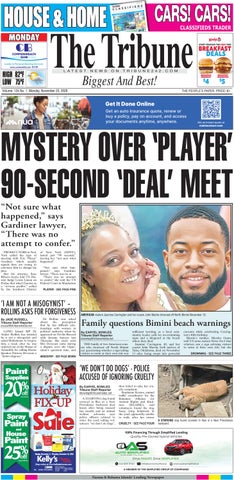
MYSTERY OVER ‘PLAYER’ 90-SECOND ‘DEAL’ MEET “Not sure what happened,” says Gardiner lawyer, “There was no attempt to confer.” PROSECUTORS in New York called the type of meeting with Eric ‘Player’ Gardiner which usually signals they are trying to convince him to change his plea. But his attorney Susy Ribero-Ayala told US District Judge Lewis Liman on Friday that what’s known as a “reverse proffer,” called by the Southern District
of New York (SDNY), lasted just “90 seconds,” leaving her “not sure what happened”. “Not sure what happened,” says Gardiner lawyer, “There was no at “There was no attempt to confer”, she told the US Federal Court in Manhattan PLAYER - SEE PAGE FIVE
‘I AM NOT A MISOGYNIST’ – ROLLINS ASKS FOR FORGIVENESS
AMERICAN visitors Jasmine Carrington and her cousin John Martin drowned off North Bimini November 13.
By JADE RUSSELL Tribune Staff Reporter jrussell@tribunemedia.net
Family questions Bimini beach warnings
LONG Island MP Dr Andre Rollins has insisted he is not a misogynist and asked Bahamians to forgive him, a week after he was ordered out of the House of Assembly for calling House Speaker Patricia Deveaux a "damn disgrace".
Dr Rollins was asked about the perception that he has difficult relationships with women in political authority when he appeared on On the Record with Jerome Sawyer last Thursday. His clash with Mrs Deveaux came during a dispute over the Opposition's question time, and MISOGYNY - SEE PAGE SEVEN
By EARYEL BOWLEG Tribune Staff Reporter ebowleg@tribunemedia.net THE family of two American cousins who drowned off North Bimini are questioning whether a sign telling visitors to swim at their own risk was
sufficient warning, as a local community leader calls for no-swimming signs and a lifeguard at the beach where they died. Jasmine Carrington, 40, and her cousin John Martin, both natives of Tulsa, Oklahoma, died on November 13 after being swept into powerful
currents while celebrating Carrington's 40th birthday. Martin's mother, Marsha Gunn, told US news station News On 6 that relatives saw a sign advising visitors to swim at their own risk, but she DROWNING - SEE PAGE THREE
‘WE DON’T DO DOGS’ - POLICE ACCUSED OF IGNORING CRUELTY By EARYEL BOWLEG Tribune Staff Reporter ebowleg@tribunemedia.net A STARVING dog found covered in flies in a New Providence backyard died hours after being rescued last month, and an animal welfare advocate says police officers refused to enter the yard, telling volunteers "we don't do dogs",
then failed to take her cruelty complaint. Stephanie Kesten, animal traffic coordinator for the Bahamas Alliance for Animal Rights and Kindness (BAARK!), said volunteers found the dog, Sassy, lying helplessly in the yard, apparently unable to walk, after her owner CRUELTY - SEE PAGE FOUR
A STARVING dog found covered in flies in a New Providence backyard.
Nassau & Bahama Islands’ Leading Newspaper
PAGE 2, Monday, November 23, 2026
THE TRIBUNE
98 Customs recruits complete rare drill training programme By KEILE CAMPBELL Tribune Staff Reporter kcampbell@tribunemedia.net NINETY-EIGHT customs recruits have become only the second class in the Bahamas Customs Department's more than 112-year history to undergo drill training, and their comptroller has urged
them to stay polite even when provoked to be rude. Comptroller of Customs Ralph Munroe told the recruits at a drill and deportment inspection ceremony: "For the more than 112 years that we have existed as a government entity, you are only the second cohort of officers
who have had the benefit of drill training." He said the training was meant to instill discipline, build physical fitness and reinforce the standards expected of officers as they begin their careers. "While integrity is at the foundation upon which all customs officers must build
their career," he said, "that precious and necessary virtue can only be safeguarded through discipline." He urged the recruits to carry that discipline into their work by being punctual, continuing their development, respecting colleagues and remaining professional and
courteous with the public, even in difficult situations. The recruits trained for several months under Assistant Superintendent of Police Rico Thompson, assisted by Sergeant Bryson Anderson of the Royal Bahamas Police Force and other training staff. Mr Munroe thanked the police for their help. He said that although Customs was not a military organisation, drill gave officers a chance to show national pride, physical endurance and their ability to follow instructions. He had been watching their progress closely. "From my observation over the last two weeks from my office, which is just above you," he said, "I have been particularly impressed by your response to command and the level of camaraderie demonstrated in your training exercise." Recruits who spoke at the ceremony described the physical toll of the training, which included repeated sprints, marching and drills
carried out in difficult weather. One said the experience had tested both physical and mental endurance, and had helped the recruits understand the responsibilities of becoming customs officers. Another said it had reinforced the importance of teamwork, perseverance and respect, but that its real measure would be how officers conduct themselves beyond the parade ground. Several recruits received certificates for their performance during the training, and presentations were made to the police instructors. Mr Munroe thanked Assistant Comptroller of Customs Larry Bodie and the department's Training Division for preparing the recruits, and said he was confident they would make a meaningful contribution to the department. He encouraged them to keep developing their skills as they enter the profession, assuring them the department would make use of their talents.
CUSTOMS Recruits Drill and Cohort Deportment Parade held on Customs grounds on Friday. Photos: Nikia Charlton
THE TRIBUNE
Family call for better safety warnings after North Bimini drownings DROWNING from page one believes stronger language is needed. “I want people to be warned. I need answers as to why this keeps happening to tourists,” she said. The deaths occured just weeks after a British tourist died after a current swept away her two sons while the family was snorkelling near the southern point of North Bimini. Paul Rolle, president of the Bimini United Organization, identified the beach where the cousins died as The Point. He said the current there is now much stronger than it used to be and can be impossible to swim against, even for a good diver. He blamed past drilling and dredging for disturbing natural conditions, but did not name any company or resort. “We don’t have a lifeguard,” Mr Rolle said. He said he would ask local and central government to put a guard in the area, because many visitors ignore the signs even when told where they can and cannot swim. He also wants signs that say no swimming at all, and someone posted to stop people swimming when cruise ships are in port. The land leading to the beach is privately owned and has a gate with a no-trespassing sign. But Mr
Rolle said visitors can still reach The Point by walking through shallow water around the rocks, because the beach itself is not private and the government has jurisdiction up to the high-water mark. Police said at the time that the group had been swimming beyond an area marked with a warning sign for strong currents. According to the family, the cousins were among five people who travelled to The Bahamas for Carrington’s birthday. For Martin, it was his first major adult vacation. The group had been standing on rocks in shallow water when the tide rose and swept them into deeper water. “The water was like at their ankles, but they were able to walk over there and just chilling and talking on that rock,” Ms Gunn said. “And then the tide rose and started sweeping them off and adding to the waters.” Carrington’s husband, a former Marine and strong swimmer, tried to rescue others despite the current. Martin’s fiancée went underwater to find him and kept him above water while they waited for help. The couple had planned to marry in February. Carrington’s father, James Rowe, said his son-in-law called him from Bimini. “My son-in-law called screaming, ‘I’m sorry. I’m
Monday, November 23, 2026, PAGE 3
SIGN warning of ‘Strong Currents’ at the Bimini Beach where two Americans drowned on November 13.
JOHN MARTIN
JASMINE CARRINGTON sorry,’ and I’m like, what’s going on?” he said. “And I was thinking, you know, something bad happened, but this is beyond bad.” One of the most painful moments, Mr Rowe said, was when his son-in-law came home carrying his daughter’s luggage without her.
“He came back with all of her orange suitcases that, you know, because orange is her colour. That’s her favorite colour,” he said. “Came back with all these orange suitcases, but she wasn’t there.” Carrington leaves behind her husband of 13 years and their three children, aged
12, nine and three. Her parents had been caring for the children in Texas while she was away. In a Facebook post, Ms Gunn described learning of her son’s death as the worst day of her life. “Our family is working on getting his body back stateside. He was also uninsured so we are needing to figure out how to cover funeral costs,” she wrote. Martin’s family is seeking $35,000 through GoFundMe for repatriation, transport, funeral costs and other expenses. More than $4,000 had been raised by press time. “As a mother, there are no words to describe the pain of knowing my son is gone,” Ms Gunn wrote in the appeal. “Alongside that heartbreak, we are also grieving the loss of my niece, another precious life taken far too soon.” A separate appeal for Carrington’s parents, James and Jaketa Rowe, and her surviving family is seeking
$60,000. More than $5,600 had been raised by press time. The cousins are not the first visitors to die in the waters off North Bimini this year. On October 20, Leanne Gregory, 36, of Stapleford, Nottinghamshire, England, died after a current swept away her two sons while the family was snorkelling near the southern point of North Bimini. She went after the boys and was swept away herself. A water taxi crew pulled the family from the sea, and her sons were at the North Bimini Ferry Dock as people tried to revive her. She was pronounced dead at the local clinic. Both boys survived. In May, a 69-year-old American man died after becoming unresponsive while snorkelling on a marine excursion off Bimini. Tourism Minister Glenys Hanna Martin did not respond to requests for comment up to press time.
FIRE VICTIM CLAIMS MAN THREATENED HER DAYS BEFORE APARTMENT BLAZE By KEILE CAMPBELL Tribune Staff Reporter kcampbell@tribunemedia.net A WOMAN who lost everything but the slippers on her feet when fire tore through her Eight Mile Rock apartment complex on Sunday says she saw a man who had threatened her and attacked her with a wrench two nights earlier running from the property just before she found her home full of smoke. The fire destroyed 11 of the 12 units in the single-storey complex on Bayshore Road, The Tribune understands. No injuries were reported, and police said the cause of the fire remains under active
investigation. Victoria Burrows said she had dropped her mother off at church around 9.45am. When she returned, she saw a young man running away, a man she said she had once been very close to. "I had to catch myself like I know who that is, and I ran in the yard before I catch myself: Hold on, my place is smoking," she said. A woman she knew called 911 after Ms Burrows told her what was happening. "I went to open my door to enter the house, my place was black with smoke, and I slipped down as I exited the house," Ms Burrows said between sobs. She said she had already spoken to police about the man over separate matters.
"He told me on text messages to my phone that he's going to do something serious," she said, "and then prior two nights ago he attacked me with a wrench and I went to the police station and they told me they were going to find him and then now this." She said she lost everything, including her passport. According to the Royal Bahamas Police Force, firefighters responded to a report of a structural fire on Bayshore Road shortly before noon, with help from Container Port and Airport Crash and Rescue personnel. Three of the 12 units were occupied at the time. It is unclear how many people lived in the complex.
GB Apartment fire victim Victoria Burrows speaks to the media. Photos: Vandyke Hepburn
TEEN CALLS POLICE AFTER BEING SHOT AT PARKING LOT EVENT A 19-YEAR-OLD man called police himself after a gunman fired several shots at him at an event in a parking lot off Market Street early on Friday, and he remains in hospital in critical condition. He contacted police shortly before 1am to report that he had been shot. Officers who went to the scene were told that two men had
approached him, one in a white hoodie and the other in a black hoodie. According to a preliminary police report, one of the men pulled out a gun and fired several shots in the victim's direction before both ran off. Emergency Medical Services took him to hospital. Police are investigating.
The shooting happened along the same corridor as one of last year's deadliest attacks. Two young men were killed and five others injured in a mass shooting in the Robinson Road and Market Street area. In that attack, gunmen pulled up in a Nissan, got out of the car and opened fire on the victims as they stood next to a car shortly after 2pm on a Saturday.
PAGE 4, Monday, November 23, 2026
THE TRIBUNE
Advocate alleges officers refused to investigate dying dog’s condition CRUELTY from page one called the group to arrange what sounded like a routine spaying. Sassy was taken to the Bahamas Humane Society for emergency treatment on October 27. A veterinarian found her severely ill, and she died during the night despite being given fluids and emergency care. “It had jaundice. It was emaciated. Its heart was in bad shape. So all around, it was not good for her,” Ms Kesten said. A tourist who had joined BAARK! volunteers during her vacation described finding Sassy lying in the sun, severely underweight, covered in flies and barely breathing. In an emotional Facebook post, she said she was left in tears trying to process what she had seen. “I thought I was there to help. I did not know that I was going to be a first hand witness on how animals are
treated here, and how little the law is upheld when it comes to animals being protected from cruelty and neglect,” the tourist wrote. “The bottom line is a dog starved to death. The authorities that were supposed to uphold the laws and protect the innocent did not do their jobs.” Chief Superintendent Achara James, who said he was transferred to the Nassau Street Police Station on October 27, told The Tribune he had no knowledge of the incident and could not confirm the allegations. He invited Ms Kesten to visit the station to make a report. Ms Kesten said the owner contacted BAARK! on October 26 asking for help to have her female dog spayed. She said the request seemed routine, although the woman mentioned a problem with the dog’s leg. “The woman called me and said she wanted to have her female spayed,”
she said. “And I even asked, ‘Well, are you able to pick her up? Is she easy to catch, or do we need a trap?’ And she goes, ‘Oh no, no, she’s in the backyard. There’s something wrong with her leg.’” After volunteers saw the dog’s condition the next day, Ms Kesten said she told them: “This is definitely an animal abuse and neglect case, and we are not picking up this dog unless we have police escort.” She said she contacted the Humane Society and sought guidance from a Department of Agriculture official, who advised the group to get police assistance, remove the dog and secure urgent medical treatment. But Ms Kesten said the officers who went to the property stayed outside talking with the owner and family members while volunteers went into the backyard to retrieve Sassy. The tourist gave the same account.
“They didn’t even come with us on the property,” Ms Kesten said. She said one officer told the group: “I’m not going on the property where I don’t know the dogs.” She said she then went to the Nassau Street Police Station to file a formal complaint. “Why do you want to fill out a police report?” she said one officer asked her. “I said, ‘Because this is against the law. This is a pure case of animal abuse and neglect.’ The officer said, ‘Well, did you ask the
lady why this dog is in this condition?’ And I said, ‘It doesn’t matter. They definitely neglected and abused this animal.’” She said she began giving a statement to another officer, but the process was interrupted and the report was never completed. “They were brushing us off,” she said. “Like it was definitely, this isn’t important. Don’t waste our time.” Ms Kesten acknowledged that she did not know the full circumstances behind Sassy’s decline or why the owner had not sought veterinary care sooner. She said the owner contributed $100 towards the dog’s treatment. She said two other dogs, a pit bull mix and a male pit bull, remain on the property, and that she understood the owners intend to breed them. She questioned whether they were licensed, properly sheltered and fit for breeding.
Ms Kesten also questioned whether the Animal Protection and Control Act was being enforced consistently. She said Animal Control was often quick to respond when someone was bitten or an owner failed to license a dog. “If an animal is abused by a person, nothing happens,” she said. “It’s like one-sided.” The case echoes one Ms Kesten brought last year. In April 2025, The Tribune reported what advocates called the first successful prosecution under the Act, after a motionless dog covered in flies was found chained on a property off Soldier Road and later died. Ms Kesten filed the complaint in that case. Two people pleaded guilty and were each fined $1,500 and banned from owning animals for five years. Police and animal control officers supported that investigation.
Second Grand Bahama primary school forced to close over bats By EARYEL BOWLEG Tribune Staff Reporter ebowleg@tribunemedia.net WALTER Parker Primary School in Grand Bahama will stay closed and its students and staff will be moved to another location while bats are dealt with, weeks after neighbouring Freeport Primary School faced the same problem. The school was closed on Friday so a pest control company could assess the building and begin remediation over the weekend. Bahamas Educators, Counsellors and Allied Workers Union (BECAWU) president Keysha LaRoda said in a statement that the union's Grand Bahama area vice-president had since told her the school would remain closed. Arrangements are being made to move staff and students elsewhere so classes can continue. Parents will be told shortly where to drop off their children, she said. Ms LaRoda said the Ministry of Education had kept the union informed of its plans and that the health and safety of teachers and students remained paramount. "We understand the concerns surrounding the presence of bats in the school environment, and we believe that the necessary steps must be taken to ensure that the environment is safe before everyone returns," she said. Deputy Director of Education Michelle Bowleg confirmed the discovery to ZNS Northern Edition. She said Walter Parker had been inspected after the Freeport Primary infestation and no bats were found then. "After we would have had that problem with Freeport Primary, at that particular time, it was just like two or three weeks ago that school was inspected and we had no bats there. But now we have discovered, yes," she said. An education official on the island told The Tribune that pest control was treating the problem and assessments were ongoing, but she could not give further details. Ms LaRoda said there
had been only two bat sightings. She could not say whether Walter Parker's infestation was as severe as the one at Freeport Primary. Bahamas Union of Teachers (BUT) Grand Bahama area vice-president John Ingraham believes the bats simply moved from one school to the other. "I think when they got rid of the bat situation at Freeport Primary, it kind of fled over to Walter Parker, and I think that's really what happened," he said. He said the Freeport Primary infestation could have been handled better, and raised concerns about pigeons and other possible pests at Walter Parker. He said both schools were among the oldest in Grand Bahama and needed proper renovation. "I think it could have been handled much better because we're not sure how they got over there," he said. "It's time for them to be renovated properly. It's very concerning right now, and it affects the learning environment. Teachers don't feel comfortable and safe." The disruption comes as students near their revision period. "We are cognizant of the fact that we are almost at the time for revision, and so we want our students to really be in school," Ms Bowleg said. Ms LaRoda said any lost day frustrates teachers. "Any teacher that's in a school, any days of loss will be a little frustrating for them because they have a curriculum that needs to be taught, and this isn't something that is planned," she said. Mr Ingraham said the BUT was awaiting a report on the situation. The Tribune had not received an update by press time. Freeport Primary has had building problems before. In November last year, the school was closed and its students relocated after roof damage and mould were found. At the time, District Superintendent Maneica Pratt said heavy rain had exposed deficiencies in many of the island's ageing school buildings.
THE TRIBUNE
Monday, November 23, 2026, PAGE 5
US prosecutors allege police protected drug traffickers PLAYER from page one A “reverse proffer” is usually part of plea negotiations where prosecutors lay out their evidence to a defendant and their lawyer, often to show how strong their case is and to encourage a guilty plea as part of a plea deal. Friday’s hearing was for US District Judge Lewis Liman to hear arguments on various motions filed by Ms Ribero-Ayala, who said she was trying to obtain more details of the case against her client, who is facing fresh cocaine smuggling charges both in New York and Georgia. She told the court that the latest indictment only outlined in “broad brush strokes” how Gardiner was alleged to have taken part in the conspiracy in which 15 people have been indicted. The other defendants had more detailed explanations of what their role was, but Gardiner did not, she said. Among developments in Friday’s hearing, the court heard allegations that: • it was a US “special ops team” that rescued Gardiner in May this year, not the US Coast Guard. She did not elaborate. • the person known as ‘Politician-1’ was “taking cash in order to provide protection.” • officers from the Royal Bahamas Police Force (RBPF) provided “protection” for drug traffickers using their guns. • there was evidence that co-conspirators bragged Gardiner was a “big drug dealer” and “one of our guys.” Ms Ribero-Ayala also referred to “multiple pen registers” – a call logging device used in surveillance by law enforcement agencies - including some with “officials” that is part of the prosecution’s sprawling, high-profile case. She claimed that a phone call to “the Prime Minister of The Bahamas” was one such “pen register” among the evidence. She did not name Philip ‘Brave’ Davis in court, but later confirmed to reporters that she was referring to the incumbent prime minister. There is no suggestion Mr Davis has done anything wrong or is in any way connected to the case. There was no detail given about where the surveillance device was deployed or which country’s network was being used. The wide-ranging case involves alleged drug trafficking from Colombia through the Bahamas and on to the US, with links to a drug trafficking gang in Georgia. It stems from a November 2024 indictment of 15 people including 11 Bahamians who are accused by prosecutors in the Southern District of New York (SDNY) of cocaine trafficking and firearms offences. Among the defendants is Gardiner, 58, aka ‘Player,’ who was arrested on May 12 this year after the plane in which he and ten others were flying crash landed in the sea off the coast of Florida. Gardiner, whose address has been given as ‘Long Island, The Bahamas,’ is accused of conspiring to import cocaine into the US, firearms possession in furtherance of a drug trafficking crime, and conspiring to possess firearms in connection with the alleged drug scheme.
they did. Mr Bodansky said that the reason the money was attempted to be exchanged was due to “competing interests” in the US government. The DEA’s “default” move in cases where money is seized is to try and convert the money so that it can be handed over as forfeiture later in the case if a defendant is found guilty. However, in this case the money could not be converted because it was “wet and mouldy”, the court heard. Judge Liman asked if there was a “reckless misrepresentation” regarding the money, but Mr Bodansky said no. JONATHAN GARDINER
JONATHAN Gardiner’s lawyer, Susy Ribero-Ayala The first matter to be dealt with on Friday was the defence’s request for a “bill of particulars” about the alleged offences, in particular the gun allegations, which dated from between 2016 to 2021. Ms Ribero-Ayala said she had reviewed audio and video recordings handed over by the prosecution and that there was none of Gardiner speaking. There were, however, some of the other defendants mentioning him saying things like: “Oh yea, he’s a big drug dealer” and “OK, I will set up a meeting” with him. Ms Ribero-Ayala said she needed a clearer understanding of what Gardiner was accused of, and how it related to separate, similar charges he is facing in a Georgia court. She also said she wanted more information about where exactly Gardiner was arrested, telling the court he was rescued on Election Day in the Bahamas on a plane with poll workers and people being taken to vote. She told the court that she had “information they were rescued by a Special Ops team” and not the US Coast Guard as the prosecution had claimed. “I would like to know…. if they were rescued in Bahamian waters or international waters or Florida waters,” she said. Judge Liman appeared skeptical and said MsRibero-Ayala was “free associating” but asked Assistant US Attorney Jonathan Bodansky to explain. Mr Bodansky said that the firearms were part of a “lengthy conspiracy” and that they in part related to the guns used by law enforcement officers who were allegedly involved. According to Mr Bodansky, these firearms were used for “providing protection” for drug traffickers.
Judge Liman asked: “Is there evidence with respect to the Bahamian police forces possessing firearms and offering to use them in connection with drug trafficking?” Mr Bodansky said: “Yes, Your Honour”. Judge Liman then turned to Ms Ribero-Ayala’s request to suppress the $30,000 that was found on Gardiner in a cross-shoulder body bag at the time of his arrest. Initially, it was claimed that $30,000 in Bahamian currency was found on Gardiner that, according to prosecutors, was in an envelope marked with the name of a Bahamanian political figure identified only as “Politician-1”. According to Ms Ribero-Ayala, the prosecution’s story about the cash was a “misrepresentation”. In fact, $5,000 was in a white envelope with the name of “Politician-1” on it and there was an “innocent explanation” for the other $30,000 in a brown envelope, making the total amount $35,000. The total amount has previously always been stated by prosecutors as $30,000. The $30,000 had been withdrawn from a bank, Ms Ribero-Ayala said, noting that there are no campaign contribution rules in the Bahamas. She also demanded an explanation as to why the US government had tried to exchange the money into US currency three times. She did, however, drop her request to have the money returned to Gardiner on the basis that the prosecution was now going to use the cash as evidence. According to Ms Ribero-Ayala, Gardiner was not a “target” for US prosecutors but once he was rescued, they were “seeking for something to charge him with”, hence why prosecutors characterised the money the way
To advertise in The Tribune, contact 502-2394
While he admitted there could be a “potential correction” with regards to the specifics of the money, he maintained that it did not “impact the probable cause analysis” given the other available evidence. Judge Liman did not appear convinced that, even if the money were not part of the case, it would change much for Gardiner. He pointed out there was another indicted co-conspirator saying that “Mr Gardiner is one of our guys”, how the person known as “Politician-1” was “taking cash in order to provide protection” and the connections to the drug gang in Georgia. Ms Ribero-Ayala
maintained none of the recordings or video she had seen included statements from her client. Judge Liman reserved his decision on all the motions and did not set a next date for the case to return to court. Also accused is Elvis Nathaniel Curtis, 51, a former chief superintendent with the RBPF, who allegedly facilitated cocaine trafficking through Lynden Pindling International Airport in Nassau. Prince Albert Symonette, 52, a former RBPF sergeant, is also accused but is not in custody. The trial for all defendants is set for March 1 next year.
“Reverse proffer” made by SDNY legal team “lasted just 90 seconds” A “REVERSE proffer” is usually part of plea negotiations where prosecutors lay out their evidence to a defendant and their lawyer, often to show how strong their case is and to encourage a guilty plea as part of a plea deal. But Jonathan ‘Player’ Gardiner’s attorney, Susy Ribero-Ayala, told US District Judge Lewis Liman the “reverse proffer” called by SDNY prosecutors lasted just “90 seconds,” leaving her “not sure what happened”. A “reverse proffer” is the opposite of a “proffer,” which is a meeting where a defendant or witness tells prosecutors and investigators what they know,
usually with their lawyer present, under a written agreement that limits how the statements can later be used. In US law enforcement circles, it’s often called “queen for a day,” and is the mirror image of a reverse proffer, where the government lays out its evidence. It lets prosecutors judge whether someone is credible and useful as a cooperator, often before a plea or cooperation deal is finalised. It can also be used by witnesses or targets who want to explain their role, often giving evidence against others in exchange for a lesser sentence – or a “substantial assistance”
motion to go below a mandatory minimum sentence. It is not known whether the only defendant in Gardiner’s case to so far plead guilty, Darrin Alexander Roker, a former chief petty officer with the RBPF, agreed to cooperate with prosecutors. He had faced 20 years in jail but was given four because he has terminal prostate cancer and he changed his plea to guilty. A second defendant, a Colombian named Lorielmo Steele-Pomare, 59, recently also changed his plea to guilty. He won’t be sentenced until next February - weeks before the trial of Gardiner and his co-accused is due to start.
PAGE 6, Monday, November 23, 2026
THE TRIBUNE
The Tribune Limited NULLIUS ADDICTUS JURARE IN VERBA MAGISTRI “Being Bound to Swear to The Dogmas of No Master”
LEON E. H. DUPUCH,
Publisher/Editor 1903-1914
SIR ETIENNE DUPUCH,
Kt., O.B.E., K.M., K.C.S.G., (Hon.) LL.D., D.Litt . Publisher/Editor 1919-1972 Contributing Editor 1972-1991
RT HON EILEEN DUPUCH CARRON,
C.M.G., M.S., B.A., LL.B. Publisher/Editor 1972-
Published daily Monday to Friday
Shirley & Deveaux Streets, Nassau, Bahamas N3207 TELEPHONES News & General Information Advertising Manager Circulation Department Nassau fax Freeport, Grand Bahama Freeport fax
(242) 502-2350 (242) 502-2394 (242) 502-2386 (242) 328-2398 (242)-352-6608 (242) 352-9348
WEBSITE, TWITTER & FACEBOOK www.tribune242.com
@tribune242
tribune news network
Before you open the door to a caregiver If an agency is sending someone to help your mother bathe, dress and have her breakfast, you ought to know that person’s name before the knock comes at the door. So should your mother. It is her home, after all, and she is the one being asked to trust a stranger with things she may have spent a lifetime doing for herself. One of the best provisions in the proposed Nursing Agencies Regulations, 2026, is also one of the simplest. An agency would have to tell a client in advance the name, qualifications and role of the person it intends to send. The nurse or caregiver would have to carry photo identification bearing the agency’s name. The rules are still out for consultation, but that provision ought to survive into the final version. A uniform tells a family very little. There is a difference between someone hired to help Dad get dressed and someone qualified to assess the wound he came home from hospital with. A good caregiver knows the limits of the job. The trouble comes when nobody has explained those limits to Dad, his daughter or the relative paying the bill. By the time the question comes up, all three may have assumed somebody else had it covered. The Nursing Council should make it easy to settle those questions before a family pays a deposit or hands over a key. A list of licensed agencies, kept up to date and available by telephone as well as online, would be a start. The agency itself should give the client a short written account of what the worker has been hired to do and the number of a supervisor who can answer for the arrangement. If the regular caregiver calls in sick
on Sunday morning, a replacement may be exactly what the family needs. One call from the agency before the substitute arrives would spare an elderly person the choice between letting in somebody they have never heard of and going without help for the day. There is a harder question, too. What happens when the person receiving care has a complaint? The draft would require an agency to notify the Nursing Council within 24 hours of abuse by a staff member and follow up with a written report within 72 hours. That places responsibility where it belongs. But an agency cannot be the only door through which a complaint can travel. A client should have a number to call independently and, if necessary, a chance to speak to someone without the caregiver in the room. Many caregivers do intimate, demanding work with a kindness that families remember for years. Clear duties protect them, too. A caregiver who declines to do something beyond her training should be able to point to the agreed duties and call her supervisor for help. She should never be left at a bedside to negotiate, on her own, what the agency promised over the telephone. When the consultation ends, the Council should put the proposed safeguards to one ordinary test. Suppose the daughter who arranged the care lives in Nassau and her mother lives on another island. Can the mother find out for herself who is coming on Monday, what help she can expect and whom she can call if something goes wrong? Her daughter may have made the booking. Her mother still has the right to decide who comes through her door.
A sea of forgetfulness, but where is taxpayers’ money? EDITOR, The Tribune. GOOD afternoon, I would like to submit the following for consideration for publication. It would appear that we are witnessing a rather interesting new development in Bahamian governance: a religious-political revival in which contractors accused of taking public money without completing the work are being offered something resembling divine forgiveness, courtesy of the Minister of Urban Renewal and Community Relations, Lisa Rahming. While the Opposition is demanding accountability for public funds paid to contractors for work reportedly left incomplete, improperly executed or not done at all, the Minister seems to have taken a different approach. Rather than explaining how the money will be recovered, who will be held responsible and what safeguards will prevent a repeat performance, she appears to have taken to the political pulpit to offer absolution. “FNM demands accountability on Small Home Repairs Program funds” – The Nassau Guardian. According to the newspaper’s report, Minister Rahming acknowledged that some contractors hired under the government’s Small Home Repairs Programme pocketed funds without fulfilling their contractual obligations. Yet, at a press briefing at the Office of the Prime Minister, she revealed that although contractors had been warned they could be blacklisted, not one had actually been blacklisted. Then came the remarkable declaration. Referring to a meeting with contractors in August, Rahming reportedly told them that she would “wipe away all the tears and all the money that went missing.” She went even further. “I forgot it in a sea of forgetfulness.” Well, isn’t that convenient! Apparently, we have moved beyond contract management, financial oversight and public accountability and entered the realm of ministerial absolution. A contractor can allegedly receive public funds, fail to deliver the promised work, and then find himself standing before a minister who is prepared to wash away the past and offer him a fresh start. One wonders whether the Minister has confused the Ministry of Urban Renewal with a church altar. Because, if this is how public administration is supposed to work, perhaps we should dispense with contracts altogether. Why bother with performance guarantees, inspections, audits, financial controls or recovery procedures? Just invite the contractors to a meeting, have a little prayer,
LETTERS letters@tribunemedia.net declare the past forgotten and send everybody home with a clean slate. Apparently, the only thing missing is a collection plate. Deputy FNM Leader Shanendon Cartwright was right to challenge this extraordinary approach, reminding the government that public money is not personal money and cannot simply be forgotten when questions arise about its expenditure. And that is precisely the point. Minister Rahming may be prepared to forgive, but she does not own the money she is forgiving. It belongs to the Bahamian people. The taxpayers who funded this programme did not give the government a blank cheque to distribute public money and then exercise ministerial discretion over which financial transgressions deserve forgiveness and which deserve investigation. More importantly, this is happening at a time when Bahamians are already struggling with the cost of living and facing increased demands on their pockets through taxation and other government charges. Think about the extraordinary contradiction. The ordinary Bahamian is expected to pay VAT, property taxes, business licence fees and every other government obligation on time. Miss a payment, and the machinery of government can be remarkably efficient in finding you, calculating penalties and demanding compliance. But when contractors allegedly receive public money and fail to deliver the work, suddenly we discover the virtues of mercy, compassion and a rather expansive sea of forgetfulness. How wonderfully accommodating! Perhaps the Minister could explain whether the same philosophy applies to the ordinary taxpayer. If a homeowner falls behind on property taxes, can he simply inform the Ministry that he has forgotten the outstanding balance in a sea of forgetfulness? If a business owes VAT, can the proprietor request a fresh start on the basis of a promise to do better next time? I suspect the answer would be considerably less spiritual. And let us be clear: this is not about denying contractors an opportunity to correct mistakes or fulfill their obligations. It is about distinguishing between an honest contractual dispute and the serious allegation that public money was received without the
corresponding work being delivered. There must be consequences where wrongdoing is established. There must be an accounting of every dollar. There must be recovery of funds where appropriate, proper investigations where warranted, and disciplinary or legal action where the evidence justifies it. A warning about possible blacklisting is not accountability. A promise to behave better in the future is not restitution. And a ministerial declaration that yesterday’s financial problems have been forgotten is certainly not an acceptable substitute for public financial management. Perhaps what the Bahamas needs is not another ministerial sermon, but an independent regulatory and oversight framework with the authority to monitor contractors, verify completed work, investigate complaints, recover public funds and prevent repeat offenders from simply moving from one government programme to another. Because contractors entrusted with public money should be answerable for their performance, not dependent upon the generosity of a minister’s memory. And here is the question Minister Rahming ought to answer: Who authorised the payments? Who verified the work? How much money is missing? Has any of it been recovered? And why has nobody been blacklisted? These are not unreasonable political questions. They are elementary questions of public accountability. At the end of the day, the Minister is not being asked to forgive a personal debt or overlook a private disagreement. She is dealing with money belonging to the Bahamian people. So, while Minister Rahming may wish to consign the contractors’ alleged transgressions to her proverbial sea of forgetfulness, I would respectfully suggest that the Bahamian taxpayer has no such luxury. The taxpayer remembers every dollar because he is the one who has to earn it, pay it, and ultimately replace it. Minister Rahming may have found a sea in which to forget the money, but the Bahamian people are still looking for the money itself. And before anyone starts preaching about second chances, perhaps they should first explain what happened to the first payment. After all, forgiveness may be a virtue. But when it comes to public funds, accountability is an obligation. ADRIAN RAMSEY Nassau, November 18, 2026.
Tribute in honour of James H Smith CBE EDITOR, The Tribune. MR James H Smith CBE was a brilliant man. Exceptionally brilliant. Yet, for all his extraordinary intellect, he was one of the humblest men I have known. He was the consummate public servant. Service was part of his inheritance. His sister, Dori Smith Bowleg, whom I met when she worked at the Princess Margaret Hospital Laboratory with my late Father, exemplified that same commitment, reflecting the values instilled by their parents - that one’s gifts were to be used not for personal advancement, but for the benefit of others. James gave generously of himself to his God, family, country and fellow man, without seeking recognition or reward. His life reminds me of the biblical parable of the talents, in which the faithful servant doubled what had been entrusted to him. James likewise multiplied his extraordinary gifts through a lifetime of faithful service. Much of that service was undertaken quietly. Few may know that James was
a trusted adviser to bishops across denominations. In this regard, he belonged in the company of men like the late Mr. Basil Sands, whose wisdom and discretion made them valued counsellors to leaders of the Church. James was also a devoted family man. His beloved late wife, Portia, was a legend in her own right. Her outstanding contribution to education, particularly to the College of The Bahamas, is commemorated in the building that bears her name at the University of The Bahamas. Although she did not live to see COB become UB, her legacy endures. James delighted in his children and grandchildren and was justly proud of their accomplishments. It was sometimes difficult to get him to acknowledge Nicola or Kimani’s accomplishments, but, when he did, his eyes lit up. Behind the formidable public servant was a deeply affectionate father and grandfather. My own memories of James are particularly vivid in the context of his
unwavering commitment to The Bahamas. James understood nation building in the tradition of men such as the late Honorable Jeffrey Thompson, the first Minister of Internal Affairs, and the late Ambassador Reginald Woods, a former Financial Secretary and Ambassador to the United States. These were men who went about the work of building our country quietly, steadily and effectively, with a deep respect for its institutions. James belonged to that tradition. He understood institutions, valued them and knew how to effect meaningful change from within. I sat with James in many meetings with representatives of the International Monetary Fund, the Inter-American Development Bank, international rating agencies and other influential institutions. James never blinked. He listened patiently as distinguished international experts presented their analyses and prescriptions for The Bahamas. Then, quietly, methodically and with
extraordinary intellectual precision, he would dismantle assumptions that simply did not fit our national circumstances. There was no grandstanding, no confrontation, no attempt to embarrass anyone. He drew upon his profound understanding of our economy, history and institutions to demonstrate why a different approach was necessary. And here was the genius of James Smith. By the end of those meetings, individuals who had arrived firmly committed to one position would leave not only understanding his perspective but advocating it themselves. He allowed them the dignity of changing their minds. He did not need to win an argument. He needed to secure the right outcome for his country. I always admired that about him. James’ confidence was quiet, his intellect formidable and his patriotism unquestionable. He never seemed to feel the need to demonstrate how much he knew. He simply served and shared what he knew. When I think of James, I think not so much of the
distinguished offices he held or the honors bestowed upon him, but of the man himself. His wisdom, his humility, his generosity of spirit and his quiet determination to do what was right for The Bahamas. The Bahamas is immeasurably better because of James, service. He was brilliant without arrogance, influential without seeking attention and profoundly patriotic without proclaiming it. I count it a privilege to have known James, to have
worked alongside him and to have witnessed firsthand his extraordinary contribution to our country. I return to the parable of the talents. James took what God entrusted to him and multiplied it many times over. Well done, thou good and faithful servant. May you rest in eternal peace. ALLYSON MAYNARD GIBSON KC Nassau, November 15, 2026.
THE TRIBUNE
Monday, November 23, 2026, PAGE 7
Rollins rejects suggestion he has problems with women in authority MISOGYNY from page one he later apologised for the unparliamentary remark. “Anyone who knows me knows that I am not a misogynist. I am not somebody who has any problems with women or women in leadership,” he said. He also apologised to the public. “Please forgive me if my conduct last week was damaging in your eyes as it relates to how women are treated in our society, and I mean that sincerely,” he said. Dr Rollins pointed to his support for former
Opposition Leader Loretta Butler-Turner, who in December 2016 became the first woman to hold the post, despite their own history of confrontation. “I did not oppose her election to that office. We were unanimous in our vote,” he said. “There is no one who can point to any position I’ve taken in my political career or otherwise that is anti-woman. I am the father of four girls.” He said he wanted to use his time in politics to help build a fairer society for women. “We have a rape culture in our society,” he said. “It
starts with what appears to be permissiveness in relation to the abuse of children in our society, it extends to an unwillingness to address violence against adult women in relationships. “I am the kind of individual that wants to use my political involvement to address those problems, I am definitely not interested in being a part of the problem of women being disrespected or undervalued in our society.” He cited former Prime Minister Hubert Ingraham as a leader whose political career helped empower women, and said he hoped to do the same by helping
women build a strong foundation. Dr Rollins and Mrs Butler-Turner clashed most memorably on June 12, 2013, when she slapped him during a lunch adjournment in the precincts of the House of Assembly, after a heated exchange during debate on the Budget and social services. Mrs Butler-Turner alleged that Dr Rollins had put his arm around her, made lewd remarks and refused to remove his arm after she asked him twice, and that she slapped him in self-defence. Dr Rollins denied making inappropriate remarks. He said he had
LONG ISLAND MP ANDRE ROLLINS told her that her criticism of then Social Services Minister Melanie Griffin was in poor taste and warranted a psychiatric evaluation. It is not the first time
he has been put out of the House. In July 2016, then Speaker Dr Kendal Major suspended Dr Rollins, then the MP for Fort Charlotte, from the House of Assembly.
Mitchell brands Rollins ‘Mad Max’ in defence of Speaker By KEILE CAMPBELL Tribune Staff Reporter kcampbell@tribunemedia.net PROGRESSIVE Liberal Party chairman Fred Mitchell has dismissed opposition attacks on House Speaker Patricia Deveaux’s impartiality as “prejudicial drivel”, and branded Long Island MP Dr Andre Rollins “Mad Max” over his outburst at her in the House of Assembly. St Anne’s MP Adrian White, the leader of opposition business, and Free National Movement chairman Dr Duane Sands questioned Ms Deveaux’s impartiality after the Bamboo Town MP spoke in defence of Jamaica’s House Speaker, Juliet Holness, in an interview with Jamaican media. Mr White suggested the government consider replacing the Speaker. In the interview, Ms Deveaux argued that Mrs Holness’s marriage to Jamaican Prime Minister
Assembly, meaning the leader of opposition business Adrian White and the chairman of the FNM could not resist calling out prejudicial drivel in attacking the Speaker of The Bahamas,” he said. Mr Mitchell rejected the claim that Ms Deveaux was biased, and pointed to Dr Rollins, whom he called “Mad Max”, after the post-apocalyptic action film franchise. He argued that Dr Rollins’s own admission of wrongdoing undermined the opposition’s case. Dr Rollins was ordered out of the House of Assembly on November 11 after calling Ms Deveaux PLP CHAIRMAN FRED MITCHELL Andrew Holness should not call her impartiality into question. She later expressed regret that her comments had been interpreted as interference in Jamaica’s internal affairs. In a voice note on Friday, Mr Mitchell said
Ms Deveaux had already clarified her remarks and moved on, and accused the opposition of prolonging the controversy because they “don’t know when to leave well enough alone”. “But of course, our nemesis in the House of
Start advertising in The Tribune Contact 502-2394
a “damn disgrace” during a dispute over the Opposition’s question time. He later apologised, describing his remarks as inappropriate and unparliamentary. “I sympathise with them, but I have no sympathy for them,” Mr Mitchell said. “Their client undermines their whole case of bias by admitting that he should not have said what he said for the second time in his political history engaging in misogyny.” Dr Rollins has insisted he is not a misogynist. In a television interview last week, he said anyone who knew him knew he had no problem with women or women in leadership, and
asked Bahamians to forgive him if his conduct had been damaging. The row over the Jamaican interview was not the only time Ms Deveaux drew attention that week. A video of her struggling to pronounce the word “signify” during a parliamentary sitting went viral internationally. It was shared by entertainment and news pages including Hollywood Unlocked, which has 4.1 million Instagram followers, and No Chill, which has more than 3.5 million. Hollywood Unlocked’s post alone drew more than 1.2m likes, 36k comments, 78k retweets and 193k saves.
PAGE 8, Monday, November 23, 2026
THE TRIBUNE
UB North honours pioneering educator Dr Keva Bethel By DENISE MAYCOCK Tribune Freeport Reporter dmaycock@tribunemedia.net A BENCH, a commemorative plaque and a small garden now honour the late Dr Keva Bethel, CMG, the first president of the College of The Bahamas, at the University of The Bahamas' North campus in Freeport, seven years after Hurricane Dorian and the COVID19 pandemic stalled the project. The historical marker was dedicated on Friday by the Pi Upsilon Omega Chapter of Alpha Kappa Alpha Sorority, Incorporated, in partnership with the university. It is the chapter's first historical marker in Grand Bahama. The project was first conceived in 2019, and Dr Bethel was inducted into the sorority in 1984. Her children, Dr Nicolette Bethel and Dr Edward Bethel, paid tribute to their mother at the ceremony, describing a woman widely respected for her professional achievements but equally cherished at home. Dr Nicolette Bethel described her mother as a fair, tactful and personable leader who believed in persuasion rather than authority. She also remembered a woman who loved music, dancing, cooking, mystery novels and crossword puzzles. She said her mother raised her children to high standards of behaviour and character, encouraging them to
A BENCH, a commemorative plaque and a small garden now honour the late Dr Keva Bethel, CMG, the first president of the College of The Bahamas, at the University of The Bahamas’ North campus in Freeport. become the best versions of themselves and to use their abilities in service to others. Dr Edward Bethel described his mother's life as one of achievement and service to the nation. He said her emotional intelligence, and her ability to recognise and develop the strengths of others, were central to her leadership. He stressed the importance of documenting the contributions of national pioneers so the foundations they laid are not forgotten. Chapter president Rashema Ingraham compared Dr Bethel's legacy to a tree, saying the educator planted seeds of opportunity and invested in a future she would not live to see. She said the marker was placed on a university campus deliberately, so young people could learn about a woman whose life showed what determination, education and service
could achieve. The bench, she said, was not where Dr Bethel's story ended, but where another student's story could begin. Dr Bethel returned home in 1959 after studying at Girton College, University of Cambridge, and the University of Alberta, and began her career as a teacher. She held leadership posts at Government High School and the College of The Bahamas, becoming principal of the college in 1982. In 1995 she became its first president, and that same year she was made a Companion of the Order of St Michael and St George. She devoted more than four decades to education. Her influence extended beyond education into cultural advocacy, scholarship initiatives and civic and community work. She was married to the Bahamian musician E Clement Bethel. University of The
Bahamas Board of Trustees chairman Allyson Maynard-Gibson, KC, said Dr Bethel had chosen to come home despite opportunities to stay overseas, because she believed education was the foundation of individual and national development. She credited Dr Bethel with helping to lay the groundwork for the university, which was formally established in 2016, five years after her death. Ms Maynard-Gibson said the dedication was particularly timely as UB North continues to recover from Hurricane Dorian, and that the garden offers a space for reflection that connects students and visitors to an important chapter in the nation's educational history. She said Dr Bethel's legacy also lives on in her children, who have continued the family's commitment to education. UB North vice-president Denise Barnes said the university was proud to partner in the chapter's first historical marker in Grand Bahama. "This is special to UB as it honors the first Bahamian President of the College of the Bahamas, Dr Keva Bethel," she said. Dr Bethel was also honoured at the university's main campus in New Providence, where its main administrative building was named after her in 2012. University president Dr Robert Blaine also attended. The Venerable
Ralph Hepburn, Rector of the Church of the
Ascension, performed the dedication.
$2.6M PINEWOOD DRAINAGE PROJECT TO BEGIN TODAY By JADE RUSSELL Tribune Staff Reporter jrussell@tribunemedia.net WORK on Pinewood's $2.6m pilot drainage system is due to begin today with two lift stations, days after floodwaters trapped residents in their homes and submerged their cars. Many residents spent days hauling water-damaged furniture and belongings out of their homes after last week's heavy rain, and the latest flooding has left the community at the end of its patience. Several residents told The Tribune they wanted a lasting solution from the government, not more promises. Pinewood MP Myles Laroda told reporters on Friday that work on the project would initially involve two lift stations. He acknowledged that his constituency had flooded badly, but pushed back against the perception that Pinewood was the only community severely affected, saying several other parts of New Providence had faced similar conditions. The Ministry of Works sent pump trucks to help drain flooded areas across the island last week. Mr Laroda also pointed to an $80m loan from the Inter-American Development Bank (IDB) for climate resilience and flood mitigation, which the bank approved last December. Parliament is expected to debate a resolution to borrow the money in the coming weeks, with $17m earmarked for flood remediation in Pinewood. The pilot project's scope has shifted since the government announced it in July. It
was first described as four lift stations: at Sapodilla Street; Bay Geranium Avenue; Pigeon Plum Street, between Saffron and Croton streets; and Jones Heights, off East Street South. A week later, during a visit to the community, Works Minister Clay Sweeting spoke of three stations, at Sapodilla Boulevard, Pigeon Plum Street and Jones Heights. It remains unclear whether the plan was revised or whether Bay Geranium Avenue is still included. When the project was announced in July, Mr Sweeting said the equipment was being manufactured and was expected to arrive within three to four weeks. The work was expected to take about 12 months once construction began. The lift stations are designed to switch on automatically when water in designated catchment areas reaches a set level, pumping the excess into specially built deep disposal wells when heavy rain overwhelms the area's natural drainage. Mr Sweeting compared them to the bilge pumps on a boat. Officials have said the system should reduce standing water and improve drainage without relying solely on traditional gravity drainage or on trucks to remove floodwater. Pinewood has flooded for decades, and during Tropical Storm Imelda some residents were trapped for days or had to be rescued. Mr Sweeting said in July that the pilot could shape how the government tackles flooding elsewhere in New Providence, and a similar system has been proposed for Coral Harbour.
TRUMP ALLY REPORTEDLY HELPS FREE JONQUEL’S SISTER FROM ICE By EARYEL BOWLEG Tribune Staff Reporter ebowleg@tribunemedia.net THE sister of Bahamian WNBA star Jonquel Jones was detained by US Immigration and Customs Enforcement (ICE) agents in Phoenix, Arizona, last week, and a longtime confidant of President Donald Trump reportedly helped secure her release, according to a US sports publication. NetsDaily reported that the sister, who is also a Bahamian citizen, believed she had the proper papers when she was detained. The reason she was taken into custody and her immigration status at the time have not been established, and there has been no indication that she broke any US law. According to the publication, New York Liberty general manager Jonathan Kolb called the team's owner, Joe Tsai, for help after she was detained. Mr Tsai reportedly contacted Jason Miller, a former chief spokesman for Mr Trump's 2016 presidential campaign, who is said to have intervened. Ms Jones's sister was eventually able to attend a ceremony at George Washington University on Tuesday, November 17, NetsDaily reported. Bahamas Ambassador to the United States Wendall Jones said the family did not ask the Bahamian Embassy or consular office for help, and that he learned of the detention only through media reports. He repeated the embassy's general advice to Bahamians travelling to or living in the United States: respect its immigration laws and do not overstay. "What we say to the Bahamians is what we
have been saying all along, that they should obey the laws of the United States of America. They should not overstay their time," he said. "If for any reason they feel that they need to stay in the United States longer than they should, they should contact US authorities and give an explanation. You cannot go to any country and disobey the laws. "The same way Americans should not come to The Bahamas and disobey our laws, our immigration laws. At the same token, we should not be in the United States disobeying the laws of the United States. Just comply, and if you comply, everything would be fine." He said Bahamians who break immigration laws make the work of the country's diplomats harder. "You make life difficult for people who are operating in the United States, for the public servants, the diplomatic corps of The Bahamas working in the United States when you do not comply with the law," he said. "People run into difficulty, and they call the consular officers, looking for these consular officers to come to their rescue. We cannot assist you when you break the law. You break the law, then you suffer the consequences." In March last year, as the Trump administration stepped up enforcement, Mr Jones said no Bahamians had been reported detained by ICE, and the embassy urged anyone with a loved one in ICE custody to contact its consular annex immediately for assistance. An ICE report showed 426 Bahamian citizens were under final orders of removal as of November 2024.
THE TRIBUNE
Monday, November 23, 2026, PAGE 9
Proverbs 31
1
The words of king Lemuel, the prophecy that his mother taught him.
2
What, my son? and what, the son of my womb? and what, the son of my vows?
3
Give not thy strength unto women, nor thy ways to that which destroyeth kings.
4
It is not for kings, O Lemuel, it is not for kings to drink wine; nor for princes strong drink:
5
Lest they drink, and forget the law, and pervert the judgment of any of the afflicted.
her hands she planteth a vineyard.
17
She girdeth her loins with strength, and strengtheneth her arms.
18
She perceiveth that her merchandise is good: her candle goeth not out by night.
19
She layeth her hands to the spindle, and her hands hold the distaff.
20
She stretcheth out her hand to the poor; yea, she reacheth forth her hands to the needy.
6
21
7
22
8
23
9
24
10
25
11
26
Give strong drink unto him that is ready to perish, and wine unto those that be of heavy hearts. Let him drink, and forget his poverty, and remember his misery no more.
Open thy mouth for the dumb in the cause of all such as are appointed to destruction. Open thy mouth, judge righteously, and plead the cause of the poor and needy. Who can find a virtuous woman? for her price is far above rubies.
The heart of her husband doth safely trust in her, so that he shall have no need of spoil.
12 life.
She will do him good and not evil all the days of her
13
She seeketh wool, and flax, and worketh willingly with her hands.
She is not afraid of the snow for her household: for all her household are clothed with scarlet. She maketh herself coverings of tapestry; her clothing is silk and purple. Her husband is known in the gates, when he sitteth among the elders of the land. She maketh fine linen, and selleth it; and delivereth girdles unto the merchant. Strength and honour are her clothing; and she shall rejoice in time to come. She openeth her mouth with wisdom; and in her tongue is the law of kindness.
27
She looketh well to the ways of her household, and eateth not the bread of idleness.
28
Her children arise up, and call her blessed; her husband also, and he praiseth her.
14
29
15
30
16
31
She is like the merchants’ ships; she bringeth her food from afar. She riseth also while it is yet night, and giveth meat to her household, and a portion to her maidens. She considereth a field, and buyeth it: with the fruit of
Many daughters have done virtuously, but thou excellest them all.
Favour is deceitful, and beauty is vain: but a woman that feareth the Lord, she shall be praised. Give her of the fruit of her hands; and let her own works praise her in the gates.
THE BIBLE IS OPENED AND WHATEVER SCRIPTURE IT OPENS TO THAT IS THE SCRIPTURE THAT GOES FORTH IT IS OF GREAT GREAT PLEASURE AND AN HONOUR TO BE CHOSEN BY THE LORD TO BE HIS SERVANT.
The Lord’s Servant
Monday, noveMber 23, 2026
THE STORIES BEHIND THE NEWS
The KDK Report
An ordinary Monday MANY patients ask me what I love most about being a foot and ankle surgeon and I always respond that I never quite know what will walk through my door or where the conversation will lead. This week, I thought I would take you through an ordinary day in my practice with all the interruptions, encounters and small satisfactions that make that answer worth explaining. An ordinary Monday for me begins at half past four. I initially remain still, wishing I had a few more moments of rest, but reluctantly get up, move fast before I change my mind, get ready and head to the gym. Today is cardio day so I say multiple prayers to carry me through. Exhausted but glad I forced myself to work out, I return home, make a smoothie and get ready for work. Here is where I confess: making a smoothie is the top end of my kitchen skills. I have yet to turn on the stove in my house though I have lived there for a few years now and can only assume it works fine. I have no hesitation performing the most intricate surgical procedure, separating foot muscles and ligaments, for instance, from a neighboring blood vessel or nerve but hand me an onion and a knife and all I can do is stare. Before heading into my office, I stop at the pharmacy in the plaza where I practice and purchase a copy of The Tribune newspaper. Reading it will occupy the small intervals the day permits and should those intervals prove generous, The New York Times waits on my phone. Gina, my office manager, is scheduling a new patient when I arrive. Kara, my medical assistant, is preparing the main treatment room. They glance up, say good morning and return to their respective tasks. I log into the medical system and unfold the newspaper just as the doorbell rings. My first patient has gout. He hobbles into the office and my heart goes out to him. His left big toe is swollen and incredibly tender and he describes his pain as utterly intolerable as he winces at the thought of me examining the area. I prescribe a medication, discuss foods to avoid and refer him for bloodwork then return to my desk to
document the visit. I empathise with him and the pain he is enduring and make a note to check up on him later in the week. Partway through, Gina tells me a pharmaceutical med-rep has called to request a meeting. Before we settle on a time, Kara announces that the next patient is ready. I finish the sentence I’m typing and leave the note open. This patient has heel pain and says that her first steps out of bed are so painful that they force her to walk like her late grandmother. We discuss her symptoms, I examine her foot, take X-rays, watch her walk, then look at her footwear. Her number one request is to get through the working day comfortably. I go over her treatment plan and explain how it should help relieve her pain. Back at the computer, I finish the gout note before beginning hers. The phone rings again. A patient wants to know whether Brooks sneakers are better than Nike for her foot type. I ask Gina to take a message. Another caller hopes I can make a house visit to see her 90-year-old father. I
give Gina the information she needs to respond, then turn back to the heel-pain note. Soon enough, Kara is at the door. The ankle injury is ready. This patient is visiting from a family island. She was cleaning her home when she fell and twisted her ankle. We review the X-rays together. She has a non-displaced fracture that will heal with rest and a CAM walker boot for ambulation but the conversation quickly turns towards work, transport and the disruption of getting through the week. She is a single mother and her treatment plan must fit into a life that was already complicated before her bone broke. I complete the heel-pain note and begin documenting the fracture. Halfway through, Gina calls about a light that will not come on at our Palmdale office. I add it to my list, alongside the air-conditioning service that needs scheduling. Then Kara calls. The next patient has completed his form and is ready. Out front, a late arrival overlaps with someone whose appointment is
tomorrow. The walk-in hopes to be accommodated so Gina revises the schedule while Kara gets them seated. The flow remains smooth and together, they bring order to the controlled chaos of an ordinary morning. My next patient has diabetes and a wound on his foot that he can barely feel. His blood sugar is often over 300, although he tells me that he only eats salad and drinks plenty of water. We discuss how Diabetes effects the feet before I treat his wound and document his visit. Then I reach for the newspaper. I find the paragraph where I left off just as Gina brings another message. A patient wants to know whether a ‘light cocktail’ this evening at dinner would be permissible with her medication. I set it aside for a return call. A little later, a patient who is overweight arrives with swollen ankles. She, too, tells me that she only eats salad and she can’t exercise even if she wanted because her painful feet would make it difficult. Her job requires her to stand all day and she can’t afford to take time off because
financially things are tough. Between visits, I arrange the Palmdale service, check which medical supplies need reordering and call in a prescription refill for my aunt. I also call my sister to ask whether my niece’s cold has improved. Then Kara comes for me again, and the unfinished supply order waits. This patient has bunions and hammertoes and is considering surgical intervention. Her shoes are narrow, with little cushioning or arch support. I place one beside her bare foot. She smiles as we consider the discrepancy, and we discuss how a more accommodating shoe might help. Back at my desk, I complete the preceding note before starting hers, finish the supply order and return the sneaker call. A headline on my phone briefly draws me into The New York Times but I only get as far as the opening paragraph. The afternoon brings nurses, teachers, hairdressers, housekeepers, construction workers, croupiers and law enforcement officers. Their aching feet tell something of what it takes to keep Nassau functioning. Several more patients follow, seeking treatment for corns, fungus, fractures and ankle sprains. As I work, our conversations move through their lives, local and international politics, and television shows we recommend with varying degrees of enthusiasm. Among the afternoon’s familiar faces is a patient returning for follow-up, pleased to report that her pain has nearly resolved. Our conversation picks up where it last left off as she mentions how her recent family trip went and meeting her daughter’s boyfriend for the first time. I dispense a pair of orthotics and we discuss the final steps in her recovery. These visits bring a particularly deep sense of satisfaction. My last patient is a little girl with an ingrown toenail. She screams before I touch her, certain that a needle is imminent. I pause and show her my empty hands. After a day spent trying to catch up, I must now proceed at the pace of a frightened child. And
once again, I am reminded that the role of a physician is not confined to medicine. Sometimes, the most important moment comes in the calming of fears or the confidence you instill in a patient who needs a reason to hope. When the visits are over, I finish the remaining notes and return the calls requiring my attention, including the question about the cocktail. I then write a letter requesting that a patient be allowed to wear orthopedic shoes at work during her recovery, followed by a treatment summary for another patient whose insurer is refusing to cover her bill despite having granted preapproval. I finish reading the newspaper, lock up far later than intended, say goodnight to security and stop for fruit for tomorrow’s smoothie. In the grocery aisle, a patient heading home from work spots me. She quickly tries to conceal both her feet and her trolley. Without saying anything we both laugh. After a stop for gas, I get home, shower, update my accounts and return emails. I watch some news and a recap of the weekend’s Formula One race. Outside, I hear the rain begin again. So much of life passes this way, through hours crowded with responsibilities that we rarely pause to consider. We work, find something to laugh about and arrive home tired. But in the quiet of the night, we realize how much those familiar routines mean to us. I end the day grateful for the people who gave it meaning, and hopeful that another ordinary tomorrow will offer me the distinct privilege of doing it all again. This is The KDK Report • Nicknamed ‘The Prince of Podiatry’, Dr Kenneth D Kemp is the founder and medical director of Bahamas Foot and Ankle located in Caves Village, Western New Providence. He served as the deputy chairman for the Health Council for five years and he currently sits on the board of directors for the Princess Margaret Hospital Foundation in his role as co-vice-chairman.
THE TRIBUNE
Monday, November 23, 2026, PAGE 11
Donnette Russell-Love, Esq. • Beyond The Borders
A Christmas Carol for Visa holders:
Don't let a revocation steal your holiday trip By Donnette Russell-Love, JD, CAMS | CEO, Global Risk Compliance Group | Cross-Border Compliance Advisor IT is the Saturday before Christmas at Lynden Pindling International Airport. Your children have their shopping lists for Florida, and your family is at the airline counter to check in. Then the agent looks up from the screen and tells you that you cannot board. Your US visa has been revoked. You never even reach the preclearance hall. For a growing number of Caribbean travellers, the holiday trip ends at check-in, before it ever begins. Like Ebenezer Scrooge, you are about to be visited by three ghosts. Unlike Scrooge, you can meet them now, in November, while there is still time to act. Why this season is different The US Department of State announced on October 20, 2026, that it had revoked more than 300,000 visas since January 2025, up from roughly 175,000 in August. The department now applies continuous vetting to the approximately 55 million people who hold valid US visas, so your file can be reopened at any time. The visa you used last summer is not guaranteed to work this December. The ghost of visas past: What triggers a prudential revocation Under INA § 221(i) and 22 C.F.R. § 41.122, a visa may be revoked at any time, at the government's discretion. A "prudential" revocation is precautionary: the department acts on
information suggesting you might be ineligible, without any finding that you actually are. The most common trigger is an arrest for driving under the influence or a similar offence within the past five years. Under the Foreign Affairs Manual, a DUI arrest typically leads to revocation even if the charge was later reduced or dismissed, because the department treats it as a possible health-related ground of inadmissibility. Other triggers include arrests for other offences, a prior overstay, suspected misrepresentation on an earlier application and new information from law enforcement databases. Here is the hard part: the department is not required to tell you in advance that your visa is being revoked, and it is not required to tell you specifically why. How travellers are finding out now
US authorities receive passenger information from airlines before departure and can advise a carrier not to board a traveller whose visa is no longer valid. Airlines, which face fines for carrying passengers who cannot be admitted, follow that advice strictly. As a result, many travellers from The Bahamas now learn of a revocation from an airline agent at check-in, not from an officer in the preclearance hall. The agent can tell you that you cannot fly. The agent cannot tell you why. Afterwards, many receive an email from the US Embassy stating that the office has received derogatory information, that this information is the basis for the revocation and that they should bring in their passport. At that appointment, the visa is physically cancelled with a stamp. In my practice, clients report that the email never identifies what the derogatory information is and that
they are given no opportunity to respond or correct the record. Do not argue at the airline counter or at the embassy. Be courteous, be truthful and keep every document and email you receive. What you say may become part of your record and may be reviewed when you reapply. The ghost of Christmas present: Can this trip be saved? Honestly, often not in time for this season. There is no appeal of a prudential revocation, no process to reinstate the old visa and no formal way to challenge the revocation itself. The only path back is a new application: a fresh DS-160, a new fee and a new interview at the US Embassy. Because "derogatory information" tells you almost nothing, the real work is identifying what triggered the revocation before you reapply. Start
with your own records: final court dispositions relating to any arrest, regardless of location; an FBI Identity History Summary if you have ever been fingerprinted in the United States; and your I-94 travel history, available online from CBP. An attorney can also send a written enquiry to the State Department's LegalNet service, which sometimes clarifies the basis. If a DUI is involved, expect a panel physician referral before your case moves forward, which adds weeks. Expedited appointments are reserved for urgent matters, and a shopping trip generally is not one. Now, about 214(b) purgatory. A revocation is not a refusal under INA § 214(b), but a new application reopens everything. The officer will weigh the issue behind the revocation, as well as whether your ties to home overcome the presumption of immigrant intent. Walk in unprepared, and a revocation can become a 214(b) refusal that colours every future application. Walk in prepared, with records in hand and a truthful account, and many applicants leave with a new visa. The ghost of visas yet to come: Your preholiday checklist Before you book a single ticket: 1. Audit your history since your visa was issued. Any arrest or charge, even one that was dismissed, and any overstay or status problem are worth discussing with counsel before you travel. 2. Read every message from the US Embassy carefully, including anything in spam or junk folders. An
email citing derogatory information and asking you to bring in your passport means your visa has been revoked. 3. Gather your records now. Final court dispositions, a current police certificate and your I-94 history take time to obtain and are essential if you must reapply. 4. Buy refundable fares if there is any doubt about your visa status. 5. Plan for each family member separately. One parent's revocation does not cancel a spouse's or child's visa, but it can upend the whole family's plans. 6. Tell the truth on every new application. Concealing an arrest to save a trip can trigger a permanent bar for misrepresentation under INA § 212(a)(6)(C)(i), a far worse outcome than any revocation. A second chance Scrooge's story ends well because he acted before Christmas morning, not after. The same is true here. A revoked visa is serious, but it is rarely the end of the road for a well-prepared applicant. Check now, plan early and keep your holiday cheer where it belongs: with your family. Disclaimer: This article is provided for general informational purposes only and does not constitute legal advice. Reading it does not create an attorney-client relationship. Immigration law and agency policy change frequently, and outcomes depend on individual facts. Consult a qualified immigration attorney about your specific circumstances.
PAGE 12, Monday, November 23, 2026
THE TRIBUNE
GBCC Business Excellence Awards luncheon set for Pelican Bay Hotel THE Grand Bahama Chamber of Commerce will recognise outstanding business leadership, entrepreneurship and community service at its 2026 Business Excellence Awards luncheon tomorrow (Tuesday) at Pelican Bay Hotel. The annual awards will shine a spotlight on the businesses and individuals whose leadership, innovation and commitment
continue to contribute to the economy and quality of life on Grand Bahama. “This year’s ceremony carries added significance as the Chamber celebrates its 60th anniversary, marking six decades of supporting commerce, advocating for the business community and recognising the people and organisations helping to shape the island’s future,” Chamber Executive
Director and Office Manager Katushka McIntosh told Around da Islands. According to Ms McIntosh, “The awards provide an opportunity to acknowledge the achievements of local businesses and the individuals behind them.” The event will bring together nominees, sponsors and members of the business community to celebrate their contributions in
several categories. The Outstanding Businessperson of the Year category features a strong field of nominees representing several sectors of the Grand Bahama economy. They are Dana Munnings-Gray of the Insurance Commission of The Bahamas; Dennis Deveaux of Doctors Hospital Health System; Dr. Sophia Johnson of Physio Works; d’Von
Michael Archer of Dolly Madison Home Center; Emrinique Seymour of E Social Marketing; Kiara Jones of Keys Bahamas Realty; Monique Coakley of Hutchison Ports Bahamas (Freeport Container Port); and Wolansa Fountain of Pepper Pot/Arturo's Investment Ltd. Nominees for Developing Entrepreneur of the Year are Akeem Hepburn of Krank Fitness/The Wellness Center; Alexandra Pelanne of Element Modern Movement (Pilates); Erakesha Hield of Lift-Chabar; George Armbrister of Garnet Fresh Seafood; and Kenneth Moncur of Kemis Digital.
The Company of the Year – Large Business category, recognising companies with more than 50 employees, includes Bahamian Brewery and Beverage Company Ltd., Doctors Hospital Health System, Grand Bahama Power Company, Freeport Ship Services Limited and Commonwealth Bank Limited. Competing for Company of the Year – Small Business, which recognises businesses employing between one and 50 people, are Essentials Convenience Store, Bootleg Chocolates, Lift-Chabar, H.G. Christie Ltd., Dolly Madison Home Center and Mini Donut King.
COURT NEWS
Manager and 4 cashiers charged with stealing by reason of employment !"#$%&'(#!%)('* +,-./01#2345#6178,31, !"#$%&'()*$"+,&-&.$#/,&) FOUR cashiers and a shift manager at Wendy's Golden Gates were charged on Friday over thefts from the restaurant between February and October, with the individual sums allegedly taken ranging from about $2,600 to more than $50,000. The largest amount, $50,638.67, is alleged to have been stolen by 19-year-old Bradley Odalus, who prosecutors say falsified the accounts between February 1 and September 24. Keitrell Minnis, also 19, is accused of falsifying the accounts and stealing $40,680.65 between February 4 and July 2. Daniesha Allen, 28, is alleged to have taken $20,741.14 the same way between February 16 and October 10. The smallest sum, $2,644.99, was allegedly taken by 18-year-old Santos Clarke over three weeks, between September 6 and 27. Clarke and Odalus were also charged with shift manager Marcus Forbes, 22, on
four joint counts of abetment to commit the offence of stealing. Prosecutors say the three aided and abetted the theft of $53,283.66 belonging to Aetos & Argos Holdings between February 1 and September 27. Odalus and Allen each faced three counts of stealing by reason of employment, three of falsification of accounts and three of money laundering (acquisition). Minnis faced two counts of each of those offences, and Clarke faced additional charges of stealing by reason of employment, falsification of accounts and money laundering (acquisition). All five pleaded not guilty before acting Chief Magistrate Ancella Evans, and Inspector Deon Barr prosecuted. Bail was set at $8,000 with one or two sureties each. The accused must surrender their travel documents and sign in at their local police stations every Monday and Thursday by 7pm. They are due back in court before Senior Magistrate Kendra Kelly Burrows on December 7.
29-year-old male accused of attempted rape remanded !"#$%&'(#!%)('* +,-./01#2345#6178,31, !"#$%&'()*$"+,&-&.$#/,&) A WOMAN who broke free from a man she knew and barricaded herself inside her home could not keep him out, prosecutors allege, and he tried to rape her before fleeing when another person came into the house. Vinterio Thompson, 29, was accused on Friday of attempted rape over the November 15 incident at the 26-year-old woman's Palm Tree Avenue home. The incident allegedly began around 4pm, when Thompson approached the woman outside her home
and physically assaulted her. Officers from the Grove Police Station later arrested him. Thompson was not required to enter a plea before acting Chief Magistrate Ancella Evans because his case is going directly to the Supreme Court by a voluntary bill of indictment (VBI), which skips a preliminary inquiry. He was told he could apply for bail in the higher court. He was remanded to the Bahamas Department of Correctional Services until his VBI is served on March 18, 2027. Inspector Deon Barr prosecuted.
$5,000 bail for man who pleads not guilty to causing damage !"#$%&'(#!%)('* +,-./01#2345#6178,31, !"#$%&'()*$"+,&-&.$#/,&) THE glass around the cashier cage at a Rubis service station took $850.47 worth of damage during a violent outburst last week, prosecutors allege, and the 48-year-old man accused of causing it was granted bail yesterday. Paul Hepburn pleaded not guilty to causing damage when he appeared
before Magistrate Abigail Farrington. The damage is alleged to have been done around 6pm on November 17 at the station on Baillou Road and Brougham Street. Reserve Assistant Superintendent of Police Deveaux prosecuted. Hepburn was released on $5,000 bail with one or two sureties and must sign in at the Grove Police Station every Tuesday by 7pm ahead of his trial on April 22, 2027.
PAGE 16, Monday, November 23, 2026
THE TRIBUNE