CARS! CARS!
WOMAN & HEALTH TUESDAY
HIGH 86ºF LOW 76ºF
The Tribune L AT E S T
N E W S
CLASSIFIEDS TRADER
O N
T R I B U N E 2 4 2 . C O M
Biggest And Best!
Volume: 123 No. 226, Tuesday, October 20, 2026
THE PEOPLE’S PAPER: PRICE–$1
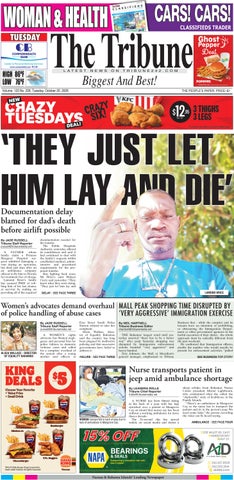
‘THEY JUST LET HIM LAY AND DIE’ Documentation delay blamed for dad’s death before airlift possible By JADE RUSSELL Tribune Staff Reporter jrussell@tribunemedia.net A FATHER whose family claim a Princess Margaret Hospital surgeon admitted damaging a vein during an operation, has died, just days after an air ambulance company offered to fly him to Florida for treatment free of charge. Lamond Brice’s family has accused PMH of robbing him of his last chance at survival by stalling on providing all of the required
documentation needed for his transfer. The Public Hospitals Authority yesterday offered its condolences and said it had continued to deal with the family’s requests within established medical, administrative and procedural requirements for the proposed transfer. But, fighting back tears, Mr Brice’s aunt Malaya Curry said yesterday: “They knew what they were doing. “They just let him lay and LAMOND BRICE
DELAY - SEE PAGE THREE
Women’s advocates demand overhaul MALL PEAK SHOPPING TIME DISRUPTED BY of police handling of abuse cases ‘VERY AGGRESSIVE’ IMMIGRATION EXERCISE By JADE RUSSELL Tribune Staff Reporter jrussell@tribunemedia.net
ALICIA WALLACE - DIRECTOR OF EQUALITY BAHAMAS
A WOMEN’S rights advocate has blamed negligence and personal bias for police failures in domestic violence cases and called for a complete overhaul of the system after a young mother said officers at
East Street South Police Station refused to take her complaint. Alicia Wallace, director of Equality Bahamas, said the country has long been plagued by ineffective policing and that successive governments have failed to address it. FAILURE - SEE PAGE THREE
By NEIL HARTNELL Tribune Business Editor nhartnell@tribunemedia.net THE Bahamas’ largest retail mall yesterday asserted “there has to be a better way” after peak Saturday shopping was disrupted by Immigration enforcement actions branded “very aggressive” and heavy-handed. Troy Johnson, the Mall at Marathon’s general manager, emphasised to Tribune
Business that - while the complex and its tenants have no intention of prohibiting, or obstructing, the Immigration Department or other government agencies in the lawful execution of their duties - the whole approach must be radically different from the past weekend. He confirmed that Immigration officers, double the number who would usually be present for enforcement activities, “pulled SEE BUSINESS FOR STORY
Nurse transports patient in jeep amid ambulance shortage By LEANDRA ROLLE Tribune Chief Reporter lrolle@tribunemedia.net
WOMAN transported in back of jeep due to lack of ambulance in Mangrove Cay.
A NURSE has been filmed sitting in the back of a jeep with her legs stretched over a patient in Mangrove Cay, an island that nurses say has been without a working ambulance for more than a decade. The 24-second clip has spread widely on social media and drawn a
Nassau & Bahama Islands’ Leading Newspaper
sharp rebuke from Bahamas Nurses Union president Muriel Lightbourn, who condemned what she called the “deplorable” state of healthcare in the Family Islands. “There’s no ambulance in Mangrove Cay so the nurse has to transport the patient and sit in the person’s jeep. We need some help,” the person recording the video can be heard saying. AMBULANCE - SEE PAGE FOUR
Tribune honours Mrs P for 57 years of service PAGE 2, Tuesday, October 20, 2026
THE TRIBUNE
THE Tribune family extends “So, ‘Poits’ congratulations on its deepest gratitude and con- such a tremendous achievement. I gratulations to Eloise Poitier, salute you on behalf of all the staff executive assistant to former Pub- on your dedicated service to the lisher, the Rt Hon Eileen Carron, people's paper.” and her successor, son Robert Reflecting on her decades-long Dupuch-Carron, on her 57th work tenure, Mrs Poitier said she was anniversary with grateful to Mrs the company. Carron, Mr Mr Carron, Dupuch-Carron Mr Dupuch-Carron said: also Tribune and The Tribune “She’s been an president and family for their integral part of the founder of trust and continTribune family and will Bahamas Aviued support. ation, Climate “It’s been continue to be. Her and Severe a pleasure to presence, her discipline, Weather have worked her work ethic, and Network at The Tribune ability to take complex (BACSWN), all these years, problems and create hailed the milewatching the win-win solutions. She stone yesterday company grow is invaluable.” and thanked into a major Mrs Poiter, media company affectionately people can trust known as ‘Mrs P’, for her dedica- and listen to. To have been part tion, discipline and strong work of that means so much to me,” ethic. she said. “I’m especially grateful Mrs Poitier became Mrs Car- to Mrs Carron and her family for ron’s executive assistant when the opportunities afforded to me. she officially assumed the role of I look forward to what the future editor in 1962 and continues to holds.” serve in that capacity, a milestone Tribune Editor-in-Chief David Mr Dupuch-Carron described as Leigh said: “Mrs P is an institution remarkable. at The Tribune. She’s an amazing
ELOISE Poitier with former Publisher, the Rt Hon Eileen Carron.
MRS POITIER (second from right standing) with The Rt Hon Eileen Carron, Robert Dupuch-Carron and (back from left) Lyrone Burrows, President and CEO of Bahamas First Alert Project Manager Limited (BFAPM), Rhett Storr, Tribune Chief Financial Officer and Paul Major, VP Governmental Affairs, BACSWN. lady who keeps the place ticking, making sure everyone stays on their toes and everything is always
running smoothly. We’re incredibly fortunate to have her as part of our newsroom family.”
ELOISE Poitier with Editor-in-Chief David Leigh.
Young voices take their seats in Parliament
YOUNG Bahamians took their seats in the House of Assembly on Friday for the 2026 Youth in Parliament sitting, gaining firsthand experience of parliamentary proceedings and an opportunity to make their voices heard on national issues. The event, organised by the Ministry of Youth and Sports as part of National Youth Month, seeks to encourage civic engagement and develop the country’s next generation of leaders. Photos: Nikia Charlton
THE TRIBUNE
Tuesday, October 20, 2026, PAGE 3
Family blames PMH delays for lost chance at treatment DELAY from page one die for a month.” Instead of celebrating the possibility of his transfer, the family is now mourning his death on Friday, aged just 42. Ms Curry said she expected to arrange his move to Florida, hoping doctors there could restore him to the vibrant man he once was. Now she is trying to find money for his funeral. On October 8, Tropic Air Rescue president Anthony Marinello told The Tribune the company was willing to transfer Mr Brice free of charge, provided Jackson Health System had made arrangements to accept him and all the necessary paperwork had been provided by the PMH. Mr Brice was admitted to PMH on September 3 for surgery to remove what his family said doctors had identified as a non-cancerous mass in his stomach. His condition worsened after the operation, and his relatives said doctors later told them his intestines were dying. Ms Curry has said that when she pressed for answers, the head surgeon told her a vein had been damaged during the first operation. “He said, ‘I am sorry. I made a mistake,’” she told The Tribune last month. The family said doctors
LAMOND BRICE tried to repair the damaged vein using one from his thigh, and that a later operation to restore his intestines failed. Doctors then told them nothing more could be done, the family said. Relatives had been seeking to have him transferred abroad for an intestinal transplant. Ms Curry said the family was still waiting for his full medical report. She claimed she learned only after his death that he had been bleeding after his first surgery and that his body had begun to rot after the final operation. She alleged doctors withheld those findings because they feared being held accountable. She also alleged that the
Public Hospitals Authority failed to send all the necessary documents to Jackson Health System and gave the family an incomplete letter needed to renew Mr Brice’s passport. She said the transfer was further delayed while the family tried to arrange transport. “They failed him 100 percent,” she said. “Because after all they did to him and still, they never got him any help.” Tropic Air Rescue offered to transfer Mr Brice after Mr Marinello read of his plight in The Tribune. When The Tribune shared the news with Ms Curry, she broke down in tears. “It’s a miracle,” she screamed, and said her
LAMOND Brice in hospital following surgery family claims led to a vein being damaged in error. nephew did not deserve to die. She recalled spending nights at the hospital watching his condition deteriorate. “I thought nobody was listening, but somebody was listening,” she said. But Mr Brice could not be airlifted because the necessary paperwork had not been sorted. Yesterday the PHA said it remained available to support the family.
The PHA has previously said it complied with transfer-related requests, including sending the required information and documents to the receiving hospital, and that it was waiting for the family to complete the next steps. Mr Brice leaves behind a 14-year-old daughter. Ms Curry said the teenager had been frightened by her father’s ordeal and was now afraid of falling ill and being admitted to hospital herself.
She said Mr Brice had been happy to have the first operation because he believed it would bring him relief. He never imagined it would cost him his life, she said. Ms Curry said neither PMH nor Health Minister Dr Michael Darville had contacted the family since his death. The family said last month that it was seeking legal action over the alleged negligence.
Wallace blames negligence and bias for police failures FAILURE from page one
“This is not a new reality,” she said. Women United president Lisa Bostwick-Dean, whose organisation works with the Royal Bahamas Police Force, said the force had made efforts to improve its handling of domestic violence cases, but some officers were still failing in their duties. Their comments come after the RBPF launched an investigation into claims by Lewratta Farisien, 23, that officers at East Street South refused to take her complaint after she was allegedly beaten by her son’s father and his aunt on October 1. She alleges that instead, officers warned her that her boyfriend, a police officer, could be arrested and that she could lose custody of her two-year-old son. Ms Farisien said she later filed her complaint at Carmichael Road Police Station. She claimed her son’s father’s family had connections at East Street South. Her son’s father and his aunt were arrested on October 15 and charged yesterday with causing harm. Ms Farisien has also alleged that once the pair were charged, officers she believed were from East Street South repeatedly came looking for her. The RBPF has said its investigation will establish the facts and determine whether any policies or procedures were breached. Ms Wallace said the problem went beyond the leadership or management of individual stations. She said every station should follow standard protocols for receiving complaints and acting on them, with specific procedures for cases involving gender-based violence, domestic violence and violence against children. “One or two trained officers is obviously not sufficient for any police force or police station,”
she said. “Women in this country are violated many times over from the interpersonal violence to the structural violence encoun-
Violence Act, 2023, as “nonsense”, saying her organisation had repeatedly warned that it would not change the legal or
Pair deny harming young mother in assault trial By KEILE CAMPBELL Tribune Staff Reporter kcampbell@tribunemedia.net A MAN and his aunt have been charged with causing harm to the mother of his son and ordered to report to the East Street South Police Station as a condition of bail — the same station under police investigation over allegations that its officers refused to take the mother’s complaint against them. Sujahri Robinson, 23, and Charlene Johnson, 52, both of Palm Estate, pleaded not guilty before Magistrate Abigail Farrington yesterday to a joint charge of causing harm to Lewratta Farisien in New Providence on October 1. Their trial is set for March 17, 2027. Prosecutors allege that Robinson and Johnson, acting together, intentionally and unlawfully caused harm to Ms Farisien. The prosecution did not object to bail. Each defendant was granted bail of $3,500 with one or two sureties. Both must sign in at East Street South Police Station on the last Sunday of every month before 7pm. Assistant Superintendent of Police Audrey Deveaux prosecuted. Ms Farisien’s allegations about how officers at East Street South handled her case prompted the Royal Bahamas Police Force to launch an investigation. She
claims officers discouraged her from pressing charges and warned her that her boyfriend, a police officer, could be arrested and that she could lose custody of her two-year-old son. She said she later filed her complaint at Carmichael Road Police Station. She has since reported the East Street South officers’ conduct to the RBPF’s Complaints and Corruption Branch. Robinson and Johnson were arrested on October 15. Ms Farisien has also alleged that once the pair were charged, officers she believed were from East Street South visited her home and her salon and repeatedly called her phone in an effort to intimidate her. The RBPF said its investigation would establish the facts and determine whether officers breached any policies or procedures. Under the Protection Against Violence Act, 2023, an officer who receives a complaint from a victim of violence must take a written statement, signed by both the officer and the victim, and the complaint must then be investigated. The law also requires anyone dealing with a victim in a professional capacity to treat them with compassion and dignity, and it covers violence between people who share a child.
tered thereafter, and this is a national failure.” Ms Wallace said Equality Bahamas was still pushing for the Gender-Based Violence Bill to be passed. She described the Protection Against
social conditions affecting women and girls. The Act requires anyone dealing with a victim of violence in a professional capacity to treat them with compassion and dignity, and it covers violence
between people who share a child. It also requires an officer who receives a complaint to take a written statement, signed by both the officer and the victim, and to help the victim get medical treatment where necessary. In July 2023, several women’s rights groups, including Women United, opposed the bill before Parliament passed it. They argued that it lacked key protections contained in the Gender-Based Violence Bill, which advocates had worked on for more than a decade. The Protection Against Violence Commission is meant to coordinate national efforts against gender-based violence, monitor data, manage shelters and ensure victims receive support and protection. It was not appointed until February 1 this year, nearly three years after the law was passed. Women United
has since complained that the 2026/27 draft budget did not appear to contain a specific allocation for the commission. The RBPF opened the country’s first standalone Domestic Violence Unit in April 2025. However, Ms Wallace said a centralised unit could not deal with a nationwide problem when victims faced barriers to reaching it. “We have, numerous times, insisted that the Domestic Violence Unit would not be sufficient in addressing a nationwide issue,” she said, “in a country where the people most marginalised have limited transportation options and need to be able to go to a police station in the vicinity of their homes.” Ms Bostwick-Dean described Ms Farisien’s allegations as alarming. She said they sent a troubling message about how seriously domestic violence is taken and about
public trust in the police, and that a child should never be caught in the middle of a threatening situation. She commended officers at Carmichael Road for promptly helping Ms Farisien and taking her complaint. She said the contrast between the two stations, with one allegedly showing compassion and care and the other failing to, pointed to a deeper problem. “Every once in a while, it seems you encounter some bad actors, and it’s incumbent upon the force to deal with them so that the public confidence can be restored,” she said. Ms Farisien detailed the alleged attack on Facebook and shared two videos of the altercation. By press time, the posts had been shared more than 4,000 times and had drawn over 3,800 reactions and nearly 1,000 comments.
PAGE 4, Tuesday, October 20, 2026
THE TRIBUNE
Mangrove Cay without working ambulance for more than a decade AMBULANCE from page one Mrs Lightbourn said she contacted nurses in Mangrove Cay after seeing the video. They told her the island had not had a working ambulance in more than ten years, and that the patient was being taken to be airlifted to New Providence for treatment. The patient’s condition is not known. Mrs Lightbourn questioned whether the nurse would be covered if anything happened to her while riding in a private vehicle that way. “It’s just sad as it pertains to the care and the quality of service that people just accept in the Family Islands. It’s so wrong,” she said. Health and Wellness Minister Dr Michael Darville said his ministry was aware of the video. He said an ambulance had been earmarked for Mangrove Cay and several other islands in need. “I’ve made it very clear
that the roll out for the EMT system in the Family Islands would be a phased approach so I do concede to the fact that some islands are still waiting on an ambulance,” he said. He said Cabinet had agreed to buy another 10 to 12 ambulances. Once those arrive in New Providence and Grand Bahama, some ambulances currently earmarked for those islands will be released to the Family Islands. However, Dr Darville rejected suggestions that the government was failing Andros, of which Mangrove Cay is part. “But, to say that we are delinquent in our mandate, I can tell you this much,” he said, “I just came from Andros and we have one of our new ambulances in the Miriam Green clinic. We have an ambulance at Central Andros and we have an ambulance at North Andros so all are functioning and providing services for the residents.” Transport Minister Leon Lundy, MP for Mangrove
Cay and South Andros, acknowledged residents’ frustration yesterday. He said he expects a new ambulance to arrive on the island once construction of the clinic is finished. “I’ll continue pushing for the healthcare emergency services our residents need because the people of Mangrove Cay deserve dependable access to essential healthcare and emergency services,” Mr Lundy said. The video is the latest in a string of cases in which Family Island patients have been taken to air ambulances in the backs of trucks and other vehicles, including in Exuma, Long Island and, more recently, Bimini. In September 2025, a Long Island woman fighting for her life was carried to an air ambulance on the back of a flatbed truck in pouring rain, even though ambulances on the island were parked and unused. Dr Darville has previously promised an end to such scenes. After a fatal
MANGROVE CAY patient transported in the back of a jeep due to lack of ambulance. crash on Long Island, he said the days were gone
when people injured in traumatic events were
placed on the back of a truck to get to the airport.
AG says benefits must be deducted from compensation By LYNAIRE MUNNINGS Tribune Staff Reporter lmunnings@tribunemedia.net
ATTORNEY GENERAL WAYNE MUNROE
THE government will appeal to reduce the nearly $942,000 awarded to a man paralysed by a police bullet unless he agrees to have his National Insurance benefits deducted, Attorney General Wayne Munroe said yesterday. Mr Munroe said failing to deduct state benefits from Thorne Clarke’s damages was an error of law. Mr Clarke, 32, was awarded $941,893.91 in a judgment by Assistant Registrar Jonathan Deal dated September 21, more than ten years after he was shot by police near Wilson Tract on February 13, 2016. He was 22 when the bullet left him permanently paralysed from the chest down, and recently said he does not believe the award will cover a lifetime of medical care. But Mr Munroe said the award will be appealed. “I know that my office is set to appeal for the reduction if they don’t agree, because the national insurance benefits are supposed to be deducted from any award you get,” he said. He said disability benefits, unemployment benefits and other state payments meant to compensate for a particular loss should be subtracted from any award covering the same loss. “So if the court is awarding you for being disabled,
any disability benefits you get should be deducted,” Mr Munroe said. He said the case had already produced a court order and an assessment, but his office believed the assessment was wrong. “There’s an order of the court. There’s an assessment. As I viewed the file, there’s an opinion that the failure to deduct those things is wrong in law, and so the question is, how do you correct that error in law?” he said. He said Mr Clarke had not agreed to a settlement. Mr Clarke sued the Commissioner of Police and the Attorney General in 2018. Judgment was entered against them in 2019 after they failed to file a defence, but damages were not assessed until seven years later. Mr Clarke had sought $2.064m, while the defendants proposed about $539,000. He had already received an $80,000 interim payment, granted after he developed a severe pressure ulcer for which surgery was recommended. That leaves $861,893.91 outstanding before interest and costs. He has said the operation has not yet been scheduled, although he is making arrangements for it. Mr Munroe previously said the government should settle claims where it is liable rather than run up legal costs, and that his office was assessing
whether to appeal any part of the award. Mr Clarke has told The Tribune that, while grateful, he does not believe the award will cover a lifetime of medical care, wheelchairs, other equipment and accessible transport. He said it would have gone further had his case been resolved sooner. He regularly needs diapers, catheters and pressure-relief cushions, some of which must be replaced periodically. He also needs an accessible vehicle and further changes to his home. The shooting has also strained his family’s finances. His mother left work to care for him in the early years and eventually closed her business. His father kept working after retirement to help cover household bills. Mr Clarke has said he has never received an apology or been given the names of the officers involved. Police said he tried to drive at an officer, who opened fire fearing he would be struck. Mr Clarke denied this. Those accounts were never tested at trial because judgment was entered in default of defence, and later proceedings dealt only with damages. He said he hopes his case will bring greater urgency to resolving claims involving life-changing injuries and to improving accessibility for people with disabilities.
MUNROE DEFENDS APPEAL OF BABY DEATH NEGLIGENCE RULING By LYNAIRE MUNNINGS Tribune Staff Reporter lmunnings@tribunemedia.net ATTORNEY General Wayne Munroe says he does not know why health officials promised not to appeal a ruling that found Princess Margaret Hospital negligent in the death of a newborn girl. He said rulings are
appealed whenever a judge is believed to have got the law wrong. “I don’t know what would have motivated them to say they were not going to appeal the ruling,” Mr Munroe said yesterday. “Rulings are appealed based on whether they’re good law or not. So, if a judge makes an error, you appeal it to have it corrected.”
His comments came after the Public Hospitals Authority and obstetrician Dr Agatha Foulkes-Mackey filed separate notices of appeal on September 8. The PHA’s appeal was filed through the Office of the Attorney General. The appeals challenge the July 28 ruling in favour of Widline Guillaume, whose daughter, Elizabeth Lundy, died just over two hours after her birth on August 2, 2022. The day after the ruling, then-PHA managing director Aubynette Rolle told The Tribune the authority would not prolong the case or force the family to relive the baby’s death. She said the PHA “at this moment has no intentions of going back against the ruling”, including any costs associated with it. Health Minister
Dr Michael Darville also indicated at the time that the ruling would not be appealed. Mr Munroe said every case referred to his office is reviewed to decide whether to fight it in court or settle. “If it’s determined that we have no case, our policy now is to engage with people to settle them,” he said. “But if we have a case, then we go ahead and have the matter litigated if it can’t be settled.” He said the Court of Appeal would decide whether the trial judge erred on causation and other matters, noting that Dr Foulkes-Mackey had also appealed. Acting Justice Raynard Rigby, KC, found that the hospital and Dr Foulkes-Mackey fell below the required standard of care.
He ruled that they failed to monitor Ms Guillaume and her baby between 4.10am and 4.37am while she waited for the result of a COVID19 test before an emergency caesarean section. The ruling followed a three-day trial in June. The court heard competing expert evidence on whether Elizabeth died from oxygen deprivation or an undetected congenital heart condition. In its appeal, the PHA argues that the judge failed to establish that the 27-minute monitoring lapse caused the baby’s injury. It also contends that he misapplied the burden of proof and relied on evidence that was not presented at trial. The authority is asking the Court of Appeal to set aside or vary the judgment, enter judgment for the defendants
and order Ms Guillaume to pay its appeal costs. Dr Foulkes-Mackey is separately challenging the finding against her personally. She argues that the judge did not identify any specific act or omission by her that fell below the required standard of care, and that she was held liable for a monitoring failure attributed to the hospital and the attending midwife. She is asking for the findings against her to be set aside and the claim dismissed or, alternatively, for a new trial before a different judge. Justice Rigby declared Ms Guillaume entitled to general and special damages, to be assessed at a later hearing, and ordered the defendants to pay her legal costs. No hearing date has been set for the appeals.
THE TRIBUNE
Tuesday, October 20, 2026, PAGE 5
No slavery apology, no royal welcome: Miller By LYNAIRE MUNNINGS Tribune Staff Reporter lmunnings@tribunemedia.net FORMER Cabinet minister Leslie Miller says he will attend no event involving King Charles III during next week’s royal visit, declaring he does not “give a damn” about the monarch because Britain has refused to apologise for slavery. “I don’t give a damn about the King,” Mr Miller said on the sidelines of the opening of Diplomatic Week 2026. “Period. I will go to no function with no King. My King is God and my Saviour. Why would I go to him when this fella refused to apologise for slavery and doesn’t want to discuss reparations?” He questioned the purpose of the visit. “What is the man coming here for? Explain that to me,” he said. “Could somebody tell me if he coming to apologise for slavery of the British, or is he coming to give us some money for what they did to our people? If he ain’t coming to do that – if the guy don’t breathe again, it won’t bother me.” Mr Miller also distanced himself from the Rastafari movement, insisting that his
FORMER CABINET MINISTER LESLIE MILLER position reflected the views of ordinary Bahamians rather than any particular group. “I ain’t no Rastafarian, them fellas by themselves. I’m a Bahamian. I agree with the average pot cakethat's my people. The 65 percent of us who are pot cakes-that's who I represent. Nobody else, that
crew,” he said. His comments come as The Bahamas prepares to receive King Charles III, with the royal visit expected to reignite debate over slavery, reparations and the country’s constitutional ties to the British monarchy. A Rastafari group, led by Royal Ambassador High Priest Richmond
McKinney of the Ethiopia Africa Black International Congress (EABIC), plans to rally during the visit and present a formal petition to the King. The petition calls for a formal apology from the British state, reparatory compensation, African repatriation and greater independence from
Britain. The group is also seeking structural measures to address the lasting effects of slavery and colonial rule, along with a formal process for continued engagement with British and diplomatic institutions. Mr McKinney said the Rastafari community had advocated for reparations and self-determination for
decades, arguing that The Bahamas could not claim full independence while remaining constitutionally connected to the British monarchy. The planned protest comes amid renewed calls for reparatory justice across the Caribbean. The Bahamas National Reparations Committee recently said the Royal Family should not visit the country “empty-handed”, demanding an apology for slavery and colonisation while renewing its call for The Bahamas to become a republic. Mr McKinney pointed to Barbados’ transition to a republic in 2021 and Jamaica’s efforts to move away from the monarchy as examples of the wider regional push for greater self-determination. The EABIC argues that the abolition of slavery did not repair the damage caused by generations of forced labour, family separation, displacement and exploitation. Its petition calls for reparations that extend beyond symbolic recognition to meaningful financial and structural measures, as well as practical support for people of African descent who wish to return to Africa.
Man denied bail claims affair PRISON SUSPENDS IN-PERSON VISITS AS HEALTH with officer’s wife led to charges OFFICIALS MONITOR RECENT COVID-19 CLUSTER objected to bail, citing the seriousness of the alleged offences and concerns that Evans would reoffend. The prosecutor referred to his antecedent report, which included previous matters for stealing, shopbreaking and housebreaking. Asking for bail, Evans said he had struggled with drug addiction from a young age, had gone to rehabilitation two years ago and was now a changed man. He disputed the allegations and said he had turned himself in to police. The magistrate said Evans had a lengthy antecedent report, but described the matters as “very, very old”, dating back about 20 years. Evans was granted bail of $5,000 and must report to Quakoo Street Police Station every Thursday before 7pm. His case was adjourned. Magistrate Abigail Farrington presided over both matters. Assistant Superintendent of Police Audrey Deveaux prosecuted.
By DENISE MAYCOCK Tribune Freeport Reporter dmaycock@tribunemedia.net
Accused faces murder and two attempted murder counts
AN ELEUTHERA man only realised he had been stabbed in the stomach while he was on his way to report that two men had hit him in the face with a bottle. The 46-year-old was airlifted to New Providence for treatment after the attack in the Blackwood community on Sunday. Police said his condition was last listed as serious but stable. Shortly before 6pm, the man went to the Bluff Police Station and told officers he had been approached by two men in Blackwood, whom he said
By KEILE CAMPBELL Tribune Staff Reporter kcampbell@tribunemedia.net A MAN accused of assaulting a woman with a handgun was denied bail after telling a magistrate that a police officer whose wife he had an affair with pressured her into making allegations against him. Alvin Alfred, 24, of Shady Tree Street, pleaded not guilty to assault with a deadly weapon and threats of death yesterday. Prosecutors allege that on October 23, 2025, he intentionally and unlawfully assaulted Alexis Saunders with a handgun and threatened to kill her, intending to put her in fear for her life. Alfred, who was unrepresented, elected to be tried in the Magistrate’s Court. The prosecution objected to bail. It cited the seriousness of the alleged offences, the fact that police had not recovered the handgun, and Alfred’s antecedent report. Alfred denied the allegations and said there was no evidence against him. He
By KEILE CAMPBELL Tribune Staff Reporter kcampbell@tribunemedia.net A 24-YEAR-OLD man has been charged with murdering a man who was shot dead near the entrance to Potter’s Cay Dock on October 13, and with attempting to kill two others. Desmond Collie, of Blackfin Close, faced six charges in the Magistrate’s Court yesterday: murder, two counts of attempted murder, conspiracy to commit murder and two firearm offences. Prosecutors allege that Collie, acting with another person, intentionally and unlawfully caused the death of Aleix Joseph. He is also accused of attempting to murder Malique Saunders and Takwan Carroll on the same date, again while acting with another person. The conspiracy charge
also disputed his previous matters, claiming he had won those cases, although he referred to outstanding fines connected to them. The outcome of those proceedings was not established in court. After considering his antecedent report, the magistrate denied bail, finding that Alfred posed a risk of reoffending. He was told he could apply to the Supreme Court for bail. His trial is set for March 18, 2027. In a separate case, a 63-year-old man who told the court he had been in and out of prison since he was 19 was granted bail. Dwayne Evans, of Coral Harbour, pleaded not guilty to assault with a deadly weapon and threats of death. He is accused of assaulting Luc Liberal with a knife at Coral Lakes on October 13 and threatening to kill him, intending to put him in fear for his life. Evans, who was also unrepresented, elected to be tried in the Magistrate’s Court. The prosecution
alleges that he and another person agreed to commit murder. The firearm charges allege that he possessed a VR80 shotgun with intent to endanger the lives of Mr Saunders and Mr Carroll, who are also listed as witnesses in the case. Collie was denied bail but told he could apply to the Supreme Court. His case will proceed by voluntary bill of indictment, which sends a matter directly to the Supreme Court without a preliminary inquiry. It was adjourned to February 4, 2027. Police said the 25-yearold victim had been at a business establishment with friends when one of his friends got into an argument with another man. He later left with two male friends in a white Acura RDX, travelling east along Bay Street.
As the car approached the entrance to Potter’s Cay Dock shortly before 1.30am, police said, a blue vehicle pulled alongside it and a man fired a gun in the victim’s direction, fatally wounding him. The other two men in the car were not hurt. The Acura veered onto the southern sidewalk, and the suspects fled east along East Bay Street in the blue vehicle, police said. When officers arrived, they found the car with its driver’s door open and the victim lying beside it with a gunshot wound to his upper body. Emergency Medical Services personnel found no signs of life. In December 2024, two men were shot dead near the exit road of Potter’s Cay Dock after a verbal altercation outside a nightclub on Okra Hill, off East Bay Street.
IN-PERSON visits to the Bahamas Department of Correctional Services have been suspended until further notice because of a cluster of COVID-19 cases in Grand Bahama and New Providence. The department announced the suspension, effective immediately, yesterday. Virtual visits will continue as scheduled so inmates can stay in contact with their families. The department called the suspension a precaution to protect the health of staff and inmates. It did not say whether any cases had been recorded at the prison. The cluster has been linked to an Anglican church retreat held in
Grand Bahama from October 8 to 11, after which 20 of the 112 people who attended tested positive for the virus. Father Earl Hepburn, Archdeacon of the Northern Bahamas, said most of those infected were doing well. “Most of the persons are well. They’ve almost basically finished their quarantine period,” he told The Tribune yesterday. The Ministry of Health and Wellness said on Sunday that it was closely monitoring the cluster. The cases were confirmed through rapid testing. Fourteen of the infected people live in Grand Bahama and six in New Providence. One of the Grand Bahama residents was admitted to the Rand Memorial Hospital and is listed in stable condition.
The retreat was held at St Jude’s Anglican Church in Smith’s Point, whose rector, Marie Roach, is said to be doing well. Fr Hepburn said the Anglican Diocese and the Bishop’s Office were aware of the situation and had released a statement. He said not every church in the diocese took part in the retreat. Health officials urged the public to stay up to date with vaccinations, wash their hands often, use alcohol-based hand sanitiser, improve ventilation indoors and wear a well-fitting mask when appropriate. They also advised people to stay home when sick, cover coughs and sneezes, and take extra care around older relatives and others at higher risk of severe illness.
POLICE INVESTIGATE SEPARATE STABBING IN ELEUTHERA AND SHOOTING ON HOSPITAL LANE he could identify if he saw them again. The men allegedly struck him in the face with a bottle, injuring his head. The man left the scene to report the attack, but while on his way, he realised he also had a deep cut to his abdomen. Police said one of the men had allegedly cut him with a sharp object. He was treated at the Bluff Clinic before being flown to New Providence. Meanwhile, a 31-year-old man was shot in the left shoulder on Hospital Lane in New Providence yesterday morning. Police were told shortly
before 8am that a man had been shot. When officers arrived, they found him with a gunshot wound to his left shoulder. Emergency Medical Services assessed him at the scene and took him to hospital. According to initial reports, the man was on Hospital Lane when an armed man approached and opened fire in his direction, hitting him in the shoulder. The gunman ran off in an unknown direction. Officers later went to the hospital, where medical staff told them the victim was in stable condition.
To advertise in The Tribune, contact 502-2394
PAGE 6, Tuesday, October 20, 2026
THE TRIBUNE
The Tribune Limited NULLIUS ADDICTUS JURARE IN VERBA MAGISTRI “Being Bound to Swear to The Dogmas of No Master”
LEON E. H. DUPUCH,
Publisher/Editor 1903-1914
SIR ETIENNE DUPUCH,
Kt., O.B.E., K.M., K.C.S.G., (Hon.) LL.D., D.Litt . Publisher/Editor 1919-1972 Contributing Editor 1972-1991
RT HON EILEEN DUPUCH CARRON,
C.M.G., M.S., B.A., LL.B. Publisher/Editor 1972-
Published daily Monday to Friday
Shirley & Deveaux Streets, Nassau, Bahamas N3207 TELEPHONES News & General Information Advertising Manager Circulation Department Nassau fax Freeport, Grand Bahama Freeport fax
(242) 502-2350 (242) 502-2394 (242) 502-2386 (242) 328-2398 (242)-352-6608 (242) 352-9348
WEBSITE, TWITTER & FACEBOOK www.tribune242.com
@tribune242
tribune news network
Fresh Creek cannot afford to stand still
A BUSINESS can survive a difficult day. It becomes harder when the difficulty returns every morning and nobody can say with confidence when it will end. For communities dependent on the Fresh Creek Bridge in Andros, restoring normal travel is about earning a living, reaching customers and getting through the ordinary business of life. Eyewitness News’s October 17 report highlighted residents’ concerns that the bridge situation is crippling the local economy. Those concerns deserve attention beyond the engineering work itself. Behind every discussion about repairs are people trying to keep their households and businesses going. The Government has identified a way forward. In September, Minister of Works Clay Sweeting announced approximately $400,000 in repairs to the existing structure after estimates for a temporary crossing exceeded $10 million. Officials said further investigations had produced a repair solution, with a permanent replacement still planned. Seeking a safe, less expensive solution was sensible. Public money must be spent carefully, and a temporary structure costing millions deserves scrutiny when a permanent bridge is also needed. But the savings on the construction bill must be considered alongside the costs residents carry while normal access remains disrupted. For a small business, fewer customers can mean less money available for wages and stock. For an employee, an uncertain journey can complicate an entire working day. Across a community, those individual difficulties accumulate. These are precisely the pressures that should shape the response while repairs proceed. Safety must govern every decision about reopening. Residents’ frustration cannot justify putting vehicles back onto a structure before engineers are satisfied. Equally, the need for careful engineering should be accompanied by determined efforts to make daily life manageable. The public needs a current, practical account of where the project stands. The original announcement anticipated an October 1 start and four
to six weeks of work. On October 7, The Tribune reported Mr Sweeting’s statement that a structural beam had been shipped and was expected the following week. These were projected milestones; residents now need to know what has been achieved and what remains outstanding. A brief weekly update would help. It should explain completed work, the next stage and any change to the expected reopening date. If equipment or materials are delayed, say so plainly and explain the response. People can plan around honest information. Uncertainty is much harder to manage. The interim transport arrangements also deserve regular review with those using them. Officials should ask whether they meet working hours, accommodate older residents and people with disabilities, and allow businesses to move necessary supplies. Where gaps emerge, adjustments should follow promptly. Local employers, transport providers and community representatives can help identify solutions that may be missed from an office in Nassau. There should also be a clear point of contact for urgent difficulties. A resident should not have to make a public complaint before discovering who can help. Once safe access is restored, attention must remain on the permanent replacement. Procurement, design and construction milestones should be explained publicly, alongside arrangements to maintain access during that work. Repairing the existing bridge can provide essential breathing room. That opportunity should be used to advance the lasting solution. We ask Family Island residents to invest, open businesses and build futures in their communities. Dependable transport is part of what makes those choices possible. Fresh Creek’s residents are asking for something straightforward: the ability to move about safely and get on with their lives. The response should match that need with urgency, clear information and practical help until normal travel returns.
New colonialism through debt and economic power EDITOR, The Tribune. THE cyclical view of global power shifts, coupled with unprecedented financial leverage, forms a central pillar of contemporary critical geopolitics analysed under the frameworks of neo-colonialism, geoeconomics subjugation, and debt-trap diplomacy. Historically, empires have expanded through cycles of conquest, but the modern era utilises sophisticated economic chains to achieve the same territory control. A process of global recolonisation is underway is validated by examining how skyrocketing global debt, assertive
Western diplomacy, and Eastern infrastructure loans function in tandem to systematically erode the sovereignty of weaker nations. The structural foundation of this new era of subjugation is built heavily upon financial leverage, validating the ancient premise that the debtor is a slave to the lender. According to the Institute of International Finance (IIF), global debt reached an unprecedented record of $365 trillion in the first half of 2026. When developing nations face immense pressure servicing these debts, dominant global actors step in to
demand structural adjustments, austerity measures, or the privatisation of public assets. This asymmetric dynamic effectively forces vulnerable governments to surrender economic self-determination, rendering them financially dependent colonies without a single shot being fired. This financial control is reinforced by aggressive Western power politics, as demonstrated by U.S. Secretary of State Marco Rubio’s speech in Athens, Greece, on October 7, 2026. Speaking at the historic Pnyx hill, Rubio explicitly urged Western nations to “awaken from their
Nothing can be changed until it is faced EDITOR, The Tribune.
LETTERS
THE perspective shared by James Baldwin is a deeply resilient perspective. It is absolutely important and necessary to explore and identify a profound truth about the human experience. It is essential that we face our challenges directly, but the reality must recognised when some things simply cannot be fixed but life still demands that we find a way to keep moving forward. Accepting that some problems cannot be neatly resolved is not a sign of defeat or weakness—it is often a courageous transition from fighting an unchangeable situation to figuring out how to rebuild around it. If you are currently navigating a heavy or unresolved situation and want to talk through it, find someone whom you trust and share it with that person; while this may not resolve the issue, but it is certainly an excellent tool to begin the moving on process. In all problems that are faced in life must be dealt with at All cost. When life’s problems cannot be resolved, after facing those problems that cannot be resolved your life must continue…without giving up…. There is an uncomfortable truth that states: that James Baldwin understood something that societies, governments, and individuals often try to avoid: problems do not disappear simply because we refuse to look at them. In 1962, Baldwin wrote, “Not everything that is faced can be changed; but nothing can be changed until it is faced.” The distinction expressed here is powerful…and it deserves your acute and tenable attention… Facing injustice does not guarantee immediate victory. Confronting victimisation and racism do not automatically an end victimisation and racism. Another example…speaking about colonialism does not instantly repair its consequences. Since I have spent the greater part of my life in the Bahamas, which is a small developing state, the same applies to political victimization as practiced in small emerging states such as the Bahamas. However, facing victimisation, in any country in its fit self does not make it go away…But let us stay on task for a while so that we may learn how deal with victimisation when it arises…Because an individual never knows how he or she would react and handle being confronted with victimisation when it occurs. Political victimisation as practised in small emerging state like the Bahamas will not disappear because Bahamians wish it away. Political victimisation in the Bahamas as an emerging states is a deeply rooted structural issue that rarely disappears through wishful thinking
alone. Academic research and geopolitical analyses from sources like the Commonwealth Secretariat and the United Nations Development Programme (UNDP) indicate that this phenomenon is driven by specific systemic vulnerabilities inherent to smaller jurisdictions. Why is it that political victimisation persist in small emerging stated like the Bahamas? (1) High Personalisation of Politics: In small states, the degrees of separation between citizens and politicians are minimal. Political affiliation is often public knowledge, making it easier for ruling parties to target specific individuals, businesses, or communities. (2) Economic Dependence on the State: The government is frequently the largest employer, contractor, and regulator in emerging economies. This concentration of economic power allows regimes to weaponise jobs, licenses, and public contracts against political opponents and some of their own who do not toe the line. (3) Weak Institutional Checks: Democratic institutions—such as the judiciary, law enforcement, and anti-corruption bodies—often lack the independence, funding, or staffing required to resist executive overreach or partisan capture. Many of these organisations are sometimes are directed by government instructions particularly when the agencies are under the direction of the Prime Minister or one of his or her Ministers or agents… Strategic Approaches to Mitigating the Issue Because wishing political victimisation away is ineffective, policy experts suggest focusing on structural reforms to gradually dismantle the systems that enable it: (1) Depoliticising the Civil Service: Implementing strict merit-based hiring and firing practices, managed by independent commissions, protects public servants from partisan retaliation. (2) Economic Diversification: Expanding the private sector reduces the state’s monopoly on livelihoods, giving citizens the financial independence to hold diverse political views without fearing ruin. (3) Strengthening Oversight Bodies: Giving institutional and financial autonomy to ombudsmen, judiciaries, and human rights commissions allows them to penalise abuses of power effectively. (4) Leveraging International Frameworks: Small states often rely on foreign aid, trade agreements, and tourism. International bodies and donor organisations can use diplomatic and financial leverage to insist on governance and human rights benchmarks.
long slumber” to rebuild military capabilities and unapologetically assert civilisational dominance. International analysts noted that these rhetoric channels classical imperial ambitions, placing raw geopolitical competition above collaborative international law. When combined with economic strangulation—such as heavy sanctions on Cuba and Venezuela—and proxy conflicts, this strategy starves targeted nations of financial access to force their compliance with dominant powers. Concurrently, Eastern superpowers utilise softer, loan-based economic strategies to secure critical strategic footprints across the global South. China’s Belt and Road Initiative (BRI) serves as a primary example of this alternative mechanism of modern colonisation. When
borrowing nations default on massive infrastructure loans, equity-for-debt swaps allow the lending nation to seize long-term leases on critical hubs, as seen with the capture of Sri Lanka’s Hambantota Port. By controlling these deep-water ports, mineral mines, and energy grids, rising empires secure vital logistical choke points, mirroring historical colonial concessions under a modern commercial banner. Faced with this dual-front pressure of domination, nations and global citizens are increasingly choosing active resistance over passive submission. While dominant empires deploy financial hegemony and strategic asset capture, the modern landscape has delivered robust mechanisms of multipolarity. Alliances like BRICS are
letters@tribunemedia.net
Acknowledging inequality does not, by itself, create justice. However, refusing to face these realities makes meaningful change even harder. Baldwin’s words challenge us to examine the uncomfortable parts of history, including the stories nations would rather forget and the injustices societies sometimes normalise. They also apply beyond politics and history. Personal failures, broken relationships, fear, prejudice, and difficult truths all demand the same courage: the willingness to look directly at what we would rather avoid. Change begins with honesty. The question is not whether every problem can be solved immediately. The question is whether we are courageous enough to confront the problem before demanding a solution. What uncomfortable truth do you think society still refuses to face? Society often avoids looking at deep-seated systemic inequalities, historical omissions, and the quiet ways comfort is prioritised over justice. Uncomfortable Truths Society Often Refuses to Face (1) Systemic and Implicit Bias: Acknowledging that historical structures continue to shape modern economic and educational gaps, rather than viewing success or failure as purely individual. (2) Environmental Costs: Recognising the long-term impact of daily consumer habits and industrial choices on the planet, which requires shifting lifestyles rather than waiting for distant technological fixes. (3) Mental Health and Loneliness: Confronting the reality of widespread isolation and emotional distress in modern society, which a culture of hyper-independence often masks or ignores. (4) institutional Inertia: Accepting that large systems (like healthcare, criminal justice, or education) often resist reform because complacency is easier than structural redesign. As James Baldwin noted in his 1962 essay for The New York Times, facing these realities does not fix them overnight, but avoiding them guarantees they will never change. That is a profound and accurate reality. Acknowledging a problem is necessary first step toward solving it, even when that confrontation is uncomfortable or painful. Avoiding difficult realities acts like a shield in the short term, but it ultimately keeps us stuck in the exact patterns we want to escape. As I began, I end this treatise: “Nothing Can Be Changed Until It Is Faced.” ~ James Baldwin’ DR DONALD M McCARTNEY Freeport, Grand Bahama October 14, 2026.
championing de-dollarisation to bypass Western transactional networks, while developing countries are collectively bargaining to renegotiate predatory infrastructure contracts. Historical cycles show that systemic coercion inevitably breeds pushback, and the fragmentation of the unipolar world order provides current societies with the diplomatic and economic alternatives required to successfully preserve their sovereignty. “Competition is always a good thing. It forces us to do our best. A monopoly renders people complacent and satisfied with mediocrity.” – Nancy Pearcy BRIAN ELLIS PLUMMER Nassau, October 16, 2026.
PM opens Diplomatic Week with call for investment THE TRIBUNE
PRIME Minister Philip “Brave” Davis officially opened Diplomatic Week 2026, calling for greater international cooperation and investment in The Bahamas’ orange, blue and green economies. Addressing diplomats, investors and business leaders, Mr Davis highlighted opportunities in cultural industries, ocean resources, sustainable agriculture and clean energy to drive trade, create jobs and strengthen economic development. Diplomatic Week runs October 18–23 under the theme, “Orange, Blue and Green Economies: New Frontiers for Trade and Economic Development.” Photos: Chappell Whyms Jr
Tuesday, October 20, 2026, PAGE 7
PAGE 8, Tuesday, October 20, 2026
THE TRIBUNE
Ivoine Ingraham • Facing Reality
The cowardice of silence:
when good people see evil and look away
A PARTICULAR kind of cowardice is quietly eroding the moral foundation of our society. It’s not the cowardice of someone who runs from physical danger or trembles before an obvious threat. It’s the cowardice of those who see evil, recognise wrongdoing, know the truth, and yet refuse to speak because they fear losing a friendship, offending someone influential, damaging their social standing, or falling out of favour with those they consider important. These are the people who know better but refuse to do better. They have eyes but pretend not to see, ears but pretend not to hear, and voices they conveniently silence when courage is required. They are prepared to sacrifice principle on the altar of popularity, loyalty, convenience, and self-preservation. And we must stop pretending that such silence is harmless. At some point, remaining silent in the face of wrongdoing is no longer neutrality. It becomes complicity. It becomes the invisible hand that protects the wrongdoer, strengthens the corrupt, emboldens the predator, and abandons the innocent. We have become far too comfortable with the culture of looking the other way. We witness theft, fraud, dishonesty, and the deliberate abuse of public and private resources. Yet, we convince ourselves that no real harm has been done because the victim is wealthy, the institution can absorb the loss, or the government has enough money to spare. What a dangerous and morally bankrupt justification! Theft does not become acceptable because the victim can afford the loss. A crime does not become less criminal because the perpetrator is our friend. And wrongdoing does not become right because the person committing it is powerful, popular, wealthy, or politically connected. Yet that is precisely the moral confusion we have allowed to take root. We see the law being broken, but instead of asking what is right, we ask who is involved. Is
the offender a relative? A political ally? A church member? A business associate? Someone whose friendship might open doors? Someone whose displeasure could cost us an opportunity? Suddenly, our principles become negotiable. The same people who loudly
to suspect that something is terribly wrong. Yet the familiar excuses emerge. "It’s not my business." "I don't want to get involved." "That family is well connected."
Photo: Gustavo Fring/pexels
demand accountability when an opponent is accused of wrongdoing become remarkably quiet when the accused belongs to their own circle. They condemn dishonesty in strangers, but manufacture excuses for dishonesty among friends. They demand justice for some, while pleading for understanding, discretion, and forgiveness for others. That’s not loyalty. It’s hypocrisy dressed in respectable clothing. And it’s eating away at the conscience of our communities. Consider the exploitation of vulnerable children and young people. We have seen situations in which adults take advantage of impressionable girls and boys, exploiting their innocence, financial vulnerability, emotional needs, or lack of experience. Sometimes the warning signs are obvious. Sometimes neighbours, relatives, friends, and other adults have serious reasons
VACANCY FOR DIAMOND GRADER A dynamic and fast-growing jewelry company is seeking a motivated and enthusiastic DIAMOND GRADER to join our team. Requirements are as followed: • Five (5) years experience in selling and buying gemstones in international markets; • Assist in daily store and operational management • egree/ iploma/ erti cation in je elry products • Expertise in precious/ semi-precious stones/ metal and gemstones; • Excellent communication and interpersonal skills
Please send your resume to Bahamasjob8@gmail.com
"I don't want to cause trouble." "What if they stop speaking to me?" Meanwhile, a child may be suffering. A young person's future may be slipping away. An abuser may be growing more confident because the surrounding community has decided that protecting relationships is more important than protecting the vulnerable. What kind of society puts adults' comfort above children's safety? What kind of moral reasoning tells us that maintaining a friendship is more important than stopping exploitation? We cannot keep calling ourselves caring, decent, God-fearing people while turning our backs on those who desperately need someone to speak for them. And let us not overlook what happens in our neighbourhoods. We observe suspicious activities. We notice unusual movements. We hear threats. We become aware of possible criminal conduct. We may even possess information that could help prevent violence or assist investigators after a serious crime. But we remain silent. Then tragedy strikes. Someone is murdered. A child disappears. A family is devastated. A neighbourhood is plunged into fear. Suddenly, the same community that refused to share information begins demanding answers. Where were the police? Why was nothing done?
How could this have happened? The uncomfortable question is whether some of us knew enough to raise a concern but chose not to. This is not to suggest that every suspicion proves criminality, or that citizens should make reckless accusations. Nor should we ignore the genuine fear of retaliation that keeps some witnesses silent. People must be able to report concerns confidentially and responsibly, without putting themselves or their families in unnecessary danger. But legitimate fear must not become an excuse for a wider culture of deliberate indifference. There is a difference between being unable to speak safely and simply being unwilling to speak because the truth is inconvenient. Some people know where evidence may be found. Others may possess information about serious crimes, including where victims' remains are located. Yet they keep that knowledge silent while grieving families wait desperately for answers. Imagine the agony of a mother who cannot
bury her child because someone who knows something has
decided that protecting a criminal relationship matters more than giving her family closure. Imagine the torment of parents who suspect that their child's abuser is known to others, but those individuals value social acceptance more than justice. Imagine the suffering of innocent people whose lives could have been spared if credible information had reached the proper authorities in time.
How do we reconcile such indifference with our constant claims of being a compassionate society? Our relationship with law enforcement reveals another disturbing contradiction. We’re quick to criticise the police, and where criticism is justified, we absolutely should. Officers must be professional, accountable, fair, and worthy of public trust. But policing cannot succeed through enforcement alone. Effective crime prevention and investigation also depend on cooperation from the communities the police are sworn to protect. We cannot withhold useful information, protect offenders, obstruct investigations, and then expect law enforcement to perform miracles. Yet when crime arrives at our own doorstep, our expectations change immediately. When someone steals our property, we demand urgent attention. When our children are threatened, we want immediate protection. When violence affects our families, we expect investigators to work tirelessly, find witnesses, identify suspects, and bring offenders before the courts. We want everyone to cooperate when we are the victims. But where is that same commitment when someone else's family needs our help? Why must
spreads. Corruption deepens. Predators become emboldened. Communities lose trust. And eventually, the consequences reach people who once believed they were safely removed from the danger. This is why the familiar principle, "If you see something, say something," must become more than a slogan repeated after tragedy. It must become a civic responsibility. But saying something requires judgment, not just courage. It means reporting credible concerns through appropriate channels, distinguishing facts from rumours, refusing to spread malicious allegations, and allowing lawful investigations to determine guilt or innocence. It also means recognising that moral courage is not measured by how loudly we condemn strangers. It’s measured by our willingness to confront wrongdoing when the person responsible is someone we know, admire, love, support, or depend upon. Anyone can denounce corruption committed by an enemy. The real test comes when the dishonest person is our friend. Anyone can demand punishment for an unknown offender. The real test comes when the suspect is a relative, colleague, benefactor, political ally, or respected community figure. Anyone can speak passionately about protecting children. The real test comes when protecting a child requires challenging someone powerful. A principle that disappears when friendship is threatened is not principle at all. It’s convenience. We must also reject the notion that loyalty requires blindness. A true trag- friend does not encourage edy another friend to become become dishonest, abusive, corpersonal rupt, or destructive. A before true friend does not shield responsomeone from accountsibility ability while letting that becomes person's conduct harm others. Sometimes the most loyal thing we can do is tell someone the truth, insist that unacceptable behaviour stop, and refuse to become an accomplice through Photo: Olly/pexels silence. important? Finally, a rocket-proThe truth is, the shoe can pelled grenade (RPG), easily be on the other foot. also known colloquially as The victim we ignore today a rocket launcher, a portcould be our child tomor- able, reusable, unguided, row. The neighbour whose shoulder-launched, antisuffering we dismiss could tank grenade launcher, was one day be us. The crimi- discovered in one of our nal we protect because of neighbourhoods. friendship may eventually How serious is this? become the person who What does this mean? Is destroys something pre- there more hidden? How cious in our own lives. did it get in undetected? Wrongdoing does not Friendship should never remain neatly confined require surrendering to the people we con- conscience. sider expendable. Crime
NOTICE INTERNATIONAL BUSINESS COMPANIES ACT, 2000 EDWARD CRAIG ASSET HOLDINGS LIMITED (IN VOLUNTARY LIQUIDATION) NOTICE IS HEREBY GIVEN that in accordance with section 138(4) of the International Business Companies Act, 2000, as amended, EDWARD CRAIG ASSET HOLDINGS LIMITED is in dissolution. The dissolution of the said Company commenced on 15 October 2026, when the Articles of Dissolution were submitted to and registered with the Registrar General in Nassau, The Bahamas. The sole liquidator of the said Company is Kim D. Thompson of Equity Trust House, Caves Village, West Bay Street, P.O. Box N-10697, Nassau, Bahamas. Any persons having a claim against the above-named Company are required, on or before 14 November 2026, to submit their names, addresses and particulars of their debts or claims to the Liquidator of the Company. Kim D Thompson Sole Liquidator
THE TRIBUNE
Tuesday, October 20, 2026, PAGE 9
Minister Cartwright headlines Older Persons Month Caregiver Symposium SOCIAL Services Minister Barbara Cartwright served as keynote speaker at the 11th Annual Sandilands Rehabilitation Centre Caregiver Symposium, an Older Persons Month event focused on empowering those who care for older Bahamians. The Public Hospitals Authority (PHA), through Sandilands Rehabilitation Centre, held the symposium on Friday, in conjunction with the Ministry of Social Services’ Older Persons/Disability Affairs Unit, under the theme “Beyond Care: Empowering Caregivers to Thrive, Lead and Transform Lives.” Minister Cartwright’s participation came as the Older Persons Bill is being debated in Parliament, placing greater national attention on the rights, protection and wellbeing of older persons. The symposium’s emphasis on dignity, independence and quality care complemented that wider focus.
The event brought together caregivers, healthcare professionals, community leaders and family members to strengthen knowledge, share experiences and encourage collaboration in caring for an aging population. Its programme was designed to explore practical approaches to care-giving, including the role of digital tools such as monitoring devices, tele-medicine and tracking systems. Alongside improving care, the symposium also focused on caregivers’ own wellness and resilience, recognising their need for encouragement, resources and support. Chaired by Dr Krystle A Rolle, the symposium continued a tradition of more than a decade of education and partnership. It reinforced the importance of equipping caregivers to deliver compassionate, person-centred care that respects older persons’ dignity and independence.
Hannah Foster-Middleton
A little Halloween fright, and a lot of October awareness
October is one of those months that seems to have something for everyone. The children are thinking about costumes, pumpkins and enough sweets to keep a dentist busy for weeks, while the adults are suddenly reminded that October is also Breast Cancer Awareness Month. So, while we may be thinking about ghosts and things that go bump in the night, there are a few things about our health that are actually worth paying attention to — and perhaps a little less frightening than we imagine. Beware the Things That Creep Up on You! Halloween is all about things appearing when you least expect them. Unfortunately, our bodies can
sometimes do something similar. Aches, stiffness, weakness and loss of balance can creep up gradually. We often ignore small changes because they don't seem important enough to do anything about. "My shoulder has been bothering me for a while." "I don't seem to have as much strength in that leg." "I've noticed I'm getting a little more unsteady." "I can't quite reach behind my back like I used to." None of these necessarily means something serious is wrong, but they are signals worth listening to. One of the things I love about physiotherapy is that we don't just treat the painful bit. We look at how the whole body is moving
CFAL renews support for cancer care for third consecutive year
and functioning and try to identify what might be contributing to the problem. Sometimes the best time to address a problem is before it becomes a big problem. Pink Isn't Just a Colour in October October also brings Breast Cancer Awareness Month, and the familiar pink ribbons are everywhere for a very good reason: they remind us to pay attention to breast health and to support those affected by breast cancer. For women who have undergone breast cancer surgery or treatment, rehabilitation can be an important part of recovery. Treatment may involve surgery, lymph-node removal, radiation or chemotherapy, and these
CFAL has once again stepped forward in the fight against breast cancer, presenting a sponsorship donation to the Gennie Dean Caring and Sharing Cancer Support Group for the third consecutive year. The contribution, presented during Breast Cancer Awareness Month, will help sustain the group's work of offering encouragement, practical assistance and a community of care to those affected by cancer. The donation continues CFAL's long record of backing breast cancer support and awareness efforts.
can leave women dealing with problems such as shoulder stiffness, reduced arm movement, weakness, pain, fatigue or swelling. And here's something that isn't always appreciated: recovering from cancer treatment isn't simply about getting through the medical treatment itself. It is also about getting back to living. Being able to reach into a cupboard. Put on a bra. Wash your hair. Carry the shopping. Lift your grandchild. Return to work. Exercise. Sleep comfortably. Feel confident using your body again. These everyday things matter enormously. Don't Be Afraid to Move After breast cancer treatment, it is understandable
that some women become cautious about movement. They may worry that exercise or using the affected arm could cause harm. In many cases, however, appropriately prescribed movement and exercise are an important part of recovery. Physiotherapy can help restore shoulder and upperlimb movement, improve strength and flexibility, manage pain and stiffness, and help women gradually return to normal activities. If lymphoedema develops, physiotherapists with appropriate training can also help with management strategies. The important word is appropriately. Recovery isn't a competition, and there is no prize for doing too much too
soon. The aim is to gradually rebuild confidence, strength and function. A Halloween Reminder for All of Us Perhaps there is a little message hiding underneath all the pumpkins and pink ribbons this October. Don't be frightened of your body. Listen to it. If something has changed, don't automatically dismiss it as "getting older." If you notice a new or persistent symptom, get it checked. And if you've been through cancer treatment, remember that rehabilitation is part of recovery too. We spend so much time looking after everyone else that it can be surprisingly easy to put our own health at the bottom of the list. So this Halloween, by all means enjoy the costumes, the decorations and perhaps a little chocolate — I'm certainly not going to tell you that Halloween sweets are forbidden! But while we're thinking about things that scare us, let's make sure we aren't ignoring the things that deserve our attention. Look after your bones, muscles, joints and balance. Keep moving. Get appropriate health checks. And if your body is telling you something isn't quite right, listen. Because sometimes the most frightening thing isn't a ghost hiding in the shadows. It's a health problem that we knew was there — but kept putting off. Happy Halloween, everyone — and here's to a healthy, active October. Standing together: CFAL’s Sophia Thurston (centre), Vice President of Pension Administration and Operations, presents a sponsorship donation to Helen Forbes (left), Treasurer, and Alexandria Armbrister, Operations Manager, of the Gennie Dean Caring and Sharing Cancer Support Group. It is the third consecutive year CFAL has supported the group, adding to its longstanding backing of breast cancer causes, including the CIBC Walk for the Cure.
PAGE 10, Tuesday, October 20, 2026
THE TRIBUNE
“I see you, I hear you, you matter”:
Girls encouraged to break the silence at S.T.R.A.W. celebration A girl’s voice can change a room, a community and even the world. That powerful message from Ann Marie Davis, spouse of the Prime Minister, helped set the tone for S.T.R.A.W. Inc. Center for Young Women’s 14th annual International Day of the Girl celebration, where girls were encouraged to recognise their worth, speak up and seek support whenever their safety or rights are threatened. The “Girls Day Out — Proud to Be a Girl!” event combined encouragement, education and practical guidance, placing girls’ voices, rights and protection
MRS. Ann Marie Davis, spouse of the Prime Minister, joins the S.T.R.A.W. team during the organisation’s 14th annual International Day of the Girl celebration at SuperClubs Breezes Resort on October 9, 2026.
Department of Gender and Family Affairs Sharmie Farrington-Austin reinforced the importance of confidence, protection and access to help. Her message paired an affirmation of personal worth — “I am fearfully and wonderfully made” — with a declaration against being overlooked or silenced: “I will not be silent. I am not invisible. I will not be deleted. Clock it!” She also stressed that the Ministry has a zero tolerance towards violence against women and girls and highlighted the role of child protection measures in safeguarding children’s
welfare, safety and rights, supporting families and enabling intervention when children are at risk. Mrs Farrington-Austin assuring them that the
Minister and Ministry of Social Services are there to support them and encouraged them to speak up about unsafe situations and reach for assistance. “You are not weak. You are strong. Speak up,” The programme also brought attention to the practical issues affecting girls’ lives. Superintendent Makelle Pinder of the Royal Bahamas Police Force addressed “When Protection Fails: Keeping Girls Safe from Violence and Exploitation.” Dr Marisa Mason-Smith, an advocate against gender-based violence was also amoung the speakers and discussed safety, dignity, respect and access to support. Other sessions included psychologist Dr Julia Garcia’s “Girls Have Rights Too”; Nursing Officer II Mr Joy Tucker’s “When Girls Don’t Speak: Recognising the Signs Behind the Silence”; and Natasha Brown the owner of the gym Downtown Natasha Brown’s “Strong in Every Way: Building Girls’ Confidence Through Movement.” Led by Executive Director Dr Therena Cunningham, S.T.R.A.W. has made the annual observance one of its signature initiatives, helping girls develop character, confidence, resilience and self-esteem while celebrating their uniqueness and encouraging their academic dreams. It stands for Strengthening, Transforming, Restoring, and Affirming Young Women. The nonprofit youth development organisation has served and engaged at-risk girls since 2004, providing a safe space to build positive relationships, find direction and contribute to their communities. Its 14th annual celebration carried a clear call to families, institutions and the wider community: listen to girls, take their concerns seriously and help ensure that every girl knows she matters.
stretched simultaneously across their homes, churches, workplaces and communities. For Ms Coakley, service became a thread running through the different seasons of her life. While Dr Carey and Ms Coakley followed distinctly different paths, their selection for the Cotton Tree Award brings their stories together. One devoted decades to the education and leadership of young people. The other built a life encompassing work, faith, civic involvement and community service. Both demonstrate that the history of Bain and Grants Town cannot be fully told without recognising the women who helped educate its children, strengthen its families, support its churches and institutions and quietly carry forward a tradition of service. The Cotton Tree Award takes its inspiration from
the enduring cotton tree as a symbol of community, strength and a brighter tomorrow and recognises individuals whose lives and contributions reflect the rich legacy of Bain and Grants Town. The women are two of eight honourees selected for 2026. They will be recognised alongside Brian R Christie, Leviticus “Romeo” Farrington, Fred “Papa” Smith, Bishop Simeon B. Hall, the late Prince Albert Richardson and Darren Edward Bastian. The recognition of Dr Carey and Ms Coakley also provides an opportunity for younger women and girls to see community history through the lives of women who came before them — women whose accomplishments were built over years of showing up, working, leading and serving. Their stories are different, but the legacy is shared. Dr Carey and Ms Coakley represent two women, two journeys and decades of contribution — each leaving her own imprint on the people and communities she served. The initiative is being spearheaded by Wayde Watson, Member of Parliament for Bain and Grants Town, alongside the festival committee, to celebrate the people whose contributions have helped shape the community. The 2nd Bi-Annual Bain and Grants Town Homecoming and Music Festival will be held October 30–31, on Market Street, opposite the Southern Recreation Grounds, under the theme “Celebrating Our Heritage and Building Our Future.” The two-day celebration will bring together residents, former residents, descendants and friends of Bain and Grants Town to celebrate the community’s people, history and culture while encouraging a new generation to help shape its future.
STUDENTS from Akhepran International Academy enjoy S.T.R.A.W.’s 14th annual International Day of the Girl celebration at SuperClubs Breezes Resort on Friday, October 9, 2026.
LOVE and hugs for Mrs. Ann Marie Davis, spouse of the Prime Minister, as girls share their appreciation during S.T.R.A.W.’s 14th annual International Day of the Girl celebration at SuperClubs Breezes Resort on October 9, 2026. at the centre of the conversation. Mrs Davis challenged the ways girls are silenced in everyday life — from being interrupted before finishing a sentence to having their opinions dismissed or decisions made without their involvement. Repeatedly being told to be quiet, she explained, can cause a girl to question her worth and retreat into the background. Yet even one brave word can begin to break that silence. “Speaking up does not require you to be the loudest in the room,” Mrs Davis told the girls. She encouraged them to recognise courage in
everyday actions: whether it be raising a hand, setting a boundary, reporting an unsafe situation or simply saying they need help. A trembling voice, a shaking hand or a frightened heart does not diminish the courage it takes to act. “A shaking hand that still reaches upward is courage,” she said. Mrs Davis urged participants to offer another girl a simple but meaningful affirmation: “I see you, I hear you, you matter!” She called for that message to become a lasting promise of solidarity, ensuring that no girl stands alone, is forgotten or sees her rights reduced to words on a page. Girls, she emphasised,
MRS. Ann Marie Davis, spouse of the Prime Minister, joins presenters and Miss Galaxy Bahamas at S.T.R.A.W.’s 14th annual International Day of the Girl celebration at SuperClubs Breezes Resort on October 9, 2026. deserve to be safe, respected, educated, protected, included and heard. “Your talent deserves to be developed. Your voice deserves to be heard. The
future needs what only you can bring to it,” she said. Speaking on behalf of Minister of Social Services, Senator Barbara Cartwright, Director of the
Two women, two remarkable journeys: Joan Carey and Ursula Coakley to be honoured by Bain and Grants Town Their journeys took them along different paths, but Dr Joan Ilene Frazier Hunter Carey and Ursula Coakley share something enduring: lives of service that began with strong community foundations and ultimately touched generations of Bahamians. The two women will be celebrated among eight recipients of the Cotton Tree Award during the 2nd Bi-Annual Bain and Grants Town Homecoming and Music Festival to be held October 30–31. Their recognition places a special spotlight on the contribution of women whose work was not confined to a single profession or moment, but built over decades through education, leadership, faith, family, civic involvement and service to others. For Dr Carey, education became both a profession and a life of service. Her career in education spanned four decades, beginning in the classroom and eventually taking her into senior school leadership. Dr Carey served as an educator before moving through the ranks to become a school administrator and principal, including leadership of Carlton E Francis Primary School and later Thelma Gibson Primary School.
URSULA Coakley
JOAN Carey Her advancement from teacher to principal reflected years of commitment to the development of children, teachers and the wider school community. But her story is larger than the positions she held. Over the course of her career, Dr Carey became part of a generation of Bahamian women educators who helped shape the country’s classrooms while assuming increasingly significant leadership
roles within the education system. Through that service, the lessons imparted extended far beyond textbooks. Her Cotton Tree Award recognises a woman whose investment in education became an investment in generations — the children she taught, the teachers she led and the families and communities touched by the schools entrusted to her leadership.
Ursula Coakley’s journey tells another story of Bahamian womanhood — one characterised by adaptability, faith and a willingness to serve wherever life placed her. Born on King Street in 1946, Ms Coakley attended Western Senior School and Prince William High School before entering the working world. Her professional journey included employment in banking and later more than two decades with Eastern Airlines, where she worked as a linotype operator and writer. But employment represents only one dimension of her story. Throughout her life, Ms Coakley remained deeply involved in church, civic organisations and community service, giving her time and talents to causes and institutions beyond the workplace. Her story reflects the contribution made by countless Bahamian women whose influence has often
SECTION D
A cancer patient’s devastating news: “YOU HAVE LESS THAN FIVE YEARS TO LIVE.” SHAVONNYA Marshall’s battle with breast cancer has come with great wins and even greater losses. While she herself has managed to overcome the disease twice, it claimed the life of her mother. A police officer and the owner of Chadash Custom Designs, and her mom Typhany Clarke, both underwent cancer treatment the same time. Shavonnya’s journey began in September 2022 when she discovered a lump in her right breast while taking a shower. With both of her grandmothers having battled breast cancer, she understood the importance of quickly having it checked. About two weeks later, she visited her doctor, who recommended a lumpectomy and biopsy. Approximately six weeks later, she returned to his office believing she was simply collecting a sick note for work. Instead, she received news that would change her life. She recalls being called into the doctor’s office alone and told that she had an aggressive form of breast cancer known as triple-negative breast cancer. She says the doctor also told her she had less than five years to live. “Those were the only words I could process,” she recalled. “I don’t remember the drive home. I only remember walking into my living room, falling to the floor, calling my mother and saying, ‘I have breast cancer. I can’t talk right now,’ before hanging up.” Treatment followed. She completed 15 rounds of chemotherapy and immunotherapy and, in early 2023, was declared cancer-free. She believed the ordeal was behind her. However, scans performed before a planned breast surgery in January 2024 revealed that the cancer had returned. This time, there was no lump and no outward warning. The cancer had spread to her chest wall and a lymph node behind it. “I was afraid, but I knew I had to fight again,” she said. “I put my boxing gloves back on and entered the ring for a second time.” The following month came more devastating news; her mother was also diagnosed with breast cancer. “Suddenly, we were fighting the same battle together,” says Shavonnya. She underwent another seven rounds of chemotherapy and 20 rounds of radiation. In January 2025, she rang the bell marking the completion of treatment and was declared cancer-free once again. One month later, her mother rang the bell too. For a brief period, mother and daughter shared the joy of reaching that milestone. Then, in May 2025, Mrs Clarke began experiencing leg pain that was initially believed to be an injury. Within weeks, her legs weakened, and she eventually became paralysed from the waist down. Scans revealed that the cancer had spread to her spine. On July 20, 2025, Typhany Clarke died. “Losing my mother while continuing my own cancer journey changed me forever,” Shavonnya said. “But I am still here. I am still fighting, still believing, and still choosing to live.” Throughout her experience, support has been an essential part of facing the disease and recovering from treatment. Shavonnya credits the Gennie Dean Cancer Support Foundation as an integral part of her support team during her breast cancer recovery. Her story highlights how deeply a cancer diagnosis can affect an entire family, and how much it matters to have people and organisations offering support along the way. “My journey has taught me that cancer is more than a diagnosis,” she said. “It is a fight that affects families, changes lives, and requires strength far beyond what you think you have.” For the Grand Bahama native, sharing that journey is also a way to honour her mother and stand alongside others facing cancer. Her account begins with recognising a change in her body and seeking medical attention, and continues through the difficult work of treatment, recovery and grief. “I continue to fight in honour of my mother, my family, and everyone who is still in the fight,” she says.
TuESDay, OCTObEr 20, 2026
PAGE 12, Tuesday, October 20, 2026
THE TRIBUNE
Sorority marks Pearls programme with pinning ceremony By DENISE MAYCOCK Tribune Freeport Reporter dmaycock@tribunemedia.net ALPHA Kappa Alpha Sorority, Inc., Pi Upsilon Omega Chapter, marked the start of its 39th annual Twenty Pearls signature programme with a pinning ceremony for more than 40 high school girls on Grand Bahama. Senator D’Asante Small delivered the keynote address at the event, held on Thursday, October 8, at the Rand Nature Center under the theme “The Power of Excellence”. A total of 46 students from high schools across the island were selected to participate in this year’s programme and were presented with pins during the ceremony. Ms Small encouraged the young women to pursue excellence through discipline, leadership, responsibility and sisterhood, emphasising that it should be a daily commitment to personal growth. “Excellence is just not a destination. It’s about your habits, your discipline, your commitment, your courage to show up every day and just be your better selves,” she said. She also stressed the importance of mentorship, noting that seeing women in leadership positions helps young women recognise the opportunities available to them. She encouraged established women leaders to remain accessible and help younger women navigate their personal and professional development. Ms Small said young women need positive influences, guidance and exposure
to career opportunities, professional development and scholarships beyond what they see on social media. Reflecting on the programme’s history, she said its longevity was a testament to the commitment and sacrifice of the women who had sustained the initiative for nearly four decades. She added that the programme allowed a vision to be passed from one generation to the next, empowering young women to develop and contribute positively to their communities. Alisa Arthur, chairman of the Twenty Pearls Committee, said the participants would take part in church and community service activities, along with sessions on college readiness, career preparation, leadership and self-awareness. The programme will conclude with an awards ceremony on April 4, 2027, when participants will be recognised for academic achievement, community service and leadership. Scholarships will also be presented. Ms Arthur said more than $15,000 in scholarships was awarded last year. Three participants received scholarships, including two who secured full scholarships to Philander Smith College, while another received a partial scholarship to LeMoyne-Owen College. As the programme enters its 39th year, Ms Arthur said the chapter remains committed to the legacy established in 1987, providing young women with mentorship and opportunities to develop the skills and confidence needed to succeed.
Alpha Kappa Alpha Sorority, Inc., Pi Upsilon Omega Chapter, marked the start of its 39th Annual Twenty Pearls Pinning Ceremony held on October 8 at the Rand Nature Center. Seen center is Senator D’Astane Small, who delivered the keynote address.
President of Pi Upsilon Omega Chapter Rashema Ingraham pins a participant of the programme.
EDUCATORS GET AN EDUCATION IN SUSTAINABILITY By Fay Simmons Tribune Education Reporter jsimmons@tribunemedia. net
EDUCATORS from across The Bahamas are gaining new tools and sharing practical ideas to make environmental education more meaningful for students, as efforts continue to build a nationwide network of schools committed to sustainability. More than 80 educators from Abaco, Andros, Eleuthera, Exuma, Grand Bahama, Cat Island and New Providence gathered for the annual Eco-Schools Bahamas (ESB) Coordinators’ Workshop, hosted by the Bahamas Reef Environment Educational Foundation (BREEF). Held under the theme “Healthy People on a Healthy Planet: Transforming Food Behaviours for Sustainability”, the twoday workshop focused on strengthening educators’ ability to incorporate environmental awareness, climate education and sustainable practices into school curricula and everyday activities. The first day of the workshop took place at the New Providence Community Centre, where
participants exchanged ideas and explored approaches to helping their schools reduce their environmental impact. The programme continued the following day with a snorkelling experience at Sea Beach Promenade, giving educators an opportunity to experience firsthand the outdoor learning methods used to connect environmental lessons with the natural world. A key focus of the workshop was equipping Eco-Schools coordinators with the knowledge and resources to guide their institutions towards the
internationally recognised Green Flag Award, which recognises schools for their commitment to environmental sustainability. Sally Johnson, Education Officer for the Social Studies Junior High Unit at the Ministry of Education, Science and Technology, said the participation of more than 80 educators reflected a shared commitment to environmental stewardship. She said the long-term vision is for every school throughout The Bahamas to become an active Eco-School, with more
institutions achieving Green Flag status. Ms Johnson noted that strengthening partnerships among educators, government and environmental organisations is important to empowering teachers and students to take meaningful action on environmental protection, climate change and sustainable development. For educators from the Family Islands, the workshop also provided an opportunity to exchange experiences with colleagues and return to their schools with new approaches to environmental learning.
Ashley Murray, who travelled from Clara A Evans Primary School in North Andros, said the sessions offered practical ideas she could apply in her classroom and through her school's Science Club. “Workshops like these are important because they give us teachers new ideas and practical ways to make learning more meaningful for our students,” Ms Murray said. She added that the experience provided strategies for encouraging students to become more involved in protecting the environment. Ms Murray said hands-on learning helps children become more curious, responsible and aware of how small actions can make a difference, reinforcing the importance of giving teachers opportunities to develop activities that connect classroom lessons with real-world environmental issues. D'Nae Bethel-Young of Old Bight Primary School in Cat Island also described the workshop as informative, helpful and encouraging as educators continue to navigate the Eco-Schools programme. In addition to professional development sessions, the workshop featured contributions from student leaders at Hillcrest Academy, who shared their school's experience achieving Green Flag status and implementing sustainable practices. Their
presentations offered participating educators examples of how environmental initiatives can be introduced and maintained within a school community. BREEF's Eco-Schools National Coordinator, Nicola Fernander, said the programme now includes 68 registered schools across The Bahamas, reflecting the continued growth of the national network. Ms Fernander welcomed the participation of new coordinators and schools from both New Providence and the Family Islands, emphasising the value of collaboration among educators working towards common sustainability goals. She said the network provides a platform for eco-educators to support one another, share successful approaches and identify ways to improve the environmental footprint of their schools and communities. The workshop concluded with a public snorkelling experience at Sea Beach Promenade, where educators and community members explored the marine ecosystem. The activity demonstrated BREEF's outdoor classroom approach, giving participants a direct experience they can draw on when introducing students to marine conservation and the importance of protecting Bahamian waters.