CARS! CARS!
HOUSE & HOME MONDAY
HIGH 85ºF LOW 79ºF
The Tribune L AT E S T
N E W S
CLASSIFIEDS TRADER
O N
T R I B U N E 2 4 2 . C O M
Biggest And Best!
Volume: 123 No. 225, Monday, October 19, 2026
THE PEOPLE’S PAPER: PRICE–$1
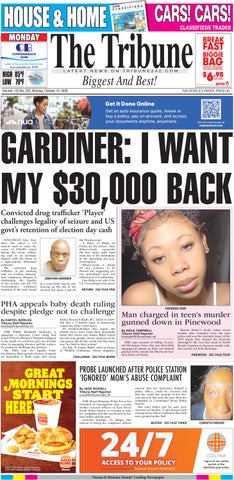
GARDINER: I WANT MY $30,000 BACK
Convicted drug trafficker ‘Player’ challenges legality of seizure and US govt’s retention of election day cash JONATHAN Eric Gardiner has asked a US federal court to order the return of $30,000 seized during his arrest, including cash in an envelope marked with the name of a high-ranking Bahamian politician. The convicted drug trafficker, in jail awaiting trial on cocaine importation conspiracy charges, is challenging the legality of the seizure and the US Government’s continued retention of the cash, found
JONATHAN GARDINER in a cross-body bag he was wearing on the day of the election day plane crash off
the Florida coast. A flurry of filings on Friday by his lawyer, Susy Ribero-Ayala, represents the first major push back from any of the defendants in the sprawling, five-year, investigation. Ribero-Ayala is asking for key evidence to be thrown out, suggesting correct procedures were not followed by US authorities. One filing even asks if the US Government was aware RETURN - SEE PAGE FIVE
PHA appeals baby death ruling despite pledge not to challenge Man charged in teen’s murder gunned down in Pinewood DAVINIQUE GRAY
By EARYEL BOWLEG Tribune Staff Reporter ebowleg@tribunemedia.net
THE Public Hospitals Authority is appealing a Supreme Court ruling that found Princess Margaret Hospital negligent in the death of a newborn girl, two months after its managing director said the authority would not challenge the decision. The PHA and Dr Agatha Foulkes-Mackey filed separate notices of appeal on September 8. Both argue that acting
Justice Raynard Rigby, KC, failed to establish that a 27-minute lapse in monitoring caused the baby’s fatal injury. Dr Foulkes-Mackey also argues she should never have been held personally liable. Her notice says Justice Rigby found that she and another doctor understood the emergency, did all they could and that there was “no fault in their actions”. On July 28, Justice Rigby ruled in favour of Widline Guillaume, whose daughter, CHALLENGE - SEE PAGE SEVEN
By KEILE CAMPBELL Tribune Staff Reporter kcampbell@tribunemedia.net THE man accused of killing 16-yearold Davinique Gray, who was shot while charging her phone in 2024, was himself gunned down outside his Pinewood Gardens home on Friday.
Keiron Butler’s death comes seven months after Gamaliel Gray, the man police said was the intended target of the 2024 attack that claimed the innocent schoolgirl’s life, was shot dead in South Beach. Gunmen in Japanese-model vehicles carried out both shootings. PINEWOOD - SEE PAGE FOUR
PROBE LAUNCHED AFTER POLICE STATION ‘IGNORED’ MOM’S ABUSE COMPLAINT By JADE RUSSELL Tribune Staff Reporter jrussell@tribunemedia.net THE Royal Bahamas Police Force has launched an investigation after a young mother accused officers at East Street South Police Station of refusing to take her complaint that she was beaten by her son’s father and his aunt. Lewratta Farisien, 23, alleges that instead of taking her complaint, officers
warned that her boyfriend, himself a police officer, could be arrested and that she could lose custody of her twoyear-old son. She said she later filed her complaint at Carmichael Road Police Station. Her son’s father and his aunt were arrested on October 15 and charged with causing harm. Police confirmed that both were granted police bail. BEATEN - SEE PAGE THREE
Nassau & Bahama Islands’ Leading Newspaper
LEWRATTA FARISIEN
PAGE 2, Monday, October 19, 2026
THE TRIBUNE
US university fair connects Bahamian students with colleges BAHAMIAN students interested in pursuing higher education in the United States had the opportunity to connect with representatives from US colleges and universities during the 6th EducationUSA – The Bahamas University Fair 2026, across the Family Islands, Nassau, and Freeport this weekend.
Organised through EducationUSA, the Department of State’s official source of information on US higher education, the annual university fair connected prospective students and their families with representatives from participating American institutions. Attendees were able to explore academic programmes, learn
about university admissions requirements, discuss scholarship opportunities, and receive guidance on the process of applying to study in the United States. The fair offered opportunities for students throughout The Bahamas to participate, with a virtual session for Family Islanders, followed by in-person events in New
Providence and Grand Bahama. Participating universities included Georgia State University, the University
of Tampa, Ball State University, Old Dominion University, the University of Connecticut, the University of Wisconsin–Madison,
East Carolina University, and Nova Southeastern University, among others. Photos: Chappell Whyms Jr
THE TRIBUNE
Mother claims police pressured her to drop case
Monday, October 19, 2026, PAGE 3
PHOTOS show marks and bruises on Lewratta Farisien, 23, which she alleges were caused when she was assaulted by her son’s father and his aunt.
BEATEN from page one Ms Farisien said the trouble did not end there. She alleged that once the pair were charged, officers she believed were from East Street South began visiting her home, her salon and her boyfriend’s residence looking for her, and kept calling her phone. When she answered one call, she said, an East Street South officer asked her to come to the station. “I immediately hung up because they were trying to pressure me and force me to drop the charges because the East Street South Police Station did not do their job right,” she said. She claimed her son’s father’s family has connections at the station. East Street South Police Station declined to comment when contacted by The Tribune. In a statement, the RBPF said it was aware of a social media post she made and that the matter was of concern. It said every person has the right to report an incident to police and have the complaint properly assessed. The force said it had launched an investigation to establish the facts and determine whether any policies or procedures were breached, and that it would follow
departmental procedures if any breaches were found. “The Royal Bahamas Police Force wishes to assure members of the public that it remains committed to providing fair, impartial, and professional service to all individuals, without prejudice,” the statement said. If Ms Farisien’s account is accurate, the officers’ handling of her complaint would run counter to the Protection Against Violence Act, 2023, which was passed to change how police and others treat victims of violence. Under the Act, every victim of violence must be treated with compassion and dignity by anyone who deals with them in a professional capacity. The law covers violence between people who are parents of a child together. The Act says that when a victim lodges a complaint, the officer “shall prepare a written statement” of the details, and both must sign it, with the victim given a copy. The complaint must then be investigated. The officer must help the victim obtain medical treatment where necessary, advise her on preserving evidence and give her contact details for the Protection Against Violence Commission. The officer must also notify the
commission in writing. The Act also requires sensitivity training for police on handling complaints, and allows the commission to engage lawyers to liaise with police where a victim feels an officer has not fully cooperated. The commission was appointed in February, nearly three years after the law was passed. Ms Farisien, a hairstylist, said she feared for her life during the October 1 confrontation. Had her boyfriend not been there, she said, “I felt like I would have been beaten to death”. She said she suffered a black eye, bite marks around her mouth, bruises to her head, scars on her body and an injured toe. Her Facebook account of the incident had been shared more than 4,000 times and drawn more than 3,400 reactions at press time. Some commenters described their own bad experiences at the East Street South Police Station. Ms Farisien said she had ended her five-year relationship with her son’s father. She said she had told him that if he wanted access to their son, he should go to court. On October 1, she said, she could not collect her son from school on time and asked her best friend to pick him up. The friend
Man shot dead after argument over debt off Carmichael Road A 36-YEAR-OLD man was shot dead off Carmichael Road on Saturday after an argument over a debt, police said. A man who had been watching the confrontation walked up and opened fire, police said, after the victim allegedly pulled out a sharp object. According to police, the victim was leaving Apostolic Way in a black Honda with another person shortly
after 4pm when a man driving a white van pulled across his path and blocked him in. The two men then argued over an outstanding debt. During the argument, the victim allegedly produced a sharp object. Another man, who had been watching, then came over, produced a firearm and shot him, police said. The gunman fled south along Apostolic Way in a grey vehicle.
Officers found the victim with gunshot wounds to the body. Paramedics confirmed he showed no signs of life. Mobile Division officers later took the 27-yearold driver of the van into custody. Police said he is assisting with the investigation and that they are pursuing significant leads. The victim was wearing a blue-and-white shirt and black jeans.
told her the child’s father had already collected him. Relatives at the paternal grandmother’s home confirmed the boy was there and told her she could collect him. For her safety, Ms Farisien said, she set her phone to record and put it in her pocket before going to the house. The blurry video captures her saying good afternoon as she approaches the front door while her son’s father repeatedly tells her she is not welcome in the yard. “I come to pick up my son,” she says. “This my child too. You ain’t welcome in this yard,” the father replies. Ms Farisien said her son called out to her from the living room, where he was watching television. When she tried to take him, she alleged, his father pulled the child back and pushed her. The video shows the father blocking the boy from reaching his mother, then a struggle over the child as he cries in the background. “They playing tug-of-war with my son, and nobody was trying to let go,” Ms Farisien told The Tribune yesterday, breaking down in tears. She said she eventually let go so her son would not be
hurt. In the video, a woman can be seen joining in and pushing Ms Farisien, who is punched, bitten and kicked. Her boyfriend also gets involved and can be seen being confronted by two men. A man is heard telling the couple not to return. The couple called police and were told to wait, but Ms Farisien alleged that relatives continued to antagonise them and dented her vehicle. They set off for the nearest station but met a police vehicle on the way, which followed them back to the scene until a patrol unit arrived. Officers then took them to East Street South. There, Ms Farisien said, officers told the father that she had full custody and that he would have to go to court if he wanted to see the child. She told officers she wanted to press charges against the father and his aunt. She alleged that officers discouraged her. She also claimed another officer told her boyfriend he would be “dealt” with if he pressed charges.
At Carmichael Road Police Station, Ms Farisien said, a female senior officer saw her injuries and immediately gave her a hospital form. She returned with the medical form, photographs of her injuries and the video. She later reported the East Street South officers’ conduct to the RBPF’s Complaints and Corruption Branch. Ms Farisien said she saw officers at her home on her security cameras on Friday while she was away. She moved temporarily to a relative’s home and cancelled appointments at her salon. When she returned to work on Saturday morning, she said, she could not stay. “I just felt unsafe. I felt paranoid because they kept ringing my phone off,” she said. She questioned why officers who had failed to help her when she was injured now wanted her at the station. “Y’all coerced me and intimidated me and told me that my boyfriend would get arrested and in trouble and that I would lose custody of my child,” she said.
PAGE 4, Monday, October 19, 2026
THE TRIBUNE
Butler shot dead outside Pinewood Gardens home PINEWOOD from page one
Butler’s partner, Stanlesha Oliver, drove him to Princess Margaret Hospital “as fast as I can”, crying for help. “I remember screaming over for help, letting them know that he got shot,” Ms Oliver, the mother of their eight-year-old daughter, told The Tribune yesterday. “They came, brought the stretcher, carry him. They made me wait, wait, wait, wait.” Ms Oliver, 29, said that although she was shocked and scared, her only instinct was to get him help. She said medical staff found a pulse but gave no further information until Butler’s mother arrived. The medical team later told them the second bullet had damaged his arteries, and he had lost a lot of blood. “Heart stopped, so that was it,” she said. According to police, the shooting happened around 1.30pm on Sequoia Street, shortly after Butler, 29, and a female companion arrived at his home. Police said a silver Japanese-model vehicle pulled
up alongside them, and a lone gunman got out, opened fire and then fled west. Davinique, an 11th grader at RM Bailey High School, was inside her Nassau Village home on January 6, 2024, when gunfire ripped through the house. Her father had been murdered two years earlier, and she was killed a day after what would have been his birthday. She was the eighth person murdered that year. Prime Minister Philip Davis said at the time that he was saddened and shocked by the killings. Police said Gamaliel Gray, who was in a relationship with Davinique’s mother, was at the house when it was shot up. He was wanted in connection with the killing of Gerrard Coakley, who was shot dead in his South Beach home on January 2. Then Commissioner of Police Clayton Fernander suggested the motive was gang retaliation. Gamaliel Gray surrendered to police days after the teenager’s death and was charged with Mr Coakley’s murder. He was
Keiron Butler with his girlfriend Stanlesha Oliver and their daughter. granted bail in December 2024 and fitted with a monitoring device. On March 24 this year, he was shot dead while working on a vehicle outside his home in the area of Ruthland Avenue and South Beach Drive. Police said
the occupants of a Japanese vehicle opened fire on him. Butler was arrested in the Berry Islands on February 9, 2024, and charged with Davinique’s murder before Magistrate Algernon Allen Jr five days later. Police alleged he shot up the
home. He was remanded and his case was sent to the Supreme Court. The status of the case could not be confirmed up to press time. Davinique’s mother, Shinika Johnson, was charged in January 2024 with harbouring a criminal for allegedly allowing Gamaliel Gray to stay at her home while he was wanted by police. She pleaded not guilty and was granted $10,000 bail. After Gamaliel Gray’s death in March, she told The Tribune the killing had made it harder to move on from her daughter’s death. Ms Oliver said she had no idea why anyone would want to harm Butler, and that the allegation against him did not fit the man she knew. “That is not his character. It’s not his character. I don’t see him doing something like that,” she said. She said she and Butler had been together since 2015, having been high school sweethearts. She described him as a loving man and devoted father who worked in construction with his uncle and was focused on building a financially stable future for his
family. “Anyone who knows Keiron will tell you he’s big on family,” she said. “That was his drive. He wanted us to be happy, he wanted us to live good, he wanted us to depend on him, he wanted us to be financially stable so we could depend on him.” She said watching him be a father to their daughter brought her joy. The child was picked up from school by her uncle after the shooting. Ms Oliver said her daughter later came to her and asked whether her father was still alive. “It took me a little minute to get it out,” she said. “I told her, ‘No, your daddy is gone’. She’s still pretty young, so she asked me, ‘Mummy, does that mean he’s in heaven or is his spirit roaming?’ I said he’s in heaven, he’s watching us, just to give her a little peace.” Asked whether she felt daunted by the prospect of raising their daughter alone, Ms Oliver said it was hard to answer at the moment. “I’m mummy and daddy now,” she said. “I only could try my best.”
Pinder: Retirement should be a choice, not mandatory By JADE RUSSELL Tribune Staff Reporter jrussell@tribunemedia.net VETERAN unionist and former director of labour John Pinder said retirement at 65 or 67 should not be mandatory, arguing that the decision should be a personal choice based on an individual's health and financial circumstances. He also called for the government to introduce a livable wage of at least $500 a week to help families cope with the rising cost of living, arguing that employers would need government assistance to avoid passing higher wage costs on to consumers. His comments come as the government considers raising the retirement age as part of efforts to strengthen the longterm sustainability of the National Insurance Board (NIB). Public Service Minister Pia Glover-Rolle last week revealed at the Exuma Business Outlook that raising the minimum
VETERAN unionist and former director of labour John Pinder. retirement age from 60 to 62 and increasing the retirement age for private-sector workers from 65 to 67 were the preferred options under consideration. The proposed changes are intended to ease
To advertise in The Tribune, contact 502-2394 PUBLIC NOTICE
INTENT TO CHANGE NAME BY DEED POLL The public is hereby advised that I, RAYMOND KNOWLES of off Kemp Road, New Providence, Bahamas intend to change my name to RAYMOND KNOWLES- RUDON. If there are any objections to challenge the name by deed poll, you may write such objections to the Chief Passport Officer, P.O. Box N-742, Nassau, The Bahamas no later than thirty (30) days after the date of the publication of this notice.
pressure on NIB by addressing the cost of pension payments and helping to ensure the Fund remains sustainable. "Some people can't wait to get 65 to they could hurry up retire. Then there's some persons who
financially probably can benefit from waiting to 67," Mr Pinder said. "Especially civil servants, a lot of times they don't qualify for mortgages until the late 40s, early 50s, and so it gives them an opportunity to
finish paying a mortgage probably at 65." NIB's financial sustainability has been a longstanding concern, with its reserves coming under pressure as benefit payments outpace income from contributions and investments. The Board's 11th Actuarial Review, based on an assessment conducted in 2018, warned that the Fund's reserves could be depleted by 2028 if reforms were not implemented. The review found that annual expenditure had exceeded income from contributions and investment earnings since 2016, forcing NIB to draw on its reserves to pay benefits. Mrs Glover-Rolle has also acknowledged that retired workers returning to employment and collecting both a pension and a salary have contributed to the pressure on the Fund. She said the proposed retirement-age changes would be discussed through the National Tripartite
Council, which represents the government, employers and employees. Mr Pinder said he believed NIB's funds had been poorly managed, but argued that more preventative measures were also needed to reduce the number of Bahamians relying on the social security system because of health problems. He called for greater access to affordable healthy food, exercise programmes and lifestyle interventions to help people maintain better health. Meanwhile, the government is also considering further increases to the minimum wage, which was last raised from $210 to $260 a week on January 1, 2023. Mrs Glover-Rolle told the Exuma Business Outlook that the National Tripartite Council had begun reviewing the minimum wage and was considering establishing a wage-setting council to recommend future increases.
Nearly $2m in suspected cocaine found buried on remote cay off Acklins NEARLY $2m worth of suspected cocaine was found buried in the sand on a remote, unpopulated cay off the southern tip of Acklins after a go-fast vessel was discovered beached along the shoreline, police said. The seizure was made on Thursday, October 15, in a joint operation involving the Royal Bahamas Police Force, the Royal Bahamas Defence
Force and Operation Bahamas, Turks and Caicos (OPBAT), a joint counter-narcotics programme with the United States. According to police, around 4pm, the Defence Force deployed a vessel to Castle Island after receiving intelligence about a suspicious go-fast vessel heading towards the southern side of Acklins. When officers arrived,
they found a white go-fast vessel beached along the shoreline. A search of the boat turned up several items of clothing and navigation equipment. Officers say they then searched the shoreline and surrounding area, where they found two orange crocus bags partially buried in the sand. The bags held black, kilosized square packages and white-and-clear-taped
square packages of suspected cocaine. In total, 40 kilo-sized packages were seized, weighing about 99 pounds, with an estimated street value of $1.98m. The drugs were brought to New Providence aboard a Defence Force vessel on Sunday and handed over to the Drug Enforcement Unit. No arrests were reported.
NOTICE
NOTICE
NOTICE
NOTICE is hereby given that I JOSEPH PIERRE of P.O. Box -55052 #3 Charles Drive, Faith Gardens, New Providence, Bahamas, applying to the Minister responsible for Nationality and Citizenship, for Registration Naturalization as a citizen of The Bahamas, and that any person who knows any reason why registration/ naturalization should not be granted, should send a written and signed statement of the facts within twenty-eight days from the 19th day of October, 2026 to the Minister responsible for nationality and Citizenship, P.O. Box N-7147, Nassau, New Providence, The Bahamas.
NOTICE is hereby given that I TINES MITIAL of Carmichael Road, New Providence, Bahamas, applying to the Minister responsible for Nationality and Citizenship, for Registration Naturalization as a citizen of The Bahamas, and that any person who knows any reason why registration /naturalization should not be granted, should send a written and signed statement of the facts within twenty-eight days from the 19th day of October, 2026 to the Minister responsible for nationality and Citizenship, P.O. Box N-7147, Nassau, New Providence, The Bahamas.
NOTICE is hereby given that I WROY DON MICHAEL CHARLES of Culmersville , New Providence, Bahamas, applying to the Minister responsible for Nationality and Citizenship, for Registration Naturalization as a citizen of The Bahamas, and that any person who knows any reason why registration/ naturalization should not be granted, should send a written and signed statement of the facts within twenty-eight days from the 19th day of October, 2026 to the Minister responsible for nationality and Citizenship, P.O. Box N-7147, Nassau, New Providence, The Bahamas.
Gardiner challenges US govt’s seizure of $30k
THE TRIBUNE
Monday, October 19, 2026, PAGE 5
RETURN from page one
carrying, or possessing a firearm during and in relation to the charged drug trafficking crime,’ prosecutors had identified ‘no firearm, approximate date or location, predicate transaction, or person with whom Mr Gardiner allegedly reached the firearms agreement. A focused identification of that conduct is necessary to permit a meaningful defense.’ In her conclusion, Ribero-Ayala states that: “For the foregoing reasons, Mr Gardiner respectfully requests that the Court direct the Government to provide the foregoing focused particulars sufficiently in advance of trial to permit meaningful use of the information in preparing the defense.” According to court documents, the plot involved a Bahamian politician inviting an undercover DEA source to Parliament to discuss a $30 million cocaine shipment. The politician has not been identified and is only referred to as ‘Politican-1’ in court documents. Gardiner, 58, and all the other defendants deny cocaine importation conspiracy and other charges. He was previously convicted in Florida of conspiracy to import cocaine and sentenced to more than 18 years in federal prison. Thirteen men in total were charged, six are due to go on trial and one, Darrin Roker, has already plead guilty. Roker, a former RBDF chief petty officer, was sentenced to four years in prison after the judge heard he had terminal colorectal cancer.
Gardiner was aboard the downed plane before the passengers aboard were rescued. Ribero-Ayala alleges prosecutors paint a ‘misleading’ portrait of where the $30,000 in Bahamian currency found on her client came from – wrongly inferring it as a politician-directed narcotics payment. She states that $20,000 of it was withdrawn from an accountant at his contracting business, Top Notch Builders, at the Bank of The Bahamas, the day before the crash, and only $5,000 was in an envelope with the politician’s name on it. The Tribune has previously revealed Top Notch secured major Bahamian government contracts, including a $34 million public-private partnership (PPP) deal for the Eight Mile Rock administrative complex in May 2017. There is no explanation as to the unaccounted $5,000. Ribero-Ayala noted that the prosecution documents filed on the day of Gardiner’s arrest omit the fact that there are no political donation limits in the Bahamas - and the plane crash occurred on election day. No further explanation is given. “The affidavit also omitted that May 12 was Bahamian Election Day and the pertinent absence of a political-contribution disclosure/limits framework,” she said. The $20,000 withdrawn from Gardiner’s bank account from Top Notch Builders was part of a ‘legitimate business transaction,’ the filing states, though no further details are given about why it was withdrawn or what it was intended for. “Only approximately $5,000 was contained in the envelope labeled ‘Politician-1,’” Ribero-Ayala says. She wrote: “These are not peripheral background details: they directly qualify the inference that possession of cash bearing a politician’s name demonstrates corrupt narcotics payments.” But in a surprising admission, Ribero-Ayala did not assert this meant the money was lawful. She said: “The defense does not ask the Court to deem the money conclusively lawful; it asks the Court to reject the affiant’s misleading conflation of the entire sum and its selective presentation of
Among items requested for Gardiner’s defence are: • Flight and aircraft records: flight plan; charter or ownership records; manifests; route and destination records; GPS, radar, transponder and tracking data; ATC communications; emergency calls; maintenance records relevant to the emergency; accident/ incident reports; and records concerning the aircraft’s legal operating status. • Pilot, crew, and passenger material: statements, interviews, reports, recordings, communications, benefits, promises, source/cooperator status, or law-enforcement direction concerning the pilot, crew, operator, or passengers. • Government knowledge before rescue: records showing when DEA, CBP, Coast Guard, military personnel, or any other United States agency first learned Mr Gardiner was aboard the aircraft; communications concerning his identity, location, expected travel, apprehension, or property. • Detention and immigration authority: records identifying the time Mr. Gardiner was first not free to leave; hospital guard logs and instructions; CBP records; immigration processing; parole documentation; detainers; warrants; communications concerning whether he would be returned to The Bahamas; and records distinguishing his treatment from that of the other rescued occupants.
an innocent contemporaneous explanation.” Ribero-Ayala said that the photograph of the stack of money released by the prosecutors depicted ‘separate stacks of currency held with rubber bands inside a white bag’ without the politician’s name on all of it. Prosecutors may have ‘collapsed a limited labeled envelope into a description of all the cash, thereby materially distorting the inference of criminal proceeds,’ Ribero-Ayala wrote. “The cumulative effect was to portray the entire sum as a politician-directed narcotics payment, rather than distinct quantities with distinct packaging and provenance,” she said, adding: “Mr Gardiner requests return of the currency subject to appropriate measures preserving its evidentiary characteristics.” According to Ribero-Ayala, prosecutors have questions to answer over whether they seized the money and three mobile phones that Gardiner was carrying on May 12 or May 16, saying the difference could undermine the probable cause used for the search warrant. For these reasons, a hearing - known as a Franks Hearing, which tests whether a warrant affidavit contains deliberate or reckless falsehoods - was necessary to determine whether the prosecution’s ‘continued retention’ of Gardiner’s items, including the cash, are lawful, says his lawyer.
“Mr Gardiner requests disclosure of the particular seizure, restraint, evidentiary, or forfeiture authority invoked to retain this currency and the documents establishing that authority,” Ribero-Ayala said. Gardiner is due to go on trial next March with five other defendants, including former Royal Bahamas Police Force (RBPF) Chief Superintendent Elvis Nathaniel Curtis. The men are alleged to have been part of a drug ring that shipped huge amounts of cocaine through The Bahamas to the US. Gardiner is facing similar charges in a separate case in the state of Georgia. The high-profile case has sparked diplomatic rows, with The Bahamas ambassador to the US, Wendall Jones, even complaining to the US Department of Justice that undercover US Drug Enforcement Agency (DEA) special agents operated illegally on Bahamian soil without government consent. It drew a blistering rebuke from US Ambassador Herschel Walker, who dismissed the accusation as “fake news” and publicly questioned why Bahamian officials were concerned that the United States “helped to arrest a known drug trafficker”. When asked about DEA agents operating in the country and whether it would impact relations, Prime Minister Philip ‘Brave’ Davis stated he was taking the advice of the ambassador to “just let
JONATHAN ERIC ‘PLAYER’ GARDINER us wait and see”. In other court filings, Ribero-Ayala said that prosecutors had handed over a terabyte of evidence but it was not clear what related to the alleged conduct. She requested a document called a ‘Bill of Particulars’ to spell out what Gardiner was accused of doing, and what evidence backed it up. Gardiner wants the hearing to determine if the prosecution showed ‘reckless disregard’ during his arrest and search on Election Day, May 12, after the plane he and ten others was flying in crashed off the coast of Florida. According to Ribero-Ayala, a waterlogged notebook found on Gardiner after he was rescued at sea was searched illegally once it had dried out.
She said the DEA special agent’s affidavit ‘affirmatively discloses that officers opened the wet notebook ostensibly to dry it and observed apparent payment entries, while representing that they did not further review it. However, she said Government photographs ‘show extensive, separately photographed interior notebook pages, including names, figures, and apparent household/ construction notes.’ “Evidence acquired as a direct product of unconstitutional detention or an unlawful search may be excluded, subject to attenuation, independent source, inevitable discovery, and other applicable limitations,” she said. She also said that while Gardiner had been charged with ‘using,
PAGE 6, Monday, October 19, 2026
THE TRIBUNE
The Tribune Limited NULLIUS ADDICTUS JURARE IN VERBA MAGISTRI “Being Bound to Swear to The Dogmas of No Master”
LEON E. H. DUPUCH,
Publisher/Editor 1903-1914
SIR ETIENNE DUPUCH,
Kt., O.B.E., K.M., K.C.S.G., (Hon.) LL.D., D.Litt . Publisher/Editor 1919-1972 Contributing Editor 1972-1991
RT HON EILEEN DUPUCH CARRON,
C.M.G., M.S., B.A., LL.B. Publisher/Editor 1972-
Published daily Monday to Friday
Shirley & Deveaux Streets, Nassau, Bahamas N3207 TELEPHONES News & General Information Advertising Manager Circulation Department Nassau fax Freeport, Grand Bahama Freeport fax
(242) 502-2350 (242) 502-2394 (242) 502-2386 (242) 328-2398 (242)-352-6608 (242) 352-9348
WEBSITE, TWITTER & FACEBOOK www.tribune242.com
@tribune242
tribune news network
Their care money should never become someone else’s spending money THERE is a particular vulnerability in reaching the stage of life when someone else must manage your money. You may still understand every dollar and simply need help getting to the bank. Or you may no longer be able to check a statement, question a withdrawal or explain that something is wrong. Either way, the person entrusted with that responsibility holds more than access to an account. They hold another person’s security. That is why the concerns raised by Patricia Moxey, proprietor of Pat’s Senior Citizens Home, deserve serious attention. Ms Moxey told The Tribune that the home is owed more than $200,000. She alleged that some relatives receive residents’ National Insurance benefits while failing to pay their accommodation bills. These are allegations, not findings against particular families. An unpaid bill does not, by itself, prove that money has been stolen or misused. But the possibility that an older person’s income is being diverted while others struggle to provide their care requires a proper response. The first priority must be the residents. Whatever dispute exists over payment, their meals, medication, accommodation and daily assistance cannot be treated as bargaining tools. Care providers should have somewhere to turn before unpaid bills threaten their ability to continue looking after vulnerable people. Social Services should work with the home to assess the cases individually. Where necessary, the relevant authorities should establish who is receiving a resident’s benefits, what authority they have and how the money is being used. That examination must distinguish hardship from exploitation. Some families are trying to meet care costs that exceed an older relative’s income while raising children and paying their own bills. They may need an assessment for assistance, a realistic payment arrangement or guidance about other care options. Others may dispute charges or believe another relative has been making the payments. Those situations require records and communication.
Deliberately using someone’s care money for unrelated personal spending is another matter entirely. Family ties should never place that conduct beyond scrutiny. There are practical safeguards worth putting in place. Care arrangements should begin with a written understanding of fees, payment responsibilities and whom the provider should contact if difficulties arise. Regular statements should reach the resident where possible and any properly authorised representative. Anyone managing another person’s money should keep clear records. Asking for an account of spending should not be regarded as an insult to the family. It is protection for the older person and for an honest caregiver who might otherwise face suspicion. Authorities should also examine whether properly authorised direct-payment arrangements could help residents who want an agreed portion of their benefits paid towards care. Such arrangements must preserve consent, allow review and leave room for personal needs. A care home should not automatically gain control of someone’s entire income. Age alone is no reason to take away a person’s financial independence. The wider responsibility extends beyond government offices. Relatives who visit can ask whether essentials are being supplied. Care workers can raise concerns through a confidential reporting process. Financial institutions can train staff to recognise possible coercion and respond appropriately. None of this requires treating every family as suspect. It requires taking vulnerability seriously. We speak warmly about respecting our elders. That respect must survive the less comfortable conversations about money, responsibility and who is actually paying for care. An older person should not spend their final years dependent on a provider’s willingness to carry unpaid bills while money intended for their welfare goes elsewhere. Their security deserves more than a promise that someone will settle up later.
ALIV fiber is shocking EDITOR, The Tribune. YOUR article in Fridays Tribune Re: Franklyn Butlers’ targeting Opportunistic growth is I feel
more than a little surprising given that the current level of the ALIV fiber service is shocking, and should be an embarrassment to him and to all the programmers and
technicians involved in on again off again presentation. CHRISTINA SMITH Nassau, October, 2026.
To advertise in The Tribune, contact 502-2394
Bahama Rock must answer all outstanding questions EDITOR, The Tribune. KEVIN Evans’s October 7, 2026 letter inaccurately characterizes opposition to Bahama Rock’s expansion as the concern of only a few residents in Hepburn Town. This description fails to capture the FHCPA’s broader perspective. The Freeport Harbor Community Protection Alliance (FHCPA) includes hundreds of individuals, including homeowners and business owners from areas such as Hepburn Town, Queen’s Cove, Hawksbill, Regency Park, Pinder’s Point, Hunters, Gardens at Sunrise, Harbor West, and Bartlett Hill. This alliance also includes concerned residents from communities across Grand Bahama, extending to the western and eastern ends of the island. The concerns raised are not limited to previous damage claims; they also encompass the environmental impact, both past and proposed, which extends beyond just Grand Bahama and affects the entire Bahamas. The Grand Bahama ecosystem is a vital part of the overall Bahamas ecosystem. FHCPA members report significant damage and disruption linked to nearly thirty years of mining and blasting. Their accounts warrant thorough investigation. Dismissing these accounts with unsupported claims about money, job applications, or land ownership does not address the evidence. Residents have reported damaged homes and concerns about health, groundwater, and environmental changes. Our concerns encompass mangroves, seagrass, corals, fisheries, salt marshes, coppice, pine forests, reported obstruction of Hawksbill Creek, and changes to natural water circulation. FHCPA recognises that individual damage claims and their environmental causes require thorough investigation. This is precisely why we seek historical monitoring records, independent assessments, and a transparent account of cumulative impacts. Mr Evans’s claim that flooding concerns lack scientific basis is hard to reconcile with the developer’s submitted documents. Appendix C of the October 2024 Environmental Impact Assessment contains a Flood Potential Assessment dated December 20, 2023. Its printed page 65 reports an observed increase of up to 10% in flood extent when comparing modeled pre- and post-dredging scenarios. It also identifies the possibility that settlements closer to the expanded harbor could become more exposed to storm-surge flooding. This text discusses the modeled extent of flooding, rather than providing a definitive increase in water depth or suggesting that every home will experience flooding. However, the assessment on page 74 concludes that the planned
LETTERS letters@tribunemedia.net expansion could increase flood risks and recommends implementing mitigation measures. The assessment indicates that targeted measures could help address these potential additional risks. The government must determine whether these measures will be effective, who will fund and maintain them, and what residual risks communities may still face. The flatness of Grand Bahama does not provide answers to these important questions. Employment requires thorough examination. We acknowledge the importance of workers’ livelihoods and reject the notion that equivalent jobs will simply materialise. Headline employment figures need further clarification. Bahama Rock must provide details about its current workforce, specifying the distinctions between salaried and hourly employees, as well as permanent and temporary positions. It must disclose actual and guaranteed weekly hours, wages, benefits, and applicable employment protections. Workers deserve a clear and accurate account of the security and value of the jobs they are fighting to protect. The company must provide a thorough and independently verifiable explanation of its claimed economic contribution. The EIA estimates that the annual economic contribution is approximately $25 million, with around $5.5 million in annual electricity expenditures. However, these disclosures do not provide a complete breakdown of the total amount claimed. Bahama Rock must clarify its financial contributions, including payroll, local procurement, electricity, water, fuel, taxes, license fees, royalties, and other payments. It must specify the recipients and indicate whether each amount is included in the $25 million estimate. Additionally, the company needs to disclose its methodology, differentiate direct expenditures from estimated indirect effects, and explain how it avoids double counting. Any relevant exemptions must also be identified. Bahamians must not be left to assume that millions in royalties are either being included in the implied economic impact or not being paid at all. The records must clearly establish the actual situation. Aggregate supply requires the same level of transparency. According to the July consultation presentation, The Bahamas needs over 350,000 tons of aggregate each year. This figure represents national demand but does not clarify how much Bahama Rock supplies to local customers.
The company must disclose annual figures for extraction, domestic sales, exports, and stockpiles by product, along with information on delivery commitments and available permitted reserves. These figures must be reconciled, including appropriate allowances for processing and other documented adjustments. Exceeding domestic demand in production alone does not indicate a contradiction; exports could account for that difference. However, it is essential to disclose the breakdown between domestic and export figures before the public can assess claims about local dependence and potential shortages. It is important to distinguish the exhaustion of currently permitted reserves from the depletion of existing sale able inventory, as well as from the separate question of whether further extraction could legally occur. Community commitments must be evaluated through a published record of promises, deadlines, completions, outstanding obligations, and monitoring results. Donations should be acknowledged, but they cannot replace proven safeguards. DEPP invited the general public and interested parties to participate in a consultation. Title deeds were not a requirement for this invitation. The government and the Grand Bahama Port Authority (GBPA) must ensure a transparent record that addresses community impacts, workforce conditions, economic benefits, aggregate supply, and practical alternatives. Bahamians are firmly opposed to approving another long-term excavation project that relies on personal attacks or fails to provide comprehensive and transparent accounting. It is essential that any proposal clearly demonstrates its potential impacts, outlines enforceable safeguards to protect our environment and communities, and details the lasting benefits for the public. If these critical elements are not adequately addressed, the proposal must be rejected to ensure the well-being and interests of our nation are prioritized. Bahama Rock Must Answer these Communities, all Outstanding Questions, and the Bahamas With Evidence. Our Homes Matter. Our Lives Matter. Our Health Matters. Our Environment Matters. Our Communities Matter. Our Safety Matters. The Hepburn Town Heritage Matters. Protect Our Homes. Preserve Our Harbor. Safeguard Our Future. Freeport Harbor Community Protection Alliance (FHCPA) Freeport, Grand Bahama C ALLEN JOHNSON Freeport, Grand Bahama October 11, 2026.
THE TRIBUNE
Monday, October 19, 2026, PAGE 7
PHA disputes link between monitoring lapse and death CHALLENGE from page one
Elizabeth Lundy, died on August 2, 2022, just over two hours after she was born. He found that the hospital and Dr Foulkes-Mackey fell below the required standard of care by failing to monitor Ms Guillaume and her baby between 4.10am and 4.37am as she waited to enter the operating theatre for an emergency caesarean section. He said the negligence arose because no monitoring took place while Ms Guillaume waited for the result of a COVID19 test before surgery. Ms Guillaume was declared entitled to general and special damages, to be assessed at a later hearing, and the defendants were ordered to pay her legal costs. The day after the ruling, PHA’s then-managing director Aubynette Rolle told The Tribune the authority would not prolong
the case or force the family to relive the baby’s death. She said the PHA “at this moment has no intentions of going back against the ruling”, including any costs associated with it. The PHA’s appeal, filed through the Office of the Attorney General, asks the Court of Appeal to set aside the judgment in its entirety or vary it, enter judgment for the defendants, and order Ms Guillaume to pay the authority’s appeal costs. It argues that Justice Rigby found negligence without establishing a causal connection between the monitoring lapse and the injury. It also says he misapplied the burden of proof by highlighting evidence that was not led at trial and “critical witnesses” who were not called, when the burden lay on Ms Guillaume to prove her case. It further argues he wrongly admitted expert opinion that challenged primary facts when the person who recorded those facts did not
testify. The authority says the decision cannot be supported by the evidence, given the court’s own findings. Those findings were that the baby’s Apgar scores of seven and eight, at one and five minutes after birth, accurately reflected her condition; that the doctors acted promptly once the caesarean was decided on; that cardiotocography (CTG) readings showed the mother and baby were not in distress; and that the delivery was not delayed. Dr Foulkes-Mackey, represented by Cheryl T Whyms & Co, wants the findings against her set aside, the claim against her dismissed, and Ms Guillaume ordered to pay her costs. Alternatively, she asks for the claim against her to be sent back for a new trial before a different judge. Her notice argues that Justice Rigby did not identify any act or omission by her that fell below the standard of a reasonably
Electrical engineer challenges BPL’s lightning explanation for outages By JADE RUSSELL Tribune Staff Reporter jrussell@tribunemedia.net AN electrical engineer says Bahamas Power and Light’s repeated blaming of lightning for power cuts does not hold up, arguing that poor maintenance and management of the grid are the biggest problems. Quintin Knowles said lightning is a normal part of nature that any properly designed power system is built to withstand. “But the frequency of it and the extent of it makes it cast doubt on the explanations that they provide,” he told The Tribune. BPL has repeatedly cited lightning for major outages this year. In September, the utility said a lightning strike at the Blue Hills Power Station caused a widespread outage on New Providence, the second strike there in recent months. In July, after another lightning strike at the plant
left communities without power for hours, BPL’s board ordered a post-incident review. Officials also blamed the summer heat for outages, but the outages have continued even as temperatures have cooled. Mr Knowles, who stressed that he was making a general observation, said surge suppressors and lightning protection devices have been available for decades. If properly designed, installed and maintained, he said, they absorb most of the energy from a strike. “Lightning occurs, and it occurs all the time,” he said. He said a severe strike can occasionally cause a major disruption. But if every major lightning storm brings a power cut, it suggests the protection systems were not installed or designed properly, or have not been maintained. He also questioned how a single fault at one station could black out
the entire island. Using a hotel as an analogy, he said a faulty hair dryer in one room should trip only the breaker feeding that outlet, not shut down power to the whole tower. “That should never happen,” he said of islandwide outages caused by a single fault, adding that they point to faulty design, protection schemes or maintenance. Mr Knowles also rejected the argument that the country must tolerate outages because the grid is old. He said engineers at utilities in the United States had told him they operate equipment more than 50 years old that still works because it has been properly maintained. “So I don’t really buy that argument that hey, we have this old, ancient, ageing system that needs to be replaced throughout,” he said. He accepted that the grid needs modernising, POWER - SEE PAGE EIGHT
competent obstetric and gynaecological registrar. It says he did not find that she removed the CTG monitor, was responsible for monitoring, told the midwife not to monitor, knew monitoring was not taking place, had access to a monitoring device or controlled the hospital’s equipment, staffing or theatre arrangements. She contends that Justice Rigby found liability against “the Defendants” collectively without deciding which of them owed or breached the duty, and held her responsible for a monitoring failure he attributed to the hospital and the attending midwife. She also argues that the monitoring lapse was never pleaded against her personally. According to her notice, the claim focused on delays in assessment and delivery,
and she was not given fair notice of the allegation or a chance to answer it. The notice says monitoring is diagnostic and its absence cannot itself cause oxygen deprivation. It argues that Justice Rigby never determined when the baby’s condition deteriorated, what monitoring would have shown, or whether any intervention would have saved her. It notes that the baby was born alive and deteriorated during transfer, and that no evidence established why. It also says Justice Rigby stated he did not have to decide what led to the baby’s sudden death, which the doctor argues he was required to do before finding liability. Dr Foulkes-Mackey further challenges the finding that perinatal asphyxia
probably caused the death. She argues that Justice Rigby rejected expert Dr Ward’s evidence of a possible congenital heart condition largely because the mother had a normal cardiovascular examination. Her notice says no expert evidence showed that such an examination ruled out heart disease in the baby. She also disputes his reliance on the death certificate. Her notice says the certifying doctor, the paediatrician and the attending nurse did not testify, no paediatric expert was called and no autopsy was performed. It adds that both medical experts considered the lack of an autopsy material to determining the cause of death. No hearing date has been set.
PAGE 8, Monday, October 19, 2026
THE TRIBUNE
Husband fails to overturn divorce order wife obtained 15 years ago By RASHAD ROLLE Tribune News Editor rrolle@tribunemedia.net A MAN who claims he did not know his wife had obtained a divorce order 15 years ago has failed to get it overturned, despite evidence that they continued living together, attended marriage counselling and twice increased the mortgage on their home. Justice Hope Strachan refused to cancel the divorce order, known as a decree nisi, which the wife obtained on May 19, 2010, after accusing her husband of cruelty. However, the wife never took the final step needed to legally end the marriage. In a ruling dated October 16, Justice Strachan gave the wife, identified as N.B., 14 days to apply to finalise the divorce. If she does, a separate divorce petition filed by her husband, W.B., last year will be dismissed. If she fails to act, her 2010 petition will be dismissed because of unreasonable delay, allowing her husband to proceed with his own case. The judge also gave the wife 21 days to file any applications concerning the couple’s property and finances. Both sides must pay their own legal costs. The couple had been married for 24 years and had three children when the wife obtained the
original order. The case went ahead without opposition because the husband did not respond to the divorce petition. Court records included a sworn statement from retired police officer Rudolph Sweeting, who said he personally served the husband with the divorce papers on February 26, 2010. Mr Sweeting said the man identified himself by the husband's name and resembled a photograph attached to his statement. Justice Michael Barnett, as he then was, granted the provisional divorce on the grounds of cruelty, leaving property and other outstanding matters to be settled later. The wife took no further action. On April 24, 2025, the husband filed his own divorce petition. When the papers were served on his wife the following month, the earlier proceedings came to light. The husband insisted he had never received the 2010 divorce papers and knew nothing about the court order. He said the couple continued living together between 2010 and 2024, raised their children, travelled, celebrated family occasions, attended marriage counselling and jointly paid for repairs to their home. He also produced a report from their marriage
counsellor confirming that divorce was never discussed during their sessions. His wife did not dispute the report. The husband argued that their conduct was inconsistent with him knowing his wife had already obtained a divorce order. He asked the court to cancel the order, arguing that important facts had not been disclosed, and to dismiss his wife's petition because of the lengthy delay. The wife acknowledged that they continued living under the same roof and participated in some family activities, but insisted they lived separate lives and never reconciled. She maintained that the husband's denial, made 15 years after the papers were served, was not enough to disprove the police officer's sworn account. She blamed financial difficulties for her failure to complete the divorce and argued that the outstanding property and financial matters could still be settled through the original case. Starting another divorce case, she argued, would waste time and money. Justice Strachan accepted the police officer's evidence that the husband had been served. She described the husband's account as a "bare denial", pointing out that he had not challenged
the date, time or location of the alleged service or whether he was the person shown in the photograph. The judge also rejected his argument that important facts had been withheld from the court in 2010, finding that the events he relied on happened after the divorce order was granted. She found no evidence that the couple had worked together to mislead the court. However, Justice Strachan raised several concerns about the wife's conduct after obtaining the order. She questioned why the couple continued making major financial commitments together, including twice increasing the mortgage on their home. The judge said a mortgage requires a long-term commitment and that entering such an arrangement with a spouse was "antithetical to having sued the other party for a divorce". She also questioned why the wife attended marriage counselling without telling the counsellor that she had already obtained a divorce order. Justice Strachan said the decision to attend counselling undermined the wife's earlier sworn position that there was no possibility of reconciliation. The couple's joint participation in counselling, she said, suggested they both intended to save the
marriage. The judge also found that the wife had failed to serve the divorce order on her husband, as required by court rules. She rejected the wife's explanation that financial hardship prevented her from completing the divorce, saying there was no convincing evidence to support it. Justice Strachan pointed out that the wife had admitted purchasing vehicles, building a wall, installing railings and renovating the matrimonial home during the intervening years. The wife also acknowledged going to dinner with her husband, although their children were present. At one point, the judge said the evidence suggested "that the parties did in fact reconcile". However, she ultimately found there was insufficient evidence to conclude that they had reconciled, citing their conflicting accounts and the lack of a clear timeline of their activities after 2010. Justice Strachan found that the wife had allowed the case to remain unfinished for 15 to 16 years "without a credible excuse". She also said the husband could not be blamed for failing to challenge an order he did not know existed, particularly since he acted to resolve the matter after learning
about it. Despite these findings, the judge refused to cancel the original order. She said forcing the parties to start the divorce process again would create unnecessary expense and delay when both accepted that their marriage had ended. The husband's own divorce petition showed that he also believed the marriage had broken down, and none of the couple's children was still a minor. "There seems to be little utility in setting aside the 2010 decree and causing the present petition to be prosecuted, to end the marriage," Justice Strachan said. She also said she could not revisit Justice Barnett's original finding that the wife had proved cruelty. The judge said there were no Bahamian court decisions directly addressing whether a provisional divorce order could be reversed and the petition dismissed at such a late stage. Relying on English case law, she concluded that the Matrimonial Causes Act gave the court that power where the circumstances justified it, but that a lengthy delay did not automatically require dismissal. Elsworth Johnson represented the husband. Maria Zancolla-Willie represented the wife.
Brothers’ repeated disputes raised during court appearance By EARYEL BOWLEG Tribune Staff Reporter ebowleg@tribunemedia.net A MAN accused of threatening his brother told a court the two had clashed before, saying: Fred Ramsey, 47, pleaded not guilty on Friday to threatening Gerard Ramsey on October 13 with intent to put him in fear of unlawful
harm. The prosecution said the brothers, who live in the same house, were always fighting. Ramsey first appeared before Magistrate Algernon Allen, but the case was moved to another court when it emerged that he was already on bail in another matter involving his brother. He made the
remark while explaining that earlier case. He later appeared before Magistrate Raquel Whyms and again pleaded not guilty. He was granted bail of $2,000 on condition that he report to the Carmichael Road police station every Tuesday and have no contact with his brother. His trial is set for January 21, 2027.
Eleuthera man denies helping hide suspect in deadly weapon case By EARYEL BOWLEG Tribune Staff Reporter ebowleg@tribunemedia.net AN ELEUTHERA man is accused of helping to hide a man he allegedly knew had committed assault with a
deadly weapon. Keyshawn Pinder, 25, pleaded not guilty to harbouring a criminal when he appeared before Magistrate Kara Turnquest Deveaux on Friday. Prosecutors allege that
on October 8, in Harbour Island, Pinder helped conceal Dudley Clear, knowing that Clear had committed assault with a deadly weapon. He was granted bail of $5,000 and is due back in court on October 21.
Engineer says grid problems go beyond ageing equipment POWER from page seven but said much of the problem could have been avoided had proper maintenance practices been in place from the start. He estimated that more than 90 percent of the problems could be avoided with preventive maintenance, proper protection systems, adjustments when new load is added, and monitoring of major equipment. He pointed to the 15MVA transformer that exploded at Blue Hills in July, causing an islandwide blackout. BPL said at the time that a suspected underground cable fault caused the explosion. Mr Knowles said he had no direct knowledge of the cause of that event,
but that transformers of that kind are fitted with devices that monitor heat, load and the condition of their components, so that problems can be spotted well before a catastrophic failure. He said he was confident that a properly maintained transformer would not have failed that way. He also suggested that some outages blamed on lightning may have other causes, such as rainwater seeping into cable trenches and reaching faulty cables, which then trips protective equipment. He said he had no evidence of this, and was speaking from experience in the industry. Mr Knowles said utilities elsewhere investigate major failures thoroughly to find out what went
wrong and correct it. He said he did not know whether that happens at BPL. He said someone in an engineering WhatsApp group had shared a Tribune headline from close to 50 years ago reporting power cuts and grid instability at BPL’s predecessor, the Bahamas Electricity Corporation. “I don’t think the full picture has been given to us,” he said. Mr Knowles is an electrical engineer and electrical contractor who designs electrical distribution systems for homes, hotels and subdivisions. He said he does not work on utility-scale transmission and distribution, but knows enough about how those systems work to make an assessment.
THE TRIBUNE
Monday, October 19, 2026, PAGE 9
PAGE 10, Monday, October 19, 2026
THE TRIBUNE
World View • Sir Ronald Sanders
The Caribbean “too rich for help”? when will the fiction end?
ON 14 October, IMF Managing Director Kristalina Georgieva warned that higher borrowing costs, falling development assistance, and other economic pressures threaten to widen the distance between advanced and developing economies. She appealed for additional resources for the Fund’s Poverty Reduction and Growth Trust and its Catastrophe Containment and Relief Trust, which assist low-income and particularly vulnerable countries. That appeal deserves support. The poorest countries should not be abandoned. But the discussion must also include countries whose vulnerability is obscured by their designation as middle-income or even high-income economies. Several Caribbean states fall into these categories. Their income classifications say something about their economies, but far less about their capacity to withstand a major disaster or a prolonged collapse in earnings. This is hardly a new argument. As far back as October 2009, I wrote about Caribbean leaders who attended the IMF and World Bank meetings in Turkey seeking relief and restructuring for the debt of vulnerable, middle-income countries. The late David Thompson, then Barbados Prime Minister, explained that restricted access to World Bank funding had pushed countries towards private borrowing at higher interest rates and with shorter repayment periods. Seventeen years later, the region is still having to make the case that the terms on which countries borrow can determine whether they develop or spend years struggling to meet payments. There has been progress, and it should be acknowledged. The World Bank’s International Development Association makes provision for some small economies above its
normal income threshold. The IMF’s Resilience and Sustainability Trust also provides longer-term financing for eligible vulnerable middle-income countries and small developing states. These arrangements are important departures from a system that relied too heavily on income alone. However, eligibility for a particular
parent accounts, sound procurement, competent debt management, and investments that can withstand scrutiny. Borrowing for projects with doubtful benefits places an unfair obligation on future taxpayers. The region’s case is stronger when governments
another loan. Repeated reconstruction can leave a country owing more simply to recover the standard of living it previously enjoyed. International financing arrangements must take account of this reality. The United Nations Gen-
vulnerability is of limited use if it leaves the terms of borrowing untouched. There should also be wider provision for suspending debt payments after major disasters, allowing governments to direct scarce resources towards immediate recovery. Such arrangements should be agreed before emergencies occur, when
Photo: JuliaVolk/pexels
facility does not settle the larger question of whether a country can obtain sufficient financing, on suitable terms, when it needs it. Nor does a new loan remove the burden of existing debt. For Caribbean people, that burden has practical consequences. Money committed to debt payments cannot also purchase medical equipment, improve schools, or repair water systems. When governments have little room to spend, necessary work is postponed. Roads deteriorate, public services struggle, and opportunities for young people diminish. The consequences extend beyond government budgets. Businesses depend on reliable electricity, functioning ports, good roads and workers with the skills their enterprises require. A government unable to finance these services will find it harder to support the economic activity from which future revenue must come. Debt can therefore weaken the very capacity needed to repay it. None of this excuses careless borrowing, wasteful expenditure, or poor administration. Caribbean governments owe their people trans-
demonstrate that they are managing public money responsibly. But even the best-managed small state cannot prevent a hurricane, control international oil prices, or stop a recession in the countries from which its visitors arrive. Nor can it spread those risks across the range of industries and markets available to a much larger economy. Consider a country whose hotels, roads, electricity network, and homes suffer extensive damage in a single storm. Its government faces urgent expenditure just as tax receipts decline. It must restore essential services and help people recover their livelihoods while continuing to meet obligations incurred before the disaster. An income figure calculated before the storm offers little guidance on what that government can now afford. There is also a distinction between borrowing to create new productive assets and borrowing to replace what has been destroyed. Replacing a bridge may restore an essential connection, but it does not necessarily create the additional income needed to service
collaboration with other development banks on debt and resilience financing demonstrate serious regional effort. These initiatives require decisions by international governments and institutions with the power to change financing rules and provide resources. Caribbean countries can develop proposals, supply evidence and negotiate persistently. They cannot, by themselves, secure changes that depend on the agreement of major shareholders and creditors. The forthcoming Commonwealth Heads of Government Meeting in Antigua and Barbuda offers an opportunity to press influential governments for specific commitments to advance these proposals within
Photo:Pixabay/pexels
eral Assembly adopted the Multidimensional Vulnerability Index (MVI) in August 2024. Antigua and Barbuda’s Prime Minister, Gaston Browne, co-chaired the UN HighLevel Panel that developed it, alongside Norway’s for mer Prime Minister, Erna Solberg. The index provides a fuller assessment of countries’ vulnerability to external shocks and their structural capacity to withstand them. That work should inform actual financing decisions, including access, interest rates, and repayment periods. Recognition of
there is time to settle the terms properly. Where repeated disasters have contributed substantially to unsustainable debt, creditors should be prepared to examine restructuring and relief. Grants and deeply concessional finance should carry a greater share of the cost of adaptation and disaster recovery. Caribbean governments and regional institutions have already done substantial work to advance this case. Barbados’ Bridgetown Initiative, the MVI, and the Caribbean Development Bank’s
international financial institutions. The people of small Caribbean island-states need financing arrangements that give them a reasonable chance to build, recover, and advance. An income classification should help explain a country’s circumstances. It should never become an excuse for ignoring them. (The writer is Antigua and Barbuda Ambassador to the US and the OAS and Chair of the Inter-American Council for Integral Development. The views expressed are his own)
How Alberta separatism went from fringe cause to referendum By ROB GILLIES Associated Press EDMONTON, Alberta (AP) — For decades, Alberta separatism was a fringe cause. On Monday, voters in Canada's oil heartland will decide whether to take the first step toward a referendum on leaving the country. Alberta, home to the world's fourth-largest proven oil reserves, is not voting to leave Canada on Oct. 19. Instead, voters will decide whether the province should remain in Canada or begin the legal process toward a future referendum on separation. Alberta Premier Danielle Smith, who called the vote but supports remaining in Canada, has said that support for starting the separation process, which was around 23% in a recent poll, is "still too high for my liking." Alberta has long feuded with the federal government over oil and federal power. Liberal prime ministers Pierre Trudeau
and, decades later, his son Justin became deeply unpopular in the province over energy policy. Justin Trudeau's government imposed a national carbon tax and other climate measures that Alberta leaders said hurt its oil industry. Yet separatist parties typically drew only 1% or 2% of the vote, former Alberta Premier Jason Kenney said. Then came the pandemic and the Freedom Convoy, which paralyzed parts of Ottawa, the Canadian capital, and blocked major Canada-U.S. border crossings. "They needed a new cause," Kenney told The Associated Press. "And it naturally morphed into separatism." Pandemic-era restrictions supercharged separatism Jeff Rath, a leader of the independence movement, said federal vaccine rules preventing unvaccinated Canadians from flying were his breaking point.
"If Trudeau won't let me leave Alberta, I'm just going to pick up my whole province and go," Rath recalled telling a friend. "COVID was really the straw that broke the camel's back." "A lot of people were radicalized by the convoy," PEOPLE cheer at a Forever Canadian rally in Edmonton, on Friday, Oct. 16, 2026. he said. Photo: John Ulan/The Canadian Press via AP The 2022 Freedom Convoy began over vaccine requirements for and drawing in political operatives Kenney said the MAGA movecross-border truckers but grew with campaign and fundraising ment has been "inspirational" into a broader revolt against pan- experience. for some separatist activists. He demic restrictions. He also sees substantial over- said they "tried to infiltrate with Kenney said people mobilized lap between separatist activists at least some success" the United over anger at globalization, vac- and people who support RusConservative Party he founded. cines and pandemic restrictions, sian President Vladimir Putin or while social media allowed previ- believe conspiracy theories about Smith replaced Kenney in 2022 ously isolated activists to find one Ukrainian President Volodymyr after appealing to United Conservative Party members angry another and organize. Zelenskyy. "They found each other and Kenney stressed he was describ- over COVID-19 restrictions. "Literally, you can look at the they found a cause," Kenney said. ing activists, not typical separation Kenney said the movement also voters, whom he characterized players," Kenney said of the became more professional, build- as frustrated Albertans sending convoy and separatist movements. ing organizations, raising money Ottawa a message. "It's the same people."
THE TRIBUNE
Monday, October 19, 2026, PAGE 11
The KDK Report
The brave new world of health technology
KARDIAMOBILE device By Dr Kenneth D. Kemp WE often ignore what our bodies are telling us. We blame the bags under our eyes on a busy week, dismiss changes in how often we pass urine, and convince ourselves that the discomfort in our chest is merely heartburn. There’s always something more urgent to do, somewhere else to be. So, we explain away these messages from within and carry on, hoping that whatever’s wrong will soon resolve itself. But what if our bodies could do more than send signs we struggle to interpret or choose to ignore, telling ourselves they don’t matter? What if, in the middle of an ordinary afternoon, our phones delivered a message: “Your resting heart rate has been higher than usual for several days. Have you noticed any other changes?” Artificial intelligence is beginning to help people interpret information collected by the devices they wear. The technology raises a fascinating question: could we one day have a conversation with our own bodies? Research announced this month by the University of Pennsylvania offers an early glimpse. In a small study involving 13 adults undergoing brain monitoring for epilepsy, patients used a smartphone application to ask questions about their brain activity, report symptoms, and receive information from
an AI system connected to their monitoring data. The system could also initiate contact when it detected changes. In the study, published in Nature Medicine, patients contributed information about what they were experiencing, which in turn helped the system interpret the signals it collected. Although this was an early hospital study, it opens a remarkable door and made me wonder what happens when that conversation extends beyond the brain? Imagine a health companion that, with your permission, could bring together your medical history, laboratory results, medications, and information from appropriate sensors. It could learn your usual patterns and help identify changes that deserve attention. Then imagine it starting a conversation. “You mentioned feeling tired. Your sleep has been disrupted and your resting heart rate has risen over the past week. Have you noticed anything else?” You might mention unusual breathlessness when climbing stairs. That detail could help the system recognize the need for medical assessment, bringing together clues you might otherwise have dismissed. Elements of this future already exist. Insulin pumps integrated with a continuous blood glucose monitor can signal patients when blood sugar is spiking and automatically adjust insulin
Record payout for workers building US consulate in Milan By COLLEEN BARRY Associated Press MILAN (AP) — Foreign workers building the vast new U.S. consulate compound in Milan signed agreements at a Milan hotel Wednesday securing payouts averaging 45,000 euros ($50,400) each for alleged labor abuses while working for an American construction company. More than 60 laborers, mostly from India, signed the deals Wednesday to receive their share of a 31-million-euro (nearly $35 million) settlement agreed last month with Alabama-based Caddell Construction. The signings began Tuesday. Prosecutors say it is the largest settlement ever for labor exploitation in Europe. Each worker signed a document seen by The Associated Press agreeing not to discredit Caddell and not to disclose the individual payments. Caddell said in the document that the settlement was not an admission of liability. Individual payments are to be made within 30 days of the signing. The workers saw the potentially life-changing sum in black-and-white for the first time at the signings — with the highest reaching nearly 90,000 euros (nearly $101,000), said Francesco Brigatti, the court-appointed administrator working to return the consulate construction site to legality.
delivery, helping keep glucose levels within a target range. Certain Apple and Samsung watches can record an electrocardiogram (ECG) and flag possible heart rhythm abnormalities. Portable devices such as KardiaMobile offer similar checks, while Oura’s AI adviser helps users interpret their health data collected by wearing a simple ring. These tools cannot replace a medical assessment by an actual physician but they reveal how much has already moved from the consulting room into our everyday lives. Now imagine what may come next. A bathroom could become a quiet checkpoint for health. A toilet with reliable testing technology might identify selected changes in urine and suggest a laboratory test. I imagine there will be future glasses that can detect eye strain and automatically send a prompt to the patient to adjust to appropriate lighting. A mirror might track a visible skin abnormality over time and prompt someone to have it examined. Their value primarily lies in recognizing something worth investigating. Even our shoes might contribute. For the past few years, I’ve been working with a footwear sensor company to explore whether changes in pressure and gait could reveal problems earlier, including movement
patterns associated with Parkinson’s disease. In my practice, the technology already helps identify abnormal pressure points in patients with diabetes, highlighting areas vulnerable to injury. A local company, Simplified Technology, is training quadrupeds (robots that look like dogs) to monitor patients who suffer from dementia, sending warning signals when they wander off, or assisting with simple tasks, including alerting them to danger. The ambition is health monitoring that fits into life without demanding that life revolve around it. Future technology could also help us describe what happens between appointments. Patients frequently struggle to remember when a symptom started, how often it occurred or whether it followed a change in medication. This system might assemble that history,
ask the patient to check it and, with consent, share a concise account with the doctor. The physician could then assess the patient with a clearer history. For The Bahamas, these possibilities have particular significance. Imagine someone on a Family Island whose symptoms and measurements could be reviewed promptly by a clinical team in Nassau. With the right infrastructure, technology might help clarify who needs to travel urgently and who can receive appropriate care locally. But a warning is only useful if help can follow. The technology would need to connect people to care they can actually reach and afford. That future, however, will depend on more than impressive software. A system can sound convincing and still be wrong. A change in a measurement may have several explanations, while serious symptoms may occur without a wearable detecting
should consider those questions from the beginning. A useful health companion would need to know when to interrupt, acknowledge uncertainty and direct someone to professional care. Ideally, it should help people live more freely. There is the reality, however, that by using increasingly sophisticated technology we have already given up what we used to think of as our right to privacy. Browse online for an item you might buy and suddenly you are bombarded with similar product offers. Science fiction has long invited us to picture technologies before they became familiar. Medicine needs that imagination, accompanied by the discipline to prove that an invention actually helps. The next generation of innovators may grow up believing that a conversation with the body is an ordinary expectation, then spend their careers making
AN APPLE watch anything unusual. Chest discomfort cannot safely be dismissed because a watch offers reassuring numbers. Clinical judgement, examination, and appropriate testing would remain essential. There are also questions of privacy and access. Who would control such an intimate record of our lives? Would meaningful protection be available only to those who could afford expensive devices and subscriptions? And could constant alerts leave otherwise healthy people afraid of every variation in their readings? Inventors
it possible. For now, we still wake up, look in the mirror and explain away the tiredness. We still postpone the appointment because there is work to finish and somewhere else to be. Perhaps one day, in the middle of that familiar rush, a message will persuade us to pause. And I suspect that the next great advance in medicine will help us understand those messages clearly enough to act, while there’s still time to make a meaningful difference. This is The KDK Report.
address abuses in India, where prosecutors could not investigate, officials said. The investigation against Caddell remains open, pending the payouts, which are expected to be completed by February. Two managers under investigation for extortion and facilitating illegal immigration remain under house arrest. Caddell's settlement The includes about 11.2 million payouts euros ($12.5 million) for combine Italy's social security cofunpaid fers and workplace injury overtime, insurance. Under the deal, reimbursethe workers are also getment for ting permits to work in housing Italy even off the Caddell illegally site. deducted Caddell, a major confrom tractor for U.S. embassies their pay A VIEW of the construction site of the new U.S. Consulate, in Milan, Italy, Wednesday, Oct. 7, and consulates worldwide, and hefty 2026. said in June that it was damages AP Photo/Luca Bruno cooperating fully with Italpersonally ian authorities, reviewing sought by its global subcontractors workers had troubles, that's why this settleinvestigating Prosecutor Paolo Storari, and consultancies for compliance with ment has been applied." Brigatti said. Over two days, 115 workers signed the labor laws, and working with authorities to "The damages component alone amounts deals, with the procedure continuing next protect workers on the project. to 60–70% of the overtime total," Brigatti "Caddell continues to cooperate in week. said, well above the 10% to 30% that he Prosecutors say workers were paid less good faith with the appropriate authorisaid is more customary in such cases. than $2 an hour, were illegally docked ties throughout this process, and we remain Dilip Ram, a 43-year-old mason from money for housing and denied overtime focused on the care and well-being of the India, has worked at the Milan consulate for working up to 10 hours a day, six days a people working on an important project," site for more than two years. He said the week. They also were allegedly subjected to the company said Wednesday. money would go a long way to helping his threats and not given proper medical care The U.S. State Department has said it is family of five back home in the Indian state when they were injured on the job. Most of investigating the allegations made by prosof Bihar. the workers were from India, but also Nige- ecutors and that U.S. law enforcement is "Things are better now than before … we ria, Kenya and Bangladesh. working with Italian authorities. Last week, get more rest now," Ram said, after signing Workers from India reported having to it added that it is following the case closely. "The U.S. government has zero tolerance the deal. "This has led to a lot of change. pay 5,000 euros ($5,600) to recruiters to get This settlement will be good. Because the the jobs, but the settlement did not directly for illegal activity," it said.
PAGE 12, Monday, October 19, 2026
THE TRIBUNE
Criminal networks threaten the Amazon. Indigenous leaders want the UN to act By STEVEN GRATTAN Associated Press
BOGOTA, Colombia (AP) — Indigenous leaders from across the Amazon are taking their fight against illegal mining, drug trafficking and deforestation to a United Nations conference in Vienna starting Monday. More than a dozen Indigenous representatives from Peru, Brazil, Colombia and Ecuador are participating in the Oct. 19-23 U.N. conference on transnational organized crime, known as COP13. The leaders want governments to tackle the financial networks behind environmental crimes while giving Indigenous peoples a greater role in protecting their ancestral territories and shaping a proposed international agreement. Criminal networks threaten Indigenous territories Galois Flores, a representative of Peru's Autonomous Territorial Government of the Wampis Nation, told The Associated Press that illegal gold mining, logging and drug trafficking are putting growing pressure on Indigenous communities. "Deforestation and pollution in the Amazon are
no longer just environmental problems, but a crisis of transnational organized crime and security," Flores said. Mercury from gold mining is contaminating rivers used for fishing and drinking water, Flores said, while criminal networks have access to weapons, money and the ability to intimidate communities. In response, the Wampis have established two monitoring posts, each staffed by 14 Indigenous guards, to confront illegal mining. But those resisting criminal groups face threats and violence, Flores said. Similar dangers confront the Kakataibo people in Peru's central Amazon, where drug traffickers have established illegal coca plantations and processing laboratories in ancestral forests, according to Indigenous leaders. Marcelo Odicio, president of the Federation of Native Kakataibo Communities, said six Kakataibo leaders have been killed since 2020, while community representatives routinely face threats. Across the border in Brazil, Francisco Piyako Apiwtxa, an Ashaninka leader, described threats from illegal logging, drug trafficking and roads used to transport illicit goods. In July, he said, at least
A DREDGE used for illegal mining sits near the Tambopata National Reserve in Puerto Maldonado, Peru, Aug. 11, 2026. AP Photo/Guadalupe Pardo, File
five heavily armed, masked men entered an Ashaninka community, threatening families and searching for Indigenous leaders. Piyako said inadequate government protection has left Indigenous communities
confronting criminal groups themselves. "Our territories, our homes, our waters, the future of our children are at stake," he said. In Colombia's southern Putumayo region, Indigenous leader Ingry
GN-3479
Mojanajinsoy said armed groups that previously relied on drug trafficking for money are increasingly turning to illegal mining. Even when mining takes place outside Indigenous territories, she said, pollution travels downstream, contaminating rivers and fish that communities depend on for food. At least 105 land and environmental defenders were killed in Latin America in 2025, accounting for 85% of the 124 killings documented worldwide, according to environmental and human rights group Global Witness. Colombia recorded 39 killings, followed by Brazil with 26. Push for an international environmental crime agreement The Vienna conference brings together countries working under a U.N. treaty to combat transnational organized crime. Governments are expected to consider launching negotiations on a new protocol addressing environmental crimes, including illegal mining, logging and wildlife trafficking. Raphael Hoetmer, Western Amazon Program Director at Amazon Watch, said organized crime and illicit economies have become major threats to the Amazon, Indigenous peoples and the global climate. He criticized governments' reliance on military operations and raids, arguing they fail to address underlying causes and can leave Indigenous communities caught in the violence. Instead, delegates want stronger Indigenous land rights, support for community-led territorial protection and a greater voice in international negotiations.
"The conference should not only agree to begin negotiating a protocol against crimes that affect the environment, but also ensure that Indigenous peoples are seriously consulted in the process," Hoetmer said. The U.N. Office on Drugs and Crime said it works with Indigenous communities across Latin America to combat organized crime and environmental threats, pointing to a project in Brazil that helps communities monitor illegal gold mining and work more closely with authorities. The project has also helped lay the groundwork for a national system to detect and respond to environmental crimes, said UNODC spokesperson Alejandra Silva. The agency did not say whether Indigenous representatives would have a formal role in negotiating the proposed protocol. Flores called for environmental crimes to be treated as seriously as drug and arms trafficking, including tracing illicit financial flows and disrupting markets for illegally mined gold. Odicio urged governments to recognize Indigenous territorial guards and protect threatened leaders. Flores said isolated police operations are insufficient because illegal operators often return once security forces withdraw. Soldiers made a similar observation to AP during an illegal mining raid in Peru in August, saying miners would wait for troops to leave before restarting work. "We do not want to leave future generations rivers poisoned with mercury, destroyed forests and communities controlled by criminal violence," Flores said.
Papal News
THIS picture shows Pope Leo XIV announcing he will be hospitalized to investigate a nodule in his lungs on Sunday, Oct.11, 2026 AP Photo/Gregorio Borgia
THE TRIBUNE
Monday, October 19, 2026, PAGE 13
PAGE 14, Monday, October 19, 2026
THE TRIBUNE
THE TRIBUNE
Monday, October 19, 2026, PAGE 15
International Culture
Wine Food &
Festival
TOP: British High Commissioner Smita Rosetti at the British stall at the International Culture Wine & Food Festival at the Botanical Gardens. Right: South African Honorary Consul Werner Gruner (in black) at the South African stall with fellow countrymen and women.
The festival returned to the Botanical Gardens, its original home, after a six-year hiatus. Among countries represented were Haiti, Mexico, China, Japan, the United Kingdom, Russia, Germany, South Africa and Brazil.
PAGE 16, Monday, October 19, 2026
THE TRIBUNE