WOMAN & HEALTH TUESDAY
HIGH 86ºF LOW 78ºF
CARS! CARS!
The Tribune L AT E S T
Volume: 123 No. 221, Tuesday, October 13, 2026
N E W S
CLASSIFIEDS TRADER
O N
T R I B U N E 2 4 2 . C O M
Biggest And Best!
THE PEOPLE’S PAPER: PRICE–$1
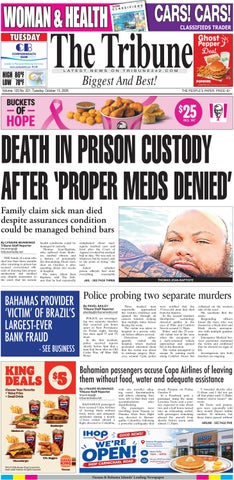
DEATH IN PRISON CUSTODY AFTER ‘PROPER MEDS DENIED’
Family claim sick man died despite assurances condition could be managed behind bars By LYNAIRE MUNNINGS Tribune Staff Reporter lmunnings@ tribunemedia.net THE family of a man who died less than three months after returning to prison has accused correctional officials of denying him proper medication and medical care despite assurances to the court that his serious
health conditions could be managed in custody. Thomas Jean-Baptiste, who suffered from diabetes, morbid obesity and a history of potentially life-threatening blood clots, died on October 4 after spending about two weeks in hospital. His sister, Alicia Jean Baptiste, told The Tribune that he had repeatedly
BAHAMAS PROVIDER ‘VICTIM’ OF BRAZIL’S LARGEST-EVER BANK FRAUD - SEE BUSINESS
complained about inadequate medical care and food after the Court of Appeal revoked his medical bail in July. “He was sick or whatever, but he wasn't sick to the point of dying,” she said. Asked whether prison officials had done everything reasonably THOMAS JEAN-BAPTISTE
JAIL - SEE PAGE THREE
Police probing two separate murders By PAVEL BAILEY Tribune Staff Reporter pbailey@tribunemedia.net POLICE are investigating two separate murders that occurred just hours apart in New Providence on Friday night, leaving two men, aged 37 and 25, dead. In the first incident, police received reports shortly before 9pm that a man had been shot on Old Cedar Way, off Blue Hill Road.
Three masked men reportedly approached the victim’s residence and opened fire through an eastern window, striking him multiple times before fleeing the scene. The victim was taken to hospital in a private vehicle before officers arrived. Detectives subsequently visited the hospital, where medical personnel informed them that the victim was about to undergo surgery. However, around 11pm, police
were notified that the 37-year-old man had died from his injuries. In the second incident, ShotSpotter technology detected gunfire in the area of Flint and Comfort Streets around 11.30pm. Police said the 25-yearold victim was in the area when the occupants of a dark-coloured vehicle approached and opened fire in his direction. The victim attempted to escape by running north along Comfort Street but
collapsed on the western side of the road. His assailants fled the scene. Responding officers found the man, who was dressed in a black shirt and black shorts, unresponsive with multiple gunshot wounds. Emergency Medical Services personnel examined the victim and confirmed that he showed no signs of life. Investigations into both murders are ongoing.
Bahamian passengers accuse Copa Airlines of leaving them without food, water and adequate assistance By LYNAIRE MUNNINGS Tribune Staff Reporter lmunnings@ tribunemedia.net BAHAMIAN passengers have accused Copa Airlines of leaving them without food, water and adequate assistance during a nearly 12-hour ordeal aboard a flight diverted to Colombia,
with one traveller alleging racial discrimination and others claiming they were left to find their own accommodation after disembarking. The passengers were travelling from Nassau to Panama when their flight was diverted to Barranquilla, Colombia, following a powerful earthquake that
struck Panama on Friday, October 9. In a Facebook post, a passenger using the name Lareinae Toote said a journey expected to take about two and a half hours turned into an exhausting ordeal, with passengers remaining aboard the aircraft from shortly before noon until almost 11.30pm.
Nassau & Bahama Islands’ Leading Newspaper
“I boarded shortly after 11.45am, and I did not get off that plane until 11.20pm. Almost twelve hours!” she wrote. Ms Toote said passengers were repeatedly told they would depart within another 30 minutes, but those times passed without AIRLINE - SEE PAGE FIVE
PAGE 2, Tuesday, October 13, 2026
THE TRIBUNE
425 receive national honours for their achievements and service to our island nation PRIME Minister Philip “Brave” Davis yesterday urged young Bahamians to build on the contributions of previous generations as 425 people received national honours for their achievements and service to the country. Speaking at the morning session of the 2026 National Investiture Awards Ceremony, Mr Davis said the honourees represented a wide cross-section of Bahamian society, including public service, private enterprise, the arts, the professions, religious institutions and community organisations. More than 200 recipients were awarded the Distinguished Service Medal, while 17 people were honoured posthumously. Mr Davis said the recipients reflected the importance of recognising Bahamians whose contributions often went unnoticed, particularly those who had
PM urges young Bahamians to build on the contributions of previous generations devoted decades to serving their communities. He recalled growing up in Old Bight, Cat Island, where his grandparents taught him that a person's worth should be measured by what they contributed rather than what they accumulated. The awards were conferred by Governor-General Dame Cynthia Pratt under the country's national honours system, which includes the Order of The Bahamas, Order of Excellence, Order of Distinction, Order of Merit, Distinguished Service Medal and Medal for Acts of Bravery. Arnold Wilson and Rudolph Moxey received
the Medal for Acts of Bravery for putting the lives of others ahead of their own in dangerous circumstances. Mr Davis said the national honours recognised people who had identified needs in their communities and taken responsibility for addressing them, often without expecting recognition. He also paid tribute to former Governor-General Sir Milo Butler and Academy Award-winning actor Sir Sidney Poitier, citing their achievements as examples of Bahamians who opened doors for future generations. Turning his attention to young people, the prime minister urged them to view
the achievements of the honourees as a foundation on which to build. Mr Davis said: “You do not need the perfect idea or the perfect moment. Begin where you are, with what you have. “Look at your community, your school, your church, your workplace. Ask what needs doing. Then ask what you can do about it.” He continued: Nation-building is not the work of government alone. It is not reserved for those with titles or positions. It is the work of every Bahamian who sees a chance to contribute and accepts the responsibility that comes with it."
THE awards were conferred by Governor-General Dame Cynthia “Mother” Pratt. Photos: Chappell Whyms Jr
PRIME Minister Philip “Brave” Davis speaks during the morning session of the 2026 National Investiture Awards Ceremony. Mr Davis encouraged the next generation to pursue excellence while remaining committed to public service and creating opportunities for others.
He congratulated the honourees and their families, saying their achievements reflected the country's values and the importance of service to others.
Minister: Government close to finalising location for halfway house for mentally ill By LYNAIRE MUNNINGS Tribune Staff Reporter lmunnings@ tribunemedia.net NEARLY four years after Parliament passed legislation to overhaul mental health care in The Bahamas, Health and Wellness Minister Dr Michael Darville said the government is close to finalising a location for a halfway house for people with severe, chronic mental illnesses. Dr Darville said an announcement is expected before the end of the year as the government continues efforts to implement the Mental Health Act 2022 and expand community-based treatment. His comments follow a recent announcement by Minister of State in the Ministry of Health and Wellness, Owen Wells, that the government intends to seek Cabinet approval to purchase two safe houses, one for men and another for women, to accommodate people with mental health challenges living on the streets. Mr Wells acknowledged last month that provisions of the Act relating to safe houses had yet to be brought into force, despite the legislation being passed in 2022 to replace laws dating back to 1969. He said the ministry would bring a proposal to Cabinet “very shortly” to obtain approval to purchase the properties but did not provide a timeline for their acquisition or when they would begin operating. It remains unclear whether the halfway house Dr Darville discussed is connected to the two safe houses proposed by Mr Wells or represents a separate initiative. Speaking on the sidelines of a Mental Health Symposium, Dr Darville said the government had been taking steps to implement the legislation, including training and partnerships with the private sector. “The act is very huge; it's very modern, and it's very expensive to bring many of the factors into force,” he said. Dr Darville said the proposed halfway house would work with Sandilands Rehabilitation Centre and
Psychological Services to improve patients' quality of life and help rebuild relationships with their families. He said the government also plans to strengthen community-based mental health care by deploying community mental health nurses to educate residents, identify people with chronic illnesses and help them receive treatment outside hospital settings where appropriate. The initiative is intended to reduce admissions to Sandilands Rehabilitation Centre by helping patients remain in their communities with support, particularly those who struggle to take their medication consistently. Dr Darville said mental health services are already available at several government clinics, particularly in New Providence, but the ministry wants to expand access to psychological support for people experiencing anxiety and depression, as well as treatment for more severe conditions. He said the ministry had spent the past two years developing support structures for public servants and was now preparing to expand services through community clinics. Asked about the proposed introduction of mental health days for public servants, Dr Darville said discussions were continuing with the Ministry of Public Service to determine how the initiative would be implemented. The Act was presented as a major reform intended to strengthen the rights of people with mental illnesses, improve access to appropriate care and establish stronger standards for mental health services. However, its implementation has faced criticism over delays. In September 2024, Dr Darville said the legislation would be brought into force “very shortly”. Two months later, Free National Movement Senator Michaela Barnett-Ellis criticised the government for failing to fully implement the law, arguing that provisions intended to improve mental health care should not remain outstanding.
THE TRIBUNE
Tuesday, October 13, 2026, PAGE 3
Grieving mother recounts the heartbreak of losing her 21-year-old son in Eleuthera traffic accident By PAVEL BAILEY Tribune Staff Reporter pbailey@tribunemedia.net A GRIEVING mother has recounted the heartbreak of losing her 21-year-old son in a traffic accident in Eleuthera on Friday, just days before he was scheduled to undergo surgery in New Providence. Marcera Smith told The Tribune her son Charles Dupuch Jr's life was cut short as he was beginning to chart a course for his future. Police said Mr Dupuch was struck by a white CMC Veryca van while walking along Queen’s Highway around 9.15pm on Friday. The male driver reportedly stopped after hearing a loud bang and realised he had struck someone when he saw Mr Dupuch lying face down on the road with multiple injuries. Mr Dupuch was reportedly taken to a local clinic, where he died at 9.23pm. Mrs Smith said she learnt of the accident shortly after it happened but was unable to be with her son in his final moments. She recalled that a neighbour who worked at the clinic came to her home after receiving a call about an emergency nearby. Knowing that Mr Dupuch frequently went for walks, the neighbour was concerned that he might have been involved. Mrs Smith said she rushed from her home after discovering her son was missing and found him at the scene of the accident. “He was still breathing at the time,” she said. “I just, and they wouldn't let me near him, so I just paced in the center of the road.” She said her son's stepfather accompanied him in
the ambulance while she was taken to the clinic. “I was just opening the phone through because the nurse had told me he was still breathing, and I felt as long as he was still breathing, he'd have a fighting chance.” Mrs Smith said her son had been scheduled to undergo surgery at Princess Margaret Hospital on Wednesday to remove a large mucus cyst from his left sphenoid sinus. Instead, she was now faced with the devastating task of identifying his body at the morgue. She said Mr Dupuch had been experiencing health problems throughout the year, including neck stiffness, difficulty sleeping and other uncomfortable symptoms. A CT scan in September revealed the cyst, which was pressing on surrounding nerves. The family had been preparing for his trip to New Providence, and Mr Dupuch had washed his clothes and arranged his video games before going out for a walk to ease his symptoms. “Yeah, and I just was frustrated because I just get he was having some health issues, and I just scheduled his surgery for Wednesday, and so he had washed his clothes,” she said. He had set up his game to come back to his video games, and he went outside to walk because the walking helped with the symptoms he was having, and it's just-it was not what I was expected. I mean, he was just walking.” Mrs Smith said she moved her family from New Providence to Eleuthera when Dupuch was ten, hoping to raise him away from negative influences. She said he embraced life on the Family Island
CHARLES DUPUCH JR with his mother Marcera Smith.
and attended Deep Creek School, where he excelled in hands-on learning. She described her son as intelligent, practical and passionate about farming, Junkanoo, swimming and video games. After developing an interest in agriculture at school, Dupuch completed a tertiary-level course in hydroponic farming. He later worked as a lifeguard, combining his employment with his love of the water. Mrs Smith said her son enjoyed meaningful conversations, had a strong sense
of humour and preferred spending time with his girlfriend or playing video games rather than socialising in large groups. “He was still figuring it out," she said. "He was only 21, and I didn't put any pressure on them. “They was just still at home, still living at home, and figuring it out. She said the family had been working towards securing land so Mr Dupuch could eventually build his own home and achieve financial independence.
Mrs Smith was helping him apply for land through his biological father's family settlement on the island. Mr Dupuch was the second child Mrs Smith has lost. His older sister, Cherith, died at three months old after being born prematurely and contracting an illness. Mrs Smith said she never imagined having to bury another child and had always expected her children to outlive her. She said: “It's just natural to think that okay, it would be me that they would bury me, and they would have each other for the rest of their lives. Not that we would have to look at letting him go.” She said Mr Dupuch's surviving sisters, aged 18 and eight, were struggling to come to terms with his death. Her older daughter has moments of grief, while the youngest has begun asking questions about why doctors could not save her brother. Mrs Smith said the family home no longer felt the same, with Mr Dupuch's belongings remaining where he left them. She said his television and video game console had remained on since Friday, and she could see flowers placed at the accident scene from her front door. Despite her grief, Mrs Smith said she had found some comfort in the outpouring of support from her son's former teachers,
employers and others who knew him. She said the tributes reflected the kind of person he had become and the positive impression he left on those around him. “And so that's one thing I'm proud of-that he carried himself out in the world like a decent human being. That's all I wanted to make it.” Asked whether she had heard from the driver involved in the accident, Mrs Smith said she had not received any condolences and was still waiting for answers about the circumstances of her son's death. She said the family had questions about the accident but was told police could not provide details while their investigation continued. Mrs Smith acknowledged feeling anger but said she was trying not to dwell on it as she prepared to bury her son. “I don't want to deal with it," she said. "I feel like that's a rabbit hole that I go down right now. Given the anger that I'm already sitting on and having to bury another child, that's something I can't afford to open right now while I deal with everything that's going on. I know it was an accident. Like I understand it was an accident, but just everything else around it just makes it even more difficult to just wrap my mind around.” Police investigations are ongoing.
Family claim sick man died despite assurances condition could be managed behind bars JAIL - FROM PAGE ONE possible to protect her brother’s life, Ms Jean Baptiste said: “Absolutely not, they made no efforts, period.” “The court order did not matter. It did not stand. They took no care, no concern.” In July, the Court of Appeal rejected Mr Jean-Baptiste’s challenge to his prison sentences, finding that his medical conditions did not justify reducing his terms or replacing them with a non-custodial sentence. The court revoked his bail and ordered him to return to the Bahamas Department of Correctional Services to serve the remainder of his concurrent sentences of three years for possession of an unlicensed firearm and two years for possession of ammunition. During the appeal, consultant urologist Dr Robin Roberts warned that Mr Jean-Baptiste’s diabetes, morbid obesity and history of multiple pulmonary emboli placed him at high risk of serious complications. He required lifelong anticoagulant medication. Dr Roberts warned that prison conditions could increase his risk of serious infection, including potentially fatal Fournier’s gangrene, and expressed concern about another pulmonary embolism. However, the Court of Appeal placed greater weight on the assessment of prison physician Dr Scavella, who said the institution could manage his illnesses and transfer him to Princess Margaret Hospital if specialised treatment became necessary. Dr Scavella recommended that Mr
Jean-Baptiste be provided with a bed, daily exercise and access to bathing and toilet facilities. Ms Jean Baptiste alleged that her brother was supposed to be housed in the prison infirmary but instead spent about a month in intake before being moved to another section of the institution. She claimed the area had no air conditioning, frequently lost electricity and was far from the infirmary. She also alleged that he was not consistently given medication he had purchased before returning to custody. “One of his medications alone was like almost like $300 just for one,” she said. She questioned why prison officials would fail to administer medication he had obtained himself after assuring the court that his medical needs could be managed. Ms Jean Baptiste also alleged that her brother frequently complained about prison food, sometimes barely eating and relying on meals purchased by relatives. She said he was initially taken to hospital after complaining of leg pain and was found to have blood clots, but was returned to prison either that night or the following morning. Mr Jean-Baptiste later complained that prison officials were not checking on him, although his family initially believed he was expressing frustration with prison life rather than signalling a medical crisis. He was subsequently rushed to hospital again, but relatives were not immediately informed. Ms Jean Baptiste said her mother travelled to New
Providence to visit him. By then, his condition had deteriorated significantly. She said that after two medical episodes, doctors discussed discharging him despite his inability to speak or move one side of his body. The family was also told that officials were concerned about returning him to the prison infirmary because it was on the second floor and his size would make transporting him upstairs difficult. Ms Jean Baptiste said her brother cried at the prospect of returning to prison. She said the family would have needed further legal proceedings to secure his release, but he died before they could pursue that option. “I feel like the neglect began from the courthouse,” she said. “Everybody know the prison within itself is not a humane place to be. It’s not a clean place to be.” Mr Jean-Baptiste was convicted on November 10, 2025, after police found a firearm containing five rounds of ammunition in his vehicle during an April 2023 traffic stop. He was granted medical bail in December 2025 but returned to prison after losing his sentence appeal in July. The Court of Appeal ruled that his medical conditions had to be weighed against the seriousness of his offences and the need for punishment and deterrence. It noted that he could seek relief through the Prerogative of Mercy if prison authorities became unable to provide adequate care. Ms Jean Baptiste said her brother’s death had
devastated his family, including his three children. She described him as an outgoing man known through his work as a boat captain. “Why was
he being neglected? Why was he not being provided with the medications that he took for himself to stay in good health, as his body depended on those
medications every day,” she said. “They don’t have to provide the bare minimum just because they’re inmates, or be neglectful just because they’re inmates,” she said.
PAGE 4, Tuesday, October 13, 2026
THE TRIBUNE
Natonal security minister Myles Laroda defends police officers’ promotion By JADE RUSSELL Tribune Staff Reporter jrussell@tribunemedia.net NATIONAL Security Minister Myles Laroda has defended the promotion of about 1,300 Royal Bahamas Police Force officers, saying they deserved to be recognised for their service. “Where you have officers who put their life on the line every day to keep our citizens safe, you know that is a price that the government is prepared to pay,” he said, Mr Laroda acknowledged the scale of the promotion exercise but said some
Says they deserve to be recognised for their service deserving officers may not have been included in this round. He added that more officers could be promoted later in the current term. He was unable to provide a price tag for the promotion exercise. Last week, about 1,300 officers were promoted in an exercise Police Commissioner Shanta Knowles said reflected the force’s commitment to recognising
merit, professionalism and dedicated service across all ranks. Commissioner Knowles said the promotions included 800 regular officers and 500 reserve officers. She could not say whether it was the largest promotion exercise in the force’s history. The promotions ranged from corporal to chief superintendent for both regular and reserve officers.
NATIONAL Security Minister Myles Laroda says Royal Bahamas Police Force officers deserve to be recognised for their service. In a message to the officers, Commissioner Knowles thanked them for their hard work, dedication and service. The promotion list has not been made public, and some appointments have raised questions because of past lawsuits involving officers who were promoted. Mr Laroda did not speak to recent controversy
surrounding the promotion of Jerone Thompson, who was moved from inspector to assistant superintendent despite a court ruling involving his conduct that resulted in a $103,000 damages award against the government. The Court of Appeal had also rebuked Mr Thompson for kneeling on a man’s neck, prompting opposition calls for greater scrutiny of
police promotion decisions. Speaking generally, Opposition leader Michael Pintard has called for cases involving officers who had harmed members of the public or cost the government money should be examined and considered before promotions are granted. Mr Pintard said his party had long raised concerns about bias in police promotions.
Laroda says officials are concerned about rocket-propelled grenade launcher found off highway By JADE RUSSELL Tribune Staff Reporter jrussell@tribunemedia.net NATIONAL Security Minister Myles Laroda says officials are concerned about a rocket-propelled grenade launcher found hidden beneath an abandoned stove off Tonique Williams-Darling Highway last week. Mr Laroda said the weapon could cause serious damage, adding that officials hoped its discovery
was an isolated incident. However, the discovery has prompted further investigation into how criminal weapons are being smuggled into the country. Asked how the military weapon entered the country, Mr Laroda declined to comment on the specifics but said the Commissioner of Police was taking the matter seriously. Police said officers from Operation Black Scorpion, assisted by the Anti-Terrorism Unit and Canine
Support Unit, were acting on information when they searched an area on the southern side of Pride Estates. Beneath the stove, officers found a green camouflage bag containing the launcher. The Tribune understands that its markings and telescoping tube suggest it is a light anti-tank weapon, sometimes called a light anti-armour weapon. It is believed to be a United States-designed,
single-use launcher that fires a 66mm unguided rocket with a high-explosive anti-tank warhead designed to disable armoured vehicles and fortified positions at short range. Such weapons entered service with the US military in the early 1960s and were used during the Vietnam War. They have since been carried by armed forces around the world, including those in Canada, Australia, Israel and Taiwan.
Discoveries of military-grade explosive weapons in The Bahamas are rare. The discovery comes amid a separate incident involving a trainee correctional officer who was found with marijuana hidden inside his work boots when he reported for duty at the prison last week. A subsequent search of his vehicle uncovered additional packages of marijuana. The 23-year-old officer reportedly pleaded guilty
to possession of dangerous drugs with intent to supply and possession of dangerous drugs at his arraignment. He was fined $4,500. Mr Laroda said this was not the first time an officer had been arrested, adding that he was aware of several other cases. He applauded officers who, despite having personal relationships with their colleagues, still held them accountable for their actions.
Minister warns against ‘vigilante justice’ following viral video of boy hanging from fence after stealing bicycle By JADE RUSSELL Tribune Staff Reporter jrussell@tribunemedia.net NATIONAL Security Minister Myles Laroda has warned against “vigilante justice” following a viral video showing a nine-yearold boy hanging from a fence by his shirt after stealing a man’s bicycle. Mr Laroda said the theft should have been handled by the Royal Bahamas Police Force. He acknowledged the community’s concerns about the child’s behaviour but cautioned
against taking matters into their own hands. “We could do the wrong things sometimes for the right reason,” he told reporters. “From what I saw, you know, that could have gone in a different direction. “While I support discipline, I support respect. I think it should be proportional. I discourage vigilante justice. We see what is happening on our streets to our young men, and that is not a direction I would like us to go to.” Mr Laroda’s comments come after a series of videos
involving the nine-year-old and the bicycle theft went viral on social media last week. The incident began on Monday when a video showed a man riding his bicycle to a corner store, parking it outside and entering the establishment. Several boys were gathered nearby on bicycles. The nine-year-old was seen sitting on the handlebars of another boy’s bicycle before getting off and waiting for the man to enter the store. He then took the unattended bicycle and
rode away with some of the other boys. A second video, titled “Culprit caught”, showed the group being confronted by a man who was recording them and demanding to know who had stolen the bicycle. The other boys pointed to the nine-year-old, identifying him as the person responsible. One boy smiled and shouted while pointing at him. The man then grabbed the child by the arm and told him he was getting “locked up”.
Another video showed the boy hanging from a fence by his shirt and crying as the person recording questioned who had placed him there. The footage prompted debate online, with some arguing that the boy should face consequences for stealing, while others condemned the decision to hang him from the fence and record his distress. In an interview with The Tribune, the boy’s mother condemned the public humiliation of her nine-year-old son. She
said he deserved discipline but should not have been treated that way. “They never should have hung him on the fence,” she said. “They should have brought him to me and let me know what he did instead of hanging him on the fence and recording it and posting it like it's a joke.” The single mother of eight added that she had disciplined her son over the theft but believed he was being influenced by older boys whose company she had repeatedly tried to keep him away from.
THE TRIBUNE
Tuesday, October 13, 2026, PAGE 5
LAREINAE TOOTE - Copa Airlines passenger.
MERICHA ROCHELLE - Copa Airlines passenger.
ELAINA CUFFY-STUART - Copa Airlines passenger.
Bahamians accuse Copa Airlines of leaving them without food, water and adequate assistance AIRLINE - FROM PAGE ONE clear explanations about when they would be allowed to leave. She alleged that passengers were left waiting for fuel without food or water and that the aircraft’s air conditioning repeatedly switched on and off, making the prolonged wait increasingly uncomfortable. “During those hours, there were also multiple incidents onboard that required police involvement, and some passengers needed medical assistance,” she wrote. “This was not just an inconvenience. Being stuck on a plane for nearly 12 hours under these circumstances was physically and emotionally exhausting.” The ordeal reportedly continued after passengers were allowed off the aircraft at 11.20pm. Ms Toote said they had been told accommodation would be provided, but no airline agents were available to assist them. Another Bahamian passenger, identified on Facebook as Elaina Cuffy-Stuart, said she was also aboard the flight and alleged that some passengers received preferential treatment during the prolonged wait. Ms Cuffy-Stuart claimed some Colombian passengers were allowed to leave the aircraft, affecting the passenger manifest and preventing the flight from returning to Panama because not everyone originally listed on the flight was present. She also complained that announcements were frequently made in Spanish, leaving English-speaking passengers confused about what was happening. “Snacks and drinks were being handed out to Hispanic natives, another clear example of the blatant racism shown yesterday,” she wrote. Her allegations of discriminatory treatment have not been independently verified. Ms Cuffy-Stuart further claimed that a Colombian woman stormed the cockpit area, demanded to be allowed off the aircraft and beat on the door before
eventually being permitted to leave. “Imagine if one of us Bahamians did that,” she wrote. Ms Cuffy-Stuart, who said she was travelling in business class, also alleged that she witnessed economy-class passengers entering the cockpit area, sitting in flight attendant seats and going through the snacks. She said the difficulties continued after passengers disembarked, claiming airport officials refused to serve people who did not speak Spanish. She alleged that Bahamian passengers were left to fend for themselves at an unfamiliar airport without working Wi-Fi, accommodation or rebooking arrangements. She also claimed Copa Airlines’ call centre and website were unavailable, leaving her uncertain about how she would continue her journey. A third passenger, identified on Facebook as Mericha Rochelle, said she was grateful the group had not experienced the earthquake in Panama itself, despite their frightening experience in Colombia. “After everything we experienced, I’m just grateful I didn’t have to go through an earthquake in Panama. I know God was protecting all of us on that plane from something far worse as scary as our experience was,” she wrote. Ms Rochelle said she doubted she would fly with Copa Airlines again and that the experience had changed her view of Colombia as a destination. However, she also expressed gratitude to people who helped the stranded passengers after they were allowed off the aircraft. The passengers’ ordeal followed a magnitude 7.7 earthquake that struck southern Panama on Friday, October 9, prompting evacuations, damaging buildings and temporarily disrupting air travel. According to the United States Geological Survey, the earthquake struck at a depth of about 12.6 kilometres, with its epicentre in a sparsely populated area
Decomposing body of man discovered in bushes near Blair Estates By PAVEL BAILEY Tribune Staff Reporter pbailey@tribunemedia.net POLICE are investigating the death of a man believed to be in his mid60s after his decomposing body was discovered in bushes near Blair Estates on Saturday. Police found the body on St Andrews Drive, off Village Road, after a concerned citizen alerted them around 10.30am. The man, described as Caucasian, was wearing a
T-shirt, shorts, a black belt and brown shoes. Emergency Medical Services personnel attended the scene and confirmed that he showed no signs of life. Detectives processed the scene, and preliminary findings suggest that foul play is not suspected. Police are awaiting formal identification of the deceased by his next of kin and the results of an autopsy to determine the cause of death. Investigations are ongoing.
near Pitaloza Arriba in Herrera province, approximately 200 kilometres from Panama City. Damage was reported in several communities, including Penonomé, where buildings were damaged or partially collapsed. Power outages were also reported across six provinces. The Associated Press reported that a second powerful earthquake, measuring
magnitude 6.6, struck the region on Friday. The tremors prompted evacuations, while a tsunami warning issued after the initial earthquake was later lifted. Reuters reported on October 9 that operations at Tocumen International Airport, Panama’s main international gateway, were temporarily suspended following the earthquake
before resuming later that day. The Panama Canal, a major international shipping route, continued operating normally. The disruption extended to international aviation, with flights diverted to alternative airports as authorities responded to the emergency. Colombia made several airports available to receive diverted
international flights, including those in Barranquilla and Cartagena. At least 27 people were injured and nearly 900 homes damaged, according to emergency authorities cited by Reuters. No deaths had been reported at the time. The government declared a national state of emergency over the weekend, allowing it to allocate up to $100m in relief funding.
PAGE 6, Tuesday, October 13, 2026
THE TRIBUNE
The Tribune Limited NULLIUS ADDICTUS JURARE IN VERBA MAGISTRI “Being Bound to Swear to The Dogmas of No Master”
LEON E. H. DUPUCH,
Publisher/Editor 1903-1914
SIR ETIENNE DUPUCH,
Kt., O.B.E., K.M., K.C.S.G., (Hon.) LL.D., D.Litt .
Publisher/Editor 1919-1972 Contributing Editor 1972-1991
RT HON EILEEN DUPUCH CARRON,
C.M.G., M.S., B.A., LL.B. Publisher/Editor 1972-
Published daily Monday to Friday
Shirley & Deveaux Streets, Nassau, Bahamas N3207 TELEPHONES News & General Information Advertising Manager Circulation Department Nassau fax Freeport, Grand Bahama Freeport fax
(242) 502-2350 (242) 502-2394 (242) 502-2386 (242) 328-2398 (242)-352-6608 (242) 352-9348
WEBSITE, TWITTER & FACEBOOK www.tribune242.com
@tribune242
tribune news network
When someone finally asks for help By the time a person admits they are struggling, they may have spent months making sure nobody notices. They have gone to work, taken the children to school, answered messages and told friends they are fine. From the outside, life appears to be moving along. Privately, getting through an ordinary day has become exhausting. That is why the recent report that more Bahamians are seeking professional mental-health support deserves our attention. There is something hopeful in people deciding they no longer have to manage everything alone. We should be careful about reading too much into that observation. It does not, by itself, tell us whether more people are becoming unwell, whether attitudes are changing or whether services are becoming better known. But it does raise a practical question: when someone finds the courage to ask for help, what happens next? Encouraging people to speak openly is only useful if someone is available to listen and provide appropriate care. Consider the working parent who can afford a consultation but cannot afford regular appointments. Or the employee who worries that asking for time off will invite questions they would rather not answer. On a small island, even walking into a particular office may feel like an announcement to the entire community. These are the everyday obstacles a serious national conversation must address. In The Bahamas, we pride ourselves on knowing one another. That closeness can be a great comfort. It can also make privacy difficult. A person may reasonably want professional help without their relatives, employer or neighbours knowing why. Confidentiality must therefore be treated as a basic part of good care. People should understand who can see their records, how appointments are handled and what information, if any, is shared with others. Affordability deserves the same attention. A service is of limited value to someone who must choose between attending an appointment and paying
an electricity bill. Public services and partnerships with qualified private practitioners should be organised around the reality that care may require several visits. The Ministry of Health should make it easier to find reliable information about available services, costs and referral arrangements. There should be clear routes into care through community clinics, with specialist support available when needed. Secure remote consultations could also help Family Island residents where clinically appropriate. This requires staff, funding and careful planning. Healthcare workers already carrying heavy responsibilities cannot simply be handed another programme without the resources to deliver it. Any expansion should begin with an honest assessment of demand, waiting times and workforce capacity. Employers have a part to play, too. A supervisor does not need an employee’s personal history to respond decently to a request for a medical appointment. Confidential assistance, reasonable flexibility and managers who know how to handle sensitive conversations would make seeking care less daunting. There is also work for the rest of us. We sometimes respond to another person’s distress by explaining how much worse somebody else has it. We offer a lecture when they have asked for a little understanding. Faith, family and friendship can provide enormous support, but they should leave room for professional care. Nor should every difficult emotion be treated as an illness. Grief, disappointment and worry belong to human life. Qualified professionals can help people understand what they are experiencing and what support may be appropriate. The encouraging part of this moment is that people appear more willing to reach out. That willingness deserves a dependable response. Someone who asks for help should come away feeling that they have taken a useful first step—and knowing how to take the next one.
The tragic case of delayed care at Princess Margaret Hospital EDITOR, The Tribune. THE recent passing of a well-known and outspoken Bahamian citizen, affectionately known as “Sparky” is deeply troubling. Sparky was a familiar voice on radio talk shows, fearlessly challenging poor governance and demanding accountability. According to reports, he arrived at the Princess Margaret Hospital’s emergency Department at 8pm one evening suffering from severe pain and waited until 7am the following morning without seeing a physician. He eventually left the emergency room and tragically died a day or two later after his return seeking help again at the hospital. While we cannot conclude that his death could have been prevented, this incident raises serious questions about the timeliness of emergency medical care in our country.
letters@tribunemedia.net No patient experiencing severe pain should have to wait 11 hours, much less 24 hrs as in some prior cases for appropriate medical assessment, regardless of staffing shortages, overcrowding or administrative challenges. Such prolonged delays are unacceptable and reflect a healthcare system under tremendous strain. The Princess Margaret Hospital, which dates to 1952, was developed to serve a vastly smaller population than the one we have today. The Bahamas now has a population approaching half million, with additional demands from foreign workers, permit holders and visitors. Our population has grown, our healthcare has expanded, but our public
DR VERONICA McIVER Health Advocate Nassau, October 11, 2026.
Celebration Key made a bad situation worse for Port Lucaya Marketplace EDITOR, The Tribune. THERE were troubling rumours circulating throughout Freeport on October 5 that Agave Lucaya had permanently closed down. Those rumours are unfounded, thankfully. A principal of Agave assured the Grand Bahama Chamber of Commerce that Agave has temporarily closed its doors in order to undergo renovations. The slow period is ideal for such an undertaking. This was published in the Tribune online business site on October 6. The fears of Grand Bahamians regarding Agave can now be put to rest. For many other businesses in the Port Lucaya Marketplace, however, they are not as fortunate as the popular restaurant. You see, according to the Central Bank of the Bahamas Monthly Economic and Financial Developments report, while sea arrivals to Grand Bahama increased from 64,916 in 2025 to over 171,300 for the first eight months of 2026, air arrivals have plummeted to just 5,831. Those who are all over the media touting the massive numbers of sea arrivals aren’t really being forthcoming with the people of Grand Bahama. The overwhelming majority of the 171,300 visitors who came to Grand Bahama came via Carnival to its $600 million cruise port development called Celebration Key. While the tourism sector outside of Celebration Key is drying up, the Carnival Cruise port is experiencing
an economic boom that is recession proof. Celebration Key is an oasis in the middle of a economic desert called Freeport. It is similar to the hilltop gated communities in Haiti, which are shielded from the harsh realities of systemic poverty for the overwhelming majority of the Haitian people. Stakeholders in the tourism sector would also tell you that they prefer air arrivals over sea arrivals because the former typically stays at the resorts and hotels and dine in the local restaurants. It is these tourists who are the backbone of the tourism sector. Cruise ship passengers, on the other hand, are inflating the numbers while not having the economic impact their overnight counterparts are having on the domestic economy. Celebration Key opened in July 2025. We were led to believe that this development would revitalise the Grand Bahamian economy. This pledge has yet to materialise. In fact, I would argue that Celebration Key’s presence has sounded the death knell of Port Lucaya Marketplace and several other tourist spots that once thrived before the opening of the cruise port. Celebration Key has made a bad situation in Port Lucaya worse. Much worse. As I stated in a previous write-up, the traffic that once flowed to Port Lucaya from Freeport Harbour has since shifted to Celebration Key. This has led to both the Freeport Harbour and Port Lucaya Marketplace becoming ghost towns.
Even Taino Beach Resort and several other tourist spots have not been able to avoid the devastating impact of Celebration Key. At its current trajectory, the Port Lucaya Marketplace will suffer the same fate as the International Bazaar. What Carnival Cruise should consider doing is allowing three of its ships to dock at the Freeport Harbour each week to help the local economy. The Ministry of Tourism, the Ministry for Grand Bahama and the Grand Bahama Port Authority should all engage the principals of Carnival with the aim of bolstering the tourism sector outside of its $600 million port development. Far too many Grand Bahamians who depend on the tourism sector have fallen through the cracks since July 2025. We thank God for the employment and entrepreneurial opportunities Celebration Key has provided for some in Grand Bahama. We thank God for the tens of thousands of tourists who visit Celebration Key each month. But this economic boom in the multimillion-dollar development is isolated, because of the lack of a better term, from the rest of Grand Bahama. If measures aren’t taken in the coming months, I fear that Port Lucaya Marketplace will become the next International Bazaar. The time to act is now. KEVIN EVANS Freeport, Grand Bahamas October 7, 2026.
Electric power cut to the main shopping district, why? EDITOR, The Tribune. I appreciate the space provided to me at this juncture to vent on an issue dear to our hearts and for which we have been receiving the same short circuit suspension of our Bahamas Power & Light (BPL) connectivities. On Monday October 5, 2026 while on my usual commute in the city center, I was surprised to see that some of the businesses downtown Nassau didn’t have power, and what was painful to see the number of tourists standing just in the doorway, with the ones brave enough were deeper inside the store, being served in darkness, but this is the city center should have substitution power source. One Of the stores I decided to visit had a light because of power backup and what the sales person revealed was that the power was offline since yesterday morning, but how come? On hearing this I was taken aback about a Canadian tourist who lamented that we in the Bahamas with all of this God’s sunlight ought not be having the outages that we
LETTERS
hospital infrastructure has failed to keep pace. Emergency departments must have the capacity to promptly triage, assess and treat patients according to the severity of their conditions. We cannot continue to normalise overcrowding, excessive waiting times and inadequate access to emergency care. This tragic incident demands a thorough investigation, accountability where warranted, and urgent, meaningful reform. A hospital emergency room must be a place where lives are saved, not a place where patients lose hope while waiting for help.
seasonally have, comparing that Canada has fewer hours of sunlight, yet the power remains-on much longer than The Bahamas’, asking me what seems to be the problem? I do believe that plenty of policking is taking place, where Bahamian people don’t seem to matter to them, the holders, managers of the power company? That’s horrible! Editor, what I find intriguing is that for years Bahamians have been paying the surcharge attached to billing and what was unfair was more than actual electricity used, never a re-endorsement recouping of any sums, portions, why? What many of the customers of the corporation have been questioning is just how difficult could managing a utility company be? After All the systems have identified each office category within the company and with the procedure must attached, you have revenues collected from usages, balances, purchases of crude oils and what that sum maybe for the various overhead salaries, incidentals, transportation expenses,
gasoline, diesel maintenance, perhaps government taxes, loans? And it is not like something catches them off guard, maybe an electrical storm where damages resulted to their systems, these were fundamental mechanisms materially connected to the management of this kind of power generation company, but it appears that wisdom, knowledge and understanding have gone on holidays? Editor, my query is how would the businesses recoup their losses for all of the hours and days of no power? This company was said to be owned by The Bahamian people, many have grown discontented with the poor management unacceptable billings being passed down to its consumers of the occasional power. And what is assured is that we cannot go on and supplement the corporation to the tune of hundreds of millions of dollars, translated further taxes, with bills upon bills, for it must end? FRANK GILBERT Nassau, October 6, 2026.
THE TRIBUNE
Tuesday, October 13, 2026, PAGE 7
Supreme Court upholds murder trial for Shakeem Munroe despite fiveyear delay in pathologist report By LYNAIRE MUNNINGS Tribune Staff Reporter lmunnings@tribunemedia.net A SUPREME Court judge has ruled that a man must still stand trial for murder, despite the State taking more than five years to provide a pathologist’s report, forcing repeated trial delays. Justice Dale Fitzpatrick said the prosecution was stalled for five years and three months while awaiting the report on the death of Lamar Moss, who was allegedly murdered by Shakeem Munroe in January 2021. The report was not disclosed until May 28, 2026, despite the autopsy being completed days after Mr Moss’ death. Mr Munroe’s trial is now scheduled to begin next year, on February 22, more than six years after his arrest. Justice Fitzpatrick said the delay was entirely the State’s responsibility but found that the limited prejudice suffered by Mr Munroe did not establish a violation of his constitutional right to a trial within a reasonable time. Mr Munroe had asked the court to declare that his constitutional rights had been breached and award him damages. However, Justice Fitzpatrick dismissed the application. Mr Munroe was arrested on January 26, 2021, and charged with murder on February 1. He was granted bail on May 28 that year, subject to conditions including electronic monitoring, regular police sign-ins and a curfew from 9pm to 6am. The case was repeatedly delayed because the pathologist’s report remained outstanding. Trial dates set for November 2023 and March 2025 were vacated, while a further trial date in March 2026 was also abandoned. Justice Fitzpatrick said the State could not escape responsibility for the delay simply because the Director of Public Prosecutions had repeatedly requested the report without success. The Pathology Department at Princess Margaret Hospital, which prepares the reports, falls under the Public Hospitals Authority.
The judge said delays by any government agency involved in the prosecution must be treated as the State’s responsibility. He also noted that the Bail Act establishes three years as a reasonable period for bringing an accused person to trial. Mr Munroe’s case exceeded that benchmark by more than three years, with no evidence that its complexity justified the additional time. The judge found that Mr Munroe had not contributed to the delay. He retained a lawyer promptly, attended court when required and accepted the trial dates offered. There was no instance in which he sought an adjournment or objected to an available trial date. However, Justice Fitzpatrick said Mr Munroe provided no evidence to substantiate his assertion that the delay had compromised his ability to receive a fair trial. The judge acknowledged that the proceedings had disrupted Mr Munroe’s family, social and working life and left him facing the stigma and uncertainty of a murder charge for years. He also raised concerns about the effect of the delay on the prosecution’s nine witnesses, particularly its primary eyewitness, Mr Dames. The court had no recent statement from the witness or evidence that prosecutors had recently contacted him to establish whether he could still recall the events of January 2021. Justice Fitzpatrick said fading memories could affect the fairness of a trial but concluded that the prejudice to Mr Munroe was minimal because he had not specifically explained or provided evidence of how the delay affected his defence. The judge said damages would not have been available even if a constitutional breach had been established, as Mr Munroe’s prosecution remains ongoing and he did not seek to have the proceedings stopped. His application for constitutional relief and damages was dismissed, and his trial remains scheduled for February 22, 2027.
INTERNATIONAL BUSINESS COMPANIES ACT, 2000 True Logos Ltd. In Voluntary Liquidation
NOTICE is hereby given that in accordance with Section 138(4) of The International Business Companies Act, 2000, True Logos Ltd. is in dissolution. The date of commencement of the dissolution was the 7th day of October A.D., 2026. Mr. Michael C. Miller, P.O. Box EE-17971, Nassau, Bahamas is the liquidator of True Logos Ltd. Michael C. Miller Liquidator
NOTICE
NOTICE is hereby given that MITCH BAZILE of #1 Claridge Avenue, Fox Hill, New Providence, Bahamas is applying to the Minister responsible for Nationality and Citizenship, for registration/ naturalization as a citizen of The Bahamas, and that any person who knows any reason why registration/naturalization should not be granted, should send a written and signed statement of the facts within twenty-eight days from the 6th day of October, 2026 to the Minister responsible for nationality and Citizenship, P.O. Box N-7147, Nassau, Bahamas.
Four men charged with stealing $66,000 worth of motorcycles from Harbour Island Police Station By PAVEL BAILEY Tribune Staff Reporter pbailey@tribunemedia.net FOUR men were accused of breaking into the Harbour Island Police Station and stealing 11 motorcycles worth
$66,000 earlier this month. Prosecutors allege Malik Whitfield, 19, Sharmal Saunders, 19, Jeremy Davis, 21, and Janeiko Saunders, 23, broke into the station and stole ten Yamaha motorcycles and
one Honda motorcycle between 11.30pm on October 1 and 2am on October 2. The defendants pleaded not guilty to housebreaking, stealing and receiving before Magistrate Abigail Farrington.
Owner fined and ordered to compensate after dog attack on Sumner Street By PAVEL BAILEY Tribune Staff Reporter pbailey@tribunemedia.net A MAN was fined $1,000 and ordered to
pay a woman $3,000 in compensation after his dog attacked and injured her on Sumner Street last month.
Ricardo Hinsley Jr, 42, allowed his dog to attack Gweneth Rolle near his home on September 4. Hinsley pleaded guilty to causing harm by animal
Six-month prison sentence for assault at breakfast stand By PAVEL BAILEY Tribune Staff Reporter pbailey@tribunemedia.net A MAN was sentenced to six months in prison
for injuring another man during an altercation at a breakfast stand last month. Shaquille Thompson, 33, attacked Dwayne Cooper at Milsa Breakfast
Stand around 9.30am on September 29, causing injuries. Thompson pleaded guilty to causing harm before Senior Magistrate Algernon Allen Jr.
Trainee correctional officer fined $4,500 for attempting to smuggle drugs into prison By PAVEL BAILEY Tribune Staff Reporter pbailey@tribunemedia.net A 23-year-old trainee correctional officer was fined $4,500 after
admitting to trying to smuggle drugs into prison. Darius Brown was found with 14.1 ounces of marijuana hidden in his work boots after his superior smelled drugs on him when he reported for duty.
A MAN is accused of stealing $42,830.80 from four people over six months.
Prosecutors allege Robinson Piervilus, 26, stole the money from four individuals to which he had access by reason of service between March 14 and August 13.
NOTICE
NOTICE is hereby given that I LOCHAMA LOUIS of Florida Court, New Providence, Bahamas, applying to the Minister responsible for Nationality and Citizenship, for Registration Naturalization as a citizen of The Bahamas, and that any person who knows any reason why registration/naturalization should not be granted, should send a written and signed statement of the facts within twenty-eight days from the 6th day of October, 2026 to the Minister responsible for nationality and Citizenship, P.O. Box N-7147, Nassau, New Providence, The Bahamas.
NOTICE
NOTICE is hereby given that TONNESHIA PINDER of Soldier Road, New Providence, Bahamas is applying to the Minister responsible for Nationality and Citizenship, for registration/ naturalization as a citizen of The Bahamas, and that any person who knows any reason why registration/naturalization should not be granted, should send a written and signed statement of the facts within twenty-eight days from the 5th day of October, 2026 to the Minister responsible for nationality and Citizenship, P.O. Box N-7147, Nassau, Bahamas.
before Deputy Chief Magistrate Shaka Serville. Should Hinsley fail to pay his fine or compensate the complainant, he risks a six-month prison term. The court also ordered that Hinsley's dog be put down. Hinsley is scheduled to return to court on October 13 to provide proof of payment. Inspector Cordero Farrington prosecuted the case.
The defendant expressed remorse for his actions, saying he had let his anger get the better of him. After admonishing the defendant for his violent actions, Magistrate Allen sentenced Thompson to six months at the Bahamas Department of Correctional Services. Inspector 3004 Sherquell Forbes prosecuted the case.
An additional 5.8 ounces of marijuana was found in the defendant’s car. The drugs had an estimated street value of $2,900.
Brown pleaded guilty to possession of dangerous drugs with intent to supply and possession of dangerous drugs before Senior Magistrate Raquel Whyms. After reprimanding Brown for conduct unbecoming of his position, Magistrate Whyms fined him $4,500. Failure to pay the fine would result in a prison sentence.
Piervilus pleaded not guilty to four counts of stealing by reason of service and money laundering before Senior Magistrate Anishka Isaacs. The defendant's bail was set at $9,900 with one
or two sureties. Under the terms of his bail, he must sign in at the Carmichael Road Police Station every Monday and Thursday by 6pm. The accused is scheduled to return for trial on March 30. Sergeant 2257 Wilkinson prosecuted the case, while Ian Jupp represented the accused.
Local resident accused of stealing over $42,000 from four individuals By PAVEL BAILEY Tribune Staff Reporter pbailey@tribunemedia.net
Whitfield and Davis were each granted $7,500 bail with one or two sureties. The remaining defendants were each granted $9,500 bail. Both Sharmal and Janeiko Saunders are to be fitted with electronic monitoring devices and must obey an 8pm to 6am residential curfew. All four defendants must sign in at the Harbour Island Police Station every Monday, Wednesday and Friday by 7pm. A trial date for the accused will be fixed in Harbour Island on October 27. Joel Seymour and Quinton Percentie represented the accused. Reserve Inspector Deveaux prosecuted the case.
NOTICE
NOTICE is hereby given that TIMMY RICHARD TROY MCFARLANE of #4 Maria Drive, Cowpen Road, New Providence, Bahamas is applying to the Minister responsible for Nationality and Citizenship, for registration/ naturalization as a citizen of The Bahamas, and that any person who knows any reason why registration/ naturalization should not be granted, should send a written and signed statement of the facts within twenty-eight days from the 5th day of October, 2026 to the Minister responsible for nationality and Citizenship, P.O. Box N-7147, Nassau, Bahamas.
NOTICE
NOTICE is hereby given that I EMMA LOIS HANNAH FOSTERMIDDLETON of Delaporte Pointe, West Bay Street, New Providence,Bahamas applying to the Minister responsible for Nationality and Citizenship, for Registration Naturalization as a citizen of The Bahamas, and that any person who knows any reason why registration/ naturalization should not be granted, should send a written and signed statement of the facts within twenty-eight days from the 6th day of October, 2026 to the Minister responsible for nationality and Citizenship, P.O. Box N-7147, Nassau, New
PAGE 8, Tuesday, October 13, 2026
THE TRIBUNE
Ivoine Ingraham • Facing Reality
When worship becomes theatre and faith becomes a weapon
MANY churches are in the business of saving souls, feeding the hungry, helping the needy, clothing the naked, and sheltering the homeless. They go above and beyond, providing soup kitchens, home visits, and even support when needed. On the other hand, some churches spring up with fancy signage. They are not attached to an established church organisation, so they are short-lived. They are popping up in the inner city, where the ground is fertile for exploitation. The people are vulnerable and, in many cases, at the lower rung of the ladder. These kinds of churches attract people who want “something for nothing” or can be easily tricked into “betting on the pastor.” So they give their last, sowing a seed that lands on concrete and never grows. Desperation soon raises its head, because after feeling fleeced, they find ways to vent their frustration. At one time, many people understood worship in relatively simple terms: a congregation gathered, Scripture was read, hymns were sung, prayers were offered, and someone attempted, however imperfectly, to proclaim the Word of God. The minister was important, but not the attraction. The church was not a theatre, the pulpit wasnot a throne, and the congregation was not an audience assembled to admire a religious celebrity. Something has changed in parts of modern Christianity. Walk into certain churches today, and the experience can resemble a carefully choreographed production. The lighting is immaculate. The music swells at precisely the right moment. Cameras glide across the sanctuary. Giant screens magnify the preacher. Assistants
move with rehearsed precision. Titles are announced. Distinguished guests are recognized. The leader's entrance may draw the kind of anticipation once reserved for the start of a stage performance. None of these things is inherently sinful. Excellence is not corruption. Technology is not apostasy. Music, beauty, organization and passionate preaching can all serve worship. The danger begins when they stop serving worship and worship starts serving them. Then church becomes spectacle. When spectacle combines with unchecked authority, desperate people, promises of prosperity, and demands for money, something far more troubling emerges: faith itself can become a weapon against vulnerability. The family business called “church” One particularly disturbing model is the church that gradually becomes indis-
tinguishable from a family enterprise. The founder is at the top. The spouse occupies another powerful position. Sons and daughters preach, administer or inherit authority. Brothers, sisters, cousins, in-laws and trusted family friends occupy strategic offices. Leadership becomes concentrated within a bloodline, while ordinary members are expected to finance the institution and show unquestioning loyalty to those in control. Again, there is nothing automatically wrong with members of one family serving in ministry. Scripture itself contains families involved in God's work. The problem is not kinship. The problem is accountability. Who corrects the leader when nearly everyone with institutional power owes their position to the leader? Who examines the finances? Who can say no? Who can ask why church resources are being spent a certain way without suddenly being accused of rebellion, jealousy or spiritual disloyalty? A church should be a community of believers. It becomes dangerous when it operates like a private corporation whose shareholders are one family and whose customers are called members. The language remains spiritual, but the struc- ture can become dynastic. Titles, thrones and the hunger for importance
Photo: Cottonbro/pexels
Then comes the obsession with titles. “Pastor” is apparently insufficient. “Bishop” is added. “Apostle” follows. “Prophet” may come next. “Archbishop, presiding prelate, chief apostle, doctor, spiritual father, general overseer” . . . the vocabulary can become almost endless. A title, of course, does not prove corruption. Christian traditions have used ecclesiastical titles for centuries. But when titles accumulate as symbols of superiority, entitlement, and financial expectation, we should ask what happened to the servant model Jesus represented when He washed His disciples' feet. The title can become leverage. Greater title, greater authority. Greater authority, greater access. Greater access, greater offerings. Greater offerings, greater lifestyle. Eventually, people may be taught that how they treat the leader determines how God will treat them. The servant becomes royalty. The shepherd becomes celebrity. The congregation becomes a marketplace. And somewhere amid the elaborate introductions, honorary chairs, reserved parking spaces, entourages, anniversaries, appreciation offerings and birthday celebrations, one question struggles to be heard: Where is “Thus saith the Lord”? That question should haunt modern Christianity. Not: What did the prophet say? Not: What did the bishop declare? Not: What did the apostle decree? Rather: What does God require? The perfect audience: desperate people The prosperity machinery works best when it reaches people who desperately need hope. The unemployed father does not need another lecture about money. He needs hope. The mother facing eviction needs hope. The woman drowning in debt needs hope. The businessman whose company is collapsing needs hope. The widow watching her savings disappear needs hope. The young person wondering whether life will ever improve needs hope. These are not foolish people. They are vulnerable people. And vulnerability deserves compassion, not exploitation. But desperation can make extraordinary promises sound reasonable: Give this amount and expect a breakthrough. Sow into this ministry and your business will prosper. Plant a seed for your children. Give an unusual offering for an unusual miracle. Sow according to the size of the harvest you expect. Suddenly, the offering plate begins to resemble an investment portfolio with God presented as the guarantor. This transforms giving from an act of generosity into a transaction. The vulnerable person is encouraged to think: If I give $100, perhaps God will give me $1,000. If I sacrifice $1,000, perhaps the contract will come. Perhaps the mortgage will be paid. Perhaps the business will recover. Faith becomes spiritual venture capital. And the church becomes the Greatest Show on Earth. When the return never comes But what happens when nothing happens? That question receives far less attention. What happens to the woman who gave money she could barely afford because she was told to expect supernatural financial release, and no release came? What happens to the man who repeatedly “sowed” into somebody else's prosperous ministry while his own electricity was disconnected? What happens when years pass and the promised breakthrough never arrives? The psychological consequences can be devastating. Some people blame themselves. Maybe my faith was too weak. Maybe I spoke negatively. Maybe I did not sow enough. Maybe a curse is over my family. So the person already financially wounded acquires another wound: spiritual shame. Some fall into despair or depression. Others quietly abandon church. Some even conclude that God rejected them, when perhaps what failed them was not God at all but a religious sales pitch that God never authorized.
Something is deeply troubling about a system that presents the preacher's prosperity as evidence the message works while blaming the struggling giver's poverty on insufficient faith. The preacher wins either way. If you prosper, the prophecy worked. If you do not prosper, you lacked faith. That is not accountability. It is an almost unfalsifiable system of control. Theatre is powerful Modern religious theatre can be psychologically potent precisely because it understands human emotion. Music can soften resistance. Repetition can create expectation. Crowds can intensify emotion. Testimonies can make exceptional outcomes appear normal. Public declarations can generate social pressure. A charismatic speaker can move hundreds or thousands of people simultaneously. None of those mechanisms proves that an experience is false. Human beings naturally experience faith through emotion, community, music and ritual. But emotional intensity does not prove divine authority. A person can cry without encountering God. A crowd can shout without receiving truth. A preacher can be charismatic without being Christlike. And a packed sanctuary can be spiritually empty. The danger arises when the entire environment is engineered to lower people's critical resistance and then, at the emotional peak, demand money. The wounded person did not come looking for entertainment. He came looking for healing. She did not come to become a customer. She came looking for God. That vulnerability is sacred territory. Anyone who deliberately exploits it commits more than a financial wrong. It is a betrayal of trust. “Touch Not the Lord's Anointed” Perhaps no phrase has been more useful for insulating questionable religious leadership from scrutiny than that one. It can be deployed like a spiritual weapon. Do not question the pastor. Do not criticize the prophet. Do not challenge the bishop. Do not investigate the finances. Do not speak publicly about what happened. Do not “put your mouth” on the man or woman of God. The implication is frighteningly simple: criticize the leader and God may punish you. For someone who sincerely believes in divine judgment, that threat can be enormously powerful. Yet accountability is not persecution. Asking where the money went doesn't attack God. Questioning a failed prophecy is not blasphemy. Reporting abuse is not rebellion. Examining teaching against Scripture is not disrespect. If religious authority cannot withstand questions, the problem may not be the questions. Ironically, some people who have been fleeced remain silent precisely because their faith is genuine. They fear offending God. They have been conditioned to equate loyalty to a leader with loyalty to Christ. That confusion must be broken.No preacher owns God. The scramble for position Once ministry becomes associated with money, prestige and celebrity, another predictable development occurs: people jostle for position. Everyone wants a platform. Everyone wants a microphone. Everyone wants ordination. Everyone wants a title. Everyone wants followers. And the church can begin reproducing the very status culture Christianity was supposed to challenge. The question is no longer, “Where can I serve?” It becomes, “Where can I sit?” Who gets the front seat? Who travels with the bishop? Who gets invited to preach? Whose photograph appears on the flyer? Who receives an honorarium? Who gets introduced first? When religious position produces financial and social rewards, ambition can easily disguise itself as calling. Yet the church is not a fraud This criticism must not become another form of dishonesty. There are genuine Christians. Some pastors
quietly serve congregations without becoming wealthy. Ministers visit hospitals when cameras are absent, feed people without posting photographs, counsel broken families, help children, bury the dead, comfort the grieving, and give from their own pockets. Some Christians sincerely try to become Christlike. That is a tall order. They fail. They struggle. They sometimes contradict the very Gospel they proclaim. But they continue trying to follow Jesus rather than merely benefiting from His name. And then there are those simply along for the ride. Every religious movement attracts a mixture of motives: faith, ambition, fear, community, opportunity, tradition, genuine service, and sometimes greed. Christianity is no exception. The task, therefore, is not to condemn every church because some churches exploit people. It is to recover discernment. Bring back “Thus Saith the Lord” Perhaps modern Christianity needs less glamour and more Gospel. Less choreography and more character. Less celebrity and more service. Less obsession with titles and more concern for truth. Less fundraising theatre and more transparency. Less fear of leaders and more reverence for God. A church should never require its members to surrender their intellect. Genuine faith does not fear examination. Genuine spiritual leadership does not need intimidation to preserve authority. Genuine generosity does not require promises of spectacular financial returns. And a genuine shepherd should tremble at the thought of exploiting wounded sheep. Jesus did not tell His followers to turn human desperation into a revenue stream. The Christian message cannot simply be: sow into me, and God will make you rich. Sometimes faith means giving. Sometimes it means sacrifice. Sometimes it means enduring circumstances that do not miraculously disappear. Sometimes there is no mansion, promotion, contract, cheque or sudden breakthrough. The cross itself should have cured Christianity of the idea that faithfulness always produces material comfort. So let the lights shine. Let the choir sing. Let technology serve the message. Let churches pursue excellence. Let gifted communicators communicate with power. But when the smoke clears, the music stops, and the cameras are switched off, one question remains: was Christ proclaimed—or was a personality promoted? If vulnerable people leave poorer while leaders become richer, ask questions. If leadership questions are treated as questions about God, ask more questions. If every spiritual solution eventually requires another financial seed, ask harder questions. If one family controls the pulpit, finances, administration and succession, insist on accountability. And if the greatest evidence offered for a ministry's divine favour is the wealth, titles and lifestyle of the person at its centre, remember the carpenter from Nazareth. Christianity does not need a Greatest Show on Earth. It needs truth. It needs compassion. It needs accountability. Do checks and balances in these churches pop up for a few months or years, collect people's money supposedly to help others, then the so-called church shuts down, and the pastor is nowhere to be found? When is there going to be some meaningful investigation about shysters who set out to exploit naive and vulnerable people? It needs leaders who understand that sheep are not customers, desperation is not a business opportunity, and the Gospel is not merchandise. Above all, amid the applause, titles, declarations, promises and demands for money, the church must recover the question it should never have stopped asking: What saith the Lord?
THE TRIBUNE
Tuesday, October 13, 2026, PAGE 9
PAGE 10, Tuesday, October 13, 2026
THE TRIBUNE
World View • Sir Ronald Sanders
When the promise of a Haitian-led solution begins to fade
WHO speaks for Haiti? It’s a question the international community can no longer avoid. For years, governments and international organisations have insisted that the country’s deepening crisis must have a “Haitian-led solution.” The principle is sound. Haitians must determine their country’s future. But the expression is wearing thin because there is little evidence of a sufficiently legitimate, representative, and coherent political process capable of delivering such a solution. The issue is not whether the solution should be Haitian-led. It’s who may legitimately claim to lead it, and by what mandate. UN experts have presented mounting evidence alleging that some persons who have exercised political influence in Haiti maintained relationships with the armed gangs responsible for much of the country’s destruction. A report by the United Nations Panel of Experts on Haiti describes connections between armed groups and political, economic and security actors. It identifies former legislators allegedly involved in supporting criminal organisations and warns that relationships between gangs and political figures could be used to influence elections.
An armored police vehicle that is part of Gang Suppression Force (GSF) patrols in Port-auPrince, Haiti, Tuesday, Sept. 29, 2026. AP Photo/Odelyn Joseph
The report alleges that former parliamentarian Alfrédo Junior Antoine supplied weapons, ammunition, and financial resources to armed groups. It also alleges that former Senator Nenel Cassy supported armed men to advance his political interests. Both have denied the allegations. The experts warn that political figures with historical connections to gangs may exploit those relationships to mobilise support, intimidate opponents
and influence electoral outcomes. These allegations require investigation and due process. But their wider significance is unmistakable. Haiti’s criminal organisations do not operate in isolation from the country’s political and economic life. Gangs have been used to control territory, protect commercial interests, intimidate opponents and acquire influence. The question, therefore, is not simply how Haiti can defeat its gangs. It’s how
the country can establish legitimate government when networks that have exercised political influence are implicated in sustaining criminal power. A Chatham House study published in August 2026 confronts this difficulty directly. Its authors observe that diplomats routinely call for Haitian leadership without adequately answering which Haitians are supposed to provide it. Based on interviews with 1,332 Haitian adults in May, the study reveals the wishes of ordinary Haitians and the conduct of their political class. More than 75 per cent of respondents expressed little or no trust in politicians. Only 2.9 per cent had a great deal of trust in them. Yet almost 90 per cent considered elections important to Haiti’s future, while 82.9 per cent wanted them held in 2026 or 2027. The survey also found that 83.4 per cent opposed allowing gang members or gang leaders to hold positions in government, while 66.9 per cent rejected amnesty for armed group members. These findings suggest that Haitians have not abandoned democracy, legitimate government or accountability. What they distrust is a political class that has failed to deliver them. The absence of agreement among politicians should not be mistaken for an absence of national aspirations. Nor can an arrangement among competing political interests automatically be described as “Haitian-led” simply because its participants are Haitian. The electoral timetable has now been thrown into uncertainty. Presidential and legislative elections had been scheduled for 13 December 2026, but
the Provisional Electoral Council has extended candidate registration until 31 October, postponed the campaign timetable and indicated that a revised electoral calendar will be published. Even if another date is announced, the deeper questions remain: who will control the political process, and will criminal organisations or their sponsors influence its outcome? International fatigue is another danger. Yet progress remains painfully limited. Other conflicts, economic pressures, and security priorities compete for attention and resources. If international engagement weakens, ordinary Haitians will suffer. Those who profit from weapons and drug trafficking, extortion, kidnapping, territorial control, and diverted public resources will not. Political and economic actors who benefit from weakened institutions have little interest in independent courts, accountable policing, or transparent administration. Haiti must not be abandoned because its political actors cannot agree. That would leave the population to bear the consequences of failures for which ordinary citizens have little responsibility. Equally, international assistance cannot mean financing one transitional arrangement after another without clear obligations, measurable results and accountability. Haitian ownership must be preserved, but its meaning must be clarified. It should mean supporting institutions with lawful mandates, transparency, and public accountability. Participation must extend beyond political factions to civil society, community organisations, women and young people, professional and religious bodies, and legitimate private-sector representatives. It should mean listening to the Haitian population, whose priorities the Chatham House study has helped to illuminate. It should also mean investigating the networks identified by the UN experts, enforcing sanctions, interrupting weapons supplies, and ensuring that persons credibly implicated in serious crimes face independent judicial scrutiny. The Gang Suppression Force and the Haitian National Police must receive the resources necessary to protect communities, alongside the judicial and administrative institutions without which security gains cannot endure. The same Chatham House survey revealed
understandable caution. Although 49.5 per cent supported the Force’s presence, 54.2 per cent doubted that it could accomplish its mission. That scepticism strengthens the case for adequate resources, clear objectives, measurable performance, and accountability. None of this requires foreign governments to choose Haiti’s leaders or dictate its constitutional future. That would undermine the sovereignty international assistance is supposed to protect. But sovereignty must not become an excuse, within Haiti, for ignoring criminal influence, institutional failure, or the absence of accountable leadership. The Caribbean Community (CARICOM) and the Organization of American States (OAS) have a particular responsibility to insist upon this distinction. Their engagement should broaden Haitian participation and strengthen institutions capable of commanding public confidence. Haiti’s tragedy is not that its people lack the desire for democracy. It’s that the institutions through which their wishes should be expressed have been weakened, while armed groups and their associates have acquired extraordinary influence. The expression “Haitian-led solution” should never be abandoned as a principle. But it must not be invoked, whether by Haitian political actors or international partners, as a substitute for confronting the realities that have repeatedly prevented such a solution from becoming legitimate, meaningful, and sustainable. A genuinely Haitian-led solution requires more than agreement among political factions. It requires an inclusive national process, transparent and time-bound transitional arrangements, the exclusion of criminal influence, stronger public institutions, and credible elections in which Haitians can freely choose their leaders. International partners should support that process with security, resources and technical assistance, while insisting upon accountability and measurable progress. The Haitian people have the right to determine their future. The task now is to ensure that this right belongs to them, and not to the gangs or those who sustain them. (The writer is Antigua and Barbuda’s Ambassador to the US and the OAS. He is also Chancellor of the University of Guyana. The views expressed are his own)
The R&B Brunch with Ginuwine
The R&B Brunch featuring multi-platinum star Ginuwine took place on October 11, 2026, at the Atlantis Imperial Ballroom in Nassau, Bahamas, captivating guests with his iconic hits like “Pony” and “Differences.” The event offered an upscale culinary experience with chef-inspired food stations, a
Tuesday, October 13, 2026, PAGE 11
premium open bar, and bottomless mimosas, creating a festive atmosphere. Local band Essence kicked off the event, leading into Ginuwine’s dynamic performance that celebrated the rich sounds of 90s and 2000s R&B and brought the community together for a day of joy and cherished memories.
Photo by: Chappell Whyms Jr
THE TRIBUNE
PAGE 12, Tuesday, October 13, 2026
THE TRIBUNE
World News
Lula seeks shake-up and Flávio Bolsonaro reaches for more support ahead of Brazil’s election runoff By MAURICIO SAVARESE and ANNACATHERINE BRIGIDA Associated Press
BRASILIA, Brazil (AP) — Sen. Flavio Bolsonaro, an ally of U.S. President Donald Trump, has pulled off a strong showing in Brazil's first round of presidential elections, giving him momentum in the weeks before an Oct. 25 runoff against incumbent Luiz Inácio Lula da Silva. Bolsonaro, the 45-yearold son of former President Jair Bolsonaro, has allied himself with the Trump administration at a moment when Trump allies are taking power in Latin America, while Lula has spoken out against U.S. interference in the Brazilian elections and built a stronger relationship with Beijing. In a tight race on Sunday, Bolsonaro garnered 47%
of the vote to the president's 45%. Since neither candidate secured an absolute majority, they will face off again in three weeks. Bolsonaro bested Lula by just 2.2 million votes, while other candidates who ran divided 9 million votes between them, leaving those potentially up for grabs. The winner of Brazil's first round of voting has never lost an election, though never before has the second-place candidate been so close in the results. Here's what to know about the upcoming second round and what it means for Brazil. Candidates are preparing strategies for a tight race The 80-year-old Lula will face an uphill battle to win the presidency for the fourth nonconsecutive term, analysts say. Edinho Silva, the chairman of Lula's Workers'
Party, told journalists in Sao Paulo that the president will meet with campaign managers in Brasilia seeking to refine his message delivery, evaluate regional turnout figures, and re-allocate resources to key battleground states ahead of the second round. TV debates, which were snubbed by both candidates in the first round, will also be key, he said. "Now it is mano a mano. We will show Brazilians that Flávio Bolsonaro is dangerous and will not run this country in a way they will see their lives improve," Silva said. "We will try to speak to every democratic force in this country." On the opposition side, Bolsonaro is engaging in outreach to political figures, party leaders and regional allies to consolidate support. His team is focusing on building on his already
THIS combination of photos shows Flavio Bolsonaro, left, in Sao Paulo, on Sept. 29, 2026 and Luiz Inacio Lula da Silva in Rio de Janeiro, on Sept. 23, 2026. AP Photo, File
impressive congressional backing: His Liberal Party will have more than onethird of the Senate after their wins on Sunday — which is unusual in Brazil's fractured political system. Lula faces right-wing shift, Bolsonaro exposed in corruption scandal Lula is fighting a trend of frustration with incumbents and a shift to the right in Brazil and worldwide, according to Creomar de Souza, a political analyst with Dharma Political Risk and Strategy, a Brasilia-based political consultancy firm. The once
will have to make appeals to these voters and those who abstained next time around. Brazil holds general elections every four years, and voting is mandatory. Those who fail to cast a ballot without justification face a small fine, which doesn't stop those who don't want to participate from sitting out. Sunday's first-round presidential vote had the highest abstention rate in 28 years — more than 33.4 million voters, or 21.08%. That's an increase com-
Supporters of pposition presidential candidate Sen. Flavio Bolsonaro cheer during a campaign rally ahead of the upcoming presidential runoff election in Sao Goncalo, Rio de Janeiro state, Brazil, Saturday, Oct. 10, 2026.
widely popular Lula's approval ratings plummeted during his third term as Brazilians grew discontent with the higher cost of living and security concerns, but bounced back. "The spirit of the times is pushing Brazil to another place. Since 2016, Brazil is under that right-wing spirit. It leaned to Flávio this time, but it could have been anybody else on the right," de Souza said. "It will be tough for Lula to win. He is rowing from the back when he thought by now they would be winning by a small margin. Can he do it? Yes. Is it likely? It will be very tough." Bolsonaro is facing his own challenges. A corruption scandal that shuttered Banco Master exposed Bolsonaro had accepted millions of dollars from a disgraced banker, Daniel Vorcaro, to fund a movie about his father's life. Bolsonaro admits to the payment but denies wrongdoing. But Brazilians now used to corruption scandals might not be swayed. Lula himself served more than a year in prison for corruption-related charges from 2018 to 2019. "They bring Bolsonaro into it, but really everyone's involved," said Tom Ferreira, a 35-year-old business administrator in Brasilia, who cast his vote for Bolsonaro. Brazil's mandatory voting law could be key Ten other candidates competed in the first round, and three have said they will not endorse either candidate. Bolsonaro and Lula
pared with the previous election, when 32.7 million voters did not show up. Analysts say Lula has a potentially narrow path to victory through boosting voter turnout in the three most populous states — Sao Paulo, Minas Gerais and Rio de Janeiro — that also have above-average abstention rates. To do so, he will have to overcome a strong anti-Lula movement, said Carlos Melo, a political science professor at Insper University in São Paulo. "Bringing voters back will require a lot of heavy lifting in populous states," Melo said. Ferreira, the business administrator, is an example of a former Lula voter who swung to Bolsonaro, even though he doesn't think the senator has strong proposals. He preferred some of the other candidates who didn't get many votes, like Romeu Zema and Ronaldo Caiado. "It's more of a question of change," he said. Some voters give some hope to Lula, too. Brenda Alves de Carvalho, a 27-year-old financial assistant, voted for another presidential candidate, Augusto Cury, in the first round but says she will support Lula in the runoff. That doesn't mean she is excited about it. She said that the president's third term was not great, but it is "closer to what we want." "I didn't want to vote at first. I know now I'll have to vote for one side, because I don't want to cast a blank vote."
THE TRIBUNE
Tuesday, October 13, 2026, PAGE 13
Confidence, character key messages at LevelUp workshop By Fay Simmons Tribune Education Reporter jsimmons@tribunemedia.net HELPING children build confidence, develop good character and prepare for success in the classroom and beyond was the focus of a back-to-school workshop that brought students and their families together at the National Art Gallery of The Bahamas. Hosted by LevelUp Leaders 360 on September 5, the free event welcomed students in Grades 4–6, along with parents, guardians, educators and community leaders, for a morning of learning, encouragement and activities aimed at supporting children's academic and personal development.
The workshop also created an opportunity for parents and guardians to explore how they can help their children grow in confidence and navigate the challenges of school and everyday life. The programme opened with a keynote presentation, “Connecting Families to Build Confident Students”, delivered by Dr Alexandria Roberts-Bowe, director of Catholic Education. A panel discussion featuring Sandena Neely, Ricardo P. Deveaux, Dr Candice Richardson and Olivia Daxon followed, with participants sharing advice on supporting children's academic, social and personal growth. Students took part in interactive sessions
covering identity and confidence, leadership and character, goal setting and school success, kindness, and making positive choices. Junell Johnson, a former head girl of Moss Town Primary School and the inaugural recipient of the Charles “Chuck” Mackey Legacy Scholarship, also addressed the students, offering an opportunity for them to hear from someone whose own educational journey could serve as encouragement.
Nine BGCSE As earn SAC student $140k college scholarship By Fay Simmons Tribune Education Reporter jsimmons@ tribunemedia.net
$140,000 over four years to support his university education. Jayden sat 10 BGCSE
SAC graduate earns $140,000 All-Bahamas Merit Scholarship A St Augustine’s College graduate who earned nine As in his BGCSE examinations has been awarded the 2026 All-Bahamas Merit Scholarship, providing $35,000 annually for four years as he pursues a degree in accounting and finance in the United States. Jayden Sands, a 2026 graduate of SAC, is now a freshman at St John’s University in JAYDEN Sands Collegeville, Minnesota, where he is studying accounting and examinations in May, finance. earning nine As and one Education MinisB. He also achieved a ter Chester Cooper announced Jayden as SAT score of 1,480, well this year’s scholarship above the scholarship’s recipient at a recent minimum requirement of press conference. The 1,220. award provides a total of
Beyond his academic performance, Jayden was involved in student life at SAC, serving as a peer mentor and participating in the school’s INTERACT Club and Student Christian Movement. He was also named valedictorian at this year’s Alpha Phi Alpha Honours Day Convocation. The All-Bahamas Merit Scholarship is awarded to students who demonstrate strong academic achievement. Applicants must earn at least eight As in their BGCSE examinations and achieve a minimum SAT score of 1,220. Candidates must also submit an essay and portfolio and participate in an interview with the scholarship committee as part of the selection process.
Another highlight was an intergenerational roundtable discussion that brought students, parents, educators, youth advocates and community leaders together to share experiences and consider ways to help young people overcome challenges, make positive decisions and succeed in school and beyond. The event also saw the launch of two books authored by Koschina L Marshall: The Primary School Planner for Grades 4–6 and The Ultimate
Primary School Planner for Grades 4–6. The planners are designed to help students strengthen their organisation, goal-setting and time-management skills, prepare for their studies and develop personal responsibility. Each student who attended the workshop will receive a complimentary copy of one of the planners. LevelUp Leaders 360 also launched the 2027 Charles “Chuck” Mackey Legacy Scholarship Competition, which will offer participating students and
their parents or guardians continued support throughout the school year. Planned activities include academic coaching, character development, deportment training, parent coaching and other enrichment opportunities. The competition winner will receive a monetary award. Parents and guardians interested in the organisation's programmes can visit www.levelupleaders360. com or follow LevelUp Leaders 360 on Facebook for further information.
ST. ANNE’S CLUB TO FOCUS ON DISASTER PREP
By Fay Simmons Tribune Education Reporter jsimmons@tribunemedia.net
ST ANNE’S School students are being encouraged to take a more active role in keeping their communities safe, with a proposed club set to introduce them to disaster preparedness, weather monitoring and hazard awareness. The initiative was presented during the school’s Social Club Development Symposium for the 2026–2027 school year, where students explored extracurricular opportunities and learned about organisations they could join. Cahya Smith, a Disaster Risk Management Authority-supported contestant in the Disaster Risk Reduction Youth Ambassador programme, used the event to launch her initiative for the proposed Disaster Risk Reduction Club. The club would introduce students to weather monitoring, hazard identification and mitigation, extreme weather safety, fire and forest fire awareness, and disaster preparedness. Through these activities, students would gain practical knowledge to help them
recognise risks and make informed decisions during emergencies, while learning how they can promote safety in their homes, school and wider communities. The symposium also featured the DRM Authority’s Disaster Risk Reduction Youth Ambassador, Gabryel Saunders, and members of the authority’s team, who joined students as they explored opportunities for involvement in school clubs and organisations. Other options showcased at the event included entrepreneurship, medicine, culinary arts, environmental stewardship, community service, leadership, languages, public speaking and debate. Among the organisations represented were the Student Christian Movement, Key Club, Eco School Club, Business Club, Chess Club, Royal Bahamas Defence Force Rangers, Medical Society, Culinary Club, Girl Guides, Economics Club and Speech and Debate Club. The proposed Disaster Risk Reduction Club would give students another avenue to develop leadership skills while learning how preparedness and prevention can help protect lives and property.
PAGE 14, Tuesday, October 13, 2026
Here’s Looking at You! A CRITICALLY endangered Philippine crocodile, considered the rarest in the world, looks out from its newly opened enclosure at the zoo in Gelsenkirchen, Germany, Monday, Oct. 12, 2026. AP Photo/Martin Meissner
THE TRIBUNE