business@tribunemedia.net
FRIDAY, SEPTEMBER 24, 2021
$5.10
$5.13
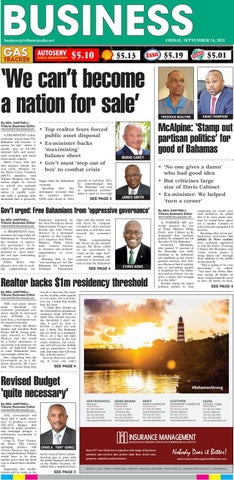
‘We can’t become a nation for sale’ By NEIL HARTNELL Tribune Business Editor nhartnell@tribunemedia.net A PROMINENT realtor yesterday voiced fears The Bahamas will become “a nation for sale” unless it quickly gets its $10.4bn national debt and associated economic and fiscal crises under control. Mario Carey, who has also stepped outside the real estate business via his Mario Carey Ventures (MCV) initiative, told Tribune Business that this nation might be forced to sell-off key national assets and patrimony unless it rapidly reckons with a growing debt mountain that is presently
• Top realtor fears forced public asset disposal • Ex-minister backs ‘maximising’ balance sheet • Gov’t must ‘step out of box’ to combat crisis bigger than the Bahamian economy. Speaking after this newspaper revealed that the country’s debt-toGDP ratio stood at 100.4
percent at end-June 2021, he acknowledged that The Bahamas was now in “uncharted territory” when it came to sovereign
SEE PAGE 3
MARIO CAREY
JAMES SMITH
Gov’t urged: Free Bahamians from ‘oppressive governance’ By NEIL HARTNELL Tribune Business Editor nhartnell@tribunemedia.net A PROMINENT businessman has urged that all Bahamians be “freed from the burdens of oppressive governance” as he called on the new administration to “peel back” the red tape confronting entrepreneurs. Ethric Bowe, who played a key role in seeking compensation for
businesses impacted by the New Providence Road Improvement Project one decade ago, told Tribune Business in a messaged response to this newspaper’s inquiries that Prime Minister Philip Davis must “remove barriers to business and promote opportunities at every level”. Warning that it was “not morning yet” for The Bahamas, the Advanced Technical Enterprises
chief said this nation was still faced by “rampant corruption” and a national debt that, at $10.4bn, now exceeds the economy’s size. While congratulating Mr Davis on his election success, Mr Bowe called on his government to “start on the right foot” and avoid handing out contracts to favoured persons so that the Bahamian
SEE PAGE 4
ETHRIC BOWE
Realtor backs $1m residency threshold By NEIL HARTNELL Tribune Business Editor nhartnell@tribunemedia.net THE real estate investment threshold for economic permanent residency should be increased from $750,000 to at least $1m, a well-know realtor argued yesterday. Mario Carey, the Better Homes and Gardens Real Estate MCR Group principal, asserted to Tribune Business that this would be a better alternative to increasing real property tax rates on high-end homes as some Bahamians have increasingly called for. But, suggesting that the Government go in a different direction, Mr Carey said: “The worst thing they
can do is increase the taxes on the wealthy with regards to real estate, the real property tax. I think that would hurt the most. “I think they should up the threshold for permanent residency from $750,00. I think they should increase the threshold; I don’t see why it can’t be $1m or $1.25m. I don’t see why not. I think The Bahamas has set itself as a standard. We’re on a nice run right now, everybody in the real estate business, but everyone will tell you the bubble will go somewhere. It will end, and what that will look like, nobody knows.” Several observers, including at least one other
SEE PAGE 4
Revised Budget ‘quite necessary’ By NEIL HARTNELL Tribune Business Editor nhartnell@tribunemedia.net THE Government will likely find it “quite necessary” to produce a revised 2021-2022 Budget that reflects its policy priorities and campaign pledges, a well-known accountant is predicting. Craig A. ‘Tony’ Gomez, the Baker Tilly Gomez managing partner, told Tribune Business that passing a supplementary Budget would have to be done quickly given that the fiscal year is almost three months’ old. Suggesting that modifications will be made as the
CRAIG A. ‘TONY’ GOMEZ newly-elected Davis administration gets to grips with the public finances and state of the Public Treasury, he added that a supplementary
SEE PAGE 3
$5.19
FREDERICK MCALPINE
$5.01
KWASI THOMPSON
McAlpine: ‘Stamp out partisan politics’ for good of Bahamas • ‘No one gives a damn’ who had good idea • But criticises large size of Davis Cabinet • Ex-minister: We helped ‘turn a corner’ By NEIL HARTNELL Tribune Business Editor nhartnell@tribunemedia.net A FORMER MP yesterday queried the size of Prime Minister Philip Davis’ new Cabinet as he demanded that “partisan politics be stamped out for the sake of The Bahamas”. Frederick McAlpine, who gained 33 percent of the Pineridge vote while standing as an independent candidate in last week’s general election, told Tribune Business that if a policy, law or investment project is beneficial for The Bahamas and its citizens “no one gives a damn who brought it to the table”. Besides urging the major political parties to stop
competing for credit over such initiatives, he added that if he were prime minister he would have opted for a smaller Cabinet to start with and expanded it if need be. Speaking after seven parliamentary secretaries (see articles in News section) were yesterday appointed to join Mr Davis’ 22-strong Cabinet, Mr McAlpine said “some serious money is being doled out” through their addition to the public sector payroll. “This is going to be very interesting,” he added. “You have the Prime Minister saying all hands on deck. I understand the need to have all hands on deck,
SEE PAGE 4
PAGE 2, Friday, September 24, 2021
THE TRIBUNE
‘NEW DAY’ FOR MONITORING INVESTORS’ COMMITMENTS By Kevin D. Seymour I READ with interest recent newspaper articles giving the reaction of the now-former minister of state for Grand Bahama and finance, J. Kwasi Thompson, as well as a prominent Freeport attorney, to the prospect of the reintroduction of the Grand Bahama (Port Area) Investment Incentives Act 2016. According to the prominent Freeport attorney, the Act was only repealed in substance, which in my view is potentially more perilous and damaging to the country’s reputation - and the Government of the Commonwealth of The Bahamas - than an outright repeal, which was believed by many to have occurred on October 18, 2017. However, since it is a “new Day” in the country, which I’m certain will be accompanied by new thinking, I chose not to engage in a debate regarding the ‘pros’ and ‘cons’ of the Act, and will do my best to steer clear of the political land mines that may have been planted. Instead, I will use
Letter to the
Business editoR KEVIN D. SEYMOUR this opportunity as a teachable moment. Successive governments over the last 60-plus years have entered into numerous agreements with foreign as well as local investors for various hotel resorts and golf courses, manufacturing and real estate developments, inclusive of second homes, throughout the length and breadth of The Bahamas. These agreements are often referred to as Heads of Agreement (HoAs) and, in the case of Freeport, the Hawksbill Creek Agreement (HCA), which was entered into by the
then-colonial government back in August 1955. The HCA has a remaining life of 33 years. A number of these agreements also fall within the definition of public-private partnerships or (PPP) agreements. Although these agreements are tailored for a diverse number of investment projects as noted above, the common underlying theme is that, in exchange for the central government granting these various investors certain tax concessions and, in some cases, land grants, the investors in turn agree to build, develop and promote major touristic resorts; construct and operate manufacturing facilities; build second homes etc. consistent with the terms set out in their respective underlying HoAs. In essence, these agreements are based on the
“quid pro quo” principle, where the investors give certain commitments and agree to carry out specific undertakings (constructing, developing and promoting a resort project, or constructing a second home within a specified period of time, or employing a specified number of Bahamians during the construction phase of a project and once the project comes to fruition etc, in return for the central government granting them these tax and other concessions. Unfortunately, over the years, and due to a lack of robust compliance monitoring by the central government, investors have not always lived up to their commitments and undertakings under these HoAs. Surprisingly, certain of these same investors continue to enjoy generous exemptions
from Customs, excise and stamp duties and real property taxes for periods of up to 20 years. Generally, there is no outcry from Bahamian taxpayers because, in most cases, they are either unaware or do not fully understand the real value of the various concessions granted by the central Government to these investors which, I might add, in the case of the larger investment projects are quite significant. As a result, successive governments have not been able nor willing to hold these investors accountable, and in the process may have foregone the realisation of millions of dollars in revenues, which could have resulted from a properly constituted and functioning compliance enforcement regime. Hence the strenuous objections raised by the former state minister of finance and the prominent Freeport attorney appear to have missed entirely the reason why it is necessary for accountability to accompany tax and other concessions granted by the central government, whether under the terms
of the HCA and ancillary legislation, or any of the multitude of HoAs currently in force. Instead, such monitoring is viewed by them and others as being contrary to ‘ease of doing business’ and subjecting the GBPA licensees to having to “beg the central government for the renewal of business license, real property tax, income tax and capital gains tax exemptions”. HoAs and the HCA have undoubtedly proven beneficial for the development of The Bahamas over the years, and such investment incentive programmes should continue. However, in my view, successive governments have not fully leveraged these arrangements by ensuring that investors comply with their commitments and undertakings, and made accountable when there is a departure from them. This now, more than ever, has to change in order for our developing nation to realise its full economic potential. Kevin D. Seymour Freeport, Grand Bahama September 18, 2021
Realtors attract over 200 trade mission attendees MORE than 200 real estate executives, advisors and potential investors gained an insight into The Bahamas’ offerings during a recent online trade mission organised by the Bahamas Real Estate Association (BREA). Organised in conjunction with the Royal Palm Coast Realtor Association, it was the second annual trade mission involving the two entities but the first to be held entirely virtually. Christine Wallace-Whitfield, BREA’s president, said the ease of attending boosted the numbers. “We were really pleased with the turnout for this
trade mission, and grateful for the partnerships including the Ministry of Tourism and other BREA members, who told their story and why they love what they do. It was a great opportunity for us to present the best of The Bahamas to an audience that included 200-plus viewers from six countries, and interest from as far away as Portugal,” she said. Participants tuned into the Zoom meeting from the US, Canada, Jamaica, Dominican Republic and The Bahamas, as well as western Europe. Attendees received a glimpse of luxury properties, including videos; facts about purchasing property in
The Bahamas; financing; and tax-friendly policies . There was also a roundup of tourism-related matters including destination updates for 16 islands; updates on airlift; and schedules through the end of the year. Attractions ranging from the blue holes of Andros to the swimming pigs of Exuma were also mentioned. “This was just our second year partnering with the Palm Coast Realtor Association,” said Mrs Wallace-Whitfield, “and the level of participation this year was more than we ever dreamed. Partly it may have been that it was easy to sign in, look at the
enticing images of properties in The Bahamas, and learn more without having to travel to an event, but I think a lot of the interest was just because The Bahamas is so desirable.” That interest heightened during the lockdowns and restrictions imposed because of the COVID pandemic, said the four-time president of an organisation that has more than 700 licensed broker and agent members. “What people around the world realised is if they could work from home, why wouldn’t they want to live in a place they love - a place of their choosing rather than where an office is located,” Mrs Wallace-Whitfield said. “It opened up a whole new world for people to seek out the most beautiful and desirable places in the world. With all the advantages and amenities that The Bahamas has to offer, and the proximity to the major markets of the US and Canada, we are at the top of many lists.” Besides promoting The Bahamas, BREA is focused on updating what it describes as antiquated legislation governing the industry.
4-TIME BREA President Christine Wallace-Whitfield.
THE TRIBUNE
Friday, September 24, 2021, PAGE 3
SKATE CITY URGES GOV’T: END COVID ORDERS EARLY By YOURI KEMP Tribune Business Reporter ykemp@tribunemedia.net A NEW Providencebased entertainment destination yesterday urged the newly-elected Davis administration to rapidly bring the COVID emergency orders to an end so it
can meet pent-up consumer demand. Ivan Francis, owner/ operator of Skate City 242, told Tribune Business he is currently painting his establishment and making minor repairs in the hope that the new government will lift the emergency orders left by the Minnis administration
before they come to an end in mid-November. Skate City is one of many entertainment businesses that have been hit by a year-plus closure due to COVID-19 restrictions. Many have been left on the brink of financial collapse as a result although cinemas have re-opened under strict guidelines
limiting audience sizes to a maximum 30 percent of full capacity. “The timing is right, and how the new government is saying that they will discard all of those emergency orders, I have started to paint up the place. The minute the emergency orders are over I will go
back to work,” said Mr Francis. Skate City is currently open to only private, select guests and not the public. Mr Francis has also been renting the facility out for small family gatherings on an hourly basis. “People have been calling me to open the place back up,” Mr Francis added.
“There is nothing else here happening other than my making repairs to my place. We are just waiting for them to open the country back up fully so we can begin advertising again. I’m waiting, so they need to hurry up and open up the country, and let’s find a way to live with this thing.”
Slashed curfew aids food store top lines By YOURI KEMP Tribune Business Reporter ykemp@tribunemedia.net A SMALL food retailer yesterday hailed the extra shopping hours created by the nightly curfew’s pushback to a midnight start for increasing sales. Travarus Barrow, the Phoenix Supermarket’s general manager, told Tribune Business that trade was starting to pick-up and he feels the “economy is beginning to
turn around”. He added that the reduced curfew was making a difference for shopkeepers and consumers alike. “Since they extended the curfew we are going back to closing up at 10pm today. Things have picked up now; more people are coming into the store and things are looking real good now,” he said. The later curfew start has allowed merchants and other industries that rely on night-time business an extra three hours of trading.
Prior to the extension, Mr Barrow was closing at 7pm due to the curfew starting at 9pm, but the Philip Davisled administration pushed the start back to 11.59pm with a stroke of the pen as its first act upon taking office. Mr Barrow now has time to close at 10pm and enable his employees to get home before the curfew starts, but he warned that food price increases are unavoidable for the time being.
“People are saying all the time that the prices are increasing, but there is very little we can do about that now. We do have a lot of specials going on and we try to levy that in certain ways, plus we have our reduced items as well,” he said. “But the price rises aren’t affecting anybody; they are still coming in and getting what they want. Once Bahamians have made up their mind to get something, no matter if the price has gone up they will get what they want.”
‘WE CAN’T BECOME A NATION FOR SALE’ FROM PAGE ONE liabilities that now exceed its total economic output. “It is concerning. It has to be concerning, it has to be,” Mr Carey said of the data confirmed by the Central Bank of The Bahamas 2021 second quarter economic review. “I just hope it doesn’t get to the point where we become a nation for sale with a fire-sale of national assets. “We’re sort of entering new territory. We had a debt before that was manageable, and if we keep going like this what will be the ripple effects?” He added that if The Bahamas did not change course, and maintained persistent annual fiscal deficits, the outcome could ultimately be a devaluation of the Bahamian dollar “and we don’t want that”. While the term “nation for sale” first appeared in reference to The Bahamas during the drug boom decades of the 1970s and 1980s, in this context Mr Carey is expressing concern that the
Government may be forced to sell-off assets owned by the Bahamian people and taxpayers to pay down the national debt if fiscal deficits maintain their current trajectory and all other policy options fail. Among the assets/ national patrimony that could be offered for sale would be Crown Land, Treasury Land and other real estate assets, including buildings owned by the Government. State-owned enterprises (SOEs), such as Bahamas Power & Light (BPL), Bahamasair and Water & Sewerage Corporation, might also be placed on the auction block although the price they would fetch is unlikely to be high. While some may deem such a scenario unlikely, there is little doubt that The Bahamas is presently headed in this direction unless the Prime Minister and his administration change course. Asset sell-offs are a feature of International Monetary Fund (IMF) adjustment
programmes, and Alfred Sears, minister of works and utilities, admitted on the campaign trail this is where The Bahamas is headed without drastic action. Under the IMF’s oversight, such assets are often sold at fire sale prices via privatisations that are not always in a country’s best interests. The Bahamas would likely earn higher prices via selective asset disposals done at its own pace, and under the Government’s control. And Mr Carey is not the only person suggesting that The Bahamas move down this route. James Smith, ex-minister of state for finance and former Central Bank governor, yesterday suggested that the Government often focused solely on the income side of its financial ledger and too often ignored its balance sheet. But, rather than simply sell-off Crown or Treasury land, he suggested that the Government partner with investors in developing
select areas. Mr Smith explained that the land would represent the Government’s equity stake in such projects, and through such public-private partnerships (PPPs) it could generate revenues to both pay down the national debt and contribute to a sovereign wealth fund to benefit future Bahamian generations. No valuations for the extent of the Government’s Crown and Treasury land holdings have been made public, but Mr Smith said: “Because the Government has a [accounting] system that deals on a cash-only basis, the Government sometimes - or most times - ignores the assets it owns. “When any household goes through tough times, and it needs additional income, you either get a loan from someone willing to give it to you, a gift from someone willing to give it to you, or you make a choice about the assets you hold that you need to liquidate to meet the expenditure
REVISED BUDGET ‘QUITE NECESSARY’ FROM PAGE ONE Budget could also be facilitated by bringing the mid-year Budget statement - typically given in February - forward by several months. “I think it’s going to be quite necessary for them to at least amend and produce a supplementary Budget,” Mr Gomez told this newspaper. “The Budget reflects their ideas and way of taking the country forward. It would be a reflection that they are thinking the same as the previous government’s thinking if they were to entirely keep the previous Budget. “By way of example, in a household, while the family has one direction to achieving their goals, it’s not always that the mother’s way of handling the budget is the same as the father’s way of handling the budget. The end game is to get the Budget in a better position, and The Bahamas in a better position and back on its feet.” Many observers believe the fiscal realities, with a $10.4bn national debt now greater than the size of the economy, and a $953m deficit for the 2021-2022 fiscal year that will add to $2.2bn worth of borrowing during the previous two fiscal years, will prevent the Davis administration from being able to deliver on much of their pre-election promises. Tribune Business columnist, Hubert Edwards,
CALL 502-2394 TO ADVERTISE IN THE TRIBUNE TODAY!
previously argued that a supplementary Budget was unlikely given the Government’s limited fiscal headroom. He suggested that while money could be repurposed and reallocated within the existing fiscal framework approved by Parliament, there was little to no scope for further borrowing beyond previously agreed limits. Mr Gomez, though, argued that a revised
Budget would serve notice of the Davis administration’s intent and seek to distinguish itself from its predecessor. Dr Michael Darville, minister of health and wellness, yesterday said extra funding must be found for the public healthcare system to enable it to cope with COVID-19. He added: “This government is going to have its own interpretation of how to achieve its aims
and make The Bahamas a better place. If the system allows, I think we’ll find that as the Government sits down and has a closer view
Atwell Ferguson, general manager of the Golden Gates Supermarket, added: “Prices are rising. I can’t say for sure how long they continue to rise, but I can say now that prices have gone up on all goods. “The extension of the curfew doesn’t affect me to any great extent because we’re still closing at the same time at 8pm. How the curfew was at 9pm, we were closing at 8pm and we have just kept the same time. But starting today we will start
closing at 9pm because we have the extra hours.” Whether or not the extra hour will make a difference will be something Mr Ferguson will “have to find out”, but he is certain that due to the weekend crowds he normally gets, this would be “perfect” for those shoppers. “What we have now are people coming in earlier, but now that they have more time and people are getting off from work later, we will have to extend the time for the weekend,” Mr Ferguson said.
gap. They should really look at doing this sort of thing.” Noting that the Government “owns a hell of a lot of real estate throughout the Family Islands that is ripe for development”, Mr Smith said it should target select areas that could be developed in partnership with Bahamian and/or foreign developers. “Suppose a developer wants to do condos in a Family Island where the Government has a lot of land. The Government puts the land into the development, and gets a revenue stream to help pay down the debt and benefit future generations of Bahamians,” he told Tribune Business. “You’re basically saying, look, we’ve already pretty much exhausted the traditional way of dealing with this such as borrowing and raising taxes, and are really in a hole with a 100 percent debt-to-GDP, which is a crisis area. The traditional form of dealing with government debt, borrow, borrow, borrow, you are coming to the end of that road. “I’m saying: ‘Step out of the box for a while, and
look at how to effectively maximise a return on your fixed assets’. Look at all the areas within the Government where they’re providing services that can be done in a more efficient way by the private sector.” Asked which services he was suggesting could be outsourced to the private sector, Mr Smith replied that matters of health, education, national security and foreign affairs need to be dealt with by governments. Much of the rest, he added, could be performed by the private sector. “The point I’m making here is that you’re coming to the end of the road with traditional strategies of borrowing to cover the debt. We need to step away, like in a household where a job has been lost, and say we have to move to a much cheaper place or sell a new car,” he said. “The Government is approaching that given the increase in the debt, where it will be very difficult to finance it without the necessary economic growth. We’re digging ourselves out of a very deep hole, and the pandemic is responsible for most of it.”
of what’s in the Treasury, and timelines for getting The Bahamas back into full business, we’ll see modifications to the Budget and a supplementary Budget. “It has to be done quickly. The Budget is already three months old, but a modification is not unusual. It’s
likely we’ll simply see it earlier, and they may bring the mid-year Budget forward. There has been a significant change, and that significant change is a change in government and perhaps a complete rethinking of the financial model used by the previous government.”
PAGE 4, Friday, September 24, 2021
THE TRIBUNE
MCALPINE: ‘STAMP OUT PARTISAN POLITICS’ FOR GOOD OF BAHAMAS FROM PAGE ONE
but there are many persons who have not been on deck before unless in a professional capacity. “I would have started smaller, and grown as need be. Right out the gate, there are almost 30 persons. Those salaries are high. Seven parliamentary secretaries and 22 Cabinet ministers. That’s high, and some serious money is being doled out. It is what it is.” Mr Davis’ Cabinet is some six members’ larger than that of Dr Hubert Minnis, which had 16 persons including the latter. With the seven parliamentary secretaries in addition to 22 Cabinet ministers, just three PLP MPs who were victorious in last week’s general election have not been given a job in a government ministry. One of those is Leslia Miller-Brice, daughter of former Cabinet minister, Leslie Miller. The Prime Minister yesterday defended his Cabinet from criticisms that it is overweight and bloated, arguing that the numbers reflect the extent of The Bahamas’ COVID19, economic and fiscal
challenges and the size of the task facing his government. Many observers are likely to reserve judgment until they see how effective the new government is. Mr McAlpine, meanwhile, said “everybody should be very concerned” by the recent Moody’s downgrade and the country’s $10.4bn national debt now exceeding the size of the Bahamian economy. “People are very concerned as to where the economy is going, we still have a number of people in the hotel industry on furlough, and many people in this country do not know where their next dime is coming from,” he added. “It’s fair to say we’re in a very rough place. Homes are being foreclosed upon, and people are unable to meet their mortgage commitments because they are out of work. This is the reality, and I’m just saying that I don’t see us getting any better.” As to the Davis administration’s prospects for turning The Bahamas’ economy, health and fiscal position around, Mr McAlpine told this newspaper: “Let me say this, and
I say it respectfully. This is not a good time to be Prime Minister of any country. If you are going to be prime minister during this particular juncture, you are going to have to be very innovative, strategic and economically prudent. “It is what it is. It is what it is. It’s very difficult. He [Mr Davis] has the task. There has to be, and I say this with all sincerity, there has to be some kind of national reconciliation. The country is long divided, and to have that economic stimulation or sense of going in the right direction we must, for the sake of the country, stamp out the partisan politics. “We must do what is right for the country. If it is right and good for the country, who gives a damn who brought it to the table?” Mr McAlpine said the focus now had to be on economic policies to “get us out of the doldrums”, and he urged the Davis administration to focus on collecting existing taxes that are due rather than implement any increases or new ones. “What they need to do is go after and seek some of the taxes that have not
been collected. We must find ways to go after those evading taxes in our country. There are people that owe property taxes, people who have been evasive in terms of Customs duties. We have to find ways to go after taxes that are owed. That’s what we have to do,” he added. Meanwhile Kwasi Thompson, former minister of state for finance, last night defended the Minnis administration’s economic and fiscal policies for having helped The Bahamas “turn a corner”. He based this assessment on the Central Bank’s 2021 second quarter report as well as Moody’s suggestion that the economy will grow by 8 percent this year. The latter contrasts sharply with the IMF and Central Bank projections of 2 percent gross domestic product (GDP) growth for The Bahamas in 2021, and Mr Thompson’s statement made no mention of the recent Moody’s downgrade or the fact that the country’s $10.4bn national debt is now greater than the size of its economy. “I am pleased that the Central Bank’s June 2021
quarterly economic review has confirmed ‘that the domestic economy stabilised during the second quarter of 2021, despite the ongoing spread of the novel coronavirus (COVID-19) pandemic’. This is confirmation that the economic policies implemented by the Minnis administration were having positive effects on the Bahamian economy,” Mr Thompson said. “Additionally, it is important to note that the Central Bank has also confirmed ‘that the Government’s overall deficit narrowed during the fourth quarter of fiscal year 2020-2021, relative to the same quarter for fiscal year 2019-2020. Underlying this outturn, aggregate revenue increased considerably, led by gains in value added taxes (VAT) receipts, which overshadowed the rise in aggregate expenditure’. “This is again confirmation that the Minnis administration’s recovery plan was taking shape with increased revenue and narrowing of the deficit. It is clear, while we have a distance to go for full recovery, we have turned a corner,” Mr Thompson added.
“This is consistent with the Minnis administration’s previous statements, and now confirmed by the Central Bank of the Bahamas. Tourism continues to improve and construction also continues to improve. We also note in a statement released by Moody’s that the economy is predicted to grow by 8 percent, four times faster than the anticipated 2 percent. It is also clear that Moody’s expects our recovery to be based on some of the same policies, initiatives, and legislative reforms of the Minnis administration.” In what appeared to be a shot at the PLP’s VAT rate cut to 10 percent, he said: “We are hopeful that before any major economic changes or tax reform, as was pledged by the Minnis administration, there are proper studies, analysis, diagnosis and consultation. Sudden changes, though well meaning, can derail economic and fiscal recovery. We therefore stand ready to assist to ensure the country’s economy fully recovers.”
GOV’T URGED: FREE BAHAMIANS FROM ‘OPPRESSIVE GOVERNANCE’ FROM PAGE ONE
economy can be made “more fair” and converted into a meritocracy. While not citing any specific incidents or evidence, he blasted: “We still have rampant corruption in place and coming into place. Our national debt has not been paid. We are still vulnerable to COVID-19 and [general election night] did not help. We still have rising food prices while poor people suffer... The problems we had yesterday are still here. “We need to reform our economy and government to move this country forward. We need to control
corruption. We urgently need a productive civil service. We have no time to tarry. Let us start on the right foot. Brave is not Jesus. This administration, just like the previous administration, will need our co-operation and support for all of us to enjoy success. “The Bahamas cannot work properly until the wealth of the Commonwealth is more common. We also need to make productivity and good service more common.” Warming to his earlier themes, Mr Bowe added: “Corruption has been a significant element
of government for many administrations. We must act to deal with corruption from the outset. The systemic corruption must be rooted out. “We need to forego vengeance on supporters of the FNM. We are all Bahamians. We are one people. In many instances, we are family. We must eliminate the urge to start giving out stupid contracts. We must eliminate the practices of giving taxi plates and bus plates to ‘special people’. We need to be very liberal in releasing the drivers without taking back plates.”
Mr Bowe called for the minimum wage to be increased to $10 per hour, or $400 per week based on a $40 hour work week, which is almost double the present $210 per week and well above new administration’s proposal for $250 per week. Many in the private sector will likely resist such a sharp hike, but he said: “We must act to make our economy more fair. The minimum wage should be increased to $10 per hour while we figure out the formula for establishing a living minimum wage. We must act to help the poor while encouraging the
REALTOR BACKS $1M RESIDENCY THRESHOLD FROM PAGE ONE realtor, have publicly argued that The Bahamas should exploit the current real estate surge to boost the Public Treasury by raising real property tax rates on high-end multi-million dollar homes whose owners can most afford to pay. While this would be a blow for progressive taxation, and potentially increase government revenues at a time when the Public Treasury needs every cent it can get, it has already been met with pushback by
other realtors arguing it would drive buyers away and stunt a growing market. “I’m just amazed at how little input the real estate profession gives to government policies,” Mr Carey added, suggesting that the Davis administration lean on it more for advice. And he is also far from alone in calling for the investment threshold to be increased. John Delaney, the former attorney general, earlier this year said raising the bar from the present $750,000 qualifying threshold would
enable The Bahamas to “get more out of persons choosing to be here” by attracting “a higher financial calibre” of investor to this nation. This would also bring the real estate investment threshold in line with the $1m minimum that the then-government was eyeing for persons seeking to qualify for economic permanent residency via contributions to sporting, cultural, arts and social development causes - a reform that Mr Delaney
hailed as “timely” given The Bahamas’ urgent need to reflate the economy, and attract investment and foreign exchange earnings, post-COVID. “It’s certainly timely that the Government revisit the threshold figure of $750,000, which was set as a matter of policy. Before that it was $500,000,” the Delaney Partners principal said. “I know others feel it should be brought down for various reasons, but in my view it should never have been lower than that.” Mr Delaney pointed out that the last Ingraham administration in 2011 established a policy whereby investors who made a real estate purchase valued at $1.5m or
poor to become consistently productive. We need to confirm and support the right to work and an honest living.” Also calling for “common sense reform” at the Immigration Department, along with new hospitals for Nassau and Freeport, Mr Bowe added: “Most of all we need to be free from the burdens of oppressive governance. We have to peel back all these laws and regulations which make it difficult for Bahamians to make it in The Bahamas. We need to make The Bahamas a safe place.... “Good, honest leadership is required. Local
government is urgently needed. We must not get intoxicated by power. We have to focus and create a meritocracy. Fair competition is important. We do not need a new day. We are long overdue a better day.” Urging Mr Davis to “make a positive difference in this country’s future history”, Mr Bowe added: “We do not want to be saying ‘Brave is the worst prime minister ever’. Whatever you focus on grows. Focus every day on how we can serve and improve the lives of the people who pay the salaries.”
above would be accepted for so-called “accelerated” consideration of their permanent residency application. The $750,000 threshold to qualify for non-accelerated permanent residency was raised as recently as 2018, having been left at $500,000 for some time, due to increasing concerns that the latter figure was resulting in overseas investors competing with middle class Bahamians for real estate. And Mr Delaney said a further increase in the threshold to $1m would also help to improve government tax yields. “I would be in favour of increasing that real estate threshold because it means we get more out of persons choosing to be here, and it serves to select a higher financial calibre of persons coming to The Bahamas
who are able to further contribute to The Bahamas,” he added. “It should be no less than $1m in terms of realty. If there are going to be other mechanisms and other avenues to qualify [for economic permanent residency], I think starting at $1m should be the threshold entry point, and there could be others up to $1.5m. That’s not an unknown level for us as we’ve have been there from ten years ago. “In my opinion, we have to be more concerned with achieving a certain level of economic impact, whether it comes from real estate investments or something else. I would say that $1m is a good level of economic impact that indicates the person will be a beneficial contributor to the economy.”
THE TRIBUNE
Friday, September 24, 2021, PAGE 5
Another rally on Wall Street erases losses for the week By DAMIAN J. TROISE AND ALEX VEIGA AP Business Writers Stocks on Wall Street rallied for the second straight day Thursday and have now reversed the market’s sharp pullback at the start of the week. The S&P 500 rose 1.2%, with more than 85% of companies in the benchmark index notching gains. The Dow Jones Industrial Average gained 1.5% and the Nasdaq rose 1%. The rally put the major indexes on pace for weekly gains just four days after a broad sell-off handed the S&P 500 its biggest skid since May and knocked the Dow more than 600 points lower. The market’s sharp swing from Monday, when the S&P 500 slumped 1.7%, to Thursday, when it closed with 0.4% gain for the week, reflects how quickly investor sentiment can change, and is another example of how in a market that’s near all-time highs, traders tend to see waves of selling as buying opportunities. Monday’s sell-off was triggered by concerns about the potential for a default by Evergrande, a huge, debt-laden private Chinese real estate developer.
Traders also were feeling uneasy about how quickly the Federal Reserve might elect to rein in some of the support measures it’s been giving the markets and economy. Those worries were allayed by Wednesday, when the Federal Reserve signaled it wouldn’t begin considering such a tapering of support before at least November, and indicated it may start raising its benchmark interest rate sometime next year. Investors also got reassuring news out of China, where Evergrande said it would make a payment due Thursday on a domestic bond. “The last few days have just been this recognition that all the things that were being talked about, the market has shrugged them off,” said Michael Antonelli, managing director and market strategist at Baird, noting that the S&P 500 is only about 1.5% below its all-time high set earlier this month. “The market was just ripe for a sell-off,” on Monday, Antonelli said. “We still have not had a 5% pullback from the highs yet this year.” After its two-day policy meeting concluded Wednesday, the Fed said
IN this Nov. 5, 2020 file photo, a sign for Wall Street is carved in the side of a building, in New York. Stocks are opening higher on Wall Street Thursday, Sept. 23, 2021, clawing back a bit more of the ground they lost at the beginning of the week. Photo:Mark Lennihan/AP it will likely begin slowing the pace of its monthly bond purchases “soon” if the economy keeps improving. The Fed and other central banks have been buying bonds throughout the pandemic to help keep long-term interest rates low. “The reality is that the Fed is going to err on side of not tightening anything
on inflation until they absolutely have to,” said Brent Schutte, chief investment strategist, Northwestern Mutual Wealth Management Company. “They are going to stick around as long as they possibly can.” Still, markets have had a rough September and investors could be in for more choppiness as they work through a mix of
concerns, Schutte said. That includes COVID-19 and its lingering impact on the economy, along with a slow recovery for the employment market. “People got so used to a one-way market,” he said. “It’s going to be more of two-way market and investors need to get used that, but I still think the trend is higher.”
The change in investor sentiment has also put oil prices in the green. Benchmark U.S. crude oil is now up 1.2% for the week. Bond yields moved solidly higher. The yield on the 10-year Treasury rose to 1.43% from 1.32% late Wednesday, a big move. All told, the S&P 500 index rose 53.34 points to 4,448.98. The Dow gained 506.50 points to 34,764.82, while the Nasdaq rose 155.40 points to 15,052.24. Technology companies and banks led the way higher Thursday. Cloudbased software company Salesforce.com was a standout with a 7.2% gain after raising its sales forecast for the year. Citigroup rose 3.9%. Small-company stocks, which are typically a good measure of investor confidence for economic growth, also jumped over to the winning column. The Russell 2000 rose 40.48 points, or 1.8%, to 2,259.04. It’s up 1% for the week. Other standouts included Olive Garden owner Darden Restaurants. Its stock jumped 6.1% after delivering strong quarterly results. European and Asian markets rose.
DEMOCRATS SEE TAX ‘FRAMEWORK’ TO PAY FOR HUGE $3.5T PACKAGE By LISA MASCARO AND ALAN FRAM Associated Press WASHINGTON (AP) — The White House and congressional Democrats have agreed to a framework of options to pay for their huge, emerging social and environment bill, top Democrats said Thursday. Now they face the daunting task of narrowing the menu to tax possibilities they can pass to fund President Joe Biden’s $3.5 trillion plan.
Senate Majority Leader Chuck Schumer of New York and House Speaker Nancy Pelosi of California announced the progress as Biden administration officials and Democratic congressional leaders negotiated behind the scenes. The package aims to rewrite tax and spending priorities to expand programs for Americans of all ages, while upping efforts to tackle income inequality and fight climate change. Staring down a selfimposed Monday deadline,
SPEAKER of the House Nancy Pelosi, D-Calif., right, Treasury Secretary Janet Yellen, left, and Senate Majority Leader Chuck Schumer, D-N.Y., update reporters on Democratic efforts to pass President Joe Biden’s “Build Back Better” agenda, at the Capitol in Washington, Thursday, Sept. 23, 2021. Photo:J. Scott Applewhite/AP
PUBLIC NOTICE
INTENT TO CHANGE NAME BY DEED POLL The Public is hereby advised that I, MANILIA FLORENCE JONNASAINT of 2nd Street, The Grove, Nassau, The Bahamas, intend to change my name to MANILIA FLORENCE JONASSAINT. If there are any objections to this change of name by Deed Poll, you may write such objections to the Chief Passport Officer, P.O.Box N-742, Nassau, Bahamas no later than thirty (30) days after the date of publication of this notice.
lawmakers said they would work nonstop to find agreement on specifics. Democrats’ views on those vary widely, though they largely agree with Biden’s idea of raising taxes on corporations and the wealthy to fund the package. “We certainly think it’s progress,” Biden press secretary Jen Pskai said at the White House.
Biden has been putting his shoulder into the negotiations, inviting more than 20 of his party’s moderate and progressive lawmakers to the White House for lengthy meetings this week. He’s working to close the deal with Congress on his “Build Back Better” agenda at a time when his presidential campaign promises are running into the difficulty of actually governing.
But the party has been divided over many of the details. Moderate Democrats, most prominently Sens. Joe Manchin of West Virginia and Kyrsten Sinema of Arizona, are demanding that the massive dollar total be reduced. The revenue options to pay for it — that mostly means taxes — being considered can be dialed up or down, the
leaders say. The ultimate price tag may certainly slip from the much-publicized $3.5 trillion. Republicans are solidly opposed to the package, calling it a “reckless tax and spending spree.” So Democrats will have to push it it through Congress on their own, which is only possible if they limit their defections to a slim few in the House and none in the Senate.
PAGE 8, Friday, September 24, 2021
THE TRIBUNE
US: NUMBER OF UNRULY AIR TRAVELERS LOWER, STILL TOO HIGH WASHINGTON Associated Press THE rate of unruly passengers on airline flights is down sharply from early this year but is mostly unchanged over the past three months and remains more than twice the level seen in late 2020, according to government figures. The Federal Aviation Administration on Thursday took credit for the recent decrease, linking it to the agency’s use of larger fines against violators. Those fines have added up to more than $1 million. “Our work
is having an impact and the trend is moving in the right direction,” said FAA Administrator Stephen Dickson, “but we need the progress to continue. This remains a serious safety threat.” At a congressional hearing Thursday, the chairman of the House Transportation Committee, Peter DeFazio, D-Ore., called for more criminal prosecutions of unruly passengers. He also said airports should stop concessioners from selling alcohol to go. “Get a great big to-go cup with four shots in it and take
it on the airplane — that needs to end,” he said. Criminal prosecutions are rare, and usually left up to local authorities. The Justice Department said it filed charges in federal court for 16 defendants in a recent 10-month period, according to travel publication Skift. The FAA said this week that airlines have reported 4,385 events involving rowdy passengers this year, with 73% of them involving passengers who refuse to wear face masks, which are required on flights by federal rule.
THIS July 2, 2021, file photo shows a sign stating face coverings are required is displayed at O’Hare airport in Chicago. Federal officials say unruly passengers are becoming a bit less common on airline flights, but they are still causing disruptions at twice the rate of late last year. The Federal Aviation Administration said Thursday, Sept, 23, the its zero-tolerance policy — including fines against more passengers — is helping. Photo:Nam Y. Huh/AP