business@tribunemedia.net
WEDNESDAY, SEPTEMBER 8, 2021
$5.10
$5.19
$5.13
$5.24
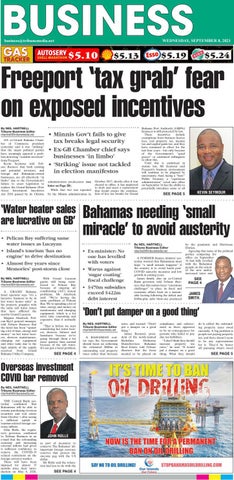
Freeport ‘tax grab’ fear on exposed incentives By NEIL HARTNELL Tribune Business Editor nhartnell@tribunemedia.net AN ex-Grand Bahama Chamber of Commerce president yesterday said it was “striking” that the major political parties have seemingly ignored a problem deterring “sensible investors” from Freeport. Kevin Seymour told Tribune Business that both existing and potential investors, and foreign and Bahamian-owned businesses, are all effectively “in limbo” due to the Government’s failure to enact legislation to replace the Grand Bahama (Port Area) Investment Incentives Act 2016 passed by its Christie
• Minnis Gov’t fails to give tax breaks legal security • Ex-GB Chamber chief says businesses ‘in limbo’ • ‘Striking’ issue not tackled in election manifestos administration predecessor (see letter on Page 2B). While that Act was repealed by the Minnis administration in
‘Water heater sales are lucrative on GB’ • Pelican Bay suffering same water issues as Lucayan • Island’s tourism ‘has no engine’ to drive destination • Almost five years since Memories’ post-storm close By NEIL HARTNELL Tribune Business Editor nhartnell@tribunemedia.net A GRAND Bahama hotel operator says “it’s a lucrative business to be in hot water heater sales” as his property grapples with the same salt water issues that have afflicted the nearby Grand Lucayan. Magnus Alnebeck, Pelican Bay’s general manager, told Tribune Business that the hotel has been “spending a lot of time, energy and money” on hot water heaters, showers maintenance, changing out equipment and other tasks due to the high salinity of the supply received from Grand Bahama Utility Company.
With Grand Lucayan guests still being transferred to Pelican Bay because of ongoing air conditioning (A/C) system problems, Mr Alnebeck said: “We’re having the same problems at Pelican Bay. We’re spending a lot of time, energy and money on maintenance and changing equipment, which is a lot more time consuming and expensive than it normally is. “That is before we start considering hot water heaters, showers, fixtures and furnitures because we’re going through them a lot more quicker than normal because of the salt water. It’s not just a hotel problem;
SEE PAGE 4
Overseas investment COVID bar removed By NEIL HARTNELL Tribune Business Editor nhartnell@tribunemedia.net THE Central Bank yesterday confirmed that Bahamians will be able to resume purchasing overseas securities and real estate from October 1 after seeing a sufficient uptick in tourism-related foreign currency inflows. John Rolle, the regulator’s governor, confirmed to Tribune Business in an e-mail that the rebounding economy and increasing external inflows had given it sufficient confidence to remove the COVID-19 related restrictions on the foreign currency market. These will have been imposed for almost 15 months since their introduction on May 4, 2020,
JOHN ROLLE as part of measures to conserve The Bahamas’ allimportant foreign currency reserves that protect the one:one peg with the US dollar. Mr Rolle said the relaxation had less to do with the
SEE PAGE 4
October 2017, shortly after it was elected to office, it has neglected to draft and enact a replacement that would ensure the continuation of key tax breaks for Grand
Bahama Port Authority (GBPA) licensees is still protected by law. These incentives include exemptions from business licence fees, real property tax, income tax and capital gains tax, and they have remained in effect for the last four years - but only because of the Government’s “good graces” or continued willingness to allow this. Until this is enshrined in statute law, Mr Seymour said Freeport’s business environment will continue to be plagued by uncertainty. And, facing a “bare” Public Treasury, a “capricious administration” voted into office on September 16 has the ability to potentially introduce some or all
KEVIN SEYMOUR
SEE PAGE 5
Bahamas needing ‘small miracle’ to avoid austerity • Ex-minister: No one has levelled with voters • Warns against ‘sugar coating’ fiscal challenge • $470m subsidies exceed $422m debt interest
By NEIL HARTNELL Tribune Business Editor nhartnell@tribunemedia.net A FORMER finance minister yesterday warned that Bahamians must hope “a small miracle happens” if the country is to avoid harsh postCOVID austerity measures and low growth in coming years. James Smith, also an ex-Central Bank governor, told Tribune Business that this nation faces “enormous challenges” to place its fiscal and economic affairs back on a sustainable footing following the deficit and $10bn-plus debt blow-out produced
by the pandemic and Hurricane Dorian. Agreeing that none of the political parties competing for office on September 16 had fully levelled with the Bahamian people on the extent of the new and/or increased taxes and
SEE PAGE 4
JAMES SMITH.
‘Don’t put damper on a good thing’ By NEIL HARTNELL Tribune Business Editor nhartnell@tribunemedia.net A BAHAMIAN realtor says the Government should focus on collecting the estimated $600m in outstanding real property taxes rather than increase
rates, and warned: “Don’t put a damper on a good thing.” James Bernard, president of the newly-named Berkshire Hathaway HomeServices Bahamas Real Estate, told Tribune Business that the focus needed to be placed on
compliance and enforcement as there appeared to be no consequences for persons who failed to pay due tax liabilities. “I don’t think they should increase property tax rates,” he said. “It would put a damper on a good thing. What they should
do is collect the outstanding property taxes owed currently. A big problem is people not paying property tax, and there doesn’t seem to be any repercussions for it. They’d be better off pursuing what’s owed
SEE PAGE 5
PAGE 2, Wednesday, September 8, 2021
THE TRIBUNE
Baby thrown out with bath water on Freeport incentives By KEVIN SEYMOUR IN reviewing the Free National Movement’s (FNM) 2021 manifesto issued on Tuesday, August 31, 2021, special note was taken of their plans for Grand Bahama, wherein the party promised inter alia to “work with the Grand Bahama Port Authority (GBPA) to improve Grand Bahama’s business processes, especially for micro-enterprise.” Other promises involve “running a housing programme” and creating “a master plan for East and West Grand Bahama”. For proper context, and to better assess the FNM’s likelihood of delivering, these promises need to be compared to the plan for Grand Bahama outlined in its 2017 manifesto, which promised “to jumpstart and fix the Grand Bahama economy so that we may maximise and realise new, substantial, sustainable development benefits …”. The FNM also promised to “repeal and replace The Grand Bahama (Port Area) Investment Incentive Act 2016 (the GBII Act) to ensure that all licensees
receive equal treatment under the law”. Partly true to their promise, on October 18, 2017, the newly-elected FNM government repealed the GBII Act. However, Grand Bahama Port Authority (GBPA) licensees are still waiting for the repealed legislation to be formally replaced in order that the expired tax incentives, namely business license fee and real property tax exemptions (hereinafter collectively referred to as the expired tax incentives), are allowed to legally continue. While these expired tax incentives continue to be enjoyed by GBPA licensees, compliments of the central government’s “good graces”, in truth they have no legal standing. These expired tax incentives undisputedly were, and continue to be, foundational to Freeport’s future economic success. Hence any economic growth for Grand Bahama has been - and will continue to be retarded until these expired tax incentives enjoyed by GBPA licensees are legally restored. Here is why. The GBII Act sought to re-ignite Grand Bahama’s
Letter to the Business Editor economy and encourage foreign, as well as domestic, investment by tying further extension of the expired tax incentives to: 1. Specific undertakings provided by the GBPA, Grand Bahama Development Company and Hutchison Whampoa 2. The value of investments, and the number of Bahamians actually employed or expected to be employed, by then-existing licensees and prospective licensees of the GBPA. These exemptions were automatically granted to the GBPA, Hutchison Whampoa and their respective wholly-owned subsidiaries, and certain other qualified existing and prospective GBPA Licensees for up to 20 years. Other GBPA licensees’ tax incentives were
KEVIN SEYMOUR automatically extended for a minimum of three years, with the possibly of having them extended for up to a maximum of 20 years upon making application and meeting certain eligibility requirements. The key takeaway here, however, is that whether you were for or against the GBII Act it effectively extended and preserved the tax exemptions relating to business license fees and real property taxes for existing and prospective GBPA licensees. By repealing the GBII Act and not immediately replacing it, the
FNM government literally threw the baby out with the bath water since neither the GBPA nor its licensees today have any legal assurance that they will continue to enjoy the expired tax incentives into the foreseeable future. Stated another way, if re-elected, the FNM administration (the central government) will be able to assess business license fees and property taxes on GBPA’s licensees without serious legal challenge. Hence GBPA licensees will find themselves in the onerous and untenable position of having to pay business license fees and service charges/property taxes to both the GBPA as well as the central government. Moreover, with such uncertainty, it would be difficult if not impossible for the GBPA to ever again promote Freeport as a fully-fledged Special Economic Zone. Therefore, the Prime Minister and the minister of state for finance need to explain to the GBPA’s licensees - and the residents of Grand Bahama atlarge - exactly how, after committing such political malpractice, they intend to
“work with the GBPA to improve the island’s business processes…” Should not the central government’s focus over the last four-and-a-half years, as it relates to Freeport and Grand Bahama, have been on legally preserving the expired tax incentives and bolstering Freeport’s brand as a Special Economic Zone? After all, the Hawksbill Creek Agreement has another 33 years before it formally expires. I ask you to put yourself in the place of a prospective investor: Would you be prepared to make a substantial investment in Freeport if such uncertainty were hanging over your head like a Damocles sword? Perhaps this may be one of the reasons why no new serious investors have been knocking at the GBPA’s door for the last four-and-a half-years. Grand Bahama, it’s about your future. Kevin D. Seymour Freeport, Grand Bahama Bahamas September 5, 2021
Cable chief named to Property Fund Board THE BISX-listed Bahamas Property Fund has confirmed that Franklyn Butler has been appointed as a director with effect from September 6, 2021. Mr Butler is chairman of Milo Butler Group, and president and chief executive of REV. The Bahamas
Property Fund, which operates as a real estate investment trust (REIT) or fund, hailed his background in corporate governance, succession planning and the Bahamian capital markets. It added that Mr Butler is often called upon to educate persons on strategies
to manage family dynamics and the business. He holds a Bachelor’s of Science degree in Accounting and Finance from the University of Warwick in Coventry, the UK. The Bahamas Property Fund currently owns three commercial properties in
The Bahamas.These are the Bahamas Financial Centre located on Charlotte Street, New Providence; One Marina Drive located on Paradise Island; and RF House located on East Hill Street, New Providence. It buys, leases and manages commercial real estate. From local start-ups to global firms, its tenants span industries including banking, healthcare, law and technology. RF Bank & Trust serves as the Bahamas Property Fund’s investment manager, administrator and real estate manager.
KEVIN SEYMOUR
Insurer acquires Barbados firm for regional expansion CORALISLE Group, which has two insurance subsidiaries in The Bahamas, yesterday said it has agreed to acquire 100% of Massy United Insurance of Barbados. No purchase price was disclosed for the transaction, which is subject to regulatory approval in the relevant jurisdictions, and will close as soon as all these are obtained. Coralisle Group (CG) operates in The Bahamas through CG Atlantic Medical & Life, its health insurance affiliate, and Security and General Insurance Company, which trades as CG Atlantic Genera. It also offers pension administration and other services. The United acquisition will expand CG’s existing presence in the Caribbean and add 14 new markets where United operates, including Anguilla, Antigua & Barbuda, St Kitts & Nevis, Montserrat, Dominica, St Lucia, St Vincent, Grenada, Trinidad & Tobago, Guyana, Curacao, Aruba, Jamaica and Belize. CG and United have complementary operations in The Bahamas, Turks & Caicos, British Virgin Islands, Barbados and the Cayman Islands, with minimal overlap in their product offerings. The acquisition
will add a complementary suite of property and casualty insurance products to enhance CG’s core life, health and property and casualty offerings in those locations. Naz Farrow, CG’s chief executive, described the acquisition as a ‘game changer’ for CG due to its geographical dynamic and new business potential. “We are very excited to join with the people of United Insurance in this new venture to provide customers with a full range of insurance solutions,” she said. “We are two well-established companies whose experience, skills and product lines are well matched to meet customer needs in all circumstances. In particular, this acquisition allows us to introduce CG health, life and pension solutions to markets where United operates, building on its strengths in property and casualty insurance. ‘My colleagues and I are particularly looking forward to working with a company whose peoplefirst approach to business is underpinned by a strong record of meeting the needs of customers and employees. We found the cultural, commercial and organisational synergies of this deal to be compelling.” CG and United carry AM Best ratings of ‘A’ and ‘A-’
respectively. A CG-United presence in 20 Caribbean markets with complementary lines of business is expected to diversify the combined company’s risk profile. Dr Grant Gibbons, CG chairman,said the United acquisition aligns perfectly with CG’s strategic objective to grow responsibly towards becoming the “insurer of choice” in the region. “This acquisition,” he said, “will significantly strengthen CG’s presence across the Caribbean, enabling us to continue our growth and deliver insurance solutions to clients seeking comprehensive regional coverage.” United’s chief executive, Randy Graham, added: “I see this transaction as the start of a new and exciting chapter for United’s customers and employees. Our business will expand with CG’s support, and with our matching commitments to the well-being of our clients this expansion will stand on the firmest footing.’ RBC Capital Markets acted as financial advisor to Coralisle Group, with Carey Olsen Bermuda as its legal counsel. Ernst & Young corporate finance acted as financial advisor to Massy Barbados.
CALL 502-2394 TO ADVERTISE TODAY!
THE TRIBUNE
Wednesday, September 8, 2021, PAGE 3
Catering companies in mixed COVID outcome By YOURI KEMP Tribune Business Reporter ykemp@tribunemedia.net BAHAMIAN catering companies yesterday revealed mixed COVID-19 experiences for their businesses with performance dependent on their target market. Kristin Cooper, owner/ operator of Chocolate Express, told Tribune Business yesterday that the pandemic has been good for her small private catering firm with business having ““worked out” because “people want to celebrate life more”.
She explained: “Things are better with COVID-19 and it actually worked out for me. I’m a private caterer and people would call me, place an order and they pick it up or I deliver it to them. “I would definitely say I do a lot of birthday events now, but while business has dropped off for me since 2019 I feel a lot more people have decided to celebrate life more, and they want to make sure every moment they are having now is the best.” Most of Ms Cooper’s business originates between Thursday and Sunday, generating “12 to 15 customers”. She added:
“People just want to live in the moment now.” However, Philip Cooper, owner/operator of PMC Exclusive Cleaning & Professional Chef Services, said his business is not going well and he does not get the “celebrate life vibe”. He added: “Nothing is going on because of COVID-19. Nobody wants people around their home and I can’t get any work because of the COVID pandemic”. Many small businesses in the catering industry depend on gatherings and events to make a living. With the COVID-19 pandemic, social distancing requirements and a 9pm
curfew, trading has been made extremely difficult for them. Mr Cooper added: “I’m not getting any type of celebration. There is no one celebrating anything here because everyone has deaths in their families, so I am not sure how anyone could be celebrating anything right now.” “Business was steady in 2019. I worked at my own leisure and I was comfortable, but now it’s not. I get only three or four events on the weekends now, and its only private events.” Most of Mr Cooper’s clients have left New Providence for the Family Islands, adding to the
decline in private catering events. “I work two other jobs now, so I am surviving that way,” he said. Janell Hart, owner/operator of Bahamian Cuisine & Delights Private Chef, said her experience was totally different. She said: “A lot of my business comes from tourists, so business had picked up for me earlier in the year. It has fallen off now due to the hurricane season. I expect it to pick back up within a month or so.” Tourists visiting The Bahamas find her contact details online and get in touch with her. “Tourists want an authentic Bahamian-made dish. They want
to taste our cuisine, so that is what I do for them,” she added. Ms Hart said she does not work through the major hotels or resorts, but advertises her company on all the websites that travellers frequent such as Trip Advisor and even BahamasLocal. They see her business and what she has to offer, and call her up when they arrive in The Bahamas. “I get more from the tourists. I push more for the tourists because I can give them more of a Bahamian cuisine and a taste of our Bahamian food.” Ms Hart said.
Union chief calls for ‘forensic audit’ at Water & Sewerage By YOURI KEMP Tribune Business Reporter ykemp@tribunemedia.net A UNION president yesterday called for a “forensic audit” into the Water & Sewerage Corporation following the allegations made against its executive chairman. Dwayne Woods, the Bahamas Utilities, Services and Allied Workers Union (BUSAWU) chief, said he was “surprised” by the claims levelled against Adrian Gibson although the Long Island MP has vehemently denied that there was any wrongdoing. Mr Woods also said his union has “no intention” of taking strike action, adding: “We have signed a Memorandum of Understanding
DWAYNE WOODS with the Progressive Liberal Party. But I also wrote the board at Water & Sewerage Corporation and sent our plight to them, and now am waiting on a reply from them so it gives them nine days before the general election. “Action now would make no sense because
no one in government is listening. They are all campaigning now. My thing is we shouldn’t wait to put our faith in the new government to come. “I’m surprised at the allegations that have been levied at the chairman, but the union has been blowing the whistle for quite
WATER & SEWERAGE HEADQUARTERS. some time now. We want a forensic audit. “All of our cries have fallen on deaf ears, so we are just sitting and watching to see what the stakeholders and the powers that be will do, and what actions they will take.” Mr Gibson has dismissed the claims made against
him, over the award of two maintenance, painting and cleaning contracts at the Water & Sewerage Corporation, as “part of the silly season”. Mr Woods, though, said: “We expect a forensic audit to be carried out with a new government. It only makes sense to look over what the
Compass Point close now eight days away By YOURI KEMP Tribune Business Reporter ykemp@tribunemedia.net A CABINET minister yesterday declined to comment on Compass Point’s threatened election day closure as its owner begins preparations for the shutdown. Dionisio D’Aguilar, minister of tourism and aviation, coolly brushed off the impending closure and declined to comment on the closure plans that have been made public by Leigh Rodney. Mr Rodney yesterday confirmed he intends to close the property on
September 16 over what he branded as Mr D’Aguilar’s failure to meet with him and address his concerns over the Hotel Licensing Authority regime, which he regards as archaic and burdensome. Compass Point’s original closure date was set for May 2022, but it has now been moved up to September 16 due to the Prime Minister’s decision to call an early election. Mr Rodney has taken out several full-page advertisements over the past two years, reiterating his promise to close the resort. Mr Rodney said in 2019: “The FNM administration promised voters that it would be the leaders that
made all changes possible to make it easier to run a business in the Bahamas. The Compass Point owner believed that promise. For the two years the FNM has been in power, the Compass Point owner has made what he thinks is a simple request.” Mr D’Aguilar, though, has repeatedly said he is uncertain what exactly Mr Rodney’s concerns and demands are. Preparation to close the resort has been taking place, Tribune Business understands, as staff have been warned of the move and work has begun to dismantle the beach huts.
previous administration did and start off afresh. “All I can say is that the documents leaked to social media and the media appear to be authentic as the signatures match up. The general manager’s signature seems to be authentic. So somebody should answer something.”
PAGE 4, Wednesday, September 8, 2021
THE TRIBUNE
‘Water heater sales are lucrative on GB’ FROM PAGE ONE it’s a residential problem, too. It’s a lucrative business to be in hot water sales at the moment.” Revealing that the Grand Lucayan’s difficulties are also continuing, Mr Alnebeck added: “Their A/C is working one week and is not working another week. This week they’re moving their guests to Pelican Bay, and we are trying to help them as much as we can, but a guest coming to a beachfront property where the A/C doesn’t work doesn’t do any good for the destination. “It varies from week to week. Some weeks they [the Grand Lucayan] have it working, and the next they have another part going down. They’re in need of a major overhaul, and are suffering from salt water that is affecting their cooling parts.”
Michael Scott QC, the Grand Lucayan’s chairman, yesterday told Tribune Business that the Government-owned resort is moving to resolve its water and A/C woes with a new reverse osmosis plant installed at the hotel and “a new chiller on the way”. Confirming that “a lot of time, energy and money” has been involved, he said: “That’s an enduring problem. We’re trying to get new equipment. It has its origins in the water sold to us by Grand Bahama Utility Company. “There’s another development in that saga. They’re denying liability or responsibility, so I read them the riot act and we’ll see where that takes us.” Mr Scott had previously blamed the resort’s woes, including closures to overnight guests, on an inferior water supply
that “rotted our chillers” and left it without air conditioning. Some $500,000 was to be invested in installing the reverse osmosis plant, with Mr Scott revealing that the Grand Lucayan was paying the Grand Bahama Port Authority (GBPA) owned GBUC some $40,000 per month for water with high salinity levels that was responsible for corroding the resort’s chillers and thus shutting down its A/C systems. Mr Scott said at the time: “Very simply, the water supply we are getting from Grand Bahama Utility Company, courtesy of the Grand Bahama Port Authority, is so bad that it’s rotting our pipes, it’s rotting our chillers and its rotting our infrastructure systems. “The water they are pumping out to consumers, for which we are paying $40,000 a month, has too
high a chloride/salinity content. Is it a surprise that our pipes are being corroded? Our A/C chillers are water cooled, and that destroys them. It’s palpably a disgrace. “If water is being delivered to us in accordance with a contract of service from the Grand Bahama Utility Company, which is a GBPA company, and that water is above the limit for chloride/salinity content, can you imagine what it is doing to other people’s properties?” However, Ian Rolle, the GBPA’s president, subsequently responded by branding Mr Scott’s attack as “disingenuous”, adding that GBUC had been impacted by “an Act of God” in the shape of Hurricane Dorian’s storm surge that overwhelmed Grand Bahama’s wellfields and contaminated them with salt water intrusion.
Mr Rolle said GBUC’s $5m investment in a three million gallon reverse osmosis plant “will not only restore water potability to the remaining 30 percent of customers across Grand Bahama, but will also ensure that Grand Bahamians will never again be without potable water for a prolonged period”. The plant was being installed throughout the summer. Mr Alnebeck, meanwhile, said Grand Bahama’s hotel and tourism industry continued to “lack an engine” to drive momentum as it continues to await the closure of the long-running Grand Lucayan sale to Royal Caribbean and ITM Group. “Until we have some attractive hotel product, it’s going to be hard to impact on overnight tourism,” he said. “We really have no engine. Viva Fortuna is
trying. They’re very much more of a middle market, beachfront, all-inclusive product but they cannot drive the destination.” The Pelican Bay chief also questioned what the Royal Caribbean/ITM deal will look like when it ultimately does close, querying whether “it’s water park or a hotel”. He added: “Now we’re coming up on five years when Memories shut down after Hurricane Matthew in October. Let’s hope they get on with it as quick as they can.” Pelican Bay’s occupancy rates presently stand at 30 percent, and Mr Alnebeck said the present 9pm curfew and high level of COVID cases was “having an impact” on the local market as fewer people ate out in restaurants during the evening.
Bahamas needing ‘small miracle’ to avoid austerity FROM PAGE ONE spending cuts that may be necessary to right the public finances, he added there was “no point sugar coating” the challenges as they would rapidly reveal themselves after the general election. “A quick answer to that would be: ‘No’,” Mr Smith replied, when asked by this newspaper whether each of the parties had been sufficiently forthcoming with voters on what might lie ahead. He argued that the Free National Movement’s (FNM) continual assertion that no civil servants were laid-off during COVID-19’s peak was nothing to boast about, while the Progressive Liberal Party (PLP) had “no appetite” for spending cuts. Mr Smith said public sector jobs accounted for around 25 percent of the workforce, yet it was the 75 percent in the private sector that had taken the brunt of the terminations, furloughs and loss of income over the
past 18 months as COVID19 raged. “If we are one society, and 25 percent were saved from 75 percent paying their taxes, it’s not good policy,” he argued. “It’s an unequal application of national resources. It don’t see it as something to be bragging about. The Opposition party is saying they are not going to slash any of the benefits the Government has in place; scholarships and social programmes, meaning there is no appetite for decreasing expenditure. “From a policy perspective we’re going to be facing enormous challenges for a couple of years out unless something extraordinary from the outside comes in to change our outlook. Bahamians can only cross their fingers and hope that, like in the past, a small miracle happens. It’s not reflected in the policy positions from my point of view.” Mr Smith said it was “not surprising” that the political
parties had not been totally forthcoming with voters about the realities all will likely face moving forward, as “you obviously don’t want to scare the voting public”. Yet he conceded: “Sometimes you have to be open and transparent, and treat people as intelligent and articulate. It’s a challenge that many of us are prepared to meet, and there is no point in sugar coating it because it will reveal itself in short order.” With a $10.356bn national debt at end-June 2021 that likely did not include a $275m overdraft disclosed in the Central Bank’s latest quarterly statistical report, Mr Smith said it was vital that the next administration “from day one try to get its arms around what position we are in”. “How much of the debt is from international agencies, how much is from private investors?” he asked. “What is the tenor of the debt - is it five, ten, 15 years? To lower your
debt service charges, you might have to reschedule it or stretch it out so that the monthly payments are less or interest-only. “You need to give yourself some breathing room until tourism rebounds. You’re looking at flow, not the stock. Debt servicing is already the highest line item in the Budget, and it’s going to be by far the highest item in the Budget.” Public debt interest payments totalled $422.4m for the 2020-2021 fiscal year, some $77.7m ahead of the prior year’s $344.7m. It was also $25.5m ahead of the $396.9m Budget forecast for 2020-2021, standing at equivalent to 106.4 percent of original estimates. However, it was not the highest expenditure item for subsidies to stateowned enterprises (SOEs) hit $469.7m in the 20202021 fiscal year - coming in nearly $100m higher than budgeted due to the heavy outlays needed to save the likes of Bahamasair ($78m)
and the Water & Sewerage Corporation ($40m). Mr Smith, meanwhile, warned that the next administration “cannot lull ourselves to sleep” over the Central Bank’s reserves standing at a record $2.6bn because “most of that is borrowed money” from the Government’s financings that will have to likely be repaid in foreign currency at some point. And he voiced misgivings that foreign currency borrowings are moving towards 50 percent of The Bahamas’ total debt. Some $1.571bn, or 91.5 percent, of the net new debt taken on in the 2020-2021 fiscal year involved foreign currency borrowed to help stabilise the external reserves. The Bahamas’ primary use of foreign currency is to help pay for its huge import bill with the earnings/ flows generated by tourism and foreign direct investment (FDI). Yet Mr Smith expressed concern that an ever-increasing amount of these earnings may now be
Overseas investment COVID bar removed FROM PAGE ONE recent allocation of some $247m in so-called additional Special Drawing Rights (SDRs) to The Bahamas by the International Monetary Fund (IMF), and was more connected to the resumption of stabilised foreign currency inflows from traditional generating industries such as tourism. He explained: “Although the IMF SDR allocations
* Spanish Teacher
provide some important support for the timing of the decision, the Central Bank placed more reliance on the improved resumption of receipts from tourism. “These represent expanded foreign exchange inflows through the private sector that can sustain more of the private sector’s demand for eternal investments. The SDRs are a one-off boost to the reserves, but the private flows are an
improving steady stream of resources. Our recent statements on the economy spoke to such private sector-driven improving conditions for foreign exchange. “The Central Bank still has the tools at its disposal to manage access to foreign exchange if pressures become unsustainable. But the outlook does not warrant such at present. At the same time this relaxation of access to foreign exchange does not change our assessments of the protracted travel sector-dependent path to a full recovery of the economy. However, access need not remain as restricted was necessary when tourism was at a virtual shutdown.” Besides individual Bahamians being able to access foreign currency for overseas investments in securities and real estate via the Investment Currency Market (ICM), broker/ dealers will also be able to restart their Bahamian Depository Receipt (BDR) initiatives to give investors access to overseas markets
via the creation of investment funds. Just $8.75m will be made available for BDR initiatives in the 2021 fourth quarter, as the annual amount made available for such investments is capped at $35m. The latter limit will again apply beginning on January 1, 2022. The Central Bank said: “The ICM and BDR programmes facilitate residents’ purchase of foreign securities and, to some extent, foreign real estate, provided application is made to the Central Bank and approved. ICM operations are delegated, to a significant extent, to commercial banks. “Residents are permitted to buy and sell foreign exchange through the market at the respective premiums of 5 percent and 2.5 percent above the official rate of B$1 = $1US. The BDR programme grants access at the official rate, allowing publicly traded foreign securities to be listed through depository receipts on the Bahamas
LEGAL NOTICE
International Securities Exchange (BISX). “Residents acquire B$ interest in the receipts, while sponsoring broker/ dealers, are authorised to conclude the external side of the transactions. On an annual basis, up to 5 percent of the external reserves at previous year’s end, but not exceeding $35m, is allocated to the participating broker/dealers.” Mr Rolle had earlier this year said the Central Bank will “be able to provide a clear signal” by the 2021 third quarter on when it will ease restrictions preventing Bahamians from making up to $100m per year in overseas investments via the ICM and BDR mechanisms. His timing forecast has thus proven spot on, and he also earlier suggested that these specific restrictions had conserved some $100m in external reserves at the COVID-19 pandemic’s peak. Signalling as recently as early August that the restrictions will be lifted, Mr Rolle said: “Taking
required to pay debts, and this was against a backdrop where foreign currency inflows had been relatively flat even pre-COVID. The former Central Bank governor added that “one of the more sensitive” issues facing the Government was “whether we continue to have access to credit”. Given The Bahamas’ elevated risk profile, he warned that some institutions may not have any appetite to lend to this nation even at extremely high interest rates and yields. “We’ve got to sit down with local and international institutions very quickly to find out what that position is, and what rates we would get in a scenario where they begin to peel back lending,” Mr Smith said. He also reiterated that The Bahamas, due to COVID-19’s impact, needed to again make the case that it should qualify for various forms of grant, development and assistance funding. account of the improved foreign exchange market conditions, the Central Bank has already removed the majority of the conservation measures that were introduced in 2020. “The remaining measures relate to capital market investments, principally through the local broker/ dealers or securities market firms, and the investment currency market. These restrictions are under review for timing that would see them removed before the end of 2021.” He added: “I believe, looking from the start of the pandemic to the point at which we saw the Government’s financing activity start, we estimate there’s at least $200m-plus of cushion that we provided to the foreign reserves over that period. “The banking sector measures added close to $100m in cushion. In ordinary year, and given the trends, you’re looking at close to $100m in transactions that happen by way of investment by residents abroad. We’d have received some conversion from NIB that was substantial. That added to the reserves.”
LEGAL NOTICE
NOTICE
NOTICE
EAGLE FLIGHT MANAGEMENT LTD. In Voluntary Liquidation
ALTERNATIVE ASSET ADVISORS S.A. In Voluntary Liquidation
Notice is hereby given that in accordance with Section 138(4) of the International BusinessCompanies Act. 2000, EAGLE FLIGHT MANAGEMENT LTD. is in dissolution as of September 6.2021 International Liquidator Services Ltd. situated at 3rd Floor Withfield Tower, 4792 Coney Drive, Belize City, Belize is the Liquidator.
LIQUIDATOR ______________________
Notice is hereby given that in accordance with Section 138(4) of the International Business Companies Act. 2000, ALTERNATIVE ASSET ADVISORS S.A. is in dissolution as of August.31 .2021 Lashaunda Strachan situated at Garden Hills No. # is the Liquidator., Armeryllis Avenue, Nassau, The Bahamas is the liquidator.
LIQUIDATOR ______________________
THE TRIBUNE
Wednesday, September 8, 2021, PAGE 5
Freeport ‘tax grab’ fear on exposed incentives FROM PAGE ONE of these taxes in Freeport given the absence of legal protection. Should this occur, GBPA licensees will be exposed to double taxation as they would be paying business licence fees to the Government and a separate one to the Port Authority, along with real property tax for Nassau and service charges to Freeport’s quasi-governmental authority. Warning that the loss of these tax breaks would undermine Freeport’s status as a free trade zone, with the Hawksbill Creek Agreement still having around 33 years to run, Mr Seymour said the uncertainty and fears associated with this issue was also a likely explanation for why no major investor had been attracted to the city in the past “four-and-a-half years”. However, neither the Progressive Liberal Party (PLP) “blueprint” nor the Free National Movement (FNM) manifesto addresses the problem despite the latter, in particular, making multiple promises and commitments on how it plans to revive Freeport and Grand Bahama’s economy. “I find that striking,” Mr Seymour told Tribune
Business. “It’s something that’s actually going to impact our ability here in Grand Bahama to attract investors. No sensible investor is going to come here with that hanging over their heads. “It has everyone, I can tell you, in limbo. That is a heavy issue. I know we have some other problems right now in terms of COVID-19 and the rest of it, but that is a key issue. You cannot talk about economic without addressing that structural problem. “I think this is an issue that needs to be at the top of any of these parties’ agenda. It has to be top of mind for any of the parties. Let’s face it; nothing has happened here for the last four-and-a-half years. If somebody wants to chalk that up to Dorian, and then COVID-19, that’s not going to fly. Prior to that things were happening, but nobody is going to be looking at Freeport until this structural issue is dealt with.” The repealed Grand Bahama (Port Area) Investment Incentives Act 2016 was met with furious opposition and resistance from many in corporate Freeport when it became law. This was because it would have forced all the
GBPA’s 3,500 licensees bar the Port Authority, its Hutchison Whampoa partner and their business interests - to apply annually to the central government in Nassau for the renewal of key tax breaks. The former Christie administration sought to tie their grant/renewal to the amount of investment involved and companies avoiding job cuts by maintaining their existing workforces for five years. It also threatened to impose financial penalties on businesses who failed to live up to the promises they made in return for receiving the renewed tax breaks. The 2016 Act was also seen as an attack on Freeport’s founding treaty, and an attempt to undermine the Hawksbill Creek Agreement, by forcing GBPA licensees to apply to Nassau for benefits and rights this already provided them. However, Mr Seymour argued that it still preserved the legal basis underpinning the tax breaks’ continued existence, with GBPA licensees able to secure the same 20-year extension as the GBPA and Hutchison Whampoa if they applied and met the then-Christie administration’s qualifying criteria.
“For those who will say: ‘Why are you making noise about this? Don’t businesses continue to enjoy those incentives?’, my response is: ‘Yes’. ‘What’s the problem?’ The problem is you could have a capricious government come in and, because the Treasury is bare, assess some additional taxes on businesses in the Port area, and take back any green shoots we may be having in Grand Bahama,” Mr Seymour said. “I really don’t want to focus on the negative part of this. I want to say: ‘Hey guys, fix it.’ We still have about 33-odd years left in the Hawksbill Creek Agreement. Please, let’s fix it.” In the absence of legislative redress, he warned: “The existing businesses here are going to have to be giving second thoughts as to whether this is the place they want to do business. “The legacy businesses would have made a decision to do business here on the basis and understanding those incentives would be extended. That is where we find ourselves right now, and I am a little surprised this is not higher up on the agenda. I see candidates talking about how many basketball courts they have put in their constituency. That’s important, but
‘Don’t put damper on a good thing’ FROM PAGE ONE currently than increasing taxes.” The current boom in high-end properties valued at $1.5m and upwards has sparked debate on whether The Bahamas should seek to exploit the present “hot market” by increasing real property tax rates, as well as removing the $60,000 cap, on multi-million homes
owned by wealthy persons who can afford to pay more. Those in favour of this argue that there is sufficient scope to make the real property tax regime more progressive, and related to ability to pay, by increasing rates on homes in areas such as Lyford Cay, Albany, Old Fort Bay, Ocean Club Estates and other gated communities throughout The Bahamas. The
Progressive Liberal Party (PLP), in its election “blueprint”, promises to make such properties pay “their fair share”. The Government tentatively seemed to agree by raising the VAT rate on the proportion of real estate transactions valued at over $2m to 12 percent in the recent Budget. Yet many realtors and others are arguing that increasing rates
would undermine investor confidence and the present sales surge, costing The Bahamas potential taxes, jobs and spending activity by wealthy homeowners. They assert that the Government should instead focus on enforcement especially given that the Auditor General has identified that some $600m in outstanding real property tax is owed to the Public Treasury.
does not rise to the level of importance identified here.” Pointing out that the issue goes “way back”, Mr Seymour told Tribune Business: “We anticipated that the incentives would be expiring, and the former administration tried to deal with it through the passage of that legislation. I don’t want to get into whether it was good or bad; the point is at least it preserved those rights in terms of the Act, and no one was left dangling wondering whether they would have the security of the law behind the Government’s promises. “Without having legislation to back it, it is really not worth it. People change their minds, and if one administration felt one way about it, without the backing of the law another administration can come in and say there’s nothing there.” Mr Seymour is far from the only person concerned by this issue. Carey Leonard, the former GBPA in-house counsel, earlier this year urged the Government to finally give Freeport’s private sector the certainty it urgently needs by fulfilling a key 2017 campaign pledge to replace the Christie-era investment legislation.
He added that the city’s business community was becoming increasingly nervous that a Philip Davisled PLP administration might seek to revive the Grand Bahama (Port Area) Investment Incentives Act 2016. “Why invest in the Port area if you have to pay service charges as well as real property tax? That’s double taxation. This government has had three-and-half years to fix that and they haven’t. It’s like the sword of Damocles over one’s head. If I’m at the discretion of the Government of the day, why would I bother to invest?” Mr Leonard said. Replacing the Christie administration’s legislation topped the Free National Movement’s (FNM) list of 2017 campaign pledges for Grand Bahama. It said: “To jumpstart and fix the Grand Bahama economy so that we may maximise and realise new, substantial sustainable development benefits the FNM will.... repeal and replace the Grand Bahama (Port Area) Investment Incentives Act 2016 to ensure that all licensees receive equal treatment under the law.”
The Government’s recently-published fullyear and fourth quarter fiscal “snapshot” revealed that the recently-closed “amnesty” initiative had gained some $27.6m in unpaid arrears from previous real property tax delinquents, although it made no mention as to how much was written-off or adjusted as a result. “Taxes on property improved by an estimated $44.4m to $143.5m, and represented 136.9 percent of budget,” the report said
of the 2020-2021 fiscal year. “This outcome included an additional $27.6m in collections from the government’s real property tax forgiveness programme to reduce outstanding arrears. “The programme sought to boost the collection of outstanding property taxes by incentivising property owners, many of whom have been adversely impacted by the COVID-19 pandemic, to become compliant.”
ASIAN STOCKS MIXED AFTER LACKLUSTER DAY ON WALL STREET By DAMIAN J. TROISE AND ALEX VEIGA AP Business Writers STOCKS were mixed in Asia on Wednesday after Wall Street closed mostly lower as traders returned from the Labor Day holiday. Shares rose in Tokyo, Hong Kong and Shanghai but fell in Seoul and Sydney. Japan's growth for AprilJune was revised up to an annual pace of 1.9% from a preliminary estimate of 1.3%. The ruling Liberal Democratic Party is due to elect a new prime minister to succeed Yoshihide Suga, adding to uncertainty over future policy, more stimulus for the economy is expected in the coming weeks, analysts say. Strong trade data from China on Tuesday failed to counter the dampening impact of a weak U.S. jobs report last week. Japan's Nikkei 225 index rose 0.5% to 30,061.71, while the Hang Seng in
Hong Kong climbed 0.7% to 26,533.40. The Shanghai Composite index added 0.3% to 3,688.27. In Seoul, the Kospi lost 0.3% to 3,178.63. Australia's S&P/ ASX 200 lost 0.3% to 7,506.30, and benchmarks declined in Taiwan and Singapore. In New York, gains for some Big Tech companies nudged the Nasdaq composite barely higher to another record, while the benchmark S&P 500 slipped 0.3%, breaking two weeks of gains. The Dow industrials lost 0.8%. The yield on the 10-year Treasury note climbed to 1.37%, while oil prices rose after falling overnight. The pullback in stocks came as traders returned from the Labor Day holiday weekend to a relatively light week of economic data. The last big economic snapshot, the August jobs report, came in weaker than expected last Friday, but stocks only slipped modestly on the news. "We're still kind of digesting Friday's weak job
number and the potential impact that might have with the economy," said Ryan Detrick, chief market strategist for LPL Financial. The S&P 500 fell 15.40 points to 4,520.03. The Dow Jones Industrial Average dropped 269.09 points to 35,100, while the technology-heavy Nasdaq composite rose 0.1% to 15,374.33, it's fourth consecutive record high. Small company stocks declined. The Russell 2000 index lost 0.7% to 2,275.61. A rise in bond yields helped out bank stocks. The yield on the 10-year Treasury note rose to 1.37% from 1.32% on Friday. Bank of America rose 0.7%. Industrial sector stocks were among the S&P 500's biggest decliners. Deere & Co. slid 4.5% and 3M lost 8.8%. Volatility is expected to pick up in the coming days and weeks, after stocks churned higher throughout the summer, helped by stronger-than-expected earnings from big companies and guidance from the
Federal Reserve that the central bank plans to keep interest rates low. Investors have a few economic reports on tap for the week.
On Wednesday, the Labor Department will report job openings for July. The jobs market is still struggling to recover from the pandemic and employers have been finding it
difficult to fill openings amid lingering health fears and the resurgent virus could make it even more difficult. On Friday, investors will get another update on inflation when the Labor Department reports on inflation at the wholesale level before costs are passed on to consumers.
PAGE 8, Wednesday, September 8, 2021
THE TRIBUNE
US stocks close mostly lower, but Nasdaq still inches higher By DAMIAN J. TROISE AND ALEX VEIGA AP Business Writers
IN this Jan. 27, 2021 file photo, pedestrians pass the New York Stock Exchange, in New York. Stocks are off to a sluggish start on Wall Street Tuesday, Sept. 7, as traders return from the Labor Day weekend in the U.S. Industrial and health care stocks were the biggest drag on the market in the early going. Photo:John Minchillo/AP
STOCKS indexes on Wall Street closed mostly lower Tuesday, though solid gains by Apple, Facebook and other tech heavyweights helped nudged the Nasdaq to another all-time high. The S&P 500 slipped 0.3%, losing some ground after two straight weekly gains. Roughly 80% of companies in the benchmark index fell. Industrial and health care stocks were
among the S&P 500’s biggest decliners. Household goods makers also weighed on the index, offsetting gains in communication services firms, technology stocks and a mix of companies that rely on consumer spending. Small company stocks also fell broadly. Treasury yields rose, while energy futures and the price of gold fell. The pullback in stocks came as traders returned from the Labor Day holiday weekend to a relatively light week of economic data. The last big economic snapshot, the August jobs report, came in weaker than expected last Friday, but stocks only slipped modestly on the news. “We’re still kind of digesting Friday’s weak job number and the potential impact that might have with the economy,” said Ryan Detrick, chief market strategist for LPL Financial. The S&P 500 fell 15.40 points to 4,520.03. The index remains within 0.4% of the all-time high it set last Thursday. The Dow Jones Industrial Average dropped 269.09 points, or 0.8%, to 35,100, while the technology-heavy Nasdaq composite rose 10.81 points, or 0.1%, to 15,374.33 it’s fourth consecutive record high. Small company stocks declined. The Russell 2000 index lost 16.44 points, or 0.7%, to 2,275.61. A rise in bond yields helped out bank stocks. The yield on the 10-year Treasury note rose to 1.37% from 1.32% on Friday. Bank of America rose 0.7%.
Paint and coatings maker PPG Industries fell 3.4% after warning investors that supply chain problems and higher costs will hurt third-quarter sales. The announcement weighed on some of the company’s peers. Sherwin-Williams fell 1.5%. Industrial sector stocks were among the S&P 500’s biggest decliners. Deere & Co. slid 4.5% and 3M lost 8.8%. Traders are back from their summer holidays, and volatility is expected to pick up in the coming days and weeks. Stocks churned higher throughout the summer, helped by stronger-than-expected earnings from big companies as well as guidance from the Federal Reserve that the central bank plans to keep interest rates low. The market had only a mild negative reaction to the August jobs report, which showed employers hired fewer workers than expected. The report came out Friday, just ahead of the Monday expiration of extended unemployment benefits, which had been in place since March 2020, when the pandemic started. “The economy has been showing signs of weakening and we’re seeing a clear impact from the delta variant seeping into economic data,” Detrick said. That same weakness could also have an upside for investors who are hoping the Federal Reserve maintains its support for low interest rates while the jobs market and broader economy continue recovering.
PUBLIC NOTICE
INTENT TO CHANGE NAME BY DEED POLL The Public is hereby advised that I, GLENDIRA SIMMONS of Strachan Corner, New Providence, The Bahamas, Parent of JEREMY CHRISTON SIMMONS A minor intend to change my child’s name to JEREMY CHRISTON AGARO. If there are any objections to this change of name by Deed Poll, you may write such objections to the Deputy Chief Passport Officer, P.O. Box N-742, Nassau, Bahamas no later than thirty (30) days after the date of publication of this notice.
PUBLIC NOTICE
INTENT TO CHANGE NAME BY DEED POLL The Public is hereby advised that I, JAMES GOMEZ JR of Flamingo Gardens, Western District, Nassau, The Bahamas, intend to change my name to RASHARD JAMES BOWLEG. If there are any objections to this change of name by Deed Poll, you may write such objections to the Chief Passport Officer, P.O.Box N-742, Nassau, Bahamas no later than thirty (30) days after the date of publication of this notice.
NOTICE NOTICE is hereby given that SHEDLINE AUGUSTE of Clifton Street, Mount Royal Avenue, Nassau, The Bahamas is applying to the Minister responsible for Nationality and Citizenship, for Registration Naturalization as a citizen of The Bahamas, and that any person who knows any reason why registration/naturalization should not be granted, should send a written and signed statement of the facts within twenty-eight days from the 8rd day of September, 2021 to the Minister responsible for nationality and Citizenship, P.O. Box N-7147, Nassau, New Providence, The Bahamas.
NOTICE
NOTICE is hereby given that GIOVANNI ANDEZ HARVEY of Malcom Road East, Nassau, The Bahamas is applying to the Minister responsible for Nationality and Citizenship, for Registration Naturalization as a citizen of The Bahamas, and that any person who knows any reason why registration/naturalization should not be granted, should send a written and signed statement of the facts within twenty-eight days from the 8rd day of September, 2021 to the Minister responsible for nationality and Citizenship, P.O. Box N-7147, Nassau, New Providence, The Bahamas.
THE TRIBUNE
REVLON CEO DISCUSSES PANDEMIC BEAUTY HABITS, STAYING NIMBLE By ANNE D’INNOCENZIO AP Retail Writer NEW YORK (AP) — When Debra Perelman took over as Revlon’s first woman CEO in its 89-year history in 2018, the global beauty company was already facing big challenges. The publicly traded company, which is backed by her billionaire father Ron Perelman’s MacAndrews & Forbes Inc., and which also owns iconic brands like Almay and Elizabeth Arden, had been struggling for years. That includes a heavy debt load, changing consumer tastes and intense competition, most recently from celebrity launches like Kylie Jenner-backed Kylie. Revlon’s problems only intensified with the pandemic, which hurt sales of lipsticks as people masked up. Sales fell 21% to $1.9 billion in 2020. The company avoided bankruptcy late last year by persuading enough bondholders to extend its maturing debt. It’s a big change from when Revlon in its heyday throughout much of the 20th century was the second largest cosmetics company by sales, behind only Avon. Now, it’s ranked number 22, according to a ranking by fashion trade WWD. Shares of Revlon are trading around $11, far from the near $80 level it traded 20 years ago. Perelman, 48 and a self-proclaimed makeup
junkie, says she’s optimistic about the future. As women venture out, Revlon’s makeup sales are rebounding, though she’s monitoring the delta variant. She also has used the health crisis as an opportunity to double-down on investments online. During the pandemic, Elizabeth Arden launched one-onone virtual consultations, for example. The company is learning from celebrity launches like Kylie to be more nimble; it’s cutting months off of developing new product launches. Perelman says she’s also seeing Revlon regaining market share. For the first half, the company’s sales increase nearly 18% to $942.4 million and its losses shrunk to $163.7 million from $340.7 million in the year-ago period. Perelman has also made a commitment to such issues as diversity and sustainability. Her current leadership team is more than 50% female. The pandemic has also inspired her to hold talks on mental health at the company. Thirteen years ago, she co-founded Child Mind Institute, a national nonprofit dedicated to helping children and families struggling with mental health and learning disorders. Perelman has a personal connection to the issue: her now 17-year-old daughter was diagnosed with an anxiety condition as a young child.
REVLON CEO Debra Perelman, the company’s first woman CEO in its 89-year-old history, show products during an interview, Wednesday Aug. 18, 2021, in New York. Revlon was already facing big challenges when Perelman took over as the first woman CEO in its 89-year-old history in 2018. But Perelman says she is optimistic about the brand’s future, pointing to steps she has taken to accelerate e-commerce and being more nimble in the face of competition. Photo:Bebeto Matthews/AP
NOTICE
Izangi Global GmbH Incorporated under the International Business Companies Act, 2000 of the Commonwealth of The Bahamas. Registration Number 201183 B (In Voluntary Liquidation) Notice is hereby given that the above-named Company is in dissolution, commencing on the 6th day of September, 2021. Articles of Dissolution have been duly registered by the Registrar. The Liquidator is Richard L. Broughton, No 6 Bosham Close, Camperdown Heights, P.O. Box SP-63801, NP, The Bahamas. Persons having a Claim against the above-named Company are required on or before the 2nd day of November, 2021 to send their names, addresses and particulars of their debts or claims to the Liquidator of the Company, or in default thereof they may be excluded from the benefit of any distribution made before such claim is proved. Dated this 8th day of September, 2021 Richard L. Broughton Liquidator
NOTICE Global Financial Investments Corporation Pursuant to the provisions of Section 138 (4) of the International Business Companies Act, (as amended) NOTICE is hereby given that Global Financial Investments Corporation is in dissolution and the date of commencement of dissolution is 01st September 2021. Beecham Braynen and Magdaline Carey LIQUIDATORS c/o Clairmont Trust Company Limited Pineapple House #4 Lyford Cay P.O. Box SP-64284 Nassau, Bahamas
Wednesday, September 8, 2021, PAGE 9
THE TRIBUNE
Wednesday, September 8, 2021, PAGE 11
KANSAS CITY SOUTHERN IN TALKS ON CANADIAN PACIFIC’S $31B BID By JOSH FUNK AP Business Writer OMAHA, Neb. (AP) — Kansas City Southern is in talks with Canadian Pacific to determine whether its $31 billion bid for the railroad is the best offer on the table after regulators rejected a key part of Canadian National’s $33.6 billion bid last week. Kansas City Southern said Saturday that its board believes CP’s lower offer could be the better deal. That would be because the Surface Transportation Board said Canadian National won’t be able to
use a voting trust to acquire Kansas City Southern and then hold the railroad during the board’s lengthy review of the overall deal. In contrast, regulators have already approved Canadian Pacific’s use of a voting trust because there are fewer competitive concerns about combining Canadian Pacific and Kansas City Southern. So there is a clearer path forward for the CP-KCS deal, although it would still face a detailed review from the Surface Transportation Board. It would be the first major railroad merger since the 1990s.
IN this May 23, 2012, file photo, surveyors work next to Canadian Pacific Rail trains which are parked on the train tracks in Toronto. Photo:Nathan Denette/AP
Canadian Pacific and Kanas City Southern have all week to work out their differences, but CP has put a Sept. 12 deadline on its latest offer, so it’s not yet clear whether the two railroads will be able to rebuild the merger offer they first announced in March before Canadian National intervened. Both Canadian bids for Kansas City Southern include a mix of cash and stock and the assumption of about $3.8 billion in KCS debt. And it’s not yet clear whether Canadian National has any appetite to increase its bid because it is facing
pressure from a major shareholder to abandon the Kansas City Southern deal. The London-based investment firm TCI Fund — which owns about 5% of CN’s stock — maintains that CN should overhaul its board, get a new CEO and refocus its efforts on improving its own operations. “We believe CN’s best days are ahead of it, provided the company immediately withdraws from its reckless, irresponsible, and value destructive pursuit of KCS,” said TCI Founder and Portfolio Manager Chris Hohn.