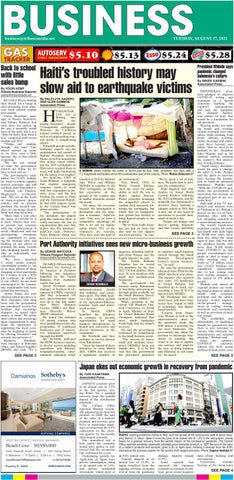
business@tribunemedia.net
TUESDAY, AUGUST 17, 2021
$5.10 Back to school with little sales bump
By YOURI KEMP Tribune Business Reporter ykemp@tribunemedia.net RETAILERS are holding their breath for a bump in sales stemming from whatever form schools reopen next month. Uhura Woodside, manager at Nassau Stationers, told Tribune Business that sales have not picked up the way it normally would have in the past, but it is a “little bit more than what it was” compared with recent months and 2019. “Things are coming, though,” she said. “One school opened up today so we have seen a little increase due to that school reopening.” “We are not certain of what the government schools are doing. So we have to wait and see.” The government’s value added tax (VAT) holiday for back-to-school supplies started yesterday and will continue until September 6. Alannah van Onselen, ShopLocal’s co-director, said: “We are in the heart of back-to-school preparations, and as parents purchase the needed supplies, we encourage them to think and shop local first. “More than a year after the onset of COVID-19, it is more critical than ever to provide our economy with the reinforcement it needs. ShopLocal and our participating merchants are committed to keeping the message alive and building on our efforts to promote the many reasons why shopping locally benefits us individually and collectively. “We have launched a social media contest, encouraging people to tag us in their photos of them shopping at local merchants for a chance to win a $250 gift certificate. In addition to our efforts, we are most encouraged by the community stakeholders who have joined this movement. “Some banks are now offering added incentives to their customers who shop local, and the government has introduced several Vat holidays that encourage shoppers to spend their money at home. We salute these efforts and encourage more organisations to drive home the importance of supporting the local economy by shopping at home by offering incentives and rewards that promote it.” Donnetta Burnside, store manager at Bahamas Office and School Supplies (BOSS), also said: “It’s a
SEE PAGE 3
$5.13
$5.24
Haiti’s troubled history may slow aid to earthquake victims By HALELUYA HADERO AND GLEN GAMBOA Associated Press
H
UMANITARIAN aid is flowing into Haiti following Saturday’s deadly 7.2-magnitude earthquake. However, the Caribbean nation’s political unrest, as well as an approaching tropical storm, is complicating efforts. Nonprofit groups and philanthropy experts say the assassination last month of Haitian President Jovenel Moise, as well as accusations that money raised following the 2010 earthquake in Haiti never reached those in need, will make fundraising for the nation even tougher. Art delaCruz, CEO of Team Rubicon, a nonprofit that deploys emergency response teams to work with first responders in disaster areas, said the first briefing his teams in Haiti and the Dominican Republic had with support teams in the United States was about security. “The assassination of the president, the almost gang-like existence there, it really increases the risk to organisations like ours that deploy into this situation,” delaCruz said. However, Team Rubicon, which was
A WOMAN sleeps outside her home in Saint-Louis-du-Sud, Haiti, yesterday, two days after a 7.2-magnitude earthquake struck the southwestern part of the country. Photo: Matias Delacroix/AP founded in 2010 by Marines Jake Wood and William McNulty in response to the 2010 earthquake in Haiti, has experience on the ground in the country and in similar situations around the world. “It’s dicey for everyone because the information is incomplete and the situation is dynamic,” delaCruz said. “One way we have a competitive advantage on this is we are an organisation where 70% of the volunteers are veterans. They have seen this kind of
an environment.” Nate Mook, CEO of World Central Kitchen, cited the need for adaptability as well. He was in Haiti’s capital Port-auPrince yesterday, managing the nonprofit’s efforts to combat food insecurity following the earthquake, but found that its transportation system was needed to bring injured people to the hospital. “We’ve been really focusing, not just on food, but also how we can support our local partners,” he said.
“We’ve spent a lot of time here. We know how to navigate the complexities.” Haiti inspired chef Jose Andres to found World Central Kitchen following the 2010 earthquake and the nonprofit has maintained a presence there, opening a culinary school in 2015 that is now one of two bases of operations to provide thousands of meals a day. “People are hungry and they’re getting desperate and that creates instability
SEE PAGE 3
Port Authority initiatives sees new micro-business growth By DENISE MAYCOCK Tribune Freeport Reporter dmaycock@tribunemedia.net NEARLY 200 new microbusinesses are licensed to do business in Freeport following two initiatives launched by the Grand Bahama Port Authority earlier this year. Derek Newbold, senior manager of business development at GBPA, reported that they welcomed 195 new micro-business licensees up to this July under their Micro Business Licence (MBL) and Business Diversity Waiver (BDW) initiatives. He stated this included 125 permit vendors who were grandfathered into the programme, 55 traditional businesses and 15 innovative businesses approved through the BDW. Mr Newbold indicated the BDW licencees operate in diverse sectors including agriculture and fisheries, hospitality/tourism, entertainment, education, retail,
DEREK NEWBOLD industrial-related, health and wellness, real estate, and export. The MBL licencees have enabled growth in the agriculture/fisheries, tourism, food, and microretail sectors. In March, GBPA launched the initiatives to continue to provide opportunities for small business entrepreneurs to launch new, innovative and diverse businesses in the community. Mr Newbold said they continue to receive interest from Bahamians. “Since the launch of these initiatives in early March 2021, GBPA has received a significant number of
inquiries, including individuals from Nassau and the Family Islands,” he said. The Grand Bahama Chamber has on record 216 members for the year 2021. Of that number, there were 20 new members with small and medium-sized businesses. The government has assisted many Bahamians in becoming entrepreneurs through grants available via the Small Business Development Centre (SBDC). While speaking at the virtual GB Business Outlook Conference via Zoom in April, Minister of State for Grand Bahama Kwasi Thompson indicated that more small businesses would help with the island’s recovery. He said the government reinforced its commitment to the small business sector. “The success of micro, small and medium enterprises (MSMEs) keep our islands alive. It is in this vein that this government has prioritised initiatives
to empower small business owners through the Small Business Development Centre’s Access Accelerator,” he said. He said the government allocated some $50m for the SBDC this fiscal year alone. The minister also reported that some 192 businesses in Grand Bahama had benefited up to April, representing a total of $1.8 m injected into MSMEs. Mr Thompson had also noted more and more businesses have begun to shift to technology and digitalbased services. “Lessons from Hurricane Dorian as well as the unprecedented onset of the pandemic made this shift almost a necessity for our local businesses. The government has taken the position to encourage businesses to continue this trend as we aim to digitise our services and improve the ease of doing business and efficiency in our country,” he stated.
$5.28 President Widodo says pandemic changed Indonesia’s culture By NINIEK KARMINI Associated Press
INDONESIA’S president pledged to improve COVID-19 testing and treatment in a speech yesterday marking the country’s independence and said the pandemic has changed Indonesian culture in ways that would be a foundation for advancement. Wearing masks, not shaking hands and avoiding crowds of people were once taboo, while working from home, distance learning, online meetings and online court have become new habits “that we used to be hesitant to do”, President Joko Widodo said in the national address marking the country’s 76th anniversary of independence. “Amid today’s disruptive world, the spirit to change, the spirit to make changes and the spirit to innovate have become the foundation to build an advanced Indonesia,” Widodo said. “With the COVID-19 pandemic, the acceleration of innovation has become an integrated part of our everyday lives.” Only half of the 711 lawmakers and senators were in Parliament for Widodo’s speech on the eve of Independence Day, with the rest attending remotely in a social-distancing measure. The world’s fourth-most populous country hit peaks last month with daily highs of 50,000 new cases, more than five times the usual highs in June. July was also the deadliest month, with more than 30,100 deaths from COVID-19 as sick people overwhelmed hospitals or died at home or while awaiting care. Its totals of 3.8 million cases and 118,833 fatalities are considered undercounts due to low testing and poor tracing measures in the nation of 270 million people. Widodo said almost all regional leaders are working hand in hand to address health and economic problems and his administration would improve on-the-ground management in testing, tracing, treatment and vaccination as well as provision of medical oxygen. “The availability and affordability of medicines should be guaranteed and there is zero tolerance to anyone who obstructs our humanitarian and national missions,” Widodo said. Once the country’s COVID-19 epicenter, Jakarta has been seeing declines in both active cases
SEE PAGE 3
Japan ekes out economic growth in recovery from pandemic By YURI KAGEYAMA Associated Press JAPAN’S economy grew at an annual rate of 1.3% in the last quarter, raising hopes for a gradual recovery from the painful impact of the coronavirus pandemic. The Cabinet Office reported Monday seasonally adjusted gross domestic product, or GDP, the sum of the value of a nation’s products and services, grew 0.3% in April-June, marking a reversal from the 0.9% contraction in the previous quarter for the world’s third-largest economy. The annualised rate is how much the economy would have grown or contracted had the on-quarter rate continued for a year. Underlining growth for April-June in Japan were private consumption, rising at an annual rate of 3.4%, and private residential investment, which grew at
PEOPLE wearing protective masks to help curb the spread of the coronavirus walk at Ginza shopping district, in Tokyo. Japan’s economy grew at an annual rate of 1.3% in the last quarter, raising hopes for a gradual recovery from the painful impact of the coronavirus pandemic. The Cabinet Office reported yesterday seasonally adjusted gross domestic product, or GDP, the sum of the value of a nation’s products and services, grew 0.3% in April-June, marking a reversal from the 0.9% contraction the previous quarter for the world’s third largest economy. Photo: Eugene Hoshiko/AP an 8.6% annual rate. Exports jumped at an annual rate of 12.3%, as Japan benefited from the ongoing overseas economic revival from the pandemic
damage. Imports surged 21.9%. Some analysts had expected the Japanese economy to continue to contract, given recent negative
data about housing and investments. Uncertainty remains because of the rising cases
SEE PAGE 4
THE TRIBUNE
Tuesday, August 17, 2021, PAGE 3
BTC EXPANDS FIBRE-TO-THE-HOME ON ABACO APPROXIMATELY 2,000 families on Abaco will have access to BTC’s expanding fibre to the home network. The company is currently installing services in Central Pines and concurrently conducting a massive overhaul of its network in the Dundas Town, Murphy Town, and Marsh Harbour communities. BTC will extend its reach into the surrounding cays – providing access to bestin-class broadband services at affordable rates for all. Commenting on this huge achievement for the
ANDRE FOSTER
company, BTC’s chief executive officer, André Foster said: “This is a really big moment, and the entire BTC family is so proud. In 2019, we made a commitment to come back stronger and build a more resilient network and we are on track. In February, 2020 we reopened a physical storefront in Marsh Harbour so our customers could connect with us once again. “We’ve also made stellar progress as the team worked throughout the pandemic to ensure that
our fibre infrastructure from Fox Town to Sandy Point was secured underground. “We’ve recently completed our upgrades in the Central Pines community and we are now installing services to almost 600 families. We are also upgrading Dundas Town, Murphy Town, Don Mackay Blvd, Green Turtle Cay and Hope Town. Our plan is to extend our enhanced fiber services throughout the length and breadth of the island and its cays.”
Residents weighed in on the fibre to the home upgrade stating that it is a welcomed surprise and are pleased with having access to superfast broadband speeds. Murphy Town resident Veancorvd Darville said, “BTC has been doing a lot of work throughout the communities. The new fiber plan is pretty good. Thank you to BTC for the powerful upgrade so far in the Abacos.” Felicity Hield, a teacher from Central Pines said,
“We just got our upgrade, I’m happy and my kids are happy! With the upgrade multiple persons can be on their devices. The kids can be on their YouTube videos, I’m able to work on my laptop and my other daughter can watch television. We don’t have any issues with buffering. The new upgrade is fast, reliable and I encourage everyone to get upgraded. The BTC team is doing a wonderful job, we see them on the road working hard. We are very thankful to them.”
BAHAMIAN MARITIME STUDENTS SET SAIL WITH ROYAL CARIBBEAN TWO Bahamians will set sail with Royal Caribbean International this month after graduating from the Caribbean Maritime University at the top of their class and landing high-ranking jobs with the popular cruise line. Shante Pearson, 23, of Nassau, will board Grandeur of the Seas August 14 to embark on her new career. Grand Bahamian Tre’von Ferguson, 27, departs on Ovation of the Seas in September. Both will serve as 2nd Officers on bridge watch, responsible for assisting with radio communications, safety, navigation, carrying out emergency orders, overseeing flag inventory, protocol and more. For both Pearson and Ferguson, the voyage to the bridge has been a long one, but one they never lost hope of. And for both, fascination with the sea began at an early age. “My dad, now a retired (Royal Bahamas) Defense Force officer, would allow me to accompany him when a ship was in the harbour and he’d explain everything to me,” said Pearson. When he was off on assignment, Pearson pulled out his navigational tools, playing explorer. At
TRE’VON FERGUSON
SHANTE PEARSON
CV Bethel Senior High School, she joined the afterschool Bahamas Maritime Cadet Corps (BMCC) and by graduation had been awarded Most Outstanding Bridge Cadet. At 17, she flew off to Africa to join a bulk carrier where she was the only female aboard in a crew of 23 men. To this day, when people ask how she did it, she says she still does not know, but one thing she was sure of – a career at sea was the only career she wanted. If life onboard demanded fortitude, what the seas dealt could be more frightening. A three-day storm in the Bay of Biscay tossed the ship around as Pearson feared the monstrous waves would swallow it whole. The bulk carrier stint lasted ten long months. Back on land, Pearson, determined to equip herself with the maritime
academics she needed to advance, earned a Royal Caribbean scholarship to the LJM Maritime Academy where she flew through the tough courses like a lifetime sailor, earning another Royal Caribbean scholarship to the Caribbean Maritime University (CMU). But it was during the first academy’s graduation ceremony aboard the world’s largest cruise ship, Royal Caribbean’s Symphony of the Seas, that she first witnessed the glamour and romance of a large ship and vowed silently one day to find a place for her talent on one. She earned her certification, graduating as Valedictorian 2020 from CMU and applied immediately for what she called her “dream career”. “Years of hard work and dedication are paying off,” she said. “I am about to
Haiti’s troubled history may slow aid to earthquake victims FROM PAGE ONE
and a lot of concerns, so we need to work with our partners to get them food, to make sure food is available,” Mook said. Skyler Badenoch, CEO of the Florida nonprofit Hope for Haiti, says the response has also been complicated because its staff has been directly affected by the disaster. The organisation is now gearing up to distribute $60m worth of first aid supplies and medical equipment to help those affected, he said. Aid to Haiti has been probed for years and scrutiny intensified in 2015 when an investigation from ProPublica and NPR questioned where $500m raised by the American Red Cross was spent. The American Red Cross said in an emailed statement that it is not seeking
President Widodo says pandemic changed Indonesia’s culture FROM PAGE ONE
and new cases from midJuly to the past week, from over 100,000 to below 15,000 active cases per day and from over 10,000 to below 2,500 new cases per day. Also, patients are not being turned away like in the past as the bed occupancy rate in hospitals declined in several regions. Restrictions on public activities, which the government credits with helping to ease pressure on hospitals, are being eased in the capital. Authorities in Jakarta have reopened malls, places of worship and outdoor sport venues since last week with certain capacity limits, and people must show they’ve been vaccinated. While current data are encouraging, the devastating health crisis is far from over, said Dewi Nur Aisyah, the National COVID-19
RICE is distributed to residents in Les Cayes, Haiti, yesterday two days after a 7.2-magnitude earthquake struck the southwestern part of the hemisphere's poorest nation on Aug 14. Photo: Joseph Odelyn/AP donations for Haiti relief at this time, but will work with its partners — including the Haitian Red Cross and the Red Crescent — to respond to the earthquake. It also disputed the ProPublica/ NPR findings. “Americans donated generously in the
aftermath of the 2010 Haiti earthquake to save lives — which is exactly what their donations did,” it said in a statement. Despite the criticisms the Red Cross has received, Maryam Zarnegar Deloffre, an expert in humanitarian
Task Force’s IT and data center head. She noted new COVID-19 cases are soaring in certain provinces outside the country’s most populated island of Java despite restrictions. Indonesia began vaccinating aggressively earlier than many other countries in Southeast Asia. The country aims to inoculate more than 208 million of its 270 million people by March 2022, but authorities have only fully vaccinated 28 million people and partially vaccinated another 30.5 million so far. “I’m fully aware that the COVID-19 pandemic has brought with it exhaustion, boredom, weariness, sadness and distress,” Widodo said, acknowledging that many criticisms have been directed to his administration, particularly on matters that have not been resolved yet. “Constructive criticism is crucial and we always respond to that by fulfilling our responsibilities as expected by the people,” he said.
Back to school with little sales bump FROM PAGE ONE steady flow. I think a lot of persons were busy this morning and were waiting for the VAT free weeks and I think they’re still waiting on an announcement from the minister of education in terms of what method they’re going to use for back to school.” The Ministry of Education is supposed to make an announcement on how the resumption of the school year is to begin, whether it will be online learning, face to face, or a hybrid. Ms Burnside added: “It’s not slow, it is a steady trail of people. Some schools are open so it’s good. “Regardless around this week and next week are our busiest weeks. Government schools, whether it’s hybrid or face to face, they are open in another two weeks.”
embark on a new journey on one of Royal Caribbean’s ships, the dream job I have been working toward all my life.” Like Pearson, Ferguson’s story begins early. His uncle was a fisherman who took young Ferguson with him for long summer fishing trips. In winter months, when Ferguson was in school, he’d live for the end-of-fishing-day stories his uncle would tell. His mother held a highly responsible position with the Freeport Container Port as a ship planner and young Ferguson became a familiar face around the office. “At a very early age, I developed an understanding of the beauty and the dangers of the sea, so while attending St George’s High School in Freeport, I joined the Bahamas Maritime Cadet Corp in my senior year to broaden my horizon in the maritime field,” he says. Knowing if he wanted a career in the world of ships and shipping, he needed to speak more than English, so at 17, Ferguson took off for university in Cuba, the closest place he knew to learn Spanish. As he completed the intensive course, LJM Maritime Academy
was opening in what used to be the grounds and underwater observatory of Coral World in Nassau. Ferguson applied, was accepted and graduated near the top of his class. He too, stepped into the work aboard a container ship with the first three months of the job landing him back in Freeport. “Locals were not used to seeing Bahamians sail at that port, the stevedores would ask me if I was African,” he joked. “It was my first taste of commercial shipping and it made me hungry for more.” He then moved onto a bulk carrier. “My most memorable moment arose when the vessel was collecting coal from Colombia to transport to Saudi Arabia. There was no land in sight for weeks as the vessel went through blackouts, extreme weather and piracy scares. The excitement of the unknown and having to be able to think on your feet constantly was more than enough to persuade me to want more.” Ferguson apprenticed, studied for his officer of the watch certification and again, a mirror of Pearson, was a standout at CMU. When Pearson and Ferguson set sail with Royal
Caribbean, they will be among a quickly growing number of Bahamians joining the company. More than 300 locals, including managers of nearly every department or division, are employed by Royal Caribbean at its private island destination experience, PerfectDay at CocoCay in the Berry Islands. “My gratitude goes beyond measure,” says Ferguson. A Royal Caribbean executive says it is not just the new officers who are excited about Bahamians being on the bridge of some of the world’s largest and grandest ships. “The Bahamas was our very first port of call more than half a century ago and is still our number one destination in terms of ship arrivals,” said Russell Benford, vice president, Government Relations, Americas. “So, we are really happy and excited to be welcoming more Bahamians onboard in critical roles and we hope the numbers will continue to increase from month-to-month and year-to-year. Ferguson and Pearson are both incredibly impressive. We know there are others out there and we want to encourage them to come aboard.”
aid and professor at George Washington University, said she believes donors will continue to rely on the organisation because of its reputation. “It has been resilient,” she said, partly because the organisation is easily recognised by donors for its work with blood drives, and other things. This time around, Marleine Bastien, the executive director of the Family Action Network Movement, a social service organisation based in the “Little Haiti” neighbourhood in Florida, says her organisation will devise a plan to hold accountable every group that’s collecting donations for Haiti. “We definitely do not want another film titled ‘Where Did The Money Go’?” Bastien said, in reference to the 2012 documentary that looked at donations given to Haiti relief following the 2010 earthquake. The deadly earthquake hit Haiti at the same time a growing humanitarian crisis is unfolding in Ethiopia, and instability is rocking Afghanistan. Deloffre, of George Washington University, said
she believes fundraising prospects for the country are bleak. “I unfortunately do not expect broad global attention to the earthquake in Haiti,” she said. “Or public giving, on the same scale as we saw in response to the 2010 earthquake.” Past allegations of misspent donations have created some hesitancy as well, said Badenoch, of Hope for Haiti, though the need following the most recent earthquake may be even more intense. “It is quite possible that Haiti is going to need more help than ever before,” said Akim Kikonda, Catholic Relief Services’ country
representative in Haiti. Laura Durington, Catholic Relief Services’ director of annual giving, said the group, which has worked there for 50 years, is providing whatever help that it can. It started to distribute emergency supplies Monday because they had stockpiled tents and metal sheeting there previously. “Yes, there have been some bad actors, but not giving because of that is short-sighted,” Durington said. “It’s really frustrating, because every penny that was given to us for Haiti went to Haiti. There has been incremental, positive change. And Haiti’s needs are so critical right now.”
PAGE 4, Tuesday, August 17, 2021
THE TRIBUNE
Japan ekes out economic growth in recovery from pandemic FROM PAGE ONE of COVID-19 infections in Japan, which has a vaccine rollout that’s among the slowest for industrialised countries. About a third of the population is now fully vaccinated. But hospitals in some regions are being stretched, and sick people are being asked to just stay home. Robert Carnell, regional head of research AsiaPacific at ING, said the GDP numbers were better than he had expected. “Normally, we’d put all of this together and forecast a slightly stronger GDP result for the third quarter based on the factors described above. But these are not normal times,” he said, referring to the worries about the COVID-19 infections. Carnell also noted GDP growth was weaker in
Japan than for some other nations, such as the US, which has recorded 6.5% annualised growth for the same quarter. The report from the US Commerce Department last month highlighted a sustained recovery from the pandemic recession in the US, where the total size of the economy has now surpassed its pre-pandemic level. Japan has never had a lockdown but has repeatedly declared a government “state of emergency”, for some areas, including Tokyo, centered around having eateries and bars close early or not serve alcohol. Some places have ignored the emergency requests. Tokyo streets are bustling with crowds of people, and commuter trains are packed. Public discontent against the government leadership has been simmering
after it decided to go ahead with the Tokyo Olympics, meaning thousands of athletes and officials entered the country, and “bubble” conditions at venues, the athletes’ Village and other places were likely compromised. Japan was not able to rake in the economic benefits from inbound travelers and tourists, as no general-public spectators were allowed in the stands. Junichi Makino, chief economist for SMBC Nikko Securities in Tokyo, said the rebound will likely pick up momentum later this year as the vaccine rollout picks up and economic activity returns gradually to normal levels. Japan has had more than 15,000 COVID-19 related deaths so far. Tokyo reported more than 5,000 daily new cases in the past week.
CAN MAKE A DIFFERENCE IN THE LIVES OF THE CHILDREN AT RANFURLY
T
he Ranfurly Homes for Children has been a safe haven for thousands of Bahamian children since 1956. The Home provides a safe, structured environment for children who have been orphaned, abused, neglected or abandoned. YOU can make a difference in the lives of the children at Ranfurly. With your support children can have nutritious food, warm beds and a safe environment where they can discover the joy of being children. For years the children living and learning at Ranfurly have made great social and academic strides. Their further development requires additional support in the form of a Transitional Home, planned for construction on the Ranfurly property. This residence will cater to teenagers and young adults who are beyond school age, but need accommodation while they find work and gain independence from the Home. We look forward to your continued support in this worthwhile endeavour.
MEMBERSHIP PACKAGES Individuals, Families & Corporate Sponsors Children Helping Children - $5 (Individual children from ages 6 - 18) Individuals Helping Children - $50 (Individual adults 18 years and over) Families Helping Children - $100
CIRCLE of FRIENDS Silver: $1,500 - $2,499 Gold: $2,500 - $4,999 Platinum: $5,000 plus
OPPORTUNITIES • • • •
Invitations to Ranfurly events Assist with fundraising events Involvement with special activities Adults are eligible to join the Board after three months • Stay in touch with Ranfurly through website and newsletters
BENEFITS
• Personal fulfillment in knowing you are impacting lives • Ranfurly children’s appreciation and positive response • Continued support provides stability and constant care
For more information visit: www.ranfurlyhome.org Please “Like” us on Facebook Ranfurly Home for Children, Mackey Street P.O. Box 1413 Nassau, Bahamas 242-393-3115
THE TRIBUNE
Tuesday, August 17, 2021, PAGE 5
S&P HITS NEW RECORD AMID RISING CONCERNS ABOUT PANDEMIC Associated Press
Despite the latest gains, there are signs that investors have turned cautious with the market at all-time highs amid rising coronavirus infections in the US and around the globe due to the highly contagious delta variant. Traders shifted money into US bonds, which helped drag bond yields lower. Small company stocks fell, knocking the Russell 2000 index 0.9% lower. Nearly twice as many stocks in the New York Stock Exchange fell than rose. “Delta is ending up being a cascading concern,” said Sam Stovall, chief investment strategist at CFRA. “It seems the market really doesn’t want to make a commitment for the intermediate or long term.”
The S&P 500 rose 11.71 points to 4,479.71. The Dow added 110.02 points to 35,625.40. The Nasdaq fell 29.14 points to 14,793.76. The Russell 2000 lost 19.69 points to 2,203.41. Stocks have been pushing to ever higher records the past couple of weeks even amid choppy trading as investors try to gauge the impact of rising virus cases. Analysts had expected economic growth to slow from its breakneck pace earlier this year, but the highly contagious delta variant has prompted even more caution from investors. The concerns are being heightened as students head back to school or prepare to head back to school at the end of August. School shutdowns because of the virus could crimp a
recovery in the job market if parents have to stay home. A resurgence could also stifle the recovery for many businesses that rely on people leaving their homes to eat, shop and get other services. Data out of China showed the global coronavirus pandemic continues to hurt economies around the world. Chinese industrial production and retail sales both rose last month, but at a far weaker pace than what economists had expected. China’s economy is suffering from supply chain issues, where manufactured goods that would typically be on their way to foreign markets have either remained unfinished or stuck in shipping containers. The pandemic
has made hiring workers harder as well. The collapse of the Afghanistan government over the weekend was also on investors’ minds. While the economy of Afghanistan is small, the country is located in a delicate part of the world, sandwiched between the economic giants of South and East Asia and the oilrich Middle East. The price of US crude oil fell 1.7% and weighed down energy companies. Exxon Mobil dropped 1.5% and Chevron closed 1% lower. Shares in some retailers and tourism-related companies also fell. Caesars Entertainment slid 4% and Gap dropped 3.1%. Bond yields fell and pulled banks lower. They
rely on higher yields to charge more lucrative interest on loans. The yield on the ten-year Treasury fell to 1.26% from 1.29% late on Friday. Wells Fargo lost 1.9% and Citigroup dropped 1.4%. Also dampening investors’ optimism was the University of Michigan consumer sentiment index from on Friday, which fell to 70.2 from its previous level of 81.2 in July. That was the largest drop in sentiment since April 2020, when the pandemic took its initial grip on the country. The unexpectedly bad reading was almost entirely due to the spread of the delta variant of the coronavirus, which has caused hospitals to fill up with unvaccinated patients across the US.
Author calls for donors to ‘decolonise’ their wealth
lot of external pressure on foundations, on corporations to invest more in social justice and just in communities of color in general. At the Decolonizing Wealth Project, we’ve really been fueling this reckoning that’s been happening across the sector for the last number of years. So the conversations, even before the murder of George Floyd, have begun to shift. I think that moment absolutely opened a new level of opportunity for resources to flow. One of the challenges that we have in philanthropy is sometimes moving money in ways that connect to a news cycle or some type of sparkplug event that happens in communities. It’s human nature to want to respond in the moment, but what we have to continue to push for is to center and prioritise Black, Indigenous and other communities of color in our grantmaking. Q: You’ve spoken about the need to extend grace to Americans learning about racial inequities. Do you believe there is a lack of grace in today’s social justice movements? A: I do, I do. But I think it’s been really hard to extend grace in a moment where we are directly in the line of attack. So I do believe there’s a time to fight and a time to really defend our positions and to maybe not compromise or find that middle ground. But I think all of us can, and should, find ways to work towards extending grace to others. In my own journey, I know that I was raised to be racist. I was raised to be sexist, homophobic, and through a lot of reading work on my own, but also the support of community around me, I’ve evolved over the last couple
of decades to be someone who thinks and shows up very differently. But had I not had that opportunity to find community, to teach me, I don’t know that I would have gotten there on my own.
And so we are living in a time of cancel culture. We’re living in a time of identity politics. And it is actually just really challenging after this last political administration and all the things we saw — policies, the attacks on our
communities — to extend grace in those moments. So it is a process of healing that we all have to engage in. I try my best to extend that to others, because that’s how I’ve been received through the years.
A CHOPPY day on Wall Street ended yesterday with the S&P 500 and Dow Jones Industrial Average notching new highs after recovering from an early slide. The indexes each rose 0.3%, extending their winning streak to a fifth day, while the Nasdaq fell 0.2%. Technology and health care stocks accounted for much of the gain in the S&P 500. Sectors traditionally considered lower risk, including utilities and companies that make food and personal goods also helped lift the market. Those gains outweighed a pullback in banks, energy stocks and a swath of retailers and travel sector companies.
EDGAR Villanueva poses for a picture. Villanueva is on a mission to change philanthropy. Photo: Kisha Bari/AP By HALELUYA HADERO Associated Press EDGAR Villanueva is on a mission to change philanthropy. Villanueva, a 44-year-old racial justice activist, became a household name in the donor world in 2018. He said he was moved by the attention gained by his book, which argues that institutionalised philanthropy in America perpetuates practices that marginalise minority communities. He says he reached that conclusion after many years of working in philanthropies from Washington state to North Carolina, where he is an enrolled member of the Native American Lumbee tribe. In recent years, he has pushed for philanthropies to incorporate more diversity and inclusion on the inside and invest more into minority communities on the outside. To that end, Villanueva launched the nonprofit Decolonizing Wealth Project in 2018. The group runs a fund supporting minority-led initiatives for social justice causes and has received contributions from billionaire philanthropist MacKenzie Scott. The second edition of Villanueva’s book, “Decolonizing Wealth: Indigenous Wisdom to Heal Divides and Restore Balance”, was released last week. The Associated Press spoke recently with him about his calls for change and other things. The interview was edited for clarity and length. Q: You’ve argued that institutionalised philanthropy is infected with a “colonizing virus”. What do you mean? A: The philanthropic industry as it exists currently, with $1tn in assets, came about through a history of inequality. There have been accumulated advantages and benefits for people with wealth, and specifically for white people in the US, to be in the position of being able to generate and build wealth in the first place. So folks who had those generational resources passed it down, and those with accumulated benefits have been in the best positions to start foundations and to actually be able to be charitable in a very traditional sense. We have to bring that history into context as we’re thinking about the gifts — who’s receiving money, who makes decisions about money and who benefits
from this entire industry. Colonisation was all about extracting resources and hoarding resources... So I talk about this colonising virus because it is like a virus that has really infected all of our systems but especially the systems connected to money. Q: And how can the sector combat such a virus? A: The way out of this is to think about healing. If trauma is the result of how wealth has been accumulated, I believe that we can flip that and use money and wealth differently, specifically philanthropic capital, which should be deployed to really benefit all people. If we’re investing in communities of color and actually prioritising Black and Indigenous communities that have historically been marginalised, then I believe that we can help close the race wealth gap that exists, in essence using money as a form of medicine. Q: Charitable foundations are criticised for investing their endowments in companies that don’t align with their missions. Some announced plans to change their strategies. Do you see that happening at a mass scale? A: I’m hopeful. Probably prior to five years ago, there was very little talk about endowments. I think more and more as we’re talking about effective and modern philanthropy, we are looking at the entire picture of all the resources that are available to foundations. And there’s a major push to align the grant-making practices and the business practices with the investment practices. What is the net value of philanthropy if with our right hand we’re doing some good and with our left hand we’re actually doing harm? It really makes no sense for a foundation to invest in grant making around criminal justice but invest their endowments in private prisons. Return on investment is not always something that can be quantified by a dollar sign. Q: Philanthropic funding for racial equity initiatives increased following the police killing of George Floyd. Will that be sustained? A: I think we’re having a breakthrough moment. I feel optimistic about it. A lot of things have been shifting in the past three years, thanks to the work of social movements like the Movement for Black Lives. There’s been a
PAGE 6, Tuesday, August 17, 2021
THE TRIBUNE
PUBLIC NOTICE
PUBLIC NOTICE
INTENT TO CHANGE NAME BY DEED POLL
INTENT TO CHANGE NAME BY DEED POLL
The Public is hereby advised that I, CHRISTINA SUCKIE of #8 Hudson Street, Blair Estates, P.O. Box CR-56766 New Providence, The Bahamas, Parent of CHRISTIAN BRYSON ROYHAL DESMANGLES A minor intend to change my child’s name to CHRISTIAN BRYSON ROYHAL SUCKIE. If there are any objections to this change of name by Deed Poll, you may write such objections to the Deputy Chief Passport Officer, P.O. Box N-742, Nassau, Bahamas no later than thirty (30) days after the date of publication of this notice.
The Public is hereby advised that I, DAMNESHA TRINITY NATASHA STUBBS of Flamingo Gardens, Carmichael Road, Nassau, The Bahamas intend to change my name to TRINITY NATASHA STUBBS . If there are any objections to this change of name by Deed Poll, you may write such objections to the Chief Passport Officer, P.O.Box N-742, Nassau, Bahamas no later than thirty (30) days after the date of publication of this notice.
MARKET REPORT www.bisxbahamas.com
MONDAY, 16 AUGUST 2021
BISX ALL SHARE INDEX: BISX LISTED & TRADED SECURITIES 52WK HI 6.50 33.95 1.62 2.90 1.67 6.00 7.50 3.60 6.01 3.77 6.16 11.26 2.71 8.25 11.06 10.08 14.31 4.10 9.00 16.00
52WK LOW 3.50 22.65 1.46 1.62 1.35 5.00 6.00 2.80 4.25 2.47 5.00 9.75 2.10 5.50 9.50 8.35 13.00 3.42 8.00 15.20
1.00
1.00 1000.00 1000.00 1000.00 1000.00
1.00 10.00 1.00
1.00 10.00 0.90
52WK LOW 100.00 100.00
%CHANGE
YTD
YTD%
2009.37
27.95
1.41
-83.09
-3.97
SYMBOL AML APD BBL BFH BOB BPF BWL CAB CBB CBL CHL CIB CWCB DHS EMAB FAM FBB FCL FIN JSJ
Bahamas First Holdings Preference Cable Bahamas Series 6 Cable Bahamas Series 8 Cable Bahamas Series 9 Cable Bahamas Series 10 Colina Holdings Class A Fidelity Bank Bahamas Class A Focol Class B
BFHP CAB6 CAB8 CAB9 CAB10 CHLA FBBA FCLB
CORPORATE DEBT - (percentage pricing) 52WK HI 100.00 100.00
CHANGE
SECURITY AML Foods Limited APD Limited Benchmark Bahamas First Holdings Limited Bank of Bahamas Bahamas Property Fund Bahamas Waste Cable Bahamas Commonwealth Brewery Commonwealth Bank Colina Holdings CIBC FirstCaribbean Bank Consolidated Water BDRs Doctor's Hospital Emera Incorporated Famguard RF Bank & Trust (Bahamas) Limited Focol Finco J. S. Johnson
PREFERENCE SHARES 1000.00 1000.00 1000.00 1000.00
CLOSE
SECURITY Fidelity Bank (Note 22 Series B+) Bahamas First Holdings Limited
SYMBOL FBB22 BFHB
BAHAMAS GOVERNMENT STOCK - (percentage pricing) 115.92 100.00 100.00 100.00 100.00 100.00 100.00 102.00 100.31 100.00 100.31 100.53 100.30 100.62 100.70
104.79 100.00 100.00 100.00 100.00 100.00 100.00 100.00 100.04 93.68 100.04 100.29 100.05 100.62 100.46
MUTUAL FUNDS 52WK HI 2.43 4.47 2.17 202.18 190.86 1.70 1.81 1.78 1.07 8.75 10.46 7.40 15.99 12.72 10.39 10.00 10.43 14.89
52WK LOW 2.11 3.30 1.68 164.74 116.70 1.67 1.73 1.75 1.03 6.41 7.62 5.66 8.65 10.54 9.57 9.88 8.45 11.20
Bahamas Note 6.95 (2029) BGS: 2014-12-7Y BGS: 2015-1-7Y BGS: 2014-12-30Y BGS: 2015-1-30Y BGS: 2015-6-7Y BGS: 2015-6-30Y BGS: 2015-10-7Y BGRS FL BGRS81037 BGRS FX BGR121138 BGRS FL BGRS81037 BGRS FL BGRS70023 BGRS FL BGRS70024 BGRS FL BGRS77024 BGRS FL BGRS79026
BAH29 BG0107 BG0207 BG0130 BG0230 BG0307 BG0330 BG0407 BSBGRS810375 BSBGR1211386 BSBGRS810375 BSBGRS700238 BSBGRS700246 BSBGRS770249 BSBGRS790262
LAST CLOSE 6.49 39.95 1.60 2.39 1.37 6.00 7.50 3.24 5.40 2.74 5.95 9.80 2.49 8.25 11.57 10.08 14.09 3.98 8.93 15.50 1.00 1000.00 1000.00 1000.00 1000.00 1.00 10.00 1.00 LAST SALE 100.00 100.00 107.31 100.00 100.00 100.00 100.00 100.00 100.00 100.00 100.05 100.00 100.05 100.27 100.05 100.62 100.72
FUND CFAL Bond Fund CFAL Balanced Fund CFAL Money Market Fund CFAL Global Bond Fund CFAL Global Equity Fund Leno Financial Conservative Fund Leno Financial Aggressive Fund Leno Financial Balanced Fund Leno Financial Global Bond Fund Royal Fidelity Bahamas Opportunities Fund - Secured Balanced Fund Royal Fidelity Bahamas Opportunities Fund - Targeted Equity Fund Royal Fidelity Bahamas Opportunities Fund - Prime Income Fund Royal Fidelity Int'l Fund - Equities Sub Fund Royal Fidelity Int'l Fund - High Yield Fund Royal Fidelity Int'l Fund - Alternative Strategies Fund Colonial Bahamas Fund Class D Colonial Bahamas Fund Class E Colonial Bahamas Fund Class F
MARKET TERMS
BISX ALL SHARE INDEX - 19 Dec 02 = 1,000.00 52wk-Hi - Highest closing price in last 52 weeks 52wk-Low - Lowest closing price in last 52 weeks Previous Close - Previous day's weighted price for daily volume Today's Close - Current day's weighted price for daily volume Change - Change in closing price from day to day Daily Vol. - Number of total shares traded today DIV $ - Dividends per share paid in the last 12 months P/E - Closing price divided by the last 12 month earnings
CLOSE 6.48 39.95 1.60 2.39 1.37 6.00 7.50 3.24 5.40 2.87 5.95 10.00 2.50 8.25 11.50 10.08 14.09 3.99 8.93 15.50 1.00 1000.00 1000.00 1000.00 1000.00 1.00 10.00 1.00
CHANGE (0.01) 0.00 0.00 0.00 0.00 0.00 0.00 0.00 0.00 0.13 0.00 0.20 0.01 0.00 (0.07) 0.00 0.00 0.01 0.00 0.00
VOLUME 1,800
2,000 330,000 1,190
1,625 220,000
0.00 0.00 0.00 0.00 0.00 0.00 0.00 0.00
CLOSE 100.00 100.00
CHANGE 0.00 0.00
107.31 100.00 100.00 100.00 100.00 100.00 100.00 100.00 100.05 100.00 100.05 100.27 100.05 100.62 100.72
0.00 0.00 0.00 0.00 0.00 0.00 0.00 0.00 0.00 0.00 0.00 0.00 0.00 0.00 0.00
(242) 323‐2330 (242) 323‐2320 EPS$ 0.239 0.932 0.000 0.110 0.070 1.760 0.369 -0.438 0.140 0.184 0.449 0.722 0.102 0.467 0.646 0.728 0.816 0.203 0.939 0.631 0.000 0.000 0.000 0.000 0.000 0.000 0.000 0.000
VOLUME
DIV$ 0.170 1.260 0.020 0.030 0.000 0.000 0.260 0.000 0.000 0.120 0.220 0.720 0.434 0.060 0.328 0.240 0.540 0.120 0.200 0.610 0.000 0.000 0.000 0.000 0.000 0.000 0.000 0.000
INTEREST Prime + 1.75% 6.25% 6.95% 4.50% 4.50% 6.25% 6.25% 4.50% 6.25% 4.25% 4.87% 5.24% 4.87% 4.53% 4.56% 4.50% 4.53%
NAV 2.43 4.47 2.17 202.18 190.86 1.70 1.76 1.77 1.04 8.75 10.46 7.40 15.99 12.72 10.39 N/A 10.43 14.89
YTD% 12 MTH% 1.85% 4.26% 0.77% 1.44% 1.14% 2.84% 0.14% 5.02% 3.25% 31.13% 1.37% 1.52% -2.05% -2.21% 0.36% 0.76% -1.28% -2.30% 3.13% 5.76% 4.29% 7.07% 1.70% 3.85% 14.99% 38.64% -1.20% -0.36% 3.43% 0.76% N/A N/A 3.00% 25.60% 7.90% 48.70%
P/E 27.1 42.9 N/M N/M N/M N/M 20.3 -7.4 38.6 15.6 13.3 13.9 24.5 17.7 17.8 13.8 17.3 19.7 9.5 24.6 0.000 0.000 0.000 0.000 0.000 0.000 0.000 0.000
YIELD 2.62% 3.15% 1.25% 1.26% 0.00% 0.00% 3.47% 0.00% 0.00% 4.18% 3.70% 7.20% 17.36% 0.73% 2.85% 2.38% 3.83% 3.01% 2.24% 3.94% 0.00% 0.00% 0.00% 0.00% 0.00% 6.25% 7.00% 6.50%
MATURITY 19-Oct-2022 30-Sep-2025 20-Nov-2029 15-Dec-2021 30-Jul-2022 15-Dec-2044 30-Jul-2045 26-Jun-2022 26-Jun-2045 15-Oct-2022 26-Jul-2037 23-Feb-2038 26-Jul-2037 29-Jul-2023 29-Jul-2024 4-May-2024 28-Mar-2026
NAV Date 31-May-2021 31-May-2021 28-May-2021 31-Mar-2021 31-Mar-2021 30-Jun-2021 30-Jun-2021 30-Jun-2021 30-Jun-2021 30-Jun-2021 30-Jun-2021 30-Jun-2021 30-Jun-2021 30-Jun-2021 30-Jun-2021 31-Mar-2021 31-Mar-2021 31-Mar-2021
YIELD - last 12 month dividends divided by closing price Bid $ - Buying price of Colina and Fidelity Ask $ - Selling price of Colina and fidelity Last Price - Last traded over-the-counter price Weekly Vol. - Trading volume of the prior week EPS $ - A company's reported earnings per share for the last 12 mths NAV - Net Asset Value N/M - Not Meaningful
TO TRADE CALL: CFAL 242-502-7010 | ROYALFIDELITY 242-356-7764 | CORALISLE 242-502-7525 | LENO 242-396-3225 | BENCHMARK 242-326-7333
NOTICE
NOTICE is hereby given that MARJORIE MILHOMME, of #120 Commonwealth Boulevard, Elizabeth Estate, Nassau, The Bahamas applying to the Minister responsible for Nationality and Citizenship, for Registration Naturalization as a citizen of The Bahamas, and that any person who knows any reason why registration/naturalization should not be granted, should send a written and signed statement of the facts within twenty-eight days from the 17th day of August, 2021 to the Minister responsible for nationality and Citizenship, P.O. Box N-7147, Nassau, New Providence, The Bahamas.
NOTICE NOTICE is hereby given that JENIKA ACCEUS, of Opulent Drive, New Providence, The Bahamas applying to the Minister responsible for Nationality and Citizenship, for Registration Naturalization as a citizen of The Bahamas, and that any person who knows any reason why registration/ naturalization should not be granted, should send a written and signed statement of the facts within twenty-eight days from the 10th day of August, 2021 to the Minister responsible for nationality and Citizenship, P.O. Box N-7147, Nassau, New Providence, The Bahamas.
NOTICE
NOTICE is hereby given that MILBERT BELTON, of Soldier Road, Nassau, The Bahamas applying to the Minister responsible for Nationality and Citizenship, for Registration Naturalization as a citizen of The Bahamas, and that any person who knows any reason why registration/ naturalization should not be granted, should send a written and signed statement of the facts within twenty-eight days from the 17th day of August, 2021 to the Minister responsible for nationality and Citizenship, P.O. Box N-7147, Nassau, New Providence, The Bahamas.
PAGE 8, Tuesday, August 17, 2021
THE TRIBUNE
Bahamians deal with anxiety caused by hurricane season By JEFFARAH GIBSON Tribune Features Writer jgibson@tribunemedia.net
WITH the 7.2 magnitude earthquake shaking Haiti on Saturday, killing more than 1,400 and displacing thousands, many here in the Bahamas watched in sadness and disbelief, and with a strong sense of empathy. Those who survived Hurricane Dorian, which left in its wake death and devastation across Abaco and Grand Bahama on September 2, 2019, watched as their Caribbean neighbours faced a similarly horrific ordeal. As they watch the news updates coming out of Haiti, some Dorian survivors could not help but feel triggered emotionally. Two years after the deadly hurricane, many are still dealing with the psychological impact of the storm. They say news of the earthquake, as well as reports of developing weather systems, the fact the Bahamas is at the peak of the 2021 hurricane season, as well as the approaching two-year anniversary of Dorian, is causing them bouts of depression, anxiety, fear, and general uneasiness. Markel Williams, who lived through Dorian and whose family was displaced after the storm, said she has been feeling uneasy and at times even stressed out ever since the start of this year’s hurricane season. “At first, I was anxious, worried
and in fear. I do not like hurricane season at all. I have been praying about my fear as it relates to storms. And it’s not just me, it’s a lot of other people who are fearful about hurricane season. How I cope now is just by realising that it is something I cannot control, and God knows best. He said He will be with us in the storm,” she told Tribune Health. “It does get challenging at times, especially how we have been on watch for Tropical Storms Fred and Grace. I have been praying for those storms to turn.” Markel said for now she can breathe a sigh of relief, knowing these two systems will have little to no impact on the Bahamas. However, she knows the country is not on the clear yet. “Watching and hearing the new developments are a serious trigger for me, but I try to combat that by
reminding myself to pray to ease my mind about it. If it comes, I know that I am going to be OK,” she said. As for Romanique Johnson, who had just arrived in Abaco for work along with her brother when Dorian stuck, she too feels the pressure and anxiety during hurricane season. “Every time they say a hurricane or tropical storm is coming, I get anxious and nervous. If it’s a tropical storm I don’t worry too much, but if they say it’s a category 1 storm then it’s another game. I get very paranoid and want to know as much as I can about it,” she said. Romanique said she has battled with short bouts of depression since the entire ordeal. “I just don’t want to be put back in that place. Sometimes I get depressed and sad, sometimes
I want to scream. Many times, I hopefully being able to leave here hold everything that I am feeling to head somewhere else won’t be in. When I am in these moments, too difficult,” she said. I try to just remember that I made Even those who did not perit through and I thank God,” she sonally live through the horror said. thatwas Dorian are worried “I cope with all of this by pray- during this season. ing, reading my Bible, listening Raymond Butler told Tribto gospel music, cleaning up, or une Health the way he deals watching a movie to take my mind with his fears is by planning and off of things.” preparation. Romanique said should a “With climate change, major storm be projected to and devastating storms impact the Bahamas in could be a reality for the ‘I think the coming months, she Bahamas every year. So about it wants to flee. it’s always something to “I do not want to be happening be concerned about. here. I would just want “Though I was not to us again directly to go to another place impacted by where a storm is not and the the storm, to see what going” she said. fear of it all it did to our country Abaconian Beth and people is saddening Russell, whose house arrests my and distressing. I think was badly damaged in heart that about it happening to us Dorian and who said she I feel it in again and the fear of it was traumatised by the all arrests my heart that ordeal, shares Roma- my chest.’ I feel it in my chest. But nique’s feelings. my anxiety is put to rest “It was so horrific... because knowing that if hours and then days of not know- it does hit us again, I have a plan ing what was going to happen. So to evacuate my family,” he said. many people have passed away in Ruth Johnson added: “I am terthe two years since the storm, I rified. I got in such a bad place believe, from the stress they lived when I saw what happened with through. Now, even when I hear a Haiti because it reminded me so strong thunderstorm approaching, much of the lives that were lost I get nervous; it all comes back to after (our) natural disaster. I think me. I know as soon as hear that a the only thing that can combat hurricane is approaching, I will be fear and anxiety for those who getting on the next plane out of have survived it is to plan and prehere; I can’t live through another pare for if the next one comes,” one….I’m fully vaccinated, so she said.
HOW RELIGIOUS FERVOUR AND ANTI-REGULATION ZEALOTRY LAID THE GROUNDWORK FOR A $36BN SUPPLEMENT INDUSTRY By CONOR HEFFERNAN Assistant Professor of Physical Culture and Sport Studies, University of Texas at Austin
SPEND any time watching television or scrolling through social media, and you’ll inevitably see advertisements for pills, powders and potions that promise to grow muscle, shed body fat, improve your focus and resurrect your youth. Most of us have used them. At last count, the National Centre for Health Statistics found that over 50 percent of all adults in America have used a supplement in the past 30 days. The centre used data from 2017 and 2018, but more recent polls suggest this figure to be closer to over 70 percent. Globally, the nutritional supplement industry was said to be worth over US$140 billion in 2020. Within the United States alone, this figure is estimated to be around $36 billion – despite evidence that the majority of these supplements do not work. How did products with questionable benefits and expensive prices become so mainstream? Nutritional supplements are not a new phenomenon. Their history dates back at least 150 years, and they’ve been able to thrive in the United States thanks to false promises, fanatical adherents and weak regulation. Stoking an appetite for alternatives Given the outlandish claims that can adorn supplement labels, it is perhaps unsurprising that some of the earliest supplement enthusiasts were religious figures. Their supplements weren’t pills, but rather food alternatives. Sylvester Graham, born in 1794, was an American Presbyterian minister who preached salvation through a vegetarian diet. Part of Graham’s teaching centered on temperance and whole grain foods. Graham’s followers made and marketed Graham bread, crackers and flour with the
promise that these products would promote righteous living and eternal salvation. Graham crackers, which are made using course wheat flour, were pitched as a healthy alternative to traditional bread. While Graham didn’t officially endorse these products, his spiritual successor, Dr John Harvey Kellogg, was an eager proponent of his family’s line of new foods. A doctor, inventor and businessman rolled into one, Kellogg ran his own health spa in Michigan – the Battle Creek Sanitarium – during the late-19th and early20th century. Although he did not create cornflakes – that was his brother, Will – Kellogg was responsible for marketing flours, protein replacements, granolas and peanut butters. Like the Graham products, Kellogg’s foods were linked to improved health and virtue. Graham crackers and granola may seem relatively benign compared to some health and wellness products sold today, such as detox teas and vitamin-enriched waters. But they were nevertheless important in promoting the still-powerful message underpinning most of the supplements we see today: This product will improve your health and your life. Fitness supplements become all the rage When teaching this topic to students, I recount a discovery made by historians John Fair and Daniel Hall when they were researching
the history of protein powders. Sometime in the 1940s, the American nutritionist Paul Bragg reached out to barbell manufacturer Bob Hoffman. At the time, Hoffman was making a small fortune selling his York Barbell workout equipment throughout the United States. Bragg, meanwhile, had firmly established himself as a leading expert on alternative nutrition. Sensing a potentially lucrative partnership, Bragg wrote to Hoffman with an idea. Dr Paul Bragg saw supplements as a financial windfall because they would always need to be replenished. In the letter, Bragg told Hoffman the fundamental flaw in his York business: his products were durable. If someone bought a barbell set in the 1930s, it was likely they could still use it in the 1950s. Bragg recommended selling nutritional supplements, which would need to be replaced on a biweekly or monthly basis. Hoffman decided to pass on partnering up with Bragg, but he soon recognised the idea’s potential. In the 1950s, nutritionist and bodybuilding coach Irving Johnson began selling protein supplements in Hoffman’s Strength & Health magazine. Made from soy, Johnson’s “Hi Protein” powder was a huge success. Within a year, Hoffman banned Johnson from his magazine and began selling his own “Hi-Proteen” powder. Protein supplements, as an industry, grew in size and scope. Soy protein products were eventually replaced by milk protein powders in the 1960s. By the late 1990s several other derivatives, ranging from pea protein to collagen powders, existed. The size and scope of other offerings grew with time. Vitamin and mineral supplements became popular in the 1950s. Energy drinks and energy boosters like creatine started flying off the shelves in the late 1980s and early 1990s.
Prohormones – which purported to build muscle and were eventually banned – were introduced in the early 2000s. Each decade, profits ballooned, as did the creativity in the branding of the products. Outlandish promises were commonplace. Vitamin producers promised cancer-curing products, protein powders advertised steroid-like effects, while pre-workout supplements – often laced with methamphetamines – offered boundless energy. Government authorities did little to stop them.
The flailing FDA It wasn’t for lack of trying. The supplements industry and federal authorities have long been playing a game of cat and mouse. When Hoffman and others began selling supplements, they were technically subject to the policies of the Food and Drug Administration. But during the 1950s, the FDA was ill-equipped to regulate nutritional supplements. However, some of the manufacturers’ outlandish claims and unhygienic practices started to attract the attention of the regulatory body, which soon sought to gain more control. By the 1960s, Hoffman – who routinely claimed his products added pounds of muscles in rapid time – became a target of the FDA. The secret to his HiProteen powder? A large mixing vat in which he stirred Hershey’s chocolate powder together with soy protein powder using a rowing oar. Hoffman was regularly censored but never stopped. During the 1960s and 1970s, the FDA regularly locked horns with manufacturers for their lax production methods and incredulous claims. The problem was that the FDA was never able to fully regulate the industry. From 1968 to 1970, Congress held several public hearings on the FDA’s plans to regulate supplements. Legislators, supplement trade
associations, manufacturers and citizens discussed restrictions and bans on certain products, such as making it illegal to sell supplements with nutrients in excess of 150 percent of daily intake recommendations. Public and private outcry stopped such plans in their tracks. The FDA was forced to engage in light-touch regulation. In 1975, a court ruling allowed supplements to advertise themselves as natural. One year later, the Rogers Proxmire Act prohibited the FDA from imposing limits on vitamin and mineral amounts in supplements. The FDA retained the right to pursue baseless or misleading claims, but this did little to slow down the industry. The number of products continued to grow. Put simply, it became impossible to oversee what went into products. This also explains why so many supplements include a note to say they are not FDA approved or endorsed. In the early-1990s the FDA resumed its efforts to regulate the supplement industry. In particular, the agency wanted to increase its own enforcement powers while simultaneously making it illegal to advertise therapeutic claims on supplement labels. Once more, private lobbying and public outcry watered down the agency’s powers. In 1994, Congress passed the Dietary Supplement Health Education Act, which completely changed the nutritional landscape. Supplements were now classified as foods, not medicines or food additives. By classifying supplements as foods, and not drugs, the act lowered the burden of proof for manufacturer’s claims. Classifying supplements as a food allowed manufacturers to sidestep stringent FDA regulations applied to drugs. The legislation also expanded which products could be classified as a supplement – and, therefore, not be subjected to the FDA’s purview.
Today, responsibility is placed on producers to self-regulate their potentially harmful products. This does expose producers to lawsuits, but it can be a long and lengthy process for consumers. In effect, supplements are brought to market before being thoroughly tested. Thus, many products are sold despite containing banned substances. A single promise wrapped in a pill Since the mid-20th century, nutritional supplements have been promoted in a variety of ways within the United States. But acknowledging the differences in product, taste and price, they’ve generally been marketed based upon a single promise: This product will, in some way, improve your life. Whether this is true or not for the individual product – some supplements do, in fact, work, with creatine being one example – it has become problematic at a broader level. Federal agencies in the US have continually been impeded from correctly overseeing the market. Private lobbying and public outcry about the government wanting to “take away your vitamins” have encouraged malpractice and dangerous messaging. A study from 2018 found 776 instances of unapproved pharmaceutical ingredients being added to supplements in the United States from 2007 to 2016. Many of these additions were relatively harmless. But several ingredients – from steroid compounds to banned weight loss drugs – were not. Supplements might promise a great deal. But in reality, most of them are articles of faith. • This article is republished from The Conversation, an independent and nonprofit source of news, analysis and commentary from academic experts. Read the original article here: https://theconversation.com
THE TRIBUNE
Tuesday, August 17, 2021, PAGE 9
Black female scientist was instrumental in development of COVID-19 vaccine THE health of a nation is the wealth of the nation. The current COVID-19 surge has left the Bahamian healthcare system crippled and in a dire crisis. Hospital beds in the public and private settings are at near full capacity, the emergency rooms are overwhelmed, nurses and physicians are overworked, the intensive care units have no available beds and there is a shortage of life-saving ventilators. The people flooding the emergency rooms with serious COVID-19 complications and requiring hospital admission for critical care represent almost wholly the unvaccinated among us. The ill COVID19 patients are younger and sicker than before. Young people in the prime of their lives, many with young children and their whole life ahead of them, are tragically dying of COVID-19. There is one common theme in these senseless deaths and that is that these persons were not fully vaccinated. Statistics published recently for the period March 14 to July 31, 2021, regarding COVID-19 hospitalisations and deaths at the Princess Margaret Hospital showed that a total of 411 individuals were admitted for COVID-19, of those 400 were unvaccinated and the other 11 had received just one dose of the vaccine. There were no COVID-19 admissions of fully vaccinated individuals. The most recent heartbreaking statistics at the Princess Margaret Hospital show that 53 patients passed away from the COVID-19 virus - 52 of these patients were not vaccinated and one patient had received only one dose of the vaccine. No patient who was fully vaccinated died from the COVID-19 virus. At the University
Hospital of the West Indies in Mona, Jamaica, recent COVID-19 statistics show that 96.1 percent of COVID-19 positive patients requiring hospitalisation were not vaccinated, the other 3.9 percent had only received one dose of the AstraZeneca vaccine. No hospitalised COVID-19 patients were fully vaccinated. The statistics for hospitalised COVID-19 positive patients in the Bahamas, mirror those at the University Hospital of the West Indies, Jamaica, with it being an absolute rarity for a fully vaccinated patient locally to require hospitalisation. The COVID-19 vaccine prevents death with almost 100 percent certainty and has been shown to prevent serious COVID-19 complications in greater than 97 percent of fully vaccinated Bahamians. An African American scientist is a hero in this COVID-19 pandemic Scientist Dr Kizzmekia Corbett is an African American woman who has been singled out and lauded with praise by Dr Anthony Fauci, the US’ leading infectious disease expert, for being instrumental in the development of the COVID-19 vaccines. Dr Kizzmekia S Corbett is a lead scientist for the Coronavirus Vaccines and
Immunopathogenesis Team at the National Institutes of Health (NIH), National Institute of Allergy and Infectious Diseases and the Vaccine Research Center (VRC). Dr Corbett is an Assistant Professor at the Harvard Radcliffe Institute and Assistant Professor of immunology and infectious diseases at Harvard T H Chan School of Public Health. She is a graduate of the University of Maryland and a Meyerhoff Scholar, a programme that mentors women and minorities in science. Former US Surgeon General Jerome Adams, an African American, was also a graduate of the Meyerhoff programme. Dr Corbett received her PhD in Microbiology and Immunology in 2014 from the University of North Carolina at Chapel Hill. She is a highly trained viral immunologist whose work focused on developing novel coronavirus vaccines, including the vital developmental of the Moderna vaccine that was approved by the US Food and Drug Administration (FDA). Dr Corbett is a highly respected member of the American and international scientific community and she continues to play an integral role in addressing the high vaccine hesitancy and outright refusal by millions of persons of African and Hispanic ancestry to take any COVID-19 vaccine. Dr Corbett is striving to have individuals of African ancestry put faith in the vaccine and faith in the scientists who brought the COVID-19 vaccines to the world. Dr Corbett is expected to go down in the world’s scientific history as one of the lead researchers that developed one of the vaccines that hopefully will
eventually put an end to this COVID-19 pandemic. High incidence vaccine mistrust in those of African Ancestry Worldwide, persons of colour have unfortunately been disproportionately affected by the COVID-19 pandemic, with higher rates of serious complications, hospitalisations and deaths. In the United States, Black, Hispanic and Native Americans are about four times as likely to be hospitalised and three times more likely to die from COVID-19 than Caucasians. African Americans have the lowest vaccination rates among all ethnic groups. The United States Centres for Disease Control and Prevention (CDC) figures show that less than 25 percent of African Americans are fully vaccinated, compared to nearly 60 percent of Caucasians. A comprehensive review of 13 published scientific literature (107,841 participants) that focused on vaccine hesitancy in the US found that the
overall COVID-19 vaccination hesitancy for all adult Americans was 26.3 percent, but for African Americans it was found to be 41.6 percent and 30.2 percent for Hispanics. The Bahamas is geographically close and strongly influenced by American culture and social media. Thousands of Bahamians and residents have received higher education in the United States or the United Kingdom or have lived in either country at some point in their lives. It is inevitable that a racially based mistrust in the healthcare system abroad will have some influence on the mindset of many Bahamians who are considering taking the vaccine. We as a nation must band together and achieve herd immunity through widespread Bahamian COVID-19 vaccinations, as this is the only light at the end of a very long and dark tunnel and nightmare for our small nation. The Bahamian healthcare system is close to imploding. In the very near future
there may be no space in the emergency rooms or hospital wards in the Bahamas for a patient with an appendicitis, a stroke, an infected diabetic foot, a hypertensive crisis, a victim of a motor vehicle accident or any other nonCOVID-19 emergency. This COVID-19 pandemic surge is leading to significant morbidity and mortality for ill patients requiring health care that is unrelated to a COVID19 virus infection. The COVID-19 vaccine saves lives and is safe and effective. • Dr Greggory Pinto is a board-certified Bahamian urologist and laparoscopic surgeon. He has trained in Germany, South Africa and France, and is a member of the European Association of Urology. He can be contacted at OakTree Medical Center, #2 Fifth Terrace & Mount Royal Avenue. Telephone: (242) 322-1145 (6) (7); e-mail: welcome@ urologycarebahamas.com, or visit the website:www. urologycarebahamas.com.
COMPLETE DECONGESTIVE THERAPY FOR CANCER SURVIVORS By DR FELICIA ADDERLEY, RPT, DPT, CKTP, MLD-C, CHC, CLT Physiotherapist and certified health coach
COMPLETE or complex decongestive therapy (CDT) is considered the mainstay of lymphoedema treatment. Lympheodema is a common complaint of cancer survivors. CDT safely and effectively relieves the discomforts associated with lymphoedema and dramatically improves the quality of life. The lymphatic system contains vessels that transport lymphatic fluid and lymph nodes which fight infections and cleanses the lymphatic fluid. Lymphoedema results when lymphatic fluid is built up in the body, especially when lymph nodes and lymph vessels are clogged. It can be presented as a slowly or quickly progressing body swelling. In cancer patients, cancer itself or cancer treatment can cause lymphoedema due to the following reasons: • Large malignant tumours can block lymph vessels • Surgical treatment of cancer may involve removing lymph nodes and lymph vessels, resulting in a lymphatic fluid build-up • Radiation used in cancer treatment can damage lymph vessels.
Lymphedoema will first manifest as a little swelling in the arm, leg, or any other area of the body, gradually increasing in size. The limb will feel heavy. The surrounding skin also may change. Lymphoedema needs to be attended to promptly as it can cause several complications, including increased risk of infections and poor wound healing. Besides, it makes the patients feel depressed and embarrassed. Although there is no specific cure for lymphoedema, the condition can be successfully managed using several treatment modalities. CDT is an intensive treatment
programme that utilises several non-invasive techniques such as manual lymphatic drainage, exercise, and compression to keep lymphoedema under control. The therapy must be applied by a skilled lymphoedema therapist. There are two main phases of CDT – phase I (intensive CDT) and phase II (maintenance CDT). The main focus of phase I is removing the excess lymphatic fluid from the affected area. This phase, which may take several weeks, includes manual lymphatic drainage (MLD), compression, skin care and exercise. MLD is a manual technique that facilitates
the flow of lymphatic fluid. A therapist should decide whether MLD is appropriate for you because it must not be applied in certain conditions such as active infections. Compression garments help by applying pressure to facilitate the movement of lymphatic fluid to the body’s centre and maintain the reduced size attained with manual lymph drainage. Phase I requires frequent visits to the therapist. Some self-care instructions for phase I include home exercises and skincare, which are essential to prevent infections and recover from compression. You have to clean and dry the skin carefully and apply appropriate emollients. Phase II aims to maintain the results of phase I. The duration of this phase may be several years or lifelong. In this phase, you are responsible for your own therapy. You will have to learn and practice putting on compression sleeves and garments and caring for them properly. Self-care is a crucial component of this phase. Some self-care tips include protecting the affected area from injuries, avoiding extreme temperature to the extremities, and overuse. Early identification of infections in the area, exercise, and weight control plans are also important. Lymphoedema therapists instruct on self-MLD as well. Patients are supposed to undergo regular check-ups with their
therapist and the physician even in this phase. The patients will have to go through phase I again if lymphoedema worsens during phase II. Exercise and movement are essential in both phases I and II of CDT to promote muscle pump activity and facilitate lymphatic flow. This also helps maintain a healthy weight. Some examples of exercises include Pilates, yoga, walking and cycling. Remember that there is no cure for lymphoedema, only treatment. Sometimes you will have to discuss with your therapist and adjust your treatment plan because the response to treatment is not the same in every person. If you are a cancer survivor, you are at risk for developing lymphoedema. Don’t fear. Be sure to take the necessary precautions and monitor for signs of this condition. Should you develop lymphoedema, take action quickly and contact your oncologist for referral to a certified lymphoedema therapist and avoid interruption and reduced quality of life. If you suspect that you could be at risk or are already struggling with lymphoedema, you can schedule a call with the therapist by reaching out to us at Adderley Physiotherapy at (242)326-3052, info@adderleyphysio.com or like us on Facebook (Adderley Physiotherapy) to watch our livestream every Thursday at 7pm.
PAGE 10, Tuesday, August 17, 2021
THE TRIBUNE
You Go Girl
Bringing back the personal touch By ALESHA CADET Tribune Features Reporter acadet@tribunemedia.net INTERESTINGLY enough, Tamara Myers does not have a background in crafting, or in any arts for that matter. Her specialty actually lies in track and field, the triple and long jump to be precise. But what this medalwinning athlete does have is a true passion for trying out new ideas and ventures. And this led her to starting her own handmade card business. “I am honestly a fast learner and learn best via visual lessons, for example, videos and YouTube, as well as blogs that provide step-by-step visuals. I spent the majority of my time prior to starting my own business learning and developing my skills and ideas as it pertains to these handmade cards, because I never envisioned myself as being good enough to be creative,” Tamara told Tribune Woman. Under her “Graceful Touch” brand, she offers handmade gift cards, handmade white, double pattern and solid-coloured envelopes, wax seals – everything you need for an elegant, old-fashioned way of communicating and expressing gratitude, congratulations and affection. She also offers the option to include pictures in cards for a fee, and specialty items that are set to be introduced very soon. She believes there are packages for everyone and every taste. “In October of 2019, I had decided to name my business ‘Graceful Touch Writing’ and was actually pursuing a business in printing, editing and proofreading, but ultimately
decided that didn’t bring me joy. I changed my mind and did not proceed with the business. In November of 2020, I was interested in applying for the small business government grant and began the search for ideas and accidentally stumbled across handmade cards on Google,” she said. “I was not selected to receive the grant, but I did not allow that to discourage or stop my dream of owning a business and decided to start out of pocket. However, I was not able to truly start creating cards until May of 2021 as I needed time to purchase my items from the United States, which was definitely exciting and a bit overwhelming. My collection is growing, and I am very excited to see what the future holds.” As an artist, she hopes she can bring a bit of joy and beauty into her customers’ lives with her cards. Tamara said the COVID19 pandemic has caused a major shift in a lot of lives,
and at times, brought with is a sense of depression. However, she is happy that she is able to use this new avenue to make others smile with her handmade cards, which she hopes people will consider as keepsakes. “Art is a form of inward expression brought to life and allows me as a person to expand my ideas and think outside of the box to create unimaginable and different cards other than the traditional cards we are accustomed to seeing. Art also allows me to forget about the stressful situations and moments in life and enjoy the process of creating something special from paper, inks, etcetera. It’s definitely the best form of relief I have found other than being a track and field athlete,” she said. “I want to be able to create different designs and grow as new artist and businesswoman. Although, I am still growing and will be adding new designs to my current collections, my favourite card or design is the easel card, which also seems to be a fan favourite. The easel cards require a lot of
FROM representing the Bahamas on the initial stage in track and field, to designing and making her own greeting cards, Tamara Myers wants to spread joy among people. attention to detail, but visually they are very beautiful, with surprise messages and attachments on the inside, and like the other cards, can be placed on a work desk, displayed at home for as long as the recipient desires,” said Tamara. Based on her research within the card community, the best quality cards are made with white or coloured 100 - 120 lb cardstock, which is what she is currently using. Tamara said this type of cardstock is very durable, thicker, and in her opinion, allows the card to last longer because it is so sturdy.
“Let me just say that this was a nerve-racking process for me, but I was inspired by my stepmom to start creating cards for Mother’s Day and since that month I’ve seen growth and improvement in my designs. Customers usually always express excitement and pure joy in receiving a card that is ‘very different’. Their words continually inspire me to bring new ideas to the table. As a businesswoman and person in general I really do appreciate criticism as that will help to improve my work and ensure that customers
are receiving the very best,” she said. Tamara is currently working on new ideas, but the necessary finding time can be tough. “I am working a full-time job, I’m an elite athlete and pursuing career advancement opportunities, but rest assured, my customers will see those designs soon,” she said. She hopes to sell her cards on every island in the Bahamas, and eventually, internationally as well. Her goal is to also inspire and touch the hearts of everyone through her brand.
WE MUST INCLUDE MORE WOMEN IN PHYSICS — IT WOULD HELP THE WHOLE OF HUMANITY By CATHY FOLEY Australia’s Chief Scientist, Office of the Chief Scientist, PRAJVAL SHASTRI Professor, and SARAH MADDISON Pro Vice-Chancellor (Academic Innovation & Change), Professor of Astrophysics, Swinburne University of Technology
ALL around the world, there is an extreme gender imbalance in physics, in both academia and industry. Examples are all too easy to find. In Burkina Faso’s largest university, the University of Ouagadougou, 99 percen of physics students are men. In Germany, women comprise only 24 percent of physics PhD graduates — creeping up from 21 percent in 2017. No women graduated in physical sciences at the University of El Salvador between 2017 and 2020. Australia fares little better. Australian National University Professor Lisa Kewley forecasts that on current settings, it will take 60 years for women to comprise just a third of professional astronomers. And the hits keep coming. A survey by the UK Royal Astronomical Society, published last week, found women and non-binary people in the field are 50 percent more likely than men to be bullied and harassed, and that 50 percent of LGBQ astronomers have suffered bullying in the past 12 months. There are occasional glimmers in the gloom. In India, for instance, women now comprise 43 percent
levels. This happens for many reasons, including uncertainty in gaining longterm employment and the associated doubts about ever achieving senior positions, but research shows the effect is felt disproportionately by women. Kewley’s analysis found that in Australian astronomy, 62 percent of women, compared with 17 percent of men, leave between postdoc and assistant professor level. A further 48percent of women (and 28 percent of men) leave before the associate professor level. Similar results are found in the UK, where the Royal Astronomical Society reported that women make up 29 percent of astronomy lecturers but only 12 percent of astronomy professors.
PROFESSOR Prajval Shastri at work. of those with a degree in science, technology, engineering or mathematics (STEM). But that figure is much lower in physics and in the higher echelons of academia. Clearly, this gender imbalance urgently needs to be fixed. This is not simply a matter of principle: around the world, many of our best and brightest minds are excluded, to everyone’s detriment. Last month, the International Union of Pure and Applied Physics held its seventh conference focused on the roles and prospects of women in the discipline.
Held online, but hubbed in Melbourne, the five-day event was attended by more than 300 scientists from more than 50 countries. We met many women who showed strength, leadership and commitment to progress physics in their countries, sometimes under very difficult circumstances. As the conference progressed, some distinct targets for action emerged. Dissolving barriers One priority is the need to overcome the barriers that prompt many women to leave physics before reaching its most senior
Collaborating with industry Mentoring women to become entrepreneurs and commercial leaders is a key strategy for underpinning independence, well-being and social standing for women physicists. “Entrepreneurship isn’t common in many developing countries, particularly not among women physicists, where social and economic conditions impede innovation and collaboration with industry,” Associate Professor Rayda Gammag, from Mapúa University in the Philippines, told the conference. Another participant, Professor Mmantsae Moche Diale, a senior physicist at the University of Pretoria, South Africa, reflected that many people don’t
know how to translate their research ideas into business. “It is important that you get guidance on how to navigate challenging situations to translate your research into a product you can sell,” she said. Helping women physicists in developing countries In some countries, social, cultural, economic and religious norms mean there is little support for women physicists. This can be deep-rooted, with discrimination at the earliest levels of education. Universityeducated women often find themselves blocked from research funding or leadership positions. IUPAP has an important role to play here, through connecting women physicists in developing countries with their global colleagues, developing codes of conduct to combat discrimination and aggression, and reaching out through our regional chapters. “Some countries have so few women that they’d benefit from joining a network with others in a similar situation,” Adjunct Professor Igle Gledhill from the University of the Witwatersrand in South Africa told the conference. Showing the way Despite the deeply ingrained challenges, there are some signs of progress. Two standout nations are Iran and India. In Iran, women make up 55 percent of physics PhD candidates and high-school science teachers, Azam Iraji zad of the Physics Society
of Iran told the conference. It was also revealed that the proportion of women in STEM education in India is larger than in the UK, the United States or France. Nevertheless, the conference heard stark evidence that action to remove gender barriers in physics around the world will often be met not just with resistance but sometimes violence. One of us (Prajval Shastri) led a workshop that delivered powerful and practical recommendations on how to ensure no one is left behind. Physicists have multiple identities beyond gender, such as race, class, caste and abled-ness, creating a complex pattern of disadvantage and privilege. Ultimately, the physics enterprise should learn from the gender gap but go beyond it and aim to centre itself on the interests of its most vulnerable members. That way, it will emerge as a better and more inclusive profession for everybody. This needs to happen everywhere from the classroom to the lab, to conferences, industry networking and public science communication. Boys and girls alike deserve to see more role models from all marginalised groups doing physics. • This article is republished from The Conversation, an independent and nonprofit source of news, analysis and commentary from academic experts. Read the original article here: https://theconversation.com
THE TRIBUNE
Tuesday, August 17, 2021, PAGE 11
LATOYA CAMPBELL WANTS TO HELP BAHAMIAN WOMEN MAKE VITAL LIFESTYLE CHANGES
from page 12
her suffer from being morbidly obese with many complications related to hypertension and diabetes,” she said. As to her thoughts on health and wellness in the Bahamas overall, Latoya said: “Personally, I feel that there is a very high percentage of overweight and unhealthy people in my country, women especially, some who really don’t know their worth. Some who are just trying to find themselves, and because of them being overweight, they don’t have the self-confidence they need to search deep within and pull out all
that they are capable of,” she said. With her Lifestyle Changers group, she encourages individuals to do just what the name says: make a lifestyle change. The group welcomes participants to take small, healthy and realistic actions they can live with and incorporate into their daily routine. Latoya believes this approach will eventually turn into big, permanent lifestyle habits. “We also educate persons on healthy eating. Whether it’s to lose weight, gain some healthy weight, or just maintain (your weight). The correct form and exercise routine is given according to the individual fitness goals. We offer
mealtime consultation, motivational fitness tips, a workout, circuit training, strength training, in 16 to 18 class sessions a month, early morning sessions at 5.30 am, and beginner friendly training. We can modify any exercise that a person cannot do,” said Latoya. Renishca Lafleur, a Lifestyle Changers participant said she particularly appreciates Latoya’s patience with her fitness journey. Anya Sturrup said she enjoys the exercises that target the hips and stomach. Meanwhile, Christine Gomez said she loves the format of the workouts and said she has much more energy since participating in the sessions.
As for Latoya’s personal fitness goals for the latter half of 2021, she told Tribune Health she will continue to focus on lowering her body fat percentage. And once she reaches the right number, she would like to move into heavyweight lifting. “Being a Bahamian woman myself, I know we tend to think that we are just big-boned and shapely or solid, and we think that’s just OK; there’s nothing wrong with our curves. In the Bahamas they are considered a ‘normal healthy look, but in actuality we can still be very unhealthy. We need to be aware of the food we intake and the portion sizes. We need to
understand that exercise and healthy eating is a natural medicine to a healthy, long lasting, fulfilling life,” said Latoya. Her summer fitness tips for readers include staying hydrated by drinking lots of water. “It’s summer, swimming is an awesome workout. Take the kids to the park. Play ball, run together, jump together, get active with them. Avoid exercising in the heat. Choose early mornings or late evenings. Don’t want to leave the house? Cool! Put on some music and dance even while you clean your house. Eat lighter, smaller portions and more frequent meals,” she said.
THE WEATHER REPORT
5-Day Forecast
TODAY
ORLANDO
High: 92° F/33° C Low: 78° F/26° C
TAMPA
WEDNESDAY
THURSDAY
FRIDAY
SATURDAY
Breezy; a morning shower
Partly cloudy
A shower; breezy in the morning
Partly sunny with a shower
Pleasant with clouds and sun
Mostly sunny
High: 90°
Low: 81°
High: 89° Low: 80°
High: 89° Low: 79°
High: 88° Low: 79°
High: 90° Low: 80°
AccuWeather RealFeel
AccuWeather RealFeel
AccuWeather RealFeel
AccuWeather RealFeel
AccuWeather RealFeel
AccuWeather RealFeel
101° F
89° F
100°-86° F
101°-88° F
99°-88° F
101°-88° F
almanac
E
W
ABACO
S
N
High: 88° F/31° C Low: 82° F/28° C
7-14 knots
S
WEST PALM BEACH High: 90° F/32° C Low: 82° F/28° C
8-16 knots
FT. LAUDERDALE
FREEPORT
High: 89° F/32° C Low: 82° F/28° C
E
W S
E
W
High: 89° F/32° C Low: 79° F/26° C
MIAMI
High: 90° F/32° C Low: 81° F/27° C
6-12 knots
KEY WEST
High: 89° F/32° C Low: 82° F/28° C
ELEUTHERA
NASSAU
High: 90° F/32° C Low: 81° F/27° C
Forecasts and graphics provided by AccuWeather, Inc. ©2021
N
tiDes For nassau High Today
Ht.(ft.)
Low
Ht.(ft.)
3:23 a.m. 4:12 p.m.
2.6 3.3
9:37 a.m. 0.4 10:45 p.m. 0.8
Wednesday 4:31 a.m. 5:16 p.m.
2.6 3.4
10:42 a.m. 0.3 11:49 p.m. 0.7
Thursday
5:36 a.m. 6:16 p.m.
2.7 3.5
11:45 a.m. 0.3 ---------
Friday
6:36 a.m. 7:10 p.m.
2.8 3.6
12:46 a.m. 0.5 12:44 p.m. 0.2
Saturday
7:30 a.m. 8:00 p.m.
3.0 3.6
1:38 a.m. 1:38 p.m.
0.4 0.1
Sunday
8:20 a.m. 8:47 p.m.
3.1 3.6
2:26 a.m. 2:29 p.m.
0.3 0.1
Monday
9:08 a.m. 9:30 p.m.
3.2 3.5
3:10 a.m. 3:17 p.m.
0.3 0.2
sun anD moon Sunrise Sunset
6:45 a.m. 7:43 p.m.
Moonrise Moonset
3:47 p.m. 1:36 a.m.
Full
Last
New
First
Aug. 22
Aug. 30
Sep. 6
Sep. 13
CAT ISLAND
E
W
High: 88° F/31° C Low: 80° F/27° C
N
S
E
W
7-14 knots
S
8-16 knots Shown is today’s weather. Temperatures are today’s highs and tonight’s lows.
Statistics are for Nassau through 2 p.m. yesterday Temperature High ................................................... 90° F/32° C Low .................................................... 81° F/27° C Normal high ....................................... 89° F/32° C Normal low ........................................ 76° F/24° C Last year’s high ................................. 92° F/34° C Last year’s low ................................... 80° F/27° C Precipitation As of 2 p.m. yesterday ................................. 0.01” Year to date ............................................... 15.89” Normal year to date ................................... 22.40”
High: 88° F/31° C Low: 81° F/27° C
uV inDex toDay
The higher the AccuWeather UV IndexTM number, the greater the need for eye and skin protection.
The exclusive AccuWeather RealFeel Temperature® is an index that combines the effects of temperature, wind, humidity, sunshine intensity, cloudiness, precipitation, pressure and elevation on the human body—everything that affects how warm or cold a person feels. Temperatures reflect the high and the low for the day.
N
N
| Go to AccuWeather.com
TONIGHT
High: 91° F/33° C Low: 80° F/27° C
LATOYA Campbell taking on her fitness routine.
ANDROS
SAN SALVADOR
GREAT EXUMA
High: 88° F/31° C Low: 80° F/27° C
High: 88° F/31° C Low: 81° F/27° C
N
High: 89° F/32° C Low: 81° F/27° C
E
W S
LONG ISLAND
tracking map
High: 88° F/31° C Low: 80° F/27° C
8-16 knots
MAYAGUANA High: 88° F/31° C Low: 81° F/27° C
Shown is today’s weather. Temperatures are today’s highs and tonight’s lows.
CROOKED ISLAND / ACKLINS RAGGED ISLAND High: 87° F/31° C Low: 80° F/27° C
High: 87° F/31° C Low: 80° F/27° C
GREAT INAGUA High: 87° F/31° C Low: 82° F/28° C
N E
W
N E
W
S
S
12-25 knots
10-20 knots
marine Forecast ABACO ANDROS CAT ISLAND CROOKED ISLAND ELEUTHERA FREEPORT GREAT EXUMA GREAT INAGUA LONG ISLAND MAYAGUANA NASSAU RAGGED ISLAND SAN SALVADOR
Today: Wednesday: Today: Wednesday: Today: Wednesday: Today: Wednesday: Today: Wednesday: Today: Wednesday: Today: Wednesday: Today: Wednesday: Today: Wednesday: Today: Wednesday: Today: Wednesday: Today: Wednesday: Today: Wednesday:
WINDS SE at 8-16 Knots ESE at 6-12 Knots E at 7-14 Knots ESE at 8-16 Knots ESE at 8-16 Knots E at 8-16 Knots ESE at 10-20 Knots E at 8-16 Knots ESE at 8-16 Knots E at 7-14 Knots ESE at 7-14 Knots ESE at 7-14 Knots SE at 8-16 Knots E at 8-16 Knots SE at 10-20 Knots E at 8-16 Knots ESE at 10-20 Knots E at 8-16 Knots E at 8-16 Knots E at 8-16 Knots ESE at 8-16 Knots ESE at 8-16 Knots SE at 12-25 Knots E at 10-20 Knots SE at 8-16 Knots E at 8-16 Knots
WAVES 2-4 Feet 2-4 Feet 1-2 Feet 1-2 Feet 3-5 Feet 2-4 Feet 3-5 Feet 3-5 Feet 3-5 Feet 2-4 Feet 1-2 Feet 1-2 Feet 1-2 Feet 1-2 Feet 3-6 Feet 2-4 Feet 3-6 Feet 2-4 Feet 3-6 Feet 3-5 Feet 1-3 Feet 1-2 Feet 5-9 Feet 2-4 Feet 1-3 Feet 1-3 Feet
VISIBILITY 10 Miles 7 Miles 8 Miles 9 Miles 9 Miles 10 Miles 9 Miles 10 Miles 9 Miles 10 Miles 8 Miles 10 Miles 8 Miles 10 Miles 10 Miles 10 Miles 10 Miles 4 Miles 9 Miles 10 Miles 9 Miles 9 Miles 8 Miles 10 Miles 9 Miles 10 Miles
WATER TEMPS. 84° F 85° F 86° F 86° F 85° F 85° F 84° F 84° F 85° F 85° F 86° F 86° F 86° F 86° F 84° F 84° F 84° F 84° F 84° F 84° F 85° F 85° F 84° F 84° F 85° F 85° F
SECTION D
TUESDAY, AUGUST 17, 2021
A teen mom success story ALIA COLEY SINGS HER WAY TO THE TOP; DAUGHTER FOLLOWS IN HER FOOTSTEPS By JEFFARAH GIBSON Tribune Features Writer jgibson@tribunemedia.net ALIA Coley’s path to success as a top Bahamian musician who sang backup vocals for major stars such as Patti LaBelle, BeBe Winans, Kelly Roland, Boyz II Men and Yolanda Adam, among others, had many twists, turns and hurdles along the way, the biggest of which was finding out she was pregnant at age 15. “I started feeling nausea in class and at the time I was attending Aquinas College. I was falling asleep frequently during the day. Also, when I brushed my teeth, I felt the need to vomit. I knew something wasn’t right,” Alia told Tribune Woman. “I was expected to have my period but missed it. I had the kind of mother who was always checking if I had seen my cycle.” To deflect any suspicion her mother, Corrine Harris, might have due to a missed period, the young Alia did something clever. “There was a bookstore across from the street from Aquinas that was in Palmdale at the time. They sold Halloween items, so I went in there and bought fake blood. I got some pads and what I would do is put the fake blood on the pads so that my mother would not be suspicious that anything was wrong with me,” she said. After employing this trick for a while, Alia decided she needed to see a doctor. She caught the bus after school to see her paediatrician, Dr Robin Roberts. He examined her and confirmed she was with child. “That news almost made my heart stop. I couldn’t believe it. In my mind I didn’t want to accept that I was pregnant. Dr Roberts sat me down and he said,
‘I am going to have to have a conversation with your mom’,” she said. Knowing her secret would soon be revealed, Alia asked the doctor to hold off on calling her mother until she made it back home by bus. “I told him to give me some time and call home in 20 minutes,” she said. When the phone rang, Alia said her heart sank; she knew she would have to face the music. “I’m in the living room and I hear (my mom) say, ‘Hello, Dr Roberts’. He broke the news to her. She looked at me and just started crying. She was heartbroken. She just cried and cried. After that she called her best friend, and we were all just crying. I then reached out to my daughter’s father and informed him of the news. And we were also shocked,” she said. Her daughter’s father was four years older than she was and was no longer a student. “The following day everyone met. They all sat down and looked at us and asked us what we were going to do. They asked us if we were going to get married. An abortion was mentioned but quickly dismissed,” she said. Alia describes her mother as a “militant Christian” who was very integrated in her church. She said the church community provided them with an extensive amount of support to during this time. This was what she really needed. “The pastor said, ‘We support you guys.’ The news started to get out. There was even an announcement in church. I was in the choir at church, and it was just a lot going on and a lot to deal with,” she said. During the pregnancy, Alia said there was never a
day she felt judged. “I was extremely supported all around. I just felt love all around. It was just tons of support,” she said. Alia was also encouraged to keep pursuing her passion for singing. With the unconditional love and support of her mother, she was able to continue her education with PACE Bahamas, a programme that is geared towards assisting teenage mothers with their education during pregnancy. “Eldece Clarke-Lewis, one of the (Olympic) Golden Girls, was a counsellor at PACE. She was always very positive and never for one moment made anyone feel bad about their circumstance. She always encouraged us and told us to stay focused on our goals and dreams, and that made me feel extremely good,” she said. After giving birth to her baby girl, Almika Cates, Alia enrolled at Government High School. During this time, she ended up entering a televised song competition called “On Stage”. “I was selected among the top three that were awarded a prize of attending the Apollo Theatre in New York. This was truly the defining moment that I knew my purpose on earth was to touch and inspire people with my gift of singing,” she said. After graduating high school, she furthered her musical education at Berklee College Of Music in
ALIA Coley and her daughter Almika Cates
Boston, Massachusetts. Upon her return from college, she became one of the lead vocalists for an inter-cultural show called “Caribe”. “I then started singing at numerous hotels such as Sandals Royal Bahamian, Sandals Emerald Bay, Atlantis Resorts and Breezes Resort,” she said.
“I released my debut album in 2005 entitled ‘Feel My Heart’ and then released my second in 2010 entitled ‘Unfadeable’.” Today, Almika is following in her mother’s footsteps by also exploring her gift of song. She decided to pursue it as a career in 2016. “I was so elated that she took this endeavour and allowed her gifts to make way for her. She can sing her butt off. She has mad vocal skills and can soothe you with jazzvocals like Natalie Cole and R&B. It’s such a blessing to see her make her mark as an artist and establish
her own sound...I have been told she sounds like her mama and embraces it with pride. She has some music in the making and will soon be gracing the airwaves and I’m so excited to see her soar to new levels in her career,” said Alia. Almika has performed at several popular venues in Nassau, including The Dune, Moon Bar at Atlantis and the Sky Bar at Baha Mar. “My daughter is one of the biggest inspirations of my life. My life has become much more satisfying and gratifying because of her. I wouldn’t do anything differently or change a thing about my story,” said Alia.
LATOYA CAMPBELL WANTS TO HELP BAHAMIAN WOMEN MAKE VITAL LIFESTYLE CHANGES By ALESHA CADET Tribune Features Reporter acadet@tribunemedia.net
FIFTEEN years ago, Latoya Campbell came to the conclusion that she had hit rock bottom in
regard to her health and fitness. At the time, she weighed 290lbs. Determined to make a change and live a healthy life from then on, she began taking classes on nutrition, joined a gym, hired a personal trainer, learned the
BEFORE and after: From weighing 290lbs 15 years ago to now running her own fitness group, Latoya Campbell has come a long way on her journey towards a healthy lifestyle.
fitness game and never looked back. Today, Latoya is the proud founder of the outdoor fitness group called Lifestyle Changers. Her new hobbies include dancing, meeting new people and travelling. She told Tribune Woman she is always ready for any challenge that requires movement. A mother of three “beautiful children”, she grew up in the heart of Kemp Road and watched as her own mother struggled with weight gain and the resultant health implications. “This (fitness) journey was inspired by my mother. I watch SEE PAGE 11
‘Being a Bahamian woman myself, I know we tend to think that we are just big-boned and shapely, or solid, and we think that’s just OK; there’s nothing wrong with our curves. In the Bahamas they are considered a ‘normal, healthy look’, but in actuality we can still be very unhealthy.’