Water breaches trauma bay at Princess Margaret Hospital
FLOODING from page one
individuals were seen walking through water while wearing protective shoe covers.
In response, Princess Margaret Hospital (PMH) clarifed that the water did not come from the roof or ceiling, but entered after an “extraordinary volume” of water accumulated outside the facility.
“PMH did experience an incident of water entering the trauma bay and other sections of Accident & Emergency Department. However, the water did not originate from the roof or ceiling,” the hospital said.
PMH said the hospital was located in an area signifcantly afected by the amount of rainfall and fooding, noting that nearby
buildings and businesses also experienced challenges due to the excessive water accumulation.
The hospital said immediate measures were taken to address the situation, including cleaning the afected areas and relocating patients and staf to alternative spaces to allow medical services to continue. As a precaution, barriers were placed at the afected entrance, while the entry point for emergency vehicles was temporarily diverted as ofcials assess the situation.
Earlier this month, Dr Darville announced that the newly renovated A&E Department had become fully operational following a phased transition process. Dr Darville said the transfer and phased occupancy
of the renovated department had been completed, describing the project as a major milestone after years of delays. The renovation was undertaken following years of public criticism over conditions at PMH and concerns about overcrowding and infrastructure challenges throughout the hospital.
PMH said it will engage with relevant partners to determine additional measures that may be implemented to help reduce the impact of similar severe weather and fooding events in the future.
“The Public Hospitals Authority and Princess Margaret Hospital remain committed to ensuring the safety and continuity of care for patients, staff, and visitors,” the statement said.
Court rejects PHA appeal in wrongful dismissal case
By RASHAD ROLLE Tribune News Editor
THE Public Hospitals Authority has failed to overturn a default judgment entered against it in a lawsuit brought by a former Sandilands Rehabilitation Centre nurse who claims she became ill after exposure to toxic fumes, was denied suitable accommodation and was efectively dismissed after her salary was stopped.
Assistant Registrar Akeria Martin dismissed the PHA’s application to set aside the judgment, fnding that its explanation for failing to defend the case was inadequate and that its proposed defence did not present a sufciently arguable case.
The ruling leaves the October 8, 2025 default judgment intact and clears the way for the court to assess how much Khaula Reid should receive if her claims for damages are proved. Ms Reid is seeking more than $364,000, including compensation for alleged wrongful and unfair dismissal, lost allowances, pension, gratuity and legal costs, along with interest.
The court awarded Ms
Reid costs arising from the failed set-aside application and directed her to fle a statement of costs within six weeks. A directions hearing will be scheduled to advance the assessment of damages.
Ms Reid’s action accuses the PHA of constructively and wrongfully dismissing her, unfairly terminating her employment and acting oppressively, arbitrarily or unconstitutionally.
She claims she became sick and unable to work after being exposed to toxic fumes at Sandilands in November 2013. According to the ruling, she was later diagnosed with vocal cord dysfunction and multiple chemical sensitivity syndrome.
Ms Reid joined the PHA as a registered nurse in 2007 and later worked at Sandilands. The judgment records that she obtained additional nursing qualifcations and a master’s degree in health informatics during her employment.
Her claim says doctors determined that exposure to strong odours and chemicals could trigger breathing difculties and that she should not work in hospitals. A doctor recommended that she be allowed
to work from home.
Ms Reid says she sought remote work or reassignment to a suitable position, but the PHA rejected those options. She claims the authority stopped her salary on May 1, 2021, after she failed to submit a medical certifcate by an April 30 deadline.
The PHA argued that Ms Reid was medically boarded in accordance with its policies, the relevant industrial agreement and the Pensions Act and was not constructively or unfairly dismissed. Its proposed defence said the decision arose from a doctor’s medical letter indicating that Ms Reid could not work in or near a hospital environment. The authority also intended to argue that it had no suitable alternative position for her. However, the court found that the proposed defence did not adequately address whether the PHA fulflled its legal duty to accommodate Ms Reid.
Assistant Registrar Martin said the PHA’s defence did not explain whether it investigated potential accommodation, obtained the necessary information or considered alternatives before medically boarding her.
The ruling said an employer’s accommodation obligations require more than merely investigating whether an existing post might suit a disabled employee. It must determine whether positions can be adjusted, adapted or modifed and must make genuine eforts unless accommodation would cause undue hardship.
The court found that the PHA’s proposed defence relied heavily on the doctor’s recommendation that Ms Reid could not work in a hospital or clinic but was silent on whether the authority fulflled that duty.
The PHA also argued that Ms Reid’s case was fled too late, saying she had been constructively dismissed on April 30, 2021, but did not fle her claim until June 10, 2025.
The court rejected that argument at this stage.
Assistant Registrar
Martin found that even if the April 2021 date were used, Ms Reid fled her breach-of-contract claim within the six-year limitation period.
The ruling said the PHA fled an acknowledgement of service on June 27, 2025, but failed to fle a defence.
The notice of assessment was served on December 8, 2025, but the authority did not apply to set aside the judgment until March 27, 2026, three days before a scheduled directions hearing.
The PHA blamed its failure to defend the claim on administrative error and difculty locating records and consulting relevant stakeholders. However, the court found that the application was not fled as soon as reasonably practicable and rejected the authority’s explanation.
Assistant Registrar Martin said the
administrative-error explanation was not good and had been overused by the PHA. She also concluded that the authority had not shown a real prospect of successfully defending the action.
“In totality, as pled, the particulars of the intended Defence are not sufcient to persuade me that a full blown trial is warranted by extension to set aside the Default Judgment and cause any further delay to the Claimant by preventing her from receiving the fruits of her labor,” the ruling said.
“Moreover, the Defendant would not lose the beneft of a limitation defence as the Claim was brought within the statutory time period.” The court dismissed the application and ordered the assessment of Ms Reid’s claim to proceed.
Search for 27-year-old man ends with tragic discovery
By EARYEL BOWLEG Tribune Staff Reporter ebowleg@tribunemedia.net
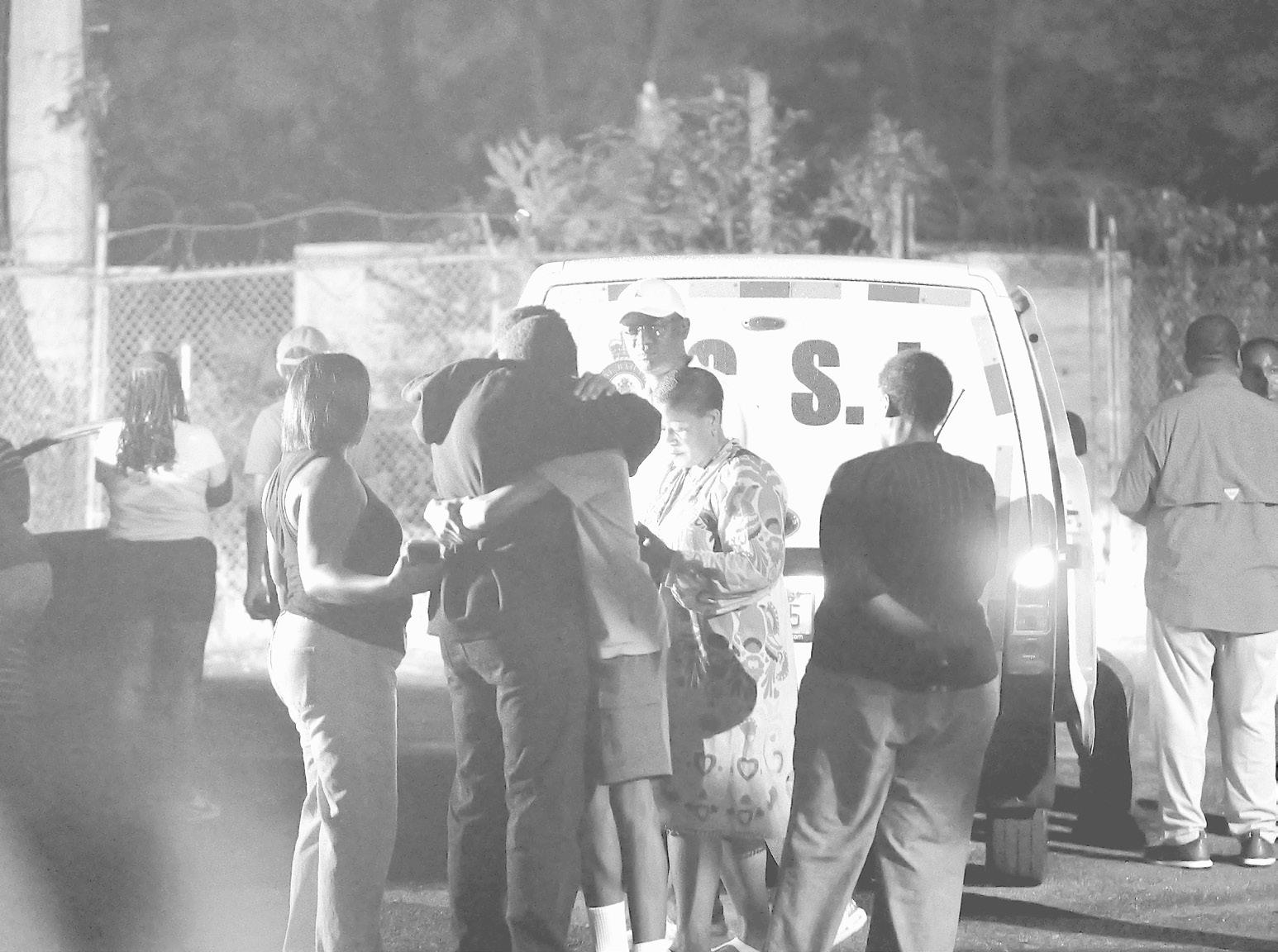
A SEARCH for a missing 27-year-old man ended in tragedy on Thursday night when a family member found him dead in the Hacio Point Close area.
A close relative identifed him as Antonio Cartwright.
A missing person poster issued on Tuesday said Cartwright was last seen at about 8.30am on July 19 at CBS Bahamas in Southwest Plaza.
Police said they received a report shortly before 8pm on Thursday about the discovery of an unresponsive man. He showed no signs of life.
Relatives remembered Cartwright as a hardworking and kind young man who loved house painting
and was dedicated to his work.
CBS Bahamas expressed condolences to his family in a statement on Friday.
“Although Antonio had only recently joined the
CBS Bahamas family, he quickly made a positive impression,” the company said. “Many of our customers would have recognized Antonio from our Paint Center, where he played an integral part in providing expert help and service to our shoppers. He was a pleasure to work with and was most recently recognized as our Employee of the Quarter.”
The company said it worked alongside Cartwright’s family during the search by distributing fyers, sharing information on social media and contacting businesses along his usual route home in the hope of fnding information that could help locate him.
A post-mortem examination will be conducted to determine the exact cause of death.
FLOODING seen in the newly renovated A&E section at PMH yesterday.
ANTONIO CARTWRIGHT
FAMILY members comfort each other at the scene where the body of a 27-year-old man who was missing was found Thursday in the Hacio Point Close area. Photo: Chappell Whyms Jr
Monday, July 27, 2026
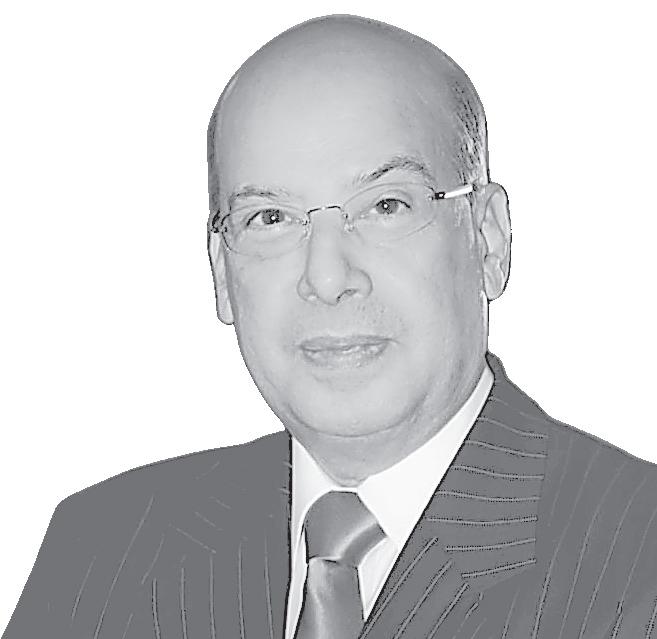
World View • Sir Ronald Sanders
Country over Party: Partisan politics and the national interest
IN 1796, as George Washington prepared to leave the presidency of the United States, he issued a warning that remains relevant, particularly for Caribbean small states. He was addressing a young republic whose 13 states were still consolidating into a durable Union while facing threats from powerful European nations.
Political parties, he feared, could become dangerous when loyalty to faction displaced loyalty to country, opponents were treated as enemies, and the acquisition of power became more important than its proper purposes. Washington called this the “spirit of party”. He did not deny that political differences were natural, nor could he have foreseen the indispensable role that organised political parties would come to play in representative democracy. His warning concerned something more corrosive: political competition becoming a permanent struggle in which every contest is treated as existential, every action of an opponent condemned, and national welfare subordinated to partisan victory. That warning deserves serious consideration in the Caribbean.
Political parties are indispensable to democracy. They organise ideas, contest elections, form governments and provide an opposition capable of holding governments to account. No healthy democracy can function without disagreement, scrutiny and the possibility of peaceful removal of a government through the ballot box.
But unbridled party loyalty becomes destructive when a victorious party treats the state as its possession and opposition parties believe their path to power requires them to attack everything the government does, irrespective of its merit or beneft to the country.
For small Caribbean states, the consequences are especially serious. These countries possess little economic or military power and are highly vulnerable to the demands of larger states. Their trade,
fnance, investment, tourism, transportation and technology depend heavily on external actors.
They are exposed to coercive measures, arbitrary classifcations, fnancial blacklisting, loss
inherited by much of the English-speaking Caribbean do not always encourage that cohesion. The Westminster system has served the region well, facilitating regular elections, orderly changes of government and a durable
Caribbean states have limited pools of highly trained administrators, economists, engineers, diplomats, educators and technical specialists. Yet too much of this scarce capacity is consumed in political combat.
of correspondent banking, visa restrictions, demands concerning taxation and citizenship programmes, and pressure to accept policies devised by larger states for their own purposes. Such demands can materially affect employment, public revenue and living standards, even though the affected countries have little role in shaping them and limited power to resist.
Under these circumstances, national cohesion is an element of national defence. The political systems
commitment to parliamentary democracy and the rule of law.
But its Caribbean form has a pronounced winnertakes-all character. Electoral victory often gives the governing party effective control of both the executive and the parliamentary majority. This places a special responsibility on governments to exercise restraint, respect independent institutions and recognise that an electoral mandate confers stewardship of the state, not ownership.
Opposition parties carry an
Nicaragua's parliament moves to abolish elections under Ortega's order, fueling criticisms
By MEGAN JANETSKY Associated Press
MEXICO CITY (AP)
— Nicaragua's lawmakers said they will carry out a plan by President Daniel Ortega to abolish elections in the Central American country, prompting renewed criticisms Wednesday by the international community.
The move was announced in a statement Tuesday by Nicaragua's congress, which is frmly in the hands of Ortega and his wife and co-President Rosario Murillo. It said the latest constitutional overhaul will ensure Nicaragua's "peace, security and stability."
The legislature was following through on Ortega's announcement from the weekend that "there won't be anymore elections," refecting both his effort to extend his nearly 20-year rule and remove any chance of the opposition gaining power.
Under Ortega, the government has carried out a
sweeping crackdown on dissent following a violent suppression of protests in 2018. Authorities have jailed opposition politicians, religious leaders and others, and also shut down thousands of civil society organizations in the country.
The congress has repeatedly amended the constitution to concentrate power in Ortega's hands and eliminate any shred of democratic independence and dissent in the country.
Ortega's remarks on Sunday, during a speech marking the anniversary of the Sandinista Revolution, effectively canceled Nicaragua's next elections. The vote was originally scheduled for November 2027 after the government-controlled congress voted in January 2025 to extend the fve-year presidential term by one year.
Volker Türk, the U.N. high commissioner for human rights, on Wednesday sharply condemned
Nicaragua's developments, saying that "people of all political viewpoints must be allowed to vote and run for offce."
"These latest developments further deepen the severe restrictions on fundamental freedoms, the dismantling of civic space, and the steady erosion of the rule of law," Türk said in a statement.
Nicaragua's government declined to comment on the criticism, saying in a statement, "Thank you for your interest."
On Tuesday, U.S. Secretary of State Marco Rubio said that the move by Ortega and Murillo to eliminate elections in Nicaragua "lays bare their true authoritarian nature."
"The United States calls on the international community to join forces to demonstrate to the Murillo-Ortega dictatorship that it cannot expect to maintain business as usual with other nations when it is thwarting
equally important responsibility. Their role is not only to scrutinise the government and present credible alternatives, but to do so in a manner that strengthens the state they seek to lead. Opposition for its own sake - attacking every initiative, obstructing measures that serve the public interest, or denying credit irrespective of merit - does not advance democracy. Exclusion from offce by the will of the electorate does not justify conduct that weakens the very institutions an opposition aspires to inherit.
Caribbean states have limited pools of highly trained administrators, economists, engineers, diplomats, educators and technical specialists. Yet too much of this scarce capacity is consumed in political combat. The country pays twice: it loses the contribution of capable citizens and diverts energy that should be directed towards development into a struggle over political advantage.
The damage extends beyond domestic governance. It affects the capacity of Caribbean states to defend their independence, sovereignty and national dignity. External actors recognise when domestic parties are prepared to use international pressure against one another, and when agreements are denounced simply because a government
negotiated them.
A powerful country or institution then does not have to confront a united state. It can exploit domestic grievances and allow Caribbean political actors to weaken their own national position.
Caribbean countries need to recover the idea that some interests belong to the nation as a whole. Territorial integrity, constitutional government, electoral legitimacy, economic security, international standing and the dignity of citizens should not become opportunistic instruments of party competition.
Too often, nothing is regarded as being above political exploitation. A foreign government takes a measure harmful to a Caribbean country, and some celebrate because they believe it injures the party in offce.
An unfounded allegation is made against the country, and political actors repeat it in the hope of embarrassing the government.
But a wound inficted upon the country to damage one administration does not disappear when another party takes offce. The weakened institution, lost international confdence, damaged reputation and adverse precedent become the inheritance of its successor.
Caribbean states cannot afford to approach every
external challenge as another opportunity for domestic combat. They require consultation across political lines, professional public services and a national understanding of the principles that should guide foreign and economic policy.
Ultimately, democratic competition must occur within an accepted framework: political opponents are legitimate, constitutional restraints apply to everyone, public institutions belong to the state not political parties, and the defence of national sovereignty is a shared responsibility.
George Washington spoke to a young republic struggling to preserve its independence in a world dominated by powerful states. Caribbean countries face a comparable challenge.
For small states, placing country above party is a practical necessity in navigating an increasingly uncertain international environment. In a world where power is unevenly distributed and external pressures are persistent, domestic division weakens the capacity to respond effectively and coherently. Caribbean nations may not be able to prevent every adverse action taken by larger states, but they can determine whether they confront such challenges with unity of purpose or internal discord.
When the interest of party is allowed to override the national interest, it is not domestic rivals who ultimately prevail, but external forces whose interests are neither aligned with, nor accountable to, the people of the region.
• The writer is Antigua and Barbuda’s Ambassador to the United States and the Organization of American States. He is also the Chancellor of the University of Guyana. The views expressed are his own.
the basic tenets of our democratic hemisphere," Rubio wrote in a statement.
The Trump administration — despite harsh words, sanctions and repeated
criticisms — has made few major moves against Nicaragua's government. In nearby El Salvador, where President Nayib Bukele, an ally of U.S. President Donald
Trump, has also whittled away democratic checksand-balances and gone after critics, the U.S. administration has largely praised the leader.
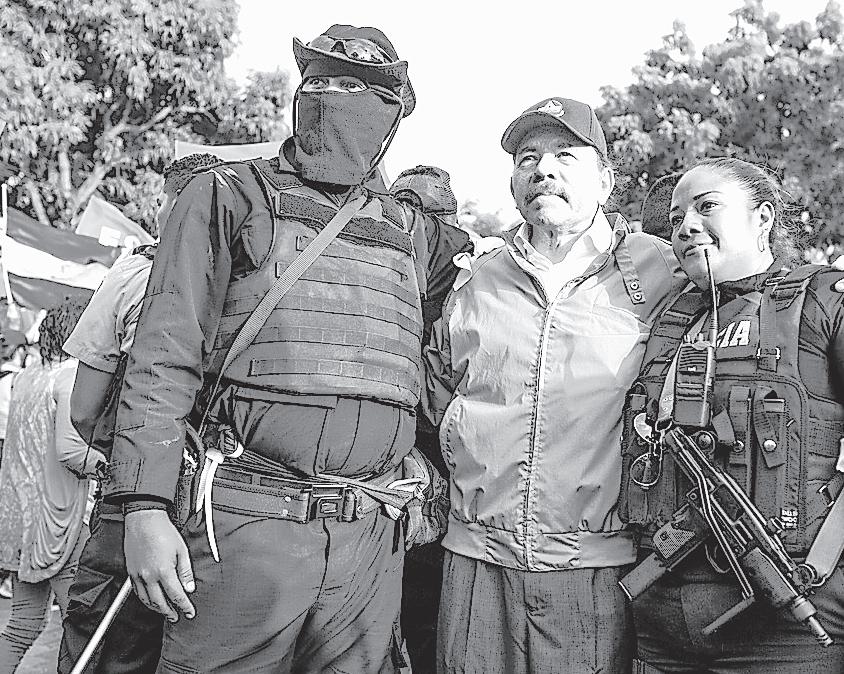
NICARAGUAN police have their picture taken with President Daniel Ortega, in Masaya, Nicaragua, July 13, 2018.