
RF Bank & Trust (RF) has hosted its fifth annual human resources (HR) leadership forum, bringing together more than 50 senior industry executives.
Held under the theme, ‘HR as a strategic partner: Navigating change management’, in partnership with the Bahamas Society for Human Resource Management and host Valdez Russell, the half-day symposium examined how emerging technologies, demographic shifts and economic shocks are reshaping companies and the talent that drives them.
RF Bank & Trust said one message that came from every session is that human resources is not a bystander to change, but a strategic partner in it. And, no matter the size or scale of any transition, human resources must be positioned to provide insight when it matters most.
Franklyn Butler, Cable Bahamas president and chief executive,
traced the BISX-listed communications provider’s evolution from a foreign-backed start-up to a fully Bahamian-owned public company. He pointed to the deliberate separation of Aliv's culture and leadership from Cable Bahamas to enable the new mobile operator to move fast, and asserted that sustainable change comes from balancing speed with cohesion, and disruption with shared governance.
Christina Sands, RF’s regional manager of group pensions, said that unlike people movements, which human resources can rarely predict, on-time retirement is one of the few reliable, scheduled events. She explained that such predictability is what turns retirement planning into a genuine succession strategy, giving emerging leaders a visible, planned path forward.
The forum closed with a panel discussion on preparing workforces for change,
human resources, the session tackled succession strategies and productivity preservation in an era defined by rapid change.
"We were pleased to convene another engaging HR Leadership Forum focused on the critical issues shaping the future of work, including leadership succession, talent development and workforce resilience," said Ms Deleveaux.
"At RF, we are committed to leading meaningful dialogue and sharing practical insights that strengthen organisations, and we look forward to seeing these conversations translate into lasting impact across our communities."

before, or considered by, the Immigration Board which decides whether to approve or reject all applications.
“The investigation revealed that the letter dated July 24, 2025, was transmitted by individuals acting outside the scope of their authority. Direct instructions had been given within the Department that the work permit cards were not to be issued,” Mr Gittens said in written evidence. He added that both “unauthorised” work permit cards were “to be withheld” and turned over to Immigration but they were found to be missing.
“The Department utilises IDMS for the issuance and tracking of immigration cards issued by them.
Records within the IDMS confirm that the work permits cards relating to the [two Jamaicans] were never issued by them,” Mr Gittens added. “The permit cards remain recorded within the system as un-issued documents.
“Though the applicants may have received a letter indicating approval does not constitute the lawful issuance of the work permit cards. Based on information received during the course of this investigation, it is believed that [Mr Munroe] and a female accompanying him may have received the work permit cards from Immigration personnel connected with the matters under investigation.”
Under cross-examination before the Supreme Court, Mr Gittens admitted the two work permit cards presented as evidence were genuine based on the features they contained. “These cards are authentic.
The records reflect they were not issued,” he reiterated. Pressed on the purported non-issuance of the cards, Mr Gittens added: “I seeing it here, but the records reflect that they were not issued. I could take you to the system and bring it up to you at Hawkins Hill, and it will show that they were not issued.”
* The Immigration Department sought to justify the work permit revocation, and non-approval, on several grounds including that the two Jamaicans both had criminal convictions while Mr McNee had been the subject of a deportation order. Mr McNee denied this, but both he and Mr Howell admitted to pleading guilty to assault and obstruction chargesalthough each asserted they did not do so of their “own free will”.
But, while both were charged with assault of an Immigration officer on June 30, 2025, evidence presented before Justice Card-Stubbs showed the outcome was “an absolute discharge” and resulted in neither man receiving a criminal record. The June 30 magistrates’ court hearing also took place when their work permit applications were in process.
Mr Munroe and the two Jamaicans also alleged that the work permit process was “infected by bad faith and anti-Jamaican bias”.
Marcia Morgan-Mackey, the mother of the Jamaican duo, even supplied allegations of “prior encounters with Immigration officers, alleged hostility toward Jamaicans and alleged targeting of her business and sons.
“Her evidence included prior encounters with
Chadwill Adams, one of the officers who met with Mr. Munroe on August 6, 2025, concerning the work permits,” Justice CardStubbs noted. Mr Munroe had alleged that, during the meeting with Stephen LaRoda, the Immigration director, and Mr Adams, acting assistant director of Immigration, the latter “expressed great hostility towards me” and “his tone of voice was extremely aggressive”.
However, the judge found there was no evidence to “establish actual bias” by Immigration. And, while quashing the original work permits’ revocation, Justice Card-Stubbs remitted both applications back to the Department of Immigration for reconsideration using the necessary lawful procedures and processes.
Detailing the dispute’s origins, Justice Card-Stubbs said Mr Munroe and his prospective employees were complaining that the work permits were “unlawfully unapproved” despite complying with all Department of Labour and Immigration requirements - advertising the job vacancies locally, obtaining the labour certificate, submitting the relevant applications and paying the necessary processing and other fees.
As a result, they challenged the Immigration Department’s work permits revocation “on grounds of procedural unfairness, inadequate reasons, illegality, irrationality, legitimate expectation and bias”. Immigration, though, countered that “no lawful work permits were ever granted” because the applications were not placed before or approved by the Immigration Board, “and that any approval communications
or cards were generated or released without lawful authority”.
Mr Munroe alleged that, after receiving the approval letters on July 24, 2025, he paid for $4,000 in fees to the Department of Immigration and obtained the physical work permits. However, six days later on July 30, 2025, Immigration recanted the initial letter by stating the permits had not been approved and instructing the two Jamaicans “to wind-up their affairs and leave the country”.
“The respondent characterises the July 30, 2025, letter as a correction of an unauthorised and invalid approval,” Justice Card-Stubbs noted. “The respondent’s case is that any apparent approval was unauthorised, ultra vires and legally ineffective because the permits were not approved by the proper statutory authority, namely the director and/or the Board of Immigration….
“The applications contained serious deficiencies and inaccuracies, including the applicants being physically present in The Bahamas at the time that the application was made. The respondent submits that there are defects in medical and police certificates, unsigned or improperly completed materials, and failures to disclose relevant Immigration or criminal history.”
Justice Card-Stubbs, in her verdict, said Mr Gittens was unable to explain how the July 30, 2025, work permit revocation letter bore Mr Pratt’s signature given that he had stepped down five days’ earlier. She added that Immigration had provided no evidence as to how it determined the approvals
EXCAVATE - from page B1
“Bahama Rock proposes to expand the Freeport Harbour,” the EIA asserted.
“The developer has entered into a purchase agreement to acquire Bahamas Cement Company, which is the owner of a former cement plant on Grand Bahama along with the approximately 515-acre site on which the former cement plant is situated.
“The harbour expansion would consist of around 269.39 acres of the total Bahamas Cement Company property. Approximately 136 acres of the property contains abandoned infrastructure and is dominated by invasive species. Once excavation of aggregates at the site is complete, the site will result in an expanded Freeport Harbour, which
is due east of the Bahamas Cement Company property.
“Excavation refers to the process of removing earth, soil, rock or other materials from the ground above and below the sea level to create a void or cavity. This Harbour expansion will create additional turning basins and deep-water berths in the Harbour. The closing of the acquisition is conditioned upon the developer’s receipt of certain approvals, including receipt of approvals of related permits.”
The EIA also suggested that the Bahamas Cement Company acquisition, and subsequent Freeport Harbour expansion, will be critical to securing Bahama Rock’s immediate Grand Bahama future given the drop-off in current aggregate mining activities.
“The proposed project will enable Bahama Rock
to retain employees, as current mining activities are reduced,” it revealed.
“Retaining 84 employees is important to the Grand Bahamian economy.
“It is estimated that Bahama Rock contributes $25m to the Bahamian economy annually through employment of 82 Bahamian citizens, and through direct and indirect contracts and support services at its existing operations. These socio-economic benefits can be expected to continue with the Bahamas Cement Company acquisition and the continued harbour expansion.
“Once aggregate mining is completed, the Freeport Harbour will be expanded to accommodate more vessels and widen the turning basin. This expansion could lead to additional commerce through the
were unauthorised, and the power used to revoke them.
“It appears that the respondent [Immigration] has adopted and thrown its weight behind the letter denying approval of the work permits. That letter is dated July 30, 2025, and bears the signature of Mr Pratt who was, by then, no longer the director,” the judge ruled.
“The respondent concedes that at the time that that letter was issued, Mr. Pratt had already demitted office and handed over. There is no suggestion, or evidence, that Mr. Pratt was authorised to act for the Department of Immigration on July 30, 2025. Yet, there is no explanation to this court as to how and why such a document was issued by, on the face of it, an unauthorised officer. No such explanation or evidence was forthcoming.”
Justice Card-Stubbs also said she was not satisfied with the assertion that the original approval letter was issued without proper authorisation, adding that Mr Munroe and the two Jamaicans were entitled to rely on its contents. The abrupt revocation, just five days’ later, ran afoul of “public law duties of fairness and rationality”.
Mr Munroe, who relied on “a consultant agency” to fill-out the work permit application paperwork, and the Jamaicans acknowledged that the submissions contained errors. And they said they were unaware of Immigration’s policy that foreign workers, who are the subject of first-time permit applications, must be outside The Bahamas until the necessary approvals are obtained.
Justice Card-Stubbs said much of the Immigration Department’s case was based on the reasons it has to reject work permit applications. This, she added, missed the mark because the real question in Judicial Review proceedings was
whether it used its powers, authority and discretion lawfully. And she found that the alleged deficiencies with the two Jamaicans’ applications “do not save” the revocation because these were not considered as factors.
There was also no evidence that the requirement for applicants to remain outside The Bahamas until their permits are approved was ever mentioned to Mr Munroe and the Jamaicans - both of whom were already here. And nothing suggested the alleged deportation order against Mr McNee was a factor in the July 30, 2025, decision.
“If the respondent’s case is that the work permits were cancelled or revoked because conditions were breached, the Department should show that the statutory cancellation power was engaged and that the relevant decision-maker was satisfied of the breach. The respondent must show that these matters were taken into account at the time of the decision. There is no such evidence before me,” Justice Card-Stubbs ruled.
“It is manifestly unfair, especially in circumstances where the Department has accepted payment from a person for a benefit - and subsequently extended the benefit to the person - to merely notify that person by e-mail that their application is ‘not approved’. Notably, in this case, the applicants had already passed the state of approval….
“Therefore, the timing and nature of the July 30, 2025, letter ought to have been addressed by the Department. To a reasonable onlooker, an explanation would be required. In public parlance, a statement of reasons would ‘only be just and fair’. As a matter of law, what the respondent did was procedurally irregular and unfair.”
Container Port or other job-creating businesses. During decommissioning, additional construction jobs will be created as the [Bahamas Cement Company] site is landscaped and graded.”
The project benefits touted by the Bahama Rock EIA include creating “a reliable supplier” mined aggregate material “that can meet the demand from the Bahamian construction community”. Other advantages cited included “increasing access to shipping goods and supplies, as well as providing a naturally-sourced product for sale locally” plus “recreational opportunities for locals and expanded tourism” together with beach and dune replenishment.
Bahama Rock added that the project also creates “potential for a larger container port/economic trade zone” and “continued long-term employment and benefits of Bahama Rock’s current Bahamian employees, and increased employment opportunities should market conditions improve”.
It continued: “Bahama Rock’s continued customer presence for the Bahamian companies that presently supply the Freeport facility, the absence of which would likely make stone for construction in The Bahamas more expensive and less available, especially when economic conditions tighten the supply.
“Once the quarry is decommissioned, the Freeport Harbour will be expanded to accommodate more vessels and widen the turning basin.”
Ralph Hebpurn, the Grand Bahama Chamber of Commerce’s president, yesterday told Tribune Business that Bahama Rock’s plans to create a deeper and wider Freeport Harbour fit well with MSC’s planned investment and the GB Shipyard and
Container Port’s models. It also further opens up the Harbour to other activities and investors, exploiting its US proximity and boosting value as a strategic asset, while also dovetailing with Grand Bahama’s ambitions to become a true maritime hub.
However, Dillon Knowles, Mr Hepburn’s immediate predecessor as GB Chamber president, yesterday questioned whether the project is designed more to benefit Bahama Rock - and both secure and prolong its presence in Grand Bahama - than Freeport Harbour and the island’s wider economy.
“I just think that the Port Authority and the Government need to ascertain what is the ultimate benefit of this particular project, and how best to turn it into something that is of benefit to Grand Bahama and not just an aggregate operator,” he explained to this newspaper. “Is it intended to be of benefit to Freeport Harbour or just intended to be a mining exercise?”
Mr Knowles also suggested that the Bahamas Cement Company property would be better off converted into a cruise port rather than MSC’s planned Billy Cay location. “If we’re going to develop the Bahamas Cement property, we should be developing it with the specifications and configuration of a cruise port,” he argued, “which would make the cruise port more appealing than being in the midst of an industrial harbour and allow it to be purpose built.
“I would not build a cruise port at Billy Cay. It’s smack dab in the middle of an industrial harbour. I believe it would be better used for a cruise port and leave Billy Cay for its originally intended use, which was more industrial and container port space.”
Mr Hepburn, meanwhile, said that based on a meeting he attended yesterday with unnamed developers, “there’s going to be a need” for increased berthing and mooring capacity within Freeport Harbour due to both MSC’s Billy Cay development and the increase in traffic to the Grand Bahama Shipyard.
“The capacity to bring in bigger ships needs a deeper and wider harbour,” he added. “We’ll definitely
have to look at expansion of the inlet. Bahama Rock is on the inlet part coming into Freeport Harbour. They’ll have to raise that a bit, open that up so ships can come in to facilitate what MSC is doing and comfortably berth and dock safely at Freeport Harbour, making it deep for the size of their ships.
Noting that MSC’s four extra cruise ship berths will require additional space to accommodate all vessels entering Freeport Harbour, Mr Hepburn said Bahama Rock’s project will also boost Grand Bahama’a designs on becoming the top maritime centre in The Bahamas.
“It bodes well for the development of the Freeport Harbour and where we’re going with the maritime industry in Grand Bahama,” he told Tribune Business. “We’re pushing for Freeport to be the main centre for maritime business in The Bahamas. This goes to strengthen our position and stance that we’re doing what it takes to make us world class when it comes to the maritime industry.
“All the environmental studies have to be done and on point before anything happens. Some people might disagree, and say we are losing natural resources, but one hand washes the next. It benefits development. These things need to be done to help us move along in our development. The expansion of Freeport Harbour, and mining of the harbour by Bahama Rock, which they have to do as part of their agreement, goes hand in hand with development of the harbour.
“We’ll be actively participating to make sure everything is on the up and up, and in line with what is happening. We don’t want to disenfranchise anyone, work against the environment or residents at the western end of the island, but once we don’t adversely affect them, the environment and sea life it’s a positive development that bodes well for all.”
Mr Hepburn said redevelopment of the former Bahamas Cement Company site would also remove “an eyesore” and “make better use of the land and that area”.
By BARBARA ORTUTAY and ALEXANDRA OLSON AP Technology Writer
A GROUP of 26 Meta employees has sued the company, claiming it used artificial intelligence systems to select people for layoffs, disproportionately targeting those on medical, parental or family leave.
They are among the 8,000 employees, or about 10% of its workforce, Meta said it would lay off in May. The lawsuit filed late Monday in federal court in Oakland, California, claims the company used internal AI systems, keystroke and activity-monitoring data, AI token-usage dashboards and algorithmically assisted performance rankings, among other methods, to determine who would be laid off.
Many of these scores and ratings “by design, cannot be accumulated by an employee who is on protected medical or family
leave, or whose output is reduced by a disability,” the lawsuit says. Meta, according to the lawsuit, did not account for protected leave when taking employees’ scores into account and “did not pause the system for the individualized, leave- and accommodation-neutral review that the law requires.”
As a result, people on protected medical or family leave were disproportionately selected for layoffs, the lawsuit says. Each of the 26 anonymous employees in the lawsuit took protected leave and requested or received a reasonable accommodation for disability. Though they have been notified of their layoffs, all 26 remain employed by Meta, with separations set to begin July 22. Many workers were on parental leave
Many of the employees in the lawsuit took pregnancy or parental leave, during which time they wouldn’t
Banks rake in big profits as both Wall Street and the US
By MATT OTT AP Business Writer
FIVE of the biggest U.S. banks reported record profits on Tuesday, boosted by their trading desks and a remarkably resilient American consumer amid persistent global economic uncertainty.
It marks the second straight quarter of strong results from the banks, which have benefited from market volatility since the Iran war began in late February.
Both consumer-facing and market-focused banks reported revenue and profit growth that beat even the most optimistic Wall Street expectations.
The KBW Nasdaq Bank Index, which tracks the performance of two dozen banks rose 0.7% in afternoon trading.
Here’s a look at how and why banks have continued to thrive despite a clouded economic future.
JPMorgan hits records
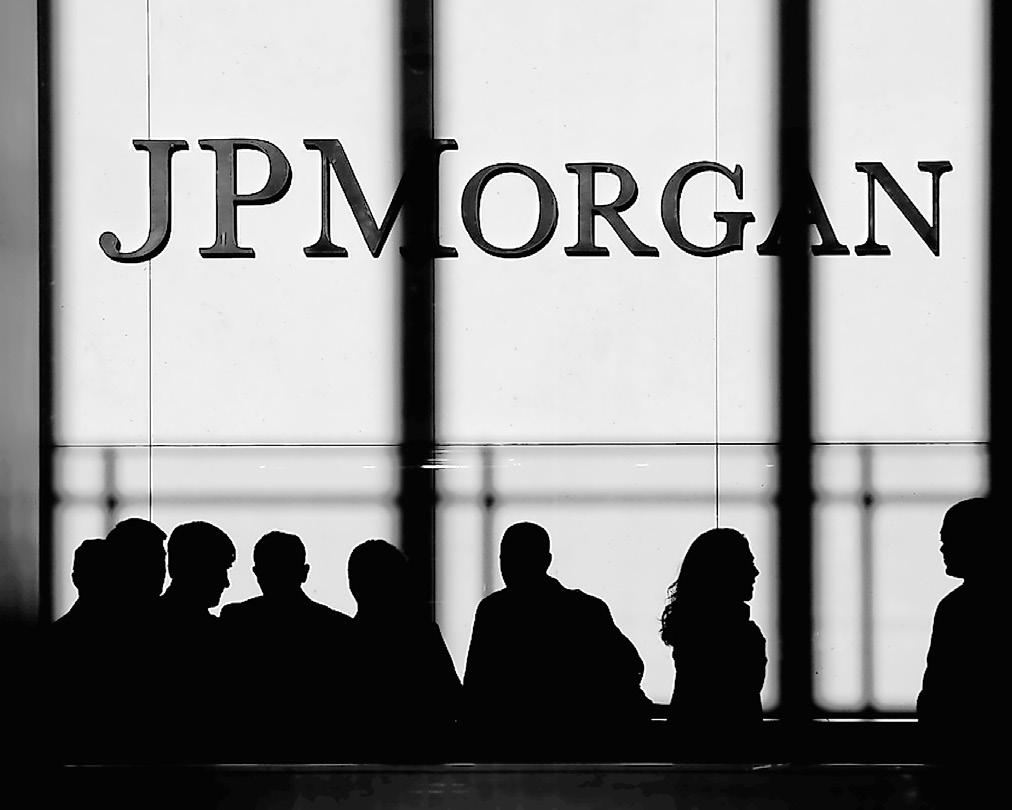
JPMorgan Chase logged $16.9 billion in second-quarter profit as its equities trading division again took advantage of market volatility triggered by the war in Iran.
The nation’s largest bank by asset size, JPMorgan said that revenue in every line of its business hit record levels in the quarter, including its markets division, where revenue grew 35% over the same period last year. Revenue in its equity markets division skyrocketed 86%.
JPMorgan earned $6.14 per share in the period, beating analyst estimates of $5.59 per share. Managed revenue came in at $58 billion, also topping the estimates of analysts surveyed by FactSet.
JPMorgan shares rose 1.8% by midday.
The consumer keeps spending
Bank executives highlighted a surprisingly strong U.S. consumer even as inflation remains elevated, in part due to the higher oil prices brought about by the war in Iran.
Bank of America said that consumer spending expanded, outperforming expectations. Consumer investment assets grew 18% year-overyear and average deposits and spending all increased from the first quarter, the bank said.
JPMorgan reported revenue of $20.3 billion from its consumer banking division in the period, a year-overyear increase of 8%.
Wells Fargo also reported improved consumer activity, reflecting a broadly healthy U.S. economy.
“Consumer spending is higher, charge-offs and delinquencies are lower, and savings and investments are growing across consumer segments,” Wells CEO Charlie Scharf said.
The unresolved conflict in the Middle East, however, remains a potential economic hurdle for consumers and businesses alike.
Oil prices fell back near prewar levels earlier this month, but they’re back up more than 10% this week after the U.S. renewed attacks on Iran and President Donald Trump announced a new blockade in the Strait of Hormuz, a key shipping route for about one-fifth of the world’s oil. At $3.86 per gallon, gas prices remain well above prewar levels but below their peak of around $4.50 in May.
Dimon said on a conference call that JPMorgan remains “appropriately cautious” in light of the current global economic risks.
“We cannot predict how these forces will ultimately play out,” Dimon said. “They may remain manageable, but they could also cause meaningful disruptions when they shift or collide.”
IPOs and mergers expected to stay hot through 2026
Dimon said that revenue from the New York bank’s investment banking division rose 30%, accelerating to the highest level since 2021 as the thirst for initial public offerings and mergers and acquisitions remained strong.
have worked and thus had their measured output reduced. Others took medical leave — one disclosed a “serious health condition and disability” that was approved by Meta’s own provider. But according to the lawsuit, he was “discouraged and deterred from taking that leave by a manager” who warned that doing so would result in his selection for the anticipated layoffs. Meta offered no accommodation for his disability, the lawsuit says.
Meta said in a statement that the claims “lack merit and are not based on facts. Workforce management and organizational decisions were and are made by people, not AI.”
About half the plaintiffs had taken leave for caregiving or pregnancy-related reasons. Eight are women who had taken maternity or pregnancy-related leave, four are men who had taken parental leave and one is a woman who had taken
All the major banks played a role in SpaceX’s record-setting IPO in June, with Goldman Sachs and Morgan Stanley acting as lead underwriters. The offering brought in $75 billion, more than all U.S. IPOs combined in 2024 and 2025, according to Renaissance Capital.
Renaissance expects the IPO market to extend its hot streak into the second half of this year, also driven by larger deals such as Korean memory chip giant SK Hynix’s “mega-listing” on Friday that raised $26.5 billion.
Global mergers and acquisition activity also accelerated in the second
leave to care for a family member and later bereavement leave.
The lawsuit says the layoffs violated several state and federal laws, including the Family and Medical Leave Act, the Americans with Disabilities Act, the Pregnancy Discrimination Act and the Pregnant Workers Fairness Act.
Lawsuit cites ‘disparate impact’
The complaint also references “disparate impact liability,” a longstanding civil rights concept that President Donald Trump’s administration moved to abandon. Disparate impact, codified in Title VII of the 1964 Civil Rights Act, holds that facially neutral policies or practices can be discriminatory if they disproportionately burden a protected class of workers and aren’t necessary for the job.
The Trump administration has ordered federal agencies to deprioritize
quarter of 2026, with announcements up 64% year-over-year and closings up 33%, according to Morgan Stanley. Goldman Sachs said revenue from advising on mergers and acquisitions in the second quarter rose 17%.
Iran war the main source of market volatility
Markets have been swinging up and down since the U.S. and Israel attacked Iran in late February, with military strikes from both sides interspersed with pauses in fighting and vague temporary truces.
Investors’ concerns that the war will last a long
disparate impact liability enforcement, arguing that its use undermines “meritocracy” and encourages the assumption that any racial or gender imbalance in a workforce is the result of discrimination.
The order has led the Equal Employment Opportunity Commission to drop discrimination cases on behalf of some workers.
However, the lawsuit against Meta underscores that companies remain vulnerable to disparate impact litigation in the age of AI despite the Trump administration’s efforts to stamp out its enforcement. Workers are still free to pursue such lawsuits on their own if the EEOC rejects their complaints, and several state laws specifically prohibit disparate impact discrimination.
In the case against Meta, lawyers for the plaintiffs argued that the company’s “algorithmically assisted selection process, by systematically recording such absences as reduced performance, falls more heavily on women than on men.” That’s because women disproportionately take pregnancy and caregiving leave, according to the lawyers. The lawsuit cites Title VII’s prohibition on employment practices that have a disparate impact, as well as a landmark 1971 Supreme Court ruling that recognized the doctrine. The plaintiffs’ lawyers said in a statement that the lawsuit asks for one thing — preserving the status quo to keep the workers employed pending arbitration. That’s because “once these separations are final, the harms are irreversible: employer-subsidized health coverage lost during pregnancy, postpartum recovery, and active medical treatment; time-bound leave rights extinguished; unvested equity forfeited; and immigration consequences triggered.”
time has triggered high volumes of selling in financial markets, while hopes for a resolution and a freer flow of crude oil has inspired optimism and buying.
Though volatile markets can cause anxiety for individual investors, high-speed Wall Street trading desks can take advantage of the wild gyrations. Big swings in markets tend to increase activity on trading desks, leading to higher commissions and fee revenue for the banks.
Goldman Sachs said it brought in $15.52 billion in revenue from its banking and markets division in the period, 53% higher than last year’s second quarter
and a 22% increase over 2026’s first quarter.
Citigroup’s market revenue also topped its first quarter figure and was up 45% over the same period last year.
Overall strong secondquarter results
Wells Fargo reported a 22% jump in net income for the quarter to $6,4 billion. Revenue of $22.6 billion topped Wall Street estimates.
Scharf said the San Francisco bank benefited from a strong economy and its newly unleashed ability to invest after years of government oversight.