BY NEIL HARTNELL Tribune Business Editor nhartnell@tribunemedia.net
A FORMER Cabinet minister yesterday asserted that the major political parties “aren’t remotely interested” in reversing the ever-increasing size of government and its $1bn civil service because the cost has yet to overwhelm or outrage Bahamians.
Dionisio D’Aguilar, former minister of tourism and aviation in the Minnis administration, told Tribune Business there will be zero political will to arrest the public sector’s continual growth until the level of taxation required to fnance and support it hits a tipping point beyond which
Maritime regulator also pursuing Potter’s Cay overhaul ‘Zero
Ex-Cabinet minister admits Gov’t ‘form of employment agency’
Bahamians start to push back and resist.
Describing the civil service as “a form of employment agency”, at least in the eyes of successive administrations, he added that The Bahamas appears far away from any such correction despite the negative impact on private sector growth, productivity and ease of doing business
Parliament watchdog set to be ‘relentless’ amid ‘handicap’ bid
BY NEIL HARTNELL Tribune Business Editor nhartnell@tribunemedia.net
THE Opposition’s leader yesterday pledged that Parliament’s spending watchdog will be “relentless” and “very aggressive” in seeking answers for the Bahamian people on how their tax dollars are being spent while asserting that government “stalling tactics” will not work.
Michael Pintard told Tribune Business the Government’s attempts to “handicap” the Public Accounts Committee (PAC), the only parliamentary committee on which the Opposition has the majority, will not succeed as he branded the promise of increased collaboration by the Auditor General’s Ofce “crucial” to ensuring greater transparency and accountability over how the Bahamian people’s money is used.
The Government’s internal fnancial watchdog, in its just-released 2026-2027 annual plan, pledged to work more closely with its House of Assembly counterpart by increasing its briefngs of the latter on various investigations into government ministries, agencies and departments from zero last year to seven by 2029.
The increase is designed to boost transparency and accountability, and ensure Bahamian taxpayers receive value for money, by “strengthening collaboration” with Parliament and, in particular, a Public Accounts Committee that acts as the latter’s watchdog over government spending.
“We believe that it is absolutely critical, particularly since it coincides with increased meetings by the Committee itself,” Mr Pintard told this newspaper of the Auditor General’s plan to increase briefngs of the Public Accounts Committee in the upcoming fscal years. “We have had two meetings thus far, and intend to increase that number.
“This would be really critical with increased concerns being expressed by civil society and members of the public in general with respect to the management of the public fnances. We believe more intimate involvement with the Auditor General’s Ofce is crucial in this regard.
“We are looking forward to greater information sharing and feedback from the reports they have gotten - both the
Growing bureaucracy: Firms take longer to reach ‘promised land’
caused by the continually expanding bureaucracy.
Speaking after this newspaper revealed that total compensation paid to the Bahamian civil service will breach the $1bn mark for the frst time in the upcoming 2026-2027 fscal period, with its ranks having expanded by 2,342 persons over the past four years, Mr D’Aguilar pointed out that thousands of ofcials
Voter change appetite ‘not there by any means’ as taxes, costs rise
and their families beneft from the current system and will be resistant to any change that threatens their well-being.
And, with many seeking government posts because of the perceived greater job security and better employee benefts, the ex-minister conceded that it will be extremely difcult to change this culture and mindset unless Bahamians
“demand better service and there are consequences” for ofcials who do not deliver.
Mr D’Aguilar, in the aftermath of the 2026-2027 Budget debate in the House of Assembly, said “nobody seems to be interested in reducing spending; it’s how do we raise revenues” as the Davis administration targets a $470m revenue increase for the 2026-2027 fscal period to around $4.4bn despite this year’s collection pace lagging 2024-2025.
Port targeting up to 15% increase from dock fees
Aims to boost Dock’s berthing capacity 20% in two years Also eyeing new head o ces, sta growth, salary rises
BY NEIL HARTNELL Tribune Business Editor nhartnell@tribunemedia.net
THE Port Department is aiming to boost “revenue collection efciency” through obtaining 90 percent of all dock-related fees due to the Government in the upcoming fscal year while increasing income from this source “by at least 10-15 percent” via rate changes.
The agency, in its 20262027 annual plan that was released alongside the Government’s Budget for the new fscal year that starts next Wednesday, is pledging to review, reform and increase all harbour-related fees and dock levies as well as improve operations at Potter’s Cay Dock.
The plan, which has been seen by Tribune Business, promised to complete a review of all harbour fees within three to six months and then submit proposed changes to the Government for approval within six to eight months. Its goals also include increasing
“revenue from public docks by at least 10-15 percent within 12 months of implementation”.
The Port Department’s dock fee ambitions are tied to its targets to “modernise operations at Potter’s Cay Dock”. This involves completing “at least 80 percent of planned infrastructure upgrades within 18 months” and a 20 percent expansion of berthing capacity at the facility, located on Nassau Harbour under the Paradise Island ‘of’ bridge, inside two years.
Other Potter’s Cay-related targets involve the attainment of “80 percent compliance with cargo and container stowage standards within 12 months” plus a 90 percent collection rate for all dock fees due to the Government by the end of the 2026-2027 fscal year.
Seabed leases, which will now attract a price tag of $5,000 per acre for industrial use, and $3,000 per acre in annual payments for tourism and other commercial uses, based on reforms accompanying
the Government’s Budget, have also attracted the Port Department’s attention. Its annual plan, dated May 27, 2026, the same day on which the Budget was unveiled, promises to seek approval of a new fee schedule within three months.
And it is aiming to complete the “transition of 50 percent of existing lease fles” from the Department of Lands and Surveys to itself within the next year, as well as increase the number of users for its long-awaited online digital application portal from the present zero to 1,000-plus by the end of the upcoming 20262027 fscal year. It wants to have 65 percent of all permit and fee payment applications submitted in electronic form within the next 12 months.
The Port Department’s annual plans also reveals it is seeking to relocate its ofces, aiming to “identify and secure” an appropriate site within the next nine to 12 months, as well as
- See Page B5
sector without sufcient knowledge of laws, safety standards or sustainable practices.
BY ANNELIA NIXON Tribune Business Reporter anixon@tribunemedia.net
BAHAMIAN fshermen yesterday demanded tougher regulation, more consistent enforcement and greater accountability, with industry leaders arguing that weak oversight is undermining both the industry’s sustainability and longterm business growth.
Speaking during a discussion on the maritime or ‘blue’ economy, Paul Maillis, secretary of the National Fisheries Association of The Bahamas (NFA), said while barriers to entering the sector remain high, obtaining a commercial fshing or charter licence requires little demonstration of competency, creating an environment where operators can enter the
“I believe that it is far too easy to get what you need,” Mr Maillis said. “Anybody can walk into the Department of Marine Resources with a Business Licence and, really, they can get a commercial fshing licence, they can get a charter fshing licence. But what basic level of competency is being demonstrated to ensure that this person is going to be adhering to the rules, regulations, laws and best practices?” He argued that licensing should require applicants to demonstrate knowledge of fshing regulations, marine protected area (MPAs), vessel safety requirements and crew management, adding that the absence of such standards leaves regulators with little ability to hold operators accountable.
Mr Maillis also criticised what he described as uneven enforcement across The Bahamas, adding that operators based in Nassau often face regular inspections while those in some Family Islands may go years without any oversight.
“You can’t have somebody who operates out of Nassau, where the Port Authority is getting checked
And wages, salaries and NIB contributions on behalf of public ofcials remain the largest line item in the Government’s recurrent spending, which represents its fxed operating costs for a single Budget period. They are projected to account for 27.2 percent of all recurrent expenditure in 2026-2027, which means more than $1 out of every $4 spent by the Government - or over one-quarter of its $3.724bn fxed costs
Sands: Gov’t ‘completely uneashed’ over spending
BY NEIL HARTNELL Tribune Business Editor nhartnell@tribunemedia.net
THE Opposition’s chairman yesterday asserted that the Government is acting as if it is “completely unleashed” over spending taxpayer monies as he challenged how the Ministry of Foreign Afairs’ $34m plan for a new Nassau head ofce and London upgrades will beneft ordinary citizens.
Dr Duane Sands, responding to Tribune Business revelations on the strategy set out in the ministry’s just-disclosed 2026-2027 annual plan, questioned why it was proposing such expenditure when critical public services such as healthcare are struggling for fnancing.
Describing the plan’s contents as unsurprising, he said: “I think they are now completely unleashed; I could go so far as to say unhinged. They idea they have an overwhelming mandate to spend away the people’s money is clearly what they intend on doing.
“You’re spending $14m on the London Chancery (Bahamas High Commission building), but cannot fnd the money for ambulances and fre trucks, you cannot fnd the money to build a shelter for women, you cannot fnd the money to do things that beneft the lives of ordinary Bahamians, but yet
- See Page B5 SHRINK - See Page B4
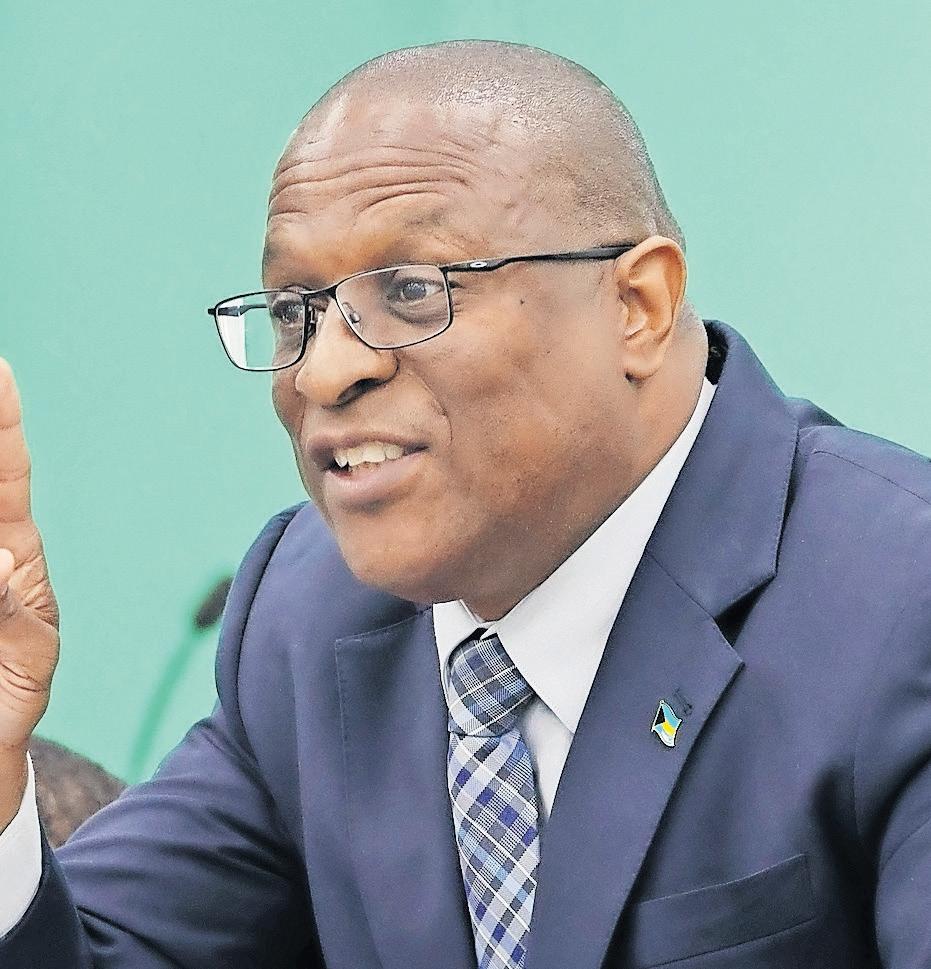
DIONISIO D’AGUILAR
MICHAEL PINTARD
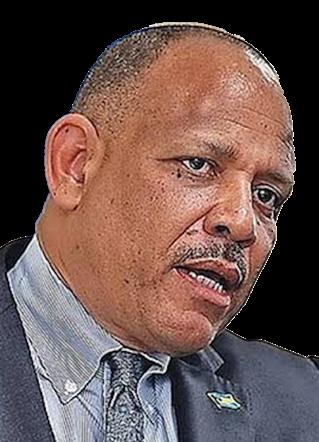
DR DUANE SANDS
Policy to make Bahamas leader in ‘blue economy’
BY ANNELIA NIXON Tribune Business Reporter anixon@tribunemedia.net
A PROPOSED policy
to accelerate development of The Bahamas’ maritime or ‘blue’ economy yesterday called for the creation of a dedicated government agency, new fnancing mechanisms and business support programmes aimed at helping micro, small and medium-sized enterprises (MSMEs).
Presenting the fndings of a strategic study during the launch of the ‘Blue Economy Accelerator’, Edison Sumner, principal of Sumner Strategic Partners, outlined an eight-part policy framework designed to remove barriers to entrepreneurship while positioning The Bahamas as a regional leader in marine economy innovation.
The consultancy, supported by the Inter-American Development Bank (IDB) and the Compete Caribbean Partnership Facility, focused on developing an entrepreneurship and innovation policy tailored specifcally for MSMEs operating in the country’s blue economy.
“Our goal was to develop a comprehensive
framework that will empower entrepreneurs and SMEs, helping them thrive sustainably,” Mr Sumner said. The study identifed challenges across fve major areas: Economic diversifcation and MSME development, institutional strengthening and governance, skills development, research and innovation, and community engagement.
To address those issues, the report recommended establishing a Blue Economy Development Unit (BEDU) that would serve as the central agency responsible for co-ordinating implementation of the policy.
According to Mr Sumner, the proposed unit would bring together government agencies, academics, private sector stakeholders and civil society to oversee policy co-ordination, stakeholder engagement, cluster development and The Bahamas’ representation in international blue economy initiatives.
“The specialised agency will serve as the central co-ordinating body for implementing the policy,” he said. Mr Sumner’s report also proposed expanding successful business cluster
models, such as the Andros community-based tourism initiative, to other Family Islands and blue economy industries.
Under the proposal, BEDU would identify high-potential sectors and facilitate collaboration among businesses, communities and public agencies to stimulate innovation and strengthen regional economies.
Recognising that access to capital remains one of the largest obstacles facing small businesses, the policy recommends creating a Blue Economy Blended Finance Fund combining public and private investment.
The fund would ofer fnancing throughout a company’s growth cycle - from seed capital to expansion funding - supporting businesses in sectors including sustainable fsheries, eco-tourism, marine renewable energy and marine biotechnology.
“This is not a one shot where you put money in and you walk away,” Mr Sumner said. “How do we sustain these businesses with fnancial and other resource support?”
The proposal also called for governance safeguards,
Small Business Centre targets 40 ‘blue economy’ MSMEs
BY ANNELIA NIXON Tribune Business Reporter
THE Small Business Development Centre (SBDC) yesterday launched its Blue Economy Accelerator Programme aimed at expanding entrepreneurship beyond the fsheries sector and helping Bahamian businesses tap into the industry while promoting marine conservation.
The programme, developed in partnership with The Nature Conservancy
(TNC) and supported by the Global Fund for Coral Reefs, will provide training, mentorship, technical support and funding opportunities to around 40 micro, small and medium-sized enterprises (MSMEs) across four groups, beginning with an inaugural batch of 12 businesses in New Providence. Speaking at the programme’s launch, Samantha Rolle, the SBDC executive director, said the initiative was designed to broaden participation in a maritime
Sustainability focus is not ‘end of world’ in sheries
BY ANNELIA NIXON Tribune Business Reporter
anixon@tribunemedia.net
STRONGER environmental regulations, sustainable fnancing and greater collaboration between conservation groups and the fshing industry will be critical to ensuring the long-term success of The Bahamas’ blue economy, according to stakeholders.
Speaking during a panel discussion at the launch of the Blue Economy Accelerator, an initiative spearheaded by the Small Business Development Centre (SBDC) and The Nature Conservancy (TNC), conservation and fsheries leaders said protecting marine ecosystems is not only an environmental priority but also an economic necessity.
Frederick Arnett, programme manager for Impact Funding for Bahama Reefs at TNC, said innovative fnancing aimed at restoring coral reefs could generate both environmental and economic returns.
“I truly believe that through Impact Funding for Bahama Reefs, which is really a long-term blended fnance programme
intended to build the blue economy and address threats to coral reefs, we can really scale impact,” Mr Arnett said.
He added that the programme seeks to restore and protect coral reefs, while creating livelihoods for Bahamians through sustainable blue economy businesses. “If this programme is successful, which the Blue Economy Accelerator programme is a part of, we can really see a change in the health of our coral reefs,” he said.
Mr Arnett pointed to the steep decline of coral reefs across the region, noting that approximately 65 percent of Caribbean coral reefs have been lost over the past decade.
“With these interventions and restorative businesses, we’re hoping that we can bring back those coral reefs, as well as provide livelihoods for people within the blue economy,” he said. “It’s important to balance both nature and people.”
However, Mr Arnett said legislative and regulatory gaps continue to slow progress. He said the TNC is collaborating with the Department of Environmental Planning and Protection (DEPP)
project monitoring and funding targets for women-led and youth-led enterprises, while ensuring investment reaches businesses throughout the Family Islands.
To strengthen the entrepreneurial pipeline, the framework recommended launching both a Blue Economy Incubation Programme for start-ups and a Blue Economy Accelerator Programme for established businesses with strong growth potential.
The incubation programme would provide mentorship, fnancing, technical expertise and networking opportunities while educating participants on sustainable business practices, emerging technologies, climate adaptation, regulatory requirements and market access.
Meanwhile, the accelerator programme would help more mature businesses scale operations, attract investment and expand into new markets.
Mr Sumner said the Small Business Development Centre (SBDC) would be well-positioned to play a key role by leveraging its existing business support programmes.
Innovation also featured in the recommendations through a proposed research and development incentive programme ofering grants, matching funds and awards to encourage commercialisation of new technologies, while strengthening collaboration between academia and industry.
To improve export readiness, the study recommended upgrading The Bahamas’ trade portal by addressing technical issues, updating content and creating a dedicated section focused on blue economy businesses, complete with market intelligence, export tools and directories of MSMEs.
Another major recommendation targets youth employment through what the report described as a ‘First Wave Initiative’ - a public-private partnership (PPP) that would connect young Bahamians with entry-level opportunities throughout the blue economy.
Mr Sumner argued that many Bahamians mistakenly associate the blue economy solely with commercial fshing. “When people think automatically that it’s about fshing… getting into the ocean and doing long-line fshing,” he said. “But it’s so much more than that.”
He added that the sector also requires professionals in administration, science, technology and technical support, creating career opportunities beyond traditional marine occupations. The proposed programme would match employers with young job seekers, establish mentoring systems and recruit support from government, academics, fnancial institutions, non-governmental organisations and international development agencies.
Although the recommendations were completed in late 2024, Mr Sumner said the framework remains relevant as The Bahamas seeks to diversify its economy and strengthen entrepreneurship in marine-based industries.
He added: “By focusing on diversifcation, governance, capacity building, research, fnance and youth engagement, it aims to foster sustainable, inclusive growth. The coordinated eforts of this unit, the SBDC, the Government at large, private sector actors and civil society engagement will position The Bahamas as a leader in blue economy innovation across the Caribbean and the wider Americas.”
economy that already contributes an estimated 20 percent, or $1.2bn, to The Bahamas’ gross domestic product (GDP) through the fsheries value chain.
“While we boast of the performance of the fsheries sector within the blue economy, there is still uncharted waters,” Ms Rolle said, pointing to opportunities in coastal and marine tourism, renewable and ocean energy, marine biotechnology, hydroponics and emerging industries such as conch farming.
on developing a National Coral Reef Conservation Plan, which would serve as a road map for managing, protecting and sustainably fnancing the country’s coral reef resources.
“That is a major priority,” Mr Arnett said. “You’ll have to outline legislation and regulations after that in terms of how we are going to operate within the blue economy with respect to coral reefs.”
He added that TNC has also worked closely with the Department of Marine Resources to help modernise regulations under the Fisheries Act. “We collaborate and provide technical assistance and expertise to the Government to fll those gaps and to meet the objectives that they have outlined,” Mr Arnett said.
Paul Maillis, director of the National Fisheries Association of The Bahamas (NFA), said fshermen depend entirely on healthy marine ecosystems and acknowledged that conservation measures are essential to protecting the sector’s future.
“This is a very edgy thing for fshermen because we harvest the natural resources,” Mr Maillis said. “We are not producing them.” While acknowledging that fshermen cannot directly replenish fsh stocks, he said they can contribute by adopting more sustainable harvesting practices.
“What fshermen can do to help with conservation is
She argued that expanding the blue economy will create jobs, increase export potential, stimulate greater economic activity in the Family Islands and generate new opportunities for MSMEs. “So today we launch the Blue Economy Accelerator to unlock the potential of the blue economy by unlocking the potential of MSMEs,” Ms Rolle said.
The accelerator is based on the SBDC’s four-pillar model of business development - training, mentorship, networking and access to funding. Participants will also receive specialised instruction on market dynamics, sustainable
simply be more informed, more educated, help educate their crews and try to do better, more sustainable fshing practices themselves,” he said. Mr Maillis rejected the notion that conservation and commercial fshing are at odds, pointing instead to decades of progress achieved through co-operation.
“We can work together,” he said. “Our two sides absolutely depend on the work that is done by the conservationists.” Mr Maillis added that destructive practices once common in Bahamian waters, including the use of dynamite and bleach on coral reefs, have largely disappeared.
“We have corrected [those practices],” he said. “We have done so much in the past, and we can continue to do it without the end of the world.” Mr Maillis also urged those entering marine tourism and ecotourism to develop a deeper understanding of the country’s natural resources.
“If you’re going to work in tourism, eco-tourism, charter fshing or tour guiding, you have to become somebody who is knowledgeable about the resources that you are involved with,” he said.
“You cannot simply get your Business Licence and put out an ad and think you’re going to have a continuous fow of business,” he added. “You have to communicate the value and beauty of what you’re displaying to people.”
Chinese aviation specialists meet with Bahamas minister
THE Chinese Ambassador met with Leon Lundy, the minister of transport, and Dr Kenneth Romer, director of aviation, with two aviation and aerospace scholars.
Yan Jiarong was accompanied by Professor Liu Hao and Professor Huang Jiefang, who were willing to exchange views with the Bahamian side on strengthening China-Bahamas civil aviation co-operation, capacity building, development of drone technologies and matters related to the re-entry, landing and recovery of rocket debris. Professor Liu Hao is executive vice-dean of the International Organisation of the School of
Global Governance at Beijing Institute of Technology, and a specialist on unmanned aerial vehicles. Professor Huang Jiefang is the former director of the bureau of legal afairs and external relations of the International Civil Aviation Organisation (ICAO) and currently a professor at Wuhan University of China.
in the group photo, from L to R: Professor Liu Hao; Professor Huang Jiefang; Chinese Ambassador, Yan Jiarong; Leon Lundy, minister of transport; Kenneth Romer, director of aviation; and Chequita Johnson, director-general of Civil Aviation Authority Bahamas (CAAB)
EDISON SUMNER
Pictured
MARINE - See Page B5
Opposition senator challenges Gov’t on energy sector reform
BY ANNELIA NIXON Tribune Business Reporter anixon@tribunemedia.net
AN Opposition senator yesterday accused the Government of failing to disclose key energy reform details as she questioned who owns Bahamas Grid Company (BGC) while arguing that ordinary Bahamians were excluded from an opportunity to beneft fnancially.
Arinthia Komolafe said Bahamians are still without answers about the circumstances surrounding the departure of Island Grid, the management frm for Bahamas Grid Company, which owns and operates New Providence’s transmission and distribution network.
“We still don’t have the full story on what transpired
and led to the departure of Island Grid,” Mrs Komolafe said. “Have the assets securing BPL’s 40 percent ownership in Bahamas Grid been legally transferred to Bahamas Grid? Who are the investors that own 60 percent of Bahamas Grid?” She added: “It’s very disappointing that, despite multiple questions surrounding this major national asset, the Davis administration continues to avoid providing direct answers.”
Mrs Komolafe also criticised the Government for not following what she described as a long-standing Free National Movement (FNM) approach of ofering ordinary Bahamians an opportunity to purchase equity in state-owned enterprises undergoing privatisation or restructuring.
“The Davis administration has not followed the process instituted by successive FNM administrations that, when key utility and public assets are sold or restructured, ownership within those assets is ofered to the average Bahamian,” she said. “This is how you build wealth.”
Mrs Komolafe cited previous inital public oferings (IPOs) involving Cable Bahamas, Bank of The Bahamas, Arawak Port Development Company, Commonwealth Brewery and Nassau Cruise Port as examples of transactions that allowed retail investors to participate.
“It appears that we have not been aforded this opportunity with BPL, which only granted the opportunity to purchase bonds at a cost of $50,000,
Senator: Use people’s ‘sacri ce’ for restoring investment grade
BY ANNELIA NIXON Tribune Business
anixon@tribunemedia.net
AN Opposition senator yesterday argued that, despite recent upgrades to The Bahamas’ sovereign creditworthiness and record government revenues, many citizens have yet to see tangible improvements in their daily lives.
Arinthia Komolafe, speaking during the 20262027 Budget debate, said that - while she welcomed recent upgrades by Moody’s - The Bahamas remains in ‘junk’ bond territory below investment grade, which still leaves international borrowing costs elevated
for both the Government and the wider economy. “The credit rating of a nation is vital to access the international market, interest rates, debt servicing and the overall debt burden,” Mrs Komolafe said, adding that the Government has frequently highlighted the ratings improvements as evidence of sound economic management. “As a Bahamian, I am glad that our nation’s sovereign rating has improved, even though our rating remains in ‘junk’ bond status.”
an amount that most Bahamians do not have access to,” Ms Komolafe said. She further alleged that “60 percent of Bahamas Grid ordinary shares were sold to select unknown investors to the exclusion of the common man”.
“That is not progress,” she said. “That’s fostering a society built on exclusion and deepening the gap between those who have and those who do not.”
Mrs Komolafe linked the restructuring to persistent concerns over electricity costs, noting that many households continue to face rising energy bills despite repeated government commitments to improve the country’s electricity system. Citing an Inter-American Development Bank report, Mrs Komolafe said Bahamians
public services and continued complaints from businesses and workers.
continue to pay signifcantly more for electricity than the regional average while enduring unreliable service.
She also referenced the Central Bank’s March 2026 quarterly economic report, saying domestic energy prices increased during the frst quarter of the year, with electricity costs for consumers using more than 800 kilowatt hours (KWh) rising 8.8 percent over the 12 months to February 2026 to 21.24 cents per kilowatt hour. “The question is this: When will the promise of reliable and afordable electricity become a reality for the Bahamian people?” she asked. “When will real relief be felt by the average Bahamian, yet the government brags about progress?” Senator Latrae Rahming accused her of
misrepresenting the facts surrounding the transaction.
“The Senator is misleading members of the public,” Mr Rahming said. He argued that the Opposition had been invited to seek answers during presentations on the project. “We invited the members of the Opposition to come and ask those same questions,” Mr Rahming said. “I believe it was the then-candidate, Michaela Barnett, who attended.”
issues afecting the country’s competitiveness.
MSC Foundation in new Ocean Cay visitor centre
BY FAY SIMMONS Tribune Business Reporter jsimmons@tribunemedia.net
THE Mediterranean Shipping Company (MSC) Foundation plans to open a new visitor facility at Ocean Cay next year as it expands eforts to restore and protect coral reefs in The Bahamas.
Speaking ahead of the Foundation's ‘Partnering for resilient reefs expert workshop’ on stony coral tissue loss disease, which takes place today, executive director Daniela Picco said the new facility will allow visitors to learn more about the marine conservation work being carried out at Ocean Cay and help broaden public awareness of the threats facing coral reefs.
“Next year we will open a new building dedicated to guest engagement, where we will interact with guests, educate people and engage with families to show the work we are doing here in The Bahamas,” she said.
The workshop has brought together more than 45 experts from seven countries to discuss the growing threat posed by stony coral tissue loss disease, which has afected reefs throughout the Caribbean. Participants are expected to assess the current state of the disease and develop a road map for future action.
Ms Picco said the workshop refects the foundation's long-term
commitment to marine conservation in The Bahamas, where it opened its Marine Conservation Centre at Ocean Cay in April 2025. The centre includes coral nurseries, laboratories and research facilities designed to support coral restoration eforts and improve understanding of reef ecosystems.
“We are here because we are hosting an expert workshop related to a very important issue, the stony coral tissue loss disease,” said Ms Picco. “We brought more than 45 experts from seven countries together to discuss this very important topic.”
She added that the urgency is growing as coral reefs face mounting pressure from climate change, disease outbreaks and other environmental threats.
“It is very important to work now for the ocean because corals are in danger,” Ms Picco said. “We risk losing many corals that are very important for the health of the ocean and biodiversity. It is very urgent to take concrete action.”
The executive director said the foundation's Ocean Cay project began about seven years ago with an assessment of local reef conditions, although progress was slowed by the COVID-19 pandemic. Now, however, the initiative has entered a new phase.
After establishing underwater coral nurseries and conducting research on coral resilience, the
“One can argue that The Bahamas should have been at investment grade status by now,” she said. “The Davis administration, by their own admission, has collected record revenue since taking ofce, and we have seen a record number of visitors come to our shores.”
Mrs Komolafe contrasted those macroeconomic indicators with what she described as deteriorating
Ms Komolafe argued, however, that the Government has failed to restore the country’s investment-grade standing despite what she described as favourable economic conditions during its term. She noted that the Davis administration has benefted from record tax collections, strong tourism arrivals and an absence of major hurricanes or COVID-related disruptions.
foundation has begun planting coral fragments back on to reefs surrounding Ocean Cay.
“We started with the coral nurseries underwater and now, after more than one year, we are starting the out-planting,” said Ms Picco. “We have begun planting coral fragments on the reef.”
The foundation is also studying coral genotypes in an efort to identify strains that may be more resistant to climate change and warming ocean temperatures.
Ms Picco said one of the programme's most encouraging achievements so far has been the survival rate of corals being cultivated at the centre. “We have close to a 100 percent survival rate for the corals,” she said. “I think that is a great achievement.”
The facility currently employs a team of six, including marine biologists and aquarists, with most staf members coming from The Bahamas. The foundation recently added another marine biologist as it prepares to expand its work.
Ms Picco said the ultimate goal is to develop conservation practices in The Bahamas that can be replicated elsewhere.
“What is important is that we bring all the fndings all over the world because we are really taking what we are doing here as a best practice, as an example to be repeated and scaled up all over the world,” she said.
She also praised the collaboration between the foundation, the Government and local academic institutions, describing the partnership as critical to advancing marine conservation eforts in Bahamian waters.
The Tribune wants to hear from people who are making news in their neighbourhoods. Perhaps you are raising funds for a good cause, campaigning for improvements in the area or have won an award. If so, call us on 322-1986 and share your story.
“It is difcult to identify how the sacrifces made by the Bahamian people have been benefting us,” she said.
She cited ongoing concerns over healthcare, delayed garbage collection, poorly maintained roads, public infrastructure and reports from vendors and contractors awaiting overdue government payments.
The Senator also questioned whether recently announced labour agreements were being fully implemented, noting that union leaders continue to raise concerns despite government announcements that dozens of industrial agreements have been signed.
Mrs Komolafe said a sustained return to investment grade status will require
greater emphasis on private sector-led growth rather than expanding reliance on government employment and contracts.
“A true commitment to returning our nation to investment grade status would see a government administration focused on fostering growth in the private sector rather than turning The Bahamas into a government country with signifcant reliance by the populace on government contracts and employment,” she said.
Mrs Komolafe called for broader economic diversifcation through the blue, green and orange economies, plus manufacturing and food security initiatives, alongside more aggressive eforts to attract foreign direct investment. She also identifed the ease of doing business and afordable, reliable electricity as critical
“We are losing competitive ground to our regional counterparts,” Mrs Komolafe said. “The capital is there, but it’s not making its way to The Bahamas at the pace and levels we need.”
She maintained that The Bahamas’ continued junk bond status keeps borrowing costs unnecessarily high and urged the Government to use the country’s improved fscal position to accelerate a return to investment grade status.
“It behooves the Davis administration to utilise the sacrifces of the Bahamian people carried by their tax collection policies to swiftly move our nation from junk bond status to investment grade,” Mrs Komolafe said. “This is what they were hired to do.”
ARINTHIA KOMOLAFE
‘Bahamians by and large want Gov’t job in droves’
outlay - will go towards covering personnel related costs.
“The civil service continues to grow and I think the headcount has gone up even more,” the former Cabinet minister told Tribune Business. “One can chew the cud on how big it is, and how costly it is to the taxpayer, but I don’t think it makes a diference. I don’t think anyone is particularly interested in changing the current construct.
“I don’t think any of the political parties are interested in changing the current construct. It’s a form of employment creation, and whether it’s efcient or delivers good service is irrelevant because it’s a form of employment creation. I don’t think any government, no matter how much chewing of the cud goes on over how big and efcient it is, I don’t think any government is remotely interested in addressing it.
“It’s probably not ideal, and some of those funds could be deployed in creating new streams of business rather than supporting someone who is not needed any more, but I don’t think
there’s any interest by the politicians and Bahamian people to address it, so it’s not worth chewing the cud on. One might argue that the Government appears to tax to meet the needs of this big body of people, but I don’t think the electorate is upset about it or making noise about it, so they keep hiring.”
Concerns over the ever-growing size and cost of government in The Bahamas are not new. Robert Myers, the former Bahamas Chamber of Commerce and Employers Confederation (BCCEC) chair, has previously argued that this nation needs to achieve consistent annual economic growth of between 3-4 percent so as to achieve sufcient private sector expansion to absorb workers transferring from the public sector.
However, cutting signifcant numbers of civil service jobs, especially in a relatively small society such as The Bahamas, comes with potentially major social and economic ramifcations unless they fnd new private sector posts quickly. And the loss of income and spending power represented by their salaries could further retard gross domestic product (GDP)
expansion and result in job losses elsewhere in the private sector.
Mr D’Aguilar said many Bahamians are unlikely to draw the “correlation” between higher taxes and the size of government until the cost burden becomes unbearable. He asserted that The Bahamas has not reached this point “by any means” and, until voters rebel over the associated tax and cost burden, there will be no pressure for change and to reform the status quo.
“I guess that when Bahamians fnally decide they don’t want to pay any more taxes, and pay any more costs, the Government will be forced to act and address that issue,” he told this newspaper, “but we’re not there by any means.
“I think that the more people you put in the public service, the more bureaucratic doing business in this country becomes. Instead of going through one person, you have to go through fve persons to get to the promised land, and that impacts growth, productivity and the ability to conduct business in this country.
“But I don’t think there is any signifcant interest in addressing it. The
Auditor General collaboration ‘crucial’ to beat ‘stalling tactic’
SCRUTINY - from page B1
ones that are tabled as well as the ones that are not tabled.”
The Public Accounts Committee, which completed and produced no reports during the Davis administration’s frst term in ofce, has been hindered and handicapped in its work and investigations by a series of rulings from various House of Assembly speakers as well as interventions by the Government to prevent senior civil servants from testifying.
Dr Kendal Major, House speaker during the last Christie administration’s time in ofce, ruled in 2015 that the Public Accounts Committee could only examine documents that were tabled in Parliament, and could only send for persons, papers or records if a parliamentary resolution permits it to do so.
This restriction, though, was overturned by his successor,
Dr Halson Moultrie, in 2021 although it seemingly sparked little to no improvement in the Committee’s output.
However, its abilities to investigate were again hampered when Ryan Pinder KC, former attorney general in the frst Davis administration, instructed Luther Smith, permanent secretary in the Ministry of Works, not to appear before the Committee on the basis that its request for his presence exceeded the powers granted by the House of Assembly’s rules, specifcally section 17. He argued that this restricted the Public Accounts Committee to “to examine and report on the accounts showing the appropriation of sums granted by Parliament to meet public expenditure; other reports, accounts or fnancial statements of ministries, departments and public corporations before the House as the committee
Fishermen resistant to sharing data on catch
CATCH - from page B1
islands these people have never even had to have any inspections whatsoever,” he said. “It’s about equal enforcement of the laws.”
Beyond licensing, Mr Maillis said the sector needs
better fsheries data to support evidence-based policymaking. “There is a great desire for fsheries data,” he said. “How do you make proper informed decisions? You need data.”
The NFA secretary questioned how policymakers
may see ft; such other accounts as may be referred to the committee by the House or any other law; or the report of the Auditor General”.
Then, earlier this month during the Budget debate, Patricia Deveaux, the present House of Assembly, ruled that all unfnished reports and investigations that the Public Accounts Committee had been working on during the Davis administration’s frst term had “fallen away” - and could not be completedbecause Parliament was prorogued and dissolved before the May 12 general election.
Mr Pintard, who chairs the Committee, yesterday reiterated his resolve to deliver reports on probes into the CARIFTA Games 2023, the Bahamas Jubilee Games, the Consumer Protection Commission’s ofce lease, the Public Hospitals Authority (PHA) and general government
can accurately assess declines in fsh stock when there is little information on what species are being caught, where they are being harvested and in what quantities.
Currently, he said, commercial fshing licences do not require operators to submit catch data, leaving both the industry and government without the information needed to defend the sector’s interests.
Government has constructed an employment agency, and everyone is happy with that. No amount of complaining about it is going to change that,”
Mr D’Aguilar said. “The more people you hire, the more cost you take on. If you don’t have the necessary GDP growth to cover it, you have to raise taxes, and that’s when people will push back.
“There’s a correlation between the size of government, size of the public service and the taxes you pay. At some stage, the electorate will say ‘enough is enough’ and they are not prepared to pay any more, but we’re not there by any means, especially if you are benefciaries of this type of expenditure. You are going to support it. Bahamians by and large want a government job in droves.”
Mr D’Aguilar suggested that such a tipping point may be reached if the Government’s tax revenues as a percentage of gross domestic product (GDP), or economic output, exceeds the Ministry of Finance’s 25 percent medium-term target.
He asserted, though, that public sector performance, productivity and customer
procurement processes in defance of the Speaker’s ruling.
Asserting that “we do not respect” Mr Pinder’s view, the Opposition leader added: “We believe we can explore not only those reports laid in the House, but in general. We have a lawful duty to investigate the way public funds are used even if they are unaudited reports. We intend to follow leads and be very aggressive in doing so.”
Pledging that the Public Accounts Committee will pick up where it left of under the frst Davis administration, Mr Pintard, who chairs it, argued that the decisions and legal opinions impacting its work “send the wrong message and may have emboldened some. The reality is we expect the work to go on and, where necessary, we will also subpoena persons who refuse to appear”.
Describing some of the purported roadblocks as “nonsense”, the Marco City MP added that the Committee was bringing its new members, including Michaela Barnett-Ellis, Jamhal Strachan and Kingsley Smith, up to speed by
“The fshermen really have nothing to counter because we don’t have any information, just like the Government has no information,” Mr Maillis said. “We need to work on extracting information from our business sector in the fsheries and in the blue economy.”
Moderator Rashard Ritchie, the Small Business Development Centre’s (SBDC) director of external relations, said that to his understanding, attempts have already been made to capture reporting of catches through an application that would allow fshermen to record volumes, weights and values. However, he said adoption had been hindered.
“The feedback that I heard was that they want to know how much money I’m making,” Mr Ritchie said, referring to fshermen’s reluctance to share commercial information. Despite that resistance, he said there remains signifcant opportunity for industry associations to encourage participation in data collection and training initiatives.
service delivery levels in the public sector are “measured at a lower standard than in the private sector, which is why there are complaints about the public sector being slow, unresponsive and that everything is done in its time”.
“If you are a business, and need a faster turnaround time to grow the economy, you have a number of public servants who say: ‘It is what it is,” Mr D’Aguilar added. “It is frustrating but you cannot do anything about it. You have a group of people protected by General Orders, which makes it very, very difcult to alter that and change that.
“If I know there are no consequences for the way I do my job - do a good job, I keep it, do a bad job, I keep it. The only way we will change that is if the Bahamian people demand better service and there are consequences if you don’t deliver.” Mr D’Aguilar said the concerns regarding the public service, and size and cost of the Government, are not unique to The Bahamas and exist around the world “but that doesn’t make it right or acceptable”.
Budget documents show that the total bill for central
providing them with all relevant documents and recalling witnesses for questioning if necessary.
“There’s nothing in law or convention where that arises. We can look at any matter relating to the public fnances,” Mr Pintard told Tribune Business. “Stalling tactics by the Government, no desire they may have to avoid scrutiny, is going to work. We are going to be relentless to get answers and make proper recommendations to improve the management of government ministries, and state-owned enterprises, to make sure the Bahamian people’s money is used properly.
“We are confdent that, despite the obstacles we believe the Government will put in our path, we are confdent the information will get to the public.” Mr Pintard said this was one reason why he has written to Ms Deveaux seeking permission for the public to attend Public Accounts Committee hearings, and have them screened live on TV as well - a move he says will bring The Bahamas into line with other jurisdictions such as the UK.
Mr Maillis acknowledged that persuading long-time fshermen to embrace greater regulation will not be easy, describing the industry as one where many operators have worked for decades with limited oversight.
“One of the issues with the fshing industry is it’s an aging industry,” he said. “They’re so used to operating in what I love to call the Wild, Wild West.” He added that, outside major population areas, enforcement is often minimal, while cash-based transactions have historically allowed much of the industry’s activity to remain outside formal government accountability. Despite these challenges, Mr Maillis warned against introducing regulations that are so burdensome they drive operators out of business.
“You also don’t want to make it so difcult for them that they stop doing business,” he said, noting that fsheries supports employment throughout the seafood value chain - from
government employees is forecast to hit $1.013bn during the 12 months to end-June 2027, all of which will be funded by Bahamian taxpayers. The just-disclosed Fiscal Strategy Report 2026 breaks this fgure down into $868.2m in wages and salaries; an additional $96.9m in allowances; and some $47.9m in National Insurance Board (NIB) contributions. The all-in fgure represents a near-$73m, or 7.7 percent, increase on the $940.3m payout forecast for the current fscal year. And Tribune Business’s review of Budget records shows that the civil service has expanded by more than 11 percent over the past four years, growing from 21,082 total workers in the 20222023 period to 23,424 for the upcoming Budget year. The Davis administration’s projections give the impression of an ever-increasing size of government whose cost burden will have to be funded by Bahamian taxpayers. Total civil service compensation is forecast to grow by almost $300m over the next decade to hit $1.3bn by 2035-2036 - a projection that, if it comes true, will represent a 28.3 percent hike over ten years.
The Opposition leader also criticised Ms Deveaux’s decision that all matters pending before the Public Accounts Committee had fallen away when Parliament was prorogued prior to May 12. He argued that she failed to hear his side’s explanation of “the process we were using in order to investigate matters that had begun under the frst sitting”. He accused the House speaker of making a “premature ruling” and taking “a partisan approach” to “appease” the Government side and “handicap the work of the Public Accounts Committee”.
Among the matters that Mr Pintard and the Free National Movement (FNM) have contacted the Auditor General’s Ofce on are the Government’s placement of $700m in net borrowing proceeds into the National Investment Fund and this vehicle’s governance, plus the $43m in “crystallised liabilities” involving the Government’s private-public partnership (PPP) agreements with Bahamas Striping.
harvesting and processing to restaurants and tourism.
Beyond regulation, Mr Maillis argued that the industry’s long-term competitiveness will depend on improving product quality and customer service rather than competing solely on price.
“There is an opportunity for growth through quality,” he said. “What are you doing to stand out as a fshing business or as a charter captain?”
Mr Maillis encouraged operators to focus on producing higher-quality seafood, improving visitor experiences and building customer loyalty to command stronger prices in an environment where fsh stocks are under increasing pressure.
He also voiced frustration with the industry’s dependence on government agencies to protect marine resources, saying fshermen have little control over issues such as illegal fshing, environmental degradation and habitat destruction.
“When we have a challenge out there, we’re very dependent on the Government’s intervention,” Mr Maillis said. “We have not seen real and strong and forceful addressing of these issues.”
He added that fragmentation within the fshing community has also weakened the industry’s ability to advocate for policy reforms, with competing fshing groups often divided by geography, fshing grounds and business interests. Since the National Fisheries Association was founded in 2018, Mr Maillis said, one of its primary goals has been to bring those groups together to present a stronger, unifed voice to policymakers.
Harbour fee review also in Port’s sights
fnish the “full operational set-up” in its new home within 24 months during the 2027-2028 fscal year.
Work space is targeted for a 30 percent increase, along with parking able to meet 90 percent of customer and staf demands.
The Port Department is seeking a head ofce sufcient for 60 to 70 persons, and is seeking to expand its workforce - in both Nassau and the Family Islandsby between 10-20 persons come January 2027. A staf salary review was branded “overdue”, and a 15-20 percent increment is being sought by July 2027.
It is also aiming to triple its number of inspectors,
“reduce inspection turnaround time by 30 percent within 12-18 months”, and have 75 percent of inspectors complete certifed training within two years. A “contingency fund” to cover the costs and liabilities associated with maritime accidents and incidents is also being proposed by the Port Department, with ambitions tp secure the necessary funding and “response protocols” and money access procedures within the next 12 months. And, to upgrade performance and service delivery, the maritime regulator is also proposing that vessel inspections, and vessel and dock applications, be completed within one-two days of requests being made.
Elsewhere, Ellison Greenslade, permanent secretary at the then-Ministry of Immigration and National Insurance, described his ministry’s annual plan as “the bridge between ambition and reality” that will “fuel” its objectives going forward. Writing in an annual plan crafted prior to the May 12, 2026, general election and the subsequent restructuring of government and its ministries, Mr Greenslade wrote: “It is important to note that this annual plan serves as the bridge between high-level ambition and fscal reality. It is intended to inspire confdence while grounding the organisation in the
Blue economy initiative To move across Bahamas
business models and conservation practices.
The programme includes blue economy foundations training, business advisory services, conservation education, funding readiness, pitch development and networking opportunities. Eligible businesses must be Bahamian-owned MSMEs operating in blue or maritime economy sectors, and demonstrate a commitment to reef-positive and sustainable business practices.
Ms Rolle stressed that the initiative goes beyond providing grants. “This programme is not just any grant,” she said. “It is a programme designed
intentionally to deliver intentional results. It is preparing MSMEs to unlock the economic potential of our waters, while engaging in reef positive and ocean conservation best practices.”
She added that protecting marine ecosystems is essential to sustaining future economic growth.
“In a country with over 100 nautical square miles, more water than land, how can we not protect the very thing that makes The Bahamas beautiful, rich, and crystal clear?” Ms Rolle said.
The Nature Conservancy said the programme seeks to bridge long-standing gaps in access to business support for entrepreneurs
operating within the marine economy.
“Our ocean is not just part of our environment; it is at the foundation of our economy, our livelihoods, and our national identity,”
Marcia Musgrove, TNC’s northern Caribbean programme director said.
She added that while marine resources represent one of The Bahamas’ greatest economic assets, many entrepreneurs have lacked consistent access to fnancing, mentorship and technical assistance needed to capitalise on opportunities.
“So this accelerator was designed to help close that gap,” Ms Musgrove said. “We are supporting a new
Opposition chair challenges how $34m outlay bene ts Bahamians
EXPENDITURE - from page B1
you want to live a life of luxury on the backs of the Bahamian people?
“When you go from ministry to ministry, this is Animal Farm Bahamas-style. I commend that book to everyone who is watching, reading and listening to what’s happening in our country right now. All animals are equal, but some animals are more equal than others,” Dr Sands blasted.
“Because that’s the only way you can describe it. They are spending the $4bn-something in revenue that they claim they are going to get, and they are going to extract it from the pockets of the people they think have it, and to hell with you if you complain.”
However, the Ministry of Foreign Afairs’ annual plan made clear that both its Nassau and London spending and expansion ambitions are medium-term objectives rather than projects that will be undertaken in the upcoming 2026-2027 fscal year.
Nevertheless, the report made clear that “plans are being developed” for both, with the multi-million dollar outlay of taxpayer funds justifed on the basis that they will “improve the quality of service”.
The spending proposals have emerged despite the annual plan signalling that the Ministry of Foreign Afairs may need to cut
back in some areas. One of the near-term targets, as detailed in its 2026-2027 annual plan, is to this year eliminate overruns on conference and event expenditure following a “more than $500,000 overspend” in this current fscal year. And Fred Mitchell, minister of foreign afairs, revealed that he and the Government have not given up on ambitions to construct a new Parliament building - a project for which a price tag and cost were not revealed. “With the looming May 12, 2026, national elections government is also cognisant of the need to continue to deepen our commitment to democracy,” the minister wrote in an annual plan dated April 30, 2026, as justifcation for the project.
“As such, plans are underway to construct a new, modern Parliament building providing greater access and efciency to the legislative arm of government.” However, questions are likely to arise over the extent of the Ministry of Foreign Afairs’ medium and long-term spending goals given The Bahamas’ $12.8bn national debt and the projected $75.5m Budget surplus for the 2025-2026 fscal period has yet to be confrmed.
“To improve the quality of the service of the ministry, plans are being developed to complete renovations of the Chancery in London (The
Bahamas High Commission) estimated at $14m, and construct a new Ministry of Foreign Afairs building estimated at $20m and two protocol houses constructed via public-private partnership (PPP) arrangements over the medium to long-term,” the Ministry of Foreign Afairs annual plan stated.
No mention was made as to the identity of the likely PPP partners or where the protocol houses and proposed Ministry of Foreign Afairs building will be located. The ministry is presently located in the Goodman’s Bay Corporate Centre on West Bay Street, where it is renting space from Goodman’s Bay Development Corporation, an entity owned by BISXlisted Colina Holdings (Bahamas).
Further upgrades to the Ministry of Foreign Afairs’ physical network involve additional passport locations and consulate general ofces. “To ensure citizens across The Bahamas have comparable levels of access to services of the Ministry of Foreign Afairs, particularly passport services, a concerted efort has been made in recent years to ensure passport services are available within a few miles to every citizen to avoid placing an additional cost constraint on persons dwelling far from headquarters,” its annual report said. With 20 such sites now in existence, the Ministry of Foreign Afairs added:
practicalities of resource allocation…
“This annual plan represents a deliberate shift from ‘maintaining the status quo’ to accelerating development and growth. We have, therefore, connected our long-term vision to the specifc goals delineated for the fscal year 2026-2027. We are cognisant that strategy without funding leads to unrealised expectations hence, this year, we have aimed for much tighter alignment between our strategic priorities and our budget.
“We have also made the deliberate choice to reallocate resources toward our strategic priorities to ensure that our highest-impact initiatives are fully capitalised.
generation of businesses that are also good for our marine environment.”
She said the programme aims to build a pipeline of “reef-positive, investment-ready businesses” capable of generating jobs, increasing community resilience and protecting coral reefs and other marine ecosystems.
Frederick Arnett, TNC’s Impact Funding for Bahama Reefs programme manager, said businesses can generate revenue through coral reef restoration tourism, wastewater collection and treatment services for vessels, and innovations that reduce environmental impacts while strengthening marine ecosystems.
“There are some opportunities there that you can engage in to develop business and be proftable,” Mr Arnett said. He cited coral restoration tourism as one example, where visitors
Our budget is no longer a constraint. It now serves as the fuel for our objectives. “ The ministry’s goals include the increased use of biometric data and e-Gates at border points of entry in The Bahamas, plus seeking approval for a public-private partnership agreement for the construction of a multi-purpose detention centre, training facility and hurricane shelter in Grand Bahama and Freeport. Alfred Sears KC, the now-former minister of Immigration and National Insurance, wrote at the time: “We are advancing eforts to modernise Immigration systems, improve border management processes and enhance service delivery to the public.
pay to participate in reef restoration projects, while encouraging entrepreneurs to develop businesses that address environmental challenges.
“Think outside the box,” he said. “Maybe you can innovate your business so that you’re addressing a need within the blue economy space that can beneft coral reefs or other ecosystems… while people are making money, doing the right thing.”
Industry representatives also used the launch to encourage greater youth participation in marine industries. Paul Maillis, director of the National Fisheries Association of The Bahamas, said attracting younger Bahamians into the sector remains difcult despite increasing business support services.
“We’re trying our best to bring in young blood to work in the business, and it’s
“At the same time, we are taking important steps to reinforce the long-term sustainability and responsiveness of the National Insurance system, ensuring that it continues to serve the needs of Bahamians efectively.
“This annual plan will serve as a road map for our ministry. It will guide our decision-making, align our strategic priorities with national development goals, and ensure that our work is both focused and accountable. It will also help us better measure performance, identify gaps and implement solutions with greater precision and efciency. Ultimately, this process places both Immigration and National Insurance on a more structured and progressive path toward prosperity.”
very challenging,” Mr Maillis said. He urged young Bahamians to look beyond commercial fshing alone, noting that the blue economy encompasses a broad range of careers and entrepreneurial opportunities.
“It’s not just commercial fshing, it’s not just chartering, there’s so much involved,” he said. “Those are wonderful ways of life that can make you a lot of money, and if you do it in the new mindset, the mindset of sustainability, loving the resource, then you love your country.” Following the pilot in New Providence, the Blue Economy Accelerator will expand to the central, northern and southern Bahamas, supporting around 40 businesses across four cohorts. The frst group’s training runs through August 14, culminating in a pitch competition and networking event on August 27.
“The new, modern facility housing both the Passport Ofce and Consular Division is soon to open in New Providence. Customers can expect an enhanced visitor experience and improved operations. New passport ofce locations are planned for Mangrove Cay, Andros, and Mayaguana for launch over the medium-term.”
Crane Operator
The ministry’s 2026-2027 annual plan also disclosed that it plans to expand The Bahamas’ global network of consulate generals to nine through the opening of such an ofce in Halifax, Nova Scotia, “in the short term”.
It added that the Ministry of Foreign Afairs’ physical plant is currently impacted by “space constraints” at certain locations, the “uneven condition” of ofce furniture and a “backlog of requests for laptops and other devices”.
Looking to ll the following positions:
Responsible for li ing, moving, and positioning heavy materials and equipment in accordance with project requirements. Follow established safety guidelines and company policies to prevent accidents and maintain a secure work environment.
Tugboat Captain Responsibilities include vessel navigation, towing operations, ensuring safety compliance, maintaining clear communication, and handling emergency responses. To qualify, you must hold a valid Captain’s license and necessary certi cations, have proven experience in a similar maritime role.
Foreman
To Lead and supervise construction crews on civil projects. Coordinate tasks, equipment, and personnel e ciently. Ensure strict adherence to safety protocols and regulations. Maintain high standards of workmanship and project quality.
Health Safety & Environment Manager
Develop and enforce safety protocols across projects, integrate safety measures into operations, coordinate with teams for e ective safety procedures, monitor and ensure compliance, and provide regular safety reports to management.
Quality Control Coordinator
Ensures adherence to quality standards through procedure development, inspections, and testing coordination. Able to manage documentation, supplier quality, and training, driving continuous improvement. Develop, implement, and monitor quality control procedures. Coordinate testing, inspections, and analysis. Bachelor’s degree in related eld is required
Pile Driver
Operate pile driving equipment to install structural foundations in construction projects. Drive pilings into the ground using various methods, such as hydraulic hammers or vibratory drivers. Follow project schedules and deadlines to complete pile driving tasks within speci ed timeframes.
Diesel Mechanic
Perform diesel engine maintenance and repairs. Diagnose mechanical issues e ciently. Conduct routine inspections and maintenance tasks. Adhere to strict safety protocols. Proven diesel mechanic experience and certi cation or vocational training preferred.
Superintendent
Oversee daily site operations, ensuring construction activities are executed safely, e ciently, and in compliance with project plans and regulations. Supervise and coordinate the work of contractors, subcontractors, and site personnel to meet quality and schedule requirements.
Electrical Specialist
An Electrical Specialist is responsible for installing, inspecting, troubleshooting, and maintaining electrical systems and equipment to ensure safe, e cient, and code-compliant operation. e role includes diagnosing faults, performing repairs, supporting projects, and ensuring adherence to electrical standards and safety regulations.
Project Manager
Able to Plans, coordinates, and oversees marine construction projects such as docks, marinas, and coastal structures from start to completion. Manages budgets, schedules, subcontractors, and resources while ensuring compliance with safety and environmental regulations.
Welding Specialist
Able to inspects, fabricate, and repairs metal components using various welding techniques and equipment. Interprets technical drawings and ensures welds meet industry standards, speci cations, and safety requirements.
Maintenance Man
Able to perform routine maintenance and repairs on buildings, equipment, and facilities to ensure smooth operations. Handles tasks such as plumbing, electrical work, carpentry, and general upkeep as needed. Identi es issues, troubleshoots problems, and completes repairs e ciently and safely.
To Apply:
2026
House gives nal approval to bipartisan housing bill aimed at lowering costs
By MICHAEL CASEY and MARY CLARE JALONICK Associated Press
THE House gave fnal approval Tuesday to a broad bipartisan bill aimed at lowering the cost of housing, with lawmakers in both parties eager to show progress on afordability issues ahead of this year’s midterm elections.
The 358-32 vote sends the bill to President Donald Trump, who is expected to sign it into law Wednesday at the Capitol. The Senate passed the legislation 85-5 on Monday.
The legislation would reduce federal regulations, streamline environmental reviews, speed up the construction process and curb the infuence of corporate landlords by limiting their ability to purchase single-family homes. It represents one of the most sweeping eforts in decades to increase the supply of housing and bring down prices, as voter frustration runs high about the cost of living.
Democratic Rep. Maxine Waters of California, who helped negotiate the bill, said the median age of a
frst-time homebuyer is now 40 and rents have soared some 47% since the COVID-19 pandemic. “Our country must do better and today we will,” she said. Dozens of bills were combined to create the fnal package after months of negotiations, creating a rare moment of bipartisanship in a congressional session that has been plagued by bitter standofs.
House Financial Services
Chairman French Hill, an Arkansas Republican who worked with Waters and the Senate on the bill, said it is the frst time in years that Congress has come together to make “measurable, accountable changes” to the nation’s housing laws.
The bill will “help build more homes to meet that growing demand and keep the American dream within reach,” he said.
The bill expands fnancing and protects renters
The legislation on its way to Trump would expand fnancing, encourage the development of “innovative housing” like modular homes, require new renter protections and enhance
THE U.S.
the ferris wheel as preparation continues for the Great American State Fair on the National Mall, Sunday, June 21, 2026, in Washington.
programs that aim to end homelessness. It would also ofer funding to local governments that build more housing, including Community Development Block Grant money to places exceeding the median rate of homebuilding. It would provide new dollars for communities to turn abandoned infrastructure into housing, and it ofers a framework
Justice Department withdraws subpoenas that sought reporters’ grand jury testimony, sources say
By ALANNA DURKIN RICHER and ERIC TUCKER Associated Press
THE Justice Department
issued and then withdrew subpoenas that sought to compel reporters at The Washington Post and The Wall Street Journal to testify before a grand jury, according to people familiar with the matter.
The Washington Post confrmed that one of its journalists received a subpoena from the Trump administration as part of a broader and aggressive crackdown on media
leaks that in January also included the extraordinary step of an FBI search of the home of another journalist at the newspaper and the seizure of her electronic devices. Reporters at The Wall Street Journal also received grand jury subpoenas, according to people familiar with the matter, a rare and unusual move that critics said amounted to a threat against press freedom.
It wasn’t immediately clear why the government withdrew the subpoenas or what precise news coverage the subpoenas concerned,
NOTICE
NOTICE is hereby given that I LUCKSON TILUS of P.O.Box: F-42549 Poinciana Drive #155 , Freeport, Grand Bahama, Bahamas, applying to the Minister responsible for Nationality and Citizenship, for Registration Naturalization as a citizen of The Bahamas, and that any person who knows any reason why registration/naturalization should not be granted, should send a written and signed statement of the facts within twenty-eight days from the 24th day of June, 2026 to the Minister responsible for nationality and Citizenship, P.O. Box N-7147, Nassau, New Providence, The Bahamas.
NOTICE
NOTICE is hereby given that I STEVEN ALTIDOR of Fox Hill Road, New Providence, Bahamas, applying to the Minister responsible for Nationality and Citizenship, for Registration Naturalization as a citizen of The Bahamas, and that any person who knows any reason why registration/naturalization should not be granted, should send a written and signed statement of the facts within twenty-eight days from the 17th day of June, 2026 to the Minister responsible for nationality and Citizenship, P.O. Box N-7147, Nassau, New Providence, The Bahamas.
NOTICE
NOTICE is hereby given that I PASCHHUR DOMINIQUE of Nassau Street, New Providence, Bahamas, applying to the Minister responsible for Nationality and Citizenship, for Registration Naturalization as a citizen of The Bahamas, and that any person who knows any reason why registration/ naturalization should not be granted, should send a written and signed statement of the facts within twenty-eight days from the 17th day of June, 2026 to the Minister responsible for nationality and Citizenship, P.O. Box N-7147, Nassau, New Providence, The Bahamas.
but the decision to rescind them, frst reported Tuesday by The Washington Post, was confrmed by people familiar with the matter who spoke on condition of anonymity to discuss a non-public law enforcement action.
Washington Post executive editor Matt Murray wrote in a staf email obtained by The Associated Press that a subpoena to Ellen Nakashima, a prominent national security journalist who has reported on the Iran war and deadly U.S. military boat strikes in the Caribbean Sea, had been withdrawn.
“The unwarranted subpoena of our reporter Ellen Nakashima – a clear violation of constitutionally guaranteed press freedom – was another sign of the government seeking to compel journalists to become instruments of its investigations. We will continue to stand fully behind the journalism of The Washington Post and fght all eforts by any administration that violate our First Amendment rights,” a newspaper spokesperson said in a statement.
A spokesperson for The Wall Street Journal didn’t immediately respond to an
for communities that want to reform outdated zoning regulations, which often limit larger housing developments.
ln addition, the bill would raise limits on the number of public housing units that can receive fnancing for renovations and codify a recovery program to help expedite funds to communities rebuilding after disaster.
The legislation does not include a Senate provision that would have required investors to sell newly constructed homes within seven years.
Housing costs are a concern for both parties
Republicans and Democrats have embraced the bill as a way to show they are addressing the nation’s afordability crisis, driven in part by rising home prices due to a shortage of afordable housing. The U.S. housing market has been in a slump dating back to 2022, when mortgage rates began to climb from pandemic-era lows.
Sales of previously occupied U.S. homes have been hovering close to a 4-million annual pace going back to 2023 — well short of the 5.2-million annual pace that’s historically been the norm. Sales slowed last year to a 30-year low and have remained sluggish so far this year, declining in January and February versus a year earlier.
The Economic Report of the President in April found a shortage of 10 million homes, while a report this month from the Joint
email seeking comment on Tuesday.
Acting Attorney General Todd Blanche declined to comment on the subpoenas or the decision to withdraw them while speaking to reporters after an unrelated news conference, calling it a grand jury matter.
“To the extent that we have to investigate breaches of national security, in whatever form they come, that’s something that we will continue to do,” Blanche said.
He noted that in media leak investigations, “reporters are not our targets. We very much value and appreciate the role that reporters play in this city and country.”
But, he added, “I have a similar important role to make sure that people that are entrusted with our nation’s secrets do what they’re supposed to do with
NOTICE
NOTICE is hereby given that I, SONIA MILLER of Queen’s Highway, North Andros, Bahamas is applying to the Minister responsible for Nationality and Citizenship, for registration/naturalization as a citizen of The Bahamas, and that any person who knows any reason why registration/naturalization should not be granted, should send a written and signed statement of the facts within twenty-eight days from the 17th day of June, 2026 to the Minister responsible for nationality and Citizenship, P.O. Box N-7147, Nassau, Bahamas.
NOTICE
NOTICE is hereby given that I ROSENA FRANCOIS of Badgeland Park West, New Providence, Bahamas, applying to the Minister responsible for Nationality and Citizenship, for Registration Naturalization as a citizen of The Bahamas, and that any person who knows any reason why registration/naturalization should not be granted, should send a written and signed statement of the facts within twenty-eight days from the 24th day of June, 2026 to the Minister responsible for nationality and Citizenship, P.O. Box N-7147, Nassau, New Providence, The Bahamas
Center For Housing Studies at Harvard University found sales of existing homes were at three-decade lows and inventories were rising due to high home buying costs. “Cost burdens for both renters and owners continue to climb, while assistance remains profoundly underfunded,” the report said.
While the median U.S. monthly rent has been declining for nearly three years, it was still 17.2% higher in May than it was before the pandemic, according to data from Realtor.com.
The legislation drew widespread support in the housing community, both from organizations representing landlords and large property owners as well as groups that advocate for tenants and low-income renters.
It also brought together Republicans and Democrats, many of whom noted the unusual level of bipartisanship ahead of the vote.
“In this polarized and angry Congress, we are actually getting something done,” said Rep. Jim Himes, D-Conn.
The Justice Department over the years has developed, and revised, internal policies governing how it will respond to news media leaks.
Though the department across presidential administration has periodically seized the phone records of individual journalists in hopes of identifying sources for national security stories, it is extremely rare for the government to attempt to compel a reporter to reveal their sources before a grand jury.
that information, which -- spoiler alert -- means not sharing with reporters. There’s tension there. I don’t deny there’s tension there. But we’re not going to stop investigating people who work in this administration who think it’s OK to leak classifed information.”
Mark Schoef Jr., a reporter at CQ Roll Call and president of the National Press Club, called the decision to seek grand jury testimony from journalists “one of the most aggressive actions against a free and independent press in recent memory.”
“Reporters were one step away from being forced to participate in a criminal investigation because they were doing their jobs. That should alarm every American who values a free press,” Schoef said in a statement.
In April 2025, then-Attorney General Pam Bondi rescinded a policy from President Joe Biden’s Democratic administration that protected journalists from having their phone records secretly seized during leak investigations — a practice long decried by news organizations and press freedom groups. The moves again gave prosecutors the authority to use subpoenas, court orders and search warrants to hunt for government ofcials who make “unauthorized disclosures” to journalists. A memo she issued said members of the press are “presumptively entitled to advance notice of such investigative activities,” and subpoenas are to be “narrowly drawn.” Warrants must also include “protocols designed to limit the scope of intrusion into potentially protected materials or newsgathering activities,” the memo stated.
NOTICE
NOTICE is hereby given that I, WILGENS JEAN-PIERRE of Stapledon Gardens, New Providence, Bahamas is applying to the Minister responsible for Nationality and Citizenship, for registration/ naturalization as a citizen of The Bahamas, and that any person who knows any reason why registration/naturalization should not be granted, should send a written and signed statement of the facts within twenty-eight days from the 17th day of June, 2026 to the Minister responsible for nationality and Citizenship, P.O. Box N-7147, Nassau, Bahamas.
NOTICE
NOTICE is hereby given that I, LOUIS PHANORD ST. JUSTE of Montgomery Avenue, Carmichael Road, New Providence, Bahamas is applying to the Minister responsible for Nationality and Citizenship, for registration/ naturalization as a citizen of The Bahamas, and that any person who knows any reason why registration/ naturalization should not be granted, should send a written and signed statement of the facts within twenty-eight days from the 17th day of June, 2026 to the Minister responsible for nationality and Citizenship, P.O. Box N-7147, Nassau, Bahamas.
Capitol is seen in the background of
Photo:Jon Elswick/AP
A BANNER with a portrait of President Donald Trump is hung from the Department of Justice, March 7, 2026, in Washington. Photo:Jose Luis Magana/AP
AI stock slump raises the question if investors are just taking pro ts or getting very nervous
By ALEX VEIGA AP Business Writer
TECHNOLOGY companies are spending big to incorporate artifcial intelligence into their businesses and to build huge data centers. Investors who had jumped on the bandwagon appear to be having second thoughts.
Proponents of artifcial intelligence see it as the next great revolution for the global economy. The revolution won’t come cheap. Just four companies — Alphabet, Amazon, Meta Platforms and Microsoft — plan to spend up to $720 billion this year, primarily on AI data centers.
This week, investors are looking at the huge sums being spent and questioning whether AI can produce the profts and productivity necessary to make all the investment worth it. Critics have been talking about the possibility of a bubble in AI investment. On Monday, Amazon and Alphabet fell about 5%.
On Tuesday, several companies that make the chips needed for the data center buildup — Nvidia, Micron Technology, Broadcom and
Lam Research — led the market lower. At frst, Microsoft, Alphabet and other so-called hyperscalers turned to cash on hand to fund the AI expansion. But they’re increasingly relying on the markets to raise cash. AI buildout needs cash Alphabet, the parent company of Google, said earlier this month that it’s raising $80 billion in cash to help pay for its investments by selling shares of its stock. Overall, Alphabet is planning to spend as much as $190 billion this year — more than all the stock of The Walt Disney Co. is worth, and Alphabet is forecasting its spending on investments next year will “signifcantly increase.”
In March, Amazon sold $54 billion of bonds in the U.S. and Europe as it plans to spend around $200 billion this year on AI investments.
Elon Musk’s rocket maker SpaceX was on a three-day skid heading into Tuesday. It regained some lost ground, but ended trading slightly below the closing price on its frst day of trading on June 12. Musk acknowledges that SpaceX
will have to spend heavily to fulfll its plans of sending AI data centers into space, and the company has announced that part of an upcoming bond ofering will fund its AI buildout.
High-priced chip companies
Chip companies have beneftted as the demand for memory chips and processing power for AI data centers and other projects has led to a supply shortage and a surge in prices.
Investors have bid up the share prices of these companies now in anticipation of big profts down the road. By one measure, which compares a company’s stock price to its earnings per share, these companies might look expensive.
Marvell Technologies lost money for fve straight years before turning a proft of $2.7 billion in the fscal year ended in January, thanks to gains in its data center business. The stock
Trump administration touts Iran deal as a payday for US farmers, but Iran denies it
By PAUL WISEMAN AP Economics Writer
U.S. President Donald Trump and Vice President JD Vance say their interim deal to end the war with Iran will deliver a fnancial windfall to American farmers.
But the Iranians deny it. And in the absence of more details, sanctions experts are fummoxed over exactly how billions of dollars’ worth of Iranian assets would make their way to the American heartland from the escrow accounts where they’ve been locked for years by U.S. sanctions.
A tentative agreement reached last week would reopen the Strait of Hormuz, through which a ffth of the world’s oil and natural gas once passed, and allow Iran to start selling its oil freely again during a 60-day period when the two countries will continue negotiating key issues. The memorandum of understanding also promised to unfreeze Iranian assets.
Trump’s deal has come under fre for failing to address the reasons the president cited for going to war with Iran on Feb. 28, including curbing Tehran’s nuclear ambitions, its missile program and its support for militant groups such as Hezbollah in Lebanon and Hamas in Gaza.
has more than tripled so far this year and its priceto-earnings ratio has gone from about 30 at the start of 2026 to near 100.
Some data storage companies have seen even more eye-popping gains. Sandisk shares have soared more than 700% year to date and its P/E ratio stands at 68. Whether Sandisk shares are overvalued will depend on whether it meets Wall Street’s lofty expectations for the next 12 months -- earnings per share of $188.05 per share compared with $29.16 per share for the 12 months ended March 31. When the current stock price is compared to the forecast, the price-to-earnings ratio falls to around 11.
The current price-toearnings ratio for the S&P 500 is around 25.
On Tuesday, investors unloaded at least some of their holdings in these stocks. Sandisk sank 13.6%, while Marvell lost 9.4%.
The sell-of also took a bite out of exchange-traded funds, or ETFs, that invest heavily in tech stocks. The Invesco QQQ Trust Series ETF was down 3.3%, while iShares Semiconductor ETF slumped 7.9%.
Pocketing some gains
While some investors may have doubts that companies going full throttle on AI infrastructure spending will ultimately be able to generate profts to justify their investment, it’s likely some of the selling this week may be investors pausing to pocket some of their gains after the stock market’s recent string of alltime highs.
“With no clear catalyst driving the move lower, we believe today’s pullback likely refects proft-taking following a strong rally from the March lows,” said Brock Weimer, an investments strategy analyst at Edward Jones. Big Tech gains have powered major stock indexes on record-setting runs this year. Within the S&P 500, the tech sector alone is up nearly 27% just over the last three months and roughly 17% for the year. In Asia, South Korea’s Kospi has nearly doubled so far in 2026.
Heavy selling on Tuesday triggered a halt in trading in the Kospi, which set the stage for the wave of tech stock selling when trading opened in U.S. markets,
But the Iranians deny that’s part of the deal.
A spokesperson for the Iranian Foreign Ministry, Esmail Baghaei, said any agricultural purchases would be based on “prices and quality,’’ not terms dictated by Washington.
“It is interesting that the philosophy and goal of the war, which was the destruction of the Iranian civilization and the collapse of Iran, has become enriching American farmers,” Baghaei said.
Iran’s ambassador in Geneva, Ali Bahreini, rejected Vance’s contention that the U.S. and Qatar would dictate how Iran uses unfrozen funds. “Iran is the only country who decides what to do with those assets,” he told reporters.
A U.S. ofcial dismissed the contradiction, asserting that Iranian leaders were speaking to their domestic audience. The ofcial spoke on condition of anonymity because they were not authorized to speak on the record.
Joseph Glauber, a research fellow emeritus at the International Food Policy Research Institute, said Iran was unlikely to abandon its other trade partners on food.
Iran’s major suppliers include Brazil, India, Turkey, the European Union, Canada, Australia and Argentina, he said. Trump’s demand to buy from the U.S. would “create some hard feelings with some of our competitors.”
Under previous sanctions, the U.S. has required that money foreign countries spend on imports from Iran — such as South Korean purchases of oil and Iraqi purchases of Iranian electricity — be locked in escrow accounts and typically released only if the Treasury approves and if the proceeds go toward
Lashing back at critics Tuesday on his Truth Social media platform, Trump said U.S. farmers would get a payday: The U.S. Treasury Department, he wrote, would release the Iranian assets “into escrow, controlled by the U.S.A., and will be used for the purchase of food and medical supplies, exclusively from the United States, including Corn, Wheat, and Soybeans from our great American farmers. These are things that are desperately needed by Iran.’’ Vance, who spoke about the proposal after highlevel talks in Switzerland, and Trump say that any frozen funds and assets held outside of Iran will be used to buy U.S. crops.
“non-sanctionable’’ items such as food and medicine.
On Monday, the U.S. Treasury approved the sale of Iranian oil, petrochemicals and petroleum products through Aug. 21. It did not mention any escrow accounts.
Richard Goldberg of the Foundation for Defense
of Democracies, who coordinated eforts to put diplomatic pressure on Iran in the frst Trump administration, said in a post on X that he would welcome “a clarifcation that Iran is actually restricted to only buying U.S. agricultural products.”
Richard Nephew, senior research scholar at Columbia University’s Center on Global Energy Policy, said it’s unclear what the new U.S.-Iran agreement actually means for releasing restricted Iranian assets.
Could the U.S. require that the assets be used to buy American farm products?
“Well, we can try!’’ Nephew, who helped design Iran sanctions in the Obama and Biden administrations, said by email. “All
you really need to do is to tell a foreign bank that they can move the money but only to a U.S. bank to buy soybeans or whatever.” Banks do not have to comply, he said. If they refuse, the U.S. could sanction them as well.
But it’s rare for the U.S. to conduct itself that way, he added, “in part because we don’t usually like to give the impression that we treat national security issues as a cash grab.”
OPTIONS trader Joseph D’Arrigo works on the floor of the New York Stock Exchange, Tuesday, June 16, 2026.
Photo:Richard Drew/AP
PRESIDENT Donald Trump speaks at a Mack Trucks facility, Tuesday, June 23, 2026, in Macungie, Pa.