




By KEILE CAMPBELL Tribune Staff Reporter kcampbell@tribunemedia.net
A MAN was mauled to death in the Kemp Road community after residents said as many as ten stray dogs attacked him while he walked through the area, renewing long-running fears about aggressive animals roaming the neighbourhood. Residents identifed the victim as Don Smith. The attack prompted
Free Town MP Lincoln Deal II to call for urgent action, saying residents have complained for some time about packs of stray and dangerous dogs threatening public safety. Mr Deal said he was saddened by the attack, extended condolences and support to the victim’s family, and had begun talks with relevant authorities and agencies about immediate steps to improve safety
By EARYEL BOWLEG
Tribune Staff
Reporter
ebowleg@tribunemedia.net
MORE than 38,000 Bahamians aged fve and older reported living with a disability in the 2022 census — nearly four times the number recorded in 2010. However, ofcials have cautioned that the sharp increase partly refects a major change in how disability was measured.
The Bahamas National Statistical Institute’s latest disability report found that 38,551 people, or 10.3 percent of the population aged fve and older, reported at least one disability. The 2010 census recorded 10,138 people with disabilities, but ofcials said the fgures are not directly comparable because the latest census used diferent questions.

By NEIL HARTNELL Tribune Business Editor nhartnell@tribunemedia.net
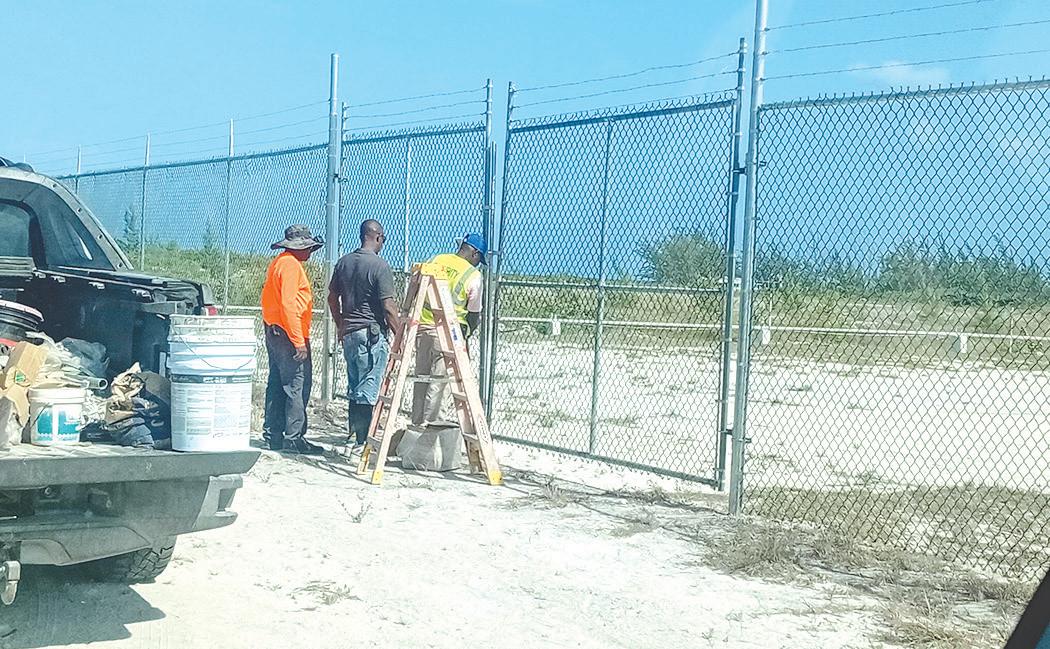
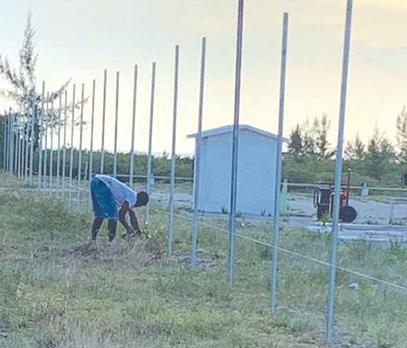
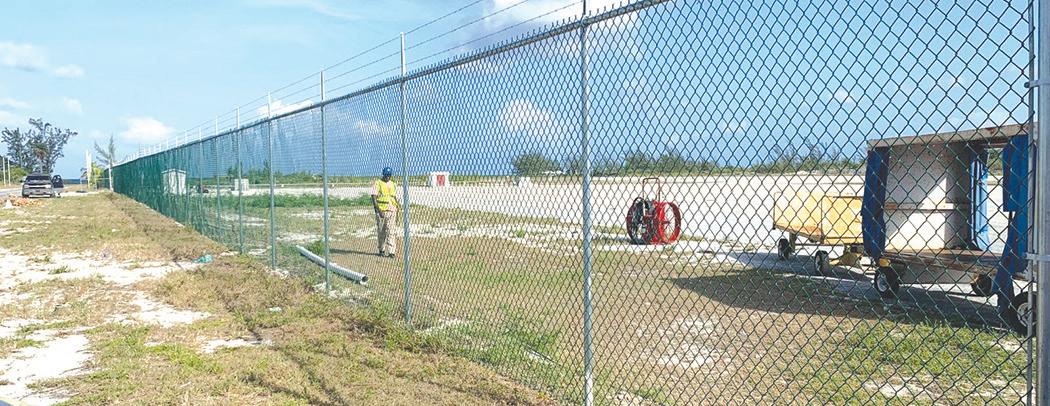
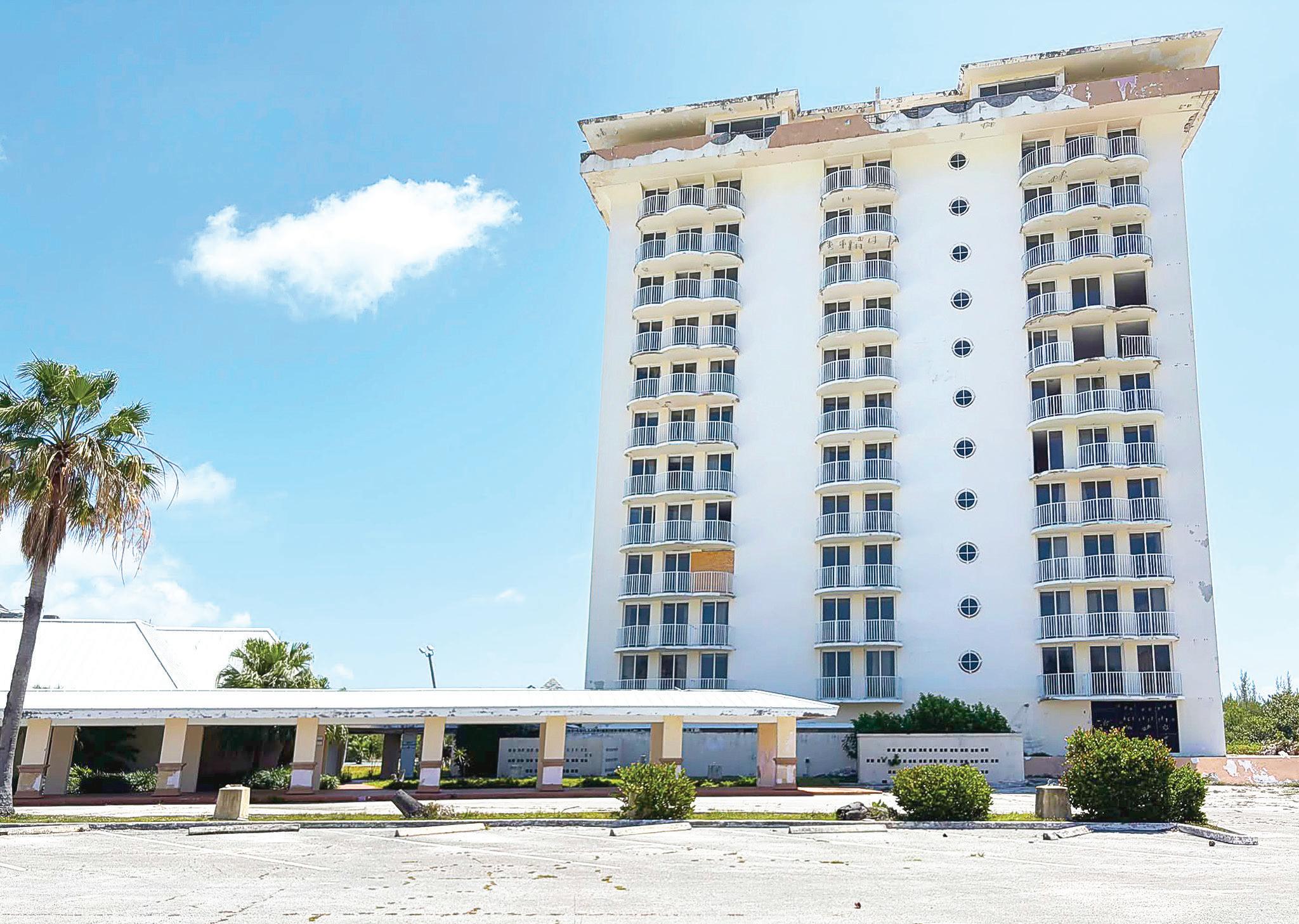
Royal Caribbean has closed its $30m acquisition of Freeport’s long-shuttered Xanadu Beach Hotel, it has been revealed, and is near to completing the purchase
of adjoining land parcels from the Royal Oasis owner.
Well-placed Tribune Business sources, speaking on condition of anonymity, told this newspaper that the cruise giant closed the resort’s purchase from the family of late businessman,
Mario Donato, at the end of May 2026 as part of its ambitions to establish a private Grand Bahama destination for its passengers that will be similar to both its own Royal Beach Club on Paradise Island and Carnival’s $600m Celebration Key project.
And Royal Caribbean is also understood to be in the fnal stages of completing its separate deal with Harcourt Developments, the Irish-headquartered property developer that owns the Royal Oasis, and
SEE BUSINESS FOR STORY
By LEANDRA ROLLE Tribune Chief Reporter lrolle@tribunemedia.net
ONGOING works at Princess Margaret Hospital have forced the cancellation of all non-emergency elective surgeries, creating a “signifcant backlog” as technical problems stall renovations in the hospital’s main operating theatre, former Health Minister Dr Duane Sands warned yesterday.
Dr Sands told The Tribune the disruption has dragged on for several weeks as the Public Hospitals Authority tries to replace fooring in the main operating theatre, but cannot move ahead because the space must be properly climate-controlled and the air-conditioning chillers are not working.
“So even though they have the
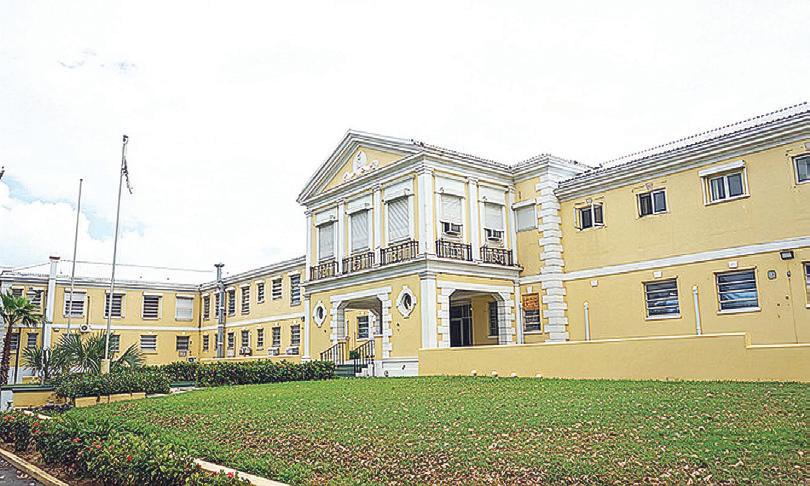


THE Royal Bahamas Police Force has opened an investigation into a viral video in which a man claims he saw ofcers dump an injured man behind an abandoned building of Market Street.
The footage, which appears to have been edited into separate clips, shows a man lying on the ground. In another clip, a man walking in the background accuses ofcers of leaving him there as a marked police vehicle passes. The man then calls out the vehicle’s licence plate number. In a statement over the weekend, police said ofcers responded to the scene, where the injured man was assisted by Emergency Medical Services and
taken to hospital for further treatment. His condition is unknown.
“Additionally, the individual recording the video made comments regarding the police vehicle observed at the scene. As a result, an investigation has been initiated to determine the accuracy and authenticity of those statements.”

Screencapture shows the body of a man on the ground near a dumpster. The person recording claimed the body was dropped there by police.
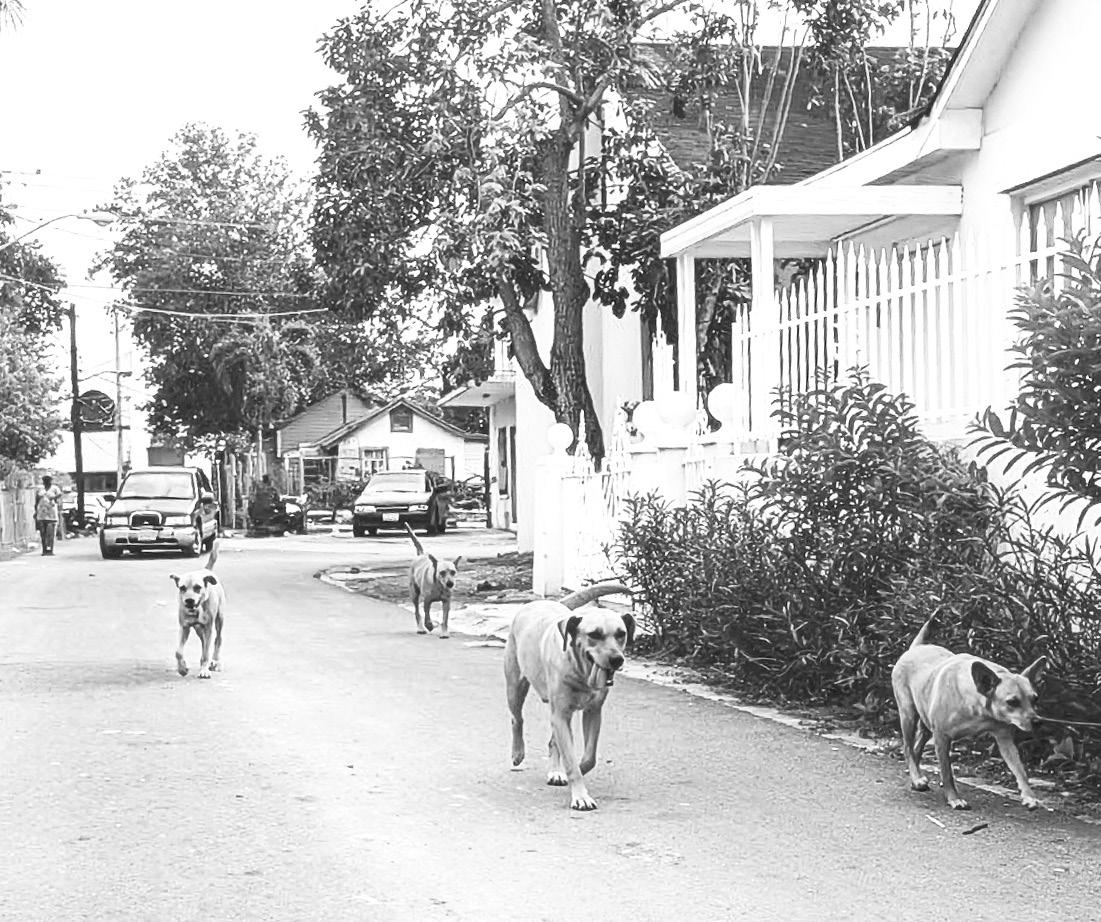
in the afected area.
“The reports surrounding this incident are deeply troubling,” Mr Deal said in a statement.
“For some time, residents have expressed concerns about packs of stray and dangerous dogs in the area and the risk they pose to the public, particularly children and senior citizens. Today’s attack underscores the urgency of addressing those concerns before another serious incident occurs. We will not take this lightly.”
The attack has intensifed
concerns among Kemp Road residents, who said they have complained for years about aggressive dogs in sections of the community and surrounding areas.
Residents said previous dog attacks in the area had injured others and claimed insufcient action had been taken despite repeated complaints.
Mr Deal said the incident showed the need for a swift response from authorities.
“I have already begun engaging the relevant authorities and agencies to determine what immediate steps can be taken to protect residents and
improve public safety in the affected area,” he said.
“I will continue to follow this matter closely and advocate for a swift and effective response.”
He also said the attack highlighted the need for greater public awareness about responsible pet ownership and animal welfare.
“Every resident deserves to feel safe in their community,” he said. “The safety and well-being of the people of Free Town will always be a priority.”
Police did not respond to requests for details on the incident up to press time.
By KEILE CAMPBELL Tribune Staff Reporter kcampbell@tribunemedia.net
NEARLY eight weeks after Lynette Hooker vanished in waters off Abaco, her mother said she remains convinced the investigation is not over, even after a recent United States Coast Guard search failed to recover her daughter’s remains.
Darlene Hamlet told Ashley Banfield’s Drop Dead Serious podcast that the Coast Guard’s multi-day operation in Abaco marked progress in the case and showed authorities had not abandoned the investigation.
"I definitely believe that the Coast Guard did a heck of a job," Mrs Hamlet said. "They outdid themselves. So, I'm not disappointed in what they had done. I'm pleased with what they have done. I don't think it's over."
The Coast Guard recently concluded a search in Abaco involving divers, investigators and support personnel. Mrs Hooker’s remains were not found.
Brian Hooker, Mrs Hooker’s husband, has not been charged with any offence and remains presumed innocent.
Mrs Hamlet’s husband, Bill Hamlet, said the Coast Guard’s involvement reinforced his belief that investigators had enough evidence to continue scrutinising the case.
"I'm not disappointed," Mr Hamlet said. "In fact, I'm happy they were there because it shows that they believe like we believe that there was foul play. There is enough meat on a bone that it bears looking at."
Mrs Hooker, 55, disappeared on April 4 while travelling in an eight-foot dinghy near Elbow Cay in
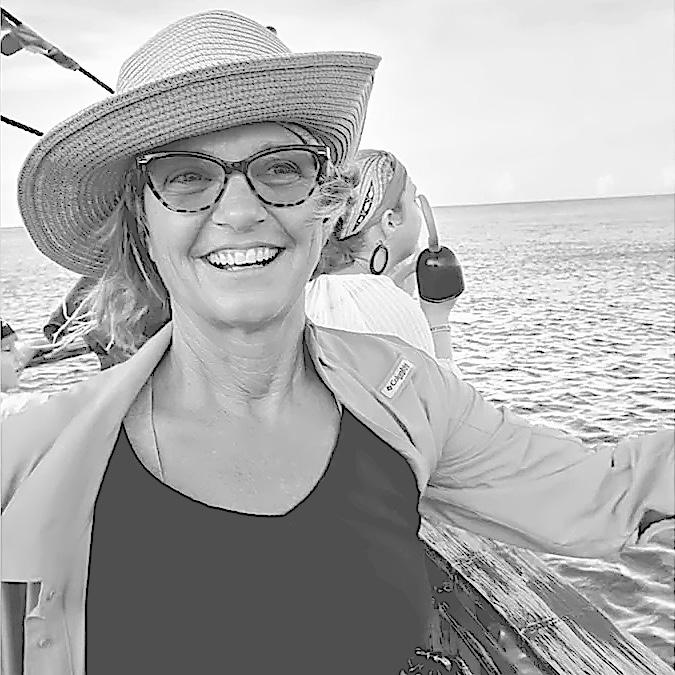
Mr Hooker told authorities his wife fell overboard during the journey and was swept away by currents after the vessel lost power.
The Royal Bahamas Police Force, United States Coast Guard and local volunteers launched an extensive search before the matter shifted from a search-and-rescue effort to a recovery operation.
The United States Coast Guard later opened a criminal investigation into the circumstances surrounding Mrs Hooker’s disappearance.
Mr Hooker was arrested by Bahamian police on April 8 and questioned in connection with the investigation before being released without charge. His attorney has repeatedly denied any wrongdoing and said he has cooperated with investigators.
The case has drawn international attention as investigators in The Bahamas and the United States continue to examine evidence. Mrs Hooker’s body has
not been recovered.
Mr Hamlet said he had known Mr Hooker for about 25 years and believed he was the kind of person who tried to stay ahead of others.
"If you'd asked me, in my personal opinion, I know Brian well enough," Mr Hamlet said. "He's going to be one step or try to be one step ahead of where he thinks you're going to go."
He said he did not expect investigators to find Mrs Hooker’s remains during the recent search.
Mr Hamlet said the uncertainty had deeply affected his wife and daughter Carly.
"It's draining to cry every hour or so, to see something and just start crying, or to have a thought, or see something on TV that causes you an emotional outburst," he said. "It's very taxing."
Mr Hamlet said Mrs Hooker had been part of his life for 38 years and was much more than a stepdaughter.
"That was my baby," he said. "For 38 years she's been a daughter to

me. She's never missed a birthday or Father's Day."
He said he routinely told Mr Hooker to "take care of my baby" whenever the couple left.
Mrs Hamlet said she struggled to reconcile Mr Hooker’s public image as a devoted husband with the circumstances surrounding her daughter’s disappearance.
"This is somebody that was his soulmate for 25 years, and he was going to stay there forever until he found her," she said. "He
said he loved her.”
Mrs Hamlet said part of her still wanted to believe her daughter’s disappearance may have resulted from an accident.
"I really believe, or at least maybe I just want to believe that this was an accident," she said.
During the interview, Mrs Hamlet said she wanted Mr Hooker’s family to be cautious.
Mr and Mrs Hamlet said they had begun attending counselling sessions to cope with the
grief and uncertainty surrounding the case.
Asked whether the family had begun discussing funeral or memorial arrangements, Mrs Hamlet said they were not ready.
"We know we have to do that," she said. "That's all I can say on that."
For now, Mrs Hamlet said her focus remained unchanged.
"I don't think it's over," she said. "I'm not going to go away until I find my daughter."
By LEANDRA ROLLE Tribune Chief Reporter lrolle@tribunemedia.net
PRIME Minister Philip
“Brave” Davis said he has been advised that aviation authorities are investigating the Election Day plane crash involving convicted drug trafcker Eric Gardiner, including whether it had valid certifcation to fy.
Mr Davis addressed the controversial crash in the House of Assembly Thursday night after Opposition leader Michael Pintard asked whether an investigation had been launched.
Mr Pintard pointed
to Aviation Minister JoBeth Coleby-Davis’ refusal to answer questions on the matter when pressed by a reporter last week.
The plane, which was carrying 11 Bahamians, had been a recurring talking point during the budget debate.
“I'd like to hear Prime Minister again, have an investigation been launched, one that the plane should not have
functioned as a charter. Secondly, that the plane may not have been licensed, and that needs clarifcation,” Mr Pintard said.
Mr Davis responded that the opposition leader “clearly” knew more about the incident than he did.
“In the public domain would’ve been that every crash that occurs in The Bahamas, the Air Accident Authority commences an investigation right away and that too is in public domain,” he said. “That’s as far as I’m aware, that’s going on and we have heard nothing yet about the results of that.”
“Do not tempt us to go down the path that you carry yourselves and your people because I could say a lot of things about how, I could show the hypocrisy here, if you're so concerned about the rule of law and investigations, there are other things you could have spoken too and raised.”
Mr Pintard urged him to go down that road, saying: “We could have a good house cleaning on all sides.”
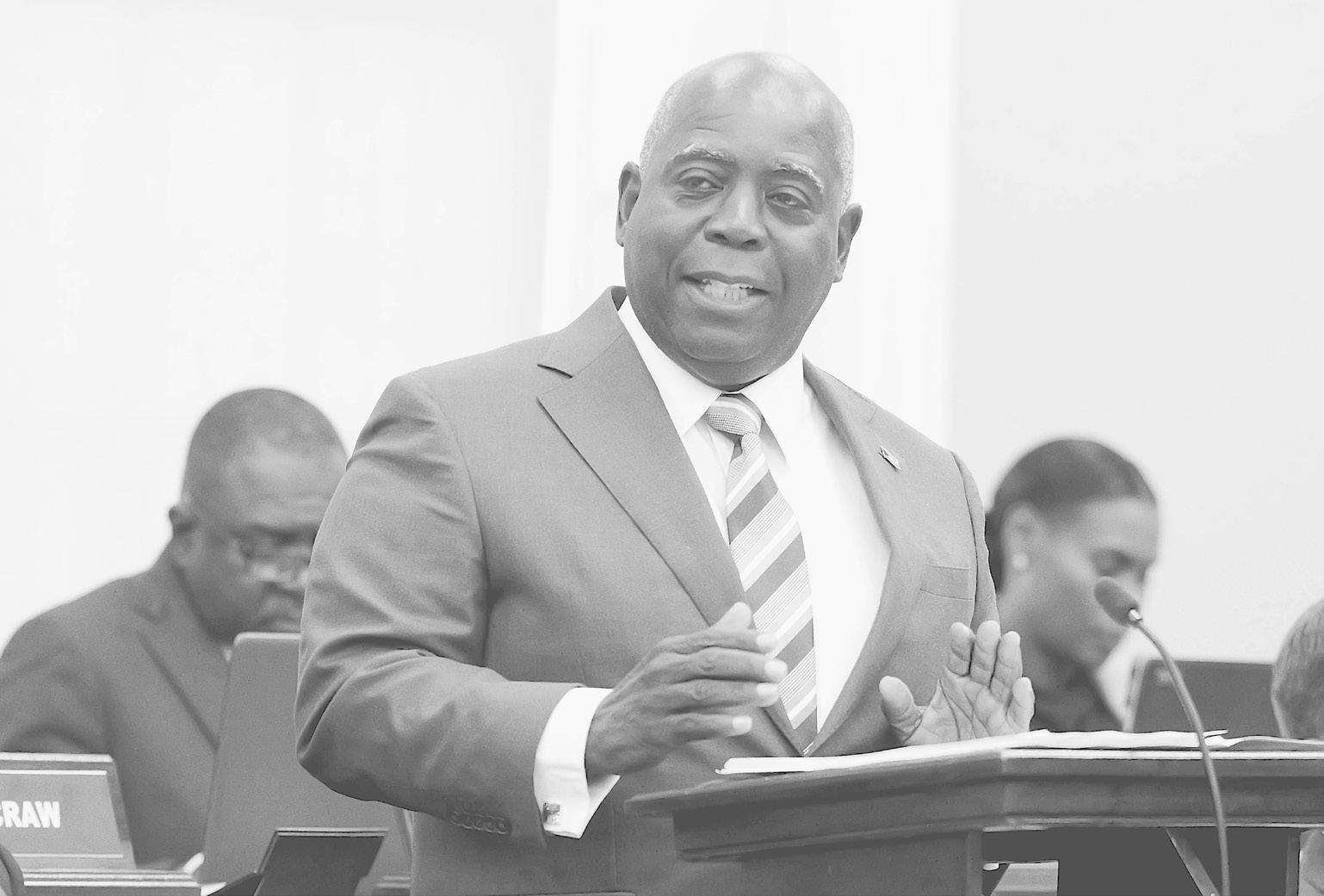
The aircraft, a Beechcraft 300 King Air twin-prop registered in Panama as HP-1859 carrying eleven people on board, was forced to ditch into the sea on May 12 after departing Marsh Harbour, Abaco, for Freeport.
The Air Accident Investigation Authority (AAIA) previously said it would not be launching an investigation as the incident falls outside Bahamian jurisdiction. It said relevant authorities in the State of Registry,
Panama, and the State of Manufacture and Design, the United States, had been notifed and that it stands ready to provide assistance or coordination support to the authority undertaking an investigation. Captain Rafael Barcenas,
managing director of the Civil Aeronautics Authority of Panama, confrmed the aircraft’s documentation expired on June 4, 2025, and said it should not have been fying after that date.
Bahamas CAA Director General Ms Chequita Johnson previously declined to comment on the matter, citing ongoing investigations. The day after the rescue, Eric “Player” Gardiner was arrested by US authorities and indicted on drug smuggling conspiracy charges in connection with a threeyear drug conspiracy operation centred on The Bahamas. According to the US Drugs Enforcement Agency, Gardiner allegedly had three phones and a cross-body bag containing about $30,000 in Bahamian currency.
He was charged with cocaine and frearms conspiracy charges in a New York court last week. However, he has denied the allegations.
By LEANDRA ROLLE
Chief Reporter
FINANCE Minister Michael Halkitis could not explain why more than $200,000 in publicly funded gift vouchers distributed in Abaco before the general election carried the names of PLP candidates and ofcials, even as he defended the payments as part of a long-running government relief programme.
intended to help residents still struggling from Hurricane Dorian.
Speaking to reporters on Friday, Mr Halkitis said the vouchers were obtained through the proper procurement process and issued under a programme
“It's a part of a longstanding government programme in Abaco, in Grand Bahama,” he said. “Individuals are still impacted or still feeling the impact of Dorian, and so there's a programme to do small home repair. It's also

here in New Providence, where you know individuals may not have the wherewithal to repair their homes, and throughout the islands, I know in Inagua and other islands, these programmes are ongoing.”
His defence leaves key questions unanswered, including who authorised the vouchers to be issued in the names of PLP candidates and ofcials, who selected the recipients, whether people outside the PLP’s political network benefted, and why the programme was distributed in that form shortly before the election. that gift certifcates worth more than $200,000 were being given to Abaco resi dents in the names of PLP election candidates and of cials as Hurricane Dorian relief payments.
utive ofcer of Premier Importers, the company that issued the certifcates, con frmed at the time that the Ministry of Finance paid for them. He said the vouchers were issued at the ministry’s request, with certifcates in amounts of $200, $300 and $500.
The Tribune showed vouch ers issued to residents and signed by Bradley Fox Jr, then the PLP’s Central and South Abaco candidate, and Preston Roberts, the PLP’s campaign coordinator and a Disaster Reconstruction Authority board member.
trustee, rejected the suggestion at the time that the party would use public funds in that way. He later said Mr Fox told him the signature on the vouchers was not his own. Mr Halkitis had pledged to address the controversy during the budget debate, but did not. He spoke on the matter only after reporters he alleged were similar practices before the 2012 general election.
“You ask Marco City what was done in the 2012 election in Cat Island when he was the candidate. I still have all the receipts, I still have all the letters that were issued even on election day for him,” Mr Davis said.
Long Island MP Dr Andre Rollins accused the government of allowing public money to be used for political purposes, saying opposition and independent candidates did not receive vouchers bearing their names paid for by the public
“Never in the history ofment allowed the people's money to be used to pay, to -
Former Marco City MP Michael Pintard rejected Mr Davis’ comparison and accused the prime ministersition into a controversy he said the government could
“If he put that on the public record what he is saying is completely false,” he said. “I mean, the member for Cat Island is really the poster child for patronage. He's never missed an opportunity to incentivise voters by depositing substantial sums at various stores Cat Island, Rum Cay, and San Salvador but we weren't cheering on about that, so I don't think he should

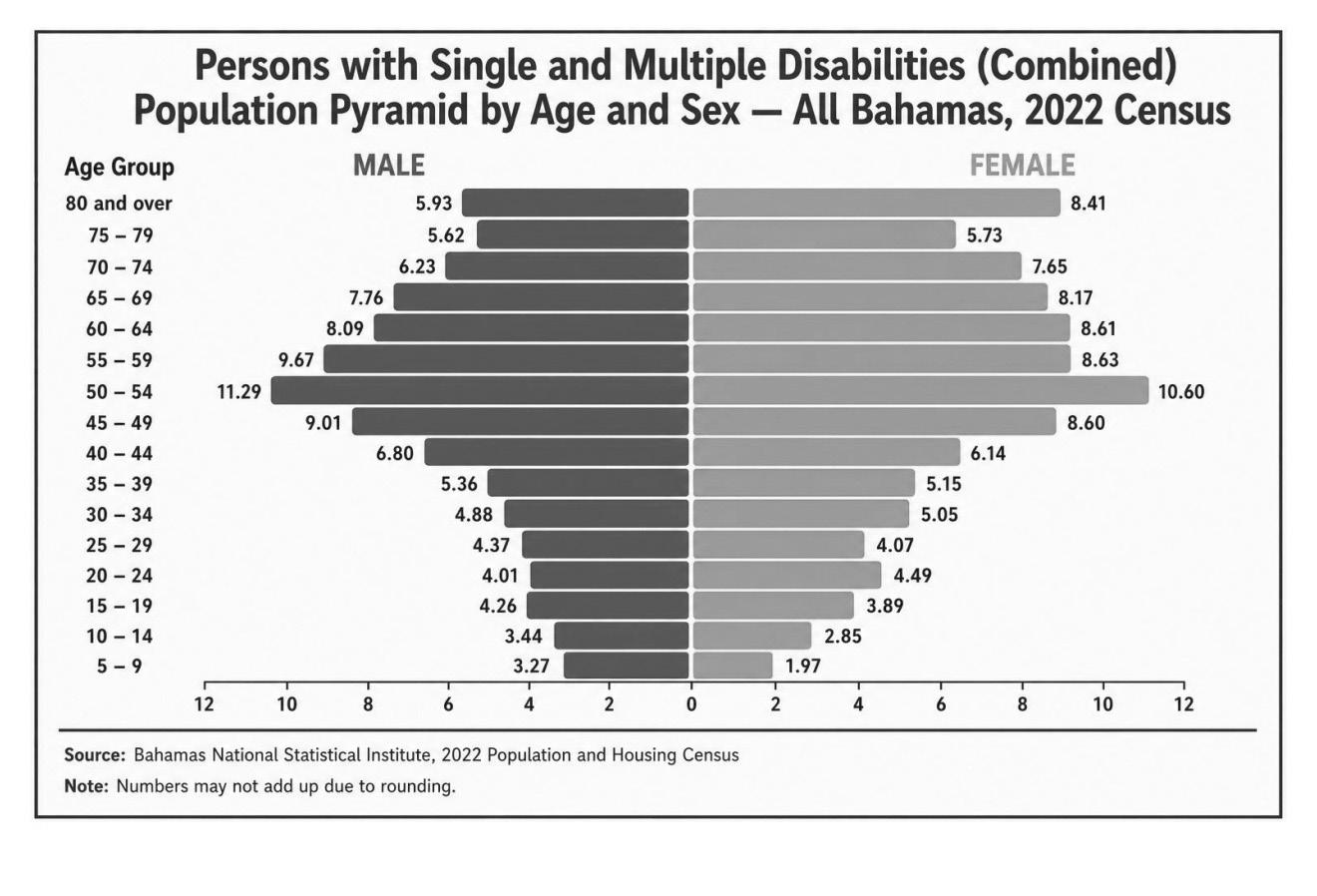
Women accounted for most people with disabilities, representing 57.1 percent, or 22,021 people, compared with 42.9 percent, or 16,530 men.
The report, the third release from the 2022 Census of Population and Housing, found that disability increased sharply with age. Five percent of adults aged 18 to 29 reported a disability, rising to 15.9 percent among those aged 50 to 59, 39.5 percent among those aged 70 to 79, and 63.9 percent among people aged 80 and older.
The census also exposed income disparities. Among people aged 18 and older, persons with disabilities were more likely than those without disabilities to live in households earning less than $5,000 a year, at 5.5 percent compared with 3.8 percent. They were also more likely to live in households earning between $5,001 and $10,000 annually, at 5.8 percent compared with 4.4 percent.
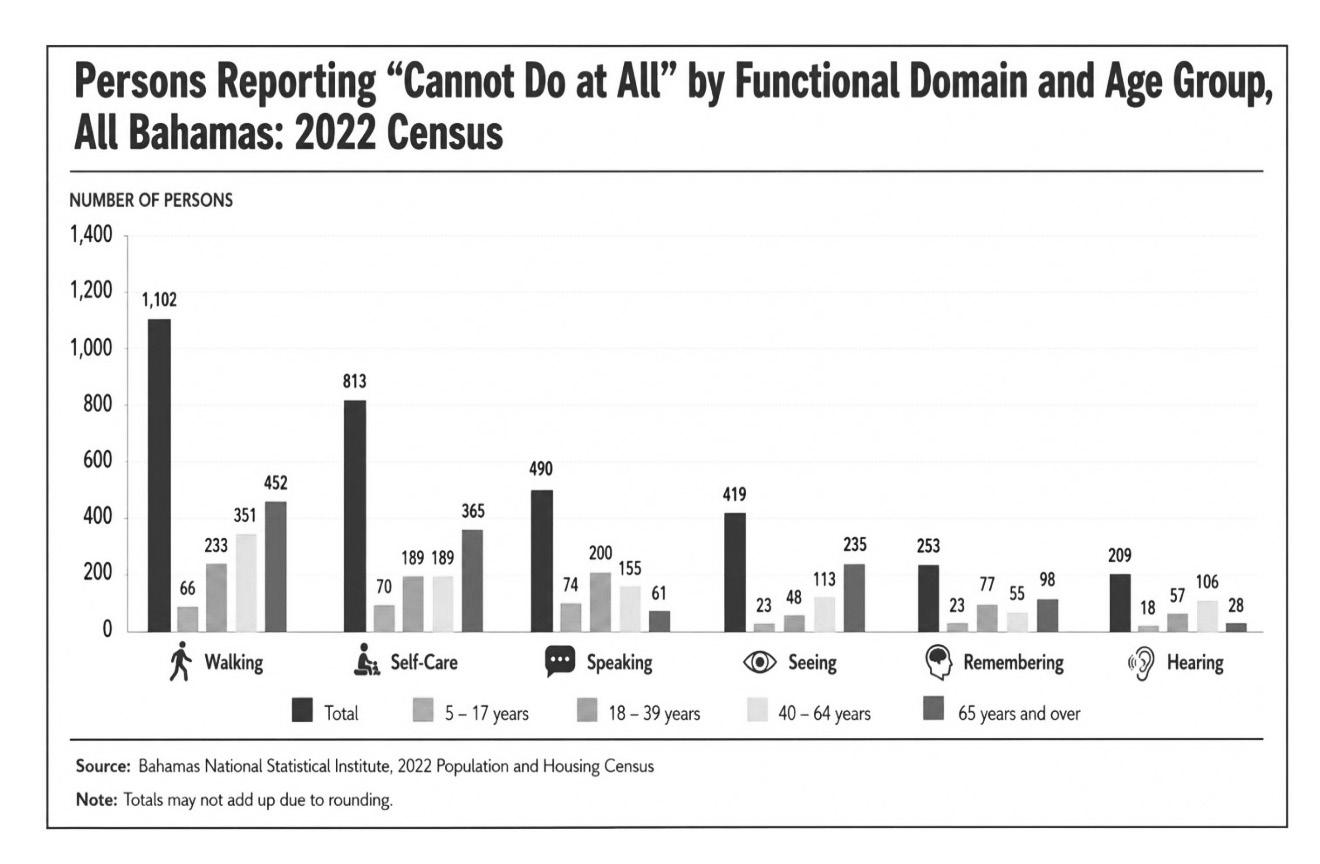
walking, 2,961 reporting a lot of difculty and 1,102 saying they could not walk at all.
Remembering or concentrating was the third most common category, with 6,303 people reporting some difculty, 1,387 reporting a lot of difculty and 253 saying they could not remember or concentrate at all.
Speaking difculties afected 3,690 people who reported some difculty, 1,221 who reported a lot of difculty and 490 who said they could not speak at all.
Older Bahamians were the most afected across the major disability domains.
Among people aged 65 and older, 4,601 reported some difculty seeing and 253 said they could not see at all. The same age group included 2,312 people with some difculty hearing and 380 who said they could not hear at all.
married status, compared with 82,059 people, or 25.4 percent, among the non-disabled population.
The population with disabilities also recorded higher proportions of widowed, divorced and legally separated people.
Asked whether future census exercises could collect broader disability information, including employment and educational challenges, Managing Director Dr Jamiko Deleveaux said planning for the 2030 census would begin as early as next month.
“At that time, we do plan on working with the commission and we do plan on working with advocates for the disability community to get their assessment and for them to help us to tweak that disability section to make it much more robust and functional, so that we can get the most data that is the most impactful and the most helpful for the communities,” he said.
Disability Inclusion
“In the international conversation, because I work internationally, regionally, and nationally, that is one of the main conversations we have is about the Washington group questions,” she said.
“The fact that it supports the medical model of disability, which is prevent cure, whereas we’re moving to the social, which is we identifying the barriers and removing those barriers or we are allowing persons access to self-identify with the varying disabilities that they live with so that you won’t lose out.”
Ms Brown said advocates are pushing for a separate, more detailed national survey because the census does not capture key areas such as employment and labour participation among persons with disabilities.
By contrast, 10.8 percent of people without disabilities lived in households earning more than $100,000 a year, compared with 9.4 percent of persons with disabilities.
The fndings were released as BNSI ofcials and disability advocates acknowledged that the census does not provide a complete picture of disability in The Bahamas, particularly mental health and neurological conditions.
Chief Census Ofcer Kim Saunders urged the public to treat the data as an estimate and a starting point for further study.
“We recommend that the disability data be used solely as an estimation of persons with disabilities. The data can be used as the benchmark data to further investigate the causes and the other issues that are not inclusive in the Washington group,” she said.
For the 2022 census, The Bahamas adopted the Washington Group Short Set of questions, an internationally recognised tool developed by the United Nations Statistical Commission to improve the quality and comparability of disability data globally.
The survey measured six functional domains: seeing, hearing, walking or climbing stairs, remembering or concentrating, self-care and communicating. People who reported “some difculty”, “a lot of difculty” or “cannot do at all” in at least one category were classifed as persons with disabilities.
“The Washington Group specifcally zeroes in on those six main functions and they are universal functions,” Ms Saunders said. “The purpose of this section is not to have a look at illnesses or medical conditions. We just want to have a look at those functions that limit persons in their daily activities, and from that estimation you can have other specialised surveys that dig deeper into disability.”
BNSI ofcials said the 2022 census achieved about 85 percent population coverage.
New Providence recorded the largest number of people with disabilities, with 26,712 residents, representing 69.3 percent of the national total. Grand Bahama recorded 4,862 people with disabilities, while Abaco recorded 1,584.
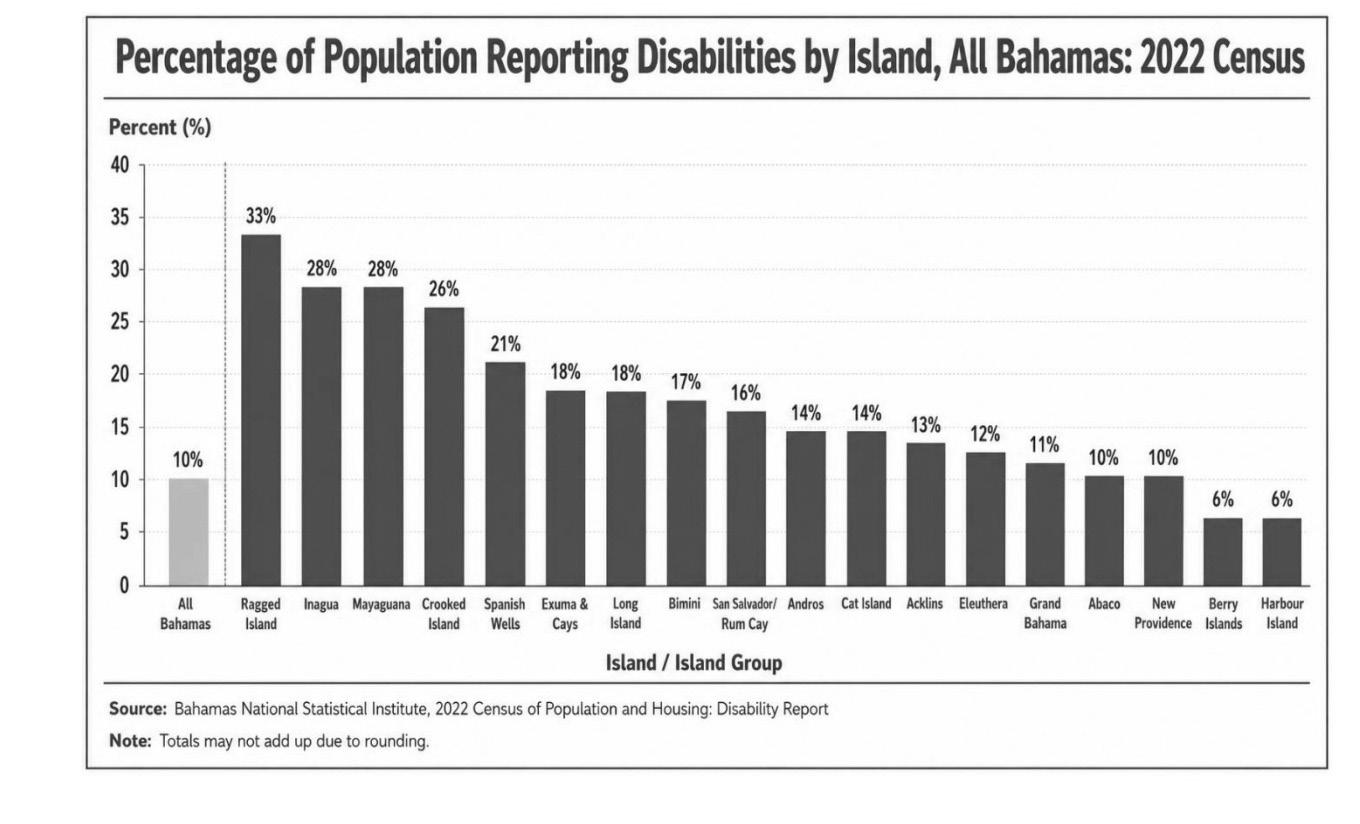
The highest proportions were recorded in Ragged Island, where 32.7 percent of residents, or 17 people, reported a disability. Inagua followed at 28 percent, or 217 people, and Mayaguana at 27.8 percent, or 54 people. Ofcials said those fgures were likely infuenced by the older populations on those islands.
Vision impairment was the most commonly reported disability. The census recorded 18,860 people who reported some difculty seeing, 1,778 who reported a lot of difculty and 419 who said they could not see at all.
Walking difculties were the second most common category, with 10,419 people reporting some difculty
Walking difculties were also concentrated among seniors, with 4,558 people aged 65 and older reporting some difculty and 452 saying they could not walk at all. Another 2,472 people aged 65 and older reported some difculty remembering or concentrating, while 98 said they could not remember or concentrate at all.
The census found only modest diferences in housing tenure between persons with and without disabilities. Nearly half of people with mild or higher disabilities fully owned their homes, at 47 percent, compared with 48.7 percent of people without disabilities.
People with disabilities rented at a rate of 29.1 percent, compared with 28.5 percent among those without disabilities. They lived rent-free at a rate of 3.8 percent, compared with 3.3 percent among people without disabilities. The data also showed that 0.8 percent of persons with disabilities were squatting, compared with 0.4 percent of persons without disabilities.
Mortgage-based homeownership was nearly identical, with 18 percent of persons with disabilities and 18.2 percent of persons without disabilities living in homes owned through a mortgage.
Among persons with disabilities aged fve and older, 3,685 people, or 9.6 percent, were enrolled in school full-time, while 557 were enrolled part-time. The majority were not attending school at the time of the census.
The report also found that 206 children aged fve to 14 with disabilities were not attending school.
Seventy-four children aged fve to 17 represented 15.1 percent of people who reported being unable to speak at all.
Ofcials said the fndings underscored the need for continued investment in inclusive education, accessibility and support services for children with communication-related disabilities.
Secondary education was the most commonly reported level of educational attainment among persons with disabilities aged 15 and older. Among people with a single disability, 15,878 had attained secondary education, followed by 5,494 college or university graduates and 2,097 people with post-secondary education.
Among those with multiple disabilities, 6,926 had attained secondary education, 1,307 had a college or university education and 648 had post-secondary qualifcations.
The data also showed that educational attainment generally declined among older age groups, with people aged 80 and older recording the highest numbers of persons with only primary education and comparatively fewer people with college or university qualifcations.
The census also found differences in marital status.
Among people without disabilities, 218,120 people, or 67.5 percent, had never married, compared with 17,264 people, or 44.8 percent, among people with at least one disability.
Persons with disabilities were more likely to be married, with 13,071 people, or 33.9 percent, reporting
Consultant Erin Brown welcomed the report but said the country needs more detailed disability data than the Washington Group’s functionality-based approach provides.
“In our current environment, even when you are flling an application out, you’re going in for the interviews, they’re not populating that information,” she said.
“Do I self-identify with a disability? If I do, what are those varying disabilities? We’re not talking about reasonable accommodation, we’re not talking about the persons with disabilities equal opportunity after 2014.” DISABLED from

NULLIUS ADDICTUS JURARE IN VERBA MAGISTRI
“Being Bound to Swear to The Dogmas of No Master”
LEON E. H. DUPUCH,
Publisher/Editor 1903-1914
SIR ETIENNE DUPUCH, Kt., O.B.E., K.M., K.C.S.G., (Hon.) LL.D., D.Litt .
Publisher/Editor 1919-1972
Contributing Editor 1972-1991
RT HON EILEEN DUPUCH CARRON, C.M.G., M.S., B.A., LL.B.
Publisher/Editor 1972-
Published daily Monday to Friday Shirley & Deveaux Streets, Nassau, Bahamas N3207
TELEPHONES
News & General Information (242) 502-2350
Advertising Manager (242) 502-2394
Circulation Department (242) 502-2386
Nassau fax (242) 328-2398
Freeport, Grand Bahama (242)-352-6608
Freeport fax (242) 352-9348
WEBSITE, TWITTER & FACEBOOK
EDITOR, The Tribune.
BAHAMIAN political history reveals that many of the individuals who transform our political landscape were, at one time or another, dissidents within their own parties. From the early years of majority rule to the present day, political realignment has been a recurring feature of our democracy.

www.tribune242.com @tribune242

TWO years ago—August 15, to be exact—the Chairman of the Clearing Banks Association, Gowon Bowe, took issue with Foreign Afairs Minister Fred Mitchell’s suggestion that the Central Bank should play a more active role in regulating commercial banks. The mere discussion of regulating fees or banking services, he argued, suggested The Bahamas was drifting toward communism and heading down a “very slippery slope.”
Perhaps. But there is another slippery slope that deserves far more attention: one where Bahamians are steadily conditioned to accept worse service, more bureaucracy and higher fees, all while being told it is simply the cost of living in a modern fnancial system.
It isn’t. As we listened to this year’s Budget Debate, we were struck by how much time was consumed by political theatre while one of the most pressing everyday issues facing ordinary Bahamians barely received the attention it deserved. The Progressive Liberal Party’s overwhelming mandate presents a rare opportunity to tackle long-standing concerns about the banking sector— concerns that have simmered for years but are now boiling over.
Every Bahamian has a story. Ask an entrepreneur trying to open a business account. Ask parents attempting to establish a savings account for their children. Ask the retiree who suddenly receives another request for documents already submitted three times before. The details may difer, but the frustration is remarkably consistent.
This newspaper has heard those complaints for years.
Nobody disputes that banks have obligations to combat money laundering or fnancial crime. Nobody is suggesting that proper due diligence should be abandoned. But somewhere along the line common sense packed its bags and quietly left the building.
How does it take more than a year for a respected doctor and his wife to open savings accounts for their infant twins? How does one of a bank’s oldest customers wait sixteen months simply to establish a new account? Why should Bahamians have to pay lawyers to notarise copies of Bahamian passports because a compliance ofce hundreds of miles away insists upon it?
More importantly, why do commercial banks operating in this country often appear to impose standards that exceed those required by our own regulators?
These are not isolated inconveniences. They are symptoms of a system that increasingly treats legitimate customers as suspects until proven otherwise.
Then there are the fees. Few things irritate Bahamians more than paying extraordinary sums simply to move their own money. Branches have closed. Face-to-face service has diminished. Customers are pushed toward digital platforms and self-service options that reduce costs for the banks themselves. Yet somehow the charges keep climbing.
The average customer is left wondering where all these efciencies have gone, because they certainly have not shown up on the monthly statement.
And while this is happening, we continue to shape our domestic practices around the expectations of international bodies and foreign compliance departments that neither answer to Bahamian voters nor fully appreciate Bahamian realities. That should concern us. International cooperation is important. The fght against illicit fnance is important. But there is a meaningful diference between sensible regulation and endless regulation; between prudent oversight and bureaucratic excess.
For too long, The Bahamas has found itself reacting rather than leading—implementing layer upon layer of requirements without ever stopping to ask whether they genuinely improve security or merely create obstacles for honest citizens trying to live ordinary lives.
We also seem reluctant to point out an obvious fact. The Bahamian dollar is a non-tradable currency operating under exchange controls supervised by the Central Bank. This is hardly a jurisdiction where money moves invisibly without oversight.
The government now has both the political capital and the parliamentary numbers to act.
A Financial Services Customer Bill of Rights would be a sensible place to begin. It could establish reasonable timelines for opening accounts, require transparent disclosure of fees, create meaningful complaint mechanisms and ensure that documentation requests remain proportionate to actual risk. None of those reforms would undermine the banking system. If anything, they would strengthen confdence in it.
There will no doubt be those who argue that government should stay out of the matter and leave everything to market forces.
Ordinarily, that argument carries weight. But markets only work properly when consumers have meaningful choices. In a concentrated banking environment where virtually every citizen must rely on a handful of institutions to receive salaries, pay mortgages and conduct everyday business, the public has every right to expect fairness, transparency and accountability.
This is not an argument against capitalism. It is an argument against complacency. More than ffty years after Independence, Bahamians should not feel powerless in their dealings with institutions that exist because the public entrusts them with its savings. Nor should we quietly accept every external directive that arrives wrapped in the language of compliance without asking whether it serves our own national interest. Too often, we have mistaken acquiescence for good governance.
The government should resist that temptation. It has been handed a historic mandate. It should use it to restore balance between regulator and regulated, between institution and customer, and between international expectation and national sovereignty.
No Bahamian should have to spend months proving who they are just to open an account, nor pay eye-watering fees simply to access their own money. Enough is enough.
In 1970, the “dissident eight” led by Sir Cecile Wallace-Whitfeld, along with Sir Arthur Foulks, Maurice Moore, Warren Levarity, Dr. Curtis McMillan, James Shepherd, George Thompson and Elwood Donaldson, broke away from the progressive Liberal Party and became known as the free PLP. They later joined forces with the United Bahamian Party to establish the free National Movement. In 1977, a split within the FNM led by John Bostwick and other dissidents gave rise to the Bahamian Democratic Party, which went on to win six seats and become the ofcial opposition.
Subsequent decades saw many prominent fgures cross political lines. Hubert Ingraham, expelled from the PLP in 1984, joined the FNM and became prime Minister in 1992. Perry Christie, who also parted ways with the PLP in the 1980s, later returned to lead the party to victory in 2002 and became Prime Minister. Arthur Hanna likewise reconciled with the PLP and eventually served as Governor General. Malcolm Adderley who aligned himself originally with the Vanguard Nationalist and Socialist Party joined the PLP and became a Member of Parliament. Fred Mitchell, after years in outside active politics and a period as an Independent Senator appointed by the FNM, returned to the PLP and successfully regained a parliamentary seat. Dr. Bernard Nottage left the PLP to establish the Coalition for Democratic Reform before later returning to serve once again as a Cabinet Minister. Tennyson Wells left the FNM,
became an independent and successfully retained his parliamentary seat. Contemporary politics has witnessed similar transitions. Branville McCartney left the FNM to establish the Democratic National Alliance (DNA) before later returning to the FNM as a Senator. Renward Wells help form the National Development Party, (NDP) in 2008, a 3rd party before joining the PLP and subsequently the FNM. Gregory Moss departed the PLP and founded the United Democratic Party (UDP). Dr. Andre Rollins journeyed from the NDP to the PLP and later to the FNM. Arinthia Komolafe rose to lead the DNA before joining the FNM and becoming a Senator. Lincoln Bain transitioned from the DNA to become leader of the Coalition of Independents (COI). Iram Lewis crossed the foor from the FNM to the COI. Successful or not, these political migrations have infuenced and reshaped the Bahamian political landscape. Scholars have long debated whether such movements are positive or negative. Some see them as opportunism, while others view them as examples of political pragmatism. Politics has often been described as “the art of the possible”—the ability to achieve practical results through compromise and reconciliation. Former Australian Prime Minister John Howard once observed that “it is better to get 80 percent of what you want than 100 percent of nothing.” In other words, politics is often a balancing act between ideals and what can realistically be accomplished.
The history of third-party movements also reveals the enormous challenges of operating within a twoparty system. Even highly respected political fgures have struggled to build viable alternatives to the
PLP and FNM. Reformers may hope that campaign fnance reform, electoral reform and a more mature democracy will one day create a level playing feld, but such changes often move slower than the political careers of those advocating for them. It is clear to see that Bahamian political history has been shaped not only by parties, but by dissidents, reformers, and political realignments. In many respects, these women and men have acted as catalysts for change, even when their immediate ventures were unsuccessful. Sometimes dissidents are often criticized as rebels, opportunists, or spoilers. Yet with the passage of time, historians frequently recognized that they helped broaden debate and force established parties to adapt. Without the dissident eight, there would have been no FNM. Without the BDP split, the FNM might have evolved diferently. Without the DNA, COI and other third parties, many issues now discussed nationally might never have entered the political mainstream.
Whether celebrated or criticized, early and contemporary dissidents have left an indelible mark on Bahamian politics. Their journeys remind us that democracy is not static, but constantly evolving. Political parties rise and fall, alliances shift, and yesterday’s adversaries sometimes become tomorrow’s allies. As the wheel od democracy moves slowly, one lesson remains clear: the story of Bahamian politics has often been written not by those who remained comfortably within the system, but by those who dared to challenged it. What political transformations await us by 2031 is anyone’s guess. We shall wait and see.
DR. VERONICA MCIVER Nassau, Bahamas June 21, 2026.
EDITOR, The Tribune.
PICTURE this: A country trying to be recognised globally as environmentally conscious with no nationalised public transportation — It is a glaring juxtaposition. The state of public transportation in The Bahamas is so poor that it has forced families that previously relied on the bussing system into car ownership. Resulting in increased costs (gas, insurance, etc), a loss of business for bus drivers, and increased trafc for everyone. This reality reminded me of our incumbent Prime Minister’s statements about Bahamians living above their means in a national address.
This statement, despite its objectively condescending nature, was defended, and never taken as seriously as I thought it should have been. Was I expecting Bahamians to drag the incumbent Prime Minister to Rawson Square by the collar? No, but I was expecting them to ask for systemic reforms at the very least. Talks of rent-control dominated public discourse for a while, but what about other legislative reforms like this? What about tax reforms (customs duties, vat, etc)?
Education reforms for Bahamian students receiving a public education? What about funding for the national university? Public healthcare infrastructure? Proper maintenance of the public thoroughfare that Pike, and Water & Sewage regularly “dig up and patch up”? One problem is never just one problem. It seems as though our problems as a nation have complied and formed a kind of limp wall that stands between its citizens and its politicians, who are nonetheless responsible for the course of the nation. It is the result of a law book full of decades old legislation and a slow legislative process. We, citizens and lawmakers alike, are always so busy as a nation reacting to the results of a slow system that we are not revitalising the systems and institutions that assist a great percentage this country’s citizen. There is a gap between the cost of gas and housing and the cost of having a national university where graduation timelines are constantly delayed, and the cost of an unequipped hospital where Bahamians die every day! The wealth gap is widening by the
second, and proportionally, mortgage approval rates are slumping. Yet, our housing reform looks like frst-time homeowner exemptions up to $600,000. I want to make a very simple point that one has to be approved for a mortgage of at least $250,000 in the frst place to reap the benefts of any homeowner’s exemptions. There is an insidious foreign investment interest sitting within most of the policies being prioritised in the budget that scares me. All while rumors of our politicians’ credibility swirl on the global stage. The deceit of our sitting politicians will weigh on our shoulders and be our children to bear in just a few years. While public services continue to fail if we stay on this course. Take a look at our neighboring nations, and by comparison, look at what we have done with our great fortune: squandered it on grandeur while national development stalls.
ASHLI BURROWS Nassau, June 15, 2026.
By KEILE CAMPBELL Tribune Staff Reporter kcampbell@tribunemedia.net
A 16-YEAR-OLD boy
was remanded to the Simpson Penn Centre for Boys on Friday after admitting to possessing an AK-47 assault rife and 22 rounds of ammunition found during a police search of a Podolio Street residence.
The admission prompted Senior Magistrate Raquel Whyms to question the circumstances surrounding the case, noting that an adult defendant had accepted responsibility for marijuana found during the same search while the juvenile admitted to the frearm charge.
"How convenient the adult takes the rap for the drugs, but the juvenile takes the gun charge," she said.
The juvenile appeared before Senior Magistrate Whyms alongside Joseph Wright, Joetisha Wright and Cherrlle Fowler following the June 16 search.
By KEILE CAMPBELL Tribune Staff Reporter kcampbell@tribunemedia.net
TWO San Salvador men were granted bail after appearing in the Magistrate’s Court on separate vehicular manslaughter charges stemming from fatal trafc accidents earlier this year.
Jervin Miller, 36, a storekeeper of Deveaux Street,
The four were initially charged with possession of dangerous drugs with intent to supply, possession of a prohibited weapon and possession of ammunition.
The court heard that police discovered a brown and black AK-47 rife and 22 rounds of ammunition inside a black Nautica bag in a closet during the search of the residence.
While Joseph Wright, Joetisha Wright and Ms Fowler pleaded not guilty to the frearm-related charges, the juvenile admitted possessing the weapon and ammunition. According to the prosecution, the juvenile told police during an interview conducted in the presence of his guardian that the frearm belonged to a friend who had asked him to hold it because police were "hot" in his area.
Defence counsel argued that the Child Protection Act required the involvement of social services before sentencing could take place. "I have never seen a
Cockburn Town, and Shervin McKinney, 45, a self-employed fsherman, also of Deveaux Street, appeared before acting Chief Magistrate Ancella Evans on June 19, 2026.
Miller’s charge stems from an April 24 collision on Queen’s Highway in the Halls Landing area.
Police previously reported that motorcyclist Whitney Burrows, 43,
more rightful situation for social services to come in," the senior magistrate said. "There is a lot going on in this house."
Referring to the circumstances of the case, she added: "How could an AK-47 be brought into a house with drugs? All kinds of foolishness going on in this house."
The juvenile was remanded to the Simpson Penn Centre for Boys pending sentencing and will return to court on July 9.
Joseph Wright, Joetisha Wright and Ms Fowler were each granted $7,500 bail on the frearm and ammunition charges.
As conditions of bail, Joseph Wright must sign in at the Wulf Road Police Station every Tuesday before 6pm, while Joetisha Wright and Ms Fowler must sign in at the Grove Police Station every Monday before 6pm. Their trial was scheduled for October 6. Before the frearm and ammunition charges were
sufered serious injuries following a collision involving a white Lexus. Burrows was airlifted to New Providence for treatment but died on May 15.
Prosecutors alleged that around 9.21pm on April 24, 2026, Miller was driving vehicle SF0380 south on Queen’s Highway in San Salvador in a manner dangerous to the public, causing Burrows’ death.
dealt with, Joseph Wright,
a 24-year-old government worker, pleaded guilty to possession of dangerous drugs with intent to supply after taking responsibility for marijuana found during the same police operation.
According to the police report, ofcers searched the home around 11.15am.
Joseph Wright answered the door and admitted there was marijuana in his jacket, telling police he smoked marijuana.
Police allegedly recovered 20 small plastic bags of hydroponic marijuana from the jacket. The drugs weighed about one ounce and had an estimated street value of $170.
A further search of the residence uncovered two and one-eighth ounces of marijuana concealed beneath a sink under a blue towel. The drugs were packaged in 40 small clear plastic bags.
Ofcers also recovered $130 from Joseph Wright, which investigators suspected
In a separate matter, McKinney’s charge arose from a March 11 incident near the San Salvador International Airport.
Police reported that Marcian Pinder, 20, sufered fatal head injuries after reportedly falling from the back of a truck travelling toward Cockburn Town. He later died in New Providence after being airlifted for medical treatment.
was proceeds from drug sales. Joseph Wright pleaded guilty to the drug charge, while Joetisha Wright, Ms Fowler and the juvenile pleaded not guilty.
During mitigation, his attorney argued that his client accepted ownership of the marijuana but denied that it was intended for supply. Counsel contended that the allegation of intent to supply arose from a legal presumption based on the packaging and urged the court to exercise leniency.
The attorney described Joseph Wright as a high school graduate, government employee and churchgoer with no previous convictions. He said his client was remorseful and apologetic to his mother, sister and family.
The prosecution argued that the quantity and packaging of the marijuana supported the allegation that it was intended for distribution.
"Far too often we see this revolving door where we see
persons keep coming back," the prosecutor said.
Senior Magistrate Whyms said it was apparent to her that Joseph Wright had been selling marijuana. He was fned $1,200 or 12 months’ imprisonment for possession of dangerous drugs with intent to supply and a further $500 or two months’ imprisonment on a separate charge. The sentences were ordered to run concurrently.
He was also placed on one year’s probation, with an alternative sentence of three months’ imprisonment if he breaches the order.
The magistrate warned him that any further trouble with the law during the probation period could result in his incarceration. The court ordered that the $1,700 in fnes be paid before his release.
Following Joseph Wright’s guilty plea, prosecutors withdrew the drug charges against the remaining defendants.
The court heard that around 3.45pm on March 11, 2026, McKinney allegedly drove vehicle SF0239 on Queen’s Highway in San Salvador in a manner dangerous to the public, causing Pinder’s death.
Acting Chief Magistrate Evans informed both men that the ofences are triable only in the Supreme Court before a judge and jury.
The prosecution raised
By KEILE CAMPBELL Tribune Staff Reporter
kcampbell@tribunemedia.net
A 22 -YEAR-OLD Carmichael Road resident was fned $400 and placed on probation after admitting to possession of marijuana with intent to supply when he appeared before Senior Magistrate Raquel Whyms on Friday.
Nazio Fatal, of Whitaker Avenue, pleaded guilty to the ofence. Prosecutors alleged that on June 18, 2026, ofcers were on patrol in the Miller’s Heights area of Carmichael Road around 4.30pm when they saw a group of people gathered near a stairwell by a liquor store.
The court heard that ofcers searched Fatal
and found 15 small clear plastic bags containing marijuana in his pocket. The drugs weighed a total of 20 grams. Fatal was arrested and taken to the Carmichael Road Police Station, where he admitted buying the marijuana in the Carmichael Road area for $100. During mitigation, Fatal told the court that he had made a mistake and had been struggling with the loss of family members, which had led him to smoke marijuana excessively.
Senior Magistrate Whyms, however, noted that the matter before the court was not simple possession, saying Fatal had been supplying marijuana. After considering the matter and noting that Fatal had no previous


convictions, Senior Magistrate Whyms fned him $400 or two months’ imprisonment at the Bahamas Department of Correctional Services. He was also placed on six months’ probation, with an alternative sentence of one month’s imprisonment if he breaches the order.
Fatal is expected to return to court on December 11, 2026, for a status hearing on his probation.
By KEILE CAMPBELL Tribune Staff Reporter kcampbell@tribunemedia.net
TWO Canadian tourists were granted bail after appearing before Senior Magistrate Kendra Kelly Burrows on Friday on allegations that they fraudulently obtained more than $19,000 in credit while visiting The Bahamas.
Richard Newport, a 25-year-old chef from Chemin du Tour, Laval,
Quebec, and Cynthia Moukawam, a 32-yearold student from Montee Champagne, Laval, Quebec, were each charged with two counts of obtaining credit by fraud. Prosecutors alleged that between June 10 and June 12, 2026, the pair, acting together with others, incurred a debt of $14,235.54 at The Cove at Atlantis on Paradise Island and fraudulently obtained credit.
On a second count,
no objection to bail. Both defendants were granted $9,000 bail with one or two sureties.
As conditions of bail, they must report to the San Salvador Police Station in Cockburn Town and sign in every Monday before 4pm. The matters were adjourned to October 8, 2026, for the service of voluntary bills of indictment.
prosecutors alleged that on June 12, 2026, they incurred a debt of $5,091.73 at Thistle Boutique on Paradise Island and fraudulently obtained credit.
Both were granted $9,000 bail. They were ordered to surrender their travel documents and were fitted with electronic monitoring devices.
The matter was adjourned to June 24, 2026, at noon for further proceedings.

DELAYS from page one
place partitioned off and they’re waiting to start the work, they cannot do any work until the climate in the operating room and humidity control is such that whatever floor work they do doesn’t just come out,” he said.
He said the operating room has been closed, but the refurbishment has stalled, putting the project behind schedule and forcing the hospital to restrict surgical services.
“The consequences are that you’ve got a significant backlog of cases, and they are literally on emergency only and this is a maintenance issue that has interrupted orchestrated capital works.”
In a statement released over the weekend, the Public Hospitals Authority confirmed that preparatory work is underway for extensive flooring renovations, but gave few details about the scope of the project.
The authority said only a portion of theatres is currently available for elective procedures, with surgical services being prioritised for emergency and urgent cases.
The PHA
acknowledged that the disruption may cause inconvenience, apologised for the impact, and said work is expected to begin this week. It said efforts are being made to minimise interruptions.
Dr Sands blamed the situation on years of inadequate maintenance and what he described as the diversion of funds to other priorities.
“We have spoken repeatedly about the lack of financial resources applied to the Public Hospitals Authority, and in particular to public hospitals,” he said.
“The Rand and the Princess Margaret Hospital, in particular, there’s outages of medication. There’s outages of equipment, supplies, and so on, and so forth, and now yet again the chillers in the critical care block that’s out of commission.”
He questioned how the country’s main public hospital could face such problems despite the size of the national budget.
“So, when you talk about you know a $4.4 billion budget, it boggles the mind that something as important as the healthcare services have been neglected the way they have,” he added.
By KEILE CAMPBELL Tribune Staff Reporter kcampbell@tribunemedia.net
A 38-YEAR-OLD man was fned $1,000 and placed on probation after admitting to possession of marijuana with intent to supply when he appeared before Senior Magistrate Raquel Whyms on Friday.
Williams Lane resident Jamal Codero Cartwright pleaded guilty to the ofence.
According to prosecutors, ofcers attached to a mobile patrol were on duty on Balfour Avenue around 8pm on June 16, 2026, when they attempted to stop a vehicle for a trafc infraction.
The court heard that the vehicle failed to stop, resulting in a pursuit that ended when it crashed into a lamp pole.
A subsequent search uncovered two clear plastic bags containing marijuana weighing approximately four ounces, with an estimated street value of $600, according to prosecutors.
The court also heard that Cartwright had two outstanding trafc warrants at the time of his arrest.
According to the police report, Cartwright later admitted obtaining the marijuana from Montgomery Avenue for $100.
During mitigation, attorney Mark Penn raised concerns about his client’s treatment while in police
custody.
Mr Penn told the court that after the crash, his client should have been taken to the hospital but was instead transported to the Drug Enforcement Unit and later released with instructions to return the following Tuesday.
He alleged that Cartwright sufered bruising to his head and claimed his client had been beaten while in custody. Counsel said Cartwright requested medical treatment but was denied.
The prosecutor responded that if counsel wished to pursue allegations of misconduct, separate procedures were available to address those complaints.
Senior Magistrate Whyms said the court was unable to verify the allegations and noted that such matters would have to be addressed through the appropriate channels.
Mr Penn maintained that it was important to place the allegations on the court record at the frst available opportunity.
After considering the matter, Senior Magistrate Whyms fned Cartwright $1,000 or three months’ imprisonment at the Bahamas Department of Correctional Services.
He was also placed on one year’s probation and ordered to pay the fne in full before his release.
AN 18- YEAR-OLD
American man was seriously injured in a boating accident near Grand Cay, Abaco, after being struck by a speedboat’s rotating propeller while spearfishing, police said. The accident happened around 2pm on Friday, June 19, about one nautical mile north of Grand Cay. According to preliminary police reports, the victim was spearfishing with two other men from a 24-foot white speedboat, Hana Papa, which another man was operating.
Police said the vessel was in neutral and drifting toward a reef when the captain shifted





into reverse to avoid a collision. The victim was in the water at the stern of the vessel and outside the captain’s line of sight when he was struck by the rotating propeller, police said. He suffered severe injuries to his right upper thigh and right ankle. Police said the crew immediately pulled him from the water, administered first aid and transported him to the Grand Cay Community Clinic, where he was admitted for emergency medical care. Shortly after 3pm, he was airlifted to the United States for further medical treatment.



Monday, June 22, 2026
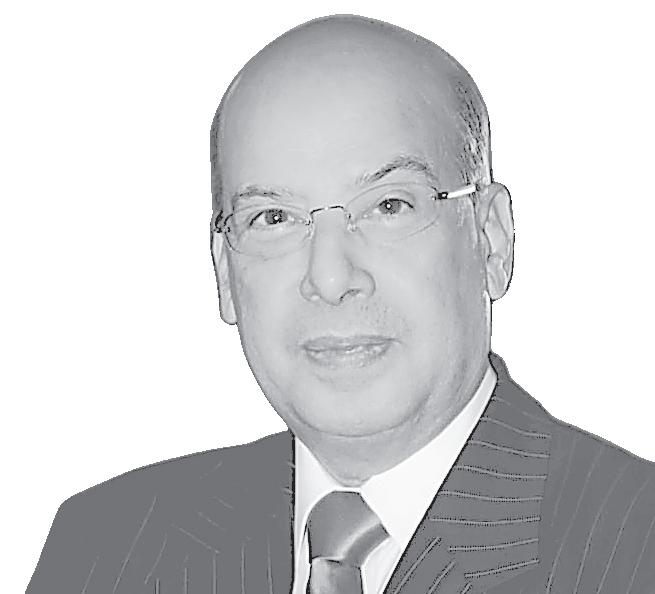
I HAVE spent a decade in the councils of the Organization of American States. I have watched governments come and go, seen some crises handled well and others handled badly, sat through more commemorative meetings than sessions discussing pressing issues, and occasionally had the satisfaction of watching this Organization do exactly what it was built to do: bring governments together to tackle problems that none of them could solve alone.
In that time, I have chaired the Permanent Council on three occasions, led OAS delegations to Haiti in 2016 and Guatemala in 2023 to help resolve political crises, and engaged closely with the questions of Charter compliance raised by the withdrawal of Venezuela and Nicaragua from the Organization. It gives me a clear-eyed sense of what this institution is, what it could be, and what is genuinely at stake.
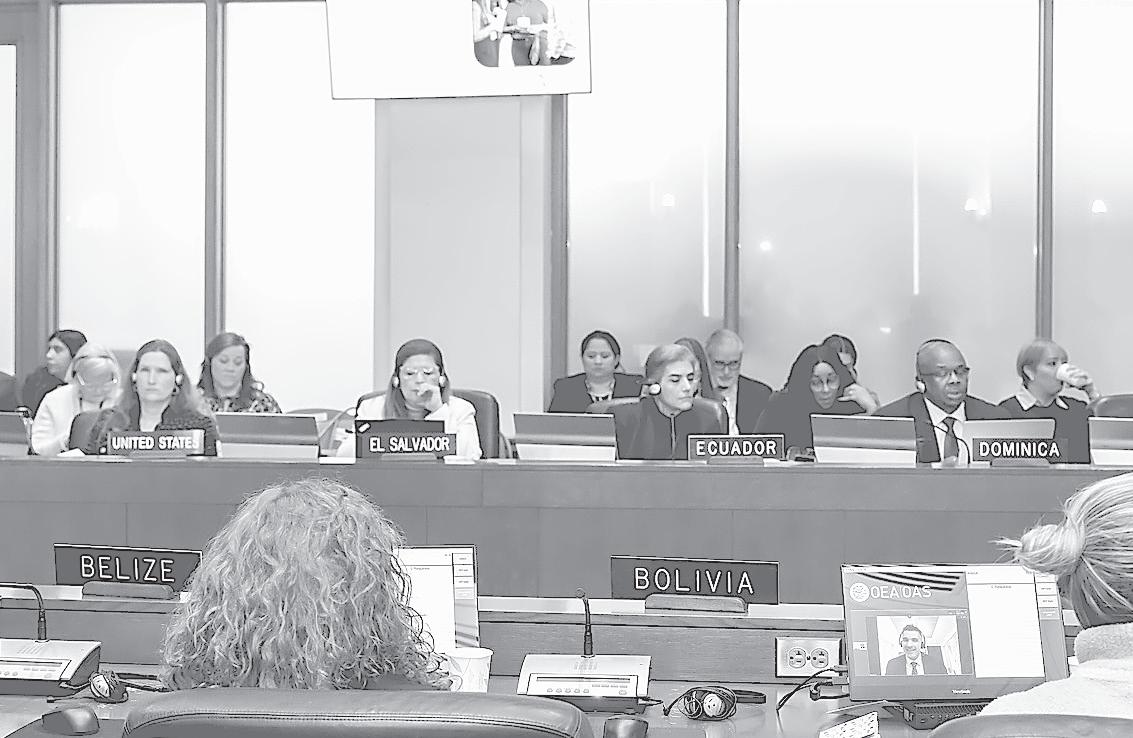
As member states gather in Panama for the 56th Regular Session of the General Assembly, from 22 to 24 June, what follows is a refection on all this.
If we did not have the OAS, we could not create it today. The architecture of hemispheric multilateralism is a remarkable inheritance. It includes 34 member states (32 active), a shared Charter, a permanent secretariat, obligations on democracy and human rights, and institutions through which citizens can seek recourse. It was built over decades through compromise, setbacks and hard lessons. The idea that we could assemble that consensus from scratch in today's fragmented and sceptical world is, frankly, fanciful. That’s not a reason for complacency, though, it’s a reason to take what we have seriously and work to make it better.
Increasingly, we have heard representatives of one government or another remark that "the OAS is not ft for purpose." Usually that means the OAS is not ft for the purpose of the government making the remarks.
Asymmetry of power among member states often overrides the Charter's commitment to equality of membership. But in a world organised around power and scale, the OAS is one of the few places in the hemisphere where nations — large and small — can gather to consider critical issues and try to build a consensus for action. It doesn’t always happen, but that’s good reason for persistence.

The basis for this Organization is worth preserving: the pursuit of peace and prosperity. As the OAS meets in Panama, its fnancial picture alone should concern anyone paying attention. The Organization's core operating fund is under strain. Its reserves — the buffer meant to protect it against shocks — have been depleted. To keep basic operations running, the Secretariat has had to rely on limited internal cash resources. Meanwhile, member states have restricted new mandates, reduced staff, and have not provided the resources to adequately carry out even the reduced tasks they have approved. The approved budget ceiling for 2027 stands at USD 95.6 million — less in real purchasing-power terms than the Organization's budget 15 years ago.
This isn’t a technical problem. It’s a political problem that requires a political decision. Governments that genuinely value the OAS must be prepared to sustain it. If the General Assembly in Panama is to mean anything beyond ceremony, member states must have an honest conversation about what predictable, adequate fnancing requires and then commit to it. No government benefts from an Organization too constrained to do its job well.
Closely related is a question that receives less public

attention but is no less consequential: the independence of the Secretary General and the international civil service created by the Charter. The Secretary General is not the representative of one government, nor should the offce be treated as subject to the preferences of the political moment. The Charter creates it as part of the institutional balance of the Organization itself — a structural requirement if the OAS is to serve all its members fairly. Accountability is essential in any healthy institution. But it must be pursued through
the Organization's established mechanisms: the Inspector General, the external auditors, the relevant oversight bodies, and the political organs in which member states collectively sit. Those mechanisms can always be strengthened, but they should not be bypassed or replaced by less formal and less even-handed means.
Governments change, priorities shift, and the OAS must be fexible enough to accommodate the full range of views that democratic elections produce across 34 member states. But that fexibility must operate within the
framework of the Charter, the Inter-American Democratic Charter, and the rules and procedures that all member states have accepted. Those rules are what make orderly cooperation possible across differences of size, ideology, and infuence — and they protect every government, regardless of its moment of infuence.
Defending institutional independence does not, however, mean defending the status quo in all things. Reform is necessary. Its Permanent Council spends a disproportionate amount of
time on commemorations, symbolic resolutions, and procedural exercises, while the issues that most directly affect the peoples of the hemisphere receive less focused attention than they deserve. Migration, organised crime, democratic fragility, climate vulnerability, food and water security, digital governance — these are the matters that shape the daily lives of our peoples and the stability of our governments. They don’t respect borders and cannot be addressed by any country acting alone. The Organization should be spending the majority of its working time, at all levels, on exactly these kinds of questions, building practical cooperation rather than reading out established positions.
The most underappreciated asset of the OAS is the forum for dialogue it provides. In a hemisphere as diverse and occasionally fractious as ours, having a permanent, rules-based space where governments can speak to one another — even in disagreement, even in tension — is of immense value. That space should be enhanced, not undermined. It’s through dialogue, conducted with mutual respect and anchored in agreed rules, that confdence is built and practical progress becomes possible.
Over a long diplomatic career, I have had to learn patience with multilateral institutions. They move slowly. That is partly a virtue. It forces deliberation and guards against impulsive decisions. But patience is not the same as passivity. There are moments when those who believe in an institution must say plainly that it needs correction, renewal, and investment.
This is such a moment. The OAS faces real strain — fnancial, institutional, and in its focus. That’s not a reason to disparage it. It’s a reason to resolve to improve it. The OAS is not perfect, but a hemisphere without any such common table is so obviously worse. Panama is a ftting place to have a conversation about connecting divides in ways that deliver prosperity.
(The writer is the Dean of the OAS Corps of Ambassadors and Ambassador of Antigua and Barbuda to the US and the OAS. He is also Chancellor of the University of Guyana. The views expressed are his own)
Dutch royals swap orange for blue as they cheer for Netherlands, then Curaçao at World Cup
By DAVE SKRETTA AP Sports Writer
KANSAS CITY, Mo. (AP) — King Willem-Alexander and Queen Maxima of the Netherlands began Saturday by cheering the Dutch past Sweden in Houston.
The monarchs ended the day by watching Curacao make some history against Ecuador in Kansas City.
The small island nation of Curacao is a constituent country within the Kingdom of the Netherlands, and that makes King Willem-Alexander and Queen Maxima the heads of state. So, after a quick fight north Saturday, the royal couple dutifully swapped out the bright orange scarves of Het Oranje Legioen they wore to their earlier match with bright blue ones for The Blue Wave. Curacao, the smallest World Cup team in population and size, made its tournament debut last Sunday in a 7-1 loss to Germany. But it bounced back from that defeat for a 0-0 draw with La Tri and earn its frst-ever point in the tournament.
"It is an extra-special World Cup because we have both the Netherlands and Curacao," Willem-Alexander told RTL-TV. "So we have twice as many teams to cheer for. A great opportunity to cheer on both the Blues and the Oranges. All in all, it will be a special World Cup for me with two teams, and I naturally hope they go extremely far."
The Netherlands moved one step closer to the knockout round after a 5-1 win over Sweden.
Brian Brobbey and Cody Gakpo scored two goals apiece to help coach Ronald Koeman's team bounce back from a disappointing draw in its opener and move atop Group F. The Netherlands concludes group play against Tunisia on Thursday in Kansas City.
Curacao is still alive, too, after Eloy Room made 15 saves — one off the World Cup record — to earn a draw with Ecuador. It concludes Group E play on Thursday against Ivory Coast in Philadelphia at the same time Ecuador is playing Germany in New York.
"It's amazing," Curacao midfelder Tahith Chong said of celebrating with the royal family in the locker room. "I
knew before the game that they were coming to the game. To have them at such a game that we pick up our frst point ever in history is amazing."
It is rare for sitting monarchs to come through the Kansas City area. Queen Ann of Romania attended the dedication of the Liberty Memorial, which is where Kansas City is holding its World Cup FanFest, in the 1920s, while King Gustav XVI of Sweden made a stop in the small Kansas town of Lindsborg when he was passing through the Midwest in the 1970s.
Then again, there has never been a sporting event as big as the World Cup through the area, either. Nor has a nation as small as Curacao ever earned a point in the tournament.
"Seeing how the king, his wife and daughter ft in our group is something that evokes a lot of respect," said 78-year-old Curacao coach Dick Advocaat, who was born and raised in the Netherlands. "They smile, they dance, nothing is too much for them, and you can see them radiating with joy. It was wonderful to see the royal family in this way."
ADJUSTMENT of Status under Section 245 of the Immigration and Nationality Act (INA) is a discretionary administrative procedure that allows an eligible foreign national to transition to permanent resident status without departing the United States.
On May 21, 2026, the United States Citizenship and Immigration Services (USCIS) issued Policy Memorandum PM-6020199, which fundamwentally recharacterizes this process. The memorandum formalizes a shift in agency posture, designating Adjustment of Status (AOS) as an “extraordinary form of discretionary relief” rather than a routine administrative beneft. For Caribbean nationals, particularly those from jurisdictions with signifcant cross-border economic ties like The Bahamas, this shift necessitates a heightened level of evidentiary precision and strategic planning.

For Bahamian nationals, this policy intersects with the Luxury vs. Liability paradox discussed in earlier analyses. While The Bahamas is a high-value economic
To navigate the requirements of PM-602-0199, applicants must adopt a cross-border regulatory compliance consultancy Caribbean approach to their flings.

The re-characterization of adjustment of status as extraordinary relief
The statutory basis for adjustment of status is found in INA § 245(a), which states that the status of an alien may be adjusted by the Secretary of Homeland Security, in his discretion and under such regulations as he may prescribe. Historically, USCIS adjudicators exercised this discretion favourably for applicants who met the basic eligibility requirements, such as having an approved immigrant petition and a current priority date, provided no signifcant negative factors were present.
PM-602-0199 clarifes that the mere absence of negative factors is no longer sufcient for a favorable exercise of discretion.
The memorandum establishes that the normal path for permanent residency is consular processing at a US embassy or consulate abroad. Adjustment of Status is now defned as an administrative grace that permits an applicant to bypass the ordinary consular process.
Consequently, the burden of proof rests entirely on the applicant to demonstrate that their case warrants a favorable exercise of discretion through the presentation of extraordinary equities.
Technical analysis of the extraordinary equities standard
The term “extraordinary equities” is not a statutory requirement, but a discretionary standard derived from administrative case law, specifcally Matter of Arai and Matter of Blas. Under the new guidance, if an applicant has any negative discretionary factors, they must
present unusual or even outstanding equities to ofset them. For Caribbean professionals and investors seeking US immigration services for Caribbean nationals in 2026, understanding the components of this totality of the circumstances test is critical.
Adverse factors that now carry signifcant weight include
· Status Violations. Any period of unauthorized stay or failure to maintain continuous nonimmigrant status, even if technically waived under statutory provisions for immediate relatives.
· Unauthorized Employment. Engaging in work without explicit DHS authorization is viewed as a signifcant negative factor in the discretionary balancing test.
· Intent Issues. Adjudicators are directed to scrutinize whether an applicant’s entry on a non-immigrant visa (such as a B1B2) was a preconceived attempt to circumvent the consular process. Dual-intent classifcations, including H-1B and L-1, continue to provide limited protection against preconceived-intent allegations because immigrant intent is statutorily tolerated within those categories. However, PM-602-0199 does not eliminate discretionary review for such applicants, and the fling record should still be fortifed with evidence of extraordinary equities consistent with the memorandum’s heightened standard. Conversely, extraordinary equities that may mitigate these factors include long-term family ties in the United States, signifcant fnancial investments, professional contributions to specialized industries, and a history of tax compliance. The technical strategy for applicants must move beyond establishing eligibility to afrmatively proving that administrative grace is warranted.
The consular process default and Caribbean mobility
The impact of PM-602-0199 is particularly acute for the Caribbean professional class. For decades, the proximity of the Caribbean to the United States has facilitated a high volume of non-immigrant travel and business activity. The memorandum’s emphasis on consular processing as the default mechanism for immigration efectively creates a regulatory hurdle for those who are already legally present in the United States on non-immigrant visas.
institutions) to establish extraordinary professional value. -Asset Liquidity. Documentation of assets, resources, and fnancial status that exceeds the basic poverty guidelines, demonstrating that the applicant is a signifcant economic asset.
partner with 12.5 million annual visitors, its citizens are now subject to a policy that views their presence in the US during the green card process with increased skepticism. The memorandum suggests that applicants who could have waited for an immigrant visa abroad but chose to enter and adjust in the US may be viewed as attempting an end-run around the system. This perception can lead to discretionary denials even where the applicant is otherwise fully qualifed.
Strategic compliance: the preparedness dividend
By ANDREA RODRÍGUEZ Associated Press
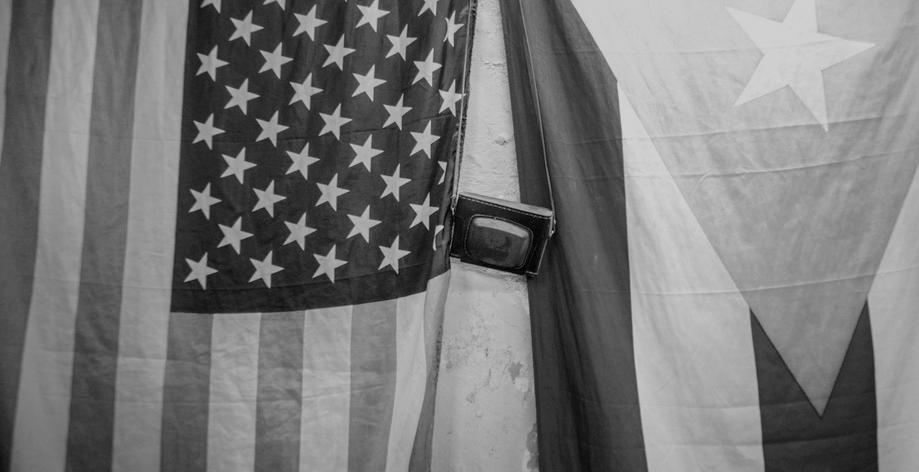
HAVANA (AP) — Observers on Friday called Cuba's new free-market reforms the most sweeping economic overhaul of the island's communist economy since the Cuban revolution, as the grandson of former President Raúl Castro said in an interview that Cuba must seek to move its economy forward.
The 176 measures aim to further decentralize Cuba's state-run economy, which has been left gasping by a tightened embargo under President Donald Trump. Under the island's current economic model, the government largely determines what is produced, who produces it, the prices at which goods are sold and how the country's resources are allocated.
The plan includes more space for private businesses, imports and exports without state intermediation, free hiring of personnel, authorization for private banks and investment by Cubans abroad. It even permits fast-food chains to establish themselves on the island.
"Elements that for decades were listed as pillars of the revolutionary economy, such as the state monopoly on foreign trade and the centralization of productive forces, have been dismantled," said
authorities cautioned that implementation could be slow, and noted measures will not be viable if the U.S. does not lift the energy and fnancial embargo on the island.
Since January, Cuba has
Luis Carlos Battista, a Cuban-American political scientist and lawyer who is a doctoral candidate at the University of Salamanca. Cuban leaders like former President Raúl Castro – who still wields signifcant power on the island – have sought to push forward more limited reforms of Cuba's economy in the past, but eforts have run into bureaucratic hurdles. In passing the reform, Cuban
been under a harsh energy and fnancial embargo imposed by the U.S., efectively blocking Cuba of from fuel, it's main energy source, and deepening the crisis had already been deteriorating for the past fve years. Blackouts have lasted up to 20 hours a day and have restricted access to health services, transportation and education.
U.S. President Donald Trump and Secretary
The presentation of a bare-bones AOS application is now a highrisk strategy. A successful fling must include a comprehensive Discretionary Memorandum that addresses the fve factors of the public charge rule and the new equity standards simultaneously.
The Discretionary Evidence checklist Applicants should structure their evidentiary packages to address the following categories -Professional Equivalency. Standardized reports for professional certifcations (e.g., maritime, fnancial, or legal certifcations from Caribbean
-Family Unity Impact. Detailed analysis of the hardship or negative impact on U.S. citizen family members if the applicant is forced to depart for consular processing.
-Community and Civic Engagement. Evidence of leadership roles, philanthropic contributions, or memberships in professional organizations that demonstrate strong moral character and social integration.
Operational strategy for government-adjacent entities
The institutional response to PM-602-0199 must involve more than individual legal flings. Caribbean government agencies and government-adjacent organizations should consider the following policy adjustments to protect the mobility of their citizens Diplomatic Engagement. Leveraging bilateral treaties to clarify that AOS for established professionals from low-risk jurisdictions should not be subjected to the same extraordinary scrutiny as applicants from higher-risk regions.
Data Synchronization. Establishing verifable databases for professional credentialing that US adjudicators can reference when evaluating education and skills under the discretionary framework. Pre-Clearance Advocacy. Utilizing existing CBP Preclearance infrastructure in locations like Nassau and Freeport to facilitate a more streamlined pre-adjudication of discretionary factors before an applicant even arrives in the United States.
Institutional strength and regulatory precision
The Beyond the Borders segment of this series concludes with a clear directive that the regulatory landscape of US immigration has transitioned from a rules-based system to a discretion-heavy environment. The issuance of PM-602-0199 on May 21, 2026, signifes that status in the United States is no longer a matter of checking boxes. It is a matter of building a solid case for administrative grace.

of State Marco Rubio acknowledged that they are maintaining a policy of maximum pressure to change the island's political and economic system, which has endured for six decades despite U.S. pressure. They have not ruled out the use of military force. Castro grandson says Cuba not even 'slightly' a threat to U.S.
In an i nterview published Friday, in the United Arab Emirates-based The National, Raul Guillermo Rodriguez Castro, grandson of the revolutionary
leader, reiterated that Cuba "doesn't even slightly represent a threat" to the U.S. Rodriguez Castro said in the video interview that Cuba's government was seeking a "very Cuban" economic model. "Our country must seek a path to economic development where we must inevitably diversify our economy, diversify the way we do business and diversify the way we do investments," he said.
Cuban President Miguel Díaz-Canel said that the proposed measures were
based on an analysis of the Vietnamese and Chinese models, communist countries with market economies.
What is likely to pose a signifcant barrier are U.S. sanctions on Cuba, said Lee Schlenker, a research associate at the Quincy Institute in Washington. "With these new measures, along with others that are likely on the table, they will only have a true efect if complemented with the gradual lifting of U.S. prohibitions and sanctions more broadly," he said.
By JILL LAWLESS Associated Press
UK Prime Minister Keir
Starmer is facing a career-defning decision: step down or fght a possible challenge from Labour Party rival Andy Burnham.
Starmer has publicly vowed to stay in ofce, but pressure is building as more and more Labour Party colleagues conclude that his time is up. Expectation is growing that he will announce a timetable for his resignation as soon as Monday. That’s the day Burnham will be sworn in as a lawmaker in the House of Commons after winning a special election last week.
Business Secretary Peter Kyle said Sunday that Starmer is “making time to refect on the political realities, challenges and opportunities that he fnds himself in.”
“I know he is a prime minister who always puts his country frst,” Kyle told the BBC, though he said that reports that Starmer will resign are “speculation.”
Starmer is spending the weekend at Chequers, the country mansion used by prime ministers, with his family. He gave no public hint about his decision, but sent a Father’s Day message on social media.
“Being a dad is my greatest joy. Today, I’m thinking about my dad, and the father I am to my children because of him,” he wrote on X.
US President Donald Trump weighed in even before an announcement, linking Starmer’s potential exit to two of his recurring bugbears: immigration and renewable energy.

“Keir Starmer will resign as Prime Minister of The United Kingdom. He failed badly on two very important subjects- IMMIGRATION AND ENERGY (OPEN NORTH SEA OIL!). I wish him well! President DJT,” Trump posted on his Truth Social network. It was unclear whether Trump was responding to media reports about Starmer’s plans. The two leaders haven’t spoken over the weekend.
Starmer’s initially warm relationship with the president has soured in recent months over issues including the Iran war, which the UK didn’t join.
If Starmer quits, he will be the sixth prime minister to leave ofce in the past 10 years, an extraordinary rate of churn for the United Kingdom.
Discontent with the prime minister has been building for months, with Labour lawmakers desperate to reverse the government’s decline in popularity since Starmer led the
center-left party to a landslide election victory in July 2024.
He has struggled to deliver promised economic growth, repair tattered public services and ease the cost of living, and has been hamstrung by repeated missteps, including his decision to appoint Peter Mandelson, a scandal-tarnished friend of Jefrey Epstein, as the UK ambassador to the United States.
Labour is losing liberal voters to the growing Green Party and facing a rising Reform UK, the Nigel Farage -led anti-immigration party that consistently leads in nationwide opinion polls.
Burnham, until this week the popular mayor of Greater Manchester, decisively won the seat of Makerfeld in northwestern England in a special election held Thursday. He took almost 55% of the 45,510 votes cast, over 9,000 more than the Reform UK runner-up.
Now that Burnham is becoming a lawmaker, he’s in a position to challenge


Starmer for leadership of the Labour Party. Burnham’s acceptance speech left no doubt that he wants to lead both the party and the country.
“Everyone knows that politics isn’t working,” he said. “Everyone can feel that the country isn’t where it should be. Tonight could, just could, be the turning point.”
It’s unclear whether Burnham would face a coronation
or a challenge, if Starmer steps aside. Wes Streeting, who resigned as health secretary last month to protest Starmer’s leadership, has said that he will run in a contest if there is one.
Starmer congratulated Burnham on Friday, but insisted that he would fght any attempt to oust him.
“I will run, I will stand,” if there is a Labour leadership contest, Starmer said. “I’ve
said repeatedly I’m not going to walk away from that.”
But Charlie Falconer, a senior Labour member of the House of Lords, said Saturday that Starmer has “absolutely no authority” left.
“There should be an agreed transition process in which Andy and Keir cooperate as to when the handover should take place,” he told the BBC.
By VALERIE GONZALEZ Associated Press
EXTREME heat and dry, windy conditions fueled several wildfres in the West on Sunday, including an uncontained blaze in Utah that forced the evacuation of a small town southwest of Salt Lake City.
The Iron Fire in Utah’s Juab County was frst detected Saturday and had blackened 34 square miles (87 square kilometers), authorities said. The fre about 70 miles (113 kilometers) southwest of Salt Lake City forced the evacuation of Eureka, population 1,000, and people at a nearby ranch.
No homes had been lost, and UTAH Fire Info, a multiagency operation, said in a post on X that frefghters conducted a successful backburn operation to protect the town.
Kelly Wickens, a fre prevention specialist with the Utah Division of Forestry Fire and State Lands, warned
that the fre was continuing to grow amid drought conditions. Wickens said the fre was human-caused and remains under investigation.
Utah Gov. Spencer J. Cox visited the town Sunday.
“We knew that there was going to be extreme fre danger, and sure enough we had multiple fres,” Cox said. The Iron Fire was one of six fres burning in Utah at varying levels of containment.
In neighboring Colorado, the southwest corner of the state was under a red fag warning issued by the National Weather Service until Monday, due to gusty winds and low relative humidity.
A wildfre prompted evacuations over the weekend near Sedona, Arizona, burning about 300 acres (120 hectares) of steep and rugged terrain near Oak Creek Canyon. As of Sunday afternoon, the fre remained uncontained. Residents evacuated earlier were still not being allowed to return
home.
Much of the Western U.S. from the Rockies to the Pacifc coast saw above-average temperatures this weekend with even hotter weather anticipated for early next week. Ofcials also warned that the prolonged dry, hot weather and relatively low humidity increased the risk of fre danger.
Much of Utah is experiencing severe to extreme drought, while parts of Arizona and Colorado are experiencing severe drought, according to the U.S. Drought Monitor.
Extreme heat claimed the lives of three hikers in two separate incidents last week in the Grand Canyon. Temperatures were expected to climb in the Southwest on Sunday, with a forecast of up to 108 degrees Fahrenheit (42.2 C) in Carlsbad, New Mexico.
Meanwhile, a brush fre in Miami-Dade County in Florida spread across 2,000 acres (800 hectares) on Saturday.


While BACSWN’s NexGen Aviation Center allows for the safe, e cient and expeditious passage of Airlines using are strategically located sovereign archipelago, airport safety is also a major component. e airside fence for the Inagua International Airport has been down for some time and in need of replacement. is fence prevents unauthorized persons or animals from entering the area unless accompanied by an o cial ensuring the safety for all. BACSWN is pleased to report the fence has been replaced as we continue to ensure safety for Bahamians and Visitor alike.