WOMAN & HEALTH






o
By LYNAIRE MUNNINGS Tribune Staff Reporter lmunnings@tribunemedia.net
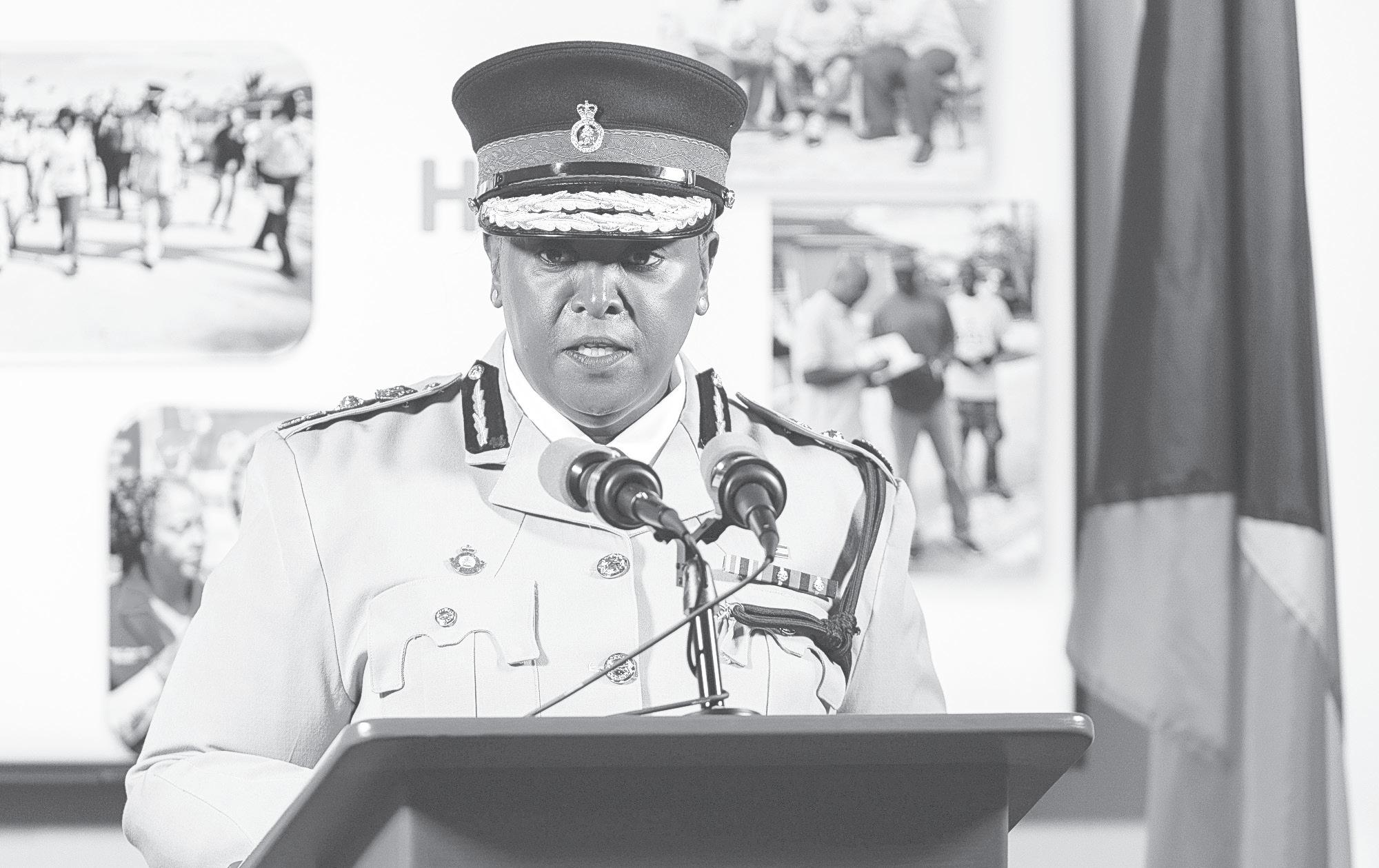
TWO police ofcers are expected to face extortion charges today after a United States tourist complained that he was targeted at the Nassau Cruise Port, a case Commissioner of Police Shanta Knowles called “embarrassing” for the force and the country.
The Royal Bahamas Police Force confrmed that
a 23-year-old female police ofcer and a 27-year-old male police ofcer were taken into custody after the tourist made an extortion complaint on Sunday, June 14. Both ofcers are scheduled to appear before the Magistrate’s Court at 10am. Commissioner Knowles told The Tribune the allegations strike at the reputation of the organisation
By LEANDRA ROLLE Tribune Chief Reporter
lrolle@tribunemedia.net

Speaking during his budget contribution, Mr Laroda outlined a broad package of crime, court, prison, border security and oversight initiatives, backed by
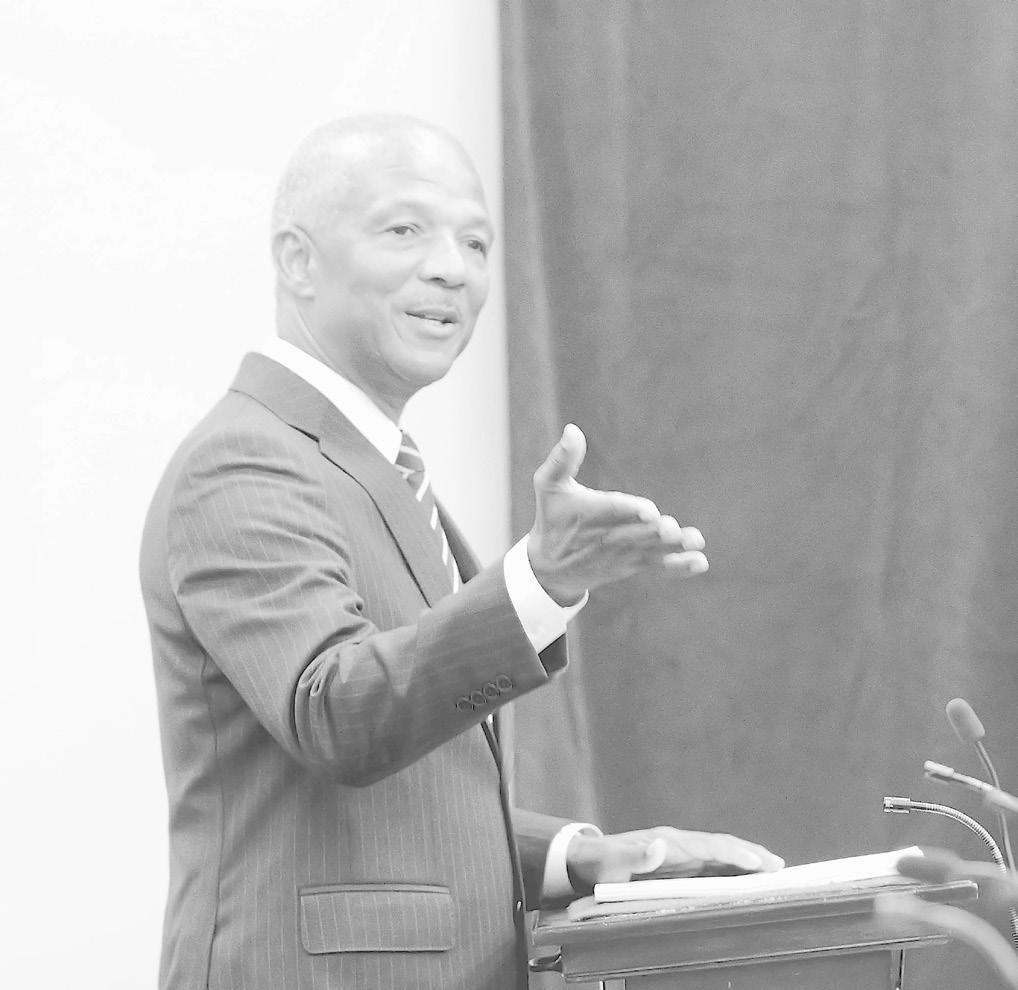
NATIONAL Security Minister Myles Laroda yesterday pledged to establish a backlog reduction court within two years, expand specialised frearms courts and spend $1.5m on a new virtual court complex as the Davis administration moves to confront long-running delays in the criminal justice system.
CHARGED - SEE PAGE THREE COURT - SEE PAGE FOUR


By DENISE MAYCOCK Tribune Freeport Reporter dmaycock@tribunemedia.net
A 21-YEAR-OLD Bahamian student in Florida was identifed by authorities as the suspect in a double stabbing near the University of South Florida before he was found dead hours later at a nearby apartment complex.
Hansel Pearson, of Grand
By EARYEL BOWLEG Tribune Staff Reporter ebowleg@tribunemedia.net
ATTORNEY General Wayne Munroe said yesterday the government will pay damages to Claudia Edwards Bethel’s estate after the Privy Council upheld the state’s liability for her unlawful detention and rape by a senior
immigration ofcer, saying “some things are more important than sorry” when asked about calls for an apology. His comments came after Human Rights Bahamas president Stephanie StFleur demanded a public apology to Edwards Bethel’s family
MUNROE - SEE PAGE FIVE
Bahama, is suspected of stabbing his roommate and another person during an early morning attack at Halo 46 Apartments in Tampa last Wednesday, according to the Hillsborough County Sherif’s Ofce. Deputies responded to the apartment complex on North 46th Street around 4.30am after a man
- SEE PAGE FIVE

EDWARDS BETHEL




CHARGED from page one
and The Bahamas.
“Again, this is something that is causing embarrassment to our organisation and eventually to the country,” she said. “It is acts like this that we even warn our ofcers about. There is no need for any ofcer to believe or to act in such a manner where you are in contravention of police policy and also the law.”
Police said the Complaints and Corruption Branch investigated the matter after receiving the complaint. The RBPF said it is maintaining a “zero tolerance” approach to criminal conduct and unethical behaviour, and said any actions that undermine public trust will be dealt with decisively and in accordance with the law.
The force said the investigation was carried out “thoroughly, fairly, and impartially,” and reaffrmed its commitment to professionalism, integrity, accountability and ethical policing.
The case comes months
The video, posted on TikTok by a tourist from Miami, showed ofcers conducting a roadblock near St Matthew’s Anglican Church of Shirley Street after the visitor was stopped while riding a rented scooter.
after police ofcers were referred to a police tribunal over a separate incident captured in a viral video that appeared to show an ofcer trying to solicit a bribe from a tourist during a trafc stop. At the time, Commissioner Knowles said police became aware of that incident through social media, prompting an immediate investigation. Two ofcers were removed from frontline duties and placed before a police tribunal.
In the footage, an ofcer identifed by badge number 4438 appeared to suggest the matter could be “worked out” rather than ticketed, comments widely interpreted as an attempt to solicit a bribe. The ofcer was also heard cautioning the tourist to move out of view of other ofcers during the exchange.
By LYNAIRE MUNNINGS
Tribune Staff Reporter
lmunnings@tribunemedia.net
POLICE Commissioner Shanta Knowles has revealed a special team has been investigating the United States criminal complaint involving Jonathan Eric Gardiner for weeks, even before opposition Leader Michael Pintard and other FNM MPs formally asked police last week to investigate the matter.
The US fling alleges that an unidentifed person referred to as “Politician-1” met in October 2024 with an undercover DEA source and a pilot inside a Parliament building to discuss an alleged cocaine shipment from Colombia through The Bahamas to the United States. It also raises concerns about possible political facilitation or protection and links to law enforcement or security ofcials.
Commissioner Knowles
told The Tribune yesterday that police received the indictment shortly after it was fled and launched an investigation before the opposition formally delivered its request.
”Let me tell you that shortly after that indictment, just a few days after that indictment had been fled, the police headquarters received a copy of that,” Commissioner
Knowles said.
“Immediately, I made sure that an investigation team was put in place to begin working on that case, and so we have been looking at this matter for the past few weeks. I do have a special team of investigators looking at this matter to determine any breach of our laws and policies, and I have made sure that the Prime Minister and my minister are aware that the Royal Bahamas Police Force has been looking into this.”
Commissioner Knowles confrmed that the investigation remains active and that ofcers are speaking with several people. She declined to disclose details, saying she did not want to jeopardise possible charges.
“I do know that my team is talking to a number of persons, and once I am able to divulge the contents of their investigation without compromising what may possibly be charges, then I
will do but at this time I’m not going to speak further,” she said.
Asked about possible US investigative activity in The Bahamas, Commissioner Knowles said she could not confrm that any such operation took place, adding that Bahamian authorities work with US partners through ofcial channels.
“I cannot say that the US were in our country doing an investigation,” she said.
“I cannot speak to any of that. I’m only going to say to you that I have a copy of the indictment, and my team of ofcers are looking at it. I want to say that when we work in partnership with the US, we work through the embassy. They are our partners, and whenever we ask or request their assistance of them, we get that. I want to say thank you to them for it. Now, to say that there was an investigation going on in the country, I cannot speak to that.”
She thanked Mr Pintard
for bringing the matter to police, but stressed that police already had the indictment and had begun reviewing it.
Mr Pintard has said the allegations, if proven, would raise serious national security concerns, including possible corruption, money laundering and misuse of public ofce.
In his letter, he urged police, working with international and national security partners, to identify any people linked to “Politician-1”, examine fnancial fows and benefcial ownership structures, and review government contracts connected to Gardiner’s company, Top Notch Builders Limited. He also cited state contracts reportedly awarded to the company for projects including the Obadiah Wilchcombe Complex in Grand Bahama and the Renaissance at Carmichael housing development in New Providence.
By LEANDRA ROLLE Tribune Chief Reporter
HOUSE Speaker Patricia Deveaux delivered a sharp rebuke of Opposition leader Michael Pintard as the budget debate continued yesterday, accusing him of “maligning” her name in a social media post about explosive US court allegations. The clash is the latest exchange between the Speaker and Mr Pintard over the controversy. It follows the opposition’s recent visit to the police headquarters where they delivered a letter to Police
Commissioner Shanta Knowles, calling for a full investigation into claims that a politician discussed drug deals in Parliament.
After delivering the letter, Mr Pintard shared a Facebook post that opened with the words “drug deals in Parliament” before criticising the House Speaker for rejecting calls for an investigation and instead directing them to take its concerns to the police.
The Speaker addressed the matter in the House of Assembly yesterday after Mr Pintard asked her to strike certain remarks made earlier by Southern Shores MP Obie Roberts.
“You know it's amazing how you sit here and you ask for my protection this morning when you maligned my name,” she said. “You put my full name under the caption of drug deal in the House of Assembly, my name, as if I was involved in some drug deal.”
The Bamboo Town MP said her only position was that Parliament should not be used to discuss the allegations, saying it is where lawmakers debate and pass laws.
She also defended her character, saying she entered public ofce with her integrity intact and
intended to leave with it unchanged.
“I allow banter, and I allow things to happen because I expect a robust debate, but when it comes to the name and the character assassin, I will put my foot down because assassinating one another is not what we came here for.”
She said she would not allow “these halls to be used for what is wrong,” calling Parliament a sacred institution.
However, Mr Pintard disagreed with the Speaker, calling her remarks completely untrue. “At no point did anyone on this side assert what you
were suggesting in what you said,” he said.
“Whatever caption you saw…the reality is the Speaker of the House of Assembly and the Prime Minister have a responsibility to launch an investigation when anyone is accused of using the precincts of the House of Assembly to engage in illegal activity, in this case setting up a drug deal,” he said. Mr Pintard later addressed the matter during the evening session of the House of Assembly.
As the Speaker interjected, he insisted he had not maligned her character
and said he had a copy of the post to support his claims.
“Just as you wish to protect your name, I’m reading it to protect mine," he said before reading the post into the record.
He clarifed that the June 12th caption referred to her by her title and did not link her to any drug deals, adding that it set out the claims and identifed the source of the allegations. He asked the Speaker to withdraw her comments. However, she refused to do so and Mr Pintard asked for the matter to be referred to the Committee of Privilege.
By LEANDRA ROLLE Tribune Chief Reporter
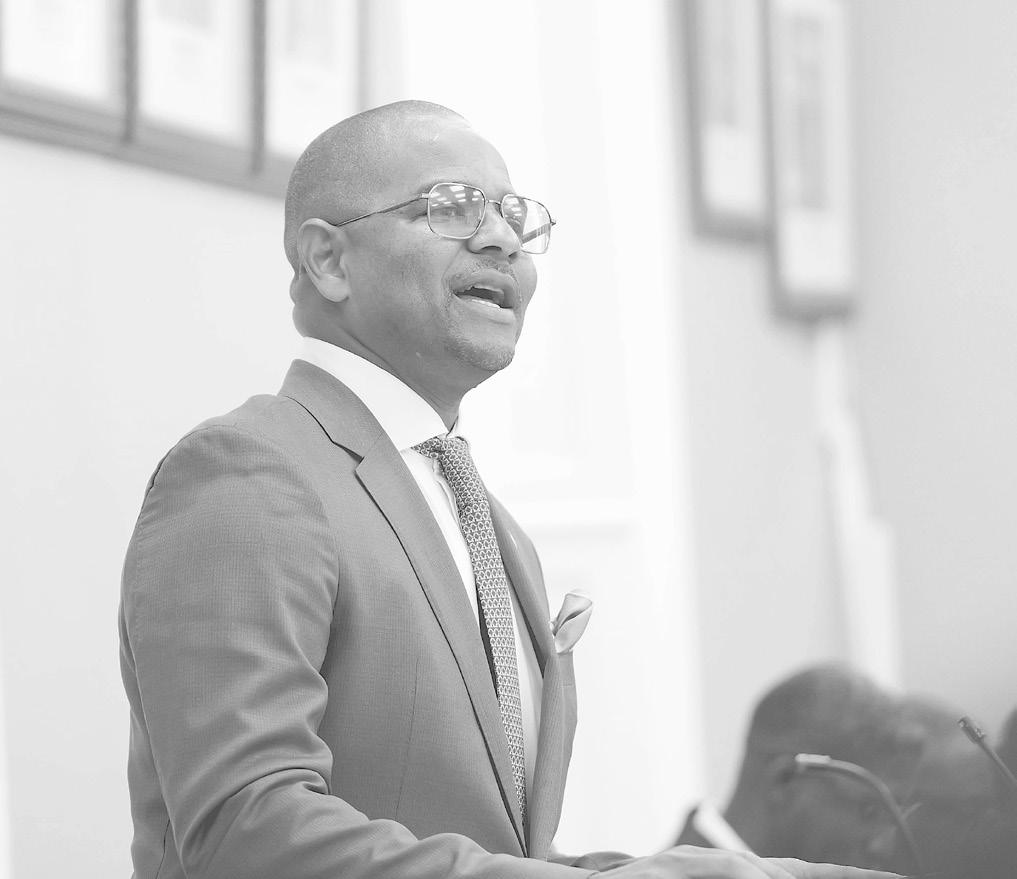
INNOVATION and National Development Minister Sebas Bastian yesterday pledged to introduce a new national ID card, saying it would give Bahamians one trusted credential to access services, sign documents and receive benefts.
The proposal would add a new layer to the country’s identifcation system, where Bahamians already rely on documents such as passports, voter’s cards, National Insurance cards and driver’s licences for various public and private transactions.
Ofcial guidance from the National Insurance Board describes the NIB card as a government-issued identifcation card required for NIB transactions, while other government services list passports, voter’s cards, NIB cards and driver’s licences among documents used to verify identity or complete applications.
Mr Bastian, speaking during his budget contribution and frst House of Assembly speech, said the country’s verifcation process is burdened by too much red tape and argued that a national ID card would help create a more seamless relationship between citizens and the state.
“One trusted, secure
credential that lets a Bahamian access services, sign documents, and receive what they are owed — simply, and safely. Less time in line. Stronger protection against fraud. A government that recognises you wherever you go,” he said. He did not say whether the proposed card would be mandatory or whether it would replace any existing form of identifcation.
Mr Bastian framed the card as the centrepiece of a broader plan to modernise government systems, warning that the country cannot continue building technology silos that prevent ministries and agencies from
communicating with each other.
He said there is a clear diference between digitisation and true transformation, arguing that installing advanced systems in individual ministries will not be enough if government platforms remain disconnected.
“That is why interoperability is central to our modernisation strategy,” he said. “Government systems must be designed to communicate securely, share information where appropriate, and support a seamless experience for citizens, businesses, and investors.”
He said the government
would advance a policy framework requiring future systems to meet common interoperability standards, with the national ID card placed “at the heart of this connected government”.
He pledged that the card would be developed with strong privacy and security protections. He said the government would retain control of the system even as it adopts world-class technology.
“Where we can build it ourselves, we will and where we license it, we will make sure Bahamians are trained to run it, maintain it, and support it, so the capability stays here, in Bahamian hands,” he said.
The national ID proposal was part of a wider reform agenda Mr Bastian announced for the Ministry of Innovation and National Development, including plans for a national artifcial intelligence committee, AI legislation, an AI literacy programme, satellite connectivity initiatives and renewed work on the National Development Plan.
On artifcial intelligence, he said no technology has greater potential to shape the future, citing its ability to transform education, business and healthcare.
He said The Bahamas would not stand on the sidelines of the AI revolution, but would not embrace the technology without safeguards.
To guide that work, he announced plans to establish a National Artifcial Intelligence Committee comprising representatives from the public sector, private sector and legal community.
The committee will draft the country’s frst AI legislation, which Mr Bastian said would be grounded in Bahamian values and principles.
He said the legislation would create a permanent Artifcial Intelligence Authority to oversee the safe and responsible use of AI, establish regulatory guardrails and strengthen oversight.
Mr Bastian said work is already underway, with discussions taking place with several of the world’s leading AI companies and technology partners.
He also proposed a national AI literacy initiative to provide online and in-person training opportunities, giving Bahamians access to courses in artifcial intelligence and software development regardless of island or background.
“And Madam Speaker, the future does not begin in the workplace — it begins in the classroom,” he said, pledging to support the Ministry of Education as it introduces AI into classrooms.
Mr Bastian said the ministry would explore opportunities in satellite connectivity and the broader space industry as part of its
long-term technology and innovation agenda. He said those plans cannot succeed without the infrastructure needed to support a modern economy, pledging to continue building secure and resilient digital systems. Mr Bastian also committed to fully implementing the National Development Plan, saying it would no longer be left on a shelf but treated as a “living instrument” that is continuously reviewed and guided by data.
He said that beginning in August, the plan’s secretariat would assess the planning capacity of every ministry and department and establish a system to track progress.
“We will write in the sectors that did not exist when Vision 2040 was penned — artifcial intelligence, digital services, fntech, space technology. These are where our competitive advantage lies. These are where we will create opportunity. And we will shape it as we always should — through genuine consultation with stakeholders, businesses, communities, and citizens, on every island,” he said.
The minister also pledged to modernise the Bahamas National Statistical Institute to improve data collection and analysis so policymakers can make faster, better-informed decisions.
COURT from page one
by a $296,494,936 recurrent allocation to the Ministry of National Security, a six percent increase over the previous year.
Mr Laroda said the funding would support the country’s crime-fighting efforts, even as major crime trends continue to fall.
He said statistics for last year show that overall crime, including murders, armed robberies and housebreakings, remains down.
He also highlighted firearm and drug seizures, saying authorities seized 276 firearms, 5,725 rounds of ammunition, 4,107 pounds of cocaine and 955 pounds of marijuana.
Mr Laroda said the proposed backlog reduction court would be created within two years as part of a wider push to modernise the justice system. He also announced plans to
expand specialised firearms courts and invest $1.5m in a new virtual court complex. The minister also said the government would invest $4.1m to expand the CCTV network, $4.9m in police and prison equipment, and $1.2m in
security and communications upgrades.
He said further investments would target intelligence and forensics, including additional bodyworn cameras, advanced DNA analysis and digital forensics.
On maritime security,

Mr Laroda said the government would advance radar surveillance across the Family Islands, purchase additional equipment, continue vessel refitting and dry docking, and expand development at the Coral Harbour base.
He also reported that 39 human trafficking matters were investigated last year, with eight cases pending trial. Seven of those cases involve sex trafficking and one involves labour trafficking.
He said nine suspects were charged, including three Bahamian men, one Bahamian woman, two Jamaican women and three Chinese men.
Mr Laroda said victim support was provided to eight people and two dependent children. He said $92,500 has been allocated in the 2026/2027 fiscal year to continue efforts to combat human trafficking.
He said police would continue to focus on early intervention, with funding
earmarked for at-risk youth and development programmes, including HYPE, the Defence Force Rangers programme and the National Youth Guard.
Mr Laroda also detailed the government’s rehabilitation and second-chance initiatives.
He said about 433 expungement applications were reviewed by the Rehabilitation of Offenders Committee between September 2021 and March 2026. Of those, 250 were approved for expungement, 69 were referred to the Prerogative of Mercy, 85 involved curfew-related violations, four were referred for counselling and one was referred for anger management.
The Advisory Committee on the Prerogative of Mercy considered 23 early release applications this fiscal year, approving 13, denying six while granting approval for the work scheme, and deferring four.
Separately, 16
expungement applications were received, of which five were approved and eight denied.
Mr Laroda said the Security Forces Bill 2026, which covers all five security forces, is under review by the Law Reform and Revision Commission and will be tabled in Parliament after Cabinet approval.
He said the Office of the Inspector General of Security Forces would be established as an independent oversight body responsible for audits, inspections, investigations and performance evaluations.
He also highlighted plans to table the Conditional Release of Offenders Bill 2026, which he said would end automatic one-third sentence reductions and replace them with a structured parole system.
He said the proposed system would include curfews, mandatory education or employment, drug abstinence and supervised reintegration.

MUNROE from page one
following the ruling.
The Judicial Committee of the Privy Council upheld a decision fnding the Bahamian state vicariously liable for the unlawful detention and rape of Edwards Bethel by former senior immigration ofcer Norman Bastian in 2014. The case will now return for the amount of damages to be assessed.
Mr Munroe said he had not read Human Rights Bahamas’ statement, but acknowledged that the government is liable for damages.
“The government position, as I understand it, was advised by council. I don’t believe a Bahamian argued in front of the Privy Council and the issue was whether the government is responsible for that sort of conduct.
Privy Council ruled against the government as did the Court of Appeal and so the government will pay,” Mr Munroe said.
He added: “Some things are more important than sorry – proper compensation.”
Immigration Director Stephen Laroda said he would be prepared to apologise to the family, but only if advised to do so by the Ofce of the Attorney General.

“I think there’s still some clarifcation and directives that we need to get from the Attorney General’s Ofce on this matter, keeping in mind that this is something that took place 11 years before I got in the chair,” he said.
The Privy Council ruled on Thursday that the state was responsible for Bastian’s actions because Edwards Bethel remained in state custody throughout the ordeal and Bastian was exercising the authority of his ofce.
The court also found that her arrest was unlawful from the outset because police had no reasonable grounds to suspect she had committed an immigration ofence. She had already produced a copy of her spousal permit before she was arrested.
Edwards Bethel, a Jamaican woman who had been married to a Bahamian citizen since 2010, was arrested during a December 13, 2014 police raid at the Twilight Bar along with a group of Jamaican women.
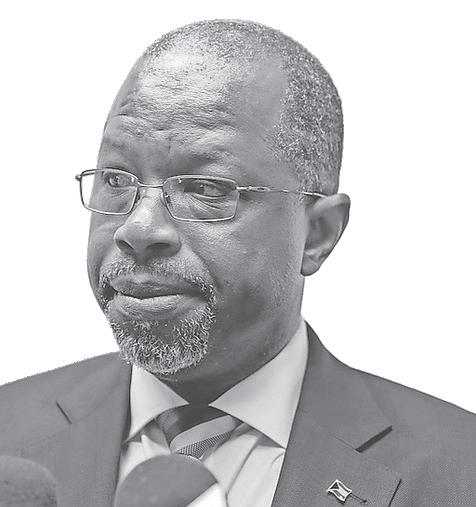
“The government position, as I understand it, was advised by council. I don’t believe a Bahamian argued in front of the Privy Council and the issue was whether the government is responsible for that sort of conduct. Privy Council ruled against the government as did the Court of Appeal and so the government will pay.”
On Monday, December 15, senior immigration ofcer Bastian lied to his superior to obtain custody
of Edwards Bethel, falsely implying that a female immigration ofcer would accompany them.
He then drove her around New Providence before taking her to his home, where he raped her, detained her overnight, sexually assaulted her and raped her again the following morning.
Edwards Bethel did not live to see the outcome of the case. She died at Princess Margaret Hospital in May 2021, one day after giving birth to her fourth child, Emmanuel. She was 35.
Yesterday, Stephanie St Fleur, president of Human Rights Bahamas, said: “Claudia Edwards Bethel died while waiting for justice. An apology, while important, will never bring her back. This case is bigger than one family—it is about every woman who is afraid to report rape, sexual abuse, or violence, especially when the alleged perpetrators are people entrusted with authority and public protection. Accountability, remorse, and meaningful reform are essential if public confdence is to be restored. The question is not only where is the apology, but where is the genuine remorse and commitment to ensure that no other woman sufers the same fate.”


STABBING from page one STAFF VACANCIES Temple Christian School 2026 – 2027
Temple Christian School invites applications from qualifed Christian persons for the following positions for the 2026-2027 school year:
• Elementary Teacher’s Aide
Pre-school teacher
Upper elementary teacher
• Music teacher
• Business Studies Teacher
Health Science teacher
Economics/Accounts teacher
• Physical Education teacher
• Art teacher
Religious Studies teacher System Administrator – for immediate employment
Applicants must:
Be a practicing born again Christian who is willing to subscribe to the statement of faith of Temple Christian School.
Applications are available on the school’s website www.templechristianbahamas.com and at the Administrator’s Offce, 4th Terrace East Collins Avenue (directly behind the New Evangelistic Temple). A detailed job description is also available at the Offce of the Administrator. Applications are to be submitted to: Dr. Samuel L. Rutherford Administrator
Temple Christian School 4th Terrace East, Collins Avenue P.O. Box N-1566 Nassau, Bahamas Ph: 325-1095 / 322-5157
The deadline for receipt of applications is Friday, June 26, 2026, at 3:00 p.m.
called 911 and reported that he and another person had been stabbed. Both victims were taken to hospital and were listed in stable condition.
Authorities said Pearson and one of the victims were roommates and University of South Florida students. The other victim had no afliation with the university.
Investigators believe Pearson was responsible for the attack, which happened
near the university campus during the early morning hours of June 10.
Later that afternoon, detectives opened a separate death investigation after Pearson was found dead at Union on Fletcher Apartments, about a mile from the stabbing scene.
Authorities have not disclosed the manner or circumstances of Pearson’s death. They have also not released a motive for the stabbing.
A relative mourned Pearson’s death in a Facebook post, describing him as her
grandson and saying he had left her with “much pain” in her heart. She wrote that she believed he had been reunited in heaven with his late father, adding that the loss made her feel as though she had “lost two sons.”
An aunt in Grand Bahama told The Tribune the family did not want to speak to the media when contacted yesterday.
The Tribune also contacted Bahamas Consul General to Miami Tyeson McKenzie, who said ofcials were still looking into the matter.

NULLIUS ADDICTUS JURARE IN VERBA MAGISTRI
“Being Bound to Swear to The Dogmas of No Master”
Publisher/Editor 1903-1914
LEON E. H. DUPUCH,
SIR ETIENNE DUPUCH, Kt., O.B.E., K.M., K.C.S.G., (Hon.) LL.D., D.Litt .
Publisher/Editor 1919-1972
Contributing Editor 1972-1991
RT HON EILEEN DUPUCH CARRON, C.M.G., M.S., B.A., LL.B.
Publisher/Editor 1972-
Published daily Monday to Friday Shirley & Deveaux Streets, Nassau, Bahamas N3207
TELEPHONES
News & General Information (242) 502-2350
Advertising Manager (242) 502-2394
Circulation Department (242) 502-2386
Nassau fax (242) 328-2398
Freeport, Grand Bahama (242)-352-6608
Freeport fax (242) 352-9348
WEBSITE, TWITTER & FACEBOOK
www.tribune242.com

@tribune242

IF the mention of plans for a national identity card sound familiar, it is because we have had this discussion before.
More than a decade ago, the then National Security Minister, Bernard Nottage, was saying that “the time has come” for the country to consider introducing such a card.
In 2013, 13 years ago, he said: “We think the time has come for us to consider the introduction of an identity card where we can – if people are required to carry it, we will know who is a citizen and who is not a citizen, and who is here illegally and who is not here illegally.”
At the time, Tribune readers gave the idea a mixed reaction, a poll showing a roughly 50-50 reaction. The idea got as far as going before then Prime Minister Perry Christie’s Cabinet – but never went further.
The idea was revived, however, under the government of Prime Minister Dr Hubert Minnis.
Deputy Prime Minister Peter Turnquest touted the prospect of a single digital ID to make access to services seamless and more efcient – cutting the cost of government.
He said in 2018: “If we are going to remain competitive with the rest of the world, we are going to have to streamline our processes and become more efcient, so we reduce the burden on average citizens.”
Mr Turnquest talked of “some amazing things to happen in the next two or three years”, right before the world shut down with COVID-19 and plans for a national ID, digital or physical, were understandably put back on the dusty shelf they came from.
And now Sebas Bastian has picked up the baton.
First, let us note two other very important projects also announced by Mr Bastian as part of his role as Innovation and National Development Minister –namely, a planned AI committee and an AI literacy initiative.
In the recent election, we saw plenty of reason for people to be educated about what is and what is not created by artifcial intelligence, and that need is only going to grow as AI advances. If nothing else, people need to become educated in order to better recognise scams and ways to protect their money and their property.
But a national ID card is also on Mr Bastian’s agenda – and we shall see if it moves of the drawing board, unlike previous attempts.
Again, Mr Bastian, like Mr Turnquest before him, talked of the need for services to be seamless, adding that a national ID card would be “at the heart of this connected government”.
He said: “One trusted, secure credential that lets a Bahamian access services, sign documents, and receive what they are owed – simply, and safely. Less time in line. Stronger protection against fraud. A government that recognises you wherever you go.”
There are some concerns, of course –namely over civil liberties.
Foreign Afairs and Immigration Minister Fred Mitchell spoke to those fears, saying: “When people call for this, they must also understand there are civil liberty implications to these things. Because what it means, essentially, if you want more enforcement, people have
to get used to the idea of being stopped on the streets and being asked ‘Do you have an identity card?’. Or something which identifes you with being in The Bahamas.”
He added: “Now obviously there has to be a lot of discussion about that because that takes thigns to a whole ‘nother level in the country. But you know, I always say, be careful what you ask for. Immigration is a blunt instrument, there’s no subtlety to it, it’s a law enforcement procedure.”
Asked if he supported the idea of a national ID card, Mr Mitchell said: “I don’t want to go so far as to say I personally support it. What I am saying is there are a range of policy initiatives that can be advanced – one of them is that. The question is, which way the public goes with it. It’s something that I think people can live with, but you have to determine that that’s what you want to live it.”
His words did not follow on the heels of Mr Bastian’s statement – they preceded it by a dozen years. Mr Mitchell was speaking in 2013, right after Mr Nottage announced his plans for such a card.
Mr Mitchell is right that there would need to be, as he says, “a lot of discussion”. The public should be consulted, the civil liberties discussion should be had, and we should not go into such a project blind.
What happens if you get stopped on the beach? Do you have your card? Do you get locked up I you left it at home? Should ofcers even be entitled to stop you for no reason to check your ID? There are many questions worth exploring.
The idea of such a card has been proposed before – but the discussion remains to be had. We would very much encourage readers to air their views in our letters page – and for Mr Bastian to ensure proper consultation is carried out.
Attorney General Wayne Munroe admitted that the government will pay damages to the family of Claudia Edwards Bethel, who was sent to the Carmichael Road Detention Centre despite having a valid spousal permit before being taken out of there by senior immigration ofcer Norman Bastian, who took her to his home and raped her.
Mr Munroe, however, is not saying sorry, despite a call by Human Rights Bahamas for a public apology to Claudia’s family. He said: “Some things are more important than sorry. Proper compensation.”
Claudia died waiting for justice, dying from COVID-19 after giving birth to her fourth child a day earlier in Princess Margaret Hospital in May 2021. She will never see the compensation.
The Privy Council ruled that the state was responsible for the actions of Mr Bastian – because Claudia remained in state custody throughout the ordeal and Mr Bastian was exercising the authority of his ofce.
Where the Privy Council has seen responsibility, it is entirely right for an apology to be given.
So say sorry. And then, yes, pay the compensation.
EDITOR, The Tribune.
THE Bahamas must stop viewing the Haitian issue solely as an immigration problem. It is fundamentally a citizenship, cultural integration, social cohesion, and national identity problem.
Currently, the Bahamas is considering a legal framework that reportedly allows individuals denied citizenship to register as permanent residents. While this may seem practical at frst glance, permanent residence is certainly better than statelessness, legal limbo, or treating people born and raised here as if they can simply be erased; it does not represent a comprehensive solution. It is merely a late-stage administrative fx for a problem that should have been addressed from the start.
The real issue is this: The Bahamas has spent decades allowing children born here to grow up culturally alongside us, but not always fully with us.
Many children of Haitian descent born in The Bahamas attend Bahamian schools, speak Bahamian English, absorb Bahamian culture, participate in Bahamian churches, play on Bahamian felds, sit in Bahamian classrooms, and dream Bahamian dreams. Yet, too many are raised under a cloud of suspicion. They are treated as if they are waiting to validate their belonging, when in reality, they have already been shaped by this country.
When these children reach adulthood, the state suddenly requires them to prove their belonging through paperwork, deadlines, discretion, records, parentage, references, police certifcates, and administrative judgment. If they fail or if the state refuses them, the alternative becomes permanent residence.
This is not nation-building; it is the creation of a parallel population.
A child does not begin to become Bahamian at age 18. Civic identity does not magically start when an application is fled. Belonging is established from birth; it forms in the home, the school, the church, the playground, the workplace, the neighborhood, and the national story a country tells about itself.
If The Bahamas waits until a person becomes an adult to decide whether they belong, then it has already failed at integration.
This is where the conversation needs to evolve. The Bahamas has every right to secure its borders. No sensible person advocates for open borders. We are an archipelagic nation with limited resources, signifcant housing pressures, uneven public services, fragile infrastructure, labor market distortions, and a long history of illegal migration challenges. The state must enforce immigration law. Human smuggling must be prosecuted. Employers who exploit undocumented labor must be held accountable. Illegal settlements must be addressed. National sovereignty must be defended.
However, sovereignty is not an excuse for ineptitude.
A country can control its borders without creating a permanent underclass of people who were born here but are never fully
accepted. A country can deport those with no lawful right to remain while still protecting children born on its soil. A country can enforce the law without turning Haitian identity into a public insult.
Too often in The Bahamas, the term “Haitian” is not just a nationality; it is used as an accusation. It is synonymous with being illegal, poor, dirty, foreign, uneducated, disorderly, and unwanted. This is not immigration policy; it is ethnic stigma.
And stigma has consequences.
When a child grows up hearing that “Haitian” means inferior, that child receives a damaging message about their place in the country. When classmates use Haitian identity as an insult, the educational system has already failed at civic formation.
When employers view Haitian descent as a justifcation for cheap labor, the labor market has failed. When politicians use Haitian bodies as symbols of disorder, leadership has failed. When the public treats poverty as proof of illegality, the national conscience has failed.
The result is predictable: we see parallel residents, parallel communities, parallel loyalties, and parallel futures.
Then, we act surprised when integration remains weak.
We cannot spend eighteen years telling a child, “You are not one of us,” and expect that individual to develop full emotional loyalty to the country. We cannot create social distance from birth and then complain about cultural separation. We cannot delay documentation, stigmatise ancestry, and politicise citizenship, only to claim that the problem exists solely on the migrant side.
The Bahamas needs a birth-to-belonging policy.
Every child born in The Bahamas should be properly registered at birth. Every child should have a clear legal fle. Every child should have access to education, regardless of their parents’ status. There should be a clearly defned pathway for every Bahamas-born child of non-Bahamian parents long before they reach age 18. Schools should teach Bahamian civics, history, constitutional responsibility, language skills, and national values to all children in the classroom, not just those whose paperwork is already sorted.
This is not an act of softness; this is statecraft.
The state needs to have accurate knowledge of its population. It should know who resides here, who was born here, and who qualifes for various statuses, and should track these processes digitally.
Additionally, it must eliminate unnecessary delays and diferentiate between an undocumented adult migrant, a child born here, a work permit holder, an asylum seeker, a permanent resident, and a citizenship applicant.
Simplifying these categories into a single issue, “the Haitian problem” is a form of lazy governance, and it can also be dangerous.
EDITOR, The
THE
is the teachers have to buy them
themselves or beg for donations. It was said that the MP for Fort Charlotte promised to put air conditioners in all classrooms in a particular public school. This sounds good on the surface but certain things must be considered. Some teachers have told me that if it was their
classroom they would prefer four Lasko fans because they don’t want to be in a closed-up classroom all day with a large group of children. They enjoy having fresh air from the outside circulating in their rooms. Other teachers have sinus or respiratory conditions and they also prefer stand fans. Then there are those
educators who welcome the air-conditioned classroom. I think the point is that teachers should be given options. They are not children. They should have a say in what takes place. The world went through one pandemic and another may come. We saw the problems air-conditioned schools faced during this time. It would be wise to ensure that all classrooms, air conditioned or not, can open all windows to allow fresh air to enter should it become necessary to do so. Ideas may sound good on the surface but details must be considered.
The Bahamas is too small to permit a signifcant population to grow up feeling culturally alienated. We cannot build a secure, cohesive, and productive nation while maintaining a class of lawful yet marginalised individuals. While granting permanent residence may clarify immigration status, it does not automatically confer a sense of belonging. A permanent resident may be lawful but still voiceless, present but excluded, documented yet treated as a foreigner, employed yet socially disposable.
This situation is insufcient.
If a person was born, raised, and educated here, and knows no other home in any meaningful way, the country must address a more critical question: Are we striving to create citizens, or are we comfortable fostering permanent outsiders?
This is the crux of the matter.
The Bahamas cannot complain about the existence of parallel communities while implementing policies that perpetuate parallelism. We cannot demand assimilation while denying belonging. We cannot advocate for national unity while allowing anti-Haitian sentiments to masquerade as patriotism. A modern Bahamas cannot be built on a foundation of inherited suspicion. A strong nation should not fear integration; it should manage it efectively.
This entails establishing clear borders for those outside while creating clear pathways for those born within. It involves enforcing laws against illegal entry, smuggling, and exploitation, but it must also ensure humane and structured integration for children born and raised here. We need to hold adults accountable without punishing children for their parents’ status. We must reject the notion that a person shaped by The Bahamas can be treated indefnitely as someone else’s problem. While granting permanent residence to denied citizenship applicants may serve as a necessary safety valve, this should not become the default structure for second-class belonging.
Our objective should not be to create permanent residents who exist alongside us indefnitely. Instead, we should aim to foster integrated citizens, lawful residents, productive workers, stable families, and cohesive communities that enhance The Bahamas rather than leave individuals stranded on its periphery. We must shift from merely managing the consequences of failed integration in adulthood to fostering a sense of belonging from the moment of birth.
The Bahamas does not need perpetual foreigners. What we require are disciplined borders, fair laws, clear pathways, and the courage to culturally integrate every child born into the life of this nation.
Let’s Engage in More Rational Discussions, Bahamas.
NOĒSIS — CRITICAL THINKER Freeport, Grand Bahama June 11, 2026.
The ability for schools to handle the additional power requirements and the maintenance of the units is another thing to consider.
All of these things must be addressed.
A THINKING BAHAMIAN Nassau, June 11, 2026.
By RASHAD ROLLE Tribune News Editor rrolle@tribunemedia.net
THE Court of Appeal has upheld the 21-year prison sentence of Akeem Wilson, ruling that a jury was entitled to convict him of raping a drunk 21-year-old woman who said she woke to fnd him on top of her on a bathroom foor in an apartment he owned.
In February, 2025, Wilson was convicted at the Supreme Court of raping the woman sometime between July 4 and July 5, 2021. Justice Renae McKay sentenced him to 21 years in prison, less time spent on remand.
The Court of Appeal dismissed his appeal on March 31 and released its written reasons on June 11, afrming both his conviction and sentence.
Justice Bernard Turner, delivering the court’s reasons, rejected Wilson’s argument that the trial judge should have taken the case away from the jury because the complainant’s identifcation evidence was weak, the lighting was poor, her observations were brief and she was intoxicated.
The court said the woman had known Wilson for seven years, saw him twice during the incident and later identifed him during a confrontation.
“It cannot be said that a one minute observation and then a 40-45 second observation of a person known to the VC, in a room that is illuminated, in a residence owned by the appellant, supported by an independent form of identifcation in the form of a confrontation, can be properly characterised as a feeting glance,” Justice Turner wrote.
The prosecution’s case was that on July 4, 2021, the complainant picked up her sister, who was the mother of Wilson’s child, from her sister’s residence on Knowles Drive of Tonique Williams Darling Highway.
The women went to a restaurant at Fish Fry, Arawak Cay, where they ate, and the complainant had one alcoholic beverage. Shortly before 8pm, they left Fish Fry and went to New Dawn, a bar on Rosetta Street owned by Wilson.
They continued drinking at New Dawn until shortly before 11pm. While heading back to the sister’s residence, they discovered that the sister had left her bag at the bar.
They returned to retrieve it, and the complainant saw Wilson there. The women then went back to the sister’s two-bedroom apartment, which Wilson owned.
The complainant and her sister entered the apartment using the sister’s key and locked the door behind them.
The complainant later began to feel dizzy while lying in her sister’s bed and went to the bathroom to vomit. She sent her boyfriend a video of herself leaning over the toilet to confrm that she had arrived safely.
She eventually left the bathroom and went into her niece’s bedroom to lie down, but again felt dizzy. She turned on the hallway light and returned to the bathroom to vomit. She then lay on the bathroom foor and fell asleep while wearing a pink dress, panties and a bra. The woman testifed that she woke to the sound of grunting in her ear and saw Wilson on top of her. She
said the bathroom light was of, but the hallway light shone directly into the bathroom. She said nothing obstructed her view of his face.
She also realised she was no longer wearing her panties, though she had not removed them.
The woman testifed that she felt Wilson insert his penis into her vagina while moving up and down on her. She said she was in shock and fell asleep again.
She said that when she woke a second time, she saw Wilson standing over her and buckling his belt before he left.
The complainant denied consenting to sex. She said she was physically unable to resist because she was intoxicated. She later crawled into her niece’s room and went to sleep.
Around 6am the next morning, she told her sister what Wilson had done. Later that morning, she showered and went to work, where she told two colleagues what had happened.
The following day, she told her boyfriend and father. After being encouraged to report the matter, she went to the Criminal Investigations Department and made a formal complaint.
Dr Tamara Mackey examined her on July 7, 2021, completed a sexual assault kit and noted no abrasions, lacerations, contusions, bruising, tenderness, bleeding, semen, bite marks, scratches or foreign material in her vagina.
On July 15, 2021, the complainant took part in a confrontation with Wilson and identifed him as the person who had sex with her without her consent while she was intoxicated.
By KEILE CAMPBELL Tribune Staff Reporter kcampbell@tribunemedia.net
A HAITIAN national accused of two murders and a Bahamian man accused of assisting in one of the killings appeared in the Magistrate’s Court yesterday, where they were served with voluntary bills of indictment sending the case to the Supreme Court.
Lucsonder Jean, 24, and Malik Hannah, 28, appeared before a magistrate, who informed them of the charges before remanding both men to the Bahamas Department of Correctional Services until October 1. Jean is accused of murdering Edward Major and Aljaron Stubbs in separate incidents.
Prosecutors alleged that on June 7, 2026, at Constitution Drive, Jean intentionally caused Major’s death.
During the confrontation, Wilson asked whether she was making up the allegation because he had called her a “Haitian”. The complainant denied that he had ever called her a “Haitian”, saying they rarely spoke.
Wilson did not give evidence at trial and called no witnesses. His defence was that the complainant was untruthful and fabricated the story to get back at him for calling her a “Haitian”.
His lawyers also relied on the lack of corroborating evidence and the delay in reporting the matter to loved ones, arguing that the jury should fnd the complainant neither credible nor truthful.
The jury convicted Wilson by a 6-3 majority.
On appeal, Wilson’s lawyers argued that Justice McKay should have withdrawn the case from the jury because the identifcation evidence was poor and unsupported by other evidence.
Murrio Ducille, KC, argued that the complainant’s evidence about the bathroom light being of and the hallway light shining into the bathroom showed the lighting was far from ideal. He also argued that seeing Wilson for one minute, and later for 40 to 45 seconds, amounted to a feeting glance.
The Director of Public Prosecutions, represented by Terry Archer, argued that the case was based
on recognition, not identifcation of a stranger. He noted that the complainant had known Wilson for seven years and gave evidence that she saw him on two occasions during the incident.
The Court of Appeal sided with the prosecution. Justice Turner said the complainant’s intoxication was a matter for the jury when deciding whether she was a credible and reliable witness.
The court also rejected Wilson’s complaint about the use of his Record of Interview.
Wilson’s lawyers argued that the trial judge wrongly allowed the unsigned Record of Interview into evidence, even though Wilson had only answered “no comment”.
Justice Turner said that the argument mischaracterised what happened at trial because the document itself was not marked and entered as an exhibit. Instead, the investigating ofcer refreshed her memory from it.
The court said Wilson’s trial lawyer had seen the document and raised no objection to the ofcer using it to refresh her memory. The court also noted that Wilson made no admissions in the interview.
The Court of Appeal further rejected Wilson’s complaint that Justice McKay wrongly told jurors they could convict him on
the complainant’s identifcation evidence alone if they accepted it.
Justice Turner said the trial judge properly warned jurors about the dangers of convicting on identifcation evidence and told them that even an honest witness can be mistaken.
The court said the judge also properly directed the jury on the lack of corroboration, warning them of the danger of convicting on the complainant’s evidence alone while explaining that they could still do so if they accepted her account.
Wilson also argued that his 21-year sentence was manifestly harsh and excessive.
The Court of Appeal rejected that argument too, noting that rape carries a sentence ranging from 15 years to life imprisonment. In sentencing Wilson, Justice McKay said she considered that he had no previous antecedents and was a successful businessman, a strong family man and a provider. However, she also found several aggravating factors, including the complainant’s age, Wilson’s familiarity with her, and the fact that she was intoxicated and thought she was safe in her sister’s home.
Justice Turner said no error in principle had been shown, and the 21-year sentence did not fall outside the range a judge could reasonably impose.
The charges relating to Major stem from a June 7 shooting on Constitution Drive in Chippingham that left one man dead and two others injured. Police previously said two masked men armed with high-powered weapons approached a makeshift garage where three men were gathered and opened fre, killing one man and wounding two others.
Hannah, of Palm Tree Avenue, faced one count of abetment to murder, two counts of abetment to attempted murder and one count of receiving.
According to the prosecution, Hannah, being concerned with another person, purposely aided and abetted Major’s murder on June 7, 2026, in New Providence.
He was further accused of aiding and abetting the attempted murders of Kenneth Woodside and Devon Woodside on the same date.
The receiving charge
He was also charged with two counts of attempted murder. Prosecutors alleged that on the same date and at the same location, he intentionally attempted to cause the deaths of Kenneth Woodside and Devon Woodside.
alleged that Hannah dishonestly received a grey Honda CR-V valued at $21,000, the property of Anissa Dean, knowing it had been obtained or appropriated through the commission of an ofence.
In a separate matter, Jean was charged with murdering Stubbs. Prosecutors alleged that on May 28, 2026, in New Providence, he intentionally caused Stubbs’ death.
The charge relating to Stubbs stems from a fatal shooting in Elizabeth Estates on May 28.
Police previously reported that the 23-yearold was shot while driving along Barbados Street near his residence.
The matters proceeded by voluntary bill of indictment, sending the cases directly to the Supreme Court for trial.
Neither accused was required to enter a plea to the indictable ofences.
Both men were remanded until October 1 and were informed that any bail application must be made to the Supreme Court.


EVERY year, as graduation season arrives, communities gather to celebrate one of society's most cherished rituals. Proud parents fll auditoriums and sports felds. Cameras fash. Families cheer loudly as names are called. Graduates walk across the stage in caps and gowns while principals and dignitaries congratulate them on reaching an important milestone.
education remains one of the most powerful tools available for personal advancement. But education is only one tool. Life demands far more than the ability to pass an examination.
Success often requires resilience, perseverance, emotional intelligence, creativity, adaptability, discipline, courage, and the willingness to continue after failure. These quali-
What separated them from others was not superior grades, but an unwavering determination to continue when others stopped.
Many young people who struggle in school eventually discover talents that classrooms failed to recognize. Some become successful entrepreneurs. Others master skilled trades. Some become artists, musicians, mechanics,
anyone expected. They become focused because they fnally understand what’s at stake. Rock bottom becomes the foundation upon which they rebuild their lives.
Ironically, some of the most successful adults were not the most promising students. The real world has a way of reshufing the deck. At the same time, the opposite can occur.
Some students who
its inevitable curveballs, they are unprepared. This is not because they lack intelligence. Rather, it’s because intelligence alone is not enough. The ability to overcome adversity often develops through struggle. People who have experienced failure, hardship, and disappointment frequently develop emotional muscles that cannot be acquired through academic success alone.

It’s a moment of pride, achievement, and hope.
Parents who have sacrifced for years feel a deep sense of accomplishment. Mothers and fathers who worked long hours, made fnancial sacrifces, and endured sleepless nights see graduation as confrmation that their eforts were worthwhile. The applause is often loudest for the students on the honour roll, those who collected awards, scholarships, and academic distinctions. Their achievements deserve recognition, and there is nothing wrong with celebrating excellence.
Yet amid the excitement, another group sits quietly in the audience.
They are the students whose names are not followed by awards. They are the students who struggled through school, who barely passed, or perhaps did not graduate at all. They watch their classmates receive standing ovations while they wonder whether they matter. Some may even leave believing that society has already decided who will succeed and who will fail.
That belief is one of the greatest misconceptions we continue to perpetuate.
Graduation ceremonies often create the impression that those who excel academically are destined for greatness, while those who struggle are somehow less capable. We unintentionally divide young people into categories: the smart and the not-so-smart, the successful and the unsuccessful, the winners and the losers.
Life, however, rarely follows such neat divisions.
The truth is that academic achievement and life success are not always the same thing. Schools are designed to measure certain abilities. They reward students who can absorb information, retain knowledge, perform well on examinations, and meet academic standards. These are valuable skills. Society needs doctors, engineers, scientists, lawyers, teachers, and researchers. Formal
ties are difcult to measure on a report card. There is no fnal exam for determi nation. No honour roll for persistence. No diploma for learning how to recover after life knocks you fat on your back. Yet these are often the very traits that determine who succeeds in the real world. The distinction between being booksmart and being successful in life is important.
Book-smart individuals possess academic knowledge and often excel in struc tured environments. They understand theories, concepts, formulas, and sys tems. They know how to navigate classrooms and examinations.

Life-smart individuals, however, often excel in situations where there is no textbook, no teacher, and no answer key. They know how to solve practical problems. They learn from experience. They adapt when circumstances change. They fnd opportunities where others see obstacles. They understand people. They build relationships. They know how to survive disappointment and keep moving forward. Ideally, a person develops both forms of intelligence. Unfortunately, society often values one more than the other. History provides countless examples of individuals who never ft comfortably into traditional educational systems yet went on to achieve extraordinary success. Some left school early. Others struggled academically. Many were labelled lazy, distracted, or incapable. Some were even told they would never amount to anything. Yet life proved otherwise.
builders, sales professionals, business owners, farmers, inventors, or community leaders. They fnd their footing after leaving school because they fnally encounter an environment that rewards their particular strengths. For some, the turning point comes through hardship.
There are students who spend their school years playing around, ignoring assignments, and refusing to take life seriously. Graduation may come and go without much direction. Then reality arrives. Bills appear. Responsibilities emerge. Children are born. Parents grow older. Rent must be paid. Suddenly, life demands maturity.
Many individuals who seemed destined for failure discover remarkable strength when they are forced to provide for themselves and their families. The pressure awakens something within them. They develop discipline. They learn skills. They work longer hours than
excel aca-
demically and enjoy every advantage enter adulthood believing that success is guaranteed. Throughout their lives, doors have opened easily. Teachers praised them. Parents protected them. Opportunities appeared at every turn. They begin to believe that life will always reward them simply because they performed well in school.
Then adversity arrives. Perhaps they lose a job. Perhaps a business fails. Perhaps a relationship collapses. Perhaps they encounter rejection for the frst time. Perhaps they discover that the workplace operates diferently than the classroom. For some, these setbacks become overwhelming. Without prior experiences that taught them how to fght through disappointment, they struggle to recover. They have spent years succeeding, but very little time failing. Consequently, when life delivers
Graduation is merely the starting gate. The cap and gown symbolize preparation, not completion. They represent the acquisition of tools, not the construction of the fnal product. What ultimately matters is how those tools are used after the ceremony ends.
The true test begins when there are no more classrooms. It begins when no teacher is available to answer questions.
It begins when there is no textbook containing the solution.
It begins when life presents problems that have never appeared on any examination.
At that point, every individual must rely upon character, determination, judgment, and resilience. Society would do well to remember this during graduation season.
While celebrating high achievers, we should also encourage those who struggled. We should remind them that their story is not over. We should tell them that a disappointing report card does not defne their future. We should help them discover their strengths rather than constantly reminding them of their weaknesses.
Not every child is designed to thrive in the same environment. Some bloom early. Others bloom late. Some discover their purpose in a classroom. Others discover it in a workshop, a business, a construction site, a studio, a farm, or a community organization.
Each path has dignity. Each path has value. Each path contributes to nation-building.
They
why life so often surprises us. The student who fnished near the bottom of the class may eventually employ the student who graduated at the top. The young person who was constantly criticized may become a respected business owner. The child who struggled with traditional academics may build a thriving company, support a family, and contribute meaningfully to society.
Meanwhile, some of the celebrated stars of graduation day may discover that achievements earned at 18 do not automatically translate into accomplishments at 35.
None of this is meant to diminish academic excellence. Education matters. Graduation matters. Achievement matters. Students who dedicate themselves to their studies deserve every award, scholarship, and standing ovation they receive. Hard work should always be recognized and celebrated.
The problem arises when we assume that graduation is the fnish line. It’s not.
A healthy society needs academics, but it also needs tradespeople, entrepreneurs, technicians, caregivers, artists, and countless others whose contributions may never be recognized with academic awards.
Success should not be measured solely by degrees hanging on a wall. It should also be measured by integrity, responsibility, perseverance, generosity, and service to others.
The person who helps build a community, raises a family, creates jobs, mentors young people, and lends a helping hand to those in need has achieved something meaningful, regardless of academic credentials.
In the end, life remains wonderfully unpredictable. It doesn’t always reward the fastest starter. It often rewards the person who refuses to quit. The applause heard during graduation ceremonies lasts only a few moments. The applause earned through perseverance lasts a lifetime.
So celebrate the graduates. Cheer for the honour students. Applaud the scholars who have worked tirelessly to achieve academic excellence.
But don’t forget the others. Don’t dismiss those who struggled. Don’t assume that today's underachiever is tomorrow's failure.
Life has a remarkable habit of humbling the gifted, elevating the overlooked, and rewarding those who keep moving forward despite setbacks. Graduation may be a milestone, but it’s not destiny.
The real graduation occurs much later, after life has tested us, challenged us, knocked us down, and forced us to rise again. It happens when we learn to stand on our own, shoulder responsibility, overcome adversity, and contribute positively to the world around us. That’s the ultimate examination. And after passing a few of those tests, one can truly say they have graduated.
By LYNAIRE MUNNINGS Tribune Staff Reporter lmunnings@tribunemedia.net
THE United States has escalated its warnings and criticism of The Bahamas’ jet ski industry, releasing a video in which Ambassador Herschel Walker said American lives have been lost, visitors have been hospitalised and Americans have been sexually assaulted by operators who took victims to isolated islands.
The US Embassy issued a new security alert warning Americans about “serious and ongoing” dangers linked to jet ski rentals in The Bahamas, citing injuries, fatalities, sexual assault reports and what it described as sporadic ofcial oversight of rental areas.
The warning, posted yesterday on the embassy’s website, reinforced long-standing US concerns about jet ski operators in New Providence and Paradise Island.
“We've lost American
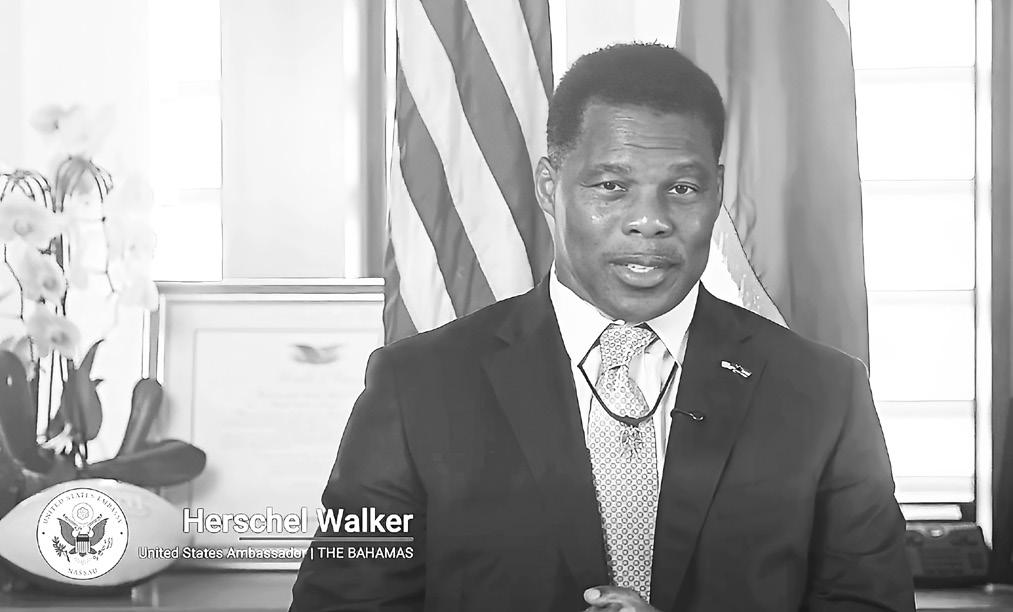
lives to preventable accidents, multiple visitors have been hospitalised, Americans have also been sexually assaulted by jet ski operators who take victims to isolated islands,” Ambassador Walker said in the public service announcement posted on the embassy’s Facebook page.
“Many watercrafts are unsafe, and operators are unlicensed and uninsured. That's why US government employees are banned from renting or riding jet skis.
We're working with the
government of The Bahamas to address these issues, but for now, consider all the risks before you get on a jet ski in The Bahamas. Your safety matters.”
The embassy said six US citizens have been hospitalised because of jet ski accidents since August 2024, with three requiring emergency medical evacuation from The Bahamas.
It also said two US women reported sexual assaults by jet ski operators in 2025 and that two more sexual assaults have already been
By KEILE CAMPBELL Tribune Staff Reporter kcampbell@tribunemedia.net
A LONG Island man was arraigned in the Magistrate’s Court yesterday on a libel charge stemming from alleged comments made on Facebook.
Godson Johnson, 59, of Stella Maris, Long Island, appeared before a magistrate accused of publishing defamatory remarks about Julian Pratt. Prosecutors alleged that on May 18, 2026, in New Providence, Johnson unlawfully published defamatory remarks about Mr Pratt on Facebook with
the intent to defame him and damage his character. Johnson pleaded not guilty to the charge.
The court granted him $3,000 bail with one surety.
The matter was adjourned to September 15, when Johnson is expected to return to court.
By KEILE CAMPBELL Tribune Staff Reporter kcampbell@tribunemedia.net
A 29-YEAR-OLD man was ordered to pay $900 in compensation and keep the peace after admitting to assaulting his former girlfriend and carrying a cutlass without lawful authority.
Kalin Clarke, of Cadway Close, West Bay Street, appeared before Magistrate Shaka Serville charged with causing harm, assault and possession of a dangerous instrument.
Clarke pleaded guilty to all three charges.
The court heard that on June 10, 2026, at Lyford Hills, Clarke caused harm to his then-girlfriend, Noella Lightbourne. According to the prosecution, Ms Lightbourne reported that she and Clarke had been involved in a physical altercation and alleged that he struck her in the eye.
Clarke was also charged with assaulting Ms Lightbourne on June 9 at Serenity Estates.
Prosecutors alleged that while the pair were walking together, Clarke grabbed Ms Lightbourne by the back of the neck, causing her pain.
A third charge stemmed from a police encounter on June 10 at Percy Road, where ofcers searched Clarke and allegedly found him with a black-handled cutlass.
Addressing the court, Clarke accepted responsibility for his actions and said he intended to stay away from Ms Lightbourne. The court heard that Clarke and Ms Lightbourne had been in a relationship for three years and that he is the father of three children. In explaining the June 10 incident, Clarke claimed Ms Lightbourne had been intoxicated and involved in an altercation in the roadway. He told the court that while trying to calm the situation and avoid being struck, he accidentally hit her in the eye during the struggle.
Clarke also said the cutlass was connected to his
landscaping work.
Magistrate Serville ordered Clarke to pay $750 in compensation to Ms Lightbourne on the charge of causing harm. Failure to pay would result in three months in prison.
On the assault charge, Clarke was ordered to pay a further $150 in compensation. Failure to pay would result in a one-month prison sentence.
The magistrate also ordered Clarke to be of good behaviour for six months on all three matters.
On the dangerous instrument charge, Magistrate Serville granted a conditional discharge and warned that breaching the good behaviour order could result in a $250 fne or one month in prison.
The total compensation ordered was $900.
The matter was adjourned to August 31 for an update on payment.
Clarke is expected to have either paid the compensation in full or begun making payments toward the amount owed.

reported in 2026.
“Rogue operators — unlicensed, uninsured, and operating unsafe watercraft — continue to solicit tourists on Nassau’s most popular beaches, including Junkanoo Beach, Saunders Beach, and Cabbage Beach, as well as near the Cruise Port and the small islands east of Paradise Island,” the statement said. “Oversight by the authorities of these supposed ‘ofcial’ jet ski rental areas is sporadic at best.”
The embassy also cited the death of Alaska Air National Guard Second Lieutenant Robert Rosa, who was killed in a jet ski-related incident while vacationing in New Providence in September 2025.
The latest warning comes amid continued scrutiny of the government’s jet ski task force, which was established in March 2024 to address safety and regulatory failures in the watercraft sector but has faced repeated questions about its efectiveness and level of activity.
When the task force was announced, ofcials presented it as a coordinated efort involving several government agencies, including law enforcement and port authorities, to strengthen monitoring of commercial recreational watercraft, improve compliance and reduce illegal operations in designated tourist areas.
Ambassador Walker acknowledged the formation of the task force but said it would have limited efect if it remained inactive. He urged the government to enforce existing regulations and strengthen accountability.
The Tribune previously reported that while the task force was formed with broad membership across relevant agencies, it has not met consistently with all members in recent periods, limiting its ability to carry out coordinated enforcement operations.
Robert Sands, senior vice-president of the Bahamas Hotel and Tourism
Association, said enforcement actions have taken place, but coordination remains uneven.
“There's no question that there is still tremendous opportunity for improvement in this particular sector, and while there has been some improvement, it's not been consistent, and it has not been with the sense of urgency that we would have anticipated,” he said.
“The industry is committed to working with the enforcement agencies to ensure that there is adequate manpower compliance enforcement in the multiple areas of where these activities take place. The reality is that there have been respectable numbers of compensation, confscations, fnes, eradication of licenses, but some still more work needs to be done. There's no hiding from that fact. The industry is committed to ensuring that happens, and we will renew our eforts to ensure that it is done.”
By KEILE CAMPBELL Tribune Staff Reporter kcampbell@tribunemedia.net
A 26-YEAR-OLD man was remanded to prison yesterday after being arraigned on an indecent assault charge. Christopher Gomez, of Strachan’s Corner off East Street North, appeared before Magistrate Abigail Farrington charged with indecent assault. Prosecutors alleged that on June 13, 2026, in New Providence, Gomez indecently assaulted Shalinka Lyons, 27. Gomez pleaded not guilty.
Magistrate Farrington denied bail and remanded him to the Bahamas Department of Correctional Services. She informed Gomez that any bail application must be made to the Supreme Court. The matter was adjourned to September 2 for trial.


By EARYEL BOWLEG Tribune Staff Reporter ebowleg@tribunemedia.net
A METEOROLOGIST
warned yesterday that The Bahamas could face more frequent heat advisories this summer as drier conditions push heat index values into dangerous territory across several northern and northwestern islands.
The Ministry of Health and Wellness and the Department of Meteorology issued a heat health bulletin yesterday advising that heat index values between 102 and 110 degrees Fahrenheit are expected in New Providence, Grand Bahama, Abaco, Bimini, the Berry Islands, Andros and Eleuthera.
Jefrey Simmons, director of meteorology at the

Bahamas Aviation, Climate and Severe Weather Network, said heat advisories are usually issued for fve to seven days, but that does not
mean extreme heat will end when the advisory period expires.
He said ofcials are expected to
here for the next three months, July, August, and September. This is now summer,” he said.
Mr Simmons said Andros could feel some of the strongest efects from the latest heat wave, though several other islands are also expected to experience high temperatures.
“Andros really a hot spot, you know, throughout the summer months as its been so always. They’ll feel a lot of heat there, and more like us will get some of the highest temperature recorded, but all of the islands will experience, especially Abaco, Grand Bahama, New Providence.”
He linked the conditions to El Niño, a climate phenomenon that he said typically brings drier weather to the region.
“With El Niño in our areas, usually drier and all of that. So you'll get the heat, and it's going to be dry also. It's gonna be a long summer. We’re just getting started.” However, Mr Simmons stopped short of saying El Niño will make this summer hotter than last year.
“I wouldn’t say hotter. In addition to being it's going to be hot. We don't expect much rain, much moisture around to cool us down much. That's a possibility because you bump an extra half a degree or two, half a degree or one degree, you know above average for this year over last year.”
A heat wave refers to an extended period of hot weather, while the heat index measures how hot it feels when humidity is factored into the temperature.
By DENISE MAYCOCK Tribune Freeport Reporter dmaycock@tribunemedia.net
A 59-year-old woman was charged in Grand Bahama’s Magistrate’s Court yesterday with fraud after allegedly swindling eight people out of $37,500 through cash payments ranging from $2,500 to $5,000.
Margaret Maria Mathiex appeared before Magistrate Uel Johnson on eight counts of fraud by false pretences and eight counts of acquisition of proceeds of criminal conduct. The alleged ofences reportedly occurred separately between November 2024 and June 2026.
Grand Bahamian Mathiex, who sufers from a heart condition, was allowed to sit on the front bench of the courtroom while the charges were read. She was represented by attorney Ernie Wallace. Prosecutors alleged that on April 14, 2025, in Freeport, Mathiex, acting with others, intentionally defrauded Kenisha Fowler of $5,000 by means of false pretences. It is further alleged that she knowingly acquired the money as proceeds of criminal conduct.
Mathiex is also accused of defrauding seven other people: Joann Armbrister of $2,500 between November 1, 2024, and May 14,
2026; Jerome Johnson of $5,000 on December 4, 2025; Latea Pennerman of $5,000 between January 1 and January 31, 2025; Vashawn Cooper of $5,000 between December 1, 2024, and May 18, 2026; Latara Saunders of $5,000 between December 1 and December 31, 2024; Chrisna Sears-Martin of $5,000 between December 10, 2024, and June 8, 2026; and Jakera Bethel of $5,000 between November 1, 2024, and June 30, 2025. She pleaded not guilty to all 16 charges.
Prosecutor Sgt 3700 Kenton Smith objected to bail, noting that Mathiex is already before the court on $20,000 bail in a separate
matter. He argued that the allegations revealed a pattern of conduct involving representations made to members of the public and said the present case involved a cumulative total of $37,500.
Sgt Smith also told the court that the current charges would make this the defendant’s third case before the courts. He further indicated that investigators had identifed 25 incidents, although only eight complainants had come forward in the present case, which he said involved matters connected to the Department of Housing. If bail was granted, Sgt Smith asked the court
to impose a substantial amount and strict conditions.
Mr Wallace urged the court to grant bail, arguing that the charges were summary ofences and that his client was presumed innocent. He noted that Mathiex is 59, would soon turn 60, and recently suffered heart failure. He told the court she was not a suitable candidate for incarceration, particularly given her medical condition, and said she posed no fight risk because she was already subject to bail conditions in other matters before the court.
Mr Wallace also argued that his client should be
allowed to prepare her defence while on bail. The court was informed that Mathiex is also facing separate fraud-related matters involving Crown land in Abaco and an alleged visa fraud case, both of which remain before the courts.
Magistrate Johnson granted bail at $9,500 with one or two sureties and informed Mathiex that her previous bail conditions would apply, including the surrender of her travel documents and reporting to Central Police Station every Monday before 6pm. The matter was adjourned to October 14 and 15, 2026.
By KEILE CAMPBELL
Tribune Staff Reporter
kcampbell@tribunemedia.net
A 20-year-old Gambier
man who admitted assaulting his sister during a family dispute was granted a conditional discharge yesterday after a magistrate expressed concern about the circumstances that allegedly triggered the confrontation.
Roston Thurston, of Douglas Road, Gambier
Village, appeared before Magistrate Shaka Serville charged with assault.
Prosecutors alleged that on June 12, 2026, at Douglas Road, Gambier Village, Thurston assaulted his sister.
Thurston pleaded guilty to the charge. He told the court the incident arose from concerns he had about interactions involving his younger sister and adult men whom he
said were associated with his older sister. He said he became uncomfortable with situations he observed involving the minor and tried to raise his concerns with his older sister.
According to Thurston, the disagreement escalated into a physical altercation between him and his older sister. He told the court that during the struggle, his younger sister was

accidentally struck.
The prosecutor noted that Thurston’s account before the court was consistent with the explanation he gave during his initial police interview.
Magistrate Serville acknowledged that the matter appeared to be a family dispute, but said the circumstances Thurston described raised concerns beyond the assault charge before the court.
The magistrate advised Thurston to confde in older family members about his concerns and suggested that he seek help from the Department of Social Services.
He also indicated that he wanted an update on the situation when Thurston returns to court on September 18.
Thurston asked the court to give him and his family an opportunity to address the issues.
Magistrate Serville granted Thurston a conditional discharge, subject to his being of good behaviour for three months.
The matter was adjourned to September 18 for review. The magistrate warned that breaching the good behaviour order could result in a $150 fne or two weeks in prison at the Bahamas Department of Correctional Services.

HUNDREDS of students across Grand Bahama are being encouraged to develop a lifelong love of reading through Alpha Kappa Alpha Sorority, Incorporated Pi Upsilon Omega Chapter’s “Read with the Ivy” initiative, which recently brought storytelling sessions and book donations to three local schools.
Chapter members visited Holmes Rock Primary School, Lewis Yard Primary School and The Beacon School, where they read to students in their classrooms and donated books to support literacy development and learning.
Reintroduced earlier this year under the leadership of Chapter President Rashema Ingraham, “Read with the Ivy” seeks to inspire young readers and promote the value of literacy among children throughout Grand Bahama.
The initiative launched on March 25, 2026, at St. Paul’s
Methodist School, where members read to Grade One students. A second engagement followed on April 28 at Freeport Primary School, featuring chapter member
and guest author Tiffany Meadows, who shared her published work, Let’s Meet LaDena. The reading provided students with an
engaging and interactive storytelling experience while introducing them to a local author.
In observance of the chapter’s 39th anniversary on May 23, members expanded the programme by conducting simultaneous reading sessions at Holmes Rock Primary School, Lewis Yard Primary School and The Beacon School. Students enthusiastically participated in storytelling activities and discussions, creating memorable learning experiences for both the children and volunteers.
“Reading opens doors to imagination, knowledge and opportunity,” said Chapter President Rashema Ingraham.
“By reading with our children, we hope to inspire curiosity, build confdence and encourage a lifelong love of learning. Through ‘Read with the Ivy,’ we are not only sharing books, but also inspiring a
By True Vision Media
NASSAU, BAHAMAS —
passion for learning.” She said education remains a cornerstone of Alpha Kappa Alpha Sorority’s mission, and the Pi Upsilon Omega
Chapter remains committed to expanding literacy outreach efforts throughout the Grand Bahama community. Through initiatives such
students.
The Bahamas has offcially joined the global Raspberry Pi Foundation network with the launch of its frst student Raspberry Pi Coding, AI and Robotics Club at Saint Anne’s Anglican School. This historic milestone makes The Bahamas only the third Caribbean country to be registered under the Raspberry Pi Foundation, alongside Haiti and Aruba. About 40 young students, some as young as seven, gathered with curiosity and excitement as they were introduced to a world many had never seen up close— coding, robotics, and artifcial intelligence.
start of a programme—it signaled the beginning of new possibilities for Bahamian children.
The initiative was led by the Rotary Club of East Nassau, its Rotary After Dark Satellite Club, and the school’s Interact Club, marking more than the
Through a live demonstration featuring a computer and a robot, students were given a frst glimpse into how technology can be created, controlled, and understood. For many, it was their frst exposure to coding, sparking curiosity, excitement, and imagination.
Leading that introduction was Howard Evans, Chairman of Rotary After Dark Satellite Club of East Nassau (R.A.D.) and Incoming Director of Environment for RCEN. Evans, who has 15 years of experience in software development, offered his mentorship and expertise to inspire the next generation. A former Programmer Analyst at AdventHealth (parent company of Florida Hospital) for seven years, Evans has spent the past nine years working in the insurance industry in The Bahamas, applying his skills to critical systems. He is also the Founder and Chairman of Top Software Technologies,
a consulting frm that helps companies advance in software development. A proud Saint Anne’s alumnus, Evans returned to his alma mater not just to teach, but to give back—sharing his professional journey and guiding students toward future opportunities in technology. His presence made the moment even more meaningful.
Mrs. Junann Lewis, Principal of Saint Anne’s School, expressed appreciation for the initiative and for Evans’ willingness to invest in the next generation, welcoming the effort as a step forward in expanding opportunities for
In the weeks ahead, the programme will move into structured, hands-on learning. Students will begin with Scratch to build beginner programming skills, then progress into Python for robotic programming. They will explore artifcial intelligence concepts, including machine learning and data training, to strengthen their problem-solving abilities and prepare them for future opportunities in technology. The long-term vision is to equip Bahamian youth with skills that open doors locally and globally, while strengthening industries at home.
But on this day, the focus was simple and powerful: Exposure.
Young minds were being shown that technology is not just something they use—it is something they can create.
The launch was supported by a committed team of Rotary leaders and community partners, including District Governor Elect Lindsey Cancino; Valentino Bethell, Incoming Vice President of RCEN; Rafque Symonette, President of RCEN; David Slatter, President Elect and current Vice President of RCEN; Kimiko Knowles, Immediate Past President of RCEN; Berchel Wilson, Vice Chairwoman of Rotary After Dark; Andrew Symonette, RCEN club member; Laura Morley, Director of Public Image of RCEN; Mrs Junann Lewis, Principal of Saint Anne’s School; Dianne Miller, Rotary School Advisor for the Interact Club; Father Bartlett of Saint Anne’s Church; Christian Knowles, Past President of RCEN; Karen Knowles, Secretary of RCEN; and Kenrad Wilchombe, Past President of RCEN.