




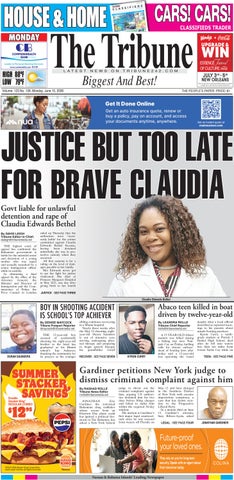
Govt liable for unlawful detention and rape of
By DAVID LEIGH Tribune Editor-in-Chief. daleigh@tribunemedia.net
THE highest court of appeal has confrmed the Bahamian government is liable for the unlawful arrest and detention of a young mother who was raped and sexually assaulted by a senior immigration ofcer while in custody.
In dismissing a fnal appeal by the ofce of the Attorney General, the Minister and Director of Immigration and the Commissioner of Police, the Privy Council in London
ruled on Thursday that the authorities were ‘vicariously liable’ for the crimes committed against Claudia Edwards Bethel because, having been detained unlawfully, she was in protective custody when they occurred.
All that remains is for a ruling on the level of damages payable to her family. Mrs Edwards never got to see her fght for justice vindicated. She died at Princess Margaret Hospital in May 2021, one day after giving birth to her fourth
JUSTICE - SEE PAGE THREE

DURAN SAUNDERS


By DENISE MAYCOCK Tribune Freeport Reporter dmaycock@tribunemedia.net

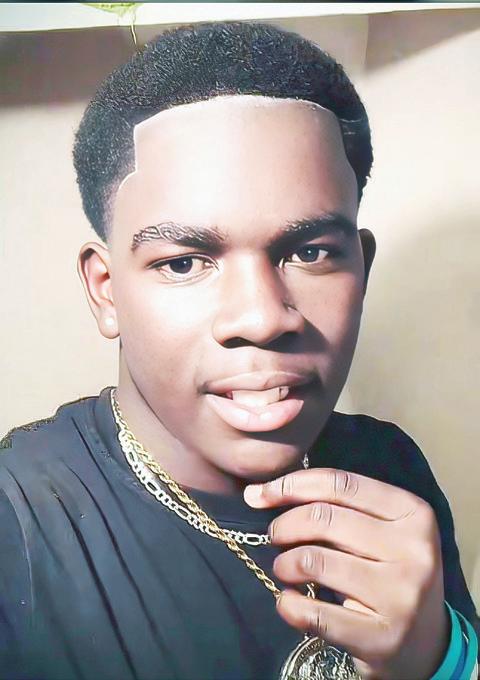
Nearly three weeks after the May 23 shooting, eightyear-old Duran Saunders is out of intensive care, moving, undergoing physical therapy and preparing to begin speech therapy, his grandfather Lloyd
RECOVER - SEE PAGE SEVEN
THE 12-year-old boy accused of accidentally shooting his eight-year-old brother in the head has graduated as his Bimini school’s Top Achiever, thanking the community for its prayers as his younger sibling continues recovering in a Miami hospital.
By LEANDRA ROLLE Tribune Chief Reporter
lrolle@tribunemedia.net
Kyron Curry, a tenthgrade student at Patrick J Bethel High School, died after he fell into waters less than ten miles from Green Turtle Cay while on
TEEN - SEE PAGE FIVE
A 15-YEAR-OLD Abaco student was killed during a fshing trip near Nunjack Cay on Friday, fuelling calls for stricter enforcement of boating laws after police said a 12-year-old was operating the vessel despite what a local ofcial described as repeated warnings to his parents about unsafe boating practices.
By
RASHAD
ROLLE Tribune News Editor rrolle@tribunemedia.net
JONATHAN Eric Gardiner, the convicted Bahamian drug trafcker whose rescue from an Election Day plane crash has ignited a political frestorm in The Bahamas, has asked a New York federal
judge to throw out the criminal complaint against him, arguing US authorities detained him for two days before fling charges and failed to indict him within the required 30-day window.
The motion is Gardiner’s frst major legal counterattack since he was rescued from waters of Florida on May 12 and later charged in the Southern District of New York with cocaine importation conspiracy, a case that has drawn scrutiny to the Progressive Liberal Party. In a motion fled on June 13, Gardiner’s attorney, Susy Ribero-Ayala, asked
LEGAL - SEE PAGE FOUR
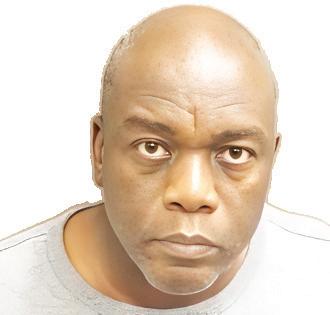
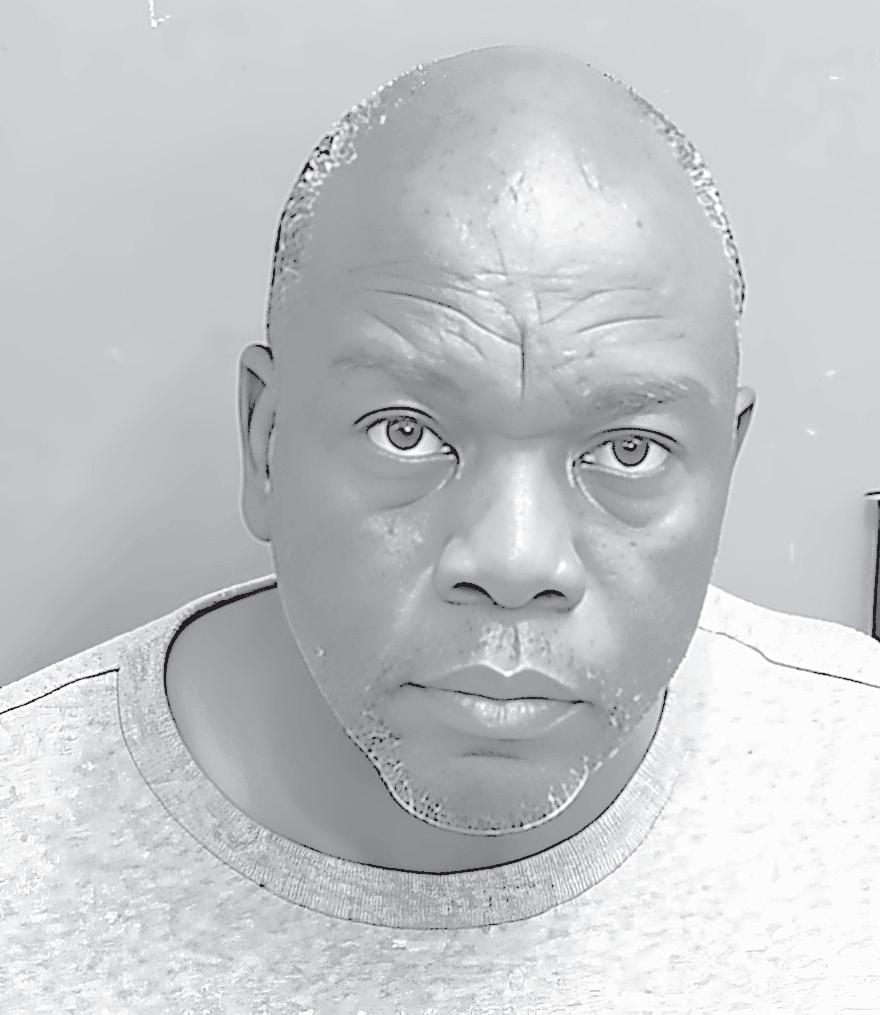
JONATHAN GARDINER


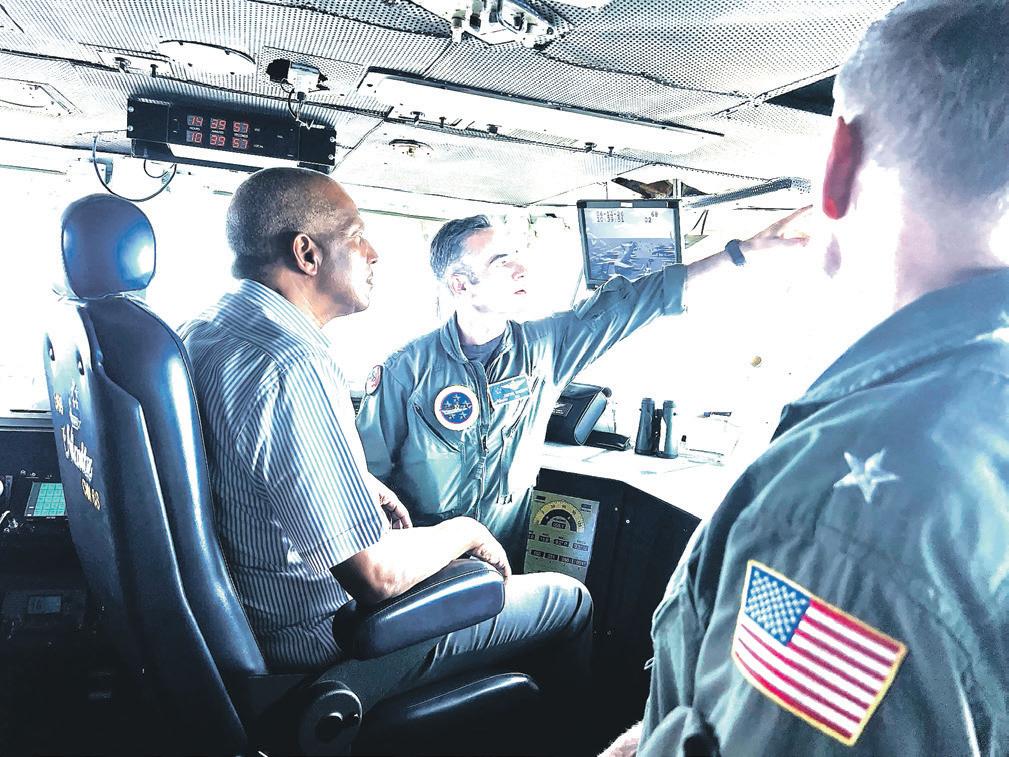
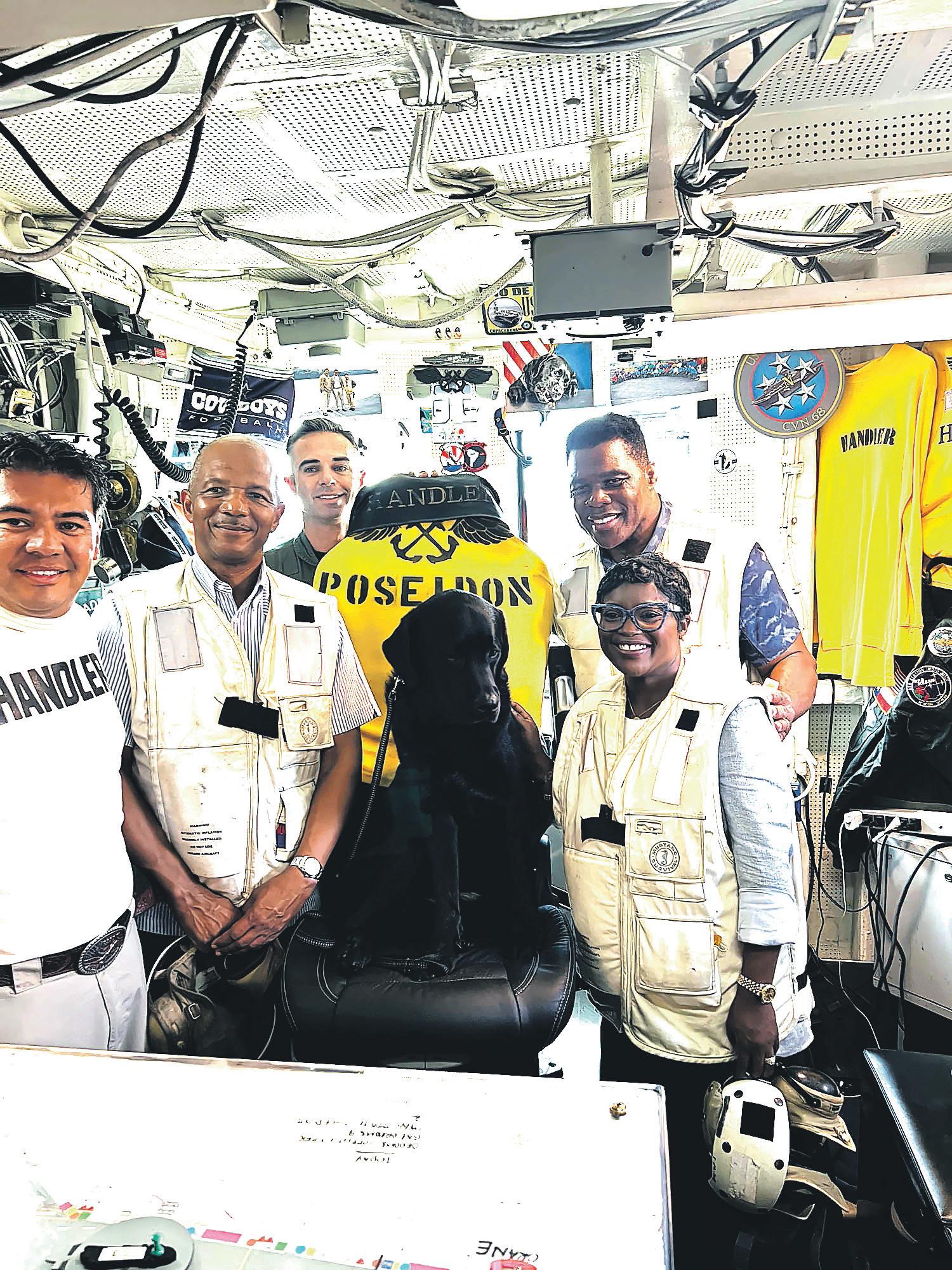
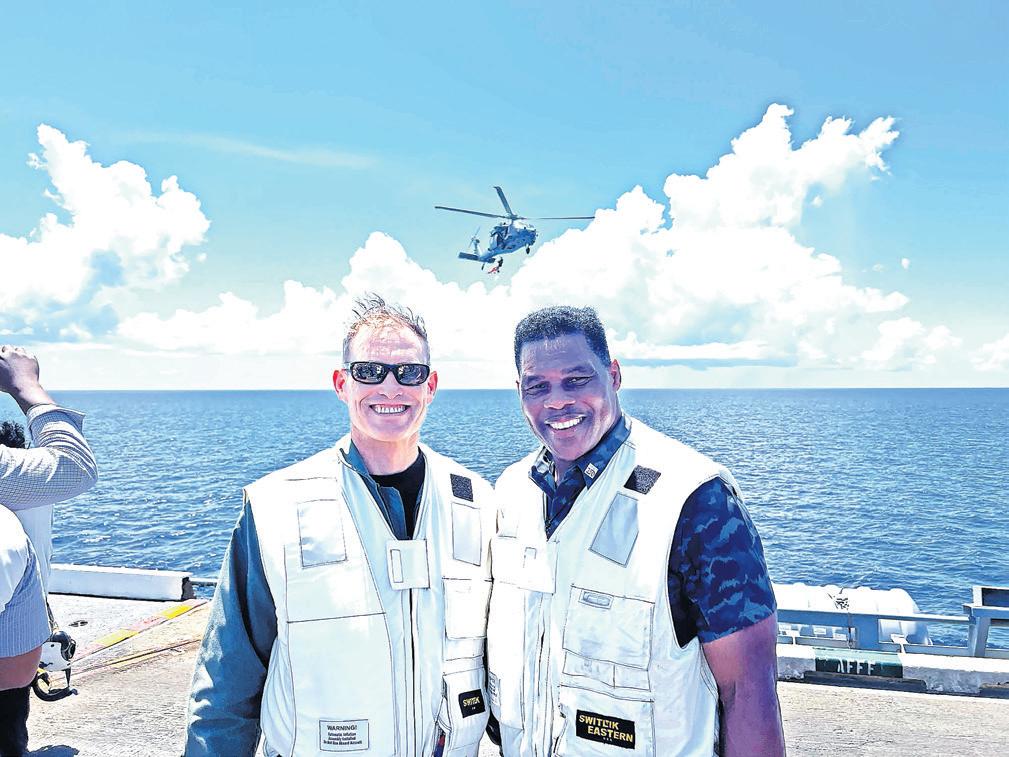
BAHAMIAN officials join US Ambassador to The Bahamas Herschel Walker on a visit to USS Nimitz (a nuclear-powered aircraft carrier), including National Security Minister Myles Laroda, Energy, Utilities and Aviation Minister JoBeth Coleby-Davis and RBDF Commodore Floyd Moxey.
US Ambassador Herschel Walker hosted senior Bahamian officials and Royal Bahamas Defence Force leaders aboard the USS Nimitz as the nuclear-powered aircraft carrier transited Bahamian waters, according to the US Embassy.
US Embassy
The Bahamian delegation toured the ship’s navigation bridge and flight deck, watched live flight operations and observed a naval power demonstration.
Ambassador Walker was accompanied by Defence Attaché Commander Victor Lange and
The visit formed part of Embassy Nassau’s Freedom 250 activities, marking the 250th anniversary of American independence and highlighting security cooperation between The Bahamas and the United States.
was welcomed aboard by Rear Admiral Cassidy “Dudley” Norman, Commander of Carrier Strike Group 11.
Bahamian officials who joined the visit included National Security Minister Miles Laroda, Energy, Utilities and Aviation Minister JoBeth Coleby-Davis and RBDF Commodore Floyd Moxey.
“The United States and The Bahamas aren't

just friends and neighbors — we're family,” Ambassador Walker said.
“The Bahamas and Caribbean are America's third border, and in many ways our first — it is where our shared security begins. This visit is a powerful reminder that Bahamian security is American security, and we are committed to protecting these waters together.”
The USS Nimitz was commissioned on May 3, 1975. According to the embassy, it is the oldest serving aircraft carrier in the world and is on its final deployment after 51 years of service.
The carrier and its strike group have been operating in the Caribbean in support of regional security.
The embassy said the visit underscored the long-running security partnership between The Bahamas and the United States, including joint counternarcotics operations, maritime security cooperation through Operation Bahamas, Turks and Caicos and the 20-year partnership between the Rhode Island National Guard
and the RBDF.
The embassy said the United States provides about $13m annually in programming, training, equipment and other support to strengthen the RBDF. The visit also reflected
Embassy Nassau’s stated priorities under Ambassador Walker, including protecting Americans abroad, securing shared borders and strengthening the relationship between The Bahamas and the United States.

child, son Emmanuel. She was just 35. Her mother Valerie Thompson yesterday told The Tribune : “I thank the Lord, I am so joyful. I’m very, very happy and Claudia would be very, very happy. She will be smiling down from heaven at finally getting justice.”
On Thursday, the Privy Council in London ruled that the State was responsible for everything senior immigration officer Norman Bastian did to her, because she was at all times a detained person in the custody of an immigration officer who was purporting to exercise the powers of his office. As counsel for the estate put it, Bastian never took off his “metaphorical uniform”.
The Board found that the arrest was unlawful from the very first moment: the police had no reasonable cause to suspect Mrs Edwards of any immigration offence –she was dressed for work behind the bar where she worked, was plainly distinguishable from the other scantily-dressed women, and had produced a copy of her spousal permit before she was arrested –and no immediate arrest was necessary.
Human Right Bahamas president Mrs Stephanie StFleur said: “This judgment is a triumph for Claudia Bethel and her family, and a disgrace for the authorities who failed her.
“A woman who proved her lawful status was arrested without cause, locked up for a weekend, and delivered by the State into the hands of her rapist.
“The Government then spent eleven years and untold public funds fighting her instead of compensating her. Justice has finally been done – but Claudia did not live to see it. That is a stain on our country that no damages award can remove.”
In demanding a public apology to her family, Mrs St Fleur described the ruling as a “damning indictment of the Bahamian authorities, who failed Claudia at every stage – when the police arrested her without lawful cause, when they detained her despite proof of her legal status, when they handed her into the custody of the man who raped her, and when, for more than eleven years, they fought her claim through three courts rather than accept responsibility for what was done to her.
“It is heartbreaking that justice took so long. Cases like Claudia Bethel’s remind us why many victims of rape and sexual violence never come forward. The fear, the trauma, the stigma, and the years of waiting for justice can be overwhelming.
“Our mothers, daughters, sisters, aunts, nieces, and grandmothers deserve better when it comes to how rape cases are handled in The Bahamas. They deserve to be heard, protected, respected, and believed.
“We need more upstanding Bahamian men to stand with women and girls, to speak out against abuse, and to help protect their precious daughters, sisters, wives, and loved ones from predators. The safety and dignity of women is not just a women’s issue—it is a national responsibility.
“May Claudia Bethel’s legacy inspire a Bahamas where victims are supported, predators are held accountable, and justice is not delayed for years.”
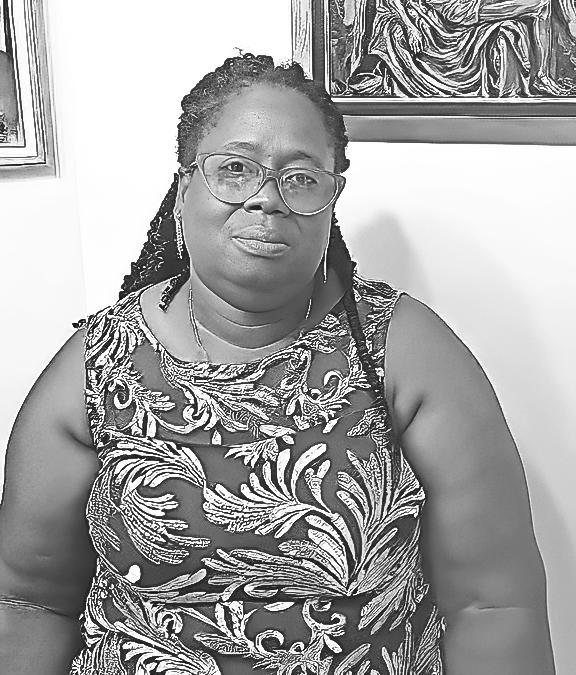
• issue a full public apology to the family of Claudia Bethel and pay all damages without further delay.
• commission an independent review of arrest and detention practices under the Immigration Act, including the conduct of raids targeting migrant women and conditions at the Carmichael Road Detention Centre.
• introduce binding statutory safeguards for women and other vulnerable persons in police and immigration custody, including mandatory female-ofcer escort requirements with real enforcement.
• account publicly for the cost of more than a decade of litigation pursued against a victim of State wrongdoing.
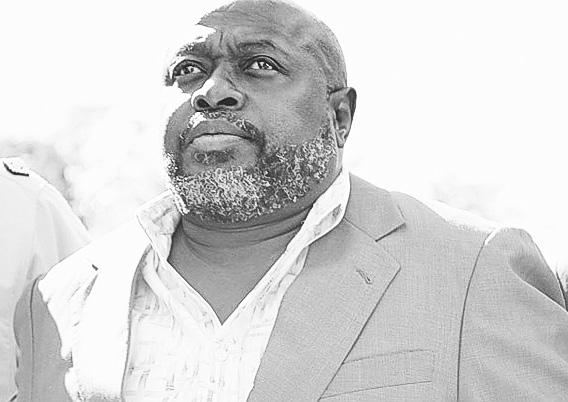
FORMER SENIOR IMMIGRATION OFFICER NORMAN BASTIAN
Mrs Edwards was arrested in the early hours of Saturday December 13, 2014, when police raided the Twilight Bar in New Providence and detained a group of Jamaican women, including Mrs Bethel, a bartender.
She had been married to a Bahamian citizen since 2010 and showed officers a copy of her spousal permit - issued by the Immigration Department itself - proving her lawful right to remain in The Bahamas. Despite that, she was arrested, told only that it was for ‘immigration purposes,’ and was never charged with any offence. She was held first at the Central Police Station and then at the Carmichael Road Detention Centre over the entire weekend - supposedly pending “verification” of a permit that could not be verified because the Immigration Office was closed.
On Monday December 15, senior immigration officer Bastian lied to his superior to obtain custody of Mrs Edwards, falsely implying that a female immigration officer would accompany them. He then drove her around New Providence before taking her to his home, where he raped her, detained her overnight, sexually assaulted and raped her again the following morning.
It was said Mrs Bethel had a fear of the immigration authorities generally and was also afraid of Mr

Human Right Bahamas president Mrs Stephanie StFleur writes:
“Today, I honour the memory of Claudia Edwards, a woman whose courage, resilience, and determination inspired many. Despite the challenges she faced, she continued to fght for justice, dignity, and the right to be heard.
“As we remember Claudia, we also remember every woman who has experienced sexual violence, especially those who were vulnerable while in custody or under the authority of those entrusted to protect them. Their voices matter. Their pain matters. Their pursuit of justice matters.
“No woman should ever have to choose between her safety and her freedom. No survivor should be silenced, ignored, or forgotten.
“May Claudia’s legacy remind us of the importance of accountability, human rights, and the protection of all people, regardless of their status, nationality, or circumstance.
“To every survivor: you are not alone. Your story matters. Your life has value. Your courage is seen.
“May Claudia Edwards rest in eternal peace, and may her memory continue to inspire.
“In loving memory of Claudia Edwards.”
Bastian. He had indicated to her that he had a licensed firearm and that a very bad man, known as ‘Death,’ was his nephew.
At trial, the judge accepted Mrs Edwards’ evidence that she repeatedly asked to go home to her three children and was refused, finding that Bastian ‘misused and abused his authority as a senior immigration officer.’
Mrs Edwards, who waived her right to anonymity, claims Mr Bastian raped her and forced her to commit oral sex after lying in wait for her in his bed naked. Within hours of finally being returned home on Tuesday 16 December, Mrs Edwards went to the police, reported the rapes and handed over physical evidence.
Mr Bastian’s attorney, Wayne Munroe, now the Attorney General, sought to poke holes in certain aspects of her story, asserting that the whole narrative stemmed from her fear of her immigration status in the country. He specifically attacked Ms Bethel’s evidence concerning the date she said she arrived in The Bahamas, as well as where she said she lived at the time she got married to her Bahamian hospital.
Though Bastian denied being liable for the offenses, Senior Justice Charles found him guilty of the sexual assault charges.Mr Bastian’s liability for false imprisonment, assault and battery was
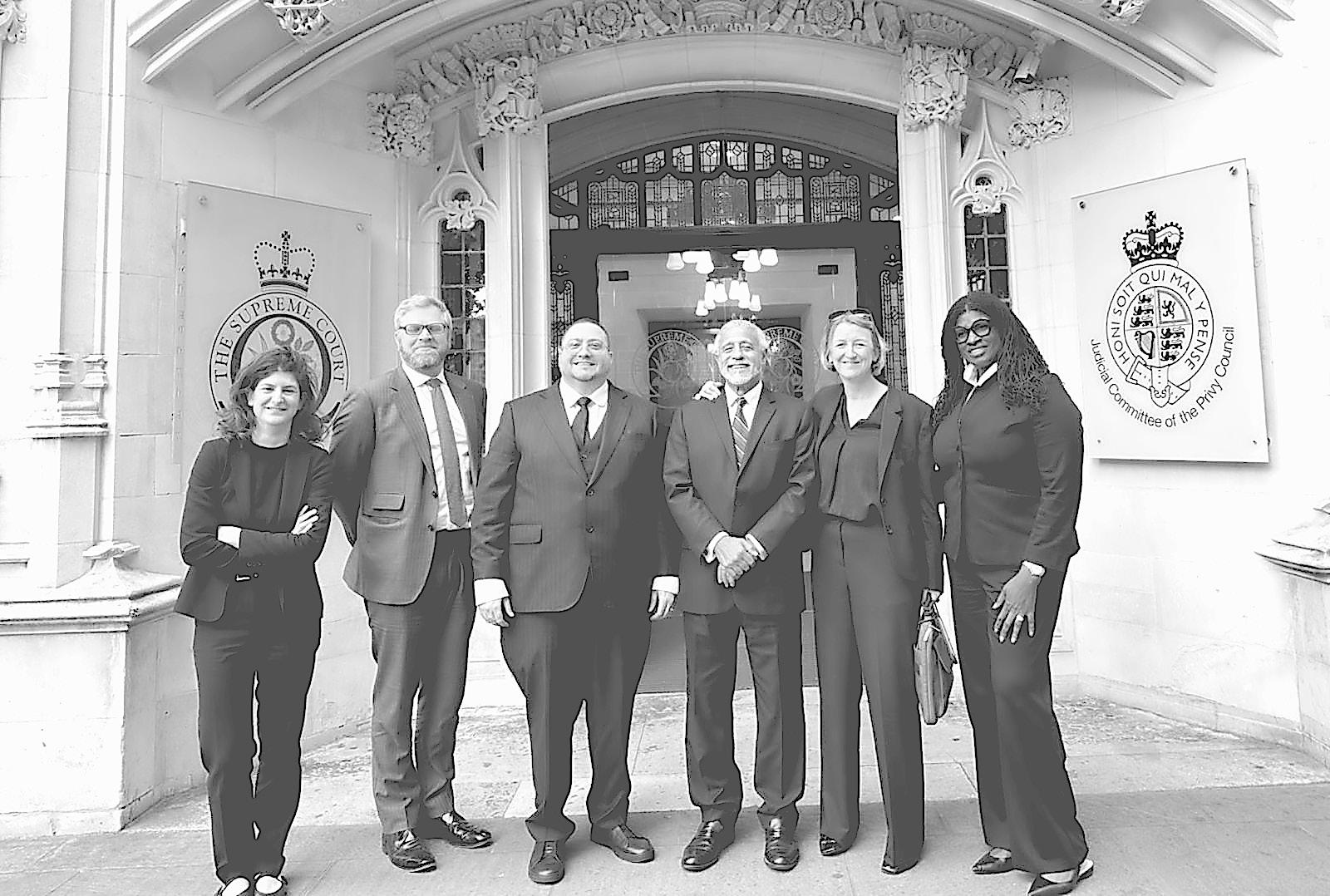
MEMBERS of Claudia’s legal team outside the Privy Council in London: Suzanne Ter-Minassian of Serle Court; Theo Solley of Sheridans; R. Dawson Malone and Frederick Smith KC of Callenders & Co.; Ruth Jordan of Serle Court; and Doneth Cartwright of Callenders & Co.
established at trial and is no longer in dispute.
Following an initial complaint, the Supreme Court found that Mrs Edwards was at first initially lawfully arrested and detained, but that this subsequently became unlawful and she was entitled to damages from the State.
For the latter period, Mrs Edwards could only claim for damages from the state agent, Mr Bastian. She could also claim damages from the State only for her rape and sexual assault.
The Court of Appeal held that, for the initial period, she was entitled to common law damages from the State, and that the State was vicariously liable for all of Mr Bethel’s conduct, and that only common law damages were required. The Court of Appeal then refused the Appellant’s request for permission to appeal to the Privy Council. The State then appealed the Court of Appeal’s decisions to the Privy Council, which rejected it.
“Instead of acknowledging these grave failures, the government litigated against Mrs Bethel – and, after her death, against her estate – for over a decade,” said Human Rights Bahamas in a statement.
“It contested her claim at trial presided over by SC Judge Indra Charles
who ruled that Mrs Bethel was unlawfully arrested for part of the time, and that Bastian did rape her, but that the Government was not responsible because he was on a “frolic of his own”.
“Mrs Bethel appealed to the Court of Appeal and judges of appeal, Sir Michael Barnett, Milton Evans and Crane-Scott ruled unanimously that the Government was responsible for the rapes by Bastian and by a majority that she was unlawfully detained for the entire time she was in custody.
Sir Michael stated: “In my judgement, Bastian’s actions after he obtained custody of Bethel from the Detention Centre were sufficiently connected to his employment as an immigration officer as to make the Immigration authorities vicariously liable for his actions. This relates both to his detaining Bethel until she returned to her home as well as the assault and battery occasioned by the rape.
“Bethel had been at the detention centre under the control of the Department of Immigration. She was ‘released’ from the detention centre, not to her freedom, but to the custody of Bastian.”
The Government pursued a final appeal to the Privy Council in London at public expense. Mrs Bethel
died of COVID-19 on 25 May 2021, before judgment was even delivered in her own case. She never lived to see her name vindicated. But on Thursday, the Board concluded: “That Mr Bastian’s employers are vicariously liable for the torts of false imprisonment, battery and assault (the detention and rapes of Mrs Bethel) committed by Mr Bastian.
“The Privy Council has now rejected the State’s case in its entirety.”
In 2021, her attorney Fred Smith, part of the team that successfully fought the authorities’ appeal, praised Mrs Bethell’s courage.
“Learning to read and write, focus on her legal case, rebuilding her sense of dignity, her sense of self, her respect, she was tremendously respectful to others as well.”
He said she had ‘high hopes’ for herself, having gained a bachelor’s degree in cosmetology and was about to graduate with a master’s degree.’ He added: “She has inspired me and her children. She has inspired lawyers in our office. To see how strong she was and how she persevered in pursuing her rights. She stands as a shining example. She didn’t hide in the shadows. She was brutally honest and was courageous.”
the court to dismiss the complaint with prejudice and order his immediate release, alleging that the government violated his constitutional and statutory rights by holding him before fling the criminal complaint and failing to secure a timely indictment.
The motion says Gardiner was a passenger on a domestic Bahamian fight from Abaco to Grand Bahama on May 12 when the aircraft crashed in waters of Florida.
The fling says the fight was expected to last about 15 to 20 minutes, the weather was clear, and Grand Bahama was visible to passengers before the crash. According to the motion, the pilot said all navigational instruments failed before the aircraft went down.
The defence argues that at the time of the aviation emergency, no arrest warrant had been issued for Gardiner in The Bahamas or the United States, and no criminal complaint had yet been fled.
The fling says the remaining passengers were allowed to return to The Bahamas on May 13 after spending the night in a hotel. It says only Gardiner and the pilot remained in the custody of US authorities, and that the pilot was later released and returned to The Bahamas with the other passengers.
The account difers in tone and timing from pilot Ian Nixon’s previous account to The Tribune.
Mr Nixon said all passengers were frst checked at a local hospital, after which
the passengers — except him and Gardiner — were fngerprinted and ofcially checked into the United States by Customs and Border Protection.
Mr Nixon said the only thing he was asked was whether he was carrying cash. He said he was not aware of survivors being searched.
He also described a less restrictive setting than the one outlined in Gardiner’s motion, saying those not detained in the medical centre for treatment, including him and Gardiner, were later taken to a large, open room with tables and airport-style chairs. He said Red Cross ofcials provided food and refreshments and that there was no sense anyone was being held against their will or was about to be arrested.
According to Mr Nixon, the group was told after a restless night that they would be fown back to New Providence around lunchtime. He said he and Gardiner were placed in a cell only about ten minutes before the fight was due to leave.
Gardiner’s motion argues that, unlike other passengers, he was not allowed to leave the hospital after being medically evaluated. It says an armed law enforcement ofcer guarded the area where he was being medically cleared.
Once discharged, the motion says, Gardiner was taken to Port Canaveral and placed in a holding cell before being transferred to the Orange County Jail in Orlando, Florida.
“From that point forward,

Mr Gardiner remained continuously deprived of his liberty,” the motion says.
The defence says the US government did not fle the criminal complaint until May 14, two days after Gardiner had already been detained. It says Gardiner made his initial appearance on May 15 in the United States District Court for the Middle District of Florida and remains incarcerated.
After that appearance, the motion says, he was taken to the Orange County Jail, transferred to the Seminole County Jail, and later moved to a detention facility in Oklahoma, where he remained when the motion was fled.
The defence argues that more than 30 days had passed since Gardiner was frst deprived of his liberty and that, as of the motion’s fling, no indictment had been returned, Gardiner had not waived indictment, and the defence’s review of the public docket found no excludable time under the Speedy Trial Act.
“Accordingly, Mr Gardiner remains incarcerated solely on a Criminal Complaint that was fled two days after his detention had already begun and for which no timely indictment has been obtained,” the motion says.
The motion says the Fifth Amendment guarantees the right to a grand jury indictment for felonies and that the Speedy Trial Act requires an indictment within 30 days of a person’s arrest.
It also cites Rule 48(b) of the Federal Rules of Criminal Procedure, which allows a court to dismiss a criminal complaint if there is unnecessary delay in presenting a charge to a grand jury or fling an information against a defendant.
The defence argues that because no indictment has been fled, there is no formal charging document that satisfes federal procedural rules. It also claims the delay has prejudiced Gardiner’s ability to mount a defence, locate witnesses and preserve exculpatory evidence.
The motion comes as Gardiner’s case continues to dominate political debate in The Bahamas.
Gardiner, also known as “Player,” was among 11 Bahamians rescued by US authorities after a plane travelling from Marsh Harbour, Abaco, to Grand Bahama.
US court documents previously alleged he was a central fgure in an international drug trafcking network under investigation by the Drug Enforcement Administration. The allegations have drawn intense attention because the DEA afdavit also referred to an unnamed Bahamian politician — identifed only as “Politician-1” — who allegedly met an undercover DEA source and a drug pilot inside the Bahamian Parliament building in October 2024 to discuss a cocaine shipment allegedly worth $30m.
The court fling also alleged that when Gardiner was rescued, he had three mobile phones and $30,000 in Bahamian currency packed in a manner consistent with narcotics proceeds. The money was allegedly found in an envelope labelled with the handwritten name of a prominent Bahamian politician, which was redacted in the US fling. The allegations have triggered weeks of political fallout.
The Ofce of the Prime Minister has said the
government received no ofcial information identifying any public ofcial in relation to the matter and would seek further information from US authorities. It also said local law enforcement agencies would conduct inquiries. Opposition Leader Michael Pintard has pressed for answers, repeatedly seeking to table documents related to the US complaint in the House of Assembly. House Speaker Patricia Deveaux blocked those eforts last week, describing the allegations as “frivolous” and “malicious” gossip and ruling that the matter should not be debated in Parliament.
The Free National Movement has since asked Commissioner of Police Shanta Knowles to launch an urgent and comprehensive investigation into the allegations in the US afdavit, including the identity of “Politician-1” and whether any elected ofcial, public ofcer, law enforcement ofcer or security ofcial facilitated criminal activity.
Mr Pintard has also asked police to examine concerns about money laundering, fnancial fows and government dealings involving Top Notch Builders Limited and afliated entities linked to Gardiner. US Ambassador to The Bahamas Herschel Walker declined to comment directly on the investigation when asked about the Speaker’s dismissal of the allegations last week, saying: “Wait and see.” Gardiner’s motion asks the court to dismiss the complaint with prejudice, a ruling that would prevent prosecutors from refling the same complaint, and to order Gardiner’s immediate release.
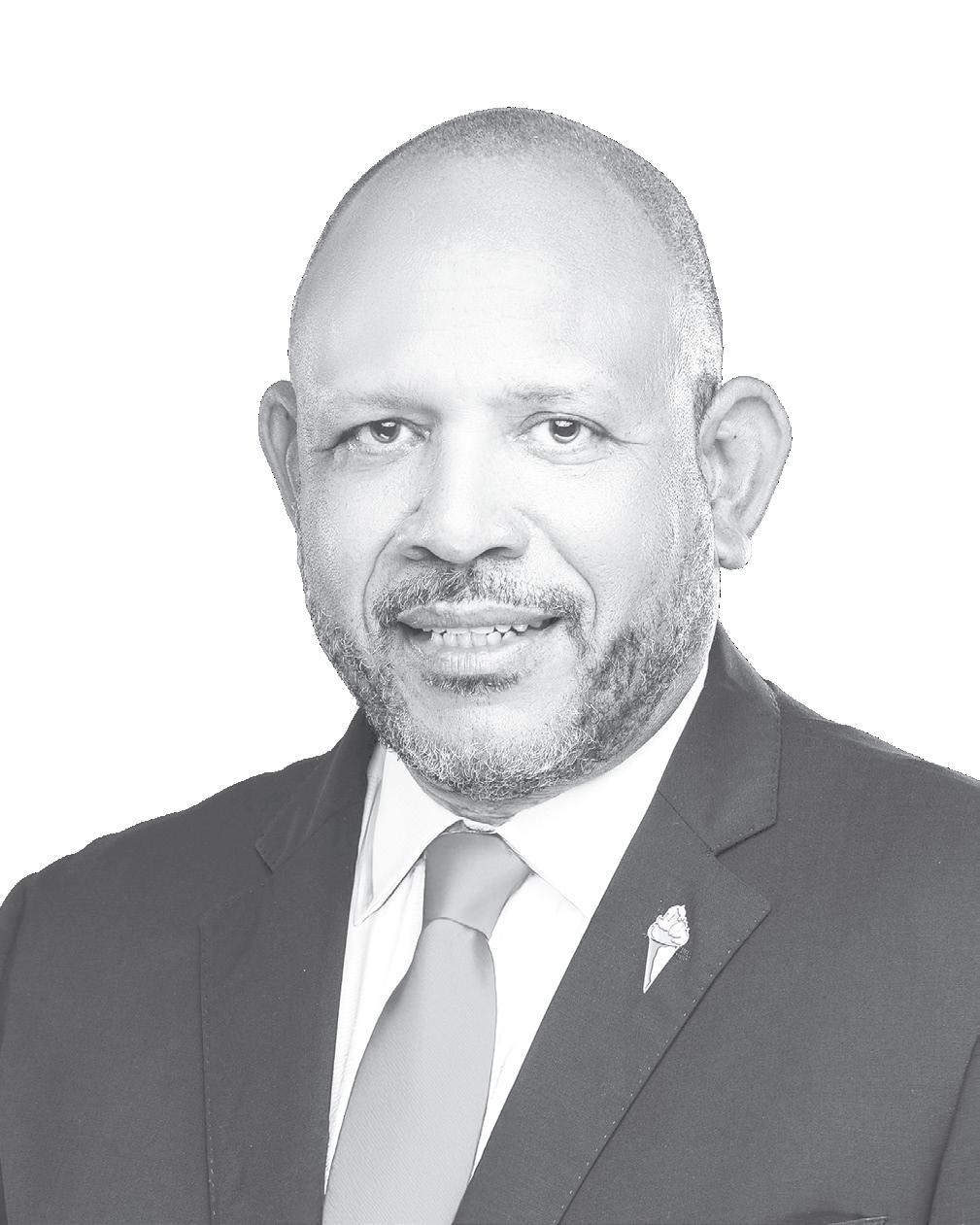
THE Free National Movement has renewed its criticism of the government's response to explosive US drug-traffcking allegations, accusing ofcials of failing to confront claims that have fuelled controversy in recent days.
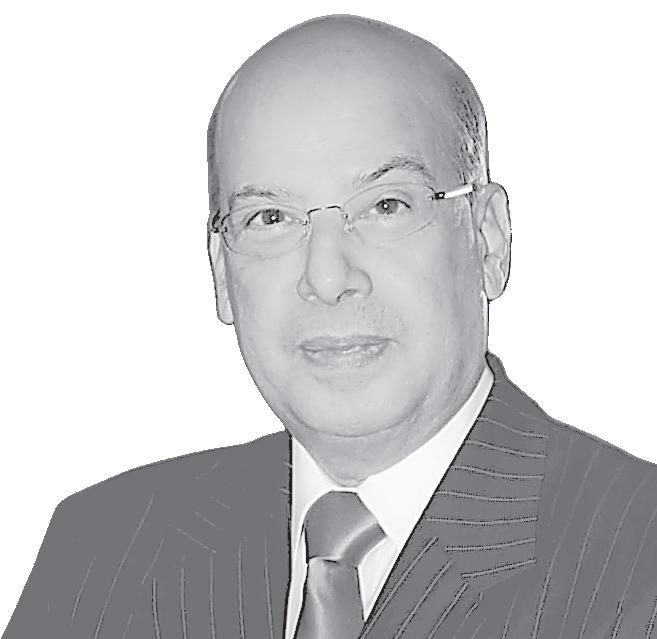
In a statement yesterday, Dr Duane Sands, the party’s chairman, refected on the history of the House of Assembly and its signifcance to democracy.
Referencing remarks by former Governor-General Sir Arthur Foulkes, Dr Sands noted that the House had endured for more than two and a half centuries and become the cornerstone of Bahamian parliamentary democracy.
“This institution and its eventual assimilation by Bahamians have contributed mightily to our history of political stability, but you know the pirates are still with us.
“Not only do we have a PLP politician allegedly using the parliament to arrange to trafc dangerous drugs, but now we have the PLP and the Speaker trying to shut down the ofcial opposition on allegations of corruption and money laundering.”
Dr Sands was referring to House Speaker Patricia Deveaux's repeated decisions to block opposition attempts to table documents related to the US court fling in the House of Assembly. She has dismised the allegations as ‘frivolous and malicious gossip.’
The fling is the latest in a series of allegations linking government ofcials to drug trafcking as part of a wider US investigation. It alleged an unnamed
Bahamian politician met an undercover Drug Enforcement Administration source and a pilot inside a Parliament building in October 2024 to discuss a cocaine shipment allegedly worth $30m. The indictment controversy has dominated parts of this year’s budget debate, with opposition members repeatedly demanding greater transparency and urgency.
Yesterday, Dr Sands called the Speaker’s refusal to address the topic unacceptable and said “Deveaux seems so busy trying to still prove herself that she forgets the import of position in the greater historical context.”
“I end by saying that the speaker clearly does not understand Bahamian history, a role as speaker, or the lowering of house standards that she is aiding and abetting, while the PLP is making a mockery of Parliament.”
Meanwhile, FNM leader Michael Pintard have formally asked police to investigate the allegation, including any individual who may be “Politician 1.” Mr Pintard has also called on the police commissioner to determine whether any elected ofcial or public ofcer facilitated criminal activity and examine whether members of law enforcement or security agencies provided assistance or protection to criminal networks.
“It hurt my heart to see it, and then to watch the kid that was driving the boat just sit there and sob; it was a hard situation all around.”
GTC deputy chief councillor Elvardo Butler
TEEN from page one
a 17-foot Cobia vessel with three other teenagers.
Police said the boat was being operated by a 12-year-old. The other passengers were 12, 15 and 16.
The teens told police that Kyron was standing on the bow, holding a rope, when he fell. They said they heard a loud sound and saw blood in the water.
After failing to fnd him, they raced back to Green Turtle Cay for help. Boaters later mobilised and recovered Kyron, unconscious with a fractured skull. He was taken to the hospital, where he was pronounced dead.
His death stunned the quiet, close-knit community and left residents asking whether more should have been done to prevent children from operating boats without proper supervision.
Island deputy chief councillor Elvardo Butler was among those gathered at the clinic after Kyron was brought in.
He said residents had turned out in force, hoping the teenager would survive, before the screams of Kyron’s mother confrmed that her only child had died.
“It hurt my heart to see it, and then to watch the kid that was driving the boat just sit there and sob; it was a hard situation all around,” Mr Butler said.
He said negligence played a role in the tragedy and argued that adults failed Kyron by allowing unsafe practices to continue.
“I’m not mad at them because they’re kids,” he said, “but some type of adult supervision should’ve been on that boat no matter what happened, and that’s my opinion, and I’m not trying to pick on his parents, but someone

dismissed.
have to be held accountable for what took place on Friday.”
Relatives of Kyron declined to speak to The Tribune yesterday.
Residents described him as bright, mannerly and widely loved in the community.
Area MP Kirk Cornish expressed sadness in a social media post and ofered condolences to the family.
Mr Butler called the incident a wake-up call for Green Turtle Cay, saying the community had grown too lax about children operating boats and other vehicles.
He said residents had repeatedly warned the parents of the 12-year-old operator about unsafe boating practices, but claimed their concerns were

“If you come on the cay and interview about 100 people, they’ll tell you the same,” he said. “We’ve been talking to these people over and over regarding coming in the harbour, regarding these kids, swimming across the harbour, all diferent type of stuf.”
“But it’s like we lost our way over there. You can’t say nothing to anyone no more. It’s unfortunate and that’s the way it is.”
The law bars anyone under 16 from operating a motorboat with an engine of more than 10 horsepower.
Exceptions apply only if a minor has passed a practical boating test and been certifed by an authorised ofcer, or if a

aged 14 to 16 is operating under the direct supervision of someone aged 16 or older. It is unclear whether the 12-year-old met any legal exception.
Mr Butler said the concerns extend beyond boating, claiming children on the cay also frequently operate motorbikes and scooters without adult supervision.
Chief Superintendent Michael Thurston, ofcer in charge of Abaco, said yesterday that police have not decided whether charges will be brought.
“We’re looking at all avenues before any decision is made as to
whether or not we’re going in any direction,” he said, adding that ofcers are in communication with the Port Department.
He said police would increase social media awareness about boating safety to help prevent similar incidents.
ASP Nicholas Johnson, press liaison ofcer for the Northern Bahamas, ofered a diferent view, saying there is nothing at this stage to suggest wrongdoing that would warrant charges. He said once the investigation is complete, the matter will be referred to the coroner for review.

NULLIUS ADDICTUS JURARE IN VERBA MAGISTRI
“Being Bound to Swear to The Dogmas of No Master”
LEON E. H. DUPUCH,
Publisher/Editor 1903-1914
SIR ETIENNE DUPUCH, Kt., O.B.E., K.M., K.C.S.G., (Hon.) LL.D., D.Litt .
Publisher/Editor 1919-1972
Contributing Editor 1972-1991
RT HON EILEEN DUPUCH CARRON, C.M.G., M.S., B.A., LL.B.
Publisher/Editor 1972-
Published daily Monday to Friday
Shirley & Deveaux Streets, Nassau, Bahamas N3207
TELEPHONES
News & General Information (242) 502-2350
Advertising Manager (242) 502-2394
Circulation Department (242) 502-2386
Nassau fax (242) 328-2398
Freeport, Grand Bahama (242)-352-6608
Freeport fax (242) 352-9348
WEBSITE, TWITTER & FACEBOOK
www.tribune242.com

@tribune242

tribune news network
Claudia Edwards never got to see justice. Despite being in The Bahamas lawfully – married to a Bahamas citizen since 2010 – she was arrested on December 13, 2014, at a bar where she worked and ended up in Carmichael Road Detention Centre. She was taken from there by a senior immigration ofcer, Norman Bastian, who took her to his home, raped her, kept her detained overnight, and sexually assaulted and raped her again the next morning.
Despite her fear of the man who had brutalised her, she had the courage to speak up. She accused Bastian over the attack, and also fled a civil suit.
She never got to see the outcome. Seven years after the attack, she died in hospital, just a day after giving birth to her fourth child. She had caught COVID19, becoming one of the victims of the pandemic. That was in June, 2021.
Despite Bastian’s denials, the Supreme Court ruled in January, 2023, that Bastian falsely imprisoned, sexually assaulted and battered Claudia, after her estate continued with the civil action after her death.
Senior Justice Indra Charles said at the time that Bastian “was on a frolic of his own when he deceived the acting director of immigration that he was taking the plaintif to verify her correct address”. She added: “His unauthorized acts of sexually assaulting and battering the plaintif was not within the course of his employment and/or sufciently close to make it right and just for the employer to be held liable under the principle of natural justice”. Thursday, the Privy Council ruled that Bastian was not the only one liable for the injustice sufered by Claudia.
Eleven and a half years on from the day she was arrested, it was ruled that the government was also to be held responsible for all that she sufered.
The arrest was deemed unlawful from the very start – with the police having no reasonable cause to suspect Claudia of any immigration ofence.
She was working where she was supposed to be. She had her spousal permit when she was arrested. Yet still she was arrested, locked up, and put in the path of a predator in uniform.
The president of Human Rights Bahamas, Stephanie StFleur, pointed up the long-running injustice when she said: “The government then spent 11 years and untold public funds fghting her instead of compensating her. Justice has fnally been done – but Claudia did not live to see it. That is a stain on our country that no damages award can remove.”
Claudia even had to defend herself in court – with Bastian’s attorney, Wayne Munroe QC, now the Attorney General, seeking to poke holes in parts of her story,
attacking evidence concerning the date she said she arrived in The Bahamas and where she said she lived at the time she got married.
All that despite having the documentation that the Privy Council, all these years later, show she should never have been detained in the frst place. Even if there had been some reason, there was no reason for her to become the victim of rape by an ofcer in uniform who was supposed to doing his duty to the nation, not exploiting those in his charge. Claudia’s should be a life that should be celebrated. After her death in 2021, we wrote of her in this column that she was described by those who knew her as energetic, committed, kind, patient, dedicated, bubbly.
She went from teaching herself to read properly to earning a bachelor’s degree, and then a master’s.
She launched her own business, Claudia’s Nails.
We promised then that we would continue to monitor the case closely, and report the outcome.
The outcome is still not done. Human Rights Bahamas has rightfully called on the government to issue a full public apology, as well as to commission an independent review of arrest and detention practices under the Immmigration Act. We must make sure that no more women sufer the plight that Claudia experienced.
Human Rights Bahamas also wants the government to tell the public how much the legal fght against Claudia has cost – a fght the government has fought and lost rather than seeking to compensate Claudia from the start. There is also a call for new statutory safeguards for women and vulnerable people in custody to prevent future predators from acting the way that Bastian did.
And fnally there will be a ruling on how much damages are payable to Claudia’s family, not that there is any amount that could truly compensate for the loss of such a vibrant woman, and the pain and sufering she was forced to endure, both from the man who attacked her, and the legal opposition she had to withstand.
Claudia’s story is not over. What she experienced should be taken to heart by government. We should hear today what the government intends to do and what measures have been taken already to prevent the mistreatment sufered by Claudia from happening to another. We must learn the lessons from this case. Claudia may well not have seen the outcome of her legal fght, but it must not have been in vain.
Claudia may not have seen justice, but the greatest injustice will be if there is no change to stop this ever happening again.
EDITOR, The Tribune.
THE pages of this newspaper and the dockets of U.S. federal courts now tell a single, terrifying story.
A convicted drug trafcker and money launderer—a man accused of laundering tens of millions more in narcotics proceeds—stands accused of sponsoring, doing business with, and cultivating infuence among elected ofcials.
The evidence is sworn testimony in a foreign court that has diagnosed our body politic with a sickness we refuse to name. Yet Prime Minister Philip Brave Davis and his administration have not quarantined the infection; they have downplayed it, dismissed the American proceedings as an intrusion, and wrapped anti-colonial rhetoric around a criminal conspiracy that eats our sovereignty from within. The Bahamas is not defending its honor; it is defending the virus that is killing it.
We must speak plainly. Corruption in this country is not a fading scar from slavery. It is a living, mutating, breathtakingly adaptive virus. It entered our bloodstream with the slave master, evolved through the colonial overseer, and did not die on January 10, 1967. That date, celebrated as the triumph of Majority Rule, was the moment the virus metastasised. It moved from a white disease to a black disaster, transferring its code of extraction, entitlement, and contempt for the common good into the very hands raised in the promise of liberation.
Today the virus hides in everyday decisions. Who gets a contract, whose child attends an elite private school while public classrooms crumble, whose neighborhood is protected, whose illness receives timely care?. Our leaders, black and proud, do not even realise they are infected. They reproduce the logic of the slave master while calling it development.
The revelations in U.S. courts are the latest mutation breaking into open sores. The convicted launderer, allegedly still deep in a criminal conspiracy, is an alleged benefactor of PLP events and a business partner of party fgures; court proceedings also tie an FNM-connected individual to the same web. This is bipartisan viral replication of the most lethal kind.
When the Davis administration dismisses the diagnosis as foreign interference, it commits immunological suicide. It attacks the instrument that revealed the tumor, screaming to the world that The Bahamas cannot police itself.
True sovereignty is not the right to be corrupt without outside scrutiny; true sovereignty is the capacity to deliver justice to one’s own people. When our institutions are so hollowed out that a foreign
court must act, sovereignty is already lost. The trust of international partners, credit rating agencies, tourists, and ordinary Bahamians evaporates with every Cabinet shrug. The damage is not hypothetical—it is already being done.
There is a mirror we refuse to look into, and its name is Nigeria. Nigeria emerged from colonial rule with boundless promise.
A functioning civil service, agricultural wealth, and an oil boom that could have made it the engine of Africa. Instead, it permitted a virus of elite extraction to fester unchecked.
Leaders became carriers, siphoning national resources while public infrastructure rotted. The state lost its monopoly on violence, insurgencies and banditry bloomed, and a once-hopeful giant became a global cautionary tale.
The Bahamas is walking that very path—an economy precariously dependent on tourism and fnancial services, a political system that auctions contracts and passports for personal gain, and a drug trade that fourishes because the state is, in too many quarters, a silent partner. If we do not change course now, we will not sufer a unique tragedy; we will merely become the next line in a long, shameful continental obituary. The infection is so advanced that it has even colonised those we once trusted to diagnose it.
Consider the leader of a Coalition of Independents—a party supposedly determined to root out corruption and restore public faith. That very leader has now demonstrated the same contempt for the Bahamian judiciary that the Davis administration directs at American courts. By openly defying a Supreme Court ruling and treating our judges as an inconvenience to be brushed aside, this COI leader proves that the virus respects no ofce. When those commissioned to heal the body politic become carriers, we have reached a stage of disease that requires not a commission of inquiry but a revolution.
I use the word deliberately. What is needed now is not another white paper, not another integrity commission that buries its fndings, not another donor-funded ethics workshop that medicates symptoms while the pathogen multiplies. We require a civic, social, and spiritual revolution.
A civic revolution means withdrawing our consent from a political duopoly that treats elections as an auction for patronage. It means building community watchdog organisations, funding an independent press, and pursuing
litigation that challenges every unconstitutional power grab. It means refusing to accept that the only choice is between red and yellow when both are painted with the same blood of the people.
A social revolution demands the dismantling of the soft apartheid that the virus has reconstructed under black faces.
Separate schools are not parental choice; they are educational segregation designed to reproduce a ruling class. Gated communities ringed by slums are not development; they are plantation logic mapped onto modern Nassau. Unequal healthcare outcomes and food deserts are not accidents but policies, maintained because those who beneft from the divide write the rules.
A social revolution would aim not to destroy private excellence but to elevate every public good to a standard so high that the rationale for a private tier evaporates—funded by a genuinely progressive tax system that asks those who profted from the old order to pay for its abolition.
Most of all, we need a spiritual revolution. I am not speaking of more sermons while the virus feasts. I am speaking of a national awakening of conscience, a metanoia that dares to call the system by its real name. Our pulpits must stop anointing parties and start denouncing the structural sin that crucifes the poor daily. Those who see the decay but have made peace with it because they beneft just enough—who are sleeping with their eyes wide open—must awake. The moral authority of the church will be reclaimed not by shouting about private morality while ignoring social murder, but by measuring our life together against the prophetic demand for justice that rolls down like waters.
The U.S. court’s indictment is an uninvited gift. It is a CT scan of our collective soul, and the tumor’s it reveals cannot be massaged away with patriotic slogans. The duty of this generation is to identify the virus as it has evolved, not as we were taught in school. We must fght the version it has become, hidden in government tenders, educational decisions, housing policy, healthcare access, and the very chambers of commissions of inquiry.
Time is now. Nigeria’s path is unmistakable and terminal. The sleeping must awake, and the awake must refuse to slumber again until the body politic is purged of an infection that has already lasted too many centuries. Our children deserve a nation that is not a host for the old slave masters’ appetite but a home for their dreams.
Sincerely, A Concerned Bahamian Awake.
RABBI COMMON ZENSE
Freeport, Grand Bahama June 11, 2026.
EDITOR, The Tribune.
IN the Simon Front Porch op-ed in the June 11 edition of The Nassau Tribune titled “FNM in the Wilderness”, the writer said that “Young voters do not remember the Ingraham years....” This was after he opined that “FNMs in their mid -50s have a certain view of the Ingraham era. Times and the electorate have changed.” The gist of the write-up was about the urgent need to rebrand the Free National Movement before it diminishes to a third-party status. With a new and emerging voting demographic, the FNM must rebuild its base.
Simon ofered timely suggestions for the FNM as it moves forward after another devastating loss. It is worthwhile noting that the FNM loss on May 12 was its frst consecutive general election
loss in 39 years. FNM Leader Michael Pintard and his team, perhaps sensing the urgency at hand, enlisted the help of former Prime Minister Hubert Ingraham to speak at their rallies in the lead-up to May 12. Before I address the matter of using Ingraham at the rallies, I will frst address the matter of Ingraham’s importance to The Bahamas. The thriving, robust tourism sector we are enjoying today is the result of the Ingraham policies of the 1990s. Ingraham had to relay the foundation Sir Staford Sands laid in the 1940s and 1950s. When the FNM frst came to ofce in 1992, the tourism sector was dying, stale and unimaginative. Atlantis on Paradise Island would serve as a catalyst in helping to resuscitate a dead tourism sector. I dare say
that without Atlantis there would be no Baha Mar on Cable Beach. In the sixties the Baptist preachers dubbed Sir Lynden Pindling the Black Moses who delivered The Bahamas from Egyptian bondage under the United Bahamian Party. His protege, Hubert Alexander Ingraham, is the Black Joshua, who led The Bahamas across the Jordan River and into the Promised Land fowing with milk and honey. Ingraham served as National Chairman of the PLP in the 1970s and was appointed to the Pindling Cabinet where he served as Minister of Housing and National Insurance after winning the North Abaco seat in the 1977 General Election. When the FNM frst came to power in August 1992, the economy was in complete shambles. Alluding
to the Bible once again, it was said in Judges 2:10 that there arose a generation after Joshua “which knew not the Lord, nor yet the works which He had done for Israel.” This aptly describes Gen Z and Gen Alpha -- both of whom are too young to appreciate what Ingraham has done for The Bahamas. This ignorance is an indictment on the educational system fnanced by taxpayers. Simon mentioned the 50-year-olds who would be familiar with Ingraham and the abysmal state of the country when the FNM came to ofce in 1992. Unfortunately, that generation is a dying one. My mom was about 30 when Ingraham frst became prime minister in 1992. She has since gone on to be with the Lord. My father also. This brings me to the point of this write-up.
For the FNM, Ingraham’s active role on the campaign trail did absolutely nothing to move the political needle in the party’s favor. It might come of as sounding harsh, but I believe that Ingraham is spending capital, politically speaking. His presence in the FNM campaign for the by-election race in West Grand Bahama and Bimini did not help the FNM. I stand to be corrected, but I also believe he assisted the party in the Golden Isles by-election last year as well. The FNM’s Brian Brown was unsuccessful. The May 12 electoral contest is one other example of Ingraham’s waning infuence among voters -- most of whom simply don’t know him. This is no fault of his own. I blame an educational system that teaches more about Christopher Columbus, Edward
“Blackbeard” Teach, William Sayle, Sir Henry Morgan in our history class than contemporary Bahamian history. Generation Z knows more about the Eleutheran Adventurers than Majority Rule in January 1967, the attainment of Internal selfrule from England in January of 1964 and the formation of the FNM in 1970. I have nothing but the greatest regard for a man who lifted this country out of the doldrums decades ago. I am old enough to remember what he has done for this country. But for succeeding generations born after 1997, they don’t know Ingraham. They do not remember the Ingraham years.
KEVIN EVANS Freeport, Grand Bahama June 11, 2026.
RECOVER from page one
Edgecombe said Sunday.
The developments are the latest for a family still grappling with the shooting, which left one child hospitalised overseas, sent another into court-ordered psychological therapy and resulted in criminal charges against their father.
During his graduation speech at Gateway Christian Academy, the 12-year-old thanked the community for its thoughts, prayers and encouragement during what he described as a

difcult season for him and his parents. He was met with loud cheers when he took the stage to receive his recognition.
Mr Edgecombe said the family was proud of the boy’s achievement, particularly given the ordeal they had endured.
“We feel real good about that, you know, especially during the turbulent time for the family,” he said. “They’re not bad boys, and the accident was an unfortunate thing.”
“He came home and graduated, and he went back to Freeport the following day because he has six weeks of therapy.”
A magistrate ordered the boy to undergo six weeks of psychological therapy in Grand Bahama. After that, a decision
will be made on how the matter proceeds.
His father, Dexter Durell Saunders, has been charged with child cruelty and possession of a frearm with intent to endanger the child’s life.
Duran was airlifted to a Miami hospital after his brother shot him in Bimini.
Mr Edgecombe, who travelled to Fort Lauderdale on Saturday, said his grandson is no longer in the ICU and is making encouraging progress.
He said Duran has not yet spoken, but doctors expect him to begin speech therapy soon.
The family is relieved
by Duran’s progress and grateful the outcome was not worse.
“Ranny is a little fghter, you know, that’s my boy,” said Mr Edgecombe. “He’s out of the woods, but he has a lot of therapy to do. He’s moving, getting up, and all the other things, so that’s good.
“He’s at the Jack Nicklaus Hospital. He was in the ICU, but he’s out of ICU now, and he’s progressing pretty well. We are really pleased and thank God, because, you know, that could have gone another way. I mean, it was a disaster what would have happened, but it could
have gone another way.”
Mr Edgecombe said the family has been buoyed by support from Bimini and beyond.
Donations have poured in for Duran.
A GoFundMe campaign to help with Duran’s medical expenses and the family’s needs during his recovery, launched by visiting American tourists Raul and Yarelys Rodriguez, of North Miami, Florida, has raised $61,926, about 62 percent of its $100,000 goal. The Rodriguezes, who have ties to Bimini, were on the island when the shooting happened.
By LEANDRA ROLLE Tribune Chief Reporter
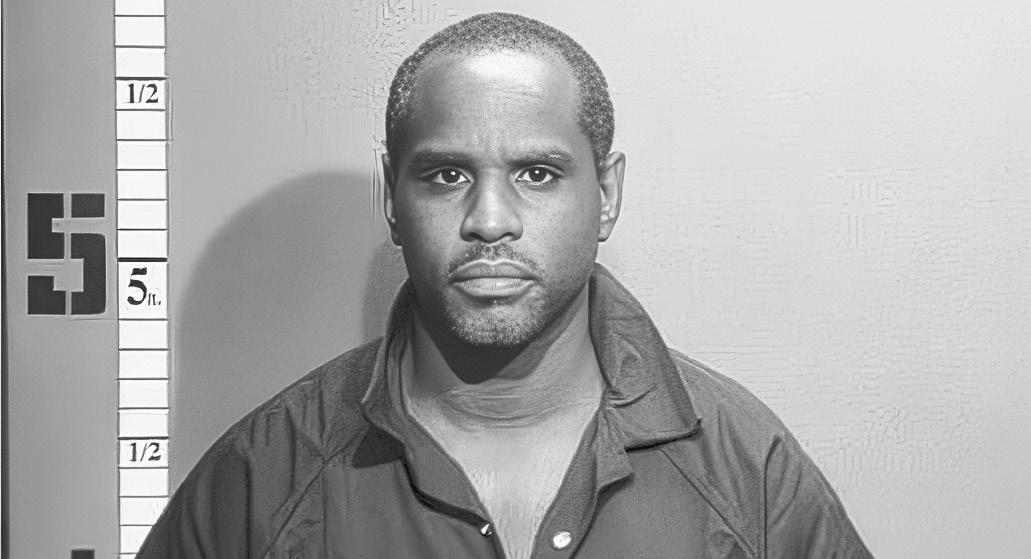
A BAHAMIAN man who sexually molested an 11-yearold girl in his care while living illegally in the US was sentenced to 27 years in federal prison last week.
Rian Wayne Johnson, 38, pled guilty to sexual exploitation of children as part of a plea deal.
In sentencing him, US District Judge Elizabeth Hanes also ordered Johnson to undergo a mental health evaluation and treatment and to participate in educational or vocational programmes while incarcerated.
Johnson had asked the court to impose the mandatory minimum sentence of 15 years, a position US prosecutors say was “far below the guideline range of 30 years to life imprisonment.”
The sentence follows his arrest last July after his former girlfriend reported the abuse to Newport News Police Department in Virginia.
The complainant reportedly discovered photos of the child, identifed as Jane Doe, 1, at their Virginia home after becoming suspicious that Johnson was cheating.
She said the pair met fve months before moving in together with the 11-year-old girl, who was not Johnson's biological child.
According to the complainant, Johnson told her he had known the girl's mother since the child was two-years-old.
Police later searched the home, seizing fve electronic devices and photographing the residence as part of their investigation.
They said numerous videos and pictures of the minor were found, including one showing the defendant masturbating while the child’s breasts are exposed. The complainant also reported watching a video where Jane Doe 1 is giving oral sex to the defendant. The woman confrmed the penis in the video belonged to Johnson.
US authorities say Johnson, when questioned, admitted that the videos were of him and the child and “that he knowingly employed, used, persuaded, induced, enticed, and coerced a minor, Jane Doe 1, who had not attained the age of 18 years to engage in sexually explicit conduct…”
He claimed the events happened between May 30 to July 15 last year in Eastern Virginia and elsewhere. Before sentencing, Johnson asked the court to impose the mandatory minimum sentence, citing his history of abuse as well as struggles with substance abuse and mental health issues.
By LEANDRA ROLLE Tribune Chief Reporter
lrolle@tribunemedia.net
THE country’s murder count rose to 32 on Thursday after a man was shot dead while sitting on a porch of Nassau Street. Police did not release the victim’s identify, but relatives say he is Cameron Dean. Dean was found dead on McQuay Street after an anonymous caller alerted police to a shooting in the area.
Preliminary investigations reveal that Dean was sitting on a porch speaking with another man when a
lone gunman approached and opened fre, striking the victim multiple times.
The suspect, who was wearing a blue hoodie and black mask, fed the scene on foot. It remains unclear whether the suspect was taken into custody. The incident was one of several violent episodes reported over the weekend.
Police also reported a double shooting on St James Road that left two men injured yesterday. The conditions of the men were not known up to press time. Meanwhile, police said investigations into both incidents are continuing.
He further argued that his age made him less likely to reofend based on age-related crime statistics.
He also contended that the federal sentencing guidelines were fawed argued that he, as a non-US citizen, would face additional punishment beyond those imposed on American citizens.
However, US prosecutors rejected that argument,
calling the recommended sentence “wholly unreasonable” and that if fails to refect the seriousness of the crime and send a strong message to the public.
As a result, Johnson was sentenced to 27 years behind bars, with credit for the time already served. He will also serve a 10-year term of supervised release following his prison release.
By DENISE MAYCOCK Tribune Freeport Reporter dmaycock@tribunemedia.net
A SENIOR pharmacist has accused government agencies of fuelling chronic medication shortages under the National Prescription Drug Plan through poor planning, outdated procurement practices and slow decision-making, even as a local pharmaceutical distributor warned that global supply chain pressures continue to disrupt access to some drugs.
The criticism followed the National Insurance Board's acknowledgement of concerns about the temporary unavailability of some medications used to treat chronic illnesses under the National Prescription Drug Plan.
“The National
Prescription Drug Plan acknowledges concerns regarding the temporary unavailability of certain medications used in the management of chronic illnesses. While only a limited number of products are currently afected, the NPDP is actively working to restore availability and expects replenishment over the coming days,” NIB said. NIB said the shortages stem from supply challenges afecting the availability of some products. It did not identify the afected medications.
However, a local distributor said Humalog, used to treat diabetes, and propranolol, used to treat hypertension, may be among the afected drugs.
Speaking on condition of anonymity, a senior pharmacist said some shortages

are linked to international supply problems, but argued that many local disruptions are worsened by government delays in approving changes and making procurement decisions.
The respected pharmacist, who asked to speak on the condition of anonymity, said government agencies cannot continue relying on outdated medication lists while the pharmaceutical market changes. The pharmacist said distributors have repeatedly raised concerns with government ofcials, but changes have not been made quickly enough.
He said delays in approvals and procurement decisions can leave distributors unable to source products through normal channels. The pharmacist
The Board of Directors of AML Foods Limited today announced its results for the fourth quarter and fiscal year ended April 30, 2026. Fourth quarter sales totaled $57.0m, representing an increase of 1.4% compared to the same period last year. For the fiscal year, sales reached $208.9m, an increase of 2.9% over the prior year. Net profit for the quarter totaled $9.0m, compared to $8.5m in the same period last year, representing an increase of 5.7%. The results include the remaining $3.0m in insurance proceeds related to the April 2025 fire. For the fiscal year, net profit was $19.3m, compared to $14.6m in the prior year.
We are pleased with our continued improvement in operating performance, with operating profit for the quarter increasing to $6.6m compared to $6.1m in the prior year. These results reflect the dedication and hard work of our team members, whose focus on operational excellence, execution, and store standards has helped deliver an enhanced shopping experience for customers across all our stores and formats. The improvement in performance was driven primarily by continued reductions in inventory shrink and increases in average basket size. We remain focused on initiatives that improve efficiency, deliver greater value to customers and strengthen profitability.
The year was also marked by the opening of new locations in Hoopers Bay, Exuma and Harbour Island, representing AML Foods' second and third store openings within the past twelve months. These investments underscore our commitment to expanding access to quality products, modern retail environments, and exceptional customer service throughout The Bahamas. We remain confident that these new stores will strengthen our presence in key communities while enhancing the shopping experience for residents and visitors alike.
Based on the quarter’s performance the Board of Directors have approved an ordinary dividend payment of $0.06 per share and an extraordinary dividend of $0.03 per share, both payable on June 25, 2026, to shareholders on record as of June 22, 2026
On behalf of the Board of Directors, I would like to extend our sincere appreciation to our dedicated team members for their hard work, commitment, and contributions throughout the year. We also thank our customers for their continued loyalty and support of our businesses. Your trust and partnership remain integral to our success.
Sincerely,
Gavin Watchorn CEO & President
also said distributors working under government contracts face price caps and cannot absorb the higher costs of expedited shipments.
Barbara Wilson, of Nassau Agencies Ltd, said the causes of medication shortages are often more complex and should not automatically be blamed on pharmacies, distributors or government agencies.
"Medication shortages are rarely caused by a single person, pharmacy, distributor, manufacturer, or government agency," she said.
Ms Wilson said shortages can emerge at any
stage of the supply chain, including through manufacturing delays, raw material shortages, transportation disruptions or higher-than-expected demand.
She pointed to ongoing global shortages afecting some insulin products, including Humalog. While some formulations have been difcult to obtain, she said alternative versions remain available.
Ms Wilson said some drugs reported to be in short supply, including propranolol, may still be available in diferent strengths or formulations. She said distributors
regularly update health authorities about inventory levels and expected delivery dates, though she acknowledged that communication about shortages can sometimes improve.
Ms Wilson urged patients not to panic if a medication is unavailable. She advised them to consult their pharmacist or physician about alternatives, other pharmacies that may have stock, or possible treatment changes.
NIB said it continues to work with suppliers and healthcare partners to address the shortages and ensure patients receive the treatment they need.
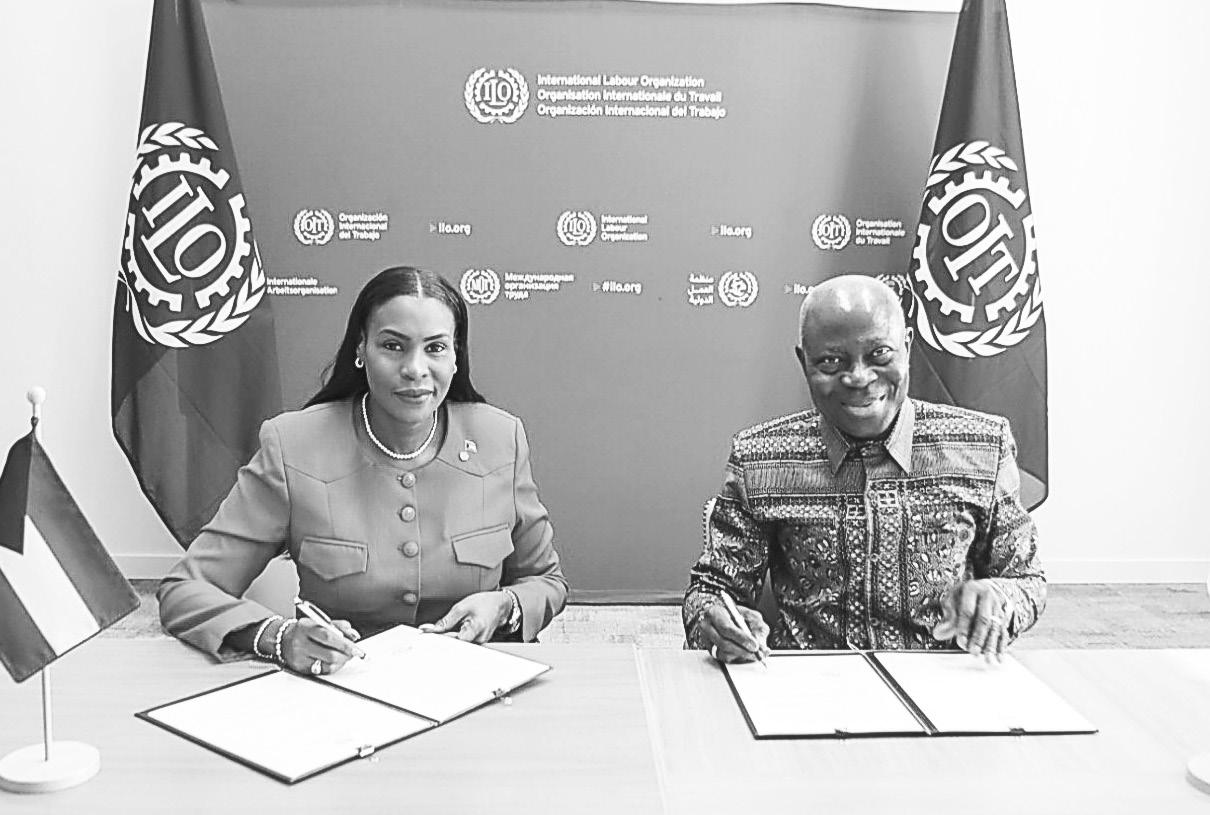
THE Davis administration has moved to strengthen workplace safety and maternity protections for women after ratifying three International Labour Organization (ILO) conventions during a conference in Geneva.
Labour and Public Service Minister Pia Glover-Rolle presented the country’s instruments of ratifcation to ILO Director-General Gilbert Houngbo at a recent ceremony.
The ratifcation of Conventions 155, 187 and 183 strengthens the nation’s occupational safety and health framework while extending maternity protections for women.
Long-awaited reforms
to the country’s maternity and paternity leave laws have previously been foreshadowed by the Davis administration and remain on track for implementation by mid-2026.
The move follows years of consultation with the tripartite council and Cabinet approval for ratifcation last year. A statement from the ministry said the decision refects the government’s broader commitment to advancing decent work for all. It added that preparations are already under way for the third iteration of the Decent Work Country Programme, with further consultations expected to guide legislation to bring
domestic law into full compliance with the three conventions over the next three years.
"This is a defning moment for Bahamian workers,” Minister Glover-Rolle said.
“Ratifying these three conventions means that every worker in this country, whether they are on a construction site or in an ofce, will have the full force of international occupational safety and health standards protecting them, and every working woman will have modern maternity protections in place. This administration made a commitment to decent work for all, and we are taking the necessary steps to deliver that promise."
By LEANDRA ROLLE
Staff Reporter
Tribune
lrolle@tribunemedia.net
THE Broadcasting Corporation of The Bahamas (BCB) sufered more than $1.2m in losses early Friday after a fre tore through its transmission facility on Baillou Hill Road South. Police were alerted to the blaze shortly after 4am by an anonymous caller. Three fre units responded and found the building fully engulfed in fames.
Preliminary reports indicate a power outage triggered the facility's backup generator. However, the generator reportedly began emitting smoke before catching fre, causing the blaze to spread.
Bahamas Power and Light (BPL) crews were later called in to disconnect electricity to the site, allowing frefghters to extinguish the fre after it gutted the building.
BCB Executive Chairman Picewell Forbes expressed sadness over the incident, saying the afected site houses ZNS Radio Bahamas 1540, The National Voice - one of fve stations operated by ZNS. Mr Forbes said the station reaches listeners throughout The Bahamas, the Turks and Caicos Islands, South Florida and the wider Caribbean.
“For our family islanders who have continued to call me all morning, when they can’t hear the 7.30 newscast or the community page when mailboats are coming or death announcements, it’s critical to them,” he told reporters at the afected site.
“And what’s also most concerning is right now, we’re in the middle of the hurricane season.”
He also noted that the fre comes after recent upgrades to the facility.
“So, we have lost just over $1.2m worth of equipment here. I’ve spoken with our engineers at the corporation, so we’ll have to take about two to three months to have a replacement.” He further added: “It’s a very sad occasion for me personally. Radio made me as a person in this country. I came here when this was all bush and we’ve taken the last two years to clear it down, redo the ground facilities here. The radios would’ve been redone, transmitting up to 48,000 to 50,000 daily. Our listeners on the islands could hear 1540.”
Police said they do not suspect arson, but that investigations are continuing.
Meanwhile, ZNS urged listeners in a statement on social media to tune in to Power 104.5 FM or visit its website for National Voice programming until full service is restored.
Monday, June 15, 2026
SMALL and medium-sized states, from the most vulnerable island nations to more diversifed middle‑income economies, have always faced a diffcult reality. They have to navigate a world in which power is unevenly distributed and in which the decisions of larger countries can have profound consequences for their security, prosperity, and independence.
For decades, however, there was a degree of predictability in international affairs. While powerful countries exercised greater infuence, there remained broad acceptance of certain principles: that sovereignty should be respected, territorial integrity protected, disputes settled peacefully, and international agreements honoured. International institutions and rules did not eliminate inequalities of power, but they helped to moderate them.
Today, that environment is less certain.
Geopolitical rivalry is intensifying. Economic pressure is increasingly used as an instrument of policy. Longstanding assumptions about alliances, international obligations, and sovereignty itself are being questioned more openly than at any time in recent memory.
For small and medium-sized states alike, these developments are especially signifcant—for the smallest because they magnify existing vulnerabilities, and for the medium-sized because they narrow the room for their, hitherto, independent initiative. They do not possess the military, economic, or political weight to shape international events on their own. Their prosperity depends upon stable international arrangements. Their security depends upon predictability. Their ability to pursue national objectives often rests on cooperation rather than coercion.
In a world where power is becoming more assertive and international rules less certain, the ability to build partnerships, form coalitions, and advance common interests through association may become one of the most important strategic assets for both small sates and medium sized nations, such as Austral-
ia and Canada. This is where the Commonwealth assumes renewed importance.
The Commonwealth – a voluntary association of 56 states from across the world remains one of the few international organisa-
never been free of power imbalances within its own association. Larger and wealthier members have often exercised considerable infuence over its priorities and decisions.
The United Kingdom has historically played a central role in shaping the institution.
The international system remains largely hierarchical.
The Commonwealth, by contrast, functions primarily through relationships, consultation, and consensus. That distinction matters.
Within the association all states possess something they
the Commonwealth matters today. For many years, concerns about sovereignty, territorial integrity, and vulnerability to external pressure were viewed primarily as a small states’ problem. Smaller nations understood instinctively the importance

tions that brings together major developed economies, emerging powers, and small vulnerable states within a single framework. It includes countries such as the United Kingdom, Canada, Australia, and India alongside nations from Africa, the Caribbean, the Pacifc, and Asia. At a time when states need wider partnerships and greater infuence, the Commonwealth offers something increasingly rare: a forum where countries of vastly different size and power engage one another regularly and directly. Yet the Commonwealth should not be romanticised. The Commonwealth has
Australia and New Zealand have long exercised signifcant infuence in the Pacifc. Canada, India, South Africa, and Nigeria each carry weight that smaller members cannot match.
The question, therefore, is not whether larger countries possess greater infuence. They plainly do. The more important question is whether the Commonwealth provides opportunities for smaller states to be heard, build coalitions, and affect outcomes in ways that would be far more diffcult outside the association; and, also, provides support for medium-sized nations that they now need.
By CATHY BUSSEWITZ Associated Press
NEW YORK (AP) — Many workers fear machines will supplant them as adoption of artifcial intelligence accelerates.
But what if people have qualities both unmistakably human and essential to career success that AI could not easily replace them?
Some workplace experts argue that with more businesses adopting AI tools, soft skills such as empathy, critical thinking and ethical decision-making are worth cultivating to help employees become indispensible.
Across industries and occupations, “the skills that are most resistant to displacement by AI are the ones that are the most distinctly human,” Maria Flynn, president and CEO of Jobs for the Future, a nonproft focused on workforce development, said. “Some of those things are relationship building, confict resolution, the ability to guide and motivate other people and ethical judgment.”
Even in job listings for technical roles such as IT support, organizations say they're looking for candidates who communicate well and take leadership initiative, Flynn said.
“We started to use the term ‘durable skills’ and think about them as capabilities that really are durable, in that they hold their value across economic shifts and technological change and labor
market disruption,” she said. “And we think, especially now, in this time of AI advancement, that it’s the durable skills that really make a worker genuinely valuable at work, regardless of what tools and technology are available.”
Here are three skills to cultivate based on the areas where experts say humans still hold an edge over artifcial intelligence.
Empathy
Interpreting body language and reading between the lines to decipher what wasn’t explicitly communicated are skills that many people fnd are best performed by humans. They also inform the ability to show empathy, and being sensitive to the feelings of others is a sought-after trait in workers.
Marco Iansiti, a professor of business administration at Harvard Business School, said he saw that frsthand during a hospital stay.
“A nurse has incredibly human impacts. Feeling, relating to the patient, the type of care that is so important,” Iansiti said. “I remember times when I was sick in the hospital and the nurse was like the godsend. Would I have let a robot do the same thing? No. There was a human connection there that I found very valuable.”
Where AI could be helpful in a hospital setting is by taking on mundane tasks such as paperwork, freeing up time for nurses to provide compassionate patient care, he said.
“There’s a lot of systems that are being deployed now that I think are very efective in doing this and essentially release healthcare workers to do the things that they should be doing and do best.”
Nurturing relationships
would otherwise lack: regular access, established networks, coalition‑building opportunities, and channels through which ideas and concerns can be advanced directly to decision‑makers.
While that does not create equality of infuence, it provides opportunities for smaller states to amplify their voice and advance their interests. Small states have frequently exercised infuence disproportionate to their size through collective action, whether on climate change, debt vulnerability, ocean governance, or broader questions of international development. But there is another reason
of international law because they lacked the power to rely on anything else. Now, medium-sized states need to embrace it too.
The international environment is less predictable. Assumptions that once appeared secure are being questioned more openly. Longstanding understandings about borders, alliances, and international obligations can no longer be taken for granted.
The Commonwealth’s commitment to sovereign equality, peaceful dispute settlement, and respect for international law therefore serves the interests of large and small members alike.
Historically, support within the Commonwealth was often viewed as fowing primarily from larger countries to smaller ones. Increasingly, however, larger members may also see value in the collective support that smaller states can provide in defence of sovereign equality, territorial integrity, and international law.
The Commonwealth is becoming more than a forum in which stronger states assist weaker ones. It is increasingly a community in which countries of all sizes have a shared interest in preserving an international order based on rules, cooperation, and mutual respect.
Therefore, the Commonwealth’s signifcance extends beyond development programmes, technical cooperation, or historical ties. It remains one of the few associations through which states of very different size and infuence can strengthen their voice, reinforce their resilience, and work together in support of an international order in which sovereignty remains meaningful.
The Commonwealth has historically achieved its greatest successes when it has combined principle with pragmatism. The same approach is needed today.
As the international environment becomes less predictable, countries of all sizes have a renewed interest in strengthening sovereignty, peaceful dispute settlement, and international cooperation. The Commonwealth remains one of the few forums in which those interests can be pursued collectively despite disparities of power.
The Commonwealth Heads of Government Meeting in Antigua and Barbuda this November offers an opportunity to demonstrate that relevance in practical ways and to help make the Commonwealth matter again.
(The writer was a member of the 2011 Commonwealth Eminent Persons Group that produced the Report “A Commonwealth of the People: Time for Urgent Reform”. He is Antigua and Barbuda’s Ambassador to the US and the OAS, and Chancellor of the University of Guyana. The views expressed are his own.)

Building strong personal ties with colleagues, clients and stakeholders remains a prized skill that experts say artifcial intelligence models have difculty replicating. Salespeople, for example, have fles or databases with information they've learned about their clients from interacting face-to-face.
"You have people that have trusted you and have bought products from you for the last 10 years. That has value and that’s hard to transfer to artifcial intelligence,” Iansiti said.
Interpersonal skills also are invaluable when conficts arise.
“Having that human in the loop to manage those expectations, to ease any rufed feathers, to build the type of relationships that are needed, to expedite good work,
is still going to be critical,” Flynn said.
Confict resolution is a musthave quality for managers, said Colleen Adler, director analyst in the human resources practice at the Gartner consulting frm.
“People do still have managers, and managers and leaders impact the way they feel, and co-workers impact the ways we feel as well," Adler said. "There is still a tone to AI that does not yet mimic human connection. That could change; I don’t think we’re there yet.”
Work environments are rapidly changing and many employees feel like they're lurching from one difcult dynamic to another, Adler said. While AI agents can't help workers feel better about
that uncertainty, strong leaders can help their teams, she added. Critical thinking Artifcial intelligence models collect information and produce responses but can generate inaccuracies, so it's important to second-guess its output. Developing deep knowledge about your feld can help you notice when the AI-generated results on topics from your industry are incorrect, said Amalia Kaufman, course developer and instructor at the University of California, Irvine Division of Continuing Education.
“You have to have the cognition and the critical thinking and the subject matter expertise to make sense of it, and to know when it’s wrong,” Kaufman said. “You have to check your facts.”
THE classifcation of foreign nationals as "likely at any time to become a public charge" under Section 212(a) (4) of the Immigration and Nationality Act (INA) remains a central pillar of United States inadmissibility law. This legal designation, defned further under 8 CFR 212.21, creates signifcant regulatory friction for citizens of nations that maintain high-value economic and tourism profles.
As of June 2026, the implementation of the "75-country pause" on immigrant visa issuance has intensifed this friction, particularly for Caribbean nations. The Commonwealth of The Bahamas presents a distinct paradox in this context: while the nation achieved a record-breaking 12.5 million visitors in 2025, solidifying its status as a premier global luxury brand, its individual citizens face the administrative burden of proving they are not fscal liabilities during US visa and residency adjudication processes.
This article, the frst in a four-part series, analyses the technical implications of this policy mismatch and the necessary diplomatic interventions required to protect Bahamian human capital.
Regulatory Framework of the Public Charge Rule
The classifcation of a foreign national as inadmissible on public charge grounds arises under INA § 212(a) (4), 8 U.S.C. § 1182(a)(4). Under 8 CFR 212.21(a), a "public charge" is defned as an individual who is likely at any time to become primarily dependent on the government for subsistence, as demonstrated by the receipt of public cash assistance for income maintenance or long-term institutionalisation at government expense.
The operative adjudicatory method remains the "totality of the circumstances" test. Under INA § 212(a) (4)(B), offcers are required to evaluate, at a minimum, age, health, family status, assets, resources and fnancial status, and education and skills.
The assessment conducted under 8 CFR 212.22 is predictive rather than retrospective. The inquiry is whether the applicant is more likely than not to become a public charge in the future, based on the statutory factors and supporting documentation submitted at the time of adjudication. The analysis is confned to individualised evidentiary thresholds, even where the surrounding national context demonstrates strong labour partici pation, sophisticated industry sectors, and low dependency indi cators associated with "Brand Bahamas."
The statistical incon gruity: 12.5 million visitors vs. "liability"
The 75-country pause, effective January 21, 2026, places The Bahamas within a grouping that includes materially higher-risk jurisdictions. The available refusal data does not support that alignment. A Bahamian refusal rate of approximately 12.8% is signifcantly lower

The inconsistency is further amplifed by the presence of U.S. Customs and Border Protection (CBP) Preclearance facilities in The Bahamas. The Bahamas is the only country on the pause list with that institutional arrangement, which constitutes an operational acknowledgment of trusted border management and a comparatively low-risk

Bahamas recorded 12.5 million visitors in 2025, con frming its status as a stable tourism econ omy, regional transit hub, and highvalue services jurisdic tion. That volume of lawful inbound movement is inconsist ent with any generalized presumption that Bahamian nationals present elevated fscal or compliance risk in US immigration processing. The contradiction is structural: a country treated internationally as a trusted destination is simultaneously subjected to heightened visa friction when its citizens seek immigrant processing.
One Tech Tip: What to know about fying with lithium ion portable battery chargers
By KELVIN CHAN AP Business Writer
Jetting of soon for summer travels? If you’re planning on bringing an extra battery charger for your phone or other devices, be aware of the latest rules when taking one on a fight.
Rechargeable lithium-ion portable battery chargers, also known as power banks, come in protective enclosures of various shapes and sizes. They’re a handy and popular way for getting more juice when you’re on the move.
But after a spate of smoke or fre incidents, U.S. and international aviation authorities have issued new guidelines and airlines have tightened up rules for passengers. Here’s a guide on fying with power banks. The rules around power banks on planes
The most important thing to know is that you can’t pack lithium battery chargers in your checked luggage. They need to go in your carry-on luggage.
Travelers can generally bring two lithium ion power banks with a capacity of 100 watt hours without needing airline approval. That’s more than enough to charge a cellphone several times over.
For non-rechargeable lithium metal batteries, the limit is two grams of lithium per battery. AA and AAA batteries typically contain less than a gram of lithium. Those limits cover nearly all types of lithium batteries in an average person’s electronic devices, according to the the Federal Aviation Authority.
The FAA says newer lithium ion batteries should have a label with the watt hour, or Wh, rating. But if your power bank’s energy capacity is
listed in milliampere hours, or mAH, you’ll need to do some math, or use the FAA’s online calculator.
To fgure out your battery’s watt-hour rating, take the mAH number, divide it by 1,000 to get ampere hours, and then multiply by the device’s voltage, which is usually 3.7 volts. For example, a battery with 10,000 milliampere hour rating is equal to 10 ampere hours. Multiply that by 3.7 volts and you get 37 watt hours.
Passengers will need airline approval for bigger lithium-ion batteries, with a capacity of 100 to 160 watt hours, such as those used in professional video gear or medical equipment.
Why lithium power banks can’t go in checked luggage Airlines are taking the risk of lithium battery fres seriously after a rash of incidents.
One of the worst happened in January 2025 when a fre broke out on an Air Busan plane waiting to take of from an airport in South Korea, forcing the evacuation of all 176 people aboard. The FAA lists nine lithium battery air incidents so far this year, including six that involved power banks.
Concerns about the batteries have been enough to disrupt fights even when there were no signs of a problem. Last month, an Easyjet fight from Egypt to Britain diverted to Rome as a precaution after a passenger told the crew that they had a power bank in checked luggage charging a device.
Lithium batteries in a jet’s cargo hold pose a danger because if there’s smoke or fre, the crew can’t take immediate action to identify and extinguish it, according to the International Air Transport Association, or IATA.
28-30% range documented elsewhere in the Caribbean. For those seeking US immigration help Bahamas, that disparity establishes a measurable disconnect between actual adjudicatory outcomes and the policy signal created by inclusion in the pause framework.
Asset correlation and the bility" paradox is most mian professional class. Nationals employed in fnance, law, hospitality, maritime operations, and related high-skill sectors are required to overcome public charge scrutiny despite strong labour force and limited ence on is not ical. It
Bahamians satisfy those criteria as a baseline matter. The present framework nevertheless fails to convert that reality into a presumption of low risk. That defciency necessitates a more technical presentation of applicant profles and a more deliberate use of immigration services in the Caribbean to align documentary evidence with the actual legal standard.
Policy recommendations and the diplomatic "ask"
Resolution of the current mismatch requires a transition from generalized diplomatic objection to datadriven bilateral engagement.
The objective should be a measurable policy carve-out for The Bahamas based on refusal-rate performance, institutional cooperation, and documented economic reliability.
What government ministries, diplomatic missions, and government-adjacent entities could consider asking for in this climate:
Data integration: Longitudinal refusal-rate studies and applicant outcome data should be presented to the U.S. Department of State to support a country-specifc carve-out from the 75-country pause. The 12.8% refusal rate should be advanced as a core evidentiary benchmark.
Bilateral reciprocity: The 12.5 million visitor milestone and the existing CBP Preclearance relationship should be used as leverage in negotiations concerning streamlined processing and differentiated treatment for Bahamian nationals.
ment history ily be treated as favourable indicators under the statutory framework. Education and skills remain among the strongest defences to a public charge fnding. Under INA § 212(a)(4)(B) and the implementing regulations, employability, credentialing, and demonstrable occupational specialization operate as material positive factors. Most internationally mobile
Educational credentialing: Standardized equivalency protocols for Bahamian academic and professional qualifcations should be developed to simplify consular review of the "education and skills" factor.
Transparency: Public-beneft usage data and related labor-market indicators should be shared in a formal framework to document the low-risk profle of Bahamian applicants.
Technical strategy for compliance
Individual applicants must approach the public charge assessment with a technical mindset. It’s insuffcient to merely state fnancial solvency; documentation must be structured to address the "totality of the circumstances" test directly. This includes the presentation of liquid assets, proof of comprehensive health insurance (to mitigate the "health" factor), and a detailed employment history that refects a high degree of specialized skill.
strength and legal infrastructure
The institutional strength of The Bahamas, refected in its high approval rates and the preparedness of its people, proves that its citizens are assets, not liabilities. The Supreme Court of The Bahamas and other legislative bodies provide a framework of stability that produces high-caliber professional citizens. When US immigration policies treat these citizens as potential public charges, they ignore the institutional vetting already performed by the home nation's educational and professional structures. The "Luxury vs. Liability" paradox for the Bahamas, due to being listed on the 75-country ban list, is a real threat to the luxury brand that the Bahamas has taken 53 years to build, and it can only be resolved through a combination of individual legal precision and high-level governmental intervention. The citizens of the Bahamas are waiting and watching to see their leaders’ next move. Will they actively advocate on behalf of the citizens for their country to be removed from the list?
Or will they sit passively by and watch their luxury label legacy slip away……
Disclaimer: The information provided in this article is for general informational purposes only and does not constitute legal advice.
To schedule a consultation: Call us @ 954-828-2429. Message us on WhatsApp@ 954-828-2429 or send us an
By PAVEL BAILEY Tribune Staff Reporter pbailey@tribunemedia.net
A 17-YEAR-OLD girl was granted bail on Friday after she was accused of committing perjury during a Supreme Court trial in March.
Prosecutors allege the teenage defendant, whose name is being withheld because she is a minor, intentionally gave false evidence under oath during a legal proceeding on March 11.
The defendant pleaded not guilty to perjury
before Assistant Chief Magistrate Kara Turnquest Deveaux. Her bail was set at $3,000 with one or two sureties. She returns for trial on September 16. Sergeant 3004 Forbes was the prosecutor. The perjury charge relates to the trial of Defence Force marine Vann Miller, who was acquitted on March 11 by Justice Neil Brathwaite of an alleged sexual assault against the defendant. She had testified that she met Miller online
after completing primary school and that he knew her age. She said they began a sexual relationship in 2021, when she was 12, and told the court they had sex daily until March 2023, when her mother and police caught her and Miller together. However, the teen claimed she had lied under oath when the defence recalled her to the stand on March 11, leading Justice Brathwaite to direct jurors to acquit Miller of unlawful sexual intercourse.
FEAR
By PAVEL BAILEY Tribune Staff Reporter pbailey@tribunemedia.net
A 42-YEAR-OLD man appeared in court accused of sexually assaulting his fve-year-old daughter. Prosecutors allege the defendant, whose name is being withheld to protect the identity of the minor, had sexual intercourse with the girl sometime between
April 3 and 4 in New Providence.
The defendant was not required to enter a plea to the incest charge before Assistant Chief Magistrate Kara Turnquest Deveaux. He was informed that his matter would proceed to the Supreme Court by a voluntary bill of indictment.
The defence said it intends to apply for
emergency bail in the Supreme Court. Until bail is granted, the accused will be remanded to the Bahamas Department of Correctional Services. Service of the voluntary bill of indictment is set for October 3. Sergeant 3004 Forbes was the prosecutor, while Tai Pinder-Mackey represented the accused.
By PAVEL BAILEY Tribune Staff Reporter pbailey@tribunemedia.net
A 17-YEAR-OLD boy was granted bail on Friday
Anxiety is not simply “stress.” Obsessive compulsive disorder is not about being neat or particular. Trauma is not weakness. For many people, these conditions can quietly dismantle careers, relationships, faith, sleep, health, and peace of mind.
Yet e ective treatment exists.
John Daniel Getchell, MSW, LCSW, a licensed psychotherapist in the United States now serving patients in e Bahamas, is bringing specialized training in anxiety, obsessive compulsive disorder, trauma, and evidence based treatment to e Discovery Clinic in Sandyport, Nassau.
A graduate of Missouri State University, Getchell brings extensive clinical experience along with 15 years of service within the United States military, working with trauma, resilience, and the human struggle under intense pressure.
His primary specialty is Exposure and Response Prevention therapy, known as ERP, a treatment widely regarded as one of the gold standards for OCD and severe anxiety disorders.
“People hear the word ‘exposure’ and assume something frightening,” Getchell said. “In reality, ERP is a practical, structured, short term treatment that helps people gradually face what fear has taught them to avoid. e goal is not su ering. e goal is freedom.”
Fear thrives on avoidance. Anxiety grows stronger when lives become organized around escape, reassurance seeking, compulsions, or constant attempts to eliminate uncertainty. ERP works by teaching people a new relationship with fear, one built on courage, acceptance, and evidence based behavioral change.
Research has shown that many individuals who fully engage in ERP treatment experience substantial improvement, with severe anxiety and OCD symptoms o en reduced by 50 percent or more. Studies also consistently demonstrate strong response rates among patients willing to commit to the process.
Perhaps most importantly, ERP is designed to empower patients rather than create lifelong dependence on therapy.
“ e aim is not to keep someone in treatment forever,” Getchell said. “ e aim is to teach skills that people can use independently. Once you understand how anxiety works and learn how to respond di erently to fear, you begin taking your life back.”
Getchell also stresses that therapy is not the only pathway to healing. Medication can be an essential and, at times, life changing component of treatment for anxiety disorders, depression, OCD, trauma related conditions, and other mental health concerns.
At e Discovery Clinic in Sandyport, patients have access to a comprehensive, multidisciplinary mental health team that includes psychiatrists, therapists, and dedicated support sta providing coordinated, individualized care. Treatment may involve psychotherapy, medication management, or a carefully tailored combination of both.
Mental health struggles a ect people from every walk of life, o en silently and invisibly. Behind successful careers, strong families, ministries, businesses, and public faces, many individuals are ghting private battles with panic, intrusive thoughts, fear, trauma, and emotional exhaustion.
e message, Getchell says, is simple but urgent.
“ ese conditions are real. ey are painful. But they are also highly treatable. People should know that they are not alone, they are not broken, and there is real help available.”
Appointments with e Discovery Clinic, 207 Lagoon Court, Sandyport Olde Town can be scheduled by calling 242 327 8718 or 242 327 8719.
John Daniel Getchell, MSW, LCSW
Licensed Psychotherapist
Graduate of Missouri State University
Specialized in Anxiety, OCD, Trauma, and Evidence Based Treatment Serving e Bahamas through e Discovery Clinic, 207 Lagoon Court, Sandyport Olde Town, Nassau
while awaiting sentencing for possessing a banned rife and ammunition.
The teenage defendant, whose name is being withheld because he is a minor, was found with a prohibited black AR-15 rife and 12 .223 rounds in New Providence on June 9. The accused was found with an additional eight .223 rounds on June 11. He pleaded guilty to possession of a prohibited weapon and two counts of possession of ammunition before Assistant Chief Magistrate Kara Turnquest Deveaux.
His co-accused, Andrew Thurston, 56, and Andrea Thurston, 26, both pleaded
not guilty to the charges. All three defendants were granted $3,000 bail with one or two sureties each.
The juvenile will remain on bail until the trial of his co-accused concludes, after which he will be sentenced. Under the terms of his bail, the teen must sign in every Monday, Wednesday and Friday at his local police station and obey a daily residential curfew. He will also be ftted with a monitoring device.
The matter proceeds to trial for the remaining defendants on September 15. Sergeant 3004 Forbes prosecuted the case.
66-year-old accused of escaping police custody
By PAVEL BAILEY Tribune Staff Reporter pbailey@tribunemedia.net
A 66-YEAR-OLD man accused of escaping from the Nassau Street Police Station last week was remanded to prison on Friday.
Prosecutors allege Henry Wright escaped from the police station around 10am on June 11 while in custody in connection with a crime.
Later that same day, Wright allegedly resisted arrest, cursed Reserve Sergeant 1624 Laroda on South
Street and behaved in a disorderly manner.
Wright pleaded not guilty to escape from lawful custody, resisting arrest, obscene language and disorderly behaviour before Assistant Chief Magistrate Kara Turnquest Deveaux. Sergeant 3004 Forbes, the prosecutor, objected to bail, citing the seriousness of the ofences.
Wright was denied bail and remanded to the Bahamas Department of Correctional Services. He returns for trial on September 16.






By ELISE MORTON and BRIAN MELLEY Associated Press
ARMED British forces boarded and detained a sanctioned tanker Sunday that is suspected of being part of the Russian “shadow feet,” shipping oil in violation of international sanctions over Moscow’s war on Ukraine, British Prime Minister Keir Starmer said Sunday.
Royal Marine commandos rappelled from helicopters onto the vessel, the Smyrtos, in the English Channel, in what the country’s Defense Ministry called “the frst U.K.-led operation of its kind.”
The vessel will be held and monitored of the south coast of England for investigation, according to
the Defense Ministry. The operation was carried out “in close coordination” with French authorities, who have previously intercepted a number of vessels linked to the “shadow feet.”
“This operation delivers yet another blow to Russia and reminds those fueling Putin’s war in Ukraine that they cannot hide,” Starmer said.
Russia is believed to be using a feet of hundreds of ships to evade sanctions over its war against Ukraine.
Sailing under a Cameroon fag, the Smyrtos left the Russian Baltic port of Ust-Luga on June 5 destined for Port Said, Egypt, according to the MarineTrafc website.
U.K. authorities said that such operations were
“directly bearing down on the resources sustaining Russia’s aggression in Ukraine and reducing its capacity to threaten security across Europe and beyond.”
Ukraine President Voldymyr Zelenskyy thanked Starmer and the British people for their “principled resolve.”
“It was Russia’s hubris, fueled by high oil and gas revenues, that paved the way for this war, and every decision by partners that deprives Russia of money also limits the war itself,” Zelenskyy said on X.
“Europe urgently needs to take legislative steps to enable not only the detention of tankers and restrictions on oil shipments, but also the confscation of the oil they carry.”