



US warns of rise in export tax over Bahamas’ lack of laws against forced labour
By NEIL HARTNELL Tribune Business Editor nhartnell@tribunemedia.net
A SENIOR fisheries executive yesterday asked “where does it end” as the Trump administration threatened to hit Bahamian exports to the US with 12.5 percent tariffs after finding this nation is failing to combat imported goods made with forced labour.
Adrian LaRoda, president of The Bahamas Commercial Fishers Alliance (BCFA), told Tribune Business that imposing such US border taxes on spiny lobster threatens to place a key fisheries product “at a serious competitive disadvantage” and undermine a major portion of the industry’s annual $90m global exports.
See BUSINESS FOR STORY
By NEIL HARTNELL Tribune Business Editor nhartnell@tribunemedia.net
A NNUAL Bahamian
household spending on electricity bills is “five times’ higher” than the Latin American and Caribbean average, an Inter-American Development Bank (IDN) report has revealed, due to “structural generation and system inefficencies”. The multilateral lender, in its first quarterly
Caribbean bulletin for 2026, said Bahamian energy costs cannot be blamed on oil price volatility alone and noted that the sustainability of Bahamas Power & Light’s (BPL) Equity Rate Adjustment tariff structure - which ensures the first 200 kilowatt hours every month are free - depends on reducing generation costs and boosting efficiency.
See BUSINESS FOR STORY

By LYNAIRE MUNNINGS Tribune Staff Reporter lmunnings@tribunemedia.net
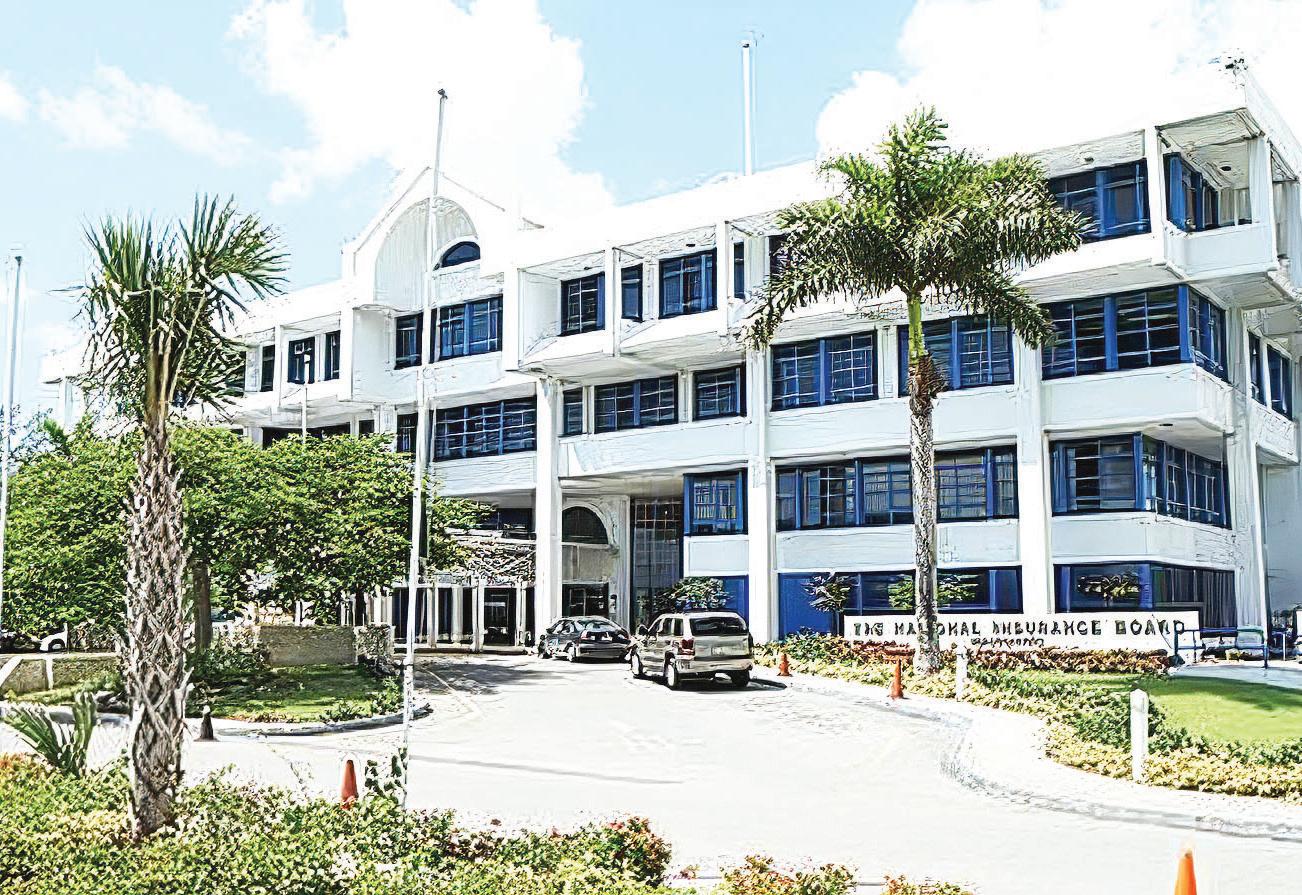
WORKERS earning more than $810 a week will pay about $4 more per month in National Insurance contributions from July 1, while pensioners will receive a monthly increase as the National Insurance Board rolls out its latest statutory biennial adjustments.
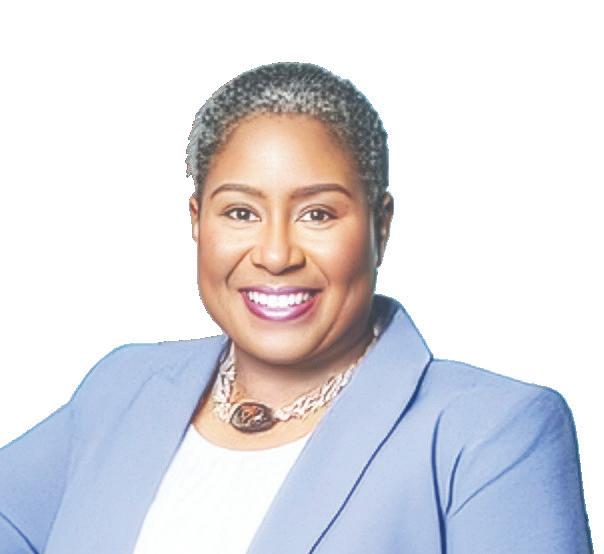
The changes, announced yesterday by NIB Director Dr Tami Francis, include a 1.5 percent increase in pensions and grants and an increase in the insurable wage ceiling from $810 to $830 per week.
The adjustments fall under the National Insurance Act framework governing mandatory biennial reviews, a system
LYNAIRE
NATIONAL Insurance Board Director Dr Tami Francis insisted yesterday that the pension fund “is actually not in crisis” after government warnings and actuarial concerns pointed to deep long-term pressure from a shrinking workforce, rising retiree numbers and demographic decline.
Dr Francis said the fund’s position has improved since the 1.5 percentage point contribution rate increase in July 2024, which she said is generating about $4m in additional monthly income and helping to stabilise short and medium-term finances.
“This is not a full stopgap measure – no, just contribution rate is just not the only CRISIS - SEE PAGE FOUR INCREASE - SEE PAGE FOUR
We wish






By LEANDRA ROLLE Tribune Chief Reporter lrolle@tribunemedia.net
FREE National Movement chairman Dr Duane Sands said he does not expect to seek re-election as party chairman when the FNM holds its next convention.
His admission comes as the party faces internal backlash over a decision to delay the constitutionally due gathering until next year. The party’s constitution requires a convention every two years. The FNM last held one in June 2024.
Dr Sands confirmed yesterday that the party’s council voted on Tuesday night against holding an early convention, although one is constitutionally due this year. He said the council instructed that the convention be held next year, but suggested the date could still change.
He declined to explain the reasons for the delay, despite criticism from some party members over the extended timeline.
Some supporters have objected to the decision on social media and in private group chats, calling for a fresh mandate and new leadership after the party’s sweeping election defeat, the first time the Official Opposition had failed to win an election in three decades.
Former Prime Minister Hubert Ingraham told The Tribune yesterday that he believed it “made good sense” to hold the party’s convention next year.
The timing has sharpened attention on the FNM’s leadership race, with speculation
continuing over who may emerge as frontrunners.
FNM leader Michael Pintard has not said whether he will step down or remain in the post. He reportedly told supporters he will await the party’s post-mortem before deciding.
Deputy leader Shanendon Cartwright recently said he would decide his political future after losing his seat. The former St Barnabas MP is being watched as a possible contender, with some party insiders viewing Mr Pintard’s decision not to appoint him to the Senate as an attempt to sideline him.
East Grand Bahama MP Kwasi Thompson stopped short of taking a firm position in a statement yesterday, saying only that his focus remains on serving his constituents and helping the FNM become a strong and effective opposition capable of winning back the trust of Bahamians.
“We have come through a difficult election,” he said. “The Bahamian people expect us to take a hard look at ourselves, to understand where we fell short, and to emerge stronger, better, and more connected to the concerns of ordinary people. The process requires humility, honesty and a willingness to change where change is necessary.”
Dr Sands said he will not seek re-election as chairman, but declined to comment further on his future plans.
Newly elected FNM MPs Michela Barnett-Ellis and Lincoln Deal, both considered bright stars with potential, declined to comment on their plans, saying they remain focused on their constituencies.
By KEILE CAMPBELL Tribune Staff Reporter kcampbell@tribunemedia.net
FREE National Movement MP Dr Andre Rollins has accused the Davis administration of trying to slip a major immigration change through Parliament during the budget debate, warning that a proposed amendment to the Bahamas Nationality Act could create a “dangerous loophole for exploitation”.
The Bahamas Nationality (Amendment) Bill, 2026 would allow the minister of immigration to grant permanent residency to people whose citizenship applications are rejected, once they pay a $500 fee.
The bill would amend section seven of the Bahamas Nationality Act, which sets out the circumstances under which people who are not entitled to Bahamian citizenship at birth may apply to become citizens. Those categories include women married to Bahamian citizens, people born in The Bahamas to non-Bahamian parents, and people born outside The Bahamas to Bahamian women married to non-Bahamian men.
Under a proposed new section 7A, “If the minister refuses an application under section 7, the minister may, upon payment by the applicant of the fee of $500, grant the applicant a certificate of permanent residence subject to such terms and conditions as the minister thinks fit.”
By PAVEL BAILEY
Staff Reporter
PROSECUTORS immediately launched an appeal for a harsher sentence yesterday after a mother and daughter were jailed for seven years after being convicted of the attempted murders of two of their tenants. Sentences of 25 years were appropriate for for Michelle Williams, 57, and Glenresha Williams, 37, they argued, citing the seriousness of the offence and the anguish endured by the victims. An appeal was lodged on the grounds that the sentences for the attempted murders were too lenient. The defence argued that a shorter sentence was appropriate because it was the accused’s first offence. The pair were convicted last November. Although the convicts were initially expected to be allowed bail until sentencing, prosecutors successfully blocked the move by appealing to the Court of Appeal. The convicts, along with
a man, attempted to kill Adrian Cooper and Savannah Bain with a handgun on an unnamed road near Komer Street on October 21, 2021.
The victims testified that the pair cut them off on the road. They said Glenresha confronted Savannah outside their vehicles before a man exited the defendant’s vehicle and shot at them.
Adrian said he thought he was going to die after a bullet grazed his face, while Savannah expressed similar fear for her life during the ordeal.
Glenresha claimed during testimony that she thought the shots came from somewhere else. She claimed she did not know the man in their vehicle had fired the shots until surveillance footage of the incident was played.
Before the shooting, the defendants reportedly contacted the victims asking for rent money.
T’Shura Ambrose and Ashton Williams prosecuted the case before Justice Renae McKay. Cassie Bethel and Tamika Roberts represented the defendants.
Dr Rollins, the Long Island MP and opposition shadow minister of foreign affairs and immigration, criticised what he described as an attempt to bury a significant change to immigration law inside the budget debate.
“We strongly advise the government against seeking to bury something as significant as the conferral of permanent residency at a cost even cheaper than that of an annual work permit - and its attendant consequences within a budget debate,” the statement read.
Dr Rollins said Opposition Leader Michael Pintard had previously urged the government to establish a select committee on immigration to address concerns about the country’s immigration system in a transparent way.
“Despite this recommendation, the government is attempting to use the upcoming budget debate exercise as an opportunity to introduce by stealth a significant amendment to our nation's immigration laws, which potentially will create a dangerous loophole for future exploitation,” Dr Rollins said.
The proposed amendment touches one of the country’s most sensitive and long-running citizenship controversies.
Under the current law, children born outside The Bahamas to Bahamian women married to non-Bahamian men are not entitled to Bahamian citizenship at birth. They may apply for
citizenship after turning 18, but must do so before they turn 21.
The issue was put to voters in failed referendums in 2002 and 2016, both of which sought to address citizenship equality for married Bahamian women with non-Bahamian spouses.
People born in The Bahamas to non-Bahamian parents also are not automatically entitled to citizenship at birth. They may apply after turning 18, but have only a 12-month window to do so, a restriction that has long raised concerns about the risk of statelessness.
The existing law allows the minister to refuse citizenship applications on several grounds, including if an applicant was convicted in the previous five years and sentenced to death or more than one year in prison, is not of good behaviour, has engaged in conduct that could threaten public safety or law and order, was declared bankrupt, or lacks the means to support themselves and is likely to become a public charge.
It also allows refusal if, for reasons of public policy, the minister is satisfied that granting citizenship would not be conducive to the public good.
Dr Rollins said the FNM maintains that citizenship and permanent residency issues should be examined by a select committee rather than advanced through the budget debate.

households.
designed to keep benefits and contribution thresholds aligned with inflation and wage growth.
A pensioner receiving the minimum retirement pension of about $364 per month will now receive about $369.46. Workers earning more than $810 per week will pay contributions on an additional $20 of weekly earnings when the new ceiling takes effect.
Dr Francis said the changes are required under a statutory biennial review process introduced through amendments to the National Insurance Act in 2010. The amendments replaced the previous system, under which changes required separate legislative approval.
“In July 2010 the National Insurance legislation was amended to establish a statutory biennial adjustment process for pensions, grants, and the insurable wage ceiling,” she said. “Prior to that amendment changes of this nature required separate legislative action. The amendment created a structured framework that allows these reviews and adjustments to occur every two years, ensuring that benefits and contribution thresholds remain responsive to economic conditions and changes in the cost of living.”
She said the adjustments are based mainly on movements in the Retail Price Index, which tracks changes in the cost of a basket of goods and services commonly bought by
“Think about the cost of living today compared to where it was two years ago. Of course, our grocery bills are higher; many household expenses cost more than they did just a few years ago,” Dr Francis said.
“The retail price index measures those changes across a basket of goods and services that people purchase every day. The law requires NIB to review those changes every two years and to determine the rate at which pensions and grants should be adjusted.”
Dr Francis stressed that the increases are not discretionary, but are legally required under the Act to help prevent benefits from losing value as inflation rises.
She confirmed that all pensions and grants will
improvements and operational efficiencies.
measure to put in place to help save the fund,” she said during a press conference yesterday. “So of course, we would be combining the contribution rate increase with other measures that would have been so, for example, recommendations that would have been made in successive actuarial reviews, as well as in-house recommendations being made to work in tandem with recommendations such as a contribution rate increase.”
Dr Francis said long-term sustainability depends on several measures, including actuarial recommendations, internal reforms, compliance
She said the goal is to extend the life of the fund well beyond 60 years so it can support future generations. Although she said current performance is stronger than previously projected, she acknowledged a continuing gap between contribution income and benefit expenditure and warned against complacency.
“While we may still have a slight difference in our contribution income versus our benefit expenditure, what we would have expected or predicted, we are doing a lot better than expected,” she said. “Now, that does not mean we are to rest on our laurels, but an increase of this nature would not
be something that will ultimately save the fund.”
Dr Francis said National Insurance is operating in a global environment where social security systems are being affected by demographic change, including ageing populations and lower birth rates.
She noted that when the system was introduced in 1974, there were about seven workers supporting each retiree. Today, there are roughly three workers per retiree.
The system has faced mounting pressure from rising pension payouts, an ageing population and a shrinking ratio of workers to retirees, factors that have prompted repeated warnings from officials and actuarial

increase by 1.5 percent,
although the amount received will vary depending on when the benefit was awarded.
“As a result of this review of that review, which considered changes in the RPI over the review period, pensions and grants will increase by one and a half percent, while the insurable wage ceiling will increase by $20 per week to ensure coverage aligns with earnings growth,” she said.
“Therefore, the weekly insurable wage ceiling will increase from $810 to $830. The monthly insurable wage ceiling will increase from $3,510 to $3,597. All minimum pension rates and grants will increase by one and a half per cent. All pensions currently in payment before July 2026 will increase by up to one and a half per cent. The maternity grant will increase from $560 to $570, and lastly, the funeral benefit will increase from $2,060 to $2,100 for pensioners.”
She added: “These adjustments provide important protection
reviews about long-term sustainability.
In October 2025, then Social Services Minister Myles Laroda warned that The Bahamas’ low birth rate poses a direct threat to NIB’s future stability, noting that the fertility rate of about 1.7 children per woman is below the replacement level of 2.1 needed to maintain population levels.
Mr Laroda said that without sufficient population growth, fewer workers will be available to support a growing number of pensioners. He said the ratio of contributors to retirees is central to the fund’s survival, describing around six workers per retiree as a healthy benchmark and warning that a drop toward three workers per retiree strains the system.
He also said that while the number of pensioners has more than tripled since the 1980s, the contributor base has not grown at the same pace, widening the gap between inflows and outflows.
Actuarial projections have previously warned that, without further reforms, the fund’s reserves could come under significant pressure in the coming years.
against rising living costs. A pensioner receiving the minimum retirement pension of approximately $364 per month will receive an increase of approximately $5.46 per month. Now, while this increase may appear modest, it reflects an important principle: pension benefits should not be frozen while the cost of living continues to change.”
Pensioners who began receiving benefits before July 2024 will receive the full 1.5 percent adjustment. Those who started receiving pensions after that date will receive smaller, phased increases based on how recently they entered the system.
The insurable wage ceiling determines the maximum level of earnings used to calculate National Insurance contributions.
Dr Francis said the increase will affect only workers earning more than $810 per week, while those at or below the threshold will see no change in deductions.
“The insurable wage ceiling is the maximum
Government figures have shown that contribution rates were increased in July 2024 from 9.8 percent to 10.3 percent, with further increases reportedly under consideration to stabilise the system.
Dr Francis said NIB has introduced operational and administrative reforms, including digital platforms such as the Employer Self Service system and the C10 Mobile App, which allow employers and self-employed contributors to make payments electronically instead of visiting offices.
She said the systems are intended to improve compliance and make payments easier and more efficient.
She also highlighted enforcement and compliance efforts, including the expansion of inspection teams by about 22 officers and the use of “boots on the ground” initiatives to engage delinquent employers.
She said the agency has implemented interest waiver programmes to encourage employers to settle outstanding debts, particularly in Grand Bahama and Abaco, where higher waiver incentives were offered.
weekly earnings that NIB uses rather to calculate its contribution payments.
Many people assume that every worker will be paying more into national insurance, but that is not the case,” she said.
“The increase only affects contributors whose weekly earnings exceed the current insurable wage ceiling of $810. If you earn $810 per week or less, there will be no change to your national insurance deductions. For contributors earning above $810 per week, the new ceiling of $830 means that contributions will now be calculated, of course, on the additional $20 of weekly earnings.”
For affected workers, the increase amounts to about 93 cents more per week for employees, or roughly $4 per month. Employers will pay about $1.33 more per week, or about $5.76 per month, for each affected employee. Self-employed contributors will pay about $2.06 more per week, or $8.93 per month.
She said NIB uses incentives, payment plans and enforcement actions, describing the strategy as a “carrot and stick” approach.
She said administrative costs have fallen from about 21 percent in 2018 to around 15 percent, though international benchmarks for social security systems are closer to ten percent.
She stressed that no social security system is immune to demographic pressure, citing declining birth rates, longer life expectancy and changing workforce patterns.
She said the system is not designed to remain static and must continue adjusting over time, while balancing benefits for current pensioners with the needs of future contributors.
“We are having less children, and we have that ageing population, so we have to come up with innovative ways to ensure that the fund is increased over the long term,” she said.
“There are several things that we may do to increase it over the short and medium term, but we want that stretch, we want that 60-year, we want that 78-year, that’s our ultimate goal.”
By LEANDRA ROLLE Tribune Chief Reporter lrolle@tribunemedia.net
LABOUR and Public
Service Minister Pia Glover-Rolle defended the government’s proposed pension overhaul yesterday, warning that concerns about the fund’s long-term sustainability can no longer be ignored despite union resistance to key parts of the plan.
Her comments came after Bahamas Public Services Union President Kimsley Ferguson criticised aspects of the proposal, particularly a provision that would require public servants with fewer than eight years of service to join a new pension plan.
Mr Ferguson has argued that workers who entered the public service under one
set of retirement expectations should not have those terms changed years later.
Speaking on Guardian Radio’s Morning Blend, Mrs Glover-Rolle said the government’s white paper process was designed to invite feedback, recommendations and negotiations from stakeholders, not impose final terms without discussion.
“We didn't say this is hard and fast, but we said this is what is proposed,” she said.
“Come and tell us what you recommend, or what you want to see or what you maybe want to negotiate for your bargaining unit. That's what this process is about. We look forward to the feedback.”
The White Paper, tabled with the 2026-2027 Budget, proposes replacing the existing taxpayer-funded
pension system with a Contributory Public Sector Pension Plan. Under the proposal, employees would contribute at least three percent of their pensionable salary, while the government would contribute five percent.
Public officers who have not yet vested in the current pension system would automatically become members of the new fund. Future hires and employees who voluntarily opt in would also be covered by the new plan.
“The point is, we have to make this happen,” MrsGlover Rolle added. “We can't keep pushing, kicking the can down the road and saying there's sustainability issues and we don't address them.”
PENSION - SEE PAGE SEVEN

By EARYEL BOWLEG Tribune Staff Reporter ebowleg@tribunemedia.net
CLEARING Banks
Association chairman
Gowon Bowe has warned that Bahamian commercial banks will struggle to provide services to cannabis-related businesses under existing banking rules, particularly those tied to the United States and the United Kingdom.
Mr Bowe said major US banks prohibit transactions with financial institutions involved in the marijuana industry. He said that creates a serious hurdle for The Bahamas, whose banking system relies heavily on US correspondent banks for international transactions.
“The United States, which is the largest clearing jurisdiction for The Bahamas because most of our transactions clear in the United States dollars, really has not changed the federal law relative to marijuana, and therefore is considered an illegal substance,” he noted yesterday.
“Accordingly, all of major banks in the
United States, the Tier one correspondent banks — Citibank, JP Morgan, Bank of America and Wells Fargo — they prohibit transacting with financial institutions that bank any persons engaged in the marijuana industry
“When we put that into context, while in The Bahamas, the laws and regulations may permit the cultivation, sale, and use of marijuana, the financial transactions associated with that activity are still not going to be permissible to be banked in the Bahamian banking system, because the Bahamian banking system still relies on the US banking system
By EARYEL BOWLEG Tribune Staff Reporter ebowleg@tribunemedia.net
PRIME Minister Philip
“Brave” Davis urged Caribbean leaders to stop depending on global financial systems he said were not built for the region, warning that survival is no substitute for building institutions capable of shaping the Caribbean’s future, such as a Caribbean Export-Import Bank. Addressing the 56th Annual Meeting of the Caribbean Development Bank in New Providence under the theme “Forging the Caribbean’s Future,” Mr Davis said the region has spent too long enduring economic shocks, climate disasters and financial constraints instead of reshaping the conditions that produce them.
“The global financial architecture was not designed for us. It was designed without our storms, our scale, and our future in mind. We have been tenants of this architecture across generations and the rent keeps rising. The rules keep changing without our consent. No outside power is coming to fix it for us,” he said.
“So we are left with one clear path. I ask every governor in this hall to consider it. If we will not write the rules of our own financial future, then we will be left only to discover how to survive within the rules of others. Those who refuse to write the rules will, in the end, become tenants, subjected to a state of perennial survival. There is no easier path. We simply wait for the house to repair itself.”
Mr Davis pointed to Africa’s creation of its own financial path, citing the African Export-Import Bank as an example of how developing regions can build institutions to serve their own interests.
He said Afreximbank has increased its commitment to the Caribbean from $3bn to $5bn and has already deployed hundreds of millions of dollars in financing across the region.
He also welcomed discussions about creating a Caribbean Export-Import Bank.
“The future will not belong to those who simply endured it,” he said. “It will belong to those who dared to build it.So let me be clear about where we now stand.
This is not a storm to be waited out. It is a tide that
in order to facilitate its credit card payments, to facilitate its international wires outgoing and incoming in order to facilitate commerce and trade.”
His comments come as The Bahamas Cannabis Authority reportedly expects to begin rolling out the country’s medicinal cannabis industry within weeks after signing an agreement with US-based tracking company Metrc.
The agreement clears the way for the public unveiling of the licensing platform, government website and application process before the end of June.
Metrc has been contracted as a platform provider and guide for the country.
Mr Bowe pointed to Canada, where cannabis is legal, but banks still face difficulties dealing with US counterparts. He said US institutions require strict separation of cannabis-related funds from US dollar transactions involving
marijuana participants.
He said that kind of separation would be nearly impossible for The Bahamas.
Mr Bowe said the challenge is sharper because the Bahamian dollar is not globally traded and The Bahamas relies heavily on US dollars.
“In Canada, the Canadian dollar is a globally traded currency,” he said. “It is a country that produces exports and imports and so therefore it has a flow of its own currency that is on the global market.”
“The Bahamas does not have the same dynamic and so ultimately The Bahamas or the Bahamian dollar has only utility in the Bahamas, is not globally traded, it's not used for any imports. All of our exports are settled in United States dollars.”
“The reality is there's no commercial bank that can feasibly ring fence this activity to say that these particular persons or these
particular businesses will have absolutely no activity that would involve correspondent banks and so in the absence of having that type of ability to ring fence, this is one of those practical hurdles that is going to take as we say, a significant amount of effort and geopolitical maneuvering in order to have any feasible chance of banking in the near term.”
Mr Bowe also cited Jamaica’s experience, noting that despite legal reforms, much of its cannabis industry remains cash-based because of banking restrictions. He said that leaves businesses holding large amounts of cash and increases their vulnerability to nefarious activity. He said alternative banking options could include European financial institutions or non-traditional providers such as credit unions and postal banking services.
However, he warned that those entities often
maintain relationships with commercial banks and could risk losing those relationships if they are found to be handling cannabis-related funds.
Mr Bowe said there have been no formal or substantive discussions between the banking sector and policymakers on how cannabis-related businesses would be banked, though there have been informal conversations about working together.
“It is largely been treated as one of those of the ostrich burying its head in the sand that it is with a viewpoint that if the laws are on the books, then the bank simply must comply, and this is one of those that is distinguishing between, as I said, a legal framework and a commercial framework,” he said. He urged the government not to put its head in the sand or simply blame the banks, but to work collaboratively with the banking sector.
has already turned. We do not seek a finer room in another’s house. We are laying a foundation of our own. We do not ask for a seat at a table that others have set. We are building the table.”
“And we are no longer the small, the vulnerable, the high risk on another’s ledger. We are the place where the Caribbean comes to forge its future. That is the name written on the door of this gathering. It should become the name on the door of the house we build.”
Mr Davis said resilience alone is no longer enough, arguing that a region limited to enduring shocks will remain poorer, more fragile and more dependent than necessary.
“We must build,” he said. “We must deepen our partnership with Afreximbank. We must move from speaking of a Caribbean Eximbank to bringing one to life. We must give this Bank’s plan our political will, not polite applause. And we must finance the ambition of our children with the same seriousness we give our debt. We cannot build the future of the Caribbean on the old order. That order is passing, and nostalgia for it is no strategy at all.”
Mr Davis said Caribbean countries face shared economic challenges that no single nation can overcome alone. He argued that uncertainty should be a reason to build, not a reason to hesitate, and said the region must move beyond attracting foreign capital to investing in its own future.
“We must no longer accept that a credit rating built for a continent should decide the fate of an archipelago,” he said. “We must create tools of our own. Regional guarantees. Blended finance. Mechanisms that reward our resilience instead of punishing our geography. We should be measured by the future we are willing to finance, not by the disasters we are forced to survive.
“We must use the institutions we already have, beginning with this one. The Strategic Plan of this Bank, for the years 2026 to 2035, gives us a foundation. We should build on it, not around it. And we must invest in the one asset that no agency can ever downgrade, and that no storm can ever wash away. The mind of a Caribbean child.”

NULLIUS ADDICTUS JURARE IN VERBA MAGISTRI
“Being Bound to Swear to The Dogmas of No Master”
LEON E. H. DUPUCH,
Publisher/Editor 1903-1914
SIR ETIENNE DUPUCH, Kt., O.B.E., K.M., K.C.S.G., (Hon.) LL.D., D.Litt .
Publisher/Editor 1919-1972
Contributing Editor 1972-1991
RT HON EILEEN DUPUCH CARRON, C.M.G., M.S., B.A., LL.B.
Publisher/Editor 1972-
Published daily Monday to Friday Shirley & Deveaux Streets, Nassau, Bahamas N3207
TELEPHONES
News & General Information (242) 502-2350
Advertising Manager (242) 502-2394
Circulation Department (242) 502-2386
Nassau fax (242) 328-2398
Freeport, Grand Bahama (242)-352-6608
Freeport fax (242) 352-9348
WEBSITE, TWITTER & FACEBOOK
www.tribune242.com

@tribune242

tribune news network
THE Lord giveth and the Lord taketh away might have been a line from Job in the Bible, but it might well be a guiding mantra for public finance as well. Earlier this year, pre-election, the government announced changes to VAT on uncooked foods that was calculated on analysis by the media to save households $11 a month on average. Post-election, we now have changes in National Insurance contributions that will see workers earning more than $810 a week paying about $4 a month extra. A little more in one pocket, a little less in the other. But while workers might find their pockets a little lighter, pensioners will find theirs a little more full.
Pensioners on the minimum pension of about $364 per month will receive a little over $5 a month more, or $369.46.
Dr Tami Francis, the director of NIB, said that the adjustments are because of changes in the Retail Price Index, saying: “Think about the cost of living today compared to where it was two years ago. Of course, our grocery bills are higher; many household expenses cost more than they did just a few years ago.”
Dr Francis is right. Inflation has been nibbling away at our incomes as it always does, but the upheavals of recent years have been an ongoing frustration.
All pensions and grants will, as a result, increase by 1.5 percent. Changes also include an extra $10 for the maternity grant, an extra $40 for funeral benefit for pensioners – you can read more in our story in today’s Tribune
As Dr Francis says, the changes “provide important protection against rising living costs”. It is an acknowledgement and balance for the inflation that affects us all.
Our pensioners certainly deserve that extra to help them get by – and it has to be paid for elsewhere, hence other workers having to contribute that little more. The numbers are quite small, and for many likely manageable, but it is always a slightly tricky balancing act politically, particularly when you see a Budget that has increases in spending in areas that look far less essential than our pensioners’ pockets.
A few dollars more is welcome, but a glance at the surging travel budget for
government makes the rise look meagre by comparison. Dr Francis also was more reassuring about the stability of the NIB fund, which she said is “actually not in crisis” despite ominous warnings in recent years.
In July 2024, of course, there was an increase in the contribution rate, which she says is now bringing in about $4m a month extra to the fund.
In October last year, then Minister of Social Services Myles Laroda was making far more worried noises, saying that The Bahamas’ low birth rate posed a direct threat to NIB’s future stability, with the birth rate of 1.7 children per woman below the level of 2.1 needed to maintain population levels. That presumably has not seen a sudden and drastic change in the birth rate – but we are no longer in the crisis state foreseen by Mr Laroda.
The Bahamas is, of course, affected by the way the rest of the world works.
Inflation is a rampant monster that roams from country to country – there is often little we can do when we are dependent on the world around us for so much of what we need. Inflation increases the price in the US, we get the knock-on effect for the imports we ship from there.
Birth rates too are an issue in a great many countries in the developed world, with declining birth rates meaning fewer working-age contributors to pensions and funds to cater for an older population. Immigration to swell the numbers is a solution that often runs into political opposition.
The global forces underline the importance of continuing to try to find ways of improving our own situation.
Stability of NIB is hugely important, but equally we must strive to find ways to ensure that any increases in costs or pensions is merited and substantial enough to make a difference.
It is reassuring that Dr Francis is setting a goal of 78 years of funding for NIB – we have sailed far too close to the wind in the past without dealing with the issue. That is a worthy goal, though whether we are past crisis point or not seems to be a matter of opinion.
EDITOR, The Tribune.
IT has been almost traditional in Bahamian politics, especially during electoral campaigns and in the aftermath, for assorted parties and defeated individuals to cry foul or worse. The cycle is now repeating itself. Over in the great constituency of Saint Barnabas, the opposition forces, such as they would have been, were badly mashed up by the dominant PLP and its brilliant standard bearer, the Hon Michael Halkitis (PLP-St Barnabas). While any administration operates as a team, it is crystal clear to me that Minister Halkitis is one of the principal Architect of the resurgent Bahamian economic boom. Under his leadership within his then portfolio of Minister of Economic Affairs, our economic ship of state was steered away from potentially dangerous financial reefs and shoals. Under his tenure, the national economy grew by 3.8% over the last fiscal period. Unemployment is less than 10% and trending downward even as you read
this. In fact, our economy is the best in the region and far surpasses many larger nations. We really need to start giving credit where it is due regardless of politics. So, the FNM was unable to defeat the PLP at the recent elections, so that party seems determined to undermine this second consecutive Davis by any and all means necessary. It has asserted that the PLP has potentially ‘corrupt’ members, inclusive of cabinet Ministers without a single iota of factual evidence! They have questioned Minister Halkitis’s role in the private sector as a Certified Financial Consultant. He was, while out of office, listed on corporate documents as an officer and director of a company believed to be beneficially owned by a Bahamian who now finds himself in the custody of the USA Justice Department. The nexus which the FNM and their legally ignorant allies seek to find to tie Minister Halkitis to that person is totally absent. Then there is the curious case where
EDITOR, The Tribune.
THE recent dismissal of a young security officer for allegedly disrespectful treatment and remarks during the screening of the Prime Minister and his entourage has sparked considerable public debate.
Regrettably, the focus has been fixed on the conduct of the officer herself, while a far more fundamental failure continues to escape scrutiny. Responsibility, I submit, should rest where it has genuinely failed – with the Prime Minister’s own protocol office and, potentially, with those charged with the proper training of our security and screening personnel.
An established and non-negotiable duty of any protocol office is to ensure that procedures and critical information are accurately relayed well in advance of a principal’s movements.
This encompasses the full traveling itinerary, the composition of the party, the timing of arrival at checkpoints, and any special arrangements required to guarantee safe passage while minimising disruption to the rights and convenience of the general public.
When such communication breaks down, the consequences are entirely predictable: front-line officers are left to make split-second decisions without the benefit of prior briefing, and the traveling principal is subjected to precisely the sort of delay and inconvenience that protocol is designed to prevent.
It appears, from the limited information in the public domain, that this is exactly what occurred. Yet, to date, there has been no meaningful discussion about the performance of the protocol staff, no suggestion that any internal review has been conducted into whether they discharged their responsibilities competently. Instead, a single security officer has been made to carry the entire weight of a systemic breakdown.
The double standard becomes stark when one recalls the Governor-General incident involving a visiting dignitary to the United States, where
a significant delay occurred due to a failure to follow established protocols.
In that case, no security or screening officer was fired or publicly reprimanded for the hold-up. Why? Because it was understood, at the highest levels, that the real lapse lay with those whose job it was to coordinate and communicate—including the dignitary’s own protocol office.
The expectation was that rules and procedures should have been followed by those responsible for preventing such embarrassments in the first place. That mature, institutional response stands in sharp contrast to the rush to scapegoat an individual officer in our own context.
Shouldn’t the same standard apply to the staff of our Prime Minister? His high office does not exempt his immediate team from accountability, nor does it transform every operational misstep by a junior employee into a fireable offence when the root cause may lie much closer to home.
Before this metaphorical storm gathers further strength and the political vitriol on all sides drowns out reason, the Prime Minister’s Office would do well to look deeper into this matter. If a thorough, impartial investigation reveals that the failure originated within his own protocol office—through a lack of proper advance notice, unclear instructions, or an assumption that ordinary security procedures would be waived without the necessary groundwork—then the young lady at the centre of this controversy unquestionably deserves redress. Her reputation has been tarnished in a very public manner, and that damage cannot be undone without an equally public acknowledgement of where the blame truly lies.
Furthermore, if it emerges that her supervisors failed to provide the training, guidance and clear
standing orders required for officers to handle high-profile screenings with both firmness and courtesy, then those supervisors are the ones who ought to face reprimand, retraining or other appropriate consequences. It is deeply unfair to punish a front-line worker for deficiencies that flow from management neglect. Many Bahamians, as well as visitors to our shores, have long expressed disquiet about the inconsistent levels of training and the frequent lack of courtesy displayed by some security personnel at our ports of entry. This incident, regardless of its immediate trigger, has thrown that wider concern into sharp relief. It suggests a sector in need of reform, not a single bad apple, to be discarded for political expediency.
The sensible path forward, then, is not a defensive circling of the wagons but a genuine commitment to improvement. A thorough, independent review of both the government’s protocol office and the security services sector is not merely advisable; it is urgent.
Such a review would examine the coordination between protocol staff and screening agencies, the adequacy of standard operating procedures, the quality and regularity of training in respectful yet vigilant screening, and the mechanisms for accountability when things go wrong— accountability that reaches up the chain of command, not just down. It would also provide a much-needed opportunity to depoliticise the conversation and focus on the systems that serve all of us, Prime Minister and ordinary citizen alike.
This is just a sensible suggestion, offered in the hope of helping to put an end to the corrosive blame game and to ensure that no other young Bahamian is sacrificed on the altar of someone else’s negligence. Sincerely tired of the Bahamian blame game.
RABBI COMMON ZENSE Freeport, Grand Bahama June 3, 2026.
EDITOR, The Tribune.
WHEN I mention historians, what thoughts come to your mind? Boring learned folk? University and College types who cannot relate to you and your daily grind?
a chartered aircraft had to ditch at sea while conveying registered voters in the West End Constituency from Abaco to Grand Bahama. That same individual who is now in the USA allegedly had an envelope with cash. They alleged that that envelope was destined for the now current PLP Member of Parliament for West End. Again, there is no criminal or legal nexus. All of these antics are mere distractions and should be totally ignored unless and until there is evidence to the contrary. In short, no one in the PLP administration of the House of Assembly needs to resign, at this time. I suggest that the FNM instead of chasing after straws, focus on the matter involving a capture boat. now in USA’s custody along with a declared and acknowledged ‘business partner’ of former FNM candidate for Mount Moriah. To God then, in all things, be the glory.
ORTLAND H BODIE, Jr Nassau, June 3, 2026.
Well ,there are all sorts of historians, many employed by schools of higher learning, national governments, corporations and foundations. Yes, those who employ them often have a say in what yarns the historian is writing about. Such influence often manipulate, the writer with undue influence. Say a historian is to study and write about the Canadian Conservative Party. The history can be plain, rooted in fact, dates and events, It could be spiced up to inspire a reader’s enthusiasm too. A corporation can employ a historian to tell its story and usually that story will not damage the corporation’s reputation but edify it.
The personal opinions and attitudes of historians can flavor and shape the stories of an event, movement or national goal. The most effective propagandists were in fact historians, shaping a story that will fit the language of the political party, nation or ideology. We can look at how current society can shape how we experience history.
In the movie “Gladiator” Russel Crowe and other actors appeared to be ripped with muscles, almost athletic. Archeologist present the true gladiator. as slightly overweight, extremely well fed with a life expectancy much longer than the film portraits. Gladiators were trained in schools vigorously and fed
sagina, barley, bean and ash soup. The ash strengthens their bones, and the other nutrients gave them energy. They gained weight to their owner’s delight. Those who owned Gladiators wished to protect their investment. When cut in battle, the wounds usually were superficial and not lethal. Many gladiators lived storied lengthy lives.
Another example showing how myth, societal fear and doctrine shaped a story for the public happened during World War Two. The Allied Public believed the Nazi Navy massacred many of the survivors of ships torpedoed by U Boats. The Allied Governments were creating an atmosphere of hate directed towards their enemies the Axis. The Nazi Public also was fed such propaganda about Allied Atrocities. Indeed, there were a few incidents where Boat Captains ordered the machine gunning of survivors in the water but historically there is little proof that the Nazi Navy carried out mass executions of survivors on the sea. One such incident, U Boat U852 sunk a merchant marine ship. Realising there were survivors,, the captain had them machine gunned. Only three survivors lived to tell the tale. The allies had their own incident (1943) carried out by a US Boat named USS Wahoo who torpedoed a Japanese troopship carrying 500 POW’s (mostly Indian Army) and Japanese troops. The US Captain ordered his men to massacre these survivors. Both German and Allied Sailors were carrying out commonsensical actions (their boats were very small). The
myth has either navy brutalising and killing their opponents without mercy when in fact history shows such incidents on the sea were limited. Society was responding in fear as the world faced a “Total War” scenario. Germany’s Naval Doctrine was in fact more Christian than the other war time departments. Hitler described his Armed Forces as a Nazi Air Force, Bavarian Army and Christian Navy. When total war was the motto and feeling of the day, the historian is the only one to be able to tell the true story. For example, there are limited incidents recorded because those involved may have been killed, so no witnesses.
Oddly, the mass media can be seen as a group of historians, seeking stories, confirming their validity and personally presenting these stories to the public.
Concern about the undue influence of corporate and governmental elements upon the media validates the fear that our history is being molded and shaped by the powers to be. Historians are essential even today as scribes of the present, which soon enough becomes the history of the past. Acknowledging the truth through investigation and years of study can allow us to understand why we think, act and react in a circular fashion. History has a tendency to be circular, repeating itself. You can be a historian too of your family, community or particular industry. Dedication and effort is, all you need.
STEVEN KASZAB Bradford, Ontario May 30, 2026.
By KEILE CAMPBELL Tribune Staff Reporter kcampbell@tribunemedia.net
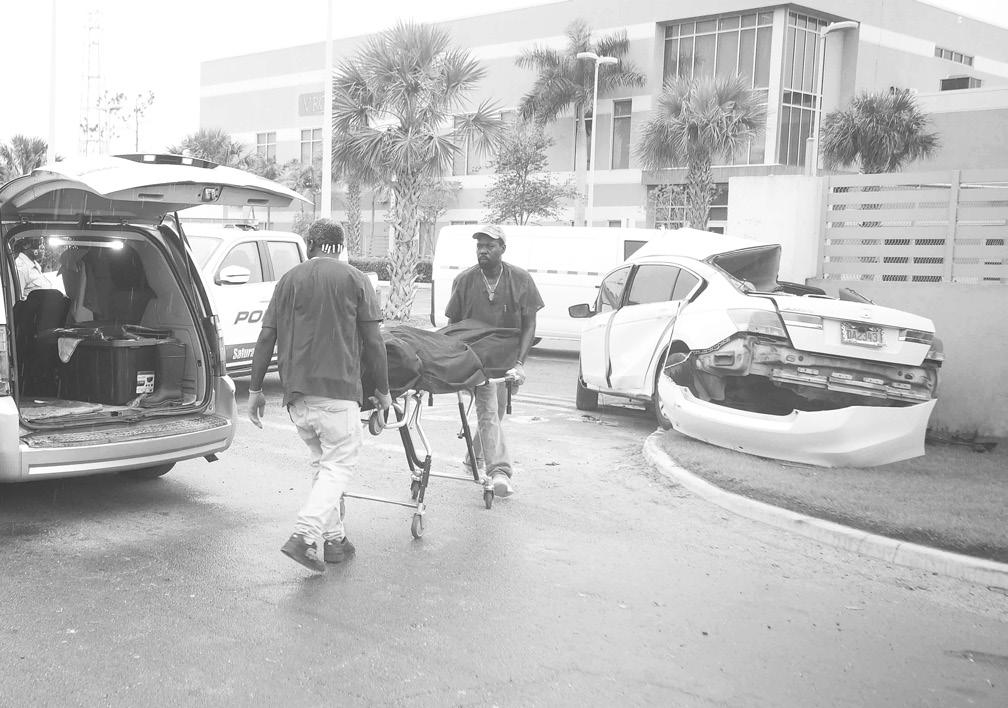
TRAFFIC tragedy struck again on Wednesday when a man believed to be in his late 30s lost control of his vehicle and crashed into the wall of a business establishment on Fire Trail Road West.
According to Assistant Superintendent Demetria Capron, attached to the Traffic Division, police received a report shortly after noon of a traffic accident involving a lone vehicle in the Fire Trail Road West area.
Officers responded to the scene, where preliminary investigations revealed the driver of a white Honda Accord was travelling east along Fire Trail Road West when he
attempted to overtake another vehicle.
Asst Supt Capron said the driver subsequently lost control of the vehicle and collided with the wall of a business establishment on the northern side of the road.
Police said the vehicle sustained extensive damage and the driver suffered serious injuries. Emergency Medical Services personnel examined the victim at the scene and found no signs of life.
While investigations remain in their early stages, police believe speed was a contributing factor in the crash.
Asst Supt Capron urged motorists to exercise greater caution on the nation's roads.
"One life lost in a traffic crash is simply one too
By JADE RUSSELL Tribune Staff Reporter jrussell@tribunemedia.net
A US Coast Guard dive team arrived in Abaco yesterday to search for Lynette Hooker, the American woman who went missing during a boat trip with her husband in April.
Speaking to media, Hope Town Fire and Rescue Chief
Troy Pritchard, who initially led the search into Hooker's disappearance, was doubtful her remains would be found.
“Anything that is found two months afterwards will probably be her personal items,” he said. “I don’t think you would find much of a body in this case. There are quite bit of sharks out here.”
Mr Pritchard said his team initially began the search based on information gathered from police
and, the victim’s husband Brian Hooker, but later discovered much of that information was false. He said he hopes new digital evidence will help bring the case to a close.
Videos and photos obtained by The Tribune yesterday showed the US Coast Guard searching several areas of Abaco waters.
ABC News reported that the Coast Guard Investigative Service is leading the investigation and received permission from The Bahamas to send US divers to areas that had not previously been searched, according to multiple US officials.
The new search comes after forensic evidence recovered from electronic devices belonging to Hooker's husband led investigators to new areas of interest, officials said.
A US official told ABC
many, and so we cannot afford to have another accident that could be avoided when speed is a factor in it," she said. She also appealed to drivers to slow down and "drive to arrive alive".
Police declined to release additional details about the victim, including his identity and place of employment, saying they wanted to give family members an opportunity
to speak with investigators first.
Asst Supt Capron said the driver of the vehicle that was being overtaken remained at the scene and was assisting officers with their inquiries.
"That vehicle at this time is not a factor inside this investigation thus far, but the driver did remain on the scene and is assisting us with our investigation," she said.
News that GPS data recovered from Mr Hooker's devices does not match the account he gave investigators.
CBS News reported that the case is being investigated as a "possible foreign murder of a US national", a US official reportedly told the network.
On April 4, Hooker and her husband, left Hope Town around 7.30pm in an eight-foot dinghy heading towards Elbow Cay.
During the trip, Hooker allegedly fell overboard while holding the boat’s keys, causing the engine to shut off. Authorities said strong currents carried her away and Mr Hooker lost sight of her.
He then paddled the vessel to shore, arriving at the Marsh Harbour Boat Yard around 4am, where he alerted someone who contacted police.
Police initially questioned Mr Hooker in connection with the incident, but he was later released.
Hooker's daughter has raised concerns about the

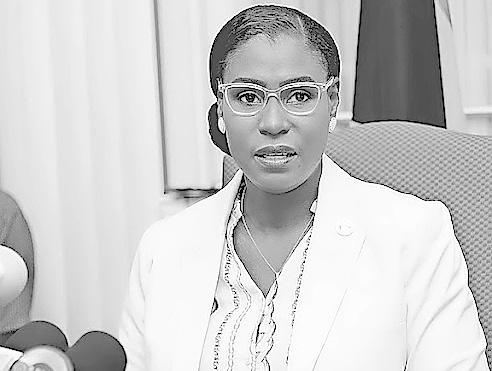
PENSION from page FOUR
Mrs Glover-Rolle also backed raising the retirement age, saying she intends to advance the issue during her tenure as minister.
circumstances surrounding her mother's disappearance, saying “prior issues” of domestic violence may be relevant to the investigation.
Last month, American investigators reportedly asked Bahamian police to expand the search for Hooker after electronic location data allegedly conflicted with her husband's initial account of the night she disappeared. Commissioner Shanta Knowles has previously said that investigators have recovered only a flotation device, which remains the sole piece of evidence in the case.
She said many retirees return to the workforce for various reasons, a pattern she linked to broader questions about the sustainability of the pension system.
“So, why not extend retirement age by a year, two, three or four or however and see how that will help. We’ve done some numbers and it’ll help by the millions obviously,” she said. “So, it’s something that I’m committed to advancing.”
The official retirement age in The Bahamas is 65, while early retirement can begin at 60.
Mrs Glover-Rolle said other labour reforms are also being developed, including measures dealing with mental health,
work-life balance, flexible working arrangements and hours of work.
She said the proposed legislative changes would create a framework for managing modern workplace arrangements and help reduce disputes between employers and employees.
On the issue of a liveable wage, Mrs Glover-Rolle said the matter is not for the government alone, but also involves the National Tripartite Council.
She said any move toward implementation must be guided by consultation and analysis.
“You can’t continue to ask an organisation and employer for more realistically if you’re not also giving more, so it’s a conversation of balance, you give a little, we give a little,” he said. “So, until the National Tripartite presents to the government an analysis, a recommendation on where we should go with the liveable age, we cannot move on.”


BY now we’re accustomed to almost unimaginably outrageous initiatives from the current Donald Trump administration in Washington DC, and the week just past brought some new ones to the headlines, while revealing more shocking details about some other ideas the president is reportedly pondering.
It’s hard to know where to begin, as is usual with this chaotic administration. A good place to start is with a Trump tactical move that has become increasingly familiar. His plan is apparently to unveil a truly astounding idea and couple it directly or indirectly with a more subtle one that benefits him financially.
This was apparently the tactic behind the Department of Justice revealing the creation of a $1,776,000,000 fund which could be used, among other things, to compensate Trump allies who had been prosecuted under prior administrations. Potential beneficiaries would include the thousands who stormed the US Capitol on January 6, 2021.
Trump has long felt that he and many of his associates have been victims of politically-motivated persecution and prosecution by federal and state courts. And he and his allies have indeed found themselves frequently defending themselves against a whole multitude of charges, often involving financial grift and graft and political maneuvering for electoral advantage.
He does seem to overlook the possibility that his actions have often been unprecedently illegal, and thus naturally subject to prosecution.
The president seemingly has discovered that American law is full of loopholes that exist because no one has taken the trouble to discover and exploit them.
These loopholes are gaps in the law that no Congress has made illegal because no previous administration has behaved as has this one. Trump’s view appears to be that if corrupt or unethical conduct is not explicitly illegal in the US code of laws, it’s therefore permissible and lawful.
A conservative, strict-constructionist US Supreme Court has often –but not always – implicitly supported this thesis in its decisions. This court is likely to retain its 6-3 conservative

majority for the intermediate future.
The American Congress will have to await different leadership and a post-Trump political environment to enact legislation that will be designed to close many of the loopholes that have become Trump’s opportunities.
The $1.776 billion fund served as a powerful lightning rod to attract outspoken opposition from virtually every Democrat and several influential Republican members of Congress, and was relatively quickly withdrawn.
But lurking behind this overt proposal to enable Trump to financially reward the January 6 participants at the American capitol building was a bit of attempted graft that far exceeds the norm from even a current administration that some argue is the most openly, unabashedly, and profoundly corrupt one in modern American history.
The acting American Attorney General is Todd Blanche, a 51-yearold lawyer who was first brought into the Trump legal orbit as the president assembled a team to defend himself in a case brought against him in connection with ‘hush money’ payments to porn star Stormy Daniels.
Remember that case? It was adjudicated just three years ago during the Joe Biden administration.
There were reports from the BBC and other news sources that Blanche left

“My God, do you not find there’s any conflict of interest in what you are doing here as the acting attorney general of the United States?”
Rep. Rosa DeLauro
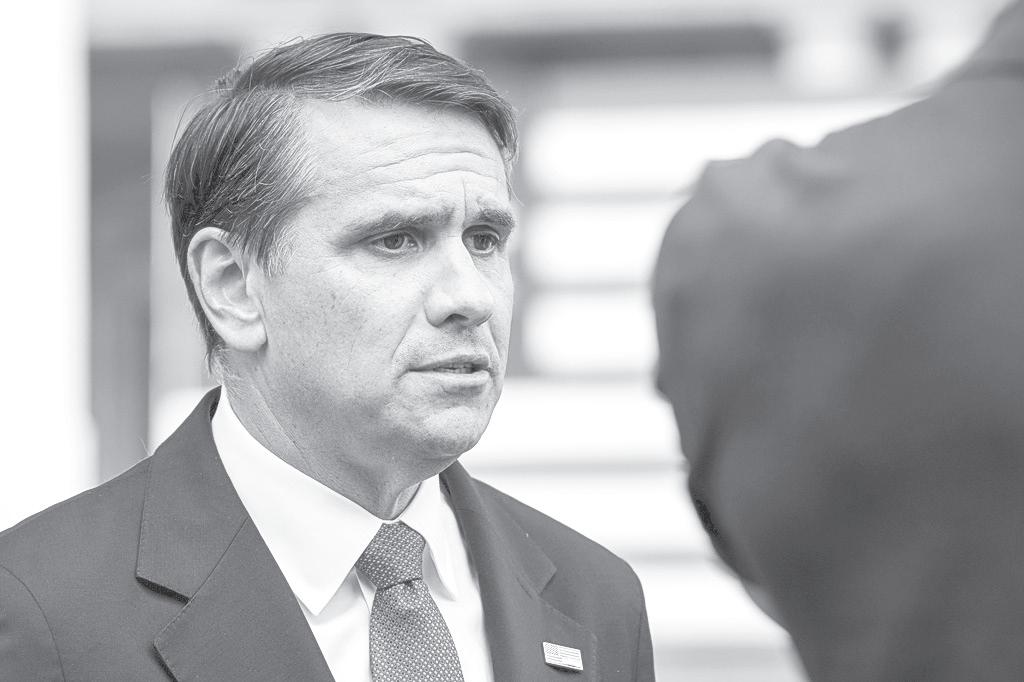
a lucrative position as a partner at a Wall Street law firm, changed his political affiliation to became a Republican, and moved to Florida to take on the biggest client of his career - Trump. It seems that Trump and Blanche got on quite well, and Blanche was confirmed by the US Senate 15 months ago to serve as Deputy Attorney General. After Trump finally fired Pam Bondi from the top Justice job in April, Blanche took over on an acting basis as America’s top law enforcement official. And it was Blanche who signed an order last week giving Trump, his family and his businesses potentially lucrative protection from investigations by the American tax collecting agency, the Internal Revenue Service. During an
appearance before a House Appropriations subcommittee, Blanche reaffirmed this order that the New York Times has estimated could save Trump and his family over $100 million in taxes going forward.
Such an order could essentially shield Trump and his many family businesses from any federal oversight indefinitely. Normally, the IRS conducts tax investigations on behalf of the US government. Blanche’s order would mean Congress would have to authorize a special investigative unit to pursue alleged misdeeds by the Trump operation in the future.
Imagine the publicity that might cause. t’s easy to foresee Trump screaming “witch hunt” all over again, and to hear the outcry from his millions of supporters.
But for now, politicians
said there was none. We’ll see how this all plays out. Will Congress actually do anything to frustrate Trump and Blanche in this matter? They don’t have too much time to do so, since the House of Representatives is due to leave Washington on August 1 for a month, and the Senate will depart on August 10 for its own month-long recess.
Commentators and pundits have been wringing their hands for months about the unwillingness of congressional Republicans to stand up to Trump on virtually anything, from his seemingly illegal pursuit of an extraordinarily expensive and ultimately pointless war against Iran to his persistent nominations of blatantly unqualified political allies to key positions in the US government that directly impact the nation’s security.
Public opinion polls show Trump’s popularity steadily declining. He is apparently becoming such a drag on the Republican brand that there is a slight uptick in reports that the Democrats, despite their lingering unpopularity after the ignominious collapse of the Biden administration and botched effort to save the 2024 election, might actually recapture control of the US Senate in November.
from both parties are speaking out against Blanche’s move.
Senator Thom Tillis, a Republican of North Carolina, expressed frustration over the IRS immunity deal. “We’re talking about family members that have had almost a doubling of their net worth over the last year and a half. How can you not at least have them be subject to the same thing that I’m subjected to as is every one of you?” Tillis asked reporters on Tuesday. Tillis, it must be admitted, can feel free to speak out on such matters. He is retiring from the Senate, so Trump cannot hurt him very much politically.
Representative Rosa DeLauro, a long-time Connecticut Democrat, said the IRS agreement proved that Blanche was continuing to act as Trump’s personal lawyer, and she cited “nearly $10 million” that he was paid by a Trump-allied group for his legal work on behalf of Trump on the Daniels hush money case between 2023 and 2024.
“My God, do you not find there’s any conflict of interest in what you are doing here as the acting attorney general of the United States?” she asked. Blanche
Such an outcome has been, and remains in many quarters, unthinkable. Most importantly, Trump is not on the ballot this November. His personal unpopularity will not necessarily lead voters to overturn the whole party. And the Democrats have remained consistent in their inability to either transition from a Senate leadership hierarchy defined mostly by longevity and gerontocracy or to develop a coherent policy platform that can engage voters.
It’s perhaps enough, still, to run on a platform largely, if implicitly, defined by the simple declaration that “the Democrats are not the party of Donald Trump.” That did work in 2020, after all. And there were strong Democratic gains in the Congressional elections of 2018 and lesser wins in 2022.
But the electoral math in the Senate requires more than not being Trump’s party. The GOP is defending relatively few truly unsafe Senate seats. It would take a truly blue wave in November to flip the four seats needed to restore the Dems to a Senate majority.
Trump doesn’t behave as though he cares if his policies imperil Republican legislative control. Maybe he doesn’t. Maybe his true objective is different. Maybe, as some are now speculating, he’s looking to a future as an ex-president who retains absolute control of one of America’s two political parties.
IN ITS election Blueprint for Change in 2021, the Progressive Liberal Party (PLP) promised: “Within the first 100 days, we will cause a review of BPL operations to reduce cost of electricity, maintain a reliable supply, and enter into contractual arrangements which would put BPL on a solid financial footing, and most importantly, reduce the costs of living and doing business in The Bahamas.”
None of this happened in the first 100 days or even many hundreds of days after. The cost of electricity shot up dramatically, with some Bahamians seeing the highest bills they have ever paid in their lives. Quite a number paid thousands in one year, enough to buy a second-hand car or van.
The end of the FNM’s fuel hedge made matters worse. The cost of electricity made the cost of living significantly more expensive, affecting scores of businesses who passed the cascading costs on to customers.
Many bills doubled or near tripled. Some consumers dipped into savings to pay light bills, while others cancelled or scaled down holidays in order to keep the lights on.
The PLP also promised to “maintain a reliable supply.” Across the country, especially in Eleuthera, Abaco, and parts of Andros, and other Family Islands, residents suffered from punishing blackouts in the last nearly five years.
Many businesses related to tourism suffered financial losses. Some schools had to send children home. Many people endured sweltering heat at home.
Now, the residents of New Providence are set to experience another long summer of long blackouts despite the promise to end these summer blues. Many in western New Providence have already experienced cuts to supply that have lasted many miserable hours.
There are multiple outages every day on New Providence! Many stages of the system seem beset by problems, resulting in unstable services. What is the response from BPL?
The power company’s lame response may be classified as articulate incompetence, which is rife throughout government.
“Articulate incompetence...relies on smoke and mirrors.... the ability to use polished vocabulary, charismatic communication, and professional buzzwords to describe plans or soothe concerns [ but is actually] a failure to follow through with meaningful action, operational efficiency, or results.”
Articulate incompetence is typically used in crisis management, employing linguistic gobbledygook and verbal gymnastics to avoid accountability and to hide behind a facade of competence.
Here is an example of the latest articulate incompetence and technical doublespeak deployed to mask BPL’s failures.
This journal on Tuesday reported: “…BPL yesterday blamed multiple New Providence outages on equipment faults, underground cable failures and soaring electricity demand caused by an early summer heat wave, while maintaining that major network
prices climb back toward $100, and US stocks halt their recordbreaking rally

upgrades remain on schedule ahead of hurricane season.”
Anthony Christie, BPL's chief operating officer, told The Tribune: "New Providence has experienced a number of outages over the past several days.
“These outages have been caused by faults affecting substation equipment and underground cables in certain areas. Additionally, the ongoing heat wave has resulted in peak system loads, placing increased demand on the electrical network.”
Is BPL really shocked that we are having an early summer heat wave, especially given the reality of climate change?
Ripening mangoes are scornful on thousands of trees on New Providence. Poinciana trees have started blooming early for years, likely because of climate change. Yet, we should somehow believe that BPL and the government have been taken by surprise by the early summer heat?
The Tribune story of June 2, noted that “major network upgrades remain on schedule ahead of hurricane season.” Newsflash for
By STAN CHOE AP Business Writer
Oil prices rose Wednesday following the latest flare-up in fighting to threaten the U.S.-Iran ceasefire, and U.S. stocks retreated from their records.
The S&P 500 fell 0.7% from its all-time high for its first drop in 10 days. The Dow Jones Industrial Average dropped 620 points, or 1.2%, and the Nasdaq composite sank 0.9%.
BPL: the official hurricane season began June 1. Why weren’t these upgrades done well before the peak summer season? According to this paper, Christie “added hat Bahamas Grid Company (BGC) is in the final stages of transmission and distribution upgrades for New Providence and remains on track to complete the work before the end of June.”
God bless Mr Christie. Still, how many times have Bahamians heard such promises of deadlines that never materialize and that are like mirages caused by heatstroke and dehydration.
Given the abysmal and sinister failure of the government to give the Bahamian people honest and thorough communications on its so-called energy reform, it is best that Bahamians take with half a grain of salt what is promised by BPL and the Minister of Energy and Transport, JoBeth Colbey Davis.
At the end of April, The Tribune reported: “With a major energy deal unravelling and millions in financing under scrutiny, Energy and Transport Minister JoBeth Coleby-Davis
Weighing on the market was a climb of 1.9% for the price of a barrel of Brent crude oil, the international standard, which brought it back to $97.81. It rose after both the United States and Iran said they launched retaliations for earlier attacks or attempted ones.
Palo Alto Networks helped drag the market lower, and it fell 5.6% even though it reported profit for the latest quarter that topped analysts’

offered little clarity yesterday, declining to explain the collapse of a key New Providence grid management arrangement...
“Her response came after the government sought to steady confidence after the abrupt exit of Island Grid, led by US energy executive Eric Pike, from the project, which had been promoted as a cornerstone of energy reform but had now fallen apart less than two years into a 25-year agreement.
“In a statement issued on Wednesday, the government sought to frame the development as a transition rather than a breakdown, pointing to new leadership at Bahamas Grid Company.”
You guessed it! Just more articulate incompetence, which involves parsing of words, deflection, and lack of full transparency. Rather than admitting failure and a breakdown, we are given the word “transition”.
It is akin to someone caught taking mangoes from someone’s tree without permission. When caught the response is: “I’m in transition to becoming a better person. As soon as I sell these mangoes, I’ll be an honest man, making my own money.”
In her 2025/2026 budget presentation in parliament, Minister Coleby-Davis stated: “As the National Energy Policy moves forward for official publication and implementation, we are positioning The Bahamas to pursue a more resilient, diversified, and sustainable energy future — grounded in transparency, inclusivity, and national ownership.”
How much more resilient and sustainable is the energy sector? How
expectations. Investors may have been looking for even more after its stock came into the day with a surge of 61.3% for the year so far, more than quintuple the S&P 500’s already big 11.2% rise.
Stocks also felt pressure from higher yields in the bond market, which climbed with the price of oil. The yield on the 10-year Treasury rose to 4.49% from 4.46% late Tuesday and from just 3.97% before the war began.
High yields worldwide are threatening to slow economies and undercut prices for stocks and all kinds of other investments.
They have already forced the average long-term U.S. mortgage rate to its most expensive level in nine months, and they could curtail companies’ borrowing to build the artificial-intelligence data centres that have supported the U.S. economy’s growth recently.
More expensive loans can hurt smaller companies in particular because many need to borrow to grow.
The Russell 2000 index of the smallest U.S. stocks fell 1.3%, more than the rest of the market.
Reports released Wednesday on the U.S. economy came in mixed.
One from the Institute for Supply Management said growth accelerated more last month for U.S. construction, agricultural and other services businesses than economists expected.
That’s an encouraging signal, but the survey also showed businesses are feeling the pinch of higher prices caused by tariffs and more expensive oil. “This is the definition of inflationary pressure starting to affect us,” one company in the accommodation and food services industry said in the survey. Still, stocks remain near their records, even with all the pressure on the global economy created by higher inflation.
Oil prices remain below their peaks from earlier in the war with Iran, and hope seems to be remaining on Wall Street that the United States and Iran will ultimately agree to reopen
much does the government continue to hide from the Bahamian people and perhaps international financial institutions? What really happened with Pike Energy?
Moreover, is BPL on a more “solid financial footing” as promised nearly five years ago, or is it in financially worse shape. Then there is this warning sounded by veteran business reporter Neil Hartnell:
“Bahamian taxpayers are owed half-a-billion dollars in outstanding loans by loss-making state-owned enterprises (SOEs), it has been revealed, with nine key government entities collectively plunging into ‘negative equity’ with debt liabilities exceeding their assets.”
The Fiscal Strategy Report [2026, which accompanied the Budget], also highlighted that the Bahamas Electricity Corporation (BEC), BPL’s parent or holding company, faces a similar - albeit less pronounced - predicament with liquid assets of around $300m exceeded by current liabilities slightly in excess of that figure. Instead of articulate or weaponised incompetence and opaqueness, might Minister Coleby-Davis and the government offer answers on the bungling failure to realize meaningful energy reform.
There are multiple outages every day on New Providence! Multiple stages of the system seem beset by problems, resulting in unstable services.
the Strait of Hormuz to oil tankers. That would improve the global flow of crude and hopefully lower its price.
Such hopes, along with strong profit reports from U.S. companies, helped launch the S&P 500 on its nine-day winning streak that ended Wednesday, one day shy of its longest in three decades.
Medtronic climbed 5.7% after reporting a stronger profit for the latest quarter than analysts expected. It also increased its dividend payout going to investors.
GameStop rose 6% after the video-game retailer said its revenue in the latest quarter grew 14% from a year earlier. It also announced a program to send up to $2 billion to its investors by buying back its own stock.
Macy’s added 0.6% after swinging between gains and losses through the day. The retailer reported profit for the latest quarter that blew past analysts’ forecasts, while saying an overhaul of its merchandise and better customer service is resonating with customers.
All told, the S&P 500 fell 56.10 points to 7,553.68. The Dow Jones Industrial Average dropped 620.72 to 50,687.07, and the Nasdaq composite sank 239.93 to 26,853.98.
In stock markets abroad, European indexes fell following a mixed finish in Asia.
Hong Kong’s Hang Seng dropped 1.6%, but Japan’s Nikkei 225 jumped 2.5% to another record. Excitement around the boom created by AI technology has been a huge engine for stock markets worldwide. On Wall Street, Marvell Technology rose another 3.7% following its best day on record, a surge of 32.5%, after Nvidia CEO Jensen Huang suggested at a conference in Taiwan that Marvell could be “the next trillion-dollar company.”
The last company to enter the expanding club of behemoths was Micron Technology, which is likewise riding the AI wave.

By JADE RUSSELL Tribune Staff Reporter jrussell@tribunemedia.net
MANY cruise passengers arriving at Nassau Cruise Port still do not know the Straw Market exists, according to Straw Businesspersons Society president Rebecca Small-Morley, who said years of weak promotion have helped keep vendors’ sales unstable.

"Why are tourists still saying 'oh we didn't know yall exist and they're on the cruise?'" she said yesterday.
Mrs Small-Morley said she hopes the market will receive greater visibility now that Glenys Hanna-Martin is Tourism Minister.
For years, straw vendors have complained about inconsistent sales and limited promotion, saying both have made it difficult to earn a stable income.
Mrs Small-Morley said the problem was not complete neglect of the market, but a failure to do enough to ensure visitors know it exists.
She said former Tourism Minister Chester Cooper met vendors individually to hear their concerns and suggestions for improving the market. She did not criticise Mr Cooper’s efforts, but said stronger promotion could have helped vendors.
Mrs Small-Morley said Mrs Hanna-Martin has consistently supported the Straw Market, even before assuming responsibility for the tourism portfolio.
“She has always reached out to us, even when she was not in the position she is in now. I'm hoping that it will be a quadrille relationship, and she'll help us. So, the market, will be promoted through the Ministry of Tourism,” Mrs Small-Morley said. Her call comes after years of complaints from vendors about declining foot traffic. In 2024, some Straw Market vendors told The Tribune fewer cruise passengers were visiting their stalls, a problem many say continues to undercut their ability to earn consistent money.
“We are still struggling, and that's the honest truth,” Mrs Small-Morley said.
Beyond promotion, Mrs Small-Morley said vendors
still face problems inside the market. She said some have worked in the straw industry for more than three generations, leaving many, especially elderly vendors, with few realistic alternatives.
She also criticised the Straw Market Authority, saying vendors often feel their concerns are not fully understood. She cited stall placement in the congested market, inadequate air conditioning and the unpredictable flow of tourists among their frustrations.
Mrs Small-Morley said vendors want the market to receive greater exposure, arguing that stronger sales would help not only straw vendors but the wider economy. She urged the government to listen to vendors and make the changes needed to help the industry survive.
By PAVEL BAILEY Tribune Staff Reporter pbailey@tribunemedia.net
A MAN was granted bail after he was allegedly found with a gun near a business on Buttonwood Avenue last week.
Prosecutors allege Marvin Thompson, 53, was found with a black Glock 26 Gen 5 9mm pistol and nine rounds of ammunition tucked in his waist around 10pm on May 28. Thompson pleaded not guilty to possession of an
unlicensed firearm and possession of ammunition before Senior Magistrate Algernon Allen Jr.
Bail was set at $8,000 with one or two sureties. Thompson must sign in at the Elizabeth Estates Police Station every Monday, Wednesday and Friday by 6pm. He returns for trial on September 20. Sergeant 3004 Forbes prosecuted the case, while Ryszard Humes represented the accused.
By PAVEL BAILEY Tribune Staff Reporter pbailey@tribunemedia.net
A MAN yesterday admitted injuring his mother during an altercation at their Washington Street home last week.
Kyle Hall, 34, pushed his mother on May 29, causing injuries to her toes.
Hall pleaded guilty to grievous harm before
Senior Magistrate Algernon Allen Jr. He was remanded to the Bahamas Department of Correctional Services until he returns to court for sentencing on June 9.
An impact statement from the complainant will be heard when he returns to court.
Sergeant 3004 Forbes prosecuted the case.
By PAVEL BAILEY Tribune Staff Reporter pbailey@tribunemedia.net
A 15-YEAR-OLD boy was remanded to the Simpson Penn Centre for Boys yesterday after admitting to breaking into a residence in Eleuthera last weekend.
The male defendant, whose name is being withheld because he is a minor, broke into a residence on the Family Island and stole property on May 31.
He admitted to housebreaking and stealing before Senior Magistrate Algernon Allen Jr.
The juvenile will remain at the Simpson Penn Centre for Boys until he returns to court on August 27. Charges against another 15-year-old boy, who pleaded not guilty to the offence, were withdrawn. Both accused were arraigned in the presence of their guardians. Sergeant 3004 Forbes prosecuted the case.

By ALEX VEIGA and BERNARD CONDON AP Business Writers
for Musk, who started xAI in 2023 with 11 other co-founders who have all since left. Some were recruited away by rivals. Its main AI product, the chatbot Grok, is "less impressive than anything that we see from any other major player in the space, whether that's OpenAI, or Anthropic, or (Google's) Gemini," said IDC analyst Arnal Dayaratna.
SPACEX says it plans to raise up to $75 billion when it goes public this month, setting the stage for the largest-ever stock market debut and putting Elon Musk on course to become the world's first trillionaire.

The company, formally known as Space Exploration Technologies Corp., said Wednesday it will sell 555.6 million shares at $135 a piece in an initial public offering. The estimated proceeds would easily top the $26 billion raised by oil giant Saudi Aramco in 2019. The offering would also give SpaceX a market value of $1.77 trillion. Only six companies in the S&P 500 are currently worth more, with Nvidia tops at $5.2 trillion.
Besides the size of the offering and the expected proceeds, SpaceX's amended prospectus updates details about how much control of the company Musk will have. As SpaceX's CEO, chief technical officer and chairman,
By JACK BROOK Associated Press/ Report for America
ACTOR Shia LaBeouf was sentenced to probation Wednesday after pleading guilty to punching three people outside a New Orleans bar during Mardi Gras.
LaBeouf must attend an alcohol treatment program under the sentence handed down by an Orleans Parish judge, according to Sarah Chervinsky, an attorney for the actor.
Musk's voting power will come primarily through his ownership of 5.22 billion Class B shares, which give the holder 10 votes for every share held. According to the filing, Musk would have 82.4% of the voting power in the company.
Forbes currently values Musk's net worth at $826 billion and his stake in SpaceX at $542 billion. The estimated value of his SpaceX holdings was based on an overall value for the company of $1.25 trillion. Based on those numbers, a $1.77 trillion valuation for SpaceX would boost Musk's net worth by $223 billion, making him a trillionaire. However, much of Musk's worth is in stock that he has yet to cash in.
Time will tell how SpaceX fares on the market. Musk's plans for the company are as fantastical as the money he hopes to raise in the sale.
Colourful, even frightening in parts, the IPO document strikes a contrast with the typically dry, technical prose in IPO documents, detailing plans to use proceeds from the sale to help put men on the
of the people attacked by LaBeouf. He has said LaBeouf had pushed him from behind at the bar earlier in the night, shouting homophobic slurs and threatening his life.
Damnit's attorney said his client hopes LaBeouf's behaviour improves after the actor undergoes substance abuse treatment.
"In New Orleans, we are all equal, we should all feel safe, and we don't treat people differently based upon relative fame," attorney Michael Kennedy said.
After LaBeouf was charged in February, a judge ordered him to return to drug and alcohol rehabilitation.
moon again and perhaps even Mars. In one section, it talks of a need to build "a permanent human colony" on the red planet with "at least one million inhabitants" as existential threats loom that could consign man to "the same fate as the dinosaurs."
Musk has almost equally ambitious plans for his other publicly traded company, Tesla. His goal is to transform the maker of electric vehicles into a producer of robotaxis and humanoid robots. Dan Ives of Wedbush Securities wrote in a research note that he expects Tesla and SpaceX to merge next year.
Key to the success of both companies — and any merged entity — is artificial intelligence. In its IPO filing, SpaceX says it sees potential revenue from AI of up to $26.5 trillion. But that depends on another lofty Musk ambition — putting data centres in space, which is not technologically possible at the moment.
Transforming his space company into a primar
Dayaratna said that doesn't mean SpaceX doesn't have potential as a major AI player, thanks in part to its computing partnership with Anthropic and Musk's recent deal that gave SpaceX the rights to buy AI coding tool Cursor for $60 billion later this year. Folding in Cursor's capabilities would give SpaceX access to the coveted business customers now using Anthropic's Claude or OpenAI's ChatGPT.
SpaceX plans to use the net proceeds from the IPO to fund the expansion of infrastructure for its AI and rocket businesses, and to beef up the constellation of satellites that power Starlink Mobile, among other investments.
The company plans to list on the Nasdaq under the symbol "SPCX" and could begin trading as soon as the end of next week.
And SpaceX isn't the only colossal market debut investors are now bracing for. Earlier this week, Anthropic submitted a confidential filing with the U.S. Securities and Exchange Commission to officially start its own IPO clock.
OpenAI has not yet reported filing the initial SEC paperwork, but an IPO from the ChatGPT maker is widely expected.
"This listing represents the first major test for public markets after years of muted IPO activity, with SpaceX paving the way for AI giants Anthropic and OpenAI to follow soon

Chervinsky said LaBeouf wanted "to take accountability for his part in what happened" and called it a "minor Mardi Gras bar tussle." Chervinsky said there was "no evidence it was about bias or prejudice."
Orleans Parish District
Attorney Jason Williams said in a statement that his office consulted with the victims to ensure their support before offering LaBeouf the plea deal.

Jeffrey Damnit, a local entertainer whom police identified as Jeffrey Klein, said he was one
LeBeouf, most widely known for his starring roles in 2007's "Transformers" and in 2008's "Indiana Skull," had been released on bail following his arrest near the city's historic French Quarter. Video of the Feb. 17 encounter shows a shirtless LaBeouf outside a bar shoving one person to the ground and hitting another person in the face, "causing his nose to possibly dislocate," according to a New Orleans police report. Police said LaBeouf repeatedly used homophobic slurs, including while he was arrested. LeBeouf pleaded guilty to three counts of simple battery. Orleans Parish Judge Juana Marine-Lombard handed the actor a six-month suspended sen tence and two years of probation. LaBeouf also must stay away from the victims and the bar.
Days later, LaBeouf denied having a "drinking problem" in an interview with journalist and YouTuber Andrew Callaghan. LaBeouf said he doubted rehab would help him. He told Callaghan that the issues leading to his aggressive behaviour during Mardi Gras were more rooted in "anger and ego" than alcohol.
LaBeouf also said that "big gay people are scary to me."
"When I'm standing by myself and three gay dudes are next to me touching my leg, I get scared," he told Callaghan. "I'm sorry. If that's homophobic, then I'm that."
By MOLLY QUELL Associated Press
A JUDGE in Amsterdam on Wednesday rejected an appeal by a Jewish organisation to block two performances by the rapper Ye, formerly Kanye West, ruling that the concerts are not a threat to public order. Ye has drawn widespread controversy in recent years for a series of antisemitic remarks, leaving Dutch authorities under mounting
pressure to cancel the gigs on June 6 and 8. The Central Jewish Council filed the emergency lawsuit on Tuesday, arguing that Ye should be banned from the country for voicing admiration for Adolf Hitler and selling T-shirts featuring swastikas.
According to the Amsterdam District Court, there were no grounds to bar Ye from performing. "There are no indications that West's presence in the
LaBeouf, who converted to Catholicism a few years ago, has had several runins with the law during his career, including a 2017 New York City arrest on suspicion of assault that happened during a livestream.
While on location in Georgia filming "The Peanut Butter Falcon" later that year, he was arrested for public drunkenness and accused of disorderly conduct and obstruction and sentenced to probation.
coming days will lead to concrete public order dangers," the court said in a statement. The Central Jewish Council expressed disappointment with the ruling. "The feeling we are getting is that it is okay if you are antisemitic," Chanan Hertzberger, the organisation's chair, told The Associated Press.
Lawmakers in the Netherlands supported a motion to bar Ye from entering the country, but the country's immigration minister said there was no legal basis for such a move. Ye's remarks were "reprehensible", but there was "no reason to bar him," Bart van den Brink told journalists last week. The 48-year-old was set to perform his first European dates in more than
Los Angeles.
That year, the English singer and actor FKA Twigs, whose legal name is Tahliah Barnett, also filed a lawsuit alleging LaBeouf was physically and emotionally abusive to her during their relationship, which they settled in July.
The actor first gained acclaim as a child for his role on the Disney Channel series "Even Stevens."
a decade. In April, he was barred from entering the U.K. over his remarks, setting off a series of cancellations. Shows in Italy and Poland have been scrapped.
More than 100,000 fans turned out in Istanbul on Saturday evening to watch Ye's first performance in Turkey.
Concert organisers say 70,000 tickets have been sold for the two upcoming shows at the Gelredome in the eastern Dutch city of Arnhem.
Ye apologised in January through a full-page advertisement in The Wall Street Journal, stating that his bipolar disorder led him to fall into "a fourmonth-long, manic episode of psychotic, paranoid and impulsive behaviour that destroyed my life."
By RUSS BYNUM Associated Press
A MUSEUM in Georgia’s oldest city on Wednesday welcomed a truckload of treasures from the earliest period of US history — 17 cannons that experts believe sank to the bottom of the Savannah River during the American Revolution and remained undiscovered for nearly 240 years.
Workers carefully hoisted the big guns one-by-one from the back of a truck and wheeled them inside their new home at the Savannah History Museum, which will put them on display just in time for the Fourth of July celebration of America’s 250th birthday.
“They look brand new,”
said Andrea Farmer, a US Army Corps of Engineers archaeologist who was part of the team that researched and preserved the cannons.
“They could pretty much be fired if someone wanted to.”
The artifacts were discovered in 2021 when a dredge scooping sediment from the riverbed as part of an Army Corps project to deepen Savannah’s shipping channel pulled up a cannon in its metal jaws. The crew soon dug up two more.
In the course of just over a year, a total of 19 cannons were hoisted from the location just downstream from Savannah, which is where Georgia was founded in 1733 as the last of Britain’s 13 American colonies.
After being pulled from
the river, most of the cannons left Georgia for several years to undergo cleaning and preservation work at a Texas lab.
Archaeologists initially assumed the cannons likely dated to the Civil War. But further research indicated they’re likely almost a century older and sank during the buildup to the American Revolution’s bloody siege of Savannah.
Savannah was under British occupation in the fall of 1779, when colonists planned an attack to retake the city with help from French allies.
When French ships carrying troops were spotted off the Georgia coast, British forces scuttled at least six ships in the Savannah River downstream from the city to block the French vessels.

The land battle that followed was one of the bloodiest of the war. British forces killed nearly 300 colonial fighters and their allies, and wounded hundreds more.
The Savannah History Museum sits right next to the battlefield. Its staff on Wednesday hoisted the cannons, weighing up to 1500 pounds (680 kilograms) apiece, onto custom display mounts that staffers likened to giant wine racks.
The cannons will be part of a new exhibit on Savannah’s role in the American Revolution, which is scheduled to open Fourth of July weekend, said Samantha Moss, the museum’s curator.
“Our great team has been prepping for months -- building mounts and planning how we can safely display these very large, very special artifacts,” she said.
Each of the iron cannons emerged from the river covered by a thick crust of mud and minerals.
Two were left in that raw state and put on display at the museum. The other 17 were sent to Texas A&M University, which has a lab that specializes in preserving
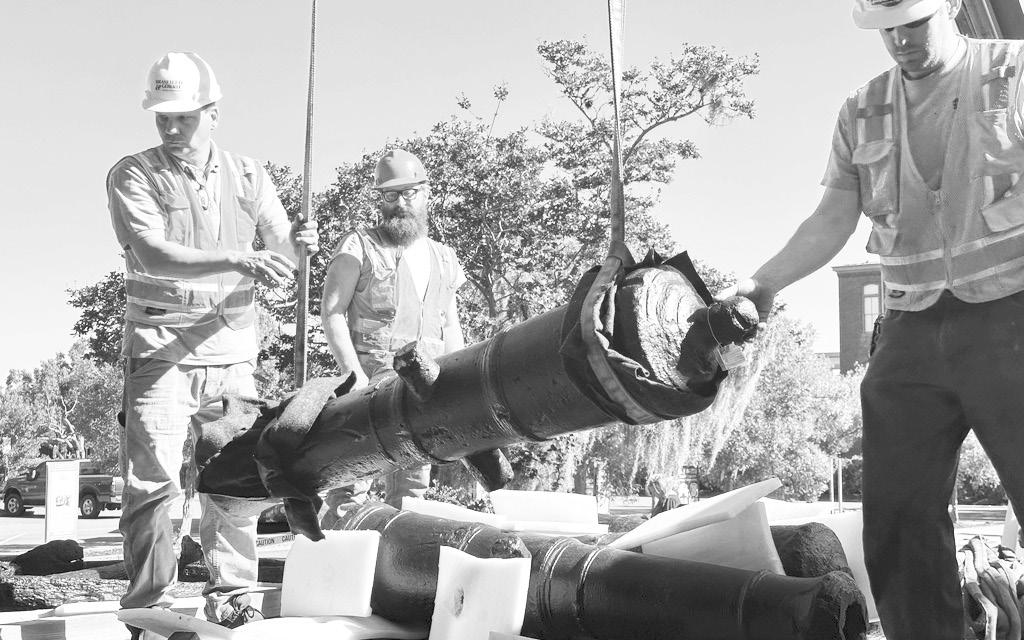
underwater artifacts. Its staff spent years painstakingly cleaning the big guns and coating them in paint and wax to prevent rusting and corrosion.
“A lot of them have scour marks on the side from anchors or dredging, so there’s some scarring on the cannons,” said Chris Dostal, a professor of nautical archaeology who leads Texas A&M’s Conservation Research Lab. “But most of them look pretty exceptional.”
Most of the cannons arrived with wooden plugs still sealing their bores, which remained packed with cannonballs and gunpowder charges.
Dostal said radiocarbon dating of the wooden stoppers placed them roughly in the late 1700s. His team
shared the cannons’ measurements and other details with experts in London, who concluded three of them were very likely forged by the British military.
The rest appeared to be of French design but bore no telltale markings. Dostal said he suspects those guns may have been cast in America around the time of the war.
Other artifacts found with the cannons included pieces of anchors and a portion of a ship’s bronze bell. Like the cannons, none of them bore engravings indicating which ship they came from.
That means many details of the cannons’ origins remain a mystery.
“You don’t have all of the information,” Farmer said.
“You’re trying to piece it together as best as you can.”



Along with the Radar Data that is fed into BACSWN’s NexGen Aviation Center the AWOS Data is also a vital component. This allows for the safe, efficient, and expeditious passage of Airline using our strategically located sovereign archipelago. Freeport is the latest Airport to be upgraded to ensure the users of the air space have consistent and high-quality date. The entire electrical system has been replaced, and all junction boxes have been replaced with watertight ones to ensure the integrity of the system. During Dorian, the whole electrical system was under water and over the years had been degrading to the point of near failure. BACSWN is happy to report this is no longer the case and all necessary repairs and replacements has been carried out to ensure a fully functioning AWOS system for Freeport.