‘Where
‘Where
BY NEIL HARTNELL Tribune Business Editor nhartnell@tribunemedia.net
A SENIOR fisheries exec-
utive yesterday asked “where does it end” as the Trump administration threatened to hit Bahamian exports to the US with 12.5 percent tariffs after finding this nation is failing to combat imported goods made with forced labour.
Adrian LaRoda, president of The Bahamas Commercial Fishers Alliance (BCFA), told Tribune Business that imposing such US border taxes on spiny lobster threatens to place a key fisheries product “at a serious competitive disadvantage” and undermine a major portion of the industry’s annual $90m global exports.
Confirming that Bahamian fisheries would be “squeezed” if the Trump administration follows through with its planned action, he warned that prices are already at a point where the sector is
Freeport
US deems nation guilty of failing to combat forced labour goods
Fisheries chief fears further ‘squeeze’ as many ‘in survival mode’
Up to $985m worth of exports in ‘competitive disadvantage’ woe
“breaking even” and “in survival mode” due to a combination of US market trends and ongoing uncertainty over Washington D.C.’s tariff policies and whether they can withstand judicial scrutiny.
Mr LaRoda asserted that The Bahamas must now prioritise finding new markets for its fisheries products amid the Trump administration’s volatile trade policies. And he told this newspaper that - while any slowdown in US exports is unlikely to “have a catastrophic effect” on the industry’s employment
by itself - there may be a knock-on impact on jobs if processors and wholesalers slash purchases if the local market is unable to absorb this extra product domestically.
The Alliance chief called for swift trade and foreign policy intervention after The Bahamas was named among 54 countries deemed by the US Trade Representative’s Office (USTR) to have neither enacted, nor enforced, a legal and regulatory regime that bans the entry of imported goods made
‘doesn’t want another industrial going by the wayside’
BY NEIL HARTNELL
Tribune Business Editor
nhartnell@tribunemedia.net
A FREEPORT-based manufacturer yesterday revealed it will speak to the US ambassador next week over the Trump administration’s threat to impose a 12.5 percent tariff on its and all Bahamian goods exports, its principal adding: “We don’t want another industrial company going by the wayside.”
Craig Simms, Polymers International’s top Bahamas-based executive, told
Tribune Business that the US Trade Representative’s proposal to levy a new, higher tariff on its US-bound exports - due to this nation’s alleged failure to combat the importation of products made by forced labour - will further increase pricing and competitiveness pressures with customers already “complaining” that its costs are too high compared to domestic American sources. Explaining that “it just adds another nail in the proverbial coffin, so to speak” if the Trump administration follows
BY NEIL HARTNELL Tribune Business Editor
nhartnell@tribunemedia.net
THE Association of Bahamas Marinas (ABM) president yesterday warned it will “cripple the industry” if operators have to pay both the Government’s new seabed lease fees as well as existing dock-related levies, asserting: “We cannot afford it.”
Peter Maury told Tribune Business that many Bahamian marinas would be forced to increase prices, at a time when previous
BY FAY SIMMONS
THE National Insurance Board (NIB) yesterday unveiled biennial adjustments that will raise pensions and grants by 1.5 percent and increase the weekly insurable wage ceiling from $810 to $830 with effect from July 1,2026. The changes, which are required every two years under a statutory review mechanism introduced in 2010, will also increase the maternity grant from $560 to $570 and the funeral benefit from $2,060 to $2,100.
Dr Tami Francis, NIB's director, said the adjustments were based on changes in the Retail Price
reforms such as the 14 percent yacht charter fee and cruising permit adjustments, have resulted in this nation losing up to 40 percent of its boating business in some categories.
“So far nobody knows much about it other than what they’ve read,” he said.
“I don’t want to come to a conclusion if they don’t send us a bill but, at the same time, a lot of us are of the opinion we can’t have both - a dock licence and a seabed lease. We cannot

Index over the two-year review period, and are intended to ensure benefits and contribution thresholds keep pace with changes in inflation, the cost of living and earnings.
"As a result of that review, which considered changes in the RPI over the review period, pensions and
through with its threatened action, he added that Freeport can ill-afford to lose another of its major industrial companies following the early 2024 closure of PharmaChem Technologies as this will further erode the sector’s base.
Speaking after The Bahamas was named among 54 countries deemed by the US Trade Representative’s Office (USTR) to have neither enacted, nor enforced, a legal and regulatory regime that bans the entry of imported goods made with forced

Household energy spend ‘five times greater’ than the region’s average
DONALD TRUMP IDB: ‘Structural inefficiences’ drive Bahamian electricity costs
with forced labour into this country.
The USTR, which promotes and enforces the US federal government’s trade policies, outlined its findings in a June 2, 2026, report that was released following an extensive consultation process involving both written submissions and public hearings.
“USTR found that The Bahamas has failed to impose, and effectively
BORDER - See Page B10
labour into this country, Mr Simms told this newspaper that - while the Trump administration’s tariffs are not alien to Polymers International - the planned increase will simply worsen the situation by further squeezing profits and margins. The Freeport manufacturer of expanded polystyrene (EPS) products exported some $55.7m worth of goods to the US in 2024, and Mr Simms said: “Currently we are under the 10 percent tariff regime so we continue to pay that 10 percent for our product coming into the US. Another 2.5 percentage points more is obviously not a good thing, but it’s not
MANUFACTURE - See Page B6
Cutting expense key to ‘durability’ of free first 200 KWh monthly Gov’t eyes up to $170m reform savings, ending Out Island subsidy
BY NEIL HARTNELL Tribune Business Editor nhartnell@tribunemedia.net
ANNUAL Bahamian household spending on electricity bills is “five times’ higher” than the Latin American and Caribbean average, a just-released Inter-American Development Bank (IDN) report has revealed, due to “structural generation and system inefficiencies”.
The multilateral lender, in its first quarterly Caribbean bulletin for 2026, said Bahamian energy costs cannot be blamed on oil price volatility alone and noted that the sustainability of Bahamas Power & Light’s (BPL) Equity Rate Adjustment tariff structure - which ensures the first 200 kilowatt hours (KWh) every month are free for residential consumers - depends on reducing generation costs and boosting efficiency.
BPL is mandated by the Electricity Act to submit a tariff review application to its regulator, the Utilities Regulation and Competition Authority (URCA), by 2027, and several energy sources - speaking on condition of anonymity - have suggested the state-owned utility will have to increase its base rate to ensure the Government’s energy reforms, as well as its financial health, remain commercially viable while potentially ending the free first 200 KWh.
However, the IDB report also acknowledged projections by the former Ministry

Walk into any successful Bahamian business, whether it is a long-established conch shack on Arawak Cay or a newly-opened boutique in Marina Village, and you will find that what brings customers back is rarely the lowest price. It is the feeling they had while they were there. This is the quiet revolution reshaping commerce in our archipelago and around
the world. Customer experience has overtaken price and product as the primary battlefield for business success. Research from major consultancies consistently shows that customers will pay more for better experiences, and switch providers after a single bad encounter. In a market as small and word-reliant as ours, this matters even more. A poor experience at a Nassau salon travels through Whats
App groups within an hour. A delightful experience at a Family Island restaurant generates online reviews that bring international visitors for years. The reasons behind this shift are not mysterious. Globalisation and online shopping have erased most price advantages. A Bahamian retailer cannot beat Amazon on price for most consumer goods, and a local hotel cannot undercut an Airbnb on accommodation
cost. What we can do, and what we have always done well when we apply ourselves, is deliver experiences rooted in warmth, knowledge and genuine hospitality. Consider what experience actually means in practice. It is the bartender who remembers your usual drink. It is the shopkeeper who calls when the size you wanted comes back into stock. It is the contractor who texts a photo

of progress before you ask. None of these gestures require capital investment. They require attention, consistency and a culture that treats customers as relationships rather than transactions.
The Bahamian economy lives or dies by this principle. Tourism accounts for roughly half our gross domestic product (GDP), and tourism is fundamentally an experience business.
The cruise visitor who has a magical day at a beach excursion will recommend The Bahamas to ten friends.
The visitor who feels rushed, ignored or hustled will warn ten friends away. The mathematics of word of mouth, amplified by TripAdvisor and Google Reviews, can build or break a business with stunning speed.

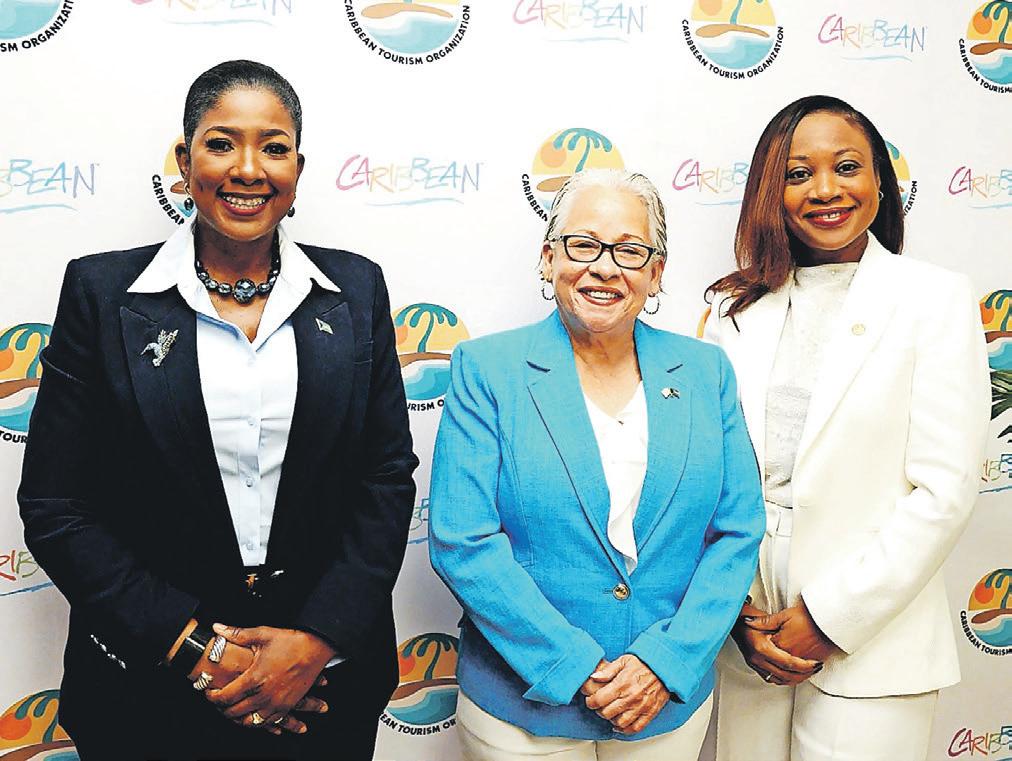
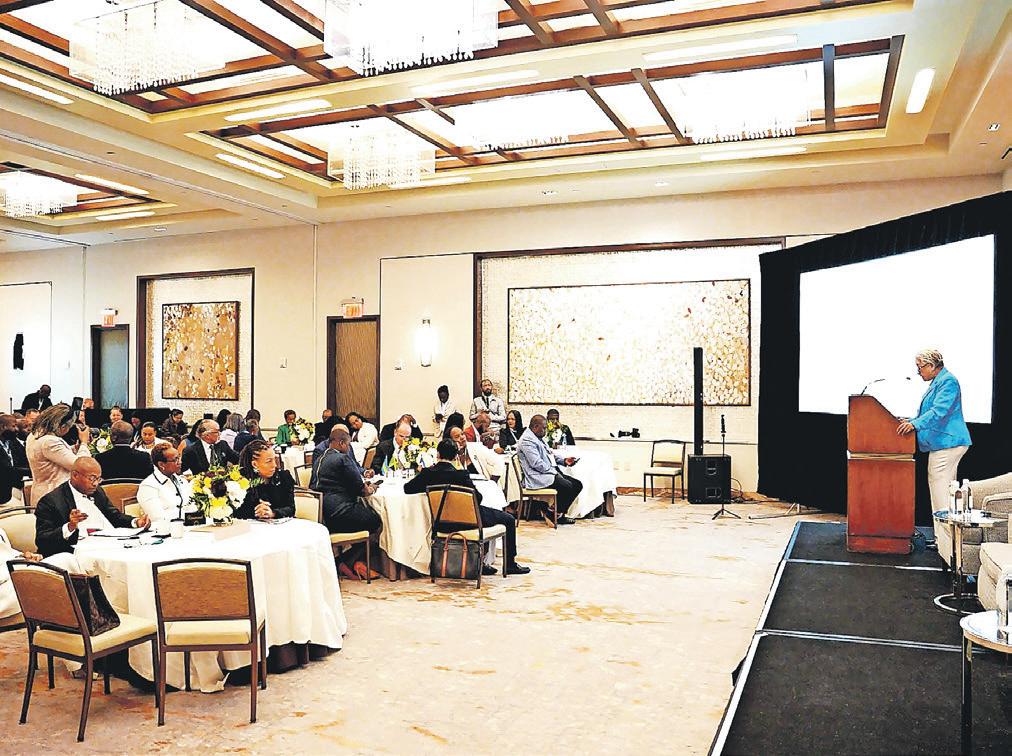
THE newly-appointed minister of tourism, Glenys Hanna Martin, is leading The Bahamas’ participation in Caribbean Week in New York 2026.
Held from June 1-5, the event is the Caribbean Tourism Organisation’s (CTO) premier annual forum for regional engagement. It is being staged at the InterContinental New York Times Square under the theme ‘One Caribbean: Infinite experiences’.
Joining Mrs Hanna Martin are Latia Duncombe, the Ministry of Tourism’s director-general, and senior government officials who are participating in a series of meetings, media engagements and strategic industry discussions throughout the week.
Mrs Hanna Martin and Mrs Duncombe will also serve as featured speakers, contributing to conversations on tourism leadership, sustainable destination development, connectivity, workforce readiness, innovation and strategies to increase the economic impact of tourism throughout the Caribbean.
“Tourism continues to be one of the most important economic pillars across the Caribbean, supporting jobs, businesses and communities throughout our region,” said Mrs Hanna Martin.
“Caribbean Week provides an important
opportunity for leaders to engage in meaningful discussions on the issues shaping our future - from resilience and sustainability to connectivity and workforce development.
“The Caribbean’s greatest strength has always been its ability to compete globally while advancing collectively. As one of the region’s leading tourism destinations, The Bahamas recognises both the responsibility and opportunity that come with leadership. We remain committed to advancing initiatives that promote sustainable growth, strengthen regional competitiveness and ensuring that the benefits of tourism are felt by the people and communities that depend on it.” The Bahamas will host the Caribbean Media Awards Luncheon on June 2. The event recognises excellence in travel journalism and brings together editors, writers, broadcasters and communications professionals from key source markets.
Caribbean Week brings together tourism leaders, industry executives, investors, media representatives and stakeholders from across the region to discuss the opportunities, challenges and innovations shaping the future of Caribbean tourism.

BY FAY SIMMONS Tribune Business Reporter jsimmons@tribunemedia.net
THE National Insurance Board (NIB) has reduced its administrative expense ratio by about six percentage points over an eight-year period, its director disclosed yesterday, while expanding compliance and collections as part of a broader push to strengthen its financial position.
Dr Tami Francis said the reduction in administrative costs as a percentage of contribution incomefrom 21 percent in 2018 to 15 percent today - reflects several operational reforms
implemented in recent years as the social security system works to improve efficiency and support its long-term financial sustainability.
"In 2018, we would have been somewhere around 21 percent in administrative expenses. Today, our administrative expenses have decreased and we are now at 15 percent,” she said, adding that NIB has pursued multiple initiatives simultaneously, including technology upgrades, compliance improvements and cost-saving measures.
"We have really reduced several things there. There are several measures working together that have helped our performance
BY ANNELIA NIXON Tribune Business
THE Bahamas Charter Yacht Show is targeting a January 2027 return after organisers were forced to cancel this year’s event due to a lack of participating boats.
Erika Festz, the director responsible for the annual show, confirmed that plans are moving ahead for the event despite concerns the same factors which derailed the 2026 show could again threaten the possibility of it happening.
“We did have to cancel it this year due to not having enough boats signed up in December. We made the decision to pull the plug. When normally we would have about 15 to 20 boats registered, we only had four, and also our title sponsor, ‘Safe Harbor’, pulled out because of that. So, unfortunately, we had to make the decision to cancel it,” she said.
The 2027 Bahamas Charter Yacht Show is scheduled to run from January 27-31, with Atlantis serving as the host hotel for the first time after originally being scheduled to host the cancelled 2026 event.
Ms Festz said organisers have already secured backing from the Ministry of Tourism and are hoping Safe Harbor will return as the title sponsor. “We have been in contact with the Ministry of Tourism, with Robert Sands, who has agreed that we will have the support of Ministry of Tourism,” she said. “So we look forward to working together with the Ministry
of Tourism and getting their support.
“I am waiting to hear back from Safe Harbor. I am hoping that they will come back on as our title sponsor, and we’re just hoping that we’ll get the boats and, hopefully, this fishing license fee will not throw a spanner in the works again.”
However, Ms Festz warned that another cancellation could place the show’s future in jeopardy.
“If we have to cancel again, then there’s no point to keep going on with the show,” she said. “So, hoping for an awesome show, and hoping that things will change to entice the charter boats to come back so that we can have another amazing show, like we did in 2025.”
Ms Festz said organisers will monitor registration levels through December 2026 before making a final determination on whether the show can proceed. “The answer to that is December,” she said, when asked when a cancellation decision would be made if vessel registrations remain low.
“We actually get an uptick after the Antigua show, which is the beginning of December. We made the decision to pull the plug mid-December if we didn’t have an uptick. I believe it was the 20th or the 22nd of December when we decided to pull the plug. We left it as long as we could,” Ms Festz added.
The cancellation of the 2026 event came amid widespread concern within the boating and marina sector over increased fees and entry requirements
over time,” Dr Francis said. Among those measures has been a greater emphasis on digital payment systems designed to make it easier for employers and self-employed persons to remain current with their contributions.
Dr Francis said NIB's Employer Self-Service (ESS) platform allows employers to make payments electronically rather than visiting a branch in person, while the mobile application provides similar functionality for self-employed persons and small businesses with ten or fewer employees.
"Our goal is to make it a lot easier for persons to do business with National
introduced by the Government in July 2025.
At the time, the Association of Bahamas Marinas (ABM) estimated the industry could lose as much as $25m in direct revenue due to a reported 40 percent decline in charter and cruising arrivals. Peter Maury, its president, linked the charter show’s cancellation directly to the reduced number of vessels operating in Bahamian waters.
Ms Festz said the event provides a rare opportunity for international brokers, yacht managers and support service providers to experience the breadth of marine infrastructure and services available throughout The Bahamas.
She added: “We also give the vendors who sign up for the show an opportunity to go on to the boats and meet with the crew and managers.” Ms Festz pointed to growing interest from marine service providers, citing one insurance company that has shifted its focus away from a competing Caribbean event.
“At Palm Beach Boat Show, MHG Insurance came up to me and they skipped last year, and he said from now on they want to support us, not Antigua, because now they’re making it stricter for the vendors to be part of it and to mix with the vessels,” she said.
“So he said, as far as he’s concerned, they don’t want to go to Antigua any more. So that’s another positive for our show. It’s just a way to help grow this industry for the country.”
Mr Maury said smaller Bahamian businesses and Family Island marinas that lack the resources to attend major international marine exhibitions benefit from the show. He argued the event gives smaller operators direct access to yacht brokers, captains and decision-makers who influence where charter vessels travel and spend money.
EVENT - See Page B10

Insurance,” she added. At the same time, Dr Francis said NIB has increased its focus on compliance and collections, including expanding the number of inspectors responsible for monitoring employers and contribution payments.
"We have increased our complement of inspectors - our compliance officers - by about 22 persons so that we will have more people available to go out to employers, explain what is happening with regard to National Insurance, and have employers come in and pay,” she added.
NIB has also relied on incentive programmes to encourage delinquent employers to regularise
their accounts. Following its "boots on the ground" outreach initiative, Dr Francis said NIB saw increased interest from employers seeking to settle outstanding obligations.
"We actually had many employers calling into the Board wanting to come in and make it right,” she said.
Dr Francis added that an interest-waiver programme, which ended on March 31, is now being considered for extension. The initiative offered employers relief from a portion of accrued interest charges, including up to a 75 percent waiver in Grand Bahama and Abaco.
"We could give you a break of 50 percent to 75 percent on your interest waiver - 75 percent in Grand Bahama and Abaco - to somewhat entice you,” Dr Francis said. She described the strategy as a balance between encouraging voluntary compliance and taking enforcement action when necessary.
"In social security there is a concept called the carrot and the stick. The interest-waiver programme is the carrot. The stick, of course, is enforcement,” the NIB director said. While enforcement can ultimately lead to prosecution, she said NIB first seeks to work with employers through instalment agreements that allow them to repay arrears while remaining current on ongoing contribution obligations.
"We allow persons the opportunity to enter into what some may call a payment plan - we call it an instalment agreement - to give them an opportunity to pay at a certain rate while continuing to stay current,” Dr Francis said.
She said the combination of lower administrative costs, improved technology and enhanced compliance efforts has contributed to stronger operational performance across NIB.
BY FAY SIMMONS Tribune Business Reporter jsimmons@tribunemedia.net
BANK of The Bahamas yesterday reassured customers that none of their funds have been stolen after a systems error caused duplicate debit card charges and disrupted domestic transfer transactions.
In a statement, the BISXlisted bank acknowledged that a systems upgrade triggered technical issues between May 26 and June 1, resulting in duplicate Visa debit card charges for some customers and problems with external domestic transfers. Some transfers were initiated but did not complete, leading to temporary holds being placed on affected accounts.
"We assure customers that, contrary to circulating rumours, no funds have
been stolen,” said Bank of The Bahamas. It added that the duplicate charge issue has been fully resolved, although work continues to address the domestic transfer problems and release any remaining holds on customer accounts. Bank of The Bahamas said it is actively reversing all verified duplicate charges and taking steps to assist customers impacted by either issue. The bank urged customers who experienced duplicate charges or have funds on hold to visit a branch, where staff can verify accounts and process reversals or release holds. In the case of incomplete domestic transfers, branch managers have been authorised to verify accounts and remove holds placed on affected funds. Bank staff can also assist
customers by executing domestic Automated Clearing House (ACH) wire transfers where necessary. To accommodate customers requiring assistance, Bank of The Bahamas said several branches will open on Saturday with extended hours. The JFK Drive, Village Road, Eleuthera and Freeport branches will operate from 10am to 1pm. The bank apologised for the disruption caused by the systems upgrade and said it is continuing work to resolve the remaining transfer-related issues. While acknowledging the inconvenience experienced by customers, Bank of The Bahamas said it remains committed to restoring normal service and providing immediate assistance to those affected by the technical problems.
BY FAY SIMMONS Tribune Business Reporter jsimmons@tribunemedia.net
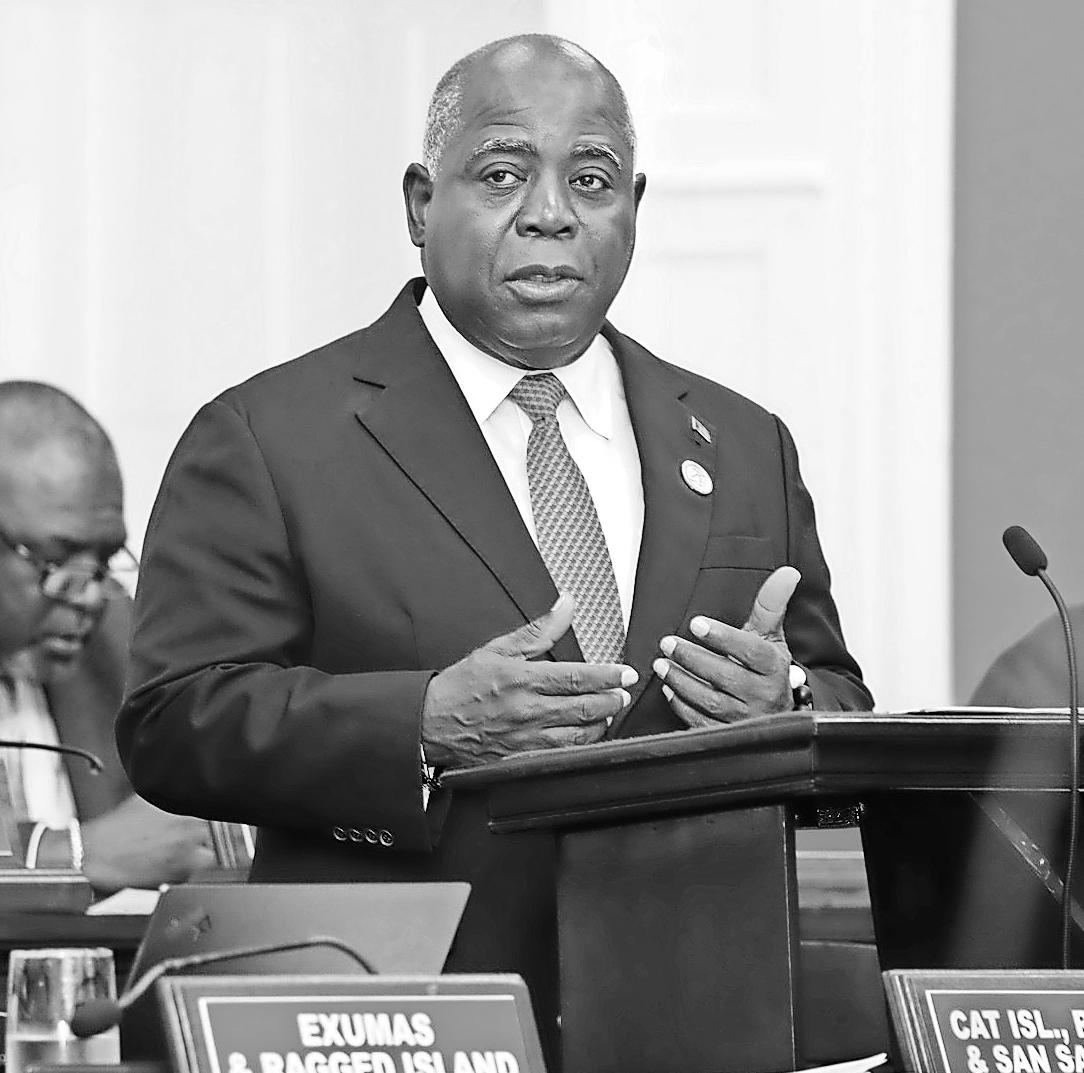
THE Prime Minister yesterday urged Caribbean nations to stop "mistaking survival for progress" and unite behind the creation of a regional Export-Import bank, arguing that its nations have been a "tenant" in a global financial system designed without their interests in mind.
Speaking at the opening ceremony of the Caribbean Development Bank's (CDB) Board of Governors meeting in Nassau, Philip Davis KC said the region faces mounting challenges from climate change, debt burdens and limited access to development financing, requiring its nations to pursue their own solutions rather than rely
on existing international structures.
"We have been resilient for so long that we have begun to mistake survival for progress. Surviving the storm is different from changing the conditions that create it. Enduring the old order is different from building a better one," said Mr Davis. He argued that many of the international financial rules governing small island states were developed without Caribbean realities in mind. "We, too, have lived as tenants in a house we did not build, following rules drafted in rooms where we had no seat,” he added. “The global financial architecture was not designed for us. It was designed without our storms, our scale and our future in mind." Mr Davis pointed to Africa's
experience as an example of how developing regions can create their own financial institutions to support economic growth and trade.
"Africa did not knock louder. Africa built its own door,” he said. Mr Davis added that the Africa Export-Import Bank (AfriExim) recently increased its commitment to the Caribbean from $3bn to $5bn.
"This year AfriExim Bank raised its commitment to our region from $3bn to $5bn. More than $750m has already reached our region. A pipeline of more than $2bn is still to follow,” Mr Davis said, arguing that the Caribbean should now pursue the creation of its own export-import bank.
"We must move from speaking of a Caribbean Exim Bank to bringing one to life,” he added. Mr Davis also warned against
countries pursuing national interests at the expense of regional co-operation, arguing that Caribbean states would be stronger if they acted collectively.
"The Caribbean has never needed speed. The Caribbean has always needed distance, and no single one of our economies, no matter how determined, can travel that distance on its own,” he said. Earlier, Michael Halkitis, minister of finance, told delegates that the Caribbean must respond strategically to growing global uncertainty and economic disruption. "We meet at a time when uncertainty has become the defining condition of the global landscape,” he said.
BY ANNELIA NIXON Tribune Business Reporter anixon@tribunemedia.net
THE Association of Bahamas Marinas (ABM) is projecting lower revenues and having to dip into cash reserves this year as reduced occupancy, falling membership dues and the continued loss of charter yacht business impacts the sector.
Stephen Kappeler, the ABM treasurer, told members that the association’s financial position has deteriorated significantly as marina traffic declines and levy contributions shrink.
“We are much less in membership dues than where we’ve been, or where we thought we were going to be from budget,” Mr Kappeler said. “And the levy has fallen significantly short with the drop of a couple marinas, for example, like Romora Bay, but there are others.”
For the first 11 months of the financial year, the Association recorded revenues of approximately $231,000 - a figure Mr Kappeler said was comparable to levels experienced during the COVID-19 downturn.
“Just to say they go back to something like the bad year of COVID explains how bad that number is,” he said. The decline has left the Association operating at a loss.
“For the first 11 months… we are at a net income as an Association of minus
$20,000, which means we’ll be dipping into that cash,” Mr Kappeler said, referring to approximately $331,000 in cash reserves. While the ABM remains financially stable, he warned that reduced revenues will require adjustments to future budgets. “We’re healthy in cash, but we will have to accommodate a different budget based on forecast and revenues,” Mr Kappeler said.
Stakeholders argued that the financial strain facing marinas is tied directly to policies affecting the charter yacht industry, particularly fees and regulatory requirements that they say have pushed vessels to competing Caribbean destinations.
Peter Maury, ABM president, said the industry continues to seek relief from the 14 percent fee applied to charter operations. “We’re still advocating for some relief on the 14 percent because you still see a lot of big boats heading outside of the country and finding new destinations,” he said. “It is such a big part of the support business in all the islands.”
According to Mr Maury, operators continue to report that the tax burden is influencing vessel owners’ decisions to relocate. “A lot of us are hearing that’s still an issue and driving customers out of the country,” he added.
The concern comes as charter yacht traffic
COMMONWEALTH OF THE BAHAMAS IN THE SUPREME COURT
Common Law and Equity Division
Claim No. 2024/CLE/GEN/00562
B E T W E E N
TO: ETHAN PEARCE
TAKE NOTICE that:
increasingly shifts towards destinations such as the Dominican Republic, Puerto Rico and the US Virgin Islands.
Mr Kappeler said many vessels that traditionally spent time in Bahamian waters are no longer stopping in the country. They pointed to charter industry data indicating that bookings are down sharply.
“This is mainly the Bahamas Yacht Brokers Association and the IYBA, NYBA,” Mr Maury said. “The feedback on the bookings is down 40 percent. In some cases more.”
He said there is also a decline in marina occupancy levels. Mr Kappeler warned that June compared to prior years has become the weakest month yet for marina traffic.
“June is our worst month yet,” he said. “We’re talking about a couple hundred slips missing from comparative years. July looks worse. And August looks worse.”
Mr Maury said additional costs imposed on charter vessels are further undermining The Bahamas’ competitiveness. One example, according to Mr Maury, involves an $11,000 fishing licence requirement that some larger charter yachts must pay despite rarely participating in fishing activities.
“For the 160-footers, or even 30-metre boats and up, these guys don’t charter fish. They don’t fish at all, really,” Mr Maury said. “But
CHRISTOPHER DORSETT Claimant AND ETHAN PEARCE Defendant
1. An action has been commenced against you by Christopher Dorsett in the Supreme Court of the Commonwealth of The Bahamas by Standard Claim Form filed on the 26th day of June, A.D., 2024 and renewed up to the 26th day of June, A.D., 2026 being Action No. 2024/CLE/GEN/00562, wherein the Claimant claims damages for personal injuries, special damages, loss and expenses arising out of an accident which occurred on the 12th day of July, A.D., 2021 on Atlantic Drive, Westridge off West Bay Street, in the Western District of the Island of New Providence, The Bahamas.
2. On the 7th day of May, A.D., 2026, Madam Adrienne Bellot, Assistant Registrar of the Supreme Court of the said Commonwealth, ordered inter alia that the said Standard Claim Form and accompanying Statement of Claim are deemed to be served on you by virtue of this advertisement.
3. You must within Twenty-one (21) days from the publication of this advertisement inclusive of the day of such publication, acknowledge service of the said Standard Claim Form by filing an Acknowledgement of Service at the Registry of the Supreme Court, the Supreme Court Building, Bank Lane, Nassau, The Bahamas, and by serving the said Acknowledgement of Service on the Attorneys whose name and address appear below, otherwise Judgment may be entered against you.
Dated the 29th day of May, A.D., 2026
OXFORD LAW CHAMBERS Park Plaza Annex Springfield Street, Fox Hill Nassau, The Bahamas Attorneys for the Claimant
Mr Halkitis described cli-
mate change as the region's greatest challenge, and said Caribbean countries must turn resilience-building into an economic opportunity.
"Climate change remains the single greatest existential threat to our region,” he added: "The transition towards green economies is not merely an environmental necessity. It is an economic opportunity."
Mr Halkitis also urged greater regional co-operation and economic diversification, arguing that Caribbean economies remain overly dependent on tourism, imports and external markets. "Economic diversification is therefore no longer a luxury. It is a necessity,” he said.
Mr Halkitis said the region must invest in agriculture, renewable energy, technology, financial services and other growth sectors while ensuring young people are equipped to lead future economic development. “We cannot speak about forging the future while excluding those who will inherit it,” he added.
they’re being required to pay an $11,000 licence.”
The fee comes on top of charter licences, Customs requirements and VAT obligations. Mr Kappeler said charter yachts are critical economic drivers for Family Island communities, noting that visitors spend money at local businesses after arriving.
“These big boats, these charters, they are the feed for the Out Islands,” he said. “They get off the island with their dinghy or their centre console and just spill money all over our settlements in the far Out Islands.”
Mr Maury said the charter sector once represented a $200m to $250m industry for The Bahamas, generating more than $100m annually in
consumable purchases and support services. Those expenditures included fuel, groceries, transportation and other local services purchased throughout The Bahamas.
“The Dominican Republic, which is starting to get this traffic, was amazed at the volume of fuel and groceries alone,” Mr Maury said.
He warned that the loss of charter activity reduces revenues for a broad cross-section of Bahamian businesses, including restaurants, provisioners, florists, laundromats, transportation operators and hospitality providers.
“It’s going to affect their revenue for sure if this keeps driving business out of the country,” Mr Maury said.
Mr Kappeler added that government revenues are also being impacted
through lower VAT collections, Customs duties and Stamp taxes. “Remember when we’re losing this revenue, you’re losing the VAT dollars, the Sstamp tax dollars, any of the duty dollars,” he said. “It’s a multiplicity loss that is even more slamming than what it is costing a marina.”
Despite recent adjustments to some boating-related fees, industry stakeholders fear many vessel operators have already established new cruising patterns elsewhere in the Caribbean.
“Everybody knows these fees have been relatively corrected, but they’ve been elsewhere,” Mr Kappeler said. “They’re getting accustomed to somewhere in the Virgin Islands, wherever that is, and especially these big boats.”
BY FAY SIMMONS Tribune Business Reporter jsimmons@tribunemedia.net
THE National Insurance Board's (NIB) 1.5 percent contribution rate increase in July 2024 has generated an average $4m rise in monthly income, helping improve the fund's financial performance beyond expectations.
Dr Tami Francis, NIB's director, said the increase introduced on July 1, 2024, has strengthened the fund's short and medium-term position but warned it is
only one component of a broader reform effort.
"On July 1, 2024, NIB took measures to move toward the short and medium-term sustainability of the Fund by increasing the contribution rate,” she said.
"By increasing the contribution rate by 1.5 percent, we have seen, on average, a $4m per month increase in our contribution income. This has really assisted us in moving toward that goal where we want to be."
The contribution rate increase took NIB's combined employer-employee rate from 9.8 percent to
11.3 percent. However, Dr Francis cautioned that the increase alone will not secure the Fund's future.
"Of course, this is not a full stop-gap measure. A contribution rate increase is not the only measure to put in place to help save the Fund,” she added.
"We would be combining the contribution rate increase with other measures, including recommendations made in successive actuarial reviews, as well as in-house recommendations, to work in tandem with that increase.
BY ANNELIA NIXON Tribune Business Reporter anixon@tribunemedia.net
THE Eleuthera Chamber of Commerce is urging the Government to adopt a more comprehensive longterm economic strategy for the island, address persistent utility challenges and strengthen local economic participation.
In a statement responding to the 2026-2027 Budget, the Chamber said it was grateful for recent public spending on infrastructure in Eleuthera but questioned what broader vision exists to sustain economic growth beyond what it described as reactive “catch-up” measures.
It added that residents and businesses continue to face frequent disruptions from unreliable water and electricity services, and warned that sustained economic expansion cannot

occur without a stable utility network. “We need a clear, proactive road map for utility resilience,” the Chamber said. It also expressed disappointment that the Budget did not fully recognise the growing economic importance of Family Islands, particularly Eleuthera, which it said has experienced some of the strongest growth opportunities in the country since 2020.
According to the Chamber, the Government should move beyond simply tracking visitor arrivals and instead focus on measuring the economic impact generated by individual projects and finding ways to keep more investment dollars circulating within local communities.
It called for the establishment of what it described as a domestic investment and empowerment regime aimed at supporting Bahamian-owned businesses.
Among its recommendations were financial incentives for local start-ups and established businesses, policies that prioritise Bahamian companies for sub-contracting and supply opportunities associated with developments, and initiatives to help businesses adopt sustainable and climate-resilient practices.
The Chamber also stressed the need for a clearly-defined strategy

"This is not to say that this will be the actual saviour of the Fund, but it is something that is going to work hand-in-hand with other recommendations to help us achieve the longterm sustainability that we are looking for,” Dr Francis said.
"We want to extend the Fund anywhere beyond 60 years or more in order to ensure that there is something there for our children, grandchildren and their children."
Despite ongoing challenges, Dr Francis said NIB's financial
for community ownership, adding that Eleuthera is still recovering from decades of economic depression.
The proposed framework would focus on community empowerment, increased local land ownership, direct reinvestment into Family Island settlements, and expanded business education opportunities for young people and aspiring entrepreneurs.
“Eleuthera is currently recovering from a multi-decade economic depression,” the Chamber said. “We must learn from our history and maximise this current moment to protect ourselves from future global crises.”
The Chamber pledged to work alongside the Government in developing policies that strengthen local participation in the economy, and ensure that wealth generated by the island’s
performance is currently exceeding projections. "At the moment, our performance is actually much better than predicted,” she said, "While we may still have a slight difference in our contribution income versus our benefit expenditure, we are doing a lot better than expected.
"That does not mean we are to rest on our laurels, but an increase of this nature would not be something that will ultimately save the Fund. As I said earlier, it will have to work along with other measures as we work toward reform."
Dr Francis said demographic trends continue to place pressure on social security systems globally.
“The fund right nowwe're not in crisis - but that doesn't mean we should rest on our laurels,” she added.
growth remains within the community.
“The Eleuthera Chamber of Commerce stands ready to partner with the Government to design and implement these essential frameworks,” it said in
"When National Insurance was implemented in 1974, we had approximately seven workers supporting one retiree. Today, we have approximately three workers supporting one retiree. If we are having fewer children and we have that ageing population, we have to come up with innovative ways to ensure that the Fund is increased over the long-term."
Dr Francis also sought to reassure contributors that any future rate increases would be gradual. "Nobody wants an increase, but I would say this: We would never have a drastic increase from 11.3 percent and move all the way to 20 percent,” she said.
"There would always be a phased approach, and we would keep in mind the cost of living and how salaries and wages increase over time."
a statement. “We remain completely committed to ensuring that the wealth generated in Eleuthera truly benefits, empowers and stays with the people of Eleuthera.”

We’re seeking reliable skilled Sous Chefs who share our commitment to culinary excellence with great people skills and a passion for exceptional services to join the Food & Beverage team. We deliver refined culinary experiences in an elegant, high-service environment. Every dish showcases creativity, attention to detail, and respect for ingredients set against a backdrop of warmth, teamwork, and professionalism. Please apply at: https://www.albanybahamas.com
Only Skilled Chefs Need Apply! No Phone Calls Please.
something that’s foreign to us. That’s what we’re living with now.”
Disclosing that Polymers International will itself advocate to the US government against imposing increased border taxes on Bahamian exports, he added: “Next week, when the US ambassador [Herschel Walker] comes to Freeport we’ll definitely have a discussion in that regard. That will be one of the items we push as far as all things that strain business in Grand Bahama and the wider Bahamas.
“It [the threatened tariff increase] doesn’t help. We hope that the Government would look at it from that standpoint. We did have the closure of PharmaChem in early 2024, so we don’t want another industrial company going by the wayside as far as Grand Bahama’s economy. We’ll definitely have consultations with the US ambassador and we’ll start here, as far as Polymers is concerned, with the minister for Grand Bahama [Ginger Moxey] once the political election dust settles.
“That’s how we’ll look at it. It’s not a favourable condition. It just adds another nail in the proverbial coffin, so to speak. It makes it more difficult for us to be profitable. Then, of course, it is a competitive disadvantage compared to other sources of our product that US customers can get.”
Mr Simms said Polymers International’s Freeport operation had yet to suffer any sales decline from the imposition of President Donald Trump’s so-called
‘Liberation Day’ tariffs last year, but added that the volume of US customer complaints showed persons were seeking lower-cost domestic alternatives to its supply.
“We try to contain costs in operations, but there’s only so much cutting you can do once you get to the bone,” he told Tribune Business. “Yes, we have customers informing us our prices are higher because of the 10 percent tariff relative to domestically-sourced product. They have been shouting to us about that.
“Sales are about the same, but when customers complain we know they are looking somewhere else as they complain. Hopefully, it can be turned around. We just do business, make a profit and keep moving along. It’s an uncertain environment for everyone, especially with oil prices. That adds pressure to prices as well. Raw material costs shoot up, transportation goes up, too. It’s not a good thing all around.”
Urging the Government to continue its advocacy efforts against the Trump administration’s ‘forced labour’ tariffs, Mr Simms said: “We would hope the Government is having consultations with the US Trade Representative’s Office in that regard. Obviously, The Bahamas is not a country that practices forced labour or violates any International Labour Organisation (ILO) standards.
NOTICE
INTERNATIONAL BUSINESS COMPANIES ACT, 2000
LEDIN HOLDINGS SA (IN VOLUNTARY LIQUIDATION)
NOTICE IS HEREBY GIVEN that in accordance with section 138(4) of the International Business Companies Act, 2000, as amended, LEDIN HOLDINGS SA is in dissolution.
The dissolution of the said Company commenced on 29 May, 2026, when the Articles of Dissolution were submitted to and registered with the Registrar General in Nassau, The Bahamas.
The sole liquidator of the said Company is Kim D Thompson of Equity Trust House, Caves Village, West Bay Street, P O Box N 10697, Nassau, Bahamas.
Kim D Thompson Sole Liquidator
“I think the Government should be doing these things, and I think it’s something that their relationship in the past should help with… We’d hope the Government, foreign affairs, would be dealing with it proactively and not being reactive to what’s coming. Sometimes, if you wait too long, the damage is done.”
Latrae Rahming, communications director in the Prime Minister’s Office, referred Tribune Business inquiries to the Bahamas Trade Commission when approached for comment yesterday. Jerome Fitzgerald, newly-appointed minister of economic affairs, did not return a message seeking the Government’s position before press time last night.
Dr Duane Sands, the Opposition’s chairman, warned that the threatened
12.5 percent US tariff would “have a dampening effect on our economy” if it becomes reality as The Bahamas “doesn’t have a whole lot of exports”. Noting that it could undermine a key source of foreign currency earnings for The Bahamas, he added: “The question is how does the Government of The Bahamas respond? That’s going to significantly increase the price of many goods and services, and the cost of living will go up.”
The Bahamas is in good company because the likes of Canada, Australia, the UK, the European Union (EU), Israel, New Zealand, Saudi Arabia, the United Arab Emirates and Singapore are among the other jurisdictions also set to be hit with tariffs. Those that have enacted prohibitions on forced labour goods, or made commitments to do
so, will face a lower 10 percent tariff rate, but those who have neither laws nor enforcement - such as The Bahamas - face being subjected to the higher 12.5 percent rate.
The Bahamas, though, and other nations now have around one month to initiate further efforts to head-off, and prevent, the Trump administration turning its threatened tariff imposition into action. The planned measures must now undergo a further round of consultation in Washington D.C., with the deadline for written submissions to the USTR set as July 6, 2026, with public hearings set to begin one day later.
The Davis administration has taken the threat posed by the US government’s forced labour tariffs extremely seriously. Besides Mr Pinder’s submissions
to the USTR, Danya Wallace, director of legal affairs in the Attorney General’s Office, represented The Bahamas at the public hearings on the issue and was one of the panellists to give evidence.
She conceded, under questioning, that The Bahamas has nothing in the Customs Management Act or other legislation “that directly addresses” the importation of goods manufactured by forced labour. However, Tribune Business previously revealed that the Government has moved swiftly to correct this deficiency through reforms to the Customs Management Act - tabled in the House of Assembly last week with the 20262027 Budget - that ban the importation of goods made with forced labour.
Ikebana International Ltd.
INTERNATIONAL BUSINESS COMPANIES ACT (No.45 of 2000)
In Voluntary Liquidation
Notice is hereby given that in accordance with Section 138 (4) of the International Business Companies Act, (No.45 of 2000), that Ikebana International Ltd. Registration no. 157564 B is in dissolution. The date of commencement of the dissolution is the 29th day of May, 2026. The Liquidator of the Company is Jose Zitelmann Falcao Vieira and can be contacted at Praia de Botafogo, 501 5th Floor,, Rio de Janeiro, RJ, CEP 24250-040, Brazil. All persons having claims against the above-named company are required to mail their names, addresses and particulars of their debts or claims to the Liquidator before 29th day of June, 2026.
Jose Zitelmann Falcao Vieira Liquidator
Kuarahy B&B Investments Inc.
Incorporated under the International Business Companies Act, 2000 of the Commonwealth of The Bahamas. Registration number 1501391 (IBC) (In Voluntary Liquidation)
Notice is hereby given that the above-named Company is in dissolution, commencing on the 2nd day of June A.D. 2026.
Articles of Dissolution have been duly registered by the Registrar. The Liquidator is Mr. Wilson Da Cunha E Silva, whose address is Rua Pará 416 Apto. 81, Higienópolis, 01243-020, Sao Paulo, SP, Brazil. Any Persons having a Claim against the above-named Company are required on or before the 2nd day of July A.D. 2026 to send their names, addresses and particulars of their debts or claims to the Liquidator of the Company, or in default thereof they may be excluded from the benefit of any distribution made before such claim is proved.
Dated this 2nd day of June A.D. 2026. WILSON DA CUNHA E SILVA LIQUIDATOR Legal Notice

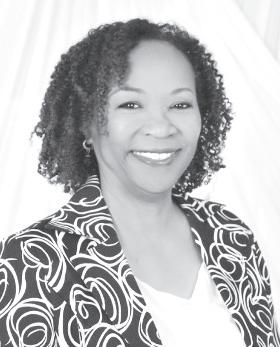
Temple Christian High School is proud to announce the appointment of Mrs. Cassandra D. Smith as Principal for the 2026-2027 academic year. With a distinguished career spanning over three decades in education and school leadership, Smith brings a wealth of experience, vision, and dedication to her new role.
Smith, a Nassau native, has served in various capacities across The Bahamas, including English Instructor and Grant Writer at New Providence Classical School, Adjunct English Instructor at the Bahamas Technical & Vocational Institute, and Director of Academy Affairs at Kingsway Academy. Her leadership has impacted thousands of students and educators, fostering academic excellence, innovative programs, and community engagement.
Smith holds a Master of Arts in Early Childhood Special Education from the University of the West Indies Open Campus and a Bachelor of Arts in Elementary Education from Ball State University. She is recognized for her commitment to professional development, having earned numerous certificates in teaching, curriculum design, and educational leadership.
Throughout her career, Smith has been an active member of professional organizations such as the Association of Christian Schools International and the National Association of Elementary School Principals. She has also contributed to national education initiatives as a BGCSE English Paper III Marker and Internal Moderator for the University of The Bahamas.
Temple Christian High School welcomes Smith’s proven leadership, passion for student achievement, and dedication to nurturing a vibrant school community. The school community looks forward to a new chapter of growth and excellence under her guidance.
of Energy and Transport that the Government’s total energy reform packageonce fully implemented and executed - will generate up to $170m in annual electricity savings for BPL customers “without requiring central government financing”. It warned, though, that restoring BPL to financial health - given 24 percent operating losses - is critical given that it “sits at the centre” of the energy reform plans.
The study also appeared to under-estimate BPL’s present tariffs, pegging them at 29 cents per KWH when - based on latest residential electricity bills - the all-in cost ranges from 33.3 cents to 38.8 cents depending on consumption and the various base rates that are triggered. Fuel alone, which accounts for around 50 percent of the total bill, stands at more than 21 cents per KWh in the latest round of billing.
Still, asserting that “this places The Bahamas among the region’s highest cost systems”, the IDB said:
“Average annual household energy expenditure is roughly $4,800, five times higher than the regional average, with households in the lowest income quintile spending about 7.3 percent of their income on electricity.
“This is well above the Latin American and Caribbean average of 4.4 percent, and exceeds the 6.5 percent benchmark designating a high energy burden. These costs reflect structural generation and system inefficiencies, not just temporary oil price spikes.” The Government, though, has asserted that the Equity Rate Adjustment structureand the provision of the first 200 KWh for free - has significantly slashed electricity costs for the poorest households and most vulnerable Bahamians.
“The recent decline in global oil prices, along with low inflation in The Bahamas - 0.4 percent year-over-year
as of end-May 2025 - created a temporary window for the Equity Rate Adjustment Programme, which zero-rates the first 200 kWh of residential consumption. However, the durability of such measures depends on structural efficiency gains and lower generation costs,” the IDB suggested.
Energy industry sources have suggested that the ‘free’ first 200 KWh is costing BPL several million dollars in revenue per month, with the utility also subsidising electricity costs on the Family Island by $50m per month to maintain one national, uniform tariff rate. The longtime strategy of using New Providence to part-cover Family Island generation costs is being ended under the Davis administration’s reforms, meaning businesses and residents there will now pay the true price for electricity.
However, the Government is hoping to still lower Family Island energy costs through the outsourcing of generation to private sector independent power producers (IPPs), with the use of solar and other renewable technologies, plus liquefied natural gas (LNG), ultimately eliminating the use of more expensive fossil fuels such as heavy fuel pil (HFO) and automated diesel oil (ADO).
The IDB, asserting that the integration of renewables into The Bahamas’ energy mix has “accelerated markedly”, said: “Prior to 2024, progress was slow, with renewable penetration staying near 0.2 percent. Since then, the reform trajectory has shifted from policy planning to implementation… “LNG-solar hybrid microgrids were launched in outer islands - Abaco, Andros, Eleuthera and Exuma, with Eleuthera and Abaco breaking ground in April 2026. And in March 2025, a 20 mega watt (MW) utility-scale solar project power purchase agreement (PPA) was signed at the Blue Hills facility in Nassau expected to be completed in 2027.
“The introduction and planned increased use of LNG represents a major structural shift in the generation mix Compared to diesel and heavy fuel oil, LNG offers lower and more stable generation costs and reduced carbon intensity.
While LNG remains a fossil fuel, it functions as a transitional stabiliser by reducing volatility and providing flexible back-up capacity for intermittent renewables,” the IDB said.
“When combined with the planned solar expansion and grid modernisation, the Ministry of Energy and Transport estimates this comprehensive reform package will generate up to $170m in annual savings without requiring direct central government financing. These substantial cost reductions could materially improve BPL’s operating margins and ease tariff pressures over time.”
The IDB report also voiced optimism that, through switching to the same combination of LNG and solar energy generation for the Family Islands, BPL’s costs will reduce.
“Today, electricity supply in these markets is heavily subsidised - at approximately $50m annually - to maintain uniform tariffs,” it said.
“By shifting to structured PPAs supported by hybrid microgrids, and more efficient generation, BPL can significantly reduce the cost of service in these regions while maintaining reliability and improving transparency in pricing.” However, it warned that BPL’s cashstrapped condition will continue to impact the pace and timing of the Government’s energy reforms.
“The utility’s weak balance sheet remains a major limitation on investment capacity. The Government’s response - lower-cost LNG substitution and mobilisation of private capital (PPAs and IPPs) - aims to reduce cost pressures while avoiding additional public borrowing. However, financial restructuring is still in progress,” the IDB
report said. “Nevertheless, important advances have been seen regarding capital expenditure restructuring……
“The core fiscal challenge for The Bahamas is to restore the financial viability of BPL, which sits at the centre of this macro transmission chain. With persistent operating losses of 24 percent and a -2.5 debt service coverage ratio in fiscal year 2023-2024, the utility represents a significant contingent liability for the Government. Continued under-performance could require fiscal intervention, increase total public debt ratios and potentially raise sovereign borrowing costs.
“Taken together, initiatives such as expansion of PPAs, debt restructuring and grid modernisation represent a fundamental restructuring of BPL’s cost base and operating model. The combination of reduced fuel and operating costs, elimination of legacy inefficiencies and more predictable long-term energy pricing positions the utility to potentially achieve financial stability and debt burden relief.”
Other constraints identified by the IDB report are
the conditions of the energy grid and technical limitations, although this will have been addressed on New Providence via the $130m foundational upgrades carried out by Bahamas Grid Company and its contractor, Pike Electrical.
“System losses remain elevated above 10 percent, and the grid lacks ‘N-1 redundancy’, meaning the system cannot fully withstand the loss of a major generation unit or transmission component without risking service disruption,” the study added.
“This limits operational flexibility and requires conventional generation to remain online as back-up, reducing the system’s ability to integrate intermittent wind and solar energy at scale.
Transmission reinforcement, digital monitoring and balancing capacity are therefore pre-requisites for achieving the 30 percent renewable target by 2030.”
The IDB document also signalled that there has been a subtle change in the Government’s energy PPAs, which are now focused on performance and delivery as opposed to construction. “Unlike earlier ad hoc approaches, the 2024
SERVICE - from page B2
enjoyed. The corner pharmacy now competes with mail order services. The local accountant competes with international software. The neighbourhood restaurant competes with delivery apps that ferry food from across the island. In every category, the winning move is to offer something that no algorithm can replicate, which is human connection done thoughtfully.
Building a strong customer experience requires more than a smile training session. It demands
hiring staff who genuinely enjoy people, empowering them to solve problems on the spot and gathering customer feedback systematically. Tools such as simple ‘after visit’ survey e-mails or comment cards still work beautifully. The data they generate should be reviewed in staff meetings as faithfully as sales figures. For an economy that has historically traded on charm and natural beauty, the customer experience era plays to our strengths. The Bahamas does not need to become Singapore to win. We need to remember that
framework establishes a structured PPP model based on performance-linked contracts and innovative financial transactions,” it said.
“Contracts are now structured around service delivery rather than asset construction, with no government guarantees granted to private participants. Each agreement includes tariff ceilings, performance clauses and eventual asset transfer provisions to BPL.
“To promote the bankability of these projects, the Government is employing blended finance strategies, which include partial risk guarantees, liquidity support instruments and escrow-backed payment frameworks in collaboration with multilateral institutions such as the IDB and World Bank,” the multilateral lender added.
“The Government is also exploring the Green Infrastructure to fund projects that target climate goals and tariff affordability. Overall, the macro-fiscal impact of more PPPs will depend less on the volume of private investment mobilised and more on sustained contract discipline, transparency and monitoring capacity.”
hospitality is a craft, that service is a profession, and that every encounter either deposits or withdraws from the goodwill bank that sustains a business. The price war is over. The experience war has begun. The good news for Bahamian enterprise is that we already know how to win it.
• NB: About Keith Keith Roye II is a highly analytic and solutions-driven professional with extensive experience in software development. He holds a BSc in computer science and his career includes leading and delivering global software projects in various industries in The Bahamas and the US.

enforce, a prohibition on the importation of goods produced with forced labour,” the report said. “We found that the failure to impose and effectively enforce a forced labour import prohibition is unreasonable.
“We found that the failure to impose, and effectively enforce a prohibition on the importation of goods produced with forced labour, burdens or restricts US commerce. For the foregoing reasons, the results of this investigation indicate that the acts, policies and practices of The Bahamas related to the failure to impose and effectively enforce a forced labour import prohibition are unreasonable and burden or restrict US commerce.”
The Bahamas is in good company because the likes of Canada, Australia, the UK, the European Union (EU), Israel, New Zealand, Saudi Arabia, the United Arab Emirates and Singapore are among the other jurisdictions also set to be hit with tariffs. Those that have enacted prohibitions on forced labour goods, or made commitments to do so, will face a lower 10 percent tariff rate, but those who have neither laws nor enforcement - such as The Bahamas - face being subjected to the higher 12.5 percent rate. The Bahamas, though, and other nations now have around one month to initiate further efforts to head-off, and prevent, the Trump administration turning its threatened tariff imposition into action. The planned measures must now undergo a further round of consultation in Washington D.C., with the deadline for written submissions to the USTR set as July 6, 2026, with public hearings set to begin one day later.
make them uncompetitive on price and losing sales and market share, it is not clear whether all will be impacted. The USTR signalled that some would be exempt given their importance to the US economy and the supply chain/production process, as well as on national security grounds.
Based on feedback submitted by Ryan Pinder KC, The Bahamas’ former attorney general, in March to the first round of USTR consultation, up to $985m worth of Bahamian to the US could be hit by the proposed 12.5 percent tariff based on 2024 data. This nation’s major export was refined petroleum, valued at $610m, while other categories included documents of title ($95.2m), styrene polymers ($55.7m) and pearl products ($39m). While these tariffs would increase the cost of Bahamian goods exports for both US importers and consumers, thus threatening to
Refined petroleum, which likely refers to products blended and composed at Buckeye Bahamas (the former Bahamas Oil Refining Company) in Grand Bahama, would be a potential exemption candidate given that California was last year sourcing up to 40 percent of its gasoline needs via this nation due to the loss of production capacity at its own refineries.
The Davis administration has taken the threat posed by the US government’s forced labour tariffs extremely seriously. Besides Mr Pinder’s submissions to the USTR, Danya Wallace, director of legal affairs in the Attorney General’s Office, represented The Bahamas at the public hearings on the issue and was one of the panellists to give evidence.
She conceded, under questioning, that The Bahamas has nothing in the
Customs Management Act or other legislation “that directly addresses” the importation of goods manufactured by forced labour.
However, Tribune Business previously revealed that the Government has moved swiftly to correct this deficiency through reforms to the Customs Management Act - tabled in the House of Assembly last week with the 20262027 Budget - that ban the importation of goods made with forced labour.
The Customs Management (Amendment) Bill 2026 introduces a new section 208A which stipulates: “The Minister may, by Order, prohibit the importation of any goods, wholly or partially produced or manufactured, from any supplier, country or territory if there are reasonable grounds to believe that the goods are a result of forced labour.”
The Bill’s ‘objects and reasons’ section reaffirmed that the change is geared towards “prohibiting goods from suppliers, places or countries that produce forced (child) labour from entering The Bahamas”. What is unknown is whether this will be sufficient to satisfy the Trump administration, given that the USTR seems to be demanding enforcement evidence as well as the enactment of the necessary laws and regulations.
Mr LaRoda, speaking on behalf of the Fishers Alliance, told Tribune Business: “In terms of the economic effect, we would be concerned because adding 12.5 percent; in real terms, that’s 15 percent. That further impacts us in being able to really sell our product to US importers. That’s a major concern for us.
“We already have a challenge selling lobster in US stores at prices that are 70 percent higher than domestic Maine lobsters. That’s going to put us at a serious competitive disadvantage. We have to find new markets to maintain our competitive advantage. We like our proximity, and to be able to access the US market, but we still have to explore new markets further north like Canada and Europe.”
While a significant portion of The Bahamas’ crawfish/spiny lobster exports are already sold to Europe, and especially France, Mr LaRoda added: “We are strong, but need to be stronger, because we’re competing with Africa and other countries. We are worried. We all are. Where
does it end? We could end up being as high as our other Caribbean brothers, being charged tariffs of 45 percent, which would really hurt economically.”
Mr LaRoda estimated that The Bahamas exports around 12 million pounds of crawfish annually, valued at close to $90m. Some four million pounds is sold to the US, which pegs the total value of that segment threatened by the tariffs at $30m, although Tribune Business has previously seen valuations as high as $50m-$60m for this category.
“Considering that spiny lobster is our main export, we are being squeezed,” the Alliance chief warned. “Some trade or foreign policy initiative needs to be introduced. We have to protect our industry. As much as we don’t want to say it, there are obviously other threats from the World Trade Organisation (WTO), so we need protection from a foreign policy initiative. That needs to be discussed.”
Voicing hope that the US will not follow through with its latest tariff threat, Mr LaRoda said: “The Government has shown it wants to do something. How much do we need to bend before we break or part-break? We’re showing we have the ability to put into legislation protections against importing forced labour goods. I don’t know how much we can be expected to do. The man with a big stick has the ability to affect us in terms of exports. We depend on the economic injection with that one export.
“We always don’t want to be burdened with additional taxes and tariffs. If this is passed, we would have to find ways to adjust.
I’m not happy to have to do that. We’re already at a price point where fisheries is breaking even. We’re in survival mode really. It’s not because we’re unable to harvest product, but the economics of tariffs and US trends.
“I honestly don’t know how much more the Government can do. There’s product we can absorb locally, but finding other markets needs to be a big push. We need to find other markets.” Mr LaRoda said much of the employment at Bahamian fisheries exporters, processors and wholesalers is seasonal, so the direct impact of any tariff-induced slowdown in US exports would not be significant for jobs.
However, he added: “The issue is we would still need to be harvesting because we
CONTRIBUTE - from page B1
grants will increase by 1.5 percent, while the insurable wage ceiling will increase by $20 per week to ensure coverage aligns with earnings growth,” she said. The weekly insurable wage ceiling will increase to $830 from $810, while the monthly ceiling will rise to $3,597 from $3,510.
NIB said all minimum pension rates and grants will increase by 1.5 percent, while pensions already in payment before July 2026 will receive increases of up to 1.5 percent.
Dr Francis said a pensioner receiving the minimum retirement pension of approximately $364 per month will receive an increase of about $5.46 monthly. “While
cannot absorb the product locally and, if the wholesalers cannot sell product, they will not be minded to purchase. The uncertainty is what is having the greatest effect right now. This is where our foreign policy needs to come into effect to head of this possibility. I hope they [the Government] stay on it.”
The present US probe is particularly interested in whether its products and manufacturers are being placed at a competitive disadvantage by other countries failing to crack down on rival goods made with forced labour. The Government’s position has been to “request” that the Trump administration find none of The Bahamas’ “acts, policies or practices” relating to forced labour are worthy of attracting sanctions under under Section 301 of the 1974 US Trade Act.
However, the USTR’s review has produced the opposite outcome. “The failure of our most important trading partners to address the importation of goods made with forced labour is unacceptable. This creates a dynamic where American workers are forced to compete globally on an unlevel playing field,” said Jamieson Greer, the US trade representative.
“We will no longer tolerate this disparity. Some trading partners have taken initial steps to prevent the importation of forced labor goods… However, each of our trading partners must do more to ensure that trade does not perversely encourage and entrench forced labour globally.”
The investigation also appears to be a thinly-veiled attempt to crack down on the volume of Chinese goods imported by some of Washington D.C’s major trading partners. China has long faced accusations that it subjects ethnic minorities, particularly the Uighurs in Xinjiang province, as well as political prisoners and dissidents to forced or slave labour where they are forced to manufacture goods against their will and for no compensation.
Media commentators have also suggested that the ‘forced labour’ investigation may be a backdoor attempt by the Trump administration to implement last year’s so-called ‘Liberation Day’ tariffs that have been ruled unlawful by both the US Supreme Court and trade court. Those verdicts are now under appeal.
this increase may appear modest, it reflects an important principle: Pension benefits should not be frozen while the cost of living continues to change,” she added.
“Many people assume that every worker will be paying more into National Insurance. That is not the case. The increase only affects contributors whose weekly earnings exceed the current insurable wage ceiling of $810,” she explained. “If you earn $810 per week or less, there will be no change to your National Insurance deductions.” For contributors whose earnings exceed the current ceiling, NIB contributions will be calculated on an additional $20 of weekly earnings once the new ceiling takes effect.
Dr Francis said this translates into an additional 93 cents per week, or $4.03 per month, for employees paying the standard 4.65 percent contribution rate. Employers paying 6.65 percent will contribute an additional $1.33 per week, or $5.76 per month, for each affected worker.
However, not all pensioners will receive the same increase. According to Dr Francis, pensions awarded before July 2024 will receive the full adjustment, while those granted after that date will receive incrementally smaller increases depending on when payments began. “This phased approach is designed to be fair and responsible,” Dr Francis said. She also sought to clarify the impact of the higher insurable wage ceiling on working Bahamian and resident contributors, noting that many workers will see no change in their deductions.
EVENT- from page B3
He added: “We charge them $100 to come to the show. They get their own booth and everything else, and for the ones certainly in the Out Islands, all they have to do is get to Nassau.”
Mr Maury added that maintaining a national charter yacht show is also important for preserving The Bahamas’ visibility in an increasingly competitive regional marketplace.
“With the other Caribbean destinations, they
have their own shows,” Mr Maury said. “Antigua is obviously the biggest, but I think The Bahamas is a leading destination. We should definitely have our own, and that’s kind of why we’re pushing to have this show so that we’re relevant. So people still talk about us.” Support for the event’s revival is also coming from operators in the Family Islands who depend heavily on yacht-related tourism.
“We really would enjoy a collaboration on specifically the show, really the only
event hosted in this country towards that market in the attraction of these larger charter boats that bring in these tourists, especially to the Out Islands,” Stephen Kappeler, managing director of the Bimini Big Game Club, said.
“So we would like a participation showing interest and care towards getting them, and we’re hoping to have a meeting so the Minister of Tourism can be helpful to understand the reality of what’s happened here.”
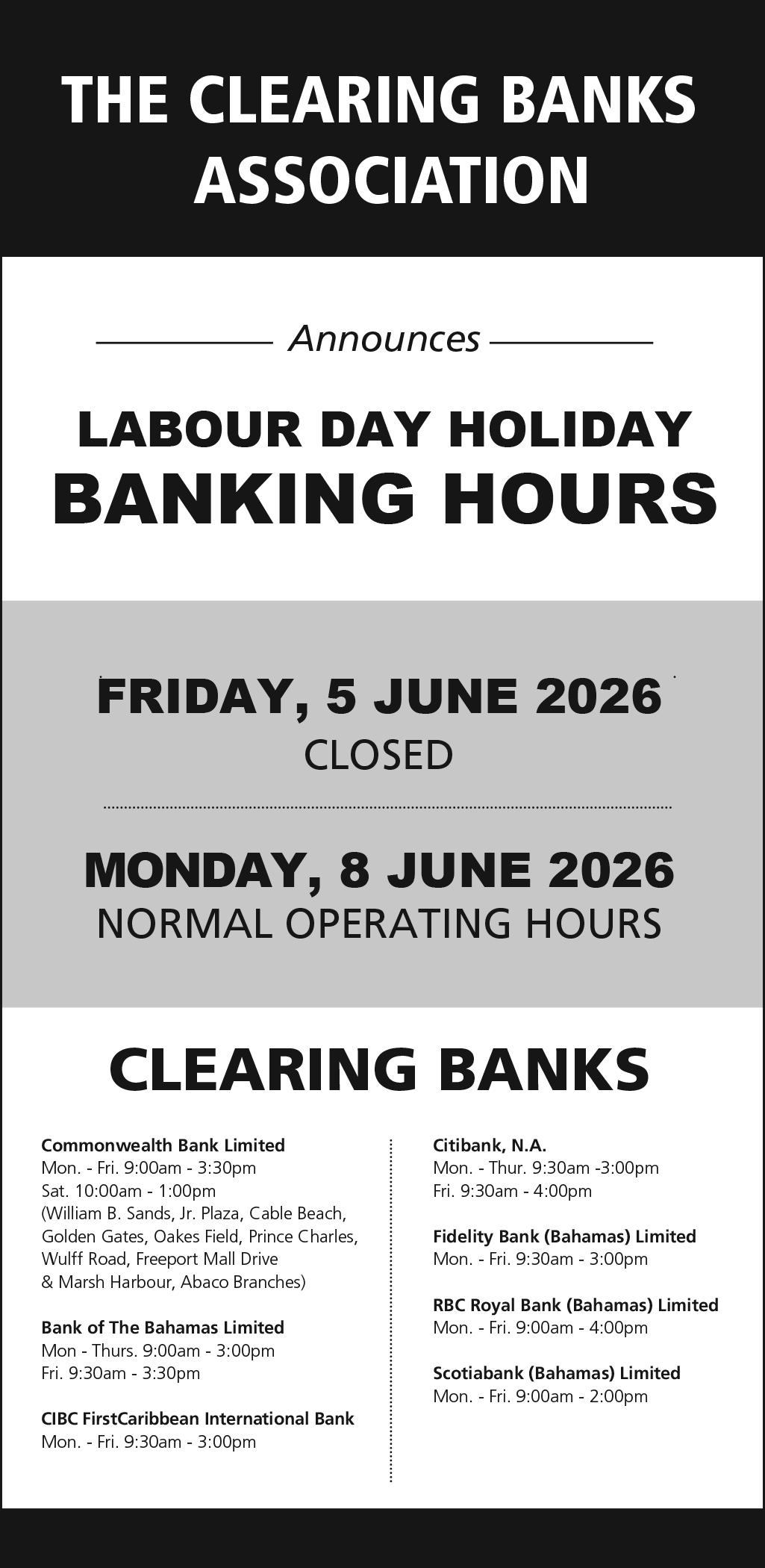
Friday, June 5, 2026
Randol Fawkes Labour Day

INTENT TO CHANGE NAME BY DEED POLL
The public is hereby advised that I, EDNISHA GEDEUS of Park Gate Road, Nassau, Bahamas, intend to change my name to EDNISHA TASSY. If there are any objections to challenge the name by deed poll, you may write such objections to the Chief Passport Officer, P.O. Box N-742, Nassau, The Bahamas no later than thirty (30) days after the date of the publication of this notice.
INTENT TO CHANGE NAME BY DEED POLL
The public is hereby advised that I, REVIE WILLARD FOX of London Avenue, New Providence, The Bahamas, P.O. Box GT2581, intend to change my name to WILLARD BAIN. If there are any objections to the change of name by deed poll, you may write such objections to the Chief Passport Officer, P.O. Box N-742, Nassau, Bahamas no later than thirty (30) days after the date of the publication of this notice.
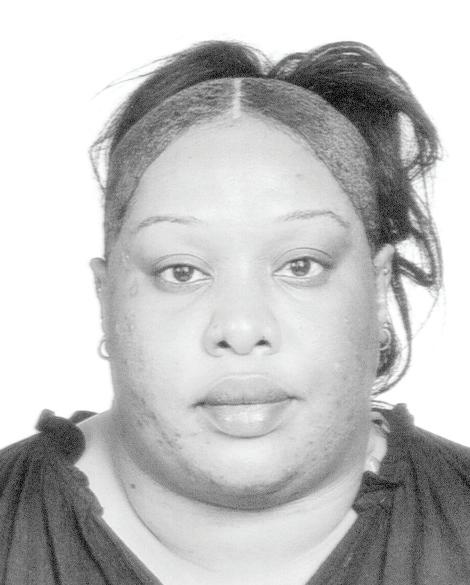
NOTICE is hereby given that I ROSE TIEMA CASIMIR of Coconut Grove Avenue, New Providence, Bahamas, applying to the Minister responsible for Nationality and Citizenship, for Registration Naturalization as a citizen of The Bahamas, and that any person who knows any reason why registration/naturalization should not be granted, should send a written and signed statement of the facts within twenty-eight days from the 4th day of June, 2026 to the Minister responsible for nationality and Citizenship, P.O. Box N-7147, Nassau, New Providence, The Bahamas.
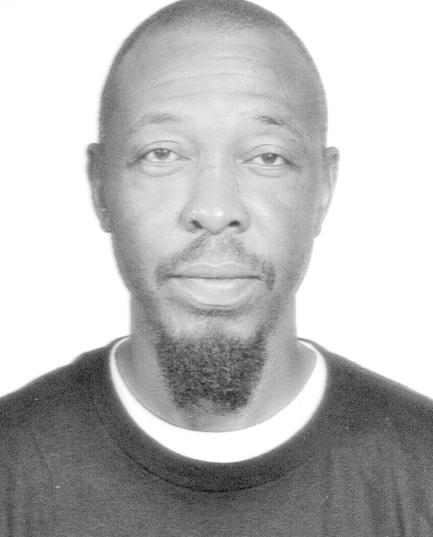
NOTICE is hereby given that I JANORDO JAVAR LIGHTBOURNE of, Homestead Street, Nassau, Bahamas, applying to the Minister responsible for Nationality and Citizenship, for Registration Naturalization as a citizen of The Bahamas, and that any person who knows any reason why registration/ naturalization should not be granted, should send a written and signed statement of the facts within twenty-eight days from the 28th day of May, 2026 to the Minister responsible for nationality and Citizenship, P.O. Box N-7147, Nassau, New Providence, The Bahamas.
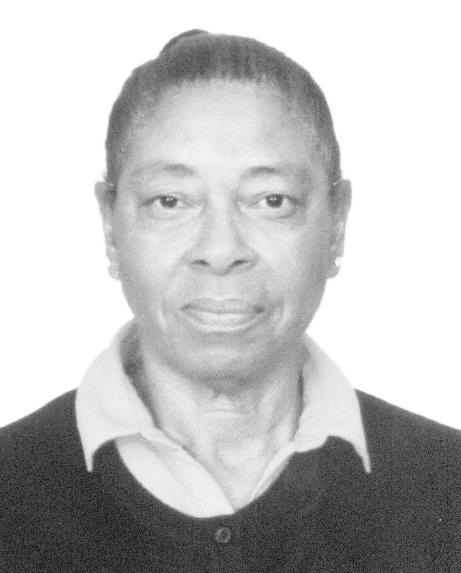
NOTICE is hereby given that I ELDEKA ROSE MARIE STRACHAN of P.O.Box N231 Rita Pugh Estate, New Providence, Bahamas, applying to the Minister responsible for Nationality and Citizenship, for Registration Naturalization as a citizen of The Bahamas, and that any person who knows any reason why registration/naturalization should not be granted, should send a written and signed statement of the facts within twentyeight days from the 4th day of June, 2026 to the Minister responsible for nationality and Citizenship, P.O. Box N-7147, Nassau, New Providence, The Bahamas.

NOTICE is hereby given that I, SHANEIKA TASHALEE BURRELL of Seaview Circle, Monastery Park, New Providence, Bahamas is applying to the Minister responsible for Nationality and Citizenship, for registration/ naturalization as a citizen of The Bahamas, and that any person who knows any reason why registration/ naturalization should not be granted, should send a written and signed statement of the facts within twenty-eight days from the 4th day of June, 2026 to the Minister responsible for nationality and Citizenship, P.O. Box N-7147, Nassau, Bahamas.

NOTICE is hereby given that I, LANDIE DAYANA UTILE of Pink Meadows, Faith Avenue, Carmichael Road, New Providence, Bahamas is applying to the Minister responsible for Nationality and Citizenship, for registration/ naturalization as a citizen of The Bahamas, and that any person who knows any reason why registration/ naturalization should not be granted, should send a written and signed statement of the facts within twenty-eight days from the 4rd day of June, 2026 to the Minister responsible for nationality and Citizenship, P.O. Box N-7147, Nassau, Bahamas.
afford it. We are already losing boating business. It would cripple the industry.
“Is it both? If that’s what they’re doing everybody’s going to have to increase their prices, and it’s just going to drive more business out of the country. If their [the Government’s] intent is to drive GDP down, I guess they’re doing a good job…
“We’re waiting to see what the Budget brings, but there will be strong objections to this. They are always coming up with new ways. Bahamian businesses cannot take all of this. If they keep putting taxes and fees on us, we will go out of business. Welcome to Communism.”
Mr Maury said marinas already pay a dock fee to the Government based on linear footage, adding that it had recently been increased from around $3 to in the region of $6. He spoke out after the Davis administration tabled in the House of Assembly plans to levy more commercial-based fees for seabed leases.
The Port Authorities (Seabed Lease Rates and Environmental Levy Fee) Order 2026, revealed after the 2026-2027 Budget was presented, proposes to charge $5,000 per acre annually for an “industrial seabed lease”, which would cover activities such as “manufacturing, processing, bulk storage, energy generation, utility infrastructure, industrial port-related developments, quarrying, mining, transshipment or similar activities for an industrial purpose”.
Then there is the $3,000 per acre annual fee for a “commercial seabed lease”, which is the category Bahamas-based marinas will fall into. This covers seabed leased by the Government “for any trade, business, tourism, recreational, marina, transportation or a similar
service for the purpose of generating revenue or for other commercial purposes”.
Several sources, speaking on condition of anonymity, said the Government has under-valued seabed leases for decades and allowed numerous developers and commercial operatorsmany of whom have deep financial pockets - to use acreage for just a nominal or peppercorn fee. They have welcomed the reforms.
But Mr Maury yesterday reiterated: “It just reduces the opportunity for Bahamian businesses.
The market can’t bear an increase. It just reduces profits. If we increase rates less boats will come in and they’ve already chased half the boats out of the country.
“I don’t know how much more the market can bear in terms of increased prices, but if we have to maintain margins… A lot of marinas have development costs, bank fees. We have to pay so much for everything. If I have to increase prices to maintain the margins, it’s just going to chase more boats away.”
Meanwhile, Kwasi Thompson, the Opposition’s finance spokesman, voiced concern that the Order gives the responsible minister the ability to negotiate, and deviate, from the fee structure after consultation with the Ministry of Finance.
“The Government’s proposed seabed lease regime in the Port Authority (Seabed Lease Rates and Environmental Levy Fee) Order 2026, released in the Budget documents, raises serious concerns about transparency, fairness and the concentration of power in the hands of a single minister,” the east Grand Bahama MP argued.
“No one disputes that those who profit from the use of the Bahamian seabed should make a fair contribution to the Bahamian people. What is deeply troubling, however, is that while
the legislation establishes published rates, it then gives the minister the authority to negotiate different rates behind closed doors. That is a recipe for uncertainty, inconsistency and public suspicion. The Bahamian people have seen too many examples of secret discretionary decision-making.
“Bahamians and investors deserve certainty. Businesses deserve a level playing field. And the public deserves confidence that national assets are not being managed through private arrangements known only to a select few. If the Government expects Bahamians to trust this process, then it must immediately publish the criteria that will be used to determine when alternative rates may be granted,” Mr Thompson added.
“It must publish every negotiated seabed lease rate and every environmental levy agreement. And it must provide Parliament and the public with an annual report identifying every lease approved under the minister’s discretionary authority and the justification for each decision.
The Government must also explain how it intends to prevent preferential treatment, political influence or unequal treatment among applicants. Why should one investor pay one rate while another pays something different?
“What objective standards will apply? Who will ensure that these decisions are made fairly? Public resources belong to the Bahamian people, not to any minister. The management of those resources must be governed by clear rules, transparency and accountability - not discretion exercised behind closed doors. If these decisions are being made fairly and in the best interests of the country, then publish the criteria, publish the agreements and let the Bahamian people see for themselves.”


Nassau, Bahamas — Maybelline recently hosted a special Nurses Appreciation Day Luncheon to recognize and celebrate the dedication of nurses throughout the community.
The event provided nurses with an opportunity to relax, connect, and enjoy complimentary Maybelline shade testing sessions, helping attendees find their ideal foundation matches.
“We wanted to create a meaningful experience that acknowledged the hard work, and compassion nurses demonstrate every day,” said Sasha Pratt, Brand Manager.
Guests enjoyed great food, beauty experiences, and fellowship in an inviting atmosphere dedicated to celebrating healthcare professionals.
Through initiatives like this, Maybelline continues to support community engagement efforts that inspire confidence and recognize everyday heroes across The Bahamas.
Maybelline – Distributed by Lowe’s Wholesale Ltd.