
Thursday, May 28, 2026
Gov’t targets $470m revenue jump but cuts surplus forecast
BY NEIL HARTNELL Tribune Business Editor nhartnell@tribunemedia.net
THE Government is targeting a $470m revenue increase for the 2026-2027 fiscal period despite this year’s collection pace lagging 2024-2025, it was revealed yesterday, as it cut the forecast Budget surplus by 24 percent.
Michael Halkitis, newly-appointed minister of finance, in his first-ever Budget presentation told the House of Assembly that the lower surplus projected for the upcoming fiscal year - now $223.1m, as opposed to the previously forecast $291.4m, representing a reduction of $68.3m - was justified by the Davis administration’s decision to “prioritise the needs of the Bahamian people” by investing in healthcare improvements.
Trimmed by 23% in upcoming fiscal year to ‘prioritise Bahamian people’s needs’
Gov’t eyes neartripling of corporate income tax revenues through larger base
And bills Grand Bahama Port Authority for $99m to cover Freeport expenses

Pension reform revival to cap $3bn unfunded Gov’t liabilties
‘White Paper’: Civil servants must pay towards their retirement Officials pay 3% of salary, with Gov’t contribution equal to 5% SOE liabilities near $400m amid fears of ‘barrier to progress’
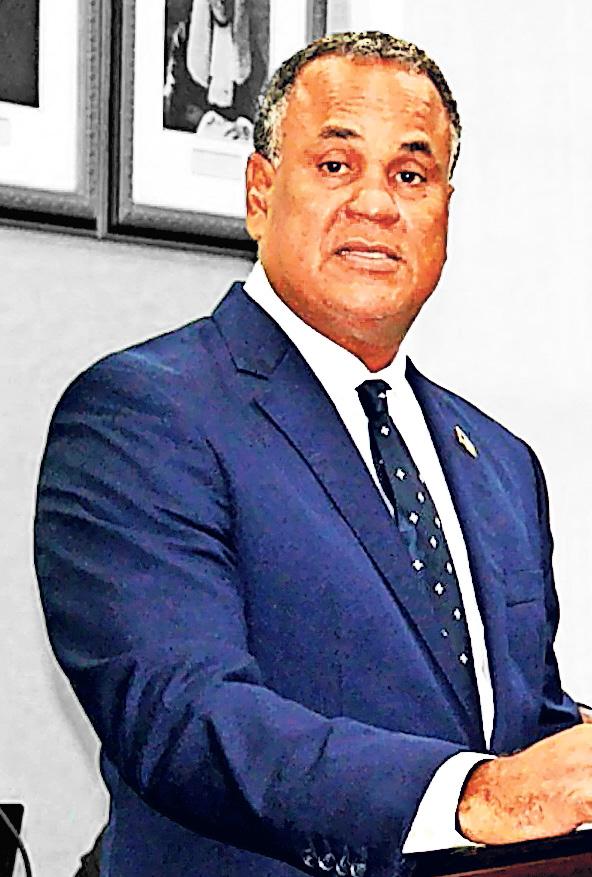
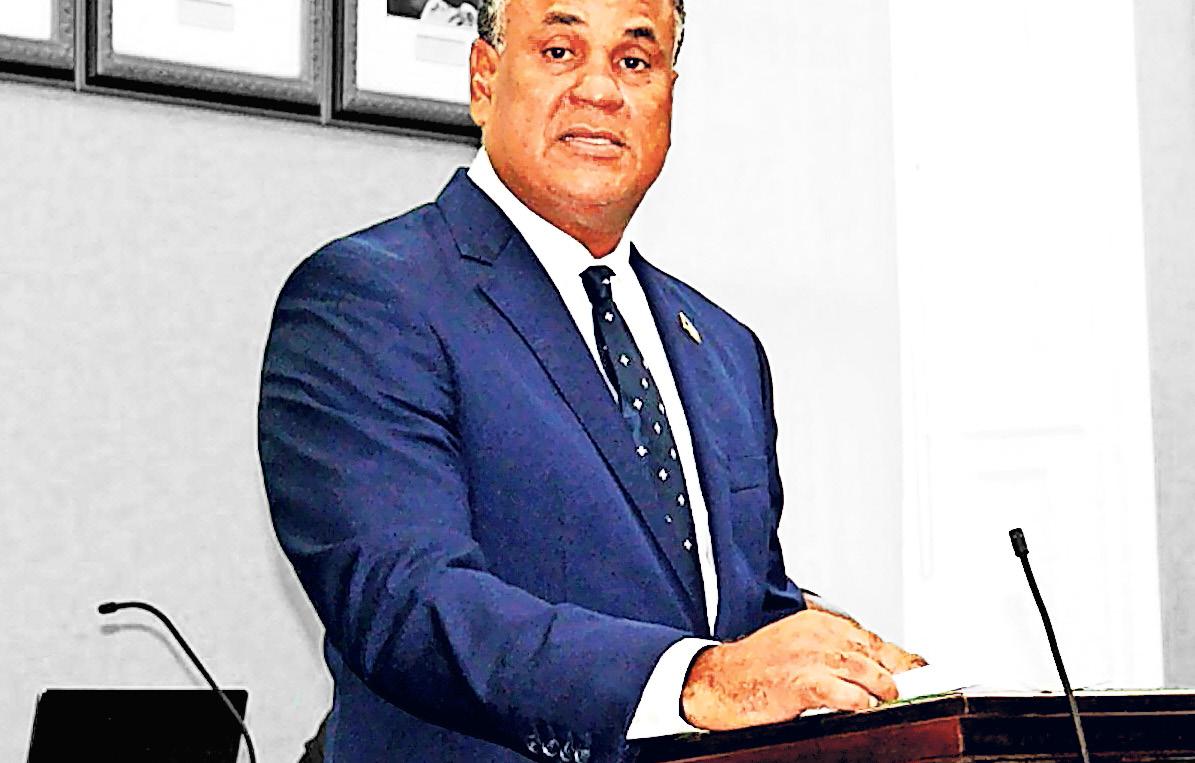
Explaining that the downward revision was also made against the backdrop of the still-simmering Middle East conflict, which has rocked fuel and energy markets and sparked renewed global inflation and pricing pressures, the minister asserted that the reduced surplus and overall fiscal position “remains positive” as the $223.1m forecast - if achieved - will represent by how much the Government’s revenue income exceeds its spending.
Key tax arrears jump 27% to reach $1.8bn
BY NEIL HARTNELL Tribune Business Editor nhartnell@tribunemedia.net
TAX arrears owed to the Government under some of its most important revenue streams grew by $382m or 26.7 percent during the first nine months of the current fiscal year to hit $1.812bn at end-March 2026, Budget documents released yesterday revealed.
The increase from $1.43bn at end-June 2025 was worsened by the inclusion of the $99.228m bill issued to the Grand Bahama Port Authority (GBPA), as the Government renewed its bid
owner occupied property taxes down $38m
to seek reimbursement from Freeport’s quasi-governmental authority for public services it has provided in the Port area, and recover costs that exceed tax revenues generated by the city. Stripping out that bill reduces the combined arrears increase for VAT, real property taxes and Business Licence fees to $283m for the first three-quarters of the present fiscal year. While the figures represent a one-time snapshot, and could have
Taxpayer SOE subsidies surge by 19% to $655m
BY NEIL HARTNELL Tribune Business Editor nhartnell@tribunemedia.net
TAXPAYER subsidies to loss-making state-owned enterprises (SOEs) are set to increase by more than $103m to $655m during the upcoming 2026-2027 fiscal year, driven largely by expanded healthcare spending, with other efforts focused on boosting transparency and efficiency for public-private partnerships (PPPs). Documents released during yesterday’s unveiling of the 2026-2027 Budget reveal that total subventions
NEIL HARTNELL
to the likes of Bahamasair, the Water & Sewerage Corporation, University of the Bahamas (UoB) and Straw Market Authority are forecast to increase by 18.8 percent from the $551.015m projected for the current fiscal year.
The bulk of the increase, around $64m, comes from increased taxpayer and Public Treasury support for the Government’s drive to invest in healthcare infrastructure throughout The Bahamas and thus improve access to critical treatment for Bahamians. The Public
been significantly reduced over the past two months, they make a case for the Davis administration’s continued focus on heightened enforcement, compliance and administration as opposed to introducing new and/or increased taxes.
VAT arrears, representing past due and owing taxes, suffered the biggest increase in jumping by 33.6 percent in the nine months since the 20242025 fiscal year ended. They rose by more than $103m, increasing from $309.24m at end-June 2025 to $413m as at the close of March 2026.
Not far behind was commercial real property tax
arrears, which were shown to have increased over the same nine-month period by 31.2 percent - from $341.331m at end-June 2025 to $447.899m at the end of March this year. Outstanding and past due real property taxes on foreign-owned vacant land also surged by a similar amount, increasing by 33.8 percent from $307.174m to $411.077m, thereby expanding by more than $103m. However, the data from other real property tax categories suggests the Government’s compliance efforts may be enjoying some
- See Page B9 STRUCTURE - See Page B9
“to cite what law they are following” after it was revealed that $700m in net new borrowings, or debt, has been transferred to the National Investment Fund. Michael Pintard told Tribune Business that disclosures during the 2026-2027 Budget’s unveiling raised questions over whether the Davis administration is using the correct legal mechanisms to effect such a move or if this was merely to keep new debt off the Government’s balance sheet so it did not blow the forecast $75.5m Budget surplus for the present fiscal year. He spoke out after Michael Halkitis, minister of finance, told the House of Assembly: “Our improvement is reflected in the increased borrowing and debt repayment activity during the year, driven mainly by our ongoing financing operations and
BY NEIL HARTNELL Tribune Business Editor nhartnell@tribunemedia.net
THE Government yesterday moved to revive long-awaited public sector pension reform in a bid to halt growth in unfunded liabilities that now stand at $3bn through the creation of a scheme where civil servants will help finance their own retirement.
A so-called ‘white paper’ outlining the latest reform proposals, tabled in the House of Assembly by Michael Halkitis, minister of finance, after the 2026-2027 Budget’s unveiling calls for qualifying civil servants to contribute a mandatory 3 percent of their monthly salary to a new defined contribution scheme with the Government injecting a sum equal to 5 percent of their earnings.
The move will ultimately phase-out the existing ‘pay as you go’ civil service pension where public officials pay nothing towards their retirement which, instead, is financed 100 percent by Bahamian taxpayers from the annual Budget. Pension payments to public officials were pegged at $154.434m for the current 2025-2026 fiscal year, with some $113.917 of this amount paid out during the first nine months, and this is forecast to steadily increase over the next three years to hit $166.75m by 2028-2029.
And, with unfunded civil service pension liabilities forecast to increase by another $1.1bn over the next six years to hit $4.1bn by 2032, change is becoming ever-more critical to resolve what Simon Wilson, the Ministry of Finance’s financial secretary, told Tribune Business in an April 5, 2024, interview is “the top risk” to the stability of the Government’s finances and need to be “dealt with as soon as possible”.
“The continued growth in pension liabilities and cash outflows is fiscally unsustainable,” the Government’s ‘white paper’ asserts. “With annual cash outflows of $184m and accrued
RETIRING - See Page B11 COLLECT - See Page B6

But
NEWLY-appointed minister of finance, Michael Halkitis (centre), pictured giving his first-ever Budget presentation.
Separating start-up success from failure
Have you ever sat in a café, looked around and thought: “How is this place always full, while the shop across the street is empty?” Well, the difference between failure and a thriving business is one of the most fascinating puzzles in entrepreneurship.
Sometimes, two businesses can sell the same product, serve the same community and still end up with completely different outcomes. The truth? It is not luck. Success thrives on strategy, adaptability, branding and how well a business connects with its customers. So let us dissect some of the
reasons why some businesses collapse while others boom.
The harsh reality of business failure is something we cannot sugarcoat. Running a business is tough and, according to statistics, one in every five businesses close their doors in the first year. Half do not make it


past the five-year mark, and here are some of the reasons. Cash flow nightmares – It is not profits that kill most businesses; it is running out of cash. A shop might look busy, but if the bills outweigh the income, the game is over.
Building without validation – Entrepreneurs sometimes fall in love with an idea, but are uncertain if anyone actually wants the product. Weak Online Presence –Be real. If you do not have a social media presence,
BUILD - See Page B4



Finance minister hails ‘mould breaking’ growth
BY FAY SIMMONS Tribune Business Reporter jsimmons@tribunemedia.net
A CABINET minister yesterday asserted that the Government is “clear eyed” about the challenges facing the Bahamian economy as he hailed this nation’s post-COVID rebound as “mould-breaking and outstanding”.
Michael Halkitis, minister of finance, in delivering the 2026-2027 Budget in the House of Assembly said The Bahamas has enjoyed a five-year growth run above its long-assumed economic ceiling and has consistently outperformed expectations since 2021.
“Among the comparable regional peers mentioned previously, The Bahamas
recorded the strongest growth performance, exceeded only by Guyana,” he said. “For five consecutive years, our economy has expanded beyond the long-assumed 2 percent ceiling, a rate once treated as the upper limit of our country’s growth potential.”
Mr Halkitis said the 3.8 percent growth estimate for 2025 followed expansion of 4.2 percent in 2024, and surpassed the IMF’s earlier 2.8 percent projection for last year. “The Bahamian economy has not only regained its footing; it has outperformed expectations,” he said.
Mr Halkitis added that nominal GDP per capita was estimated at $42,722.8 in 2025, up 6.9 percent yearover-year and significantly
FNM leader: GB is not feeling tourism growth
BY FAY SIMMONS
THE Opposition’s leader yesterday argued that Grand Bahama continues to struggle economically despite government assertions of record tourism growth, while also warning that wider cost of living pressures are leaving many Bahamians financially strained.
Speaking after the 2026-2027 Budget communication, Michael Pintard said the Government’s headline tourism numbers do not reflect the economic reality facing many residents and businesses in Grand Bahama. “The minister of finance talked about record increases in arrivals,” he said.
“What he does not say is that you have an increase in cruise passengers who are coming in, but few of them are leaving Celebration Key, and even fewer of them are spending any money once they have exited the gate.” Carnival’s $600m Celebration Key project has been promoted as a major economic boost for Grand Bahama, particularly through job creation and increased cruise passenger traffic. However, critics have questioned how much spending will flow into the wider local economy beyond the cruise port itself.
Mr Pintard acknowledged there would be some
employment benefits tied to the development, but argued the broader impact remains limited. “Apart from the direct benefit of employment in Grand Bahama for those people who are hired at the Key, for the most part the impact is negligible for many citizens,” he said.
The Opposition leader also pointed to ongoing uncertainty surrounding several major Grand Bahama assets and infrastructure projects. “The Grand Lucayan is now closed, persons are out of work, and we’re not sure they have even settled all of their obligations to the employees,” said Mr Pintard. He further criticised the pace of progress on Grand Bahama Interntational Airport’s redevelopment.
“The airport is still in a worse state,” he said. “We left in place a plan when we were kicked out of office in 2021, and the Government, for four-and a-half years, because of the internal conflicts they have had, has not been able to make progress on that.”
Mr Pintard also questioned the government’s ability to successfully reform Grand Bahama’s energy sector given the persistent operational and financial struggles at Bahamas Power & Light (BPL). “With respect to the Power Company, I just ask you: How well are they doing with BPL?” he said.
above the regional average for Latin America and the Caribbean. He said tourism remained the dominant driver of economic activity throughout 2025 and into the first quarter of 2026.
“Total visitor arrivals reached approximately 12.5m visitors during 2025, representing growth of 11.4 percent over the previous year,” he said. Sea arrivals increased 13.8 percent to 10.8m visitors, while air arrivals totalled around 1.7m. As of March 2026, total arrivals had already reached 3.9m visitors, representing growth of 17.5 percent compared to the same period a year earlier.
Mr Halkitis also pointed to major gains in Grand Bahama following the opening of Carnival’s
“If we are to judge what we’re going to get from them in terms of the Power Company in Grand Bahama, on the basis of what they’ve done with BPL, I mean, we’re praying already.”
Beyond Grand Bahama, the Opposition leader argued that broader economic pressures continue to weigh heavily on Bahamian households despite the Government’s assertions of economic recovery.
“In our view, the Government has failed to provide meaningful proposals that we believe would transform people’s lives,” he said. Mr Pintard argued that food prices, housing affordability and energy costs remain major concerns for ordinary Bahamians.
“We do not believe that if you go in the food store your prices have gone down over the course of the last four-and-a-half years that they have been in power,” he said. “We do not believe that if you are moving from one apartment to another, that you are able to find an apartment the average Bahamian citizen can afford to rent.”
While welcoming VAT concessions announced for some first-time homeowners and multi-unit residential developments, Mr Pintard argued the measures fall short of what is needed to improve housing affordability.
“Anything that makes the potential for home ownership greater, we applaud,” he said. “When we hear about a reduction of VAT for firsttime homeowners, or for a multi-purpose building, triplex or fourplex, and the VAT is again reduced for the first-time homeowner, any step in that direction is a good step. What we’re saying is it’s not sufficient.”

Celebration Key cruise destination. “Total arrivals to the island exceeded one million visitors during 2025, representing growth of 91.2 percent over the previous year,” he said.
Beyond tourism, Mr Halkitis highlighted broadbased gains across multiple sectors. Construction activity grew by an estimated 9 percent in 2025, supported by tourism developments, foreign direct investment (FDI) projects and public infrastructure works.
The utilities sector rebounded by 20.1 percent, which Mr Halkitis attributed to electricity grid modernisation, LNG-transition works and infrastructure upgrades supported by the
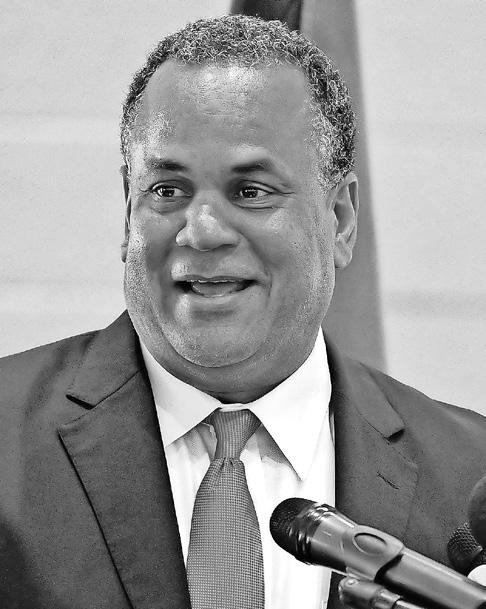
Inter-American Development Bank (IDB).
Financial and insurance activities expanded by 19.8 percent, while transport and storage grew by 6.6 percent and accommodation and food services by 5.2 percent.
Agriculture, forestry and fishing grew by 8.4 percent, although mining and quarrying activity expanded by a more modest 0.6 percent due to climate-related impacts on salt production in Great Inagua.
Mr Halkitis also pointed to improving labour market conditions. Preliminary data
BPL fuel hedge to cover GB Power
BY FAY SIMMONS Tribune Business Reporter jsimmons@tribunemedia.net
THE minister of finance yesterday said the Government will to expand Bahamas Power & Light’s (BPL) fuel hedging deal to cover to the Grand Bahama Power Company (GBPC) following its purchase of the utility in a bid to protect consumers on the island from oil price volatility.
Michael Halkitis, in unveiling the 2026-2027 Budget, said the Government executed a fuel hedge in December 2025 designed to protect BPL consumers against sudden increases in international oil prices while The Bahamas transitions toward LNG
generation and expanded energy infrastructure.
“The arrangement covers approximately 2.5m barrels of fuel oil and is intended to help stabilise electricity generation costs and reduce exposure to external oil price shocks,” he said. “It is intended that the hedging arrangement now supporting Bahamas Power & Light will be extended to the Grand Bahama Power Company.”
The comments come weeks after the Davis administration completed the acquisition of all remaining shares in GB Power through a government-backed transaction that Prime Minister Philip Davis KC said would reduce electricity bills on
10.8 percent in March
to approximately 9.3 percent by June 2025. “These developments reflect ongoing economic recovery and continued expansion in employment opportunities for Bahamians throughout the domestic economy,” said Mr Halkitis. He said inflation remained relatively subdued, averaging 0.6 percent during 2025 despite continued volatility in global commodity and energy markets. The Government projects inflation of 1.6 percent in 2026. On the fiscal side, Mr Halkitis said total revenue for the first nine months of the 2025-2026 fiscal year increased by 3 percent to $2.5bn, supported largely by VAT collections, which rose 6.6 percent year-over-year to $1.1bn. Aggregate expenditure for the nine-month period totalled $2.7bn, producing a fiscal deficit of $157.5m, or 0.9 percent of GDP.
the island by an average of 37 percent.
The acquisition was financed through government-guaranteed loans and executed via a special purpose vehicle known as Grand Bahama Electricity Company. The Government has argued that the move will align Grand Bahama’s electricity tariffs with those charged by BPL, while also improving competitiveness and lowering the island’s cost of living.
Mr Halkitis said yesterday: “We are also acquiring critical components to support energy resilience for all Bahamians. A key example of this is the agreement of the acquisition of all outstanding shares of the Grand Bahama Power Company.
“Through this transaction, Grand Bahama Power Company will adopt the BPL tariff structure with effect from the date of
PROTECT - See Page B4

MICHAEL HALKITIS
Bahamas’ import bill breaches $5bn mark
BY ANNELIA NIXON Tribune Business Reporter anixon@tribunemedia.net
THE Bahamas imported around $5.1bn worth of goods in 2025, a 3 percent increase over the $4.9bn recorded in the prior year, while this nation’s total exports were relatively flat at $677.6m.
The Bahamas National Statistical Institute (BNSI), unveiling its annual foreign trade statistics report, said machinery and transport
equipment remained the country’s largest import category, totalling $1.4bn and accounting for 27.7 percent of all imports. Food and live animals followed at $855.6m, representing 16.8 percent of the import bill. Manufactured goods accounted for $762.6m, or 14.9 percent of imports, while miscellaneous manufactured articles contributed $651.5m, representing 12.8 percent. The data illustrates the steady escalation of import spending over the
last five years. Imports grew from $3.483bn in 2021 to $5.107bn in 2025. Exports, however, failed to keep pace, moving from $543.42m in 2021 to $677.65m in 2025. Domestic exports accounted for only $193.6m, or 28.6 percent, while re-exports made up $484m, representing 71.4 percent.
Food and live animals dominated domestic exports at $117.7m, accounting for 60.8 percent of locally produced exports.
Chemicals followed at $46m, contributing 23.8 percent.
The US remained overwhelmingly dominant as The Bahamas’ primary trading partner, accounting for 81.9 percent of imports and 82.4 percent of exports.
China remained this country’s second-largest import source, with imports rising to $138.221m in 2025 from $123.83m the previous year. Trade persisted with other partners including Panama, the United Kingdom, Japan, Switzerland and the US Virgin Islands. Imports from Panama jumped sharply in 2025 to $57.695m from $38.414m in 2024, while imports from the United Kingdom increased to $46.408m from $29.772m a year earlier.
Minister reiterates 37 percent savings for GB Power clients
PROTECT - from page B3
acquisition, May 12, 2026, which is expected to significantly reduce electricity costs for Grand Bahamians.
The estimated average savings is 37 percent on electricity costs for the typical Bahamian household.
“This acquisition represents a major policy accomplishment that not
FIELD TRAINING OFFICER
only alleviates the financial burden on Grand Bahamians but also strengthens investor confidence and enhances Grand Bahama’s position as a more competitive and attractive
A reputable and growing franchisee retail organization is seeking a highly qualified Field Training Officer to design, implement, and manage a comprehensive training framework for Managers and Line Staff across multiple locations. This role is critical to ensuring operational excellence, consistency, Franchise compliance, and superior customer service throughout all facilities.
Key Responsibilities
• Develop, implement, and continuously improve structured training programs for management and frontline employees.
• Coordinate onboarding, certification retraining , and ongoing leadership develop ment programs aligned with franchise standards and corporate objectives
• Deliver training through a variety of methods, including in-person sessions, work shops, coaching, and on-the-job training.
• Assess training needs by evaluating performance gaps and operational requirements.
• Monitor and evaluate training effectiveness through assessments, KPIs, audits, and feedback mechanisms.
• Ensure compliance with health & safety regulations, food safety standards, company policies, international franchise standards.
• Collaborate with Operations, HR, and Senior Management to support performance goals and succession planning.
• Build and maintain strong bench strength through coaching and succession planning initiatives.
• Support the development of leadership skills among management teams to drive pro ductivity and employee engagement.
Qualifications & Experience
• Master’s degree in business administration, Education, Hospitality Management, or a related field.
• Minimum 5 years’ experience in training, learning & development, operations within a retail, hospitality, or franchise environment.
• Proven experience developing training programs for multi-unit operations.
• Strong knowledge of operational standards, customer service excellence, and compliance requirements.
• Excellent communication, facilitation, and presentation skills.
• Strong organizational and analytical abilities.
• Proficiency in Microsoft Office and learning management systems (LMS) is an asset. Skills and Competencies:
• Strong leadership and team-building skills.
• Excellent communication and interpersonal abilities.
• Proven track record of driving operational excellence and achieving measurable results.
• Proficiency in data analysis and using metrics for decision-making.
• Proficiency in Microsoft Office Suite (Excel, Word, PowerPoint).
• Results-oriented, proactive, and adaptable.
• Strong problem-solving and decision-making skills.
• High level of integrity and professionalism.
Interested candidates should submit their resume and cover letter outlining their relevant experience to: P.O. Box N-4351, Nassau, Bahamas, Application Deadline: June 15th, 2026.
destination for investment. In the medium-term it would also help the national electricity sector, through the infusion of another cadre of skilled Bahamian workers.”
Prime Minister Davis previously described the acquisition as a way to bring Grand Bahama “inside our national energy strategy”, arguing that the island’s residents and businesses had long paid significantly higher electricity rates than consumers elsewhere in the country.
The Government’s fuel hedge forms part of broader efforts to shield both BPL and, eventually, GB Power customers from volatility in international oil markets while LNG-related reforms and grid modernisation projects continue.
Mr Halkitis said inflation remained relatively subdued at 0.6 percent during 2025 despite uncertainty in global commodity and energy markets, with the hedge helping to support domestic price stability.
Energy reform has become a central plank of the Government’s economic strategy as officials seek to lower electricity costs, improve reliability and support investment activity, particularly in Grand Bahama.
The administration has also argued that lower and more predictable electricity costs are essential to improving the island’s competitiveness for tourism, industrial and commercial investment.

The road map to a thriving business
BUILD - from page B2
customers will assume you are not serious.
Ignoring Customers – If customers feel like they are just wallets to your business, they will find a competitor who actually listens.
Why failure is not the end
Here is something most entrepreneurs will not admit: Failure happens more often than success, but it is not final. Many thriving businesses were born after a failed attempt. Think of it like testing recipes. The first pancake flopped, but you adjusted the heat, added a little butter, and suddenly you have got perfection.
What thriving businesses do differently
So we have covered the doom and gloom. What exactly makes a thriving business? It is not magic. It is a mixture of mindset, strategy and execution. A strong brand and online identity
When people think of your business, what do you think comes to mind? Is it professionalism, creativity or trust?
Thriving businesses nail their branding early. They do not just pick a random name; they choose one that reflects their identity, one that tells their story. A brand that instantly sets you apart, one that says: “We’re serious. We’re trustworthy. We’re here for the long run.”
Innovation and flexibility
A thriving business does not stay rigid. They pivot when needed, like moving from DVDs to streaming, or small restaurants turning to delivery apps during a pandemic. Change is not a threat; it is really fuel for growth.
A customer first approach
Here is a big one: Thriving businesses genuinely care. They listen, they adapt and make customers feel valued. Ever walked into a local shop where they know your name and order? That is not just service; that is loyalty and loyalty is priceless.
Smart financial decisions
Money management is the heartbeat of a thriving business. It’s not about having the most funding, it’s about using resources wisely, and planning for rainy days.
Digital presence defines a thriving business
Think about this. If your business is not online, does it even exist? To be honest, customers expect to find you on Google, Instagram
or TikTok before they even walk through your doors.
Social media platforms let thriving businesses humanise their brand simply because people want reasons to connect with you.
Content is Currency
Thriving businesses use blogs, videos and social posts to stay relevant. A blog on your site is not just a filler; it is a magnet for customers searching online. The human factor behind every thriving business? Behind logos and websites are people making decisions daily. Leadership and culture play a bigger role in success than most realise.
Visionary Leadership
A thriving business starts with a leader who sees beyond today; one that sets a vision, and adapts strategy when needed. Also, building the right culture is a game changer. Culture is not just ‘Pizza Fridays’. It is how you communicate, innovateand treat customers. Happy employees make for happy customers. When your team feels valued, they bring their best selves, and customers really do feel it. Energy cannot be dismissed.
Here is your roadmap to a thriving business: Research: Do not just assume people want your product - prove it. Use surveys, interviews and competitor analysis. Lock in your brand identity: A name is your digital handshake. Choose one that says ‘we’re here to serve you’. Online visibility: Create content that solves problems. Obsess over customers: Every purchase, every interaction is a chance to wow. Thriving businesses should treat customers like partners, not transactions. Stay Flexible: Do not marry your first business plan. The market shifts, so shift with it. Finally, the difference between a failed venture and a thriving business is not luck; it is preparation, adaptability and branding. Success starts with the right foundation even if it is as small as a hand shake. Until we meet again, live life for memories rather than regrets. Enjoy life and stay on top of your game.
• NB: Columnist welcomes feedback at deeproject21@gmail.com
About columnist: Deidre M. Bastian is a brand marketing analyst/graphic designer, international award-winning author and certified life coach.
Caves Village
Premium Office Space available for Lease
1,056 sq.ft, 4 offices, reception, conference room, kitchen $2,640.00 Plus CAM and VAT
1,072 sq.ft, 4 offices, conference room, reception, kitchen $3,126.66 Plus CAM and VAT
1,196 sq.ft, 4 offices, conference room, reception, kitchen $3,488.33 Plus CAM and VAT
1,906 sq.ft, 11, offices, conference room, reception, kitchen, $4,765.00 Plus CAM and VAT
Contact Mr. Sean McCarroll Cell # 359-2957 Email: sean@mccarrollrealestate.com
LEGAL NOTICE
JORGAL SUPPLIERS LTD. (In Voluntary Liquidation)
NOTICE is hereby given in pursuance of Section 218(e) of the Companies (Winding Up Amendment) Act, 2011, that the Members of the above-named Company by Resolution passed on the 11th day of May 2026 resolved that the Company be wound up voluntarily forthwith and that the Liquidator be Ms. Tanya P. Simmons of Ronald Atkinson & Co., Chartered Accountants, Marron House, Virginia and Augusta Streets, P.O. Box N-8326, Nassau, Bahamas.
Dated the 22nd day of May 2026. Tanya P. Simmons Liquidator
Minister predicts 50% target for debt-to-GDP will be hit
the rollover of short-term obligations as they matured.
“Our gross borrowings during the nine months in the fiscal year [to endMarch 2026] amounted to $2.5bn, while our debt repayments totaled $1.8bn. However, the excess borrowing receipts were transferred to the National Investment Fund and not used for deficit financing. This underscores our commitment to meeting our obligations, maintaining our targets and fostering stable fiscal consolidation.”
The Government thus appears to have followed the template established last year, where $265.3m of the surplus $300m generated by the $1.067bn external foreign currency bond issue were placed into the National Investment Fund to help finance critical infrastructure projects. And it also treated the $265.3m as “equity” even though it seemingly represented the proceeds of borrowing given that a bond is a debt security, or IOU, obligating the issuer to repay investors interest and principal.
Mr Pintard yesterday reiterated the Free National Movement’s (FNM) arguments, made at that time, that such a move - as well as the $700m transfermust first be approved by Parliament via an appropriation or resolution as all
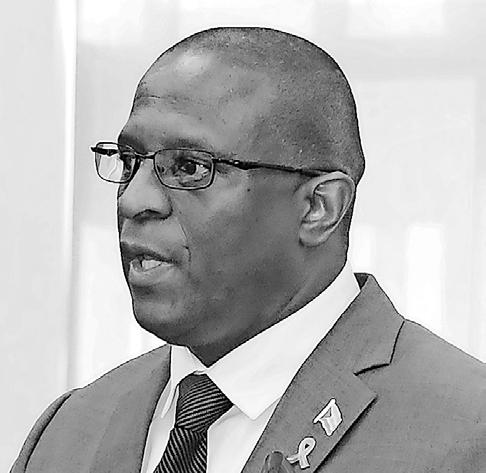
MICHAEL PINTARD
borrowing proceeds must first go into the Government’s consolidated fund and cannot be removed otherwise.
“There’s a mechanism in law for how you are able to transfer funds from the consolidated fund to the National Investment Fund,” the Opposition’s leader told this newspaper. “We have not heard them cite the law that authorised them to do this. They have to come to Parliament for the appropriate mechanism to do that.
“Until they do that, they are acting ultra vires, outside the law. They ought to cite what law are they following in transferring the funds. The constitution reiterates that the appropriation of funds outside the consolidated fund must go through Parliament.”
The Opposition’s objections thus lie with the mechanism the Government is using because it believes it must first, under the constitution and statute law, place all borrowing proceeds in the ‘consolidated
fund’ and then obtain Parliament’s permission for how they are used.
Kwasi Thompson, the Opposition’s finance spokesman, previously voiced fears voicing fears that the Government would circumvent the provisions of the Public Debt Management Act by directing the $300m excess sovereign bond proceeds earlier this year directly into the National Investment Fund as opposed to first going into the ‘consolidated’ fund.
“Any government spending ought to be approved by Parliament,” he told this newspaper last year. “The way government spending is appropriated by Parliament is through the Budget process. The Government has to get parliamentary approval to borrow funds and to spend funds.
“The law obligates the Government to come to Parliament to get approval to spend government monies. If the Government wants $300m to invest in the National Investment Fund, which we have no difficulty with, it must be approved by Parliament. And to be approved by Parliament it must be in the Budget.”
Mr Pintard yesterday argued that government debt has not been reduced but only “shifted”. He said: “Increasingly, public debt is not sitting transparently on the Government’s balance sheet. Instead, it is being pushed into state-owned
enterprises, disguised as loans, buried in long-term contracts, and parked in financing arrangements that do not show up clearly in the Budget numbers presented to Parliament.
“This does not make the debt go away. It simply makes it harder for the public to see how much the country truly owes and how much future taxpayers will be required to pay… Another glaring omission from the Budget speech is the Government’s complete failure to explain why, despite an annual borrowing plan last year that clearly stated there would be no new net borrowing for the current fiscal year, the Government’s own official reports show that public debt has increased by approximately $689.2m in just the first nine months of the year.
“This figure does not come from the Opposition; it comes directly from the Government’s own public debt statistical bulletin. Bahamians are therefore entitled to ask a very basic question: How has the Government been able to borrow hundreds of millions of dollars without returning to Parliament for the necessary borrowing resolution and approval?
“And let me pre-empt any attempt to brush this aside by claiming that this near $700m was merely short-term borrowing,” Mr Pintard asserted. “We
US stocks inch to more records after oil prices drop
By STAN CHOE AP Business Writer
U.S. stocks inched to more records Wednesday after oil prices fell and eased the pressure on households and businesses worldwide.
The S&P 500 edged up by less than 0.1% and added to its all-time high set the day before. The Dow Jones Industrial Average climbed 182 points, or 0.4%, and the Nasdaq composite gained 0.1% as both indexes also set records.
Stocks of companies with big fuel bills helped lead the way on hopes that lower oil prices will remove a big drag on their profits. Norwegian Cruise Line Holdings climbed 6.1%, and United Airlines rallied 6.3%. Delta Air Lines rose 3% and set an all-time high.
The price for a barrel of Brent crude oil fell 4.6% to $92.25 after the ceasefire between the United States and Iran appeared to hold despite the U.S. military launching what it called “self-defense” strikes in southern Iran. A barrel of benchmark U.S. crude fell even more, 5.5%, to settle at $88.68 and is back to where it was in mid-April on hopes that the United States and Iran can reach an agreement to reopen the Strait of Hormuz and allow oil tankers to exit the Persian Gulf for deliveries again.
Stocks have been able to run to records despite the painful inflation and uncertainty caused by high oil prices largely because companies have reported surprisingly strong profits for the start of 2026, and the forecast is for them to continue.
Bath & Body Works rallied 9.7%, and Abercrombie & Fitch climbed 8.9% after both reported bigger profit for the latest quarter than analysts expected. That’s even as U.S. consumers continue to say they’re feeling discouraged about the economy and inflation.
Lululemon Athletica rose 2.9% after reaching a deal with its founder, Chip Wilson, where it will add a former chief marketing officer of ESPN and a former co-CEO of On to its board of directors.
On the losing side of Wall Street was Dick’s Sporting Goods, which dropped 6% despite delivering a profit for the latest quarter that edged past expectations. Analysts pointed to how much profit it wrung out of each $1 in revenue, which some called a bit weak.
Oil-and-gas stocks also sank, hurt by the dropping prices for crude. Exxon Mobil fell 1.3%, and Chevron slipped 1.3%. Halliburton dropped 3.6% to bring its gain for the year so far back toward 40%.

All told, the S&P 500 rose 1.24 to 7,520.36. The Dow Jones Industrial Average climbed 182.60 points to 50,644.28, and the Nasdaq composite gained 18.55 to 26,674.73.
In the bond market, Treasury yields eased after falling
already know that this increased debt is going to crystallise as long-term debt well beyond the current fiscal year.
“This pattern reflects an administration that has consistently evaded parliamentary oversight and parliamentary authority in order to run up significant debts outside of the transparent and lawful framework required by statute. This is not accidental. It is a deliberate approach that undermines accountability, weakens Parliament’s control over the public purse, and erodes trust in the Government’s claims of fiscal discipline and responsibility.”
Mr Halkitis, meanwhile, yesterday told the House of Assembly: “Central government debt stood at $12.5bn, representing a modest increase of 6.4 percent when compared to end-March 2025. It is important to note that growth in the economy outpaced the growth recorded for central government debt stock at end-March 2026.
“External debt amounted to $5.4 bn, accounting for 43.4 percent of total central government debt. Domestic debt totalled $7.1bn, representing 56.6 percent of total debt and increasing by 6 percent relative to end-March 2025. The composition of the debt stock continues to reflect the Government’s balanced approach to financing, with
oil prices took pressure off inflation. The yield on the 10-year Treasury slipped to 4.48% from 4.50% late Tuesday and from 4.67% roughly a week ago. It’s a respite following recent gains for yields in bond markets worldwide, which threatened to slow economies and undercut prices for stocks and all kinds of other investments. High yields have already forced the average longterm U.S. mortgage rate to its most expensive level since last summer, and they could curtail companies’ borrowing to build the artificial-intelligence data
NOTICE
IN THE ESTATE of TREVIS FRANCIS CURRY, late of the Settlement of Marsh Harbour in the Island of Abaco, one of the Islands of the Commonwealth of The Bahamas, deceased.
Notice is hereby given that all persons having any claim or demands against the above named Estate are required to send their names, addresses and particulars of the same duly certified in writing to the undersigned on or before the 28th day of May A.D., 2025, and if required, prove such debts or claims, or in default be excluded from any distribution; after the above date the assets will be distributed having regard only to the proved debts or claims of which the Administrator shall then have had Notice.
And Notice is hereby given that all persons indebted to the said Estate are requested to make full settlement on or before the aforementioned date.
MICHAEL A. DEAN & CO.,
Attorneys for the Executor Loyalist Plaza, Don Mackay Boulevard P.O. Box AB 203777
Marsh Harbour, Abaco, Bahamas

domestic debt remaining the larger share of the portfolio.”
And the minister of finance added: “Government debt is projected to follow a firm downward trajectory over both the medium and long-term, declining from $11.4bn in fiscal year 2025-2026 to $8bn by 2035-2036. In relation to GDP, the debt ratio is expected to fall from 64.6 percent in 2025-2026 to 51.5 percent by 2028-2029, and further to 47.9 percent by 2030-2031.
“This places the Government on a clear path toward achieving its fiscal objective of reducing central government debt to no more than 50 percent of GDP by 2030-2031. Thereafter, the debt- to-GDP ratio is projected to continue declining steadily, reaching 30.3 percent by 2035-2036. This sustained reduction is underpinned by strong and persistent primary surpluses, continued economic growth and prudent debt management.
“The composition of public debt is also expected to improve over the projection horizon. External debt is projected to decline from $5.1bn in 2025-2026 to $2.8bn by 2035-2036, while domestic debt is expected to decrease more gradually from $6.3bn to $5.1bn. This rebalancing will help reduce external vulnerabilities while maintaining a stable domestic financing base.”
centers that have supported the U.S. economy’s growth recently.
In stock markets abroad, indexes were mixed across Europe and Asia. South Korea’s Kospi was one of the world’s best performers and jumped 2.3% after SK Hynix, which is a big beneficiary of the AI boom, soared 9.3%.
NOTICE
IN THE ESTATE of THOMAS CRAIG CURRY, late of the Settlement of Marsh Harbour in the Island of Abaco, one of the Islands of the Commonwealth of The Bahamas, deceased.
Notice is hereby given that all persons having any claim or demands against the above named Estate are required to send their names, addresses and particulars of the same duly certified in writing to the undersigned on or before the 28th day of May, 2026, and if required, prove such debts or claims, or in default be excluded from any distribution; after the above date the assets will be distributed having regard only to the proved debts or claims of which the Administrator shall then have had Notice.
And Notice is hereby given that all persons indebted to the said Estate are requested to make full settlement on or before the aforementioned date.
MICHAEL A. DEAN & CO.,
Attorneys for the Executors Loyalist Plaza, Don Mackay Boulevard P.O. Box AB 203777
Marsh Harbour, Abaco, Bahamas

Gov’t sticks to 2025-2026 surplus despite pressures
And the second Davis administration, just weeks into its second term following May 12 general election success, is also sticking to its initial projection of a $75.5m fiscal surplus for the current 2025-2026 fiscal year, which is due to end on June 30, despite the persistence of a volatile global economic and trade environment that could impact both tourism demand and drive higher prices for Bahamian consumers.
Mr Halkitis, in his Budget communication, did not give a dollar figure for where the Government’s estimated 2025-2026 surplus will close. “The Government should be able to achieve its goal of a Budget surplus,” he said, basing
this on continued spending restraint and discipline plus renewed optimism that the $130m in projected corporate income tax payments will be collected before the fiscal year closes at end-June.
The Government’s nearterm fiscal projections show it expects total recurrent revenues to jump by $470m, or 12 percent, yearover-year for the 2026-2027 Budget period compared to 2025-2026’s projected $3.887bn. It is aiming to achieve this despite the revenue collection pace for the nine months to-end March 2026 lagging behind the same period in the prior year, with just 65.3 percent of the full-year target collected compared to 69.4 percent at the same stage of 2024-2025.
And the Davis administration is also forecasting revenues will increase by nearly half a billion dollars despite predicting that real economic growth will slow drastically from 6.5 percent in the present 2025-2026 fiscal period to 1.8 percent in 2026-2027 - a rate that will be maintained in the following fiscal year. The Bahamas’ consumption-based tax system means a growing economy is vital for expanding government revenues by the projected $470m, yet the Budget estimates appear to be going in the opposite direction.
The Budget’s gross domestic product (GDP) growth forecasts also appear to be at odds with the stronger-than-expected 3.8 percent estimate for


2025 that was released last week by the Bahamas National Statistical Institute (BNSI). However, the 2026-2027 Budget identifies several areas where the Government expects to generate significant revenue growth.
Chief among them is the Domestic Minimum Top-Up Tax (DMTT), or 15 percent corporate income tax that is now levied on Bahamas-based companies that are part of multinational groups generating more than 750m euros in annual turnover. The Government is forecasting that revenue from this source will near-triple from the $130m projected in the present 2025-2026 fiscal year to $350m - a 169 percent year-over-year jump.
The Fiscal Responsibility Council, the Bahamas’ top public finance watchdog, in its recently-published assessment of the 20252026 mid-year Budget had voiced doubts over whether the $130m in DMTT revenues for 2025-2026 would be collected before the fiscal year closed because the necessary collection mechanism, guidance notes and regulations had not been implemented.
However, Mr Halkitis yesterday not only voiced optimism that DMTT revenues will be received next month before 2025-2026 closes, but disclosed that the Government now anticipates a much expanded taxpayer base for a levy that was introduced to enable The Bahamas to comply with the G-20/OECD minimum global corporate tax initiative intended to prevent multinationals dodging due taxes by shifting profits to lower-tax jurisdictions where they were not earned.
“As we move toward the close of fiscal year 202520026, the full-year fiscal outlook will be shaped by several important developments across revenue, expenditure and financing activity,” the minister of finance explains.
“One of these developments relates to the Domestic Minimum Top-Up Tax Act, which is a tax measure designed to ensure that large multinational enterprise groups operating in The Bahamas are subject to a minimum effective tax rate of 15 percent.
“Revenue collections under the Domestic Minimum Top-Up Tax Act were budgeted at $130m, or 0.7 percent of GDP. This is a new revenue category
for the Government, and the related collections are expected to be received in June of this fiscal year,” Mr Halkitis added.
“At the time of last year’s Budget preparation, the anticipated taxpayer base was expected to be fewer than five taxpayers. However, recent information indicates that the number of taxpayers could exceed this projection, and this would have a positive impact on the overall year-end fiscal position.”
Besides the likes of Atlantis and Baha Mar, which are owned by Brookfield Asset Management and Chow Tai Fook Enterprises (CTFE) respectively, other major hotel chains such as Sandals are also likely to be caught by the 15 percent corporate income tax on profits. The major Canadian banks - Royal Bank, Scotiabank and CIBC - have also made provisions to pay the DMTT.
However, other companies such as Commonwealth Brewery, the Kalik maker that is 75 percent majority-owned by Belgian brewing giant, Heineken, and the Bahamas Telecommunications Company (BTC), controlled by Liberty Latin America, will also likely fall into the DMTT net. Commonwealth Brewery recently obtained an extension for publication of its 2025 year-end financials so it could properly assess corporate income tax liabilities.
Hutchison Whampoa’s Freeport assets, such as the Freeport Container Port and Freeport Harbour Company, are also likely to be caught, while Tribune Business also previously reported that Shell’s Bahamian subsidiary has a $248m corporate income tax liability “accrued” on its books for 2024. Besides, the $220m year-over-year increase in corporate income tax revenues, which would account for 46.8 percent of the $470m total jump that the Davis administration is projecting, it has also included in its revenue forecasts a $99.228m bill issued to the Grand Bahama Port Authority (GBPA) to cover public services provided in the Port area whose costs exceed tax revenues generated by the city (see other article on Page 1B).
The Government is also projecting that it will generate $24m from a new real property tax category for “foreign owner-occupied” property. Properties in this
category will pay a 0.625 percent rate, Mr Halkitis announced yesterday, and face a 33 percent increase in the “cap” or maximum they are liable to pay from $150,000 to $200,000. The qualifying criteria is also being changed from spending a minimum 180 days in The Bahamas to the owner using this as their primary residence.
Finally, the Government is also forecasting that VAT revenues in 2026-2027 will increase by $110m yearover-year, rising from a forecast $1.525bn this fiscal year - a target which is on pace to be beaten - to $1.635bn in the upcoming Budget period. Much of the increase is forecast to be driven by VAT levied on property sales worth over $1m, which is predicted to rise by $67m from 2025-2026’s $170.472m to $237.366m.
“The 2026-2027 Budget estimate for total revenue amounts to $4.4bn or 23.6 percent of GDP,” Mr Halkitis reiterated. “Total expenditure is estimated to amount to $4.1bn or 22.4 percent of GDP. Of this, recurrent expenditure accounts for $3.7bn or 20.1 percent of GDP, and capital expenditure for $415.8m or 2.2 percent of GDP.
“The fiscal surplus is estimated at $223.1m or 1.2 percent of GDP, with the primary balance showing a surplus of 5.2 percent of GDP. Given this, the debtto-GDP ratio has been projected at 59.9 percent of GDP at the end of fiscal year 2026-2027.
“While this surplus is lower than previously projected in the Fiscal Strategy Report 2025, the revision reflects a changing global and domestic environment. Ongoing tensions in the Middle East have increased uncertainty, particularly around energy and import costs,” the minister of finance added.
“At the same time, we have made the deliberate decision to strengthen our healthcare system, including increased support for the Public Hospitals Authority (PHA) and further investment in hospital services.
“These are necessary and responsible choices. Although they have narrowed the surplus, the fiscal position remains positive, underscoring this Government’s continued commitment to sound financial management while prioritising the needs of the Bahamian people.”



Scepticism if Gov’t can collect $99m GBPA bill
ENFORCE - from page B1
success. Residential property arrears increased by less than $5m, or just 2.4 percent, during the nine months to end-March as they rose from $202.394m at end-June 2025 to hit $207.263m.
And owner-occupied real property tax arrears were slashed by more than $38m in just nine months, falling by 18.3 percent from $208.549m at end-June 2025 to $170.4m at the close of March 2026. Business Licence fee arrears, too, had only increased by less than $2m over the same period to $63.019m at end-March 2026, and both this levy and real property taxes were at the year’s traditional payment peak when the data was taken - meaning the
outstanding balances could have been sharply reduced. Tribune Business sources, speaking on condition of anonymity, yesterday revealed the Government’s demand letter for the $99mplus was received by the GBPA just days before the May 12 general election. They suggested that battle between the two sides will likely recommence in earnest once the 2026-2027 Budget process is completed next month, following the arbitration ruling earlier this year, but suggested collecting on the $99m will not be as simple as the Government appeared to suggest yesterday. Michael Halkitis, minister of finance, cited the GBPA case as an example of the action the Davis administration is taking to recover revenues due and owing to
the Bahamian people. He reiterated: “Where obligations exist, they must be honoured. And where revenue is due, it will be collected.”
Expanding on this theme, he told the House of Assembly: “We are also taking firm action to recover revenues due to the Bahamian people. Following the recent arbitration between the Government and the Grand Bahama Port Authority, the Tribunal confirmed that the Government’s cost recovery rights remain fully enforceable.
“Accordingly, the Government has formally invoked its review rights and issued a demand for reimbursement of administrative costs incurred in the Port Area.The administrative cost demanded has been independently assessed and reflect the
legitimate cost of services provided by the Government.”
However, one well-placed source, speaking on condition of anonymity, voiced scepticism over whether the Davis administration will be able to collect on the $99m bill during the 2026-2027 Budget year - an outcome that could throw its fiscal projections out of whack. “That pre-supposes they will get a determination on this $99m done this fiscal year,” they added.
The three-person arbitration panel determined that the “the Government can invoke the review for future years” over whether it should be reimbursed for the cost of providing public services in Freeport that exceeds tax revenues generated by the city. However, the source said it was still “unclear” - despite the
building greater economic capacity and strengthening the nation’s finances without increasing taxes or placing additional burdens on Bahamian citizens.
ruling - how the Government and GBPA determine if a shortfall exists, how much is payable to the former and what mechanism and formulas are employed to resolve this. This was not resolved by the arbitrators, and the source also pointed out that the Government appeared to be using the same original Hawksbill Creek Agreement mechanism for calculating the GBPA’s purported liabilities to come up with the $99m bill even though the panel ruled this had been replaced by the 1994 agreement that committed the quasi-governmental authority to pay $500,000 per annum over five years. With much left to resolve, the source suggested that the Government will be hard-pressed to collect on its $99m GBPA demand
appropriate oversight and fiscal discipline.”
during a 2026-2027 fiscal period that closes on June 30 next year.
Elsewhere, the Budget documents showed a much-reduced $183.75m worth of borrowing that the Government plans to guarantee on behalf of state-owned enterprises (SOEs) during the upcoming fiscal year. Some $90m, or almost half this sum, relates to the loan taken out by the Bridge Authority to finance the replacement of the Glass Window Bridge in Eleuthera, while a further $84m involves the Bahamas Mortgage Corporation and $9.75m is for the Education Loan Authority. There is also $70m described as “on lending” to the Public Hospitals Authority (PHA).
Hospitals Authority (PHA)
is set to enjoy a near-$40m subsidy increase, growing from a forecast $247.855m in the present fiscal year to $286.056m in 2026-2027. And the National Health Insurance Authority (NHIA), which oversees the Government-run and financed healthcare scheme bearing the same name, is set to receive a 50 percent increase in its subsidy from $48.2m to $72.7m.
This could provide sufficient funding to finally cure long-standing complaints by NHI doctor providers, who have asserted that the scheme has been two months behind in paying them for services rendered for up to two years now. Questions, though, are likely to be asked over whether some subsidy estimates are realistic. The Bahamas Public Parks and Beaches Authority, a source of pre-election controversy over its spending, has only been allocated $29m in taxpayer subventions for 2026-2027 - the same as the current fiscal year - even though this budget had been exhausted, and over-spent, at end-March after just nine months with $29.525m used.
There is also a new $18m allocation for the Bahamas
Air Navigation Services Authority (BANSA), which only received $3m of taxpayer support during the previous three fiscal years combined through 20252026, while the Davis administration’s Afro-Caribbean Marketplace, located at the former International Bazaar in Freeport, is set to enjoy a $2m annual injection for each of the next three years.
The Golden Yolk Authority, which oversees the Government’s domestic egg production initiative, is in line to receive a $2.5m taxpayer subsidy, too, for each of the next three fiscal and Budget periods.
Meanwhile, Michael Halkitis, minister of finance, during the Budget communication told the House of Assembly that the Government has hired international advisors to develop what he described as a ‘PPP Assessment Framework’ by end-summer to govern such structures with the Budget documents showing some $417m worth of such deals as either active or proposed.
Apart from Bahamas Striping’s roadworks projects on Eleuthera and Exuma, valued at $180m and $62m, respectively, these also include Cat Island Development Company’s $124m road upgrade


and pipeline works on Cat Island, plus similar $52m and $19m works on San Salvador and Mangrove Cay, Andros, respectively.
These deals have frequently been targeted by the FNM, which has branded them as “off the books” loans designed to keep debt off the Government’s balance sheet and from adding to the annual deficit, and have also been flagged by Fitch, the credit rating agency, and the International Monetary Fund (IMF), the latter of which called for “stronger governance” of PPPs and warned they must generate “public value without creating hidden fiscal liabilities”.
Mr Halkitis, signalling that the Government has heeded the IMF’s advice, said: “We are committed to
“Public private partnerships, or PPPs, remain an important vehicle for delivering major infrastructure projects in a timely manner, while combining public oversight with private sector financing and expertise. They offer a practical means of advancing critical public services and infrastructure in a way that is both strategic and efficient.
“In keeping with the recommendations of the IMF, the Government of The Bahamas has continued to prioritise PPPs as a means of supporting additional investment in critical infrastructure, including airport upgrades and further improvements to the electrical grid. This approach allows the Government to accelerate development in key areas while maintaining
CONSTRUCTION WORKERS NEEDED
He added: “To support this work, the Ministry of Finance engaged Misca Advisors to develop a PPP assessment framework that will strengthen transparency, efficiency, project identification, appraisal and approval.
“This initiative is helping to refine the existing PPP framework, improve risk allocation and incorporate value-for-money and fiscal affordability assessments so that future projects are pursued on a sound and responsible basis. This framework is being refined for publication by the end of the summer.”
Michael Pintard, the Opposition’s leader, reiterated his concerns over the Government’s PPP deals post-Budget yesterday, arguing that large infrastructure projects are “presented as progress but structured in ways that obscure their true cost”.
“Major road projects in places like Exuma and Eleuthera together commit hundreds of millions of dollars in public resources. Yet the Bahamian people have not been shown the full contracts, the long-term payment schedules, the financing costs or the risks taxpayers will bear if things go wrong,” he said.
“These are not minor details. They are essential to understanding whether these projects represent value for money or simply deferred debt that will come due long after the political speeches are over.
“Both domestic and international oversight bodies have warned that these arrangements can quietly load obligations on to future generations. This Budget still is not recognising them for the long-term debts that they are. This careless administration continues to ignore those warnings.”
PHYSICIAN BUSINESS PARTNER NEEDED

LEGO Foundation donates $97 million to bring play-based learning to children impacted by conflicts
By JAMES POLLARD Associated Press
GLOBAL conflicts from South Sudan’s political crisis to the United States’ recent war with Iran are putting more children at risk of suffering. One humanitarian duo wants to ensure conflict-stricken children get funding for an often-overlooked need: education. Under an agreement announced Wednesday, the LEGO Foundation committed $97 million to expand International Rescue Committee
programs that use play to help millions of children learn and recover.
“Children who are born in conflict have their childhood stolen from them,”
IRC President David Miliband told The Associated Press. “But what’s remarkable about children is that if you give them a bit of their childhood back, they make the most of it. And this is about giving the best of childhood back.”
The five-year partnership aims to reach 5 million children across East Africa and the Middle East. Who, exactly, they serve will
change as conflicts evolve.
LEGO Foundation CEO Sidsel Marie Kristensen pledged to focus on those “in the most dire contexts.” Currently under consideration are Ethiopia, Lebanon, the Palestinian territories, Somalia, South Sudan, Sudan, Syria and Uganda. Kristensen said the “truly agile” framework is designed to bring playbased learning wherever it’s needed most, rather than funding individual placebased grants that might become outdated as conflicts evolve in real time.
“In the world we are living in right now, nobody knows honestly what is happening tomorrow or in two months,” Kristensen said. “That (flexibility) is what we need right now.”
The investment will introduce more classrooms to an IRC-led program called PlayMatters that offers training for teachers of 3-to 12-year-olds to integrate what they call “playful learning” into lessons. The goal is not to tell educators what they should teach but help tailor instruction to the needs arising in schools serving children
UK cyberspying chief calls AI ‘an unstoppable force’ and warns about Russia
By JILL LAWLESS Associated Press
ARTIFICIAL intelli-
gence is “an unstoppable force” that is being weaponized in ways that fall just short of traditional warfare, the U.K. cyberspying chief warned Wednesday.
Anne Keast-Butler, director of the communications intelligence agency GCHQ, said that Britain and its allies are in “a space between peace and war” as Russia increases its “daily hybrid activity” against the West — even as Russian combat deaths in Ukraine approach 500,000.
She said that the West risks losing the conflict in cyberspace against
Russia and other adversaries, unless citizens, companies and governments treat cybersecurity with much greater urgency.
“I’ve spent three decades working in national security, and the risk of miscalculation is as high as I’ve ever seen it,” Keast-Butler said in a speech at a World War II code-breaking center near London.
She said that “tech companies are releasing AI-driven innovations at a remarkable pace, with untold consequences, as algorithms are weaponized often just below the threshold of traditional warfare.
“AI is an unstoppable force with great
NOTICE
AABYA FUND LIMITED
In Voluntary Liquidation
Notice is hereby given that in accordance with Section 138(4) of the International Business Companies Act. 2000, AABYA FUND LIMITED is in dissolution as of May 19, 2026
MMG Fund Services (Bahamas) Ltd. situated at 204 Church Street, Sandyport, Olde Towne, West Bay Street, Nassau, The Bahamas is the Liquidator.
LIQUIDATOR
opportunity,” she added. “But it is also a force with risks.”
Keast-Butler singled out Russia as a threat, accusing Moscow of “relentlessly targeting critical infrastructure, democratic processes, supply chains and public trust,” as well as stealing technology and plotting sabotage and assassination attempts.
“Russia is scaling up its daily hybrid activity against the U.K. and Europe, stretching from the seabed to cyberspace,” she told an audience of computing experts, diplomats, journalists and senior officials.
She said that one focus for British spies is “exposing Russia’s intent, motive and underwater capabilities” to target undersea telecoms cables and energy pipelines.
At the same time, she said that Russian troops are “going backwards on the
battlefield,” with new intelligence suggesting “almost half a million Russian soldiers” have been killed since the full-scale invasion of Ukraine on Feb. 24, 2022.
The speech is the latest in a string of warnings from Western spies and intelligence experts that Russia is stepping up hostile activity in a “gray zone” that falls just below the threshold of war.
In recent months, authorities in countries including Sweden, Poland, Denmark and Norway have alleged that hackers linked to Russia targeted their critical infrastructure, including power plants and dams.
The head of the U.K.’s National Cyber Security Centre, Richard Horne, warned last month that hostile states including Russia, China and Iran are behind the most serious cyberattacks the country faces. He said such attacks could
NOTICE
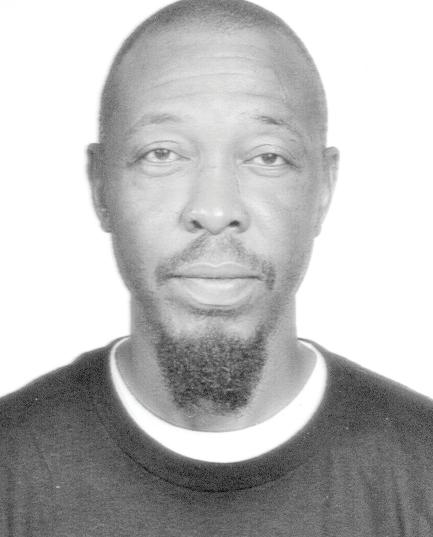
NOTICE is hereby given that I JANORDO JAVAR LIGHTBOURNE of, Homestead Street, Nassau, Bahamas, applying to the Minister responsible for Nationality and Citizenship, for Registration Naturalization as a citizen of The Bahamas, and that any person who knows any reason why registration/ naturalization should not be granted, should send a written and signed statement of the facts within twenty-eight days from the 28th day of May, 2026 to the Minister responsible for nationality and Citizenship, P.O. Box N-7147, Nassau, New Providence, The Bahamas.
traumatized by crises. Program leaders also act as a policy advocates for education funding at the national level, working with government officials to embed their materials into their curriculum. Engaging kids to process their experiences with ‘playful learning’ At a primary school serving refugees in western Uganda’s Nakivale settlement, one teacher credits PlayMatters with reducing absenteeism. Sister Kasingye Secunda said attendance used to be an issue. Teachers try their best
to make students “feel at home,” she said. But many students don’t understand both the local language and English, the language of instruction.
Children learn colors through a game where they select mangoes, bananas and other fruits to share with their classmates. They build confidence through class presentations and develop leadership as they take turns guiding small groups through activities.
“Learners enjoy the lessons,” Secunda said. “They are eager to come to school.”

increase dramatically if Britain becomes involved in an international conflict.
Keast-Butler said that rapid advances in artificial intelligence mean that “the ground beneath our feet is shifting” and there is a “narrowing window for the U.K. and allies to stay ahead” of countries such as China, a science and technology “superpower.”
She said that the threat extends to space, where thousands of satellites have
been launched in the last few years, and “both China and Russia are investing heavily ... to support both peace and war ambitions.”
The spy chief said that GCHQ is developing a plan to use cutting-edge agentic AI for a national cybershield that could protect U.K. infrastructure and businesses from cyberattacks — though it’s thought to be several years from completion.
NOTICE

NOTICE is hereby given that I, MARKENSON CORNEILLE of Marsh Harbour, Abaco, Bahamas is applying to the Minister responsible for Nationality and Citizenship, for registration/naturalization as a citizen of The Bahamas, and that any person who knows any reason why registration/naturalization should not be granted, should send a written and signed statement of the facts within twenty-eight days from the 21st day of May, 2026 to the Minister responsible for nationality and Citizenship, P.O. Box N-7147, Nassau, Bahamas.
ICETRUE CONSULTORIA TÉCNICA LTD.
Incorporated under the International Business Companies Act, 2000 of the Commonwealth of The Bahamas. Registration number 210980 B (In Voluntary Liquidation)
Notice is hereby given that the above-named Company is in dissolution, commencing on the 27th day of May A.D. 2026.
Articles of Dissolution have been duly registered by the Registrar. The Liquidator is Mr. Mauro Tiecher, whose address is Rua Iguacu – E 444 E, Casa 05, SAIC, Chapeco, SC, CEP: 89802 – 171, Brazil. Any Persons having a Claim against the above-named Company are required on or before the 26th day of June A.D. 2026 to send their names, addresses and particulars of their debts or claims to the Liquidator of the Company, or in default thereof they may be excluded from the benefit of any distribution made before such claim is proved.
Dated this 27th day of May A.D. 2026.
MAURO TIECHER LIQUIDATOR
NOTICE
GOLDEN APPLE INVESTMENTS LTD.
NOTICE IS HEREBY GIVEN that pursuant to section 138 (8) of the International Business Companies Act 2000 the dissolution of GOLDEN APPLE INVESTMENTS LTD. has been completed and the company has been struck from the Register on the 20th day of April 2026.
BAIRD ONE LIMITED LIQUIDATOR NOTICE
NOTICE
BT GLOBAL LTD.
Incorporated under the International Business Companies Act, 2000 of the Commonwealth of The Bahamas. Registration number 200466 B (In Voluntary Liquidation)
Notice is hereby given that the above-named Company is in dissolution, commencing on the 26th day of May A.D. 2026.
Articles of Dissolution have been duly registered by the Registrar. The Liquidator is Mr. Fernao Paim Battistoni, whose address is R. Luiz Martins de Araujo, Sao Paulo, SP, Brazil. Any Persons having a Claim against the abovenamed Company are required on or before the 25th day of June A.D. 2026 to send their names, addresses and particulars of their debts or claims to the Liquidator of the Company, or in default thereof they may be excluded from the benefit of any distribution made before such claim is proved.
Dated this 26th day of May A.D. 2026.
FERNAO PAIM BATTISTONI LIQUIDATOR
Legal Notice N O T I C E
TNAPB Fund Icon
NOTICE IS HEREBY GIVEN as follows:
(a) TNAPB Fund Icon has been dissolved on the 13th day of May 2026 under the provisions of the Investment Condominium Act, 2014.
Shareece Scott Liquidator
NOTICE
WEAVER MOUNTS LIMITED
In Voluntary Liquidation
Notice is hereby given that in accordance with Section 138(4) of the International Business Companies Act. 2000, WEAVER MOUNTS LIMITED is in dissolution as of May 19, 2026
International Liquidator Services Ltd. situated at 3rd Floor Whitfield Tower, 4792 Coney Drive, Belize City, Belize is the Liquidator.
LIQUIDATOR
Notice N O T I C E
Lorenzo Fund Icon
NOTICE IS HEREBY GIVEN as follows:
(a) San Lorenzo Fund Icon has been dissolved on the 13th day of May 2026 under the provisions of the Investment Condominium Act, 2014.
Shareece Scott Liquidator
DIRECTOR of GCHQ Anne Keast-Butler delivers her inaugural annual lecture Wednesday, May 27, 2026, at Bletchley Park, Buckinghamshire, Britain. Photo:Jacob King/AP
Capital markets absorption concerns over
$20m-$25m annual
contributions
liabilities for pension benefits estimated at $3bn, and projected to grow to $4.1bn by 2032, the Government’s financial capacity is increasingly strained.
“Also, significant deficits within the Government-owned corporations - many of which carry implicit government guarantees - further compound the liability burden with net pension liabilities estimated at $396m.” The latter figure was calculated in 2020-2021, and is likely to have grown significantly since then.
Mr Halkitis, in providing headline details for how the new defined contribution scheme for civil servants will work, confirmed that the mandatory contribution rate for officials will be a minimum 3 percent of their salary with the Government contributing 5 percent.
“As we look ahead to build upon what we achieved over the past five years, we are excited to embrace further reforms, including enhancing the public sector pension system, ensuring it benefits every public officer,” he told the House of Assembly.
“This reform is a positive and necessary stride toward securing our financial future and providing greater peace of mind for public officers. By addressing the pressures of the current pension model and ensuring comprehensive coverage, we are laying the foundation for a brighter and more secure tomorrow.
“In our new approach we are proposing a contributory pension fund, with employees investing 3 percent and Government contributing 5 percent. This system will feature individual accounts and enhanced protections for workers and their families, empowering them to plan confidently for their retirement,” Mr Halkitis added.
“Our next steps in continuing this reform include finalising the legal framework and tabling the White Paper today, marking another milestone in our shared journey toward progress and prosperity for all Bahamians.” Tribune Business records show that civil service pension reform has been discussed since 2012 at least, when the second Christie administration took office, but it has taken 14 years to reach the point where widespread consultation on the reforms has launched.
The new plan, to be called the Contributory Public Sector Pension Fund (CBBP), will be created by legislation modelled on the Pensions Bill 2025 that is now set to be revived. Initial plan members will be civil servants “not yet vested” in the existing civil service pension plan, plus future hires and those workers who want to opt in.
Each participant will have an account, the contents of which will “fully vest” in them upon retirement, early retirement, disability, death or meeting other qualifying criteria.
Fair housing groups file lawsuit arguing a federal rule change removes protections
By MICHAEL CASEY Associated Press
FAIR housing organ-
izations filed a lawsuit Wednesday over a federal rule change that they say would reverse decades of lending protections and open the door to discrimination against Black people, Latinos and other minorities.
The federal lawsuit, filed in Washington, D.C., takes aim at a change made earlier this year by the Consumer Financial Protection Bureau to the Equal Credit Opportunity Act, which bars lenders from discriminating against credit applicants. Among the changes being challenged is that lenders will no longer have to consider “disparate impact” — policies that appear neutral but tend to cause disproportionate harm to certain groups.
Plaintiffs also argue the rule would make it easier for lenders to market loans to predominantly white neighborhoods, forcing minority communities to rely on risky, high-cost lenders that offer predatory loans with exorbitant interest rates.
“This is the deliberate dismantling of 50 years of legal jurisprudence, regulatory guidance, and bipartisan consensus that
lending discrimination has no place in America,” Lisa Rice, the CEO and president of the National Fair Housing Alliance, one of the plaintiffs that filed the lawsuit, said in a statement.
“This reversal by the CFPB is a continuation of this Administration’s efforts to gut fair housing and lending protections,” she said. “Eviscerating these guardrails will ultimately result in less credit access for many people, make our markets less sound, and cause our economy to be less productive.”
Paulina Gonzalez-Brito, the CEO of another plaintiff, Rise Economy, a California nonprofit that advocates for economic justice, accused the CFPB of ignoring “public comments, common sense, and decades of precedent in its misguided attempt to turn anti-discrimination law on its head.”
“The CFPB was created to protect consumers and small businesses from financial abuse and discrimination, and this final Reg B rule would do real harm, setting us back in our collective efforts to ensure that all families and small businesses have a fair chance to achieve the American Dream,” Gonzalez-Brito said.
PUBLIC NOTICE
INTENT TO CHANGE NAME BY DEED POLL
The public is hereby advised that I, JANAMAE JUILETTE MATILLA ROBERTS of Harbour Island, Bahamas intend to change my name to MRS. JANAMAE JULETTE MATILDA ROBERTS GRANT. If there are any objections to challenge the name by deed poll, you may write such objections to the Chief Passport Officer, P.O. Box N-742, Nassau, The Bahamas no later than thirty (30) days after the date of the publication of this notice.
NOTICE

NOTICE is hereby given that I MARC JOSEPH LANDRY of, #33 Kingfisher Drive, Nassau, Bahamas, applying to the Minister responsible for Nationality and Citizenship, for Registration Naturalization as a citizen of The Bahamas, and that any person who knows any reason why registration/naturalization should not be granted, should send a written and signed statement of the facts within twenty-eight days from the 21st day of May, 2026 to the Minister responsible for nationality and Citizenship, P.O. Box N-7147, Nassau, New Providence, The Bahamas.
The central government currently employs more than 23,000 civil servants, and the ‘white paper’ added: “Pension obligations limit the ability of the Government and Corporations to secure financing, thereby forming a barrier to investment, development and progress.
“The existence of significant pension liabilities and the future cash outflows required to support pension arrangements have the potential to adversely affect external investors’ view of The Bahamas to the extent that they are viewed as an implicit debt. This can affect credit ratings, and both limit and raise the cost of financing, as well as hinder the ability to execute other types of transactions such as privatisations.”
Acknowledging that defined benefit pension schemes, such as the ones currently in place within the Government and most state-owned enterprises (SOEs) where the employer finances 100 percent of retirement costs and the employee pays nothing, are “rare”, the ‘white paper’ said the proposed reforms will bring the public sector into line with the Bahamian private sector and the rest of the world.
“The Government has limited visibility and purview of the operation and financing of the corporations’ pension arrangements. Decisions taken by corporations’ Boards in contract negotiations can, sometimes unknowingly, have severe impacts on pension liabilities. This lack of transparency and control presents a governance challenge and heightened financial risk,” the Government’s ‘white paper’ added.
“Pension liabilities present significant financial
and demographic risk to the Government. Financial exposure is driven by inflation and salary growth. Additionally, demographic risks stem from increasing life expectancy and changing retirement patterns, both of which often extend the period over which benefits should be paid.
“Benefits currently provided by the existing public sector pension scheme are low for employees who leave public service before reaching retirement. This disincentivises people from changing careers and discourages labour force mobility, potentially leading to inefficiency and stagnation in development across various industries and sectors.”
However, the Government conceded that not all its employees may welcome pension reform as the existing ‘pay as you go’, fully taxpayer-financed structure provides greater assurance over their likely level of retirement income. “There is greater certainty for employees over the level of retirement income under the current system,” the ‘white paper’ said.
“Under the proposed contribution-based pension plan, it is not possible to predict with certainty what level of income the member will receive at and/or in retirement, as benefits will depend on contributions and investment performance. However, the proposed CBPP provides Government with greater predictability over its financial obligations and helps avoid unfunded liabilities associated with the current scheme.”
The Government said it thus has little alternative but to “contain the growth in pension liabilities to reduce the burden on public sector finances”.
It added that the CBBP’s creation will “reduce administrative and financial inefficiencies associated with multiple corporations operating separate pension plans or savings arrangements”, and “regularise staff of decentralised bodies currently without a pension or gratuity” such as local government or school Boards.
The ‘white paper’ said labour force mobility and pension governance should also improve under the proposed reforms. It added that the CBBP would be overseen, and governed, by an independent Board and employ private sector investment managers to invest contributions and generate returns to support retirement incomes.
“The Bill will set out the various investment classes in which the CBPP may invest and those in which it may not invest,” the Government’s ‘white paper’ stipulated. “In particular, the Bill will prohibit investment of the CBPP’s assets directly in real estate.
“Investments are not restricted to government assets. However, there will be strict limitations on investments made in higher yielding and volatile investments. In due course, it is intended that the CBPP will permit investment in such asset classes to be made only from surpluses derived from the interest income of the CBPP’s assets….
“Administration expenses will be met from investment returns. Administrative expenses will be limited to less than 2.5 percent of total annual contributions. Consideration will also need to be given to the capacity of the local capital markets to absorb the increased investment levels, both the initial larger amounts relating to past service contributions, and then the subsequent ongoing employer and employee contributions which are estimated to be upwards of $20-$25m annually.”
The “normal retirement age” for members of the
new plan is being raised slightly to 67, though, although existing pensionable and permanent officials can keep 65.
“Employees are required to pay a mandatory fixed minimum percentage of their pensionable salary to the arrangement each month, initially set at 3 percent, and may choose to pay additional voluntary contributions subject to certain limits. These contributions are deducted from the employee’s monthly pay and paid to the CBPP,” the ‘white paper’ is proposing.
“This differs from the current public sector pension scheme where employees are not required to pay any contributions. The employer also contributes a fixed percentage, initially set at 5 percent of the employee’s pensionable salary per month.” Those civil servants who switch from the existing scheme will have their contributions transferred. and these will be financed “by a promissory note” that is interest bearing with the full sum paid over within three to five years.
Mr Halkitis, meanwhile, told the House of Assembly that the changes do not stop there. “In addition to pension reform, our government will introduce comprehensive health insurance plans for public officers,” he said. “Three plan options will be available, allowing public officers to choose coverage that best reflects their healthcare needs and income level.
“The Government will cover a significant portion of the cost, depending on which plan is selected by the officer. These plans will also include vision and dental benefits, survivor benefits, and options for family coverage. Comprehensive healthcare access for all is a priority for us. Further details will be provided by the Ministry of Public Service in the weeks ahead.”
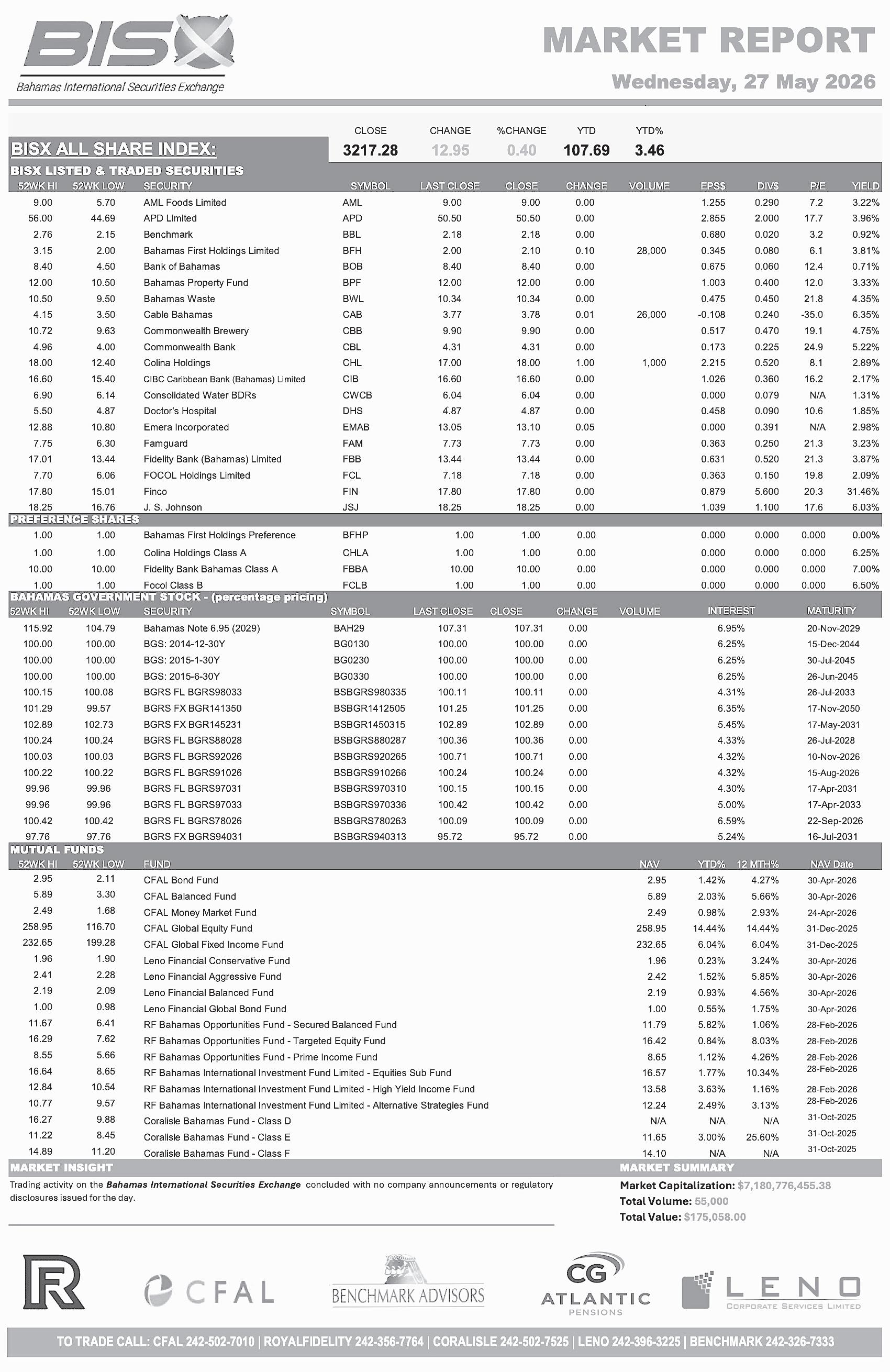
Zelenskyy asks Trump for more US air defense help against Russian missile attacks, Kyiv says
By The Associated Press
UKRAINIAN Presi-
dent Volodymyr Zelenskyy has written to U.S. President Donald Trump and Congress asking for more American-made air defense ammunition to counter intensifying Russian ballistic missile attacks, Kyiv said Wednesday.
Meanwhile, Russian lawmakers have backed a draft bill to have bank employees join the fight against Ukraine’s longrange drones that strike deep inside Russia — with trained bank staff shooting down the unmanned aircraft.
The steps came after a recent escalation in aerial attacks by both sides in the more than four-year war that followed Russia’s
all-out invasion of its neighbor. Neither side has been able to make much progress on the 1,250-kilometer (780-mile) front line.
Also on Wednesday, Anne Keast-Butler, head of U.K.’s intelligence agency GCHQ, asserted that Russian President Vladimir “Putin is going backwards on the battlefield.” New data shows that “almost half a million Russian soldiers have now been killed since the conflict began,” she added.
Ukraine has pounded Russian targets, especially oil facilities and manufacturing plants, with its domestically produced drones. At the same time, the Russian military has intensified its aerial attacks, firing almost 90 missiles as
well as hundreds of drones at Kyiv last weekend in an effort to overwhelm air defenses.
Zelenskyy seeks more Patriot defense systems
The Ukrainian leader urged Trump and Congress in a letter, which was obtained by The Associated Press, to supply more Patriot PAC-3 missiles and other air defense systems, warning that deliveries to Ukraine are falling dangerously short as the Iran war diverts U.S. stocks.
Ukraine has raised its drone interception rate to more than 90%, the letter says, and Ukrainian specialists have helped countries in the Middle East — specifically the Gulf Arab region — strengthen air defenses.
They have also helped at American military bases in the Mideast, the letter says.
But Ukraine cannot yet produce its own anti-missile defense systems, Zelenskyy said, and for that relies “almost exclusively on the United States.”
“For us — for a nation fighting for its survival — there is hardly anything more painful to see than Patriot batteries with no missiles loaded,” Zelenskyy wrote.
Deliveries, he says, are “no longer keeping up with the reality of the threat we face.”
Washington did not immediately comment on the letter. The U.S. weapons that European nations and Canada buy to donate to Ukraine are a vital
component of the country’s air defenses, but only a few NATO allies are investing significant sums in the arrangement, alliance officials say.
Russia wants bank employees to join the fight against Ukrainian drones In Russia, an ambitious plan approved by the country’s lower house of parliament on Tuesday envisages banks installing electronic jamming systems on their premises while selected employees would be trained to shoot down incoming drones. And with banks in almost every town, their incorporation into Russia’s air defenses could help expand its cover. The bill, which state news agency Interfax said was first presented last
August and later expanded in scope, must still be approved by the upper house Federation Council and signed by Putin before coming into force.
Russia is finding it hard to protect its large land mass from a growing number of attacks by increasingly sophisticated Ukrainian long-range drones. Smaller drones are also holding back Russian troops along the front line, Western analysts and officials say. As the intensity and depth of Ukrainian drone attacks have increased, Russian authorities have encouraged businesses to contribute to protective measures against aerial strikes. Russian banks are not known to have been a prime target for Ukrainian drones in the war that followed Moscow’s 2022 invasion. The plan encompasses Russia’s central bank and other top institutions, including majority stateowned Sberbank.