Gov’t makes $682m unbudgeted loans and guarantees in past year
BY NEIL HARTNELL
Tribune Business Editor nhartnell@tribunemedia.net
THE Bahamas’ top fiscal watchdog yesterday revealed that the Davis administration in its final year has entered into $682.2m worth of unbudgeted borrowing and guarantees, including the Chinese loan for the new hospital and underwriting Grand Bahama Power Company’s purchase.
The Fiscal Responsibility Council, in its just-released analysis of the Government’s 2025-2026 mid-year Budget that was issued at end-February, said that - while the second New Providence hospital and GB Power’s acquisition fit with its healthcare and energy policy priorities - they and other previously-unplanned financings threaten to “increase the fiscal risk” and “depart” from the target of achieving a 50
percent debt-to-GDP ratio by 2030-2031. Breaking down the $475.9m in recently-approved guarantees that did not form part of the Government’s initial plans for the 2025-2026 fiscal year, the Council said 58.8 percent or more than half of this sum was the $280m to underwrite the acquisition of GB Power and provide working capital for the utility moving forward. A further $160m worth of loan guarantees not budgeted for were to finance the Government’s obligations in the deal to provide liquefied natural gas (LNG) fuelled power for Nassau. Guarantees issued on behalf of the Public Hospitals Authority (PHA) rose from $75m to $109m to help finance the acquisition of the Harbourside complex from Doctors Hospital, while the remaining $1.9m
UNDERWRITE - See Page B10
Sands blasts Miller’s $35m ‘offset’ as unfair to taxpayer
BY NEIL HARTNELL Tribune Business Editor nhartnell@tribunemedia.net
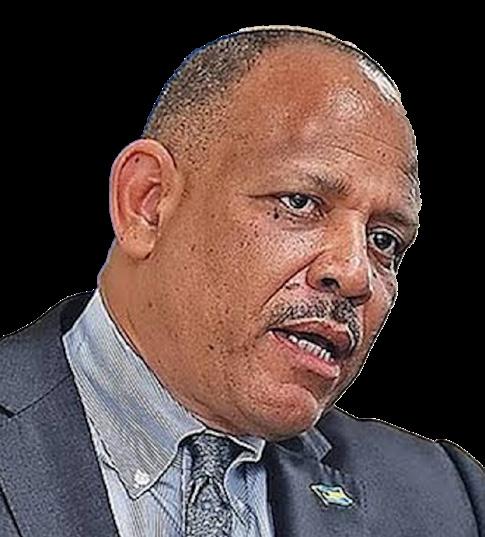
THE Opposition’s chairman yesterday asserted that “if you are in the inner circle of the PLP you have access to the national ATM” as his party demanded that the Government halt any plans to “offset” Leslie Miller’s combined $35m bank and real property tax debt until full disclosure is provided on the deal’s terms.
Dr Duane Sands told Tribune Business that the key issue is “are the Bahamian taxpayers getting a fair deal or not” after this
newspaper revealed that the ex-Cabinet minister and the Government are in negotiations that could settle
BY NEIL HARTNELL Tribune Business Editor nhartnell@tribunemedia.net
THE Government’s top fiscal watchdog yesterday urged it to switch to accrual-based accounting as an “urgent priority” as this would provide greater transparency and planning insight into The Bahamas’ public finances. The Fiscal Responsibility Council, unveiling its assessment of the 20252026 mid-year Budget that was released at end-February, said moving the entire public sector to this accounting standard - which the Government has long promised to do - would give a more complete, accurate and updated picture of its financial position as spending commitments would be recognised immediately when they are made. This stands in contrast to the Government’s current cash-based accounting, which only recognises spending when monies are actually paid out or revenue once it is received. As
Fiscal watchdog warns on $130m corporate tax hole
BY NEIL HARTNELL Tribune Business Editor nhartnell@tribunemedia.net
THE Bahamas’ top fiscal watchdog is warning that the Government’s forecast of a first-ever Budget surplus is in peril because it has not enacted the regulatory framework for collecting $130m in projected revenue from large corporate income taxpayers.
The Fiscal Responsibility Council, unveiling its assessment of the 20252026 mid-year Budget that was delivered at end-February, said receipt of this revenue before the fiscal year closes on June 30 “is in doubt” because the Davis administration has yet to put in place mechanisms
Budget surplus in peril because no 15% levy collection mechanism
New income source critical for $418m second-half deficit reversal
Net $1bn-plus repayment needed for Gov’t to meet its debt target
and processes for collecting the 15 percent corporate income tax levy. This is to be paid by Bahamas-domiciled entities that are part of multinational groups with more than 750m euros in annual turnover.
Generating the extra income anticipated from the Qualifying Domestic Minimum Top-Up Tax (DMTT), projected to be
equal to around 1 percent of Bahamian gross domestic product (GDP), is critical to helping the Government convert its $342.4m mid-year fiscal deficit into the full-year $75.5m Budget surplus it forecast in May 2025 - a target that the Council fears is now in jeopardy.
The Davis administration needs a major second-half
Union chief cites ‘confusion’ on GB Power job security
BY NEIL HARTNELL Tribune Business Editor nhartnell@tribunemedia.net
THE head of the union representing Grand Bahama Power Company’s middle managers yesterday said staff were informed their jobs and benefits are only secure for 12 months in seeming contrast to the blanket assurance given by the Prime Minister.
Kendal Culmer, president of the Bahamas Industrial Engineers, Managers & Supervisory Union, told Tribune Business that he and the union were informed by Emera executives in a meeting immediately prior to the ceremony announcing the Government’s acquisition of GB Power that such protection will only last
for one year following the takeover’s completion.
This appears to contradict the impression given at the acquisition signing by
Philip Davis KC who signalled that job and benefits security would be openended and gave no timeline for when this would end.
fiscal swing to hit is muchtouted surplus goal, and this will be made even more challenging if the $130m corporate income tax revenue cannot be collected before end-June 2026. While the revenue-rich period between January and April, in particular, traditionally helps governments to narrow first-half deficits, the Council warned that the Davis administration must generate primary and full fiscal surpluses of $746.6m and $417.9m, respectively, to hit its goals. Its report, which has been released at an inconvenient time for the Government less than a week before the May 12 general election, also casts doubt on whether
Told posts, benefits only guaranteed for 12 months Says workers reacting: ‘We are Gov’t workers now
‘Doesn’t make sense to hurt heads’ until postelection
“One thing was said at the ceremony and something different was said to us.
“That is something that needs to be cleared up with us,” Mr Culmer told this newspaper yesterday.
“We had a meeting. We were told by Emera executives that the agreement is there will be no terminations or lay-offs within the first year, and all the benefits will be secure for 12 months. That’s where the confusion comes in; for the first year, and we were also told that Emera will be sitting there until the money hits the bank.” Mr Culmer said executives from the Canadian utility giant, which selling 100 percent ownership of GB Power to the Government via the latter’s Grand Bahama Energy
ELECTRIC - See Page B12
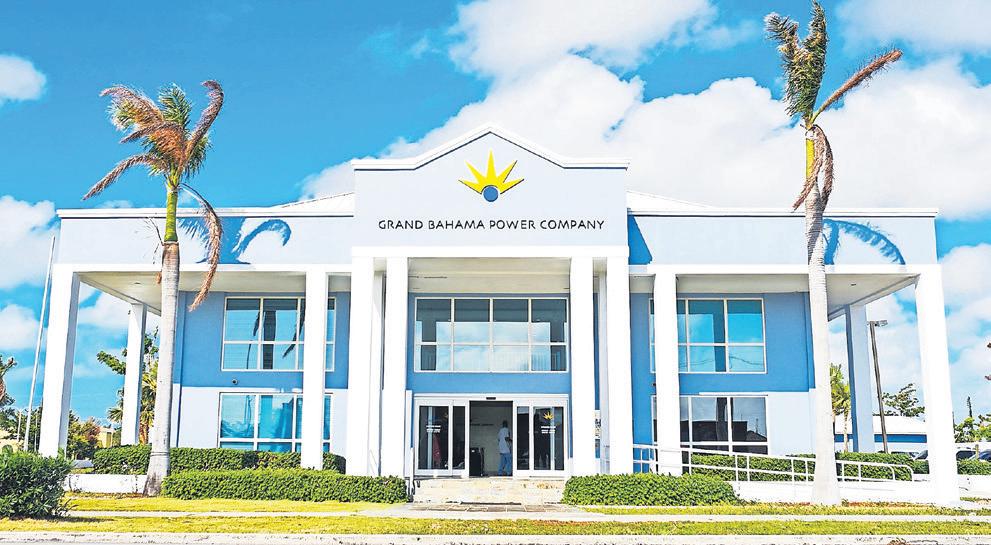
GRAND BAHAMA POWER COMPANY HQ
DR DUANE SANDS
JOB VACANCY
Registration Officer (London/Nassau)
An exciting opportunity to work with a well-established ship registry in the capacity of Registration Officer within the global Registration team.
Working within the Registration Team, the key client delivery team of the flag state. The team is vocal point in client delivery and ensure compliance to flag state legal framework and international maritime regulations upon registration of vessels. There is an exciting opportunity to join a global ship registry in the supporting the London Registration Team as a Registration Officer.
The Registration Team is key to provide efficient and clientfocused services to our stakeholders and customers. With clients across the global maritime industry, the team is the vocal point in client delivery and ensures compliance of flag state legal framework and international maritime regulations upon registration of vessels.
The successful candidate will play a key role in the management of the end-to-end registration process and ensure all transactions comply with national and international maritime regulations.
Nature of the role:
A detail-oriented and proactive person to provide delivery of our Ship Registration Department. The successful candidate will be responsible for providing experienced support and guidance to clients to ensure the smooth processing of vessel registrations, certifications, and compliance documentation in accordance with international maritime regulations and registry policies.
Key responsibilities:
1. Provide quality service to clients registering their vessels and registration transactions with the flag administration.
2. Prepare and compile appropriate vessels’ documents to perform the completion of registration transactions, such as delivery of vessels, change of ownerships, court sales, mortgages etc.
3. Advise clients on the registration procedures for each registration transaction, inclusive of relevant legal and statutory requirements.
4. Ensure that relevant office procedures are followed, and during the registration of vessel transactions and information is put into the database.
5. Manage provisional extension whenever the need arises.
6. Issue various ship documents as ensure delivery of service.
7. Document the change of ownership, change in vessel name and other registration transactions.
8. Provide guidance to junior team members and necessary training of team members were required.
Qualifications required:
• Essential:
o Undergraduate Degree-level with law being preferable.
o Previous experience working as supervisory level in a registry (flag or aviation administration) or registration team at shipping company.
o Up to five (5) years or more experience working in a client-based industry; working directly with lawyers would be useful.
o Ability to read and understand mortgages instruments
o Understanding of IMO and other international maritime conventions
o Experience using vessel registration database.
• Desirable:
· Knowledge of Document Management System
· Knowledge business or insurance sector
Personal qualities required:
Attention to detail is essential
Fluent in both written and spoken English
Highly developed written and oral presentation skills in a professional manner
Good critical thinking and analysis skills
Good inter-personal and cross-culture skills
Good team-working skills
Self-motivated and able to work without supervision
Good organisational skills and capable of logical prioritisation of activities
Computer competency is essential
Benefits: Competitive salary
Annual Leave: 22 days per annum (pro-rated first year) & Bahamas public holidays
Private Medical Insurance Closing date for applications: 8th May 2026
System glitch gives GB Power clients zero account balances
By FAY SIMMONS Tribune Business Reporter jsimmons@tribunemedia.net
GRAND Bahama
Power Company (GBPC) customers were yesterday left confused after a system glitch caused some account balances to show as zero or incorrect, with the issue emerging just one day after the Government announced plans to acquire the utility and cut electricity
BY FAY SIMMONS Tribune Business Reporter
ABACO marina operators yesterday said they are bracing for a “shaky” summer as US economic uncertainty and rising costs threaten to weigh on boating traffic, even as recent fee adjustments offer some longer-term relief for the sector.
Emanuel “Manny”
Alexiou, proprietor of the Abaco Beach Resort, said while business has stabilised after a slow start to the year the outlook remains uncertain heading into the key summer months.
“The beginning of the year was slower than normal. April and May have been better than normal, so combined, we’re probably okay compared to last year,” he said.
However, Mr Alexiou warned that broader economic conditions in the US — The Bahamas’ primary source market — will play a decisive role in shaping demand.
“What’s happening with the economy in the United
costs by an average 37 percent. The utility acknowledged the issue in a customer notice, warning that account information shown in its portal may not have reflected accurate balances.
“Please be advised that we are aware of a system issue impacting how account balances are displayed for some customers,”
GB Power said. “Customers are asked to disregard any unusual or zero balance
States also matters,” Mr Alexiou said. “The wealthier traveller will continue to travel, but middle and lower income segments may opt for a cruise or a cheaper vacation. “I don’t know what the net impact will be. It may still turn out okay. We have to keep our fingers crossed that the US economy improves. This year feels a bit shaky.”
Mr Alexiou said that uncertainty is particularly pronounced heading into June and July, when a different segment of boaters typically visits. “I’m concerned about the different kinds of people that come at different times. The people most affected by the boating fees would be those coming in June and July, so it will be interesting to see how those months perform,” he added.
Mr Alexiou shared that early booking patterns have already reflected some fallout, with large group trips diverted elsewhere. “We already know we lost some of the 30, 40 and 50-boat rendezvous. They had to make decisions early, and they went to the Florida
readings until further notice.”
The disruption quickly drew reaction on social media, where some customers expressed frustration and scepticism about the timing. One user wrote: “They just buy the company and already there’s an issue… it was never like this.”
Another added: “Soon as my account balance showing zero, y’all actively
Keys because of the boating fees,” he said.
“But others.. we hope we can still capture those who haven’t made decisions yet.” At the same time, cost pressures - particularly fuel - are adding to the overall burden for boaters considering a trip to The Bahamas.
“It’s just another cost. The cost of getting here, provisioning, and then putting in 2,000 to 3,000 gallons of fuel - at least twice - plus the trip back and forth adds up. That becomes a big number in the overall decision to come here,” he said.
Still, Mr Alexiou noted that his property’s focus on higher-end customers provides some buffer against softer demand. “We cater to the upper market, so that helps,” he said. “In April and May especially, people want to go fishing. If they have the money, they’ll spend the extra.”
Meanwhile, Molly McIntosh, a senior executive at Bluff House Beach Resort and Marina, said she remains cautiously optimistic despite similar concerns over costs and demand.
working to resolve it… why y’all like that?”
Others used the moment to highlight longer-standing service concerns, particularly during peak summer months, with one commenting: “For the last two years we’ve been having all kinds of power problems in June, July and August. That’s what needs to be resolved.”
GB Power said its teams worked to fix the issue as quickly as possible, and later confirmed that the
“I think business is going to be okay for the marina this year. Is it going to be great? No, I don’t think so,” she said. “But I’m still very hopeful… It’s not a boom year, but it’s not a bad year either.”
Ms McIntosh said higher-income boaters have so far continued to travel despite rising fuel prices, although shorter-stay visitors may be feeling the squeeze.
“Boat owners still have enough disposable income to come over… It’s probably impacting shorter-term visitors more than those who come for a week or longer,” she explained. Beyond fuel, she pointed to broader cost increases affecting operators themselves, which may ultimately feed through to pricing.
“Costs are rising across the board… freight, wholesale prices… we’ve had to raise our own prices,” said Ms McIntosh. “I’m reluctant to do that because I don’t want to chase people away.
“Getting goods here, fuel, trucking, everything, has become much more expensive, and we have to
problem had been resolved.
“The temporary system issue affecting customer account balances has now been resolved, and balances should now be displaying correctly within the account portal,” the company said. “We thank our customers for their patience and understanding while our teams worked to restore the system. Should you continue to experience any irregularities, please contact our customer service team.”
While GB Power did not detail the cause of the glitch, the timing drew attention as it came just a day after the Government announced it had reached a deal to acquire the utility, promising a 37 percent reduction in electricity costs. Although there is no indication that the system issue was connected to the pending acquisition, the proximity of the two developments added to customer confusion, particularly as some users reported zero balances in their accounts. The company has not indicated whether any billing data was affected beyond the display issue, and advised customers to report any ongoing discrepancies.
absorb that.”While recent adjustments to boating-related fees have been welcomed, both operators indicated that the timing of those changes limited their immediate benefit, as many visitors had already made summer plans. Still, Ms McIntosh argued that the policy shift should support the sector over time. “It has definitely been a good thing; it’s made a positive difference… It still hurt us because the change came so late, but I think it will help in the long run,” she said.
Bahamas hosts first final for UN tourism initiative
THE Bahamas has hosted the finale of the first Caribbean small island developing states United Nations (UN) tourism initiative.
The event, which brought together entrepreneurs, investors and tourism executives to advance sustainable island tourism, was held held at Margaritaville Beach Resort under the theme: 'Reimagining the future of tourism.'
Chester Cooper, deputy prime minister and minister of tourism, investments
and aviation, hailed the UN Tourism Sustainable Islands Innovation Forum and Bahamas Startup Challenge as “a timely and progressive gathering that brings global expertise, regional collaboration and Bahamian innovation into one shared space”.
Launched in August 2025, the forum is a strategic partnership between The Bahamas and UN Tourism that believes the industry’s future - particularly for island destinations- must be
innovative, sustainable and resilient by design.
Discussions explored how public and private sector collaboration, regional co-operation and access to capital can strengthen tourism ecosystems across the Caribbean. Also discussed was the role of local leadership and community-driven innovation in protecting natural assets while delivering tangible economic benefits.
Mr Cooper encouraged all participants to approach the forum “as a platform
for action; to forge partnerships, mobilise investment and accelerate solutions that position tourism as a force for resilience and inclusive development”.
“As a small island developing state, we are on the frontlines of climate change, global economic shifts and technological disruption. These realities demand that we do more than recover. They demand that we reimagine how tourism works for our people and our islands,” Mr Cooper said.
“This is precisely why The Bahamas sustainable islands challenge was conceived. It called on entrepreneurs, start-ups and innovators to develop solutions that respond to our unique needs. Solutions in coastal and maritime conservation, community-based tourism and green technology, while remaining scalable, investable and impactful.”
”Our government is committed to building the enabling systems, policy, finance and institutional support that allow good ideas to become commercially viable solutions and long-term engines of growth.”
The Bahamas was represented by 53 out of 87 total participants. “Their ideas demonstrated that sustainable tourism solutions do not have to be imported. They can be designed here, tested here and scaled from here,” Mr Cooper added.
Winners included Bluequest Bahamas for ocean and marine conservation; Access Island Guide for local and community-based tourism; Out Island Water Company Recycling Programme for green technology and sustainability; and Out Island
Water Company Recycling Programme and Trevor Williams as the overall winner.
The winning start-up and runner-up will receive support to help scale their
solutions, while all finalists gain access to the UN Tourism Global Innovation Network, mentorship, and international visibility.
Bahamas receives 13 World Travel Awards nominations
THE Ministry of Tourism, Investments and Aviation has announced that The Bahamas has secured 13 nominations for the World Travel Awards 2026, which are viewed as one of the hospitality industry’s highest awards.
The Bahamas nominations for 2026 include:
* Caribbean’s leading beach destination
* Caribbean’s leading business travel destination: Nassau, The Bahamas
* Caribbean’s leading cruise destination: The Bahamas
* Caribbean’s leading culinary destination: The Bahamas
* Caribbean’s leading destination: The Bahamas
* Caribbean’s leading dive destination: The Bahamas
* Caribbean’s leading family travel destination: The Bahamas
* Caribbean’s leading honeymoon destination: The Bahamas
* Caribbean’s leading luxury island destination: The Bahamas
* Caribbean’s leading meetings and conference
destination: The Bahamas
* Caribbean’s leading sports tourism destination: The Bahamas
* Caribbean’s leading tourist board: The Bahamas Ministry of Tourism
* Caribbean’s most romantic destination: The Bahamas The Bahamas won the
Caribbean’s leading luxury island destination; Caribbean’s leading sports tourism destination; and Caribbean’s leading business travel destination.
CHESTER COOPER deputy prime minister and minister of tourism, investments and aviation, addressing the forum on Wednesday, April 29.
MIRKO Ebelshaeuser, United Nations Development Programme; Dr Kenneth Romer, deputy director-general of tourism and director of aviation; and Noemi Espinoza Madrid, secretary-general, Association of Caribbean States.
GB residents fear paying for lower energy bills via taxes
BY ANNELIA NIXON Tribune Business Reporter anixon@tribunemedia.net
GRAND Bahama businesses and residents yesterday challenged whether taxpayers will have subsidise the Government’s promised 37 percent electricity cost savings following the Grand Bahama Power Company acquisition.
John Fox, a Grand Bahama resident, said while the prospect of lower bills is appealing, many people may not fully understand the consequences of the deal. “On one hand everybody wants their power bill to go down. But I don’t believe the vast majority of Bahamians really understand what this means for GB Power,” he said.
Based on his own assessment, Mr Fox warned that the tariff reduction and $280m loan to finance the acquisition could put the utility under strain. Prime Minister Philip Davis KC pledged that households and businesses on the island could see an average 37 percent reduction in electricity
costs, as tariffs are aligned with those of Bahamas Power & Light (BPL). However, details on how this will be achieved while maintaining GB Power’s financial stability remain unclear.
“This purchase of GB Power by the Government, and this reduction of 37 percent, is going to turn GB Power from a profitable company into a company that’s losing money year in and year out, considering they’re are borrowing $280m to purchase and operate,” Mr Fox said. He argued that operational costs are unlikely to decrease in tandem with revenues, creating a gap that could persist for years. “They’re going to go from a slightly positive, profitable company to an unprofitable company. And they will be unprofitable for a long time,” Mr Fox said. He added that taxpayers might eventually have to subsidise the utility company if losses continue. “So they did borrow $280m to do this purchase and have funds,” he said. “But
based on the numbers that I crunched, GB Power is going to be low on money every year because operational costs are not going to change, and revenue dropping by 37 percent. It's going to hit the bottom line hard. They're going to go from a slightly positive, profitable company to a unprofitable company.
“And they will be unprofitable for a long time because that is a huge debt to service, and the amount that they're borrowing for operating will keep the company going for a certain amount of time, but eventually that's going to be all consumed. And by the time that's consumed, they still wouldn't be paid off, this loan. When that happens then, as with other government entities, where they are unprofitable, taxpayers have to support it. And that's what's going to happen.”
Robert Nabb, another Grand Bahamian, echoed concerns about who will ultimately bear the cost of the promised savings. While he said that a 30
percent-plus reduction in energy bills would be beneficial, he questioned whether the savings could lead to increased taxation elsewhere.
“If you’re Emera, you have to answer to the shareholders.” Mr Nabb said. “So you have to have a profit and they’re not a charity. The Government runs on a different paradigm. They run on a paradigm, which is our tax dollars, which they only have to account for once every five years, if that.
“I'm not deep into the weeds on what the profit margins are with regards to power, but if they're promising 30 percent-plus savings, that’s fantastic. I just hope we don't have to pay for it on the other end with taxes,” Mr Nabb added.
“I’ll give an example. I saw they paid for people's power on Grand Cay. How did they pay for that? We'd like to know. The public would like to know, because the only way the Government can pay for that is through tax dollars.
SUPPLY - See Page B6
New Tarpum Bay dock to boost fishing industry
BY ANNELIA NIXON Tribune Business
ELEUTHERA residents say the new Tarpum Bay dock will significantly benefit the local fishing industry once fully completed.
John Carey said yesterday that while the facility has officially opened, it is still a work in progress and lacks several key components needed for full operation.
“It's not completed as yet,” Mr Carey said. “I know they opened it yesterday, but the dock is not fully completed. It still needs a boat ramp in place and further extension to the other portion of the dock. There's more dredging to be done, and also the addition of fresh water for the fish cleaning stations and bathroom facilities.”
He added that once the remaining works are finished, the dock could become a key hub for fishermen and small-scale commerce in the area. “So I think all of that is on tab to be completed,” Mr Carey said. “It’s not there as yet. But once all of that is done, then it affects the local fishing industry, where fishermen can launch their boats, have a place to clean their fish and sell their fish
once they do come in from fishing.”
He also pointed to other economic opportunities, including tourism and small business activity at the site.
“Visitors to Tarpum Bay as well as residents can enjoy the view,” Mr Carey said. “There are further possibilities with having to go through local government, and with the addition of vending stalls or something like that. So that is basically the impact it will have, mostly to the fishing industry, and secondly, towards domestic as well as foreign tourism.”
When asked whether the upgraded dock could draw more visitors, Mr Carey said the improvements would likely have a positive effect, especially compared to its previous condition.
“I think it will help,” he said. “The dock before renovation was in a dangerous and unhealthy state. With the facility in place and set up properly, out there is where all the fishing goes on. People do come and purchase fresh fish on a daily basis. So a better working environment for the fishermen always works out. You might have more stalls and more people out there trying to sell fish, which would bring more people in turn.”
The Tarpum Bay dock project is just one of the many infrastructure upgrades planned for Eleuthera. Clay Sweeting, minister of works and Family Island affairs, told the Eleuthera Business Outlook a few weeks ago that the Glass Window Bridge will also see improvements.
“So you have a part of a bridge package that would be a new dock in Hatchet Bay, because you need a new dock to bring all the equipment to build a new bridge,” Mr Sweeting said. “You also have to reinforce the current bridge, because that might collapse as they carry all the heavy equipment to the northern part to start to build the new Glass Window Bridge.”
He added that the development will also incorporate cultural and commercial space intended to support local artisans and tourism activity. “But what’s also exciting is the bridge will also have a cultural site where persons in the orange economy can sell their straw work or restaurants or different things,” Mr Sweeting said. “So it’ll be almost like a mini market… So it’ll be more than persons just coming to look at the Caribbean side or the ocean
LATIA DUNCOMBE CHESTER COOPER
Testing phase launches for digital Immigration card
THE Ministry of Tourism, Investments and Aviation says the pilot testing phase for the Bahamas’ first-ever digital Immigration card has been launched.
It pledged, in a statement, that the Bahamas Digital Arrival Card (BDAC) will deliver a seamless, world class arrival experience for visitors by replacing the traditional paper-based Immigration card for arriving guests.
The Ministry added that the Digital Arrival Card test phase will allow visitors participating in the pilot to complete their entry documents online via a dedicated web form prior to arrival, thereby reducing the need for paper forms at participating ports of entry.
side for a minute. It’ll be somewhere where they can experience the Glass Window Bridge.”
Mr Sweeting also confirmed progress on dock projects in other communities, including Spanish Wells and Harbour Island, noting that construction timelines are now advancing following contract signings and mobilisation payments
The system functions as both an Immigration card and a Customs declaration, and is currently offered to selected flights as a part of this initial phase.
The pilot is being executed via a joint effort between the Ministry of Tourism, Investments and Aviation, the Immigration Department and Bahamas Customs, ensuring a fully integrated and measured approach to modernising this nation’s border entry processes. The soft launch follows successful system
testing conducted over several months and the passage of amendments to the Immigration Act, which established the legal framework for digital entry documentation. During this period, the traditional paper-based process will remain in place alongside the pilot, allowing for realtime evaluation, system refinement and stakeholder feedback.
"This represents a critical step forward for The Bahamas," said Chester Cooper, deputy prime minister and minister of tourism, investments and aviation. "The Digital Arrival Card is not simply a technological upgrade; it is a statement of commitment to innovation. We are focused on ensuring that, when fully implemented, it delivers a seamless and effortless arrival experience for every visitor to our shores."
Latia Duncombe, the Ministry of Tourism, Investments and Aviation’s director general, said: "This pilot reflects years of deliberate planning and collaboration across the Government. It allows us to maintain the high standards our destination is known for. Our goal is to ensure that this platform enhances the visitor journey from the very first touchpoint.”
Nassau/PI Board names Baha Mar chief as chair
THE Nassau & Paradise Island Promotion Board (NPIPB) yesterday said it has appointed Graeme Davis, Baha Mar’s president and chief executive, as its new chairman.
The Board, in a statement, said Mr Davis’ appointment comes at a time of continued growth and strong global demand for Nassau and Paradise Island, with the organisation working closely with its 19 member hotels and resorts to drive
GRAEME DAVIS
Gov’t urged to ‘strengthen’ cruise line enforcement
REFORM - from page B1
a result, the present system does not capture all the Government’s liabilities as represented by spending commitments or obligations that have been made but not paid, thus leaving an incomplete picture of its finances.
The Council raised its concerns in the context of noting that the Government owed vendors and suppliers some $21m in unpaid recurrent invoices, and $59.9m in capital expenses, at end-December 2025 even though these were not included in actual expenditure data for the 2025-2026 first-half.
“Taking actual reported payments and due bill payments into account for spending over the first six months of 2025-2026 suggests a recurrent expenditure total of $1.679bn or 48.7 percent of the budgeted allocation, which remains in line with the 50 percent actual-to-budget benchmark,”
the Council said. “Capital expenditure, including unpaid invoices, amounts to $251.6m or 67.4 percent, which is consistent with the Government’s expressed aim to front-load investment spending in the first half of the year.
“Outstanding balances from the previous fiscal year, however, suggest unbudgeted expenditure for the current fiscal year, which would have implications for achievement of the budgeted fiscal balance. The mid-year review reports arrears of $60.5m.
“These circumstances underscore the significance of how cash basis accounting – the current accounting method employed by the Government, differs from accrual basis accounting – the method that the Government aspires to implement,” the Council said.
“Cash basis accounting does not recognise expenditures until they are
NOTICE
visitor numbers and elevate the destination’s profile. “I am honoured to be named chairman of the Nassau & Paradise Island Promotion Board, and eager to get to work as we promote what makes our destination so unique,” said Mr Davis. “Through my time at Baha Mar, I have seen first-hand the strength and appeal of the destination. I look forward to working with our partners to build on the destination’s strong foundation, unlock
paid or revenue until it is received. Whereas accrual basis accounting recognises expenditures at the point when they are incurred or revenue when earned, which has the effect of providing a comprehensive view of the Government’s financial position. Thus, improving transparency while facilitating enhanced financial planning, with liabilities recorded as they are incurred.
“The Government has indicated its intent to move towards accrual basis accounting. The Fiscal Responsibility Council is of the view that implementation of accrual basis accounting, which aligns with the established general principles of responsible fiscal management, should be an urgent priority,” it added.
“The Fiscal Responsibility Council also notes the overall budgetary commitment to unclassified current transfers, comprising current transfers to non-financial public corporations, at $281.7m reflecting an 11.4 percent increase over the 2024-2025 budgetary commitment, the highest rate of increase
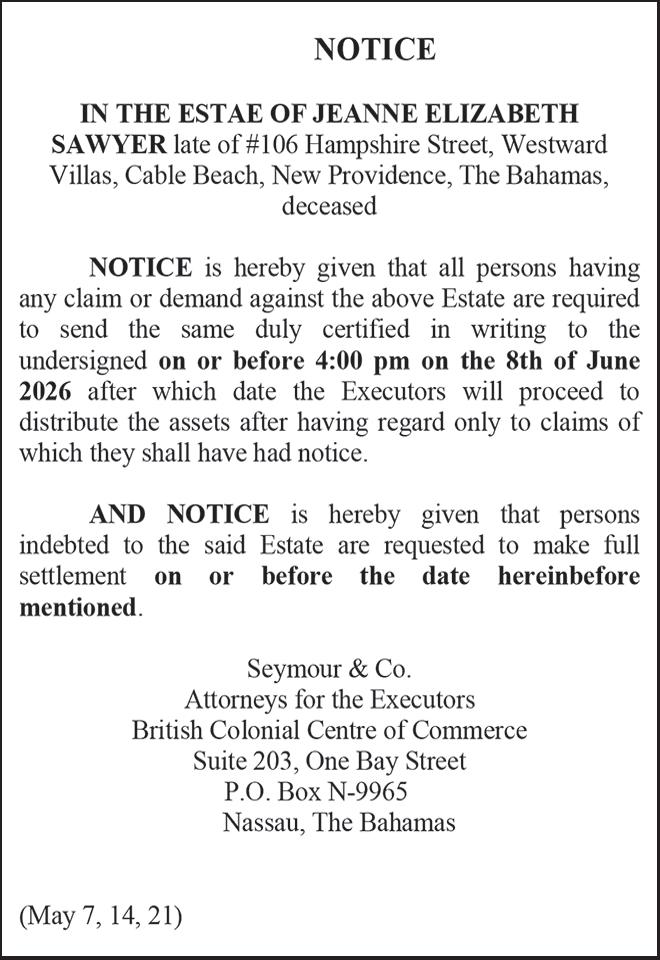
In THE ESTATE OF IAN ALEXANDER THOMPSON, late of Chippingham situate in the Western District of the Island of New Providence one of the Islands of the Commonwealth of The Bahamas, deceased.
IT IS HEREBY NOTIFIED, for the information of those having claim or demand against the said Estate are required to send the same to the undersigned on or before 28th day of May, A.D. 2026 and if so required by notice in writing from the undersigned to come in and prove such demand or claim or in default thereof be excluded from the bene t or any distribution made before such debts are proved;
AND NOTICE is hereby given all persons indebted to the said Estate are requested to settle their respective debts at the Chambers of the undersigned on or before the date hereinbefore mentioned.
Dated 30th day of April, 2026
CALLENDERS & CO.
CHAMBERS
One Millars Court P. O Box –N7117
Nassau, The Bahamas
Attorneys for the Personal Representative
NOTICE
In THE ESTATE OF VICTORIA BERNADETTE ROBERTS, late of Palm Cay in the Eastern District of the Island of New Providence one of the Islands of the Commonwealth of The Bahamas, deceased.
IT IS HEREBY NOTIFIED, for the information of those having claim or demand against the said Estate are required to send the same to the undersigned on or before 28th day of May, A.D. 2026 and if so required by notice in writing from the undersigned to come in and prove such demand or claim or in default thereof be excluded from the bene t or any distribution made before such debts are proved; AND NOTICE is hereby given all persons indebted to the said Estate are requested to settle their respective debts at the Chambers of the undersigned on or before the date hereinbefore mentioned.
Dated 30th day of April, 2026
CALLENDERS & CO.
CHAMBERS
One Millars Court P. O Box –N7117
Nassau, The Bahamas
Attorneys for the Personal Representative
new opportunities and further elevate Nassau & Paradise Island on the global stage.”
Mr Davis succeeds John Conway, general manager of The Ocean Club, who served as chairman for the past ten years. “John Conway’s leadership has helped guide the Nassau & Paradise Island Promotion Board through a period of tremendous growth and continued evolution for the destination,” said
among all major recurrent expenditure components.
The item, at $136.7m, constituted 7.4 percent of total 2025-2026 half-year expenditures.”
The Council also called on the Government to “strengthen enforcement and compliance” when it came to cruise lines and Bahamian private islands paying all due taxes to the Public Treasury. It said: “Departure tax collections at an estimated $160.9m, accounting for 12 percent of total tax collections, represented just 40.5 percent of budgetary
Joy Jibrilu, the Promotion Board’s chief executive.
“We are deeply grateful for his years of service, steady guidance and commitment to strengthening Nassau & Paradise Island’s position in the global tourism marketplace. We are also pleased to welcome Graeme Davis as chairman and look forward to working with him as we continue elevating the destination through strong partnerships, authentic
expectations, significantly under-performing 20242025, which at higher actual collections of $169.6m also constituted a larger 70.3 percent share of the budgeted forecast.
“The comparative shortfall was partly explained by outstanding cruise departure taxes and sustainability levy payments of an estimated $18.8m. The Fiscal Responsibility Council acknowledges the delayed payments associated with the cruise industry, but notes that even with those outstanding payments, which would have raised the estimated departure tax total
GB residents urged go solar despite lower power bill pledge
SUPPLY - from page B5
So, basically, my money is going to go pay someone else’s power bill. I don’t remember anybody asking me about that. It doesn’t make sense. I’m paying my bill plus helping someone else pay their bill?”
Mr Nabb stressed that the long-term plan for Grand Bahama’s electricity network should remain a priority with proper maintenance and infrastructure investment. “This is a long term thing,” he said. “I’m more concerned, for example, with regards to where we are in five years with regards to maintenance.
Are you putting money aside for improvements on transmission?
“Because I don’t want our network, which is a good network, to get to the point where New Providence’s network was, where you are scrambling… Generation is one thing. Then you have transmission. And so those two things have to be paid for. And so I just want to see where we are in five years; if we’re better off or if not.”
story-telling and world-class visitor experiences.”
Vaughn Roberts, Atlantis chief operating officer, remains as the Promotion Board’s vice-chairman, while William Naughton, senior vice-president and managing partner of Comfort Suites Paradise Island, is still treasurer After more than 30 years of service, Michael Reckley has retired as secretary to be replaced by Viana Gardiner, senior vice-president of legal at Atlantis.
to $179.7m, the resultant 45.2 percent actual-to-budget share still significantly under-performs the 20242025 ratio of 70.3 percent.
“The Fiscal Responsibility Council notes that abatement in stopover arrivals during the July to December 2025 period would have been expected to temper receipts from departure taxes in the air component of the measure. The Fiscal Responsibility Council further notes that expressed payment delays from cruise businesses suggests a need for strengthening in enforcement and compliance.”
Mr Nabb also encouraged greater energy independence among residents who can afford it. “I have solar. I’m not going to lie to you, my power bill in the winter is somewhere between $10 and $25 because I’m almost off the grid,” he said. “So with the little bit of power that I use, even in the summer, where I’m paying around $150 to $200, if they’re giving me 37 percent discount on that, wonderful.Again, I know it sounds a little selfish, but it’s not going to affect me that much because I am off the grid.
“I’m going to encourage all Grand Bahamians who can afford to to just become more independent, and become self-reliant and get off the grid as much as possible. Even if it’s half your bill, even if you’re only able to produce half of your electricity with solar, go do that, because at least you’re less dependent.”
Gov’t exceeds domestic funding goals by 138% in
the Government will meet its 2025-2026 fiscal yearend direct debt target of $11.387bn.
To do so, the Council warned that it will have to make a net debt repayment of more than $1bn during the six months to end-June 2026 as it also voiced concern about the Government’s ever-increasing reliance on short-term financing, driven by Central Bank advances and Treasury Bills, to meet its funding needs. It also noted that the Government’s gross borrowings in the domestic capital markets during the 2025-2026 first-half was more than double the fullyear target - 138 percent higher at $1.92bn.
And the Council also echoed earlier calls by Gowon Bowe, the Fidelity Bank (Bahamas) chief executive, and others that the Government would have done better to offer targeted relief to the most vulnerable and lowest-income Bahamian families than provide blanket assistance to those who do not need it by eliminating VAT on all uncooked foods from April 1 this year.
While the Government has asserted that this break is only costing it $15m in annual revenues, the Council’s report warned that this - when combined with the likelihood of not collecting the $130m in corporate income tax monies and the Middle East conflict’s negative fall-out for tourism and energy/fuel costs - could cause “further under-performance in revenue” during the Budget year’s second half.
While acknowledging that the 2025-2026 first half fiscal and primary deficits were lower than the same period in the prior year, the Council nevertheless noted that revenues collected during the six months to end-December 2025 were lower than in 2024 as a percentage of the total Budget target. They stood at 38.7 percent of full-year income compared to 40.7 percent in the 2024-2025 fiscal year’s first six months, and were also below the historical average of 42 percent.
“To meet the budgeted fiscal and primary surpluses of $75.5m, 0.5 percent of GDP, and $743.5m, 4.5 percent of GDP, for fiscal year 2025-2026, the Government will need to run fiscal and primary surpluses of $417.9m and $746.6m, respectively, over the remaining six months of the fiscal year,” the Council’s report asserted.
“The Fiscal Responsibility Council notes that inflows from property taxes, Business Licence fees and the DMTT are expected to partly underpin a stronger second half of the fiscal year.
“The Fiscal Responsibility Council also notes that the projected DMTT revenue outlook is in doubt, as
the implementation framework continues to take shape ahead of the March 31, 2026, submission deadline for entities subject to the tax. Failure to achieve the $130m projection could have significant implications for the final budgetary outcome.”
Similar concerns were previously voiced by Fidelity’s Mr Bowe, who told this newspaper last week: “The question is, and I think I know the answer because the work is not completed, is the DMTT going to make it into this fiscal year?
“I may be wrong. There may be bilateral discussions and agreements, but there needs to be a very clear framework for reporting, paying and confirmation of having done so to be set out for all those affected. We only have two months, and we are losing May because of the election and efforts to get the Budget completed. From that perspective, how are we making up the stagger?”
Mr Bowe, when contacted by Tribune Business yesterday, reiterated those concerns while echoing the Fiscal Responsibility Council’s concerns. “We have the legislation. That is there,” he said of the DMTT. “The regulations that are sort of attached to it, and the guidance notes, the procedural mechanisms, have not been fully ventilated. The regulations, though, have been drafted.”
The prospect of the DMTT providing a new source of additional government revenue for the 2025-2026 fiscal year was one of the factors that prompted Moody’s to last week upgrade The Bahamas’ sovereign creditworthiness by one notch - albeit still leaving it in so-called ‘junk’, or non-investment grade, status. However, according to the Council’s report, such optimistic expectations and forecasts may need to be revised.
“Overall, fiscal performance for the first half of 2025-2026 reflected under-performance in revenue, contributing to fiscal and primary deficits,” the Council added. “Likely lower than projected DMTT collections and losses associated with the fourth quarter elimination of the VAT on unprepared food is expected to temper the second half revenue performance. Much stronger fiscal effort will be required over the second half of the year if budgeted targets are to be met.”
The Council also signalled that the Government’s end-June 2026 debt will also exceed Budget forecasts given that it must cut its outstanding liabilities by more than $1bn during the final six months of the fiscal year to meet this goal.
“Central government debt at the end of fiscal year 2025-2026 is projected at $11.387bn or 68.6 percent of GDP. To meet the target, the Government will
need to realise net repayment of $1.02bn over the second half of the fiscal year,” the Council wrote.
“The Fiscal Responsibility Council notes that – other things being equal – amortisation totalling $2.339bn scheduled between January and June 2026 would support a reduction in central government debt outstanding at the end of fiscal year 2025-2026.
“A programmed fiscal surplus of just $75.5m, however, limits the Government’s ability to finance principal payments from the Budget. While debt service obligations could be financed from the Government’s cash and other (sinking fund) resources, the FRC does not have sufficient information on these balances to assess the likelihood… If available resources fall short of $1.02bn, nominal central government debt at the end of fiscal year 2025-2026 is expected to be higher than Budget.”
And the Council said the Government’s debt financing plans appeared to have altered significantly from what was set out in its previously-published annual borrowing plan for the 2025-2026 fiscal year.
“During the first six months of fiscal year 2025-2026, the Government raised $1.92bn in domestic financing, which was 137.8 percent of the planned amount for the fiscal year,” its report said.
“The 2025-2026 indicative Bahamian dollar bond issuance calendar schedules bond issuances totalling $259.6m, with $138.5m scheduled during the first six months of the fiscal year. Total actual bond issuances for the period were $486m or 87.1 percent of programmed financing for the year.
“Treasury Bills, which were recorded on a net basis, totalled $277.2m, or 86.7 percent of programmed financing for the fiscal year.
Total foreign currency bank loans were $238.1m or 104.4 percent of the planned amount, while unplanned Central Bank advances amounted to $918.3m.” The Council said no rationale or explanation had been provided for the significant change in the Government’s borrowing strategy, and said the increasing reliance on short-term funding was contrary to its debt management strategy.
“The Fiscal Responsibility Council also underscores previously expressed risks associated with the Government’s reliance on short-term financing, noting that Treasury Bills and Central Bank advances accounted for 54.9 percent of total financing during the half-year period,” the Council said.
“The Fiscal Responsibility Council notes that this has implications for the debt portfolio’s average time-to-maturity (ATM), which fell from 6.6 years at end-June 2025 to 6.4 years at end-December 2025. The downward revision in the targeted ATM for the portfolio from more than seven years in the 2023-2024 to 2025-2026 medium-term debt strategy to more than 6.5 years in the 2026-2027 to 2028-2029 [report] is inconsistent with the strategy of lengthening maturity terms.”
Elsewhere, the Government said the initial cut in the VAT rate on unprepared food - from 10 percent to 5 percent effective on April 1, 2025 - had cost the Public Treasury some $24.3m in revenue levied on these items during the six months to end-December last year when compared to the same period in the prior year.
“Further adjustments shifting the VAT rate on unprepared food from 5 percent to tax exempt status, which took effect
on April 1, 2026, will place further downward pressure on VAT revenues in the closing quarter of the fiscal year,” the Council said. “In addition, the exempt treatment of these items has impacted the ability of food suppliers to recover VAT expended on inputs, which may impact the desired outcome of providing relief to consumers.
“The Fiscal Responsibility Council restates the view previously expressed that tax policy changes should be accompanied by explicit costing of the fiscal impact of those changes. In addition, once such changes are implemented, periodic updates and reporting and specific revenue data that demonstrate the actual results of the policy changes should also be provided to enable an assessment of the actual versus the forecasted results.
“The Fiscal Responsibility Council also notes that such tax policy changes must be supported by system-wide data collection and reporting mechanisms
that would appropriately allow for this level of accountability,” it added.
“The Fiscal Responsibility Council further underscores the view previously expressed that a more efficient and equitable alternative approach to the VAT rate reductions would have been the implementation of targeted subsidies for the intended high-risk groups.”
The Fiscal Responsibility Council is chaired by Christel Sands-Feaste, the Higgs & Johnson attorney and partner. Other members are Rupert Pinder, assistant professor of economics at the University of The Bahamas (UoB); Pedro Rolle, chairman of the Bridge Authority and president of Seaside Real Estate and Capital Investment Services; Dr Gezel Farrington; and Stephan Knowles, chief executive and president of SJK Engineering and Construction.
Position Summary:
The VP, Finance & Accounting is a senior leadership role responsible for the overall management and execution of the Finance and Accounting functions across Bahamas Grid Company (BGC). Reporting directly to the Chief Financial Officer, the VP ensures financial integrity, regulatory compliance, and the delivery of accurate financial insights to support strategic decision making. This role provides leadership and oversight to the VP, Finance & Accounting and the broader Finance team, including General Accounting, Project Accounting, Accounts Payable, and Payroll. The VP is responsible for driving financial performance, maintaining strong internal controls, and ensuring accurate and timely financial reporting in compliance with applicable standards.
Essential Functions:
Strategic Financial Leadership
• Develop, lead, and continuously refine BGC’s overall financial strategy to ensure alignment with corporate objectives, operational priorities, and long term infrastructure investment plans. Serve as a key member of the executive leadership team, contributing to enterprise wide strategic planning, business growth decisions, and capital allocation strategies.
• Provide executive level financial leadership and guidance to support organizational transformation, grid modernization, and large-scale utility investment initiatives.
• Lead the annual budgeting, forecasting, and long-range financial planning processes, ensuring alignment with operational requirements and strategic goals.
• Deliver high-quality financial analysis, scenario modeling, and performance insights to support data-driven executive decision making. Monitor financial performance against budget and forecast, identifying risks, variances, and opportunities, and recommending corrective actions where necessary.
• Develop and maintain key financial performance indicators (KPIs) to support operational efficiency and financial accountability across all business units.
Accounting, Reporting & Compliance Oversight
• Oversee all accounting operations, including general ledger management, financial reporting, month-end and year-end close processes, ensuring accuracy, completeness, and timeliness.
• Ensure compliance with Bahamian financial regulations, applicable accounting standards (GAAP/IFRS as applicable), tax requirements, and internal policies.
• Review, approve, and ensure integrity of financial statements, reconciliations, journal entries, and management reports prepared by the Finance team.
• Maintain strong internal control frameworks to safeguard company assets and ensure audit readiness at all times. Serve as primary liaison for external auditors, regulatory bodies, tax authorities, and financial institutions.
Capital Management, Investment & Project Finance
• Provide financial oversight and advisory support for capital projects, infrastructure development, and major utility investments. Evaluate investment opportunities, financing structures, and capital allocation decisions to ensure optimal return and financial sustainability
• Oversee project accounting, including cost tracking, budget control, revenue recognition, and financial reporting for major initiatives.
• Review and approve significant financial transactions, procurement commitments, contracts, and capital expenditures in accordance with delegated authority limits.
Leadership & People Development
• Lead, mentor, and develop the Manager, Finance & Accounting and the broader finance team to build a high performing and technically strong finance function.
• Foster a culture of accountability, integrity, continuous improvement, and professional excellence within the Finance department. Ensure effective succession planning, skills development, and leadership pipeline development within the finance organization.
• Provide coaching and guidance to strengthen technical accounting, financial analysis, and business partnering capabilities across the team.
Cross Functional Business Partnership
Partner closely with Operations, Engineering, HR, Procurement, and IT to ensure financial discipline across projects, payroll, workforce planning, and operational expenditures.
• Support strategic decision making by providing financial insight into operational efficiency, cost optimization, and resource allocation.
• Ensure strong alignment between financial planning and operational execution across all departments of BGC.
Systems, Controls & Process Optimization
• Oversee the effective use and continuous improvement of ERP and financial systems to enhance reporting accuracy, operational efficiency, and data integrity.
• Drive automation and process improvement initiatives within Finance to modernize reporting, reduce manual processes, and improve financial transparency.
• Collaborate with HR and IT to ensure seamless integration of ERP, HRIS, payroll, and financial systems for accurate and efficient data flow
Other Requirements:
Perform additional finance and strategic tasks assigned by executive leadership.
• Represent the Finance function in cross functional initiatives and strategic planning meetings.
• Must have a valid driver’s license
Qualifications:
Bachelor’s Degree in Accounting, Finance, or related field (Master’s Degree or MBA preferred).
• Professional designation required (CPA, ACCA, or CFA).
• 10 - 15 years of progressive finance and accounting experience, including a minimum of 5 years in senior leadership or executive roles.
• Proven experience leading large finance teams and managing complex, multifunctional accounting operations. Strong knowledge of Bahamian financial regulations, statutory requirements, and compliance frameworks.
• Demonstrated expertise in budgeting, forecasting, financial analysis, and strategic financial planning.
• Advanced proficiency in Microsoft Excel and ERP/financial management systems.
What’s In It for You:
• Competitive compensation and performance based incentives
• Comprehensive health and wellness benefits
• Retirement savings plan with company matching
• Generous paid time off and leave benefits Life and accident insurance coverage
Opportunities for professional growth and career development Executive leadership role reporting directly to the CFO within a national utility.
• Opportunity to shape BGC’s financial strategy and support major infrastructure investment decisions.
• Oversight of a core Finance function with responsibility to build and lead a high performing team. Applicants please reply
Deadline: May 22nd, 2026
Watchdog warns on higher ‘fiscal risk’ and debt target ‘departure’
UNDERWRITE - from page B1
balance represented the Africa Export-Import Bank loan to finance preparatory work for the development of an Afro-Caribbean Marketplace at the former International Bazaar site in Freeport.
The Council acknowledged that the GB Power deal, and the creation of Bahamas LNG Partner, “align” with the Government’s energy reform priorities. The latter was created as a special purpose vehicle (SPV) to hold the Government’s interest in the Clifton Pier LNG regasification terminal in New Providence, and the $160m guarantees includes a $30m performance letter of credit to support LNG fuel supply obligations under the deal with Shell and a $30m performance letter of credit.
However, the fiscal watchdog warned that this will result in additional commitments that will have to be funded and under-written by the Bahamian taxpayer. “The guarantees are in line with the new energy era reforms aimed at improving energy efficiency and affordability,” the Council wrote. “Similarly, the ACMLC Grand Bahama guarantee aligns with the Government’s objective of diversifying trade relationships, and the additional guarantee to the PHA supports objectives of improving health care.
“However, the Fiscal Responsibility Council notes that these initiatives will result in $475.9m in additional commitments that did not form part of the listed guarantees for the fiscal year. The issuance of guarantees by the Government in excess of the budgeted amounts increases the fiscal risk to the Government.” The Davis administration had originally budgeted to issue some $343.8m worth of loan guarantees during the 20252026 fiscal year on behalf of the likes of Bahamasair and Water & Sewerage.
However, of the budgeted amount only $75m has actually been provided for the PHA. And, when this sum is added to the $475.9m in new but unplanned guarantees, the total $550.9m exceeds the budgeted amount by more than $200m or 60.2 percent. “The Fiscal Responsibility Council is of the view that consideration be given to accelerating credit risk assessments, and the introduction of guarantee fees and limitations consistent with the strategy outlined in the 2025 Fiscal Strategy Report,” it said.
The Council also voiced similar concerns over the China Export-Import Bank hospital loan, which has drawn criticism from Herschel Walker, the US ambassador to The Bahamas, that such financing may not be in this nation’s best interests.
“In November 2025, the Government received
approval for a loan from the Export-Import (EXIM) Bank of China in the principal amount of 1,423.5 million yen (approximately $206.3m). The stated purpose of the loan was the construction of an additional hospital facility in New Providence to meet growing health needs,” the Council said.
“This project and loan facility are not included in external financing projections in the annual borrowing plan for 2025-2026. As such, a disbursement of this loan during the current fiscal year would further escalate the borrowing recorded for the fiscal year thus far.
“While the Fiscal Responsibility Council notes that investment in healthcare and securing better health outcomes for Bahamians are among the Government’s stated priorities for the fiscal year, these and other financing activities suggest a departure from the medium-term debt-toGDP trajectory outlined in the Fiscal Strategy Report 2025 and could impact the achievement of the 50 percent debt- to-GDP target in fiscal year 2030-2031.”
And, while subsidies to loss-making state-owned enterprises (SOEs) were largely in line with the 20252026 Budget’s first half forecasts, the Council added that the full-year allocation of taxpayer funds represents an $89m or 16.4 percent jump on 2024-2025.
“During the first half of the fiscal year, the total subvention to SOEs was $304.2m (53.1 percent of budget). Recurrent subventions at $287.3m, or 52.5 percent actual-to-budget, compared to $270m and 57.3 percent in 2024/25,” it said.
“Capital subventions during the reported period in 20252026 were $17m, accounting for 70.4 percent of planned expenditure versus $4.4m and 34.3 percent for the comparative period during the prior fiscal year.
“At end-December 2025, the stock of guarantees to SOEs was reported in the mid-year Budget performance at $315.6. While the Fiscal Responsibility Council notes that subventions to SOEs for the first six months of the fiscal year were broadly in line with the budget, the Fiscal Responsibility Council notes the projected overall increase in the total commitment to SOEs at $572.7m, representing an $88.6m or 16.4 percent increase from the previous fiscal year’s budget commitment, exceeding the 5.7 percent rate of increase in total budgeted expenditure for 2025-2026 compared to the budgeted amount for 2024-2025.”
Elsewhere, the Council repeated its call for greater transparency over the Government’s so-called public-private partnership (PPPs) deals given that several had not been included in the 2025-2026 Budget.
“The draft estimates of
revenue and expenditure 2025-2026 highlights five proposed PPP projects, with an estimated total cost of $437m,” it said.
“Further PPP projects were announced which were not included in the 20252026 Budget. At present, there is no mechanism for public disclosure of matters such as contract dates, duration, whether the project is revenue generating or not, and the nature and extent of any debt obligations associated with PPPs.
“Consequently, based on the information available, the Fiscal Responsibility Council is unable to assess the impact of PPPs on the overall fiscal performance or any other matters contained in this report… The Fiscal Responsibility Council recommends that reforms to the current framework include the publication of a schedule of all payment and debt obligations associated with PPPs to align with the general principles of responsible fiscal management.”
The Council also said there had been “no meaningful update” on the Government’s progress in cutting arrears and unpaid invoices, which represent both past due and current debts owed to its vendors and suppliers.
“At end-December 2025, arrears and unpaid invoices amounted to $241.9m, of which $60.6m were arrears; that is, payments brought forward from previous fiscal years, and $181.4m accounted for unpaid invoices from the current fiscal year. This represents an increase of $119.5m, a near doubling (97.6 percent) relative to the end-December 2024 position,” it added.
As for public sector pension reform, the Council said: “For the first half of 2025-2026, the Government spent $103.2m on pensions and gratuities, marking 51.1 percent of the total budgeted for the fiscal year, and 6.2 percent of total recurrent expenditure for the period.
“This compared to $100.4m and a 52.9 percent actual-to-budget ratio by the mid-year point of 20242025, an increase of $2.8m (2.8 percent). The mid-year Budget communication estimates that the Government’s pension obligations will rise to $4.1bn by 2032.
“The Fiscal Responsibility Council welcomes the preparation of the ‘white paper’ for pension reform. With projections of a $4.1bn pension bill by 2032, the Fiscal Responsibility Council recommends that coverage of the scheme also target mechanisms to transition existing public service employees to the proposed plan. The Fiscal Responsibility Council also notes that no timeline for the consultative process and eventual tabling of the reforms in Parliament was provided.”
FNM chair asserting double standard for those connected
outstanding debts owed over his Summerwinds Plaza complex without a cent changing hands.
Damian Gomez, KC, Mr Miller’s attorney and a former minister of state for legal affairs, told Tribune Business on Tuesday that “we have not yet finalised” a settlement in the long-running dispute over the government’s alleged breaches of several lease agreements for public agencies to rent space at the Summerwinds Plaza complex off Tonique Williams Highway.
However, the Opposition chairman accused the Government of using “legal mumbo jumbo” and “technicalities” in a bid to justify, and disguise, a taxpayer-funded bail-out of private business and real estate interests owned by Mr Miller and his family.
Latrae Rahming, the Prime Minister’s communications director, in response to this newspaper’s revelations effectively confirmed that the article was correct.
“As Leslie Miller’s attorney, Damian Gomez, has confirmed no settlement has been finalised. No amount has been agreed. Nothing has been approved, confirmed or concluded. Discussions remain ongoing and subject to negotiation,” he said.
Mr Rahming then sought to justify the Government’s position, and signalled that any settlement would likely involve “offsetting” the $30.5m owed to Bahamas Resolve, the Bank of The Bahamas bail-out vehicle, and some $5m-plus in due
real property taxes against the unpaid rent that Mr Miller alleges the Public Treasury owes him despite not using the Summerwinds Plaza until the Road Traffic Department moved in in mid-2024.
“The Office of the Attorney General is in possession of legal advice, previously shared with Cabinet under the former administration, which confirmed that the leases executed by the Government in relation to the Summerwinds development were valid and enforceable, and that there was a breach of contract by the Government,” Mr Rahming said.
“That advice was ignored by the previous administration, creating the liability now being addressed. The Government will be guided by the law, the facts and the public interest.” Tribune Business understands that the settlement is now being sent around the relevant government agencies for approval and sign-off, with the Ministry of Finance and Department of Inland Revenue having already done
their part by “offsetting” the real property tax debts. The Bahamas Resolve loan, though, remains. Mr Miler and his attorneys have always taken the position that the Government caused him to default on the Bank of The Bahamas loan by failing to honour valid and binding leases that were approved by Parliament for five government agencies, including the Immigration Department, Registrar General’s Department, Public Parks and Beaches Authority and Parliamentary Registration Department, to rent space in the Tonique Williams Highway plaza.
No rent was paid, which they argue led to the loan default and build-up of real property tax arrears, even though the leases were never abandoned or repudiated by the Government. As a result, Mr Miller has been seeking to use the rent arrears - which have been said to be as high as $66mto offset his other debts.
However, Dr Sands yesterday questioned whether there was a double standard in play and whether other Bahamians, lacking the right family and political connections, would be considered worthy of similar treatment. “If you are in the inner circle of the PLP you have access to the national ATM,” he blasted. “It doesn’t matter what happens to the rest of us. We have to try and win this election because this is unconscionable. This sort of thing should make us all sick to our stomach.
“You can expect increasingly more outrageous and reckless decisions as this administration winds down
by next Tuesday. Don’t be surprised if this decision [for Mr Miller] is signed off on by Monday. Don’t be surprised at all. The question is: Are Bahamian taxpayers getting a fair deal or not?”
The FNM chairman argued that it was unfair on the basis that the Government had never had the benefit of the five leases. “The properties were not rent-able. They could not be used,” he added, although Mr Miller has claimed Bank of The Bahamas never provided the renovation financing to make them fit for the Government agencies as agreed.
“They [the Government and Mr Miller] are relying on some technicalities to say that is not his problem. He had enforceable leases,” Dr Sands added. “If the Bahamian people are forced to pay exorbitant rates for a property that cannot be occupied, then to repair the property and pay the loan arrears and real property taxes, ultimately what you have is someone living in a bubble different from every single one of us. We don’t have the ability to get a pass like this. He will regain the assets and they stay with him.
“It’s little wonder that they [the PLP] want to pull out all the stops to get re-elected. If this deal and others see the light of day you wonder what the response of the Bahamian public will be. It’s unlikely to be pretty. The Bahamian taxpayer should not be on the hook for someone business that doesn’t succeed.”
The FNM, in its statement, demanded that the Government “publicly disclose every Cabinet conclusion, memorandum and instruction relating to the Summerwinds offset” and “halt any further accounting adjustments until the matter receives proper parliamentary and legal scrutiny”. It also demanded that all Bahamas Resolve Board minutes relating to the affair be publicised, and called for an explanation as to why the real property tax owing on Mario’s Bowling and Entertainment Palace “with arrears dating back to 2009 has been quietly reduced” from $2.113m to $70,140.
“That $30.5m debt, and the buildings pledged as security against it, belong to the Bahamian people through Bahamas Resolve. The Bahamian taxpayer absorbed $267m in toxic
loans when this country bailed out Bank of The Bahamas. The Bahamian taxpayer is the creditor here, and the Bahamian taxpayer must be paid back. A book-entry ‘offset’ does not pay anyone back. It simply transfers a $30m loss off one balance sheet and on to the public’s,” the Opposition party added.
“Why is this administration writing off real, established public liabilities against rental claims no court has ever validated? In 2021, the Court of Appeal overturned the judgment that said the Government owed Mr Miller money and sent the case back for a fresh trial. That trial has never happened. There is no judgment. There is no proven debt. Yet the public’s $30m is on the move regardless.
“The math itself does not add up. The 2020 judgment, overturned, was for $9.846m. How does an unproven, dismissed near-$10m claim balloon into a $35m write-off with the Bahamian taxpayer absorbing the difference?… Seven days from now, the Bahamian people have the power to end this assault on the Public Treasury.”
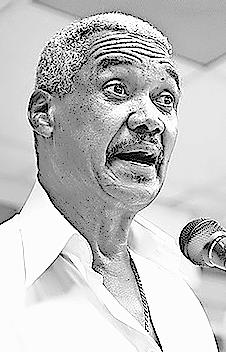
LESLIE MILLER
GB Chamber says $280m deal chance to tackle energy costs
Company special purpose vehicle (SPV), were unable to give a precise date for when the transaction will close. “They said they don’t know,” the union president added. “They said it was the signing of the agreement.
“The signing of the agreement was just to get the funds moved from one
bank to the next. Right now, the company is still under Emera, managed by Emera until the funds hit the bank.” The Government is financing GB Power’s purchase, and subsequent working capital needs, with a combined $280m borrowing from a consortium of banks headed by Standard Chartered and Scotiabank.
The loan is being underwritten by Bahamian
NOTICE
NOTICE is hereby given that I LINA DUPA of Sommerville Drive #25S Freeport, Bahamas is applying to the Minister responsible for Nationality and Citizenship, for registration/ naturalization as a citizen of The Bahamas, and that any person who knows any reason why registration/naturalization should not be granted, should send a written and signed statement of the facts within twenty-eight days from the 30th day of April, 2026 to the Minister responsible for nationality and Citizenship, P.O. Box N-7147, Nassau, Bahamas.
taxpayers after the guarantee was approved by Parliament.
Emera, in a statement to Tribune Business, confirmed that “the sale is expected to close within the next few weeks”. Meanwhile, what Emera executives told the middle management union appears to differ from what the Prime Minister subsequently said at the signing ceremony.
“This acquisition also protects the employment and benefits of all existing employees of Grand Bahama Power Company. The Bahamian management team will remain in place,” Mr Davis said. “To the workers of GB Power, we believe you are ready for a new energy era.
“You know the system. You know the grid. You know the customers. You know what it takes to keep power flowing through good days and difficult ones. Your experience belongs in the next stage of national reform.
“In the coming months, trained employees of Grand
Bahama Power Company will take up key roles in the Government’s wider energy reform agenda. That means Grand Bahama will help shape the energy future of The Bahamas. Engineers, technicians, system operators, managers, customer service professionals and energy specialists from this island will help build a stronger, cleaner, steadier and fairer electricity system across our country.”
Mr Culmer, though, said many GB Power employees had been left less than impressed. He added that it “doesn’t make sense to hurt our heads over this” given the upcoming May 12 general election, and the possibility that the administration may change with an FNM government adopting a different approach to Grand Bahama’s energy utility.
The union chief also suggested that many long-serving staff do not want GB Power to “look like Bahamas Power & Light (BPL)”, with some inquiring whether voluntary
severance packages will be offered as an option and others joking: “We are government workers now. Can we come in late and leave early?”
Mr Culmer said line staff had also been “upset” that none of them were invited to the acquisition signing ceremony involving the Prime Minister and several Cabinet ministers despite members of the public being there - a number of whom were wearing Progressive Liberal Party (PLP) t-shirts and other campaign gear. As a result, he questioned whether the deal was merely “smoke and mirrors” and the signing an election campaign event. “The staff were told to take the rest of the day off and don’t return to the property until the following day,” Mr Culmer told Tribune Business. “They were upset. We came together as a group and watched the ceremony. People were sitting there with PLP paraphernalia as if it was a PLP campaign event. The argument was: Is this all smoke and mirrors? Why is it being rushed?”
Mr Culmer said Dave McGregor, Emera’s Caribbean chief, became unhappy when the union posed such questions at Tuesday’s 10.30am meeting with GB Power executives and those from the Canadian utility.
“I think the entire Emera executive team aren’t pleased with this because of the way the staff felt,” he added. “It didn’t fall within Emera’s business model, as it left the staff in the dark and getting caught up in this election season as if it was just for show.
“To be honest, I think the Government sought to manhandle them and there weren’t good relations between Emera and the Government for a while. They are happy to get away from it, and get away from this government right now. The Government, we understand, sweetened the pot just to speed it up.”
Mr Culmer said Emera executives also gave different accounts, as he had to correct Karen Hutt, its executive vice-president of corporate development and GB Power chair, when she addressed all staff at 11.30am on Tuesday following the union meeting. She assured workers “nothing is going to change”, which the union president said had been contradicted earlier by GB Power executive, Nicole Godet, who had informed them of the 12-month timeline.
Mr Culmer said staff now want to know who will be brought into manage GB Power, whether it is the likes of BPL or FOCOL Holdings, and who will head the management team and sit on the Board of Directors. “Some persons are asking Emera to go back and see if the Government will offer us voluntary separation packages,” he added.
“They want to know if it’s too late to get them as they are not ready to work for the Government. Some are asking for the packages, some are being humorous with it: ‘We are government workers now, we can come in late and leave early’. There is also a general election next week, and we don’t know which way the pendulum is going to swing.
“This is the Brave Davis administration’s plan and, if the Government changes, we don’t know what will happen about that. There’s another uncertainty there. The staff are going to see what happens next week; it doesn’t make sense to hurt our heads over this. A lot of staff are hoping the Government changes because they feel they will get a more relaxed deal with them. Some of us have 20 years invested in the company and we don’t want it turned around and looking like BPL.”
Meanwhile, the Grand Bahama Chamber of Commerce, in a statement on
the GB Power deal, said the acquisition creates an opportunity to tackle energy affordability issues that have impacted the island’s competitiveness and economic growth.
“This development represents a significant moment for the island’s economic and infrastructural future,” it said. “Reliable, efficient and affordable electricity remains one of the most critical components of economic growth, investment confidence, industrial development and overall competitiveness in Grand Bahama. As the island positions itself for renewed activity and long-term growth, the stability and sustainability of its energy infrastructure will remain essential.
“At the same time, the scale and significance of this transition naturally raise important questions within the business community regarding implementation, operational continuity, longterm planning and execution. This further underscores the importance of transparency, stakeholder engagement and clearly communicated plans as the process moves forward.
“While Grand Bahama has historically benefited from comparatively stable electricity service, the cost of energy continues to place significant pressure on businesses and households alike. From this perspective, the proposed acquisition presents an opportunity to address one of the most important long-term challenges affecting the island’s competitiveness and economic growth.”
Emera’s financials for the 12 months to year-end 2025 show that GB Power generated a $10m Canadian dollar contribution to the utility giant’s “consolidated adjusted net income” for the period - a figure that was slightly down on the prior year’s $11m. Using the current exchange rate, that $10m Canadian dollars translates into about US $7.3m.
Those profits were generated from $162m Canadian dollars worth of revenue, which represented a 16.5 percent year-overyear increase compared to 2024’s $139m Canadian dollar top-line. The increase is likely due to increased economic activity among GB Power’s 20,000-strong customer base, with Carnival’s $600m Celebration Key destination having opened last July. The exchange rate conversion means GB Power generated $118.26m worth of revenues in US dollars last year.
The value of the Grand Bahama-based electricity provider’s physical assets, namely property, plant and equipment, narrowed slightly last year from $371m Canadian dollars at year-end 2024 to $361m Canadian dollars some 12 months later.
To give an idea of what the Government is potentially acquiring, Emera said: “With $378m US dollars of assets, and approximately 20,000 customers, GB Power owns 98 mega watts (MW) of oil-fired generation, approximately 100 kilometres of transmission facilities and 1,000 kilometres of distribution facilities. GB Power’s approved regulatory return on rate base is 8.52 per cent.” The Government has yet to disclose its “game plan”, and the commercial and economic rationale, for acquiring GB Power and adding more than a quarter-of-a-billion dollars to The Bahamas’ $12bn-plus national debt other than implying that Grand Bahama businesses and households will see a reduction in energy bills and costs following the acquisition. It has also yet to show how its valuation of GB Power was derived, given that $200m of the $280m has been earmarked for covering purchase costs.
Oil prices sink and stocks leap worldwide on hopes for a reopening of the Strait of Hormuz
By STAN CHOE AP Business Writer
OIL prices sank Wednesday, and stock markets rallied worldwide with hopes that the United States and Iran are nearing a deal to allow ships to deliver crude from the Persian Gulf once again to their customers.
The price for a barrel of Brent crude oil, the international standard, fell 7.8% to $101.27, down from more than $115 early this week. It dropped as President Donald Trump said the Strait of Hormuz could be “OPEN TO ALL” if Iran accepts a reported
agreement that the U.S. president did not detail. The small strait has caused big trouble for the global economy because the war with Iran has blocked oil tankers from using it to exit the Persian Gulf. A reopening could allow oil to flow freely again and remove upward pressure on inflation that’s driving prices up for all kinds of products worldwide.
On Wall Street, the S&P 500 climbed 1.5% for its best day in nearly a month and hit another all-time high. The Dow Jones Industrial Average jumped 612 points, or 1.2%, and the
NOTICE
NOTICE is hereby given that I ONES DUPA of Sommerville Drive #25S Freeport, Bahamas is applying to the Minister responsible for Nationality and Citizenship, for registration/ naturalization as a citizen of The Bahamas, and that any person who knows any reason why registration/naturalization should not be granted, should send a written and signed statement of the facts within twenty-eight days from the 30th day of April, 2026 to the Minister responsible for nationality and Citizenship, P.O. Box N-7147, Nassau, Bahamas.
NOTICE
International Business Companies Act 2000 No. 45 of 2000
Nasdaq composite rose 2% to its own record.
Stock markets abroad had even bigger gains, with indexes leaping 6.5% in Seoul, 2.9% in Paris and 2.1% in London.
Of course, hopes have risen several times already on Wall Street about a possible end to the war with Iran, only to get dashed each time. That could happen again, and oil prices pared some of their steepest losses from Wednesday morning.
The price for a barrel of Brent briefly dove below $97 before returning above $100 after Trump threatened to start bombing “at a much higher level and intensity” if Iran does not accept the agreement.
Wall Street nevertheless latched onto some potentially encouraging signals. Trump said Tuesday he was pausing his effort to forcefully reopen the Strait of Hormuz to commercial ships. And China’s foreign minister called for a comprehensive ceasefire following a meeting with Iran’s foreign minister. That
could be influential because of how closely tied Iran is to China economically and politically.
In the meantime, big U.S. companies continue to turn in much stronger profits for the start of 2026 than analysts expected. That’s supporting the stock market despite all the uncertainties created by the war.
AMD helped lead the market with a surge of 18.6% after it joined the
NOTICE
list of big-name companies topping expectations for both profit and revenue.
CEO Lisa Su said the chip company benefited from continued growth from artificial-intelligence technology, which is demanding tremendous amounts of computing power from data centers. AMD also said its revenue growth could accelerate in the current quarter to roughly 46% from a year earlier.
Another company enmeshed in the AI industry, Super Micro Computer, rallied 24.5% after likewise delivering stronger earnings than analysts expected. Nvidia, the chip company that became the poster child of the AI boom, rose 5.7% and was the single strongest force lifting the S&P 500 because of its immense size.
CVS Health climbed 7.6% after delivering better results for the first quarter than analysts expected and raising its financial forecasts for the full year. The Walt Disney Co. gained 7.5% after saying its “Zootopia 2” movie helped draw people to its streaming business, parks and cruise ships, while delivering a better-than-expected profit. Uber Technologies drove 8.5% higher after giving a bookings forecast for the spring that was higher than analysts expected. Outside of earnings reports, companies with big fuel bills jumped on hopes that oil prices will continue to ease.
NOTICE
Notice is hereby given that, in accordance with Section 138 (8) of the International Business Companies Act, No.45 of 2000, the Dissolution of HIGHWAY ONE LIMITED has been completed, a Certificate of Dissolution has been issued and the Company has therefore been
The date of completion of the Dissolution was April 9, 2026 Legal Notice
NOTICE
Chance Investments Limited
NOTICE IS HEREBY GIVEN as follows:
(a) Chance Investments Limited is in voluntary dissolution under the provisions of Section 138 (4) of the International Business Companies Act 2000.
(b) The dissolution of the said Company commenced on the 27th day of March , 2026.
(c) The Liquidator of the said Company is Sparrow Nominees Limited c/o Delaney Corp. (Bahamas) Ltd., Lyford Cay House, Western Road, Lyford Cay, Nassau, Bahamas
Dated 27th day of March A.D. 2026
Sparrow Nominees Ltd. Liquidator
NOTICE is hereby given that I LEPNY LESLIE SAINTCYRIN of Lavelle Road, West Bay Street, Nassau, The Bahamas, is applying to the Minister responsible for Nationality and Citizenship, for registration/ naturalization as a citizen of The Bahamas, and that any person who knows any reason why registration/naturalization should not be granted, should send a written and signed statement of the facts within twenty-eight days from the 7th day of MAY, 2026 to the Minister responsible for nationality and Citizenship, P.O. Box N-7147, Nassau, Bahamas.
NOTICE is hereby given that MEDIUS CASEY MILIEN JR. of #4261 West McNab Road, Pompano Beach, Florida, United States of America is applying to the Minister responsible for Nationality and Citizenship, for registration/ naturalization as a citizen of The Bahamas, and that any person who knows any reason why registration/ naturalization should not be granted, should send a written and signed statement of the facts within twenty-eight days from the 7th day of May, 2026 to the Minister responsible for nationality and Citizenship, P.O. Box N-7147, Nassau, Bahamas.
TRADER JOSEPH STEVENS, left, works on the floor of the New York Stock Exchange, Tuesday, May 5, 2026. Photo:Richard Drew/AP
US rights agency sues New York Times for discriminating against white man passed over for promotion
By ALEXANDRA OLSON AP Business Writer
A FEDERAL civil rights agency filed a discrimination lawsuit Tuesday against the New York Times, claiming that the news organization passed over a white male employee for a promotion in favor of a lesser qualified woman to meet its diversity goals.
The New York Times called the lawsuit politically motivated and said it would defend itself “vigorously.”
The Equal Employment Opportunity Commission filed the lawsuit Tuesday on behalf of a New York Times editor who lodged a complaint after he didn’t get the role of deputy real estate editor in 2025, alleging gender and racial discrimination under Title VII of the 1964 Civil Rights Act, which prohibits employment discrimination on the basis of sex, race, national origin or religion.
The EEOC claimed the news organization’s publicly stated goals of increasing the number of women and people of color in its leadership ranks influenced the decision to exclude the white male applicant for a final round of interviews, while advancing three women and a Black man. EEOC Chair Andrea Lucas, a Republican, has been a staunch champion of the Trump administration’s campaign against corporate diversity policies that she argues veer into discrimination against white men and others. In December,
Lucas posted a social media call urging white men to come forward with complaints if they believe they have faced discrimination because of their employer’s diversity policies.
“No one is above the law — including ‘elite’ institutions. There is no such thing as ‘reverse discrimination;’ all race or sex discrimination is
equally unlawful, according to long-established civil rights principles,” Lucas said in a statement. “No matter the size or power of the employer, the EEOC under my leadership will not pull punches in ensuring evenhanded, colorblind enforcement of Title VII to protect America’s workers, including white males.”
A SIGN for The New York Times is displayed above the entrance to its building in New York on May 6, 2021.
The New York Times spokeswoman Danielle Rhoades Ha said the EEOC “deviated from standard practices in highly unusual ways. The allegation centers on a single personnel decision for one of over 100 deputy positions across the newsroom, yet the EEOC’s filing makes sweeping claims that ignore the facts to fit a predetermined narrative.”
“Neither race nor gender played a role in this decision – we hired the most qualified candidate, and she is an excellent editor,” Rhoades Ha added.
In the lawsuit filed in the U.S. District Court of the Southern District of New York, the EEOC complaint said the complainant, who was not identified, has worked as an editor for the New York Times since 2014, mostly as a senior staff editor on the international desk with previous experience working on real estate stories.
The lawsuit claims that the woman ultimately
appointed deputy real estate editor “did not have experience with real estate journalism” but “as a multiracial female, this candidate matched the race and/or sex characteristics NYT sought to increase in its leadership.” The EEOC said one final panel interviewer described her as “a bit green overall.”
The EEOC’s lawsuit extensively cited The New York Times diversity and inclusion policies as evidence for its alleged discriminatory policies.
In particular, the lawsuit cites the organizations “Call to Action” plan published in February 2021 in which it set a goal of increasing the number of Black and Latino employees in leadership by 50% by 2025. The EEOC said the New York Times met that goal in 2022 but continued its commitment to diversity policies. According to reports cited in the lawsuit, white employees composed 68% of its leadership in 2024,
MARINE FORECAST
Photo:Mark Lennihan/AP
Why gasoline costs 52% more in the US than it did before the Iran war
By CATHY BUSSEWITZ Associated Press
THE price of a gallon of regular gasoline in the U.S. climbed 31 cents in the past week, spiking to an average of $4.54 per gallon Wednesday, a price 52% higher than before the war with Iran began, according to AAA data.
The main reason drivers are paying more at the pump is because the war has stranded oil tankers near the Strait of Hormuz, a narrow passage through which a fifth of the world’s crude oil normally passes.
The price of crude oil, which is the main ingredient in gasoline, climbed for most of the past two months because Iran has effectively shut the waterway located off its coast.
In mid-April, U.S. gasoline prices fell daily for almost two weeks amid signs the conflict could be winding down.
“After the announcement of the initial ceasefire, there was kind of optimism that this really could be the beginning of the end of the conflict,” said Rob Smith, director of global fuel retail at S&P Global Energy.
“And so crude prices came down correspondingly, gasoline spot prices followed, and so on and ... the retailers lowered prices as well.”
But gasoline prices reversed course and began increasing again as deepening hostilities over the strait between the U.S. and Iran kept oil supplies constrained.
“There’s a fundamental shortfall that will exist globally or fundamental struggle to meet that demand that will drive up price,” Smith said. “No matter what a government says or what any market person thinks, there is a true kind of upward pressure that’s being exerted on
prices every day the Strait of Hormuz is constrained. And it is still severely constrained.”
Who sets gasoline prices
Gas station owners set prices at the pump, but a lot of factors go into what they decide to charge.
The main ingredient in gasoline cost is the price of a barrel of crude oil. In the U.S., oil prices represented about 51% of the price of a gallon of gasoline in 2025, according to the Energy Information Administration.
That means when crude oil prices rise, gasoline prices generally follow. Less oil on the market means higher prices for oil and gasoline.
Iran’s effective closure of the Strait of Hormuz during the war triggered the largest supply disruption in the history of oil markets, according to the International Energy Agency, pushing oil prices as high as $112 a barrel in early April.
Oil prices fell below $100 a barrel Wednesday after the U.S. and Iran appeared to be moving closer to an initial agreement to end the war. That could pull gasoline prices down as well, if the trend continues.
Bob Kleinberg, adjunct senior research scholar at the Columbia University Center on Global Energy Policy, compared the average price of a gallon of gasoline in the U.S. with the price for a barrel of WTI, the U.S. benchmark oil, over the past few weeks, and said their price changes generally matched up.
“Not much of a mystery here,” Kleinberg said. “It’s not exactly proportional but the shape of the curves follows the same pattern, and really with very little delay.”
Federal and state taxes contributed about 17% of the oil price, refining costs
and profits contributed 14% and distribution and marketing contributed 17%, the EIA said. In some states, such as California, higher taxes and refining costs push the price of gasoline well above the national average.
What caused renewed march in gasoline prices
One event that could have changed the trajectory of gasoline prices occurred in April, when the U.S. blocked Iranian ports
to stop the country from exporting oil.
“Iran had been moving an unusually high amount of oil to global markets, so that was helping moderate prices,” said Jim Krane, energy research fellow at Rice University’s Baker Institute. “The Trump administration decides they’re going to punish Iran, and try to put more pressure on Iran by blocking their exports, so of course that does put pressure on Iran, but also puts pressure on global oil prices and
forces them up. That was probably a big factor.”
What refineries and traders are willing to pay for oil swings wildly after news breaks about attacks on ships in the Persian Gulf or diplomacy talks stalling.
“The oil market is exquisitely sensitive to what’s coming out of the White House,” Kleinberg said.
Back in early March, at the beginning of the Iran war, the price of gasoline jumped 48 cents in a week.
The highest weekly jump was in March 2022, when
the price jumped 60 cents in a week after Russia invaded Ukraine, AAA said. No quick fix
No one can predict how high gasoline prices will climb. A gallon of regular in the U.S. costs more now than it did in early May of 2022, and back then, the price kept climbing through Memorial Day, AAA said.
The longer the flow of oil through the Strait of Hormuz is hindered, the higher prices will go and the longer it will take to get back to normal, Smith said. “Even if there was a true and lasting resolution of the conflict, both sides agree to play nice and truly do commit to keeping Hormuz open, it will still take months to get back to what it was pre-war, if not even longer,” Smith said.