Transgender Breast Implants: What You Need to Know
Transgender breast implants may be considered by some transgender women and transfeminine people seeking a fuller or more traditionally feminine chest. While hormone therapy can lead to breast development, the amount of growth varies from person to person. Breast augmentation can provide additional volume and shape when someone wants a result that hormone therapy alone may not provide. Understanding the procedure, implant choices, preparation, recovery, potential risks, and long-term considerations is important before making a decision. What Are Transgender Breast Implants? Transgender breast implants are implants used during breast augmentation for transgender women or other transfeminine individuals. The procedure is designed to increase breast volume and may also help create a particular breast shape or improve symmetry. Breast augmentation is not required as part of gender-affirming care. Some people are satisfied with breast development from hormone therapy, while others may consider surgery to achieve their personal goals. Individual anatomy plays an important role in determining the appropriate surgical approach. Factors such as chest width, existing breast tissue, skin elasticity, body proportions, and previous medical treatment can influence the planning process.
Why Do Some People Consider Breast Augmentation? Hormone therapy can stimulate breast development, but the amount of growth differs considerably among individuals. Some people may experience limited development or may want additional volume after reaching a stable point in their breast growth. Breast augmentation may be considered for several reasons, including: • • • • •
Increasing breast volume Creating a fuller appearance Improving breast symmetry Developing a specific breast shape Addressing concerns about limited breast development
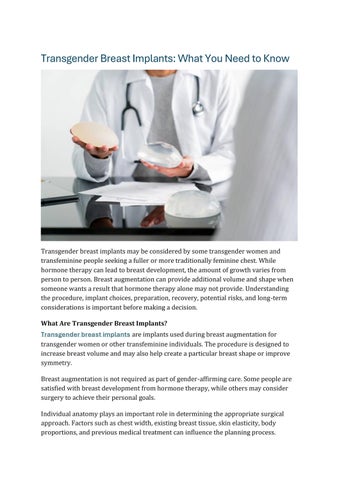
The goal should be based on the individual's preferences rather than a particular standard of appearance. Types of Breast Implants Breast implants generally differ in their filling material, shape, size, and surface characteristics. The two broad categories of implant filling are saline and silicone gel. Silicone Gel Implants Silicone gel implants contain a cohesive gel designed to provide a breast-like feel. They are available in different sizes and shapes, allowing surgeons to select an option based on the patient's anatomy and desired outcome. Saline Implants Saline implants contain sterile saltwater solution. They are placed inside the breast pocket and filled to the desired volume during surgery. The choice between implant types involves several considerations, including appearance, feel, surgical technique, potential complications, and personal preference. A qualified surgeon can explain the differences and help determine which options are appropriate. How Is Breast Augmentation Performed? Breast augmentation is usually performed under anesthesia. The surgeon creates an incision and forms a pocket in the chest tissue where the implant will be positioned. The implant may be placed above or below the chest muscle, depending on the individual's anatomy and the surgical plan. In transgender patients, chest anatomy may differ from that of typical cisgender breast augmentation patients, so individualized planning is particularly important.
After the implant is positioned, the incision is closed. The exact incision location and surgical technique depend on factors such as skin quality, existing breast tissue, implant characteristics, and the surgeon's approach. Preparing for Surgery A consultation before surgery is an important part of the process. The healthcare team typically reviews medical history, medications, allergies, previous procedures, and general health. Patients should discuss their expectations openly and ask how their anatomy may affect the final result. Measurements and physical examinations may be used to determine suitable implant dimensions. Important Pre-Surgery Considerations Before surgery, patients may need to discuss: • • • • • • • •
Current medications and supplements Hormone therapy Smoking or nicotine use Previous chest procedures Allergies or medical conditions Expected recovery time Future pregnancy or weight changes Potential need for additional surgery
Following preoperative instructions carefully can help reduce avoidable risks. What Is Recovery Like? Recovery varies between individuals. Immediately after surgery, patients may experience swelling, bruising, tightness, soreness, and temporary changes in sensation. The chest may feel uncomfortable during the first several days. Pain medication and other postoperative treatments may be provided according to individual needs. Patients are generally advised to avoid strenuous exercise and heavy lifting during the early recovery period. The healthcare team will provide specific instructions about bathing, sleeping positions, physical activity, wound care, and returning to work. Although many people resume light daily activities relatively quickly, the breasts can continue changing as swelling decreases and the implants settle into position. Potential Risks and Complications Breast augmentation is a surgical procedure and therefore carries potential risks. Possible complications include infection, bleeding, changes in sensation, scarring, asymmetry, and problems with wound healing.
Implant-specific complications can also occur. These may include implant leakage or rupture, movement or displacement, changes in breast shape, and capsular contracture, in which scar tissue surrounding the implant becomes unusually firm. Some patients may eventually require revision surgery or implant replacement. Implants are not generally considered lifetime devices, so long-term monitoring and future treatment may be necessary. How Long Do Breast Implants Last? The lifespan of a breast implant varies. Some implants remain in place for many years without requiring replacement, while others may develop complications that require earlier intervention. Patients should understand that having implants involves long-term considerations. Changes in body weight, aging, hormonal changes, pregnancy, or natural changes in breast tissue can alter the appearance of the breasts over time. Regular medical follow-up can help identify potential problems and determine whether additional care is necessary. Choosing Implant Size and Shape Selecting implant size is more complex than simply choosing a desired cup size. Surgeons consider chest width, skin elasticity, existing breast tissue, implant dimensions, and overall body proportions. A very large implant may place additional stress on the surrounding tissues and may not produce the desired appearance. The objective is to select an option that is appropriate for the person's anatomy and goals. Setting Realistic Expectations It is important to understand that surgical results vary. The same implant size can look different on two people because chest structure, tissue distribution, skin characteristics, and body proportions differ. Patients should discuss desired outcomes with their surgeon and understand both the possibilities and limitations of the procedure. Hormone Therapy and Breast Augmentation Many transgender women use hormone therapy as part of their gender-affirming care. Hormones can contribute to breast development, but individual responses vary. The timing of breast augmentation should be discussed with a healthcare professional because ongoing changes in breast tissue may influence surgical planning. Patients
should also discuss how hormone therapy and other medications relate to surgical preparation and recovery. Questions to Ask Before Surgery A consultation should provide an opportunity to ask detailed questions, such as: About the Procedure • • • • •
What implant options are suitable for my anatomy? Where will the implant be positioned? What incision technique is recommended? What results are realistic? Could additional surgery be necessary?
About Recovery • • • •
How long should I expect to recover? When can I return to work or exercise? What symptoms are normal after surgery? Which warning signs require medical attention?
About Long-Term Care • • • •
How should the implants be monitored? What complications should I watch for? How might aging or weight changes affect the result? What happens if an implant ruptures or needs replacement?
Final Considerations Transgender breast implants can be one option for people seeking additional breast volume or a particular chest contour. The decision to undergo breast augmentation is personal and should be based on individual goals, anatomy, health considerations, and a clear understanding of potential benefits and risks. A qualified healthcare professional can explain available implant options, surgical techniques, recovery expectations, and long-term considerations. Taking time to understand the procedure and maintaining realistic expectations can help patients approach the decision with appropriate information and preparation.