Introduction to Subterranean Foundation Leaks A home constructed on a reinforced concrete slab foundation provides long-term structural stability, termite resistance, and a level architectural footprint. However, pouring hundreds of tons of concrete directly over a network of pressurized domestic water supply pipes and drainage lines introduces an inherent, silent vulnerability. When one of these buried conduits develops even a microscopic fissure or pinhole rupture, water begins escaping beneath the reinforced slab. This condition is formally termed a slab leak.
Unlike a dripping kitchen faucet or an overflowing toilet where water accumulation is immediately visible, a leak beneath a concrete foundation operates hidden from sight. Water migrates along subterranean gravel beds, saturates supporting subsoils, weakens load-bearing foundations, and wicks upward into porous flooring. Left unaddressed for weeks or months, a minor hairline pinhole can escalate into cracked load-bearing walls, buckled hardwood, hazardous black mold colonies, and tens of thousands of dollars in structural foundation restoration. Successfully managing this threat requires a comprehensive understanding of how under-slab plumbing behaves, how environmental and chemical factors deteriorate piping, how modern non-destructive diagnostics work, and how a licensed technician determines the safest, most cost-effective permanent fix.
The Anatomy of Under-Slab Piping To understand why slab leaks occur and how they are resolved, property owners must understand how residential foundations are plumbed during initial construction. ● ● ● ● ●
Finished Flooring: Tile, Hardwood, Luxury Vinyl Plank, or Carpet Reinforced Concrete Foundation: Four to six inches of solid concrete Vapor Barrier: Heavy plastic moisture-retarding membrane Compacted Sand and Pea Gravel Bed: Encasing hot and cold water distribution lines Subsoil and Natural Earth: Expansive clay, silt, or sand supporting the structure
Under-slab plumbing is divided into two distinct configurations: ● Pressurized Supply Lines: These carry incoming municipal or well water throughout the home at pressures ranging from forty to eighty pounds per square inch. Because they are continuously under pressure, a rupture here releases water non-stop twenty-four hours a day, regardless of whether any household tap is turned on. ● Drain Waste and Vent Lines: These gravity-fed drainage conduits carry wastewater away from toilets, sinks, and tubs toward the sewer or septic tank. Leaks in drainage lines are often intermittent, occurring primarily when fixtures drain, but they carry pathogenic bacteria and sewer gases into the soil beneath the home.
Why Buried Pipes Fail Over Time Pipes do not fail randomly. Their deterioration is driven by chemical, physical, and mechanical stressors acting upon the piping material year after year. ● Thermal Abrasion and Mechanical Wear: Every time hot water flows to a shower, washing machine, or sink, copper pipes heat up and expand slightly. When the water cools down, the pipe contracts. Over years of daily temperature cycling, this constant movement causes the pipe to grind against coarse gravel, concrete aggregate, or rebar. Eventually, the friction wears down the outer wall of the copper tubing until a pinhole break opens. ● Galvanic and Soil Corrosion: Depending on local soil minerals and moisture levels, soil surrounding buried pipes can react with the copper. Pinhole pitting corrosion eats through metal from the outside inward, often accelerated by electrical grounding currents running through household plumbing infrastructure. ● Water Chemistry and pH Imbalance: Municipal water that is excessively acidic or heavily saturated with hard minerals strips away the inner protective patina that naturally forms inside copper piping. Once this barrier erodes, pitting corrosion forms microscopic pinholes throughout the domestic supply network. ● Excessive Water Pressure and Water Hammer: Municipal water pressure spikes push joints and fittings past their rated tolerances. When valves snap shut quickly, sudden
pressure waves rattle buried pipes against dense concrete, weakening fittings and solder joints over time. ● Soil Movement and Foundation Settlement: Expansive clay soils swelling during rain and shrinking during dry spells exert immense pressure against the concrete foundation. As the earth moves, buried pipes experience shearing stress that can crack joints or snap rigid lines. ● Installation Deficiencies and Kinks: If installers kinked the copper tubing during the initial construction phase or failed to sleeve the pipe through concrete penetrations, the stressed metal becomes a prime candidate for premature failure.
Telltale Symptoms Every Homeowner Should Watch For Because subterranean pipes remain hidden beneath solid stone and earth, catching a leak early depends on observing sensory, operational, and structural indicators throughout the home. ● Unexplained Increases in Utility Bills: A sudden, steep spike on your monthly municipal water bill without an increase in household usage is often the first financial warning sign. If the leak is located on the hot water distribution line, your gas or electric bill will rise simultaneously because the water heater continuously runs to reheat incoming cold water. ● Localized Warm Zones on Floors: When hot-water supply lines rupture, heat radiates upward through the concrete, creating noticeable warm patches on tile, laminate, or carpeted floors, especially around bathrooms, hallways, or laundry rooms. ● Nonstop Water Heater Cycling: If your hot water tank is firing constantly, hissing, or cycling without anyone drawing hot water, heated water is actively escaping into the ground beneath your home. ● Audible Sounds of Running Water: When all faucets, appliances, and fixtures are turned off, hearing a faint hissing, rushing, or bubbling noise behind baseboards usually signals an active pressurized breach. ● Drops in Household Water Pressure: A substantial underground rupture diverts water volume before it reaches household outlets. If shower pressure drops suddenly or hot water takes twice as long to arrive at a faucet, volume is being lost underneath the slab.
Visual and Structural Warning Indicators As escaping water saturates the soil beneath the slab, it creates hydrostatic pressure that forces moisture upward through microscopic pores and hairline cracks in the concrete: Buckling, cupping, or warping in hardwood, engineered wood, or laminate flooring. Discolored, darkened, or loose tiles with powdery white mineral efflorescence along grout lines. Peeling paint, bubbling wallpaper, or damp drywall along baseboards and interior walls. Distinct earthy, moldy, or mildew smells circulating through living spaces and HVAC vents.
Cracks emerging along interior drywall corners, sticking door frames, or exterior brickwork separation indicating foundation shifting.
The Five Minute Water Meter Diagnostic Process If you suspect an underground supply-line leak, this standardized protocol allows you to confirm pipe integrity in minutes: ● Shut off all household fixtures including sinks, showers, hose bibs, and appliances. ● Ensure automatic water-consuming devices like dishwashers, washing machines, and refrigerator ice makers are not running. ● Locate your main municipal water meter box near the street or sidewalk. ● Inspect the low-flow leak indicator on the meter dial, which appears as a small triangle, star, or gear wheel. ● If the indicator is slowly spinning while all household taps are closed, water is actively escaping somewhere in the pressurized supply line. ● Next, shut off the dedicated cold-water inlet valve directly on top of your water heater. ● If the meter stops spinning immediately, the leak is located on the hot water distribution network. If the meter continues spinning, the leak is situated on the cold water supply line or main incoming service branch.
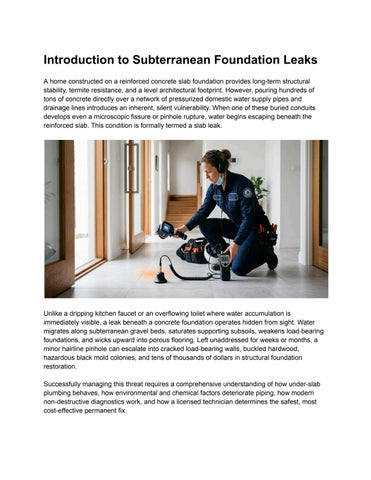
Modern Non-Destructive Detection Methods Decades ago, identifying a slab leak required sledgehammers, heavy jackhammers, and destructive trenching through interior floors based on broad guesswork. Today, licensed trade professionals utilize acoustic, thermal, and electronic tools to pinpoint ruptures within inches before ever breaking concrete. ● Electronic Acoustic Amplification: Water escaping through a microscopic puncture in a high-pressure pipe creates distinct sonic frequencies as turbulence collides with surrounding gravel and concrete. Technicians wear noise-canceling headsets connected to ground microphones and electronic listening discs placed along the floor. By adjusting frequency filters, the technician maps acoustic amplitude spikes until the exact epicenter of the breach is identified. ● High-Resolution Infrared Thermography: Thermal imaging cameras detect infrared radiation emitted from flooring surfaces. When hot water discharges beneath a slab, thermal energy pools and radiates outward in an identifiable heat plume. By scanning flooring with an infrared camera, technicians visualize the hot spot directly on screen, distinguishing the supply pipe's path from ambient floor temperatures. ● Electromagnetic Pipe and Cable Locators: Before planning a repair path, technicians must know the precise depth and horizontal trajectory of underground lines. A lowvoltage transmitter is connected to an accessible pipe manifold, sending an
electromagnetic signal through the copper line. A digital receiver wand traces this signal across the floor, mapping the exact subterranean route of the plumbing infrastructure. ● Tracer Gas Detection: For microscopic pinholes that produce minimal acoustic noise, technicians isolate the line, purge remaining water, and inject a safe, non-toxic gas mixture of nitrogen and hydrogen. Specialized sniffer wands scan surface seams, baseboards, and expansion joints. Because hydrogen atoms are tiny and light, they escape through the breach and rise through the slab, alerting the sensor precisely where the line is compromised.
Comparing Permanent Repair Strategies Once an under-slab leak has been accurately located, property owners and technicians have primary permanent repair methodologies to consider. Each approach carries distinct structural, aesthetic, and budgetary implications. Targeted Spot Repair Explained How It Works: The technician scores and breaks open a small access opening in the flooring and concrete directly above the acoustic detection point. The gravel and soil are excavated, the compromised pipe section cut out, and a new segment of heavy-duty copper or PEX is spliced in using brazed joints or mechanical couplings. The cavity is then backfilled, repoured with fresh concrete, and patched. Advantages: ● Targets the specific failure point directly. ● Avoids opening long drywall runs across the home. ● Highly economical if the foundation is easily accessible and flooring is inexpensive carpet or vinyl. Disadvantages: ● Noisy, dusty, and invasive inside living areas. ● Damaged custom tile, stone, or hardwood flooring can be difficult or impossible to match. ● If the pipe failed due to systemic water corrosion, another leak will often develop a few feet down the line within months.
Overhead PEX Line Rerouting How It Works: Rather than jackhammering through finished floors, the compromised under-slab line is disconnected, capped off, and permanently abandoned in place. A new, continuous line made of flexible PEX piping is installed from the water manifold, routed up through interior walls, across the attic or ceiling joists, and dropped back down to the target fixture.
Advantages: ● Leaves the structural concrete foundation completely undisturbed. ● Eliminates future under-slab leak risks on that entire plumbing branch. ● Protects expensive interior flooring such as continuous Italian tile, natural marble, or solid hardwood. ● Fast installation with minimal household disruption. Disadvantages: ● Requires opening small drywall inspection access holes that need patching and painting. ● In colder climates, attic lines require proper insulation to protect against winter freezing.
Whole House Repiping Solutions How It Works: All aging copper or galvanized supply lines under the concrete slab are permanently retired. The home's entire domestic water delivery network is upgraded to modern, flexible PEX piping installed through walls, ceiling chases, and closets. Advantages: ● Completely solves systemic corrosion issues across the entire property. ● Eliminates the stress of recurring foundation leaks. ● Increases property resale value and improves home insurance insurability. Disadvantages: ● Higher upfront financial investment. ● Requires multi-room drywall access over a three to five day installation window. Engaging in regular slab leak repair reading materials helps homeowners evaluate whether a spot repair or an overhead bypass best protects their property investment and budget.
Structural Dangers of Delayed Repairs Delaying repairs converts an isolated plumbing fix into a catastrophic structural and environmental emergency: ● Subsoil Erosion and Void Formation: High-pressure water continuously washes away compacted sand and structural subsoil underneath the slab. As soil washes out, unsupported concrete sections sag, crack, and fail under the structural weight of the building.
● Foundation Heaving: In regions with expansive clay soil, escaping water causes clay beneath the foundation to expand dramatically. This swelling heaves the slab upward, cracking interior tile, twisting doorframes, and buckling load-bearing partition walls. ● Indoor Air Quality and Mold Prevention: Moisture wicking up through concrete creates persistent relative humidity above seventy percent beneath flooring and inside wall cavities, creating the ideal breeding ground for toxic black mold colonies that compromise indoor respiratory health. ● Structural Wood Rot: Base plates, wall studs, and sill plates absorbing under-slab moisture suffer fungal decay, compromising structural framing integrity over time.
Homeowners Insurance Coverage Realities Insurance coverage for under-slab leaks is widely misunderstood. Understanding typical policy terms helps prevent denied claims: Covered by Most Standard Homeowners Policies: ● Tear-out costs associated with jackhammering concrete or opening access points to reach the leak. ● Resulting water damage to finished flooring, drywall, cabinetry, and baseboards. ● Professional mold remediation and drying services required to restore living spaces. Typically Excluded or Paid Out of Pocket: The physical plumbing pipe and replacement fittings that failed. Normal wear-and-tear, gradual deterioration, or age-related pipe corrosion. Pre-existing foundation settling damage that occurred prior to the sudden plumbing event.
Documenting Claims for Maximum Recovery Take high-resolution photos and video before, during, and after diagnostic work. Request an itemized invoice from your plumbing contractor detailing diagnostic tear-out labor, access costs, and plumbing parts separately. Report the claim immediately to establish that damage occurred from a sudden and accidental plumbing event. Long-Term Preventive Measures Proactive maintenance significantly reduces the risk of sub-slab pipe failure: ● Install a Pressure-Reducing Valve: Keep residential water pressure regulated between fifty-five and sixty-five pounds per square inch. If municipal pressure fluctuates above seventy-five pounds per square inch, install an adjustable regulator at the main shutoff.
● Perform Water Quality Testing: Test domestic water pH and hardness. If municipal water is slightly acidic or excessively hard, install a neutralizer or softening system to protect copper piping from internal corrosion. ● Install Smart Flow Monitoring Systems: Modern smart water monitoring valves monitor household flow patterns continuously and automatically shut off the main water supply when abnormal micro-leaks are detected. ● Schedule Periodic Plumbing Inspections: Have a licensed technician conduct pressure checks and valve audits every two to three years to catch joint stress before leaks develop under your foundation.
Frequently Asked Questions Can a slab leak stop on its own? No. Pressurized water pipes never heal themselves. Sediment or corrosion may temporarily slow a leak, but escaping water will inevitably erode the obstruction, causing an even larger rupture under pressure.
How long can you safely live with an active foundation leak? A slab leak should be treated as an urgent emergency. Every day a leak runs, soil washes away and moisture accumulates. Property owners should contact a licensed professional and shut off water supply lines within twenty-four to forty-eight hours of detection.
Is a hot water slab leak worse than a cold water slab leak?
Yes. Hot water leaks introduce thermal expansion stress, deteriorate surrounding concrete faster, continuously waste energy via the water heater, and accelerate mold growth due to elevated floor temperatures.
Will insurance cover an overhead pipe reroute? Policies typically cover the cost to access the leak and repair resulting water damage to floors and walls. While the replacement pipe itself is often an out-of-pocket expense, rerouting is frequently comparable in total cost to direct slab demolition when factoring in floor restoration savings.
Summary Action Checklist ● ● ● ● ●
Check your water bill monthly for unexplained volume increases. Feel flooring for uncharacteristic warm spots around bathrooms and hallways. Run the five-minute water meter test if an underground leak is suspected. Isolate whether the leak is on the hot or cold supply network. Hire a licensed plumbing team equipped with electronic acoustic and thermal diagnostic tools. ● Evaluate direct spot repair versus an overhead PEX reroute based on pipe age and flooring value. ● Document all diagnostic findings and tear-out procedures for insurance claims.