MONDAY, APRIL 26, 2018 • VOL. 122, ISS. 56
THESUNFLOWER.COM
WICHITA STATE UNIVERSITY’S INDEPENDENT STUDENT NEWSPAPER SINCE 1896.
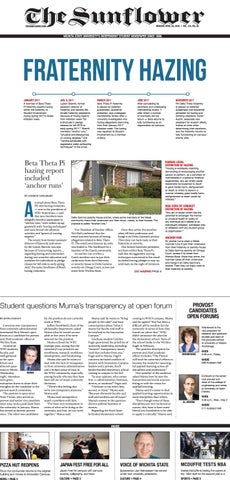
Fraternity Hazing JANUARY 2017
A member of Beta Theta Pi fraternity reports hazing within the fraternity to Student Involvement during spring 2017’s Greek initiation week.
JAN. 9, 2017
Lyston Skerritt, former assistant director of fraternity and sorority life, emails fraternity presidents because of hazing reports from initiation week “for individuals in pledge classes for fall 2016 to early spring 2017.” Skerritt mentions “anchor runs,” “physical activities/games of varying degrees,” and “varying schedules with aggressive wake up/scaring techniques” in the email.
MARCH 2017
Beta Theta Pi fraternity is placed on deferred suspension, academic probation, and undergoes membership review after a university investigation into hazing allegations stemming from their January 2017 initiation week. The hazing was reported to Student Involvement by a member of Beta.
JUNE 2017
After completing its sanctions and undergoing membership review — after which a number of members did not return — Beta returns to fully functioning as an organization on campus.
Beta Theta Pi hazing report included ‘anchor runs’
A
“Hazing is recklessly coercing, demanding or encouraging another person to perform, as a condition of membership in a social or fraternal organization, any act which could reasonably be expected to result in great bodily harm, disfigurement or death or which is done in a manner whereby great bodily harm, disfigurement or death could be inflicted.”
WSU CODE OF CONDUCT DEFINITION OF HAZING KYLIE CAMERON/THE SUNFLOWER
Delta Gamma sorority house anchor, where some members of the Greek community throw their underwear and then return, naked, to their houses. The practice is called “Anchor runs.”
Vice President of Student Affairs Teri Hall confirmed that the email was sent because of hazing allegations related to Beta Theta Pi. The email, sent January 30, 2017, was leaked to The Sunflower by a member of the Greek community. An anchor run is when a Greek member runs in just their underwear from their fraternity or sorority house to Delta Gamma sorority on Omega Court, across 21st street from Wichita State.
Once they arrive, the member takes off their underwear and hangs it on Delta Gamma’s anchor. Then they run back nude to their fraternity or sorority. One former fraternity president, not from within Beta Theta Pi, said that the aggressive scaring techniques mentioned in the email included forcing pledges to stay up until 6am on the night of initiation. SEE HAZING PAGE 6
“Any act or action which has the potential to endanger the mental or physical health or safety of any individual as it relates to an individual’s initiation, admission into, or affiliation with any student group or organization.”
ANCHOR RUN
An anchor run is when a Greek member runs in just their underwear from their fraternity or sorority house to Delta Gamma sorority on Omega Court, across 21st street from Wichita State. Once they arrive, the member takes off their underwear and hangs it on Delta Gamma’s anchor. Then they run back nude to their fraternity or sorority.
Student questions Muma’s transparency at open forum BY JENNA FARHAT
Concerns over transparency from university administration dominated Rick Muma’s open forum as a candidate for provost and chief academic officer at Wichita State. Around 90 WSU students, faculty, and staff gathered at the open forum and directed questions to Muma MUMA Wednesday night. Attendees were given evaluation forms to share their thoughts on the candidate to the provost search committee. The position is open since Tony Vizzini, who served as provost and senior vice president since 2014, took a paid leave from the university in January. Muma has served as interim provost since. The other two candidates
Phi Delta Theta fraternity is placed on deferred suspension and academic probation for hazing and drinking violations. Aaron Austin, associate vice president for student affairs, makes an error when determining their sanctions, and the fraternity returns to fully functioning on campus shortly after.
KANSAS LEGAL DEFINITION OF HAZING
BY ANDREW LINNABARY
n email about Beta Theta Pi’s 2017 hazing violations — sent to the presidents of WSU fraternities — said that new members were allegedly forced to participate in “anchor runs,” were woken up aggressively with “scaring techniques” and were forced into physical activities and “games of varying degrees.” The email, from former assistant director of fraternity and sorority life Lyston Skerritt, was sent because of “concerning reports … regarding hazing and misconduct during new member education and initiation for individuals in pledge classes for fall 2016 to early spring 2017,” the same timeframe of Beta’s hazing violations.
NOVEMBER 2017
for the position do not currently work at WSU. Jeffrey Hershfield, chair of the philosophy department, asked Muma what he would accomplish in five years if he were selected for the position. Muma echoed the WSU strategic plan, saying that the university’s top priorities are enrollment, research, workforce development, and fundraising. Muma also said he wants to deal with the lack of transparency from university administration and a broken sense of trust in the WSU community, especially among faculty who say they have been left out of major university decisions. “There’s this feeling that we’re not transparent anymore,” Muma said. Muma said transparency wasn’t a problem with him. “I’ve been very transparent in terms of what we’re doing at the university and how we can work together,” Muma said.
Muma said he wants to “bring people to the table” and have conversations about “what it means for faculty and staff to be involved in the Innovation Campus.” Graduate student Carolyn Fugit questioned the priorities of university leadership, including “massive” transparency issues, “and that includes from you,” Fugit said to Muma. Fugit’s concerns included conflicts of interest with Innovation Campus leaders and a private, Koch family-funded elementary school coming to campus in the fall. “In your opinion, who comes first — administration, business, donors, or students?” Fugit said. “I hesitate to say who’s first, second, or third,” Muma said. “Because obviously faculty and staff and students are all equal.” Muma’s answer to the question did not address business or donors. Regarding the Koch family-funded elementary school
coming to WSU’s campus, Muma said he agreed “that has been a difficult pill to swallow for the university in terms of how they found out about that.” WSU didn’t announce the plan for the elementary school. News of the school broke in the Wichita Eagle in February. The position description for provost and chief academic officer includes: “The Provost will lead the university’s efforts to become the model for meaningful applied learning across all disciplines and professions.” One member of the audience asked Muma how he sees the humanities and social sciences fitting in with the vision for applied learning. Muma said it’s easier to find applied learning opportunities in some disciplines than others. “Even though some of these disciplines are very technical in nature, they have to have some liberal arts foundation to be able to apply it critically,” Muma said.
PROVOST CANDIDATES OPEN FORUMS Wisniewski is the vice president for research and graduate studies and dean of the graduate school at University of Alaska Anchorage.
WISNIEWSKI
WHEN
3:30 p.m., Friday
WHERE
208 Hubbard Hall
El-Rewini is the senior vice provost and dean of the college of engineering and mines at University of North Dakota.
WHEN EL-REWINI
3:30 p.m., Wed., May 2
WHERE
211 Hubbard Hall
INSIDE
JAPAN FEST FREE FOR ALL
VOICE OF WICHITA STATE
MCDUFFIE TESTS NBA
Pizza Hut co-founder returns to the original building as it moves to Innovation Campus.
Japan Fest hit campus with samurai swords, calligraphy, and food.
Spokesman Joe Kleinsasser has served under four university presidents.
Markis McDuffie is testing the waters of the NBA draft for the second year in a
NEWS • PAGE 2
CULTURE • PAGE 3
CULTURE • PAGE 4
SPORTS • PAGE 5
PIZZA HUT REOPENS
NEWS
2 | THURSDAY, APRIL 26, 2018
www.thesunflower.com
www.thesunflower.com
THE STAFF EDITORIAL
Editor-in-Chief Chance Swaim Managing Editor Jenna Farhat Culture Editor Marissa Campbell Sports Editor Matt Crow Opinion Editor Evan Pflugradt Design Editor Madeline Deabler Photo Editor Brian Hayes Digital Editor Nicole Byrne
ADVERTISING
Advertising Manager Christian Yost
ADVISING
Faculty Adviser Amy DeVault
BRIAN HAYES/THE SUNFLOWER
Pizza Hut co-founder Dan Carney greets guests in front of the original Pizza Hut, which he started with a $600 loan, during the opening of the Pizza Hut Museum.
LETTERS TO THE EDITOR
Send letters to the editor to editor@thesunflower.com or submit at thesunflower.com. Please keep letters to 400 words or less. All letters are edited for clarity and length. Please include your name, WSU affiliation and a phone number for verification purposes.
Our Mission
The Sunflower — both in print and online — will be a timely resource of information about the Wichita State University community. It will report on news, issues, activities, academics and athletics, in addition to offering a forum for discussion, reviews and commentary. It will also be an effective learnig experience for students, who will have the final authority over what is published.
Legal
The Sunflower (published for use by WSU students, faculty and staff) is private property and unlawful removal or use of papers is prosecutable. One copy may be taken for free. Additional copies must be purchased for $1 each. The Sunflower is also partially funded by the Student Government Association at WSU. The opinions expressed in The Sunflower editorials, columns, guest columns, reviews, advertisements, letters and editorial cartoons are not necessarily those of the staff, publications board, student body or university. The Sunflower reserves the right to edit or reject any submission. We also reserve the right to edit or reject any advertisement.
CONTACT THE SUNFLOWER 019 Elliott Hall 1845 N. Fairmount Ave. Campus Box 134 Wichita, KS 67260-0134 ----------
SUNFLOWER OFFICES Front Desk: 316-978-3640 Fax: 316-978-3778 ADVERTISING Christian Yost: 316-978-6906 admanager@thesunflower.com EDITORIAL Chance Swaim: 316-978-6905 editor@thesunflower.com ADVISER Amy DeVault: 316-978-6052 amy.devault@wichita.edu
HUT, HUT
Co-founder Dan Carney welcomes visitors to Pizza Hut Museum BY EVAN PFLUGRADT
P
izza Hut co-founder Dan Carney comes from humble beginnings. Working for Carney Market and studying for a master’s degree at the University of Wichita, he was frustrated with the day-to-day and became determined to make a change. “If you want to do something, do it for yourself,” he recalls his dad telling him. “That’s the only way to get a true score of what you’re capable of doing,” his father said. Carney decided it would be best to go into business for himself. Dan and his brother, Frank, borrowed $600 from their mother to open a 500-square-foot restaurant in Wichita. The brothers decided to take a pizza recipe from their friend John Bender and roll it out to the Wichita community. The sign on the door fit 10 characters. The brothers knew they wanted to have “Pizza” in the name, leaving room for a three-letter-word. Given the building’s resemblance to a hut, Carney settled on Pizza Hut. “By happenstance or by God’s good grace,” Pizza Hut
became an instant success, Carney said. Pizza Hut opened its doors in 1958. Wednesday, Dan Carney, surrounded by a crowd of 300, cut the ribbon to reopen the original Pizza Hut building as a museum. “It tells the story the way we want to tell it,” Carney said. “This museum tells the story of friends, family, and franchise.” Carney stood in the kitchen-side of the museum and told stories of the company’s history. He recalled times when five people would stand shoulder-to-shoulder in the kitchen and toss pizza dough, while up to 15 diners crowded the seating area. Through help of the WSU Foundation, $1.2 million was fundraised to help renovate the facility into the a museum filled with artifacts kept by Carney’s wife. The building was moved to Innovation Campus in September as part of the renovation project. “The story of Pizza Hut is changing lives,” WSU President John Bardo said. “It’s about willing to take a chance on yourself, about reaching out to your friends, and about caring … That’s the story of Pizza Hut. That’s the story of Wichita State.” The building was moved from its original location at
BRIAN HAYES/THE SUNFLOWER
WSU President John Bardo walks around the Pizza Hut Museum on the day of the grand opening.
the corner of Kellogg and Bluff to WSU’s campus to serve as a symbol of entrepreneurial leadership and success. The building was dedicated Sept. 11, 1986. Bardo said he envisions the relocation of the Pizza Hut Museum, which is located behind the Marcus Welcome
Center, will challenge 17-yearolds to think in terms of entrepreneurship. “I want them to ask themselves, ‘How big can I dream?’,” he said. “Pizza Hut tells you what’s possible.” Pizza Hut has been in operation for 60 years. There are 17,000 Pizza Hut locations worldwide.
---------ONLINE www.thesunflower.com FACEBOOK www.facebook.com/sunflowerwsu TWITTER @sunflowernews INSTAGRAM @thesunflowernews
CORRECTIONS This space is reserved for corrections. Spot an error? Call us at 316-978-6905.
CLASSIFIEDS The Sunflower will not knowingly publish advertising that is false or misleading. If you have a question about an ad or a classified, call the Wichita Better Business Bureau at 316-2633146.
Thinking Abortion? Alternatives: Free Testing 265-0134
More classifieds can be found online at www. thesunflower.com/classifieds. Be see in the classifieds by calling 316-978-6906.
Ad wars: Innovation Campus developers, donors, Koch exec, others buy counter-protest ad BY CHANCE SWAIM
Innovation Campus developers, donors, and board members of the nonprofit managing the campus expansion joined an executive from Koch Industries and others in placing an ad in the Sunday Eagle supporting Wichita State’s leadership. The ad came a week after a group called “Friends of the University” placed an ad protesting Wichita State’s leadership’s “abuses of the public trust,” and asking the Kansas Board of Regents to protect “protect students, faculty members and community residents from further such abuses,” including intimidations and threats to The Sunflower’s funding, the creation of the nonprofit Innovation Alliance to manage projects on Innovation Campus, underfunding faculty positions in certain disciplines, use of student fees on Innovation Campus development, building a multi-million-dollar housing complex and diverting 5 percent of scholarship money to non-academic purposes, inflating enrollment numbers, and leasing a university building to a private school. The Kansas Board of Regents said they would not comment on the ad.
The counter-protest ad, which is titled “Innovative Thinking For Today’s Realities in Higher Education,” didn’t address any of the specific claims of “Friends of the University” ad, but it did say the “playing fields of higher education is rapidly changing” and that “The models of the 1970s, or even 1990s, are no longer applicable.” The advertisement said state public funding covers 35 percent of total education costs, “roughly half the amount covered less than 20 years ago.” The argument continues that because the state doesn’t account for as much of a percentage of total educational costs, “universities must seek new avenues of revenue and partnerships.” The ad says Wichita State is “on the leading edge of this forward-thinking concept” that will provide a “pathway to ongoing success, not merely for the University but all of Wichita and South Central Kansas, for decades to come.” “For the record,” the ad said, “we support Doctor Bardo and his colleagues who are bringing favorable national recognition to our community, while assuring Wichita State’s ability to continue
to prepare students with knowledge and skills for successful careers in all academic areas.” The full-page advertisement, which cost more than $3,000 to run, featured an image of “Partnership 2,” a building on Innovation Campus. President Bardo is the chief officer for the board that awards contracts on Innovation Campus. Steve Barrett and Nestor Weigand, who are co-owners of Innovation Campus development company MWCB with the chairman of the board of regents David Murfin and Ivan Crossland, included their names in the advertisement. Steve Clark, an early partner of MWCB who recently helped donate $1 million for the YMCA on Innovation Campus, also signed. MWCB has gotten several major projects on Innovation Campus. Bill Moore and David Mitchell, who were both appointed by President Bardo to the Innovation Alliance board that manages public-private partnerships on Innovation Campus, also signed. Executive Vice President and Chief Financial Officer for Koch Industries Steve Feilmeier also chipped in.
Student arrested for attempting to steal iPad from Ablah Library BY JENNA FARHAT
A student was arrested and booked into jail on one count of theft after attempting to steal an iPad from Ablah Library. A student had checked out an iPad from the library and was working there when he noticed that the iPad was missing from his bag, Wichita State Police Chief Robert Hinshaw said in an email. The student looked around and noticed a man walking away with the iPad, Hinshaw said. The student approached the man, who is also a student, and got the iPad back before calling WSU police, Hinshaw said. Campus police were dispatched around 3:40 p.m. to Ablah on April 20, and a 20-year-old man was arrested and booked into jail. Hinshaw said the man is no longer in jail. Hinshaw did not know the circumstances of his release.
CULTURE
www.thesunflower.com
Antebellum literature presentation coming to campus BY MATT COOPER
Kansas University’s Laura Mielke, an associate professor and published author, will give a presentation on her soon-to-be released book on anti-slavery discourse in pre-Civil War era America. The presentation, hosted by Sigma Tau Delta, will take MIELKE place at 3 p.m. on Friday in Lindquist Hall Room 112. Aside from her work as a professor at KU, Mielke’s work has been widely distributed in the realm of early American literary criticism. Past publications of Mielke’s include theses on early American captivity narratives, and examinations of Nathaniel Hawthorne and antebellum theatrical criticism. Mielke’s newest book, “Eloquence: Theatre, Violence, and Anti-Slavery Speech in the Antebellum U.S.,” will present readers with a contemporary perspective on pre-civil war abolitionism in literature. Sigma Tau Delta Adviser Rebecca Bechtold commented on the importance of Sigma Tau Delta’s Speak Series and how students stand to benefit from attending. “We want to show undergraduates a professional in literature,”
THURSDAY, APRIL 26, 2018
JAPAN FEST FUN IN PHOTOS
Bechtold said. “Even if they don’t have a background in literature. Hopefully students will get a more in depth understanding of early American literature and how it helped shape the culture and society.” Sigma Tau Delta President Victoria Stewart said that Mielke’s presentation could be a positive experience for those students outside the realm of the English department. “This is different than the exposure they have had so far in college,” Stewart said. She mentioned that students outside the liberal arts college tend to have little exposure to literature outside of the core academic curriculum. “I think this is an interesting opportunity for students to see what professors of English 101 and English 102 actually do in the field,” Stewart said. She noted that Friday’s speaker series would be an opportunity to learn about literature firsthand. “Students can ask questions of Dr. Mielke about her experiences as an author and a scholar,” Stewart said. Along with teaching at KU and authoring works of literary criticism, Mielke said she enjoys studying antebellum-era literature. Mielke notes in her Kansas University faculty profile: “I have found American Literatureto be a treasure trove of case studies.”
BRIAN HAYES/THE SUNFLOWER
BRIAN HAYES/THE SUNFLOWER
Top: Tora Lawson and Michael Keller demonstrate kenjutsu — the Japanese art of Samurai swordsmanship at the Annual Japan Festival in the RSC. Middle: Nao Tanaka does calligraphy at the annual Japan Festival. Left: Guests got phrases and their names in Japanese calligraphy at the annual Japan Festival.
BRIAN HAYES/THE SUNFLOWER
COURTESY
Members of The Travel Guide.
The Travel Guide Back from year-long hiatus BY LARISSA LAWRIE
After a year’s hiatus, local rockers The Travel Guide are back playing gigs — even after changes with their lineup. The guitar-driven indie-rock band has existed in some configuration since 2010 and now has a new drummer and guitarist. Kristyn Chapman and Will Erickson are no longer with the band. Now, members include Tim Cote on drums, Beau Harris on guitar, Caleb Drummond on bass and Thayne Coleman on guitar and vocals. Although the band has seen several members step down over the years, Coleman, a founding member, describes relationships as being mostly on good terms now. “You play music with people for five years and throughout the ups and downs of touring and things like that and feeling like you have to work really, really hard to make a tiny amount of progress and it can kinda wear on things and strain friendships and relationships,” Coleman said. The Travel Guide is focusing on playing all-ages shows and getting back into the music scene with their most recent performance at The Backbeat at Midwest Drum on April 21. “We’ve been focusing most on playing all-ages shows. We had the bar scene going for a while but when we came back after that long of a break, it felt like we’d dropped into a completely different music scene.” Coleman
said. “To me, I’ve always wanted to make stuff that could be for anyone anywhere. It still has my identity — where I come from imbued into, but in a way that’s still relatable.” Bailey Tredway, who attended the show at The Backbeat, approves of their new sound. “The last time I saw them (before The Backbeat show) was at Riverfest. It was different, I was really excited to see this new dynamic,” Tredway said. “It was really awesome because (the band members) feed off of each other and it’s a different kind of energy but it goes well into their music and performance and how the crowd receives it.” Elina Quinones, another fan of The Travel Guide that attended the show, also approves of the new sound and is looking forward to going to more shows. “I love their new sound. I think they play really well together, the new bandmates. I like the style of the new drummer, I feel like his style fits really well.” Quinones said. The Travel Guide performed at The Backbeat with three other bands including The Cavves, MILKWAVE and Junior Retreat. Brandon LaBarge, drummer for MILKWAVE, describes a growing music scene in Wichita and said that it’s always good to see a band like The Travel Guide come back from hiatus because of how long they have been together. Coleman said that the band is looking to release a single by the end of the summer.
|3
CULTURE
4 | THURSDAY, APRIL 26, 2018
Robert reviews: A very personal #MeToo memoir
ROBERT HITE COLUMNIST
Probably everyone has seen snippets of Ashley Judd, Taylor Swift and others on television angrily explaining the work environment in the film industry that developed into the #MeToo, #Timesup and other anti sexual assault, harassment, and sexual misconduct movements. Now, author JK Stein provides a more in-depth account with her five-year “relationship” with a Hollywood movie director who used the right words, which she describes as “effective” because his language teased her into listening to and complying with his sexual fantasies while making filmstar promises in her book “The Director: a memoir.” He made her “feel special and like shit.” It started when she was a 22-year-old recent college graduate when he introduced himself to her at an upper west side New ght color background, onYork City coffee shop. He was 65 and erials. three times the size of her anorexic weight, a subject he used to bully her. She also references her low self-esteem. It took a lot of guts for her to write about something so personal and awful. It mentions her boyfriend raping her and ark color background, onher not understanding it was rape until her erials. therapist explained it to her. It was not denial; it was disbelief. Sixteen of the chapters are raw, unedited journal entries about her encounters with the director, whom she never names, and a forward that explains why she wrote the book — to herself, personal therapy, others who came forward, addressing unaddressed issues, UND, on uncoated and for others to read who have
also been abused and manipulated to let them know they are not alone — and an epilogue of the 162-page book. I wonder if it would be better to read the epilogue first because that would be a way to understand why it happened and then what happened instead of the other way around. Her entries are limited to her encounters with the director, except for ones about meeting her therapist talking about David, her boyfriend, and talking with David about the director. Most all of them included lots of talk about sex, promises of a movie role with famous actors, name dropping, his wife and child and whatever pills he popped (she never said what they were if she knew) and his control and manipulation over her. The book was published nine years after her first entry. I would like to know how she survived financially and how much money, especially travel expenses, played a role, but that was not a part of the journals and the book would not been such a personal memoir, but more of an analysis and changed the tone of it. I digress. I wish she would have added a chapter written by a psychologist about how manipulation works in this type of setting. That would have added a deeper understanding about how this happened to her and is happening to others. I sometimes thought to myself why didn’t she get out of the situation and away from him, the creep, but coercion, domestic violence and abuse are not simple topics to understand as I have read and written papers about them myself. I digress again in the interest of academic understanding. Maybe she will include a professional analysis in a second edition. As she wrote: “consent is more complicated than a simple ‘yes’ or ‘no,’ and it is imperative that this become a part of the #metoo dialogue.” It is a book worth reading. After all, April is Sexual Assault Awareness Month.
ted materials.
Through the works of one history professor, one illustrator and three history graduate students, a graphic novel was born. The history department sponsored the book “Luke the Longhorn: Chisholm’s Trail.” It took the five about 15 months to write the first of three volumes. “This began with the One-hundred and fiftieth commemoration of the Chisholm Trail,” Professor Jay Price said. “What would be the story? What would the book look like?” Researcher Andrea Wilson said learning a new process in writing a book versus a graphic novel was the most interesting aspect. “The biggest difference is the visual aspect,” Wilson said. The book was written for middle school students to entertain them and whet their appetite for local history. The plot follows Luke, a fictional longhorn steer, as he meets historical people such as James R. Meade, who established trading posts, William Greiffenstein, who became known as the Father of Wichita, and others. The first volume covers 1865 to 1870 and each panel on every page shows a different scene. Miles Foley, the illustrator, said he looked at period paintings, photographs and talked with family descendants to create the art. “It was a very different time
Kleinsasser reflects on tenure as spokesman for the university BY ROBERT HITE
Joe Kleinsasser remembers the first press conference he organized after arriving at Wichita State. “I was instructed to call a news conference to announce the end of the football program,” he said. He is in his thirty-second year of involvement in media relations and is KLEINSASSER the Director of News and Media Relations at WSU. “It didn’t take reporters that long to figure out what it was,” he said about that press conference. “I couldn’t say yes, because that’s why they were having the announcement. I couldn’t say no because that’s lying and my credibility’s shot.” The university president at the time was Warren Armstrong. Kleinsasser, 64, has also worked under presidents Eugene Hughes, Don Beggs, and currently John Bardo. He said one thing that has not changed much in his time at WSU is the students. “I don’t think students have changed so much as you might think. They are still trying to find themselves,” he said. He said students have been changed by technology. “They are so hooked to online and social media [and] have a different way of looking at things,” Kleinsasser said. “Information is getting to people for better or worse.” Technology has made his job different over the years.
“One big invention was the fax machine. That was better than sliced bread,” Kleinsasser said. The days of posting information online or sending press releases for students, faculty, staff and the media came years later. Much of his job involves working with people, but how we work together is changing with more contact being electronic with sometimes less personal interaction. “You have to grow with it or get out,” Kleinsasser said. Online classes have become more important and provide more opportunity, too. Other changes at WSU came in a more physical, noticeable way. “The physical structure of the campus has changed over the last five years. It’s just remarkable,” Kleinsasser said. Overall, he has enjoyed his years at WSU. Before he came to the university he graduated from Tabor College in Hillsboro, where he still lives, with a degree in business communication and worked there for three years. After that, he worked at a small radio station in Newton writing commercials and being “on air” for eight years. He describe WSU as a “good fit.” Lou Heldman, vice president for strategic communications, said he agrees it has been a good. “He’s a great resource because of the deep knowledge he has developed and the personal credibility he has built with people across the campus and with local and national media outlets,” he said. Heldman said Kleinsasser’s long-term association makes him a unique resource for everyone.
Kleinsasser said it is that connection that has kept him working at WSU for so long instead of taking another job that could have meant more money. “I enjoy working with the media and people on campus,” he said. It’s still a challenge. It’s not boring. It still comes down to the fundamentals of working with people.” A big part of that is being helpful, which is an important part of working anywhere, he said. “If you do, people are more often to cut you some slack when you make a mistake,” Kleinsasser said. Elizabeth King, WSU Foundation CEO and President, said his skills and abilities have kept in his job. She said he is always honest and forthright when working with the media even during some difficult times. “He has a fun sense of humor and gets along with his colleagues, the university administration, and members of the media,” she said. “His years of being a basketball referee certainly helped him finetune the art of mediation.” He worked as a high school and small college basketball referee for many years where calls he made were probably agreed with and disagreed with by the fans. He retired three or four years ago for what he considered the right reasons. “I didn’t want to be one of those they say “why is he still here’,” Kleinsasser said. Lainie Mazzullo, assistant director of new and media relations, probably would not mind if Kleinsasser worked there for many years to come. “He always listens to everyone and takes into account their
WRITING NOW READING NOW <--THERE IS A WHITE ONE
Professor, grad students create book to illustrate Wichita history for middle school students
BY ROBERT HITE
www.thesunflower.com
period,” Foley said. Price said a tribe of Native Americans named Wichita came up from Oklahoma and camped in the Wichita area before Wichita officially became a city in 1880 with a population of about 24,000. Alicia Duran said, “we wanted to portray it in a positive light.” The hard part was what to leave in and what to leave out, she said. “It’s pretty accurate,” Barb Myers said, “what businesses and who would be here.” That included Indian tribes, African Americans, immigrants and people traveling westward. “The problem these days is being politically correct while still being accurate,” Myers said. “It’s kind of a sticky thing.” Wilson said she expects it to be more difficult with the next two volumes. “I’m referring to it as the Star Wars problem,” she said. That problem is knowing when it’s best to end a volume and start the next. The second volume will be from 1870 to 1872 and the third will be from 1872 to the late 1870s or 1880s. The book is available in the WSU bookstore and other book stores in the Wichita area. The proceeds will finance future academic projects at the university. A book signing is scheduled for 1:30 p.m. on May 5 at the Wichita Historical Museum at 204 S. Main.
^ pantone 109 u MFA Graduate Reading
Our final reading of the year honors Wichita State’s 44th graduating class of MFA Creative Writing students. The 2018 class will read selections from their work, with fiction by Matthew Garner, Chance Swaim, Annmarie Woods, and Josh Zimmerer, and poetry by Katie Amundsen, Nicole Byrne, Shannon Nakai, and Toni Loeffler. WNRN is co-sponsored by the WSU Department of English, Fairmount College of Liberal Arts & Sciences, Watermark Books & Café, and the Ulrich Museum of Art.
Writing Now/Reading Now is co-sponsored by the WSU Department of English, Fairmount College of Liberal Arts & Sciences, Watermark Books & Café, and the Ulrich Museum of Art.
Sunday, April 29
1:30 p.m. Reception | 2 p.m. Reading Location: Ulrich Museum Free Admission | Public Welcome @ulrichmuseum | ulrich.wichita.edu | Free Admission | 316.978.3664 | 1845 Fairmount
SPORTS
www.thesunflower.com
THURSDAY, APRIL 26, 2018
|5
SHOCK THE HAWKS
BRIAN HAYES/THE SUNFLOWER
Wichita State forward Markis McDuffie leaves the court after beating the Florida Gulf Coast Eagles 75 - 65 in Charles Koch Arena.
Markis McDuffie enters NBA Draft
W
BY EVAN PFLUGRADT
ichita State junior forward Markis McDuffie has entered his name into the NBA Draft, first reported by NBC Sports. According to reports, McDuffie has not signed an agent. McDuffie worked out for NBA teams last season before returning for his junior season with the Shockers. NCAA officials confirmed eligibility rules regarding players declaring for the NBA Draft. Players entering the NBA Draft can enter the Draft can enter as many times as they wish and not waiver their NCAA eligibility. McDuffie can return to the Shockers assuming he does not sign an agent, and withdraws his name within 10 days post-completion of the NBA Combine. The NBA Combine is May 16 through May 20. McDuffie would have to withdraw his name and notify Wichita State before May 30 to return for his senior season.
McDuffie, a 6-8 forward, is not listed on mock draft boards currently. Rob Dauster, reporter for NBC Sports, said McDuffie is a late-second round draft pick, at best, if he decides to stay in the draft. McDuffie reportedly told coaches he was “all in” to lead the Shockers after sophomore shooting guard Austin Reaves announced his release last week. Coaches told media members that McDuffie had been “very hands-on” with recruiting trips, was eager to embrace the changes, and wanted to be “the face” of the program going forward. Without McDuffie, Wichita State will return just three scholarship players — Samajae Haynes-Jones, Rod Brown, Asbjørn Midtgaard — to the 2018-19 roster. McDuffie averaged 8.5 points and 3.3 rebounds his junior season with the Shockers. He appeared in 22 games after an off-season stress fracture injury kept him sidelined for the first-half of the season. McDuffie was named the Missouri Valley Player of the Year his sophomore season with the Shockers.
SELENA FAVELA/THE SUNFLOWER
SELENA FAVELA/THE SUNFLOWER
Top, Wichita State freshman Tyler Davis delivers a pitch against KU at Eck Stadium. Middle, Wichita State’s Luke Ritter hits against KU at Eck Stadium. Left, Wichita State’s Alec Bohm watches the pitch from first base during the game against KU at Eck Stadium. COURTESY
JuCo All-American joins spring recruiting class BY ALIYAH FUNSCHELLE
JuCo All-American Ricky Torres announced that he will join Wichita State for the 2018-19 season Wednesday morning. Torres chose WSU over Auburn, Virginia Tech, and American Athletic Conference schools SMU and South Florida. Torres will be a junior this fall with two seasons of eligibility remaining. The 6-foot-3 point guard from Missouri State-West Plains averaged 17.2 points per game with a 49.9 field goal and 43.3 three-point percentage. He also averaged 4.7 rebounds per game. Torres has an unselfish style of play averaging 8.1 assists per game. He set his school’s single-game (16), season (268) and career (427)
assist records. “We feel Ricky has the poise, leadership ability and talent to step in from day-one as a lead guard. He scores at all three levels and has a tremendous feel for the game,” Head Coach Gregg Marshall said. “He plays at his own pace and averaged eight assists per game last year for Coach Chris Popp because of his tremendous vision.” Torres joins the recruiting class of Jamarius Burton, who announced his commitment last week, along with Dexter Dennis, Erik Stevenson, Morris Udeze, Chance Moore, Jaime Echenique, Isaiah Chandler. WSU has one more remaining scholarship spot if junior forward Markis McDuffie returns for his senior season.
Need
SELENA FAVELA/THE SUNFLOWER
to catch up?
If your first year of college wasn’t as successful as you’d hoped, you can get back on track over the summer, with a little help from Salina Area Technical College.
Summer
claSSeS:
$99/credit-hour
• College Algebra • English Comp I • General Psych
• Intermediate Algebra • General Psychology • Human Development
claSSeS
traNSfer to
• Human Anatomy • Interpersonal Communication • Technical Writing
WSu!
785-309-3100 | admissions@salinatech.edu Salina Area Technical College does not discriminate on the basis of race, religion, color, sex (including pregnancy and gender identity), sexual orientation, parental status, national origin, age, disability, family medical history or genetic information, military service, or any other non-merit based factor in admission or access to, or treatment or employment in, its programs and activities. Any person having inquiries concerning compliance with the regulations implementing Title VI, Title VII, ADA, Title IX, Section 504, Title II, GINA, is directed to contact the Human Resources Specialist, 2562 Centennial Rd, Salina, KS 67401, 785-309-3100.
OPINION
6 | THURSDAY, APRIL 26, 2018
www.thesunflower.com
BRIAN HAYES/THE SUNFLOWER
#SaveStudentNewsrooms
T
hey lock doors. They steal newspapers from racks. They shoot high school magazines with rifles. They set them on fire. They confiscate cameras. They threaten to pull funding. “They” are censors, and you don’t have to look far to find them. Last spring, administrators locked Hutchinson Community College’s student newspaper staff out of its newsroom after a series of articles exposing administrative and faculty bullying. This year, Butler Community College’s student newspaper had copies stolen from the racks when they printed a story about a football player’s arrest for murder in another state. Eisenhower High students burned and shot copies of a student publication that featured an illustration of a Ku Klux Klan member as a Trump supporter. Shawnee Mission North student journalists had cameras confiscated by a principal for covering a protest with which he disagreed. Emporia State’s student government cut its student newspaper budget following an outstanding series of investigative stories uncovering sexual misconduct by a faculty member. The examples listed above have all happened to student journalists and their publications in Kansas in the past year. But the problem is not unique to Kansas. Student newsrooms across the
HAZING
FROM PAGE 1
After finally letting the pledges sleep, they were woken up with firecrackers, the source said. Pledges were also forced to sit in dark rooms for extended periods of time, the source said, and communication with family members was cut off. Student Conduct, Student Affairs and Student Involvement would not confirm or deny these alleged details. Beta Theta Pi’s current president, Lane Smith, initially replied to requests for comment, declining an in-person interview but agreeing to answer questions over email. When asked about these alleged details, and the details within Skerritt’s email, Smith did not reply. Former assistant vice president for student advocacy, intervention, and accountability Mandy Hambleton said in August 2017 to The Sunflower that Beta Theta Pi’s hazing violations were related to “things that affect your physical health and safety” and “things that affect your emotional and mental health safety.” When asked for further clarification on the details within the email, Lyston Skerritt directed The Sunflower to Student Involvement director Nancy Loosle. Loosle then
CHANCE SWAIM EDITOR IN CHIEF
country have come under increased threats this year, including The Sunflower, at a time when student newspapers are more important than ever to the communities they serve. But why now? Student newspapers have always covered controversial subjects. They’ve always had a rebellious streak and exposed wrongdoing, propelled by a strong sense of justice. They’ve always pissed off administrators and student governments. The question administrators and student governments across the country need to answer is why attempt to destroy something that’s not broken — especially as its importance grows? As professional newspapers struggle to gain a foothold in the marketplace of the 21st century, many are undergoing, or have already undergone, the same corporate transformation other industries made decades ago. The same goes for universities.
directed The Sunflower to Student Conduct. Student Conduct’s assistant director Kyle Wilson said he couldn’t comment on specifics of an individual case. Beta Theta Pi’s sanctions for hazing included a deferred suspension, disciplinary probation and a membership review, where each brother was scrutinized to determine if they should remain with the fraternity. Teri Hall said the membership review — an extra step that Phi Delta Theta, who also recently received hazing sanctions, was not required to do — was because of Beta’s unwillingness to cooperate with the university’s investigation. “At that time, Beta Theta Pi did not necessarily want to say ‘we screwed up, we want to do better, let us work with you to make sure that happens,’” Hall said. Leaders within the fraternity did not reply to emails or return calls from university officials, Hall said. “I believe (Beta Theta Pi national headquarters) was concerned about the leadership as much as we were,” Hall said. At the time of the investigation into hazing allegations, Beta’s president was removed from office. Hall said that’s a problem within fraternities — choosing between defending your members
In some industries, like fast food, conformity maximizes efficiency and ultimately improves the product. For example, when McDonald’s fries taste the same in Fresno, California, as they do in Wichita, that’s good business. But when a newspaper in Wichita is the same as the newspaper in Fresno, California, you can be sure readers in neither location are being properly served. When corporate owners demand the same conformity from newspapers as fast food restaurants, the consequences are dire. Like newspapers, public universities are making a late transition from once-differing institutions to boxy, indifferent, bottom-line obsessed corporate entities. As corporate universities become more alike, they must expend more money and effort on branding, insisting they’re different from their competition — similar to the Cola Wars between Pepsi and Coke. Student newspapers, protected by the First Amendment and relatively insulated by sustainable funding through student fees from the corporate forces hamstringing local newspapers, are caught in the middle of this madness. But the sustainable funding that insulates student newspapers, like The Sunflower, from the corporate decisions diminishing local newspapers and universities across the country is in jeopardy. The First
or defending the ethics of your organization. “I’d say sometimes undergraduate members of chapter struggle with loyalty,” Hall said. “Who’s your loyalty to? Is your loyalty to the brothers or sisters in your chapter, or is your loyalty to the values of the organization?” Anchor runs, participated in by fraternities and sororities, have been a part of WSU’s Greek community for years, members of the Greek community said. They could happen as part of initiation, or could come up as a dare during a night of drinking. Hall said she is aware of anchor runs, but has never seen actual evidence of it happening. “Frankly, I’ve heard tales of anchor runs, but no one’s ever reported it since I’ve been here,” Hall said. “And I’m not used to sorority girls running naked. I’m used to fraternity boys running naked.” Hall said it’s important to remember that “hazing is a criminal offense.” Hazing is a misdemeanor crime in Kansas. “It can be life threatening,” Hall said. Hazing incidents are turned over to the District Attorney, Hall said, if a police report is filed and “(the university) feels there is enough to turn over to the D.A.”
Amendment protections afforded student newspapers, too, have come under threat. Student newspapers are now at a crossroads: do they continue bravely and independently serving their readers free from corporate influence and brand-building demanded by their intersecting industries — higher education and newspapers — or do they conform, sell their souls, and help build the brand of their schools in exchange for student fees. For The Sunflower, this crossroads was laid clearly out in an email from an administrator. It was said we could not operate “without bias or control from anyone” because we receive student fees. The answer for The Sunflower, and other newspapers across the country, is simple. A newspaper functioning as a public-relations arm of the university, suppressing confrontational coverage and giving a false impression of reality, is worse than no newspaper at all. Student newspapers serve a vital role in our democracy and occupy a special place in our society that allows the truth to determine its coverage — not its profitability. In these tough times for student journalists, The Sunflower supports all student publications as they fight for their right to report the truth.
When asked if a police report was filed against Beta Theta Pi, Hall said she was unsure. “It could have been there were just (university incident reports) and no police reports.” The University Police Department wasn’t immediately able to check if a report about Beta’s hazing had been made last year. Robert Hinshaw, interim police chief, said he’d have that information available soon. Hinshaw said because there is no hazing classification for a police report, he would have to check the details within reports from the timeframe of Beta’s hazing violations. “It could be an information report, a disorderly conduct report -- there’s a whole series of classifications it could be,” Hinshaw said. “It would be dependent on the report to see if it could potentially be hazing.” Hall said her conversations with fraternity leaders give her hope that WSU’s fraternities want to work toward operating within the university’s guidelines and values. “If we did that, then we wouldn’t be having the problems that we do,” Hall said. “The conversations I’ve had with our chapter presidents said ‘I don’t want us to be a campus that closes down.’”
Correction An unfortunate error printed on the front page of The Sunflower Monday. The teaser headline on the bottom of page one featured a word that was not intended to make it into print. Our readers expect a high caliber of quality from The Sunflower, and the error that was printed does not meet the standards that we, or our readers, expect of the newspaper. For that, we apologize. The mistake occurred during the process of laying out the paper for print, and was not the mistake of the reporter whose story the teaser headline appeared above. It is not outside The Sunflower’s standards to publish expletives, but we prefer to do so for a reason, such as inside a quote by a prominent figure or to add emphasis. This was not for a reason and was a regrettable mistake we have learned from and will not make again. —Jenna Farhat, Managing Editor