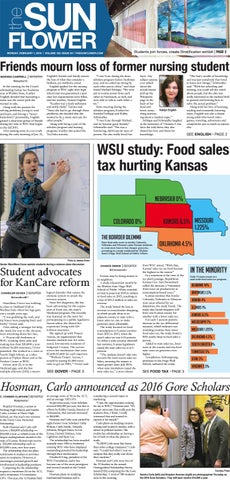
the
SUN FLOWER
MONDAY, FEBRUARY 1, 2016
VOLUME 120, ISSUE 39
Students join forces, create Stratification exhibit | PAGE 3
THESUNFLOWER.COM
Friends mourn loss of former nursing student REPORTER
MARISSA CAMPBELL
@soupitup13
In the running for the Dean’s scholarship before her freshman year at Wichita State, Kaitlyn English decided that becoming a nurse was the career path she wanted to take. Along with her passion for solving problems, loving to read and learn, and having a “neverback-down” personality, English gained a close-knit group of friends during her time at WSU that began in the fall 2011. After passing away in a car crash during the early morning of Jan. 21,
English’s friends and family mourn the loss of what they consider a brilliant, yet stubborn, mind. English applied for the nursing program at WSU right after high school and was guaranteed a spot once her requirements were filled, said her mother, Tammi English. “Kaitlyn was a fairly asthmatic and sickly child,” Tammi said. “Since she had to go through those problems, she decided that she wanted to be a nurse and care for other people.” Along with being a part of the scholars program and nursing program, Kaitlyn also joined the Tri-Delta sorority.
“I met Kate during the dean scholars program before freshman year, and we ended up sitting by each other pretty often,” said close friend Michael Schlapp. “We were put in rooms across from each other in Fairmount, as well, and were able to talk to each other a lot.” Since meeting during the scholars program, Kaitlyn befriended Schlapp and Bobby Schmeidler. “I met Kate through Michael, and we became great friends,” Schmeidler said. “She was a fun-loving, didn’t-say-no type of person. She also really loved fun
facts. Any subject anyone ever talked about she would always pull up the Wikipedia page in the back of her head and know some- Kaitlyn English thing interesting about a random topic.” Schlapp and Schmeidler laughed at the memories of Vitamin-A fun facts she told them; they also shared her love and thirst for knowledge.
“She had a wealth of knowledge and was just somebody that loved to learn new things,” Schmeidler said. “With her schooling and nursing, you could tell she cared about people, but she also was really interested in the medical field in general and learning how to solve the actual problem.” Along with her love of learning, reading and constantly knowing more, English was also a classic young adult who loved video games, traveling, adventures and competition just as much as anyone else.
SEE ENGLISH • PAGE 2
WSU study: Food sales tax hurting Kansas NEBRASKA 0% KANSAS 6.5% MISSOURI 1.225%
COLORADO 0% The boarder dilemma State food sales taxes in nearby Colorado, Nebraska and Missouri cause Kansas residents to cross state lines to buy cheaper groceries, according to a study conducted by Wichita State’s Hugo Wall School of Public Affairs.
OKLAHOMA 4.5%
Photo by Jessica Green
Senior Marcillene Dover assists students during a science class discussion.
Student advocates for KanCare reform CHANDLER OCHOA
REPORTER
@chandlerwilli11
Marcillene Dover was walking to class in Hubbard Hall at Wichita State when her legs gave out a couple years ago. “I was grabbing the wall, and my knees were popping back and forth,” Dover said. After asking a stranger for help, she made her way to the elevator, tears streaming down her face. A 19-year-old freshman at WSU, working three jobs and making less than $20,000 a year without health insurance, Dover panicked. She worked as a tutor at North High School, as a sales person at Payless Shoes and at the Heskett Center at WSU. Dover, now 21, is in the Medicaid gap, and she has multiple sclerosis (MS), a neuro-
logical disorder that causes the immune system to attack the nervous system. Since her diagnosis, she has been advocating for the expansion of KanCare, the state’s Medicaid program. She recently was featured on the news for participating in a public legislative forum where she shared her experience living with MS without insurance. She signed up with Project Access, an organization that donates medical care for uninsured, low-income residents of Sedgwick County. The service covers her medication that costs $2,000-$3,000 for each injection. “Without Project Access, I would be paying $1,500 every time to get an MRI, “ Dover said.
SEE DOVER • PAGE 3
CHANCE SWAIM
REPORTER
@chanceswaim
Kansas may be losing money to its neighbors. A study released last month by the Wichita State Hugo Wall School of Public Affairs concluded that Kansas lost $345.6 million in food sales in 2013, resulting in a loss of $21.2 million in sales tax revenue. The study linked the loss in revenue to cross-border shopping, in which people shop in an adjacent county or state with a lower sales tax rate to make groceries more affordable. The study focused on food consumption in Kansas counties from 2012 to 2013, when the state’s sales tax was 6.15 percent. To offset a state revenue shortfall last summer, Kansas legislators raised the state sales tax to 6.5 percent. “The analysis doesn’t take into account the most recent sales tax hikes, meaning the impact is much greater since July 2015, when state lawmakers raised the state sales tax,” a news release
from WSU stated. “With that, Kansas’ sales tax on food became the highest in the nation.” In a statement at the time of the tax plan’s passage, Republican Kansas Gov. Sam Brownback called the increase a “transition from taxes on productivity to consumption-based taxes.” Kansas counties that border Colorado, Nebraska or Missouri were most affected by tax disparities, the study found. The study also found shoppers will leave one Kansas county for another with a lower sales tax. For each 1 percent positive increase in the tax differential measure, which indicates surrounding counties have lower food sales tax, the study found a $101 yearly drop in food sales a person. Added to state sales tax, local taxes at the county and city-level raise taxes on groceries even higher. Arwiphawee Srithongrung, professor in the Hugo Wall School, authored the study.
SEE FOOD TAX • PAGE 3
In the Minority Only 13 states resort to a state-wide food sales tax program.
Alabama 14% Arkansas 1.5% Hawaii 4% Illinois 1% Kansas 6.5% Mississippi 7% Missouri 1.225% Oklahoma 4.5% South Dakota 4% Tennessee 5% Utah 3% Virginia 2.5%
Hosman, Carlo announced as 2016 Gore Scholars C. CONNER CLAPHAM REPORTER @clapdaddy1
Brayden Hosman, a senior at Sterling High School, and Sandra Carlo, a senior at Maize High School, are this year’s two winners in the Harry Gore Memorial Scholarship. Both Hosman and Carlo will receive a $60,000 scholarship — $15,000 a year — which is one of the largest undergraduate awards in the state of Kansas. Runner-ups receive a $52,000 scholarship each — $13,000 a year, over four years. The scholarship does not place restrictions in studies or activities upon its recipients. However, it encourages personal growth and involvement in leadership positions. Competing for the scholarship requires a minimum 24 on the ACT, and a minimum 3.5 cumulative GPA. This year, the 12 finalists held
an average score of 30 on the ACT, and an average 3.82 GPA. In previous years, Gore Scholars received $52,000 per year, but due to efforts by Bobby Gandu, director of Admissions, that amount increased to $60,000. Hosman and Carlo were picked by eight former Gore Scholars: Libby Wilson, Caleb Smith, Amanda Johnson, Reegan Innes, Kevin Kraus, Derrick Holmes, Amy Lightfoot and Ryan Lee. The scholarship has been awarded annually since 1954 to freshmen entering WSU who have displayed outstanding potential for leadership through their involvement. Elizabeth King, president of the WSU Foundation, said it has become one of the most prestigious and coveted awards in the United States. Hosman plans on studying international business and is
considering a second major in marketing. “I saw the opportunities waiting for me at WSU,” Hosman said. “It’s a great university that really puts the students first, I think. I really witnessed that and wanted to capture it for myself.” Carlo plans on studying creative writing and women’s studies, with a minor in political science. She credits her scholarship on having a lot of faith in what she plans to study. “It (WSU) felt more like home than other college campuses,” Carlo said. “I could feel when I was on campus that they really care about their students.” Hosman and Carlo were two of the 12 finalists in the annual Distinguished Scholarship Invitational (DSI) competing for the Gore Scholarship. A total of 380 students were in the running.
Courtesy Photo
Sandra Carlo (left) and Brayden Hosman (right) are photographed Thursday as the 2016 Gore Scholars. They will each receive $15,000 a year.
THE STAFF:
EDITORIAL
Editor-in-Chief Shelby Reynolds Managing Editor Danielle Prewitt
www.thesunflower.com
MONDAY, FEBRUARY 1
PAGE 2 | OPINION
STAFF EDITORIAL
Parking garage would alleviate frustrations
Multimedia Editor Jessica Green Sports Editor Evan Pflugradt Opinion Editor Alex Perry Special Sections Editor Chandler Ochoa Production Editor Jillian Clough Social Media Manager Chelsea Moore
ADVERTISING
Advertising Manager Jordan Becker Advertising Representatives Emily Maslow Landen Swearingen
BUSINESS / ADVISING Business Manager Robbie Norton Faculty Adviser Jessica Bertapelle
File Photo The Sunflower is published by student-employees on Monday and Thursday during the fall and spring semesters. During the summer session, the paper is printed once a month, with exceptions for holidays and finals. The Sunflower (published for use by WSU students, faculty and staff) is private property and unlawful removal or use of papers is prosecutable. One copy may be taken for free. Additional copies must be purchased for $1 each. The Sunflower is also partially funded by the Student Government Association at WSU. The opinions expressed in The Sunflower editorials, columns, guest columns, reviews, advertisements, letters, Yik Yak posts and editorial cartoons are not necessarily those of the staff, publications board, student body or university. The Sunflower reserves the right to edit or reject any submission. We also reserve the right to edit or reject any advertisement.
LETTERS TO THE EDITOR
Send letters to the editor to editor@ thesunflower.com. Please keep letters to 250 words or less. All letters are edited for clarity and length. Please include your name, WSU affiliation and a phone number or email address for verification purposes.
CONTACT THE SUNFLOWER: 019 Elliott Hall 1845 N. Fairmount Ave. Campus Box 134 Wichita, KS 67260-0134 ---------SUNFLOWER OFFICES Front Desk: 316-978-3640 Fax: 316-978-3778 ADVERTISING Jordan Becker: 316-978-6906 sunfloweradsales@gmail.com EDITORIAL Shelby Reynolds: 316-978-6905 editor@thesunflower.com BUSINESS Robbie Norton: 316-978-6900 robbie.norton@wichita.edu ADVISER Jessica Bertapelle: 316-978-6129 jessica.bertapelle@wichita.edu ---------ONLINE www.thesunflower.com FACEBOOK www.facebook.com/sunflowerwsu www.facebook.com/sunflowerads TWITTER @sunflowernews @sunflowersports @Sunflower_SGA INSTAGRAM @thesunflowernews CORRECTIONS A story in the Jan. 28 issue said that a project to renovate the Grandview Terrace Apartments is “not completing” the remodel. The story was supposed to read “is now.” We regret the error.
CLASSIFIEDS The Sunflower will not knowingly publish advertising that is false or misleading. If you have a question about an ad or a classified, call the Wichita Better Business Bureau at 316-263-3146.
Thinking Abortion? Alternatives: Free Testing 265-0134
More classifieds can be found online at www.thesunflower.com/classifieds. Be see in the classifieds by calling 316-978-6906.
@sunflowernews
If approved by the Kansas Board of Regents later this month, Wichita State plans to construct a multilevel parking garage south of the Rhatigan Student Center.
A
parking garage may finally be in Wichita State’s future. Students, faculty and staff have grumbled about finding a parking spot for years. The never-ending battle could be resolved in fall 2017 if the Kansas Board of Regents approve WSU’s request for the parking garage, which will be presented during a meeting later this month. The parking garage, if approved, would be constructed just south of the Rhatigan Student Center, and the entrance would face Perimeter Road, according to a news release from the university. The details about who would park there, how the permit system would work and how much it would cost are still to be determined. But it’s hope.
Hope for students who have to park far away from their building, but still pay $150 a year for a permit; hope for faculty who feel like they’re being overrun by students; and hope for visitors who are frustrated with not knowing where to go. It is the The Sunflower’s concern, though, that the parking garage will be unaffordable for the average student or faculty member. “Generally you pay more to park in a garage than in a surface lot,” said Lou Heldman, vice president of Strategic Communications at WSU. That makes perfect sense; a concrete slab on dirt is much cheaper to construct than a multilevel structure. So are students and faculty willing to pay a little extra to park closer? “I don’t think parking is an issue for me,” sophomore Chase
Government spending overhaul
My boyfriend recently competed with other members of COLUMN BY the College VICTORIA of EngineerHENDRICKS ing at Texas A&M in a competition sponsored by the private rocket company SpaceX to revolutionize the modes of travel and transportation. Known as the WSU Hypershocks, they were competing to design and build a pod that travels inside a transparent tube from one place to another. It reduces harmful emissions and time on the road monumentally. For example, it would only take 30 minutes to travel from Los Angeles to San Francisco, versus an hour-long plane or car ride. In lieu of this groundbreaking and significant historical event, it got me thinking about government spending, which I can imagine is a topic we all love debating. As we all know, it takes money to do stuff, and it takes a lot of money to do really important stuff. Investing in green energy, for example, initially takes a lot of money, but the results far outweigh the upfront cost. It ends up being worth it since we still have our lives and this planet in tact. It should come as no surprise that government spending is out of whack and in desperate need of re-evaluation. The energy and science sectors both make up only 1 percent of spending, according
ENGLISH
FROM PAGE 1
“She was a brutally honest person,” Schmeidler and Schlapp agreed. “She wasn’t mean, she just wouldn’t beat around the bush when it came to anything. She would say what was on her mind whether it was necessary or not, but we all appreciated her for it.” Laughing so hard they were hardly able to speak, Schmeidler and Schlapp
to Politifact.com, a fact-checking website. And education is no better, coming in at only 3 percent. Now, I am no fiscal expert, and finding reliable sources online is tough due to bias, but these are the numbers I found. And they’re problematic. I am not claiming that we take from any other part of the spending sectors such as healthcare and social security because those are equally important in their own ways. They are necessary and vital. And I am well aware that taking from one to solve another doesn’t solve anything. But I do know that something needs to change. Education is imperative for change and progression. Without it, we amount to nothing. And being in the state of Kansas under Brownback’s “leadership,” we have suffered immensely under his neglect toward education. Without education, there is no knowledge of science and the other STEM projects, which leads to my next point. NASA needs more money than they are currently getting. The state of our planet is in great peril, and it has become paramount that we colonize Mars so we may go on as a species. And besides, who doesn’t want to explore the stars? Perhaps, for starters, this could be achieved through taxing, and taxing the wealthy more. I don’t know about you, but I wouldn’t mind being taxed a little extra if that meant science stood a chance again. We’ll be dead without it.
reminisced about English’s favorite things. “What was her favorite food? Free,” Schlapp said, chuckling. “T-shirts: free,” Schmeidler said. “I think she bought two shirts at SGC (Screwattack Gaming Convention) — ” “Correction, I bought her those shirts,” Schlapp interrupted. Through the laughing, the two decided that although English loved many things, free things were her favorite. Between laughing and thinking
Sacket told The Sunflower in August. “It’s pretty easy to find a spot. I do, however, disagree with making students pay $150 for a pass. I already spend thousands a semester and that just adds to the frustration.” Perhaps to ease some of students’ financial need, the university should consider grants or scholarship funds for parking alone. Can’t afford a $150-plus parking permit? Apply for a parking scholarship. The same could be said for the university’s plans for a 400-bed residence hall on Innovation Campus, which was a recommendation from a 94-page study about students’ needs for housing based on an online survey. Based on the results, 81 percent of students were satisfied with their current living arrangements, and only 5 percent were
dissatisfied, whether it be dormitory- or apartment-living off campus. Meanwhile, 14 percent were neutral. According to the study, students would pay between $750 and $1,000 a month. Current Shocker Hall residents spend more than $800 a month, while the average student spends $533 on rent and utilities living off campus. If a new dorm is in the works for Innovation Campus, The Sunflower would also recommend an increase in housing scholarships. Otherwise, populating the new structure will be difficult if the majority of students are already satisfied with their current — and much cheaper — arrangements. For most students and faculty, a parking garage will be godsend, but only if they can afford it. — The Sunflower Editorial Board
Big choice for America’s youth with election looming Turn on the news today and you are guaranteed to hear something about COLUMN BY the presidenJOHN SMITH tial election. Despite being nearly a year out from the general election, speeches, rantsand debates pervade our television sets. It’s almost as if nothing else were even going on. We live in a critical time in our country. From terrorist attacks around the world, to the possibility of the next president appointing as many as three Supreme Court Justices, surely the future of our country is highly contingent upon this election. College students will have a big say as to the outcome of that election this year. According to the Huffington Post, there are more than 93 million millennials eligible to vote, and that makes up roughly 40 percent of the voting population. Imagine, with a demographical control such as this, our voice could be heard at a level never before heard. In 2012, roughly 130 million people cast their votes in the general election. Now, the millennial population equals more than 70 percent of this vote. Large voter turnout should not simply be a pipedream, but an obligation for all of us.
Thankfully, it seems that millennials are making their voices heard in this election cycle, evidenced by the candidates who have risen to the forefront just shy of today’s Iowa Caucus. A survey of 18 to 29 year olds by the Harvard Institute of Politics found that young people who expect to vote in Democratic primaries and caucuses, 35 percent said their first choice was the frontrunner, Hillary Clinton, while 41 percent favored her challenger, Bernie Sanders. Among likely Republican voters, the top candidates were Donald Trump, the first choice for 22 percent, and Ben Carson at 20 percent. Overall polls show that millennials’ opinions are making an impact. Much work remains to be done. I feel that many potential voters get burned out on the whole election process due to the endless hours of coverage from news outlets. It’s important to not let reports of the drab and inconsequential to overshadow the importance of what’s looming. The Kansas caucus is roughly a month away for Republicans and Democrats. The first opportunity for Kansas millennials to make their voices heard is upon us. Whether this is your first opportunity to cast your vote, or your seventh, don’t let this opportunity to make a difference pass by.
of all the memories, the two recalled the trips and adventures they took with English. From going to Texas, Sedona and the Screwattack Gaming Convention, the three friends shared many new experiences and adventures together. “Kate was just loved greatly by all of us,” Schmeidler said. “Everyone thinks their friends get annoying sometimes, and she did act like a goddess sometimes — in fact, I think referring to her as a ‘goddess’ would make her so happy —
but she was such a loved individual.” As Schmeidler and Schlapp finished each other’s sentences through the memories they have of English, one idea they never failed to agree on was how loved she truly was. “She was a good person,” Schmeidler said. “She was honest and she didn’t judge you for who you are, and she had friends who loved her. We didn’t just like her, we loved her. She meant a lot to each of us, and to some, the world.”
MONDAY, FEBRUARY 1
www.thesunflower.com
Fairmount neighborhood brainstorms ways to improve perception, reality of safety CHELSEA MOORE
REPORTER
@chelslalamoore
Community members and Wichita area and university leaders gathered for a conversation Thursday about the perception and reality of safety in the Fairmount neighborhood just south of Wichita State. After brief introductions of leaders in the neighborhood, Wichita Police officer Chat Burnett gave a presentation on the current state of the neighborhood according to crime statistics. “If you want to compare,” Burnett said in his presentation, “Fairmount is gobs ahead of every other community in the area.” In 2015, in comparison to the other neighborhoods surrounding Wichita State, Fairmount recorded less than half of the reported crimes than the other four surrounding neighborhoods. There were zero reported homicides, three reported rapes and three reported robberies. “You have a safe neighborhood,” said Gavin Seller, interim deputy chief with the WPD. “You should be proud of that.” Although the numbers in Burnett’s presentation suggest the neighborhood is safer than the surrounding neighborhoods, leaders within the neighborhood were still concerned that students perceive the area to be unsafe. “Trust is a huge issue when it comes to perception,” Burnett said. “One of the best things I can tell is … don’t be scared to get out. Have cookouts, picnics, let your kids go play in the park. “Don’t be sheltered in your houses, because that is where criminal activity will thrive. The way to prevent a lot of criminal activity is by getting out and doing stuff.” Burnett said he gives an updated version of the same crime statistics every month at the Fairmount Neighborhood Association
FOOD TAX FROM PAGE 1
“Setting a state’s sales tax rate above a certain level can cause local governments to lose their competitiveness in economic development,” Srithongrung said. “Which, in turn, defeats the state’s purposes in cutting income taxes for growth.” In 2013, more than 300,000 business owners and farmers paid no income taxes in Kansas. “Sales tax rates that are set beyond the level of its neighbors
DOVER
FROM PAGE 1 Even while on medication, Dover never knows when the symptoms of numbness, trouble walking, fatigue and slurring words could flare up. She takes MRIs when she needs them. By the end of the day, her right leg drags, which causes her to trip. “I feel like I don’t have time for myself or I just want to sleep because
Photo by Jessica Green
Interim deputy chief Gavin Seiler talks to Fairmount residents Thursday about ways to increase safety in the neighborhood south of Wichita State.
PAGE 3 | NEWS
Stratification leads to collaboration MARISSA CAMPBELL
REPORTER
@soupitup13
The word “stratification” means a process by which materials form or are deposited into layers. A collaboration of six artists — including a Wichita State professor and many alumnus — took that idea to heart and created a series of artworks now on display at the WSU-owned SHIFTSPACE gallery in the 400 block of Commerce Street in downtown Wichita. Stratification will be on display until Feb. 13. About 800 vistors saw the art during the Final Friday gallery crawl this weekend. In this fourth installment curated by SHIFTSPACE manager Lisa Rundstrom and Creative Rush founder Kylie Brown, the artists took the challenge of creating artwork that explores insight into humanity through a shared artistic journey. “This idea originated when I was trying to break down my own creative process,” Brown said. “I was trying to figure out how I organize myself so I created six or seven layers that I deal with when trying to come up with an idea. When I broke them down, I was trying to figure out what would match that.” After creating a list of artists that would fit with the concept, the idea was pitched to Rundstrom and they decided which artists would best realize the aesthetic idea. “If you look at a composers score, there are maybe 20 lines, and every note has their own individual lines,” Brown said. “As a whole, it looks beautiful, but it looks chaotic to somebody who doesn’t understand. That is what I was trying to replicate in this gallery.” Although Brown did not necessarily specify the “look” the gallery needed, she said the concept was crafted by the six artists, who together created a gallery that flowed through her “layers” as she had planned. Tim Allen, artist and life drawing professor at WSU, is one of the artists in the series.
Photo Coutesy of Rick McPherson
Visitors of the Stratification exibit view collaborated pieces by several WSU students Friday.
meeting. Later, those in attendance were divided into groups to discuss three things: what they believe is working in the neighborhood to make them feel safe, what is happening in the neighborhood that makes them feel unsafe, and what can be done to improve safety. What’s going well Residents of the neighborhood agreed the current state of officer involvement within the Fairmount neighborhood was working and making them feel safe. They were also pleased by the increase in community meetings and some improved lighting. Another item of comfort to the neighborhood was the blue light boxes that have spread from the WSU campus into the Fairmount neighborhood. The presence of the WSU shuttle has also helped to improve the safety of the neighborhood, they say. What’s still unsafe Although the group was able to find some improvement in the neighborhood, they were still able to find some critiques to share. Among these, lighting was most discussed. Some of the lighting in public
areas of the neighborhood has been switched to LED, which provides a larger amount of light, but not all the lights have been adapted. Others voiced concerns about loitering in empty lots, sidewalks in poor condition and a poor connection with WSU. Ways to improve After finding the neighborhood’s faults, Misty Bruckner, director of Public Policy and Management Center at WSU, asked the group for suggestions on how to improve the neighborhood. Many suggestions were made, but they all fell into the same category: community visibility. There were many ideas on how to accomplish a louder voice and better visibility among the community. These included repairs to the park, neighborhood block parties and an expansion to the community garden. A parade was also briefly discussed. In the end, Bruckner and other community leaders said they had some great leads for where to move next. “There is a commitment,” Bruckner said while cleaning up the community building Thursday, “to be involved from the people here. That [was] a huge start.”
can cause inefficiency in the free market and taxing systems,” she said. “This is the main focus of this study.” Kansas is one of only seven states that charge a sales tax on food, and all four of its bordering states offer lower taxes on groceries. Colorado and Nebraska exempt all food sales from taxation, while Missouri’s rate is only 1.225 percent. Oklahoma’s food sales tax rate is 4.5 percent. KC Healthy Kids, a nonpartisan, nonprofit organization that commissioned the study, thinks the
findings of the study are cause for concern, especially for low-income households. “This may cause a substitution effect toward lower-priced convenience foods, as it is often pointed out that these convenience foods are often cheaper than fresh foods,” the organization said in a separate study. Meaning, when given the choice between cheaper, less nutritious foods and more expensive options like fresh fruits, vegetables and meat, people will choose based on price instead of nutrition.
Representatives from KC Healthy Kids worry the substitution effect may lead to higher rates of obesity and poor health, and the food taxes place a higher tax burden on low-income families. The second study conducted by the Hugo Wall School and commissioned by KC Healthy Kids found the less income a family made, the higher percentage of their income was paid in taxes. For example, a family of three living in a metropolitan area with an income greater than $150,000 a year spends under 0.2 percent of its
household income on grocery taxes. For a family with an income of less than $10,000, the tax burden climbs to 5 percent of household income, the study found. Ashley Jones-Wisner, state policy manager for KC Healthy Kids, said the findings indicate disadvantages for people of all income levels. “For Kansans living near the border, it pays to leave their state to buy food,” Jones-Wisner said. “We want lawmakers to exempt groceries from the state sales tax and keep shoppers and their money in Kansas.”
another symptom of MS is fatigue,” Dover said. Disability Services works to help students like Dover who have trouble walking to class. “We have golf carts ... to transport students around campus,” said Grady Landrum, director of Disability Services at WSU. “We would be able to pick her up at the parking lot and then give her a ride to the building where her classes are.” She has had to give up walking
dogs for the Humane Society, running at the Heskett Center or anything that involves a lot of walking. “I used to workout at the Heskett Center all the time, and once I fell off the treadmill I realized I shouldn’t be doing this anymore,” Dover said. Dover grew up poor and learned from an early age that if she needed something, she would have to do it herself. Earning her way through college
with financial aid and scholarships as a dean’s scholar, Dover is familiar with working hard to achieve success. Dover, now a student teacher at East High School, will graduate in May from WSU, and she hopes to work as a physics teacher at North High School where she went to school. “She was always willing to help anyone who needed tutoring in any subjects,” said Kimberly Hewitt, North High’s 2012 class sponsor. “She has a very giving heart and she always wants to help the underdog, and now she is the underdog.” But Dover does not act like an underdog. She continues to advocate for herself and others despite the daily battle with people who don’t understand.
She looks past the confused, confrontational stares she gets for using a handicapped decal or because she walks funny. “MS is one of those diseases that is not on TV or anything, and people don’t understand anything about it,” Dover said. She eventually wants to continue her education and earn a master’s degree in education and make a difference in her students’ lives. “If you don’t advocate for yourself, nobody is going to do it for you,” Dover said. Rides from Disability Services are available from 7 a.m. to 6 p.m. Monday through Thursday and 7 a.m. to 5 p.m. Friday. Contact the office at 978-3309. It is located in Room 150 in the Grace Wilkie Annex.
“I feel like this gallery was sort of an experiment to see how our art would be able to come together and how it clashed,” Allen said. “My work consists of paintings on canvas and a new experimental process of painting on masking tape on the canvas and then taking it off and installing it. By doing this, it gets rid of the object and focuses more on the illusion.” “Stratification” consists of different styles that blend and mesh paintings, drawings and yarn work, just as Brown hoped. “It’s great to see everyone viewing these artists’ work and reacting to it,” Brown said. “It’s nice to see the community being involved in a unique and interesting creative process and for the community to feel a part of the process.” WSU students and faculty stopped by to view the work. “This was my first time coming to SHIFTSPACE,” said Johnny Vu, an art education major. “I liked the intimate, avante garde style of the gallery because it is unusual and seemed to be pushing the boundaries of what one might normally view.”
ELECTRONIC CIGARETTES
MON-FRI 10-9pm SATURDAY 10-7pm SUNDAY 1-5pm KITS • MODS •E-HOOKAHS TANKS • E-LIQUID ACCESSORIES • BATTERIES
MONDAY, FEBRUARY 1
PAGE 4 | SPORTS
www.thesunflower.com
Bears end Shockers’ two-game Wichita State survives defensive battle, VanVleet win streak in weekend loss NICK BEACH
leads with career night
REPORTER
@nickbeach1
Battling down against a less than proficient defensive quarter, the women’s basketball team couldn’t find the spark they needed offensively to stretch a victory over the conference-leading Missouri State Bears on Saturday. Missouri State handed the Shockers their seventh conference loss of the season, 77-57. “(Missouri State) knows how to win games,” said Wichita State head coach Jody Adams. “They play with an aggressive style. They run off their leaders.” Faltering to an early double-digit deficit, the Shockers were challenged to find baskets to keep the pace with the Bears. A defensive stop by the Shockers led to a rebound by freshman Ellie Lehne. The freshman forward handed the ball off to junior Taquandra Mike, who raced down the court, crossing a defender. With the game clock ticking down, Mike wrapped the ball behind her back, and as the defense collapsed, she passed to an open Aundra Stovall in the corner. Stovall laid up a buzzer-beating three-point basket that hit the bottom of the net. The team rallied down a 17-point deficit to enter the fourth quarter trailing by 12 points. Despite challenged efforts in the paint, the Shockers were never able to fully capitalize when the score got closer. The Shockers gave up 24 turnovers. “Turnovers are never good for us,” Mike said. “It’s fixable. When we get in games sometimes we freak out. We need to learn how to slow it down.” After a sluggish start in the first half, the Shockers fell behind quickly. They surrendered a double-digit lead to the Bears in only six minutes of play. The team looked to relish the spirit that harvested back-to-back conference victories a week earlier. With a never-give-up mentality preached by Adams, junior Jaleesa Chapel reeled in a loose-ball on an inbound pass and marched down open court for a layup, bringing
EVAN PFLUGRADT
SPORTS EDITOR
Photo by Manny De Los Santos
Women’s basketball head coach Jody Adams directs her players Saturday at Charles Koch Arena during the Missouri State game. The Shockers fell to Missouri State 77-57.
the team to within two points. It was enough to keep the Shockers in the game briefly. The Shockers hung around with the Bears for the remainder of the first half, but their efforts were never enough to take the lead or build any string of momentum. The third quarter was a story of post-play Adams’s group couldn’t match. Unsuccessful defensive efforts piled up one-by-one. Four Bears finished the game with double-digit scoring. The veteran opponent showed their experience. The Bears capitalized on defensive efforts and posted 30 points on 24 turnovers. It’s a lesson Adams hopes her group can pick up sooner rather than later. “We didn’t take advantage of our turnovers,” Adams said. “It shows me insufficient shot selection. We’re not connecting on those turnovers.” Saturday’s game was alumni night; the arena recognized the program’s previous players on the court during halftime. Despite a halftime deficit, it created new motivation for Shockers trying to shine in their own light. “I think in my mind, what helped me was seeing the alumni here,” Chapel said. “Knowing the work they put in before our time, it
motivated me.” Though Adams battled with the frustrations of a young team, a positive spark is brewing in the guard duo of Chapel and Mike. The duo showed consistency with the ball in their hands that gave the team a veteran presence they’ve been searching for since November. Chapel kicked things off with hot shooting. The junior guard didn’t miss in the first half and carried the momentum through the second-half to garner 12 points. She was six for nine from the field. “We all battled, but it was [Chapel’s] best game today,” Adams said. “Both offensively and defensively.” Taquandra and Mike drew attention from the defense and pushed the ball to her teammates for a team-high five assists to coincide with her 18 points and eight rebounds performance, leading her team in all three categories. Though carrying seven losses in their conference record, the season is all but an afterthought in a storyline of a book Adams cannot wait to close. But with veterans blooming, things are looking up. The Shockers go on the road to take on Drake at 7 p.m. Friday.
INFORMING VOTERS GET INSPIRED
Discover just how much your vote counts. New location and topic, 2nd Tuesday of every month. 5:30 - 8:00 pm The Monarch 579 W Douglas FIND OUT MORE
EngageICT.org
February Topic: Education Learn about student loans and debt, common core legislation, and why you should care.
@evpflu
Nearly a month ago, Evansville’s D.J. Balentine raced down the court with six seconds left in the game, a desperation three-point shot would send his team to overtime in Charles Koch Arena. He traveled at midcourt. The nation’s active leading scorer, Balentine was held without a made field goal for the first 25 minutes of play Sunday; No. 22 Wichita State swept Evansville 78-65. Balentine haltered in a senior campaign worthy of conference Player of the Year, but All-American point guard Fred VanVleet had a notable reminder to the candidate trying to claim his first title — he won it first. VanVleet was named MVC Player of the Year in 2014. With the game tied 10-10, VanVleet looked to challenge driving baseline on Evansville guard Mislav Brzoja. Trying to draw contact, VanVleet’s shot fell off the mark. Though VanVleet knew the accolades that he’s piled up time and time again have not been the result of settling. VanVleet challenged on the next possession. Splitting defenders, he tossed in a layup for his first points of the game. “I know the coaches get frustrated with [my shot selection] sometimes,” VanVleet said. “ I stayed focused on driving to the rim. Sometimes I come up empty-handed, but I keep doing what I do.” An Evan Wessel three-pointer festered a five-point WSU lead and the game started to take the shape of a traditional Gregg Marshall win. Evansville center Egidijus Mockevicius, the nation’s leading rebounder and the Valley’s leading shot-blocker, reached high into the air for a ball only the 6-foot-10 big man could pull down; he raised for a three-point-play pulling the Aces back in close. Gregg Marshall’s All-American backcourt was not impressed. VanVleet drove baseline to end a
two minute scoring drought. On the other end, Ron Baker blocked Mockevicius’ shot out of bounds. Despite a challenged half of foul trouble, the Shockers covered one of the Valley’s top offensive threats; they pressured the Purple Aces with a season-high nine blocks, eight coming in the first half. With an 11-point halftime lead Gregg Marshall had feelings of slight insecurity. His team entered the half on a 17 percent three-point percentage, a lone three-pointer by Evan Wessel tallied on the stat-sheet. After holding the conference’s leading scorer without a made basket through a half, Marshall knew things wouldn’t last; he called for his team to up the offensive intensity. It’s almost as if the words were spoken directly into VanVleet’s listening ear. VanVleet split the Purple Aces’ defense and rallied five-consecutive points, pushing a 16 point spread in favor of the Shockers. VanVleet continued to lead the charge, challenging in the paint the Purple Aces made him earn it at the charity stripe. He could not miss. VanVleet was perfect on all 15 attempts from the stripe, tying a school record. “I felt like I should’ve had 25 attempts,” said VanVleet after countless challenged shots. “I just try to stay calm and get to the line.” Knocking down two free-throws with a little over a minute to play VanVleet tied his career-high of 26 points. With two more free throws a possession later, he beat it. VanVleet wasn’t finished leaving his mark on Evansville. With under a minute left in play he pulled the ball out of Balentine’s hands and raced down for a layup — 30 points. And with a final opportunity, VanVleet broke the defense, ultimately ending the game with another driving layup — 32 points — breaking his career-high set not but a few weeks ago. “This is a special opportunity,” said VanVleet.
The Sunflower’s Missouri Valley Conference mid-season awards It’s early February and the conference season in the Missouri Valley has climbed over it’s peak to see the other side. In a conference stifled by COLUMN BY growing competition, EVAN PFLUGRADT league play has led to success from talented outliers stepping ahead of the rest. With half the conference season now in the rear-view mirror, let’s take a look at naming conference awards. Player of the year Player: Fred VanVleet (Wichita State, guard) In stiff competition, the senior All-American guard has proven time and time again his value. Leading the conference in assist-to-turnover ratio and rallying his team to 11-straight victories and a 14-1 record since his return in early December, he is poised for his best season in history. His quick hands on defense have pressured an average of more than two steals per game and on the offensive end he’s shooting 45 percent from threepoint range. VanVleet brings out the best in his teammates, and while he doesn’t need the numbers to show it every game, he’s the added “X factor” driving Wichita State to the top of the conference. Runner-up: D.J. Balentine (Evansville, guard) Coach of the year Coach: Marty Simmons (Evansville) Simmons has struck gold in senior D.J Balentine. Balentine will likely leave the Purple Aces as the program’s all-time leading scorer. Standing in the top-tier in the conference standings the Purple Aces have certainly gone the distance, an overtime victory against Southern Illinois and pressing WSU to their tightest competition of the season. While Balentine has been a gracious gift for the program, things can’t go unnoticed of Simmons’s development of Egidijus Mockevicius and Mislav Brojza. Runner-up: Barry Hinson (Southern Illinois) Rookie of the year Player: Markis McDuffie (Wichita State, forward) McDuffie has the luxury of playing in good company. With veteran All-Americans leading the charge, he hasn’t been taxed to the same degree that freshman Ronnie Suggs has faced trying to carry the load for Bradley. McDuffie has certainly held his own in every
facet. The freshman has been challenged with defending the conference’s best scorers and his numbers have proven better. McDuffie averages nine points and three rebounds per game. Runner-up: Ronnie Suggs (Bradley, guard) Sixth-man of the year Player: Markis McDuffie (Wichita State, forward) McDuffie hasn’t done much wrong. The freshman has capitalized on the offensive end, standing as the team’s third leading scorer, something not easily done when pressuring the top competitors in the league on defense. A lock-down defender and a prolific scorer, McDuffie was made for the big moment. McDuffie averages nine points in 18 minutes per game off the bench. The freshman holds a shooting percentage nearing 50 percent; his career-high of 16 points came against Missouri State on 8-9 shooting. Runner-up: Mislav Brzoja (Evansville, guard) Most improved player Player: Shaq Morris (Wichita State, forward) Morris started the season a foul-prone and unconditioned defender. Sitting behind senior transfer Anton Grady in the rotation, Morris’s progress looked to be another slow and steady journey. In the time since, Morris challenged critics and transformed into Wichita State’s starting center. Posting double-digit numbers on offense the sophomore is on a mission to prove his worth. Morris has broken down the post-play on offense and challenged the league’s best scorers with active hands on the block and tenacity off the glass. Runner-up: Brenton Scott (Indiana State, guard) Defensive player of the year Player: Egidijus Mockevicius (Evansville, forward) Mockevicius leads the conference in blocks, averaging more than one block more than the next challenger. Mockevicius leads not only the Valley but also the entire NCAA in rebounds (14.2.) His numbers on the glass nearly double the next best competition, in rebounds and blocks he’s unmatched. Runner-up: Fred VanVleet (Wichita State, guard) — Contributing: Jessica Green, Nick Beach and Joshua Duncan of The Sunflower