The student newspaper of Stevens Institute of Technology, and creator of Attila the Duck. www.thestute.com TikTok @thestute Instagram @thestute facebook.com/stevensthestute
Welcome Back Ducks!
We write Stevens history HOBOKEN, NJ | SEPTEMBER 11, 2026
VOLUME CXXIII No. 01
NEW STUTE EVERY FRIDAY • EST. 1904
Davis Hall demolition approved
Change to eighteen credit max
BY ALESSANDRA ZULUETA NIETO, STAFF WRITER
BY KATHERINE GARCIA, CONTRIBUTOR
A change to the Hoboken skyline is on the horizon. On June 9, the Hoboken Planning Board reviewed and approved plans for the demolition of Davis Hall. While the upcoming change to campus has been waiting in the wings for about two years, this approval brings the longplanned project a step closer to becoming reality. Plans to replace Davis Hall were first revealed in 2024, with the new building designed by Davis Brody Bond, an architectural firm headquartered in New York City. The 238,000-squarefoot building will combine academic, research, and residential spaces. The first three floors will house offices, classrooms, and teaching laboratories. Floors four through six will have dry laboratories, research rooms, additional offices, and study spaces. Floors seven through thirteen will serve as student housing, holding 457 beds. This will give Stevens a net increase of 245 beds. Current plans also include a green roof deck along Wittpenn Walk and a solar canopy atop the building. Davis currently serves as a residence hall, but the
SEE DAVIS PAGE 2
SAMUEL STRASSBURGER FOR THE STUTE
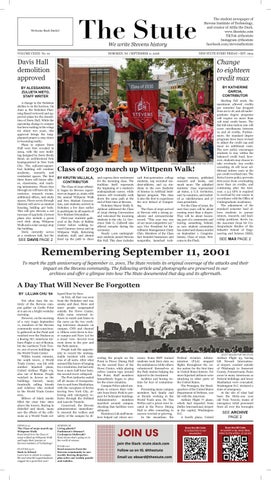
Class of 2030 march up Wittpenn Walk! BY KRUTIN VALLALA, CONTRIBUTOR The Class of 2030 officially began its Stevens experience on August 31, 2026, with the annual Wittpenn Walk and New Student Convocation, and students arrived in Hoboken a few days earlier to participate in all aspects of New Student Orientation. First-year students gathered at the Patio of Babbio Center before walking toward Canavan Arena and up Wittpenn Walk. Returning students, staff, and alumni lined up the path to cheer
and express their excitement for the incoming class. The tradition itself represents the beginning of a student’s undergraduate career, while seniors will eventually walk down the same path at the end of their time at Stevens. Hoboken Mayor Emily B. Jabbour addressed the Class of 2030 during Convocation and welcomed the incoming students to the city. Lt. Governor Dale G. Caldwell also offered remarks during the ceremony. Nearly 1,100 undergraduate students joined Stevens this Fall. This class includes
248 first-generation college students, 193 recruited student-athletes, and 23 students in the new Bachelor of Science in Artificial Intelligence program. This class is also the first to experience the new School of Computing. The Class of 2030 arrived at Stevens with a strong academic and extracurricular record. “This year was one of our most competitive yet,” says Vice President for Enrollment Management Cindy Chin. Members of the Class had founded businesses and nonprofits, launched tech-
nology ventures, published research and books, and much more. The admitted students’ class represented 46 states, 5 U.S. territories, and 74 countries, and included 41 valedictorians and 57 class presidents. For the Class of 2030, the next four years will be about earning more than a degree. They will be about becoming part of a community and leaving something behind, as new student orientation has ended and classes started on September 1. Congratulations, Class of 2030. Welcome to the Flock.
Starting Fall 2026, the maximum allowed credits per semester has dropped from 20 to 18, and all undergraduate degree programs will require no more than 128 total credit hours. The flat full-time tuition rate will cover enrollments between 12 and 18 credits. Furthermore, the standard degree programs have been revised to adjust the credit cap and incur no additional costs. The new policy encourages students to stay within the balanced credit load; however, students may choose to take overloads. Any credits exceeding 18 will incur additional tuition costs at the per-credit overload rate. The Extra Course policy prevents first-years from overloading more than 20 credits, and continuing after the firstyear, a 3.3 GPA is required to overload by one course in accordance with the Office of Undergraduate Academics. The adjustment of the standard semester load allows students to pursue minors, research, and leadership positions. Kevin Lu, the Associate Dean for Undergraduate Studies of the Schaefer School of Engineering and Science (SES),
SEE MAX PAGE 2
Remembering September 11, 2001 To mark the 25th anniversary of September 11, 2001, The Stute revisits its original coverage of the attacks and their impact on the Stevens community. The following article and photographs are preserved in our archives and offer a glimpse into how The Stute documented that day and its aftermath.
A Day That Will Never Be Forgotten BY LILLIAN CHU ‘04 Not often does the entirety of the Stevens campus gather on Castle Point at 9 am on a bright weekday morning. However, on the morning of a very tragic September 11, members of the Stevens community semi-consciously gathered on the Point and watched over the Hudson as a Boeing 767, American Airlines Flight 11 out of Boston, hit the northern Twin Tower, one of seven buildings in the World Trade Center. Within twenty minutes, the south tower, 2 World Trade Center, was hit with another hijacked plane, United Airlines Flight 175, also out of Boston. People watched in horror as the buildings burned, many frantically calling friends and relatives who worked in the World Trade Center area. Billows of black smoke filled the clear blue skies above the towers. Staring in disbelief and shock, many saw the effects of the collisions as 2 World Trade col-
lapsed floor by floor. At first, all that was seen from the Hoboken end was smoke and dust. More and more people congregated outside the Howe Center, while some returned indoors to watch and listen to the news on the two working television channels on campus, CNN and channel 2. Others went down to lower campus and Navy Lot for a closer view. Several even went down to the pier and the Path station. People took the opportunity to record the unimaginable incident with cameras of all sorts. After what seemed like hours of longing for a resolution, but had only been a mere half hour later, the second tower collapsed. The Port Authority sealed off all means of transportation to and from Manhattan, with the exception of ferries leaving New York City, allowing only emergency vehicles through the Holland and Lincoln Tunnels. Concerned, the Stevens administration immediately ensured the welfare and safety of the campus by di-
NEWS (2-4)
SCIENCE (8)
The Class of 2030 march up Wittpenn Walk Read about how the Class of 2030 walked up Wittpenn Walk and begin their journey at Stevens Institute of Technology! FEATURE (5-6)
Back to School Learn how to adjust to campus life and what the upperclassmen suggest for a great first year!
Living plastic? Parkinson’s Disease? Cyclospora Outbreak? Read about what’s going on in the world of science. PULSE (10)
Read answers from the Stevens community to our weekly Roving Reporter, plus solve our weekly puzzle and sudoku.
recting the people on the Point to Pierce Dining Hall on the second floor of the Howe Center, while placing yellow caution tape around the Point. Staff members immediately began to plan for the crises situation. Campus Police asked students to remove their vehicles from Davis Field to prepare for helicopter landings. Administrative members marched around campus, checking that facilities were adequate. Residence Life staff members helped out where nec-
essary. Some EMT trained students took their duty on the ambulances while others volunteered themselves at the Path station helping the injured to the treatment facilities and hosing victims for fear of contamination. Presuming many campus members had family and or friends working in the World Trade area, Dr. Tim Welles and a priest were located in the Pierce Dining Hall to offer counseling to anyone worried or grieving. In the meantime, the
Federal Aviation Administration (FAA) stopped flights throughout the entire nation for the first time in United States history. Yet more hijacked airliners were attacking in other parts of the United States. The Pentagon, the Headquarters of the United States Department of Defense, was hit with the American Airlines Flight 77 plane, which had departed from Dulles International Airport in the capital, Washington D.C. A fourth plane, United
SCOTT MOLSKI FOR THE STUTE
Airlines Flight 93, having left Newark International Airport, crashed outside of Pittsburgh in Somerset County, Pennsylvania. Panic arose in many Americans as Federal buildings and lower Manhattan were evacuated. Washington D.C. declared a state of emergency. At the site of what had been the thirty-one year old Twin Towers, teams of emergency relief personnel from all over the boroughs
SEE ARCHIVE PAGE 2
Friday, September 11
2
News Masthead Volume CXXIII No. 1 Executive Board
EDITOR-IN-CHIEF.............................JIYA JAISINGHANI ‘27 BUSINESS MANAGER.......................CAMRYN WINANT ‘28 MANAGING EDITOR.................................TIANNA SPITZ ‘27 LAYOUT EDITOR.......................................CLAIRE DEANS ‘29 OUTREACH CHAIR................................ISABELLA FAMA ‘29 DIGITAL MANAGER.........................CHARMY KOTADIA ‘27 SECRETARY.....................................JOSEPHINE CHOONG ‘28
DAVIS
CONTINUED FROM PAGE 1
new building’s plans expand how the area will be used. Alongside increasing student housing capacity, the addition of teaching and research spaces will make the site both an academic and residential area of campus. The project was made possible in part by a change in Hoboken zoning
regulations adopted back in 2018. The rezoning has already played a role in changing the skyline, allowing for the construction of the UCC Towers, which opened to students back in 2022. The Edge Sub-Area, tracing from Howe Center to Fifth Street along the edge of Sinatra Drive, was made to accommodate the construction of buildings up to 160 feet in height, with the exception of the taller UCC towers. The new Davis Hall replacement will
continue the transformation of this zone, making for another substantial addition to campus. While an exact date for the demolition of Davis Hall hasn’t been announced as of yet, The Stute previously reported that Stevens intends to complete the replacement of Davis by 2032. Until a construction timeline is officially given, it remains unclear when students can expect to see Davis Hall come down.
Editorial Board NEWS EDITOR...................................JOSH BODENSTEIN ‘29 SCIENCE EDITOR.......................................DISHA GOHIL ‘28 OPINION EDITOR....................VEDHESH A. KAMARAJ ‘28 SPORTS EDITOR..........................MILAGROS CARBAJAL ‘28 FEATURES EDITOR ...........................PRISHA VAGVALA ‘28 HEAD COPYEDITOR................................KAILEY SUPAN ‘29
Operations Board
HEAD PHOTOGRAPHER.................BRADY SANSOTTA ‘29 ASST. SOCIAL MEDIA...............................CHRISTINE YI ‘29 DELIVERY BOY....................................MARTIN MURIITHI’28
Staff & Contributors Krutin Vallala Alessandra Z. Nieto Katherina Garcia Ashley Elias Flores Kannon Peters Srikar Velam Nehemiah Liciaga Jeylan Jubran Isabella Marques Ryan Levinter Shri Saranya
Sean Palermo Chris Kalish Riyana Phadke Sydney Leung Chrystiella Mensah Wesley Yu Breona Pizzuta Alessandra Chavez Viktor Palmer Gavin Ruby Jack Dietrich Tanya Zanes Rachel Choi Dominic Souza
Contact Us
GENERAL.........................................EBOARD@THESTUTE.COM EDITOR-IN-CHIEF.........................EDITOR@THESTUTE.COM ADVERTISING.............................BUSINESS@THESTUTE.COM OFFICE.................................UNIVERSITY CENTER ROOM 216B
Corrections NOTICE A MISTAKE? Email us at eboard@thestute.com.
Disclaimer
All opinions and editorials reflect the views of their respective author(s). No Part of The Stute may be reproduced in any form, in whole or in part, without the written consent of the Editor-in-Chief. Cited references of The Stute are permitted.
Policy on Letters to the Editor
All members of the Stevens community are able to submit a Letter to the Editor to be published in The Stute. Letters must refer either to a piece published in The Stute or to The Stute in general and must be between 400 – 800 words in length. Submit letters to editor@thestute.com with your name and title (when applicable) or using our Google form. For writers who wish to write a Letter to the Editor anonymously, please see our policy on anonymity. The Editorial Board reserves the right to choose whether or not to publish a submitted Letter to the Editor based on a majority rule vote, and additionally reserves the right to edit letters for clarity or request authors to revise. Provided that the author approves the final version, The Stute reserves the right to edit letters according to our copy editing procedures, defined in our policies.
Policy on Op-Eds
All members of the Stevens community are able to submit a standalone opinion piece (otherwise known as an Op-Ed) to be published in The Stute. Op-Eds must be between 400 – 800 words, but longer submissions will be considered on a case-by-case basis. To submit an OpEd please email eboard@thestute.com with your name and title (when applicable) or using our Google form (tinyurl.com/submit-t0-stute). For writers who wish to write an Op-Ed anonymously, please see our policy on anonymity. The Editorial Board reserves the right to choose whether or not to publish a submitted Op-Ed based on a majority rule vote, and additionally reserves the right to edit Op-Eds for clarity or request authors to revise. Provided that the author approves the final version, The Stute reserves the right to edit Op-Eds according to our copy editing procedures, defined in our policies.
FULL LIST ON thestute.com/policies
MAX
CONTINUED FROM PAGE 1 has explained that “We want our students to also learn outside the classroom, and that is a very strong vision.” To add on, Stevens is enhancing the student experience by prioritizing and focusing on quality. According to the Office of the Provost, the change will provide greater flexibility, improve well-being, and increase campus engagement. Moreover, Stevens remains committed to a rigorous education and will continue to meet essential competencies. “So, it’s not a single instructor. Usually there are multiple instructors because, for example, all the engineers need to take those courses. The courses are carefully designed, and we have to document the process for accreditation purposes,” Lu clarifies. On the other hand, the Student Government Association (SGA) proposed a petition that was established to reinstate the ability to take 20 credits per semester, to
ARCHIVE
CONTINUED FROM PAGE 1
and nearby New Jersey flocked to the aftermath of the scene to help the rescue effort. By 4 pm on Tuesday afternoon, over 2000 injuries had been reported, not counting fatalities. The falls of the towers impacted surrounding buildings, which caused 7 World Trade Center to collapse by Tuesday evening. Reactions all over the nation and even worldwide were of shock and disbelief. American embassies and federal buildings all over the world were on alert. Airports throughout the United States were evacuated. Political figures around the world made statements and sent condolences, but none took responsibility for the act. United States Defense officials began to search for evidence from the hijacked planes of terrorist group involvement. At the time of print, U.S. officials confirmed identification of the hijackers involved in all the flights. Investigations proceeded and President Bush made statements of assured retaliation once the involved groups were identified. New York City Mayor Giuliani advised New Yorkers to stay home for the next day. The mayor also suspects that fatality counts were “in the thousands,” including an estimation of 260 firefighters and police officers. Officials at the Pentagon estimated between 100 to 800 deaths. Of the four airliners that crashed, the 266 people on those planes had been declared dead. Although Con Edison removed lower Manhattan off the power grid, due to fear of continued fires
submit the policy to a formal faculty-student review process, and to publicly release the data used to justify the modification. The petition opposes the policy, arguing that it goes against students choosing to change their degree or follow a minor, concentration, double major, grad certificate, accelerated master’s program, or research for credit hours. The document implies that many common academic paths will now require overload fees, summer courses, or extended time to graduate due to the challenge of completing programs on time. The SGA President, Jeylan Jubran, 4/4 Industrial and Systems Engineering major, has inquired of the administration for specific reasoning for the modification during scheduled meetings. However, she recalls the process as a chase of rerouting SGA to different executives without a direct answer. Jubran describes, “The formal process consists of a letter that allows SGA to vote and as of now, we [SGA] have done it twice. It is a new process, and we’ve never been
expected to encounter a situation where the administration does not respond. So, they [the administration] were no longer responding to the formal processes; it opened the door for us to ask, ‘Okay, well, what do we do next?’” Currently, SGA continues to hold events that support students academically or mentally. Overall, Jubran concludes, “Student leaders are being placed under significant pressure without sufficient consideration of mental health. The university’s leadership was not always direct in communication, and students are not consistently treated as adults.” On the contrary, Lu recommends, “If any student has questions, they should discuss them with their academic advisor. Most of the time, academic advisors can help students with scheduling. If students have other issues or concerns related to the technical aspects of their program, the curriculum, or their career, they should also reach out to their faculty advisor.”
and gas line dangers, news coverage on television, radio and Internet medias broadcasted throughout the night, while rescue units continued their efforts in New York and at the Pentagon. The New York Stock Exchange was closed and did not expect to open until at least Friday. Schools were closed without notice as to when they will reopen. Officials feared the collapse of other surrounding areas. By Wednesday evening, 1 Liberty Plaza across the World Trade Center had fallen, while 5 World Trade Center was predicted to be the next. Officials determined that identification of the bodies would be very difficult due to the overwhelming trauma. DNA testing of the remains will be conducted after a list of missing persons is conducted. While New York City and Washington D.C. were trying to restore their cities, the rest of the nation waited in prayer and silence. On Wednesday afternoon, over 600 people gathered in the Schaefer Athletic Center for an ecumenical service remembering the victims of the tragedies of the infamous Tuesday, 9/11. Members of the Stevens community recalled the events of the previous morning and prayed for the casualties. Some grieved over the loss of loved ones and others
wished for safety and peace over the world. The vigil opened with a rendition of Let There Be Peace on Earth performed by Barbara Carames, Jessica Pisano, Kelly Searson, and Mónica Velasco. President Hal Raveché commented on how the Stevens community “all continue to be touched deeply” by the disasters over the past several days. He reminded people “respect is what holds [the community] together”. He urged people against discrimination, explaining that acts of “extremism [do] not represent the religion or people as a whole”. Following President Raveché’s speech, several clerics of different faiths each said a prayer for the victims, relatives, friends, and rescue units of the tragedy. Songs dedicated to the disaster included Amazing Grace and Be Not Afraid. Kelly Searson read an “Intention for the Nation”, in which she asked for peace and guidance through these difficult times. She also explained the significance of the green ribbons given at the beginning of the service. Green indicated “renewal and rebirth”, symbolizing the strength to resume living conditions to the way they were before the attacks. The service concluded with the assembly singing God Bless America, as all hoped a resolution would be found soon.
SCOTT MOLSKI FOR THE STUTE
tinyurl.com/stutesubmit
SHRI SARANYA FOR THE STUTE
Friday, September 11
3
News Stevens launches new master’s in Aerospace Engineering BY SRIKAR VELAM, CONTRIBUTOR The field of aerospace is currently experiencing a golden age of flight and space exploration. This rise to popularity in recent years has sprouted boundless opportunities in companies such as NASA and Lockheed Martin. Subsequently, Stevens has decided to meet this overwhelming demand with our very own Aerospace Engineering major for graduate students. The aerospace engineering curriculum consists of various graduate-level courses that each focus on critical topics within the aerospace industry and beyond, including, but not limited to, advanced fluid mechanics, space system design, and solid mechanics. The program also provides students with opportunities to collaborate alongside well-known names in the aerospace industry such as NASA. To match the growing pace of newly developing technologies within the engineering industry as a whole, the aerospace major has been outfitted with AI electives and handson experiences to enrich student expertise and critical thinking. The major was founded by Assistant Professor Jason Rabinovitch. Professor Rabinovitch is highly experienced in the aerospace industry, having worked
at the Jet Propulsion Laboratory (JPL). There, he worked on both the Mars Perseverance rover and the Mars Ingenuity helicopter, both of which provided invaluable insight into our Martian neighbor. “It was a great experience, really, to get to work in the aerospace industry,” Rabinovitch says. He often still collaborates with JPL and has just recently completed a summer alongside two Ph.D. students at JPL. In comparison to some of the more well-renowned aerospace majors such as those of Georgia Institute of Technology, Massachusetts Institute of Technology, and California Institute of Technology, Rabinovitch describes the graduate program as more “mechanically oriented.” “We wanted to cater our program to those who have a mechanical focus or are interested in advancing mechanical engineering fundamental skills within the aerospace kind of realm,” Rabinovitch states. “We wanted to make the classes accessible to someone with a mechanical engineering background.” But why now? To Professor Rabinovitch, “Aerospace is becoming more and more prevalent, for a while now […] With the growth of the new space industry, kind of the larger role that a lot of aerospace applications are having, be it aeronautics and civilian transport,
Ranked: Stevens School of Business named to The Princeton Review’s best on-campus MBA programs 2027 list BY ASHLEY ELIAS FLORES, CONTRIBUTOR The Stevens School of Business has been ranked in The Princeton Review’s Best On-Campus MBA Programs for 2027. This recognition is based on information gathered from business schools and the students enrolled in their MBA programs. For the 2027 list, The Princeton Review surveyed administrators at 245 schools offering on-campus MBA programs and more than 24,250 students during the 2025-6 academic year. More than 60 data points were considered as part of the selection process. The survey covered areas including academics, faculty, and career opportunities. Students were also asked to evaluate their experiences with the technology, their classmates, and campus life. Student input provided insight into areas such as the quality of professors, the campus environment, and how well a program prepares students for their careers. These are also some of the areas that shape the experience of pursuing an MBA at Stevens. The program combines a strong business foundation with a focus on technology and innovation, allowing
students to develop business skills while understanding the technologies of today’s economy. Students can explore areas such as strategy, finance, marketing, and management while also understanding how artificial intelligence, data analytics, and automation are changing the way businesses operate. The Princeton Review’s recognition highlights many of the qualities MBA students consider when they are searching for a program: academics, faculty, career services and opportunities, technology, and student experiences. For prospective students, the Stevens School of Business offers an experience that does go beyond the traditional degree. With its access to the New York City business community and flexible program options, Stevens gives students the opportunity to build the skills needed to move forward. Inclusion on The Princeton Review’s 2027 list reinforces the strength of that experience, while the perspectives of current students provide a closer look at what makes the program stand out. For prospective students, these qualities offer a better understanding of what they can expect from the program and how a Stevens MBA can support their goals as they take the next step in their careers.
SUBSCRIBE TO OUR NEWSLETTER
national security applications, satellites […] It’s everywhere.” He views the immense impact that the aerospace industry has on our world right now as the appropriate time to reveal the aerospace major. Rabinovitch cites additionally that the basis for the aerospace major was present beforehand. “We already have a significant amount of aerospace content at Stevens to begin with. So, it’s kind of like reworking some of our courses and
packaging that as an aerospace major.” He also describes the development timeline for the aerospace program as spanning years, initially beginning as an internal discussion between coworkers. Rabinovitch elaborates that he had often been “working [their] external advisory board to make sure that this level of education, this style of education, and how [they] would develop the program would be useful
to students.” Rabinovitch insists the major’s inception was not a solo endeavor: “The development of this new master’s program was a group effort — the entire Mechanical Engineering Department was very supportive. Professor Chang was instrumental in working through the approval process, and I worked very closely with Professor Parziale on developing the academic content for the program.”
PHOTO COURTESY OF STEVENS.EDU
Friday, September 11
4
News Ranked: Stevens earns 4.5 stars in new “Money” best colleges 2026 rankings BY KANNON PETERS, CONTRIBUTOR Stevens Institute of Technology, for the third year in a row, obtained a spot on Money magazine’s “Best Colleges in America” list. This list ranks 735 colleges out of 5 stars, based on
25 data points including educational quality, affordability, and graduate outcomes, and is designed to serve as a guide to prospective students and their families to make wise economic decisions for their futures. Stevens ranks second-highest among universities in New Jer-
sey on the list, sitting above Princeton University and below Drew University. Core requirements include a minimum of 500 undergraduate students enrolled, accurate and recent data on alumni outcomes, and graduation rates above the median for its institutional cat-
egory to be considered for a spot on the list. Colleges on the list must also be financially stable. Stevens’ 4.5-star ranking adds to a growing list of monetary titles the university has accumulated, bolstering its national recognition of being one of the best financial-value col-
leges. Other prominent rankings include: No. 3 on Best Value Schools’ “Top 25 Computer Science Programs with the Best ROI,” No. 1 on NJ.com’s “35 N.J. colleges with the highest-paid grads,” and No. 9 among U.S. News’ “Colleges With the Best Return on Investment.”
NATIONAL NEWS Heat dome and the Canadian wildfire smoke BY SRIKAR VELAM, CONTRIBUTOR In recent years, summer has become less of a season to look forward to; in fact, it has become more a season to be dreaded due to high temperatures. Not to mention, of course, heavy droughts caused by the heat, which promote dry weather conditions and exacerbate blazing temperatures. Subsequently, a domino effect of all sorts of deadly consequences is generated for us. There is a more direct cause for these extreme conditions, which can be attributed to the pressure cooker effect of a heat
dome. Heat domes are described as huge lids placed over large geographical areas, trapping heat in a high-pressure system. With nowhere to go, the enclosed area heats up far beyond the normal range. The recent heat dome episode ranging July 14 to 18 was reported to develop a large area of high pressure and the hottest period of the year across northern parts of the Rockies and Plains.These heat domes, although naturally occurring, become more frequent by virtue of global warming, with rising temperatures being the key factor. Consequently, heat domes are amplified, and their durations greatly increase, igniting inten-
sified versions of the effects listed above.. One prominent effect is that they have the unfortunate ability to spur wildfires at a far more rapid frequency than normal conditions. The recent July Canadian wildfires are a prime example of this, as Canada’s magnificent forests burn in this artificial, scorching heat. This is a recurring problem: Canada is plagued yearly by such deadly conflagrations, with the 2023 wildfires appearing at the forefront as Canada’s worst year yet. This year’s fires, however, are still nothing to laugh at. And where there’s fire, there’s smoke; in Bergen County alone, the PM2.5, partic-
ulate matter that has a width of 2.5 micrometers or less, concentrations exceeded a 24-hour average of 35 micrograms per cubic meter in multiple areas on July 16, classifies the air quality as unhealthy for sensitive groups. In Washington, D.C., the effects were far more disastrous as NASA reports indicated that on July 17, PM2.5 concentrations neared 200 micrograms per cubic meter. At these levels of PM2.5, the air quality would have had extremely damaging effects on all groups. This precarious development results from the very real threat climate change poses to our society. Furthermore, the size of soot and particulate
matter allow them to reflect longer wavelengths of light. This, in turn, tints the sky an orange-red hue as if to signify the raging blaze. There is one good thing to come from this, being that temperatures are temporarily reduced due to the smoke blocking out sunlight. We also see this effect when volcanoes erupt, releasing volcanic ash which has a similar temperature-reducing effect. Of course, most people wouldn’t even think about going outside with the haze. While the temporary smoke cover hovers to change the sky in affected areas, communities will consider not if another episode will happen, but when.
PHOTO COURTESY OF THE GUARDIAN
Friday, September 11
5
Feature
BACK TO SCHOOL
What’s in your backpack?
Refurbished Store can bring the price down to $1,099. Long story short, I recommend saving your money; give a computer another life. If you love music as much as me, you have it continually running and need earbuds to last the day. It might be tempting to get the AirPods Pro 3, but they’re overpriced; the AirPods 4 with noise cancellation are very similar and still work with the Apple Ecosystem. Another option I’ve been using is the CMF Buds Pro 2 as a replacement for my AirPods Pro 2, which has given me better battery and noise cancellation for a fraction of the price. To protect your shiny new (or used) laptop, you’ll want a water-resistant sleeve. They’re much cheaper than repairing it later, and they’re all over Amazon. Just make sure to buy the correct size. I always use my iPad for notes, but there are far better options. I use the iPad Air 5th Generation, which has been discontinued in favor of the iPad Air M4 — both
BY RYAN LEVINTER, CONTRIBUTOR So you’re going to college, and the question on everyone’s mind is “what do I need for classes?” Everyone will have an opinion, so here’s what I recommend as an incoming freshman with a shopping addiction. The first thing is a laptop. Of course you need a laptop, and the school sent a list available in the Stevens Backpack. However, as per Dell’s website, the laptop recommended for engineering students is over $5,000, but Dell Outlet has the same computer for less than $3,000, which is definitely more reasonable. However, according to multiple upperclassmen, you can get a gaming laptop with an Nvidia GPU — anything above a 4060. If you’re not an engineering student, consider a MacBook. The Neo might be tempting, but there will inevitably be software that will need more than eight gigabytes of RAM. Looking at a used MacBook Air through the Apple
1 Castle Point Terrace Hoboken, NJ 07030 201-216-5000 stevens.edu
N
GTON ST
P
WASH IN
NORTH TENNIS COURTS
Castle Point Hall Lot
28
27
9TH S T
29
E POIN
HUDS
8TH S T
25
21
CAST L
20
DR
30
P North Lot
24
31 23
22
P STA N
P 8th St Lot
LEY
33
35
Ruesterholz Lots
32 DR
P
Howe Center Lot
34
THE TORCH BEARERS
19
7TH S T
BA BB IO
26
T TER
ON ST
MAIN GATE
TRAC
36
DEBAUN ATHLETIC COMPLEX
18 17
38 16
15 7
6TH S T
11
10
40
14 13
9
8
A
CAMPUS POLICE
4
DR
N SI
P
River Lot
42 EAST PLAZA
RIVE
1
K
AN
FR
41
R ST
3
CASTLE POINT
39 R AT
12
6 5
SOUTH TENNIS COURTS
37
PLAZA
P
Babbio Center Garage
43
2 5TH S T
*These buildings have single stall restrooms. View a complete list of locations.
PARKING FACILITIES 8th St Lot Babbio Center Garage Castle Point Hall Lot Howe Center Lot North Lot River Lot Ruesterholz Lots
being very powerful and lightweight with a great battery, but you’ll pay for it. If you prefer Android, the Samsung Tab S10 Lite is far cheaper and comes with a stylus. If you’re easily distracted by social media, these might not be the best options. The BOOX Note Air 5C is my personal favorite digital notebook. It allows you to easily upload your notes to your phone or laptop and grants a battery life of up to three days under standard use. Everyone has their own preference when it comes to pens, but at Hofstra University, my mentor required the use of Pilot G2 pens as they don’t smudge or bleed. Just don’t use markers in class. In addition to a writing tool, I’ll always carry a cheap college-ruled notebook. Do you remember those marble ones we all had in elementary school? Those are the best. They’re small and durable. You’ll figure out what you need as the year goes on. Some people will need way more notebooks; others won’t touch them. ACADEMIC BUILDINGS ABS Engineering Center* 17 Babbio Center 3 Burchard Hall* 4 Carnegie Laboratory* 5 Davidson Laboratory* 19 Edwin A. Stevens Hall* & DeBaun Auditorium 1 Gateway Academic Center Gianforte Family Hall* 7 South Hall* 6 Kenneth J. Altorfer Academic Complex 15 Kidde Hall 14 McLean Hall* 2 Morton Hall* 12 Nicoll Environmental Laboratory* 18 North Building* 24 Peirce Hall 13 Rocco Technology Center 16 Samuel C. Williams Library*/Technology Resources and Assistance Center (TRAC) 35 ADMINISTRATIVE BUILDINGS 1 Ninth Street* 26 2 Ninth Street 27 807 Castle Point Terrace* 21 Gatehouse 42 Griffith Building* 43 Hoxie House 30 Martha Bayard Stevens Hall* 31 Ruesterholz Admissions Center* 32 Student Wellness Center* 25 Wesley J. Howe Center* 34 University Center Complex* 39 RESIDENCE HALLS 600 River Terrace 8 602 River Terrace 9 604 River Terrace (Gibb House) 10 606 River Terrace 11 Castle Point Hall* 29 Davis Hall* 41 Humphreys Hall* 23 Jonas Hall* 22 Lore-El Center* 20 Palmer Hall* 33 Residential Towers Harries Tower* 37 Clark Tower* 38 FRATERNITIES & SORORITIES ATHLETIC FACILITIES Schaefer Athletic & Recreation Center* 36 Tennis Office 28 Walker Gymnasium* 40
PHOTO COURTESY OF STEVENS.EDU
It’s all about figuring this out for yourself. Luckily, Hoboken has a very short ferry ride to New York
City, so whatever you don’t get can be bought later.
PHOTO COURTESY OF @STEVENSDUCKS ON INSTAGRAM
A day in the life of a freshman: a.m. to p.m. BY ASHLEY ELIAS FLORES, CONTRIBUTOR After what felt like forever to unpack on move-in day and finally get hit with the realization that, “wow, I live in Hoboken now,” it’s kind of hard to have a set schedule from the get-go. There’s so much to do, so much to try, and so many new people to meet. And I, for one, think that after a week of wandering the streets of Hoboken, having a spontaneous trip to New York City (NYC) with friends, and meeting new people during orientation, I finally have a schedule that I try to follow. Since I was not used to these mattresses in Jonas, I’ve found myself waking up at 8:30 a.m. every morning. So I start my day off and contemplate whether I should go to Pierce for some food on campus or convince myself to walk around Hoboken and find a nice coffee shop to go to. Then, we have events for orientation, so I open my phone and check GroupMe to see if my peer leader has sent anything out yet. Then, I obviously had to get Starbucks because their pumpkin spice lattes were back for the season (best season in my opinion). Once orientation events wrap up and we’re free to just chill or hang out, it’s probably about 5 p.m. I’ll go back to my dorm and talk with my roommate Rebecca (love her), and then I’ll go to Pierce for dinner with my friends. After dinner, there’s really no telling what the rest of the night is going to look like. Sometimes, my friends and I will go back to someone’s dorm and just talk for hours. Other nights we’ll decide
that we’re bored and need to go find something to do. I think that’s one of my favorite parts about being in Hoboken so far. There’s always something going on, and even when there isn’t, there’s always someone willing to make something happen. It’s definitely different from being at home, where my days felt a lot more predictable. One of the biggest adjustments has been getting used to doing things on my own. At home, I didn’t have to think about when I was going to eat, what I was going to do for the day, or whether I had enough time to get somewhere. Now, I’m constantly checking my phone, looking at GroupMe or Slack, figuring out where I need to be, and trying to make plans with people. I feel like I’m becoming more independent without even really noticing it. I also think that my schedule is going to look completely different once classes actually start. Right now, orientation has been keeping me busy, but soon I’ll have to balance classes, homework, friends, meals, and hopefully getting enough sleep. I’m sure there will be days when my plans completely fall apart, but that’s okay. College is about being open to things you didn’t plan for, whether that means grabbing coffee somewhere new, going into New York with friends, or staying up way too late talking in someone’s dorm. So, while I may not have a perfectly organized routine yet, I think I’m starting to create one that actually feels like mine. And honestly, after only a week, I’d say that’s a pretty good start.
navigate living without your parents and handling any potential roommate conflicts. You have to worry about student loans, jobs, internships, and everything else that comes with adulthood. Each day, it’s a constant question of how you should handle your time. Should I hang out with my friends or focus on academics? Should I go to other fun events to meet new people, or should I prioritize my job to pay off loans? Which club should I go to, and why does every club I want to attend happen on the same day? There are so many opportunities available that it can feel overwhelming. But you can’t do everything. That doesn’t mean there aren’t resources available to help you. For academics, go to the office hours provided by professors
and their teaching assistants. You can also take advantage of individual tutors for each class or stop by the drop-in tutoring center in the library. For clubs, try out everything at first, then determine which ones you feel the most comfortable with or you want a leadership role in. For finance, create a budgeting plan to determine what percentage of money should be divided up into tuition, savings, and wants. College is a balancing act, but don’t be too hard on yourself. It’s only been two weeks; you don’t need to have everything figured out. It can be difficult adjusting to an entirely new environment, but if you pace yourself, college is your chance to find your passion and create long-lasting memories!
Adjusting from high school to college BY JOSEPHINE CHOONG, SECRETARY High school is weird, but college is even weirder. It represents a peculiar time between your teenage and adult years where you aren’t expected to know everything, but you are expected to be a bit more responsible than before. The transition from high school to college can feel intimidating at first, but it’s an excellent opportunity to become more independent and to try something new. So, here are some of the biggest adjustments you should be aware of going into college. In high school, your classes had a predetermined schedule with few variations. In college, you can schedule your classes
based on your own preferences. Are you a morning, afternoon, or evening person? Are you more productive with classes crammed into a few days or spread out over the week? These are the questions that you can answer to figure out what works best for you. During your later college years, you’ll have more freedom to choose different electives and discover which academic areas excite you! Furthermore, because there’s less time spent in classes, there’s plenty of free time to spare. Compared to high school, there are more free social opportunities with various organizations. You can try completely new activities or find a community based on your current interests. To find these events, check out DuckLink to discover social, academic, and
professional opportunities. Many of these events offer free food, which is a perfect chance to uncover Hoboken’s amazing food scene (and fill your stomach). You can also explore Hoboken, take a walk around the pier, or catch a train to New York City. Why? Why not? You’re free to do what you like! However, that freedom comes at a cost. With great freedom comes great responsibility. When you miss class, there aren’t professors emailing your parents: You just miss class. There isn’t anyone holding you accountable for your grades. You have to get used to self-studying for exams worth 40% of your grade and keeping up with the work for semester-long group projects. If you’re dorming, you have to
Friday, September 11
6
Feature
BACK TO SCHOOL
FYP: Finding your people BY ISABELLA BARROQUEIRO MARQUES, OPINOIN COLUMNIST With the start of a new semester comes a wave of new students, and as one of those new students, I can say that one of my biggest worries has been how to meet “my people.” I know that obviously, I’ll meet fellow classmates here and there, but I want to make the connections that everyone talks about: The ones that result in trustworthy friends who last a lifetime. So if you’re a nervous freshman like me, or even just someone trying to figure out how to meet these people,
you’re in luck! I’ve spent the last few weeks both on and off campus figuring out the easiest way for you to meet your people. Without a doubt, the easiest way to find people is to explore the different clubs and organizations at your school. Just recently, our school hosted its annual Flock Party, where groups of all sizes advertise their club or society. As per our peer leaders, Flock Party is single-handedly the easiest way to figure out what your interests are and who you share those interests with. It also helps that Stevens is an incredibly diverse school, with organizations that cover almost every base from smaller inter-
ests like snowboarding to bigger groups like student government or cultural communities. While not necessary, joining cultural groups or organizations affiliated with your major can be an extremely straightforward way to make friends due to the nature of your shared background or academic interests. Many of the sororities and fraternities we have on campus are geared towards some part of your identity, and Greek Life can be a great way to become friends with a large group of people and create a “family” of sorts on campus. This sort of family bond amongst classmates is also extremely prevalent amongst
sports teams, so whether it’s intramural or varsity, having any kind of sports team to belong to really fosters that connection between you and everyone else on that team. While all these ways to connect seem simple enough, going out and participating in all of these things can be easier said than done. Many people just aren’t in the mood to be super involved, or some of us are commuters, and that’s okay! Sometimes it’s as simple as sitting next to someone who looks nice in your class. Most times, you won’t be able to meet your people through those three-hour-long lectures you have, but just talking to
the classmate next to you can be a solid way to make some decent friends and introduce yourself anyway. If you struggle to find connections or common ground with any clubs or associations here on campus, try DuckLink or see if those groups have an Instagram page! It’s a much easier and more organized way of keeping track of when everyone meets and what their group is all about, which will make it easier to decide whether or not that community is right for you. Above all else, remember that what matters most is being true to yourself. Find the things that make you happy, and then go from there.
Your guide to navigating Hoboken BY JEYLAN JUBRAN, OPINION COLUMNIST Welcome to Hoboken!! A milesquare city where you’re never more than a block away from a good bar, a good coffee shop, and a good meal. It’s chaotic in the best way, and once you find your spots, it starts to feel less like a college town and more like home. Coffee Hoboken takes its coffee seriously, and you’ll find a shop for every mood. For specialty beans, Modcup and Gotan are the move. If you’re after a good espresso, Empire Coffee & Tea and Bwè Coffee deliver. If you just want a fun latte to get you through the afternoon, Mojo, Joboken, and The Hive have you covered. Food Fiore’s is a rite of passage — free fresh mozzarella every single time. Plus, it has some of the best Italian subs you’ll find anywhere near campus. If you want something closer to campus, Vito’s is a great backup; just double-check their hours before you go. If you are on a college budget, no problem. Hoboken Burrito almost always has a buy-one-getone running, South Lion’s Dim Sum has some of the best ribs I’ve had, and 7th Street Burger is a classic for when you need a pickme-up. When you’re trying to eat a little cleaner, GTK’s Caesar wrap and lunch deal are hard to beat; Alfalfa is a bit pricier but always worth it, and Honeygrow is your go-to for a solid stir-fry. For anyone with gluten or other allergies
— Honeygrow is a must. Breakfast Turning Point is a classic, and the walk along the river to get there makes it even better. Tosti has some of the best French toast in town, and Anthony David’s is a reliable favorite for an all-around great breakfast. Taking Your Parents Out When your parents come to visit, you’ll want somewhere that feels a little more special. Elysian Cafe has beautiful historical charm, City Bistro’s rooftop is unbeatable if you want a view, and the sister restaurants Sirenetta and Sorellina serve food that genuinely cannot be beat. Groceries Acme is the convenient option, but Trader Joe’s is the cheaper one. ShopRite is a close second, and Whole Foods rounds things out as a solid third.
town, and between the PATH, the light rail, and Port Authority, you can get pretty much everywhere else. It’s also worth signing up for Nixle, the Hoboken Mayor’s Office alert system. From block parties to street closures to flooding, it’s one of the easiest ways to stay in the loop on what’s actually happening in your community. While it’s easy to be distracted by New York, Hoboken is an amazing city to live in. It can feel like a lot at first — new city, new routines, and a hundred restaurants to try before you find “your place.” But go explore!! Give it a semester, walk around in Hoboken and get lost, and eventually you will find a list of favorites that make you never want to leave! PHOTO COURTESY OF JERSEYDIGS.COM
Parks Hoboken doesn’t run short on green space. Church Square Park is a favorite, and while you’re out, stop by the Hoboken Public Library and grab yourself a free library card — it comes with perks you wouldn’t expect, from free museum passes to rentals to access to the MakerSpace. And of course, there are the parks along the pier: Pier A is the classic pick, but Maxwell Place Park is just as relaxing and half as crowded. Getting Around and Safety You don’t need a car to get anywhere here. The Hoboken HOP is a free shuttle that loops around
PHOTO COURTESY OF EMPIRECOFFEETEA.COM
From home to dorm: The dorming experience BY SHRI SARANYA, CONTRIBUTOR The worst part about moving into college was sitting on my bed knowing I was going to be alone for the first time ever. Luckily, I met an incredible group of people who spent the entire day with me. The feeling of loneliness didn’t linger long, as I was immediately swept away by orientation activities and meetings. It made me think about how sometimes you take life at home for granted. I missed my friends and my family so much despite being only 40 minutes away, which is not the case for some people. I ended up calling home at least five times a day, but don’t worry, it gets better. Most of the people I asked had trouble finding their roommate, but that was hardly the case for me. I met mine at the Admitted Students Weekend in April and immediately connected with her. Although living alone is hard, it is so much easier when you are doing it side by side with your roommate. Now we have made room 223 at Davis Hall our home for an entire year. Through my roommate, I met someone who I became extremely close with in such a short period of time. What started as simply meeting someone I’ve seen on Instagram quickly turned into an in-
separable friendship. It’s crazy to think that the people you meet unexpectedly end up being the most important parts of your journey and the many memories you make here. The best part about college is that everyone is willing and eager to meet new people. Whether it be asking for Instagrams, trading Snaps or phone numbers, or even leaving the door open to say hi to neighbors in passing, the Stevens community is unmatched when it comes to connectivity. There are always certain things that remind you of home, and for me it’s my parents’ chai and my brother’s wet clothes on my bed. Although there is only one thing I miss out of the two (hopefully you can guess the right one), there are a plethora of moments I wish I were back at home, drawn to the kitchen by the aroma of tea leaves boiling in milk. But don’t worry. When you are surrounded by amazing people at an outstanding university, even the cockroaches (I found two in my shoe), unrenovated bathrooms, and the longing for your mom’s cooking don’t hold a candle to the memories you are making. I finally realized that this was the start of a new journey when I woke up the next morning to the sunlight streaming through the enormous windows at Davis Hall. I finally stopped thinking about
Stevens as a place that I was staying at and started accepting that it was a place where I belonged. Somewhere between the ice cream runs on Washington Street, beach volleyball on the Palmer lawn, and late-night card games in the Castle Point common room, Stevens
started to feel like home. Although there might be some lingering feelings of loneliness, you will forget all about it when you walk along the Hudson at night, staring at the city lights. Stevens is home away from home, made up of wonderful faculty, our “dads and moms” on
campus protecting us 24/7, and the bright new faces that might become lifelong friends. But don’t forget that college is a completely new journey, and you don’t stop missing home when you leave it. You just start building another one.
PHOTO COURTESY OF STEVENSREC.COM
Friday, September 11
7
Sports
ON DECK IN SPORTS FRI, SEP 12 MEN’S GOLF Famingdale Farmingdale, NY TBD MEN’S TENNIS Haverford/Swarthmore Haverford, PA 10:00 a.m.
PHOTOS COURTESY OF STEVENSDUCKS.COM
WOMEN’S CROSS COUNTRY Back to The Bowl Invitational TBD 10:00 a.m. MEN’S CROSS COUNTRY Back to The Bowl Invitational TBD 10:45 a.m. WOMEN’S VOLLEYBALL Kean University Hoboken, NJ 11:30 a.m. FIELD HOCKEY Swarthmore College Swarthmore, PA 12:00 p.m.
Women’s Lacrosse and Stevens Baseball earn major national academic honors BY MILAGROS CARBAJAL, SPORTS EDITOR As the new academic year gets underway, Stevens can start off on a high note by celebrating standout classroom achievements from the spring, highlighted by major national academic recognitions for both the baseball and Women’s
Lacrosse programs for their performances throughout the 2025-26 season. Stevens baseball captured the American Baseball Coaches Association (ABCA) Team Academic Excellence Award for the 11th consecutive year. The Ducks cleared the award’s 3.0 benchmark, posting a 3.75 spring GPA and finishing with a 3.74 cumulative mark.
In Stevens Women’s Lacrosse, the program was recognized as an Intercollegiate Women’s Lacrosse Coaches Association (IWLCA) Academic Honor Squad for the 22nd time in program history after eclipsing the required 3.2 cumulative GPA standard. The Ducks also made a major statement on the national leaderboard: 17 student-athletes
were named to the IWLCA Division III Academic Honor Roll, tying Bates College for the highest individual total of any institution across the country! These national honors set the tone for the year ahead, demonstrating the standard of dedication that follows scholar-athlete leadership at Stevens. Congratulations to both programs on continuing to raise the bar.
WOMEN’S TENNIS TCNJ Invitational Ewing, NJ 12:00 p.m. MEN’S SOCCER Worcester Polytechnic Institute Hoboken, NJ 1 p.m.
Stevens takes 34th in the LEARFIELD Directors’ Cup standings BY CAMRYN WINANT, BUSINESS MANAGER
can’t wait to see what our Ducks
WOMEN’S SOCCER Wesleyan University Middletown, CT 3:00 p.m.
accomplish this year.
WOMEN’S VOLLEYBALL Swarthmore College Hoboken, NJ 3:30 p.m.
PHOTO COURTESY OF STEVENSDUCKS.COM
The LEARFIELD Directors’ Cup is a way to measure the success of a school’s overall athletic department based on their NCAA Championship performances. It was developed through a partnership between the National Association of Collegiate Directors of Athletics and USA Today. These athletic departments have the opportunity to score in up to 18 sports, including mandatory scoring in both Men’s and Women’s Basketball and Soccer. To finish off the 2025-26 academic year, the Stevens Institute of Technology athletic department placed 34th in the LEARFIELD Directors’ Cup standings, marking their fourth consecutive year finishing top 36 nationally. While starting strong with 125 points during the fall and 82
points in the winter, the Ducks showed their strength with 291 points in the spring, bringing them to 498 total points gained during NCAA Championship play throughout the year. That total of 498 points led all institutions in the Middle Atlantic Conference and placed them third among all other colleges and universities in New Jersey. Leading the Ducks in the spring was Men’s Lacrosse with 64 points. Following them was Women’s Lacrosse and Men’s and Women’s Tennis, all with 50 points, and finally Men’s Volleyball and Men’s Golf with 45 and 32 points respectively. To top off their success of the 2025-26 year, the Ducks had 13 MAC and MAC Freedom team championships as well as conference-best 10 MAC Senior-Scholar Athlete Awards. With the start of the 2026-27 year, we
WOMEN’S VOLLEYBALL Kean/Swarthmore Hoboken, NJ 1:30 p.m.
WOMEN’S SOCCER Montclair State University Montclair, NJ 7 p.m.
SAT, SEP 13 MEN’S GOLF Famingdale Farmingdale, NY TBD MEN’S TENNIS Haverford/Swarthmore Haverford, PA 10:00 a.m.
STEVENS SCOREBOARD DATE
MON, SEP 1
THU, SEP 4 FRI, SEP 5
SAT, SEP 6 MON, SEP 8
TEAM
FIELD HOCKEY WOMEN'S SOCCER MEN'S SOCCER WOMEN'S VOLLEYBALL FIELD HOCKEY WOMEN'S VOLLEYBALL WOMEN'S VOLLEYBALL WOMEN'S SOCCER MEN'S SOCCER WOMEN'S SOCCER FIELD HOCKEY MEN'S SOCCER
OPPONENT
YORK COLLEGE UNIVERSITY OF HARTFORD WILLIAM PATERSON UNIVERSITY MIT WILDENER UNIVERSITY BRANDEIS UNIVERSITY WELLESELY WESTFIELD STATE UNIVERSITY WESTERN CONNETICUT STATE UNIVERSITY PLATTSBURGH STATE ROWAN UNIVERSITY SKIDMORE COLLEGE
LOCATION
HOME HOME AWAY AWAY HOME AWAY AWAY AWAY AWAY AWAY HOME HOME
SCORE
W (4-3) N/A W (2-1) L (2-3) W (3-0) W (3-0) W (3-0) T (1-1) T (0-0) T (1-1) W (2-1) TBD
Friday, September 11
8
Science Degradable “living plastic” self-destructson command without leaving microplastics BY KATHERINE GARCIA, CONTRIBUTOR Many plastic items are used only once, yet remain in the environment for years. Researchers have developed a new method where plastic can degrade on command. The new method incorporates newly activatable microbes to break down the polymer. Previous attempts focused on a single enzyme. However, Zhuojun Dai, Jin Geng, Dianpeng Qi, and colleagues improved the breakdown process with more efficiency. In a study published in ACS Applied Polymer Materials, a team utilized two cooperating bacterial strains that decomposed the polymer without producing microplastics. Microorganisms can break down long polymeric chains into smaller fragments. Plastics are
considered polymers, and enzymes, or microbes that produce them, can be integrated into plastic. Zhuojun Dai, a corresponding author on the paper, describes “the realization that traditional plastics persist for centuries, while many applications, like packaging, are short-lived, led us [them] to ask: Could we build degradation directly into the material’s life?” The team engineered Bacillus subtilis to produce two polymer-degrading enzymes that work as a sequence. The first enzyme cuts long polymer chains into shorter sections at random points, while the second enzyme further degrades the sections into their individual monomer building blocks. Dai explains how “by embedding these microbes, plastics could effectively ‘come alive’ and self-destruct on command, turning durability from
U.S. measles cases reach 35year high in 2026, surpassing last year’s total BY RYAN LEVINTER, CONTRIBUTOR Measles have been eliminated in the United States of America since the year 2000. However, measles cases have reached its highest in 35 years with 2,318 cases logged by the Centers for Disease Control and Prevention as of the start of 2026. Measles is a highly contagious disease which causes high fever, coughing, runny nose, red and watery eyes, and a rash; in extreme cases, symptoms include ear infections, diarrhea, pneumonia, encephalitis, and possible death. Starting in 1912, it was required for doctors and laboratories in the U.S. to report all cases to the CDC, where within the first decade, there was an average of 6,000 measles-related deaths annually. To combat this, John F. Enders and Dr. Thomas C. Peebles sought to find a vaccine; they collected the blood of several ill students and used this to create a vaccine for the strain of measles isolated — the Edmonston-B strain. The vaccine was released in 1963, and an updated version was released in 1968 for the Edmonston-Enders strain, which has been the only measles vaccine used in the U.S. since its release. In 1989, the measles broke out among a group of vaccinated children, leading to the Advisory Committee on Immunization Practices, the American Academy of Pediatrics, and the American Academy of Family Physicians to recommend a second dose of the MMR (a combination of the measles, mumps, and rubella vaccines) for children. This greatly reduced the amount of reported cases of measles throughout the U.S. For the MMR vaccine to provide herd immunity (the entire population is protected from a disease with only a portion being vaccinated), 95% of the population must be vaccinated. However, this number has now dropped to 92.5%, leaving people who are unvaccinated at a heightened risk
PHOTO COURTESY OF CDC.GOV
of catching the measles. In 2025, there were a total of 2,286 cases across the U.S compared to 282 cases as of 2024 which is an increase of over 710%. Within the first half of 2026, there have been 2,175. Assuming this will increase at a constant rate, there will be a total of 4,350 cases over the year, resulting in a 90% increase from 2025 to 2026. This is directly related to the declining vaccination rate across the United States, with a 78% decline between 2019 through 2024. If the vaccination rate continues to decline, it is believed that the measles could return to endemic levels. A major reason for this decline in vaccination rates is that President Donald J. Trump stated that the MMR vaccine should be separated into 3 independent vaccinations against measles, mumps, and rubella. This follows a similar pattern against the DTP (Diphtheria, Tetanus and Pertussis) vaccination. There is a myth claiming that rubella vaccine contains fetal tissue: This stemmed from fetal cells being used in 1960 to replicate the virus, though it has been replicated since then without the use of fetal tissue. There is trace DNA in the vaccine, although it is below the natural background levels found in food across the U.S. Japan in the 1990s separated the MMR vaccine, leading to a decreased amount of people who received all vaccinations other than the measles vaccine. Because of this, Japan faced outbreaks of rubella in 2013 and 2018. If the U.S. separates the vaccines, it is expected a similar pattern would return. Another reason for the declining vaccination rate is people in disagreement with authorities. Parents, for example, may feel they shouldn’t be requested to give their children vaccines for the health of others, regardless of the benefits. It is due to these factors the vaccination rate drops below the required 95%. To ensure the safety of future generations, it is important to ensure most of the population is vaccinated against measles, mumps, and rubella.
a problem into a programmable feature.” The team combined dormant spore form of B. subtilis with polycaprolactone (a polymer common in 3D printing and some surgical sutures). The combination allowed the microbes to be protected until the team was ready to conduct the degradation process. The resulting living plastic had mechanical properties similar to those of ordinary polycaprolactone films. Under normal conditions, the plastic was strong and functional, concluding that the additional spores had not significantly weakened the product. The bacteria was activated by the addition of a nutrient broth heated to 122 degrees Fahrenheit (50 degrees Celsius). The spores became active and degraded the plastic into its basic building blocks within six days so
efficiently without producing microplastics during decomposition. To demonstrate a preliminary presentation of a real-world use, the team of researchers created a wearable plastic electrode from the living material. The instrument performed as intended and degraded completely in two weeks. The final result advocates that living plastics can be implemented towards products that need to
remain durable for a short period of time, while not persisting after use. In future research, the team hopes to develop a method to activate spores in water, where the largest accumulation of plastic pollution resides. Despite the fact that the experiments focused on one polymer, the researchers speculate similar strategies can be applied to other materials, including single-use plastics.
PHOTO COURTESYOF SCIENCEALERT.COM
Yale scientists discover Parkinson’s-spreading proteins red-handed BY SEAN PALERMO, SCIENCE WRITER A new study published in the Nature Communications journal suggests a link between the spread of the toxic, misfolded protein, a-synuclein, and proteins found on dopamine-producing neurons in the substantia nigra, mGluR4 and NPDC1. Due to a-synuclein being a hallmark of Parkinson’s disease, this newfound connection may enable future treatments that shift away from managing symptoms and instead on slowing or even halting spread. Parkinson’s disease is a progressive neurological disorder where brain cells become increasingly damaged and die over time as a result of a buildup of the misfolded protein, a-synuclein, resulting in a myriad of symptoms such as tremors, impaired balance, and slower movements that worsen as the toxic protein accumulates in healthy, motor neurons. It is becoming an increasingly notable public health concern in the United States, with about 1.1 million Americans currently living with the disease and nearly 90,000 new cases being
diagnosed each year, according to the Parkinson’s Foundation. In fact, the number of Americans over the age of 65 is expected to expand over the coming decades— increasing the pool of individuals at increased risk of developing the disease. Despite scientists not fully understanding how the abnormal a-synuclein spreads from dying neurons to healthy ones, Stephen Strittmatter, MD, PhD, AB, Vincent Coates Professor of Neurology and Professor of Neuroscience at Yale University, sought to uncover the mystery. He and his team of researchers suspected that the a-synuclein protein may be spread to healthy neurons by attaching to proteins on the cell surface, prompting them to conduct the formal study. In the procedure, the team produced 4,400 groups of cells that were individually engineered to each display a different surface protein to determine whether the a-synuclein would bind to any of them. Interestingly enough, while the majority showed no interaction, 16 surface proteins did in fact bind to the a-synuclein — notably among them being mGluR4 and NPDC1
found in the substantia nigra, the most heavily affected part of the brain by the disease. Following these successful binding attempts, the team genetically engineered mice to remove functionality from either the mGluR4 or NPDC1 before exposing them to the misfolded protein. While normal mice suffered from abnormal a-synuclein accumulations and displayed Parkinson’s-like symptoms, the ones lacking working mGluR4 or NPDC1 proteins did not — reducing symptoms of progression and lowering the risk of death. As a result of the test, Strittmatter determined that the two proteins work together to transport the toxic a-synuclein that otherwise resulted in worsening symptoms. When reflecting on the potential implications of the study on Parkinson’s treatments moving forward and the increased demand for such treatment, Strittmatter remarks that “we have an aging population. How we can stop or slow neurons from dying is an enormous problem…This is really the time to make some inroads into figuring out how to slow it down.”
The science behind the 2026 Cyclospora Outbreak BY RIYANA PHADKE, OPINION COLUMNIST This summer, a common salad ingredient became the center of a major foodborne illness outbreak across the United States. The Food and Drug Administration (FDA) and Centers for Disease Control and Prevention (CDC) linked thousands of cases of cyclosporiasis to iceberg lettuce sourced from central Mexico and processed by Taylor Farms of Mexico. As of August 27, 2026, 11,458 illnesses had been reported across 20 states, with 495 hospitalizations and two deaths. Some of the states with reported cases include Arkansas, Kansas, Kentucky, Massachusetts, Maine, Michigan, New Hampshire, North Carolina, Pennsylvania, and New Jersey. But what exactly is causing people to become sick? Cyclosporiasis is an intestinal infection caused by Cyclospora cayetanensis, a microscopic, single-celled parasite. Unlike bacteria or viruses, Cyclospora has a complex life cycle. The parasite can contaminate food or water when it comes into contact with human feces. Once swallowed, the parasite reaches the intestines,
where it infects the intestinal lining and develops into an oocyst, an egg-like structure that eventually leaves the body through stool. Importantly, these oocysts need time in the environment before they become infectious, making direct person-to-person transmission unlikely. The infection can be particularly unpleasant because symptoms do not always appear immediately. They often begin about a week after consuming contaminated food or water. The most common symptom is watery diarrhea, but people may also experience abdominal cramps, bloating, nausea, vomiting, loss of appetite, and fatigue. Some people develop a mild fever or lose weight. Symptoms can last for weeks and may disappear temporarily before returning. Most people with healthy immune systems eventually recover, but the infection can be more serious for people with weakened immune systems. Children can also become dehydrated more quickly from prolonged diarrhea. Mayo Clinic recommends contacting a healthcare professional if diarrhea lasts more than one day
in children or two days in adults, particularly if there are signs of dehydration. Immediate medical attention is important for severe abdominal pain, high fever, bloody or black stools, inability to drink enough fluids, or confusion. Luckily, there are a number of ways that people can protect themselves. During an outbreak, consumers should follow public health recommendations and avoid recalled foods. More generally, washing hands with soap and water for at least 20 seconds, rinsing fresh produce under running water, removing outer leaves from lettuce, and cleaning kitchen utensils can reduce the risk. However, contaminated produce can look, smell and taste normal, so these steps cannot guarantee that food is parasite-free. The recalled Taylor Farms iceberg lettuce is considered off the market, but the outbreak investigation has not yet been completely resolved. FDA inspections and sampling in Mexico are ongoing, meaning scientists and public health officials are still working to understand how the contamination occurred and prevent another outbreak.
INTERESTED IN SCIENCE JOURNALISM? Join our Science writing team! Reach out to Disha Gohil, Science Editor (dgohil3@stevens.edu) for more information – No experience necessary to write • thestute.com/category/science –
Friday, September 11
9
Opinion THE STUTE EDITORIAL
And The Stute continues to grow Welcome back Stuters!! This summer not only changed the way I view The Stute but reassured me that we have a strong year ahead of us! I am in my last full term as Editor-in-Chief this year, so I have seen quite a few Alumni Weekends and Stute Weekends, but none like this past summer. Alumni Weekend was more stressful than usual this year. Isabella, the Outreach Chair, and I beautifully set up the UCC second Floor with free tote bags, old issues, photos, and decorations to welcome our alumni. However, we were not informed that the event would not be taking place in front of our office as it had in years past. We found out an hour before the event began, post-setup. Sadly, this year, several organizations were placed in TechFlex, and The Stute was given a single round table with eight chairs. Safe to say, I was not impressed and deeply disappointed by the lack of communication on the administrative end. However, Isabella
and I made the decision to make the most of it and split up. As she spoke to alumni downstairs, she sent them upstairs to look at our setup and hang out in front of the office, where they were greeted by me. I was quite relieved that more than 20 alumni showed up to support us and share their stories from when they were part of The Stute. What really stunned me was that it was not just alumni from five or more years ago. Some were recent alumni who brought me into The Stute in the first place. It melted my heart talking to old friends and mentors and getting to show them what I had done since they graduated. This year was different. It was a reminder that soon, I will be attending Alumni Weekend and not waking up at 6 a.m. to get the office prepped for company. For Stute Weekend this year, we invited 10 Class of 2030 students to campus, housed them in the UCC Residential Towers for three days, and put them through newspaper workshops. There were
plenty of mishaps, from the bowling alley not being open at the time we booked our event to being stuck in New York City for three hours at 11 p.m. in Port Authority because our original PATH train was so packed it could not fit us all. Yet, when I look back on all the Stute Weekends I have been a part of, I have never been so impressed by the maturity and ease with which those 10 students carried themselves. They kept smiles on their faces, cracked jokes, kept each other company, and still wanted to go out and get ice cream at 12:30 a.m. They were so grateful to be part of the experience, and most of them even took two articles each for the first edition of the school year! It was refreshing to see younger individuals so passionate, kind, and confident in themselves. In the end, they did something that I really could not have expected: They bought us chocolates and signed a card to say thank you for everything The Stute had done for them.
MIND OF A FRESHMAN
In my last term as Editor-in-Chief, my biggest worry was how I was going to let it all go. Four years later, The Stute has become the living, breathing part of my college experience. Before Stute Weekend, I felt unsure of how it would look when we seniors graduate this year. But those ten students, smiling, brought me to tears and gave me the reassurance that my worries were just that — worries. Thankfully, it’s not over yet. You still have 19 more issues to hear me ramble on. Both events were the heart and soul of The Stute summer. And there will be many more just like them. With that, I leave you Stuters with this quote that perfectly describes how I have been feeling about college lately: “One day, you’re 17, and you’re planning for someday. And then quietly, without you ever really noticing, someday is today. And then someday is yesterday. And this is your life.” - John Green, Looking for Alaska
Jiya Jaisinghani ‘27
Editor-in-Chief
SENIORITIS
How many hoodies is too many? The beginning of the “lasts”
BY CHRYSTIELLA MENSAH ‘30 How many hoodies is too many? I’ve been asking myself this question for the past few weeks, and I still haven’t found an answer. I currently have seven sitting in my room, and somehow still debating whether I should bring another one. Unfortunately, I love one of the heaviest types of clothing to pack. Packing for college sounded easy at first. Like my sister did when she went to college, I thought I would just go through my room, pick out what I wanted, put everything into bags, and be done — quick and simple. Instead, I’ve spent way too much time trying to figure out how much of everything I actually need. How many pairs of pants? How many shorts? How many shirts? What about shoes? Do I need formal clothes? What if I suddenly need something I decided not to bring? And then there are the endless college packing lists. There are so many videos on TikTok and Instagram telling you what you “need” for college. One person says you absolutely need some-
thing, while another says they brought it and never used it. Then there are things I’ve never even heard of, like a Woozoo fan, that apparently belong on every student’s dorm checklist. The more videos I watch, the longer my packing list gets. At some point, I started questioning everything I own. Do I need this? Maybe. Will I use it? Probably not. Am I bringing it anyway? Absolutely. I’ve also realized that packing is a lot harder when you’re not just packing for a trip. When I go on vacation, I know how long I’ll be gone and roughly what I’ll be doing. Packing for college is the complete opposite. I’m trying to pack for an entire semester without knowing exactly what my life is going to look like once I’m there. I think part of what makes packing so stressful is that I’m trying to prepare for a life I haven’t experienced yet. I don’t know what my daily routine will look like. I don’t know what I’ll actually use every day, or what I’ll end up needing once I’m there. I don’t even know how much space I’m going to have. But I still want to be prepared. I don’t want to get to campus and suddenly realize I forgot something important. I don’t want to be sitting in my dorm thinking, “Why did I leave that at home?” So naturally, my solution is to bring everything. Except I can’t actually
bring everything. My dorm room has limited space, and unfortunately, I don’t think Stevens is going to give me another closet just because I brought too many hoodies. At this point, my mom has had to remind me that I can’t bring my entire room with me. Every time I decide that I need to bring something, I have to think about where it is actually going to go. It’s easy to say “I’ll just bring it,” until you look at the number of bags sitting in your room that all need to fit into one car. There’s also something strange about deciding what to leave behind. My room at home has accumulated many things over the years, and now I suddenly have to choose what gets to come with me. Some things are useful, some things are sentimental, and others I honestly don’t know why I still have. Eventually, I will have to stop packing and just trust that I’ll figure things out. If I forget something, I can get it later. If I bring too much, I’ll figure out what I don’t need. And if I end up bringing something I never use, at least I’ll know not to bring it next time. Maybe that’s part of starting college. No matter how much I prepare, there’s still going to be a lot I won’t know until I actually get there. So, how many hoodies is too many? I still don’t know. But I will be bringing seven just in case.
BY BREONA PIZZUTA ‘27 There is a distinct, unwritten ritual to the first day of classes. You wake up five minutes before your alarm, agonizing over an outfit that says “effortlessly put together” rather than “I just finished track and field lift five minutes ago.” You wait in an absurdly long line for an iced coffee that costs more than a textbook chapter, and you sit in a lecture hall listening to a syllabus review you could have easily read on Canvas. For three years, this day felt like a predictable reset button. A clean slate. A fresh notebook with untouched margins. This year, though, the reset button had an asterisk. Walking across campus this week, I was hit by an unfamiliar, slightly jarring realization. This was my last first day of classes. Suddenly, the most mundane campus routines carried an unearned emotional weight. When I begrudgingly walked up the 9th Street hill with my roommate, a small voice in the back of my mind whispered, “Take it in, this is your last first week walk to school.” When I climbed the steps up to the main en-
COMIC CORNER BY TANYA ZANES
trance of the athletics building, I didn’t just curse the lack of swipe access to the weightroom door; I found myself thinking, someday, you’ll miss this building. Everyone warned us about senioritis. We’ve spent years hearing about the legendary fourth year slump — a mythical condition where your motivation dissolves, deadlines become mere suggestions, and your attendance record resembles a game of hide and seek. But entering senior year has revealed a version of senioritis nobody really prepares you for. It’s not just laziness. It’s the strange tension between wanting to check out and desperately wanting to freeze time. Right now, senioritis feels like standing on the edge of a cliff. On one hand, the temptation to mentally check out from the exhaustion of three years of midterms, lab reports, group projects, and late night cram sessions and coast to graduation is practically magnetic. On the other hand, the realization that our collegiate timer is running out makes every ordinary Tuesday feel weirdly sacred. You find yourself lingering five minutes longer on the lawn or outside the library just talking to friends.
You tolerate the UCC rush hour with a little more patience. You catch yourself actually paying attention during the campus resources portion of the syllabus, wondering how four years vanished into thin air. Every “first” this semester is secretly a final countdown. The last first track meet, the last first club meeting, the last time you’ll ever buy a notebook for an undergraduate syllabus. It’s an odd headspace to occupy. How do you push forward to finish the marathon while simultaneously trying to slow your stride so it doesn’t end? If you’re a senior feeling this peculiar brand of whiplash, my advice, and my personal goal for this column is simple: Lean into both. Let yourself feel tired of the grind, you’ve earned the right to roll your eyes at an eight-page paper prompt. But don’t let the fatigue blind you to the everyday magic of this place. The finish line will arrive whether we’re ready or not. So, here’s to the syllabus weeks, the packed campus sidewalks, and the quiet realization that the best way to handle the beginning of the end is just to show up, even if we’re already running on senior time.
PHOTO COURTESY OF BREONA PIZZUTA
Friday, September 11
10
Opinion GIRL(ISH) TALK
From Cubicles breathability or extra pad- lectures! Looking good and to Campus: Take two ding. Brands like New Bal- feeling good can help you
The closet of a teenage(ish) girl
BY ISABELLA BARROQUERIO MARQUES ‘30 With move-in day approaching, chances are we’re both buried in to-do lists and buying essentials. However, I’ve recently hit a bit of a block when it comes to what clothes to pack. After checking in with my friends, I realized that many of us are in the same boat. So, because I have my priorities “entirely straight”, I took it upon myself to search far and wide for the five most important pieces of clothing you may be forgetting to pack in that suitcase of yours. The first item is a good pair of walking shoes. Although they’re technically not a piece of clothing, anyone who has stepped foot onto any college campus ever would argue this belongs at the top. No matter the school you’re attending, there’s going to be some kind of on-foot commute. And if you pick those cute ballet flats or Sambas every day, well, I’m sure your feet will let you know how they feel about that. A good pair of walking shoes should prioritize support and comfort, whether for
FROM CUBICLES TO CAMPUS
ance and Hoka tend to be the most popular, offering plenty of styles at an affordable price. Sticking with the theme of stylish comfort, the second item on this list is a pair of baggy jeans. While jeans may not be the comfiest pants in the world, baggier styles typically offer more movability and comfort than their flared or (god forbid) skinny jean counterparts. A well-made pair gives you something comfortable for class and fashionable enough to pair with a cute top if you want to show up to class looking a little nicer than sweatpants and a hoodie. There’s no shame in a comfortable sweat set, which makes it the third item here. Many people undermine the importance of total comfort when it comes to attending class. Going overdressed to class is a mistake I regret every time and it is not worth sitting through a lecture in discomfort because you didn’t want to look “lazy.” People forget that sweat sets are also extremely versatile. You could wear the hoodie one day, or those sweats another. Either way, they can work separately or together if styled correctly, making them an easy choice when you’re running late to class or are out of options. They match, it’s cute, and you’re comfortable. That’s all that really matters! The fourth item on this list is a cute top to go out in. Going out is just as much a part of college as
do better when it comes to making friends and balancing everything else that comes with college life. But please, don’t spend a fortune on going-out tops that’ll go out of style by next year. Thrifting and secondhand websites like Depop or Vinted offer some really cute options for cheap, making it easy to save money and find something new for that party next week in a sustainable way. The fifth and final item is something business casual. While researching, it was the one thing missing from every wardrobe list I found: professional clothing. After asking some of my upperclassmen friends, I’ve found that it is one of the easiest items to miss, but one of the most important ones. Unless you’re going into something like business or law, you don’t need a tailored Aritzia suit that’ll cost a kidney (as stunning as they are). Affordable stores like Burlington or Marshalls carry cute options that will do the job. Regardless of what you pack this upcoming semester, remember to stay true to your style! Everyone is different, and this list doesn’t have to be a non-negotiable guide. It’s simply a guide for those who, like me, may be stuck on what’s actually needed for college life. And if you’re reading this with absolutely none of these things packed in your suitcase, I’d take that as a sign to go on a shopping spree. Immediately.
BY JEYLAN JUBRAN ‘27 Hey everyone! My name is Jeylan. I’m a 4/4 Industrial and Systems Engineering major stacking an accelerated master’s, and a former co-op dropout! I’m sadly a senior who is going into the sem with a parttime and a full-time offer already lined up post-grad, BUT I still don’t have all of this figured out. That’s kind of the whole point of this column. So I am here to help you—and myself— figure out your career as you go! I started as a co-op kid. I dropped it because, in my experience, the trade-off wasn’t giving me what I needed at the time. I don’t say that to talk anyone out
BY ALESSANDRO CHAVEZ ‘28 Truth forms when creativity meets reality. The reality dawned on me in my second semester, when I noticed the erratic behaviors of technology. Canvas glitches. Internet connectivity issues. A broken laptop. At some point in college, all students encounter their fair share of tech troubles, but Stevens Institute of Technology has a knack for those problems appearing in conveniently annoying patterns. Take the humble projector. Professors and students alike can testify to the projector’s eccentric behavior at the worst possible times. Lectures. Presentations. Asynchronous lessons. Each break just borderlines past inconvenience, becoming a substantial disruption to our learning environment. The heart of what I’m getting at is that these technological disruptions are not coincidental inconveniences. As I learned while taking HASS 105 with Professor Virginia Conn, it points towards a ghost in the machine. An entity within Stevens Institute of Technology, affectionately
named Big Sister. An artificial intelligence of sorts that loves toying with university students, faculty, and staff by messing with the backbone of operations: Technological reliance in an education environment. Big Sister is what one calls a conspiracy theory. But not the tinfoil-hat type. She is something less in the realm of science fiction and more in line with the true spirit of engineering: Innovation from the uncanny. Her origins, intentions, and why she’s so prevalent at Stevens are murky at best and convoluted when you dig deeper. As I cannot do her full justice in a single 600-word essay (perhaps something she intended), my one sentence summary is she’s the paradigm of IT and learning disruptions. Technology glitches? Blame Big Sister. Distracted by doom scrolling? That’s just Big Sister. Canvas glitched out again and locked you out of your classes right as assignments were due? That’s once again Big Sister. So prevalent that we see her everywhere, yet so detached that catching her is like grasping at smoke. Aside from Big Sister’s ability to tangibly express our everyday grievances such as files not attaching to an email, notifications arriving late, and the dreaded laptop blue screen, why should we as engineers care about Big Sister? Why devote an entire article— about engineering nonetheless—to her existence when this seems like something more suited for the HASS majors?
The ugly truth is Big Sister schooled us engineers in something elementary: exploration. Not the journey itself, which is a byproduct of exploration. The power for something to create a new path through specifically unknown or impossibly deemed routes. To elaborate, as engineers, we are confined by physics. Reality dictates our designs. But reality should not dictate the design process. When we develop items to fit reality, instead of thinking about how to make reality fit our designs, we set limitations on what is possible. Big Sister exists not by chance. She exists because she is the embodiment of exploration. Born as a conspiracy theory inside someone’s mind, she was released into Stevens Institute of Technology and thrived not from what she was, but from how she morphed to fit our world. She became our world. Big Sister started as a story, but because she was meshed into reality instead of designed around its constraints, she continues to thrive and adapt in real time. We bend reality to her and from there create truth. Now it’s our turn to learn from Big Sister. Engineering shouldn’t focus solely on constraints. It’s about exploration. Creating something unfamiliar, then adapting it to fit reality over various iterations. That’s why it’s called a design process. And like conspiracy theories, truth isn’t the goal; it’s the coincidence of real-world application.
But I can help you become the professional version of yourself — or help you figure out what you don’t want to be, which is its own useful thing to learn early. This column is going to stay what it’s always been: co-op and internship advice, plus the wider stuff nobody tells you until you’re already in it — interviews, career fairs, the part-time-offer conversation, salary negotiations, and whatever else is stressing out the people around me at any given moment. Some issues will be practical and structured. Some will be me thinking through something in real time, three hours before the deadline, same as you probably are with whatever homework is due this week. If you’ve got a question or a topic you want covered, reach out. I’d rather write about the thing actually keeping you up than guess at it. So, happy to chat this year and, as always, my email and messages are always open!
UNDERGROUND FASHION
Should we still be following Vogue
EXPERIMENTAL ENGINEERING
Engineering a conspiracy theory
of co-op—in fact I am a strong advocate for it—but the “right path” conversation gets oversimplified a lot on this campus, and I’d rather be honest about how I actually landed where I did. Somewhere in the years since, I became the person underclassmen come to for advice before a career fair, before an interview, before deciding whether to take an offer. Not because I have a title that says so — just because I’ve sat through the awkward conversations, sent the emails I was scared to send, and made enough mistakes to have real opinions about them. It also helps a bit that I am the president of the Society of Women Engineers, so me and recruiters are now besties. So here’s the disclaimer: I’m not the most polished, corporate-suit version of a professional. I curse more than this column will ever let on, and I spent an afternoon this summer coloring thank you notes at my desk instead of running around on the floor of a plant.
BY GAVIN RUBY ‘27 In the world of fashion, Vogue has always been the pinnacle of the industry, and this publication defines fashion itself. However, as influencers and alternative means go against mainstream fashion, is there still a need to listen to Vogue? For context, Anna Wintour, the former editor-in-chief of U.S. Vogue, stepped down in 2025 with Chloe Malle taking over that September.
When Malle took over, I defended her as she was finding her footing. However, this recent cover of Kaia Gerber and Homer Gere disappointed me. The September issue of Vogue is typically the most important issue of the year and carries the most information about the industry, but this cover felt void of personality and felt like it could belong to another magazine. Compared to other editions of the magazine like Vogue India, Vogue U.K., Vogue China, Vogue Japan, and Vogue Arabia, U.S. Vogue is lacking in terms of artistry and fashion’s core purpose: art. You can try to sell products while also selling a vision. It feels like U.S. Vogue has lost its ways. What used to be location shoots turned
into gray backgrounds and lack of artistic vision. Publications like Interview and i-D prove that there is still a market that values covers that are avant-garde. After working in communications you learn that “never judge a book by its cover” doesn’t necessarily apply to magazines when you are supposed to allure your audience with an enticing image and headline, but the September issue falls short of that. You see a cool pose, cool outfit, and a beautiful homage to Kaia’s mother’s old, iconic shoot with the pub, but there’s something missing. Ultimately, Vogue is still the mainstream publication for the world of fashion and will never be gone, but being void of color and personality is losing a large part of their audience.
PHOTO COURTESY OF VOGUE.COM
Friday, September 11
11
Opinion BOOK OF THE WEEK
We’re back! So don’t sweat the small stuff
BY RIYANA PHADKE M.A. ‘27 Richard Carlson’s Don’t Sweat the Small Stuff... and It’s All Small Stuff is the perfect book to kick off a brand-new school year. Whether you are a first-year student hoping to make the biggest splash in college or a fourth-year student trying to plan the next chapter of your life, there are bound to be ups and downs along the roller coaster of life. For those of you already intrigued, this book is one of the easiest reads you will pick up this semester. Why? Because everything in it, in my opinion, is common sense. We all just need a reminder every once in a while. The book is divided into 100 very short chapters, each addressing a different habit or mindset that can make our lives unnecessarily stressful. Here are a few of my must-read chapters. Chapter 19: Lower Your Tolerance to Stress. This is one of my favorite chapters. Carlson argues that society tends to admire people who can handle high levels of stress. Think about how often you
hear professionals proudly say, “I have a high tolerance for stress.” The problem is that when we see stress as a badge of honor, we often continue taking on more and more until we reach our breaking point. Carlson suggests doing the opposite. Instead of trying to become better at handling stress, we should learn to recognize it early and address it before it becomes a serious problem. As students, I think we are especially prone to falling into this cycle. So, lower your tolerance. With less stress, we can be more effective, more present, and maybe even have a little more fun. Chapter 22: Repeat to Yourself, “Life Isn’t an Emergency.” The main idea here is that much of the pressure we feel every day comes from ourselves. And believe me, I get it. At our age, it can feel like life is passing us by while we desperately try to keep up. This chapter reminds us that it is okay to slow down and take a step back. Not every assignment, email, missed opportunity, or bad day needs to feel like a crisis. Sometimes, in order to become our best and most peaceful selves, we need to pause and simply appreciate where we are. Chapter 26: Set Aside Quiet Time, Every Day. This chapter is exactly what the title suggests. In a busy college student’s life, it can be easy to forget that not every moment of the day needs to be about our future career, next exam, or next
leadership position. To feel truly peaceful and fulfilled, we need to carve out time for ourselves. Carlson suggests that growth does not only happen in lecture halls or at GBMs. It also happens when we have the chance to reflect on ourselves and what we have learned. Freshmen, especially, take some time to think about what you love and what you do not love about these first few weeks. You might be surprised by what you learn about yourself, and it could help you navigate the rest of the semester. The book has dozens of other relatable chapters, and it is an easy read to finish in 100 days since each chapter is only about one to three pages. If you give this book a chance, you might find yourself feeling a little more in tune with yourself, the people around you, and your community. So, as we head into another school year, let’s all take a moment to slow down, take a breath, and remember that the small stuff is not always worth sweating.
PHOTO COURTESY OF BARNESANDNOBLE.COM
ON SHUFFLE
From inspiration to interview
BY VIKTOR PALMER ‘28 I recently applied for an internship at Warner Music Group (WMG). I recognized the name but later realized that this is one of the largest labels in the world. The subsidiaries include Atlantic Records, Reprise Records, and Warner Chappell Music. I was asked to think about artists from the label and realized that so many of my influences come from this label. I am most largely impacted by three genres: Punk/Emo, Hyperpop, and Folk. What I have found is that some of the most influential artists I have ever listened to are part of this label and its affiliates. My Chemical Romance (MCR) is one of those bands that has shaped who I am. Being from New Jersey has also helped me feel very personally connected to the band. Three Cheers for Sweet Revenge is one of my favorite albums of all time. Gerard Way is a true creative, and the band has done amazing things when it comes to challenging the standards of society within the musical world. The band has never cared about being perceived as weird or too emotional or anything like that; they keep doing
what they do. I saw them on their Black Parade tour last summer and experienced the acoustic-social phenomenon very heavily and cried as I heard a wall of voices united over the music that means so much to me. MCR was a band I used to play all the time, and my younger sibling would make fun of me. Now, MCR is the band that I took my younger sister to see with me because we have bonded over the music. Another huge influence of mine is Neil Young. He is an artist who has completely shaped my musical identity. Young signed to Reprise Records which is a WMG affiliate that was actually founded by Hoboken’s own Frank Sinatra. What a cool coincidence. Neil Young has completely inspired my songwriting — Harvest, Harvest Moon, and his work with Crazy Horse have been a soundtrack to the most recent chapter of my life. When I heard “Everybody Knows This Is Nowhere” for the first time last fall, I felt it alter my brain chemistry. Besides my electronic compositions, I have been very focused on acoustic guitar writing and banjo. The blend of Young’s voice and instrumentation on these albums has impacted the way I want to record music and the blend of timbres I want to try. Atlantic Records specifically has signed some of my biggest electronic and hyperpop heroes. Charli XCX of course, who I have been listening to since I was young, and 100 Gecs, who
have completely inspired me since day one. 100 Gecs’ Laura Les and Dylan Brady are two producers who I have been trying to learn from since I heard their music for the first time. Laura’s identity as a trans woman has been so inspirational to me, which is why the hyperpop movement has been such an important musical scene to me. When 100 Gecs performed in front of the Deftones fans and got heckled, it was the boundary-pushing I looked up to. Another electronic artist I love is FKA Twigs. Eusexua and Eusexua: Afterglow are albums I have been listening to constantly — I find the album super creative and adventurous and FKA Twigs is a visionary. Another WMG artist is David Bowie, who has impacted me greatly. His gender expression, unapologetic true identity, and weirdness continues to inspire me. As a kid, I was so captivated by his performance in Labyrinth. The characters Ziggy Stardust and Major Tom have been part of my life since I started listening to music. Another cool thing is that many Music and Technology students have had the privilege of working under his guitarist Carlos Alomar here at Stevens. Being selected for this interview with WMG was a giant step for me. The executive I spoke with knew all of my projects and what bands I am in and my passions — it was really cool to get professional feedback from such a huge company.
THE BIG QUESTIONS OF EVERYDAY
The gaps between the shelves
BY MILAGROS CARBAJAL‘28 I was very young when I first stepped into my first public library. Luckily for me, my library is about five houses down from me at the end of the block. Coming from a family of immigrants, my parents took great pride in teaching me Spanish. Learning to read and understand English was going to happen, but exactly when and how well was still up for debate. Walking through those doors, with the smell of old paper, air freshener, and stillness, I found a great amount of comfort. It was like an escape from the expected chaos that comes with growing up in a large family. I could spend hours flipping through the books and studying the images on their pages. I couldn’t really read in English, and the small bits of syllables and letters I could decipher mostly echoed in my head in Spanish. But I believe that just looking at the illustrated action sparked a drive in me to understand what was going on. The first step I took toward learning how to read was through audiobooks. I didn’t know what they were, but the librarian at my local library must have noticed my unusual ways of “reading” and recommended that I try them. I went home and opened one of those Ziploc-looking
bags equipped with a CD and a book. I placed the disc in my CD player, put on my small headphones, and I immediately fell in love. I had already learned to understand English but still had a limited vocabulary. I knew enough words to understand books like “Pig meets Dog” and “Dog eats burger.” Before the audiobooks, I could look at the pictures, but I didn’t always understand what they meant. The narration gave those pictures context, helping me understand what was happening in the story. Then, when I heard a word I didn’t know, I could look at the picture and use what was happening in the scene to figure out its meaning. The more I listened, the more words I recognized, and the more of the story I could understand. It was this process that taught me how to read and understand English, slowly growing my limited vocabulary until it eventually matched, and then surpassed, the vocabulary I had in my first language. I think that the library is a special place for children, or at least it was for me. It gave me the opportunity to learn and grow at my own pace, not as a form of punishment, but in a way where I could be in control of my own learning. Learning En-
glish became a joyful journey led by curiosity through the shelves of my local library. A couple of classes offered at the library also helped me connect with my peers in smaller groups, while my parents could speak with others and ask questions about what they thought would be best for me. As I begin this new chapter of my column and ask myself the questions that will come about with every new coming year, I think that the library is definitely a great place to start, and I would recommend others to do the same. I believe that libraries can help people from many different types of groups that may be in need of a little guidance, comfort, and community. Libraries can meet people at whatever gap they happen to have in their lives. For a child of immigrants, that gap might be language. For someone else, it might be access to a computer, a quiet place to study, help finding a job, or simply a community outside of their home. There is no assigned reading, no deadline, and no one telling you what you have to be interested in. You can walk in not knowing what you need and leave having discovered something you never knew you wanted to know.
PHOTO COURTESY OF UNSPLASH.COM
SOPHMORE SLUMP
A summer well spent
BY ROBERT JACK DIETRICH ‘29 Coming off my first two semesters at Stevens, the summer had never felt more wide open. There wasn’t the anticipation of a new life event like the previous summer. There was no summer assignment, reading list, or online introductions on my horizon. I would be going back to the summer job I had had for the past four years. Once I had put down the pen on my final exam and clicked submit on the final Canvas page, I kicked back, ordered some sushi, and thought of nothing but relaxing for days on end. Fast forward three months and I am wondering why I ever thought I would have time to relax. I got home and immediately, plans started forming around me. The life I had just left was quickly becoming a distant memory. Hanging out with friends from high school, I honestly wasn’t giving a single thought to my life back in Hoboken.
As with anything familiar, being back home brought back old habits and routines. Picking up lunch shifts Tuesday through Friday at the restaurant, hanging out with friends Thursday through Saturday, and spending time with family on Sunday. As the summer progressed, my schedule filled up and the routine started to falter. Two weeks in, I went to a concert in Washington, DC with some friends. Three weeks in and I was asked to help out with the end of year festivities at my old high school. The routine I had known for two weeks was gone, and thank God. While my work schedule was relatively the same, throughout June and July, it was filled with family functions and side-quests with friends alike. A family vacation to Lewes, DE immediately followed by a welcome home party for one of my international friends was the cause of simultaneously one of the most exhausting and rewarding weekends of my summer. Then, only giving myself two weeks to rest, there would be a going-away party for the same friend, a trip to New York City to see the Odyssey, and another family vacation, this time in Sea Isle City, NJ. August then followed, a little more quietly than the previous two months but eventful nonetheless. One
more family function, one more poker night, one more pool party, and suddenly, I was the last one home. Everyone else had gone off to their respective schools and I was stuck twiddling my thumbs for another week because Stevens starts late for some reason. With days more mellow and calm, they allowed me to take stock of just what all I had experienced in the past few months. Scrolling through my camera roll allowed me to see how much I had done and how far I came. Pictures spanning six states and all 24 hours in a day. Locations ranging from concert venues to beaches to friends’ basements. Every emotion that could possibly be conceived as positive, happy, and joyful. After gathering up all the functions, side-quests, and time well spent, I could only come to the conclusion that this was my most complete summer yet. And with that in mind, for the first time in months, I start looking to the future. As I am writing this, I am counting down the days until I move into my new dorm — until I see some of the friends I had made not even a year ago, until I start classes, and until I can get back to Hoboken and New York City. If this summer was my most complete yet, what’s to stop this school year from being the most complete as well?
Friday, April 24
12
Campus Pulse
Patrick Nohilly ‘28
Rebecca Ganzekaufer ‘27
Hannah Casale ‘30
“Echoes of Past”
“Crimes of Future”
“My legs hurt”
ROVING REPORTER By Brady Sansotta
Ryan Levinter ‘30 “Just a lot of listening”
“How was FDOC in 3 words?”
“Exciting, Stressful, Joyful”
Lauren Owen ‘30
Maria Dante ‘27
Shea Kelly ‘30
Armaam Basu ‘28
“Syllabus. Homework. Sports.”
“Fun yet annoying”
“I am tired”
Puzzle Page
Dominic Souza Kings Tour
Mini Crossword Across: 1. Flagship item of the Campbell’s Company 5. Extrinsic reward sought after in every career 6. Designated opening where fluid enters a machine 7. Group of individuals equal to oneself 8. Standard network that boosts radio signals inside of buildings in case of an emergency (acronym)
Down: 1. More rational or more mentally sound compared to someone else 2. Name of the NHL team based in Edmonton (singular) 3. Windows’ directory for storing individual account profiles 4. Dogs, cats, rabbits, guinea pigs 5. Fruit ready to be picked or consumed
Traverse each square one by one in any of the eight directions (like a king in chess) to spell out the answer. The starting and ending squares are bolded. Every letter will be used exactly once. The clue below the grid designates the lengths of each word.
Hidden Links
Chain Reaction
Inspired by the British game show Only Connect, the goal of this puzzle is to find the hidden connection between four seemingly abstract clues. Each answer will use trivia, wordplay, logic, or some combination thereof. The solution is always more specific than “nouns”, “places”, etc. What do the following have in common?
Each of the six clues on the right leads to a two-word phrase or compound word. Insert each answer into two of the boxes on the right. At the end, you will have an interlocking chain of six phrases.
Samuel
Edwin
Wesley
Bat
Firefly
Raccoon
Owl
Reeve
Cavill
Welling
Corenswet
*Puzzle instructions by Stephen Pachucki
S
A
L
E
C
N
P
I
O
T
A
H
L
L *Puzzle instructions by Stephen Pachucki
Martha
T
*Puzzle instructions by Stephen Pachucki
Sudoku Difficulty: Medium
Residence Hall at Stevens [6-5-4] Clues: 1-2. Control panel interface that organizes important info in a single view 2-3. Tabletop activity 3-4. Dying in a video game 4-5. Common fee given out at a library 5-6. Expected time an assignment must be completed by
D___ B____ G___ O___ D__ D___