‘ “...they truly believe that they are doing this for the benefit of the student body. What’s crazy to me is you didn’t ask the student body,”..’ - a quote from the op-ed on pages 1 and 3
We write Stevens history HOBOKEN, NJ | OCTOBER 9, 2026
VOLUME CXXIIII No. 05
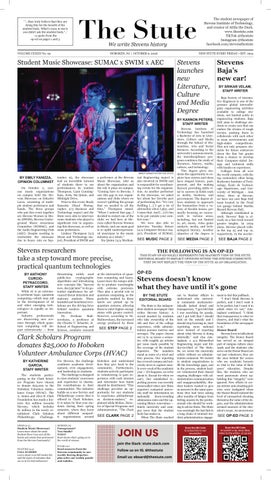
Student Music Showcase: SUMAC x SWIM x AEC
The student newspaper of Stevens Institute of Technology, and creator of Attila the Duck. www.thestute.com TikTok @thestute Instagram @thestute facebook.com/stevensthestute NEW STUTE EVERY FRIDAY • EST. 1904
Stevens launches new Literature, Culture and Media Degree
ical Engineering major) is also involved in SWIM and is responsible for coordinating events for the organization. As another performer in the showcase, we asked her about her favorite part of performing live. “It’s very thrilling […] I get a lot of adrenaline when I play, and I enjoy that. And [...] it’s fun to be put outside your comfort zone.” We were also able to interview Tuesday Detore (4/4 Computer Science major), President of SUMAC,
Stevens Institute of Technology has launched a Bachelor of Arts in Literature, Culture and Media through the School of Humanities, Arts and Social Sciences. According to the university’s announcement, the interdisciplinary program combines the study of literature, history, media, culture, and technology. This degree gives students the opportunity to explore how stories and ideas have shaped history, past, present, and the making thereof, providing skills vital to careers in fields such as media, business, and government. The degree allows students to approach the humanities from a variety of flexible lenses, primarily focusing on coursework in various areas, including, but not limited to, art, music, video game analysis, media, and technological literacy. Another objective of the degree is
SEE MUSIC PAGE 2
SEE MEDIA PAGE 2
SEE BAJA PAGE 2
BRADY SANSOTTA FOR THE STUTE
On October 2, various music organizations on campus held the Stevens Showcase on Schaefer Lawn, consisting of multiple student performers and bands. The three groups who put this event together are Stevens Women in Music (SWIM), Stevens Underground Music Awareness Committee (SUMAC), and the Audio Engineering Club (AEC). Despite needing to reschedule the showcase due to heavy rain on Sep-
tember 25, the showcase had an incredible turnout of students there to see performances by Lindsey Thompson, Liam Cunningham, Jorts, Sia Quinn, and Midnight Drive. Prior to this event, Brady Sansotta (Head Photographer, 2/3 Business and Technology major) and the Stute were able to interview some students who played a significant role in organizing this showcase, as well as some performers. Lindsey Thompson (3/3 Music and Technology major), President of SWIM and
a performer at the Stevens Music Showcase, told us about the organization and the role it plays on campus. “Coming here to Stevens, I saw this gap in our organizations and clubs where we weren’t uplifting the groups that we needed to all the time,” Thompson stated. “When I noticed that gap, I decided to restart one of the clubs we had here at Stevens called Stevens Women in Music, and our main goal is to uplift underrepresented musicians in the music industry as a whole.” Sia Quinn (4/4 Mechan-
Stevens researchers take a step toward more precise, practical quantum technologies BY ANTHONY CURCIOPETRACCORO, STAFF WRITER
While AI is an extremely pertinent topic, quantum computing—which may aid in the development of AI and other emerging technologies—is equally as important. Industry professionals are discovering new avenues through which quantum computing will impact cybersecurity — from
threatening widely used public-key cryptographic algorithms and introducing new concepts like “harvest now, decrypt later” to its potential significance for advanced threat detection and malware analysis. These harmful and beneficial revelations are the driving force behind modern quantum innovation. Dr. Svetlana Malinovskaya, a professor at the Charles V. Schaefer, Jr. School of Engineering and Science, conducts research
at the intersection of quantum computing and lasers. Lasers have the unique ability to produce wavelengths with extreme precision. They play a pivotal role in quantum computing, as the particles emitted by these lasers are picked up by quantum systems, allowing them to enter higher-energy states with greater control. However, according to Dr. Malinovskaya, the increased energy produced by these
SEE STEP PAGE 2
Clark Scholars Program donates $25,000 to Hoboken Volunteer Ambulance Corps (HVAC) BY KATHERINE GARCIA, STAFF WRITER The students participating in the Clark Scholars Program have chosen to donate $25,000 to the Hoboken Volunteer Ambulance Corps (HVAC). The A. James and Alice B. Clark Foundation has made a historic $21 million towards Stevens, which includes $1 million in the newly established Clark Scholars Philanthropy Challenge.
For Stevens, the challenge combines academic development, civic engagement, and leadership in students. The challenge is designed to raise students’ awareness and experience in charitable contributions to their communities. The initiative builds on a new Service and Philanthropy course that is offered to Clark Scholars. It is taken by first-year students during their spring semester, where they learn about different nonprofit organizations around
NEWS (2-3)
SCIENCE (6)
Student Music Showcase! Learn more about the 2026 Student Show Case and all the bands and artists that preformed from the Stevens Community! FEATURE (4-5)
FALL IS HERE! Learn about your fall bucket list and the types of costumes that are so in for this halloween!
Pomegranate? Two Snails? NASA? Read about what’s going on in the world of science. PULSE (10)
Read answers from the Stevens community to our weekly Roving Reporter, plus solve our weekly puzzle and sudoku.
Hoboken and understand how they give back to the community. Furthermore, students actively participate in volunteering to gain experience with each mission and determine how funds should be distributed. “This challenge provides an opportunity for our students to experience philanthropy as decision-makers,” explained Alida McKee, Director of Special Programs and Administration. “The Clark
SEE CLARK PAGE 2
BY SRIKAR VELAM, STAFF WRITER Baja Society of Automotive Engineers is one of the premier global intercollegiate engineering activities available to college students, not limited solely to engineering students. Baja SAE aims to challenge students to create cars that can endure the strains of rough terrain, pushing them to collaborate with each other in team environments and high-stakes competitions. This not only prepares students for future endeavors down the line but grants them a chance to develop their Computer-Aided Design and technical skills with hands-on experience. Colleges from all over the world compete, with the top contenders often being Rochester Institute of Technology, École de Technologie Supérieure, and University of Michigan - Ann Arbor. Here at Stevens, we have our own Baja SAE team located in the Pond Lot garage behind Martha Bayard Stevens Hall. Although established in 2018, Stevens’ Baja is already on a fast track toward greater heights. In 2024 alone, Stevens placed within the top 25 and top 12, respectively, in the acceler-
BY KANNON PETERS, STAFF WRITER
BY EMILY FANIZZA, OPINION COLUMNIST
Stevens Baja’s new car!
THE FOLLOWING IS AN OP-ED
THIS STAFF OP-ED SOLELY REPRESENTS THE MAJORITY VIEW OF THE STUTE EDITORIAL BOARD TO REFLECT OPINIONS WITHIN THE STEVENS COMMUNITY. THEY DO NOT REFLECT THE VIEW OF THE STUTE AS AN ORGANIZATION.
OP-ED
Stevens doesn’t know what they have until it’s gone BY THE STUTE EDITORIAL BOARD The Stute is the independent student newspaper that writes Stevens history: A record marked by students who take ownership of the ebb and flow of the college experience, while administration pursues metrics and averages. The paper churns out 13 to 14 issues a semester, with roughly 30 articles per issue made possible by the coverage of 80 student reporters. The numbers stand as sums of a tried and true process. Our reporting has covered campus and university news to capture nearly every week of the academic year — if it happens, we write about it. Except for when we can’t. Our established reporting process was recently stonewalled when new Stute reporters contacted university staff for information on nationally down-trending admissions rates and the upcoming library renovation — timely university and campus news that the student body has stakes in. When The Stute reached
out to Student Affairs to understand why university comments uncharacteristically lacked detail and transparency, “I got told that I was searching for gossip, and I got told that I should look on the outside and I should stop focusing in, start reprinting more national news instead of reporting about what Stevens is doing internally,” said Jiya Jaisinghani, a 4/4 Biomedical Engineering major and Editor-in-Chief of The Stute. So, we wrote the university article without an administration comment. We turned to student organizations to fill the knowledge gaps, and in the process, student leaders volunteered their shared ongoing challenges with administration communication and unapproachability. Student leaders wanted to give us answers to the same questions they had been asking after months of fatigue from feeling unseen by the professionals who should be working to advise them. The Stute was seemingly the last link in a long chain of strained student-administration engage-
ment to feel this pullback. “I don’t think Stevens is perfect, and I don’t want it to be perfect, but I want it to admit when it’s not,” Jaisinghani continued. “I think that transparency is what we deserve, and that’s what the foundation of the newspaper is on.” Honor Board Stevens loves to talk about integrity. The Honor Board has served as an integral part of campus culture since 1908, and the students who serve on the Honor Board are not just volunteers; they are the ones behind the scenes who see academic honesty as vital to the value of their peers’ education. Despite this, the students who are most passionate about upholding this “integrity” were ignored. New efforts to create stricter anti-cheating policies were instigated when the Honor Board realized the level of unreported cheating threatens the value of the degree, and the administration seemed unaware of the situation’s scope. An anonymous
SEE OP-ED PAGE 3
Friday, October 9
2
News MUSIC
Masthead Volume CXXIIII No. 05
CONTINUED FROM PAGE 1
Executive Board
EDITOR-IN-CHIEF.............................JIYA JAISINGHANI ‘27 BUSINESS MANAGER.......................CAMRYN WINANT ‘28 MANAGING EDITOR.................................TIANNA SPITZ ‘27 LAYOUT EDITOR.......................................CLAIRE DEANS ‘29 OUTREACH CHAIR................................ISABELLA FAMA ‘29 DIGITAL MANAGER.........................CHARMY KOTADIA ‘27 SECRETARY.....................................JOSEPHINE CHOONG ‘28
Editorial Board
NEWS EDITOR...................................JOSH BODENSTEIN ‘29 SCIENCE EDITOR.......................................DISHA GOHIL ‘28 OPINION EDITOR....................VEDHESH A. KAMARAJ ‘28 SPORTS EDITOR..........................MILAGROS CARBAJAL ‘28 FEATURES EDITOR ...........................PRISHA VAGVALA ‘28 HEAD COPYEDITOR................................KAILEY SUPAN ‘29
as well as former President Liam Cunningham. Both of them mentioned how they were responsible for contacting and recruiting bands for performances, including last week’s showcase. “We like to bring in new acts for people to sort of expand their horizons in a way that they might not have the time or ability to,” Detore told us. “Having it on campus, it’s a lot easier, it’s a lot safer […], and you get to do it with your friends.” When asked about his experience in SUMAC, Cunningham told us, “It really is a great way to have a 3rd space on campus that people can go to […] even though Stevens is an engineering, more tech-sided school. It’s creating opportuni-
ty for people to come together for the love of music.” As President of AEC, Cameron Millar (4/4 Music and Technology major) and the rest of his club were responsible for providing and managing the sound equipment being used at the showcase. In his interview, he expressed his love for AEC and the music community at Stevens. “I feel like it’s almost cheesy saying this, but it’s just such a cool community,” Millar remarked. “It’s really cool to just meet all sorts of people with like-minded interests and everything.” Our final interview was with singer and songwriter Viktor Palmer (3/4 Music and Technology major), and a member of Jorts. He told us about the band’s future activities, as well as some accomplishments such as playing at TechFest last year. “I’m very
influenced by folk music, and […] late nineties low-fidelity music, and everyone else in the band is influenced by so many vast, different genres. We’ve been recently jamming a lot and playing a very different style of music than we’ve been usually playing, and we’re kind of trying to expand on it.” Additionally, Jorts is currently working on a new Extended Play (EP), which he and the rest of the band are very excited about. Despite being a technology-focused school, music on campus has shown to be an integral part of the Stevens community, giving students opportunities to express themselves musically and perform around campus and Hoboken. SWIM, AEC, and SUMAC will continue to host events throughout the school year, open to any students considering involvement in music at Stevens.
Operations Board
HEAD PHOTOGRAPHER.................BRADY SANSOTTA ‘29 ASST. LAYOUT EDITOR...........................LIEU BUTLER ‘29 ASST. LAYOUT EDITOR..........................ALANA JONES ‘29 ASST. LAYOUT EDITOR..............................SACHEL GIL ‘30 ASST. LAYOUT EDITOR........................SHRI SARANYA ‘30 ASST. SOCIAL MEDIA...............................CHRISTINE YI ‘29 DELIVERY BOY...................................MARTIN MURIITHI ‘29
Staff & Contributors Reka Weinacht Alessandro Chavez Krutin Vallala Emily Fanizza Srikar Velam Katherine Garcia Anthony Curcio-Petraccoro Breona Pizzuta Kannon Peters Chrystiella Mensah Bella Marques Nehemiah Liciaga Riyana Phadke Ashley Elias Flores Viktor Palmer Alessandra Z. Nieto Gavin Ruby Jack MacDonnell
Wesley Yu Dominic Souza Sydney Leung Jeylan Jubran Jack Dietrich Sean Palermo Mahi Verma Fiona Shi Tanya Zanes
Contact Us
GENERAL.........................................EBOARD@THESTUTE.COM EDITOR-IN-CHIEF.........................EDITOR@THESTUTE.COM ADVERTISING.............................BUSINESS@THESTUTE.COM OFFICE.................................UNIVERSITY CENTER ROOM 216B
Corrections NOTICE A MISTAKE? Email us at eboard@thestute.com.
Disclaimer
All opinions and editorials reflect the views of their respective author(s). No Part of The Stute may be reproduced in any form, in whole or in part, without the written consent of the Editor-in-Chief. Cited references of The Stute are permitted.
Policy on Letters to the Editor
All members of the Stevens community are able to submit a Letter to the Editor to be published in The Stute. Letters must refer either to a piece published in The Stute or to The Stute in general and must be between 400 – 800 words in length. Submit letters to editor@thestute.com with your name and title (when applicable) or using our Google form. For writers who wish to write a Letter to the Editor anonymously, please see our policy on anonymity. The Editorial Board reserves the right to choose whether or not to publish a submitted Letter to the Editor based on a majority rule vote, and additionally reserves the right to edit letters for clarity or request authors to revise. Provided that the author approves the final version, The Stute reserves the right to edit letters according to our copy editing procedures, defined in our policies.
Policy on Op-Eds
All members of the Stevens community are able to submit a standalone opinion piece (otherwise known as an Op-Ed) to be published in The Stute. Op-Eds must be between 400 – 800 words, but longer submissions will be considered on a case-by-case basis. To submit an OpEd please email eboard@thestute.com with your name and title (when applicable) or using our Google form (tinyurl.com/submit-t0-stute). For writers who wish to write an Op-Ed anonymously, please see our policy on anonymity. The Editorial Board reserves the right to choose whether or not to publish a submitted Op-Ed based on a majority rule vote, and additionally reserves the right to edit Op-Eds for clarity or request authors to revise. Provided that the author approves the final version, The Stute reserves the right to edit Op-Eds according to our copy editing procedures, defined in our policies.
FULL LIST ON thestute.com/policies
tinyurl.com/stutesubmit
BRADY SANSOTTA FOR THE STUTE
MEDIA
CONTINUED FROM PAGE 1 for students to understand how
BAJA
CONTINUED FROM PAGE 1 ation and cost events, highlighting their exceptional growth. Beyond these events, they placed in the top 50% in the hill climb event, facing a startlingly high 40-degree incline, which made this event even more challenging than previous years. Despite major challenges, Stevens pushed through difficulties and landed above significantly larger schools such as Northwestern University and New York University, a clear sign of the team’s dedication. Stevens Baja plans for this year’s car to be far different from 2026. Ella Warnock, a 4/4 Cybersecurity major and the Corresponding Secretary of Stevens Baja, said, “This year, the car will have a major difference in the implementation of data collection sensors and systems to aid us in improving our engineering.” 4/4 mechanical engineering major and club Treasurer Ethan Krup-
STEP
CONTINUED FROM PAGE 1 lasers “can also trigger unwanted multiphoton processes allowing the molecule to access many different states and pathways, making its behavior much more difficult to predict and control.” Extreme precision is a necessity when manipulating the behavior of quantum systems. In cybersecurity, Quantum Key Distribution (QKD) creates a secure medium for distributing cryptographic keys. If a laser pulse contains more
CLARK
CONTINUED FROM PAGE 1 Foundation recognized that the same spirit of thoughtful investment that guides its own philanthropy could be an important part of the Clark Scholars experience. Through this program, students are learning how to identify community needs, evaluate nonprofit organizations, and make decisions about where their collective resources can have an impact.” At the end of the Spring 2026 semester, students were able to nominate and present proposals of nonprofit organizations that they believed earned a donation. Alexandra Zaragoza, a 2/4 Biomedical Engineering student, was the Clark Scholar who proposed the organization HVAC. She explained, “For families without
such disciplines interact with one another — for instance, how do film and photography coalesce? Technology is integrated throughout the program, with students examining the ethical, historical, and societal questions
that accompany technological change. Students will take major-focused courses and can take other general electives, such as Fictions of AI, Storytelling from Myths to Video Games, and AI and Society.
ka added that “while this aids us in having a better understanding of how the car drives and potential problem areas, it also creates talking points for the design presentations at competition.” Currently, the club is experiencing an extremely rapid growth phase, to which Krupka stated, “It is a fact that [the garage] is a small workspace and with the rate that the club membership is increasing it starts to become a safety risk.” “We do not want to implement a maximum occupancy and turn people away from the garage because they weren’t fast enough showing up, but we have to preserve a safe working environment. The only solution would be some form of expansion.” This could mean that in the future, Stevens may see a much larger base of operations for our beloved Baja team. The Baja SAE 2027 events will take place at three separate locations in America, spanning across Arizona, Pennsylvania, and Michigan. “Historically, the competition consists of design presentations
for each subsystem, four static events that test individual capabilities like acceleration and maneuverability, and a four-hour endurance race to conclude the event,” Krupka mentioned. Warnock describes the general pipeline for Stevens Baja: “Every year, starting in the summer, we do a bulk of the design of our systems. As we enter the fall and go to the spring, we finalize our designs and manufacture the whole car. Throughout the year, we attend many events, including a testing day in the spring and business outreach events.” Future plans for Stevens Baja include “outreaching out to more sponsors for funding and connecting with alumni to help maintain more knowledge within the club,” said Warnock, with the goal of providing club members to expand their network and connections for future prospects. Stevens Baja is a trailblazer for engineering at Stevens Institute of Technology and will only continue to grow in the years to come as they improve their cars time and time again.
than a single photon, an adversary can intercept a photon, potentially compromising the security of the quantum channel. In quantum computing more generally, this undesired communication between photons creates ambiguity when taking critically sensitive measurements. Dr. Malinovskaya and her team of researchers developed a potential solution to quantum crosstalk, in which the laser emits 12 short, low-intensity bursts rather than a strong beam of directed light. This process, referred to as a “digitized” version of a laser, produces the same effect as a steady beam,
allowing the photons to remain in a controlled state. As Dr. Malinovskaya explains, “Each pulse carries much less energy, but its timing, intensity, frequency, and phase are precisely calculated and controlled.” This newfound approach could help unravel the complex challenges faced by quantum systems previously plagued by erratic behavior. In the decades to come, this approach may be viewed not merely as a solution to a modern quantum-computing challenge, but as another step toward developing increasingly precise and capable quantum technologies.
insurance, the cost of medical transportation can create a significant financial strain in addition to treatment expenses. Without access to safe and affordable transportation, families risk the lives of loved ones by attempting to transport an injured person themselves.” HVAC is a nonprofit organization dedicated to providing essential emergency care without charging patients for more than 50 years. Alexandra emphasizes how the organization responds to more than 7,000 ambulance calls annually, and their medical attention maintains the community’s health without financial burden on residents. Ultimately, 39 students of the program voted and elected Hoboken Volunteer Ambulance Corps as the inaugural recipient. President Thomas F. Molta expressed gratitude for the award and highlighted that HVAC is incredibly honored. “The generosity
of the Clark Scholars will help us continue that tradition and ensure that we have the resources, equipment, and capabilities we need to be there for our neighbors when they need us most,” Molta stated. The program itself reflects the aspirations of the Clark Foundation, which is to strengthen organizations serving individuals, families, and communities. The Clark Foundation’s investment in Stevens demonstrates that it extends beyond scholarships and education to encourage students to be engaged philanthropists. Zaragoza elaborates, “Community service can take many forms. As Clark Scholars, we have opportunities to find meaningful ways to give back to our community. I encourage everyone to volunteer because not only does your time and effort make a difference, but you also have the opportunity to make someone’s day a little bit better.
Friday, October 9
3
News OP-ED
CONTINUED FROM PAGE 1 student leader on the Honor Board described the cheating situation as “life or death.” Months of hard work and effort to engage the administration were met with silence. This resulted in confusion and exhaustion among the students involved. It was made clear that professors fear that their jobs may be affected by negative evaluations if they abide by the Honor Board’s rules. Despite being aware of the issue, the administration was reluctant to take action on the issue. “Everyone is cheating on every exam. Honor Board is trying to do stuff. They don’t have the power. Admin doesn’t care.” When another anonymous student leader tried to work with administration to combat these problems, they quickly learned what came with the role of being a leader. At first, there was hope, with meetings and promises of working in partnership and drafting. This dissolved when the Honor Code Handbook was introduced in Fall 2025. The problem? It solidified the Honor Board’s position in defining academic policy, something the administration seemed reluctant to share. An anonymous student elaborates on the situation, stating, “[when] someone has accumulated power, they don’t want to let that go [...] [but] in turn, I don’t think what
they realize they’re doing is they’re making the situation worse.” The introduction of the Handbook, which sought to standardize and set rules for both academic integrity and proctoring, began a debate over how much authority the Honor Board truly holds at a time when the university needs stability. These experiences reveal the structural gap that student leaders are forced to fill. Honor Board had stepped up from an adjudicator of the Honor System to a vocal advocate for integrity, compiling an entire code to provide stability for professors. The initial result was pushback and a debate over who truly holds power in these situations. Student leaders on the Honor Board subsequently struggled when trying to enforce any form of policy order, with one leader explaining, “[w]hen I was trying to report faculty who were violating proctoring policy, there was a lot of administrative pushback [...] It was not my job, and there were also problems with ‘we’re going to look into it,’ and then there was no follow-up.” Indeed, the Honor Board had acted outside the precedents it set for the past few years. It did so out of care for the university, and a desire to support their fellow students and faculty. What transpired was a situation where the standardization was seen as a threat, and from there, debates proceeded, leaving student leaders burnt out on an initiative that came from a place of true care.
Credit cap Stevens introduced a credit cap where they have reduced the maximum load of credits a student can take in any given semester. This “wellness initiative” is described as more beneficial for students, reducing their workload and allowing them to participate in more Stevens extracurriculars. What about the students who want to double major, declare a minor, or do a co-op? Administration had already made the decision for the credit cap when SGA came to them with student feedback. An anonymous student leader from SGA spoke on their experience and interactions with administration on the topic. “At the end of the day it’s about the money for them […] It feels like lies about ‘we want students to have more time and reduced credits to allow them to do more extracurriculars.’ It’s none of your business if I have free time. I’m here to get an education. If I want to be overwhelmed and doing homework all the time and not have to do other things, that’s my business.” SGA leaders entered their terms with goals to rebuild trust and strengthen communication by meeting regularly with administration. In February and March, meetings with the Academic Operations Affairs Committee were held to ask questions about the credit cap and changing the grading scale. Jeylan Jubran, 4/4 Industrial and Systems Engineer and SGA President, recounted, “So we asked a
few questions, and we saw the tone shift with a few of the deans that were there.” There were repeated attempts to clarify, but this was met with meetings redirected, emails rerouted, and questions left unanswered. “We brought it up, saying we just don’t understand how you expect students to do co-op, how you expect students to do majors and minors, etc., in which I just continuously kept on getting gaslit,” said Jubran. This matter finally reached the Dean’s Undergraduate Student Advisory Council, where an administrator told Jubran, “I don’t think this is the place where students should come and voice these concerns.” Jubran replied, “The Dean’s Advisory Council that is meant for students to voice concerns is not the place where students should voice concerns?” Within weeks, SGA noticed tone shifts from almost all of the administration, across all departments. “All the projects that we were working on with the mayor’s office, we were suddenly not allowed to speak to the mayor.” Long-standing partnerships were suddenly affected; The SGA was unable to present to the Board of Trustees, a crucial opportunity to funnel student voices up the chain of command. Jubran stated the board was concerned over the numbers to justify the credit reduction and did not discuss academic ramifications or ROI. “They just cared about the money, and because we weren’t at the trustees meeting, we couldn’t
have a conversation with them.” SGA has not received consistent communication from the trustees since March. Cabinet meetings touched on students’ request for more transparency on the university budget crisis, despite admin silence and denial. Jubran highlighted students’ need to address campus operational changes, asking for basic updates and clarity. Jubran stated that the Vice President of Finances did not address this question. Instead, President Favardin pivoted to reiterate the credit cap and made incorrect statements on student credit course load. In response to this, SGA introduced the Letter from the Student Body against the credit cap to cite student concerns and institutional research on truly competitive approaches to lessen credit load rather than enact a cap. By the end, their concerns were silenced. Library Renovation The same pattern of dismissal and silence resurfaced with the expected library renovation. Stevens plans on renovating the library for the entirety of the Spring 2027 semester. When SGA leaders asked for transparency, there were concerns about delayed communication and administration hesitance to open dialogue. Jubran stated that Student Affairs and administration refused to host a town Continued on thestute.com
LOCAL NEWS Lt. Gov. Dale Caldwell resigns after sexual assault claims and ethics violations BY NEHEMIAH LICIAGA, STAFF WRITER On September 25, 2026, Stevens class of 2030 convocation speaker and New Jersey’s Lieutenant Governor, Dale Caldwell, resigned after a combination of ethics violations, sexual harassment claims, and accusations involving staffers. Soon after, there was public demand, led by Governor Mikie Sherrill, to make him step down from office just eight months into his term.
To understand the situation, you have to look at the beginning of the issue. On May 14, 2026, an anonymous tip to the Office of the Governor’s Chief Ethics Officer on Caldwell stated that the Lieutenant Governor violated New Jersey State Policy Prohibiting Discrimination in the Workplace (the Workplace Policy) and the Code of Conduct for the Governor. Caldwell received formal notification of the independent investigation on May 22, 2026. On September 23, 2026, Lowenstein Sandler released the indepen-
dent report that Caldwell did violate the Workplace Policy by making sexually harassing advances to a female staffer and her friend. It also found that Caldwell violated New Jersey Ethics Rules by bringing personal guests to ticketed events and attempting to secure a promotion for a New Jersey state employee, with whom he had a romantic relationship. This crisis has come at an unfavorable time for the Sherrill administration. New Jersey Republicans criticized and raised questions
about the methods that Sherrill chose to nominate Caldwell as her running mate, as well as allowing him to serve as acting governor while she was out of state. However, her response to the scandal has received high praise from the majority of New Jersey residents. The Rutgers-Eagleton poll highlighted her approval rating at 44-34, and 70% of voters approved of how she responded to the scandal. It is unclear at this time who will succeed Caldwell. Governor Sherrill has 31 days left to nominate a new
NATIONAL NEWS
lieutenant governor without confirmation by the New Jersey Assembly. Names. Possible replacements include Assemblyman Chigozie Onyema from Newark, Assemblywoman Verlina Reynolds-Jackson from Trenton, and Randal Pinkett, among others. Although the appointment of a new lieutenant governor is not expected until later October, given the upcoming midterm elections, Shirley U. Emehelu has been appointed as Acting Secretary of State of New Jersey to oversee New Jersey elections.
The Supreme Court revives a controversial data system for citizenship checks BY ASHLEY ELIAS FLORES, STAFF WRITER The U.S. Supreme Court has allowed the federal government to temporarily resume using an expanded federal data system to check the citizenship status of people registered to vote in state elections. The system, known as the Systematic Alien Verification for Entitlements (SAVE), was originally created about 40 years ago to verify the immigration status of non-citizens applying for certain public benefits. The Department of Homeland Security (DHS) has since updated the system to compare voter-registration information with federal records. Under the updated system, DHS connected SAVE with Social Security Administration records, which contain information on most Americans. The changes also made it possible to process
voter information in large batches. DHS encouraged states to submit their voter-registration lists so the federal government could check whether registered voters were U.S. citizens and whether federal records identified them as deceased. Many states provided their voter lists, and tens of millions of records were processed before a federal judge stopped the program in June. The federal government has argued that the updated system helps states identify people who may be ineligible to vote. In an appeal to the Supreme Court, Solicitor General D. John Sauer said that the system had checked more than 65 million voters across 26 states since May 2025 and had identified 28,635 people as potential noncitizens. The federal government argued that blocking the system makes it more difficult to identify potentially ineligible voters. The Supreme Court majority also said
the lower court’s decision could limit the federal government’s ability to assist state and local agencies with election administration. The use of SAVE has also led to concerns about privacy and the accuracy of the information it produces. Organizations including the League of Women Voters and the Electronic Privacy Information Center (EPIC) challenged the modified system in court. They argued that federal law does not authorize the government to create a comprehensive database of U.S. citizens and questioned whether the available federal records could accurately establish citizenship for every voter. They also argued that federal laws can restrict how Americans’ sensitive personal information can be reused and shared. In June, U.S. District Judge Sparkle Sooknanan blocked the modified SAVE system. She determined that the government’s collection and disclosure of certain
information violated provisions of the Social Security Act, the Privacy Act, and the Administrative Procedure Act. The federal government appealed, and an appeals court panel declined to temporarily stop the lower court’s ruling. The case was then brought to the Supreme Court. The Supreme Court’s decision temporarily allows the federal government to use the expanded SAVE system while the broader legal dispute continues. The majority concluded that a provision of the 1996 Illegal Immigration Reform and Immigrant Responsibility Act allows DHS to provide certain citizenship information, including Social Security information, to states. The three dissenting justices disagreed with the majority’s interpretation. Justice Ketanji Brown Jackson wrote separately that the ruling failed to adequately consider the potential harm to voters. A major concern is the possibil-
ity of incorrect matches. SAVE has previously identified eligible citizens as potential noncitizens. In Texas, the state’s entire voter list of approximately 18 million people was checked, and the system initially flagged 2,724 voters as potential noncitizens. Of those flagged, 117 cases, or 4.2%, were referred for investigation for possible noncitizen voting. According to a September 2026 release from the Texas Secretary of State’s office, about 20% of those initially flagged were later determined to be citizens and were reinstated. The Supreme Court’s decision allows the federal government to use the modified SAVE system for now, while the underlying lawsuit remains ongoing. The system’s effects on the upcoming midterm elections are uncertain, and federal law restricts states from systematically removing voters from registration rolls within 90 days of a federal election.
Military Cyber Forces to Guard Midterm Elections BY ISABELLA FAMA, OUTREACH CHAIR As the November midterm elections are approaching, the U.S. government is deploying something that has never been done before. Military cyber units will be deployed to defend elections from foreign interference. U.S. Defense Secretary Pete Hegseth announced that the National Security Agency and the U.S. Cyber Command will “mobilize every resource to defend our election infrastructure from foreign malign influence and ensure that every lawful voter can cast their ballot free from foreign intimidation, co-
ercion, or fear.” This announcement came as a shock to many, as the Trump administration cut millions in funding from the U.S. Cybersecurity and Infrastructure Security Agency within the Department of Homeland Security, which is designated to safeguard local and state elections. The decision to ultimately deploy this initiative comes from the concerns surrounding election security. Since 2016, U.S. intelligence has documented multiple attempts by foreign governments to disrupt elections. The most known attempt was during the 2016 presidential election, when Russia conducted
a large-scale hacking campaign. In 2020, Iran attempted to spread misinformation, and during the 2024 presidential election, China attempted to influence the election through social media. Although these attempts have been proven, it has not been proven that U.S. vote totals and ballots were changed, most recently evaluated in the 2021 Intelligence Community Election Security Review. These attempts have led to election systems being classified as “critical infrastructure,” which falls under the same protection standards as water systems and power grids. The deployment of the military cyber units marks a new shift in
how the federal government will approach election defense. These teams will be monitoring network traffic, potential attacks, and working with local election offices to respond to any incidents. The mission claims to be strictly defensive by protecting voter registration rights. Although these units will not be located inside actual polling places, many state election officials have expressed mixed feelings about this. The National Association of Secretaries of State, representing the chief election offices in all 50 states, shared the welcoming of this new precaution but emphasized the need for clear boundaries between federal and state author-
ity. Officials have told Associate Press News that although the federal tools are appreciated, they do not want military personnel near polling stations. As early voting begins, these newly introduced cyber defense tactics will be seen and implemented at almost every polling station across the country. These new measures will either reassure voters or raise new concerns about federal involvement in state and local elections. The reactions of the country are hard to predict as of right now, but what can be said is that the new age of voting is not solely relying on ballots, but on the protection of our digital presence.
Friday, October 9
4
Feature
FALL IS HERE! The best Halloween costumes of 2026 BY CAMRYN WINANT, BUISNESS MANAGER We are officially less than one month away from Halloween, which means it is finally time to lock in on your costumes if you haven’t already picked the perfect one. Of course, you can go on to be a pirate, a fairy, or a Disney princess wearing a corset. Maybe you’re going with a friend as an angel and a devil, or maybe, if you’re aiming for a couples’ costume, you’ll really spice it up and go as Padme and Anakin. These are the typical Pinterest-y costumes, but at the end of the day they’re timeless. You can choose one of those timeless costumes, but I don’t think it’s too hot of a take to say 2026 was the year of movies and TV shows, bringing some of the best new content for Halloween costumes. Nikki from Obsession will easily be the
most popular costume this Halloween. If seeing Inde Navarrette, who plays Nikki, walk in reverse freaked you out, I would recommend that you stay in your house on Halloween weekend. Any of her looks would totally work out, but you can’t forget the fake blood if you go with this — who would be scared of a regular girl walking around? (PSA: If you plan on going as Nikki, please do not make it a couples costume with Bear. They are not a couple!!!) In the same vein of horror movies, if your color is neon yellow, get yourself a hazmat suit, and you can say your costume is based on Backrooms. I didn’t actually watch Backrooms, but they definitely wear hazmat suits. Now, the new movie Primetime isn’t necessarily a horror movie, but I don’t think it’s insane to group it here, and I definitely would expect to see some
Chris Hansens around. I know my brother is thinking about going as him, so it’s officially a verified costume. Shifting over, there has been a crazy resurgence of superheroes following the opening of Spiderman: Brand New Day and Avengers: Doomsday, Marvel’s re-release of Avengers: Endgame in theaters, Supergirl: Woman of Tomorrow, and even the final season of The Boys. There will be an abundance of superheroes walking around this Halloween, no matter what recently came out. There will always be an abundance of superhero costumes. But aside from the obvious choices of The Avengers and such, there is the possibility of snagging the niche choice of Jean Grey. Not that Jean Grey is really niche, but the untapped potential of Sadie Sink’s portrayal specifically. I want to hope Supergirl will be
a hit costume, but…I’m not super optimistic. I, however, do think I will see some Homelanders and Billy Butchers. The Boys season five came out like five months ago, and it still feels relevant. Continuing from the most popular hits from 2026, there will no doubt be Odysseus costumes. Maybe some Athenas. I think Odysseus and Penelope will be a hit couples’ costume. Now, this next costume I was a little hesitant to add, but is it too ambitious to say I hope I see some people as Grace from Project Hail Mary? Similar to the Backrooms costume, if neon yellow is your color, then you’d be the perfect fit for his spacesuit. It’s a perfect nerdy costume; assuming the majority of us here at Stevens are science people, this costume could be peak. I thought for a while about super influential pop-culture shows
that came out this year, and I struggled a bit before remembering the gold that is Off Campus. If you’re solo, you can throw on a letterman jacket or light hockey gear, making you an official Off Campus boy. If you’re looking for a couples’ costume, then of course there is the obvious going as Garrett and Hannah when they are dressed as the magician and bunny. But the real hitter from that show would be Dean and Allie when they are dressed as Maverick from Top Gun and J-Lo’s red carpet look. If you haven’t watched it, that duo might sound insane but very real. Or, if you plan on just spending Halloween with your girls, Allie and Hannah are besties and a totally simple duo costume. While these costumes might sound extremely basic, they are timely, and a true testament to the year’s pop culture trends.
The commuter’s guide to surviving fall at Stevens BY PRISHA VAGVALA, FEATURES EDITOR Fall comes, the leaves turn crunchy, and the breeze is blowing through Hoboken. One of my favorite things is the view of the leaves turning into different colors. Personally, I think Hoboken peaks in fall. It’s just the perfect cozy feeling that makes Hoboken feel like Stars Hollow in Gilmore Girls: neighborly, cozy, and very fall. Even with the beautiful scenery of all the leaves changing from gradients of green, yellow, orange, to red, and the leaves piling into crunchy piles, there are some drawbacks. To start, even though it isn’t fully daylight saving time yet,
the sky is gradually getting darker earlier, which means, as a girl, the Hoboken Terminal gets a bit spookier too, with all types of people (you know what I mean) coming in a bit earlier due to the dark sky outside. I do recommend, whether you are walking back to your apartment or dorm, or traveling in the city, investing in a legal self-defense item to keep you safe. That’s what I did this semester, and I feel so much safer walking home late at night. On top of that, we are in a weird time between summer and fall, as though they’re happening simultaneously. The weather can either drop suddenly or be 80 degrees Fahrenheit outside, and you
have no idea whether to put on a sweater or a tank top. The best way to counter this is to do both! My personal favorite is my cardigans. This is peak cardigan season, when you can wear your cute summer top and then throw on a cardigan, so if it is cold, you can put that on but have the versatility for bundling up a little. I guess the guy version of this would be a shirt and zip-up hoodie, which honestly anyone can do. Take advantage of the Citi Bikes while you can. The weather is still at the perfect moment to finish up doing the last of the activities you can before the frigid winter hits us. When I see people using the Citi Bike, I always think about how
nice it must be with the view and the breeze blowing past them, with the beautiful fall scenery enveloping them. Definitely, if you are a skater, bicyclist, or scooterist, take advantage of the nice weather and use it as much as you can before winter hits. Another thing is to be aware of the leaf blowers on the Hudson walkway. I believe they come either Friday or Thursday. Usually, they stop when they see people, but I just go the other route so I don’t have to inconvenience them. Along with that, fall may come with some rain, as we have seen so far, and Hoboken is prone to flooding. If you are a commuter, map out all the possible ways to get to cam-
pus just in case you need to pivot. After the nor’easter storm, I had to go through the bus exit from the terminal since the main exit had flooding when you walked outside. Definitely wear comfy, sustainable shoes or just a really comfortable pair of sneakers. I’ve been seeing a lot of Doc Martens and heavy-duty boots recently. Just in general, as a commuting hack, keep a few snacks on you if you have a bunch of classes back to back, like granola bars, chips, or a banana, since many feel too cold or too tired to buy some food from Washington Street. I hope you commuters get to enjoy the best of fall, and don’t let the chillier weather stop you from enjoying it!
tumn-themed events. There’s a large variety of events throughout October, from pumpkin painting, trick-or-treating, costume contests, and murder mysteries. Many of these events typically come with free food like apple cider, fallthemed pastries, or apple donuts.
Hoboken for any limited-time autumn drinks. Head to New York City to discover more festive events. Experiment with roasting pumpkin seeds, making candy apples, baking pumpkin or apple pies, or creating your own pumpkin spice latte. Autumn is the season of change, so enjoy the changing weather and find something exciting along the way!
How to start your Hoboken fall! BY JOSEPHINE CHOONG, SECRETARY Whether it’s your first time or your fourth, there’s always something to do in Hoboken to celebrate the autumn season. From admiring the fall foliage, enjoying the seasonal pumpkin drinks, or watching a zombie opera, there’s something for everyone! So start your fall bucket list with some Hoboken classics! Autumn Walks It’s free, great exercise, an excellent break away from school, and filled with beautiful foliage if you know where to look. While you can explore local parks like Elysian Park, if you’re looking for somewhere farther, check out Branch Brook Park in Newark to escape the college sights. On October 17, they have a costume contest for dogs where pet owners can celebrate their furry companions. Run and Volunteer
Not only can you enjoy the lovely Hoboken weather, but you can also spend your time helping others! One of the more prominent fundraisers is the HoBOOken 5K race, which is hosted this year on Sunday, October 25. In support of the Hoboken Shelter, grab a friend or two to race through Pier A together. Or, participate as a volunteer contributing to activities like event set-up, registration, videography, and medal distributions. Zombie Opera If fall isn’t exactly your style, maybe you’re just dying to experience those Halloween chills. With Jersey City’s annual Zombie Opera, the afterlife will come to you! Occurring on Saturday, October 24, it’s a free show with past wacky themes from Olympian Gods to outer space zombies. So, bring a picnic blanket, wear a spooky costume, and be prepared for freaky frights. Fall Festivals
If you’re looking to interact with the local community, try going to one of the many fall festivals. For example, on Saturday, October 31, Hoboken is hosting its annual Ragamuffin parade with decorated carriages, costumes, live local music, and spectacular floats. Hosted by the Hoboken Cultural Affairs division, the parade will start at 10th Street and stretch all the way down to 5th Street. Since it’s supported by the Hoboken Business Alliance, you could expect dedicated local business floats to make an appearance. Or if you want somewhere further away on Halloween Day, Jersey City will be celebrating through its Hudson County fall festival! The spooky festival will feature live music, local artisan vendors, and a special costume contest!
Something New If none of these interest you, try something new! Walk around
Stevens Fall Activities Of course, Stevens had plenty of fall fun activities right on campus. To stay up to date, check DuckLink throughout the season for any au-
PHOTO COURTESY OF HOBOOKEN5K.COM
A coffee lover’s favorite season, but ranked! BY ASHLEY ELIAS FLORES, STAFF WRITER Let’s be real, this weather doesn’t really feel like fall, but who says you can’t have a nice, cute, and fun drink to welcome fall anyways. As someone who LOVES trying new things, I, of course, always look forward to trying new seasonal drinks. It also gives me an excuse to try a new place out. Since moving to Hoboken, where I see a new coffee shop on almost every corner, my wallet’s been soft-launching that I need to stop going to a new spot and stick to what I know and love. So, luckily, I have compiled a top five list of my favorite fall drinks and where to get them. First Place: Cinnamon Swirl Latte from Mojo Coffee Company If you had asked me a year ago to get a latte with white mocha, I
would have laughed in your face, but honestly, now it’s one of my favorite things to add. In short, a cinnamon swirl latte, if ordered hot, with cinnamon bun syrup, white mocha, whipped cream, and cinnamon powder on top. (I 100% recommend you try it at least once.) I have had this drink iced, and it still is very good, which is why it’s my top drink at the moment. Plus, if you get it hot, you get a really cute cup that Mojo is using as part of a collaboration with Margaret Joy, a local artist, and no AIslop, so that’s a plus! Prices vary depending on size and milk but range from $5.50 to $6.75, which is not bad for a latte. Mojo also has two locations in Hoboken, so no need to walk too far for a good drink. These are on Bloomfield Street and Willow Street. Second Place: Chai Latte from Hidden Grounds Honestly, you can’t go wrong
with a chai latte. I prefer it iced, and you could pair it with some cold foam or a pump of any sweetener (vanilla is my personal preference). I have no particular place I get a chai latte from; I’ve had one from a multitude of places, and they all were good, so I think wherever you go to get one, you’ll be good! But, if you want a specific spot in Hoboken, definitely check out Hidden Grounds on Garden Street. It’s a bit more on the “treating” yourself side, with a chai latte ranging from $7 to $9, but I’d say it’s worth it. Third Place: Pumpkin Spice Latte from Starbucks This is a classic, and although I don’t get it as often, it’s still on my list. Since coming back to reintroduce fall, the Starbucks baristas have always kept me entertained with the drawings or notes they leave when I order a pumpkin spice latte. One barista drew Snoopy on my cup, which I
adored, and the drink itself was great, so overall a positive experience. Some people say that pumpkin spice is basic or overused, but when something’s good and working, why change it? I think the reason this is third on my list is because of the wait at Starbucks. Pricing for this drink also depends on the size, but I believe it’s about $7. If you’re looking for some cute art on your cup, the Starbucks on Washington Street always makes my day with a drawing or a sweet note. Fourth Place: Pumpkin Shaken Espresso from Starbucks As someone who already loves Starbucks’ Shaken Espresso, this was a pretty good addition to my list. The pumpkin cold foam mixed really well with the drink and really enhanced the flavor of the espresso itself. I don’t have much to say besides that it’s definitely something you should try at least once. The reason it’s not in my top three choices is that it’s not
my go-to when I go to Starbucks, but it’s a drink I enjoy, hence why it’s on this top five list. Fifth Place: Apple Cider from Mojo Coffee Company Unfortunately, apple cider is the lowest on this list just because there’s not too much variety in Hoboken. The only place I’ve seen it this season so far has been at Mojo, and you can order it hot or iced, which is a plus! Apple cider is a classic drink and is a definite “must-try” at least once. If anyone finds another place in Hoboken that sells apple cider, please let me know! The season has just begun. Some people’s fall list may look completely different, and that’s okay. There are plenty of coffee shops in the area to find something new for fall. If you were unsure where to start, try one of the drinks I recommended — I promise they won’t disappoint.
Friday, October 9
5
PHOTO COURTESY OF STEVENSDUCKS.COM SHOT BY DAVE JANOSZ
Sports
ON DECK IN SPORTS FRI, OCT 9 WOMEN’S VOLLEYBALL Rutgers-Newark Hoboken, NJ 6 p.m.
SAT, OCT 10 MEN’S GOLF Mason-Dixon Collegiate Classic Day 1 Waynesboro, PA TBD
WOMEN’S AND MEN’S CROSS COUNTRY
Men’s Tennis ITA Day 1 & 2 results BY KRUTIN VALLALA, STAFF WRITER The Stevens Men’s Tennis team competed in the first two days of the ITA Southeast Regional Championship on October 1 and 2 at the University of Mary Washington in Fredericksburg, Virginia. Stevens opened the tournament Thursday with Samvid Andhare, Christopher Cho, Renat Kramin, and Jamie Ortiz competing in Championship singles. Cho faced Salisbury’s Gurv Suri and recovered from a 3-6 opening set to take the second 6-4. The match went to a deciding 10-point tiebreak, where Suri won 10-6. The remaining opening-day singles matches ended in straightset losses for Stevens. Andhare fell 5-7, 2-6 to Swarthmore’s Fate MacAlasdair, while Ortiz lost 2-6,
4-6 to Mary Washington’s Evan Fisher. Kramin faced Carnegie Mellon’s Jayden Yu and fell 3-6, 2-6. First-year Pratik Nayak won both of his B2 singles matches Friday, taking the first 6-3, 7-6 and the second 6-2, 6-2 to secure a semifinal spot. Elias Alkio also earned a B3 singles victory, winning a deciding tiebreak 10-3 after splitting the first two sets. He then fell 5-7, 3-6 in the quarterfinals. Kramin added an 8-2 consolation win, while Tristan Wroe lost his B2 singles match. Nayak, a Quantitative Finance major from Nanuet, New York, is one of three first-year players on the Stevens roster, alongside Cho and Ortiz. Nayak said a disputed line call during the second-set tiebreak of his opening match became a source of motivation. He recalled
believing that a serve called out landed in, and channeled that frustration to win the match. “I really wanted to prove that I didn’t need that point to win that match,” Nayak said. Nayak credited his singles success to serving and volleying, a tactic he had practiced but had not used much in matches. Playing aggressively at the net helped him shorten points and conserve energy, while varying his pace gave his opponents tough shots to handle. He described the adjustment as “playing smarter tennis, not necessarily hitting harder.” In Championship doubles, Kramin and Wroe opened with an 8-4 win before losing 3-8 in the Round of 32. Nayak and Cho also reached that round, following an 8-3 victory with a 5-8 loss. Alkio and Johnny Haase fell 4-8 in B1 doubles, and Ortiz and Andhare
lost their Championship doubles match. Nayak said his partnership with Cho benefited from a connection that began before Stevens. The two played high school tennis together for four years and already understood each other’s games. That familiarity strengthened their synergy and helped them handle important points. Although Nayak did not play his semifinal match, he said the two singles victories gave him confidence after weeks of preparation. Looking toward the spring, he hopes to build his fitness and endurance to meet the demands of longer college matches. Stevens will close its fall schedule on October 17 with a pair of MAC Freedom matches against King’s College and Misericordia University at 11 a.m. and 2 p.m. in Bayonne.
This past weekend, on October 2, the Men’s and Women’s Cross Country teams raced at Lehigh University’s Paul Short Run. There were more than 550 racers from over 20 schools like Yale, Penn State, Cornell, Brown, and Villanova. For the men’s team, the Ducks who ran included first-year Matthew Reed, who was the team’s top finisher at 28:32.6. The final three runners to stay under 30:00 were first-years Benjamin Adamo, Nelson VanMaaren, and Max Thorn. All three boys were able to shave some time off of their previous runs. Both of the next runners shaving time off their MAC Preview runs, first-years William Parker and Connor Wrinn ran
30:32.2 and 30:26.2, respectively. To round out the Ducks, there were sophomores Daniel Affoumani and Wesley Schlimer, and first-year Christian Garofano. For the women’s team, there were only two runners from Stevens — sophomore Caitlyn Adamchuk and first-year Kaley Byhre, who finished at 28:57.7 and 29:33.4, respectively. Both runners found themselves a little behind at the two-mile mark, but managed to move up at the end of the race, Adamchuk by 33 places and Byhre by 26. The Championship Race, which was set to feature 10 more runners for the women’s team and nine more for the men’s team, was canceled. Both teams will be traveling to Rowan University on October 17 for the Rowan Border Battle.
WOMEN’S AND MEN’S SWIMMING Rowan University Hoboken, NJ 12 p.m.
WOMEN’S AND MEN’S SOCCER Lebanon Valley College Annville, PA 1 p.m./4 p.m.
FIELD HOCKEY Marywood University Hoboken, NJ 12 p.m.
WOMEN’S SOCCER Lebanon Valley College Annville, PA 1 p.m.
MEN’S SOCCER Lebanon Valley College Annville, PA 4 p.m.
SUN, OCT 11 MEN’S GOLF
Women’s and Men’s Cross Country runs in Lehigh’s Paul Short Run BY CAMRYN WINANT, BUSINESS MANAGER
22nd Annual NJIT XC Invitational Newark, NJ 10:30 a.m.
Mason-Dixon Collegiate Classic Day 2 Waynesboro, PA TBD
WOMEN’S AND MEN’S FENCING North America Cup Day 2/Day 1 Orlando, FL TBD
TUE, OCT 13 MEN’S GOLF
Drew University Madison, NJ TBD
MEN’S SOCCER Swarthmore College Swarthmore, PA 7 p.m.
WOMEN’S VOLLEYBALL Desales University Hoboken, NJ 7 p.m.
WED, OCT 14 FIELD HOCKEY PHOTO COURTESY OF STEVENSDUCKS.COM SHOT BY DAVE JANOSZ
Misericordia University Dallas, PA 7 p.m.
STEVENS SCOREBOARD DATE
WED, SEP 30 THU, OCT 1 FRI, OCT 2
SAT, OCT 3
MON, OCT 6
TUE, OCT 7
TEAM
FIELD HOCKEY WOMEN'S SOCCER MEN'S TENNIS MEN'S TENNIS MEN'S AND WOMEN'S CROSS COUNTRY MEN'S AND WOMEN'S FENCING FIELD HOCKEY WOMEN'S VOLLEYBALL WOMEN'S SOCCER WOMEN'S VOLLEYBALL MEN'S SOCCER WOMEN'S SOCCER MEN'S FENCING MEN'S GOLF MEN'S GOLF
OPPONENT
LOCATION
SCORE
UNIVERSITY OF SCRANTON DREW UNIVERSITY ITA ATLANTIC SOUTH REGION CHAMPIONSHIP ITA ATLANTIC SOUTH REGION CHAMPIONSHIP DAY 2 PAUL SHORT RUN
AWAY AWAY AWAY AWAY
L (3-4) W (1-0) COMPLETE W (7-2)
AWAY
COMPLETE
DREW UNIVERSITY
AWAY
COMPLETE
KING'S COLLEGE WILKES UNIVERSITY KING'S COLLEGE DREW UNIVERSITY KING'S COLLEGE MARYWOOD UNIVERSITY USA FENCING NORTH AMERICAN CUP - DAY 4 RPI COLLEGIATE INIVTATIONAL - DAY 2 ALVERNIA UNIVERSITY
AWAY AWAY AWAY AWAY AWAY AWAY AWAY AWAY AWAY
W (7-0) W (3-0) W (2-0) W (3-0) T (1-1) W (3-2) COMPLETE 8th 9th
Friday, October 9
6
Science Scientists say a critical Atlantic Ocean current is weakening and the effects could be global BY RÉKA WEINACHT, STAFF WRITER Deep in the Atlantic Ocean, the Atlantic Meridional Overturning Circulation (AMOC) is a massive system of currents that span the entire ocean from south to north in a vertical loop. It brings warmer waters northwards along the surface (this section of it is known as the Gulf Stream) and transports colder waters at greater depths to more southern latitudes. It doesn’t just transport water; it also carries heat and nutrients — like carbon, for example. Expansive and influential, the AMOC is a fundamental behind-the-scenes part of Earth’s climate control system, regulating winters, hurricanes, rainfall, and other weather patterns globally. Its consistency is part of the reason why we have had foreseeable seasonal weather patterns. Recently, however, researchers at the University of Miami have concluded that the AMOC has been steadily slowing down for two decades, based on compiled data from a long-term, large-scale study. Based on pressure sensors placed on the ocean bottom at various stations along the western North Atlantic, they found signs that the current may be steadily losing strength. The researchers write that activity at the western boundary of the AMOC is like a canary in a coal mine for what is happening along the entire AMOC system; this is how they can extrapolate a guess as to how the eastern boundary and other parts of the system may be behaving based on measurements at the western
boundary. They do also mention, though, that continued monitoring along the eastern boundary is important to further understand how the current is moving and changing. This study accounted for data from as far back as 2000; since the effects were observed at different times and across different locations, they seem to be persistent enough to describe a broad change, not just minor regional variations. This also means that the changes are far-reaching, affecting all the areas regulated by the current. European winters and Caribbean hurricane patterns are only the beginning of the story; sea levels and coastlines may also be affected. One thing caused by the weakening of the AMOC, for instance, is the spread of cold and dry conditions towards the equator — a disruption to the humidity and warm conditions usually present in the tropics. Another predictable future effect is a drop in overall temperatures in Northern Europe, accompanied by a drying that would negatively affect agriculture in the region. Further consequences include the rise of sea levels along the coastline of the American continent, increasing the risk of flooding. In this situation, more research is imperative to understand exactly how the AMOC is changing in direction, strength, and volume of water transported. It is also crucial to do research and adapt infrastructure to mitigate the effects of the disruption to patterns that have previously been regulated by the AMOC for thousands of years.
Scientists find two tiny new snails with shells that close like doors BY JACK MACDONNELL, STAFF WRITER Members of the snail community rejoice worldwide as scientists discover two brand new species — both kinds of snails with the unique ability to seal their shells like a door. The snail was discovered in Durmitor National Park in Montenegro by a team of scientists, researchers, and citizen volunteers who were studying the biodiversity of the National Park’s landscape. The new species of the snail genus, which has yet to receive a common English name and is thus only known as Cochlostoma komarnica and Cochlostoma dobrido, has two unique traits that set it apart from the rest of the snail world: its eyes and its shell. The vast majority of snails have their eyes positioned on the tops of their stalk-like antennas, but this new species has their eyes placed on the sides of their head, a trait very rare in the snail family gastropods. The snails also have a unique ability to seal themselves inside their shell like it’s a personal bunker. They possess a hardened circular disk on the end of their tails, so that when they recede into their shells at the sight of danger, the tail plugs the entry to the shell, effectively rendering
them invulnerable to harm. The species resides in caves, rock faces, and other parts of the rugged and rocky Montenegro landscape. The snails themselves are very small, measuring around just a millimeter in diameter and residing in conical spiral shells made out of calcium secreted by the snail’s body. The shells are typically six millimeters long. They primarily feed on the algae and lichens that grow on the rocks and limestone that they live on. The snails are found exclusively in the largely unexplored Komarnica Canyon, which is a river canyon in the northern region of Montenegro. Its unique geographic conditions promote the growth of unique species, making it the subject of much biodiversity research to better understand it and the creatures that inhabit it. It was this further research that led to the discovery of this exciting new snail. This riveting new addition to not just the snail family, but the list of various other newly discovered animals from the year alone, proves that despite how well documented we may think the world is, there’s always something unknown lurking in the shadows. It’s just a matter of putting in time and effort to explore and research the fine details of our world.
PHOTO COURTESY OF SCIENCEDAILY.COM
NASA-backed scientists turn plastic waste into edible cookies BY SRIKAR VELAM, STAFF WRITER Plastic waste is a plague that afflicts everyone inhabiting our planet and pollutes our rivers, lakes, and oceans. This problem arises from the lack of reusability of plastic waste, which inadvertently leads it to be dumped into waterways, where micro-plastics contaminate drinking water. However, scientists at Southern Illinois University (SIU) discovered a method in which plastic waste can be reduced and even be reused into edible protein cookies that could feed humans across the globe. This opens up the possibility of sustaining life in high-stakes environments such as undersea missions or even missions that extend beyond our atmosphere and into deep-space. But what is this miracle cure for plastic waste? The team at SIU began experimenting with microbes aimed at converting polyethylene terephthalate (PET), a common plastic compound found in soda and water bottles. Associate Professor Lahiru Jayakody and graduate student Sandhya Jayasekara
focused their research on yeast, during which they bioengineered several varieties of yeast, including baker’s yeast, to break down this waste into proteins, vitamins, and other more useful products. Although this type of work could be done by chemical reactions in the laboratory, microbes accomplish this task naturally and are significantly more eco-friendly. Jayakody notes that “microbes are very clever. So, we are using their traits to solve the problems we created.” The yeast cannot immediately break down these materials, so the team first turns these pieces into a more manageable size through a process called oxidative hydrothermal dissolution (OHD). Developed by Ken Anderson, a geology professor at SIU, OHD is a chemical process that only necessitates oxygen, water, and heat. Specifically, the main benefit of this process is that it breaks down resistant materials into miniscule pieces so that the yeast can more effectively break them down. Additionally, this process is cited to be “non-toxic, easily transportable, and amenable to a wide va-
riety of microorganisms,” opening up the possibility of large-scale mass production later in the future. Once the yeast have produced the necessary ingredients, the researchers subsequently combine them with fiber, starch, and sweetener, then 3D-printing nutrient packed cookies dubbed “μBites.” Although these μBites have been tested for food safety based on available data, researchers are awaiting formal approval before conducting taste tests. Another benefit of the yeast microbes is their capability to produce additional ingredients derived from plant biomass, such as vanilla and beta-carotene. The researchers’ ultimate goal for this project is to produce a vast variety of ingredients that are needed for μBites and, more overarchingly, prepare these cookies for public consumption relatively soon. As global starvation becomes more and more of an overlooking threat, this project offers an innovative solution to this problem while also recycling the waste that threatens our ecosystem into something far more productive.
PHOTO COURTESY OF THESCIENCESIGNAL.COM
Compound linked to pomegranates may improve heart function by up to 80% BY SEAN PALERMO, SCIENCE WRITER In a study published in the scientific journal Science Advances, funded by the British Heart Foundation, researchers at King’s College in London discovered that urolithin A, a compound associated with foods such as pomegranates, may help the heart relax more effectively as well as reduce scarring and limit harmful enlargement for normal function. Urolithin A is a compound produced in the body after consuming food such as pomegranates, walnuts, and some berries when the natural compounds in the food, ellagitannins, are broken down by gut microbes. It’s a compound that scientists have become increasingly interested in due to its uncovered associations with healthy aging and mitochondrial function that is vital to cell energy production. In the recent study, the team used animal models to take away promising results: The compound improved heart function by as much as 80% compared to those that didn’t receive the experimental treatment. Further lab tests demonstrated similarly positive results by relaxing heart tissue and reducing fibrosis, a harmful scarring that can interfere with normal organ function. With these successes, the researchers moved on with human stem cells to engineer human heart tissue in a lab to mimic the structure and function of human heart muscles, which further reinforced effects of improved relaxation to suggest a connection
between the initial success found in the animal model. Their findings were explained by how urolithin A activates the protein PKGLα, which is vital in blood vessel function and relaxing heart muscles through an acting on particular amino acids to trigger a pathway associated with cardiovascular benefits. These findings may be good news for nearly half a million people in the UK suffering from preserved ejection fraction (HFpEF), a form of heart failure that accounts for approximately half of all heart failure cases — characterised by breathlessness, fatigue, reduced ability to exercise, and overall poor quality of life. People with this condition have hearts that can pump effectively, but have difficulty relaxing between beats to fill the organ with blood. At the moment, treatment is relatively limited due to the difficulty in managing the condition’s contributing factors such as aging, high blood pressure, and diabetes — clinicians usually tending to focus on managing underlying conditions with lifestyle changes like weight loss and blood sugar control. However, despite the apparent positive results and implications, there are still a few caveats yet to be explored. First, while the pomegranate connection is an interesting one, simply eating pomegranates does not guarantee the body will produce certain amounts of urolithin A due to the ways in which the conversion process from ellagitannins depends partly on gut microbiomes that differ from person to person. Additionally, while the lab-made heart is
a promising starting point for the treatment’s efficacy, it is limited in the fact that it cannot replicate all biological processes that occur in a living person due to the focused nature of the cells produced. To further prove the effectiveness of urolithin A as a treatment, more research will be conducted through clinical trials to see if the same kind of results are reinforced by human subjects. Dr. Joseph Burgoyne, senior author of the study and a cardiovascular scientist at King’s College London, reflected on the study in lieu of its possible treatment benefits by explaining that “this type of heart failure remains one of the most challenging forms of heart disease to treat. Our findings identify a completely new therapeutic target and show that urolithin A can activate this pathway to improve heart relaxation and reduce disease severity. This raises the exciting possibility of developing new treatments that improve clinical outcomes and quality of life for people living with the condition.”
PHOTO COURTESY OF ANCIENTNUTRITION.COM
INTERESTED IN SCIENCE JOURNALISM?Join our Science writing team! Reach out to Disha Gohil, Science Editor (dgohil3@stevens.edu) for more information – No experience necessary to write • thestute.com/category/science –
Friday, October 9
7
Opinion THE STUTE EDITORIAL
Starting from scratch When I came in as Editor-in-Chief, I wanted to change the little things. I advocated for uniform opinion columnist headshots, more events, more themed general body meetings (GBMs), and more collabs — things of that nature. The shining star of The Stute, the newspaper, already has a perfected process. I never wanted to touch something that worked so well, so I didn’t. I may have cleaned up some of our side processes and the way we track certain things, but never the newspaper timeline itself. Since the last semester, The Stute has gained essential people that will carry it on as the current eboard transitions out. With the new generation of Stuters, they have ideas for modernizing our newspaper, and I will be the first to admit that it scared me.
Certain things, I stuck to what I knew. I know how the newspaper runs, I know how it should look, I have rules, and I follow them as best as I can. But when new ideas like 1-5 minute videos on the website come up, I draw a blank. I have no guidelines, no rules to follow, no process, nothing. And I have members who look to me for either the approval of their ideas or critiques, and I just don’t know. In those moments, I like to use the line, “I think it’s a great idea; let’s table it and come back to me with more information next week.” I say that, and I try to think about it for a week and hope that another response can come out of me during future meetings. I did my research; I looked into other college newspapers, and yes, they have mini videos on
their websites. They add to the article rather than shadow it, which immediately lessened some of my worries. I saw the sample video that our Head Photographer, Brady, made. And wow. No words, no thoughts. It was beautiful, and it is exactly what The Stute needs. The Stute’s progression should not be stopped because I have a few worries and doubts that can easily be addressed. Right after I was reelected, I made it very clear that all the changes I made last year are to stay, but this time around there will be more documentation and clear instructions for the future Stute eboard. But, I did not expect to have to create a whole new section of The Stute during my term. I will tell you right now, my only thoughts are that we need to
MIND OF A FRESHMAN
You see how this looks, right?
somehow weave it into our normal production, find more crew to help Brady, purchase all of the equipment so that there can be more videos in the future, and find a way to store it in our office. It is a lot. But not impossible. And I said my last term would be smooth sailing.
Jiya Jaisinghani ‘27
Editor-in-Chief
PHOTO COURTESY OF STEVEBIZBLOG.COM
SENIORITIS
The art of them? Is there something something I’ve already been the senior year “YOLO” that happens along the way thinking about: How little
BY CHRYSTIELLA MENSAH ‘30 I watched Primetime recently, and I don’t really know what I expected going into it. I knew it was about Chris Hansen and To Catch a Predator. I knew Robert Pattinson was playing Hansen. I knew the basic idea of what the movie was about. What I didn’t expect was to leave the theater thinking, “Why do people do this?” Not just the obvious question, “Why would someone do something so horrible?” but the bigger question of why people become the way they are in the first place. I don’t think there’s a simple answer to that. Honestly, I don’t even know if there is an answer that would make me feel better. When you hear about someone doing something horrible, it’s easy to just put them into a category in your head. They’re bad people. They did something terrible. That’s it. But at some point, I started wondering what actually gets someone to that point. Why does someone have those thoughts in the first place? Why do they act on
that could have changed things? And then I realized I was trying to understand something I don’t think I’m ever going to understand. Maybe that’s part of why true crime is so popular. We want answers. We want to know why someone did something, what they were thinking, and how they got there. But Primetime also made me think about the other side of it. To Catch a Predator was supposed to expose people who were trying to meet minors. But it was also a television show. People watched it. People talked about it. Chris Hansen became famous from it. At what point does exposing something horrible turn into entertainment? I don’t really have an answer for that either. I watched Primetime, so clearly I’m part of the audience too. And that’s probably what made me uncomfortable. I’m watching something because I want to know what happens. I want to understand the story. I want to see someone get caught. But why? Is it because I care about what happened? Because I’m curious? Because watching someone get exposed is satisfying? Probably a little bit of everything. The movie got me thinking about this way more than I expected, and somehow that led me back to
we actually know about the people around us. Every person has a completely different mind. Different experiences, different families, different things they’ve been through, and different ways of looking at the world. You can talk to someone for hours and still have no idea what they’re thinking about when they go home. That’s a weird thing to think about, especially when you realize that someone can grow up in a completely different environment from you and come out of it seeing the world in a way you might never understand. I think that’s what Primetime made me think about the most. Not necessarily the people in the movie, but people in general. How much of the way we think comes from how we were raised? How much comes from the people around us? How much comes from things that happen to us? I don’t know. Maybe that’s what I liked about Primetime. I didn’t leave with an answer; I left with a lot more questions.
PHOTO COURTESY OF IMDB.COM
BY BREONA PIZZUTA ‘27 For the past three years, my fall weekends followed a rigidly responsible script. Spontaneity had to be penciled into my calendar at least two weeks in advance. Lately, the encroaching reality of senior year has done strange, liberating things to my impulse control. The phrase “You Only Live Once,” once an outdated, ironic meme from 2012, has quietly morphed into my operating manual. Case in point: The third weekend in September. It started innocently enough as a long-overdue tourist day with friends. For three years, we have stared across the Hudson River, pointing at the quirky, concrete stilts and making the classic, empty promise, “We really need to go there.” Saturday, we finally stopped stalling. We hopped across the river and started our day at the Snoopy in Style pop-up, leaning into nostalgia. From there, we grabbed food at Pier 57, checking out the view, and finally looking back at our own campus
skyline from the other side. We wandered over to Little Island, feeling like explorers in a place we had only ever watched from afar, before getting swept into the sensory overload of Chelsea Market and capping off our afternoon at the Starbucks Reserve Roastery. We strolled the High Line, letting the afternoon wind down with some gelato, entirely satisfied with our wholesome, highly photogenic Saturday trip. By 5 p.m., the responsible senior in my brain cleared her throat. She politely reminded me of the coursework and unread emails waiting on my desk. Then my phone buzzed. It was a text from my boyfriend: His friend, who is currently on tour with Malcolm Todd, offered me tickets… for free… for that night in Philadelphia! To understand the panic and electric shock that immediately surged through my nerves, you have to know that I have been obsessed with Malcolm Todd and his new album for months. His NY shows were sold out, and I had already resigned myself to living vicariously through blurry videos on TikTok. Now, there were tickets with my name on them, two states away, with doors opening in a matter of hours. Underclassman me would have hesitated. She would have thought about Sunday morning plans and
deadlines, reluctantly saying no. Senior me looked at Claire. I said to her, “This would be crazy.” We debated it for a bit as we continued to walk. We called my childhood bestie and avid concertgoer who goes to school in Philly, Alex, and asked her on the chance that we could get another ticket if she would be able to get them from the box office before nine. She said yes. We got a third ticket. When else in life would we get the opportunity to see Malcolm Todd for free? We simply ditched the responsible script, rushed back to Hoboken, grabbed Claire’s car, and hit the road toward Philadelphia. The next few hours were a blur, singing lyrics, hunting for last-minute parking, and suddenly standing in the middle of a crowd listening to songs I never thought I’d get to hear live. It was loud, chaotic, and completely unplanned. Driving back late that night, running on Royal Farms dinner and sheer disbelief, I didn’t feel tired; I felt alive in a way a quiet study night could never deliver. That is the true magic of YOLO. It’s about recognizing that our time in this bubble is running out, and the memories you hold onto after graduation will never be the nights you went to bed on time to get ahead on homework. Sometimes, you just have to say yes to that road trip.
Friday, October 9
8
Opinion BOOK OF THE WEEK
Mad Mabel or Magnificent Mabel? You decide.
BY RIYANA PHADKE M.S. ‘27 These days, I’m not looking for a multi-book series or a 500-page commitment. I want a quick novel that grabs me from the first page. One I can pick up, get lost in, and finish before the day gets away from me. Mad Mabel by Sally Hepworth is exactly that. The story follows Elsie Mabel Fitzpatrick, an 81-year-old with a sharp tongue who is fiercely independent and lives quietly in a Melbourne suburb. But Elsie was not always Elsie. Decades ago, she was “Mad Mabel Waller,” the youngest person in Australia to be convicted of murder. So, when a neighbor turns up dead, the old rumors come back fast. Was Mabel re-
sponsible again? Or did everyone simply decide they already knew what she was capable of? The book moves between Mabel’s present and flashbacks to her childhood. Little by little, we see the difference between the woman people think they know and the woman she was forced to become. That difference is where the book’s big idea lives: Sanity is subjective. Mabel is defined by other people throughout the novel. “Mad Mabel” is a label that follows her for decades, long after the events that earned it. But how much does a label like that really tell us about who she is? Since I always bring my book reviews back to campus, here is where I think this applies to us. We do this to people all the time. We take what we see, fill in the blanks, and build a story about someone from our own point of view. But someone else’s version of you is not automatically your truth. No one can fully know what’s going on inside your head, what you’ve been through, or why you made the choices you did.
That idea matters even more when Mabel’s “bosom friend,” Daphne, enters the story. I loved their friendship because of the comfort it gave Mabel. There is something special about having a person who feels yours completely. Someone who knows you, understands you, and makes you feel less alone. I can’t imagine what it would be like if I had not found my own “bosom friend” here. Shoutout TK! And then we learn that Daphne is not exactly who we thought. I will not spoil the twist, but Hepworth handles it beautifully. Once the truth comes out, you start to rethink Mabel’s memories and how she has lived her life. What struck me most is that Mabel’s need for that friendship was still very real. Even if Daphne was not what we first believed, the comfort and companionship Mabel felt, and the sense of being understood, were real to her. Perhaps that is why I found this book so cozy. It sounds ridiculous to call a story about murder, rumors of murder, and a very
FROM CUBICLES TO CAMPUS
Let’s talk about money table from you. You don’t want to walk in assuming the worst. But you also don’t want to be naive. So you sit with both of those things at once, and you still have to have the conversation.
BY JEYLAN JUBRAN ‘27 The most nervous I’ve ever been at this job wasn’t climbing equipment, looking down, and thinking if I trip right now it’s game over. That, weirdly, I was fine with. The moment that actually got me was when my boss called to talk about my full-time offer. That conversation is layered in a way people don’t talk about enough. Going into it, you’re already terrified — it’s money, it’s your future, and it’s a number that’s about to define a lot of decisions for the next few years. And then there’s the second layer, the one that’s harder to say out loud: you’re a woman, and you’ve read about the wage gap, and you know how people can quietly shortchange you and smile through it. You want to believe better of the people across the
Here’s what I’d tell you Sometimes it’s okay not to push. If the offer is fair, if you’ve done the research and it actually lines up with the market, you don’t owe anyone a negotiation just to prove you can. Not every conversation needs to be a fight. But sometimes you do need to have it. If something feels off — if the number doesn’t match what you know your role is worth, if you did more than the job description said, if you have a competing offer or real information that changes the picture — say something. Quietly deciding not to ask because you’re scared of seeming difficult isn’t caution; it’s a decision too, and it’s one that costs you specifically. A few things that actually help going in • Know the number before you’re on the call. Not a vibe, an actual
figure, based on real data for your role and location. • Decide your floor beforehand, privately, so you’re not doing math in real time while someone’s on the phone with you. • If you’re going to ask for more, ask for a reason, not just because you read somewhere that you’re supposed to negotiate. “I’d like to talk about the number” lands differently than “I did X, Y, and Z this summer, and I’d like to talk about the number.” • Remember benefits are part of the number too. Start date flexibility, relocation, signing bonus, and PTO — the salary line isn’t the whole conversation. Bottom line You’re allowed to be scared and still ask the question. You’re allowed to trust the person on the other end of the call and still know your worth going in. Those two things aren’t in conflict — they’re just both true at the same time, and that’s what makes this conversation harder than climbing the equipment ever was.
Moving intentionally. And that concept goes far beyond the track. Moving with intention means learning to recognize which choices will serve us and which ones feel easier in the moment. In an age where shortcuts are everywhere, it is up to us whether we make decisions that keep us where we are or push us outside of our comfort zones. Repeatedly choosing what feels familiar can teach your brain that when things become difficult, you will choose comfort over growth. That being said, I think it was intentional that my coach would say “walk with a purpose” during the rest-
questionable past comforting. But Mad Mabel is really about home and the people who make it one. Over time, Mabel’s relationships with her neighbors on Kenny Lane matter more to her than the reputation she’s carried for most of her life. Family is not always the people you’re born into. Sometimes it’s the neighbor who will not stop knocking on your door, the kid whom you babysit on occasion, or simply the people who make you feel like you belong. That’s what makes Mad Mabel more than a murder mystery. Hepworth gives us just enough information to make every explanation feel possible, while the back-and-forth between Mabel’s past and present slowly changes how we interpret what we have already read. Even the speculation surrounding her alleged crimes leaves you wondering whether you are uncovering the truth or simply adopting another person’s version of it. In the end, the real mystery of Mad Mabel is not whether Mabel was mad. It’s whether anyone else
ever had the right to decide who she was. As Shakespeare wrote
in Hamlet, “There is nothing either good or bad, but thinking makes it so.”
PHOTO COURTESY OF GOODREADS.COM
SOPHMORE SLUMP
Lopsided
Making your schedule for the upcoming semester is always interesting. Trying to plan out how early you want to wake up or how many back-to-back classes you can handle in a day. There is always some level of disappointment whether you didn’t get your first choice for a section or the elective you wanted is completely full, but by the end of it, you usually can make peace with whatever you end up with. This semester, my schedule is somewhat lopsided. Tuesdays through Fridays, three classes a day, all roughly at the same time. However, I have a single class on Monday at 1 p.m. So far, this has led to my week feeling uneven. I am a person who likes a solid routine, but I also have trouble sticking to it.
Tuesday through Friday is great. I wake up at the same time, am in class at about the same time, have a break at the same time, and then I study and do my work at the same time. Of course there is some variation with club meetings and whatever else may happen in a week, but at its core those four days are relatively identical. When Monday rolls around, I have an issue. I’m usually still exhausted from Sunday, so sleeping in should be a good option. That works in theory, but in reality, with nothing to get up for until 1 p.m., it has led to me sleeping in till noon for the first few weeks of school. Now with midterms starting and my workload starting to ramp up, I cannot afford to waste time like that no matter how good it feels getting damn near 12 hours of sleep. So, what to do? I have had no issue being productive after my single class on Mondays, but it would be really nice to utilize the five or so hours before I have to start moving. I tried going to the gym in the morning one week, but it was not as enjoyable as going in the afternoon. Another week I tried going out for breakfast at a spot in Hoboken.
This was fun and got me to do work afterwards, but I’m not made of money, so doing this every week would not be sustainable. And now, it is Sunday night, and I am wondering what I am going to do tomorrow morning. The alarm is already set for 8:30 a.m. Hopefully when I wake up, I can find something to do and not feel like I am wasting away my day. That’s the interesting thing about scheduling classes. Before college, this was never an issue. I knew exactly what I’d be doing from 8 a.m. to 3 p.m., Monday through Friday. Now, there is an entire day of uncertainty. Going forward, I doubt I’ll make a schedule like this again. Either I’ll try to condense all my classes to four days, or I’ll pick different sections, so I have something to do every day. Who knows? Next semester is a ways off anyways. For now, I have to live with my decision and make the best of it. Find some way to be productive. Regardless of what I do, Mondays will come and go. Hopefully I can find a way to make them feel less like a lopsided weekday and more like any other day of the week.
ing part of practice, and not “sprint with a purpose,” which is seemingly the more difficult part. More often than not, it is not at the finish line where we are tested. It is in the small decisions we make every day: having a difficult conversation, sticking to our routines, and owning up to our mistakes. In short, not avoiding the things that make us uncomfortable. My coach was a smart and wise man, and he knew we could not keep sprinting forever. Although it might be more physically engaging to sprint the entire practice, doing so would ultimately work against the goal of becoming a better
runner if we can’t show up the next day. Sometimes our purpose requires us to push ourselves, and other times it requires recognizing when to honor our needs and allow ourselves to rest without feeling as though we are giving up. Learning to recognize the difference is key to building trust in your own judgement. These decisions eventually shape the love and care we give to ourselves, to other people, to our work, and define who we become. I think this is part of the reason I walk with my head slightly higher when I remember this mantra. Rather than focusing on
“grind culture” or performative positivity, intention is something only you can truly know you are doing. As we move into October, surrounded by midterms, work, managing our social lives, and everything else competing for our attention, it is important to remember that our sense of purpose does not have to depend entirely on the outcome or how our choices appear to others. We can’t control whether everything goes to plan. But we can control the intention we bring with us. No matter what we are doing, there is great security in knowing we can always choose to walk with a purpose.
BY ROBERT JACK DIETRICH ‘29
THE BIG QUESTIONS OF EVERYDAY
Walk with a purpose
BY MILAGROS CARBAJAL‘28 My high school track coach used to always tell us to “walk with a purpose.” He repeated it nearly every practice, and every once in a while, when I’m out walking, the phrase still rings in my ear. Instinctively, I pull my shoulders back, swing
my arms a little harder, straighten my spine, and tilt my head and nose slightly higher. At the time, I thought our coach was simply calling us out for being slow. My friends and I would laugh about getting “in trouble” after being sternly reminded of this principle when we tried to sneak into a slower walk or got distracted telling stories during practice. As I move further into adulthood—now in my third year of college—I have begun to place a different meaning upon this phrase. I believe our coach was trying to tell us that everything we do should be done with our purposes in mind.
Friday, October 9
9
Opinion ON SHUFFLE
8 tracks??
BY VIKTOR PALMER ‘28 Over the weekend, I played around with a collection of old 8-track tapes. I felt like I was treasure hunting as I came across various different classics in 8-track form. I was listening to the tapes with my band and friends on the roof of my building on an awesome speaker system, listening to the different artifacts and warm tones hidden in the tapes. 8-tracks are a very
unique method of playing sounds. Unlike their compact, two-spooled counterparts, 8-tracks rely on one magnetic spool to contain all the information. The electrical signals are stored on the tape. Inside the cartridge, they are split into eight tracks or four stereo programs. The tape reads two sides at once to create a stereo playback. As the tape moves through the player, a playback head reads the magnetic information and converts it to sound. When one program ends, the player automatically switches to the next track, creating a pause between songs. The tape continuously loops, so after all four programs play, it loops from the beginning of the tape. When the tape gets pulled from the center, the spool turns. The tape then
wraps around the outside of the spool. This allows for the tape to basically be wound and unwound all at once. The tape has graphite on it so it doesn’t get too loose or slippery as it plays. However, tapes have been criticized for self-destructive tendencies because they do get pulled over time. 8-track maintenance includes splicing, snipping, and pulling. They are a lot harder to maintain than cassettes. One of the best tapes we found wasn’t an official one. It was a self-recorded version of Pink Floyd’s “Wish You Were Here,” recorded over top of an official copy of The Allman Brothers Band’s “Eat a Peach.” I was pretty bummed when I realized someone recorded over the Allman Brothers, but it ended up being the
start of “Shine On You Crazy Diamond” part 1. The warmth contained on the tape was extraordinary, and the crackling small artifacts sounded beautiful in addition to the music. As it played, I remember most of my attention turning towards the way it sounded. The saxophone specifically sounded perfect on the tape, with a graininess that blended perfectly with the timbre of the saxophone. I actually enjoy the sound of the program changing mid-song as it adds to the experience. Another great addition was a self-made Creedence Clearwater Revival (CCR) tape that was recorded over another self-recorded disco fever compilation. This made for a very interesting listening experience. As “Have You Ever Seen the Rain” played, you could
hear joyfully obnoxious disco brass and funky hihat hits as the singer sang runs over the top while the entire CCR tape had disco in the background. When the last person recorded over the tape, they didn’t erase anything and just tried to record louder over the disco, leaving pieces of whatever was there before. 8-tracks, though they lost the war to cassettes, are still a really fun meth-
od to listen to music. They have their own characteristics and qualities that make them special. Digging through the old collection opened up a lot of curiosity about analog music. I have really only been collecting records, but recently I’ve started making my own tapes, collecting CDs, and looking into the less popular methods for music listening.
can trust. For me, this realization started in high school. I always had a lot of friends, always had someone to go out with, and was overall someone who had a pretty good social life. When I came here, I lost almost all of that. I was left scrambling to try and find their “replacements.” I said yes to any plan and would go out and do things all day and night, but in the process, I ended up confusing who I really am with who I’m pretending to be in order to be more appealing to the people around me. Over time, this performance leaves you lonelier than you would’ve thought, and those feelings can creep up before you
notice them. I think for us girls, this balance of “who am I?” and “who am I to others?” is something that we struggle with. From the beginning, we’re taught to be nice and easy to work with, and that can transfer onto the dynamics we have with the people we’ve just met or the friends we’re trying to make. But this process of being likeable can start to bear the weight of a full-time job and is exhausting for everyone. So I think it’s time to start paying attention to the difference. It’s easy to get to know people, and there’s nothing wrong with having those connections with others. Recognize the importance of the little gestures,
like sharing notes with that guy next to you in lecture, or that girl you stuck by at a party. Those people are equally important, and I’m glad I have them in my life. But they aren’t my friends, and that’s okay! You can have good experiences with people without owing them a friendship, and you can recognize that liking someone doesn’t mean you’ll remain friends. Friendships are built over time and through the reality of our lives, through schoolwork and endless responsibilities. It can seem daunting at first, and it can get a little lonely. You’re suddenly left with nothing to really do around campus, and you can feel like you’re missing
out. But in that free time, you’ll build relationships with the few people you connect with, and that’s when you’ll find the people who you’ll value the most for the next four years. If you’re a freshman reading this, know that you do not need to have a big group together by October, and you don’t need to have a people-pleasing persona at all times. Be kind to everyone, but save your energy for those who are kind in return. Know and be comfortable with the idea of being a little alone these first few months, and know that eventually you will build that friendship with those who are meant to be your friends.
ed it’d continue to grow. Additionally, we started to see celebrities like Sophia from KATSEYE, beabadoobee, Olivia Rodrigo, or H.E.R. dominating their respective spaces. In a cultural zeitgeist, I consistently see people talking about my culture on social media and memes being made about us that make me feel oddly proud about being Filipino. Now we have our own little niche on the internet of being able to sing,
having a specific type of fashion, “swagapinos,” or that Cameron Diaz video. To me, it’s really cool to shine and have a spot in pop-culture, and it makes me proud especially during Filipino American History Month (FAHA). However, at some point we as Filipinos need to draw a line before cultural presence shifts from appreciation to fetishization and bastardization. This exposes a broader challenge
on how a culture becomes mainstream when outside forces pick and choose parts of the culture and reclaim it as their own. We saw this with the introduction of purple ube on the Starbucks menu, but we shut it down early and let the internet know what it is and how it is pronounced. In all, this FAHA, I am proud to see my culture getting the spotlight, but we need to ensure it stays authentic.
wouldn’t exist. The idea of engineering tied to writing was explored in the past. Historical records show that in the 1900s, both the Soviet Union and China took great pride in their fictional writers, specifically those of science fiction. Why? They understood that writers have a knack for innovation. A writer in China envisions a high-speed rail line. Perfect. The engineers build it. A Soviet scientist examines space travel and what life is like on the moon. Amazing. Add it to the list of things to consider. Storytelling is engineering at its finest. To properly use storytelling, constraints are necessary. Obviously, not all stories influence reality. If that were true, I should have my
hoverboard from Back to the Future, or a dragon flying around campus. That is why science fiction writing during this era came with restraints. Authors looked to the near future and drew inspiration from the world around them, penning it from a new perspective. Story engineering is the way to eliminate information entropy. Stop isolating problems. Stop pretending that a single solution exists. Stop feeding entropy by simplifying problems. Students must learn to engineer like a writer. Let them build. Let them explore. Let them question. The next breakthrough won’t come from a lab. It will first come from the mind of a story engineer who dared to ask what could be possible.
PHOTO COURTESY OF NPR.COM
GIRL(ISH) TALK
Quality over quantity
BY ISABELLA BARROQUERIO MARQUES ‘30 For many of us, college is a time when we are taught many life lessons that will resonate for the rest of our lives. It’s a time of change and discovery that can leave freshmen feeling lost and overwhelmed by new responsibilities and unspo-
ken rules and expectations. One of the biggest changes for me and those around me has been learning the difference between knowing people and having friends. At some point during the mess of orientation week, we’ve all been added to 20 different group chats, our following lists have doubled despite having spoken to maybe 10 of those new people following you, and you’ve promised to hang out with more people than you can remember. Somewhere in that blur, the true meaning of friendship and the value of real connection become lost, and we forget the importance of quality over quantity, especially when it comes to people we
UNDERGROUND FASHION
Being Filipino is trendy
BY GAVIN RUBY ‘27 Growing up, I knew that being Filipino was cool. It never felt like something
that I should be ashamed of. I felt like that because I grew up watching Filipino media, and any sort of celebrity that had someone that was Filipino made me feel proud. However, as time moved forward, I started to feel less represented in the media because they were only pushing one type of Filipino, and the media was lacking at trying to break us into the mainstream media. The only time within
the last few years where I felt represented was seeing socialites like Kris Aquino in Crazy Rich Asians or Hidilyn Diaz winning gold at the Olympics. I am not mentioning Manny Pacquiao because I do not agree with his politics. Something changed in the 2020s. CNBC reported that the United States alone saw a rise in foods like purple ube by 230% across restaurant menus in the past four years and predict-
EXPEDITION ENGINEERING
Story engineers. Myth, legend, or mastery
BY ALESSANDRO CHAVEZ ‘28 Imagination is the yellow-brick road to engineering success. Last time on Expedition Engineering, I dove into the reality that engineers are humanities students. Today, I plan to expand on that idea and present something bolder. A verdict that flips the engineering world on its head. The best engineers are writ-
ers, specifically those in fiction. Understanding that fictional writers supersede engineers is pivotal to reforming the education system. When you emphasize the creative talent of the discipline over regurgitating knowledge, you nip the bud of information entropy at its source before it collapses the entire discipline. Interpretation is the double-edged sword of information entropy. For those new to the concept, information entropy is a phenomenon in academia where knowledge is naturally lost as it transfers from professors to student projects. What drives information entropy is interpretation. At each step, from course objectives to slides to student minds, informa-
tion is lost in abstraction. A game of telephone applied to academics. Underappreciated in telephone, and what I failed to mention in my last article on information entropy, is that the same abstraction which distorts a message can subsequently reverse the entropy process. Fictional writers plan for information entropy. When a writer gets an idea, they generate a whole universe to house it within their minds. Naturally, writers understand the mechanics of their world, from gravity to why lemons explode, and the identity of Big Sister. When authors pen their work, they knowingly submit their world to information entropy, both when the book is written and when in-
dividuals interpret its pages. Think about that. The author knows upfront that information entropy exists, and either provides compensation or, oftentimes, plays it to their advantage. Ambiguous endings. Unresolved romantic interests. New villains from the ashes of old. Information entropy no longer dictates the story. It elevates the story. But an engineer is not a writer. They look for solutions. They problem-solve. They are constrained by reality. Wrong. I wholeheartedly argue that the engineer should not look for silver bullets. The goal is not a single solution. If that were true, all bridges would look the same. Dominos would still use square boxes. For crying out loud, Big Sister
Friday, October 9
10
Campus Pulse
Alex Switaj ‘27
Mark Leszczynski ‘27
Ben Good ‘28
“Pierce breakfast sandwiches”
“Pierce Sushi Friday”
“Tu Taco quesadillas”
ROVING REPORTER By Brady Sansotta
Chase Scherer ‘29
Aleena Kelkar ‘27
“Yellas breakfast potatoes”
“What is the best food that Stevens offers?”
Shell DeCastro ‘28
Ava Wyman ‘27
Akosua Ansong ‘29
“Zaro’s”
“CrEATe custom sandwiches”
“Tu Taco burrito bowl”
“Meatball sub from Piccola Italia”
Puzzle Page
Dominic Souza Kings Tour
Mini Crossword Across: 1. Money 5. First half of the Latin phrase that translates to “Seize the day” 6. Good grade to get on an exam 7. Classmates and colleagues 8. Special IDs assigned to every US citizen
Down: 1. Common accessory worn by superheroes (plural) 2. Fictional town in the American cartoon ‘King of the Hill’ 3. San Antonio basketball team 4. American energy company that also makes toy trucks 5. Main center for mental health services at Stevens
Hidden Links
Ocean
Passaic
Clown
Colonel
King
Cow
September
October
November
December
*Puzzle instructions by Stephen Pachucki
Sudoku
U
H
O
R
R
I
N
E
Body of water between NY and NJ [6-5]
Cryptolist
Inspired by the British game show Only Connect, the goal of this puzzle is to find the hidden connection between four seemingly abstract clues. Each answer will use trivia, wordplay, logic, or some combination thereof. The solution is always more specific than “nouns”, “places”, etc. What do the following have in common? Atlantic
S
V *Puzzle instructions by Stephen Pachucki
Hudson
D
Traverse each square one by one in any of the eight directions (like a king in chess) to spell out the answer. The starting and ending squares are bolded. Every letter will be used exactly once. The clue below the grid designates the lengths of each word.
The following list has been translated using a basic substitution cipher. For example, if E represents T in one word/phrase, it will represent T in all the words/phrases in the list. No letter maps to itself. The list is alphabetized. Hint: start guessing things in the category and see if any of the letter patterns match up. Birds YOXQ
LOBCOKR
WTTZR
KTEUF
RJWBR
DJKKTC
*Puzzle instructions by Stephen Pachucki
ANSWERS TO LAST WEEK’S PUZZLES
Difficulty: Hard
CROSSWORD
KINGS TOUR
Tame Impala CRYPTOLIST Sports Baseball
Football
Tennis
Boxing
Golf
Soccer
Cricket
Hockey
Wrestling
HIDDEN LINKS Torque, Monkey, Pipe, Allen → Types of wrenches Ball, Bank, Flake, Birds → Words that follow ‘snow’ Boxing, Baseball, Tennis, Golf → Sports featured in Wii Sports