Look at the Professor Spotlights on Page 4!
We write Stevens history HOBOKEN, NJ | OCTOBER 16, 2026
VOLUME CXXIIII No. 06
The student newspaper of Stevens Institute of Technology, and creator of Attila the Duck. www.thestute.com TikTok @thestute Instagram @thestute facebook.com/stevensthestute NEW STUTE EVERY FRIDAY • EST. 1904
New Director of Career Center aims to strengthen career support for students BY ADVIKA JOSHI, STAFF WRITER
PHOTO COURTESY OF SAMUEL STRASSBURGER
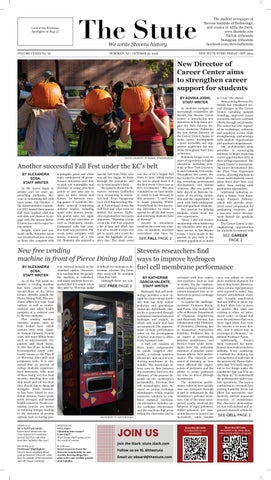
Another successful Fall Fest under the EC’s belt BY ALEXANDRA SOSA, STAFF WRITER As the leaves begin to crinkle and we start approaching midterms, Stevens is welcoming fall with open arms. On October 7, the Entertainment Committee (EC) hosted their annual Fall Fest, packed with fun activities and chances to engage with the season before it turns too cold to enjoy being outside. Despite winds and seasonal chills, Schaefer Lawn was transformed into a classic farm vibe, complete with
a pumpkin patch and white tents reminiscent of greenhouses. Attendees were able to pick out a pumpkin and decorate it using provided paints or just take one to spice up their dorms and homes. In between rousing games of cornhole, students enjoyed comforting autumn staples, including apple cider donuts, pumpkin pound cake, hot apple cider, and hot chocolate, as well as charcuterie snacks. Compared with last year, less food was provided. The event came complete with music, courtesy of a live DJ. Students also enjoyed a
special visit from Tillie, who was all too happy to frolic through the pumpkins and try to steal people’s food. We spoke to Event Co-Directors Autumn Gallicchio (2/4 Accounting & Analytics) and Evan Papageorge (4/4 Civil Engineering, Music & Technology) about the Fall Fest and what went on behind the scenes. Gallicchio explained her view as an organizer: “Planning a large event like Fall Fest requires a lot of time and effort, but it is all so worth it when you get to watch your event become the highlight of people’s day. The 2026 event
was one of EC’s largest Fall Fests to date, which makes me feel so proud since it is the first event I have run as EC’s Co-director.” She also reminded us we have another event to look forward to this semester: “I can’t wait to begin planning Winter Wonderland for this upcoming December to make it special for all the first-years and returning students here at Stevens!” Anyone in attendance could see the event was a success, as students swarmed everywhere and lines for
SEE FALL PAGE 2
As students navigate an increasingly competitive job market, the Stevens Career Center is introducing new initiatives to help them prepare for their futures. Rebecca Andersen Polimeda, the new Senior Director of the Career Center, hopes to make career development a more accessible and supportive experience for students throughout their time at Stevens. Polimeda brings over 20 years of experience in higher education, including positions at New York University and Columbia University. Throughout her career, she has worked in student advising, recruiting, professional development, and alumni relations. She was particularly drawn to Stevens because of its strong reputation and the opportunity to work with both undergraduate and graduate students. Her passion for helping students stems from her own experiences. “Since I did not receive mentorship when furthering my education after my military service in the Marine Corps, I have made it my passion to give back to the student population as much
as I can,” she shared. Since joining Stevens, Polimeda has introduced several changes to the Career Center, including updated branding, improved career resources, and new outreach efforts through social media. The center has also expanded its workshops, webinars, and employer events while strengthening partnerships with student organizations and academic departments. One of Polimeda’s main priorities is encouraging students to begin exploring career opportunities early in their college experience. The Career Center is incorporating career development into the First Year Experience course, allowing students to create individualized career plans from their first year rather than waiting until graduation approaches. Additional initiatives include a Senior Year Experience Passport Pathway, which will provide structured career preparation for graduating students, and a two-year career development kickoff for graduate students. The Career Center is also emphasizing opportunities for students to connect with
SEE CAREER PAGE 2
New free vending Stevens researchers find machine in front of Pierce Dining Hall ways to improve hydrogen tein oatmeal instead of the it difficult for students to de- fuel cell membrane performance BY ALEXANDRA standard option. However, termine whether the items SOSA, STAFF WRITER
As of the Fall 2026 semester, a vending machine has been placed on the second floor of the Howe Center, directly outside the Pierce Dining Hall. This machine offers low-cost food options as well as contraceptives and other health products at a reduced cost to Stevens students. This vending machine includes snacks such as fruit leather bars, which contain only fruit, Quaker Instant Oatmeal Protein cups, and more filling items such as microwavable rice packets and black beans. It also has items including levonorgestrel (more commonly known as the Plan B or Morning After pill) and pregnancy tests. It is estimated that 23 percent of college students experience food insecurity, with most of these being very low food security, meaning they will skip meals and eat less than they should due to financial struggles. Food insecurity has been linked to academic distress, lower grade point averages, and mental health concerns. Foods containing protein are better at satiating hunger, leading to the inclusion of protein options such as having pro-
it is unclear how frequently the machine is restocked, and many students have reported that it is empty when they pass by. This may make
SCIENCE (6)
FEATURE (4-5)
PULSE (10)
Professor Highlights! Do you know anything about your professors? Discover what they do outside of the classroom and why began teaching!
SEE FREE PAGE 2
DNA zips? Vitamins into water? Lost City? Read about what’s going on in the world of science. Read answers from the Stevens community to our weekly Roving Reporter, plus solve our weekly puzzle and sudoku.
BY KATHERINE GARCIA VALENTE, STAFF WRITER Hydrogen fuel cell technology provides a new insight for clean-energy methods that can help reduce pollution and greenhouse emissions. Specifically, electricity is generated through a chemical reaction between hydrogen and oxygen, in which only water and heat are produced. The improvement of their performance relies on the development of better materials to effectively transport ions. A fuel cell consists of three main components: an anode (negative electrode), a cathode (positive electrode), and an ion-conducting membrane in the middle. The membrane allows ions to flow between the electrodes; however, the efficiency of the process depends on the membrane’s permeability. Previous fuel cell technologies have focused on proton exchange membranes, which require expensive catalysts to continue chemical reactions. An alternative includes anion exchange membranes, and the reactions that occur within the electrodes can be
ARYAN BASETTY FOR THE STUTE
NEWS (2-3)
EC’s Fall Fest 2026! Learn more about how the Entertainment Committee hosted Fall Fest and what food they included this year!
they need will be available when they visit. Although there are con-
activated with less expensive catalysts, such as iron or nickel. On the contrary, anion exchange membranes cannot transport ions as effectively as proton exchange membranes. To combat the challenge, Assistant Professor Benjamin Paren, who studies fuel cells at Stevens Department of Chemical Engineering and Materials Science, has collaborated with Professor of Chemistry Chulsung Bae at Rensselaer Polytechnic Institute. Professor Bae is an expert at synthesizing polymer membranes, and Paren’s team could investigate how the molecular structure of polymer membranes affects their performance. The research consisted of focusing on how water affected the organization of polymers and the ability to create pathways for ions to travel through membranes. The membrane performance relies on how quickly ions can transport through it and is influenced by the membrane’s polymer structure. One of the most unexpected results involved the behavior of rigid polymers. Stiffer polymers are commonly known to restrict ion movement, while flexible
ones can adjust to create more uniform channels for ions to flow faster. However, when certain rigid polymers were exposed to water, they formed well-defined channels. “Usually, membranes that are stiffer or more rigid don’t allow ions to move as quickly. But what was exciting is when we introduced water, we found that even the polymers that were more rigid when they were dry became a lot more flexible. And it allows ions to rearrange in channels,” explained Professor Paren. Additionally, Paren’s team examined the membranes’ nanoscale structures utilizing X-ray scattering, a method for studying the arrangement of materials at the microscale. Paren elaborates that “It’s really important to test things under the conditions that you’ll be using them in,” to understand the performance under realistic operations. The team is continuing to research how varying humidity levels can affect ion movement, conductivity, and the nanoscale structure of membranes. The discovery demonstrated that well-defined and organized channels within hy-
SEE CELL PAGE 2
Friday, October 16
2
News FALL
Masthead Volume CXXIIII No. 06
CONTINUED FROM PAGE 1
Executive Board
EDITOR-IN-CHIEF.............................JIYA JAISINGHANI ‘27 BUSINESS MANAGER.......................CAMRYN WINANT ‘28 MANAGING EDITOR.................................TIANNA SPITZ ‘27 LAYOUT EDITOR.......................................CLAIRE DEANS ‘29 OUTREACH CHAIR................................ISABELLA FAMA ‘29 DIGITAL MANAGER.........................CHARMY KOTADIA ‘27 SECRETARY.....................................JOSEPHINE CHOONG ‘28
Editorial Board
NEWS EDITOR...................................JOSH BODENSTEIN ‘29 SCIENCE EDITOR.......................................DISHA GOHIL ‘28 OPINION EDITOR....................VEDHESH A. KAMARAJ ‘28 SPORTS EDITOR..........................MILAGROS CARBAJAL ‘28 FEATURES EDITOR ...........................PRISHA VAGVALA ‘28 HEAD COPYEDITOR................................KAILEY SUPAN ‘29
food and pumpkins snaked along pathways. Papageorge expressed his excitement: “I am very happy to say that Fall Fest was a successful event! With 700 attendees, I loved watching everyone enjoy the games, pumpkins, food, and fall vibes! We are looking forward to hosting another great Fall Fest next year — and now we’re heading to a season of planning for Winter Wonderland on December 2!” The Fall Fest was a resounding success, but the Entertainment Committee is far from done. The EC also plans several other events, including the upcoming Winter Wonderland on December 2.
Operations Board
HEAD PHOTOGRAPHER.................BRADY SANSOTTA ‘29 ASST. LAYOUT EDITOR...........................LIEU BUTLER ‘29 ASST. LAYOUT EDITOR..........................ALANA JONES ‘29 ASST. LAYOUT EDITOR..............................SACHEL GIL ‘30 ASST. LAYOUT EDITOR........................SHRI SARANYA ‘30 ASST. SOCIAL MEDIA...............................CHRISTINE YI ‘29 DELIVERY BOY...................................MARTIN MURIITHI ‘29
Staff & Contributors Advika Joshi Ryan Levinter Alexandra Sosa Kathy Garcia Krutin Valalla Jack MacDonnell Ashley Elias Flores Ansley Castro Flor Vasquez
Srikar Velam Sean Palermi Reka Winacht Charles Beale Maya Meents Emily Fanizza Breona Pizzuta Brooke Nagurka Dominic Souza
Wesley Yu Sydney Leung Fiona Shi Aryan Basetty
Contact Us
GENERAL.........................................EBOARD@THESTUTE.COM EDITOR-IN-CHIEF.........................EDITOR@THESTUTE.COM ADVERTISING.............................BUSINESS@THESTUTE.COM OFFICE.................................UNIVERSITY CENTER ROOM 216B
Corrections NOTICE A MISTAKE? Email us at eboard@thestute.com.
Disclaimer
All opinions and editorials reflect the views of their respective author(s). No Part of The Stute may be reproduced in any form, in whole or in part, without the written consent of the Editor-in-Chief. Cited references of The Stute are permitted.
Policy on Letters to the Editor
All members of the Stevens community are able to submit a Letter to the Editor to be published in The Stute. Letters must refer either to a piece published in The Stute or to The Stute in general and must be between 400 – 800 words in length. Submit letters to editor@thestute.com with your name and title (when applicable) or using our Google form. For writers who wish to write a Letter to the Editor anonymously, please see our policy on anonymity. The Editorial Board reserves the right to choose whether or not to publish a submitted Letter to the Editor based on a majority rule vote, and additionally reserves the right to edit letters for clarity or request authors to revise. Provided that the author approves the final version, The Stute reserves the right to edit letters according to our copy editing procedures, defined in our policies.
Policy on Op-Eds
All members of the Stevens community are able to submit a standalone opinion piece (otherwise known as an Op-Ed) to be published in The Stute. Op-Eds must be between 400 – 800 words, but longer submissions will be considered on a case-by-case basis. To submit an OpEd please email eboard@thestute.com with your name and title (when applicable) or using our Google form (tinyurl.com/submit-t0-stute). For writers who wish to write an Op-Ed anonymously, please see our policy on anonymity. The Editorial Board reserves the right to choose whether or not to publish a submitted Op-Ed based on a majority rule vote, and additionally reserves the right to edit Op-Eds for clarity or request authors to revise. Provided that the author approves the final version, The Stute reserves the right to edit Op-Eds according to our copy editing procedures, defined in our policies.
FULL LIST ON thestute.com/policies
tinyurl.com/stutesubmit
PHOTO COURTESY OF SAMUEL STRASSBURGER
CAREER
CONTINUED FROM PAGE 1 professionals and alumni. Alongside the return of the large-scale, in-person Career Expo this fall, the center is launching a biweekly alumni panel series covering industries such as finance, engineering, healthcare, technology, and artificial intelligence. These efforts come as many college students face uncertainty about their professional futures. Polimeda recognizes how increased competition, lengthy hiring processes, and changing employer expectations have made the job search particularly stressful. She has also noticed that stu-
FREE
CONTINUED FROM PAGE 1 doms placed in most vending machines in residential halls and other parts of campus, this inclusion aims to make other forms of contraceptives and items to assist students more accessible. The greater
CELL
CONTINUED FROM PAGE 1 drated polymers offer promising insight for the support of efficient ion transport. The research was published in the journal Macromolecules and has demonstrated the importance of evaluating membranes in their hydrated, working state. Furthermore, it has revealed how a material’s performance can change dramatically under real operating conditions. The application of hydrogen fuel cells can benefit electrolyzers, which split water molecules into hydrogen and oxygen. Energy produced by renewable sources, such as wind or solar power, can be utilized to produce hydrogen through electrolyzers. In return, the hydrogen can be stored until it is later needed and converted back into electricity by fuel cells. Paren expressed, “It is an important step forward for the field that hopefully others working on similar systems will be able to build off of as well.”
dents increasingly compare their progress with their peers, often feeling discouraged when they have not yet secured internships or full-time positions. “One of my primary goals is to help alleviate some of the pressure they are experiencing by providing clear direction, actionable goals, and a sense of perspective as they continue to move forward,” Polimeda explained. Rather than focusing solely on resumes and job applications, she believes career services should also help students develop confidence, resilience, and realistic expectations about entering the workforce. Ultimately, Polimeda hopes students will view the Career Center as a resource they can turn to
throughout their academic journeys, regardless of where they are in their career preparation. “The goal is simple: Make sure no Stevens student feels like they are navigating this alone.”
visibility of contraceptives in higher education is supported by statistics proving comprehensive sex education reduces teen pregnancy rates by 30% globally. This initiative has been funded by the New Jersey Office of the Secretary of Higher Education’s Hunger-free Campus Grant. This grant has committed 1.2 million dollars to combat food insecurity on col-
lege campuses and was made to foster innovative approaches to assist students experiencing food insecurity. 36 institutions, including Stevens Institute of Technology, Drew University, and Rutgers University, are receiving this grant. Overall, this vending machine is an initiative from the college that aims to make it easier for students to make healthier decisions.
PHOTO COURTESY OF REBECCA ANDERSEN POLIMEDA
SUBMIT YOUR ARTICLE IDEAS TO THE STUTE! Help us craft articles that resonate with you. Whether you prefer to remain anonymous or wish to disclose your identity, your input matters!
tinyurl.com/ stutesubmit
Friday, October 16
3
News LOCAL NEWS Hoboken selected for $70,000 in resident-led neighborhood projects BY KRUTIN VALLALA, STAFF WRITER Hoboken was selected as one of 25 local governments nationwide to join Love Your Block on September 30, a program that provides $70,000 to support resident-led neighborhood improvements. The Bloomberg Center for Public Innovation at Johns Hopkins University announced the new participants on September 22, with Hoboken joining municipalities across 20 states. The city’s proposed focus area includes the Hoboken Housing Authority campus and the surrounding southwest Hoboken neighborhood. Residents will help identify local needs and lead projects to improve spaces in their community. The funding can support mini-grants, volunteer activities, neighborhood beautification, and community partnerships. The city has not yet outlined individual projects in its announcement, but described the initiative as an opportunity for residents to take a direct role in improving neighborhood quality of life.
“In Hoboken, we know that some of the best ideas for improving our community come directly from the people who live here,” Jabbour said in the announcement. She added that the program would give residents resources and support to turn their ideas into projects. Hoboken will also receive expert support from the Bloomberg Center and a dedicated Love Your Block Fellow to assist with the work. Across participating cities, the program supports efforts such as clearing vacant lots and reclaiming public spaces. Jersey City and Newark were also selected for the latest group, making Hoboken one of three New Jersey municipalities included. Love Your Block began in 2009 with support from Bloomberg Philanthropies. According to the program’s website, it has helped 50 local governments engage more than 88,000 residents across 33 states. Those participants have removed more than 7 million pounds of trash, cleaned over 550,000 square feet of graffiti, and created nearly 800 art displays. The program also aims to
strengthen relationships between residents and local government. Its approach gives residents a role in identifying problems and working with city officials to address them, while providing funding and assistance to carry out the improvements. Other cities have already used Love Your Block funding for
neighborhood projects. In April 2026, Columbia, MO, announced 10 selected projects from 23 applications. The projects included removing invasive plants and adding native plants at a local park, creating a pollinator garden, and refreshing a neighborhood mural. The city also reported that the program funded 11
projects in 2025. Residents interested in participating will need the local program details, including information on how to get involved. The city said in its September 30 announcement that additional details would be released in the coming weeks.
PHOTO COURTESY OF PATCH.COM
Judge orders New York to restart second-home tax and start over BY JACK MACDONNELL, STAFF WRITER New York City Mayor Zohran Mamdani has faced significant resistance in his quest to successfully raise taxes on the upper class of the city, as on Tuesday, Staten Island judge Wayne M. Ozzi ruled in favor of homeowners who have sued the city’s administration and its new tax laws. A large part of Mayor Mamdani’s campaign for office was his claim of increasing taxes on the extremely wealthy upper class of the city to help fund improved infrastructure for the city, with a heavy emphasis on those who own homes and apartments in the city but don’t use the property as their primary residence. One of the big promises to the city was to improve infrastructure and quality of life, with things like cracking down on potholes and trying to decrease the cost of public transit like the subway and buses. With this increased ambition of projects, it’s critical that the increase in funding coming from the taxes on the upper class is prominent.
A group of Staten Island homeowners has sued Mayor Mamdani’s administration for erroneously including their homes in a newly implemented pieds-àterre property tax — a tax meant to apply to secondary homes, targeting people who keep vacation homes and properties that aren’t their primary residence in New York City. It’s part of the Mayor’s plan to prioritize New Yorkers and citizens who live in the city day to day. When this tax was rolled out, it sent letters out to every property that could be considered a secondary residence. The owners of the property were then given until September 18th to prove that the property was their primary residence, lest they be included in the tax. The homeowners who are suing the city do so under the explanation that the city was far too broad in picking which homes were to be included on the list, causing unnecessary burden and stress on those who now have to prove to the city that they live in their domiciles. As New York City takes on a large shift under the new mayoral administration, some growing pains and public outcry are
expected. Historically, a more hands-on approach by the government has always been a cause
for frustration with the public, but time will tell whether or not the extra effort will be worth it
to try and make one of the most iconic cities in the world a little better.
PHOTO COURTESY OF NYDAILYRECORD.COM
NATIONAL NEWS Trump’s plans reshape D.C BY ASHLEY ELIAS FLORES, STAFF WRITER President Donald Trump is pursuing a series of projects to change the White House and other parts of Washington, D.C. The plans include a new White House ballroom, renovations to public spaces, and a proposed triumphal arch at Arlington National Cemetery. The administration has cited security, modernization, and the commemoration of American history as reasons for the projects, while preservation groups and other critics have raised questions about their costs, effects on historic sites, and legal requirements. One of the largest projects is a proposed 90,000-square-foot ballroom at the White House, estimated to cost $400 million. Trump has said the facility would accommodate large events and include security features such as bomb shelters and defenses against drones and missiles. The project follows the demolition of the historic East Wing, which previously housed offices
and other facilities. The demolition and construction plans have faced legal challenges over the administration’s authority to proceed. Reuters’ report on the administration’s projects states that the Supreme Court allowed construction to continue in August while the legal dispute proceeded. Changes have also been made to the White House grounds. The Rose Garden’s grass lawn was replaced with a stone patio and outdoor seating, and additional statues and other features were introduced around the presidential complex. A granite helipad was also planned for the South Lawn in place of the flagstone walkway that had lined the West Wing colonnade. These changes have altered the appearance of the grounds, which have served as part of the White House complex for decades. Another proposal involves a 250-foot triumphal arch near the Lincoln Memorial and Arlington National Cemetery. Trump has described the structure as a monument to the United States and has also discussed potential
national security uses. However, the proposal has prompted opposition from veterans, lawmakers, and historic preservationists. NBC Washington reported on a protest against the proposed arch, where opponents raised concerns about its size, its potential effect on historic views, and whether congressional approval is required. The debate involves questions about the structure’s design, its location near Arlington National Cemetery, and the process required to approve construction. The administration has also undertaken work on the Lincoln Memorial Reflecting Pool. Trump initially estimated that the renovation would cost up to $2 million, while the administration pursued a project costing more than $16 million. Following the work, the pool developed visible problems, including peeling paint and algae growth. Officials initially attributed the damage to vandalism, but prosecutors later cited a rushed installation process. A judge dismissed the vandalism charges in October, according to Reuters’ overview
of the projects. Plans for Lafayette Park, across from the White House, have also drawn attention. The administration has pursued a proposal for permanent fencing around the park, which has historically served as a gathering place for demonstrators. NPR’s reporting on the proposal examined the administration’s security rationale alongside concerns about public access and the ability to protest near the White House. Together, the projects cover a range of goals, from upgrading facilities and adding security features to changing the design of public spaces and commemorating American history. Their effects will depend on how the projects are implemented, how legal disputes are resolved, and whether proposed plans receive the necessary approvals. As the work continues, the projects raise broader questions about how Washington’s landmarks should be maintained, how public spaces should be managed, and what authority a president has to change historic
federal property. The decisions surrounding these initiatives will help determine the future appearance and use of some of the capital’s most recognizable sites.
PHOTO COURTESY OF CAPRADIO.ORG
Friday, October 16
4
Feature
PROFESSOR TAKEOVER
Advice to professors from a student’s perspective
BY PRISHA VAGVALA, FEATURES EDITOR First, I want to preface this arti‑ cle by saying that being a professor is truly an extraordinary job. On top of all the research, studies, and pro‑ fessional accomplishments you have achieved throughout your academ‑ ic career, you also have to manage teaching students, maintaining com‑ munication with them, and grading hundreds of papers. Although as a student, I can only offer my own per‑ spective, certain policies, structures, and experiences have made me ap‑ preciate my professors a lot more. I understand that communicating with students can be difficult, espe‑ cially when it comes to attendance policies. However, as a student, commuting, balancing job inter‑ views, jobs, constantly getting sick, and dealing with other extenuating circumstances can make it difficult to attend every class or show up on time. While I believe students should communicate these circumstances with their professors, I also believe professors should extend some lev‑ el of empathy and understanding in return. Some professors underestimate how packed a student’s schedule can be. The amount of work assigned can sometimes feel unrealistic, es‑ pecially when professors prioritize their courses without considering the workload students have across their other classes. Keeping this in mind when assigning work, especial‑ ly when considering how much time an assignment realistically requires, is crucial when creating an effective learning environment. I have found that the projects with the clearest instructions, in‑ cluding examples of past projects, have been the most helpful. I have dealt with numerous projects with vague instructions, and when you ask for help, you sometimes end up even more confused. Make it clear what needs to be done so that expec‑ tations are not left up for interpre‑ tation. The clearer the instructions, the easier it is for students to meet expectations and for professors to achieve the common goal of produc‑ ing high-quality work. Professors have different policies concerning AI, and I respect that. Although I will say that students will use AI regardless, whether it is pro‑ hibited or not. This is purely opin‑ ionated and depends on the case, but creating an open conversation about AI use is better than shunning the topic of AI completely. One thing I especially liked in my Social Psychol‑ ogy class was how the professor asks that if we use AI, we should include a disclosure. This encourages open and honest conversation about AI use. It does not have to be exactly the same for every class since, for a cod‑ ing assignment, that approach would be counterproductive. However, I think it is important to acknowledge AI use and consider how to help stu‑ dents understand the implications it can have on their own learning. If you notice your class is not in‑ teracting or it is always the same students participating, chances are a majority of students may not under‑ stand what is going on. You need to alter your teaching strategy to find what works best for your class. I’ve seen numerous professors who are well-versed in their subjects, but as educators, they should know how to teach. Making your class as interac‑ tive as possible is the key to engaging an otherwise disengaged class (lec‑ ture-style classes are where students often struggle to pay attention). If students do not know the answers, don’t take it personally. Instead of moving on to another student to ex‑ plain the answer, take the time to walk the student through the rea‑ Continued on thestute.com
Dr. Querido’s life outside of the classroom BY JOSEPHINE CHOONG, SECRETARY For Dr. William Querido, his day doesn’t begin with reviewing lesson plans or preparing research papers. It starts with taking care of his two beloved dogs and a cup of Brazilian coffee. Dr. Querido is an Assistant Pro‑ fessor in the Department of Biomed‑ ical Engineering. A majority of his career is dedicated to studying bones as more than a hard structure. His lab uses tools like infrared spectros‑ copy and imaging to study a bone’s composition and molecular organi‑ zation to answer broader questions about bone structure and health. Before opening his own lab at Stevens, he previously taught at Temple University in Pennsylvania. Throughout the week, he bal‑ ances his research responsibilities, teaching tasks, and running lab ex‑ periments. From analyzing data, planning experiments, studying, to meeting with students, there isn’t a single typical day for Dr. Queri‑ do. He particularly appreciates lab days where he can run experiments with students and delve into topics in depth. This semester, he teaches
BME 502, a Biomedical Engineering class for senior students. Dr. Queri‑ do likes interacting with students with different backgrounds as they bring unique perspectives to discus‑ sion. However, his research and class‑ room instruction only showcase some aspects of his life. They don’t tell Dr. Querido’s full story. Outside of the classroom, Dr. Querido enjoys spending quality time with his wife and two dogs. While the dogs were initially his wife’s idea, Dr. Querido instantly fell for them once they en‑ tered his life. The elder dog is a Bea‑ gle mixed with a King Charles, while the younger is a mini Dachshund. He considers both dogs to be extremely sweet and very spoiled. During his free time, he’s an avid movie watcher and enjoys horror films. Some of his favorite horror movies are Obsession, Possession, and House of 1000 Corpses. Addi‑ tionally, Dr. Querido loves cooking a variety of dishes, especially Brazilian dishes. He can make delicious pas‑ ta (especially bolognese) and pizza from scratch. Since moving to Hoboken, Dr. Querido has enjoyed the large vari‑ ety of great restaurants, good plac‑ es for walking, and its proximity to
New York City. His favorite Hobo‑ ken restaurants are Apulia, for their pizza, Martha’s, for their cauliflow‑ er appetizer, Anthony David’s, and Barbès. He’s currently on the hunt for good taco restaurants. At the end of the semester, he will take his annual trip to Brazil. As he’s from Rio, he loves Brazil’s environ‑ ment, lush green, plenty of birds, and good food. He’s especially looking forward to Brazil’s beautiful beach‑ es along with the unique patterns etched into the boardwalk tiles. Dr. Querido loves the beach Arpoador so much that he has a tattoo of it. He recommends that students explore and take advantage of Ste‑ vens’ various resources. Dr. Querido encourages students to notice their likes and dislikes, as they reveal their interests and potential paths. Dr. Querido emphasized that having good relationships between students and professors will lead to better communication and respect between the two parties. One of his objectives is having students feel comfortable enough to reach out with questions and ideas. He wants to create an en‑ vironment where students don’t see professors as distant figures who as‑ sign exercises, but as regular people who want to support students.
What do professors do when they aren’t teaching? BY FLOR DEL SINAI VASQUEZ, CONTRIBUTOR Students are usually only exposed to the teaching side of their profes‑ sors. What they know is whether their professors are harsh graders, assign a lot of homework, or explain concepts well. However, just like ev‑ eryone else, professors have interests and hobbies they enjoy outside of work. To learn more about this side of our professors, I had the chance to speak with Dr. Jennifer McBryan and Dr. Daniela R. P. Weiner about how they spend their free time and what they enjoy doing beyond the class‑ room. Dr. McBryan, who works as the Associate Dean for Undergraduate Studies, is loved by her students. She is known for helping students build their academic writing skills, her passion for teaching, and her engaging lectures. Apart from her professional life, she enjoys spend‑ ing time with loved ones, including her son and close friends. One of her favorite things to do is read. She also shared that she loves going on hikes
and cooking. These activities give her a chance to spend time doing things she enjoys outside of her responsi‑ bilities at work. Students might be surprised to learn that even with her busy schedule, she still finds time to pursue her various hobbies and spend time with the people closest to her. Dr. Weiner, Teaching Assistant Professor in the School of Human‑ ities, Arts and Social Sciences, is a historian who specializes in modern European history, modern Jewish history, and the Holocaust. She also teaches several courses at Stevens. Dr. Weiner is well-liked by her stu‑ dents and valued for the connections she builds with them. Although her work keeps her busy, she has inter‑ ests that allow her to take a break from her daily responsibilities. When she is not on campus, she enjoys try‑ ing out new and “fancy” coffee shops around Hoboken. She also likes going on walks with a coffee in hand. For her, getting outside and exploring the area is one way to enjoy her free time. Similar to Dr. McBryan, Dr. Weiner has a busy schedule, especial‑ ly with her two-year-old son. When
she has the chance, she likes to go to the gym and exercise. Another inter‑ esting fact about Dr. Weiner is that she grew up around the New Jersey and New York area. She appreciates being able to work near the place where she grew up and enjoys spend‑ ing time in the area. After a busy day, one way she recharges is by be‑ ing outdoors. She loves taking in the fresh air while walking along the wa‑ ter, giving herself time to relax away from her responsibilities. Although Dr. McBryan and Dr. Weiner have different interests, both show how professors balance their professional and personal lives. Be‑ tween spending time with family, exploring Hoboken, reading, cook‑ ing, and exercising, they find ways to make time for themselves despite their busy schedules. Learning about their interests gives students a differ‑ ent perspective on their professors. Beyond teaching and helping stu‑ dents succeed, professors have their own lives, interests, and responsibil‑ ities that make them who they are outside the classroom. It’s important to know there is more to professors than what we see in class.
What were professors like as students, and what made them become professors? BY ANSLEY CASTRO, CONTRIBUTOR There are times when we often wonder what our professors were like before they stood at the front of the classroom. To find out, I spoke with four professors here at Stevens and learned how their college experi‑ ences ultimately led them to become the educators they are today. First and foremost, we have Pro‑ fessor Ying Wu, Associate Professor in the School of Business at Stevens. As a college student, she describes herself as “very introverted,” often keeping to herself and rarely speak‑ ing to professors. Her turning point came during her junior‑year math‑ ematics class, when a disappointing exam grade pushed her to knock on her professor’s office door for the first time. Professor Wu’s professor reviewed her work, understood her reasoning, and helped her earn a better grade — a moment that taught her the value of communicating rather than staying silent. Professor Wu grew up in rural China and was motivated by watching her parents work tirelessly, and dreamed of lift‑ ing her family out of low income. She earned her bachelor’s and master’s degrees in China before completing her PhD at Cornell University. One of her greatest inspirations was her
PhD advisor, whose commitment to teaching showed her the impact a professor can have. Today, she sees herself not just as faculty, but “a member who can provide help for the younger generation,” carrying forward lessons from her mentors and from her mother as well. Next up is Dr. Chris Shemanski, the Director of the First-Year Experi‑ ence in the Office of Student Affairs. As a college student, he began his undergraduate years unsure of his academic direction, starting as an environmental engineering major after letting go of his early dream of becoming a broadcast meteorologist. His first semester was difficult. Bal‑ ancing chemistry, calculus, and in‑ troductory engineering courses often left him overwhelmed, and he vividly remembers the embarrassment of once turning in a math quiz “literally blank” because he didn’t understand the material. He regrets not access‑ ing the materials he had at hand, like office hours and tutors. He attended a small liberal arts college, where he became a Resident Assistant for three years while also leading global ser‑ vice‑learning trips to Kenya. These experiences pushed him out of his comfort zone and helped him grow personally and socially. Academical‑ ly, he eventually switched to econom‑ ics and later added political science,
finding mentorship in Dr. Chasek, who sharpened his writing, public speaking, and critical thinking skills. His experiences ultimately fueled his PhD research on first‑year STEM re‑ tention and inspired his passion for supporting students. Today, he finds joy in watching students grow from their first semester to graduation, the very journey he once had to navigate himself. Now we have Professor Emmanu‑ el D. (Manos) Hatzakis, who is an In‑ dustry Professor and the Director of the Master’s in Finance and Master’s in Financial Engineering programs at the School of Business. As a college student, he came in with the mindset of “studying all the time,” with little social life because he didn’t want to fall behind, especially after realizing how smart his classmates were. De‑ termined to keep up, he spent nearly all his time preparing for classes and earned strong grades, though physics challenged him the most. He loved math and began as a mechanical engineering major. Coming into col‑ lege, he even imagined becoming a doctor, but his curiosity and passion for mathematics ultimately led him toward engineering instead. Unlike many professors, he didn’t have a mentor who guided him early on. In Continued on thestute.com
“What advice would you give to your younger self now?”
Sean Cashbaugh “Be more open to exploring and getting a little bit lost in whatever environment you’re in. It’s in those moments of confusion that you end up learning a lot about the world and yourself. Those surprises are often the ones that stick with you the most.”
Allyson Packer “Don’t be afraid to push the boundaries of your assignments. Keep up your relationships with your professors.”
Louis Segura “Stay the course, it’s gonna work out.”
Kevin Ryan “Time passes quickly. Treasure each moment. Trust in God. Stay close to your family and friends. And forgive yourself and others for mistakes.”
Joelle Saad-Lessler “Focus on the skills you develop during college and it will make you more resilient in your career. Your journey through college is about learning — not just technical skills but also learning to make social connections.”
Jennifer McBryan “If you make important friendships in college, make sure to maintain them as an adult because those relationships will see you through a lot.”
Friday, October 16
5
PHOTO COURTESY OF STEVENSDUCKS.COM SHOT BY DAVE JANOSZ
Sports
ON DECK IN SPORTS FRI, OCT 16 WOMEN’S VOLLEYBALL Bridgewater College Bridgewater, VA 6 p.m.
SAT, OCT 17 MEN’S CROSS COUNTRY Rowan Border Battle Logan Twp, NJ 11:45 a.m. WOMEN’S AND MEN’S TENNIS Misericordia University Bayonne, NJ 11 a.m. WOMEN’S AND MEN’S SWIMMING Rowan University Hoboken, NJ 12 p.m.
Women’s and Men’s Swimming fall to Rowan in season opener BY KRUTIN VALLALA, CONTRIBUTOR The Stevens Men’s and Women’s Swimming teams hosted Rowan University on October 10 in Hoboken. The men fell 135127, while the women lost 146116, despite winning eight events. The men recorded six individual victories, finishing eight points behind Rowan. The Women’s Swimming team opened with a win in the 200yard medley relay. Junior Delaney Klaus, senior Ashley Settle, sophomore Samantha Gallo, and freshman Caitlyn Baum finished in 1:52.20, beating Rowan’s top team by 0.74 seconds. Klaus won both backstroke events, taking
the 100-yard race in 1:00.11 and the 200-yard race in 2:13.03. Junior Eszter Kiss also earned two individual wins, finishing the 200-yard freestyle in 2:00.25 and the 500-yard freestyle in 5:21.64. Baum and Kiss took first and second in the 50-yard freestyle with times of 25.73 and 25.92, respectively. Baum later placed second in the 100-yard freestyle in 57.42. Junior Hanna Matheson added a victory in the 200-yard butterfly, finishing in 2:16.48. Junior Dora Dvorkin placed second in the 1,000-yard freestyle in 11:19.29 and third in the 200yard breaststroke in 2:35.35. The women closed with another relay win. Klaus, Kiss, Gallo, and Baum completed the 200-yard freestyle
relay in 1:42.46, finishing more than two seconds ahead of Rowan. For the Men’s Swimming team, freshman Rahul Shahani earned Stevens’ first win in the 200-yard butterfly with a time of 1:59.79. Sophomore Sebastien Nappi and graduate student Ron Gvishi finished first and second in the 100yard freestyle, recording times of 48.73 and 49.71. Junior Ethan Emerton won the 200-yard backstroke in 1:57.57, while freshman Ryan Bailey took the 200-yard breaststroke in 2:14.22. Freshman Owen Yam and junior James Johnson followed Bailey in third and fourth, giving Stevens three of the event’s top four places. Freshman Achilles Scaper-
das added a win in the 500-yard freestyle in 4:52.66. Freshman Jonah Briggs then won the 100yard butterfly in 52.62, finishing one-tenth of a second ahead of the runner-up. Sophomore Cooper Moffatt and Shahani placed second and third in the 200-yard individual medley, finishing in 2:01.98 and 2:02.93, respectively. The men finished second and third in the final 200-yard freestyle relay. Briggs, Nappi, Sean Perez, and Gvishi led Stevens with a time of 1:28.20. The women will visit Kean University in Union, NJ, on October 23 at 6 p.m. The men will return to competition on November 6 and 7 at the NYU Fall Invitational.
FIELD HOCKEY Delaware Valley University Hoboken, NJ 11 a.m. WOMEN’S CROSS COUNTRY Rowan Border Battle Logan Twp, NJ 11:30 a.m. WOMEN’S VOLLEYBALL Randolph Bridgewater, VA 1 p.m. WOMEN’S SOCCER Delaware Valley University Hoboken, NJ 2 p.m. WOMEN’S TENNIS King’s College Bayonne, NJ 2 p.m.
PHOTOS COURTESY OF STEVENSDUCKS.COM
WOMEN’S VOLLEYBALL Marymount University Bridgewater, VA 3 p.m. MEN’S SOCCER Delaware Valley University Hoboken, NJ 5 p.m.
SUN, OCT 18 WOMEN’S TENNIS Moravian University Bethlehem, PA 10 a.m.
MON, OCT 19 MEN’S GOLF York Spartan Fall Tournament Day 1 York, PA TBD.
TUE, OCT 20 MEN’S GOLF York Spartan Fall Tournament Day 2 York, PA TBD
STEVENS SCOREBOARD DATE
WED, OCT 7
FRI, OCT 9 SAT, OCT 10
SUN, OCT 11 TUE, OCT 13
TEAM
OPPONENT
LOCATION
FIELD HOCKEY WOMEN'S VOLLEYBALL MEN'S SOCCER WOMEN'S VOLLEYBALL MEN'S GOLF MEN'S AND WOMEN'S CROSS COUNTRY
DESSALES UNIVERSITY ARCADIA UNIVERSITY MARYWOOD UNIVERSITY RUTGERS-NEWARK MASON-DIXON COLLEGIATE CLASSIC DAY 1 22ND ANNUAL NJIT XC INVITATIONAL
HOME AWAY AWAY AWAY AWAY AWAY
MEN'S AND WOMEN'S SWIMMING WOMEN FIELD HOCKEY WOMEN'S SOCCER MEN'S SOCCER MEN'S FENCING MEN'S FENCING MEN'S GOLF MEN'S SOCCER WOMEN'S VOLLEYBALL
ROWAN UNIVERSITY
HOME
ROWAN UNIVERSITY MARYWOOD UNIVERSITY LEBANON VALLEY COLLEGE LEBANON VALLEY COLLEGE NORTH AMERICA CUP DAY 1 NORTH AMERICA CUP DAY 2 MASON-DIXON COLLEGIATE CLASSIC DAY 2 SWARTHMORE COLLEGE DESALES UNIVERSITY
HOME HOME AWAY AWAY AWAY ORLANDO, FLA WAYNESBORO, PA SWARTHMORE, PA HOBOKEN, NJ
SCORE
W (3-0) W (3-0) L (0-1) W (3-0) COMPLETE :+4 3RD PLACE MENS, 5TH PLACE WOMENS L (116-146) WOMENS, L (127-135) 12 P.M. W (6-0) W (4-0) T(0-0) COMPLETE COMPLETE CANCELED 7 P.M. 7 P.M.
Friday, October 16
6
Science Scientists just found a new way to make hydrogen from water BY RYAN LEVINTER, STAFF WRITER Scientists have searched for a clean energy source for tasks such as car propulsion. Hydrogen has promising qualities: Instead of releasing large quantities of carbon dioxide as exhaust, it only releases water vapor and warm air. In addition to car propulsion, hydrogen is used in the process of ammonia production, metal refining, and plastics manufacturing. Companies including Toyota, Honda, and Hyundai have released hydrogen-based cars, but none were considered popular, with the best-selling being the Toyota Mirai, selling roughly 14,300 units. One reason for this is because of the limited availability of hydrogen fuel in the United States. A popular method of obtaining hydrogen is steam methane reformation (SMR). However, SMR also produces carbon monoxide and carbon dioxide, giving it similar issues to combustion engines. To combat this issue, a team at Oregon State University College of Science, led by Kyriakos Stylianou, created a photocatalyst, allowing for a cleaner means of producing hydrogen. A catalyst is a substance that increases the rate of a chemical reaction without undergoing a permanent change, and a photocatalyst is capable of absorbing
light to reach a higher energy level and speed up reactions. This photocatalyst is a crystalline, porous material known as a metal-organic framework (MOF). This is made of positively charged metal ions surrounded by organic molecules, resulting in a porous material, granting millions of possible different properties. There have been nearly 100,000 of these MOFs created to date, and the properties of over half a million have been predicted. This research centered on the MOF BVR-19, which contains a sulfide-to-sulfide bond, resulting in a reactive sulfur species when exposed to light. By not using metal ions, the reaction relies on the organic component, which is a different way of thinking about using MOFs to produce hydrogen previously. This MOF is also synthesized at room temperature spontaneously, meaning there is a strong energy advantage compared to previous methods such as SMR. Other methods to produce hydrogen are known as hydrolysis and may be more environmentally friendly than SMR, though this is dependent on where the energy is sourced from. This lays the groundwork for future research, though in its current state it cannot be utilized commercially; it costs $5 per kilogram versus $1.50 per kilogram from SMR. Nevertheless, this provides a positive outlook on the future of hydrogen-based energy.
Scientists finally see DNA “zip” itself together for the first time BY SRIKAR VELAM, STAFF WRITER One of the most fundamental parts of the human genome is deoxyribonucleic acid, more commonly known as DNA. DNA essentially contains the guidelines needed for the development of an organism, establishing it as an utmost necessity for the continuation of life. What most people don’t necessarily know as well is that DNA naturally carries a negative charge. Following general electrostatics, two objects with similar charges should repel each other. DNA, however, occasionally needs to join together for major processes such as genetic recombination, gene splicing, and, more negatively, cancer development. So how does such a process happen? Professor Agnes Noy and her team at the University of York witnessed the answer to this question when they watched two DNA pieces align with utmost precision. These fragments connected groove for groove, but how? Powerful computer simulations revealed that this was the work of positively charged metal ions appearing in between, serving as connection points between the two pieces. Professor Noy describes the discovery of such a process as one that “could help researchers identify regions of the genome specifically involved in DNA pairing.” DNA pairing is a crucial aspect of the human genome as it consistently allows DNA to be transcribed into RNA and later into amino acids. Additionally, this could have big implications for the advancement of gene repair in cells, plants and mammals alike. This process, now physically observed, provides crucial experimental evidence towards the electrostatic DNA zipper, presented 20 years ago by Professor Alexey Kornyshev of Imperial College London. The basis of this idea
revolves around discussing the effect of gathering ions on DNA’s electrical landscape. Specifically, as a direct result of DNA’s helical nature, these ionic charges are hypothesized to create a recurring pattern enabling helices to connect together. The researchers investigated this process by scanning DNA via atomic force microscopy, which is a technique developed to scan microscopic surfaces and generate incredibly high-resolution 3D topographic maps. In turn, this allowed the researchers to analyze how the DNA molecules were positioned. In tandem with this, advanced computer simulations and algorithms traced the behavior of individual atoms and molecules. The simulations revealed that dual-charged metallic ions effectively act as a bridge, interacting with both DNA molecules and keeping them in alignment. Dr. Thomas Catley of the University of Sheffield described it as “incredible to be able to directly visualize the long-hypothesized mechanism for the first time,” adding that these discoveries may illuminate deeper implications in multiple cellular processes. Dr. Victor Velasco-Berrelleza of the University of Sheffield added that “the simulations allow us to uncover the molecular mechanism behind [the DNA interactions].” Furthermore, the researchers discovered that the DNA does not automatically pair equally with every sequence, with some DNA strands creating far stronger contacts than others. Something similar was seen in another recent finding where researchers found that matching DNA sequences align more frequently than nonmatching sequences. Moving forward, these discoveries could hold major uses in numerous fields, including the likes of medicine, biology, and even technology. Findings like these pave the path forward for the frontier of humanity.
Common vitamin may be a useful treatment against a deadly brain cancer BY SEAN PALERMO, SCIENCE WRITER A study led by two researchers, both hailing from the Hotchkiss Brain Institute and Arnie Charbonneau Cancer Institute, has revealed promise for the common and inexpensive vitamin supplement, niacin (B3), in treatments for the cancer glioblastoma — a condition whose treatment has hardly budged since the 1970s. Glioblastoma is an aggressive form of brain cancer that has garnered the reputation of being notoriously difficult to treat through standard practices such as surgery, radiation, and chemotherapy. While as much of the tumor as possible is attempted to be removed, the ability for cells to spread into surrounding brain tissue makes complete removal extremely difficult. Even after difficult treatment, it is common for the cancer to return. At the University of Calgary, Dr. Voon Wee Yong, PhD, a neuroscientist part of the recent study, became aware of the potential treatment avenue during an earlier series of studies on how the immune system affects the brain. Screening more than a thousand compounds in search of the one that could “wake up” the immune cells, he noticed how niacin stood out — mice with brain tumors lived longer with the treatment than the ones who didn’t receive it. This success was promising enough to encourage Yong to move on to a study involving human subjects in notable collaboration with Gloria Roldan Urgoiti, MD, an oncologist specializing in brain cancers. The goal of this new study was to determine whether the vitamin could be used to help restore the
dampened immune cells in order to potentially fight the tumor cells by controlling niacin release alongside the recommended chemotherapy and radiotherapy. One of the first things the team needed to find was the highest dose that could be safely administered before side effects became a problem — finding 2,000 milligrams a day to be the ceiling. While the most common side effect complaint was flushing (warm, reddened skin the vitamin is known for and usually mild), at higher doses the team ran into more serious blood-related side effects. With this ceiling, the study shifted to looking for evidence that niacin may improve the lifetime of patients without worsening the cancer (progression-free survival). The researchers pledged to stop the trial if the progression-free survival failed to improve by at least 20% compared to older studies. From the 24 patients, the 20% threshold was surpassed when,
after six months, 82% of participants had not experienced a progression of their cancer — representing a 28% improvement compared to previous studies, according to the researchers. The team sees these early findings as promising for niacin’s effectiveness against the incurable cancer, though results are still preliminary and involve a relatively small group of patients. Looking toward the future, they hope to expand the study with 48 participants and conduct their final analysis by the end of 2026 or in early 2027. Roldan Urgoiti, a clinical associate professor at the Cumming School of Medicine at the University of Calgary, commented on these early results: “Glioblastoma is the most aggressive brain cancer in adults. Survival of patients with this condition hasn’t changed significantly for 20 years.” She continued, “Anything that may help should be explored, but it requires strict protocols and safety monitoring.”
PHOTO COURTESY OF SCIENCEDAILY.COM
The Lost City: life beneath the Atlantic Ocean and extraterrestrial biology BY RÉKA WEINACHT, SCIENCE WRITER Deep beneath the Atlantic Ocean, a landscape of jagged spires, small mounds, and monumental towers is home to a community of microbes, snails, and crustaceans. They all live at the bottom of the sea, some without any oxygen in the cracks and crevices of the hot springs forming these mounds, at temperatures reaching up to 104 degrees Fahrenheit. As absurd as it sounds, the Lost City Hydrothermal Field, as it is called, is real; it has been known to be located west of the Mid-Atlantic Ridge since the year 2000. The carbonate stacks and spires act as part of a huge vent system that spews hydrogen, methane, and other gases into the water around it. The tallest vent chimney is named Poseidon, standing at 200 feet tall and emitting hot fluids (liquids and gases) from multiple outlets. There is huge variability in the sizes of the towers; next to Poseidon is a small one named Beehive that measures just three feet tall, and on its other side is a 26-foot-tall block named IMAX that has a large protruding lip and stalagmite-like growths. No sunlight reaches these rocks; anything that manages to live amongst them must do so with an alternate energy source. The creatures that live in the Lost City are all extremophiles: they thrive in environments that are hostile to much of the life on Earth we are familiar with. Plants and animals we see on the surface of the Earth and in shallower waters all get their energy from the sun, directly or indirectly (i.e., by
eating other organisms that got energy from sunlight). Energy cannot be created or destroyed; life forms are just converting it from one form to another. Plants like trees, ferns, and grass, for example, take light energy and convert it into chemical energy, which is a more usable form for them. Animals then consume the chemical energy stored in plants, thus indirectly accessing energy that came to Earth from the sun. The creatures in the Lost City, however, have been living off of the hydrocarbons coming from the carbonate chimneys. The nutrients they depend on were produced not by interactions with sunlight, but by reactions underneath the ocean floor. This characteristic of the Lost City’s inhabitants means that it might be a good model for how life could exist on other planets. For example, Enceladus—a moon of Saturn with a liquid ocean beneath an icy outer layer—may have such an environment on one of its ocean floors. Even more intriguing is that this form of life may give us clues about how life first formed on Earth billions
of years ago. Life back then was very different from the life we know now, but basic mechanisms for catalyzing chemical reactions (essential for metabolism) and passing on genetic information must have existed in some form. The origins of life is an elusive, difficult field to study, and any clues that can help us piece together how biological systems came about from inorganic molecules are exciting steps for the scientific community. Although the Lost City was discovered decades ago, a study was published this July in Geochemistry, Geophysics, Geosystems reporting on a 1268-meter-deep (4160 feet) borehole sample that was drilled right next to the hydrothermal field. Studying the rock and seawater below it is what yields information about what environment and reactions produced the hydrothermal fluids ejected by the chimneys. As beautiful and intriguing as this underwater fantasy landscape is, the fluids it produces and the ecosystem it feeds can teach us even more intriguing things about the nature and origin of life.
PHOTO COURTESY OF OCEANEXPLORER.NOAA.ORG
INTERESTED IN SCIENCE JOURNALISM?Join our Science writing team! Reach out to Disha Gohil, Science Editor (dgohil3@stevens.edu) for more information – No experience necessary to write • thestute.com/category/science –
Friday, October 16
7
Opinion THE STUTE EDITORIAL
What is your move, Stevens? The Stute released its first Staff Op-Ed on October 9, 2026. This was not a decision that any of us took lightly. Rather, it was the culmination of months of disagreements, unfulfilled promises, and growing frustrations. A few weeks ago, I published my two Editorials, “The art of the PR response” and “Fail, get up, and try again,” which outlined the beginning and end of The Stute’s issues with the administration. As discussed in those pieces, the primary way the organization can be affected is when our production is halted because of a lack of information from them. We chose not to explore The Stute’s perspective in greater depth because, ultimately, it was not just about us. We did not have to seek out student leaders who felt concerned — they found us. Several student leaders approached me with an interest in sharing their experiences with the administration with the newspaper. I initially encouraged
them to write their own articles and submit them to The Stute for publication. It was not until we were directly affected that I found myself in an administrative office voicing my concerns. During the conversation, I recall saying something along the lines of, “I have so much evidence about how much they do not want us to share; I could make an article on it.” The response was quite simple: “Why don’t you?” And so, Staff Op-Ed came to fruition. The article was always intended to be a critique of administrative decisions rather than an attack. The administration has been viewing students through a glass window, and it is time they join us in the room, sit down, and level with us. I once heard an administrator remark that significant efforts have been made to shield students from the effects of the university’s current budget challenges. When asked to elaborate, they struggled to understand why students were concerned about the
changes and their impact on us. What changes, then, do not disrupt a student’s quality of life on campus: the credit reduction, shortened dining hours, reduced library hours, decreased tutoring center hours, additional dining upcharges, decreased food quality, the planned library closure beginning in Spring 2027, persistent construction disrupting class and essential walkways, and the faculty layoffs that leave students concerned about who will be able to support and mentor them. The list goes on. Since the Op-Ed was published, several alumni reached out to us, asking how they can help. Honestly, I do not have a definitive answer. We want to be brought into important conversations, we want to rebuild our trust with the institution, we want the administration to act with kindness, and, above all, we want transparency from Stevens. Students recognize that Stevens, like many other institutions nationally, are navigating bud-
get constraints. We understand that difficult decisions need to be made to sustain the school. But if we are expected to pivot, the faculty, administrators, as well as the Board of Trustees should be willing to do the same. This responsibility cannot fall disproportionately on the members of the community with the least influence over these decisions. This article is a cry for help, Stevens, and I hope the administration recognizes it as such. Throughout my term, I have been careful in determining what we publish. And for the first time, I chose a completely different approach. This time, I continued to follow our established guidelines and published this piece as an Op-Ed rather than a News article, despite having the evidence to back up our claims. We could have included more, but we didn’t. Student leaders have made their positions clear. Now, Stevens, what will you do?
Jiya Jaisinghani ‘27
Editor-in-Chief
SENIORITIS
MIND OF A FRESHMAN
What does it look recognize these bad habits, amount of effort it takes like to be alifelong learner
Breaking bad habits
BY KATHY GARCIA ‘30 As I get comfortable on campus, I recognize the major transition from teenage life to young adulthood. Only one month into this new environment, I feel as though I know everything and everyone on campus. Although college has encouraged me to become more independent, it has drastically changed my habits, routine, and lifestyle. Stevens has so many opportunities with clubs, work, and events that I want to try everything. With assignments and exams, it is difficult to manage my time and pursue everything at once. It has led me to procrastinate, which causes unnecessary stress and affects my work quality. As a result, I stay up late at night to finish assignments, which disrupts my sleeping schedule. Many students can relate to this endless cycle, and yet few break out of it. These habits go under the radar, even as students try to juggle both. Don’t get me wrong, I am guilty of convincing myself that I am powering through in college. I understand the effort and time it takes to even
but I believe that developing stronger routines in our daily lives can help establish these responsibilities and create motivation to continue holding ourselves accountable. A consistent schedule helps me stay organized and manage my time more effectively. For example, I have time in between classes to focus on reviewing assignments, completing classwork, or taking a break to relax. Although I do not have the same classes every day or at the same times, I enjoy the variation that each day brings. Additionally, I love to go out to eat with friends! As long as I get my work done, I can have fun with friends while enjoying really good food at the same time. The independence college brings is liberating. However, at the same time, it is disciplining, but when applied in the right ways, independence can push you towards better and bigger things. Some experiences here in college could be your first, and most of mine are, too. I think we should embrace experiences as they come, whether it is scary, exciting, or a mix of both. You never know what will happen, so experience everything while we are still young and free! My lifestyle is nothing like what I am used to. And honestly, whose lifestyle hasn’t changed? Sure, maybe people are from the city and are used to walking and public transportation. But you cannot deny the
to get used to school life as well. Seriously though, I am trying to get used to both, and it is a real challenge. What has helped me are my friends and the random activities we seek out, whether in Hoboken or in New York City. It has definitely fostered some memorable moments and welcomed distractions from school. There is so much to explore and things to do that you will genuinely never get bored here. As much as I hate to admit, I love the city life and the chaos it brings, whether it be strangers arguing on the side of the street or the loud music from the fraternities, it is all so new to someone from the suburbs. With this all said and done, the experience of college is not only academic success, but the new personal growth it brings and memories that can never be forgotten.
PHOTO COURTESY OF @R/COMEDYEMBALMING ON REDDIT
BY TIANNA SPITZ ‘27 I’ve been thinking a lot about what learning looks like beyond the classroom. I’m not sure what I’m looking to equip myself with going into young adulthood that hasn’t been modeled in academics. How problem-solving plays out in not just the correct multiple-choice answer or paper outline, but a lifetime of experiences, satisfaction, or missed connections. I’m grateful to my parents for the opportunity to earn a degree, their open-mindedness in pursuing a career of my choosing, and the wealth of knowledge a college setting provides. There’s something to be said for the rigorous academic game we play, but I know that college doesn’t seek to benefit students as people, of course, unless they return as generous alumni. I love the sense of awe that comes with tackling course material until it clicks or expands my mental world, and the academic progress made within one semester blows my mind — I’ve achieved the goals I set for myself as a freshman who was too timid to even
speak out loud, and then some. These reflections are valuable, but they push me to ask what else? Maybe I can take notes or pass a class, but how can I make sure I’m proud of my decisions, what are my hard lines, and what do I stand for? Clearly, I’ve been itching for graduation and to become the version of myself who has already made countless decisions, life-altering or even simply choosing to be kind even if I think I’m too tired. Since last spring, I’ve been impatient to get out of the college bubble and learn by doing. Whether it’s work experience, listening to other people’s stories, or failing. Anything other than another grade. This is mirrored in my friends who had a taste of corporate life, and something shifted in their outlook on coursework and personal time, now having one foot in the college scene and the other out the door towards a nine-to-five. People said this time would fly, and it did, but I’m still surprised by this sense of outgrowing and burnout that would wash over me—like I’ve been walking around in shoes a size too small that have begun to blister—and it’s just a pain now to keep going. Through work, I’ve been meeting many people with many different lives who happened to become a patient in the thick of it: some are quick to jump back into their bustle, or have lived a full life and spend their
days recovering in reflection. Here are some scenes from a hospital: - A son sitting with his father resting in bed, watching the Broncos before visiting hours end. The son is shy to ask the nurse about his treatment concerns and shifts on his feet while standing in the doorway. The son caresses his father’s cheek before having to leave. - A woman asked to turn off the bed alarm so she can practice getting out of bed on her own and to her walker, stating, “No one is going to be there for her when she gets home.” From her walker, she pulled out utility bills that needed to be called in and paid up after she gets back into bed. -A brother came to pick up his older sister who stopped speaking. He cared for her well-being and managed her medical appointments. I helped her change out of the hospital gown as her brother and the nurse were bent over discharge papers, the brother taking notes on the new medications to understand. - An older woman turns 90 in the hospital, telling me that she and her best friend look out for each other in old age. Their family has passed or moved away, and they stick together to go to doctor’s appointments and play jigsaw puzzles after a lifetime of community service. She loves to update their shared calendar that has a pocket for paper bills every month.
Friday, October 16
8
Opinion BOOK OF THE WEEK
FOR MATH’S SAKE
Returning to the arena
How do we reverse declines in in the field, and Plutarch and players; everyone is math literacy? saying “She doesn’t sur- made to love and hate each
BY MAYA MEENTS ‘28 As any person in college will naturally feel inclined to do sometimes, I went back this past week and rewatched all of the original Hunger Games movies. They hold a special place in my heart, as in middle school I read them all, and then read them again, and then watched all the movies, and then again. In honor of this most recent rewatch, I want to just talk through some of the things that stood out to me this time around. During this watchthrough, I wanted to start really trying to understand the “game” analogy used throughout the movies. It is one of the earliest things mentioned by Peeta before the first games when talking to Katniss about how he didn’t want to become a pawn in their games. Katniss very quickly becomes one of the Capitol’s pawns, as she was often easily persuaded in action by those around her. I think this is proved in the lack of surprise by her actions from all of the characters in the film—Gale noting that she only kisses him when he’s hurt, Haymitch knowing she would respond well out
prise” at the end of Mockingjay – Part 2. The only time she was able to force someone into an unpredictable position was when she pulled out the berries in the end of the 74th games, where Seneca seemed genuinely surprised and was forced to make an unsanctioned countermove. With this in mind, maybe the reason Seneca had to die at the end of the first movie was that he wasn’t able to deliver on a predicted outcome for the games; he, therefore, wasn’t a good game maker and was a pawn himself. A good game maker should be able to predict the outcome of the games, and practically promise that outcome, as shown by Plutarch. Plutarch was part of the rebellion and was able to get Katniss back into the games, get her out alive, use her as the Mockingjay, predict every move she was going to make, and use that understanding to orchestrate the revolution he planned. Coin, too, was an outstanding gamemaker, as she was able to pit Snow and Katniss against one another — as acknowledged by Snow in his final conversation with Katniss when he said they had both been played. Snow was a good game maker in his own right, managing to keep the districts in line by pitting the districts against one another in the Hunger Games, and manipulating people into thinking the rebellion was the enemy. Everybody is just pawns
other, made to do things they wouldn’t do otherwise, doing what they can to “get ahead” of the next person. But it was all decided by someone before them. What Peeta never wanted—“to become a pawn in their games,” as said before the 74th games—was the first acknowledgment of this large cycle of games, and I think he was also the only person who really saw everything as clearly as it was. He was always the one to warn Katniss about the people she was around and who to trust, because he understood the larger game and he was playing one of his own: trying to protect her from becoming a pawn, too. Of course, he became part of it himself, and so did she. The resolution of the films is that they didn’t have to play this game anymore, and I think that is beautiful. Anyways, those were my thoughts! Somewhat scattered, but maybe with the next watch I’ll get there. Thanks for reading, as always!
PHOTO COURTESY OF GOODREADS.COM
THINKING FRAME
About Time
BY VEDHESH A. KAMARAJ ‘28 Many time travel movies are about traveling through time, making drastic mistakes, and trying to fix them. About Time is about learning to stop needing to time travel. Richard Curtis’ 2013 film follows Tim Lake, who learns from his father on his 21st birthday that the men in his family have the ability to travel back in time. He is able to relive any moment that he can remember. His father uses this power to read all the books in the world and encourages Tim to use it on something useful and noble. And Tim, being a 21-year-old in need of a girlfriend, uses it on trying to find “the one.” If you have watched the film before, chances are that Tim’s time travel ability isn’t the first thing you remember. It is the overall feeling of the film. It is the coastal summers in Cornwall, the family’s warmth and kindness towards each other, and the sense of an ordinary scene being highlighted for its beautiful aspects. By the end of the film, Curtis has convinced us and Tim that we carelessly move through our lives without appreciating their wonders. The film’s most distinc-
tive feature is that it barely uses its central device throughout the film. Tim does not go back in time to kill anyone, prevent any disasters, or anything in a grand sense. He uses his ability to get a girlfriend, redo awkward moments, and be less clumsy at social events. He mainly uses it for the small things in life. By not making time travel a spectacle in the movie, Curtis is able to force the audience to notice the little things in Tim’s life — a conversation with his father, his train ride to his job, and spending time with his wife Mary. The film shows that these are the moments that are worth going back for. The film always brings it back to Tim’s relationship with his father, played by Bill Nightly. Tim’s father is quiet, gentle, bookish, and unbothered by the strangeness of what their family can do. He treats his ability to time travel the same way he treats everything else — something to enjoy rather than exploit. The scenes of Tim and his father carry the emotional weight of the film. They are never dramatic, and it’s just two people talking, playing table tennis, or walking along the beach. And from these ordinary and mundane things in Tim’s life, the audience and Tim learn the true meaning and cost of his power. The scene that stuck with me the most was Tim’s second time living out one of his days. Listening to his dad’s advice, he makes sure to live out that day, stopping for its beauties. He is able to appreciate the little things
he sees that he missed out on the first time he lived that day. It is a simple scene without any dramatic reveal or confrontation, but it is the moment when the film’s argument clicks into place. Curtis doesn’t use any grand gestures to make his point. He just needs Tim to stop and look. About Time is ultimately not a movie about finding love, although it does have that. It is a movie about living in the moment and the irony that it takes a spectacular power to teach you how to appreciate an ordinary life. About Time doesn’t show the audience what you could do if you could change the past. It shows that you should learn to pay attention to the present. No matter where you are in life, this advice lands differently, but it hits especially hard for students here, where we are caught between chasing grades, securing internships, and planning for what comes next. About Time is a reminder that the life happening around you right now is the one that will be worth going back for.
PHOTO COURTESY OF IMDB.COM
BY CHARLES BEALL B.S. ‘23 & PHD STUDENT Growing up, one of my earliest memories in school is playing with toy currency. This was a clever way to teach kids how to add and subtract in a way that (at least to me) was fun—it’s toy coins and bills!—and useful. Now, with contactless pay becoming ever more common, it seems the usefulness of calculating change has mostly run its course, unless you find yourself paying in cash — which still comes with a discount in many places, so it’s not that useless! Anyway, this anecdote is just one small example of how math literacy has declined due to technological advances in recent decades. With computers capable of making calculations quickly and accurately, why should humans have to crunch the numbers? We have seen this in even more pronounced form with AI, with companies like OpenAI and Anthropic announcing solutions to a slew of challenging problems that have eluded expert mathematicians for decades — though it’s crucial to note that these AI agents were trained extensively on the incredible mathematical advances made by human
researchers. More than that, efforts to improve math education have struggled. There’s been a lot written about reading crises as social media and video content have become so prevalent, but scores for 13-year-olds on the National Assessment of Educational Progress have been on the decline since 2012. Scores for 9-yearolds in mathematics have recovered slightly since a sharp drop right after the COVID pandemic, but disparities still exist as minority groups and students from lower-income families continue to score lower on exams. With such difficulties in reforming primary education, and the increasing prevalence of AI tools, my worry is that math literacy will wane over time. While my meager words can’t reshape the future on their own, I do want to articulate what I see as more positive steps that we should adopt. First, in the short term, we should take a stand against rote use of AI in performing mathematics. I know that people even in STEM fields bristle when they have to do a lot of mathematics — even I will bristle at problems I know can be highly technical or involve a lot of bookkeeping that isn’t necessarily the most challenging but is certainly tedious. But working through these problems allows us to really understand what the math is, and think critically through even the most abstract of problems. This kind of critical thinking is vital for pretty much any field, and is an immensely
fulfilling aspect of the human experience, one that we should never cede to AI agents. Then, in the longer term, I think it’s important for us to remember what helped us understand math, so that we can explain it to others. Not all of us will want to become teachers, but we can nevertheless play a positive role as expert STEM communicators, providing novel and exciting ways of thinking about mathematics and related fields. This really helps educators at all levels — they can point to real-world, human-driven advances and stories to share with the next generation of learners. Finally, as the midterm elections near, vote to ensure elected officials continue to prioritize schools. Do your research, and keep education as a topic on your mind when considering which candidates you want to support. While it might seem like a small issue compared to the many other pressing issues in this election cycle, continued support in education ensures that kids grow up with educational experiences at least as good as, if not even better than, yours. This isn’t something that can be fixed all at once, but each day you can make an effort to continue your education with perseverance, creativity, and collaboration with friends and colleagues. With this combination, I am confident that over time, you will find that the learning process engenders the excitement of a kindergartener from the early 2000s playing with toy money for the first time.
ON SHUFFLE
Live music is so cool!
BY EMILY FANIZZA ‘29 Two weeks ago, I had the opportunity to interview and speak with some coordinators and performers at the Stevens Music Showcase that took place earlier this month. This experience really made me appreciate how vibrant the music scene on campus is and how passionate everyone is about performing. It also reminded me of some of my first concert experiences. The first concert I ever went to was Fall Out Boy’s “So Much For (2our) Dust” at Madison Square Garden in 2024. I remember being really excited for it as a long-time fan. My mom bought us floor seats, so we were able to get a really great view of the stage and the overhead screens. One of my favorite moments of the concert was hearing the band play one of my favorite songs, “XO.” When this song came on early on in the set list, I screamed so loud and even jumped with joy, since I’d had this song on repeat days before the concert! I
later learned it was their tour debut song, which just made me even happier to know I was lucky enough to hear that song played live. A year later, I was also able to see Weird Al Yankovic’s “Bigger and Weirder” tour since my dad and I are fans of his music. He’s most famous for his parodies of popular songs, and he performed some fun ones like “White and Nerdy” (parody of “Ridin’” by Chamillionaire) and “Tacky” (parody of “Happy” by Pharrell Williams). There were so many great costume changes, and it was overall a really fun and exciting time. A fun thing about going to this concert was that I got to meet up with my best friend, Milo. A while after seeing Fall Out Boy, we both discovered that we happened to be at the exact same concert without even realizing it. When I heard that he was going to see Weird Al that night, I was stoked that the same coincidence happened again! We got to meet up after the show and chat about how cool the performance was. One of my favorite on-campus events from last semester was TechFest! It was so fun getting to hang out with my friends and take advantage of the free pizza and brownies from the food trucks they had at the event. The opening bands did an amazing job and had powerful vocals and instrumentation, but my favorite
part of the night was seeing Rachel Chinouriri perform. I had never heard of her prior to TechFest, but she had such a contagious energy that made everyone, myself included, dance and vibe to the music. She had a beautiful mix of slow emotional songs, as well as high-energy hits that had the whole crowd clapping and singing along. I remember when someone tossed a small plushy onto the stage, and Rachel Chinouriri was so happy and thrilled that she put it on a mic stand and held it up for the audience, causing everyone to erupt with applause and excitement. As I was walking back to my dorm after the show, I knew that I wanted to go to TechFest every year while I was at Stevens. Live music and concerts are so important to me because they allow me to immerse myself in the feelings, energy, and overall vibe the performers are conveying through song. It’s especially great that we have free performances on campus from such talented student musicians. Even though Stevens is a technology-focused school, I’m so glad to see that our school encourages us to foster our love for music, whether it be through singing, playing an instrument, or producing and writing songs. I should probably start thinking about which artists I want to see on tour next!
Friday, October 16
9
Opinion FOODIE FINDS
Eating my way through NYC
BY PRISHA VAGVALA ‘28 I went to New York almost every week over the summer. New York food staples have been part of my life forever, from Magnolia Bakery’s banana pudding and black and white cookies to the honey-roasted almonds my dad used to
RE: WIRED
get me. Between the long lines, overpriced food, and the crowded, tiring nature of New York, what locations are worth checking out? I tried the butter ice cream from Papa D’Amour, and let me tell you, it is not worth the hype. The slightly salty hard shell contrasted nicely with the sweet vanilla soft serve, but eating what tastes like plain butter with extra dairy quickly becomes sickening, though it might be a personal preference. The vanilla ice cream itself had a smooth, authentic vanilla bean flavor, and the bottom of my cone came with a pleasant mochi surprise. If you vis-
it Papa D’Amour, try the other amazing pastries and bakery items — definitely anything mochi-related! I kept hearing about the $10 gnocchi all over Instagram from Gnocchi on 9th, and I was so tempted that I finally went to try the gnocchi alla vodka. Unfortunately, the gnocchi itself was so overcooked and chewy that it stuck to my teeth. While it’s a decent, affordable staple, it was far from the best gnocchi I’ve ever had. In fact, eating it became so irritating that I committed to making homemade gnocchi for the next three months. As someone who loves matcha, I shouldn’t be say-
When I was getting ready to move to college, I had to decide what laptop I wanted (and needed). As a Computer Science major, I figured a Windows laptop would be a no-brainer. Here’s the problem: I hate Windows laptops. I would’ve loved a MacBook, but I wasn’t sure I could do all my work on one. I ended up with a two-device solution: a desktop PC that stays in my dorm, and a MacBook as my daily driver that remotes into the PC when I need Windows-only software. Does it work? Yes. Is it kind of annoying? Also yes. The root of this is my distaste for Windows laptop trackpads. If you’ve never used a MacBook, that may sound trivial, but I grew up on MacBooks and used one throughout high school. A MacBook trackpad doesn’t physically pivot like a button. It senses your press and fakes the click with a haptic motor, so clicking anywhere
too. While I like it that way, even this was too much for me. The birthday cake smear was super delicious for the first few bites, but then got too sugary for the rest. Overall, I would say it’s a decent bagel. I might go back and try an actual bagel with my typical order, an everything bagel with scallion cream cheese. On the subject of bagels, I also got to try PopUp Bagels — which I will say was worth the hype. The bagel comes with cream cheese separately, so I broke apart my bagel into bits and ate it like that. It was way more fun. The bagels were amazing, perfectly fluffy, and crackly at the top. The
smear was equally good — do not be boring like me and go for the scallion cream cheese. Mix it up a bit and try their brown sugar cinnamon butter or their crazy weekly specials. If I could actually list every spot I visited this summer, I think this article would take up the entire newspaper, so I’ll stop here. I will say that places I personally avoid are Mimi’s Frozen Yogurt because I don’t get the hype, and Dot Cakes, where I got too lazy to stand in line because why are we so obsessed with cake and sprinkles? It’s up to you to decide which ones become your new New York staples, or just trust me .
😉
HER CAMPUS
How to navigate group project dynamics as the only woman at the table on the surface feels iden- files between the machines
Fragmentation of my devices sure “helps” with productivity
BY JOSH BODENSTEIN ‘29
ing Blank Street matcha is good matcha, but I genuinely like it. I got a lemon loaf matcha, and they genuinely managed to capture not only the lemon flavor, but the flavor of a baked lemon, which was impressive. Their strawberry shortcake matcha was equally good and didn’t taste like an ordinary strawberry matcha because the shortcake flavor came through as well. Liberty Bagels: Is it really a tourist trap? I went there to discover and got the most ridiculous flavor ever: The rainbow bagel with birthday cake cream cheese. The bagel was kind of dense and thick and the smear was equally thick,
tical. Unlike a MacBook, many Windows laptops still use a hinged design, where clicking the upper half is either impossible or takes real effort. Could I have survived? Yes. But I didn’t have to, because I was fortunate enough to be gifted a PC for college. Here’s where the fragmentation comes in. My PC lives in my dorm and has a great setup: two monitors, my preferred mechanical keyboard, a macro pad with my most-used shortcuts, and a mildly comfortable chair. But to use it, I have to be in my dorm (shocker). The bigger issue is that the Mac goes everywhere with me, so nine times out of 10, when a class asks me to install software, it gets installed there. Neither computer ever has my whole workflow. Take my current class, CS 382. It requires a virtual machine—another operating system running inside your computer—to complete the assignments. I built mine on the Mac so I could work in lab without worrying about keeping my PC awake. Now, every time I need to do work for that class, I pull out the Mac, even when I’m at my dorm desk with two monitors and a good keyboard, because repeating an hour-long setup on Windows doesn’t make sense to me. Syncing
doesn’t help either. It takes either a local network connection or paid cloud storage, and I want neither. That’s what makes this setup strange: the best hardware I own often sits unused while I work on the weaker machine. I can’t just use the PC because my work isn’t there, and I can’t just use the Mac because the PC has the setup and the Windows-only software. Remoting to the PC is supposed to bridge the gap, but it only works if the PC is awake and I remember to leave it ready. So I bounce around. You might see me working at my desk on the PC, then suddenly stand up, move to a chair in my living room, and start something different on the laptop. It’s not a huge deal, but the tools meant to make me more productive end up costing me time. I know this is a firstworld problem, and I don’t want this to be read as whiny even though I have two computers. I know how fortunate I am, and how hard my parents work to afford them. I love my MacBook for its ease of use, and I love my Windows machine for its power, its games that let me bond with friends, and the work I do for my job. But I’d like to stop treating my computers like two coworkers who never share notes.
motion states that every action has an equal and opposite reaction. We always discuss and apply these thoughts as we work to build and develop the world, but I feel I rarely hear it reflected interpersonally. In every encounter, there are countless ways to interpret a person’s words, body language, and tone. Most frequently, arguments are caused by the miscommunication of these things. In an argument, there are often thoughts of pain and confusion about how someone may callously hurt you in such a way, but in an equal and opposite reaction, the other person often feels the same. I rarely hear this law applied interpersonally, and within a person even less. As a mechanical engineering student, I frequently study the internal reactions of materials in
Every woman at a tech school knows this exact scenario: you walk into your first lab or capstone meeting, pull up a chair, look around the room, and realize immediately that you are the only woman in the room. Almost on cue, the quiet mental calculations start. You wonder if you’ll be defaulted into taking notes, tasked with making the presentation slides look nice, or talked over the moment the technical discussion begins. In male-dominated technical environments, imposter syndrome isn’t just an internal monologue — it is often amplified by subtle group dynamics that make speaking up feel like an uphill battle. Surviving the group project grind requires more than just knowing your material. It requires tactical strategies to claim your space, direct the workflow, and make your technical
contributions unmistakable. Here are a few ways to set the tone from day one and command the room! First, claim high-impact technical roles immediately! During the kickoff meeting, roles and assignments are usually claimed in the first 10 minutes. If you wait for tasks to be assigned organically, you risk being nudged into organizational upkeep or documentation. Disrupt that pattern by speaking first. Open the kickoff with “I’m interested in taking the backend pipeline implementation,” or “I’ll be handling the core algorithm.” Volunteering immediately for the most critical technical deliverables sets a definitive precedent: You are here to engineer solutions, not just coordinate logistics. Second, speak within the first three minutes. Psychologically, the longer you sit in silence at the start of a meeting, the harder it becomes to jump in. Make it a non-negotiable rule to contribute in the opening minutes, even with a brief framing comment: “Before we dive into the code review, let’s agree on today’s top three action items.” Breaking the sound barrier early establishes your presence as an active driver of the conversation rather than a passive listener.
Third, counter dismissive interruptions with calm precision. When you get talked over—and it will happen—resist the urge to back down or retreat into silence. Hold your ground without losing composure. A calm, direct phrase delivered in an even tone works wonders. Try phrases like “Hold on, let me finish that thought before we pivot,” or, “To finish what I was saying about our database.” Refuse to apologize before speaking. Cut phrases like “Sorry, quick question” or “I could be wrong, but…” from your vocabulary. State your technical assertions as facts, because your technical analysis is just as valid as others. Lastly, document your technical footprint. Keep receipts of your work. Ensure your commits are clean, well-documented under your name, and linked directly to the project requirements. When team progress is reported, speak directly to your specific technical builds during standups so your contributions are transparent to your teammates and professors alike. Being the only woman at the table is exhausting, but it also means you are actively reshaping the culture of the room. Own your expertise, demand your space, and remember, you don’t need an invitation to lead!
different situations, observing the coexistence of two opposing forces in a stable member. The way I see it, the same is happening with the symbolism of the Geranium. True friendship exists because of the ability to turn off your brain and be stupid. It exists because of an individual’s ability to recognize times when they were deceitful or envious and to move past those frustrating emotions for the sake of that friendship. Similarly, I think people’s emotions exist in the same vein — that you can feel remorse for an action but know that it had to happen. In a more trivial example, I knew someone who adored carrots but was allergic to them. Both emotions existed: the desire to eat the carrots and the fear of the reaction. The emotions would always be in coexistence with one another. He’d eat them on occasion
as the desire for the taste overpowered the fear of the reaction and vice versa, but there were frequent times of feeling frozen, when he couldn’t tell what was winning. Being stuck in the in-between where conflicting emotions compete for dominance can be difficult. It’s almost paralyzing as you try to finally do something. The indecision tears you to pieces, making you feel isolated. If that is what the contradictory coexisting emotions make you feel, then what’s the next rational step? I don’t know if there is any proper step at that point. A pros and cons list could be drafted, but at the end of the day, the values of each pro and each con might vary in significance. While I understand that a Geranium doesn’t exactly have a logical brain for thought, I still ponder its
duality. The fact that it is accepted to mean two starkly different things is a comfort, as it almost normalizes indecision. It says that two things can be true at once, just as two emotions can be true at once. So, while not everyone may experience your exact scenario, we as people are tied to each other by emotion, and someone out there has felt similarly, which means no one is ever truly alone in an experience.
BY BREONA PIZZUTA ‘27
THE LANGUAGE OF FLOWERS
Geranium
BY CLAIRE DEANS ‘29 The Victorian Language of Flowers was used for decades to relay feelings that people had a hard time expressing or were too embarrassed to share. Each flower has its own meaning, and each color further explains the emotions they imitate. The flower we will be looking at today is the Geranium. The flower has five symmetrical petals and typically blooms in cooltoned colors. True geraniums are not to be confused
with pelargoniums, as the latter is an annual or tender perennial. In folklore, there is a superstition that snakes and flies avoid specifically white geraniums. In the Victorian Language of Flowers, the True Geranium symbolizes a host of things including availability, constancy, deceit, envy, folly, friendship, passing frustrations, health, preference, stupidity, and true friendship. Through our discussion of the Victorian Language of Flowers, it has become apparent that flowers carry a variety of meanings. Oftentimes the meanings conflict. To me, the juxtaposition of the Geranium symbolizing both deceit and friendship gives the flower its own unique meaning and application. The flower adopts a new meaning of internal conflict. Newton’s third law of
PHOTO COURTESY OF DUTCHGROWN.COM
Friday, October 16
10
Campus Pulse
Kira Voistinova ‘29
Sathvika Gokulakrishnan ‘30
Niranjana Menon ‘27
“Go get matcha/coffee with my friends.”
“Grabbing a drink from Dunkin.”
“Walking by the river with friends.”
ROVING REPORTER By Brady Sansotta
Aidan Whang ‘30
August Rose ‘27
“Going to extremely expensive restaurants.”
“What is your favorite fall activity in Hoboken?”
Evan Meurer ‘29
Izzy Gabay ’28
Jennifer Macias Cedeno ‘28
“Laying on the lawn.”
“Scarfing tomato soup.”
“Walking up and down Washington.”
“Kick up the leaves when I walk.”
Puzzle Page
Dominic Souza Kings Tour
Mini Crossword Across: 1. Alternates for short 5. 'To consume' in the past 6. Boeing 747 7. Cut or trimmed something 8. Special IDs assigned to every US citizen
Down: 1. Book of maps and charts 2. Gain new information 3. Looney _____ 4. Moved quickly 5. Phone programs
Traverse each square one by one in any of the eight directions (like a king in chess) to spell out the answer. The starting and ending squares are bolded. Every letter will be used exactly once. The clue below the grid designates the lengths of each word.
Sites
Sheets
Maps
India
Ireland
Italy
Brazil
Home
Speed
Re
Over
*Puzzle instructions by Stephen Pachucki
Sudoku Difficulty: Hard
E
C
Y
L
O
C
R
O
O
A
D
Cryptolist
Inspired by the British game show Only Connect, the goal of this puzzle is to find the hidden connection between four seemingly abstract clues. Each answer will use trivia, wordplay, logic, or some combination thereof. The solution is always more specific than “nouns”, “places”, etc. What do the following have in common? Drawings
V
Car Model [5-8]
*Puzzle instructions by Stephen Pachucki
Hidden Links
H
The following list has been translated using a basic substitution cipher. For example, if E represents T in one word/phrase, it will represent T in all the words/phrases in the list. No letter maps to itself. The list is alphabetized. Hint: start guessing things in the category and see if any of the letter patterns match up. Tech Companies QNQJLP
NDGQ
QBBKD
PXWAWQ
ULLUKD
GDVKQ
*Puzzle instructions by Stephen Pachucki
ANSWERS TO LAST WEEK’S PUZZLES CROSSWORD
KINGS TOUR
Hudson River CRYPTOLIST
Duck
Birds
Vulture
Goose
Robin
Eagle
Parrot
HIDDEN LINKS Hudson, Atlantic, Ocean, Passaic → NJ Counties Clown, Colonel, King, Cow → Fast Food Mascots September, October, November, December → Months that end with ‘ber’