We will miss you library <3
We write Stevens history HOBOKEN, NJ | NOVEMBER 6, 2026
VOLUME CXXIIII No. 09
The student newspaper of Stevens Institute of Technology, and creator of Attila the Duck. www.thestute.com TikTok @thestute Instagram @thestute facebook.com/stevensthestute NEW STUTE EVERY FRIDAY • EST. 1904
School of Engineering cuts conferencing fund BY ISABELLA FAMA, OUTREACH CHAIR
JIYA JAISINGHANI FOR THE STUTE
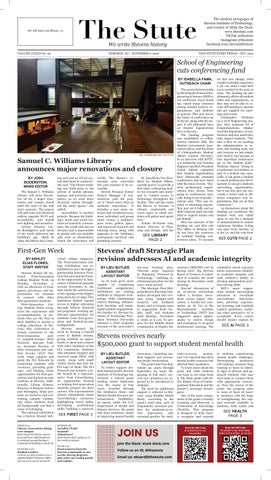
Samuel C. Williams Library announces major renovations and closure BY JOSH BODENSTEIN, NEWS EDITOR The Samuel C. Williams Library will close December 26 for a major renovation and remain closed until the start of the Fall 2027 semester. The project will add seats and electrical outlets, upgrade Wi-Fi and accessibility, and install new lighting and acoustics. Library Director Linda Beninghove said much of the work addresses the building’s age. “Built in 1969, the library has a leak-
ing roof and an HVAC system that must be replaced,” she said. “The library building was built prior to the advent of mobile phones, laptops, and personal computers, so we need more electrical outlets throughout the study spaces,” she added. Accessibility is another priority. Because the building’s north and south sections are joined by a mezzanine, the south side has no elevator and is inaccessible to people who use mobility aids such as wheelchairs, which the renovation will
rectify. The library’s restrooms were renovated this past summer to be accessible. Dereck Persaud, Senior Project Manager of construction, said the project is “much more than an aesthetic renovation.” It includes a new main entrance and circulation area, more individual and group study rooms, a multipurpose room, gallery space, and improved research and tutoring areas, along with upgrades to the building’s mechanical, electrical, and plumbing systems.
Dr. Sara Klein, Vice President for Student Affairs, said the goal is “to provide a first-class, welcoming facility for research and study” and to “embed access to technology throughout the facility.” She said she wants the library to become “a vibrant, comfortable and warm space in which students will gather and spend time.” Justine Di-Nardo Lim, Senior Director of Planning and Design, said the
SEE LIBRARY PAGE 2
The recent decision made by the Schaefer School of Engineering & Science (SES) to cut conference travel funds has raised many concerns among student leaders, organizations, and students in general. This now leaves the future of conferences up in the air, along with the impact it will ultimately have on student organizations here at Stevens. The funding program was established in collaboration between SES, the Student Government Association (SGA), and the Dean of Undergraduate Student Affairs Council (DUSAC). In an interview with SITTV, 4/4 Industrial and Systems Engineer and SGA President Jeylan Jubran explained that student organizations have historically attended conferences, but were faced with the issue of costs. “Student professional organizations have always been going to conferences, typically doing it out of pocket,” Jubran said. “This year instead of informing anyone, they just cut it fully and we didn’t find out until one club tried to request money and got denied.” SGA was unaware of the funding cut, and SGA and The Office of Student Life do not have the resources to continue funding conferences alone. To account
for this new change, clubs would eventually experience a 3% cut, until a total 60% cut is reached in the next 10 years. The funding cut also ultimately affects all student clubs and organizations, as they may not be able to receive full funding to operate and get supplies for meetings and events. Christopher Thelisme (2/4 Civil Engineering major), SGA Assistant VP of Communications, emphasized the importance of conferences and how much they truly impact students. “The idea is that we are pushing the administration to restore this funding back, not only because we just simply can’t fund it, but because of how important conferences are to the student body,” Thelisme shared. “Going to a conference as a student, as part of a student org, especially, it can grant a student so much professional development. It can give students networking opportunities, but it can also give our university a better look to different companies and organizations that are at that conference.” As discussions about the funding cut continued, the student body was called upon to vote for a demand of administration to restore conference funding. Voting was open from October 13 to the 27, and the vote from
SEE CUTS PAGE 2
Stevens’ draft Strategic Plan vidual college campuses. revision addresses AI and academic integrity The First-Generation Col-
First-Gen Week BY ASHLEY ELIAS FLORES, STAFF WRITER Stevens kicked off National First-Generation College Student Week on Monday, November 2, with an afternoon of food, games, giveaways, and opportunities for students to connect with other first-generation students. First-Generation College Student Week recognizes the experiences and accomplishments of students who are the first in their families to pursue a college education. At Stevens, this celebration is closely connected to the First-Generation and/ or Limited-Income (FLI) Network. Maryam Tobias, Assistant Director of First Generation and Limited Income (FLI) Network, helps support and guide the FLI Network by connecting students with resources, providing guidance, and helping create opportunities for first-generation and limited-income students at Stevens. Additionally, Liliana Delman, Director of Student Culture and Belonging, helps promote an inclusive and welcoming campus community where students from all backgrounds can find a sense of belonging. The national celebration has a history beyond indiNEWS (2-4)
Library renovations taking over campus Read about the library renovations and how administration is working towards finding a replacement building to study in! FEATURE (5-6)
Student Leaders Curious on what it takes to be a student leader? Discover different ways you can be involved!
lege Celebration was established in 2017 through a partnership between FirstGen Forward and the Council for Opportunity in Education. Celebrated annually around November 8, the date marks the anniversary of the signing of the Higher Education Act of 1965. This legislation helped expand access to higher education through federal financial aid programs, creating additional opportunities for students from first-generation and limited-income backgrounds. Stevens started the week by hosting a kickoff event in Babbio Atrium, giving students an opportunity to meet and connect with other members of the FLI community. Students who attended mingled and received mugs filled with candy, along with small rubber ducks that had the FLI logo on them. The FLI Network also features a table hosted by a representative from CareerSpring, an organization focused on helping first-generation students prepare for their careers. The representative shared information about CareerSpring’s resources, highlighting career paths, developing professional skills, building a network,
SEE FIRST PAGE 3 SCIENCE (8)
Invisible Cloak? Kratom? Alzheimers? Read about what’s going on in the world of science. PULSE (12)
Read answers from the Stevens community to our weekly Roving Reporter, plus solve our weekly puzzle and sudoku.
BY LIEU BUTLER, ASSISTANT LAYOUT EDITOR As AI tools grow more capable of completing traditional assignments, institutions are seeking methods to integrate technology while maintaining critical thinking, independent learning, and meaningful student engagement. On October 27, Stevens Institute of Technology President Nariman Farvardin released a draft midpoint revision of the university’s
ten-year strategic plan, “Stevens 2032: Inspired by Humanity, Powered by Technology,” outlining institutional priorities for the 2027–2032 period. The Strategic Plan Midpoint Review Steering Committee developed this revision using campus-wide research and feedback forms, and it remains open to suggestions from faculty, staff, and students until Monday, November 2, 2026, at 9 a.m. To prepare for the Middle States Commission on Higher Ed-
ucation’s (MSCHE) visit in Spring 2027, the Stevens Board of Trustees is scheduled to consider the draft during its December 2026 meeting. Stevens’ discussions of an AI-driven curriculum reflect a broader movement across higher education. A faculty-led committee on AI Use at the Massachusetts Institute of Technology (MIT) has suggested major adjustments to course design and evaluation to AI-proof institutional learning. The
committee raised concerns about assessment reliability, academic integrity, and each student’s ability to develop independent problem-solving skills. MIT’s main suggestions include encouraging educators to reevaluate conventional take-home tests, prioritize experiential learning, and establish explicit guidelines outlining when generative AI is acceptable. Every course should clearly explain its
SEE AI PAGE 3
Stevens receives nearly $500,000 grant to support student mental health BY LIEU BUTLER, ASSISTANT LAYOUT EDITOR To better support student mental health, Stevens Institute of Technology has received a federal grant totaling nearly $500,000 over the course of four years. Awarded through the Substance Abuse and Mental Health Services Administration (SAMHSA), an agency under the U.S. Department of Health and Human Services, the grant will fund initiatives aimed at improving mental health
awareness, expanding student support, and increasing faculty involvement. The grant runs from September 30, 2026, through September 29, 2030. Beginning in Fall 2027, several new initiatives are expected to be introduced to students. The need for additional support is reflected in Stevens’ 2024 Healthy Minds Study. According to the grant’s cited data, 32% of respondents screened positive for moderate-to-severe depression, 25% screened positive for mod-
erate-to-severe anxiety, and 71% reported that their mental health concerns had affected their academics. To learn more about the grant and what students can hope to see come from it, The Stute spoke with Dr. Eve Riskin, Dean of Undergraduate Education and the project’s principal investigator. One of the main components of the grant is Faculty Learning and Outreach: a Community of Knowledge (FLOCK). This program is designed to help faculty recognize and respond
to students experiencing mental health challenges. Participating professors will undergo semester-long training to learn to identify signs of distress and approach students who may need help to connect them with appropriate resources. Over the course of the grant, the program aims to train at least 18 faculty members with the hope of strengthening the support network available to students, both inside and
SEE HEALTH PAGE 3
Friday, November 6
2
News Masthead Volume CXXIIII No. 09 Executive Board
EDITOR-IN-CHIEF.............................JIYA JAISINGHANI ‘27 BUSINESS MANAGER.......................CAMRYN WINANT ‘28 MANAGING EDITOR.................................TIANNA SPITZ ‘27 LAYOUT EDITOR.......................................CLAIRE DEANS ‘29 OUTREACH CHAIR................................ISABELLA FAMA ‘29 DIGITAL MANAGER.........................CHARMY KOTADIA ‘27 SECRETARY.....................................JOSEPHINE CHOONG ‘28
Editorial Board
NEWS EDITOR...................................JOSH BODENSTEIN ‘29 SCIENCE EDITOR.......................................DISHA GOHIL ‘28 OPINION EDITOR....................VEDHESH A. KAMARAJ ‘28 SPORTS EDITOR..........................MILAGROS CARBAJAL ‘28 FEATURES EDITOR ...........................PRISHA VAGVALA ‘28 HEAD COPYEDITOR................................KAILEY SUPAN ‘29
Operations Board
HEAD PHOTOGRAPHER.................BRADY SANSOTTA ‘29 ASST. LAYOUT EDITOR...........................LIEU BUTLER ‘29 ASST. LAYOUT EDITOR..........................ALANA JONES ‘29 ASST. LAYOUT EDITOR..............................SACHEL GIL ‘30 ASST. LAYOUT EDITOR........................SHRI SARANYA ‘30 ASST. SOCIAL MEDIA...............................CHRISTINE YI ‘29 DELIVERY BOY...................................MARTIN MURIITHI ‘29
LIBRARY
CONTINUED FROM PAGE 1 aim is an “inclusive, welcoming, and neurodiverse-friendly environment” with flexible study and collaborative spaces and lighting and design that accommodate “a range of sensory needs.” The renovation will also centralize the Library Archives & Special Collections in a research center with temperature and humidity control, security, and compact shelving. The collection includes The Stute’s archives, yearbooks, and The Stevens Indicator, which are climate sensitive and can deteriorate over time without proper care. The closure will affect a building that is home to more than books. Especially during midterms and finals, students fill the library to study and work in groups. It also houses the Technology Resource & Assistance Center (TRAC), a research desk, the Tutoring Center, the English Language Communication (ELC) office, and America’s Cup, which offers food through Zaro’s Coffee and CrEATe. Klein acknowledged the dis-
ruption. “There is no good time to ever close a campus library; however, it is a necessary closure so that we can make these significant improvements,” she said. Persaud said planners weighed several schedules, including keeping parts of the library open during construction. But extensive work throughout the building would make continued operation “highly disruptive,” he said, and closing allows the work to proceed “more safely and efficiently.” A more specific reopening timeline will be shared as construction progresses, he said. Beninghove said staff understands why students value the space. “We appreciate and respect students’ need for a third space, a place to focus and get work done, to collaborate, think, get organized, and gather,” she said. During the closure, the Tutoring Center and library printers and computers will temporarily relocate, Klein said. “America’s Cup will stay open through the spring semester.” The university is finalizing additional study spaces around campus and will provide seating “to mirror the number of students who are typically in the library over the course of the day,” she said. Hours will
match the library’s current schedule and will not be extended during midterms and finals, Klein and Beninghove said. Beninghove said the list of study spaces should be confirmed later this month and posted on the library’s renovation page. Staff will continue book borrowing, Interlibrary Loan, printing and computer access. Librarians will answer research questions by chat, email, phone or at a temporary Research Desk whose location has not been set. Student input has shaped the plans, administrators said. Beninghove said staff met with a group of students earlier this fall. Di-Nardo Lim said planners consulted the Student Government Association, Student Affairs, and library staff about relocating quiet study, group study, and other library functions. Klein said feedback will continue to guide decisions such as furnishings. Students can send concerns to library@stevens.edu. “The benefits very much outweigh the disruption,” Klein said. “Students will come back in the fall to a beautiful new space that will support and enhance their learning and campus experience. It will be well worth the wait!”
Staff & Contributors Jeylan Jubran Breeze Ma Alessandra Nieto Jack Dietrich Sean Palermo Ashley Elias Flores Tanya Zanes Toni Rivada Srikar Velam Reka Weinacht Dominic Souza Alexandra Sosa Wesley Yu Olivia Nutt Kannon Peters Luke Giangrande Sydney Leung Rishi Prabhakar Breona Pizzuta Mahi Verma Alessandro Chavez Fiona Shi Anthony Curcio-Petraccoro Bella Marques Viktor Palmer Chrystiella Mensah
Contact Us
GENERAL.........................................EBOARD@THESTUTE.COM EDITOR-IN-CHIEF.........................EDITOR@THESTUTE.COM ADVERTISING.............................BUSINESS@THESTUTE.COM OFFICE.................................UNIVERSITY CENTER ROOM 216B
Corrections NOTICE A MISTAKE? Email us at eboard@thestute.com.
Disclaimer
All opinions and editorials reflect the views of their respective author(s). No Part of The Stute may be reproduced in any form, in whole or in part, without the written consent of the Editor-in-Chief. Cited references of The Stute are permitted.
Policy on Letters to the Editor
All members of the Stevens community are able to submit a Letter to the Editor to be published in The Stute. Letters must refer either to a piece published in The Stute or to The Stute in general and must be between 400 – 800 words in length. Submit letters to editor@thestute.com with your name and title (when applicable) or using our Google form. For writers who wish to write a Letter to the Editor anonymously, please see our policy on anonymity. The Editorial Board reserves the right to choose whether or not to publish a submitted Letter to the Editor based on a majority rule vote, and additionally reserves the right to edit letters for clarity or request authors to revise. Provided that the author approves the final version, The Stute reserves the right to edit letters according to our copy editing procedures, defined in our policies.
BRADY SANSOTTA FOR THE STUTE
CUTS
CONTINUED FROM PAGE 1 the students unfortunately did not pass. A separate letter, on behalf of SGA and select professional organizations was sent to administration to express their concerns. “Regardless, the letter was sent to administration this morning indicating the SGA’s position along with SWE, NSBE, SASE, and SHPE’s” Jubran commented to The Stute. While the outcome of the student vote did not result in restoring conference funding, student leaders and organizations remain committed to advocating for the issue. This does, however, leave many students wondering how the loss of this funding will affect their personal and career development, and overall success as a student here at Stevens.
Policy on Op-Eds
All members of the Stevens community are able to submit a standalone opinion piece (otherwise known as an Op-Ed) to be published in The Stute. Op-Eds must be between 400 – 800 words, but longer submissions will be considered on a case-by-case basis. To submit an OpEd please email eboard@thestute.com with your name and title (when applicable) or using our Google form (tinyurl.com/submit-t0-stute). For writers who wish to write an Op-Ed anonymously, please see our policy on anonymity. The Editorial Board reserves the right to choose whether or not to publish a submitted Op-Ed based on a majority rule vote, and additionally reserves the right to edit Op-Eds for clarity or request authors to revise. Provided that the author approves the final version, The Stute reserves the right to edit Op-Eds according to our copy editing procedures, defined in our policies.
FULL LIST ON thestute.com/policies PHOTO COURTESY OF @STEVENS_SGA ON INSTAGRAM
SUBMIT YOUR ARTICLE IDEAS TO THE STUTE! Help us craft articles that resonate with you. Whether you prefer to remain anonymous or wish to disclose your identity, your input matters! tinyurl.com/stutesubmit
tinyurl.com/stutesubmit
PHOTO COURTESY OF @SITTVSTEVENS ON INSTAGRAM
Friday, November 6
3
News AI
CONTINUED FROM PAGE 1 expectations and provide an instructional justification for them. Ultimately, these measures aim to reflect genuine student comprehension while supporting appropriate technology use. These recommendations highlight the difficulty colleges have recently faced in balancing academic duty with technological advancement. Although MIT acknowledges AI’s potential for
scholarly creativity, such as assisting with research and analyzing complicated information, its widespread availability also raises concerns about originality. Instead of merely accepting automated outputs, students need to learn how to critically evaluate AI-generated information. Addressing these issues requires more than simply limiting access to AI. Curriculum creation must actively prepare students to demonstrate their own knowledge while comprehending the possibilities and limitations of the technology. Through thought-
fully designed assignments and clear regulations, institutions can distinguish legitimate AI assistance from work that falsely displays a student’s comprehension. As Stevens examines its strategic path for 2027 through 2032, the developing value of AI in education offers an opportunity to reevaluate how learning is assessed. Universities can better prepare students to navigate an increasingly AI-driven academic and professional environment by promoting responsible technology use while upholding strict academic standards.
PHOTO COURTESY OF STEVENS.EDU
HEALTH
CONTINUED FROM PAGE 1 ou1side the classroom. Riskin emphasized the importance of faculty involvement, explaining how “faculty are on the front lines” and that having professors approach students in need of support “can happen organically,” rather than relying on students seeking out assistance themselves. According to Riskin, the idea for faculty involvement originated with Dr. Xiangwu (David) Zeng, Senior Vice Provost of Academic Innovation and Faculty Affairs, who had been developing the concept for nearly a decade.
ASHLEY ELIAS FLORES FOR THE STUTE
FIRST
CONTINUED FROM PAGE 1 receiving career advice, and applying for opportunities. The kickoff marks the beginning of a week-long celebration running from November 2 through November 6. Each day
features a different opportunity for students to participate. Upcoming Tuesday will feature a campus-wide scavenger hunt, followed by a resume workshop on Wednesday in collaboration with the Career Center. On Thursday, the FLI Student Union will host a game night, and Friday will close out the week with free haircuts and manicures for students.
Riskin expressed excitement about the program’s potential, explaining that the initiative “could be a model nationally.” Beyond faculty training, the grant will support several programs aimed at students. Stevens plans to introduce a new lesson in its First-Year Experience (FYE) course, covering mental health awareness, substance misuse prevention, and the importance of seeking help and academic accommodations. Additional initiatives include expanding the visibility of existing mental health campaigns, offering ADHD testing to students without a formal diagnosis, and installing two sensory pods that will provide low-stimulation spaces for neurodivergent students. The grant also
focuses on increasing student engagement, particularly among transfer and commuter students, to both strengthen their sense of belonging and reduce feelings of isolation. This is especially important, considering data cited by the grant proposal stated that 46% of first-year commuter students from the Fall 2025 cohort had attended zero campus events as of February 2026. The grant will build on existing mental health resources, including Counseling and Psychological Services (CAPS), while encouraging further awareness of support already available to students. Through these initiatives, Stevens hopes to make it easier for students to receive help when they need it.
ult
Friday, November 6
4
News LOCAL NEWS Hoboken’s proposed short-term Hudson Tunnel rental regulations in the wake of assault Project’s massive BY JOSEPHINE CHOONG, incident, officers received informa- amendment change to City Code boring machines get to work tion that suggested that someone Chapter 155 that would prohibit SECRETARY
Hoboken currently has no regulations for short-term rentals. However, because of a recent assault occurring outside a rental property, Hoboken is looking to tighten its oversight and introduce new ordinances regarding short-term rentals. Compared to its neighbors, Hoboken doesn’t have a dedicated short-term rental ordinance. Instead, its rental regulations are conducted under the Rent Control Ordinance, Chapter 155. Under state law, short-term rentals are stays of less than 30 consecutive days with hosts complying with local and state laws. Hoboken requires an annual property registration for all owners of residential properties, including single-family homes, condos, and multi-unit dwellings. The assault happened on October 18 following a disturbance at a shortterm rental property on the 500 block of Garden Street. The apartment had a history of complaints about sanitation and noise. While ABC News reported that some of its neighbors stated “the Airbnb-listed unit had been a problem location before,” others claimed that its renters were not a problem. During the
was barricaded inside with potential hostages. Because of this, a SWAT team was sent and ultimately determined that there were no hostages. Authorities arrested five men, four from Indiana and one from West New York. Hoboken Mayor Emily Jabbour stated that there is an ongoing, active investigation and there was a gun charge with one of the arrested adults. In an Instagram post, Jabbour addressed the assault, stating that “I want to emphasize that the safety and quality of life of our residents are the highest priorities for me, my administration, and our entire Public Safety Department.” At the next City Council meeting, she planned to introduce an ordinance that regulates short-term rentals by establishing clearer safety protocols, increasing accountability for property owners, and equipping the Public Safety Department with better tools to monitor those properties. This is not the first attempt at increased rental regulations. In May, Hoboken issued a request for short-term rental monitoring and compliance services like tracking rental properties and issuing taxes. In 2021, Jabbour co-sponsored an
short-term rentals in rent-controlled properties. On a global scale, the rules for short-term rentals are drastically changing. Airbnb announced updates to its house rules, which include holding homeowners more accountable by limiting the number of checkout chores, like washing dishes, that the host requires guests to complete. Tasks that require a significant amount of effort or time, like stripping beds, would be off-limits as guest requests. Additionally, the new policy requires hosts to be upfront about their house rules at the time of booking. In an interview with CNN, an Airbnb spokesperson said that house rules are intended to help guests understand the host’s expectations but can be confusing. These policies were designed to alleviate any confusion and keep requests reasonable. These new policies will be applied to all reservations booked after November 20. Between the new policies enacted by Airbnb and increased short-term rental regulation proposal, the future of short-term rentals in Hoboken may look very different from now on.
Snapshots of midterm polls: how they’re going for New Jersey and predictions for Congress BY ALEXANDRA SOSA, STAFF WRITER The polls have opened and closed, and Stevens’ Babbio Atrium was open for business! New Jersey’s general congressional election day was November 3, 2026, and citizens voted on who will control Congress for the next two years; in other words, how the rest of Trump’s second term is going to look. Up for election across the country are senators, state representatives, and local politicians, though New Jersey is only voting for a Senator and a District 7 representative this time around. Midterm primary elections were already held on June 2, with results turning out primarily Democratic for New Jersey, as is the norm with a solid blue state like ours. Early voting for the general was held during the period of October 24 to November 1, with registered
voters able to vote at any early voting location in their county. Statistics show that 19% of the 6.7 million registered voters in New Jersey voted early, though only 8% of early in-person/mail-in votes were from college-age students (aged 18 to 29). Despite this, Stevens itself is a particularly engaged campus; in fact, it was chosen by application as one of ALL IN’s most engaged campuses for student voting in 2024. Predictions for this general midterm election were murky. The House, presently Republican-controlled with 53 seats to the blue 47, won’t stay that way if voters go the way they’re registered. Thirty-five seats were up for election, and Republicans only needed to hold onto their current majority, while Democrats needed to flip some Republican seats as well as win over the swing seats to gain control. However, Trump’s approval rating is
currently at a historical low of 38%, which could be reflected in the polls in certain elections. The ability to handle the American economy is the key issue for voters this year, and trust is leaning towards the Democratic Party after what many view as missteps by the current administration regarding the average fuel price rising to $4 and distracting announcements on White House renovations. The House stands a very low chance of remaining red as it is, but the Senate is a steeper battle; one possible outcome is a blue House and a red Senate, which would result in even more gridlock and government shutdowns if the two entities clash. Even historically deep red states like Kansas and Texas are turned blue. The truth, though, is that the Senate really was a toss-up in pre-results. New Jersey House and Senate results can be found here.
GLOBAL NEWS Snapshots of midterm polls: how they’re going for New Jersey and predictions for Congress BY VEDHESH ANANDHAN KAMARAJ, OPINION EDITOR What started as a localized university student and teacher protest in a Parisian suburb has led to protests against the living conditions, high gas prices, and worsening conditions in school, all across the country as well as the European continent. The series of protests have lasted six weeks since September 18. Soon enough, other organizations like labor unions, climate activist groups, and human rights groups joined the protests, bringing the issues to the global eye. The spark for these protests started in Créteil, southeast of Paris, where students rallied with striking teachers for overcrowded classrooms, staffing shortages, and poor building conditions. Similar protests appeared in other cities around the country, from Lille in the north to Marseille in the south. Outlets are calling it the biggest student protests in decades as rally organizers report 400 schools across the country participating in the demonstrations by the end of September. Labor unions soon joined the student activists to protest the costof-living crisis, converging grievances into a national movement. On
October 31, high school students, unions, and climate activists, each with their own banner, marched alongside security staff from the Confédération générale du travail (CGT)—one of France’s largest unions—keeping watch at the front. The protests peaked on October 17. Authorities estimated the turnout at almost 550,000 marchers on that day. Protesters set fires, looted shops, clashed with police, and stormed public buildings, including Marseille’s city hall. In response, police made more than 1,300 arrests. Across the six weeks of protests, the police’s actions have been judged with heavy scrutiny. They have used tear gas, rubber bullets, stun grenades, and charges with batons. Several high school students have been hospitalized and, in some cases, suffered injuries requiring amputations. In one incident, a police officer standing two yards away fired a tear gas grenade in a boy’s face, breaking his jaw and destroying many of his teeth. In another case, a 17-year-old boy’s hand was destroyed by a grenade. The government has continued to support the police’s actions, citing that they were forced to protect themselves from violent protesters. However, police conduct has been scrutinized in recent years. During a
protest over high gas prices and other issues between 2018 and 2020, some protesters were shot in the eye with rubber bullets. Experts say the use of heavy-duty weaponry for crowd control has been the cause of such incidents. Saturday saw a third straight weekend of mass protests against increasing cost-of-living and police brutality, mostly peaceful. The Interior Ministry estimated that 320,000 people protested nationwide, with 70,000 in Paris, some of whom were dressed in Halloween costumes. One of the signs stated, “No need for tear gas to make our future look bleak.” The police resorted to tear gas and clashed with the protesters, while 300 arrests have already been made nationally. The unrest has spread to other countries. In Germany, thousands of young people have been protesting in the streets, motivated by similar protests in other parts of Europe, calling for increased education funding and against the high cost of living. The police used water cannons and pepper spray as the masked protesters threw fireworks, rocks, and bottles at them. In Barcelona, a youth meeting on October 24 led to looting and fires, with 128 people arrested and 15 injured police officers.
BY SRIKAR VELAM, STAFF WRITER The North River Tunnel, in service since 1910 and used for intercity passenger rail service, will be rehabilitated and remain in service alongside the Hudson Tunnel Project, expected to finish by 2035, with progress swiftly underway. Initially, the North River Tunnel was built with two tunnels in mind; however, only one was ever finished. This lack of completion has led to only two tracks existing between New Jersey and New York. As such, this limits the options for daily commuters and makes the North River Tunnel a source of continuous delays for thousands of daily commuters. The Hudson Tunnel project aims to implement two additional tracks to help reduce this issue. But why does the North River Tunnel have these issues in the first place? In 2012, the North River Tunnel was damaged by Hurricane Sandy, leading to severe storm damage that necessitates regular maintenance. The Hudson Tunnel Project is a direct result of the collaboration between the Gateway Development Commission, the Federal Transit Administration, and the Federal Rail Administration. In October of 2022, the Gateway Development Commission became the National Environmental Policy Act (NEPA) sponsor for this project. With the installation of the Hudson Tunnel Project, the North River Tunnel tracks will enter rehabilitation and return to service after complete re-
pairs. Recently, additional progress has been made, as the Gateway Development Commission announced on October 8th that tunnel boring machines (TBMs) have begun drilling into Palisades Cliffs. These machines will drill about 30 feet a day, with a 28-foot, 8-inch diameter cutterhead to help in this process. The TBMs were developed in late 2023, where space was created in Tonnelle Avenue, North Bergen, and were factory tested in 2025 before being shipped to New Jersey for reassembly. The TBMs are one of 10 distinct construction projects, each with its own purpose in helping advance progress. Many of these projects include building varying sections of the tunnel in different locations, including segments in the Hudson River and Manhattan, and ground stabilization in the Hudson River to remove obstructions. One major concern the Hudson Tunnel Project aims to address is dwindling job opportunities available by creating 95,000 total jobs during construction. Additionally, this project is estimated to generate nearly $20 billion in economic activity while preventing $16 billion that shutting down the North River Tunnel could bring. The Hudson Tunnel Project is shaping up to become an extremely pivotal project for New Jersey and New York alike. Although its future seems uncertain, with any setback potentially pushing the calendar date past 2035, this project will surely provide an added layer of comfort for those in their daily commute.
Midterm race raises questions about election integrity BY KANNON PETERS, STAFF WRITER The midterm elections took place Tuesday, November 3, and the stakes couldn’t be higher. Polls that predicted a “Blue Tsunami” to rise and for Democrats to take control of the House and the Senate have generated dialogue on ballot security. A Democratic majority would obtain the power to impeach President Donald Trump. Last month, at the Republican National Convention in Dallas, Trump promised a reward of $5,000 to every American adult on the condition that Republicans won both the House and the Senate in the midterms. This offering was estimated to cost around $1.3 trillion. Trump later claimed at a rally in Corpus Christi, TX, that his promised dividend would be able to buy nothing more than “a burger and a small dessert” at his Mar-aLago mansion. These are just two of the focuses in a growing list of legal battles, all of which contribute to the backbone of the Democrats’ case against Trump to turn the midterm elections in their favor. On October 26, Trump announced a $1 million reward for
information about voter fraud leading to an arrest and conviction. Documented instances of noncitizen voting are rare: according to Brookings, the Heritage Foundation’s database included 100 cases from 1982 to 2025, though this is not a comprehensive count of all incidents. Meanwhile, some naturalized U.S. citizens have been incorrectly flagged as potential noncitizens during voter-registration checks. At the time of the announcement, ABC News reported that the reward’s funding source was unclear and that the White House had provided no additional details. Any claims of fraud have not been substantiated either. Trump has made claims of fraud or rigging in the 2016, 2020, and 2024 elections. Even Trump’s allies and other right-wing figures have not been able to point to any signs of rigging occurring in any previous elections, most notably the 2020 election, which in turn led to the Jan. 6 riots at the U.S. Capitol. As midterm election results are underway, Democrats continue to build a case for democratic stability against the Trump administration.
PHOTO COURTESY OF STEVENS.EDU
Friday, November 6
5
Feature
STUDENT LEADERS
Life as a course assistant BY ALESSANDRO CHAVEZ, STAFF WRITER Teaching is an art. Ever since I was young, I knew I wanted to teach. Teachers throughout my life have consistently inspired me and pushed me to improve. In college, my professors are like a second family. They take me into their offices, give me life advice, and create an environment of dedicated trust. This semester, I was given the outstanding opportunity to push that environment forward and serve as a course assistant for
ENGR 212, Design of Data Acquisition Systems. Being a mechanical engineer, ENGR 212 (better known as the Design IV course) was an adventure. The course explores electrical circuits with filtration and data acquisition. It involved both a lecture component and laboratory assignments that culminated in a final project, presentation, and report. I was assigned to serve as a course assistant for the laboratory and work on both in-class instruction and grading. My first day on the job was an enlightening experience. You nev-
er realize how much work our professors put into their curriculum and an understanding of their subjects until you are forced to stand in their shoes. It was humbling. Even though I took ENGR 212 only a semester ago and served as the Head Laboratory Assistant for that workspace in the past, I found myself dumbstruck in the opening act. While I managed to get through it, no problem, I felt a weight on me throughout the day as I remained cautious about the advice I gave. I knew that if I were wrong, not only would someone’s grade suffer, but their confidence in my skill would
evaporate. A course assistant’s capacity to assist is based on the information they provide and the trust from students who receive it. After the first week on the job, my next challenge was grading. Many picture grading as a quick glance and a check over the answer key. Or possibly even see the course assistant as a menace who conspires to fail every student in their path. That was not my experience. Grading is more like a peek into the mind of the student. You feel their work like a hand on stone hieroglyphs, eyes closed, picturing what happened in their mind when
it was penned out. The intention. The analysis. The goals. It’s quite illuminating, especially when I get to review ethics course modules. Writing is a naturally vulnerable state, and I had the privilege of reviewing the work of these students. What is perhaps my favorite part of being a teaching assistant is critiques. While I ideally want to give every student a 100% on every assignment, I know that isn’t how learning works. My humanities professors put it simply: There is no such thing as perfect. With every assignment, there are errors, and it is my job as the grader to
four events and operational items. The weekly budgets can vary, but at least for The Stute it’s really only food and supplies for our weekly Tuesday events. So, I put these budgets in before Wednesday night (the SGA deadline) and go to finalize the purchases once my budget is approved, and then oh no! Looks like I can’t because the event hasn’t been finalized on DuckLink yet, but the treasurer has no control over that. This puts me in a bit of a time crunch to do the budget, get it approved, and finalize the purchases all in less than a week. Actually, barely a week. Budgets are due to the SGA by Wednesday at 11:59 p.m., and then the budget committee will go through all of the requests. They
are either approved, or you get sent to the weekly Sunday night budget meeting. That’s where every treasurer who was called there sits around the room and takes turns basically arguing their case on why they should get the money. Finally, I use Monday to make my purchases for our Tuesday night events. There are a ton of upsides to being a treasurer for a student organization, though, especially The Stute. For one, it is super rewarding. While most of the ideas come from other members and I don’t always decide what needs to be bought, it feels good to know these events would not have happened the way they did if there wasn’t a treasurer behind every
purchase. On another note, as a certified shopaholic, being treasurer gives me the dopamine hit that pressing the “Buy Now” button usually gives me, but without the stress of using my own money. And, as treasurer, I am in charge of picking up the packages and making sure they get to where they need to, so I even get that dopamine hit from receiving and opening the package. Being treasurer for a different organization might give you a completely different experience, but I promise you will still feel rewarded by the end of it, no matter what — all of the stress you went through on those Wednesdays and Sundays will have felt worth it.
The life of a treasurer BY BY CAMRYN WINANT, BUSINESS MANAGER Throughout my time at Stevens, I’ve been in countless classes about how to survive in the business world, and almost every time I have had a professor tell me my resume isn’t doing enough. By the end of my second year, I had already committed the majority of my time to The Stute, and it didn’t make much sense to switch direction. I realized being the treasurer for The Stute would be the best thing to ever happen to me. Going into being treasurer, I didn’t really think about how much work it would actually be. Which is to say, not actually that much. I make the big budget for
the semester and create smaller budgets throughout the semester, and that’s really the brunt of it. But the pressure is so painfully real. While every member of the executive board or minor board is vital in making an organization run smoothly, when a treasurer messes up, the consequences can feel much more real. If you have an incident that causes you to go over budget, or not logging something right, it could lead to you having to pay for stuff out of pocket or even getting your club sanctioned. As I mentioned, being the treasurer isn’t an insane amount of work. The big budget you have to make prior to every semester is fairly simple, with only budgets for
PHOTO COURTESY OF BRADY SANSOTTA
Your voice matters: get involved BY PRISHA VAGVALA, FEATURES EDITOR College is a network, so make the most of it. One of the best ways to do that is by getting involved in decision making, whether it’s as a member of an organization or by working closely with faculty. Every facet of being an involved student, whether in a Stevens organization or department, teaches invaluable lessons while expanding your network and opening up so many opportunities. Start with the simplest step: Voice your opinion, no matter how minor you think it is. Even working on a single initiative will teach you a great deal about the school’s behind-the-scenes processes, which gives you more power to be heard. You get to be in charge and make real change instead of complaining and waiting for something that never happens. Getting things done at this school is hard, and I say that as someone who has tried. But during my time in the Student Government Association (SGA), I have seen multiple initiatives roll out efficiently, whether through SGA or any other organization or department you are involved with. Change doesn’t have to be monumental. Sometimes it’s as simple as suggesting a new way to communicate. Your voice is what drives the school to become better for the future Ducks to come.
It isn’t always about getting things done, but also about the lessons you learn along the way. You learn how to work in an organizational space where disagreement often brews, and how to navigate pushback, communicate professionally, and work with faculty. You also learn to work in teams with various kinds of teamplayers, who might end up becoming your closest teammates, and sometimes even friends. I can personally attest that being a student leader has exponentially improved my communication skills. I now feel confident voicing my opinions in a room full of people. Before, I would simply stay quiet because I was afraid my ideas would be shot down or sound stupid. I’ve also learned to accommodate last-minute problems by knowing where to find the right connections and resources to make things happen. All of this builds transferable skills that apply to real-world workplace scenarios. That is the leverage many student leaders have, and it’s why companies often ask what leadership roles you’ve had on campus. Involved students already know how to operate in a workplace because they’ve had exposure to one. College leadership roles are a kind of simulation: You practice communicating, working in teams with a variety of personalities, and taking the initiative to get things done. Everyone says it looks good on a resume, and
that’s partly what convinces people to get involved on campus, but the real reason lies in the skills you gain from these roles. On top of all those reasons, you get to do what you genuinely want to do and enjoy growing and learning through your role. I moved from an opinion writer to Features Editor at The Stute, and I realized that my interests aren’t limited to writing. I also love reading other people’s articles, editing them, and creating features articles every week. Positions can lead you to discover something new that you love. It also feels good to be attached to an identity and connected to something bigger. When I think about the alumni of Gear & Triangle, it feels good to be part of such a network, and these networks can open up so many opportunities, whether through alumni or elsewhere. One example is through the student newspaper, you have the chance to interview professors, sometimes even in your field, who may present you with job, research, and other opportunities. This applies across clubs, too: Faculty you work with are almost always happy to help a college student who is putting their best effort forward. Being in an organization has helped me create so many amazing friendships and has contributed to my academic success, too. It doesn’t come without stress, but the rewards are truly worth it, so
go out there and make the most of
your college experience.
PHOTO COURTESY OF NJ.COM
Friday, November 6
6
Feature Types of volunteering opportunities BY ANTHONY CURCIO-PETRACCORO, STAFF WRITER Volunteering can be a truly transformative experience. Throughout high school, I’d spend much of my time after school volunteering at the local food shelter in my town. At first, I saw volunteering as a way of “building my resume,” so to speak — I volunteered my time and received hours to submit toward my National Honor Society application. At the time, the National Honor Society required students to submit 60 hours of volunteer work, so you can imagine how I spent the summer of my sophomore year of high school. This was during the height of the COVID-19 pandemic, when local communities needed more help than ever. The first day my friend and I volunteered, I remember we spoke of our experience and downplayed the work we had done — as if assembling boxes to be filled with goods would really make that much of a difference. Fast forward two years and 200 hours volunteered at the same food bank, and I can assure you the work definitely paid off. We saw firsthand how those in need were affected by the work we did. When I came to college, I
sought to continue volunteering and searched for local opportunities near Stevens. Drawing on my colleague’s experience and my own, we have compiled a list (though certainly not comprehensive) of some ways you can help out the Hoboken community. A local favorite of mine is the Hoboken Shelter, located at 300 Bloomfield St. The shelter aims to provide hunger relief to those in need. Volunteers can sign up for a breakfast, lunch, or dinner shift, where they help prepare and distribute meals. I’ve personally hosted some Stevens organizations here for volunteering events, and I have always received positive feedback from the students. To continue the hunger relief initiative, St. Matthew Trinity Lutheran Church on 8th Street hosts its “Lunchtime Ministry” campaign. Started in the 1970s, this daily service provides meals for those in the community, sourced from Hoboken establishments and individual donations. The Hoboken Shelter and St. Matthew Trinity Lutheran Church are always in need of volunteers, so be sure to check out their respective websites for more details! Shifting gears, the Symposia Community Bookstore on Washington Street frequently seeks vol-
unteers to perform basic library tasks (organizing books, helping customers, accepting donations), as well as to bolster its social media and marketing presence. If you’re someone who doesn’t want to leave the comfort of your home, there’s an opportunity for that too! Be My Eyes is an accessibility technology app that provides blind and low-vision users with the opportunity to better understand their environments through the aid of a volunteer. Users can call volunteers 24/7 and have their surroundings explained through video. Right now, there is a network of over 11 million volunteers and 1 million active users in more than 150 countries! It is important to mention that the four activities listed above are just a small selection of local volunteering opportunities. There are so many options available for anyone and anything, so doing some preliminary research will certainly yield more personalized results. To close this piece, I’d like to hone in on the word that introduced this article: transformative. The time I spent volunteering at the food banks in my local town and Hoboken completely shifted my understanding of what it means to volunteer. Philanthropy
is often viewed by many people as a way of enhancing their status in society or benefiting their personal lives or careers. The more we participate in these activities and
uplift those around us, the more we will come to understand the benefits of volunteering and view it as an altruistic experience rather than a self-serving one.
PHOTO COURTESY OF HOBOKENSHELTER.ORG
A guide to becoming president of the Stevens SGA BY RISHI PRABHAKAR, STAFF WRITER Ever wanted to be President of the Stevens Student Government Association (SGA)? Well, this guide should tell you how to do just that. Plus, I’ll also include a few words from 4/4 Industrial and Systems Engineer and outgoing SGA President Jeylan Jubran. Step 1: Find a running mate: Every President needs a Vice President, so make sure to find one you can trust and who you think would be good at their job, as well as one you can get along with. (You do have friends, right?) Jubran said, “For VPO, I knew I wanted someone personable who can connect with you from a human-to-human level and just cares about that. Subsequently, I wanted someone who could tell me I am wrong and give me different perspectives; not a yes man.” Step 2: Fill out and submit an Intent-to-Run form: This part’s pretty simple. Just fill out a form stating your intent to run for SGA president and submit it to the current SGA secretary. (Note: As the deadline for submitting the Intent-to-Run form has already passed, this step may re-
quire a time machine.)
streamed on SITTV.)
Step 3: Get signatures from at least 5% of the student body to become a candidate: Go around asking people for signatures. They have to be physical signatures, by the way, so no putting out a social media post and just kicking back.
Jubran said, “For my responses, I just said what came to mind. I remember I got asked a fun question about what ingredient of a salad you would be, and I was so stressed on stage, but when it came my turn, I blacked out and gave an answer about how I would be a lettuce because it is the base of the salad and president is the base of the student body, and I don’t know where that came from, but I am very thankful I said that.” (Wait, isn’t the student body the base? Unless the SGA constitution — no, I think that would be the bowl…maybe the SGA is the dressing? Or the fork? Uh, I’ll get back to you.)
Step 4: Attend “Meet the Candidates”: Stand around in the UCC and talk to people about your platform. Also, make a cool poster to stand in front of. (Note: This is happening on Wednesday, so get ready!) Jubran said, “Just be you. Remember you are doing this to serve the student body, so be nice to the student body, accept that you don’t know anything and are here to make everyone’s lives easier.” Step 5: Face your opponents in the Presidential Debate: Now for the really scary part. Sit in front of an audience and cameras, and answer questions about your platform and what you will do for the student body. This is the first time you have to actively make an impression on the whole student body, so don’t let it go to waste! (Note: This is happened on Wednesday, November 4, and was
er you want! Maybe throw a pizza party. That’s about it! Student elec-
tions are coming up soon, so remember to vote, and good luck to all the candidates!
Step 6: Campaign! Send out emails, run an Instagram account, and go door-todoor. Do what you can to get people on your side. There are many ways to run a campaign. Jubran said, “Keep it cute, keep it simple, reach out to as many students as you can, and don’t just ask for their vote. Talk to them, follow up with them, even after you win or lose.” Step 7: Win (hopefully): The fun bit. Celebrate howev-
PHOTO COURTESY OF ABBY JACOBS
Behind the scenes of a Residential Assistant BY NEHEMIAH LICIAGA, STAFF WRITER As Stevens students finish applying for next year’s Residential Assistant position, I wanted to share a behind-the-scenes look at what it’s really like to be a Residential Assistant in the Office of Residence Life & Dining. Residential Assistants (RAs) are selected members of the undergraduate Stevens community who live on campus to help build community within their assigned area, advise floor members, and ensure the safety and maintenance of their designated area. Being an RA comes with responsibilities and benefits. Remember the poster boards on your residential floor that you see every single day and how they change every month? RAs have to update their boards at the start of the month and include an educational aspect. These boards can range from topics such as seasonal depression to how to help improve your GPA. Your RA will host events every month and sometimes collaborate with other RAs or the Resident Hall Association (RHA) to host community-building events.
RAs serve as mandated reporters to ensure the safety and conduct of residential areas. They can deal with incidents regarding mental health, Title IX, noise and alcohol violations, and other emergency situations. The perks that come with the job include fully covered housing and the inclusion of the terabyte meal plan. Now, as much as this news-sounding article feels like a lecture about what being an RA is, I wanted to go further and get an in-person experience of what being an RA really means. Throughout the entire month, The Office of Residence Life & Dining hosted four events for the 2027-2028 RA position. I attended the October 7 meeting to hear firsthand about being an RA. This was also my first time seeing one of the Community Directors (known as CDs, formerly named Residential Directors), as well as more RAs outside of the ones I usually see in my dorm. Elson Martinez, Community Director for Harries and Clark Tower, explained that RAs can be placed in either the First-Year Residential Experience (FYRE), Harries or Clark Tower, or in
Living Learning Communities (LLCs). LLCs include the Lor-El Center, 1036 Park, the Pinnacle Scholars floor, and more. They continued to mention that the position encompasses meetings, mandatory training, working with other CDs, and that they are flexible if you have other commitments such as internships, co-ops, or research. Further interested in learning about the role, I spoke with Joseph Brennan (2/4 Computer Engineering major), an RA for Davis Hall. When asked about seeing the personal growth of his freshmen residents, he found the journey fulfilling. “You get to see people. Some people who are a little shy start to come out of their shell,” Brennan said. “Some people who aren’t used to living on their own for the first time become more independent. People who are excited realize their expectations, and it’s a growing experience; it’s a very fulfilling experience, and a lot of the time, through their growth, like the growth of your residents, you can grow yourself too. So I think not only is it fulfilling for them, but also fulfilling for you.” Brennan also highlighted his own experience as an RA.
“You think I’m grown up, I’m mature, I’m very responsible,” Brennan stated. “But then just through my time at college and my time like developing as a new campus leader, you kind of realize like, hey, like I’m gaining more responsibility. I’m becoming more mature, and you get to a point where you realize that despite thinking that you’ve got every-
thing figured out in the moment, there’s always more to learn and there are always more ways to grow, and similarly, there are always more ways to mature and develop. So I think that being in the RA position really exemplifies how you should take a growth mindset to life because things can always get better despite your first thought.”
PHOTO COURTESY OF JIYA JAISINGHANI
Friday, November 6
7
PHOTO COURTESY OF STEVENSDUCKS.COM (SHOT BY CARLISLE STOCKTON)
Sports
Gavilanes posts top 15 finish in épée for Women’s Fencing at Coach Nikki Franke Classic BY OLIVIA NUTT, CONTRIBUTOR The Stevens Women’s Fencing team competed at the Temple-hosted Coach Nikki Franke Classic in Philadelphia, PA, on Saturday, October 24. In the épée discipline, senior Grace Hicks, sophomore Madyson Gavilanes, and senior Sofia Stoeckel all had strong pool-play performances, each recording at least two wins and 17 touches. Hicks recorded 18 touches and two wins in pool-play. Heading into the tableau, she followed her previous victories by securing a win of 15-5 in her opening match
in bracket play. She ended up later losing 15-10 to an opponent from Florida. Stoeckel competed in this discipline and their successes included 17 touches and wins over opponents from Drexel University and the University of Pennsylvania (Penn) in poolplay. Similar to Hicks, she was able to continue her success in the tableau by taking an initial win over a competitor from Fairleigh Dickinson University (FDU), but also later lost in the next round to the No. 1 seed from Penn. In pool-play, the Ducks continued to compete with Gavilanes, who managed 19 touches and three wins, including one over an op-
ponent from Penn. She continued to pick up wins in the tableau over opponents from Haverford College and Johns Hopkins University, but ended up falling to the No. 5 seed from Boston College in the round of 16. In the foil competition, junior Julia DiPaolo and senior Akemi Rodriguez had early victories, each achieving two pool-play wins. One win from Rodriguez even included a win over an opponent from FDU. Later in the tableau, DiPaolo lost in her first match to an opponent from Boston College. Meanwhile, Rodriguez faced two opponents from Penn in the tableau. While she
initially continued her prior success by securing a win in her first match against her opponent, she later fell to the No. 1 seed. During the sabre event, junior Ashlyn Leung became the sixth Duck of the day to have a strong pool-play performance, as she had multiple wins in the poolplay competitions that included one over an opponent from Florida. She later ended up losing in the first round of the tableau to an opponent from New Jersey Institute of Technology (NJIT). The Stevens Women’s Fencing team will return to competition on November 7 and 8 at the Drew Invitational.
Stevens Men’s Golf teams finish fifth and sixth at Lebanon Valley Invitational BY LUKE GIANGRANDE, CONTRIBUTOR The Stevens Men’s Golf ‘B’ and ‘C’ teams competed in the Lebanon Valley Fall Invitational on Monday, with the ‘B’ team earning a fifth-place finish and the ‘C’ team close behind in sixth. The ‘B’ team carded a 318 (+30), while the ‘C’ team finished with a 319 (+31). The two Stevens squads were separated by one stroke in the team standings. PSU-Harrisburg took first place with a team score of 14over par.Pittsburgh-Greensburg followed in second at 20-over, while Eastern finished third at 23-over. Rutgers-Camden rounded out the top four at 26over, just ahead of the Ducks’ ‘B’ team. Lebanon Valley finished seventh with a 323 (+35), placing behind both Stevens teams. Catholic carded a 324, and Elizabethtown finished with a 325. The remaining nine teams all recorded scores of 328 or higher. Senior Noah Eide led the nine Ducks who competed, shooting a one-over-par 73 to finish fourth
overall. Eide birdied the par-5 seventh and par-4 eighth during an even-par front nine before adding another birdie on the par-4 16th. Freshman Troy Nguyen tied for 16th with a six-over 78. Nguyen birdied the par-5 second during a two-over front nine and made par on 11 holes. Senior Sebastian Beaver finished tied for 37th after carding an 82 (+10), going four-over on the front nine and making par on 12 holes. Freshman Ridhit Beri tied for 51st with an 85 (+13). After a difficult start, Beri parred holes five through nine during a three-over front nine and added a birdie on the par-4 13th. Senior Maxime Debets tied for 76th with a 91 (+19). Debets made par on four holes, including the 18th, the only ‘B’ team member to do so. Sophomore Bryce Karty paced the ‘C’ team, tying for 11th with a five-over 77. Karty birdied the par-5 second and seventh during a two-over front nine, then added another birdie on the par-4 13th. Senior Arav Tank tied for 16th with a 78 (+6). Tank was three-over through five holes
but made par on 10 of his final 13 holes. Junior Alex Carey tied for 26th after shooting a 79 (+7). Carey made par on eight of the first nine holes and finished with 12 pars overall. Senior Dillon Kim tied for 51st with an 85
(+13), making par on four frontnine holes and three more on the back nine. Kim also birdied the par-4 16th, joining Eide as the only Ducks to birdie that hole. The Ducks will return to official competition in Spring 2027.
ON DECK IN SPORTS FRI, NOV 6 WOMEN’S SWIMMING NYU Invitational New York, NY 3 p.m. MEN’S SWIMMING NYU Invitational Hoboken, NJ 3 p.m.
SAT, NOV 7 MEN’S SOCCER MAC Freedom Championship TBD FIELD HOCKEY MAC Freedom Championship TBD WOMEN’S SOCCER MAC Freedom Championship TBD MEN’S FENCING Drew University Madison, NJ TBD WOMEN’S FENCING Drew University Madison, NJ TBD WOMEN’S AND MEN’S FENCING Columbia Invitational New York, NY 11 a.m. WRESTLING Ned McGinley Invitational Wilkes-Barre, PA 9 a.m. WOMEN’S AND MEN’S SWIMMING NYU Fall Invite New York, NY 10 a.m. WOMEN’S VOLLEYBALL Montclair State University Hoboken, NJ 12 p.m. WOMEN’S VOLLEYBALL Montclair, Union College Hoboken, NJ 2 p.m. WOMEN’S VOLLEYBALL Union College Hoboken, NJ 4 p.m.
SUN, NOV 8 WOMEN’S AND MEN’S FENCING Drew University Madison, NJ TBD WOMEN’S BASKETBALL Babson College Babson, Mass 1 p.m.
TUE, NOV 10 MEN’S BASKETBALL Rutgers-Newark Newark, NJ 7 p.m.
THU, NOV 12
PHOTO COURTESY OF STEVENSDUCKS.COM (SHOT BY DAVE JANOSZ)
WOMEN’S VOLLEYBALL MAC Freedom Championship Semifinals Hoboken, NJ 6 p.m.
STEVENS SCOREBOARD DATE
TEAM
WED, OCT 29 FIELD HOCKEY WOMEN'S SOCCER THU, OCT 30 WOMEN'S VOLLEYBALL SAT, NOV 1 WRESTLING MEN'S CROSS COUNTRY WOMEN'S VOLLEYBALL WOMEN'S CROSS COUNTRY FIELD HOCKEY MEN'S SOCCER WOMEN'S VOLLEYBALL WOMEN'S SOCCER SUN, NOV 2 WRESTLING MEN'S FENCING WOMEN'S FENCING TUE, NOV 4 WOMEN'S SOCCER
OPPONENT
MISERICORDIA UNIVERSITY DESALES UNIVERSITY WILLIAM PATERSON UNIVERSITY NED MCGINLEY INVITATIONAL MAC CHAMPIONSHIPS WORCESTER POLYTECHNIC INSTITUTE MAC CHAMPIONSHIPS FDU-FLORHAM DELAWARE VALLEY UNIVERSITY EASTERN UNIVERSITY DELAWARE VALLEY UNIVERSITY PRINCETON OPEN DREW INVITATIONAL DREW INVITATIONAL LEBANON VALLEY COLLEGE
LOCATION
HOME HOME AWAY AWAY AWAY HOME AWAY HOME AWAY HOME AWAY AWAY AWAY AWAY HOME
SCORE
W (3-1) W (4-0) L (1-3) 3RD 4TH W (3-0) 4TH W (6-0) W (3-0) W (3-2) W (8-0) 6TH 4 WINS, 2 LOSSES 4 WINS, 3 LOSSES W (2-1)
Friday, November 6
8
Science Kratom on the rise as a “gas station drug” BY RÉKA WEINACHT, STAFF WRITER Kratom is being advertised on convenience store windows, smoke shop signs, and gas station shelves across the U.S. What, exactly, has crept up on us in the past few decades — are opioids being sold at convenience stores? Is this a new wonder drug that makes us happy, pain-free, and full of energy? What is kratom, and where does it come from? Kratom is a plant called Mitragyna speciosa that originated in Southeast Asia. It is a tree with flat green leaves and small, white blossoms and is part of the coffee family. The tree’s leaves have been used for centuries in Southeast Asia, mainly by chewing on them or using them to prepare tea. Kratom use has recently been expanding to spread around the globe; however, this comes with a diversification of the forms of kratom that are used. Things like liquid
extracts from kratom leaves, kratom leaf powder, and isolates have been turned into edibles, capsules, tea bags, and gummy candies. Kratom has now been available in the U.S. for at least two decades. Traditionally, kratom leaves are chewed by farm laborers in Southeast Asia to relieve muscle pain and boost energy. Kratom contains many different alkaloids (naturally occurring bases that contain nitrogen), but the primary compounds responsible for its effects on the human body are mitragynine and corynantheidine. These have been shown to have analgesic effects (reducing pain), with mitragynine acting as a weak partial opioid, in addition to showing antipsychotic and antidepressant effects. Consequently, one of the main positive effects kratom can have is that the alkaloids it contains act to reduce pain and opioid withdrawal symptoms. Current evidence indicates “therapeutic potential” as a drug for reducing use
of morphine, heroin, or other addictive substances, and there was a self-report study published in 2024 in which many participants already reported using kratom as a replacement for opioids or for relief from withdrawal symptoms. At this moment, though, there is not enough research to support or reject this use of kratom; controlled clinical trials have not been done to evaluate how safe and how effective kratom actually is in treating substance use disorders. There is also the potential for dependence on mitragynine. There have been mild to moderate withdrawal symptoms in case reports on kratom by the Subjective Opioid Withdrawal scale (SOWs), but there is no officially defined kratom use disorder. The long-term effect of kratom use on organs has also not been studied much, although some laboratory studies have shown that mitragynine puts people with pre-existing heart conditions at cardiovascular risk.
The main issue is that most experiments done so far have been pre-clinical, not on humans. Furthermore, many experiments have tested just one or two specific compounds found in kratom, not all 40-plus alkaloids acting together. Kratom is not an opioid. However, it can have opioid-like effects on the body. The question is how strong these effects are, and whether their benefits can outweigh costs in some cases. The problem is that we don’t really know yet. Meanwhile, kratom has been commercialized, especially since the COVID-19 pandemic, with a huge diversification of available products — similarly to the commercial cannabis market. The market’s desire for convenient and potent products has driven it to a state where capsules, compressed tablets, liquid extracts, edibles, and vaping products are being sold not only online, but also in gas stations and smoke shops. Due to the novelty of so many
kratom products and the need for more research, regulation of kratom in the United States is very inconsistent and largely nonexistent. Kratom is currently not recognized by the Food and Drug Administration (FDA) as a supplement. Seven states have recognized it as a Schedule I controlled substance, making it illegal to sell or purchase kratom, while other states have banned it entirely; some have age restrictions on purchasing it, and some have no restrictions at all. In New Jersey, there are no restrictions on purchase or consumption of kratom except that one must be 18 years old to buy it. “Gas station drug” is the term used for a psychoactive substance that is legal and often marketed as a safe dietary supplement but has the potential to become addictive. The problem with something like kratom becoming a gas station drug is that it conceals the possible potency of the drug and the lack of research behind the kratom market.
Study confirms simple liquid may stop cavities without drillingdrug” BY SEAN PALERMO, SCIENCE WRITER A new study led by the University of Michigan and published in JAMA Pediatrics suggests that the simple, inexpensive liquid, silver diamine fluoride (SDF), may be an effective avenue for treating cavities and preventing painful infections or dental surgery. Bringing together researchers from the University of Michigan, New York University, and Indiana University and providing more than $12 million in funding from the National Institutes of Health, this successful trial suggests that the paint-on procedure effectively stops the tooth decay responsible for causing cavities. Yearly, thousands of U.S. children visit emergency departments as a result of untreated cavities — a particularly pressing problem due to the emergency physicians generally being unable to provide
the necessary procedures to address the underlying problem. In fact, among American children, tooth decay is the most common chronic disease, with untreated cavities resulting in toothaches, infections, eating and sleeping issues, missing school, and repeated medical appointments. Additionally, conventional methods of treatment have proven to be challenging, especially among younger children due to struggling to stay still during procedures or experiencing general feelings of fear or anxiety. While SDF is the focus of the study, it has actually already been successfully used to manage cavities in various countries for decades. As for the U.S., the FDA approved it for treating tooth sensitivity in 2014, though dentists would use it off-label to help treat cavities. This most recent investigation is planned to provide a large-scale clinical trial from U.S.
populations to establish the safety and effectiveness of SDF on cavities, and by extension, move it away from off-label use as a more accessible treatment. Beginning in 2018, the investigation was launched and continued despite initial major disruptions caused by the COVID-19 pandemic. Testing the product Advantage Arrest 38% SDF provided by Elevate Oral Care, the Phase III clinical trial included 830 children younger than six — participants coming from dental clinics, pediatric medical practices, and Head Start and Early Head Start programs in Michigan, New York, and Iowa. Results showed the solution successfully halted tooth decay in more than half of the affected baby teeth when treatment was provided at six-month intervals — working through the combined effects of silver helping to combat bacteria associated with the decay and
fluoride helping to strengthen the mineral structure of the teeth to resist additional damage. On top of this success, Margherita Fontana, Professor of Dentistry at the University of Michigan School of Dentistry and the study’s lead investigator, would comment that the benefits may extend well beyond children, such as older adults, people with developmental or physical disabilities, those with severe dental anxiety, and those experiencing difficulty getting conventional dental care. One caveat of the treatment that the researchers noted was that the SDF permanently turned the decayed portion of the treated tooth dark, which was particularly noticeable in front teeth. If this trial successfully manages to extend access to SDF, it could give children an earlier intervention before initially relatively manageable cavities develop into more serious problems
down the line — with an application every few months being enough for some to keep a cavity under control until the affected baby tooth naturally falls out. Yet, even beyond children, the study turns to the potential usefulness among adults through managing decay over longer periods of time or simply serving as a temporary solution before a filling or other restorative procedures become available. While the study noted that the treatment is not suitable for all cavities and that stopping decay does not eliminate the need for future dental work, the findings suggest the new procedure may be a viable alternative to more conventional, complicated treatment. Reflecting on the study, Fontana said, “For almost anyone, this can arrest the decay and stop the infection and the pain it causes […] This could benefit many people.”
Fighting Alzheimer’s without entering the brain BY TONI SOFIA RIVADA, CONTRIBUTER Around the world, approximately 33 to 38.5 million people have Alzheimer’s disease, a common type of dementia. Alzheimer’s causes people to struggle with concentration and thought, which can then cause them to forget things such as basic tasks and the names of people and places, as well as cause a shift in personality and behavior. Oftentimes, Alzheimer’s is caused by a protein called tau, which is meant to assist neurons in maintaining the cell’s shape, assist the movement of nutrients and signals, and convert shortterm memories into long-term memories. But tauopathies, the neurodegenerative disease group Alzheimer’s belongs to, causes tau to grow uncontrollably in the brain. What differentiates Alzheimer’s from other tauopathies are clumps known as amyloid plaques, which cause brain cells around these clumps to die.
So far, there has been no known cure for Alzheimer’s, only treatments that target removing amyloids, as well as two medications named lecanemab and donanemab. But a new study suggests that researchers may have gotten the approach to stop Alzheimer’s all wrong. Recent evidence suggests that Alzheimer’s damage to the brain is caused not by tau itself, but rather the immune system’s response to it. Scientists at Washington University School of Medicine in St. Louis, led by the Holtzman lab found that T cells, a type of white blood cells that helps fight germs in the immune system, bring abnormal amounts of tau into the brain. This was found in a study involving young mice with tauopathies developed early enough without substantial brain cell loss. Researchers focused on chemokine CXCL10 and chemokine receptor CXCR3, where chemokines are proteins that guide the movement of white blood cells throughout the body and chemo-
kine receptors are the surface the cells are guided on. They observed that CXCL10 was found in high levels in the mice and other groups linked to Alzheimer’s disease, in which T cells would follow the route activated by CXCL10 on the surface of CXCR3. Researchers ran multiple tests with the proteins, the first being the removal of either CXCL10 or CXCR3 receptors from the mice’s brain. This resulted in the T cells being unable to infiltrate the brain, even when inflammation was forcibly triggered. Next, they tested an antibody that blocks CXCR3, a treatment that would protect the mice’s brain without removing tau. The mice were injected every five days for three and a half months, with the antibody never entering the brain tissue and instead nesting at the brain’s boundary. The results show that the mice had about half of the amount of T cells in their brains compared to animals that didn’t receive the antibody. On top of that, their brain’s memo-
ry-related regions were less damaged, and they performed better on a memory test. But the mice’s tau clumps looked the same, despite their cognitive improvements. This suggests that treatment without touching the brain could be possible. David M. Holtzman, MD, said, “For this therapeutic approach, if it is safe, you wouldn’t have to design the drug to get into the brain—which is a big deal since most molecules don’t cross the blood-brain barrier well—and you
don’t have to get rid of the tau to get this therapeutic effect.” However, more research is required on this method before it can be tested on humans, as well as the question of whether the treatment would work after a greater amount of neurodegeneration occurred. But Holtzman also suggests that existing T cell treatments, such as therapies used for multiple sclerosis and other autoimmune disorders, could be reevaluated and tested as a new way to treat Alzheimer’s.
PHOTO COURTESY OF SCITECHDAILY.COM
Can you hide from the heat? BY BREEZE MA, COPYEDITOR Heat is a terrible secret keeper. Whether it’s a hot cup of tea, a laptop running for too long, or your own body on a cold day, heat is constantly escaping into the world around us. Because of this, it’s one of the hardest things to hide. However, thermal imaging cameras can find what the eye can’t see by detecting heat signatures. Researchers challenged this assumption by developing a 3D invisibility cloak that can hide an object’s heat signature from all directions, pulling off something straight from fiction. Engineers at the University of
Illinois and the Technical University of Denmark created a 3D thermal cloak that bends heat around a hidden object, leaving the surrounding temperature mostly undisturbed. Unlike earlier designs, which were limited to simple shapes and could block visibility from only one side, this cloak can hide more complex objects and work regardless of the direction of heat flow. This discovery can help protect sensitive electronics and manage heat in computer chips. The secret to the cloak’s ability to hide objects lies in the way it handles heat. Instead of absorbing or blocking heat, it is geometrically designed to redirect it around the
object and reconnect the heat flow with the outer environment. To a thermal camera, the temperature around the object appears unchanged, giving the illusion that there is nothing under the cloak. Researchers used precisely engineered aluminum fused with a rubbery material with low heat conductivity and a carefully calculated structure to manipulate the heat flow around the cloak. To test the design, scientists placed the cloak between two aluminum plates, one hot and one cold, and recorded it with a thermal camera for an hour. Once time had passed, the temperature of the cloak remained constant, com-
pletely concealing the object from the camera. The object inside the cloak indicated a relatively low temperature change, revealing that heat rarely crossed the protected area. The team repeated the experiment with a heart-shaped cloak and one, oddly, in the shape of a human face. The heart worked as predicted, but the face-shaped cloak demonstrated the most impressive performance in both complexity and result. Although the tests reveal exceptional results with inanimate objects, researchers have yet to yield results in subjects that produce their own heat outside of the influence of the environment. The
cloak may be able to hide the heat of an object in controlled temperature, but it failed to hide the heat of emitting from a person or piece of machinery. Despite being far from an invisibility cloak from Harry Potter or an awesome spy gadget from Mission: Impossible, scientists were still able to conceal one of nature’s dead giveaways by setting heat on a detour. They are taking steps to bring something out of fiction and make it reality. For now, the cloak can’t hide you from your responsibilities, your professors, or your deadlines, but it can hide something from a thermal camera, and that’s a pretty impressive start.
Friday, November 6
9
Opinion THE STUTE EDITORIAL
A ladder worth climbing There is beauty in rising through an organization. I take pride in the way I climbed The Stute ladder. Beginning freshman year, I threw myself into Stute production by becoming a Layout Assistant. I was worried that I was not involved enough in The Stute, so I became a Staff Writer. I did not write a lot, but if something caught my eye, I tried. I will admit, I was not very good. My first Stute election came up in March 2024, when I ran in a contested race for Layout Editor. It was one of the most horrifying experiences I have had on this campus. But in the end, it gave me the confidence I needed to consider running for Editor-in-Chief (EIC). I spent my entire year as Layout Editor trying to get my layouts down to a science while also debating if I was good enough to be EIC.
In the last two months before the March 2025 elections, I was a bundle of nerves. I asked too many questions and took on some EIC responsibilities that still fell under Layout Editor jurisdiction. And then elections came. I look back on it now, and laugh, but I remember hearing my heartbeat in my ears. I was sweating so much and could not eat the entire day. I practiced my speech with my friends and had them give me critiques for hours until it was perfect. Then I won. The Napoli’s I ate after being elected Editor-in-Chief was delicious — it has never tasted that good since. My first year as Editor-in-Chief felt like I was always running. I never stopped, and I did everything that I wanted to do. Now, in my second-term, my biggest worry
is the time after I leave. It went by fast. I know that is a cliché, yet it is completely true. Not only did it happen so quickly, but it changed me fundamentally. I am a different person from the woman who first became a Layout Assistant and different from the woman who first became EIC. Being a part of The Stute in this large capacity completely altered what my college experience would have been, for the better. I mention this as a reminder to underclassmen to understand the importance of taking on a larger role in an organization. It is the best thing you can do, and you would never know until you take the chance. My experience is not universal, but until you have taken that leap yourself, you cannot truly appreciate what it means to step up, take
MIND OF A FRESHMAN
And this is supposed to be fun?
ownership, and grow into a role that once felt out of reach. Four years ago, I never imagined I would be sitting here writing this editorial as Editor-in-Chief. I certainly never imagined how much this organization would shape me. You don’t have to know where an opportunity will take you to take it. Sometimes, you just have to be willing to start.
Jiya Jaisinghani ‘27 PHOTO COURTESY OF ARYAN BASETTY
SENIORITIS
It’s never too late hilarious. They even started to leave, they’re practically to try something new! taking pictures of my reac- on the edge of their seats
BY CHRYSTIELLA MENSAH ‘30 I absolutely hate horror movies. I mean, I will do just about anything to avoid watching one. If there’s an opportunity to choose a different movie, I’ll take it. I’m much more into action, comedy, crime, and superhero movies. Give me Rush Hour, Casino, The Irishman, Spider-Man or even My Neighbor Totoro. I can watch those for hours. Just don’t ask me to sit through a horror movie. Unfortunately, my friends had other plans recently when they decided we were going to watch Resident Evil. I wasn’t exactly forced to watch it, but when everyone else wants to watch a movie, you eventually run out of excuses. So there I was, sitting down to watch a movie I would never have picked myself. To be fair, Resident Evil wasn’t as terrifying as I expected. It had its fair share of comedy and lighter moments, which made it a little easier to get through. But that didn’t stop me from jumping at pretty much every scary moment. My friends, naturally, found this
tions throughout the movie. Apparently, watching me be scared was just as entertaining as watching the actual film. I’m not sure what was worse — the movie itself or knowing that my reactions were being documented for everyone to laugh at later. But this whole experience reminded me why I avoid horror movies in the first place. I genuinely do not understand the appeal. Why would anyone willingly spend two hours watching something designed to scare them? People go out of their way to find the scariest movies, recommend them to their friends, and even rewatch them. Meanwhile, I’m sitting there wondering when it’s going to be over. I understand that some people enjoy the suspense. Some like the adrenaline rush or the feeling of being scared without actually being in danger. I get that everyone has different tastes, but I still have questions. Is the entertainment really worth having to anticipate every unexpected noise, sudden movement, or jump scare? And why does everyone seem so excited when something terrifying happens on screen? What I find especially confusing is how horror fans seem to enjoy the anticipation just as much as the scary moments themselves. They’ll sit through a quiet scene knowing something is probably about to happen, and instead of wanting
waiting for it. I would much rather enjoy a movie without constantly wondering when the next jump scare is coming. If I wanted to be surprised every five minutes, I’d find something else to do. Halloween was just last week, so I suppose this is the time of year when horror movies are especially popular. Between scary movie marathons, haunted attractions, and people recommending their favorite horror films, there’s no shortage of opportunities to scare yourself. I respect the commitment, but I think I’ll be sitting those activities out. It’s also interesting how people spend the entire month looking for ways to get scared, while I’m doing my best to avoid anything remotely frightening. Maybe my friends will convince me to watch another horror movie someday. Maybe I’ll eventually understand what everyone else seems to enjoy so much. But I’m not making any promises. I think I’ve given the genre a fair chance, and I’m not sure it needs another one. For now, I’ve had enough. If you need me, I’ll be watching Rush Hour for the 100th time. At least Jackie Chan isn’t going to jump out of my TV screen.
PHOTO COURTESY OF ROTTEN TOMATOES
Editor-in-Chief
BY BREONA PIZZUTA ‘27 There is a comforting, unspoken trap that college seniors fall into: We stick to what we know. By your fourth year, your routine is practically chiseled into stone. You sit in the same corner of the library, walk the same routes to avoid the campus wind tunnels, and keep company with the same circle of people. Experimentation feels like underclassman territory. Senior year is supposed to be about cruise control. However, over the summer I decided to do the exact opposite. I emailed my strength coach and asked to start powerlifting and weightlifting. I joined a powerlifting gym and decided to get serious. Up until a few months ago, my relationship with lifting was built entirely around what was familiar and routine for the track team. Olympic weightlifting and powerlifting were subcultures that existed purely on my Instagram Reels, disciplines dominated by people who casually tossed around loaded bars and threw chalk
COMIC CORNER BY TANYA ZANES
like confetti. Walking onto a platform for the first time as a beginner wasn’t just intimidating; it was also a bit humbling. You have to be entirely okay with failing publicly, checking your ego at the door, and learning complex techniques from absolute zero. Yet, as the summer progressed, the gym became my favorite escape. In a college routine dominated by open-ended assignments, abstract career planning, and endless uncertainty about the future, the gym offered refreshing clarity. Either the bar moves off the floor, or it doesn’t. Physics doesn’t care about your resume. Every set demanded total focus, forcing all the background noise of work and post-grad anxieties completely out of my head. Before long, what started as a casual summer experiment snowballed into a serious commitment. I wasn’t just lifting to stay active. I was training with intention. Fast forward to this past weekend, when I found myself stepping up to the platform at the New Jersey State Weightlifting Championships. Standing at the warm-up area, listening to the clatter of plates and the rhythmic countdown of the competition clock, my nervous system was firing on all cylinders. A few months earlier, I barely understood how to position my grip correctly. Now, I was wearing a singlet (gross), waiting for the judges to call my name,
and staring down attempts that once seemed physically impossible. Stepping onto the platform, in front of a crowd, was an adrenaline rush unlike anything I’ve experienced in college. Three white lights later, I walked away with a state championship gold medal. Standing on the podium was surreal, but the real victory wasn’t the hardware around my neck. It was the reminder that we are never too far along to reinvent ourselves. Senior year is often described as checking out. Mentally retiring from college before you’ve earned your degree. But I’d argue the antidote to senioritis isn’t forcing yourself to grind harder at the things you’re burned out on; it’s finding something brand new that makes you feel like an excited beginner again. As seniors, we spend so much time mourning the “lasts” that we forget there is still plenty of room for “firsts.” We convince ourselves that our college identities are locked in, and that picking up a completely unfamiliar challenge this late in the game is pointless. But life doesn’t freeze the moment you hit senior year. Whether it’s loading up a barbell, picking up an instrument, or trying a hobby you swore you had no business doing, say yes to being bad at something until you’re good at it. You might just surprise yourself with what you can lift.
Friday, November 6
10
Opinion BOOK OF THE WEEK
What would you do with Power?
BY RIYANA PHADKE B.S. ‘26 AND M.S. ‘27 For those of you following along, so far I have mostly talked about books that had simple, perfectly wrapped stories. Naomi Alderman’s The Power was something different. In fact, this book took me well over three weeks to read because of how much there was to think about. The premise is simple but unsettling: Teenage girls around the world suddenly develop the ability to generate electrical jolts from their fingertips. This newfound ability gives women a phys-
ical advantage over men, reshaping the balance of power between the sexes. As women begin to understand their abilities, governments, religions, and social structures change in ways nobody could have predicted. One of the most interesting aspects of the book is how it explores our world through this role reversal. Alderman follows characters across the United States, Britain, Nigeria, and Bessapara, a fictional country south of Moldova. Through their experiences, we can see how various cultures might react to a sudden shift in societal expectations. Some women use their abilities to protect themselves, while others use them to gain political influence or control. While the writing is relatively easy to follow, the concepts are mind-bending. There are moments that are deeply disturbing, others that are heartbreaking, and a few that are downright ri-
diculous. What made these moments so effective is that they forced me to question how much of what we consider normal is determined by who holds power. The book can be uncomfortable, especially when familiar situations from our society are presented with the roles reversed. I have seen The Power be compared to Margaret Atwood’s The Handmaid’s Tale or described as a story about the power of female puberty. While I understand these comparisons, I do not think either fully captures what Alderman is trying to accomplish. Initially, I viewed the novel as a dystopian take on what might happen if women were suddenly in charge. However, after reading Alderman’s explanation of her book in an interview, I began to look at it differently. Alderman explained: “People say to me, ‘Ah, your novel is a dystopia.’ And I say [...] ‘It’s only a dys-
UNDERGROUND FASHION
BY GAVIN RUBY ‘27 Every day, it feels like the new normal in the luxury market is to spend a minimum of $200 on running shoes, $3,500 on a bag, and $1,100 on a pair of Margielas. While watching a video by Cassie Thorpe, a luxury YouTuber, I struggled to find recommendations for bags under $2,000 from the big luxury houses. It used to be that the aspirational customer could get a bag under $1,100, but now these companies raised the bar of entry to the big luxury houses. Where you could once buy a pair of shoes for under $600, you now spend that much on a bag charm or a card holder. Here is the question: Is this sustainable? As we know, everything has become more expensive: food, clothes, and other necessities. But one thing the general public doesn’t talk about enough is that luxury is no longer
nature of power itself. Having the ability to protect yourself does not necessarily mean you will protect others, and experiencing oppression does not automatically make someone compassionate once they gain control. This made me think about leadership in our own college community. At Stevens, many of us take on leadership roles. While these positions are very different from the power explored in Alderman’s novel, they still raise an important question: What do we do when we are given authority over others? It is easy to assume that putting different people in charge will automatically lead to different outcomes, but The Power challenges that assumption. I found The Power compelling precisely because it was so jarring. It is unlike anything I have read before, and I appreciated how it challenged assumptions I don’t really stop to question. This is not a light
read, and I would not recommend it if you are looking for something comforting. However, if you have a couple of weeks and are open and curious, I would encourage you to give it a try. After all, the most interesting question Alderman leaves us with is not what happens when someone gains power, but what any of us would do if we had it.
PHOTO COURTESY OF GOODREADS.COM
EXPEDITION ENGINEERING
Is the current pricing of luxury sustainable? for the aspirational customer. The current scope of luxury is for those who have been immersed in the world for years. A medium Chanel Classic Flap in 2015 was $4,900. That same bag is now $11,700. One could say, “Well, it is an investment. If I want to sell it, I can get my money back.” Wrong. I can find brand new, slightly used Classic Flaps on Fashionphile or The RealReal for around $6,000. Growing up, I saw my parents and family afford luxury on salaries half of what they make now. It used to be inspiring to see that this is what my future could be. But now, to afford those same luxuries, I would need to make a minimum of $150,000. Yes, this is frivolous, and at the end of the day, one does not need these products. However, it is important to note that all of these issues stem from the government and the people you put in office. These are the people who dictate how we spend our money and what it’s worth. It feels as though every niche is price gouging the people who are the backbone of their interests. This includes industries like gaming, cars, and tech, all of which are areas affected by inflation.
topia for the men.’ And in my world, nothing happens to a man that is not happening to a woman in the world we live in today. So if we find my world to be a dystopia, then we are already living in a dystopia.” When I read this, it completely changed how I thought about the novel. Rather than simply imagining a frightening future, Alderman asks us to consider whether the world we already live in contains many of the same problems. What initially seems extreme or disturbing becomes even more unsettling when we recognize its parallels to reality. To me, this book is not necessarily about women being better suited to lead than men. Instead, it examines what happens when the balance of power changes and whether those who gain it will actually do anything differently. Ultimately, the book becomes less about men and women and more about the
ABET and what it means for you Overall, this is not sustainable. And if you didn’t vote, I believe this is the world you chose to make for yourself.
BY ALESSANDRO CHAVEZ ‘28
PHOTO COURTESY OF THEREALREAL.COM
PHOTO COURTESY OF FARFETCH.COM
It’s accreditation season. Anyone who has an ear to the academic world has likely heard the word accreditation thrown around a few times these past few months, specifically in relation to the Middle States. However, what if I told you there was a second, perhaps lesser-known accreditation institution preparing for its visit to our university? Known as the Accreditation Board for Engineering and Technology (ABET), this organization is responsible for the certification of the engineering curriculum. Here at Stevens, we pride ourselves on offering a Bachelor of Engineering over a Bachelor of Science. For those unaware, the primary distinction between the former and the latter is a rigorous engineering curriculum constructed from hands-on projects. Those are your core engineering classes, from Design I through Design VIII. Furthermore, the overall curriculum must adhere
to seven ABET standards. Oversimplified, these criteria include proper use of the engineering design process, ethical considerations, communication, and teamwork. Beyond these main criteria, there are various other nuances a university must demonstrate. Specifically, I want to turn to ABET Criterion 4 and Criterion 7. Number four is especially interesting because it demonstrates how the engineering design process and engineering education are a circular system. Just as engineers must continue to adapt, so too must their curriculum. Any university looking for a Bachelor of Engineering must demonstrate it can measure its adherence to the ABET standards and self-improve as real-world engineers do with their designs. Criterion 7 is much less fascinating, as it concerns safety and facilities. However, it reminds us that infrastructure is crucial to any successful project. I can develop the world’s best curriculum, but if I lack a laboratory adequate for its instruction, there is no point in implementing it. Furthermore, as much as we take safety for granted, it is a complex network that operates behind the scenes to ensure student well-being. Inspections, manuals, reports — all of it is background noise to the every-
day member, but without it, we as an institution would cease to function. From an engineer’s standpoint, ABET humbles us, serving as the crucial reminder that no system is ideal. Without consistent improvement, any design develops flaws. Whether that is the world’s largest bridge, smallest microchip, or an engineering curriculum. ABET is there to hold us, not just as a university, but as a collective set of engineers, accountable for our actions. They force us to think, reflect, and wonder exactly if the degree we receive is the degree we worked to earn. For students, I wrote this article to empower you all to embrace the ABET accreditation. This cycle is not bestowed upon every generation of students, meaning we exist at a pivotal time in history, especially given the changes across the university through the implementation of artificial intelligence. Take pride in existing in this moment in history. Ask professors and administration for information. Get involved and provide suggestions if you feel something ought to change. The purpose of ABET is to prevent rigid mindsets. Nevertheless, true prevention emerges from questioning. If something is not right, open conversations and make your voice heard.
clicked: I hadn’t been pushing paper. I had been learning. The beginning of any job is heavy on onboarding for a reason. You’re watching videos, reading documentation, studying the 90-day plan, and trying to piece together how everything fits. You’re absorbing far more than you realize. Some of the most valuable learning I did didn’t even happen at my desk — it happened during lunch, when coworkers turned conversations into Thermodynamics 101 or impromptu technical roundtables. No judgment. No pressure. Just people who understood that being new means learning.
And that doesn’t stop at entry-level roles. No matter what stage of your career you’re in, you’re constantly learning. New systems. New standards. New teams. Feeling unsure doesn’t mean you’re incompetent — it means you’re growing. So if you’re early in a co-op or new job and questioning whether you’re cut out for it, give yourself time. Growth doesn’t look impressive at the moment. Sometimes it looks like confusion, questions, and drafts that need red ink. That doesn’t mean you’re bad at your job. It means you’re exactly where you’re supposed to be.
FROM CUBICLES TO CAMPUS
You’re not bad at your job. You’re just new!
BY JEYLAN JUBRAN ‘27 One of the hardest things to accept when you start a co-op or a new job is that you’re not supposed to be good at it yet. Somehow, we walk into professional environments expecting to
immediately perform at the level of people who have been there for years — and when we don’t, we assume we’re failing. The truth is much simpler: You’re not bad at your job. You’re just new. When I started my coop, I spent a lot of time observing. Not just the work itself, but the people doing it. I watched engineers approach problems in completely different ways. Some were methodical and quiet; others talked through every step out loud. Some worked fast and refined later; others moved slowly but precisely. It took time to figure out
what style worked for me — and that didn’t happen overnight. In the beginning, a lot of my work, honestly, wasn’t great. I submitted reports that got ripped to shreds with heavy edits. I got back an unhealthy amount of feedback. And while it was frustrating at first, I slowly realized that this was part of the process. You don’t magically learn how to write clear, concise technical reports without first writing a few bad ones. You have to miss the point before you learn how to get to it. Over time, the feedback changed. Comments became smaller. Edits be-
came suggestions instead of corrections. And eventually, I wasn’t just receiving feedback — I was reviewing others’ work myself. That shift didn’t happen because I suddenly became smarter. It happened because I had learned the system, the expectations, and the language of the job. What surprised me most was that it wasn’t until the last month of my co-op that I realized I was good at what I was doing. I quickly realized people had been counting on me for things I never expected to be trusted with. Not busywork. Not “just helping out.” Real responsibilities. That’s when it
Friday, November 6
11
Opinion THE BIG QUESTIONS OF EVERYDAY
GIRL(ISH) TALK
One lucky girl
BY MILAGROS CARBAJAL‘28 The presence of the women in my life—and maybe I just got lucky— brings a sense of understanding and freedom that follows us through ordinary days and planned nights out. There’s something about their company that makes happiness feel happier and turns sadness into laughter. This weekend, I went out dancing with my girlfriends. It wasn’t anything extraordinary. We were simply girls having fun. Yet I remember feeling remarkably safe, confident, and free. While this feeling isn’t exclusive to female friendships, I’ve found a particular kind of intimacy within them that is difficult to put into words. It exists in small gestures, fueled by a genuine curiosity to understand one another. I sometimes wonder whether this attentiveness develops, at least in part, from the expectations women grow up navigating. From childhood into adulthood, we learn to scrutinize nearly everything about ourselves. As the monologue in Barbie describes, women are often expected to embody contradictory ideals.
We must be strong, but never intimidating; independent, but not so independent that we appear to need no one; beautiful, but effortlessly so, because caring about our appearance supposedly makes us vain. We must be nurturing and gentle while possessing an almost mechanical capacity to endure. One unfortunate consequence of this constant scrutiny is how easily it can turn into comparison. Female friendships are not immune to competition or jealousy. When we’re made to feel that we’re never quite enough, it’s tempting to look toward other women who seemingly have everything figured out. But in my life, I’ve been lucky enough to find something like a lotus blooming from the muddy waters of those expectations. I think some of the women I love have developed a rare ability to understand others precisely because they’ve spent so much time questioning and examining themselves. They know what it feels like to be scrutinized, misunderstood, or made to feel insufficient. And rather than reproducing those feelings, they’ve chosen to offer others the appreciation they have sometimes been denied. There is something bittersweet about this theory. I wish the women I love had never been made to feel inadequate in the first place. Yet I find something profoundly moving in how they’ve chosen to respond. My friends notice qualities in me that I sometimes struggle to recognize in myself. They remember pass-
Girls make girls ing comments, celebrate my accomplishments, and encourage me through uncertainty. And I have the privilege of doing the same for them. I love watching my friends grow into new versions of themselves while continuing to recognize the hearts I’ve come to know. That love isn’t limited to encouragement, either. We disagree, challenge each other, and sometimes have uncomfortable conversations because we care enough to help one another to grow. None of this is to suggest that women should be held to yet another standard of emotional attentiveness, or that the pressures placed on us are justified by the empathy that can emerge from them. I also do not believe that women are instinctively more empathetic. I believe everyone, regardless of gender, is able to have the same level of depth within their friendships that I am describing in this article. Empathy is not the entirety of what women are, nor is empathy exclusive to women or men. I’m only reflecting on the female friendships I’ve been fortunate enough to experience, and the particular ways I’ve found love within them. What I do celebrate is the consideration that I feel comes from the women in my life — not out of obligation, but because they understand how meaningful that consideration can be. Understanding how deeply our actions can affect another person and choosing, again and again, to make that impact one’s care is perhaps what the art of loving is all about.
Long live art
BY ROBERT JACK DIETRICH ‘29 Being an art major at a tech school has its hosts of challenges. No options at the “all-industries” career fair, being asked “Why are you here?” once a week, and consistent reminders that my major is so much easier than anyone who has to take thermodynamics are all fun things to hear on a weekly basis, but none of that really matters to what this is about. As someone who is both studying the arts and hoping to one day have a career in the arts, it is infuriating to see so many of my peers using generative AI for the most trivial of things. Let me be clear, I am against generative AI, not AI as a whole. AI’s potential as a tool is incredible when used correctly. That is anything except generative AI. The reason I have not transferred to a liberal arts school is I enjoy seeing how my peers use AI. Along with this, I like hearing their opinions and justifications on how and why they use AI in their work. When it comes to non-generative AI, most of the time I see the vision, like creating a database of research papers that a model can pull from
We have a serious problem to address with how we rank the things in our lives. For me, a big part in coming to college was the connections I would be able to make. But no, I’m not talking about the connections that are going to land me research hours or an internship. I’m talking about the connections that are going to land me a friend group that goes out for food at the end of every day, that has inside jokes for every situation, and that sticks by each other no matter what. What nobody tells you about friendships is that they don’t happen overnight, and I know that firsthand. I’ve spent weeks here feeling as if I had nobody in my corner and nobody to talk to. It can seem pretty difficult to maintain friendships here when we take into account all the other things we have going on as college students. We love to treat friendships as our “side quests” while we tend to throw ourselves toward grades, internships, and that latest situationship of the week (yikes). But what
at something, or thought I didn’t come across right, there’s always one of my girlfriends who has been there to let me know that I did do it right, or maybe even that I was right but that I didn’t come across as well as I could’ve. But what’s important is that there is someone there encouraging you along the way. Whether we like it or not, we as women tend to shape each other. The good news is that we have these friendships to pass down confidence and courage to one another. We complement each other, we share opportunities, and we do things together. All of these things help us feel more secure in ourselves, even if they may seem like small little gestures. I’m aware that some people may read this and think it comes off as maybe a little too idealistic. And they are right. Not every woman is going to want to be your best friend, and I’ll tell you now that not all of them are going to be “lifting you up” all of the time. But most of the best things in my life have come from the strength that other women have given me, and there is nothing that I would love to do more than acknowledging it and passing it on through writing.
PHOTO COURTESY OF MEDIUM.COM
ON SHUFFLE
Do NOT let her thaw yet
SOPHMORE SLUMP
or reading over their graded tests to find the areas they struggle the most with. None of that requires AI to be creative; they have a set of rules they follow and return the results based on what was asked of them. I’ve questioned my classmates and asked them why they use AI to replace uniquely human tasks. From the obvious generative AI pictures and videos to the smallest, most basic tasks like writing an email or essay. We all got into this school based on our ability to be creative and problem solve. If you use AI to write a report for a project, you might as well transfer to a community college that costs $90,000 less because you’ll get the same damn experience out of it. So how does this relate to art? AI cannot be creative. Simple as that. All AI-generated images were based on pre-existing images. AI contributed nothing new, just regurgitated, uninspired slop. The same goes for an AI-generated email or essay. Every single sentence a model generates has been written before by a human. When you use generative AI, you are regurgitating someone else’s creativity and passion into something deformed and downright disgusting. Recently, a movie came out called Wildwood. Made by Laika, a studio out of Portland, Oregon, this stop-motion animated movie is the culmination of 15 years of dedication from hundreds of individuals. It
BY ISABELLA BARROQUERIO MARQUES ‘30
nobody tells you, either, is that the friendships you have with each other run deeper than anything else. Recently, I’ve become friends with a group of girls that have changed how I approach college and have made me rethink the way I have been going about everything here. In this time, I’ve also been swamped with midterm exams and what seems like a never-ending list of homework and responsibilities to complete. So at first, the value of these friendships didn’t exactly click, until I realized that it was one of the most valuable things I had in my life at the moment. One of the things that I think I failed to realize was that friendships aren’t just a luxury for whenever I’m feeling “free” enough to do something, and that treating them as optional is a mistake. Women are able to have an enormous and very underrated impact on each other, and it’s high time we talked about it with the same seriousness as everything else going on in our lives. The girls I hold close today are the ones who have shown me this impact over time. They’ve spent time with me, they’ve forced me to get up and do things when I lacked the motivation, and they’ve inspired me to keep going and be someone who can pass on that inspiration. The friendships we find in each other can often be a reprieve from the rest of the world, and we can see the better parts of ourselves through each other. Every time I’ve failed
is something spectacular, and I implore everyone to go see it in theaters. Wildwood is the antithesis of generative AI. It is human collaboration in its finest form. However much time you think you are saving by using generative AI to do your report, your essay, your email, or your visual aids, I promise you two things. One, you are only contributing to a growing pile of slop that will one day have as much relevance to society as the excrement of a fly. And two, no matter how small it is, your life can only be improved by using your own creativity and doing it yourself. Wildwood is proof of that — every single worthwhile invention, creation, and work of art that has existed across humanity is proof of that. It is movies like Wildwood that remind me why I am going into this industry. It’s about more than the money. It’s about the humanity of it all. Art speaks when words fail us. If I can contribute to something that is so universal, even just a little bit, I will die happier than words can express. Long. Live. Art.
PHOTO COURTESY OF THEINTRINSICPERSPECTIVE.COM
BY VIKTOR PALMER ‘28 Halloween is now over, which means that we have approached one of the scarier times of the year. I have already seen signs foreshadowing what is to come — holiday music. However, it is not time yet. I need more time. The phenomenon of Mariah Carey thawing from her ice cube shell to unveil her hit “All I want for Christmas Is You” has already begun. Why must it start so early? I don’t want to be grumpy, but November needs its own time to shine. What are the alternatives then? If I am not listening to Christmas music yet what am I doing? I am happy to provide some alternatives to help with the pacing of the transition between November and December. To start off here, what about some Vince Guaraldi? The jazzy and serenading tones of the Charlie Brown soundtrack makes a perfect transition from October into December, in a way that allows us not to get ahead of ourselves. Hosting a cozy friend hangout while listening to “Great Pumpkin Waltz” is something I have been romanticizing recently. The “Thanksgiving Theme” needs to be played at No-
vember functions. To me the music feels warm and comforting, allowing for the perfect amount of wiggle room to transition into Christmas music further into the month, with the Guaraldi theme as a pivot point. Fall jazz makes it very hard for me to be the person that skips straight to christmas music. We still have some more time to enjoy the changing colors of the leaves, which is why I have been listening to some acoustic and folk music. I have been trying to enjoy the beauty of the natural world, and I find that acoustic music accompanies it perfectly. These songs feel dreamy and comforting, while allowing some room to reflect on the things around you. “Boy With a Coin” by Iron & Wine has been one of those songs. It has a gentle guitar riff that propels the song along and feels like watching leaves rustle and fall. “Across the Water” by Vashti Bunyan also captures the gentleness of fall, which is made even more beautiful when juxtaposed with the harshness of winter. Songs that slowly move along with intention compliment the beauty of autumn into winter. Of course I cannot end this category without Mr. Folk Fall himself: Neil Young and his albums Harvest and Harvest Moon. These two albums are absolutely perfect for November. They are cozy, calm and feature the acoustic and harmonic characteristics I associate with the joys of fall. His lyrics and songs reference the transitional elements of the fall equinox, rustic themes
of road trips, the passing of time, and crisp air. His music feels so reflective, which is an approach I often find myself taking to life in the fall. Listening to folk, or reflective music feels very fitting. Other songs I have been listening to recently have been “Lake Shore Drive” by Aliota Haynes Jeremiah, “Alameda” by Elliott Smith, and “Golden Brown” by The Stranglers. They all have feelings that I associate with fall, like road trips and being involved in nature, and have an intimacy to them that feels so perfect for this weather. There are many options to choose from if you still want to feel the immersion of music matching the month and holidays. I am not saying not to listen to Christmas music at all, but I think that adding a smoother transition may make life feel more immersive and special. Give Mariah her time to thaw before she is playing in every supermarket and public space across the country. Be a little reflective, enjoy nature, and do NOT let her thaw yet.
PHOTO COURTESY OF NEILYOUNG. WARNERRECORDS.COM
Friday, November 6
12
Campus Pulse
Jacky Lei ‘27
James Schorle ‘27
James Carey ‘28
“I wish it didn’t mean Bissinger becomes the library in the spring.”
“Gonna miss my go-to study spot for my final semester.”
“Excited to see the innovation when it’s done.”
ROVING REPORTER By Brady Sansotta
Joe Holland ‘27
“Unnecessary, closing the library for an entire semester is ridiculous.”
“How do you feel about the library renovation for Spring” 2027?”
“The type of stuff that happens in my last year at this school.”
Akousa Ansong ’29
Luke Giangrande ‘28
Youya Wang ‘30
“I think it’s kind of dumb to close it for a whole semester ngl. Like why not during the summer??”
Luis Oliveira ’27
“The library is my home all the time, I would miss my ship on the first floor.”
“I don’t go to the library enough.”
Puzzle Page
Dominic Souza Kings Tour
Mini Crossword Across: 1. Spaghetti, Penne, Ravioli 6. Killer Whales 7. Iron Man’s Alias 8. “Bulls” in Spanish 9. Opposite of hard
Down: 1.Vertical beam members of a fence 2.Phonetic nickname for R2-D2 from Star Wars 3. Accessory worn in the winter to stay warm when outside 4. Special set of cards used commonly for fortune-telling 5. Questions
Traverse each square one by one in any of the eight directions (like a king in chess) to spell out the answer. The starting and ending squares are bolded. Every letter will be used exactly once. The clue below the grid designates the lengths of each word.
N
T
O
I
G
N
H
W
S
A
S
T
E
E
R
T Road in Hoboken [10-6] *Puzzle instructions by Stephen Pachucki
Hidden Links
Cryptolist
Inspired by the British game show Only Connect, the goal of this puzzle is to find the hidden connection between four seemingly abstract clues. Each answer will use trivia, wordplay, logic, or some combination thereof. The solution is always more specific than “nouns”, “places”, etc. What do the following have in common?
The following list has been translated using a basic substitution cipher. For example, if E represents T in one word/phrase, it will represent T in all the words/phrases in the list. No letter maps to itself. The list is alphabetized. Hint: start guessing things in the category and see if any of the letter patterns match up.
Leopard
Whale
Tiger
Cow
Jackson
Pierre
Madison
Austin
Oxygen
Iodine
Bromine
Fluorine
*Puzzle instructions by Stephen Pachucki
Fast-Food Chains
SWTHDT LPVH
WGAJVRKAQ
GRVDQ
BJBDZDQ
GFPGL CPK R
NDVAZQ
*Puzzle instructions by Stephen Pachucki
Sudoku Difficulty: Hard
ANSWERS TO LAST WEEK’S PUZZLES CROSSWORD
CHAIN REACTION Hallo Week End City
CRYPTOLIST Ghost
Vampire
Zombie
Mummy
Tax Evasion
Werewolf
HIDDEN LINKS Stake, Sunlight, Silver, Garlic → Vampire Weaknesses Zombie, Skeleton, Spider, Witch → Minecraft Monsters Alien, Dracula, Frankenstein, Psycho → Classic Horror Movies