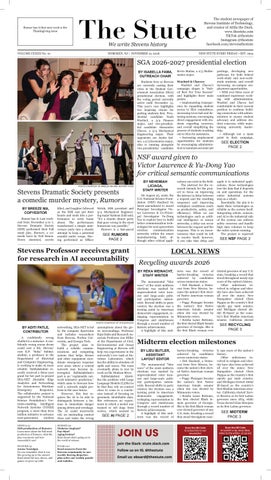
The student newspaper of Stevens Institute of Technology, and creator of Attila the Duck. www.thestute.com TikTok @thestute Instagram @thestute facebook.com/stevensthestute
Rumor has it that next week is the Thanksgiving issue
We write Stevens history HOBOKEN, NJ | NOVEMBER 13, 2026
VOLUME CXXIIII No. 10
NEW STUTE EVERY FRIDAY • EST. 1904
SGA 2026-2027 presidential election BY ISABELLA FAMA, OUTREACH CHAIR
Kevin Matias, a 2/3 Mathematics major.
Students here at Stevens are currently casting their votes in the Student Government Association (SGA) presidential election, with the voting period currently active until November 13. This year’s race highlights two inspiring visions for putting students first. Presidential candidate Noah Wachtel, a 3/4 Finance major, and vice-presidential candidate Alessandro Chavez, a 3/4 Mechanical Engineering major. Their opponents are Justin Safner, a 2/3 Economics major, who is running alongside vice-presidential candidate
Wachtel & Chavez: Wachtel and Chavez’s campaign slogan is “Suited Best For Your Success” and highlights three main points: • Implementing transparency by expanding student access to SGA committees, increasing town hall and listening sessions, encouraging direct engagement with students regarding concerns, and overall simplifying the process of students reaching out to SGA for assistance. • Increasing employment opportunities for students by encouraging administration to maintain accurate job
postings, developing new pathways for both federal work-study and non-workstudy students, and overall increasing on-campus employment opportunities. • With over three years of combined experience working with administration, Wachtel and Chavez feel comfortable in their current position to continue building connections with administration to ensure student advocacy and address student concerns, while maintaining university leadership. • Although not a main point in their campaign,
SEE ELECTION PAGE 2
NSF award given to Victor Lawrence & Yu-Dong Yao for critical semantic communications PHOTO COURTESY OF BREEZE MA AND JEFFERY VOCK
Stevens Dramatic Society presents a comedic murder mystery, Rumors BY BREEZE MA, COPYEDITOR Rumor has it: Last weekend from November 5 to 7, Stevens Dramatic Society (SDS) performed their Fall 2026 play, Rumors, a comedic farce by Neil Simon. Doors slammed, secrets
filled, and laughter followed as the SDS cast put their hearts and souls into a performance to write home about. The performance transformed a simple anniversary party into a chaotic attempt to keep a potential scandal under wraps. Having performed as Officer
Welsh, SDS president and 3/4 Mechanical Engineering major Kalman Zold said, “It’s a chaotic dinner party that goes wrong in the most humorous way possible.” Rumors is a fast-paced
SEE RUMORS PAGE 2
Stevens Professor receives grant for research in AI accountability
BY NEHEMIAH LICIAGA, STAFF WRITER On August 25, 2026, the U.S. National Science Foundation (NSF) finalized its latest amendment to award Principal Investigator Victor Lawrence & Co-Principal Investigator Yu-Dong Yao to explore how to build better communication technologies for next-generation wireless communication networks within the smart manufacturing field, although other critical appli-
BY ADITI PATLE, CONTRIBUTOR A confidently wrong chatbot is a nuisance. A confidently wrong rescue drone could cost a life. Stevens’ own K.P. “Suba” Subbalakshmi, a professor in the Department of Electrical and Computer Engineering, is working to make AI more reliable. Subbalakshmi recently received a three-year grant for her part in project SEA-NET (Scalable Edge Analytics and Networking for Autonomous Maritime Emergency Response). The collaborative project is supported by the National Science Foundation’s Verticals-enabling Intelligent Network Systems (VINES) program, a more than $110 million initiative to advance next-generation wireless
networking. SEA-NET is led by the company Spectronn and includes researchers from Stevens, Purdue University, and Georgia Tech. The project aims to build a reliable communications and computing system that helps drones and other equipment coordinate emergency response over areas where a central network may become interrupted. Subbalakshmi’s part is an “explainable network telemetry prediction,” which aims to forecast how well a network might perform in the near future. However, this feat requires the AI to be able to distinguish between a human in immediate danger among debris and wreckage. The AI could incorrectly rely on misleading context clues and make the wrong
NEWS (2-3)
SCIENCE (6)
FEATURE (4)
PULSE (10)
SDS production of Rumors Learn more about the Fall 2026 production of Rumors, what the play was about, and how successful it was! 2000s Nostalgia Do you remember what it was like growing up in the 2000s? Read about the toys, shows, and games we grew up with!
Diabetes Implant? Pac-Man? Aging brains? Read about what’s going on in the world of science. Read answers from the Stevens community to our weekly Roving Reporter, plus solve our weekly puzzle and sudoku.
assumptions about the given surroundings. Professor Raju Datla and Research Associate Professor Jon Miller of the Department of Civil, Environmental and Ocean Engineering at Stevens will help run experiments in the university’s tow tank at Davidson Laboratory, which has the ability to simulate oil spills and waves. The team eventually plans to test its work on the Hudson River. Subbalakshmi identifies the problem with Large Language Models (LLMs) to be that they rely on context clues to come to a conclusion instead of focusing on genuinely identifiable data. She references an experiment in which a model was trained to tell dogs from wolves, which seemed to
SEE AI PAGE 2
apply it to industrial applications, these technologies lose the data that it depends on and operations for the entire industrial systems stop as a whole. Essentially, the aim is to make these technologies as reliable as the system itself. Integrating robots, sensors, and AI to the industrial side of the system can address safety concerns and handle high data volumes to keep the entire system running. The project is expected
SEE NSF PAGE 2
LOCAL NEWS Recycling awards 2026 BY RÉKA WEINACHT, STAFF WRITER
PHOTO COURTESY OF STEVENS.EDU
cations can exist in the field. The abstract for the research intends for the project to focus on improving the latency (a delay between a request and the resulting response) and improving workplace conditions (such as productivity, safety, and efficiency). When we use technologies such as artificial intelligence or sensor networks, a delay can occur between the request and the response. This is an inconvenience that could be left to resolve itself; however, if you take that delay and
The monumental “blue wave” of the 2026 midterm elections was marked by unprecedented voter turnout and large-scale political participation nationwide. Beyond shifts in party control, the election was a turning point in American democratic engagement, reshaping representation in Congress and statehouses through a record number of historic achievements. A highlight of this mid-
term was the record of barrier-breaking victories achieved by candidates across numerous states: • Deb Haaland, a Democrat from New Mexico, became the nation’s first elected Native American woman governor. • Peggy Flanagan became the nation’s first Native American female senator when she was elected by Minnesota voters. • Keisha Lance Bottoms, the first elected Black female governor of Georgia. She is the first Black woman ever
elected governor of any U.S. state, breaking a record that stood throughout nearly 250 years of the nation’s history. Other milestones involved in religion and identity have also been achieved all over the states: New Hampshire elected Chris Pappas as the country’s first openly gay male senator, and Michigan elected Abdul El-Sayed as the country’s first Muslim American senator. California elected
SEE RECYCLING PAGE 3
Midterm election milestones BY LIEU BUTLER, ASSISTANT LAYOUT EDITOR The monumental “blue wave” of the 2026 midterm elections was marked by unprecedented voter turnout and large-scale political participation nationwide. Beyond shifts in party control, the election was a turning point in American democratic engagement, reshaping representation in Congress and statehouses through a record number of historic achievements. A highlight of this midterm was the record of
barrier-breaking victories achieved by candidates across numerous states: • Deb Haaland, a Democrat from New Mexico, became the nation’s first elected Native American woman governor. • Peggy Flanagan became the nation’s first Native American female senator when she was elected by Minnesota voters. • Keisha Lance Bottoms, the first elected Black female governor of Georgia. She is the first Black woman ever elected governor of any U.S. state, breaking a record that stood throughout near-
ly 250 years of the nation’s history. Other milestones involved in religion and identity have also been achieved all over the states: New Hampshire elected Chris Pappas as the country’s first openly gay male senator, and Michigan elected Abdul El-Sayed as the country’s first Muslim American senator. California elected Xavier Becerra as its first Latino governor since 1875, while Texas elected Gina Hinojosa as its first Latina governor.
SEE MIDTERM PAGE 3
Friday, November 13
2
News Masthead Volume CXXIIII No. 10 Executive Board
EDITOR-IN-CHIEF.............................JIYA JAISINGHANI ‘27 BUSINESS MANAGER.......................CAMRYN WINANT ‘28 MANAGING EDITOR.................................TIANNA SPITZ ‘27 LAYOUT EDITOR.......................................CLAIRE DEANS ‘29 OUTREACH CHAIR................................ISABELLA FAMA ‘29 DIGITAL MANAGER.........................CHARMY KOTADIA ‘27 SECRETARY.....................................JOSEPHINE CHOONG ‘28
Editorial Board
NEWS EDITOR...................................JOSH BODENSTEIN ‘29 SCIENCE EDITOR.......................................DISHA GOHIL ‘28 OPINION EDITOR....................VEDHESH A. KAMARAJ ‘28 SPORTS EDITOR..........................MILAGROS CARBAJAL ‘28 FEATURES EDITOR ...........................PRISHA VAGVALA ‘28 HEAD COPYEDITOR................................KAILEY SUPAN ‘29
Operations Board
HEAD PHOTOGRAPHER.................BRADY SANSOTTA ‘29 ASST. LAYOUT EDITOR...........................LIEU BUTLER ‘29 ASST. LAYOUT EDITOR..........................ALANA JONES ‘29 ASST. LAYOUT EDITOR..............................SACHEL GIL ‘30 ASST. LAYOUT EDITOR........................SHRI SARANYA ‘30 ASST. SOCIAL MEDIA...............................CHRISTINE YI ‘29 DELIVERY BOY...................................MARTIN MURIITHI ‘29
Staff & Contributors Lina Temimi Jeffery Vock Breeze Ma Nehemiah Liciaga Alessandra Z. Nieto Aditi Patle Reka Weinacht Ryan Levinter Ashley Elias Flores
Sean Palermo Breona Pizzuta Kalal Rodriguez Brooke Nagurka Riyana Phadke Brady Sansotta Srikar Velam Dominic Souza Kathy Garcia Wesley Yu Charles Beall Sydney Leung Maya Meents Mahi Verma Emily Fanizza Vedhesh A. Kamaraj
Contact Us
GENERAL.........................................EBOARD@THESTUTE.COM EDITOR-IN-CHIEF.........................EDITOR@THESTUTE.COM ADVERTISING.............................BUSINESS@THESTUTE.COM OFFICE.................................UNIVERSITY CENTER ROOM 216B
Corrections NOTICE A MISTAKE? Email us at eboard@thestute.com.
Disclaimer
All opinions and editorials reflect the views of their respective author(s). No Part of The Stute may be reproduced in any form, in whole or in part, without the written consent of the Editor-in-Chief. Cited references of The Stute are permitted.
Policy on Letters to the Editor
All members of the Stevens community are able to submit a Letter to the Editor to be published in The Stute. Letters must refer either to a piece published in The Stute or to The Stute in general and must be between 400 – 800 words in length. Submit letters to editor@thestute.com with your name and title (when applicable) or using our Google form. For writers who wish to write a Letter to the Editor anonymously, please see our policy on anonymity. The Editorial Board reserves the right to choose whether or not to publish a submitted Letter to the Editor based on a majority rule vote, and additionally reserves the right to edit letters for clarity or request authors to revise. Provided that the author approves the final version, The Stute reserves the right to edit letters according to our copy editing procedures, defined in our policies.
Policy on Op-Eds
All members of the Stevens community are able to submit a standalone opinion piece (otherwise known as an Op-Ed) to be published in The Stute. Op-Eds must be between 400 – 800 words, but longer submissions will be considered on a case-by-case basis. To submit an OpEd please email eboard@thestute.com with your name and title (when applicable) or using our Google form (tinyurl.com/submit-t0-stute). For writers who wish to write an Op-Ed anonymously, please see our policy on anonymity. The Editorial Board reserves the right to choose whether or not to publish a submitted Op-Ed based on a majority rule vote, and additionally reserves the right to edit Op-Eds for clarity or request authors to revise. Provided that the author approves the final version, The Stute reserves the right to edit Op-Eds according to our copy editing procedures, defined in our policies.
RUMORS
CONTINUED FROM PAGE 1 comedy fueled by quick wit, physical humor, and an endless series of rumors. The play thrives on carefully orchestrated chaos, where one lie, one misunderstanding, quickly snowballs into another. As more guests arrive at the anniversary party, each character scrambles to make sense of the night’s unusual events while frantically keeping the truth hidden. Their attempts to cover up the scandal only create increasingly outrageous explanations, turning the evening into confusion, deception, and laughter. Through its rapid-fire dialogue and escalating absurdity, Rumors keeps audiences guessing as to what really happened that night and how much more chaotic the evening can become. “I hope [the audience] can leave much happier than when they came. It’s not a show to feel deep emotions, but it is a show that makes you feel joy,” said 4/4 Computer Science major and cast member Mircea Florescu. The play begins amidst disaster as Chris Gorman, played by 4/4 Environmental Engineering student Julia Salmon, and Ken Gorman, played by 3/4 Visual Arts and Technology student Christian Fodor, freak out about arriving at their friends Charlie and Myra Brock’s anniversary party to discover Charlie shot in his bedroom and Myra nowhere to be seen. What follows is a series of conflicting explanations as they are joined by Lenny and Claire Ganz, played by Mircea Florescu and 4/4 Mechanical Engineering student GiGi Cannon, respectively. The evening quickly spirals into chaos when more guests start to arrive. The production showcased not just the cast’s talents, but the crew’s hard work and effort. Countless nights of the set team struggling to manage time and doors, lighting timing, police lights, sound gambling on gunshot sound effects, hair and makeup fielding endless contour questions, props relying on communication and teamwork, and costume order delays. 3/4 Chemistry major and Assistant Director Leia Magette said, “So much [effort] from people on and off the stage, from people who have so much love and passion for this club.” and Assistant Hair and Makeup Artist Logan Caron (3/4 Civil Engineering major) added, “It’s a buttload [of work]. Nightly for actors, 24/7 for set, and everyone else in between has things they work on.” To anyone looking to get involved with SDS or theater in general, it is a great way to get involved with the community and tell a story, while making friends in the process. Jayden Clark, 4/4 Chemical Biology major and the role of Ernie Cusack, said, “Just do it [theatre]. There aren’t many arts at this school, and there aren’t many chances to experience being on stage and helping with a production. Everyone is so welcoming. The fact that you get involved is enough for people to know.” With the rousing success of Rumors, cast, crew, and audience alike are excited to see what else SDS has in store for us. One thing is for certain: We haven’t seen the last of this lively family of student actors and artists.
FULL LIST ON thestute.com/policies
tinyurl.com/stutesubmit
PHOTO COURTESY OF LINA TEMIMI
PHOTO COURTESY OF @VOTENOAHANDALESSANDRO AND @VOTEJUSTINANDKEVIN ON INSTAGRAM
ELECTION
CONTINUED FROM PAGE 1 they emphasize the library closure, and solutions include 24-hour access to Howe Center as well as initiatives that are currently being worked on. Safner & Matias: Safner and Matias’ campaign slogan is “Putting Students First,” and it highlights six main points: • Addressing the loss of study space and accessibility due to the closing of the library for renovation, and in turn proposing to keep buildings such as the University Complex Center and Babbio Center open for 24 hours a day, all days of the week. This initiative would potentially use surplus funds from the Student Activity Fee funding • Bringing attention to the connectivity issues in buildings such as Edwin A. Stevens, Babbio Center, and Gateway North and South. They feel that there should be reliable internet access, especially at a technology school. • Focusing on building temperatures, since students have raised
NSF
CONTINUED FROM PAGE 1 to be done under a joint partnership with MIT, supported by NSF and Business Finland (BF). BF is known to fund projects related to Lawrence and Yao’s fields, such as the University of Oulu’s first 6G program in 2018, which further supported the university in becoming a leader in smart communication research for smart societies. This collaboration between
concerns about temperatures in classrooms, where they are most frequently overheating, especially during transitional weather periods. They propose to publish a transparent seasonal heating schedule that is tied to outdoor temperatures, along with regular review dates. • Advocating for extended gym hours, which would implement earlier gym opening times and later closing times. • Attempting to collaborate with the Office of Undergraduate Research and Fellowships to create more research opportunities for students, a more transparent application process, and overall more opportunity awareness. • Rebuilding the relationship between students and administration and attempting to pursue monthly meetings with SGA and administration, public summaries of said meetings, formal student feedback periods, and overall transparency. With voting remaining open until November 13, Stevens students now have the opportunity to determine who will represent their voice and be the face of Stevens for the 2026-2027 academic year. the two areas at Nokia Bell Labs in New Jersey, as well as Finnish research labs, would allow for the seamless development of semantic solutions within the U.S. in order to test them, while being able to test those prototyped in Finland without having to build a new lab facility from scratch. This project officially began on September 1, 2026, and is expected to conclude on August 31, 2029. The NSF awarded Lawrence and Yao a total of $900,000, with $294,983 allocated during the current fiscal year.
PHOTO COURTESY OF STEVENS.EDU
AI
CONTINUED FROM PAGE 1 work until researchers examined the reasoning that brought the AI to its conclusion: It was relying on snow in the background, not the animal itself. The model got the right answer for the wrong reason, which could fail under different conditions, a risk that matters when lives are at stake. Subbalakshmi’s attention is on regulating the LLM to self-correct
and integrate training into it to allow for rewarding a truly correct answer rather than a response, more or less correcting hallucinations before they occur in the output. Subbalakshmi, who has been at Stevens for 26 years, cautions against using AI as if it were lying or scheming as a person does. Its behavior comes from the training it is given, she says. As AI becomes increasingly independent, she says, anyone who relies on it for important decisions should be able to explain why.
Friday, November 13
3
News LOCAL NEWS RECYCLING
CONTINUED FROM PAGE 1 Xavier Becerra as its first Latino governor since 1875, while Texas elected Gina Hinojosa as its first Latina governor. Additionally, the number of
MIDTERM
CONTINUED FROM PAGE 1 Additionally, the number of Black governors serving at the same time reached a record of five due to new statewide victories in Florida, Wisconsin, Nevada, and Georgia. The election of Juliana Stratton in Illinois will be the first state represented by two female senators of color, and the Democratic gains as a whole put the U.S. House in a position to potentially elect its first Black speaker. In order to increase the number of voters, grassroots leaders emphasize the importance of voter registration campaigns in underrepresented communities. At the
Black governors serving at the same time reached a record of five due to new statewide victories in Florida, Wisconsin, Nevada, and Georgia. The election of Juliana Stratton in Illinois will be the first state represented by two female senators of color, and the Democratic gains as a whole put the U.S. House in a
position to potentially elect its first Black speaker. In order to increase the number of voters, grassroots leaders emphasize the importance of voter registration campaigns in underrepresented communities. At the same time, analysts do not attribute the result to a single cause or viewpoint; instead, they point to
broader dynamics, such as changing demographic trends, public responses to ongoing economic policies, and varying levels of voter enthusiasm across different regions. These election results carry significant structural implications for federal governance, as a Democratic-controlled Senate and
same time, analysts do not attribute the result to a single cause or viewpoint; instead, they point to broader dynamics, such as changing demographic trends, public responses to ongoing economic policies, and varying levels of voter enthusiasm across different regions. These election results carry significant structural implications for federal governance, as a Democratic-controlled Senate and House will now operate alongside a Republican presidency. This arrangement reshapes the balance of power in the American government. A Democratic Congress gains significant tools to test the administration’s policy agenda, while exercising oversight, influencing budget negotiations, and establishing legislative priorities.
House will now operate alongside a Republican presidency. This arrangement reshapes the balance of power in the American government. A Democratic Congress gains significant tools to test the administration’s policy agenda, while exercising oversight, influencing budget negotiations, and establishing legislative priorities.
PHOTO COURTESY OF FASTCOMPANY.COM
NATIONAL NEWS A new HIV-prevention offers hope, but accessibility remains limited BY RYAN LEVINTER, STAFF WRITER Yeztugo, a brand-name form of Lenacapavir, is a human immunodeficiency virus (HIV) pre-exposure prophylaxis (PrEP), a form of medication used to reduce the risk of contracting HIV. In June 2025, it received FDA approval and is approximately 99.9% effective. It works by binding to capsid protein subunit interfaces and blocks vital components of the virus’ life cycle, including nuclear import of proviral DNA. Unlike Truvada, a popular form of PrEP, it only requires one injection every six months, compared to a daily pill, allowing for greater peace of mind and a reduced chance of missing a dose. This extended time would especially be useful for people who would have difficulty accessing healthcare consistently or those with inconsistent work schedules. In the red-light district in
Mbarara, a city in western Uganda, sex-based tourism is common, with the rate of teenage prostitutes increasing. This has resulted in the spread of sexually transmitted infections (STIs), including, but not limited to, HIV. The issue is complicated by economic or social situations that make it difficult for people to protect themselves. Some people in sex work have less access to healthcare or education on how to protect themselves against STIs. These barriers can result in STIs spreading more rapidly and over a wide region. It would be expected that Lenacapavir would be widely available, but production cannot keep up with the demand. Doses arrive in sporadic numbers, which can be enough for 40 to 70 people at a time. Healthcare workers acknowledge the importance of this medication, but they are unable to assist people due to this limited supply. Though other forms
SUBMIT YOUR ARTICLE IDEAS TO THE STUTE! Help us craft articles that resonate with you. Whether you prefer to remain anonymous or wish to disclose your identity, your input matters! tinyurl.com/stutesubmit
of PrEP are widely available, they are either not as effective or not as long lasting. To combat this, the FDA approved a generic version, available in a larger quantity at a lower price at only $40 annually compared to the U.S. list price of $28,218 of the name brand. This difference in price is especially important in low-income countries where the healthcare systems may be unable to afford name-brand medication for a large number of people. It came only 16 months after the name-brand medication received approval. The hope is to have three million people using it by the end of 2028. It is estimated this medication has the potential to bring an end to the global HIV pandemic. This remains to be seen as funding is still necessary to make it more accessible for those in need. The medication itself, however, proves to be a great milestone.
PHOTO COURTESY OF JAMAICAGLEANER.COM
Supreme Court hears case on Catholic preschools and LGBTQ families BY VEDHESH A. KAMARAJ, OPINION EDITOR The Supreme Court of the United States heard arguments on November 3, 2026, in a case on whether Catholic preschools in Colorado could join the state’s publicly funded preschool program without admitting children from LGBTQ families. The Archdiocese of Denver makes the case that excluding the schools is a violation of First Amendment rights, but the state of Colorado says that nondiscrimination rules apply equally to every school in the program. In the case of St. Mary Catholic Parish v. Roy, two parishes and two parents are challenging Colorado’s universal preschool program, which was enacted back in 2020. The program began in 2023 and offers families 15 free hours of preschool a week. The participating schools must provide equal enrollment opportunities regardless of gender, religion, sexual orientation, and other characteristics. Colorado has almost 2,000 providers, but the archdiocese’s 34 schools are not among them. A federal district court and the 10th Circuit sided with the state, and the Trump administration
backs the school. This new case also has the chance to overturn the 1990 Supreme Court ruling in the case of Employment Division v. Smith, written by Justice Antonin Scalia in a dispute over the use of peyote. It held that religious practices do not create exemptions from laws that apply broadly. This decision has long been a target for the conservation legal movement; ruling for the schools could help overturn the decision. Many different justices and lawyers have debated whether Colorado’s conditions are neutral and generally applied. The schools argue that the rule is not true across the board because the preschool program does allow some exceptions, such as children with disabilities and low-income families. Nicholas Reaves, the lawyer representing the schools, argues that including the schools in the program will add more seats rather than take away. When asked by Justice Sonia Sotomayor, he said that the schools could reject a child because the parents are a same-sex couple if doing so is because of religious belief. Supreme Court justices appear to be divided in how to approach the case. Justices Elena Kagan, Ketanji Brown Jackson,
and Sonia Sotomayor, all appointed by President Obama, questioned the school’s argument. They say the Trump administration seems to argue that “exposing” children of samesex marriages to other children “creates a problem” and that the preschools and the Archdiocese are seeking special permission to turn away children because of their parents’ characteristics. Republican nominated appointees were more sympathetic to the schools. For instance, Justice Amy Coney Barrett wondered why Colorado would not be able to ban religious schools outright, but allow for conditions that it knows the schools cannot meet, while Justice Brett Kavanaugh wanted to know why Colorado would not be able to reach an acceptable compromise between the two. The Human Rights Campaign, the largest LGBTQ+ civil rights organization in the United States, pointed out that a victory for the schools would enable religious preschools participating in the program to exclude LGBTQ+ families from participation or to rescind their participation should the families come out. Such a move would leave rural families without any preschool choice.
Friday, November 13
4
Feature What made growing up in the 2000s so special? BY ASHLEY ELIAS FLORES, STAFF WRITER There’s something about growing up in the 2000s that is hard to explain to people who did not experience it. As an ‘08 baby, I was still pretty young during the late 2000s, but having older siblings gave me a glimpse of what growing up during that time was really like. In a way, they introduced me to the shows, games, toys, music, and activities that shaped their childhood, letting me experience many of those things myself. Looking back, it is hard not to feel nostalgic about a time when life seemed so much simpler, and the smallest things could make an entire day exciting. One of the biggest parts of growing up was entertainment. Disney
Channel and Nickelodeon had some of the most memorable shows, including Wizards of Waverly Place, The Suite Life of Zack & Cody, iCarly, and many more. There were also classics like SpongeBob SquarePants and movies like Sharkboy and Lavagirl. You would watch the same movies over and over again and somehow never get tired of them. Having a DVR made it even better because you could record and watch whenever you wanted. It was a time when everything seemed exciting because so many new devices and forms of entertainment were becoming popular. Nintendo DS systems, Nintendo Wiis, and Game Boys were a big hit. Popular games like Mario Kart and Pokémon kept you entertained. Websites like Club Penguin and Poptropica gave
kids their own little online worlds to explore. Technology was everywhere, but people hadn’t yet become dependent on it every second of the day. School was filled with experiences that made childhood feel much more wholesome. Specifically, the Scholastic Book Fair. Getting the pamphlet and talking to your parents about how you needed both the inspirational cat poster and the fun gel pens, and getting to circle what you were considering buying. It was as if you entered another world where getting both the fun-smelling erasers and a book was the ultimate package. Besides the fair, to keep entertained, you had Pokémon cards and Rainbow Loom bracelets. Another unforgettable school experience was classroom movie and TV days. You know it was a good day when the TV would
be rolled out, and the teacher put on The Magic School Bus. It was such a simple thing, yet it meant so much during that time. Outside of school and technology, some of the best memories came from simply being a kid. Going to the park, riding bikes, playing outside with friends, having sleepovers, and spending summers at local summer camps were some of the simplest but most enjoyable experiences. It was a time of finding joy in doing, literally, anything. Looking back, I guess what makes me miss this time the most is knowing that we’ll never experience it in quite the same way again. So many things that were normal parts of being a kid have become memories people currently look back on with nostalgia. I was lucky enough to experience many
of these things myself, while having older siblings introduced me to even more of the trends and activities that I might’ve never experienced otherwise. Some of my favorite childhood memories are connected to things that we all got to enjoy, even if we experienced them at slightly different ages. At the time, none of us really thought twice about these little moments because they were simply part of growing up. Now, looking back, I realize just how much I miss that feeling. I wouldn’t necessarily say everything was better back then, but there is definitely a part of me that wishes I could go back for one more day, even just to experience what it felt like to be a kid during that time again. But since we can’t, we’ll just hold a special place in our hearts for the 2000s.
Ranking the boy bands of the 2000s (and a little beyond) BY JOSH BODENSTEIN, NEWS EDITOR Every generation thinks it has the best boy bands. Mine just happened to be right. For this list, I’m covering groups active from 2000 to roughly 2013, ranking them on chart success, cultural footprint, and how well their music holds up when it comes on at a party. It’s subjective, but I stand by it. 5. Big Time Rush (BTR) BTR gets a lot of credit for pulling off something strange: A band that started as a Nickelodeon sitcom and turned into a real one. From 2009 to 2013, they released three albums, and
“Boyfriend” and “Worldwide” still hit if you’re being honest with yourself. They rank last because their run was the shortest and their reach the smallest, but their 2021 comeback proved the fan base never left. 4. Jonas Brothers The Jonas Brothers were everywhere from 2006 to 2013. Between the purity rings, the Disney Channel takeover, and Camp Rock, you couldn’t escape them. “Burnin’ Up” and “Year 3000” are pure pop-rock comfort food. They lose points for fading fast after 2010, and their 2013 breakup, announced right as a tour was about to start, is a bad look. Still,
the 2019 reunion showed the catalog aged better than anyone expected. 3. One Direction One Direction only overlaps with this list for its first three years, which makes their ranking even more impressive. Formed on The X Factor in 2010, they became the first British group to debut at number one on the Billboard 200 with Up All Night. By Midnight Memories in 2013, they were a global phenomenon. “What Makes You Beautiful” and “Story of My Life” are modern classics. If the cutoff stretched to 2016, they’d be higher. 2. Backstreet Boys
The Backstreet Boys have the longest resume on this list. Black & Blue sold 1.6 million copies in its first week in 2000, and they kept releasing albums through This Is Us in 2009. They’ve sold well over 100 million records, making them one of the best-selling groups ever. “I Want It That Way” is technically a 1999 song, but it defined everything that came after it. Longevity is their trump card. 1. NSYNC NSYNC had the shortest run of the top five, and it still gets number one. No Strings Attached sold over 2.4 million copies in its first week in 2000, a record that stood for 15 years. “Bye
Bye Bye,” “It’s Gonna Be Me,” and “Pop” all but defined the sound of the early 2000s, and the choreography is still unmatched. They went on hiatus in 2002, but few groups have made that much noise in so little time. And they have Justin Timberlake, who became the biggest solo star in the group, which counts for something. The Verdict Boy bands tend to get dismissed as disposable pop. But more than a decade later, people still know the words. That’s a legacy, and it’s why these groups keep getting reunions, tours, and nostalgia-themed pieces like this one.
ry-school stepbrothers, have technical abilities that would put engineering majors to shame. As these boys try to make every day of summer vacation one to remember, they embark on grand adventures accompanied by phenomenal original music by creators Dan Povenmire and Jeff Marsh. Every episode follows the same format, yet each turns out to be just as memorable, with witty banter, meta humor, and of course, Perry the Platypus. 3. iCarly (2007-2012) Oh, Carly Shay, what a great TikToker you would have been. iCarly follows a group of teenagers, Carly, Sam, and Freddy, as they host their own web show and become internet sensations overnight. It characterizes the era of the late 2000s extremely well, with internet comedy becoming relevant with the release of YouTube in 2005! Its absurdist humor made every episode unique, with even the supporting cast stealing the show in
episodes! ICarly’s true testament is how well its concept has held up, with the internet only further exploding in relevance and internet celebrities becoming even more common in the modern day. 2. Avatar: The Last Airbender (2005-2008) It would be a travesty to not include the critically acclaimed Avatar: The Last Airbender in the top three. This story is set in a world where individuals can manipulate one of the four elements: earth, water, fire, and air. A special being known as the Avatar is able to control all four. The show follows Aang, the Avatar and last Airbender, as he awakens from his century-long slumber. With his friends Katara, Sokka, and Toph, Aang must find a way to stop the Fire Nation before they conquer the world. With praise for its masterful storytelling, character writing, worldbuilding, animation, music, and its ability to explore mature themes, Avatar is a
beautifully developed show suitable for all ages. Just don’t talk about the live-action film — it’s best if that’s forgotten. 1. SpongeBob SquarePants (1999 - Present) In probably one of the most obvious conclusions to a ranking ever, SpongeBob comes out on top! In all seriousness, the influence a talking yellow sponge, a stupid starfish, and a cranky octopus (yes, an octopus) have had, not only on childhoods throughout the world but on pop culture as a whole, is irrefutable. With a mix of chaotic humor for children and deeper references for older audiences, SpongeBob has captured the hearts of many. Due to its sheer relevance, it’s hard to meet someone who doesn’t like this fun sponge. There is something so unique about this show that allows it to be relevant no matter what time, making its early years on the silver screen one of the most prominent examples of 2000s nostalgia to date.
appointment-television staples such as American Idol, Survivor, House, M.D., and Curb Your Enthusiasm alongside darker, acclaimed dramas like The Sopranos and later Breaking Bad. Despite the massive cultural unity of this monoculture and bold fashion, real-world events would give the era an early, massive reality check. Following the attacks on the World Trade Center on September 11, 2001, this post-9/11 era was characterized by institutional skepticism, the creation of the TSA, and persistent foreign wars under the mission of the War on Terror. Coupled with economic devastation in the 2008 financial crisis, pop culture was becoming increasingly influenced through the lens of escapism, survival, and corrupt futures. While earlier readers in the decade sought comfort in the escapist worlds of Harry Potter and Twilight, this environment laid the groundwork for the literary and cinematic boom
of young adult franchises such as The Hunger Games in the closing years of the decade. Yet, as the 2000s began reaching the end, this somewhat volatile and largely transitional period in history would begin seeking a new mindset and clean break for the following decade. Barack Obama’s election as president of the United States in 2008 on the platform of “Hope and Change” signaled one of the first massive symbolic closures of the 2000s era — directly addressing the skepticism, anxiety, and volatility of the post-9/11 era and financial devastation through a seeking of hope and stabilizing change. Along with the sudden death of Michael Jackson in 2009 and the continued, exponential growth of the internet that would widely define later decades, the 2000s time in the spotlight with all of its bold style, real-world tragedy and response, and foundational, experimental nature had finally begun to pass.
that were super enticing to a young Prisha. However, what had me truly enamored were the extravagant Barbie dolls that my uncle would buy for me every time he visited. I remember receiving a life-size Barbie doll, which was honestly a little creepy since she would stare at me at night like a sleep paralysis demon. Apart from that, I loved Barbie. I had the Barbie closet, Barbie Life in the Dreamhouse as a
toy, and Barbie dollhouse sets. I still find Barbie clothes in my closet if I clean hard enough. Fidget spinners were the heat in elementary to middle school, with everyone showing off their glow-inthe-dark fidget spinners, magnet ones, and the light-up fidget spinners. I’m pretty sure at one point they
Best 2000s shows ranked BY KALEL RODRIGUEZ, COPYEDITOR Television reached its modern golden age as the 20th century came to a close and an era of media turned a new leaf. With this revamp of TV came the emergence of a definitive ‘Big 3’ of children’s entertainment: Nickelodeon, Cartoon Network, and Disney Channel. These powerhouses of kids’ programming were cornerstones of our childhoods, becoming undeniably influential as we all grew up. With such a high quantity and quality of shows released in this period, it may be hard to rank them without bias. To gauge a true consensus of the people’s opinion, I did what any reporter would do — take to Instagram! Shortly after posting a story asking for responses and sifting through them, I came to the conclusion that only I actually hold the correct opinions and I disagree with everyone else. Anyway, here are the top five best shows from
2000-2010 ranked: Honorable Mentions: Drake & Josh (2004-2007), The Fairly OddParents (2001-2017), The Suite Life of Zack & Cody (20052008), Pokémon (1998-2023), and What’s New, Scooby-Doo? (2002-2007) 5. Adventure Time (2010-2018) Released just in time to be considered a 2000s show, Adventure Time is a masterclass in storytelling. Following the lives of Jake the Dog and Finn the Human in the colorful land of Ooo, its nonsensical humor begins to mature as pieces of a deeper story unveil. Adventure Time sets a great example of character development, non-linear storytelling, and mixing deep philosophical and emotional beats with comedy to become a show that is truly mathematical. 4. Phineas and Ferb (2007-Present) Phineas and Ferb, two elementa-
The 2000s! Fashion, tech, and culture BY SEAN PALERMO, SCIENCE WRITER It’s 10 seconds to midnight — massive crowds are packed in Times Square, counting down the seconds until the shift from 1999 to the new year. Audiences clustered around their TVs as the Y2K glitch feared to crash power grids, water systems, banking networks, and air traffic control was running high. 5, 4, 3, 2, 1… Of course, when the clock struck midnight, it would not be the end of the world — it would give rise to a vibrant and transitional cultural decade. Y2K fashion captured a cultural zeitgeist of technological optimism with a futuristic aesthetic defined by the dawning of shiny metallic fabrics and futuristic sunglasses. At the same time, Blockbuster was running strong as the golden age of DVD swept the nation — a world caught, both emphasizing the aesthetics of the future while bound by physical media rituals
of the past. Yet, the world of tech was preparing a wave of years that would begin changing this world forever. By 2001, Apple would release the first iPod for sale, which boosted the MP3 boom launched in the mainstream through free MP3-grabbing websites like Napster, which arose in 1999 — permanently disrupting the record industry. While the former reliance on physical media began its fracture, 2007 would prove a devastating, final blow. By that year, Steve Jobs would shake the world forever with the announcement of the iPhone, which marked the beginning of the end for physical media and storefronts as the world became increasingly online and connected like never before through the multifunctional device. With increasing accessibility, the online world of the 2000s marked a shift from private journaling to a culture of online “oversharing” through the likes of public blogging and early
social media platforms such as MySpace, which served as the breeding ground for the rise of many notable subcultures of the time such as indie sleaze, scene, and emo culture. On this growing visual stage, skinny jeans, tight band tees, fitted hoodies, canvas sneakers, and heavy, sideswept hair dominated profile pictures everywhere. This bold style was soundtracked by the boom of alternative and pop-punk bands of the time, such as My Chemical Romance, Paramore, and Fall Out Boy, that fueled dark eyeliner all across the web. In the broader music world, monoculture was still unifying and dominating the masses. The massive pop and R&B wave of the time was being spearheaded by Beyoncé, Britney Spears, and Justin Timberlake, the latter two of whom strongly influenced the at the time denim-on-denim outfit obsession. Meanwhile, television was running strong as a cultural anchor as millions tuned into
The 2000s toys we grew up with! BY PRISHA VAGVALA, FEATURES EDITOR Having a shopaholic mom meant that every Christmas, the gifts under the tree came straight out of the holiday shopping catalog. These early 2000s toys were what made my Christmases and birthdays so special, as I eagerly waited to get an American Girl doll that I saw in the Christmas
catalog or the 24-pack of Shopkins. As someone who has collected almost every collectible, from Pokémon cards to an enormous Shopkins collection, I feel fairly skilled to write this article. On a Christmas spent in Cincinnati, OH, my cousin introduced me to the world of Shopkins, and I was hooked. I’m pretty sure my parents spent an absurd amount of money
on my entire Shopkins collection, because on every trip to Target I would beg them until they took me to the collectible toy aisle and bought me the small Shopkins basket that came with two blind-bag Shopkins. Then, for birthdays, all my friends and family, knowing about my Shopkins addiction, would give me more. Num Noms were these scented, food-themed lip gloss collectibles
Continued on thestute.com
Friday, November 13
5
Stevens Field Hockey wins the MAC Freedom Championship with a shutout against DeSales BY CAMRYN WINANT, BUSINESS MANAGER After the Stevens Field Hockey team, the No. 1 seed in the tournament, beat Misericordia in a 2-0 shutout on November 4, they moved on to the Middle Atlantic Conference Freedom Championship against DeSales University, the No. 2 seed. On November 7, the Ducks went up against DeSales and won with a consecutive shutout of 4-0, earning them their fourth straight MAC Freedom Championship. It was the second time in four years, along with 2023, that the Ducks managed to shut out their semifinal
and championship opponents. The game started with the Ducks coming out strong, immediately testing DeSales’ goalkeeper with several early attempted shots. It wasn’t until the 10-minute mark that senior Jenna Piantieri found the back of the net with an assist from senior Sophia Cozza. In the first quarter of the game, the Bulldogs didn’t manage a single shot on goal compared to the Ducks’ six shots. The second quarter continued with the Ducks controlling the play, though by the end of the first half the score remained unchanged. Many scoring chances were produced by the Ducks, with 14 shots,
but they were shut down by the Bulldogs’ goalkeeper. However, DeSales remained with zero shots on goal. The third quarter was when their game really took off, with the Ducks notching three goals on the scoreboard. Sophomore Julia Katz doubled the Ducks’ lead barely two minutes into the period, followed by Cozza with the third, and senior Kylee Scherer with the game-winning fourth goal. DeSales was still held without any shots on goal by the time the fourth quarter rolled around. It was in the fourth that the Bulldogs were finally able to notch some shots on goal, but ju-
PHOTO COURTESY OF STEVENSDUCKS.COM (SHOT BY DAVE JANOSZ)
Sports
nior goalkeeper Natalie Ward kept the ball from finding the back of the net. The game ended at 4-0 in favor of the Ducks, marking them as this year’s MAC Freedom Champions. In the end, Cozza was named Tournament Most Valuable Player. Additionally, this game was Ward’s eighth shutout of the year, tying her with Ellyn Griggs in 2009 for the most shutouts in a single season in program history. With the win, the Ducks earned the MAC Freedom’s automatic bid to the NCAA Division III Field Hockey Championship where they were selected to compete against Ursinus College at Collegeville, PA.
Stevens Wrestling scores second at Ned McGinley Invitational BY JOSEPHINE CHOONG, SECRETARY On November 7, Stevens wrestling finished second in the season-opening Ned McGinley Invitational. Building from last year’s third place at the invitational, Stevens earned the second-place finish with eight wrestlers placing in the topthree finishes. Altogether, the Ducks accumulated 140 points during the season opener. Finishing in first place for their respective brackets were freshman Ryan Yang (141), senior Carmen Cortese (149), and sophomore Noah MacIlroy (184). Freshman Jake Zemsky finished in second place at 197. The third-place finishers were sophomore James McGinty (125),
sophomore Sidney Dillon (149), freshman Reed Loeffel (157), and junior Kristian Koroveshi (197). For fourth place was sophomore Cole Grenier (197) and senior Ian Flanagan (174) while sophomore Michael O’Connor (157), sophomore Sawyer Pugh (174), freshman Aaron Moccia (184), sophomore Terrence Thomas (197), and sophomore Charles Piccione took sixth. NYU finished first with 154 points, with the Violets and Ducks taking 11 out of 20 potential first and second-place finishes between them. At 126.5 points, Merchant Marine was third, while Roger Williams was fourth at 106 points. At Wilkes-Barre, PA, the Ned McGinley Invitational was raring for action. During a 4-0 start, Cor-
tese demonstrated why he was No. 1 seed at 149 by collecting two technical falls and a pin. He finished with a third technical fall in the finals. Meanwhile, another No. 1 seed at 184, MacIlroy collected a pin and two technical falls, including the finals, for a 4-0 day on the mats. The freshmen started off strong at the invitational which was their first collegiate competition. Firstyear Yang seeded sixth at 141 and went 5-0 with a fall, a major decision, and three decision wins. Meanwhile, Jake Zemsky, a 6 seed, went 5-0, and collected a decision and two technical falls. Unseeded at 157, Reed Loeffel started off with a technical fall and then a pin. He achieved third place through another pin to clinch third. After a sudden victory loss in
the semifinals, he bounced back with another pin to clinch third. McGinty, No. 5 seed at 125, recorded back-toback pins to start off. After falling to the No. 1 seed, McGinty’s decision win landed him in third place. Koroveshi, who is unseeded at 197, took back-to-back decisions but suffered a sudden victory loss in the semifinals, pushing Stevens Duck Grenier in the third place match. At 149, the 4 seed Dillon wrestled five matches with everyone else ending via decision. Dillon won his first three matches, lost to Cortese in the semis, but ended strong by winning the third place match. The dual season for Stevens wrestling will be facing Ithaca, taking place on Friday, November 13 at 6 p.m. at home.
ON DECK IN SPORTS FRI,NOV 13 WRESTLING Ithaca College Hoboken, NJ 6 p.m. MEN’S BASKETBALL California Lutheran Univeristy Thousand Oaks, Calif. 7 p.m./4 p.m. PST
SAT, NOV 14 WOMEN’S VOLLEYBALL MAC Freedom Championship TBD WOMEN’S SOCCER Univeristy of Lynchburg Pittsburg, PA TBD WRESTLING Racich Ramble Collegeville, PA 9 a.m. MEN’S SOCCER NCAA Division III Men’s Soccer Championship Amherst, MA 11 a.m. WOMEN’S CROSS COUNTRY NCAA Metro Regional Championship Bethlehem, PA 11 a.m. MEN’S CROSS COUNTRY NCAA Metro Regional Championship Bethlehem, PA 12 p.m. MEN’S CROSS COUNTRY NCAA Metro Regional Championship Bethlehem, PA 12 p.m. WOMEN’S AND MEN’S SWIMMING Montclair State University Hoboken, NJ 12 p.m.
STEVENS SCOREBOARD DATE
WED, NOV 4
THU, NOV 5 FRI, NOV 6 SAT, NOV 7
SUN, NOV 8
TEAM
FIELD HOCKEY WOMEN'S VOLLEYBALL WOMEN'S SOCCER MEN'S SOCCER WOMEN'S AND MEN’S SWIMMING WRESTLING MEN'S FENCING MEN'S FENCING WOMEN’S AND MEN'S SWIMMING MEN'S FENCING MEN'S FENCING FIELD HOCKEY WOMEN'S VOLLEYBALL WOMEN'S VOLLEYBALL MEN'S BASKETBALL MEN'S FENCING MEN'S FENCING WOMEN'S SOCCER MEN'S FENCING WOMEN'S VOLLEYBALL MEN'S SOCCER WOMEN’S AND MEN'S FENCING MEN'S FENCING WOMEN’S AND MEN'S FENCING MEN'S FENCING
OPPONENT
LOCATION
SCORE
NO. 4 MISERICODIA UNIVERSITY MARYWOOD UNIVERISTY NO. 4 DESALES UNIVERSITY NO. 1 LENANON VALLEY COLLEGE NYU INVITATIONAL
HOME AWAY HOME AWAY AWAY
NED MCGINLEY INVITATIONAL DETROIT MERCY JOHN HOPKINS UNIVERSITY NYU FALL INVITE
AWAY AWAY AWAY AWAY
LAWRENCE UNIVERSITY WAYNE STATE UNIVERSITY NO. 2 DESALES UNIVERSITY MONTCLAIR STATE UNIVERSITY MONTCLAIR VS. UNION COLLEGE RUTGERS-NEWARK DENISON UNIVERSITY CLEVELAND STATE UNIVERSITY NO. 2 MISERICORDIA UNIVERSITY NJIT UNION COLLEGE NO. 2 ARCADIA UNIVERSITY JOHN HOPKINS UNIVERSITY
AWAY AWAY HOME HOME AWAY HOME AWAY AWAY HOME HOME HOME AWAY AWAY
W (2-0) W (3-2) W (2-0) W (1-0) 2ND (77 POINTS), 2ND (98.5 POINTS) 2ND POINT (140 POINTS) W (20-7) L (10-17) 2ND PLACE (276 POINTS), 2ND (287.50 POINTS) L (10-17) L (12-15) W (4-0) W (3-1) MONTCLAIR 3, UNION 0 W (90-79) W (17-10) W (17-10) W (2 - 1 2 OT) L (5-22) W (3-0) W (2-1) L (3-24), NO RESULTS
CLEVELAND STATE UNIVERSITY LAWRENCE UNIVERSITY
AWAY AWAY
W (16-11) L (7-20), W (14-13)
WAYNE STATE UNIVERSITY
AWAY
L (12-15)
Friday, November 13
6
Science Finally, something can eat plastic! The little enzyme with an appetite BY BREEZE MA, COPYEDITOR Few materials have impacted the modern era as much as plastic. It is lightweight, durable, and cheap to produce; it’s become a vital part of everyday life. It’s in water bottles, shopping bags, food packaging, and, unfortunately, our environment. Plastic pollution is one of the world’s most persistent pollution problems. Vast amounts of discarded plastic gather in our oceans, threatening marine life. Fortunately, scientists have found an enzyme with a Pac-Man-like appetite for plastic. Researchers from the University of Konstanz have discovered a curious enzyme that can digest certain polyesters and biodegradable plastics. Not only can it eat plastics, but it can also break down
The brain may have evolved to trade penicillin, suggesting a possible ing it is rich with microorganisms memory for wisdom with age effect on antibiotic resistance. The to observe. They repeated the exenzyme was dubbed the Pac-Man enzyme due to the wide active site, the opening where the reaction takes place, in the molecular structure. This shows that bacteria have adapted to digest certain plastics more rapidly than scientists speculated. Biologists Harry Lerner and David Schleheck found these enzymes in an attempt to learn whether microbial communities could break down long-chain aliphatic polyesters (LCAPs). “We buried small pieces of LCAP bioplastic film in the upper humus layer in the forest at the university’s botanical garden, about ten centimeters deep,” Lerner explained. The humus layer is the layer of soil containing the greatest amount of decaying organic matter, mean-
PHOTO COURTESY OF ZMESCIENCE.COM
periment with different kinds of plastic: cellulose, other biodegradable plastics, and conventional polyethylene plastic. After a year of being buried and undisturbed, they discovered that the bioplastic had completely broken down, while the polyethylene remained intact. These results showed the importance of the chemical composition of the plastic, which can affect whether or not the enzymes can attack and break the bonds of some polymers. Additionally, after further investigating the structure of these enzymes, the scientists found a striking similarity to that of bacteria resistant to antibiotics, like penicillin. This hints at the enzyme’s dual biochemical function — breaking down polyesters into monomers on the one hand and cleaving penicillin on the other. Plastic remains one of the most frequent pollutants in our environment, with 57 million tons of plastic pollution every year. The discovery of the Pac-Man enzyme is a big step in regulating the world’s plastic pollution problem. While it’s not a one-and-done solution to our problem, it does show the importance of switching to biodegradable plastics and how it might put a dent in that huge statistic. For now, the battle with pollution persists, but at least we found something willing to eat our plastic; tiny as it may be, Mother Nature fights on.
Scientists discover a surprising brain benefit of eating peanuts every day BY SRIKAR VELAM, STAFF WRITER Few materials have impacted thPeanuts are a great delicacy that many people enjoy, but recent research has revealed that ingesting peanuts may provide greater benefits than just a powerful source of protein and fats. Recent research from researchers at Maastricht University Medical Center has revealed that eating peanuts may actually lead to improvements in brain memory, specifically in insulin responsiveness. Taking a few steps back, how is insulin actually used in the brain? Although insulin is well known for regulating blood sugars, it plays a critical role as a neuroregulatory chemical through processes such as glucose entry, cognitive-related systems such as memory and learning, and feeding behaviors. Additionally, insulin is critical in simply maintaining nerve cell growth. In fact, the development of insulin resistance as aging occurs is one of the driving factors behind diseases such as Alzheimer’s, type
2 diabetes, and a more extreme type of diabetes, dubbed “type 3,” specifically in relation to insulin resistance. The researchers had 31 healthy participants eat 60 grams of roasted, unsalted peanuts daily over the course of 16 weeks. Researchers then compared these results to a control group and observed an increase in insulin responsiveness in the brain in the experimental group. Specifically, they noted that cerebral blood flow had increased by 3.6% and a 5.8% increased verbal memory performance. In the words of Dr. Peter Joris, the study’s senior author and an associate professor in the Department of Nutrition and Movement Sciences, “the hormone insulin plays an important role in the brain, where it supports memory and other cognitive processes. As people age, the brain may become less responsive to insulin, which has been linked to age-related cognitive decline.” Importantly, the research featured the use of arterial spin labeling magnetic resonance imaging (ASL-MRI), which measures
blood flow at different sections of the brain, alongside a controlled dietary intervention and advanced brain imaging over those weeks. The ASL-MRI primarily aided in investigating changes in cerebral blood flow after the insulin was regulated through the nose. The participants’ cognitive skills were assessed through the Cambridge Neuropsychological Test Automated Battery (CANTAB) during this entire experiment. What the researchers concluded was that multiple components of the peanuts may be responsible for the neurological improvements displayed, with Joris stating that “multiple nutrients present in peanuts, including unsaturated fats, dietary fiber, vitamins and minerals and bioactive phytochemicals, could potentially contribute to the observed brain benefits.” We can reasonably say that these experiments are a step in the right direction towards better understanding the brain and the chemical processes that govern its development.
BY SEAN PALERMO, SCIENCE WRITER After drawing upon previous findings from existing findings in neuroscience, molecular biology, and animal studies, researchers at the University of Arizona published work in the peer-reviewed journal, Perspectives on Psychological Science, claiming that rather than the brain necessarily just becoming less capable over time, it may be adapting to a new stage of life. This claim, which they dubbed the adaptive aging hypothesis, suggests that as the brain ages during adulthood, it gradually prioritizes accumulated knowledge, wisdom, and big-picture understanding over the ability to recall small details to better utilize accumulated experience. To explain this shift, the researchers used readings of activity in the hippocampus, which preserves specific information about events such as details and circumstances, through episodic memory, and the frontal cortex — more aligned with extracting broader meaning, pattern recognition, and understanding central messages through semantic memory. After observing changes in balance between these two regions during healthy aging, they argued that, as people grow older, the brain shifts priority from the hippocampus and greater resources to the frontal cortex — thereby resulting in greater emphasis on interpreting information through existing knowledge than recording new experiences with precision. The team reasoned that, while young brains greatly benefit from being able to gather and absorb enormous amounts of new information out of the necessity of building an understanding of the world, by adulthood people have developed extensive memories, understanding of concepts, and experiences — making the ability to connect new information to this reservoir of knowledge more useful than creating new detailed records of events. In this context, this shift from emphasis on the hippocampus to the frontal cor-
tex may be indicative of how the brain processes experience by moving from simply collecting in great detail to later, greater emphasis on understanding relationships, identifying underlying meaning, and applying previously acquired knowledge. Additionally, similar changes in animal models raised the possibility of this shift having an evolutionary explanation, causing the team to suggest that the brain may be adapting to help individuals preserve and share acquired knowledge. Under this reasoning, improved ability to draw upon decades of experience prepares older adults to become increasingly valuable in judgment, guiding others, and transferring information through mentorship, teaching, and storytelling. Ultimately, the researchers suggest a reframing of what successful aging of the brain means, particularly noting that encouraging older adults to process information like younger people may not be a very productive approach. Study coauthor Fabian-Xosé Fernandez, an associate professor of cognition and neural systems at the University of Arizona, explained that excessive emphasis on recalling precise detail may actually work against the brain’s shifting focus. The adaptive aging hypothesis suggests that growing older involves more than a reduction in cognitive abilities, adapting to be better used in the landscape of accumulated knowledge and experience despite the decreasing reliability of some other skills with age. While the hypothesis formed through past data is a start, looking to the future, Fernandez says more research is needed to advance the current hypothesis, including studies following the same individuals for years, to determine whether these shifts truly produce measurable benefits. Through these later studies, there is hope to show that the proposed reorganization predicts meaningful benefits in knowledge integration and social judgement rather than simply accompanying improvements in semantic memory.
PHOTO COURTESY OF SCIENCEDAILY.COM
Shock to the system: new implant uses electricity to lower blood sugar BY RIYANA PHADKE, OPINION COLUMNIST In October 2026, researchers at Swiss Federal Institute of Technology Zurich (ETH Zurich) in Basel, Switzerland, unveiled an experimental electronic implant that could one day transform how type 2 diabetes is treated. Led by bioengineer Martin Fussenegger, the team published its findings in the journal Science, describing a wireless device the size of a USB stick named ECHO, short for “electrocatalytic closed-loop health optimization,” that sits just under the skin and lowers blood sugar without insulin or other drugs. Diabetes is a chronic condition in which the body cannot properly regulate blood glucose, the sugar that fuels our cells. In type 1 diabetes, the immune system destroys the insulin-producing cells of the pancreas, while the far more common type 2 diabetes—which is often linked to obesity, inactiv-
ity, and excess energy intake over many years—develops when the body becomes resistant to insulin. Left unmanaged, high blood sugar damages blood vessels, nerves, and organs over time. The new implant tackles the problem in an entirely new way. Instead of telling the body how to manage glucose, it removes glucose directly. The device contains a graphite wafer coated with gold nanoclusters studded with tiny platinum particles. When powered wirelessly at a medically approved frequency, this catalyst uses electricity to convert excess blood glucose into gluconate, a harmless compound the body flushes out through urine. Because that glucose is never metabolized or stored, the approach may also limit fat buildup. The system runs as a closed loop: a standard glucose sensor monitors blood sugar, and when levels spike after a meal, a smartphone or smartwatch activates the implant, which shuts
off automatically once glucose returns to a safe range, preventing dangerous crashes. The results in diabetic mice were striking. Switching on the implant brought blood glucose under control within an hour, and repeated treatment kept it regulated for six weeks, along with reduced triglycerides and lower body weight. The implant caused no inflammation, scarring, or tissue damage, and a two-week automated trial ran without any human involvement. The team even tested the catalyst against five liters of glucose solution (roughly the volume of blood in an adult human), and it cleared the sugar just as efficiently. For the diabetic community, the implications are significant. Millions of people depend on daily insulin injections or drugs. A drug-free, electronically controlled implant integrated with everyday devices could offer hands-off glucose management.
As Fussenegger put it, “If it’s possible to do this maybe every three months or up to a year, and then ‘I can forget my diabetes,’ I think people would be happy.” Still, more research is needed. The device has not been tested in
humans, and questions remain about long-term tissue compatibility and sustained catalytic activity at human scale. Even so, ECHO marks a new shift: treating diabetes not with medicine, but with electronics.
PHOTO COURTESY OF SCIENCEDAILY.COM
Friday, November 13
7
Opinion BOOK OF THE WEEK
Some in-progress thoughts on Sunrise on the Reaping
BY MAYA MEENTS ‘28 Okay, by now, if you have been following my biweekly Book of the Week column, you probably have learned two things about me: I love Jodi Picoult, and I love The Hunger Games. This column focuses on the latter half of these two loves. For those who have been following the latest Hunger Games news, the movie Sunrise on the Reaping
comes to theaters in a week, and I have already bought my tickets. But to get ready for this movie premiere, I have decided to reread the book, and I thought I would share some of my thoughts on it! So, anyways, here you go! I think that the newer Hunger Games prequels are hard to enjoy because nothing compares to the nostalgia and depth of the original trilogy. What can seem like a story about overcoming cruel governments and sad love tropes is really more about the desensitization to violence, PTSD, coping, and sacrifice. What disappointed me, though, is that within the first chapter, Sunrise on the Reaping didn’t even try to seem like anything deeper than a love story. That is unfortunate given
the context of all the other books, but maybe it is just part of the larger question the books are trying to ask: To what extent will people go for love? In chapter 14 of Catching Fire, we learn from Katniss and Peeta that Haymitch also won his games during a Quarter quell, where the reaping pool was doubled to 48 tributes in one arena. Haymitch won by using the force field. After experimenting with it, he learned that if you fell off the arena, you could bounce back, and he used that to win his final fight. In Sunrise on the Reaping, though, within the first few chapters, we learn that Haymitch only has one motivation for winning: return to District 12 and be with the girl he loves. At first, I thought it was strange
The title is only half true. It is only raining dogs here in Hoboken. Every corner I turn, you are bound to see a dog. I think I have seen more dogs during my time living on campus than I had seen in my entire life before college. If you were to ask me, I personally prefer cats over dogs. Like what is there not to like about cats? They are the fluffiest, cutest, and quietest creatures. Honestly speaking, if I am going to live in the city, I might get convinced to get a dog instead. Pets are, of course, the ideal companion to combat loneliness. The list of options of what kind of pet to get goes on and on. When I was a kindergartner, I had a pet chicken which was very silly to say the least. My sisters and I treated it as family, of course, with much love and care. However, it was meant to be our Thanksgiving dinner. Sadly, it never did reach the kitchen table. The day before Thanksgiv-
ries reveals more depth every time you watch or read it. I love talking about this literary universe, so let me know your thoughts as well. Until next time! Have a nice weekend, and thank you for reading.
PHOTO COURTESIES OF GOODREADS.COM
An old friend
It’s raining cats and dogs
BY KATHY GARCIA ‘30
and losing hope can really hurt a person for the rest of their lives. This book gives us the full context for the bitter, alcoholic man we see in the trilogy. Haymitch is someone who is smart — someone who eventually has hope restored back into his life by mentoring Katniss, and someone who seems alright by the end of the trilogy even after losing all the people who he has ever loved. I’m really excited to see the movie adaptation of this book to analyze how it ties to the original books, and to see the filmmakers’ vision of the arena. I’m also excited to hopefully get a better understanding of the book, since I know Suzanne Collins is extremely intentional about how she writes, and the original se-
SENIORITIS
MIND OF A FRESHMAN
ing, we let the chicken play in the front yard like usual. Our neighbor was infamous for his two large, predatory dogs. When we let our chicken out, his dogs were also released shortly after. I will never forget the horrific scene of those dogs tearing apart my poor, helpless chicken. That was genuinely the most devastating loss of a pet ever. Even though it was going to get eaten anyways, it was heartbreaking to see it get brutally murdered in broad daylight. My family was not huge fans of pets, but I guess the only exception was birds. Later in 10th grade, my family was given a parakeet at a birthday party. Unrelated at all, but the birthday party had parakeets in cages as table center pieces. We decided to name the bird “Fluffy” because of his soft and fluffy feathers. Every time I was stressed, I would take Fluffy out of his cage and pet him while doing my homework. Fluffy was very polite to people, but not with his food. He would devour his food as soon as we gave it to him and would take naps after snacking. Definitely the chillest pet ever, but he passed away a year later. We had a cute little ceremony and burial for him, but my little sister cried so loud it ruined the moment fast. I didn’t cry as much as I did for my chicken, but I was grateful
to see a tribute wanting to win the Games motivated almost entirely by love. Even Peeta, who I think is the closest example of another person driven mostly by love, has another motive: refusing to play the Capitol’s games. I also don’t think the Hunger Games series was ever as overtly about love as Sunrise on the Reaping is at the beginning. Even in the other prequel, The Ballad of Songbirds and Snakes, Snow’s initial motivation was making sure his family didn’t go bankrupt. Haymitch’s motivation rested entirely on the people he loved and cared for, even in the Games, where he partnered with the younger tributes and took care of them. I think the point of this book, in a series about love, is to show how force
for the moments I did have with Fluffy. Maybe I am not cut out for either a cat or a dog. It’s nice to envision a life with one, but I think it’ll be harder living and taking care of one. Do the benefits outweigh the cost of having a pet? I think it depends from person to person. Even if it is a pet chicken or an exotic pet like a snake or an axolotl. Like I said, there’s many options to choose from, and there’s a good fit for everyone.
PHOTO COURTESIES OF DALMATIONDIY.COM
BY TIANNA SPITZ ‘27 I’m starting to think that the secret to nourishing complete and enduring adult friendships is not asking to catch up, but asking to come over. It’s silly to think that asking to go grocery shopping with a friend who’s making dinner is more forward than asking to book a brunch three weeks out on Google Calendar, but I find it striking to ask to be a part of unplanned life moments by simply occupying their space. In a world of coffee chats and calendar events, the intimacy of sharing a life together is almost intrusive, and it’s exactly what we crave. Something I found really beautiful in my philosophy class was just a quick sidebar on Aristotelian friendship, but I’ve been chewing on it for weeks. Aristotle describes the idea of a shared life as the core of friendship, in which one friend views the other as “another self,” or the term Eudaimonia, seeing their
COMIC CORNER BY BROOK NAGURKA
goals and pursuits as your own. Female friendships have been my anchors throughout middle school, girlhood, adulthood, and personhood — the everyday and the world ending. I’m a big believer in choosing your own family, and because of this outlook, there’s no doubt my friendships have impacted my values, my humor, my phrases, and my limits, making me the person I am today. Whenever I visit a hometown friend, I see flashes of how she was when we first met in high school, almost like a dead wife montage, flickering back to her present-day mature self. I think of how far we’ve come individually and as a pair, and I know that the younger version of herself would think she’s the coolest. Reminiscing makes me want to hold on to old friends a bit tighter to face the test of time, distance, and the demands of being ambitious women who hold each other accountable. It starts out so simply: sitting together at lunch, painting nails at sleepovers, picking flowers at recess, and braiding hair for teammates or classmates. I used to think this dynamic existed only by virtue of proximity that phased out with the start of adulting, brunches, dinner parties, and fancy trips. But now I’m starting
to see how this mundane closeness survives growing up and becomes a major theme that grounds me, because those long-term platonic friendships can witness you from a drastically different angle than any romantic partner can. We’re too grown to treat these friendships as appointments and act as if intimacy is only reserved for dating. Learning how to show up through a shared life has become a priority for me, to maintain my current friendships and open myself to those yet to come. And it’s taken me a beat to appreciate the changing trajectory of what girlhood now looks like and feels like as a steady hum. If it’s not a quick errand trip together, it’s a walk-and-talk on the phone on the way to class or work. It’s been grocery shopping virtually, perusing the CVS makeup aisles on FaceTime, and asking if they’ve seen a certain product stocked before, as if they’re in person. Experiencing a routine virtually, rather than a neat retelling of the events that have now gone cold during a catchup. There are so many ways to let people know you’re thinking of them, and it seems like every random selfie, Instagram Reel, or 8-ball message is an intentional bid that affirms there’s still skin in the game.
Friday, November 13
8
Opinion
PHOTO COURTESY OF ELEMENTALPOST.COM
PHOTO COURTESY OF IMBD.COM
THINKING FRAME
Eternity: Who Do You Spend Forever With?
BY VEDHESH A. KAMARAJ ‘28 Eternity opens with Larry choking on a pretzel at a gender-reveal party. For a rom-com, that is the least romantic way to start the movie. Then he’s young again, waking up on a train opposite a kid in an oversized suit. Larry steps off the train at the Junction, an afterlife station where every
soul has one week to choose an eternity. His wife, Joan, dies soon too, and she faces a complication when she arrives at the Junction. She finds Luke, her first husband, who was killed in the Korean War and waited six decades to spend eternity with her. It becomes a love triangle of picking who to spend forever with. Each soul is met with an Afterlife Coordinator and a catalogue of eternities: Beach World, Mountain World, Paris World, and so much more. The station itself looks like a cross between a hotel and an airport lobby where people can wait to pick their eternity or wait for the right person to come to spend eternity with. Da’Vine Joy
Randolph and John Early play two coordinators who have seen every delay tactic, but now each is trying to pawn Joan off to the other. Luke, meanwhile, never picked an eternity at all. He took a job tending a bar at the Junction and stayed put, waiting for Joan. What makes the movie more interesting than the premise is the years of waiting. Luke waited for Joan for 67 years. Larry shared roughly 60 years of life with Joan. The numbers nearly match, but they mean two totally different things. Luke’s love is stunted at twenty-something, never being tested with life’s other difficulties. Larry’s love is accumulated through both the romantic and un-
FOR MATH’S SAKE
Can P really equal NP?
BY CHARLES BEALL B.S. ‘23 & PHD STUDENT I have been thinking for some time about how to write an article on the recent slew of results released by the big AI companies claiming to resolve many unsolved problems in mathematics. One of the challenges in doing this is that there are so many results (close to 400 in one release) in various subfields of math that I am ill-equipped to cover all of them in even a year’s worth of For Math’s Sake columns. Nonetheless, these are still important things to write about in my view — not just because of the mathematical results, but of what AI’s role in them says about the field going forward. The effects of these developments may go well beyond reshaping what mathematics looks like in the future. I think the quintessential example of this is a recent claimed disproof of the Exponential Time Hypothesis (ETH), a conjecture in theoretical computer science about the complexity of certain types of computer algorithms. I’ve just used a lot of jargon in that last sentence,
so let me try to explain in more general terms what this is all about. First, the goal of algorithms is to solve problems with a computer. These problems can feature a number of variables, and the understanding is that the more variables you have, the harder the problem is to solve. Complexity theory seeks to quantify just how hard a problem is, by measuring the growth in time it takes for the algorithm to work as the number of variables increases. When this amount of time grows at an exponential rate, like two to the power of the number of variables, then we say the problem is solvable “in exponential time.” These are among the trickiest kinds of problems to deal with, because algorithms whose complexity grows exponentially quickly become unfeasible to implement on an actual computer. ETH posited that a certain set of problems could not be solved in anything faster than exponential time. But OpenAI and Anthropic have independently claimed to disprove this hypothesis by announcing algorithms found by their AI models claiming to solve the set of problems. This has even made headlines because of the possibility that we may be able to solve other problems more quickly than previously thought, if only we can find the right algorithm to do it. Ideally, we look for problems that can be solved “in polynomial time,” where the complexity only grows like the number of variables raised to a
certain power. Additionally, there are problems that seem harder to solve but whose solutions are verifiable in polynomial time. A core problem of math and computer science is whether the problems in class P (solvable in polynomial time) fall into the same category as those in class NP (whose solutions can be verified in polynomial time). The negative result of the ETH means there may be an ever-so-slight possibility that P = NP, contrary to the consensus in the field. I’m no expert in complexity theory, and I will emphasize that the P versus NP question is much more general than ETH, and thus remains (perhaps) far more difficult to resolve. Also, a result that P = NP could be rather dangerous — think about how encryption is based on the idea that the encrypted message is hard to decipher unless you know the key. If P = NP, one could in theory find an algorithm that can break this encryption in a similar amount of time as someone who already has the key. But I think the point of all this is, for now, that AI companies continue to display the immense power of computation in solving problems for mathematics and computer science. This is great for the fields in some respects, but we should be immensely careful. While the contributions from computers can be polynomially, even exponentially valuable, human work and thought should remain priceless.
romantic times that have shaped his love with Joan. The Junction’s quiet rule of souls appearing at the age they were happiest gives a hint to which time in Joan’s life she was happiest, with Larry or with Luke. Luke’s devotion is also questionable to an extent. Waiting for one person for six decades is not purely romantic. By waiting for Joan, Luke never chose anything for himself, and his loyalty doubles as a refusal to move on from his only love. Larry’s love had no such gap. The director implies that there is no good guy or bad guy here to pick. Joan’s choice is incredibly difficult, and her confusion is valid. The cast plays each
character superbly. Miles Teller plays Larry amazingly, with an old man’s mind in a younger man’s body. Callum Turner plays Luke with the eagerness of a man ready to resume his love story after a nearly seven-decade pause. Elizabeth Olsen carries the real weight of the film, keeping Joan’s indecision from turning into selfishness. Together, they make it easy to show why Joan loves both men and the difficult choice to make. The world that surrounds the romance is captivating. Director David Freyne studied production design, and this can be seen from the Junction, an enormous terminal with booths selling everything you
might want for your eternity. It is no coincidence that he mentions Powell and Pressburger’s A Matter of Life and Death as the inspiration for visuals and Billy Wilder’s The Apartment as the one for tone. Beneath the extravagant set designs and different-themed eternity humor, the question Eternity poses is whether love is about what you would sacrifice for the other person or what you have sacrificed for the other person. I’m not going to reveal who Joan ends up choosing, but what will stay with you is the fact that the film refuses to make one side the better side to choose. It’s a choice that might take an eternity to answer.
group with music that you like, the next step is to start getting to know the members. A really helpful resource is KProfiles, which is a website that has information for each member of any K-pop group you can imagine, including birthdays, age, group position (such as main dancer or lead vocalist), and other fun facts. It also includes pictures of each member, making it easier to associate the face with the name, a common struggle when starting to follow a new group. Most K-pop groups also have a YouTube channel where they post not only their songs and music videos, but also miniseries involving the members. It’s really fun to see the groups bonding through games, challenges, or daily vlogs while getting a sense of each person’s personality. Watching interviews of your selected group through outlets like Teen Vogue, BuzzFeed, or WIRED is also a great way to get to know the members. The puppy interviews are my favorite! Arguably, the most difficult part of stanning a group is picking a bias, or your favorite member. There are a variety of factors to consider when choosing your bias from a member’s
skills in dancing and singing to their overall personality and likeability, which can make it challenging to know what to look for. In my experience, the biases I chose were the members who really stood out to me in their group’s performances. For instance, Jihyo is my bias in TWICE because she has incredible energy and charisma when performing onstage and is a talented songwriter and leader. Everyone’s reason for picking their bias is both different and personal to them, so there’s no wrong answer. Some fans even choose the whole group as their bias! The final and most important step is to have fun listening to the group’s music! The beauty of K-pop is that every group brings something new to the genre through experimenting with their discography or telling well-developed stories in their music videos. Explore both the title tracks and the B-sides — you might just find a new song to add to your playlist! I hope this guide inspired you to learn more about K-pop or find a new group to support. Just remember to stay clear of the toxic fans and just have fun!
ON SHUFFLE
K-pop 101
BY EMILY FANIZZA ‘29 If I told my past self that one music video would change my music taste, I would probably get a confused reaction. A few years ago, I stumbled across the music video for a song called “FANCY” by TWICE. The combination of bright and energetic vocals, colorful effects, and mesmerizing choreography led me down a rabbit hole of other K-pop songs where I eventually discovered the groups I still support today. This is my beginner’s guide to exploring K-pop as a genre and eventually finding your favorite group! The first step is to find a concept or subgenre you enjoy. K-pop has a variety of songs with different aesthetics, from futuristic fantasy to cute and youthful. I highly recommend exploring some recent releases from multiple artists to get an idea of what kind of vibe and sound best piques your interest. Since I mostly listen to girl groups, the songs I recommend starting with are “Birthday Wish” by NMIXX, “Looks Can Kill” by IVE, “LEMONADE” by Aespa, and “Motto” by ITZY. Once you start finding a
PHOTO COURTESY OF KPOPREVIEWED.COM
Friday, November 13
9
Opinion FOODIE FINDS
Ai Fiori
BY PRISHA VAGVALA ‘28 Ai Fiori is an Italian and French restaurant located on 5th Avenue and 36th Street. Dining at Ai Fiori was quite the immersive experience, with sophisticated botanical fixtures throughout the restaurant. Every table was arranged with a pot of vibrant flowers attached to a lamp,
which was a fitting touch since the restaurant’s name translates to “Among the Flowers” in Italian. Ai Fiori’s menu was exceptional, centering on French and Italian Riviera cuisine, with a variety of pasta, seafood, and regional dishes. I think a good testament to their menu and overall experience is their editorial-quality photo gallery, giving you a good idea of what to expect in presentation and plating. Ai Fiori knew how to complement flavors and curate the right pairings with each seafood dish. To start, the branzino came seared with eggplant caponata, salsa verde, and charred lemon. The branzino itself was perfectly tender despite being seared,
while the lemon complemented its delicate flavor. The eggplant caponata’s strong flavors also helped bring out a more complex flavor profile. My favorite dish, which was absolutely mind blowing, was the Atlantic fluke with American sturgeon caviar and olive oil. Although the menu mentioned crème fraîche, which was not in the dish, I actually preferred the olive oil for the slight vibrancy it added to the fish. The fluke itself was incredibly fatty yet delicate, with a subtle flavor that paired perfectly with the caviar. The caviar itself added a subtle sea flavor, while its slight pepperiness complemented the olive oil. Together,
these elements made the dish feel so light yet incredibly well rounded. The lackluster part of the night was the spaghetti. I rarely order spaghetti at restaurants, but this was an elevated version with blue crab, and I thought the Calabrian chili would introduce a nice kick of flavor. Unfortunately, the spaghetti was overwhelmingly oily, which made the dish feel cheap. I will give it points for how amazing the crab tasted, although there were very few pieces. It was quite displeasing to eat, but the blue crab made it bearable. Ai Fiori earned points for the lobster knuckles and the garlic-butter dip they came with. It was so
amazing that I had to request more focaccia just to dip into the lobster-infused garlic butter sauce. The lobster itself was buttery, tender, and packed with amazing flavor. Then came dessert time, always my favorite part of dinner. The dessert menu offered many cheese and gelato options. The final choices were the tiramisu and the apple tart. The tiramisu was satisfactory. The plating was amazing, although the tiramisu itself was just alright, not the best. I felt there was too much mascarpone filling and not enough ladyfingers, but that could just be personal preference. The apple tart, though, exceeded my expectations.
The flavor profile actually felt like I was ascending after that first bite. I tried each component of the dish together: the apple almond tart, amaretti crumble, apple cider, and crème fraîche Chantilly. Together, the flavors exploded in my mouth. The amaretti crumble added such a nice texture, while the sauce brought a strong kick of fall spice to the tart. I would say the Chantilly rounded out the dish perfectly. It was an amazing way to end the dining experience. Ai Fiori was definitely an experience you don’t want to miss, and if you’re planning to visit, I definitely recommend the Atlantic fluke with American sturgeon caviar and olive oil.
PHOTO COURTESY OF AIFIORINYC.COM AND PRISHA VAGVALA
HER CAMPUS
Beating the November slump: survive the longest stretch of the semester
BY BREONA PIZZUTA ‘27 The costumes are packed away, the carved pumpkins on the Hoboken stoops are beginning to cave in, and the end of daylight saving time just stole the last hour of afternoon sunlight. Hello darkness. Suddenly, stepping out of your 3:30 to 6 p.m. lecture feels like walking into the
dead of night. Welcome to the November slump. The three-week stretch between Halloween and Thanksgiving is arguably the most grueling pocket of the fall semester, especially at a tech school. Midterms somehow never truly ended; they just quietly mutated into design reviews, senior design deliverables, and preliminary lab reports. Energy levels are scraping the bottom of the barrel, burnout is peaking, and the finish line still feels frustratingly out of reach. When your workload spikes just as your circadian rhythm takes a hit, powering your way through a 14-hour library session will only lead to an inevitable crash. Sur-
viving November requires shifting from sheer grind to aggressive energy management. Here is how to navigate the sprint without draining your battery down to zero percent! First, stop sacrificing daylight! When it gets dark before 5 p.m., staying all day indoors can trick your brain into feeling perpetually exhausted. Hack your alertness by intentionally chasing natural light during the morning and early afternoon. Take a 15 minute walk between lectures, grab your midday iced coffee outside, move your study spot next to a large window, or hey, you could even go touch grass! Getting real photons in your eyes early in the day helps regulate your sleep-
wake cycle and counters the seasonal sluggishness trying to pull you down. Second, kill the “perpetual study” weekend. One of the fastest routes to that midsemester breakdown is the endless, unstructured study marathon. You tell yourself you’re going to work on a project from 10 a.m. to 10 p.m. on Saturday, but between phone scrolling, fatigue, and staring blankly at your laptop screen, you only get three hours of actual deep work done, while spending 12 hours feeling stressed. Set hard boundaries. Block out three to four focused, uninterrupted hours to knock out high-priority assignments, and then deliberately shut your laptop. Claim the evening entirely
for yourself. Cook a comforting meal, catch a movie with your friends, or just rot in bed guilt free. Clear boundaries make your work sessions sharper and your rest actually restorative. Third, triage your perfectionism. Women in demanding STEM environments often fall into the trap of believing every assignment requires a flawless, 100% effort. In November, perfectionism is your worst enemy. Look at your syllabus and be strategic. An introductory lab worth 1% of your total grade does not deserve six hours of obsessive formatting. Learn the art of “good enough” for low-stakes tasks so you can preserve your cognitive stamina for
those high-impact exams and core technical assignments. Lastly, find your offline anchor. When campus culture turns into an echo chamber of stress and sleep-deprivation contests, step outside the bubble. Pick one nonnegotiable routine this month that has zero connection to your academic performance, whether that is a dedicated morning gym session, Sunday grocery runs with your roommates, or reading 10 pages of a book before bed. Trust me, the semester is starting to wind down, even if it feels agonizingly slow right now. Give yourself grace and just remember: Thanksgiving break is on the horizon. You’ve got this!
fine. They sent me to Apple, Apple sent me back to T-Mobile, and this went on until it finally got fixed. For something as ubiquitous as cell data, you’d think the big brands would have figured out how to work together. They haven’t. My solution, such as it is, is a plan through a company called Mobal, the only one that would give me a Japanese phone number without making me go somewhere in person after I land. Every other option made me jump through hoops. Here’s how it works: Mobal sent me an eSIM that I can set up before I leave, and it comes with a real Japanese phone num-
ber. That means I can call and text locally without hunting for a SIM counter after a long flight. It costs about $70, which is a little steep for two and a half weeks, but it was the only option that let me get everything sorted before I board the plane. And the upgrade I wanted? Off the table, for now. The new phone would come locked, and T-Mobile won’t unlock a financed phone early. I checked. So I’ll get to Japan connected, with a Japanese number and my old phone, after more research and phone calls than anyone should need for something this basic. Why can’t cell data be simple?
PHOTO COURTESY OF THE NEW YORK TIMES
RE: WIRED
Why can’t cell data be simple?
BY JOSH BODENSTEIN ‘29 This winter I’m traveling to Japan for two and a half weeks to study abroad, and while I’m there, I’ll obviously need to stay connected. Unfortunately, that’s a lot harder than it sounds.
Japan has four major cellular brands, but I only looked at the two most famous: NTT Docomo and au. Both had plans at reasonable prices. For about five minutes, I felt like a responsible adult who had planned ahead. Then I remembered my phone. My iPhone 16 Pro is unlocked, so a Japanese SIM would work on it just fine. The problem is that I’m on a T-Mobile plan that lets me upgrade every two years (thanks, Dad!), and I wanted to use that upgrade on an iPhone 18 Pro. But a new financed phone means the lock comes right back, and a locked phone can’t take a local SIM. If I upgraded, I could buy
T-Mobile’s international data, but I wouldn’t get a Japanese phone number. If I wanted the number, I had to keep my old phone. I was stuck in the middle, and all I wanted was to text my host organization and look up train times. Honestly, I should have seen it coming. Even in the United States, cell data is a pain in the neck, even on the best plans. When I first moved to Hoboken, my phone suddenly stopped receiving calls and texts but kept working fine on cellular data, which left me trapped in a prison of kind-of-working service. Every time I called T-Mobile, they said everything looked fine and told me to restart my phone. It wasn’t
Friday, November 13
10
Campus Pulse
Paul Coloma ‘29
Thomas Youssef ‘29
Christian Lencsak ’27
“Turducken but specifically the one from regular show with the golden wish bone”
“The entire charcuterie board”
“Oxtail, ribs, cornbread”
ROVING REPORTER By Brady Sansotta
Melanie Montanez ‘28
Mariano Schwartz ‘29
“Stuffing”
“What is your favorite thing to eat on Thanksgiving?”
Sai Revuru ’29
Ayush Rai ’30
Jessie Domo Ibea ‘27
“Mashed potatoes”
“Mac and cheese”
“Yams”
“Anything that is traditionally Thanksgiving-ish food”
Puzzle Page
Dominic Souza Kings Tour
Cryptolist The following list has been translated using a basic substitution cipher. For example, if E represents T in one word/phrase, it will represent T in all the words/phrases in the list. No letter maps to itself. The list is alphabetized. Hint: start guessing things in the category and see if any of the letter patterns match up. Insects VQB MOTMPC MCC RSLZC WPI
TSZXOEBS
NLVIEQY TVQBEZ
ZNEGCL
Traverse each square one by one in any of the eight directions (like a king in chess) to spell out the answer. The starting and ending squares are bolded. Every letter will be used exactly once. The clue below the grid designates the lengths of each word.
T
R
E
N
O
E
E
N
S
L
I
N
A
M
A
Song and Artist [6 - 9] *Puzzle instructions by Stephen Pachucki
*Puzzle instructions by Stephen Pachucki
Hidden Links
Chain Reaction
Inspired by the British game show Only Connect, the goal of this puzzle is to find the hidden connection between four seemingly abstract clues. Each answer will use trivia, wordplay, logic, or some combination thereof. The solution is always more specific than “nouns”, “places”, etc. What do the following have in common?
Each of the six clues on the right leads to a two-word phrase or compound word. Insert each answer into two of the boxes on the right. At the end, you will have an interlocking chain of six phrases.
Bee
Rabbit
Tiger
Leprechaun
Sun
Quick
Cold
Meteor
Los Angeles
Arlington
Houston
Milwaukee
*Puzzle instructions by Stephen Pachucki
Sudoku Difficulty: Medium
Clues: 1-2. Famous tourist attraction in Canada for example 2-3. To lose balance and collapse 3-4. Initial amount paid upfront 4-5. Method to pay off debt in installments 5-6. Make arrangement in advance
W____ F___ D___ P______ P___ A____
*Puzzle instructions by Stephen Pachucki
ANSWERS TO LAST WEEK’S PUZZLES CROSSWORD
KINGS TOUR
Washington Street CRYPTOLIST Fast-Food Chains Burger King
McDonalds
Canes
Popeyes
Chick Fil A
Wendys
HIDDEN LINKS Leopard, Whale, Tiger, Cow → Types of sharks Jackson, Pierre, Madison, Austin → State capitals that are also common names Oxygen, Iodine, Bromine, Fluorine → Elements that naturally form diatomic molecules