The student newspaper of Stevens Institute of Technology, and creator of Attila the Duck. www.thestute.com TikTok @thestute Instagram @thestute facebook.com/stevensthestute
LAST STUTE ISSUE OF THE YEAR!
We write Stevens history HOBOKEN, NJ | MAY 1, 2026
VOLUME CXXIII No. 25
NEW STUTE EVERY FRIDAY • EST. 1904
Palaver launch
Stevens hosts 2nd annual research week
BY CLAIRE DEANS, LAYOUT EDITOR The word palaver is a noun that may be described as “an improvised conference between two groups, typically those without a shared language or culture.” Palaver is also the name of a journal created by Stevens students and faculty. Faculty such as HASS Teaching Assistant Professor Benjamin Ogden, who has spearheaded this year’s 2026 edition. On Wednesday, April 22, the School of Humanities, Arts, and Social Sciences hosted a publication party and round table discussion in honor of this year’s edition of Palaver, the sixth journal of its kind. This year’s edition was centered around Dialogues of Trust. They provided this year’s collection of student and faculty passages, previous editions of Palaver, and pens for all of the attendees. There was also an assortment of cookies and water for those who attended the discussion. Once everyone was settled, they had prepared a slideshow of different artworks created for the edition. The artworks were created by different Stevens students, specifically Anna
SEE PALAVER PAGE 2
BYJOSEPHINE CHOONG, SECRETARY
tween members of your organization, learning systems, and policies that can feel confusing, the space you wanted for an event already being booked, and retaining strong membership.” She also addressed more current pressures students must navigate today like “challenges with the state of higher education, challenges within our country’s policies and politics, and challenges navigating the rapidly grow-
From April 20 to 24, Stevens hosted the second annual undergraduate research week. Iterating on feedback from last year, the week was filled with meaningful events designed for students to network, learn from each other, and strengthen community bonds. The Council on Undergraduate Research (CUR) defined undergraduate research as “a mentored investigation or creative inquiry conducted by undergraduates that seeks to make a scholarly or artistic contribution to knowledge.” Each year, CUR designates a week in April as “Undergraduate Research Week,” which is a national celebration for campuses to congratulate their students and thank their faculty for guiding them. It started in November 2010 when the U.S. House of Representatives declared the week of April 11, 2011, as the first “Undergraduate Research Week.”
SEE BANQUET PAGE 2
SEE RESEARCH PAGE 2
PHOTO COURTESY OF LILLIE MILLER
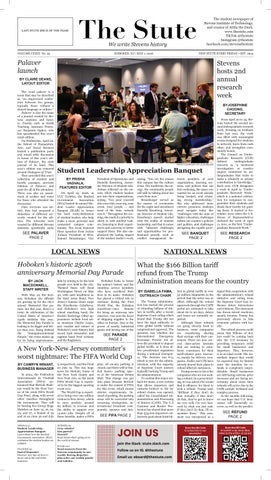
Student Leadership Appreciation Banquet BY PRISHA VAGVALA, FEATURES EDITOR On April 23, 2026, in UCC Techflex, the Student Government Association (SGA) hosted its annual Student Leader Appreciation Banquet (SLAB) to honor the hard work/dedication of student leaders who help make a more personal and connected campus community. The event featured three speeches from Jeylan Jurban, President of SGA; Samuel Strassburger, Vice
President of Operations; and Danielle Eisenberg, Associate Director of Student Life. Jurban reflected on the unseen effort student leaders put into their organizations, noting, “You pour yourself into your club, your org, your event, your people — and most of the time, nobody sees it.” Throughout the evening, she made it a priority to check in with student leaders, listening to their experiences and concerns to better support them. She also emphasized the lasting impact of the student leader’s work,
LOCAL NEWS
saying, “You are the reason this campus has the culture it has. The traditions, the energy, the community people will still be talking about ten years from now.” Strassburger served as the master of ceremonies for the night and introduced Danielle Eisenberg, Associate Director of Student Life. Eisenberg’s speech started with the reality of student leadership, and that it comes with “inherent challenges and opportunities for professional growth, such as conflict management be-
NATIONAL NEWS
Hoboken’s historic 250th anniversary Memorial Day Parade BY JACK MACDONNELL, STAFF WRITER With May on the horizon, Hoboken city officials are gearing up for the city’s annual Memorial Day parade, but this year, there’s a twist: In celebration of the United States of America’s 250th birthday this year, the Memorial Day Parade is looking to be bigger and better than ever. Being dubbed the “Semiquincentennial Parade,” the event makes up for its being unpronounce-
What the $166 Billion tariff refund from The Trump able by aiming to be the best Hoboken looks to honor Administration means for the country parade ever held in the city. the nation’s history and the Themed floats will flood Washington Street on May 30, with such headliners as the 63rd Army Band, New Jersey’s famous drum corps the Hawthorne Caballeros, and Hoboken’s own high school marching band, the Rockin’ Redwings. Other appearances include local salsa musician Charlie Lopez, jazz vocalist and winner of Hoboken’s 2016 Sinatra Idol award Zack Alexander, and ragtime band Fred Lehotay and the Ragtimers.
countless service members who have sacrificed their lives in its name. Hoboken has played a critical role in wartime; during the First World War, the Hoboken waterfront—once famous for being an entryway into America—was now the heart of shipping supplies to the Allies in Europe. Due to the power of nearby industrial giants and having one of the
SEE PARADE PAGE 2
A New York-New Jersey commuter’s worst nightmare: The FIFA World Cup BY CAMRYN WINANT, BUSINESS MANAGER In 2024, the Fédération Internationale de Football Association (FIFA) announced that MetLife Stadium would be the Host Venue of the 2026 FIFA World Cup Final, along with seven other matches throughout the tournament. They will be hosting five Group Stage Matches on June 13, 16, 22, 25, and 27, a Round of 32 and 16 on June 30 and July
5, respectively, and the Final on July 19. This was huge news for MetLife, home of the New York Giants and New York Jets, as the 2026 FIFA World Cup is expected to be the biggest sporting event ever. The World Cup is expected to bring over one million visitors to New Jersey, which in turn predicts around $2 million in revenue and the ability to support over 14,000 jobs. Despite all of these benefits, under a FIFA
NEWS (2-3)
SCIENCE (6)
Student Leadership Appreciation Banquet Learn about how the Student Government Association (SGA) celebrates the student leaders on campus! FEATURE (4)
End of Semester! Discover new tips on how to move-out at the end of the semester.
Gray whales? Kea parrot? Hawaii? Read about what’s going on in the world of science. PULSE (10)
Read answers from the Stevens community to our weekly Roving Reporter, plus solve our weekly puzzle and sudoku.
plan, all on-site parking is closed, and there will be limited $200+ parking spaces at the American Dream Mall. This change was put into place because MetLife is under the control of FIFA for this event, which causes stricter requirements. Instead of parking, the parking areas will be converted into screening checkpoints, international broadcast compounds, sponsor and hos-
SEE FIFA PAGE 2
BY ISABELLA FAMA, OUTREACH CHAIR The Trump Administration has started the process of refunding billions of dollars in tariffs, after a recent Supreme Court ruling which found that Trump did not have the legal authority to raise global tariffs without congressional approval. The question was whether the International Emergency Economic Powers Act allows the president to impose global tariffs, as it does allow presidential regulation during a national emergency. The decision was 6-3, which is rare for the administration, with the majority of Supreme Court justices typically backing Trump and his administration. To combat this major setback for many, a new system that allows importers and customs brokers to file for refund claims was opened, called the Consolidated Administration and Processing of Entries (CAPE). The U.S Customs and Border Protection has shared that more than 333,000 importers collectively paid about $166 bil-
lion in global tariffs in over 53 million shipments in the period that the order was in effect. Although the refund approvals through the CAPE portal are estimated to take about 60 to 90 days, delays and issues are naturally expected. Although these refunds are going directly back to business, some companies are considering sharing their savings with their customers. There are now several class-action lawsuits that are seeking to reimburse consumers for their tariff-related price increases, mainly for delivery companies. FedEx and UPS have already shared their plans to refund affected customers. Trump seems to favor the companies who are not seeking a refund. In a press briefing, he was asked if he would find it offensive for them to seek a refund. Trump said, “Brilliant if they don’t do that. Actually, if they don’t do that, they’ve got to know me very well. I’m very honored by what you just said. If they don’t do that, I’ll remember them.” This comment was interpreted as a
signal that cooperation with the administration’s refund initiative and ruling from the Supreme Court may influence future interactions and relations. The statement has drawn mixed reactions, mainly because Trump has previously shown to link economic policies with loyalty. The refund process could mean that billions of dollars could be coming back into the U.S economy by providing temporary relief for small businesses and importers. This, however, is in an ideal world. The immediate impact that would be expected may be limited since the timeline for refunds is completely unpredictable. Small businesses are still facing extreme price increases and are facing uncertainty about when their refunds will arrive due to the CAPE portals’ technical and complex process. In the months following, we can hope that U.S. businesses will financially recover, as well as the predict-
SEE REFUND PAGE 2
Friday, May 1
2
News Masthead Volume CXXIII No. 25 Executive Board
EDITOR-IN-CHIEF.............................JIYA JAISINGHANI ‘27 BUSINESS MANAGER.......................CAMRYN WINANT ‘28 MANAGING EDITOR.................................TIANNA SPITZ ‘27 LAYOUT EDITOR.......................................CLAIRE DEANS ‘29 OUTREACH CHAIR................................ISABELLA FAMA ‘29 DIGITAL MANAGER.........................CHARMY KOTADIA ‘27 SECRETARY.....................................JOSEPHINE CHOONG ‘28
Editorial Board
NEWS EDITOR...................................JOSH BODENSTEIN ‘29 SCIENCE EDITOR..................................RIYANA PHADKE ‘27 OPINION EDITOR.........................................ITAI GELLER ‘26 SPORTS EDITOR..........................MILAGROS CARBAJAL ‘28 FEATURES EDITOR ...........................PRISHA VAGVALA ‘28 HEAD COPYEDITOR..............................TASHA KHOSLA ‘25
PALAVER
CONTINUED FROM PAGE 1 Tolmanov, a 1/4 Visual Arts and Technology major, Isabella Gabay, a 2/4 Visual Arts and Technology major, Shreya Modi, a 3/5 Business and Technology major, Ksenia Dontsova, a 4/4 Visual Arts and Technology major, and Issac Van Benthuysen, a 4/4 Physics major. These individuals were just a handful of the panelists present to discuss and unravel the complexity of trust. Artworks presented were a mixture of digital and traditional media. Some consisted of graphite and oil pastels, while others were digital depictions of trust.
Others in attendance include some of the participants in the dialogue. The roundtable discussion with crowd commentary was about an hour and a half long. Students and staff members alike discussed their respective prompts that revolved around the concept of trust. A prominent theme throughout the event was the idea that you cannot trust an organization or a government, as trust requires a two-way relationship and more of a connection. It was discussed by many that the “trust” in organizations is, in actuality, faith. As the discussion closed out, celebrating the completion of this year’s edition, the editorial board encouraged students to participate in the coming year of dialogue.
Operations Board
HEAD PHOTOGRAPHER.......ISABELLE VILLANUEVA ‘26 ASST. SOCIAL MEDIA...............................CHRISTINE YI ‘29 DELIVERY BOY.........................................JONATHAN LAI ‘28 ASST. LAYOUT EDITOR.............................SHREYA ROY ‘27 ASST. LAYOUT EDITOR....................BRADY SANSOTTA ‘29 ASST. LAYOUT EDITOR..........................KAILEY SUPAN ‘29 ASST. LAYOUT EDITOR..................EILIYAH SAROWAR ‘28
Staff & Contributors Jack MacDonnell Maya Meets Alessandra Nieto Reka Weinact Tanya Avadia Atreyee Halder Sean Palermo Ruthie Mullisky
Izzy Gabay Dominic Souza Christopher Kalish Lillie Miller Sydney Leung Wesley Yu Disha Gohil
Contact Us
GENERAL.........................................EBOARD@THESTUTE.COM EDITOR-IN-CHIEF.........................EDITOR@THESTUTE.COM ADVERTISING.............................BUSINESS@THESTUTE.COM OFFICE.................................UNIVERSITY CENTER ROOM 216B
Corrections NOTICE A MISTAKE? Email us at eboard@thestute.com.
Disclaimer
All opinions and editorials reflect the views of their respective author(s). No Part of The Stute may be reproduced in any form, in whole or in part, without the written consent of the Editor-in-Chief. Cited references of The Stute are permitted.
Policy on Letters to the Editor
All members of the Stevens community are able to submit a Letter to the Editor to be published in The Stute. Letters must refer either to a piece published in The Stute or to The Stute in general and must be between 400 – 800 words in length. Submit letters to editor@thestute.com with your name and title (when applicable) or using our Google form. For writers who wish to write a Letter to the Editor anonymously, please see our policy on anonymity. The Editorial Board reserves the right to choose whether or not to publish a submitted Letter to the Editor based on a majority rule vote, and additionally reserves the right to edit letters for clarity or request authors to revise. Provided that the author approves the final version, The Stute reserves the right to edit letters according to our copy editing procedures, defined in our policies.
Policy on Op-Eds
All members of the Stevens community are able to submit a standalone opinion piece (otherwise known as an Op-Ed) to be published in The Stute. Op-Eds must be between 400 – 800 words, but longer submissions will be considered on a case-by-case basis. To submit an OpEd please email eboard@thestute.com with your name and title (when applicable) or using our Google form (tinyurl.com/submit-t0-stute). For writers who wish to write an Op-Ed anonymously, please see our policy on anonymity. The Editorial Board reserves the right to choose whether or not to publish a submitted Op-Ed based on a majority rule vote, and additionally reserves the right to edit Op-Eds for clarity or request authors to revise. Provided that the author approves the final version, The Stute reserves the right to edit Op-Eds according to our copy editing procedures, defined in our policies.
FULL LIST ON thestute.com/policies
tinyurl.com/stutesubmit
PHOTO COURTESY OF LILLIE MILLER
BANQUET
CONTINUED FROM PAGE 1 ing use of AI and its impact on almost everything we do.” Along with addressing current issues students must address or work through, she acknowledged the everyday responsibilities of a student leader. Though some of the tasks may seem menial, the impact they make in creating the personality and different communities for students on campus is significant. Building on this recognition of student leadership, these student leaders are appreciated not only through SLAB but also through the list of awards with nominees on screen, alternating between nominees for the Civic Engagement Award, Rising Leader Award, Social Justice Advocate, Stevens Pride Award, Student Leader of the Year Award, and Woman of Distinction. The list of Nominees included: The Civic Engagement Award Adelina Logozzo, Aidan Robinson, Anna Dabrowski, Breona Pizzuta, Christopher Alessandri, Meghan Zarish-Yasunas, Michael Moschello, Rimmo Loyi Lego, Sarah Peneiras, and Victoria Okonkwo. The Rising Leader Award Alessandro Chavez, Anna Sauchelli, Benjamin Good, Christina Chen, Christopher Thelisme, Isabella Lee, Jasraj Baweja, Justin Safner, Khadijatu Dabo, Lillie Miller, Lindsey Thompson, Noah Wachtel, and Yang Yi Zheng. Social Justice Advocate Award August Rose, Shahd Ibrahim, and Tanishka Kapoor. Stevens Pride Award Breona Pizzuta, Chris Longo, Christia Napoleon, Cooper Poggioli, Dalia Abbad, and Xiangxi Wang. Student Leader of the Year Award Abigail Thomas, Alexandria Switaj, Breona Pizzuta, Evan Papageorge, Jeylan Jubran, Khadijatu Dabo, Maeryn Erdheim, Max Green, Meghan Zarish-Yasunas,
Noor Kanaan, Ryan Manley, Samuel Strassburger, Shrikar Swami, and Sukira Ali. Woman of Distinction Award Aliona Heitz, Breona Pizzuta, Colleen Ginsberg, Dalia Abbad, Elizabeth Halton, Gabrielle Moroney, Georgina Fields, Khadijatu Dabo, Maeryn Erdheim, Meghan Zarish-Yasunas, and Mollie Good. The winners of these awards will be announced at the Undergraduate Student Awards Ceremony on April 28, 2026. There were four student leaders in particular who were responsible for planning and organizing this amazing event: Maya Ponce, Vice President of Communications of SGA; Christopher Thelisme, Assistant Vice President of Communications of SGA; Autumn Gallicchio, Assistant Vice President of Operations for SGA; and Sam Strassburger, Vice President of Operations. The Operations team of SGA had mostly first years, including Chris Thelisme, Autumn Gallicchio, and Maya Ponce, who were planning this event for the first time, taking as much inspiration from last year and improving on it despite not being there. Gallicchio, as the newly appointed Assistant Vice President of Operations, took the lead in organizing the seating chart, ordering decor, and developing a vision for the event. This team worked closely with the Office of Student Life to bring the event to life and did so efficiently. Student leaders at this event took photos, had dinner, and enjoyed the night, including time with student photographers. The evening was made possible due to the planning and execution behind the scenes for this event and the people who brought it to life. This was a night to celebrate a year of hard work, along with all the unseen efforts and challenges student leaders face on a daily basis, and the recognition that comes from continuing to show up and lead even when it is not always appreciated.
RESEARCH
CONTINUED FROM PAGE 1 At Stevens, the week was a collaboration between the Office of Undergraduate Academics (OUA), Student Government Association (SGA), and the Commuter Student Union (CSU). According to Noor Kanaan, one of the week’s student organizers, the planning started months in advance with the organizations collaborating to coordinate logistics, secure room spaces, invite speakers, and ensure that students made the most out of it. It was led by Andrés Mansisidor, Noor Kanaan, Kazi Tishan, Victoria Okonkwo, and Sofiia Goncharuk, along with other student leaders and partners. This year, event advertisements, through Instagram and flyers on campus, began earlier, which led to a significant increase in the number of attendees, with over 200 students participating during the week’s events. The full list of events was as follows: Monday, April 20: Undergraduate Research Week Kickoff Event Held in the UCC Gallery, it was a perfect way to kick off the research week through opportunities to network with fellow students, hear from professors, and play a fun trivia game. Additionally, awards were presented to undergraduate students and faculty alike, honoring their research and mentorship. The full list of awardees was: Outstanding Researcher Award: Athena Efthymiou (Class of 2027, Biomedical Engineering) with faculty mentor Dr. Antonia Zaferiou. Rising Researcher Award: Isabella Lee (Class of 2029, Physics) with faculty mentor Dr. Xiaofeng Qian. Honorable Mention: Evnika Myhovych Young Innovator Award: Rhea Bachani (Class of 2027, Chemical Biology) with faculty mentors Dr. Sunil Paliwal and Dr. Kwahun Lee. Honorable Mentions: Brendan Lee and Emily Lossman. Outstanding Mentor Award: Dr. Eman AlOmar Early Career Mentor Award: Dr. Xiaofeng Qian Senior Mentor Award: Dr. Hongjun Wang Towards the end, two alumni speakers discussed their research journeys. The first, Erika McCarthy, was a Chemistry major from 2021 and a Ph.D candidate at Rutgers University. The second was Sean Karg, a Physics major from 2021 and a Ph.D candidate at Princeton University. Tuesday, April 20: Research Fellowships Info Session Similar to last year, a virtual info session was held discussing research fellowships and where to find them. Wednesday, April 21: Research Social Hour The event, hosted by SGA and CSU, was a student and faculty lunch that served as an informal opportunity for students to speak and connect with their professors in a casual setting. Thursday, April 22: Lunch with the Director of Undergraduate Research Similar to last year, students conversed with each other and with Andrés Mansisidor, the Director of Undergraduate Research and Fellowships, about their research journeys, fellowships, and academic goals at Pi Kitchen. Friday, April 24: Undergraduate Research Movie Night This night was a new addition to the lineup of events and was hosted by CSU and OUA. Coupled with free popcorn, a casual and informal setting, and a fun film about research and discovery, it was a great way to conclude the research week. There are still plenty of ways to get involved in research and explore your passions. From keeping up to date with Instagram for undergraduate research to exploring the research and fellowship website, there’s a world of research waiting to be discovered.
Friday, May 1
3
News PARADE
CONTINUED FROM PAGE 1 most efficient ports in the metropolitan area, Hoboken’s ports were officially seized by the U.S. government and made a part of the New York Port of Embarkation. When the United States decided to official-
ly join the fight, the waterfront was then used to dispatch thousands of troops by sea to aid in the battle in Europe; it was one of the most utilized ports on the East Coast for the military. A common phrase amongst soldiers hoping to return home from the war is, “It’s heaven, hell, or Hoboken.” The WWI memorial statue by the waterfront remains as a physical reminder of
all the men whose last sight of this country was our shores. The stories of our veterans’ battles are to be celebrated in the parade, to let them be remembered for generations to come. And as Emily Jabbour said, “Hoboken looks forward to honoring both our nation’s history and the generations of service members who have defended it.”
REFUND
CONTINUED FROM PAGE 1
PHOTO COURTESY OF HOBOKEN GIRL
FIFA
CONTINUED FROM PAGE 1 pitality installations, fan festival spaces, and staging areas for buses and emergency services. The lack of parking options for visitors increases the need for public transportation. NJ Transit has announced that it will be charging $150 for round-trip train tickets from New York Penn Station to MetLife Stadium and $80 for a round-trip shuttle bus service from certain locations. Not only will
prices be inflated, but New York Penn Station will be closed to commuters for four hours before the game on match days to ensure that all World Cup ticket holders will be able to travel to and from MetLife Stadium. It was announced that tickets will be checked, commuters will not be able to access Jersey-bound trains, and Amtrak and Long Island Rail Road users will be directed to other entrances. On April 6, 2026, NJ Transit told The Hoboken Girl, “The mobility plan is still being finalized and will be announced later this month. NJ Transit remains
committed to safely transporting 40,000 fans to and from the FIFA matches, while also providing a transportation plan that will minimize the impacts to our regular riders to the greatest extent possible.” The major change for the few match days has left people very upset, especially commuters who rely on the NJ Transit system for work. Kris Kolluri, NJ Transit’s President and CEO, had argued that the World Cup would be the most important security event the United States would be seeing, so during the duration of the World Cup, there would be an increase
ability and decisions of the U.S. trade policy are improved moving forward. The refund effort has now been marked as one of the largest financial reversals in the history of modern trade.
PHOTO COURTESY OF QUARTZ
in security perimeters at New York Penn Station, MetLife Stadium, and Secaucus Junction. Despite the inconvenient turn hosting the World Cup has taken, there is a silver lining. The PATH Train will continue to run, but riders should still expect a high increase in demand. The PATH will be in service to all riders throughout the World Cup, ticket holder or not, and there are even talks to increase PATH service on game days. Seth Stein, a spokesperson for the Port Authority of New York and New Jersey (PANYNJ), told
SUBSCRIBE TO OUR NEWSLETTER
the Hoboken girl, “We are working closely with the states of New York and New Jersey, the City of New York, the host committee, and our regional and Federal partners to support a safe, efficient, and seamless experience for fans, visitors, and residents. Planning is ongoing, and we are preparing for increased demand across our facilities as part of this coordinated regional effort. Specific operational plans, costs, and funding arrangements are still being finalized in coordination with our partners.” We can only hope that a solution comes from NJ Transit soon.
Friday, May 1
4
Feature
THE END OF THE SEMESTER How you are going to get out and have the most memorable summer BY MAYA MEENTS, STAFF WRITER With the semester coming to an end and the weather getting warmer, it’s time to start thinking about all the possibilities of things to do over the summer. I don’t know about you, but I have a horrible habit of making large bucket lists of events and ideas, and by the end of the summer, I’ve realized I’ve done nothing. As we get older, too, and many people have jobs, internships, and larger travel plans, it becomes harder to get out, see your friends, and do fun things for yourself. So, in this article, I will try to lay out how I plan on trying to do everything I want to do this summer outside of work, and also maybe try to provide some ideas to add to your summer itinerary. I imagine most people reading this have a saved list of ideas or things to do in their free time, and this is the time to go through those ideas and organize them into three major categories: day trips or day commitments, high effort, and low effort.
From there, it is important to assess your free time by putting dates, work, personal commitments, and anything else you already know will be taking up your time into your Google Calendar. The goal here is to assess when you have free time so you can start reaching out to people to make plans. Part of my hope for this summer is to get out on lots of hikes and beach trips with people, and many plans like these can be half or full-day trips, which means if they are going to happen, they need to be scheduled early. I think having day trips planned and put in your Google Calendar, even if the day trip is just for yourself, is a great way to ensure it happens. I’ve often realized that I want to go so many places, but without preplanning the free days, I would just spend them at home, not doing anything. Also, if you plan a day trip with friends, and let’s say nobody can make it, still go out on that day trip by yourself. Or also, on the same note, plan day trips also just for yourself. Again, I think this is a way better method of re-
laxing than spending the beautiful sunny days inside doomscrolling. Looking into your calendar some more, I would acknowledge where you have “dead-space” — I consider this any time where you are driving, commuting, or eating. These are spaces where you can add in a small social hour, or something in the low-effort activities list. Commuting to work? Listen to a podcast or bring a little activity. Going for a lunch break? Bring a friend or maybe do a crossword puzzle. (Also a great idea to do at Stevens.) I think to fill your cup is to try and also just make use of these dead spaces in a way that feels fun and beneficial to you. I find that when I do things with other people, I often feel refreshed and more energized afterwards. In the evenings, after your job or longer day activity, if you still have the energy, I would also consider a higher energy event. Make cookies and invite your friends over. Host movie nights or game nights in your basement. Maybe have friends over for arts and crafts. One of the best things you
PHOTO COURTESY OF WHITNEY.ORG
can do over the summer is promote a sense of community with your friends. Many people after work don’t do much besides lying in their house and playing on their screens, so be the one to get people out and social. I remember last summer, one of my friends texted that she had made cookies and people should show up if they had a point in the evening, which ended up being one of my favorite memories because we just all got to chat and eat cookies. I also think that by making activities that you’d want to do by yourself, like sitting and watching TV or playing video games, into a social activity, you increase the fun and memorability of that event. Be proactive, be the one to reach out and make plans. If you want to have a good summer, it is also your part to make the effort. Lastly, I feel like the best way to fill your cup is to say yes and show up. Say yes when you have free time. Show up when you said you would and make the plan to. Say yes and do the things you need to do to make sure you can show
PHOTO COURTESY OF BETTYCROCKER.COM
up. The summer is one of the few times in a year when you can have more flexibility within your schedule, and as the years progress, it will become increasingly harder to get out and see people, so make the most of it while you can. Also, I thought I would add this in here for the people staying in the Northeast or around New York this summer. Trips I plan on doing: The Whitney Museum (Free for ages <25) The MET Cloisters (Pay what you wish) Dance Classes at Peridance ($24 per class for students) Hiking In Upstate New York and Pennsylvania Watching the Sunrise at Bradley Beach Going to the New Jersey Palisades And then yes, as I mentioned earlier, I plan on hosting some events in the evenings for my friends. I want to give as much time as I can to the people I care about, and I hope this inspires you to do the same.
Exit strategy: Five tips for Move-Out Day BY ALESSANDRA ZULUETA NIETO, CONTRIBUTOR Move-Out Day is imminent for students living on campus. Unless you’re staying for research, summer classes, or an internship, it’s time to pack up. With residence halls closing at 6 p.m. on May 16, or within 24 hours of your final exam, planning ahead is key to avoiding the panic of a last-minute scramble. Here are five tips to help you get a handle on the chaos. Tip #1: Take Stock Before you reach for packing tape, you need to know what you’re dealing with. After a year on campus, things accumulate. Most people underestimate how much they’ve managed to cram into a dorm room. Taking inventory helps avoid last-minute surprises and gives you a clearer idea of how to pack efficiently. Jotting things down in your notes app and categorizing items helps visualize everything.
Tip #2: Downsize & Donate Spring cleaning season is here. If you have clothes or accessories that no longer fit your style or needs, consider donating them or recycling them. With limited trunk space, unnecessary items are just clutter. There are plenty of options for donating, the best of which were previously highlighted here on The Stute just last week. Don’t waste money and energy packing things you’ll just throw away later. Tip #3: Winter Wrap-Up The bulkiest items should be your first target. The more puffers, boots, and heavy duvets you can box up and set aside now, the better. They are the hardest items to cram into luggage at the last minute. Even better if you can send them home now to lessen the work needed later on. Tip #4: Consider Vacuum-Sealing Vacuum-sealing bulkier items is an easy way to save a ton of space. By removing the air from linens or piles of folded clothes,
you can work with a much more manageable, compressed stack. All you need is an appropriate vacuum bag and a standard vacuum hose. If you don’t own one, reach out to friends; odds are, someone has one tucked away and won’t mind lending it out for 20 minutes. Tip #5: Pack a Bag Packing a separate backpack with vital electronics, chargers, basic toiletries, and a change of clothes is a great way to avoid unnecessary stress. The last thing you want to be doing, on top of saying goodbye, is tearing open boxes or undoing your hard work because you need a charger or set of keys. Packing up is never easy, but starting early turns a mountain into a molehill. Don’t forget to sign up for a move-out time through the housing portal and complete your checkout form to avoid extra fees. Good luck with finals, and enjoy the well-earned summer break!
PHOTO COURTESY OF @FOLLOWSTEVENS ON INSTAGRAM
Group project survival guide BY TASHA KHOSLA, HEAD COPYEDITOR At Stevens, a major aspect of the coursework is collaboration, which manifests in the form of group projects. Many students feel a sense of dread when they hear the words “group projects,” flashing back to memories of group mates who ghost, do nothing, or submit AI-generated slop. While group projects may feel overwhelming and frustrating, they are necessary for learning how to work well with others. Although you may not be able to choose your group mates, here’s a survival guide to get you through your next group project. Make a group chat The very first thing you should
do when tasked with a group project is create a group chat so that you can all communicate with each other. The choice of platform (iMessage, Discord, WhatsApp, etc.) is up to you and your group, but it’s important to have a way to contact each other outside of class. Define roles and responsibilities Oftentimes, the biggest challenge in group projects is a mismatch between what you and your group members are expecting from one another. In your newly formed group chat, communicate your expectations and assign clear roles and responsibilities. Sometimes, people want to contribute but aren’t sure where they fit into the project or are worried about
overstepping. Setting these expectations ahead of time helps ensure everyone is on the same page. Know your deadlines (and make sure your group knows too) For a long-term project, be aware of what deliverables your team is responsible for. Check the syllabus, listen to any updates from the professor, and keep an eye on your Canvas announcements. Make sure to remind your team of the next deadline so everyone is aware of what needs to be done. Don’t be afraid to hold each other accountable You’ve assigned the roles and responsibilities. You’ve made your expectations clear. You all know the deadlines. If at any
point a group member isn’t doing their work, don’t be afraid to approach them about it. We all have a lot going on between school, work, and extracurricular activities, but in group projects, we owe it to one another to complete the work together. Be understanding when you approach your group member, but don’t feel guilty about reminding them of their duties. If needed, you and your team members can adjust the workload to accommodate group members who may not be able to complete the work at that time. Involve your professor if needed Even after attempts at communicating with your group members and trying to fairly divide the work, sometimes things
just don’t work out. At any major signs of trouble, try to speak with your professor and keep them informed on what’s going on. They may have advice for you, or they can factor in the situation when evaluating the project. Remember that your professor wants you and your group to succeed, so if you need any help, don’t hesitate to ask them. Group projects can be challenging, but this guide can help make the next group project feel less daunting. Stay organized, communicate with one another, and adjust as needed.
PHOTO COURTESY OF EVEREDUCATING.COM
Friday, May 1
5
PHOTO COURTESY OF STEVENSDUCKS.COM. SHOT BY SID ROCHLANI
Sports
ON DECK IN SPORTS FRI, MAY 1 SOFTBALL MAC Freedom Tournament TBD WOMEN’S AND MEN’S TRACK AND FIELD MAC Freedom Championship TBD BASEBALL DeSales University Center Valley, PA 4:30 p.m.
Stevens Softball sweeps King’s in MAC Freedom Doubleheader, 14-3, 6-1 BY MILAGROS CARBAJAL, SPORTS EDITOR The Women’s Softball team extended its late-season push on Saturday, sweeping King’s College in the Middle Atlantic (MAC) Freedom doubleheader. The Ducks (22-12, 7-5 MAC Freedom) powered past the Monarchs (11-23, 3-9 MAC Freedom) with a 14-3 victory in game one before securing a 6-1 later in the day. The sweep marks Stevens’ eighth consecutive win. Stevens wasted no time setting the tone in the opener, with two runs in the first inning through aggressive baserunning.
Junior Emma Quattrochi led the offense with an infield single and advanced to third before sophomore Allison Mitloff and sophomore Carmelita Murphy-Brown helped bring her to home base. Sophomore Jessica Hsu followed with a sacrifice fly to make it 2-0. Hsu dominated in the circle early, retiring the next six batters while the Ducks added on in the third. Mitloff and Murphy-Brown led off with walks as Hsu and first-year Isabela Lipsky followed with RBI singles and pushed the score to 4-0. First-year Kacey DiPasquale laced a double to right center, only two batters later, stretching the lead to 6-0. A defensive mis-
cue allowed another run to cross, pushing the advantage to seven. King’s threatened in the fourth, scoring three runs and loading the bases, but Stevens shut the door as Riley Lawrence fielded a grounder and stepped on second to end the inning. The Ducks answered in the bottom of the inning with seven runs. Murphy-Brown hit a two-run single and sophomore Isabelle Won added an RBI double, while King’s errors and wild pitches helped extend the inning. Hsu finished the game in the fifth to secure the 14-3 win. In the second game, Stevens struck first as Emma Quattrochi scored on a throwing error.
SAT, MAY 2
Senior Kyra Fischer retired the first six batters, and after King’s tied it in the fifth, the Ducks responded with a five-run sixth. Hsu delivered a two-run single, Fischer added a two-run hit, and Mitloff drew a bases-loaded walk to cap the inning. Fischer then retired the side in the seventh to secure the 6-1 win and complete the sweep. Stevens showcased a complete performance across both games. With eight straight wins, the Ducks are finding their rhythm as MAC Freedom play continues. Fans can look ahead to the Ducks’ next game against Misericordia University on April 30 at 3:30 p.m. in Dallas, PA.
The Women’s Tennis team has had an extremely successful season so far, with their overall record of 15-2 and an undefeated conference record of 6-0. The Ducks’ most recent victories came from matches against SUNY New Paltz, Lebanon Valley College, and DeSales University. On Saturday, April 18, the team faced SUNY New Paltz, earning a 7-0 win and bringing the team to nine straight wins. The Ducks won two of three doubles flights, with sophomore Gigi Arenas and senior Stephanie Untermeyer winning 6-0, and junior Alix Dry and first-
year Kaylee Hobbick winning 6-4. The Ducks won all six singles matches, with Arenas winning 6-1, 6-2; Dry and sophomore Wei-Wei Lai each winning 6-3, 6-2; junior Lorena Piegas winning 6-3, 6-3; Untermeyer winning 7-5, 6-4; and Hobbick winning two of three sets (6-4 and 1-0). On Sunday, April 26, Stevens defeated Lebanon Valley College, winning 6-1, clinching the No.1 seed in the Middle Atlantic Conference (MAC) Freedom Tournament. In doubles play, Untermeyer and Arenas, along with Dry and Hobbick, won their respective matches 6-0, while Lai and Piegas won their match 6-2. In singles matches, Dry added a 6-0, 6-1 win as first singles,
as well as wins being contributed to from Piegas (6-1, 6-1), Untermeyer (6-4, 6-0), Hobbick (6-1, 6-0), and Lai (6-2, 3-6, 1-0). Following such an impressive win, the Ducks faced fourth-seeded DeSales University in the MAC Freedom Semifinals on Tuesday, April 28, winning 4-0. In doubles matches, Dry and Hobbick won 6-0, and Arenas and Untermeyer won 6-1. In singles matches, both Hobbick and Arenas each won their matches at 6-0, 6-0 for each set. Untermeyer delivered the match-winning point, winning 6-0, 6-1 at the No. 3 spot. This victory marked the Ducks’ ninth consecutive conference tournament match, counting both semifinals and finals appearanc-
MEN’S LACROSSE MAC Freedom Championship TBD WOMEN’S AND MEN’S TRACK AND FIELD MAC Freedom Championship TBD SOFTBALL MAC Freedom Championship TBD WOMEN’S TENNIS MAC Freedom Championship Hoboken, NJ TBD
Women’s Tennis recent wins lead the Ducks to MAC Championships BY RUTHIE MULLISKY, SPORTS WRITER
WOMEN’S LACROSSE MAC Freedom Championship TBD
es, since the 2021-22 season. Stevens will play again in the MAC Freedom Championship on Saturday, May 2, where they will face Lebanon Valley College once again.
MEN’S TENNIS MAC Freedom Championship TBD BASEBALL DeSales Univeristy/MAC Freedom Semifinals Center Valley, PA 1:00 p.m.
THU, MAY 7 WOMEN’S AND MEN’S TRACK AND FIELD West Point Twilight West Point, N.Y. TBD PHOTO COURTESY OF STEVENSDUCKS. COM (SHOT BY DAVE JANOSZ)
STEVENS SCOREBOARD DATE
WED, APR 22 FRI, APR 24
SAT, APR 25
SUN, APR 26
TEAM
SOFTBALL SOFTBALL MEN'S AND WOMEN'S TRACK AND FIELD BASEBALL MEN'S AND WOMEN'S TRACK AND FIELD SOFTBALL MEN'S TENNIS SOFTBALL MEN'S AND WOMEN'S TRACK AND FIELD MEN'S GOLF MEN'S LACROSSE WOMEN'S LACROSSE MEN'S GOLF WOMEN'S TENNIS MEN'S TENNIS BASEBALL
OPPONENT
LOCATION
SCORE
MANHATTANVILLE COLLEGE MANHATTANVILLE COLLEGE RICK MCCORKLE INVITATIONAL
AWAY AWAY AWAY
L (1-4) L (5-8) COMPLETE
FAIRLEIGH DICKINSON UNIVERSITY PENN RELAYS
HOME AWAY
W (15-8) COMPLETE
FDU-FLORHAM COLLEGE OF NEW JERSEY FDU-FLORHAM RICK MCCORKLE INVITATIONAL
AWAY AWAY AWAY AWAY
W (1-0) W (4-3) W (8-0) CANCELED
MAC FREEDOM CHAMPIONSHIP DESALES UNIVERSITY DESALES UNIVERSITY MAC FREEDOM CHAMPIONSHIP LEBANON VALLEY COLLEGE LEBANON VALLEY COLLEGE FDU-FLORHAM
AWAY AWAY AWAY AWAY AWAY AWAY AWAY
1ST PLACE W (20-7) W (15-4) 1ST PLACE W (6-1) W (7-0) W (13-3), W (5-2)
Friday, May 1
6
Science A new theory may explain the matter-antimatter asymmetry problem BY ATREYEE HALDER, SCIENCE WRITER According to our current understanding of the universe, equal amounts of matter and antimatter should have been produced in the Big Bang, then both annihilated. However, the universe is dominated by matter, and most of the antimatter is missing! Where did this antimatter go? The matter-antimatter asymmetry problem is one of the greatest challenges in physics today. A new theory may lead us closer to solving this fundamental mystery. Nikodem Poplawski, a Polish theoretical physicist of the University of New Haven, theorizes that tiny primordial black holes created during the Big Bang consumed vast amounts of antimatter, leading to the asymmetry between matter and antimatter. Antimatter can be interpreted as the “opposite” of regular matter, made up of antiparticles like antiprotons and antielectrons, with signs opposite to those of regular protons and electrons. “Primordial black holes are hypothetical black holes that formed soon after the Big Bang because of extreme, high-density fluctuations in the early universe. They are good candidates for being the seeds of supermassive black holes at the centers of massive galaxies, as well as of intermediate-mass black holes at the centers of globular clusters,” Poplawski said. “There are other models of elimination of antimatter, but they all assume some physics be-
yond the Standard Model of particle physics. According to Poplawski, because antimatter particles are more massive than matter particles, when matter-antimatter pairs were produced in the early universe, the antimatter particles were slower than the corresponding matter particles. Since a black hole is more likely to capture massive particles due to their slow speed, the primordial black holes gobbled up more antimatter than matter, and the rest of the antimatter was annihilated when it met with the surviving matter. “Because the probability for gravitational capture of a massive particle by a black hole increases as its speed decreases, the antimatter particles were captured by black holes at larger rates than the corresponding matter particles,” Poplawski explained. “The missing antimatter fell into primordial black holes, and what did not fall was annihilated by matter.” This theory could explain another problem in cosmology, in which the James Webb Space Telescope (JWST) began spotting supermassive black holes around 500 million years after the Big Bang. However, the process of formation and growth of these supermassive black holes was predicted to take at least 1 billion years. Poplawski thinks that by gobbling up antimatter, primordial black holes could have gotten a head start on these growth processes. “Primordial black holes consumed more antimatter than matter,
and because antimatter was much heavier than matter, primordial black holes enormously increased their masses,” he said. “This could possibly explain how supermassive black holes recently observed in the early universe have grown so quickly.” To confirm this theory, observational evidence of the existence of primordial black holes could be obtained. However, these have remained hypothetical since they were first proposed by Stephen Hawking in the 1970s. Another theory proposed by physicists at the University of Massachusetts Amherst relates a mysterious 2023 event to these primordial black holes. In 2023, scientists detected a subatomic particle called a neutrino hitting Earth with an energy level so extreme that it seemed impossible. In a study published in Physical Review Letters, researchers at the University of Massachusetts Amherst suggested that this event may have originated from an exploding primordial black hole. “Primordial black holes would have existed in the very early universe, which is currently very difficult to probe. I hope that gravitational waves and neutrinos could be used in the future to test this hypothesis,” Poplawski said. “Also, there could be future experiments testing if matter and antimatter particles may have slightly different masses at higher densities or smaller distances compared to those currently probed.”
This kea parrot is the firstknown disabled alpha male BY RÉKA WEINACHT, STAFF WRITER The kea bird is a large parrot native to New Zealand, similar in size to a rabbit. This endangered bird has olive-green feathers and eats everything from roots and berries to land snails and insects. A flock of keas is called a circus (or a conspiracy), which just indicates how playful and active these birds are. Their name, kea, is most likely an onomatopoeic representation of their call, “keeaaa.” They sound like a raucous and fun group of birds already — but one of them took this a step further. Introducing Bruce, the kea bird who just made headlines in science articles all over the internet. Bruce has lived at the Willowbank Wildlife Reserve by the Waimakariri River in New Zealand since 2013, when he was found in the mountains by a researcher, missing the upper half of his beak. Since kea beaks are highly sensitive tools that they use for just about everything from grooming to feeding to fighting for male dominance, Bruce was taken back to the wildlife reserve to increase his chances of survival with his disability. Thirteen years later, Bruce is not only surviving, but thriving: He has become the alpha male in his group! Kea birds have a social hierarchy that is determined by fighting between males, squawking, or puffing up feathers — these are called dominance interactions. Usually, the birds bite and kick each other while fighting, but Bruce is unable to bite with half of his beak missing. One would think that this would make it harder for Bruce to fight, as it puts him at a disadvantage compared to other birds. In fact, many visitors at Willowbank think so as well, expressing pity for Bruce when they see his broken beak among all the kea birds in the trees at the aviary. However, “the visitors’ pity is misguided,” says Alex Grabham, a behavioral ecolo-
gist at the University of Canterbury in Christchurch. Bruce did not let his injury (or whatever it was that may have caused his disability) get him down. As researchers at the reserve have observed and documented, he developed his own new techniques for fighting other birds, such as a technique that the scientists have called “jousting.” Instead of opening his beak and biting the other birds’ necks, which is what most kea birds do, he lunges forward with his lower beak sticking out, using it like a dagger. This unconventional way of fighting back seems to be catching all the other birds off guard, judging by the fact that he won all 36 of his physical dominance interactions that Grabham’s team recorded. He has taken advantage of the shape of his damaged beak and has also made extensive use of kicking with his feet. Bruce has also been observed using unique techniques for other things, including the daily task of grooming himself. When he’s not being groomed by the other members of his circus as a token of respect for his alpha status, he can be seen using small pebbles to remove dirt from his feathers. Bruce has even made it into the Wikipedia page on kea birds for this fact! Bruce’s way of working around his missing upper beak has been compared to a human’s compensation for a missing limb. It’s incredible to see an example of this happening, if not in the wild, but in a community of parrots. Bruce is the first observed and recorded example of a disabled animal achieving alpha status without help from another animal, but that doesn’t mean it hasn’t happened before; it just means we haven’t observed it. Perhaps we should pay more attention to the animal world, and perhaps Bruce can teach us all a lesson about staying positive in a disadvantaged situation and about playing to our strengths, whatever those may be.
Gray whales are dying off the coast of San Francisco PHOTO COURTESY OF ASTRONOMY.COM
Hawaii is repurposing plastic pollution in its roads BY SEAN PALERMO, SCIENCE WRITER Due to Hawaii’s economic and logistical challenges in recycling plastic waste, such as marine debris lingering in its ocean waters, researchers have been pioneering a method for recycling this waste (e.g. derelict fishing nets, discarded fishing gear, tourist waste, the Great Pacific Garbage Patch, and residential plastic trash) by covering roads with an asphalt-plastic mix. While places such as Missouri and Texas have both already introduced plastic-paving initiatives, Hawaii is the first to use marine debris in the effort. Already, more than 90 tons of plastic trash have been removed from the Pacific Ocean, with more than a metric ton of fishing nets alone being repurposed in this endeavor. To move forward with plans, the Hawaii Department of Transportation (HDOT) reached out to environmental chemist Jennifer Lynch (director at the Center for Marine Debris Research or CMDR) with two requests: provide derelict fishing nets to be recycled in these modified pavements, and measure potential microplastic shedding from said pavements in comparison to roads modified with SBS (a type of copolymer) that had been mostly used
since 2020 to increase strength and durability in the tropical climate. In fact, one of the key questions in the introduction of these new roads was whether their wear and tear would shed microplastics into the environment, especially concerning the chance of exposing humans and animals to toxic plastic additives that may lead to several health drawbacks, such as hormone disruption, chronic inflammation, and reproductive problems. According to Lynch, “CMDR’s laboratory is equipped with state-of-the-art chemical instrumentation for quantifying and characterizing microplastics in environmental samples,” which has been put to full use during initial testing. Preliminary results have been promising, with the asphalt remaining largely intact, according to researchers who reported on March 22 at the American Chemical Society meeting in Atlanta. The first phase of this research began in 2022, when three experimental pavement strips were laid: one of traditional asphalt and SBS, one of marine waste and rubber, and one of marine waste and asphalt without rubber. After 11 months, samples were collected and tested for microplastic leaching through a variety of ways simulating how microplastics are normally released into
the ecosystem, revealing no significant microplastic release compared to the strip without plastic mixed in, according to marine biologist Jeremy Axworthy, a lab manager who worked on the program for CMDR. In fact, it was determined that polymers shed by tires far surpassed those from the pavement itself. The second phase began in 2024, where five experimental strips were tested: one with ground fishing nets and SBS, one with plastic from consumer trash and SBS, one with traditional asphalt and SBS (the control), one with fishing nets and no SBS, and one with plastic waste and no SBS. This time, the team made use of an industrial solvent called dichlorobenzene in order to extract polymers from the mixed dust to more accurately quantify the release of microplastics from the roads. These results are still to come, as Lynch would say at the end of March, “we don’t have any findings yet from the road that contains the fishing nets,” though he recounted the promising results from phase one so far. When reflecting on current progress, Lynch described how “some people think plastic recycling is a hoax — that it doesn’t work; it’s too challenging…But this work demonstrates that recycling can work when society prioritizes sustainability.”
BY TANYA AVADIA, OPINION COLUMNIST The Bay Area is a popular tourist destination for many, including gray whales. However, it has recently been discovered that coming to San Francisco can be life-threatening for these whales. In fact, researchers have reported that one in five gray whales that enter the bay die there, according to the Frontiers of Marine Science report published on April 13, 2026. For the marine mammals, this is extremely bad as their population has already faced discrepancies in recent years. To understand why these whales are even entering the waters close to San Francisco, Josephine Slaathaug, a whale biologist at Sonoma State University, and her colleagues have been studying the whales’ migration patterns for some time now. Gray whales, also known as Eschrichtius robustus, typically migrate from the freezing waters of the Arctic down to Mexico. Along the journey, they typically eat, and while surrounding the waters of Mexico, they tend to mate and give birth before returning north to where they started. Their trips are usually nonstop, but in recent years, researchers have found that some possibly hungry whales go looking for food within the San Francisco Bay Area. This is no surprise, as it coincides with the decrease in food availability within the Arctic, which has led animals to be resourceful and find food elsewhere. However, this in turn has caused a huge die-off of whales. Slaathaug and her colleagues
have collected 100,000 photos of gray whales from 2018 to 2025 to identify the 114 specific whales that visited the Bay Area. Similarly, 70 carcasses were found in the waters near the city in that area, and 21 matched the photographed whales. This meant that 18% of the whales that entered the region died during this time period. However, researchers have reason to believe that this percentage is a severe underestimate. Many of the carcasses were too decomposed for identification, but there is a possibility that they died after entering the bay. Further examination shows that nine out of the 21 identified whales had a cause of death related to vessel strikes. This shows a possible causation for the whale deaths. While this study primarily focuses on gray whales within the San Francisco area, it is indicative of a larger trend, as whales have been spotted in unusual areas such as off the coasts of New England, Florida, and Hawaii. Slaathaug shares that whales’ exploration of other areas isn’t necessarily a bad thing. For Arctic whales, getting comfortable in warmer waters is a sign of adaptation. However, this also leads to other risk factors, such as boats and human activity, which can be detrimental. This poses a bigger responsibility on humans to be cautious of whale activity and provide a safer space for them to be able to hunt for food. Alternatively, Slaathaug also attributes climate change to whales being unable to find food in their normal migratory patterns, which bodes a larger issue that needs to be addressed.
INTERESTED IN SCIENCE JOURNALISM?Join our Science writing team! Reach out to Riyana Phadke, Science Editor (rphadke@stevens.edu) for more information – No experience necessary to write • thestute.com/category/science –
Friday, May 1
7
Opinion THE STUTE EDITORIAL
The end of the semester, but The Stute continues on This weekend, I came back from home to find pages of The Stute torn and stomped on outside my room, scattered across the hallway. I am the Resident Assistant for the floor, so I had to follow my protocol, but as the Editor-in-Chief of The Stute, it stung to see our work treated that way. As I reflect on the semester, I have realized that, aside from those in the organization, no one recognizes the work we put in each week. I could sit here and teach you our Stute timeline, but instead, I urge you to read one of my first editorials, “How are you?” In this, I go through the production week in the eyes of the Editor-in-Chief. Instead, right now, I want to bring to light everyone behind the scenes. We are a team of 55+ students. To my writers, thank you for filling our pages every week. You are the heart of our newspaper,
and I appreciate every single one of you taking the time to produce one, sometimes more, 500-700word articles. Your passion for your sections is seen through every word on every page. I cannot fathom how you all continue to write and submit articles in less than five days while also battling your academic and personal lives. To my copy editors, you are a small but mighty team. It is because of you that the writers are able to express themselves in a manner that is understood by all. Reading and closely editing 25-plus articles each week is no easy feat. And yet, you all do it with ease. You put my copywriting skills to shame and teach me something new each week. To my editors, thank you for being involved in each issue in a larger capacity. I cannot express the amount of gratitude I have for you all for confirming that your writers submit their articles,
putting out fires, fact-checking/ copyediting content, photographing, pitching articles, and overall making The Stute feel welcoming to the new Stuters on our team. By consistently attending our events on Tuesday nights and our staff meetings on Wednesdays, you have become the most recognizable faces of this organization. To my e-board, thank you for taking care of everything in between. You plan our events, maintain our website, book rooms, and turn ideas into reality. Simply put, you make this organization run. Without your enthusiasm, we would have no writers, photographers, or editors. You show the school that there is more to The Stute than a newspaper; there is a family of passionate and creative people behind every thought, word, and event. To anyone who has reached out to me outside the organization, thank you for trusting us to relay
MIND OF A FRESHMAN
BY ROBERT JACK DIETRICH ‘29 With the exception of final exams and projects, my freshman year at Stevens is pretty much over. As I type this, it is a little hard to believe. Not just because my school year is ending a month earlier than it has for the past 13 years, but also because it has been so wildly different from anything I have ever experienced up to this point. This column is called Mind of a Freshman. The intended purpose is to give a freshman (or two) a place to voice literally whatever they want about their first year at Stevens. Now that I am at the end of my first year, I would like to run down some last few thoughts that I have had over the last couple of months that never made it into one of my articles for one reason or another. False Spring: I just want to enjoy one week without it going below freezing. Seriously, this isn’t my first time with turbulent weather, but it certainly has been the worst. I went from wearing shorts and a Hawaiian shirt one day to having on sweatpants and my winter coat the next. I planned on writing a full article on this, but it came off as a 600word rant, and I scrapped it. Going Home: I’m from Pennsylvania. It’s about a three and a half hour drive to get back home, and I do not have a car here.
Jiya Jaisinghani ‘27
Editor-in-Chief
SENIORITIS
One down, three to go So, over the past two semesters, I have only gone home four times: fall break, Thanksgiving break, winter break, and spring break. Something I’ve noticed, being here for almost every weekend, is that for all the people “living” on campus, they sure do go home a lot. Now I get that going home is nice, but isn’t the whole point of college to grow as a person and learn how to live on your own? Going home every single weekend completely defeats the purpose. For those who go home frequently, I implore you to stay a weekend and just relax. Walk around Hoboken, sit in a park, or clean your dorm. Just enjoy what college and this area have to offer, and learn to live on your own. Yes I Know My Major is Easier: I am a Music and Tech major. My schedule is significantly lighter than an engineer or Computer Sci-
the information you want written about in an unbiased and cohesive manner. Your tips, op-eds, or thoughts fuel our motto. You remind us of why we do it each week. To anyone who picks up our newspaper, this is your reminder that there is a team of 55-plus people behind each issue. We even plan summer events during Alumni Weekend and Stute Weekend to keep the organization active. I saw those newspapers stomped on and thought: It took Claire and me 12 hours to digitally design that, and five seconds for them to rip it apart. But, it is so much more than two people’s work that was thrown around. The semester comes to a close, but The Stute does not. Even when you don’t see an issue on the rack, we are still writing, editing, planning, and showing up. Good luck on finals, Stuters! And thank you for being a part of the 26 issues this year.
Dear freshman year Abby ence major. Especially since because of switching, I am going a couple classes out of order. But for the love of all that is holy, I am a person too; I am allowed to complain about a class or two. We all have bad weeks sometimes, but just because I’m not taking Differential Equations or Thermodynamics classes does not mean I don’t have the right to complain about a bad assignment or rough test. So, for all the engineers who have a friend in the arts, they are human too. They have bad weeks just like you. Treat them as such. This column has been so much fun to write over the last couple of months. Not all of my articles have been great, but I enjoyed writing each and every one of them, regardless of who read them. Hopefully, I’ll be back next year writing for a different column, but if not, it’s been fun. I’ve survived one year at Stevens so far. Three to go.
PHOTO COURTESY OF ROBERT JACK DIETRICH
BY ABBY THOMAS ‘26 Dear Freshman Year Abby, Hey. It’s you… from the future. I wanted to use my last Senioritis article to write to you and give some spoiler alerts for your next three years. I know exactly how your freshman year went, and damn, I’m just proud of you for making it through all that. Between changing your major, finding new friends, joining a sorority, and being away from home, you have really learned a lot about yourself. I have news for you though: you have a lot more learning to do. Sophomore year will be fun. You’ll be in the towers on the 18th floor with a beautiful city view. This will be the year of finding who you are professionally. You started three new jobs on campus. Circulations assistant in the library, where you will meet some of the most amazing people ever. Graduate students who provide you a place to rant about classes, cry about boys, talk about the world around you, and learn about different cultures and customs. You’ll work as a student ambassador and meet the friendly faces that run Stevens behind the scenes. By the time you graduate, you have attended every single Admitted Students Day. And you’ll start working in the business school as a Research Assistant. This job opens doors for you that you could’ve
COMIC CORNER BY IZZY GABAY
never imagined. Along with work, you changed your major and truly found your passion in Quantitative Social Science — one of the best decisions you have ever made. Junior year is all about the life experiences you have gained. That year you learned to let it hurt, then let it go. You moved into the Phi Sig house (shoutout 835!!!!) and lived with your best friends. You applied to be president and were elected. You led your chapter and learned how to be the head of operations, logistics, risk, recruitment, administration, literally everything, but you had an amazing executive board and chapter right beside you. And hey, you just won President of the Year! You also teamed up with the most amazing people ever and started a band. You would end up opening for Dayglow at Tech Fest — one of the best experiences of your college career. Junior year, you met a few people who would get to know you more than anyone else ever will. You have made real friendships and found who your people truly are. These friends will stay with you forever, I just know it. You will also get into a relationship this year. This experience will give you insight into what it means
to have certain feelings for someone. You’ll fall in love, lose your sense of self a little bit, break up, and eventually end up on your own, feeling slightly confused and sad, but more alive than ever. This will be good for you, though. Because like the great Taylor Swift says, “Everything you lose is a step you take.” Senior year has been all about love. Loving yourself, loving your friends, loving your life! You will do all the things you have always wanted to do. You roadtripped with your best friends, you got into graduate school to pursue a career you are passionate about, and you found yourself again. I realized that when I was younger, I was constantly looking for something. I was looking to my friends for validation, constantly unsure of my actions and searching for reassurance. I was looking to certain people to find a sense of love and romantic belonging, losing my own identity in the vast waves of another. Time and time again, I was walking away from people and situations that sucked the life out of me and quickly took over my personality. I am finally learning to trust myself. Finally, I am back to me.
PHOTO COURTESY OF THE ENTERTAINMENT COMMITTEE
Friday, May 1
8
Opinion BOOK OF THE WEEK
An introspection with The Possession
BY CHRISTINA THOMAS ‘26 The Possession by Annie Ernoux is a short novella about an all-consuming jealousy the narrator feels about her ex-husband’s new partner. The story follows the narrator as she begins to obsess about the new woman her ex-husband is dating, and the feeling of desire and resentment she begins to feel as she compares it to being “possessed.” The narrator spends the story trying to figure out who this mysterious woman he is dating is and regretting ending her
relationship even though it left her feeling unsatisfied. It is a deeply interesting character study into the emotion of jealousy that works really well. The introspective nature of the story makes it effective and compelling. There is not a lot of plot in the story. The author instead chooses to focus on the psyche of the narrator and how her jealousy towards this relationship begins to affect her everyday life. The story is vaguely modeled after the author’s own relationship experience, which makes the story feel real and almost tangible. The most interesting part is how much she obsesses over the woman, whom she has never met and never will meet, rather than her ex-husband. She wants to know who this woman is and what is so special about her. It drives the narrator mad, and the descent into obsession is incredibly in-
teresting. I think the short nature of the book works to its advantage. Because of the lack of plot, a longer story would lack structure, and the all-encompassing mind of the narrator would start to feel repetitive. Ernoux is fantastic at describing minor details that get under your skin, as the emotions that the narrator is feeling begin to feel relatable. The descent into possessiveness she feels as she begins to obsess over this woman and who she might be. The story mostly takes place in her thoughts, and the plot revolves around minor moments in her relationship with her ex-husband after their divorce. I recommend this novella to anyone interested in reading a story about introspection and the encompassing nature of jealousy and obsession. The writing style was gripping, and the story itself was really well
crafted. The descriptions that Ernoux uses to explain what she is feeling are very engaging, vulnerable, and work really well. I will note that some of the sexual references made throughout the story felt a little jarring, but I did listen to the story via audiobook, so that may have affected my experience. Overall, it did not distract from the quality of the story, and sometimes even enhanced it, but it was notable enough for me to notice it. I also highly recommend the audiobook. The story itself reads as a stream of consciousness as the protagonist begins to recount her obsession and jealousy over the woman, and the audiobook narrator does a great job of putting you into her mind. The Possession is a short novella, definitely worth reading, and the contemplative nature of the story will leave you thinking about it for a while.
ing that some traditions are not dependent on circumstance. That even in unfamiliar spaces, a single bite can recreate something familiar. Beyond the plate, the act of beginning with something sweet says more than it seems. It reflects a belief that life, at its core, is still worth celebrating. That
even when the past year has been difficult, the next one deserves to be welcomed with openness rather than hesitation. It is a small act, but it carries something larger: The quiet belief that happiness is worth reaching for. I still take that first bite every year. Not because I expect the
PHOTO COURTESY OF AMAZON
BEYOND THE PLATE
A sweet beginning
BY DISHA RANA ‘29 Before anyone says happy birthday, something sweet is placed in your mouth. It happens almost instinctively. A small piece, pressed forward with expectation. You don’t question it. You take the bite. Sugar dissolves quickly, settling on your tongue before anything else can. Before candles, before wishes, and before the day fully begins, there is sweetness. In my culture, this is how we mark beginnings. Sweets are never random. They appear at moments that matter — good news, celebrations, or milestones that deserve recognition. A birthday is no exception. It is not simply the passing of time, but the start of something new. Another year. Another chance. And the first way we acknowledge that is through taste. Not with something savory. Not with something practical or filling. With something sweet. There is something intentional about that choice. Sweetness is not necessary. It does not sustain you the way a full meal does. It is not about hunger. It is about meaning. To begin a year of
life with sugar is to make a quiet statement: that we hope what comes next carries the same softness, the same warmth, the same ease. Of course, life rarely follows that script. Years are not consistently sweet. They are uneven, unpredictable, and sometimes sharp in ways no amount of sugar can soften. Yet, the ritual remains unchanged. Every birthday, the same gesture. The same offering. The same belief, repeated without needing to be explained. Maybe that’s what makes it matter. Sweetness, in this context, is not a reflection of reality. It is a form of hope. A way of setting the tone, even when we know we cannot control the outcome. It is optimism made tangible — something you can hold, offer, and taste. I didn’t always think about it this way. Growing up, it felt automatic. A piece of mithai pressed into my hand, a bite of cake shared between family members, and sugar offered with the kind of certainty that made questions unnecessary. It was simply what we did. Only later did I begin to notice how constant the ritual was — how it persisted regardless of where we were, how much had changed, or what the year before had held. Even when everything else shifted, the sweetness stayed. There is comfort in that kind of continuity. In know-
year ahead to be easy, but because I’ve come to understand what that sweetness really holds. It isn’t a promise. It’s the beginning. A small, deliberate way of choosing joy before anything else has the chance to define the day. There’s something comforting in that — starting with sweetness, even if life
doesn’t always follow. It reminds me that happiness doesn’t have to wait for the right moment. Sometimes, it’s something you decide to taste first. Before anything else, there is sweetness. And maybe that’s the point — not that life will always be sweet, but that we begin as if it can be.
PHOTO COURTESY OF DISHA RANA
UNDERGROUND WORLD OF FASHION
Confusing state of clothing
BY GAVIN RUBY ‘27 After having a conversation with someone during the budget meeting, we had an in-depth conversation about the confusing na-
ture of fashion right now. For example, we still see a lot of functional items like the Salomon XT-6 and XT-4s—a hiking shoe—become a cult classic in the sneaker game. Moreover, the current scope of fashion is trying to mix what would theoretically be used for hiking, skiing, or skateboarding with practical everyday activities. Where the hype used to be Nike Dunks or the New Balance 550, it’s now Salomon and Puma Speedcats. A different conversation
that was had is that with the rise of conservatism and the current state of the world, fashion also followed suit and went two different ways: maximalism and conservative/stripped back. It isn’t like these styles ever left, but it seems more polarizing as the world becomes more divided. On one side of the spectrum, we see companies like the Row and Bottega Veneta with astronomical growth in sales on social media. This is ironic because popularity is the antithesis of the
Row since their roots lie in creating capsule pieces that aren’t meant to be trendy. On social media, they became known for their “quiet luxury” and effortless look with pieces that would last a lifetime. However, when fast fashion houses—Zara, H&M, etc.—try to emulate that same look, it dilutes what the meaning of “quiet luxury” is supposed to be: quality. On the other side, we see “quiet luxury’s” contrast in maximalism and big, bold patterns. It feels more
about individuality rather than trying to get pieces that should last a long time. A good argument is, why are 20-year-olds dressing like they are in their 40s? Maximalism pushes the wearers to try to look from within and break the status quo’s conservatism in fashion. You can still get the pieces that will last you a lifetime, but it’s true to what you believe in. For me, it’s no coincidence that with the current state of the world, fashion will be held to the same
standards. Moreover, I believe that you should be able to look back at what you are wearing and regret what you wore. It is OK to let your wardrobe be a time capsule. Mix and match those stripped-back pieces with clothes or shoes that make your outfit yours. The rise of conservatism can be seen in so many aspects of the world right now, but your self-expression speaks more to the true individualism that people are trying their hardest to aspire to.
Friday, May 1
9
Opinion THE THINKING FRAME
Parasite: the cost of desiring
BY VEDHESH ANANDHAN KAMARAJ ‘28 Most films about class and social hierarchy are filmed to tell you who to root for. Parasite, directed by Bong Joon-Ho, makes it difficult to root for either family in the film. The director spends the first half of the film building the Kim family as desperate, resourceful underdogs you want to root for. Then the second half of the film makes you question whether you should have at all. What begins as a dark comedy about survival and class becomes something more uncomfortable. It pulls back the curtain on the entire system of class conflict and economic dis-
parity in Korea. The Park house is not only the setting, but also the real subject of the film. Every room, every furniture piece, and every carefully designed decor is meticulously placed, reflecting their wealth that becomes invisible to the people who own it. The Kims painstakingly infiltrate the Park house one by one, by sabotaging the current workers and slipping into those jobs as a driver, housekeeper, tutor, and art therapist. The Parks don’t see them as people at all, people who might have other lives outside of working for them. They blend into the house itself as functions that keep the house running. This carefully sets up to make sure the audience realizes how the class system works. The film’s most quiet devastating detail that comes up multiple times is smell. Mr. Park, throughout the film, comments on the Kim family’s shared smell without realizing they might be related. It is the one thing the Kims are un-
able to distance themselves from. They cannot fake it, cannot wash it off, and cannot leave behind, no matter how convincingly they play their parts. Smell stands as a symbol of class in Parasite, something invisible to people at the top but eternally consumed by the people at the bottom. Mr. Kim never brings up how he feels uncomfortable about it. He lets Mr. Park keep talking, and the discomfort persists throughout the movie. The flooding scene is where the film makes its argument most clearly. While the Parks enjoy the rain from the safety of their mansion as a pleasant backdrop, the Kims come back to the semi-basement apartment to find it flooded with sewage water. It’s the same rain, the same city but two different realities. There is no commentary or music in the background that tells you how to feel. The contrast between the two houses experiencing the same weather is the message that the film has been building towards.
Beneath the dark comedy and the genre shifts, Parasite is a film about desiring something more than the system allows and the associated costs with it. The Kims are clever, capable, and resourceful and in a different situation, it would be good enough to build something real. But in this world, they can only get close to a life they cannot keep. The closer they get to the Park house, the more they abandon their own lives to maintain their act. By the end, they have lost more than they gained. In the end, Parasite offers no solution or comfort. The final image of Ki-woo Kim writing a letter about how one day he will buy the Park house is nothing but a pipe dream, even though he knows it will never come true. The house belongs to someone else, someone not in their social hierarchy. He knows how long it would take. But he writes the letter anyway because he believes it is the only thing he has left. The system always wins. Bong Joon-ho doesn’t
end the film with hope because this is not what the film is about. It’s about the distance between being in different classes in a system
where it is extremely difficult to advance. And how that distance may never close, even within a full lifetime.
PHOTO COURTESY OF GATEWAY FILM CENTER
HER STEVENS
To the version of me who started this school year BY BREONA PIZZUTA ‘26 At the beginning of this school year, I had a plan. I knew what I wanted my schedule to look like, how productive I was going to be, and who I thought I’d become by the end of it. I told myself this would be the semester where everything clicked: the one where I stayed on top of my work, studied for exams early, balanced my social life perfectly, and somehow felt put together the entire time. Looking back now, I can say one thing with certainty: It didn’t go the way I planned… and that’s not necessarily a bad thing. To the version of me who walked into the first day of classes full of expectations, I wish I could tell you that growth doesn’t always look like progress. Sometimes
it looks like falling behind, feeling overwhelmed, or questioning everything you thought you had figured out. There were days this semester when getting out of bed for that 8 a.m. lift felt harder than it should have. Weeks where assignments piled up faster than I could manage. Weeks where I had every hour on my calendar booked. Weeks where sorority events became more important than my 21st birthday. Weeks where I was on campus until midnight instead of eating dinner. Moments where I compared myself to everyone around me and felt like I wasn’t doing enough, or worse, that I wasn’t enough. But there were also quieter moments. The ones that don’t show up on a resume or transcript. Moments where I laughed with my friends over din-
ner at East LA until I forgot about the group project that wouldn’t respond to my text messages. Moments where I connected with sisters I don’t get to talk to very often. Where I had conversations that made me feel understood. Where I realized that maybe I don’t have to have everything figured out right now. If I’ve learned anything this semester, it’s that success isn’t always visible. It’s not just the grades you get or the accomplishments you can list. Sometimes success is showing up on the days you want to give up. It’s asking for help when you’d rather stay silent. It’s continuing, even when things feel uncertain. To the version of me (and maybe you) who thought she had to be perfect: You don’t. You don’t have to do everything right to be doing enough. You don’t have to
have a packed schedule to prove that you’re working hard. You don’t have to finish the semester as a completely new person to have grown. Growth is quieter than that. It happens in the small choices, the ones no one else sees. Like choosing to rest instead of pushing yourself to exhaustion, letting go of things that no longer serve you, or learning to be kinder to yourself in moments when it would be easier not to be. This semester may not have been perfect. It may not have looked the way you imagined it would. But you made it through, and that counts for more than you think. As the semester comes to an end, there’s a lot of pressure to “finish strong.” To push through finals, stay motivated, and end on a high note. But maybe finishing strong doesn’t
mean being perfect. Maybe it just means finishing. So to anyone reading this who feels like they didn’t do enough this semester, like they could have tried harder, been better, or achieved more, I hope you give yourself some grace.
is that not the life of a student? The tumultuous trials that one must endure as they are trying to improve themselves. It is this that helps me most. The fear of failure can be debilitating, yet it is when the fear begins to worsen that I start working to remind myself that I would not have learned anything
had it not been for struggle. No one would have, and there wouldn’t be any advances in society. It makes me recall subjects that I really struggled with. For instance, I remember truly struggling for the first time with math over long division — for some reason, I just couldn’t get it. I had to sit with the
teacher and work through every problem while I recalled everyone else working on something else independently. I would have to meet with my teacher during breaks so that I wouldn’t fall behind. It took me an additional two weeks to understand the content. Now, however, the process is burned in my mem-
You are allowed to be proud of yourself for making it this far. At the end of the day, this semester wasn’t about becoming perfect. It was about becoming resilient and that’s something worth carrying into whatever comes next!
PHOTO COURTESY OF TINYBUDDHA.COM
THE LANGUAGE OF FLOWERS
Field Bindweed
BY CLAIRE DEANS ‘29 The Victorian Language of Flowers was used for decades to relay feelings that people had a hard time expressing or were too embarrassed to share. Each flower has its own meaning, and each color further explains the emotions they evoke. The flower we will be looking at today is the Field bindweed. This flower is an invasive vine with trumpet-like blooms. Its deeply invasive nature has gained it a reputation for wreaking havoc. This plant has cost American farmers millions of dollars in destroyed crops. In the Victorian Language of Flowers, the Field bindweed symbolizes humility, perseverance, and uncertainty.
With finals fast approaching, I feel there is this nervous air about campus. Like everyone is just a little bit on edge. I think it’s because of the uncertainty of finals and the fatality of final grades. Despite this uncertainty, students, much like the Field bindweed, persevere. Finals season in general completely disrupts the routine of everyday life. Suddenly, I can’t remember the last time I truly slept or what I ate today. I feel caught in a loop of constantly studying yet moving through nothing. It can be rather devastating to an individual to be so out of the loop. I think it’s because of the loss of routine that coping with the severe stress in our lives feels impossible. It changes strategies and can put a person on edge. Yet people will keep developing new coping strategies and new ideas, even if it is not the best option in actuality. I think that much like the vine, students are incredibly determined — slowly stretching out as we try to cover as much material as possible. It’s difficult, but
ory. I have not once forgotten how to do long division, but I have forgotten about things that came more easily to me, like cross-multiplying. This may be a very trivial example, but I think, like this Field bindweed, we must persevere through the worst conditions, because in the end, we’ll come back stronger than ever before.
PHOTO COURTESY OF PLANET NATURAL
Friday, May 1
10
Campus Pulse
Josh Bodenstein ‘29
Jiya Jaisinghani ‘27
“When your roommate sets an 8am alarm and doesn’t wake up to it!”
Jack Dietrich ‘29
“The fact that we have to pay for the montly LTOs in UCC.”
“8am finals.”
ROVING REPORTER
By Brady Sansotta and Rachel Choi
Lacy Orr ‘27
“My coffee not being right in the morning.”
“What is your final straw?”
Armaan Basu ‘28
Chiara Henselder ‘26
“My professors releasing midterm grades on the last day of withdrawal.”
Prisha Vagvala ‘28
“My sleeve getting stuck in the doorknob when I’m leaving.”
Christian Fodor ‘28
“My roommate, Emma Nei.”
“Using ChatGPT on the final project.”
Puzzle Page
Chris Kalish
Crossword
Across: 1. Result of addition 4. The Home Box Office, of Max fame 8. Scrambled word 11. Casual fashion retailer 14. “You didn’t have to tell me all that”, briefly 15. Short, shallow sleep 18. Capital of Idaho 20. Nibbled, or a binary digit 22. Award to be won by Gilgeous-Alexander, Jokić, or Wembanyama this month 23. Like a broom, but wet 25. Des Moines is the capital 27. Breakfast is allegedly the most important of these 28. Bread massage 30. An airline, or a rate in mathematics 31. Nemo’s home 32. Intelligence force of the USSR 33. Sun, Mon, ___
Sudoku
ANSWERS TO LAST WEEK’S PUZZLES KINGS TOUR
Difficulty: Hard
7 7 9 9 1 1 8 8 4 4
3 3
9 9
8 8
8 8
2 2 6 6 7 7 9 9
2 2
9 9 3 3
7 7 2 2
9 9 3 3 8 8 1 1
1 1 4 4 2 2 7 7
Down: 1. Flowy South Asian garment 2. Card game exclamation 3. Cartographer’s work 4. Longer than mins, Shorter than yrs 5. What hits a baseball and the Joker 6. Nation on the tip of the Arabian Peninsula 7. Meow! 9. Top-level domain for the United States 10. Put some ___ in your step! 12. A character from Inside Out (or, at least most of them) 13. Garment worn by a scientist or doctor 16. Top-level domain for businesses 17. Teaspoon (abbr.) 19. League of prestigious American universities 20. Vehicle with two wheels and pedals 21. Adjust slightly 23. Second installment of the Super Smash Bros. series 24. Theater show 26. The Last Airbender, casually 27. Catalog of food in a restaurant 29. Nickname for Debra 30. What precedes 9-down and 16-down in a browser
8 8 7 7 1 1 6 6 5 5
5 5 2 2 9 9
Fall, Gate, Shed, Bottle → Words that follow water
Lincoln Tunnel
7 7 1 1
•• First First select select a a number/operator number/operator and and than than apply apply itit to to a a sudoku sudoku cell. cell.
Taurus, Mustang, Puma, Bronco → Ford Vehicles that r are also animal names Arthur, George, Martha, Clifford → PBS kids show R characters
8 8 3 3
HIDDEN LINKS
CRYPTOLIST
CHAIN REACTION Research
Fictional Dogs Air Bud
Clifford
Paper
Bluey
Goofy
Hat
Brian Griffin
Scooby Doo
Trick
Snoopy
Shot Clock