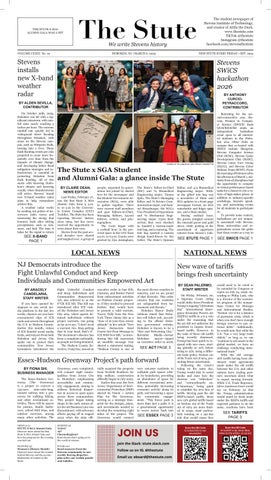
THE STUTE X SGA ALUMNI GALA WAS A HIT
We write Stevens history HOBOKEN, NJ | MARCH 6, 2025
VOLUME CXXIII No. 19
The student newspaper of Stevens Institute of Technology, and creator of Attila the Duck. www.thestute.com TikTok @thestute Instagram @thestute facebook.com/stevensthestute NEW STUTE EVERY FRIDAY • EST. 1904
Stevens installs new X-band weather radar
Stevens SWiCS hackathon 2026
BY ALDEN SEVILLA, CONTRIBUTOR
BY ANTHONY CURCIOPETRACCORO, CONTRIBUTOR
On October 30th, 2025, Hoboken was hit with a significant rainstorm, with rainfall rates nearly reaching 3 inches per hour. The extreme rainfall rate quickly led to widespread street flooding throughout Hoboken, with areas on the Stevens campus, such as Wittpenn Walk, turning into a river. These flash flooding events are only projected to occur more frequently over time from the impacts of climate change, and developing better flood mitigation strategies and infrastructure is essential in protecting Hoboken from flash flooding. All of this starts with knowing Hoboken’s climate and knowing exactly when thunderstorms will arrive. Stevens’ brand new X-band weather radar aims to help researchers achieve this. A weather radar works by sending out pulses of microwave radio waves and measuring the energy that bounces back after hitting precipitation, such as rain, snow, and hail. The time it takes for the signal to return
Editor, and 4/4 Biomedical Engineering major. Within the gifted tote bag was a newsletter of Stute and SGA updates in a front-page newspaper format, an SGA waterbottle and fidget spinner, and a Stute sticker. During cocktail hour, the guests mingled around the emerald green and gold decor, while picking at the assortment of appetizers catered from Alessio’s Cafe.
Returning for the second-consecutive year, Stevens Women in Computer Science (SWiCS) leads QUACKHACKS 2026, an independent hackathon event open to all interested students in the Hoboken area. Other clubs on campus that co-hosted with SWiCS include Blueprint, Stevens Computer Science Club (SCSC), Stevens Game Development Club (SGDC), Stevens Linux User Group (SLUG), and Stevens Cyber Defense Team (SCDT). From the morning of February 28 to the afternoon of March 1, students from all disciplines had the opportunity to compete in virtual performance-based tasks for a chance to win a variety of high-stakes prizes, in addition to industry-specific workshops, keynote speakers, and networking events for all students to participate in. To provide some context, hackathons are not uniquely associated with Stevens. Many universities and organizations across the globe host these events as a way to
SEE STUTE PAGE 1
SEE SWiCS PAGE 1
SEE X-BAND PAGE 1
ISABELLE VILLANUEVA AND BRADY SANSOTTA
The Stute x SGA Student and Alumni Gala: a glance inside The Stute BY CLAIRE DEAN, NEWS EDITOR Last Friday, February 27, was the first Stute X SGA Alumni Gala from 5 p.m. to 10 p.m in the University Center Complex (UCC) Techflex. The Stute has been reporting Stevens’ history since 1904, but has never received the opportunity to write about their own. Stories from the past several decades were shared and laughed over. A group of
people, separated by generations but joined by shared love for the newspaper and the Student Government Association (SGA), were able to gather together. There were current staff members and past Editors-in-Chief, Managing Editors, Layout Editors, writers, and photographers. The event began with a cocktail hour in the preevent space in the UCC from 5 p.m. to 6 p.m. Guests were greeted by Jiya Jaisinghani,
The Stute’s Editor-in-Chief (EIC) and ¾ Biomedical Engineering major, Tianna Spitz, The Stute’s Managing Editor and ¾ Science Communication major, and Samuel Strassburger, the SGA’s Vice President of Operations and ¾ Mechanical Engineering major. Upon their arrival, they were checked in, handed a custom-made tote bag, and a nametag. The tote bag sported a custom design hand-drawn by Itai Geller, The Stute’s Opinion
LOCAL NEWS
NATIONAL NEWS
NJ Democrats introduce the Fight Unlawful Conduct and Keep Individuals and Communities Empowered Act BY ARACELY CANDELARIA, STAFF WRITER If you have opened Instagram or any social media platform in the last few weeks, chances are you have encountered clips of ICE raids and arrests throughout the U.S. in Hudson County. Earlier this month, videos of ICE flooded social media feeds, and mayors from both Hoboken and Jersey City spoke out to protect their communities. New Jersey lawmakers introduced the
Fight Unlawful Conduct and Keep Individuals and Communities Empowered Act, also referred to as the F*CK ICE bill. This bill was introduced after ICE visited the Hoboken and Jersey City area, where agents detained individuals without proper warrants, one going so far as to say, “I don’t need a warrant, bro. Stop getting that in your head, that’s it”. The document’s absence has been a complaint nationally, as people are being detained. The Hudson County Executive, Craig Guy, issued an
executive order to ban ICE, Customs, and Border Patrol from enforcement activities on Hudson County property; if they needed to proceed further, they would have to present a valid warrant. Tracey Tully from the New York Times claims this as a “dose of in-your-face Jersey attitude” in her article “New Jersey Democrats Send Coarse but Clear Message to ICE With New Bill,” as introducing this bill represents an unsubtle message. Guy shared a statement stating, “Hudson County is one of
the most diverse counties in America, and we are proud of that diversity. This order ensures that our residents are safeguarded from harassment and threats.” Hoboken Mayor Emily Jabbour stated that Hoboken will follow suit. According to the official Hoboken government website, Hoboken is known to be a “Fair and Welcoming City.” Ravinder Bhalla—former Hoboken mayor—signed an executive order in 2018,
SEE ACT PAGE 3
Essex-Hudson Greenway Project’s path forward BY FIONA SHI, BUSINESS MANAGER The Essex-Hudson Greenway (The Greenway) is a project to convert a 135-acre, nine-mile-long, unused railway into a greenway for walking, biking, and other recreational activities. There will be spaces for picnics, family barbecues, school field trips, and outdoor exercises, among many other activities. The
Greenway, once completed, will connect eight municipalities from Jersey City to Montclair, emphasizing accessibility and community engagement, aiming to address historical disparities in access to open space across these communities. This project began taking shape in the early 2000s after the old Boonton Line was discontinued, with advocacy efforts paying off in August 2022 when the state offi-
NEWS (2-3)
SCIENCE (6)
FEATURE (4)
PULSE (10)
STUTE X SGA Alumni Gala Discover more about the first Stute X SGA Alumni Gala and how the program for the evening was laid out. Women’s History Month! Discover more abour the women behind Stevens and the accomplishments of women in the Stute.
NASA? AI? Chronohygiene? Read about what’s going on in the world of science. Read answers from the Stevens community to our weekly Roving Reporter, plus solve our weekly puzzle and sudoku.
cially acquired the property from Norfolk Southern for $65 million; construction officially began in July 2025. Earlier this year, the New Jersey Department of Environmental Protection (DEP) shared its Vision + Action Plan for The Greenway, serving as a strategic blueprint for the designs, plans, and investments needed to develop the remaining eight miles of the project. The Greenway would connect
over 100,000 residents to walkable park spaces within its boundaries, providing an abundance of space for different recreational activities, potentially increasing economic activity along its path, and becoming a space for community engagement. “This linear park is more than just a path; it is a generational opportunity to weave nature back into
SEE ESSEX PAGE 3
New wave of tariffs brings fresh uncertainty BY SEAN PALERMO, STAFF WRITER On Friday, February 20, a Supreme Court ruling would strike down President Trump’s ongoing “Liberation Day” International Emergency Economic Powers Act (IEEPA) tariffs in a 6-3 vote under the reasoning that the act did not authorize the president to impose broadbased tariffs. However, in the wake of these old tariffs being recently dismissed, Trump has been quick to respond with new ones, starting globally at 10% before rising to 15%, using a different trade policy, Section 122 of the Trade Act of 1974, promoting future uncertainty. Following the Court’s ruling on the same day, Trump would take to social media and state how the decision was “ridiculous” and “extraordinarily anti-American,” being quick to establish his new line of tariffs. Moving past the old IEEPA-based tariffs, these new 15% global tariffs based on Section 122 of the Trade Act of 1974 are more limited in scope, most particularly running on a 150-day rule that would mean they
would need to be voted to be extended by Congress or expire on July 24, 2026. According to Philip Luck, who is a director of the economics program at the nonpartisan Center for Strategic and International Studies, “Section 122 is for a balance of payments crisis, which is when you don’t have enough foreign reserves to pay external debts”. Additionally, he would note that while the U.S. “has a very large trade deficit,” so long as we can “continue to sell assets to the global market, we have no challenge conducting international trade.” With the old average 16% tariffs having been dismissed, trade agreements made under the old tariffs between the U.S. and other nations leave trading partners uncertain about what to expect moving forward. While U.S. Trade Representative Jamieson Greer would say on February 22 that the Trump administration would stand by deals made under the IEEPA tariffs and expected partners to do the same, reactions have been
SEE TARIFFS PAGE 3
Friday, March 6
2
News Masthead Volume CXXIII No. 19 Executive Board
EDITOR-IN-CHIEF.............................JIYA JAISINGHANI ‘27 BUSINESS MANAGER.....................................FIONA SHI ‘27 MANAGING EDITOR.................................TIANNA SPITZ ‘27 LAYOUT EDITOR...............................EILIYAH SAROWAR ‘28 OUTREACH CHAIR..................................TANYA AVADIA ‘25 DIGITAL MANAGER..........................CHARMY KOTADIA ‘27 SECRETARY.....................................JOSEPHINE CHOONG ‘28
Editorial Board
NEWS EDITOR........................................... CLAIRE DEANS ‘29 SCIENCE EDITOR..................................RIYANA PHADKE ‘27 OPINION EDITOR.........................................ITAI GELLER ‘26 SPORTS EDITOR..................................CAMRYN WINANT ‘28 FEATURES EDITOR ...........................PRISHA VAGVALA ‘28 HEAD COPYEDITOR..............................TASHA KHOSLA ‘25
Operations Board
HEAD PHOTOGRAPHER.......ISABELLE VILLANUEVA ‘26 ARCHIVES LIASON....................................ISABELLA ZIV ‘25 ASST. SOCIAL MEDIA...............................CHRISTINE YI ‘29 DELIVERY BOY.........................................JONATHAN LAI ‘28 ASST. LAYOUT EDITOR.............................SHREYA ROY ‘27 ASST. LAYOUT EDITOR....................BRADY SANSOTTA ‘29 ASST. BUSINESS MANAGER........JOSH BODENSTEIN ‘29
Staff & Contributors Anthony A. Cisevilla Camryn Winant Izzy Gabay Anthony Cursio-Petraccoro Robert Dietrich Rachel Choi Aracely Candelaria Abigail Thomas Disha Gohil Sean Palermo Milagros Carbajal Sydney Leung Isabella Fama Vedhesh A. Kamaraj Jeylan Jubran Breona Pizzuta Viktor Palmer Christina Thomas Vincent Olivieri Dominc Souza Atreyee Halder Disha Rana Ruthie Millinsky Gavin Ruby
Contact Us
GENERAL.........................................EBOARD@THESTUTE.COM EDITOR-IN-CHIEF.........................EDITOR@THESTUTE.COM ADVERTISING.............................BUSINESS@THESTUTE.COM OFFICE.................................UNIVERSITY CENTER ROOM 216B
Corrections NOTICE A MISTAKE? Email us at eboard@thestute.com.
Disclaimer
All opinions and editorials reflect the views of their respective author(s). No Part of The Stute may be reproduced in any form, in whole or in part, without the written consent of the Editor-in-Chief. Cited references of The Stute are permitted.
Policy on Letters to the Editor
All members of the Stevens community are able to submit a Letter to the Editor to be published in The Stute. Letters must refer either to a piece published in The Stute or to The Stute in general and must be between 400 – 800 words in length. Submit letters to editor@thestute.com with your name and title (when applicable) or using our Google form. For writers who wish to write a Letter to the Editor anonymously, please see our policy on anonymity. The Editorial Board reserves the right to choose whether or not to publish a submitted Letter to the Editor based on a majority rule vote, and additionally reserves the right to edit letters for clarity or request authors to revise. Provided that the author approves the final version, The Stute reserves the right to edit letters according to our copy editing procedures, defined in our policies.
Policy on Op-Eds
All members of the Stevens community are able to submit a standalone opinion piece (otherwise known as an Op-Ed) to be published in The Stute. Op-Eds must be between 400 – 800 words, but longer submissions will be considered on a case-by-case basis. To submit an OpEd please email eboard@thestute.com with your name and title (when applicable) or using our Google form (tinyurl.com/submit-t0-stute). For writers who wish to write an Op-Ed anonymously, please see our policy on anonymity. The Editorial Board reserves the right to choose whether or not to publish a submitted Op-Ed based on a majority rule vote, and additionally reserves the right to edit Op-Eds for clarity or request authors to revise. Provided that the author approves the final version, The Stute reserves the right to edit Op-Eds according to our copy editing procedures, defined in our policies.
X-BAND
CONTINUED FROM PAGE 1 indicates how far away the precipitation is, while the strength of the returned signal indicates how intense the precipitation is. Together, this information helps forecasters track storm location, intensity, movement, and potential severe weather. The New York City region already has multiple weather radars that cover the area, operated by the National Weather Service (NWS). The closest of these radars is about 50 miles from Manhattan. Precipitation that is further from the radar will return a lower resolution output when compared to precipitation that is closer. The Stevens campus is conveniently located about 2 miles from Midtown Manhattan. Building a weather radar in this location provides the capability to track and analyze storms in and around New York City to a degree that no other currently operational radar can
STUTE
CONTINUED FROM PAGE 1 Around 7:15 p.m., Jaisinghani opened the doors to allow guests to enter the event space to be seated. The Tech Flex Center was decorated with a green and gold theme, and guests were greeted with an itinerary of speeches as they were seated. At this event, speeches were delivered by Jiya Jaisinghani, Tianna Spitz, Kenneth Nilsen, Dean of Students, and Samuel Strassburger. Within her speech, Jaisinghani remarked, “the point of the gala was to not only celebrate [the alumni] but also to learn from them.” While the current figureheads of these organizations gave speeches, those of the past reflected on their time in the organization: the joy, the struggle, the camaraderie, and the laughter. Among the 90 people in attendance sat former EIC, Gerald T. Crispin, and former Managing Editor, Edward Eichhorn, both graduates of ‘69, and Chris Candreva, graduate of ‘91 and former Managing Editor, News Editor, and Friday Observer. The collec-
SWiCS
CONTINUED FROM PAGE 1 identify talent and connect students with industry opportunities. In our case, Stevens hosts QUACKHACKS to help students demonstrate their knowledge and expertise to industry-aligned corporations. In a typical hackathon, members are provided a list of technical tracks to choose from. This year, students selected from four tracks: “Mindfulness & Wellbeing,” “Anti-AI,” “Accessibility,” and “Gaming.” The goal of these tracks is to separate student groups into a restructured format that permits competition and self-expression, in a way that the classroom lacks. Although hackathons are popular amongst college professionals, not all follow the same timeline. This year, Stevens took a different approach to the QUACKHACKS format. The event began on Saturday at 9 a.m. with opening remarks
achieve. Additionally, this radar implements the X-band, which can scan precipitation at a higher resolution when compared to the NWS S-band NEXRAD radar. Being able to scan storms over Manhattan from only two miles away allows for precipitation to be visualized in incredible detail. Having access to real-time, high-resolution data gives forecasters the ability to issue weather warnings with greater lead time and accuracy, both of which are essential in giving cities such as Hoboken the time to prepare adequate flood mitigation measures. The ability to issue timely weather warnings is essential. In the 2025 October flooding event, despite the intense rainfall rate, a flash flood warning was never issued for Hudson County. While there are numerous reasons for this, part of the reasoning may have been due to the unexpected nature of the rainfall intensity. In a statement issued by former Hoboken Mayor Ravinder Bhalla, the October event “produced significantly more rainfall than forecasted.” Despite major ad-
vances in weather guidance models, there is still no operational model that incorporates smaller-scale storm features and real-time data into its forecasts, partially due to the lack of radar systems that can scan storms with great detail. These models—called nowcasting models—would allow meteorologists to accurately predict storm evolution over minutes, rather than hours. It is possible that forecasters may have been able to anticipate a rapid flash flooding event such as the one that occurred in October had such a model existed. Stevens hopes that the capabilities provided by their new X-band radar will allow its partners, such as the NWS and Offices of Emergency Management to better predict rainstorms as they evolve, and coordinate timely weather warnings. Additionally, graduate and undergraduate students will receive the opportunity to work directly with real-time radar data from the X-band radar, serving as a new educational resource for Stevens students and faculty.
tion of former leadership shared stories of their student life experiences, one of them being that there was once a bar in what is now the Howe Center. Candreva fondly recalls Wednesday afternoons as “it was more than just work, it was a social time, it was a group, it was camaraderie, it was just a time to be together.” People, long-graduated, connected with current undergraduates over the chaos of the infamous layout Wednesdays — an unmatched chaos that has been felt through generations. Among the more recent alumni were Isabella Ziv ‘25, Sanjana Madhu ‘23, and Maryia Spirydonava ‘20. In conversation, they all bonded over the common tie of being EIC and the love they share for The Stute. Spirydonava said, “It’s so nice to see how The Stute has grown. We didn’t have nearly this many editor positions, such as layout; everyone did it together,” accentuating the growth and change that can happen in just a couple of years. She also noted, “that one of the things [she] loved the most, the people, haven’t changed.” This is something that many throughout the organization have felt. Not only do they feel drawn together
by a shared directive, but also by shared laughter. Throughout the gala, alumni and students were encouraged to take photos by the newspaper wall that had a border of balloons. Brady Sansotta, Layout Assistant, and Isabelle Villanueva, Head Photographer, were gathering groups of past e-boards, SGA alumni, and students to take pictures at the newspaper wall. Alumni were also encouraged to sign a poster board with a message for the current Stute staff, so that it may be hung in the Stute Office once the gala concluded. By 8 p.m., dinner was announced, and alumni and students alike stood together in line to grab an assortment of food from Karma Kafe, Robongi, and Alessio’s Cafe. There was also Paris Baguette for desserts. The Tech Flex Center was filled with the sounds of conversation, laughter, and everyone enjoying a good meal. Members of The Stute and SGA alike came together to celebrate those who came before in an exciting and new way. Jaisinghani hopes for this to become an annual event, to continuously celebrate the alumni community.
and a team bonding session. Later that afternoon, in between mingling and working on their projects, students listened to workshops hosted by Chubb and Automatic Data Processing (ADP), two major companies with large tech divisions headquartered within driving distance from Stevens. To further enhance technical skills, workshops were hosted for platforms like Amazon Kiro, along with presentations by Major League Hacking and IEEE YP. To cap the night off, students got to engage in information sessions pertaining to different tracks, like gaming engines, graphics, and more. Although the festivities for the first day had ended, there were still eight hours until check-in for the final day, with many groups taking this time to truly hone their focus on building a viable product. To begin the final day, students had the opportunity to refine their projects one last time before submission. Each group was required to submit a public repository with
working code, along with instructions for running and testing the application. Faculty members and students joined forces to judge each project, assessing the creativity, demonstrated learning, technical impressiveness, and adherence to the selected track. Once all projects had been entered and assessed, the finalists presented their projects on the main stage for a chance to win the prizes provided by the event sponsors. This year, Ayre was the highest-regarded project — a translation platform enhancing musical techniques for those unable to perform. After its successful second year, it’s clear that the Stevens community is extremely proud of the work all of these clubs have done to expand the university’s reputation and allow students to demonstrate their talents in a demanding market. Although still in its early stages, we all look forward to how QUACKHACKS will continue to grow and promote new opportunities for students to get involved.
FULL LIST ON thestute.com/policies
tinyurl.com/stutesubmit
PHOTO COURTESY OF ANNA HAUK
Friday, March 6
3
News CONTINUED FROM PAGE 1 which was later passed in 2025, officially known as the Hoboken Trust Act. Hoboken City Council is strongly committed to ensuring safety among the community, alongside Katie Brennan, a Democrat from Jersey City, who claimed, “There have to be real consequences if ICE breaks the law.” The U.S. Department of Homeland Security gave negative backlash to the New Jersey legislation, claiming it is
ESSEX
CONTINUED FROM PAGE 1 our urban fabric,” said John Cecil, DEP’s Assistant Commissioner for State Parks, Forests & Historic Sites. By serving some of the most densely populated municipalities in New Jersey, The Greenway has the potential to redefine how nearby residents interact with public space, spend their free time, and interact with one another. Work is already underway in Newark, where three new, ADA-compliant features and pub-
“disgusting, a bill meant to demonize our officers who are experiencing a highly coordinated campaign of violence.” New Jersey has the second-highest percentage of immigrants after California. Delaney Hall is a detention facility in Newark that holds up to 1,000 detainees, one of ICE’s largest facilities on the East Coast. Activists and faith leaders continue to protest nearly daily outside the center. Over 200 people stood in the rain on Ash Wednesday together in faith, praying over the detainees who passed away in ICE custody due to poor food, undrink-
able water, and overall poor living conditions. Assemblyman Paul Kanitra, a republican and former Mayor of Point Pleasant Beach in New Jersey, shares his concern that “we appear to have gone from a society that peacefully protested, to one that now actively wants to interfere physically with law enforcement.” Criticizing the bill, describing it as “vulgar”. Others have shared similar sentiments regarding the bill. Despite its controversy, the act highlights NJ officials’ commitment to protecting their communities.
lic spaces are being built, including the Newark Central Activity Center, the largest gathering center in the Newark segment of the Greenway, and an observation platform at the Branch Brook Park Overlook. A significant underground stormwater management system is also being installed along the Newark segment, designed to mitigate flooding and reduce strain on the city’s combined sewer system. As work progresses in Newark, officials are simultaneously focused on the broader vision. Developing a comprehensive master plan for the remaining eight miles will require continued commu-
nity engagement, environmental assessment, and coordination among eight municipalities. Securing sustainable funding sources will be critical to ensuring both completion and ongoing maintenance. The development of operational protocols must address safety, landscaping, and equitable access, particularly to prevent unintended consequences such as displacement in adjacent neighborhoods. When fully constructed, the Greenway will represent a commitment to expand opportunities, connect communities, and provide a lasting public space with access to all.
TARIFFS
CONTINUED FROM PAGE 1 less than positive. A top European Union lawmaker on that same day would propose a pausing of the ratification of the new agreement between the EU and the U.S. and India, which had agreed to an 18% deal, has since postponed a trade visit to Washington that aimed to finalize the agreement, according to CNBC. On social media, chair of the European Parliament’s international trade committee, Bernd Lange, would describe the “pure tariff chaos on part of the U.S. administration”—that “no one can make sense of it anymore—only open questions and growing uncertainty for the EU and other U.S. trading partners.” In a similar vein, while these measures have been notably done in order to protect domestic manufacturers, according to William Reinsch, a senior advisor at the Center for Strategic and International Studies and former president of the National Foreign Trade Coun-
cil, manufacturers importing components used in fabrication faced higher costs as a result of the tariffs that limited production. This plight was in addition to long-term issues beyond these measures, such as an industry-wide shift to automation and fierce global competition with trading partners who have increased subsidies on key industries in order to offset higher tariff costs. However, even Trump himself is not entirely satisfied with these tariffs, as he is currently already looking for a more concrete solution — possibly through the utilization of other trade laws like Section 301 of the Trade Act (expiring instead after 4 years) that would allow Trump to enact country-based tariffs in the situation where the U.S. Trade Representative determined a trading partner was engaging in unfair trade practices. In fact, he has already launched investigations into unfair trade practices in order to secure said potential tariffs, explaining that “we have other ways, numerous other ways” and that “the numbers can be far greater than the hundreds of billions we’ve already taken in.” PHOTO COURTESY OF ENGLISH.AAWSAT.COM
ACT
-STEVENS DINING PRESENTS-
SPRING BREAK HOURS OF OPERATION
Pierce Dining Hall
America’s Cup
Friday, March 13th 7:00am-8:00pm Saturday, March 14th Closed Sunday, March 15th Closed Monday, March 16th - Friday, March 20th Pierce Hours: 8:30am- 7:00pm Breakfast: 8:30am-10:30am Lunch: 11:30am – 2:30pm Dinner: 3:30pm – 7:00pm Saturday, March 21st Closed Sunday, March 22nd 10:00am - 9:30pm
Friday, March 13th Zaro’s: 8:00am - 3:00pm Create: 11:00am - 3:00pm Saturday, March 14th - Sunday, March 22nd Closed
Wesley J. Howe Center, 2nd Floor
Pierce Cafe
Wesley J. Howe Center, 2nd Floor
Friday, March 13th 8:00am-6:00pm Saturday, March 14th - Sunday, March 15th Closed Monday, March 16th - Friday, March 20th 8:00am - 4:00pm Saturday, March 21st Closed Sunday, March 22nd 8:00am - 6:00pm
Samuel C. Williams Library, 1st Floor
UCC Marketplace
University Center, 1st Floor
Friday, March 13th Yella’s: 9:00am - 10:00pm Tu Taco: 11:00am - 8:00pm Piccola Italia: 11:00am - 8:00pm Pom & Honey: 11:00am - 8:00pm Saturday, March 14th - Saturday, March 21st All retail locations closed Sunday, March 22nd Yella’s: 9:00am - 12:00am Tu Taco: Closed Piccola Italia: Closed Pom & Honey: Closed
Cannon Cafe
UCC Harries Building, 1st Floor
Friday, March 13th 8:00am - 3:00pm Saturday, March 14th - Sunday, March 22nd Closed
Gateway Cafe
Pi Kitchen
Friday, March 13th 9:00am - 8:00pm Saturday, March 14th - Sunday, March 22nd Closed
Friday, March 13th 11:30am - 3:00pm Saturday, March 14th - Sunday, March 22nd Closed
Gateway North, 1st Floor
University Center Ground Floor
ALL OPERATIONS RESUME REGULAR HOURS ON MONDAY, MARCH 23RD ANY QUESTIONS? EMAIL US AT DINING@STEVENS.EDU
Happy L A N O I T A ! N H T N O ION M NUTRIT
LEARN MORE AT
WWW.EATRIGHT.ORG/NATIONAL-NUTRITION-MONTH
NATIONAL NUTRITION MONTH® IS A YEARLY CAMPAIGN ENCOURAGING EVERYONE TO LEARN ABOUT SMART FOOD CHOICES AND ACTIVE LIVING. THIS YEAR’S THEME, “DISCOVER THE POWER OF NUTRITION,” HIGHLIGHTS HOW GOOD NUTRITION SUPPORTS STRONG, THRIVING COMMUNITIES. FIND TRUSTWORTHY, SCIENCE-BACKED SUPPORT FROM A REGISTERED NUTRITION PROFESSIONAL TO GUIDE YOUR FOOD CHOICES.
THE FOLLOWING IS AN OP-ED
OP-EDS REPRESENT THE VIEWS OF THE GUEST WRITER FROM WITHIN THE STEVENS COMMUNITY AND ARE SUBMITTED TO THE STUTE FOR PUBLICATION. THEY DO NOT REFLECT THE VIEWS OF THE STUTE ITSELF.
OP-ED
Lockheed Martin - Steven’s Most Dangerous Ally BY MOHAMED BENGABSIA ‘26 Did you know that Stevens actively maintains and encourages partnerships with companies proven to be complicit in war crimes? One example is Lockheed Martin, an American defense and aerospace manufacturer with historic and celebrated connections to Stevens. Lockheed Martin has played a key and direct role in conceiving and developing Stevens’ Department of Systems and Enterprises, to which Jack Irving, Senior VP and General Manager at Lockheed Martin, praised as a “controllable curriculum that we could continuously customize to meet the ever changing needs of our business... it was perfect” (Stevens). See the following paragraph from the article, “Stevens Institute of Technology and Lockheed Martin: A Historic Partnership in Systems”: Over the past 10 years of SSE [now the Department of Systems and Enterprises], the numbers reflect the depth of the Stevens and Lockheed Martin collaboration. On education, more than 2,000 Lockheed Martin employees have enrolled at Stevens graduate programs, many completing doctoral degrees. On research, over the past 5 years funded more than $2 million inresearch at Stevens, which has resulted in more than $5 million in supplemental research funding by the U.S. Department of Defense. And several Lockheed Martin executives have served on the Board of Advisors of the Stevens School of Systems and Enterprises, including Jack Irving, Senior VP and General Manager, Lockheed Martin. (Stevens) Stevens is very proud of their relationship with Lockheed Martin, and even invited former CEO and Chairman Norman Augustine to kick off The President’s Distinguished Lecture Series in 2012. Corporate connections are a great resource for a university of bud-
ding engineers, computer scientists, and mathematicians. But a seemingly inseparable relationship to a company with staggering accounts of human rights violations should certainly raise alarms. Here are a few examples: In 2023, Lockheed Martin, Raytheon and General Dynamics, three of the five largest U.S. defense contractors, were sued in the US federal court for supporting war crimes by selling weapons to Saudi Arabia and UAE-led coalition forces during the civil war in Yemen. Reports have linked Lockheed Martin weaponry specifically to a horrifying instance on Oct. 8, 2016 - in Yemen’s capital. According to Military Times, “Hundreds were gathered at the Great Hall of Sana’a City for the funeral of a tribal leader, when a Raytheon and Lockheed-made GBU-12 Paveway II 500-pound laser-guided bomb leveled the area, killing 140” (Military Times, Human Rights Watch). Stevens’ most distinguished corporate partnership also “faces multiple lawsuits for toxic pollutant contamination from a Florida facility that has resulted in brain lesions, multiple sclerosis, cancer, and birth defects, as well as litigation linked to a uranium facility” (IASJ, Law360). Stevens remains steadfast in its alliance with Lockheed Martin— a corporation entrenched in violence and pain. The institution continues to proclaim, “Inspired by Humanity, Powered by Technology,” yet declines to examine the moral cost of the power it chooses to stand beside. At a moment when the consequences of such alliances reverberate globally through two distinct genocides (Gaza and Sudan), Stevens has shown little appetite for confronting the ethical implications embedded within its own partnerships. As Stevens students we must ask ourselves: Is this the legacy we wish to uphold? A special thanks to James Hooker for his contributions in writing this entire paper.
Friday, March 6
4
Feature
WOMEN’S HISTORY MONTH
The legacy behind the name: Martha Bayard Stevens BY ISABELLA FAMA, STAFF WRITER Whether you are a student at Stevens Institute of Technology or just visiting the campus, there is a chance that you have walked past “Martha Bayard Stevens Hall.” To many passing by, it is simply just a building, but it holds a deeper meaning than just a name on a sign. It honors the woman who shaped Stevens to become the university it is today, built the city of Hoboken, and influenced all of education and philanthropy in New Jersey. Martha Bayard Dod was born on May 15, 1831, in Princeton, New Jersey. Her father was a math professor at Princeton University, and her mother was from the extremely politically prominent family of the Bayards. The Bayard family was originally from France but escaped to Holland and then settled in New Jersey just before the Revolutionary War. Martha always had a connection with Hoboken, with her relative originally owning the land itself. She would later come into possession of the land after it was bought by Colonel John Stevens III, as she would marry into the Stevens family. Martha married Edwin Agustus Stevens in 1854. He was known as the last surviving son
of the Stevens family in Hoboken. The Stevens family had already influenced the world of engineering and innovation years before. Working on early steam transportation, forming some of the first commuter railroads, and most notable association, the establishment of Stevens Institute of Technology. Edwin had passed in 1868, and in his will, he asked Martha for one thing: to establish a school that was dedicated to mechanical engineering. Without Martha carrying out Ediwns’s wish, I would not be here writing this to tell you her remarkable impact. Martha became crucial in the founding of Stevens after her husband’s passing. She worked closely with all members of the community to make Edwin’s wish come true. The motto of “Inspired by humanity, powered by technology” comes from the unique approach of mixing scientific and humanistic education. The curriculum that is taught here at Stevens, the unique mix between engineering and liberal arts, is because of Martha. Martha was dedicated to more than just founding Stevens. She was also a philanthropist and sought to help the lives of those in Hoboken. Much of the history and what is here in Hoboken today is because of her endeavors. Martha
Stevens Women in Computer Science
@ Harvard WECode 2026!
established multiple initiatives and institutions; the Industrial Education Association, a school for young women in Hoboken, the Martha Institute, where boys were trained in industrial skills, provided the funding to build the Hoboken free public library, founded St. Martha’s Ward in St Mary’s Hospital, and was a liberal contributor to St. Katherine’s Home, Christ Hospital, and almost every other church in Hoboken. Martha believed that education was a gift and should be shared with everyone across all different communities. She placed the opportunity to learn in the hands of many residents in Hoboken. Martha Bayard Stevens died on April 1, 1899, in Hoboken, the city she dedicated herself to. She spent her life building a legacy that would be remembered, taught, and honored. What Martha created is still seen in all corners of the city today. She established innovation and opportunity, and her philosophies that she enforced are taught in all classrooms at Stevens. She was committed to Hoboken, helping its people and making lasting impacts for generations to follow. Her name is a reminder of resilience and carrying out purpose; Martha Bayard Stevens taught Hoboken what it truly means to make a lasting impact.
The women behind The Stute
PHOTO COURTESY OF THE HOBOKEN GIRL
The women who shaped the future of Stevens BY JOSEPHINE CHOONG, SECRETARY While Stevens was founded in 1870, it took more than a hundred years for women to be admitted into the undergraduate program in 1971. From a small class of 19 to a class size of 1,100, women make their mark on Stevens’ history each year. Their legacy can be seen throughout Stevens and has continued to impact us today. One of these women, Lore E. Feiler, was an eager student who was excited to learn. Before women could enroll at Stevens, they often attended the institute’s business classes. Feiler was born in 1914 in Pforzheim, Germany, and lived with her parents and siblings above their father’s jewelry factory. After moving to America in 1925, she lived in West New York, NJ, and attended Packard Business College. Her friend, the mayor of Hoboken, introduced her to Professor Frederick Gaudet, who helped arrange for Feiler to attend business classes unofficially at Stevens. Using the coursework’s foundations, she grew her manufacturing business and sold to customers like Bulova and Girard. After she retired, Stevens had gone co-ed, and Feiler expressed her gratitude through a founding gift for the Lore-El Center for Women’s Leadership, a residence hall for women and
non-binary students. Another pioneer, Enid May Hawkins, the first professional librarian in Stevens, worked at Stevens for nearly 40 years. During her time here, she grew the library’s collection from 5,000 to over 30,000 books and oversaw the acquisition of various technical reference texts, engineering periodicals, and significant historical collections. According to a profile from The Stute, Hawkins was largely responsible for changing the library’s reputation from “dingy old den” in Edwin A. Stevens Hall to the “central nervous system for research and study on campus.” Finally, the first president of the Society of Women Engineers (SWE), Beatrice Hicks, obtained her master’s in Physics from Stevens. Hicks was born in 1919, where she was surrounded by and engaged in technology during her childhood. In 1955, she became the president of Newark Controls Company, which manufactured control devices and sensors. There, she developed a gas density sensor, a device that accurately measured the density of gases from a wide range of temperatures and pressures. This invention was essential for the space industry, aviation industry, and safety systems. Throughout the years, she continued to promote the role of women in engineering.
In 1950, Hicks and a group of female engineers started the Society of Women Engineers (SWE) to support women in technician professions. As SWE’s first president, she organized the First International Conference of Women Engineers and Scientists in 1964. Hicks continued to travel across the country to promote equal opportunities and conduct educational activities. The impact of these women can still be felt today. The Lore-El Center remains an active participant in the campus community, hosting events to celebrate and support the inclusion of everyone. They hosted events like the Leadership Conference: Rise & Redefine, which brought students together for a day of collaboration around modern leadership. The Samuel C. Williams Library supports students each day through its drop-in tutoring program and large selection of historical archives. Meanwhile, SWE is the “world’s largest advocate and catalyst for change in engineering and technology” with over 50,000 members spanning 85 countries. Stevens’ chapter of SWE has hosted many events to professionally network with companies, engage in mentorship programs, and build a strong community of women engineers. To this day, women have continuously shaped the future of Stevens and the world.
Let’s be real; in a male-dominated school, it often feels harder to voice concerns as women, and I’m fairly positive that there are a multitude of shared experiences that come with this gender dynamic. I can think of not being taken as seriously in group projects where I’m the only woman, as one instance. It often feels harder to have a voice here as a woman, and that is where the voice and historical record of the school comes in, The Stute. As the primary source of information across campus, The Stute carries great responsibility and serves as the chronicler of Stevens’ history, recording how stories are remembered for generations to come. So now I pose the question: why is it so significant that we, the Stute e-board and minor board, are primarily women? To start, it is empowering to contribute to the main voice of Stevens as women, since that has not always been the case. Even though many years have passed, at the end of the day, we are a school with a 30 to 70 women-to-male gender ratio, and there is still a concern about not having enough representation. Since there are women in charge shaping the perspective, choosing the headlines, laying out the page perfectly, and deciding what stories are worth telling, it shifts what gets recorded and valued. We get the choice. Experiences that may be brushed aside or not even acknowledged in the first place are now going to be accounted for. For example, I chose this week’s feature theme to be Women’s History Month and put out
article ideas I believe are important to women as a woman myself, and through columns like Girl(ish) Talk and HerStevens, we get personal perspectives from those who truly live and experience these realities. It creates a shared community through these columns that might not always be easy to bring up normally, and makes women feel less alone. For the past five years, we have had only female Editors-in-chiefs, which I find pretty cool. Of course, this is not meant to discredit the others who help write and publish The Stute each week, but rather to acknowledge and value the hard work of the women behind it. From communicating with writers, writing columns, handling production, budgeting, and creating events, every single responsibility is deeply technical. Yet women are often not considered technical, even when we are doing all of this behind-the-scenes work diligently. I recently learned in my Women and Gender in American History class that women have often been at the forefront of change. From the suffrage movement and the Seneca Falls Convention to the cultural symbol of Rosie the Riveter, women have long been powerful forces in history. The progress they have made has made our society more diverse and equitable. Women who contribute today, including those in leadership and production roles at The Stute, continue this legacy. So the next time you pick up The Stute from the newspaper rack or pull up an article online, it is worth remembering the dedication and effort of the women who help lead and produce the paper each week.
BRADY SANSOTTA FOR THE STUTE
BY PRISHA VAGVALA, FEATURES EDITOR
Friday, March 6
5
Sports
PHOTO COURTESY OF STEVENSDUCKS.COM
ON DECK IN SPORTS
Men’s and Women’s Track and Field both finish top five at MAC Indoor Championships BY CAMRYN WINANT, SPORTS EDITOR Both the Men’s and Women’s Track and Field teams finished top five at the Middle Atlantic Conference (MAC) Indoor Championships this past weekend on February 27 and 28, with the men at fifth and women at third. Day one for the men’s team ended with them at fifth place with 21.5 points, just half a point behind Eastern University. Leading the day was senior Brandon Kiefer, a two-time heptathlon champion. Kiefer finished first through four events, coming second in the long jump, the shot put, and the 60-meters, putting him 21 points ahead of second place. Keeping their dominance, the distance medley relay team of junior Ryan Paradine, sophomore Enrico Parrella, and first-years Markus Soennichsen and Christopher Reyes came fourth. The 4x200 meter
relay team of senior Connor Robinson, juniors Tyler Hackett and Case Kosiba, and first-year Iyasu Richards took sixth. For field events, first-year Jonathan Mordi took fifth in the high jump and sixth in the long jump, with sophomore William Ladd right behind him at sixth for the high jump. Kiefer continued with the energy going into day two, winning his third conference heptathlon title, coming seventh, fourth, and first in the 60-meter hurdles, 1,000-meters, and pole vault respectively. Going into relays, the 4x800 meter relay team of senior Danny Jutras, Parrella, Soennichsen, and Reyes took second, running the second fastest time in Stevens’ history. Ladd and Mordi were also on fire from the day before, with Ladd finishing second in the 60-meter hurdles and clocking a personal record, and Mordi breaking a school record in the triple jump at 14.02 meters. Alongside them was
sophomore Joseph Perriello who took fourth in the 60-meter hurdles and set a new personal record, and senior Mick Barbi at 10th in the 3,000-meters which marked the ninth fastest time in program history. Also running on Saturday was Jutras who took fourth in the mile, first-year Kane Perry at fifth in shot put, and junior Doug Winant who clocked in at sixth in the 60-meters. Day one for the women’s team set them in a tie for eighth at 10 points. Two relays ran, with the distance medley relay team of sophomores Isabella Gabay and Anya Sadowski, and seniors Taylor Enes and Isabel Vogel coming in fourth. The 4x200 meter relay team of seniors Stephanie Ryazanova and Lauren Alley, firstyear Caitlyn Adamchuck, and junior Isabella Shanley took seventh, notching the sixth fastest time in program history. Alongside them, junior Kaitlyn Adams took fifth in
the 5,000-meters. On day two, the Ducks hustled and came out at third place in the end. Shanley placed third in the 400-meters, claiming the final all-conference honor for the women. The 4x400 meter relay team of Adamchuck, Alley, Shanley, and Sadowski, and the 4x800 meter team of Sadowski, Gabay, Enes, and Vogel both took fourth in their relays. Vogel and Sadowski both ran in the 800-meter, finishing sixth and seventh respectively, and Shanley notched her third top-six finish in the 60-meter hurdles. For field events, senior Alexis Merola and Ryazanova finished second and third in the pole vault, and senior Maggie Previglian came first in the high jump. The Ducks will be running again at the All-Atlantic Region Track and Field Conference Indoor Championships on March 6 and 7, held at the New York City Armory.
FRI, MAR 6 WOMEN’S AND MEN’S TRACK AND FIELD AARTFC Indoor Championships - Day 1 New York, NY 10 a.m. MEN’S BASKETBALL NCAA Division III Men’s Basketball Championship Newport News, VA 5:45 p.m SOFTBALL NFCA Leadoff Classic - Day 1 Columbus, GA 3 p.m.
SAT, MAR 7 MEN’S FENCING NCAA Regionals Haverford, PA 9 a.m. WOMEN’S FENCING NCAA Regionals TBD 9 a.m. WOMEN’S AND MEN’S TRACK AND FIELD AARTFC Indoor Championships - Day 2 New York, NY 10 a.m. MEN’S TENNIS New York University New York, NY 1 p.m.
Women’s and Men’s Basketball Compete in MAC Championships BY RUTHIE MULLISKY, STAFF WRITER The Stevens basketball program has had an impressive season, with both the women’s and men’s teams putting up amazing performances throughout the season and especially in the Middle Atlantic Conference (MAC) Freedom Championships. On Wednesday, February 25, the women’s team traveled to Glenside, PA to play the No. 2 conference seed, Arcadia University, in the MAC Freedom Semifinals, winning the game 76-44. Of these 76 points, senior guard Leyla Castro tallied a career-high 31 points, senior guard Olivia Schubiger added another 20, and senior guard/forward Dorothy Loffredo added another 10. This game marked Castro’s seventh consecutive game scoring at least 16 points. The Ducks maintained
a high intensity throughout the game and especially during the third quarter, scoring 26 points while only allowing eight to be scored against them. Following their Semifinals victory, the Ducks faced off against No. 1 MAC seed, DeSales University, on Saturday, February 28 in Center Valley, PA. The Ducks fell to the Bulldogs as the championship game ended 51-59, but they were still able to put up impressive performances throughout the game. Castro scored seven of the first eight points of the game, putting the Ducks in the lead early in the game at 8-6. The team put up the most points during the third quarter, where Schubiger, Loffredo, and sophomore forward Fiona O’Boyle each contributed multiple baskets toward the 16 points scored in this quarter. The women’s season ends with an impressive 20-7 overall record and 10-4
conference record. Additionally, Castro was named to the All-MAC Freedom First Team for the second time in a row, and Schubiger was named to the All-MAC Freedom Second Team. The men’s team hosted DeSales at Canavan Arena in the MAC Freedom Semifinals on Wednesday, February 25, where they put up an 81-60 point victory against the Bulldogs. This win advanced them to their sixth conference championship since the 2019-20 season. Junior guard Anthony Loscalzo put up a career-high 17 points, including four three-pointers, and junior guard Tommy Scholl put up a game-high 23 points, marking the 11th time that he scored at least 20 points in a game this season. Following the Ducks’ MAC Semifinal win, they hosted Misericordia University at Canavan Arena on Saturday, February
MEN’S LACROSSE SUNY - Oneonta Oneonta, NY 1 p.m. 28 for the MAC Championship game, where they secured the championship title with a score of 68-59. The Ducks kept offensive pressure throughout both halves of the game, scoring 38 points in the first half and 30 in the second. Scholl put up 19 points and eight rebounds, while junior forward Harmehar Chhabra tallied 15 points and seven rebounds, and Loscalzo added another 10 points. Following the conference tournament, Scholl was named the MAC Freedom Tournament Most Valuable Player. This championship win brought the men’s overall record to 18-9 and conference record to 10-4. The men’s team will be competing in the NCAA Division III Championship, travelling to Newport News, VA to play against Christopher Newport University in the first round of the tournament on Friday, March 6.
WOMEN’S LACROSSE Rowan University Hoboken, NJ 1 p.m. MEN’S VOLLEYBALL Hood College Hoboken, NJ 1 p.m. MEN’S VOLLEYBALL New Paltz Hoboken, NJ 3 p.m. SOFTBALL NFCA Leadoff Classic - Day 2 Columbus, GA 3 p.m. WOMEN’S TENNIS Franklin and Marshall College Hoboken, NJ 5:30 p.m.
STEVENS SCOREBOARD DATE
WED, FEB 25 FRI, FEB 27
SAT, FEB 28
TEAM
WOMEN'S BASKETBALL MEN'S BASKETBALL WRESTLING MEN'S TRACK AND FIELD WOMEN'S TRACK AND FIELD BASEBALL WOMEN'S FENCING MEN'S TRACK AND FIELD WOMEN'S TRACK AND FIELD WRESTLING WOMEN'S LACROSSE WOMEN'S BASKETBALL
OPPONENT
LOCATION
SCORE
ARCADIA UNIVERSITY DESALES UNIVERSITY NCAA REGIONALS - DAY 1 MAC INDOOR CHAMPIONSHIPS - DAY 1 MAC INDOOR CHAMPIONSHIPS - DAY 1
AWAY HOME AWAY AWAY AWAY
W (76-44) W (81-60) 2ND 5TH T - 8TH
MONTCLAIR STATE UNIVERSITY NIWFA CHAMPIONSHIPS MAC INDOOR CHAMPIONSHIPS - DAY 2 MAC INDOOR CHAMPIONSHIPS - DAY 2
AWAY AWAY AWAY AWAY
W (6-5) 4TH 5TH 3RD
NCAA REGIONALS - DAY 2 GETTYSBURG COLLEGE DESALES UNIVERSITY
AWAY AWAY AWAY
1ST L (7-12) L (51-59)
Friday, March 6
6
Science Is this a sleep epidemic or a body clock crisis? BY RIYANA PHADKE, SCIENCE EDITOR Humans today may actually be sleeping a reasonable number of hours, but scientists warn that our internal clocks are increasingly out of sync with the world. This misalignment may be more damaging than simple sleep loss. The concept of chronohygeine has emerged to describe the habits and routines that keep daily schedules aligned with circadian rhythms, the roughly 24-hour cycle in the body that regulates sleep, hormone release, body temperature, and metabolism. These rhythms rely on environmental cues such as light and darkness, temperature changes, and meal times. Before widespread artificial lighting, people woke at sunrise, were active in daylight, and slept in darkness. Dim evening light allowed the hormone melatonin to rise and promote drowsiness. Today, modern indoor lighting and glowing screens extend “daytime” late into the evening, delaying melatonin onset and making bedtimes later, even when early school and work start times keep wake-up time fixed. Over months and years, this chronic mismatch between internal time and social time has been linked to higher risks of depression, cardiovascular disease, metabolic problems, and other health issues. For years, public discussions have framed these concerns as evidence of a global “sleep epidemic,” implying that people in industrialized societies are severely sleep-deprived. However,
How personality shapes the way we a large comparative study that tively dim indoor lighting, rarely perceive artificial intelligence pooled objective sleep data from see bright morning sunlight, and more than 5,000 adults across 21 countries challenged that story. Using tools such as polysomnography and wrist actigraphy, the researchers measured how long people actually slept and how efficiently they slept, as well as how much of their time in bed they spent asleep. They found that, on average, people in large industrial societies slept longer and more efficiently than people in small-scale, non-industrial communities that live with minimal electricity. Across all groups, mean sleep duration was just under seven hours, with industrial populations sleeping about three-quarters of an hour longer than non-industrial ones, and with higher sleep efficiency as well. These findings suggest that safer, quieter, and more controlled sleeping environments in industrial settings can support relatively long, consolidated sleep, even as other features of modern life introduce new risks. The real problem appears to lie not in how much we sleep, but in how strongly and how well our sleep is anchored to circadian time. In the same study, scientists created a circadian function index that captured the robustness, regularity, and amplitude of people’s daily activity patterns. On this measure, non-industrial groups showed stronger circadian function than industrial ones, reflecting lifestyles that are tightly coupled to sunrise, sunset, and natural temperature cycles. People in cities, by contrast, may spend their days under rela-
then use intense artificial light at night, all in climate-controlled spaces that mute normal daynight temperature swings. This combination weakens the signals that synchronize our internal clocks, producing what researchers call circadian mismatch. Importantly, this mismatch can exist even when sleep duration looks healthy, meaning that more hours in bed are not necessarily beneficial if they occur at biologically inappropriate times. The idea of chronohygiene focuses on repairing this disconnect through everyday choices. Good chronohygiene includes maximizing bright light exposure in the morning, dimming and warming indoor light in the evening, setting regular sleep and wake times, limiting late-night screen use and heavy meals, and structuring daily routines to provide consistent timing cues. Because individuals differ, flexible work and school schedules that allow people to align better with their chronotype could reduce chronic social jet lag. Rather than merely telling people to “sleep more,” this research argues that public health efforts should emphasize sleeping at the right times and strengthening circadian rhythms. By reshaping our environments and habits to respect our internal clocks, chronohygiene offers a path to enjoying the comforts of modern life without paying the hidden biological costs of living out of time.
PHOTO COURTESY OF NEWS-MEDICAL.NET
BY ATREYEE HALDER, SCIENCE WRITER The increasing integration of artificial intelligence (AI) into our daily lives has led to all of us perceiving AI differently. Research suggests that this difference could be shaped not just by the technology itself, but by who we are. A study published in the Journal of Technology in Behavioral Science on March 25, 2025, finds that being more proficient in using AI and possessing a sense of personal control leads to higher well-being of users. “Public reactions to artificial intelligence are highly polarized. While some people see AI as exciting and beneficial, others express concern, discomfort, or even fear about its societal and personal consequences,” explained study authors Dr. Magnus Liebherr, cognitive psychologist of the University of Duisburg-Essen, and Dr. Raian Ali, an Associate Professor at Hamad Bin Khalifa University researching digital addiction, responsible technology use, and impacts of technology design on human well-being. According to the study, extraversion (or extroversion), the personality trait describing people energized by social situations; conscientiousness, describing thoughtful, self-disciplined, and organized people; and agreeableness, describing empathetic and cooperative people, predict positive experiences with AI. However, neuroticism, the personality trait associated with people who tend to have mood swings, stress, and anxiety, predicts negative experiences with AI. What’s more, technical skills play a major role in shaping how people respond to AI. The study highlights that higher competency with using AI leads to users having positive perceptions towards AI. “We expected personality traits to be the dominant predictors, but AI competency emerged as equally strong in predicting positive perceptions of AI,” Liebherr and Ali said. “This was encouraging because personality traits tend to be relatively stable, whereas competency can potentially be improved.”
Another important contributor to people’s well-being is their “locus of control,” a psychological concept that refers to whether people believe outcomes in their lives are mainly caused by their own actions or by external forces such as luck, fate, or other people. Participants who believed they were largely in control of their own life paths had positive experiences with AI. “Future research should examine how these psychological factors interact with specific AI applications and how perceptions change over time as people gain experience,” Liebherr and Ali said. “It is also important to investigate both potential benefits and risks of AI use. For example, conversational AI systems may provide support and information, but there is also a need to study whether heavy reliance on such systems could have unintended negative consequences for well-being.” Another article published in the journal BMC Medical Education on January 6, 2025 evaluated how dentistry students view AI, noting their personality traits. Among the participants of this study, openness and agreeableness were the most common personality traits. The least common personality trait was extraversion. The participants perceived AI to be useful, especially in helping dentists evaluate radiographs, though the least agreed statement was that they would trust evaluations of radiograph results by AI more than a dentist. Overall, these findings suggest that attitudes towards AI reflect a mix of personality traits, confidence in using AI, and how much control we think we have over our lives. As we approach an AI-driven world and continue to improve the technology, it becomes increasingly important to consider and understand how humans view AI to foster well-being, trust, and responsible AI use.
PHOTO COURTESY OF NEUROSCIENCENEWS.COM
Artemis II Lunar Mission grounded due to helium leak BY DISHA GOHIL, SCIENCE WRITER NASA postponed the launch of Artemis II once again, with a new launch window for April. The launch was initially scheduled for March 6, but a helium leak in the rocket caused further delays. While preparations were underway for the launch, NASA says it ran into an issue with the flow of helium to the Space Launch System rocket’s upper stage. According to NASA administrator Jared Isaacman, the failure was due to an interruption in the helium flow in the interim cryogenic propulsion stage of the SLS. Helium flow is essential for purging engines and pressurizing the fuel tanks, which makes this issue vital. Now, the rocket and the Orion spacecraft have to travel four miles back to the Vehicle Assembly Building, which will postpone the launch. “I understand people are disappointed by this development,”
Isaacman stated on his X account. “That disappointment is felt most by the team at NASA, who have been working tirelessly to prepare for this great endeavor. During the 1960s, when NASA achieved what most thought was impossible, and what has never been repeated since, there were many setbacks.” The mission had its first launch window between February 6 and 11. However, during the first dress rehearsal (a full rehearsal involving fuel), the team detected small hydrogen leaks during refueling along with some minor technical glitches. Due to this, NASA decided to postpone the launch as it could endanger the astronauts on board. The second dress rehearsal that took place on February 19 was successful. The space agency explained that it loaded 700,000 gallons of liquid propellant, closely monitoring the system for any leaks. However, “hydrogen gas concentrations remained
under allowable limits, giving engineers confidence in new seals installed in an interface used to route fuel to the rocket,” NASA said. Due to this success, mission representatives confirmed to the media that a tentative launch date would be March 6. However, on February 20, the team failed to get helium flow through the vehicle, which could have been caused by a faulty filter, valve, or connector plate. When the Orion capsule eventually launches, during its 10-day mission, it will travel farther than any other manned spacecraft, surpassing on the sixth day the record of 400,171 kilometers set by Apollo 13. The return will conclude with the capsule landing in the Pacific Ocean off the coast of San Diego, California. Even though there will be no lunar landing, this launch is crucial. Its success will demonstrate that NASA has the ability to return to the moon and begin a new phase of space exploration.
PHOTO COURTESY OF ABCNEWS.COM
INTERESTED IN SCIENCE JOURNALISM? Join our Science writing team! Reach out to Riyana Phadke, Science Editor (rphadke@stevens.edu) for more information – No experience necessary to write • thestute.com/category/science –
Friday, March 6
7
Opinion THE STUTE EDITORIAL
Thank you <3
graduation. From the food and decor to the alumni who shared their stories, I am in awe. Thank you! I was on the fence if an event like this would ever happen again. But, after the overwhelmingly positive feedback, I know it will. I was even more impressed to see how
our alumni engaged with our current staff. It was as if everyone knew each other already. The Stute has all bonded us, and it genuinely felt like we were a large family. And an even bigger thank you to my Managing Editor, Tianna. Thank you for listening to every
idea and somehow making it grander than we imagined. Thank you for your leadership, creativity, and long hours in the office, bringing our vision together. It is baffling that a year of planning is complete. I am grateful, although I will admit, I am relieved
ISABELLA VILLANUEVA AND BRADY SANSOTTA FOR THE STUTE
There are not enough words to express my gratitude to my team, the alumni, and the Stute staff for putting together a beautiful gala. The whole point of this gala was to celebrate our alumni and show our current staff that they can still be part of our Stute community after
to not have to look at another green and gold Pinterest board. To any alumni that is reading this, thank you for sharing your stories with us! We hope to see you again during Alumni Weekend 2026!
Jiya Jaisinghani ‘27
Editor-in-Chief
MIND OF A FRESHMAN
Objection! I have no idea what I am doing!
BY ROBERT JACK DIETRICH ‘29 This past weekend, the newly founded Stevens Mock Trial team competed in their first-ever regional tournament. Although we did not receive a bid to the next level, in my eyes, this tournament went exceedingly well, and the future of mock trial at Stevens is bright. But let’s back up, what is mock trial? Mock trial is a national competition where teams of college students all play the roles of attorneys and witnesses. We receive a case packet in the fall that is a fabricated story about a crime. It contains witness statements, exhibits, and many other legal documents that, together, create a story about a court case that we then argue from either the prosecution side or the defense side. Over the next few months, roles are assigned, the case theory is created, the examinations are practiced, and the team is built. We then start competing in scrimmages and tournaments to practice and bolster our case until the weekend of regionals
comes around. The team then gives it their all with the hope of moving onto the Opening Round Championship Series (ORCS). A collegiate mock trial team is typically made up of 17 people: six attorneys and 11 witnesses. With this amount of people, you can assign every person just one role. More commonly, however, teams are made up of 12 people with only six witnesses. As you can only call three witnesses per side during a trial, some people can learn more than one role and perform a different witness based on who is called. This year, Stevens’ mock trial had seven competing members. I was in mock trial in high school. My role was usually one of a character witness. Like the name suggests, I played a character during trials and tried to be more personable than the other witnesses. Over four years, I learned the ins and outs of being a witness. So when I got the email asking if I wanted to be an attorney, for some reason I said, “Sure, why not?” Thus started the great learning curve. I had observed attorneys over the past four years, but had never played one myself. While writing this case, I called my former teammates asking for advice, found old material from past years, and tried to figure out how to emulate it. But, no matter how much prep work I did, there is no better teacher than experience.
My first regional tournament was an experience I will never forget. I remember the exact moment when I realized I could actually play the role of an attorney. About halfway through the second trial, we were arguing the defense case against another team. During the cross-examination of my witness, I stood up to object. I yelled “Objection!” and then paused. In my head, I immediately thought, “I have no idea what I am doing!” Despite this, I composed my argument to the judge, and they sustained my objection. That was the first time I had ever won an objection battle, and doing so gave me the confidence I needed to confirm that I could be an attorney. Although our team is not moving forward this year, the future is bright. The team has already talked about ways to expand our numbers and grow the club, which I am incredibly excited about. However, this season has been one of the best I’ve ever had. Even though our workload was massive, I am so very proud of my teammates and the case we put together. So thank you to Ananya, Sam S., Luke, Sarah, Zora, and Sam C. for such an incredible season.
SENIORITIS
There is no solution because there is actually no problem
BY ABBY THOMAS ‘26 My plan after undergrad is to attend graduate school and obtain my master’s to become a practicing licensed therapist. I know this is my calling, and I’m truly beaming about my future. One of my greatest strengths that has led me to pursue this career is my ability to give good advice. I’m humbly known as the friend who can give advice whether it be about a partner, family stuff, or work decisions. I carry this honor with pride. However, I’m only as good as the advice I receive. Today, I wanted to share some of the most influential advice I’ve either received or given out. First, and this is my screen saver on my phone, everything is a win when the goal is to experience. For so much of our lives, we strive for greatness. Success is something we think we can measure, whether it be an amount in a bank account or a number on a scale. Success is invaluable. It’s a feeling rather than a number. I’m reminded every day to shift my mindset. One
COMIC CORNER BY IZZY GABAY
of my biggest pieces of advice that I love to share is to learn how to shift your thinking. You do not need to stop yourself from thinking negatively; you just need to shift the thought process, tweak it a little. If your initial goal is to experience the world around you, you’re already a winner. Next addresses the idea of being cringe. 2026 is full of an absurd amount of irony and wit. Everyone’s always biting, constantly trying to be the funniest in the room. The loudest people in a room are typically the most lonely and judgemental, as they hide behind their jokes and keep the world at an arm’s length. Everything’s ironic and cringe. This piece of advice goes like this: do not kill the part of you that is cringe, kill the part of you that cringes. What a release! We all want to be perceived in a certain way. Some of us want the cool guy persona or the nonchalant chiller. It can be exhausting trying to be funny and witty, yet calm and reserved. Just be cringe, say weird things, and enjoy yourself. Earlier this week, myself and a couple other seniors caught up after not seeing one another for a while. We were talking about everything from our friends to relationships to work and where we want to move to next. It was really nice. During all of this, we were discussing how we want to set ourselves up for success in our futures. All of a sudden it was mentioned: I
don’t want to just constantly please my future self. I want to live in this moment. This shifted my perspective into a different point of view. Yes, we have to work on ourselves now so our future self can be successful — have the career, the house, the family, whatever it might be. But on the flipside, we have to enjoy our current self. Live in the moment, be present, be bold and impulsive. Life is about finding that balance. I love psychology, obviously, but I try not to therapize my friends or family. To be fair, I’m not yet a therapist. However, this is the most intellectual advice I can give, especially in the eyes of mental health. Don’t believe everything you think. We are all just human. We have intrusive thoughts, scary ideas that just come into our brains. We can’t try to harness every single one of our thoughts and try to make sense of them. If our brain wishes to travel into a far off land, displaying negative outcomes or bad omens, we don’t always have to try and intellectualize it. Sometimes the best thing we can do for ourselves is to just let the thought cross our minds and not let it intrude into our spirit. Our brains can do pretty gnarly things if you give it the chance. I leave you with this. There is no solution because there is actually no problem. Give yourself grace, this is our first time on earth. And living is such a gift.
Friday, March 6
8
Opinion BOOK OF THE WEEK
The suspense of Strangers on a Train
BY CHRISTINA THOMAS ‘26 Strangers on a Train by Patricia Highsmith is a mystery thriller about murder and XX. It follows two leads, Guy and Bruno, who meet on a train and have an uncomfortable encounter. Bruno, who abhors his father, tries to convince Guy, who hates his ex-wife, to
kill the other for each other. Immediately, Guy wants no part of Bruno’s twisted plan, but he becomes entrapped in his scheme after Bruno follows through on killing Guy’s ex-wife. What proceeds is a complex psychological look into both characters’ minds throughout the aftermath of the murders. The novel is a suspenseful thriller that focuses more on both characters as they try to navigate their way to their own end goals. Bruno wants Guy to follow through on this scheme, and Guy wants nothing to do with it. The novel repeatedly and successfully switches between both perspectives to immerse you into the minds
of each character. You follow Guy and Bruno meeting on a train by random happenstance and watch as the narrative unfolds. Bruno’s main philosophy is that “anyone is capable of murder,” and you watch as Guy reacts and disagrees with that sentiment. While the plot itself is very intriguing, the most interesting part of the novel are the two perspectives. At times their minds are conflicting, and at others they are aligned. Highsmith skillfully manipulates the reader the same way the characters themselves are being exploited. She is highly adept at constructing complex and thoughtful characters, which further enhances the
BY DISHA RANA ‘29 Every household has a dish food that never runs out. It’s never isn’t the most elaborate dish. It doesn’t require a celebration, sitting. It sits quietly in the kitchen to be, replenished without discussion, expected without announcement. While some homes have bread, tortillas, or pasta, mine hasIn some homes, it’s bread. In others, it is tortillas or pasta. Mine is rice. And beside it, always, a jar of achaar. On rushed days, a packet of Maggi waits in the pantry like an unspoken understanding. Rice is not dramatic, but it . It is dependable. A pot steams on the stove almost daily, the grains softening into something that can stretch to meet whatever the day requires. Rice absorbs lentils, vegetables, yogurt, even silence. It is the foundation of a meal — the guarantee that no one will leave the table hungry. Achaar, though, refuses to be ignored. It is a South Asian pickle — mango or lime cured slowly in oil, salt, and spices strong enough
to stain your fingers yellow. A small spoonful sits at the edge of the plate, sharp and unapologetic. It is sour before it is sweet, spicy before it is subtle. You don’t eat achaar by itself; you fold it into rice, let it cut through blandness, and let it wake everything up. In our house, the jar lasted months, aging quietly in the pantry to grow, growing deeper in flavor —. sIt taught me that staples do not have to be mild to be constant. And then there is Maggi. The bright yellow packet contains a, the compressed block of instant noodles, with athe tiny sachet of masala seasoning tucked inside. Two minutes in boiling water and dinner is solved. Maggi is what you make when time is thin and patience thinner. It is the first meal you learn to cook alone — the taste of after-school afternoons, late-night studying, and independence measured in small domestic victories. Across South Asian households, it is almost universal. In ours, it meant someone was tired but still trying. Staple foods reveal what a family values:. Rice signifies means stability,. Achaar represents intention through flavormeans flavor matters, and even in simplicity. Maggi illustrates convenience in adaptation means convenience is not laziness — it is adaptation. Together, they form a quiet system of survival. When I leave home, I notice what I miss most.
novel to anyone who wants a quick but thought-provoking read into the intricacies of the human mind. By giving you two characters to think about, you are able to see how a situation like this can unfold, and how guilt and grief breaksbuilds in a person to make them do unthinkable things. The character work in Strangers on a Train is fantastic, and a lesser writer would most likely cheapen the intricacies of their characters to service the plot, but Highsmith does not do that. She lets the characters speak for themselves and their actions as well. This is a great book to read when you are in the mood for a suspenseful novel with rel-
atively high stakes, but will leave you thinking about the intricacies of the human mind and what someone will do when they are pushed to their breaking point.
PHOTO COURTESY OF AMAZON
ON SHUFFLE
BEYOND THE PLATE
Staple foods
plot. Why would you care about a relatively simple plot like this if the character work is not as intricate as it needs to be to make it work? Sometimes, psychological thrillers can come off bland or uninteresting, but Strangers on a Train avoids that pitfall by creating a situation that is complicated and introducing two different men whose lines of thinking are just as complex. The story is also easy to follow, which is important as the minds of the characters heavily informs the plot are the most important part. The novel itself is fairly short too, so it manages to do a lot with only a little bit of room. I highly recommend this
Battle of the bands Not the elaborate dishes reserved for guests, but the ordinary bowl of rice that requires no explanation. The jar of pickles passed across the table without ceremony. The crinkle of a noodle packet signaling that hunger would be handled quickly. These foods are intended to endure rather than perform. do not perform. They endure. There is humility in a staple. It does not compete for attention. It shows up when money is tight, when schedules overflow, or when emotions feel heavier than appetite. It feeds without demanding applause. Beyond the plate, staples tell the story of continuity. They are proof that identity can be simple and still profound. I can be in a new city, in a different kitchen, and recreate a version of home with rice and a spoonful of achaar. I can feel overwhelmed and find comfort in two-minute noodles that taste exactly the way they always have. Not every meal needs to be memorable. Some only need to be reliable. And maybe that is what love looks like in its most sustainable form — not extravagance, not spectacle, but presence. A grain that fills the bowl. A spice that lingers. A packet waiting patiently in the pantry. Every household has a staple. Mine tastes like rice, achaar, and Maggi. And it has never failed me.
There is something magical about playing in a live band. It only exists at a certain point when everyone is playing at once, there’s maybe a bridge or a transitional section going on in the song, and there is tension building. Suddenly you’re hit with an urge to break the tension and continue the song, and then you do. It is moments like those that the music being played rests in YOUR hands, and you decide the outcome of the performance. To me, it feels like the whole band develops this unbreakable forcefield made of musical tension that can only be disrupted when the band decides it is time. It is these things that make playing live so unique to each individual and special for each band. This week, Battle of the Bands is happening on campus, and we will all be able to observe the magic of playing live before our very eyes. I am looking forward to seeing the different dynamics between each band. The different melodic takes or timbres everyone prefers,
and different chemistry are going to be fun to watch. I don’t think it will be super competitive, but I am hoping to find new inspiration by seeing different creatives at work. Sometimes I will hear a song that’s so catchy that I get kind of annoyed, like come on I should’ve written that. I am hoping to have some experiences like that this weekend. My band Jorts will be performing at Battle of the Bands this weekend — I’ve been working towards this moment ever since I started attending this school. It means a lot to be able to play and put myself out there for this event. We will be playing songs I wrote that I feel very proud of. I am a very introverted person, and I have a really hard time taking credit for things that I do. I feel a lot of discomfort when I get compliments, and I have been working on being able to front my band without feeling awkward. This weekend will be a pretty big deal for me as I will finally be standing up there accepting the attention to the music I wrote without finding some excuse or distraction. There is something empowering about having a band behind you that gives you courage you wouldn’t typically have. I have definitely found more love for myself thanks to my band. I can also say that recently I have been trapped in a terrible, awful writer’s block. When that happens to me, my entire perception
of my worth gets destroyed. When I can’t write or find inspiration I don’t know what to do. I was coming out of a few weeks where I slept all day and forgot to wake up and participate in life. My band got together and right as practice started I wrote a song and we started working with it. We had one of those moments I was writing about, where you can feel the new layers added to the song as more parts come in, there is this tension as the song builds into something new. Writing a new vocal part and hearing the harmonies, and visualizing the patterns that appear in front of me, I found inspiration again. The events of being with my band with no expectations and something new formed gave me inspiration that I haven’t been able to find. I am really excited to showcase music that is a product of something I am proud of and creates shared inspiration amongst my peers. I am looking forward to seeing how it goes and what bands end up winning.
damage. Smaller designers are paving the way for the future, and if we keep trying to instill this idea that archival is the way, we’re only making those larger fashion houses richer than they already are. We can’t
keep diluting and pushing these smaller designers away when in reality, they’re pumping out more avant-garde and interesting pieces at their haute couture shows or ready-towear collections. Overall, I am tired of
archival fashion. It used to mean something, but now, it’s just oversaturated. For this coming season, hopefully we begin slowly moving away from the archives as the statement, but moving towards the innovation that we used to see.
BY VIKTOR PALMER ‘28
PHOTO COURTESY OF JORTS.GRAM ON INSTAGRAM
UNDERGROUND WORLD OF FASHION
The demise of archival fashion
BY GAVIN RUBY ‘27 This is going to be another short and sweet article, because to be honest, fashion month hasn’t been wow-ing me as it usually does. Some quick highlights are Bottega Veneta showing their FW26 show with some spectacular woven leather clothes and Gucci’s Fall 2026 collection by Demna Gvasalia that really took looks-maxxing to a whole new level. The collection was fine, but kind of just Demna being Demna, heavily mirroring his time
at Vetements and Balenciaga. Anyways, it used to be a rarity 10 to15 years ago for a celebrity to break into a designer’s archive from years prior. However, there seemed to be a pivot post2020 at the height of the thrifting and sustainability movement. As stated in Elle, “the 2020s have seen fashion hit rewind. In an industry where innovation was once synonymous with modernity, the most compelling statement a designer, stylist or celebrity can make today is one of reverent restoration.” It felt like in order for you to make a statement, you needed to pull out a piece from an iconic collection from the ‘80s or ‘90s. Celebrities like Cardi B, Kim Kardashian, Zendaya, and Margot Robbie partially spearheaded this movement, showing that you can
go back to the past to show that you are an avid listener to fashion. This isn’t to denounce the pieces they wore — they looked good, and if anything, it imprinted them into the lexicon of celebrities that actually care about fashion. However, when every single celebrity, including the C-list influencers are partaking in this movement, it feels stale after a while. How many more times do I need to see the same Versace or Chanel piece from the ‘90s until you beat a dead horse into the ground? In a world where there is still so much innovation and creativity, you don’t always need to be jumping into the archives to make the statement that you are trying to make when also a lot of these pieces physically cannot be worn without
PHOTO COURTESY OF HYPEBAE
Friday, March 6
9
Opinion THE THINKING FRAME
Train Dreams: man versus time
BY VEDHESH ANANDHAN KAMARAJ ‘28 Clint Bentely’s Train Dreams portrays the quiet story of Robert Grainier, a logger who lives through immense historical change in the US while remaining physically and emotionally disconnected from the world around him. The film follows Grainier as the railroads he builds cut through the wilderness, and modern life slowly replaces the frontier through the decades. Rather than celebrating the progress, the story presents
it as loneliness and loss. Through its amazing visuals and deep themes, Train Dreams becomes a portrait of a lone life and disappearing world. Isolation follows Grainier from the beginning of his life. Having no memory of his parents, he spends most of his life working alone in the mountains of Idaho, rarely forming any long lasting relationships. He lives by routine and in silence, keeping to himself. Grainier moves in parallel with history rather than living and participating in it. Major events like industrialization and war occur in the background, barely affecting his life. Shots of endless forests and mountains visually reinforce his loneliness and distance from other people. These scenic landscapes are not only settings for the film, but the reflections of Grainier’s solitude. After the loss of his wife
and child in a fire, loss becomes the central force in the latter part of Grainier’s life. This devastating moment splits his life into a “before” and “after,” turning his remaining years into a reflection of grief. Grainier is haunted by the visions and dreams of his family, leaving the audience unclear whether these are memories, hallucinations, or signs. He never has any outbursts of emotion to these visions but dwells in quiet suffering. These dreamlike visions blur the line between reality and imagination, suggesting Grainier regularly retreats to memories of better times. Grief slowly becomes part of his daily life. The film challenges the idea of the modernization of America. Railroads and growing cities show progress of the world around him, yet none bring Grainier fulfillment or relieve him of grief. He is mesmerized by
the changes as he visits cities and rides trains on railroads he had helped build. But at the end of the day, he returns to his lone log cabin in the forest away from the progress. Grainier works until the end of his life, but it doesn’t bring any prosperity or purpose. The film suggests that progress can erase just as much as it creates, leaving those unwilling to adapt stuck in between a long lost past and an uncertain future. What makes Train Dreams truly special is for its visual style. The cinematography is amazingly beautiful, often framing each shot like a still photograph. Dense forests, drifting smoke, and blazing fire dominate the screen, presenting the elegance and ruthlessness of nature. Long, quiet shots allow the audience to feel what Grainier is feeling, his life of waiting and living in memories.
The absence of fast editing and booming music forces us to sit with silence, just as Grainier does. Fire and light recur throughout the film as symbols of destruction and memory. Fire, burning his family and his home, later illuminates the visions of his family. The film superbly portrays the minute details and vulnerability of human life against the vast landscapes and passage of time. In the end, Train Dreams is not a historical drama, but a drama about what is left behind after history has passed us by. It is a drama about a man who has endured monumental change, yet lives alone in a log cabin. Through its haunting themes and visually artistic filmmaking, the movie shows us the impact of isolation, loss, and progress on a life that is simply monumental in its quiet nature. The artistic composition of each scene transforms
Grainier’s life into a drama about memory and the price of modernization. By combining the depth of emotion with the awe of visuals, Train Dreams proves that films are not only capable of depicting events, but the quiet moments in between.
PHOTO COURTESY OF IMDB
HER STEVENS
The productivity trap: when being busy becomes your personality BY BREONA PIZZUTA ‘27 “Sorry, I’ve just been so busy.” It’s a sentence I say almost automatically every single day in college. Busy with classes. Busy with internships. Busy with meetings, networking events, workouts, side hustles, and somehow still trying to maintain a social life. On campus, being busy isn’t just normal — it’s impressive. It’s proof that you’re ambitious, driven, and doing something “right.” But what happens when being busy stops being something you do… and starts becoming who you are? Somewhere along the way, productivity turned
into a personality trait. We introduce ourselves by listing everything we’re involved in. We compare Google Calendars like they’re resumes. If we have a free night, we feel guilty for sitting down and relaxing instead of being grateful. For many college women especially, the pressure runs deep. We want to succeed academically, build strong resumes, maintain friendships, take care of our bodies, and look put-together while doing it. The message is subtle but constant: if you’re not maximizing your time, you’re falling behind. Being overwhelmed becomes a humblebrag. Exhaustion becomes proof of effort. Rest feels lazy. That’s the productivity trap.
The problem with always being “on” is that it leaves very little room to actually exist. When every hour is optimized, there’s no space to reflect, feel, or simply exist. Over time, constant busyness can blur your identity. If your schedule defines you, what happens when things slow down? Who are you without the deadlines, the meetings, or the constant notifications? Burnout doesn’t usually arrive dramatically. It creeps in quietly, leading to irritability, lack of motivation, emotional exhaustion, and difficulty with concentration. You might still be functioning, but you’re not really thriving. And the hardest part? From the outside, you still look successful.
THE BIG QUESTIONS OF EVERYDAY
Advantages of the Underdog
BY MILAGROS CARBAJAL ‘28 We all have a version of ourselves that we would consider perfect. It’s not random. It’s shaped by our surroundings, social media, our parents, and by the subtle or overt messages that we absorb everyday that decide what kind of person survives in the “real world.” We believe that there are simply certain impressive traits that will make our lives easier, and others that will make life harder. And we change accordingly. But what if the hierarchy is wrong? What if certain qualities we’ve labeled as advantageous don’t function according to our assumptions? What if we are aiming to change in the wrong direction? In David and Goliath, Malcolm Gladwell examines these assumed advantages and begins dismantling them. He questions whether the traits we admire are inherently powerful, or if they only appear that way because
we’ve been sold a distorted image of what strength looks like. The book begins by recounting the legendary story of David and Goliath, where the seemingly frail and powerless David faces the feared giant, and according to popular understanding, wins through sheer willpower and courage. One might assume that Gladwell’s stance is that David simply beat the odds through bravery alone. But this is not the case. His argument is that Goliath never truly had the advantage at all. While the popular understanding of the story is that Goliath was destined to win because of his massive frame, heavy armor, and professional training, Gladwell suggests that David actually had the upper hand. Goliath was built for close hand-to-hand combat, while David was armed with a sling — which, contrary to popular belief, was not just a toy, but functioned more like long-range artillery. Additionally, because of Goliath’s suggested medical condition that may have affected his vision, a stone launched from a sling traveling at high speed was a lethal strike that Goliath’s wouldn’t have been able to detect or avoid. David was never a weak boy defeating a giant through luck or faith alone. He was armed. And he knew how to use his advantages. This idea goes beyond
the battlefield. Gladwell explores how traits that are labeled as disadvantages— such as dyslexia, small stature, or coming from a less privileged background—do not always function as permanent setbacks. Dyslexia, for example, is often framed as an academic limitation; however in a room full of successful entrepreneurs and leaders, there are many more dyslexic people than you would assume. It turns out that those who struggle with dyslexia are forced to develop compensatory skills including stronger memory, sharper listening, and greater resilience. It is in these compensatory skills that are built out of necessity where true advantages are found. In the right environments, this redirection can be the key to our success. Gladwell’s larger point is this: when we learn how to use our perceived disadvantages and capitalize on them, not only can we compete with those who seem to have every advantage, but the odds could actually be stacked in our favor. By capitalizing on the skills we already have, we don’t have to aim to become the popularly perceived perfect version of ourselves in every battle we face in order to win. We must simply play to the strengths built through these “disadvantages” and learn how to use them.
College culture rewards productivity. Career advice tells us to “get ahead.” Social media glorifies 5 a.m. routines and color-coded planners. When everyone around you is doing more, slowing down can feel like self-sabotage. There’s also fear underneath it all. If I’m not busy, am I still valuable? If I say no, will I miss out? If I rest, will someone else get ahead? But in reality, productivity is a tool, not a measure of your worth. Escaping the productivity trap doesn’t mean abandoning ambition. It means building a healthier relationship with it. Here’s what that can look like: Instead of filling every gap in your calendar, intentionally block off time for nothing.
No assignments, no plans, just room to breathe. Protect it the way you would an important meeting. Separate your achievements from your identity. You are not your GPA, your internship title, or your involvement list. Those are things you do, not who you are. Practice saying no without explaining everything, “No, I can’t this week” is a complete sentence. Boundaries don’t require a five-paragraph justification. Before committing to something new, pause. Are you excited about it? Or are you afraid of seeming unproductive? Ask yourself why. You’re allowed to be more than “busy”. The most powerful shift you can make in college isn’t adding an-
other line to your resume, it’s learning that your value isn’t tied to output. You are allowed to rest without earning it. You are allowed to have slow seasons. You are allowed to exist outside of achievement. Being driven is admirable. Caring about your future is important. But when productivity becomes your entire personality, you risk losing the parts of yourself that aren’t measurable like your creativity, your joy, your softness, and your presence. Moving forward this semester, instead of asking “How can I do more?” try asking “What actually matters?” Because the goal isn’t to be the busiest person in the room. It’s to build a life you don’t need to recover from.
THE LANGUAGE OF FLOWERS
Lupine
BY CLAIRE DEANS ‘29 The Victorian Language of Flowers was used for decades to relay feelings that people had a hard time expressing or were too embarrassed to share. Each flower has its own meaning, and each color further explains the emotions they evoke. The flower we will be looking at today is the Lupine. This flower is tall with spikes of small pea-like blooms. They are poisonous plants that attract butterflies, bees, and hummingbirds. In the Victorian Language of Flowers, the Lupine symbolizes dejection, imagination, and voraciousness. As I was proceeding with my normal take for this column, I confirmed the definitions of each of the former words, as I am not particularly familiar with “voraciousness.” As I did my quick Google search, I found on Vocabulary.com that it could be defined as an “excessive desire to eat.” Of course, this was one of a few different interpreta-
tions, and it just made me think of food. So, I apologize as this article may not be as insightful as usual, but I just really gotta say it — I really love food. I feel as though there have been several times in my life where I have been asked if I live to eat or eat to live and, quite frankly, I’d go with the first. In my mind, there is nothing a good meal can’t fix. Regardless, my mindset will improve as I am no longer hungry, and I’ve filled my tummy with something delicious. I have been trying to branch out more with my tastes in food, and I must say, though it depresses my wallet, it brightens my day. Recently, I tried Indian food for the first time, and there is nothing quite like a good curry. It was absolutely delicious. Half the time, I don’t really know what it is I’m eating, more so just how I feel based on vibes. I would also like to make it well known that I am by no means a good food critic.
I get in weirdly picky moods where I can only eat one thing while everything else makes me feel sick. So what tastes life-altering one day may appall me the next. Oddly enough, I can hardly have vegetables uncooked, something about it doesn’t feel right. My favorite veggies are zucchini, eggplant, broccoli, and brussel sprouts. They’re so incredibly yummy. If you could not tell yet, this article is being written in a bit of a scramble, and I’ve yet to have dinner so I sincerely apologize. Anyways, the Lupine represents several different qualities, one being voraciousness. If you take anything away from this, have it be to have a really good meal that makes you happier and healthier. If you ever have any flower requests—for a much more thought out interpretation— in the Victorian Language of Flowers, please let me know through cdeans@stevens.edu!
PHOTO COURTESY OF VERMONT PUBLIC
Friday, March 6
10
Campus Pulse
Alex Orr ‘29
“I’d be Stewie Griffin because he’s just a fun character.”
Khadijatu Dabo ‘28
Sydney Lanager ‘26
“Herlock Sholmes because he’s my favorite TGAA character.”
“Snoopy because he’s so cute.”
ROVING REPORTER
By Isabelle Villanueva and Rachel Choi Aleksandar Dragic ‘29
“My childhood hero Lightning McQueen”
“What cartoon character would you want to be?”
Will Stibor ‘26
Terence Richards ‘29
“Definitely Gojo because he has blue eyes like me.”
Jordan Benzon ‘29
“I’d be Mater cuz he’s helpful all the time and a good friend.”
Kaila McNamara ‘27
“Korra because of the time period and powers that she has.”
“SpongeBob so I eat Krabby Patties.”
Puzzle Page
Dominic Souza
Crossword
Across: 1. A scene in a movie or show, set in a time earlier than the main story 10. Per Person 12. EST 15. Latin word that ‘art’ is derived from 16. 2000 pounds 17. Type of seaweed that is typically long and tough to form a underwater ‘forests’ 18. Small and hard skin growth that appears as a rough lump, typically on the hands or feet 19. Name or syllable of Korean origin meaning ‘great’ or ‘grand’ 20. ‘Zero” in Japanese 21. Words of reflection 22. Relating to fat or other lipids 23. Angry 26. Boxy vehicle used to transport goods, equipment, and people 27. A phrase commonly associated with Hammurabi’s Code 31. Reviewed quickly or hit by a car 32. Phrase you could use to describe your answer to [21 Across]
Sudoku Difficulty: Easy
Down: 2. Marketing Strategy where a business sells a popular product below market cost to attract customers 3. Small insects known to live in a complex social colony 4. Attempt to find 5. Possessive adjective form for ‘she’ 6. Institution to invest and store money 7. To do something or behave in a specific way 8. Famous American Actress known for her role as Anita in West Side Story (1957) 9. Specific periods of the day, week, or year when demand for services, traffic or utility usage reaches its highest levels 11. Brought up before 13. Passageway between buildings 14. Increased wages 24. Unisex name meaning ‘my joy’ or ‘my song’ in Hebrew 25. Male name of Sanskrit origin meaning ‘sun’ or ‘sun god’ 28. US federal agency responsible for regulating civilian aviation 29. Thin and straight bar typically made of wood and metal 30. Not existing before, till now
ANSWERS TO LAST WEEK’S PUZZLES CROSSWORD
KINGS TOUR
Matcha Latte CHAIN REACTION Taco Bell Bottoms
HIDDEN LINKS Jackson, Pierce, Garfield, Cleveland → U.S. Presidents Time, Learning, Gun, Florence + → With “Machine” Spear, Fly, Bait, Net → Types of fishing
Up Town Hall