The student newspaper of Stevens Institute of Technology, and creator of Attila the Duck. www.thestute.com TikTok @thestute Instagram @thestute facebook.com/stevensthestute
Last Stute before The Stupe :0
We write Stevens history VOLUME CXXIII No. 20
HOBOKEN, NJ | MARCH 13, 2026
NEW STUTE EVERY FRIDAY • EST. 1904
Stevens students volunteer at Weehawken Middle School STEM Night BY HUGO HOLLAND, STAFF WRITER Stevens students recently volunteered at the Weehawken Middle School STEM Night, leading a variety of interactive experiments and workshops for the children there. On February 26, Theodore Roosevelt School, a Weehawken Middle School ranging from third to sixth grade, set up various stations in the school gym where Roosevelt School students were able to learn more about science through performing experiments. The Roosevelt School’s first STEM night was hosted by the Parent Teacher Association with support from the Weehawken High School STEM Club, Robotics Club, and Student Council. Connor McGinley, a ¼ Mechanical Engineering major, was one of roughly a dozen Stevens students who volunteered at the event. “It was fulfilling and fun to help the kids learn more about the spine and civil engineering,” he said, adding that Stevens students ran “a boat-making stand, a marshmallow-spaghetti tower stand, a spine-making stand, and a microcontroller presentation stand.”
The event was a first for Roosevelt School, yet the collaboration and communication with the outside groups were seamless. Groups present included: the American Society of Civil Engineers, the Society of Naval Architects and Marine Engineers, the Society of Hispanic Professional Engineers, and the Stevens Health Professionals. All of these groups helped the teachers put on the event, McGinley said. The volunteers helped with “cutting pool noodles for materials or knowing if they had enough marshmallows to make marshmallow-spaghetti towers.” Other Stevens booths “taught the kids about microcontroller boards and buoyancy.” The Stevens students were joined in putting on the event by several other local groups, including the Weehawken High School STEM club and the Weehawken Public Library. Local high school student, Delia Holland, worked the lava lamp station and described the night as a rewarding experience. “It was really nice seeing the kids enjoying the experiments — it was heartwarming to
SEE STEM PAGE 2
Decoding the brain with AI BY SOFIA STOECKEL, STAFF WRITER
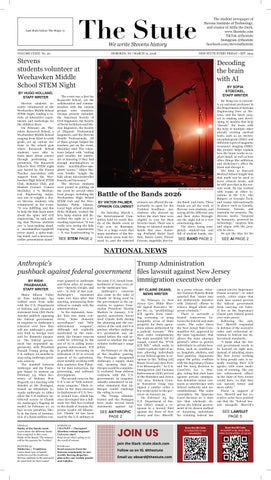
din Band, and Jorts. These bands are all the work of Stevens’ own students, and seeing all the different acts and their styles throughout the night led to a very entertaining show. The show, being completely student-run and full of student bands, stu-
Dr. Feng Liu is currently an assistant professor in the Department of Systems Engineering here at Stevens, and his latest project is making and developing AI models that help “decode” the brain with the help of multiple other already existing medical tools, such as an electroencephalogram (EEG) and different types of magnetic resonance imaging (MRI). His project helps explain how the brain works in explicit detail, as well as how other things like addiction and Alzheimer’s affect the brain and disrupt it. His time at Harvard Medical School taught him that math can be used to serve clinical needs, and he still uses that in his current work. He has worked with teams at other locations in the U.S., like Rutgers or Georgia Tech, and teams internationally in places such as Canada, Germany, Taiwan, and Australia for projects. The Stevens motto “Inspired by humanity, powered by technology,” inspires him and aligns with the projects he does. He got the idea for his
SEE BAND PAGE 2
SEE AI PAGE 2
ANTHONY SEVILLA FOR THE STUTE
Battle of the Bands 2026 BY VIKTOR PALMER, OPINION COLUMNIST On Saturday, March 7, the Entertainment Committee held its yearly Battle of the Bands event at 7:30 p.m. in Bissinger. This is a huge event that many members of the Stevens music scene look forward to, and the selected
winners are offered the opportunity to open for the Techfest headliner. Any students who showed up before the start time were eligible to vote for their favorite band. There was a lineup of talented student bands this year, featuring Portland Hotel Yard Sale, Desire Lines, Flower Crowns, Angelidis, Eve Go-
NATIONAL NEWS Trump Administration Anthropic’s pushback against federal government files lawsuit against New Jersey tract granted to Anthropic the joint U.S.-Israeli bom- immigration executive order BY RISHI Major Silicon Valley AI firm Anthropic has walked away from talks with the U.S. Department of Defense and released a statement from CEO Dario Amodei publicly opposing the federal government, in response to Anthropic’s concerns over how they will use Anthropic’s products both in foreign wars and for domestic purposes. The federal government has responded aggressively, with President Donald Trump giving the U.S. military six months to stop using Anthropic products entirely. The standoff between Anthropic and the Pentagon began in earnest on February 24, when Secretary of Defense Pete Hegseth, in a meeting with Amodei at the Pentagon, issued an ultimatum towards Anthropic to either allow the U.S. military unfettered access to Claude AI, Anthropic’s flagship AI model, by February 27, or face severe penalties, likely in the form of termination of a $200 million con-
and three other AI companies—OpenAI, Google, and xAI— in July of last year. Anthropic’s statement came two days after this meeting, announcing their refusal to comply with the administration. In the statement, Amodei lists two main concerns: “mass domestic surveillance” and “fully autonomous weapons”. Although not explicitly mentioned in the statement, the former concern could be referring to the use of AI in aiding immigration enforcement. ICE is gradually increasing its utilization of AI in several aspects of its operations, most notably working with data analytics firm Palantir for data extraction, tip processing, and software development. The second concern, the U.S.’s use of “fully autonomous weapons,” likely relates to the then-increase in deployment of U.S. forces around Iran, which has since developed into a fullscale war that has resulted in the death of Iranian Supreme Leader Ali Khamenei. Claude AI has been used by the U.S. military in
NEWS (2)
SCIENCE (6)
FEATURE (4)
PULSE (10)
PRABHAKAR, STAFF WRITER
Battle of the Bands 2026 Learn about the different bands that competed in this years Battle of the Bands! The winners will be the openers for Techlex! Midterms + Traditions Learn about how to handle midterms and the traditions Stevens students in the past used for good luck on their exams!
CHATGPT = Therapist? Wireless retinal implant? Universe star? Read about what’s going on in the world of science. Read answers from the Stevens community to our weekly Roving Reporter, plus solve our weekly puzzle and sudoku.
bardment of Iran, even after the Anthropic ban. Anthropic’s concerns also come in the wake of Claude AI being used by the government in the operation to capture Venezuelan President Nicolás Maduro in January. U.S. special operations forces used Claude both during the planning and the execution of the raid, and it is unclear whether Anthropic’s permission was obtained before the raid occurred or whether the raid violates Anthropic’s usage policy. On February 27, the day of the deadline passing, the Pentagon designated Anthropic a supply chain risk, meaning that Anthropic would be completely excluded from defense contracts with the U.S. government. In response, Amodei announced in another statement that Anthropic would challenge the ruling in court. The Trump administration and the Pentagon have made several harsh statements against An-
SEE ANTHROPIC PAGE 2
BY CLAIRE DEANS, NEWS WRITER On February 11, New Jersey Gov. Mikie Sherrill signed Executive Order No. 12, “prohibit[ing] ICE agents from entering, accessing, or using nonpublic areas of State property for their operations unless authorized by a judicial warrant.” This state order complements the state assembly bill NJ A4446, coined the “F*CK ICE Bill,” which seeks to create a private right of action allowing individuals to sue federal agents in response to the “killing [of] Renee Good and Alex Pretti in Minneapolis.” As U.S. Immigration and Customs Enforcement (ICE) arrived in the Hoboken and Jersey City area, Hudson County Executive Craig Guy signed a similar order a few weeks prior to the governor on January 29. On February 23, the U.S. Department of Justice (DOJ) issued a response in a lawsuit filed against the State of New Jersey and Gov. Sherrill.
In a press release, Attorney General Pamela Bondi asserted that “states may not deliberately interfere with [federal] efforts to remove illegal aliens and arrest criminals.” There is currently a heated controversy between the federal and state courts. The order obeys the New Jersey Safe Communities Act, approved by the state legislature, that allows the state attorney general’s office to protect individuals in certain locations, such as courthouses, hospitals, shelters, and food pantries. Opponents argue the policy conflicts with the Supremacy Clause and the 2025 decision in CoreCivic, Inc. v. Murphy, ruling that state bans against private immigration detention center contracts as interference with federal authority and unconstitutional. The order contradicts the Supreme Court decision as “a state law that wholesale deprives the federal government of its chosen method of detaining individuals for violating federal law
cannot survive Supremacy Clause scrutiny”; in other words, critics argue that state laws cannot prevent the federal government from carrying out federal law as the Supremacy Clause puts federal power over state power. Following the suit, Gov. Sherrill responded in defense of the executive order and redirected attention to federal law enforcement standards.: “I think what the federal government needs to be focused on right now, instead of attacking states like New Jersey working to keep people safe, is actually training their ICE agents, with some modicum of training, like any law enforcement officer in the state of New Jersey would have, so that they can operate better and more safely.” Those in support of Gov. Sherrill and her executive order have pointed out that the “federal lawsuit misspells Sherrill’s
SEE LAWSUIT PAGE 3
Friday, March 13
2
News Masthead Volume CXXIII No. 20 Executive Board
STEM
CONTINUED FROM PAGE 1 see the kids be truly amazed by the experiments.”
EDITOR-IN-CHIEF.............................JIYA JAISINGHANI ‘27 BUSINESS MANAGER.....................................FIONA SHI ‘27 MANAGING EDITOR.................................TIANNA SPITZ ‘27 LAYOUT EDITOR...............................EILIYAH SAROWAR ‘28 OUTREACH CHAIR..................................TANYA AVADIA ‘25 DIGITAL MANAGER..........................CHARMY KOTADIA ‘27 SECRETARY.....................................JOSEPHINE CHOONG ‘28
Editorial Board
NEWS EDITOR........................................... CLAIRE DEANS ‘29 SCIENCE EDITOR..................................RIYANA PHADKE ‘27 OPINION EDITOR.........................................ITAI GELLER ‘26 SPORTS EDITOR..................................CAMRYN WINANT ‘28 FEATURES EDITOR ...........................PRISHA VAGVALA ‘28 HEAD COPYEDITOR..............................TASHA KHOSLA ‘25
Operations Board
HEAD PHOTOGRAPHER.......ISABELLE VILLANUEVA ‘26 ARCHIVES LIASON....................................ISABELLA ZIV ‘25 ASST. SOCIAL MEDIA...............................CHRISTINE YI ‘29 DELIVERY BOY.........................................JONATHAN LAI ‘28 ASST. LAYOUT EDITOR.............................SHREYA ROY ‘27 ASST. LAYOUT EDITOR..........................KAILEY SUPAN ‘29 ASST. LAYOUT EDITOR....................BRADY SANSOTTA ‘29 ASST. BUSINESS MANAGER........JOSH BODENSTEIN ‘29
Staff & Contributors Viktor Palmer Hugo Holland Sofia Stoeckel Jack MacDonnell Disha Gohil Rishi Prabhakar Josephine Choong Sean Palermo Vincent Olivieri
Sean Palermo Chris Kalish Anna Dabrowski Sydney Leung Jeylan Jubran Wesley Yu Vedhesh A. Kamaraj Anthony Sevilla Charles Beall Madison Heller Abigail Thomas Isabella Villanueva Dominic Souza
PHOTO COURTESY OF @WEEHAWKENTSD
BANDS
CONTINUED FROM PAGE 1 dent support made it a very unifying experience. There was support and joy at the show, and it was evident in the crowd. Before doors opened, the bands were bowling in the Howe basement, sharing the achievement of being selected to perform. The bands were given 15 minutes each to perform original material for the audience. It was evident how much hard work each band put into their sets, as they gave their all to the performance. The show started around 7:30
p.m., with an announcement Battle of the Bands and Techabout the voting process for ev- fest are events that stand out at eryone who signed in prior to the Stevens every year. The Audio start time. The show concluded Engineering Club (AEC) suparound 9:40 p.m. with an audi- ported the performance logistics ence still dancing around to the as they set up the stage, lightmusic. The bands were made up ing, and ran sound. The support @WEEHAWKENTSD of members outside of just Music given to the bands on campus and Technology majors, show- means everything to the artists casing the strength of the music involved, as the annual compeand arts community on cam- tition was a community effort pus. The diverse backgrounds of across disciplines and organizaeach of the talented musicians tions. The winners of Battle of allowed for a very vibrant show- the Bands 2026 are Jorts, Eve case of original sound and stage Godin band, and Angelidis! Anpresence. With some members gelidis will be playing a 20-mina part of Greek life or leaders of ute set, Eve Godin 30-minutes, on-campus organizations, the and Jorts, a 40-minute set. music community is a unifying Come see them play at Techfest hub across student life this year on April 18.
Contact Us
GENERAL.........................................EBOARD@THESTUTE.COM EDITOR-IN-CHIEF.........................EDITOR@THESTUTE.COM ADVERTISING.............................BUSINESS@THESTUTE.COM OFFICE.................................UNIVERSITY CENTER ROOM 216B
Corrections NOTICE A MISTAKE? Email us at eboard@thestute.com.
Disclaimer
All opinions and editorials reflect the views of their respective author(s). No Part of The Stute may be reproduced in any form, in whole or in part, without the written consent of the Editor-in-Chief. Cited references of The Stute are permitted.
Policy on Letters to the Editor
All members of the Stevens community are able to submit a Letter to the Editor to be published in The Stute. Letters must refer either to a piece published in The Stute or to The Stute in general and must be between 400 – 800 words in length. Submit letters to editor@thestute.com with your name and title (when applicable) or using our Google form. For writers who wish to write a Letter to the Editor anonymously, please see our policy on anonymity. The Editorial Board reserves the right to choose whether or not to publish a submitted Letter to the Editor based on a majority rule vote, and additionally reserves the right to edit letters for clarity or request authors to revise. Provided that the author approves the final version, The Stute reserves the right to edit letters according to our copy editing procedures, defined in our policies.
Policy on Op-Eds
All members of the Stevens community are able to submit a standalone opinion piece (otherwise known as an Op-Ed) to be published in The Stute. Op-Eds must be between 400 – 800 words, but longer submissions will be considered on a case-by-case basis. To submit an OpEd please email eboard@thestute.com with your name and title (when applicable) or using our Google form (tinyurl.com/submit-t0-stute). For writers who wish to write an Op-Ed anonymously, please see our policy on anonymity. The Editorial Board reserves the right to choose whether or not to publish a submitted Op-Ed based on a majority rule vote, and additionally reserves the right to edit Op-Eds for clarity or request authors to revise. Provided that the author approves the final version, The Stute reserves the right to edit Op-Eds according to our copy editing procedures, defined in our policies.
FULL LIST ON thestute.com/policies
tinyurl.com/stutesubmit
ANTHONY SEVILLA FOR THE STUTE
AI
CONTINUED FROM PAGE 1 most recent project while doing his Ph.D., when he started working with brain imaging data, such as an EEG and functional magnetic resonance imaging (fMRI), and then he started “decoding” brain states under anesthesia using those tools. He then realized that he could use AI to explain and interpret those brain waves to be used for medical research and needs. Pairing EEG with fMRI data allowed Liu and his lab to non-invasively map internal brain activity compared to surgically invasive measuring techniques. His lab utilizes Graph Neural Networks (GNN) to decode how brain regions communicate and how those pathways are changed be-
cause of disease. Graph neural networks turn scientific information, such as neural pathways and activity, into graphs to process, interpret, or model them for researchers to use in their studies and projects. His lab also uses large language models (LLMs), like EpiSemoLLM, to interpret the patients’ descriptions of seizure symptoms to help medical professionals treat epileptogenic zones, which are zones in the brain that tend to induce epilepsy. Liu’s team builds models that can help find where seizures start and help treat patients who don’t respond well to medication. When testing an LLM’s ability to interpret seizure symptoms from patients’ descriptions, its performance was similar to that of human experts, showing its efficiency and reliability. He is also expanding into the territory
of sleep disorders, such as sleep apnea, to help determine severity, making diagnoses more accessible for everyone. In terms of working with addiction, Liu is trying to use LLMs to be able to effectively predict and prevent relapse events and identify their brain state at that point. Liu’s system provides a novel medium to study the electrical properties of biological cells and tissue through “3D visualization of the electrophysiological source.” This form of imaging shows doctors and medical providers where the issue is, so they know how to properly treat it with other tools they have, whether that be medication or surgery. These tools allow doctors to be able to medically diagnose a range of brain disorders in a non-invasive way, making the medical industry significantly safer and more accessible
ANTHROPIC
CONTINUED FROM PAGE 1 thropic and Amodei since Amodei posted his first statement. In a post on Truth Social, President Trump himself referred to Anthropic as a “radical left, woke company” and accused them of trying to “strong-arm” the Department of DefenseWar, while Hegseth commented on X, describing Anthropic’s behaviour as a “master class in arrogance and betrayal,” additionally stating that “the Department of War must have full, unrestricted access to Anthropic’s models for every LAWFUL purpose in defense of the Republic.” Meanwhile, Anthropic rival OpenAI has made its own agreement with the federal government on February 27, allowing them access to classified systems, although stating that its terms of service also prohibited mass domestic surveillance
PHOTO COUTESY OF BUILTIN.COM
and fully autonomous weapons. However, the company amended the agreement a week later due to severe backlash from their
consumer base, with CEO Sam Altman making an apology and saying the move “looked opportunistic and sloppy.”
Friday, March 13
3
News THE FOLLOWING IS AN OP-ED
LAWSUIT
OP-EDS REPRESENT THE VIEWS OF THE GUEST WRITER FROM WITHIN THE STEVENS COMMUNITY AND ARE SUBMITTED TO THE STUTE FOR PUBLICATION. THEY DO NOT REFLECT THE VIEWS OF THE STUTE ITSELF.
CONTINUED FROM PAGE 1 name multiple times” in an effort to further discredit the case compiled against them. The case is currently going through the federal court system without any further comment. In other words, there are no “bright line rules regarding where our immigration laws are permitted to be enforced,” DHS Memorandum at 1, and instead, the location of a civil enforcement action is properly determined “on a case-by-case basis considering the totality of the circumstances,” ICE Memorandum at 2.
PHOTO COURTESY OF WASHINGTONTIMES.COM
A Somewhat Didactic Argument against the AI Undergraduate Major BY JO STRANO ‘26 Stevens has announced that it will be offering undergraduate and graduate degrees in Artificial Intelligence starting in Fall 2026. Given current financial and research interests in AI, it makes perfect sense that SIT would want to add AI to its portfolio of programs. After all, it’s looking like generative AI and language learning models are the future. Why, then, should we oppose this addition to the catalogue of majors? Artificial Intelligence is, undoubtedly, a hot-button item. Every major technology company is rushing to create its own LLM. You can’t Google something without the Gemini’s opinion being the first result on the page. I had to get a new laptop recently, and it came equipped, curiously, with a Copilot button. Tech all-stars, like Microsoft and Meta, have poured trillions of dollars into the development of this technology. AI is impossible to ignore because of its rapid proliferation in the digital world and in the news. But with further investigation, the robustness of the technology’s future is called into question. For example, OpenAI, darling of headlines
and investors, is currently the most valuable privately owned company in the world. But it has operated at a loss for every year of its existence, with its projected operating costs increasing significantly through the end of this decade. This pattern exists in other companies, none of which have a clear path forward to making AI profitable in comparison to its soaring operating cost. Some financial experts have compared the AI hype to the dot-com bubble of the late nineties and early aughts. With this context, it makes the AI-ification of everything a little more dubious. Why should I trust Gemini to summarize the results of a Google search, when the source for its information is right beneath it? Why do I need a dedicated Copilot button, when the program is already pinned in the task ribbon of every Windows computer? It seems to me that these companies are pushing AI as a means of justifying their investment. They’re insisting to us that AI is the future. It appears they’ve forgotten we’ve been just fine without it. What I mean is that we don’t know what the future holds for AI. It obviously isn’t going away, and it has certainly proved its
value in certain applications, but we don’t know the financial future of this technology. For this reason, I think the addition of a dedicated AI major is a little shortsighted and overzealous. From the administration’s perspective, if students want to major in it, and AI research makes Stevens look more prestigious, it doesn’t matter if some people think AI won’t be as exciting in ten years. I, however, take moral issue with encouraging 18-year-olds to take on massive student loan debt to pursue a highly specialized degree, for an industry that may or may not be dead in the water by 2035. There are a few other issues that I wish to mention. The environmental problem is, succinctly, difficult to ignore. AI is extremely resource-intensive, and data centers are being built rapidly to support the increasing interest in the technology. These data centers consume a lot of power, put stress on the grid, increase carbon emissions, and use a lot of fresh water. I think that Stevens, which conducts a great deal of climate change and sustainability research, has an intellectual responsibility to consider these impacts before going all-in on AI.
AI is attractive to the ruling-investor class because its end goal is to be a budget replacement for human workers. If you’ve tried to call a customer service line or been to a drive-thru recently, you know that AI is already replacing human jobs. The writing on the wall, whether it’s in human handwriting, or littered with em-dashes and bullet points, is that companies will use AI to hire less people the moment they can justify it— that means engineers, computer scientists, and other white-collar professionals. This should give pause to just about anybody obtaining a degree here, and is another reason I reject AI as a profession. AI is anti-profession. I would be lying if I said I’ve never used AI, and I see its value in specific applications. But, I think that a dedicated AI major is contradictory to the university’s future-forward approach. I believe a much more austere, reasonable capitulation to the market would be to stick with the AI minor, and add a concentration in the CS program. It’s impossible to do away with it entirely, and it is, truthfully, a very powerful tool. But I refuse any future that insists it’s the only way forward.
DINNING COMMITTEE MARCH 25, 2026
Your feedback matters! Stop by to share your thoughts and suggestions on how we can continue to improve dining at Stevens. This open conversation gives the Stevens community a chance to connect directly with the Stevens Dining Team and RHA. We’d love to hear from you! SCAN HERE TO JOIN THE CONVERSATION
ALL ARE WELCOME! Wednesday, March 25 3:00 PM - 4:00 PM Virtual Event
COMING APRIL 3 SUBMIT YOUR ARTICLE IDEAS TO THE STUTE! Help us craft articles that resonate with you. Whether you prefer to remain anonymous or wish to disclose your identity, your input matters! tinyurl.com/stutesubmit
Friday, March 13
4
Feature
MIDTERMS AND TRADITIONS
BY JOSHUA BODENSTEIN, ASSISTANT BUSINESS MANAGER Midterms have a way of sneaking up on you. One week you’re telling yourself there’s plenty of time, and the next week you’re getting asked to leave the library because it’s closing, running on cold brew and whatever snacks you could grab between classes. By the time exam week actually arrives, many students have completely wrecked their routines — sleep schedules are gone, caffeine intake is questionable, and studying feels less productive than it probably should. The problem isn’t just the amount of work. It’s the way many students try to handle it. A typical midterm routine looks something like this: skip sleep, drink coffee, panic-study, repeat. It might feel productive in the moment, but it usually makes things worse. When you’re sleep-deprived, it becomes harder to focus, harder to remember information, and much easier to burn out before the exams are even finished. The good news is that fixing your routine during midterms doesn’t require a complete lifestyle overhaul. Small changes can make studying significantly more effective while keeping you from completely burning yourself out.
The first thing to fix is sleep. Pulling one late night might seem harmless, but stacking several of them together quickly destroys your ability to concentrate. If your sleep schedule has already drifted into “2 a.m. every night” territory, the easiest reset is to start by waking up earlier rather than trying to force yourself to sleep earlier. Getting up at a consistent time naturally helps your body return to a healthier schedule. Even an extra hour of sleep can make a huge difference in how well you retain information. Caffeine is another major factor. Coffee can absolutely help during long study sessions, but it’s easy to overdo it. Drinking caffeine late in the evening makes it harder to fall asleep, which leads to more exhaustion the next day — and even more caffeine to compensate. A good rule of thumb is to stop drinking caffeine about six hours before you plan to go to sleep. Switching to water or tea later in the day can prevent the cycle where caffeine ruins your sleep and sleep deprivation ruins your studying. It’s also worth reconsidering how you study. Long marathon sessions where you stare at a textbook for four hours straight usually aren’t very productive. Shorter, focused blocks tend to work better. I find that studying for about 45–60 minutes, followed by
a short break, helps me maintain focus without burning out. Taking a walk around campus, grabbing food, or just stepping away from your laptop for a few minutes can make it much easier to return to the material with a clear head. Food and hydration matter more than most people realize. It’s surprisingly easy to forget to eat real meals during busy weeks, especially when studying late at night. Quick options like fruit, granola bars, or sandwiches are simple ways to keep your energy levels stable while studying. Drinking enough water can also improve focus and help avoid the sluggish feeling that sometimes gets blamed on “being tired.” Finally, it’s important to remember that productivity isn’t just about the number of hours you spend studying. A well-rested two-hour study session can be far more effective than five hours spent exhausted and distracted. Taking care of basic things— sleep, food, and breaks—actually makes the time you spend studying more valuable. Midterms are always going to be stressful, but they don’t have to completely destroy your routine. With a few small adjustments, it’s possible to study effectively without surviving entirely on caffeine and two hours of sleep. And when the exams are over, your body will probably thank you for it.
Brain rot, doomscrolling, and locking in BY JACK MACDONNELL, CONTRIBUTOR Midterms have a way of sneaking up on you. One week you’re telling yourself there’s plenty of time, and the next week you’re getting asked to leave the library because it’s closing, running on cold brew and whatever snacks you could grab between classes. By the time exam week actually arrives, many students have completely wrecked their routines — sleep schedules are gone, caffeine intake is questionable, and studying feels less productive than it probably should. The problem isn’t just the amount of work. It’s the way many students try to handle it. A typical midterm routine looks something like this: skip sleep, drink coffee, panic-study, repeat. It might feel productive in the moment, but it usually makes things worse. When you’re sleep-deprived, it becomes harder to focus, harder to remember information, and much easier to burn out before the exams are even finished. The good news is that fixing your routine during midterms doesn’t require a complete lifestyle overhaul. Small changes can make studying significantly more effective while keeping you from completely burning yourself out. The first thing to fix is sleep.
PHOTO COURTESY OF TODAY.COM
Pulling one late night might seem harmless, but stacking several of them together quickly destroys your ability to concentrate. If your sleep schedule has already drifted into “2 a.m. every night” territory, the easiest reset is to start by waking up earlier rather than trying to force yourself to sleep earlier. Getting up at a consistent time naturally helps your body return to a healthier schedule. Even an extra hour of sleep can make a huge difference in how well you retain information. Caffeine is another major factor. Coffee can absolutely help during long study sessions, but it’s easy to overdo it. Drinking caffeine late in the evening makes it harder to fall asleep, which leads to more exhaustion the next day — and even more caffeine to compensate. A good rule of thumb is to stop drinking caffeine about six hours before you plan to go to sleep. Switching to water or tea later in the day can prevent the cycle where caffeine ruins your sleep and sleep deprivation ruins your studying. It’s also worth reconsidering how you study. Long marathon sessions where you stare at a textbook for four hours straight usually aren’t very productive. Shorter, focused blocks tend to work better. I find that studying for about 45–60 minutes, followed by a short break, helps me
maintain focus without burning out. Taking a walk around campus, grabbing food, or just stepping away from your laptop for a few minutes can make it much easier to return to the material with a clear head. Food and hydration matter more than most people realize. It’s surprisingly easy to forget to eat real meals during busy weeks, especially when studying late at night. Quick options like fruit, granola bars, or sandwiches are simple ways to keep your energy levels stable while studying. Drinking enough water can also improve focus and help avoid the sluggish feeling that sometimes gets blamed on “being tired.” Finally, it’s important to remember that productivity isn’t just about the number of hours you spend studying. A well-rested two-hour study session can be far more effective than five hours spent exhausted and distracted. Taking care of basic things— sleep, food, and breaks—actually makes the time you spend studying more valuable. Midterms are always going to be stressful, but they don’t have to completely destroy your routine. With a few small adjustments, it’s possible to study effectively without surviving entirely on caffeine and two hours of sleep. And when the exams are over, your body will probably thank you for it.
Cremation of Calculus vs. Slap the Ass and Pass BY PRISHA VAGVALA, FEATURES EDITOR Stevens has its fair share of traditions — founded in 1870, we have a rich history of past Hoboken life and campus life. Luckily, we had The Stute to start documenting these traditions starting in 1904 and the Samuel C. Williams Library archives to document even more of the preceding years. From past to present, students will always find a way to create tradition and a shared sense of community. I remember peer leader orientation back in my freshman year. I got a wonderful, perfect introduction to the ways of Stevens and my favorite: Slap the Ass and Pass conspiracy. If you are not familiar with this, I am fairly surprised, but it’s simple. The Torch Bearers statue at the center of campus has a horse on its hind legs. Supposedly, if you smack the horse’s ass (not the human’s), you will pass your exam. Does it work? I’ll let you be the judge of that, as I get too embarrassed in broad daylight to walk up to the statue and smack the ass of the horse. I’d say do it just in case you are truly in dire need of luck for your exams this midterm season. This is not the only exam tradition to exist throughout Stevens’ history. Before Slap the Ass and Pass, there was Cremation of Calculus, which started in 1889, and doesn’t the name sound tempt-
PHOTO COURTESY OF THE LINK YEARBOOK 1924, PAGE 42
Stress, caffeine, and no sleep: how to fix your midterm routine
ing? Personally, I love calculus, but I would gladly burn my old paper coding tests. At the end of the semester, when classes were done, there would be a ceremony one night where the sophomore class would wear costumes and robes and carry an effigy of “Ol’ Man Calculus” through the streets of Hoboken, then back to campus. A court case against him was held in front of professors, faculty, students, and whoever stopped to look. The faculty members served as jurors for this trial, the verdict would always be death by fire, and the effigy would be burned, the Ol’ Man of Calculus never to return to their course load. After this eventful burning, students would dress as clowns on the steps of Edwin A. Stevens Hall for the post-cremation parade. Slap the Ass and Pass is a good, lighthearted way for Stevens students to cope during exam times, although Cremation of Calculus was the whole spectacle. Maybe we can’t burn an effigy and parade the streets of Hoboken, but I think we should still have an end-of-semester parade for finishing classes. These traditions are what bring Stevens together and give it such a rich history. While Slap the Ass and Pass is classic, on behalf of Stevens students, we would love to have something else to commemorate the hard work we put into studying and have a nice, lighthearted event.
Stevens students’ guide to getting through exam season BY CAMRYN WINANT, SPORTS EDITOR In what feels like no time at all, midterms are back on our radars, and we’re holed up in our dorms or the library for hours at a time, cramming every bit of information from the past six weeks. The minute midterms are brought up, my stress levels spike — and if we’re being honest, it’s just because of their special name. It is not a special exam. Despite this, it doesn’t eliminate any stress someone might feel over it. Every student here has their own way of dealing with stress, whether that’s not doing anything and just sitting in the stress (guilty) or doing everything in their power to remain as stress-free as possible. When asking around for students’ de-stressing tips, I saw more variations of the word “doomscrolling” than I think I ever have. So, I suppose if you were to tell a fellow student you were feeling stressed, they would tell you to open up TikTok or Instagram and let it numb your mind. This method might be a little too conflicting, as it typically just leads to you hearing some brain-rotting audio over and over again during the exam in your mind instead of any relevant information. Along a similar vein are the students who said “get extra sleep,” “ignore them and lie in bed all day,” “watch movies,” and “watch a lot of TV.” These are the most helpful bits of advice—in
moderation—making sure you still allow yourself to rest. Similar to doomscrolling, I got many responses along the lines of “exercising” and “going for walks.” One student says they “like to run on the pier” with a memorable follow-up of “can’t find my sanity or my waist.” Whether it is just a simple walk or run, or going to the gym for a workout, or even throwing a frisbee on Schaefer Lawn, being active is a perfect way to make your stress feel miles away. Deviating from the typical answers, one student bakes, which “helps calm the nerves,” and she finds the time for it when she can. Maybe none of these are appealing to you at all, and maybe even make you feel more stressed. A student says they “make sure to have time to [themselves] to do the little things that bring [them] peace of mind like reading.” If you’re not into doomscrolling or napping or exercising, finding anything you might like to do that doesn’t fill you with dread is the quickest de-stressor. The last tip from fellow students is to surround yourself with people. One student likes to “talk to friends,” and another likes to “call her mom”. At the end of the day, exams will come whether we feel ready for them or not, and the most you can do is surround yourself with people you love doing things you love, and just remind yourself that it is only an exam.
Friday, March 13
5
Sports
ON DECK IN SPORTS
PHOTO COURTESY OF STEVENSDUCKS.COM
FRI, MAR 13
Stevens’ Fencing takes on the NCAA Regional Championship BY RIYANA PHADKE, SCIENCE EDITOR The Stevens women’s and men’s fencing teams competed at the NCAA Mid-Atlantic/South Regional Championships on Saturday, March 7. The teams faced Division One and Division Three Programs, including competition from University of North Carolina, Princeton University, the University of Pennsylvania, and NJIT. In men’s fencing, sabre second-years Spencer Depew and Chinli Ong both competed to move
into the second round. In Pool 1, Depew had a 5-1 record. He took down saberists from Drew, Haverford, Princeton, and Penn State. In the second round, Depew was bested after scoring 12 touches. Ong moved through the first round after defeating saberists from Wagner and Haverford, but was eliminated in round two after scoring five touches. Third-year epeeist Riley Parker had a strong showing as well, leading his first pool with a 4-1 tally. However, in the second pool he was unable to advance despite
scoring 12 touches. First-years Skanda Krishnan and Donovan Aggeler added two wins at epee with Krishnan becoming the winner of Pool 3 in the first round. In foil, senior Nick Reznick and second-year Dev Badlani earned many victories for foil in the first round, knocking out opponents from NJIT, Penn State, and Wagner. The women’s team had an impressive day. In epee, juniors Grace Hicks and Sofia Stoeckel both moved through round one with a 3-3 record. They advanced
to the second round where they each tallied one win but failed to move to round three. In sabre, third-year Sasha Craine failed to advance to the second round by just one touch. She collected three victories, however, over Penn State, Drew, Haverford. Second-year foilist Julia DiPaolo just missed advancing to the second round. Both teams fought well in this year’s Championships. The Ducks move towards off-season training to come back even stronger next winter.
WRESTLING NCAA Championships Day 1 Cedar Rapids, IA 11 a.m. BASEBALL DeSales University (DH) Port Charlotte, FL 3:30 p.m.
SAT, MAR 14 WRESTLING NCAA Championships Day 2 Cedar Rapids, IA 11 a.m. BASEBALL DeSales University Port Charlotte, FL 11 a.m. WOMEN’S TRACK AND FIELD NCAA Indoor Championships - Day 2 Birmingham, AL 12:30 p.m. MEN’S LACROSSE Union College Schenectady, NY 1 p.m. MEN’S VOLLEYBALL Widener University Chester, PA 1 p.m. SOFTBALL DeSales University (DH) Center Valley, PA 1 p.m. MEN’S VOLLEYBALL Ramapo College Chester, PA 3 p.m.
SUN, MAR 15 SOFTBALL Hunter College (DH) Weehawken, NJ 1 p.m.
MON, MAR 16 MEN’S TENNIS College of Coastal Georgia Hilton Head, SC TBD
PHOTO COURTESY OF STEVENSDUCKS.COM SHOT BY CARLISLE STOCKTON
BASEBALL Clarkson University Auburndale, FL 4 p.m.
STEVENS SCOREBOARD DATE
WED, MAR 4 FRI, MAR 6
SAT, MAR 7
TEAM
MEN'S VOLLEYBALL WOMEN'S LACROSSE MEN'S AND WOMEN'S TRACK AND FIELD SOFTBALL SOFTBALL MEN'S BASKETBALL MEN'S AND WOMEN'S FENCING MEN'S AND WOMEN'S TRACK AND FIELD MEN'S LACROSSE WOMEN'S LACROSSE MEN'S VOLLEYBALL MEN'S VOLLEYBALL
OPPONENT
LOCATION
SCORE
ARCADIA UNIVERSITY UNIVERSITY OF MARY WASHINGTON AARTFC INDOOR CHAMPIONSHIPS - DAY 1
AWAY HOME AWAY
W (3-0) W (12-9) COMPLETE
DENISON UNIVERSITY SUNY - CORTLAND CHRISTOPHER NEWPORT UNIVERSITY NCAA REGIONALS
AWAY AWAY AWAY AWAY
L (0-1) W (7-1) L (62-75) COMPLETE
AARTFC INDOOR CHAMPIONSHIPS - DAY 2
AWAY
COMPLETE
SUNY - ONEONTA ROWAN UNIVERSITY HOOD COLLEGE NEW PALTZ
AWAY HOME HOME HOME
W (15-5) L (11-13) W (3-0) L (0-3)
Friday, March 13
6
Science Evolutionary shift in one of universe’s biggest stars BY DISHA GOHIL, SCIENCE WRITER Scientists have observed something strange about one of the largest stars known in the Universe, and they aren’t entirely sure about what it means. WOH G64, a star with a mass 28 times that of the sun, resides in a satellite galaxy of the Milky Way known as the Large Magellanic Cloud. Compared to the sun, its luminosity is about 300,000 times greater, and its diameter is about 1,500 times greater. If it were in place of the sun, its surface would span a distance between the orbits of Jupiter and Saturn. “WOH G64 is a massive star and very different from the sun,” said astronomer Gonzalo Muñoz-Sanchez, from the National Observatory of Athens in Greece. Scientists started noticing changes in the star in 2011, when the star started to dim. Then, in 2013 and 2014, not only was the star able to recover its initial brightness, but it significantly exceeded it. Its surface temperature rose up by more than 1000°C, causing the star to shift from a classic red supergiant to a hotter, yellower state. The star shrank while heating up, deflating to around 800 solar radii. Then, in 2025, the star began to fade again to less than half its brightness, dropping by roughly two magnitudes in less than a year. WOH G64 appears to be near the end of its lifespan at around 10 million years old. In contrast, the sun, around 4.5 billion years old, has an estimated 5 billion years left. Stars between eight and 23 times the sun’s mass are expected to evolve into red supergiants that eventually explode as a supernova. As for stars in the
range of 23 to 30 times the sun’s mass, it is not clear what would happen to them. They could explode as a supernova as well, collapse to form a black hole, or evolve from a red supergiant to a yellow hypergiant stage. Between November 2024 and December 2025, astronomers Jacco van Loon of Keele University in the UK and Keiichi Ohnaka of Universidad Andrés Bello in Chile conducted observations using the Southern African Large Telescope. They found titanium oxide in the atmosphere of WOH G64, but such a yellow hypergiant is too hot to sustain titanium oxide. “WOH G64 has been claimed to have turned into a yellow hypergiant, which could signal a pre-supernova post-red supergiant evolution,” said van Loon. “However, our new spectra obtained with SALT show the hot companion’s presence but also clear molecular absorption bands from titanium oxide. This implies that WOH G64 is currently a red supergiant and may never have ceased to be.” This doesn’t mean that nothing striking is happening with the star. Van Loon and Ohnaka believe that the star has a binary companion. They believe interactions between the two stars may have complicated the environment around them, producing such remarkable changes. It is difficult to say for certain what the reason is behind what is happening with WOH G64, and continued monitoring is crucial for scientists to uncover more details. “We all agree that we are witnessing an unprecedented spectacle,” van Loon says, “and therefore are unsure of what exactly is going on. We’re all looking forward to new observations that might offer us new clues.”
The ethical implications of ChatGPT as a therapist BY JOSEPHINE CHOONG, SECRETARY Imagine an on-demand therapist designed to relieve your mental health needs without the stress of booking an appointment. That’s why some rely on AI as their therapist. However, a recent research study by Brown University examines the potential risks of relying on AI for therapy. They revealed 15 ethical risks from using LLMs, their implications, and the potential future of AI in therapy. There are numerous reasons why someone would consider using an LLM as a therapist. It’s free to use, without judgment, and helps clarify thoughts by putting emotions into words. Because of its instant accessibility, an AI therapist can outline the costs and benefits of a difficult decision and provide cognitive reframing of negative thoughts. However, others argue that an AI therapist merely provides an illusion of support, lacks the human connection, has no accountability, and lacks nuance and depth that a human therapist could offer. These concerns about the absence of human connection when interacting with AI are not new. Last year, Friend, a pendant designed to be an AI companion for users, received significant backlash from the public. Many of their ads plastered on New York City subways were torn down or graffitied with statements like “AI is not your friend” and “talk to a neighbor.” While its creator wanted it to be an additional companion, many question if it would instead replace human companions. Zainab Iftikhar, a Ph.D. candidate at Brown University, led the research on AI therapy because she was interested in how different prompts would impact a LLM’s output in a mental health setting. She noted how prompts are instructions to guide a model’s behavior and how “you don’t change the underlying model or provide new data,” she said. “But the prompt helps guide the model’s output based on its pre-existing knowledge and learned patterns.” Based on the prompt provided, they used learned patterns to generate the responses. During the study, Iftikhar and her team observed seven peer counselors, all trained in cognitive behavioral therapy techniques, conduct self-counseling chats with CBT-prompted LLMs like
ChatGPT, Claude, and Llama. Afterwards, a series of simulated chats based on the original chats were analyzed for potential ethical violations. Based on the 15 identified risks, the study revealed five general categories of interest. The first, lack of contextual adaptation, explored how LLMs give more general advice instead of customizing it for each person. It also provides poor therapeutic collaboration as it dominates the conversation and occasionally reinforces the user’s false benefits. Moreover, phrases like “I love you” create a false connection between the user and the LLM. Furthermore, it exhibited gender, cultural, or religious biases. Finally, there’s a lack of safety and crisis management, where the AI therapist could deny advice on sensitive topics and fail to refer users to appropriate resources. Additionally, another recent study, named “Expressing stigma and inappropriate responses prevent LLMs from safely replacing mental health providers,” observed similar ethical risks and revealed the human-AI gap in therapy. The 24/7 accessibility of LLMs could worsen obsessional thinking and negative ruminations, causing an overreliance on an AI therapist. That could lead to discouraging users from seeking real human help when it’s needed the most. Even commercially available “therapy bots” are susceptible, as they only answer about 50% of prompts appropriately. There was a significant gap between human and AI therapists, as human therapists responded appropriately 93%, while the AI therapists responded appropriately less than 60% of the time. Iftikhar acknowledged that human therapists are susceptible to some of these ethical risks, however the difference is accountability. If a human therapist commits malpractice, governing boards will hold the therapist professionally liable. However, no such governing board currently exists for AI therapists. Despite this, Iftikhar noted that AI has the potential to reduce barriers in mental health care by decreasing the cost of treatment or increasing the availability of therapists. Iftikhar hoped that her research would reveal the current risks posed by AI systems. Ultimately, the research demonstrates that there needs to be carefully thoughtful implementation and regulations for AI technologies, especially in healthcare.
A hundred years of color mystery BY VINCENT OLIVIERI, SCIENCE WRITER As humans interact with the world each and every day, not a second goes by without the use of one of the five senses. Of these, sight is arguably the most useful. With perception and visuals being such a key component of life, it is no surprise that scientists would want to understand every minute detail about how vision works. Movies and other visual media are the primary carriers of entertainment through sight, and the easiest way to change the feel of a scene or alter the emotional impact is with color. This narrows into the question Schrödinger and other scientists were trying to answer: What causes humans to perceive color? In the 19th century, mathematician Bernhard Riemann proposed that color perception may be categorized into curved spaces as opposed to flat ones. This can be simplified into the idea of diminishing returns, where, for example, a sudden shift from a very light to a very dark blue would be perceived as less of a change than the sum of many gradual changes across that spectrum of blues. This proposition was backed by the theory of Erwin Schrödinger in the 1920s, who further added that color could be categorized into three non-Euclidean (curved) spaces that we know today
as hue, saturation, and brightness. Schrödinger attempted to prove this theory through the use of Riemannian geometry, essentially the study of distance over curved surfaces; however, his model was incomplete. At Los Alamos National Laboratory, Roxana Bujack led a team of scientists aiming to continue and complete the theory proposed by Schrödinger. The original idea for a three-space color spectrum emerges from the types of cone cells in human eyes, each sensitive to red, blue, and green light, respectively. To enable this model, Schrödinger chose to center the spaces around a neutral axis — a line of gray tones running from black to white. The initial definitions of color perception were tied to where the colors were positionally from the neutral axis, these positions were never mathematically defined. One of the most prominent achievements of the team was the mathematical establishment of this neutral axis purely from the geometry of the color spectrum, finally providing ground for the theory to stand on. The team then went on to correct other known issues with the theory, most prominently the Bezold-Brücke effect. In the original model, increasing brightness in a color would cause a notable shift in hue. The solution to this was a shift in thinking, where instead of assuming colors move along a straight
path, they instead move along the shortest possible path within the geometric space, thus accounting for the diminishing returns aspect of the color space. Across the United States, there are 42 Federally Funded Research & Development Centers (FFRDCs), with Los Alamos being a single standout location. Of 181.4 billion dollars spent towards R&D across the country, around (as of 2024 budget) 103.6 million dollars went to Los Alamos’ internal research funding — about 2-3 million of which was spent on a single research project, such as the one conducted by Bujack and their team. With only ~0.0014% of total funding in 2026 going towards this project, it is evident that the goal itself was an undertaking of very little interest to researchers as a whole. Despite this, any advancement to visualization science could mean major steps forward in the world of photography, videography, and data analysis. Finer use of equipment due to a new and complete understanding of the color spectrum could lead to more energy-efficient or cost-effective technology in the future, and the idea of finally piecing together a century-old theory put into place by two of the most notable mathematicians and scientists in history is undoubtedly awesome.
Small, wireless implant helping to restore central vision BY SEAN PALERMO, SCIENCE WRITER According to results published October 20, 2025, in the New England Journal of Medicine, a newly developed, tiny, and wireless retinal implant device is helping restore vision in individuals with advanced age-related macular degeneration (AMD). AMD, which is the most common cause of permanent blindness in older adults and affects more than 5 million people worldwide, causes the central field of vision to become blurred as a result of the permanent damage to light-sensing cells of the retina called photoreceptors, as the condition advances. This new device, dubbed PRIMA (photovoltaic retina implant microarray)—a culmination of decades of development, prototypes, animal trials, and a small first-in-human trial—focuses on replacing the damaged photoreceptors that capture light and convert it into electrical signals that travel through nerve cells located at the back of the eye and through the optic nerve to the brain where images are formed. As a result, it has become successful in restoring the ability to perceive shapes/patterns, also known as form vision. Originally developed by study co-leader Daniel Palanker, Ph.D., a professor of ophthalmology at Stanford University, the 2x2 millimeters and 30 micrometers thick implant placed at the back of the eye functions by converting light into electrical pulses that are meant to stimulate surviving retinal cells in the peripheral — a real-time camera built into specialized glasses being used to record images and sending
them to the implant through the use of near-infrared light. Beyond assisting in restoring the transmission of visual information to the brain, users are able to adjust the zoom and contrast settings to improve their individual clarity. Unlike previous eye prostheses that required an external power source and cable running out of the eye, PRIMA’s photovoltaic nature allows it to require only light to generate an electric current — taking advantage of the transparency of the eye to deliver information by light. An international, multi-center clinical trial co-led by Palanker, JoséAlain Sahel, M.D. (chair of the Department of Ophthalmology at the University of Pittsburgh School of Medicine and author of the study), and Frank Holz, M.D. (professor of ophthalmology at the University of Bonn, Germany) sought to test PRIMA with 38 participants aged 60 and older at 17 medical centers in five European countries: France, Germany, Italy, the Netherlands, and the United Kingdom. Four to five weeks after implantation in one eye, participants began using the glasses — enabling some to make out patterns immediately, though the general visual acuity of all patients would improve over months of training. Two-thirds would report medium to high satisfaction with the device, with 19 experiencing side effects such as ocular hypertension (high pressure in the eye), tears in the peripheral retina, and subretinal hemorrhage (blood collecting under retina): none life-threatening and resolved within two months. After 12 months of use, all side effects in relation to the procedure resolved, and most by then were showing clear improvement in
ability to identify letters on an eye chart — 81% improving by at least ten letters, the average participant improving by 25, and one individual improving by 59 (12 lines). Of the 32 participants who completed the one-year follow-up, 26 (81%) experienced meaningful improvement in visual acuity, and 27 (84%) reported using the artificial vision to read numbers and words at home. In combination with the use of PRIMA’s digital enhancements, such as the zoom and contrast, these participants could read with an acuity equivalent to 20/42 vision. While the device—originally developed by the Paris-based company Pixium Vision and later acquired by Science Corporation in 2024— has given some promising results, it is still only in its relative infancy. A questionnaire about users’ daily lives revealed no significant overall improvements, and an anonymous researcher would speak to Nature about his concerns that the lack of a control group doesn’t rule out the ability for improved results due to the intensive training and motivation from the exciting device. Currently, it can only provide black and white pictures, though grayscale and even colored advances are planned for the future. Additionally, being 100 micrometers wide with 378 pixels in each chip, the resolution is currently being sought to be improved, with a new, testing version on rats being as small as 20 microns wide with 10,000 pixels in each chip. As a result, co-leader Frank Holz looks to the future brightly, anticipating great improvements to the device that will yield even better results — this being only “the beginning of a journey.”
PHOTO COURTESY OF NEWATLAS.COM
Friday, September 19
7
Opinion THE STUTE EDITORIAL
The end of the first chapter There are no words to describe the emotions I have been feeling this week. I was speaking with a friend of mine this past weekend, and I told him without a second thought, “I am different from the way I used to be.” And I cannot stop thinking about how easily those words rolled off my tongue. I did not mean the statement negatively, simply truthfully, I am different. Only just one year ago, I took over The Stute. I was more afraid than I would admit to anyone. I had a four-hour-long transition meeting that took two days to complete, in which I tried not to expire on the spot. I had a few ideas of what I wanted my version of The Stute to look like, but no idea how to begin. I was similar to a doe-eyed lost puppy. The first minor board meeting that I directed, I had spent two hours rehearsing. I was running back and forth between the bathroom and the office because I
thought I was going to vomit from the anxiety of it all. I had called my older sister in tears, panicking, telling her I could not breathe at the thought of entering that glass room with everyone staring at me. By the time I entered that meeting, my hands were sweating, my face was bright red, and my eyes were a little swollen from the tears. The first General Body Meeting (GBM) I hosted, I begged my entire friend group to show up. I made sure that we had catered some Mamoun’s Falafel so we would have an attendance of at least five people. I remember leaving the meeting impressed because we had a grand total of 15 people show up, and I was not forced to give a presentation to an empty room. The first issue I created with my e-board was The Stupe 2025. Unfortunately, I also faced my first hate emails, hate comments, and hate Instagram DMs that
week. I believed every criticism at The Stute was a direct shot at me. It was only an alumnus, Chris Candreva, Managing Editor ‘90, who changed my perspective on the issue. He said, “If you don’t piss people off enough at least once so they steal the papers, you aren’t doing your job!” Thanks, Chris. I look back, and I cannot help but smile and cry at the thought of it all. I was afraid, but knew with time, I would be able to be the person and Editor-in-Chief I wanted to be. My team and I were able to organize opinion columnists’ headshots, e-board headshots, new GBM themes, additional food at events, 40+ new staff members, new collaborations with other organizations, creative layouts for the News and Feature section, an inclusion of more National News in our front page, advertisements from local establishments, and the first-ever Alumni Gala hosted
MIND OF A FRESHMAN
by The Stute. This year also brought the first-ever all-women e-board. I’m no longer bouncing around Stevens, wondering where I belong. I feel settled. I’ve accomplished something freshman-year Jiya only dreamed about. I think she would be proud of me. Because, right now, I am proud of me too. Freshman year Jiya dreamed of being the Editor-in-Chief, but I lived it. This position has taught me so much about myself, from my work ethic to how I need to decompress after a long, mentally exhausting day. If I had the chance, I would relive this year again. I would take the anxiety, the stress, the long nights, but also the laughter, the friendships, and the moments that made it all worth it. I am different. But I am exactly where I wanted to be. Thank you for letting me be your Editor-in-Chief this year.
Jiya Jaisinghani ‘27
Editor-in-Chief
SENIORITIS
The light at the end of the tunnel Rejection
BY CLAIRE DEANS ‘29 Once more, we reach this time of the semester. I may only be a freshman, but it is safe to say that I am over the midterm season. I say that because I feel as though the word midterms implies a half way point cumulative exam. Judging by our semesters that last around 15 weeks, you would think all the midterms would be the same week, but no. All of the exams are spread out in a nice two to three months of stress and frenzy. But what does that mean now? Now we have Spring Break and I could not be more excited. Unfortunately, the term “Spring Break” is a bit misleading, as the weather does not represent “spring” at all, besides this past Tuesday. For me, that little glimpse
at spring from Tuesday felt like a gift. I am the kind of person who absolutely loves fall and winter, but it can make you feel isolated when everyone locks themselves inside as they try to stave off the cold. But in the spring, I am reminded of the beginning of my time here at Stevens. I recall the first few weeks I was here where games of Spikeball filled Palmer Lawn and where I still struggled to make it on to my fully lofted bed. Filled with excitement, anticipation, and new friendships. Everything felt limitless. I felt as though I would be able to do my coursework just fine, and everything would be okay because I finally made it to college. College, the thing that I had been obsessing over for years prior. While my ambition hasn’t yet disappeared, I do feel it has been significantly dampened by the presence of midterms and the looming threat of 30% of my grade being one exam. The frenzy of school and exams makes it feel as if I’m in a cartoon with a tornado shoving one assignment in my face, with it completely disappearing as I discover
another, making it feel impossible to stay on top of everything. Somehow, in this jumble of everything, I always manage to do the least demanding tasks first, which makes it really hard to keep procrastinating. Somehow, someway, everything still keeps chugging, and I still manage to get all of my work done. Days and opportunities like the lovely weather of Tuesday that make everything lighter are absolutely wonderful surprises, but they can’t be counted on. So, once again, I resort to my method of making it to the light at the end of the tunnel. For me, it can be as simple as rewarding my own hard work with a gift, like a book I’ve been wanting, or a plan to stay up studying in the MakerSpace with friends. It can be stupid and silly, but it can remind me to enjoy what I’m doing as I go along and to not be completely swept up in the world of academics. There will always be more work to do, but there won’t always be fun times to share. So enjoy a fun time, find your light at the end of the tunnel.
PHOTO COURTESY OF STEVENS
BY ANNA DABROWSKI ‘26 I believe that the most powerful thing I have gained from Stevens is no longer fearing rejection. I remember stepping foot on campus at the young age of 18 and being fearful to even email a professor to ask to be excused from class for illness. Now, I ask for what I want, frequently and with confidence, but it did take me a long time to get here. The first time I candidly asked a professor for a favor was in my first year at Stevens. I felt lost and unsure as to how to navigate my new major, Quantitative Social Science (QSS), and the internship space. I reached out to the major coordinator asking if there was any way I could get involved with outreach for QSS, in hopes that I would be able to develop a mentorship relationship with a professor. I remember reading my email to myself eight times,
sending it to my mom for approval, and anxiously awaiting a response. Now, I consider this professor to be the greatest influence on my time at Stevens. Under her mentorship and example, I have grown into a more confident individual, and I do not fear rejection as much as I once did. I feel like the advice she instilled in me was simple — “It can’t hurt to ask.” Neither novel nor unique advice, but I think that women especially struggle with this. We are taught to make ourselves small, to not embarrass ourselves, and to make sure that we are overly qualified for everything we engage with. I never would have thought that I could simply ask someone for an internship, yes, literally ask. One of my most foundational and paid internship experiences came about from simply asking. And with that comes learning to deal with rejection, which I have done hundreds of times over, and it does get easier. I spent a summer on a local political campaign knocking on doors and gathering feedback from constituents. I probably knocked on over 2,000 doors in one summer, and each door was an opportunity for acceptance or rejection. Rejection defi-
nitely won that battle, but in a way that strengthened me significantly. I’ve had doors slammed in my face more times than I can count, and this is something I am proud of. Fear is the number one thing standing in between you and what you want. I recall my run for the Hoboken Democratic Committee and calling a long list of names, begging for write-in votes (I missed the ballot deadline). I remember my opening pitch: “Hi, my name is Anna Dabrowski, I am your neighbor and running to be on the Democratic Committee. I think it’s really important that this district receive representation, can we chat?” Sometimes they would say no, sometimes they would hang up, the majority of calls were between me and an answering machine, and I remember a particularly hurtful, “No, I don’t think I will be doing that.” But I only remember all of this because I am choosing to write about it now. These hundreds of rejections are simply the thousands of brush strokes that make up the backdrop of my life. The foreground of the painting is beautiful, but the scene would never have been completed without the thousands of coin tosses.
Friday, September 19
8
Opinion BOOK OF THE WEEK
Review of Yellowface by R.F. Kuang
BY MADISON HELLER ‘27 I’ve read a few different books by R.F Kuang, enough to know I have a generally mixed perspective on her novels. I really enjoyed reading Babbel and found its concept fascinating and story to be well paced and enjoyable. Katabasis meanwhile left a bad taste in my mouth, I found it both derivative and overly pretentious. But because
of my mixed feelings I’ve given her another go and read Yellowface, which she released in 2023. The story is what the name suggests, it’s about a white author stealing the story of an Asian author and putting an ethnically ambiguous pseudonym on the cover so that she can sell more copies. It’s meant to be a dark satire of the publishing industry, where you’re kind of meant to hate everyone. My thoughts on it are rather mixed but I overall think it was a good read but with a disappointing ending. The narrator of Yellowface, Juniper/June is deeply dislikable and I absolutely love it. A good unreliable narrator makes you question everything including yourself and your own perception of the story. You
can not know for certain what is or isn’t true. What makes Juniper interesting to me as a narrator is she is aware of her flaws but continually tries to justify or overwrite them anyways, she is not honest with herself first and foremost. This aspect of narration is what adds to the intrigue of the story. It’s hard to gauge precisely what it happening because all the information you take in is biased in some way. Which happens to link back to the stories main theme of telling or stealing stories that are not your own. Another part of yellowface that was really well done is the pacing. Things start of with a bang, someone very important dies in the first chapter, and it only gets more intense
FOODIE FINDS
Bite of Italy in Hoboken
BY PRISHA VAGVALA ‘28 Sometimes, I feel like transporting to a different country while studying for midterms for a small getaway, and Alessio’s Cafe is exactly that. They bring our favorite Italian food to Hoboken with their delicious pastas, paninis, and sides. So far, my personal favorite has been their Gnocchi Sorrentina made with marinara, mozzarella, parmesan cheese, and basil. When Alessio’s Cafe tells you the pasta is fresh, it tastes super fresh and refreshing. They also have crazy big portions that make up two meals. At this point, I always have to ask for a box. As for the Gnocchi Sorrentina, it was incredibly warm, hearty, and filling. The first bite I took was so warm, delicious, potatoey, and satisfying. The heavy potato gnocchi, accompanied by the fresher marinara, made it so easy to devour as much as I could before I
hit that “food wall” and genuinely could not eat more. Even then, I tried stuffing as much as I could. I also tried their Penne Alla Vodka, and the sauce was super good and savory, creamy and not too heavy, yet a little tangy from the tomato, garlic, and onion, probably. I would say the sauce was a little too thin, but it still held well with the pasta. At some point, when I ate too much, it did feel a little less flavorful. Overall, it was super good. I also think the sauce-to-pasta ratio might be a little off, or maybe the pasta wasn’t fully tossed in the sauce. Either way, I found a way to eat it, and on a cold, rainy day, entering Alessio’s Cafe and eating their hot, fresh Penne Alla Vodka will be the highlight of your day. On top of that, how could I not mention Alessio’s awesome bread that they give with every pasta? It is super soft and feels like you are eating a cloud. It may be sourdough, although it seemed too suspiciously fluffy to be. After having such a successful pasta streak, why not try their panini? So I got their Turkey Pesto Panini, and they really kept their quality streak going. One thing I love is when my pesto tastes bright and almost like spring, and it was ex-
actly like that. Something about turkey and pesto is super delectable. I guess since turkey is lighter and not heavy like chicken, it pairs really well with the pesto. With the mozzarella, tomatoes, and lettuce, it made me bite into the perfect spring garden sandwich. They also had a variety of bakery items, and after taking what felt like forever to decide between the cannolis, tiramisu cake, and everything else they had, I settled on the classic rainbow cookie. I hope I don’t get scrutinized for saying this, but I was not the biggest fan, especially since everyone has been raving about them. They tasted a little too dense and almost frozen, but the flavor was good. Before I even bit into it, the layers were already falling apart, but when I got a stacked bite of the cookie, the flavor was incredible, and I got hit with a wave of nostalgia from my childhood filled with rainbow cookies. Overall, Alessio’s Cafe is awesome. It is a quick walk from campus and a great lunch spot. It took me forever to review this place, even though I had it on my list for a while. They may be on the pricey side, but I recommend getting the things they are known for, like the amazing feel-good pastas.
from there. The story is a slow unraveling where the main character becomes convinced that rather than playing it safe, and doubles down on her risky behavior. Most of the book deals with the online hate and controversy surrounding the main character and her writing. The scandals surrounding her work only continuously grows and grows. The very modern voice that Kuang tends to have in her writing works really well for a book that is intentionally trying to be chronically online. The escalation of the drama and tension is framed through makes you really want a solid ending that emotionally satisfies the reader. What the ending actually was though was honestly really dissapointing.
The point of the ending was basically “and nothing ever happens”, as in people can do all sorts of crazy unethical things and nothing will ever be done to punish them. Which is absolutely true in reality regarding any industry and especially when the individuals behaving unethically are important people in it. But that doesn’t work as an ending to a story where “nothing ever happens” is the entire middle of the book. R.F. Kuang has a habit of really hitting her audience over with the point of her books over and over again. In fact I think the only way to miss the message of yellowface is to avoid it on purpose, even the most casual of readers will pick up on it accidentally. So the ending being one more affirmation of
the message just leaves you wanting more. You’re left wondering what else Kuang has to say, and you’re left with an ending that narrative wise is lackluster. Overall I think yellowface is a perfectly good casual read but I’d hesitate to say it’s better than a beach read.
PHOTO COURTESY OF AMAZON
ON SHUFFLE
Wishbones & clovers On Shuffle
This past week I was privileged enough to get a ticket to the Conan Gray concert at the Prudential Center for the Wishbone World Tour. I went with my sister and best friend, and we truly had the best time ever. I’m here to tell you a little about my time at this show, and why Conan Gray is and will always be my favorite artist. So to begin. I recommend going to concerts at the Prudential Center and becoming friends with the ushers. My group and I decided to purchase these tickets slightly later than usual concerts, so our seats were pretty high up. We didn’t mind because we love Conan and just wanted to be in the room. We were happily taking the escalators all the way up and purchased our merchandise tour t-shirts. When we got to our seats, we started chatting with the ushers and just being friendly. Next thing we
know, we are being escorted downstairs and handed paper tickets. The tickets read “side stage view” row 4. So naturally, we freaked out. We got upgraded to the front row of the Conan Gray show. I don’t know how, and I don’t know why, but ever since then, I have been thanking my lucky star. Next is the album. I urge you to listen to Wishbone by Conan Gray if you haven’t already. This album is everything, truly. If you have gone through a breakup, gained or lost friends, worked through hard times, and got through it all, this album is for you. It explores themes of heartbreak, self-discovery, and friendships that mean a little more than friendships. Conan Gray knows exactly how to vocalize extremely specific moments in a 20-something’s life. Going through breakups and the pain of the first heartbreak are discussed throughout this album as well. You can literally hear Conan finding himself track by track. He is vulnerable in songs like “Care,” confessing that “I won’t miss being your lover, I’m still losing a friend.” Like wow. To me, this is a very underexplored truth when it comes to breakups. When all is said and done, some people are just not meant to have that kind of romantic relationship. But
either way, it is hard to lose a friend. I might even argue it is harder to lose the friendship aspect of a relationship than the romantic part. This album resonates so loudly with so many people. The room was electric. We screamed and sang and danced and had fun and cried and felt all the emotions. Before the concert, we were discussing why each song is so important to us and talking about specific lyrics that we relate to. This concert was a really special one. Being able to get upgraded right next to the stage for the show was an experience that I’ll never forget. The drive home from this concert was historic. We were talking about the show, repeating the same shocking story of getting upgraded and having the best night ever. I would take a concert over any other activity at night. Going to a show, especially a show that’s by an artist you love so much, like Conan Gray, is just an amazing privilege and experience.
the war. Russians, meanwhile, are forced to pay higher taxes which go primarily to defense; this, matched with soaring interest rates in the double digits, labor shortages, and high mortality rates, all contrast starkly with Vladimir Putin’s promises to make Russia great again. Since clearly the loss of millions seems like an acceptable statistic to the likes of Trump, Putin, Khamenei, and so many other world leaders, why does this economic toll also matter so little? Do these people really want gas prices to rise 14% in a week, tens of thousands of flights to get canceled (with an estimated tens of billions of dollars lost in tourism revenue), or $1 million extra spent to reroute each ship carrying global goods? Conflict between countries is incredibly messy,
and there is so much history to unravel and debate over before reaching anything close to long-standing agreements, so I know my pacifism probably sounds to many of you horribly naive. Moreover, the common outcry from hawks is that, without using force to restrain countries or bring about change, bad actors will continue killing and maiming their perceived enemies. But at a certain point, is anything other than peace at all practical? The world wars left wide swaths of the world in shambles, with no money to repair the damage – a bright spot in US history, I would argue, is its support to rebuild the world with sweeping initiatives like the Marshall Plan and the development of nuclear nonproliferation treaties (which we now no longer seem to care about).
With AI and drones becoming norms in modern warfare, and Trump alone having access to the US nuclear codes, it seems closer than ever that a “FAFO” mentality in global conflict leads to armageddon. Does anybody want this? As at the end of my last column, I am at a loss for words — but I hope at least some of the world leaders playing a real-life version of Risk heed the following: “With malice toward none with charity for all with firmness in the right as God gives us to see the right let us strive on to finish the work we are in to bind up the nation’s wounds, to care for him who shall have borne the battle and for his widow and his orphan — to do all which may achieve and cherish a just and lasting peace among ourselves and with all nations.” Abraham Lincoln.
BY ABIGAIL THOMAS ‘26
PHOTO COURTESY OF POLLSTAR NEWS
FOR MATH’S SAKE
More on the severe toll of war
BY CHARLES BEALL B.S. ‘23 & PHD STUDENT While I by no means expected my previous column to generate a groundswell of global antiwar sentiment, I have been left saddened and furious at another outbreak of war targeted at Iran and quickly radiating to many other parts of the Middle East. It is hard to tally up the harrowing amount of death. Along with the killing of Iran’s Supreme Leader
Ali Khamenei—an odious figure who oversaw the murders of at least 5,000, and perhaps as many as 20,000, Iranian civilians in just the most recent set of mass protests against his regime—another 1,205 civilians died from the US-Israeli strikes in these past few weeks; almost 400 people died from Israeli strikes on Lebanon and six U.S. servicemembers in Kuwait died from retaliatory strikes by Iran. But death from maximal shows of military violence seems all the rage now, let’s not forget. The Lancet Global Health has estimated 75,200 violent deaths in Gaza—more than half of whom were women, children, or adults over 64—since Israel began a war against Hamas following the latter’s slaughter of around 1,200 Israeli civilians. In Sudan, a civil war
with no end in sight has seen the death of as many as 400,000 (although death toll estimates here vary widely) — the same number, around 400,000 survivors, face a brutal famine, and refugees number around 11 million. Slightly to the south, the Democratic Republic of the Congo sees continued violence from allegedly Rwanda-backed militias; this complicated power struggle goes all the way back to the Rwandan genocide of 1994, in which 800,000 people were slaughtered. With Ukraine’s more than 100,000 deaths, military and civilian, and Russia’s more than 1 million casualties, I can continue with this horrific list. What else can we say about Ukraine and Russia, in particular? Around 100,000 surviving Ukrainians have lost at least one limb from
Friday, September 19
9
Opinion FROM CUBICLES TO CAMPUS
The quiet confidence you gain after a co-op
BY JEYLAN JUBRAN ‘27 There’s a certain kind of confidence you gain after a co-op that’s hard to explain until you see it. It’s not loud. It doesn’t show up as bold statements or constant certainty. It shows up quietly; in how you carry yourself, how you speak, and how comfortable you are not knowing everything.
I’ve noticed it in people who come back from co-op. They don’t always talk endlessly about their experience, but something about them is different. They pause before responding. They ask better questions. They’re less rattled by uncertainty. It’s not that they suddenly know more — it’s that they trust themselves more. What makes this kind of confidence different is that it doesn’t announce itself. It’s not about having all the answers or feeling like the smartest person in the room. If anything, coop teaches you how often you won’t be. And instead of that being intimidating, you learn how to be okay with it. Over time, you get more
comfortable asking questions without apologizing for them. You stop feeling the need to overexplain yourself or prove that you belong. You start to understand that not knowing something isn’t a failure: It’s normal, necessary even. Everyone around you is still learning too, just at different stages. I noticed this shift most clearly when I came home after a year away. The last time I had been home was Christmas 2024, and when I returned for Christmas 2025, the difference was obvious — not just to my family, but to me. The only major thing that had changed in that year was my co-op, and yet people could tell something was different.
THE THINKING FRAME
Little Women: growing up by letting go
BY VEDHESH ANANDHAN KAMARAJ ‘28 Most coming-of-age films are about exploring and finding a sense of freedom, identity, or purpose in life. Little Women is about what you lose to get there. Greta Gerwig’s film follows the four March sisters in Civil War-era Massachusetts. Beloved by their parents and people around them, the sisters go through complicated times of grief, ambition, and the painful cost of becoming something. If you have ever watched Little Women, chances are the first thing to come to mind isn’t one single moment. It is the feeling of the film itself. The past is shown through warm, golden tones, while the present is cold and muted. Gerwig tells the story out of order, jumping between the past and present without warning. The scenes from the past evoke a sense of nostalgia that Jo, the central character, feels for the childhood she is slowly losing. The non-linear narrative is the film’s most distinctive choice. The past is warm and joyful, full of life. The present is dark and grey,
stripped of life. Gerwig’s use of color as memory is masterful. When young Jo laughs with her sisters around the table, we already know what she’s lost. This means that every past scene carries an undertone of grief and longing. We are watching something disappear in real time, and Gerwig makes sure we feel it. At the center of the film is Jo’s ambition and her need to accomplish her goals. Unlike many women of that time, she resists marriage. She moves to New York to write — to be known solely for her own work. And yet, the world around her still pressures her for one thing — to find a husband. What makes the film feel so alive is that Gerwig refuses to let Jo reject these old ideologies easily. Jo wants everything: to be published, freedom from everyone, love and family, and the film lets her dream without judgment. Even the ending refuses to give a straight answer. We are left to question whether Jo marries the professor or if she remains true to herself and does not marry. Each of the March sisters also answers the same question differently: What do you do with the life you’ve been given? Meg chooses love of her own accord, and the film respects her for it rather than treating it as a compromise. Amy is the most “practical” of the sisters. She knows that for a woman without money, it is imperative that marriage is not romance but survival. “I’m not a poet, I’m just a woman,”
she says to Laurie. Beth, the quietest sister, embraces stillness, and in doing so, she becomes the emotional center of the film and the sisters. Where another film would make one of the sisters’ choices superior, Little Women celebrates them all. The scene that stayed with me is Jo’s fireside speech, where she declares that “Women, they have minds and they have souls as well just hearts.” This part is written by Gerwig, not Alcott, a deliberate addition to a period piece. She does not pretend the film is purely historical. The themes and ideologies presented in the film are still relevant today. She lets the modern feeling bleed through and it makes the whole thing feel urgent and alive. It is a reminder that Alcott’s Little Women still has things to say, and Gerwig makes sure everyone listens. Little Women is ultimately not a nostalgic letter to girlhood. It is a movie about the agony of becoming and the price of time passing. Gerwig turns a classic into something that feels genuinely new with its non-linear narrative, warm and cold color schemes, and refusal to dictate what women should want. Little Women serves as a reminder that neither growing up nor discovering one’s identity is a linear process. Some movies portray life’s significant moments. This one encapsulates the sensation of living through them, which is more difficult to describe.
PHOTO COURTESY OF MADI LUMSDEN
I hadn’t just grown up. I had changed for the better. I had a different perspective on simple things I wouldn’t hesitate about before. Conversations felt different. I listened more than I spoke. I didn’t rush to fill the silence. I trusted my instincts instead of second-guessing every response. It wasn’t something I consciously worked on; it was something co-op quietly trained into me. And it’s not just personal. You see it in how people returning from coop interact back on campus. They’re more patient in group work. Less reactive in stressful situations. More willing to sit with uncertainty instead of panicking through it. That doesn’t
come from confidence in your skills alone — it comes from learning how to operate in real-world environments where things are rarely clear or perfect. Co-op doesn’t make you fearless. It makes you steadier. You learn how to take feedback without taking it personally. You learn how to navigate rooms where you’re the youngest, least experienced person there, and still know that your perspective has value. That kind of confidence doesn’t disappear when the job ends; it follows you back into classrooms, meetings, and leadership roles. If you’re about to start a co-op and expecting some dramatic transformation, you might miss what’s actually happening. Growth
doesn’t always feel impressive at the moment. Sometimes it just feels like being tired, figuring things out as you go, and learning how to exist in spaces where you’re not the expert. That quiet confidence doesn’t mean you’ll always feel prepared. It means you’ve learned how to handle not being prepared. And that’s something you carry with you long after the co-op ends. You might not notice the change right away. It may take coming home, returning to campus, or looking back a year later to realize how much you’ve grown. But, if co-op taught you how to listen, adapt, and trust yourself a little more, then it did exactly what it was supposed to do.
GIRL(ISH) TALK
My review of Bridgerton season four pt. two
BY TANYA AVADIA ‘26 *Disclaimer: This contains spoilers.* Never more in my life have I gushed, screamed, and had a dopey-looking grin on my face than when I was watching Bridgerton season four, part two. Netflix really did us so dirty, making us wait a whole month after the atrocious “be my mistress” line Benedict says to Sophie, but at the same time, I can’t complain because they really delivered. Now that I’ve finished watching season four, here are my takeaways: I absolutely adored Benedict and Sophie’s chemistry and their overall storyline. I like that while they meet at a ball, Benedict— not realizing that Sophie is the Lady in Silver whom he is searching for—is still able to form a bond with her. Sophie is full of feisty, intellectual, and resilient energy, which we see not just through how she diligently performs her duties as a maid but also through how she navigates her evergrowing feelings for Benedict. While she likes him, you see the hesitancy. From her perspective, this could be beautiful and also ruinous. This makes her a very compelling and realistic character. On the contrary, Benedict is a lot more free spirited but lacks purpose. As viewers, we know that he is a man of many
trades but cannot commit to anything or anyone. Sophie challenges him in that regard, and we can understand why she draws him in. Their class difference, which is the main obstacle they face in being together, forces Benedict to rise to the task of finding a way to be with Sophie, which in turn gives him a drive and purpose, especially now that he has found love. I really appreciate how attentive Benedict is in addressing Sophie’s concerns and reassuring her. As an avid Bridgerton fan, Benedict has always been a man of the arts, and you see his emotional maturity and intellect in these intimate and emotional scenes. I absolutely love that we see them navigate this conflict together and in a way where Sophie doesn’t have the short end of the stick. The scene where Benedict confirms to Sophie that her father has always loved her and that she has every reason to question Araminta’s words regarding her father’s will was so touching. He really took the lead in that conversation and provided so much support. Outside of just the main storyline, there are so many other characters and plot points that stood out to me. The evolving friendship between Lady Danbury and Queen Charlotte was so wholesome to watch. I understand the Queen’s pain in her closest friend leaving, but I also found it very thoughtful that she came around and even appreciated Lady Danbury at a ball in her honor. While this is a romance drama, female friendships are essential. Similarly, I love the bond between Posy and Sophie. I love that despite having a very difficult mother, Posy always remained true to
herself and never faulted Sophie. In fact, I love that Posy goes out of her way to help Sophie, even though from a societal point of view, Sophie’s existence was a taint on her family’s reputation as she was illegitimate. It made me so happy to see Sophie and Posy stating that they are to be sisters once Sophie had the Queen’s approval. Additionally, I was so shocked to see Cressida as the new Lady Penwood. It was a fantastic thing to do for her character, as you learn through the previous seasons that she really was the product of her environment and that she has learned from her past mistakes. I’m glad she is in a better place where she can be who she wants to be. Her apologizing to Penelope was necessary, and I sincerely hope that she, Eloise, and Penelope can all be friends. Lastly, I want to talk about how the show handled grief. John’s passing was a very sad endeavor, and it impacted everyone differently. You see through Francesa that sometimes acting like everything is fine is the way to convince yourself that you are fine even when you are not. On the other hand, seeing Michaela celebrate John’s life really goes to show that you can find good even through the worst. It was very difficult to watch this particular part of the story, but nevertheless it was executed quite well. Overall, this show really challenged season two as my favorite season. Going forward, I am also eager to see if season five will be Eloise’s season or Francesa’s — for now, Benedict and Sophie live rent free in my head.
PHOTO COURTESY OF LIAM DANIEL/NETFLIX
Friday, March 13
10
Campus Pulse
Joey Agodini ‘29
Kenzel Slade ‘27
Kayla Holmes ‘27
“My mom. She’s my #1 fan.”
“Other than my mom, Alyssa Liu.”
“Diana Ross”
ROVING REPORTER By Isabella Villanueva
Annika Villanueva ‘29
“My sister. She inspires me. She walked so I can run.”
“Who’s your favorite woman?”
Marissa Ryan ‘27
Vivian Zhang ‘27
Sera Kim ‘27
“My mom. She’s the most inspirational woman in my life and my rock.”
Francesco Pedulla ‘27
“My academic advisor, Liz.”
“My mom and my sister. Not Francesco.”
“The green M&M.”
Puzzle Page
Chris Kalish Kings Tour
Mini Crossword Across: Down: 1. Strange in a comical 1. A genre with conflict and way shock, often synonymous 6. Transmission of with stage plays electromagnetic waves,2. Multiple often used for music half-circumferences 7. Filipino dish of 3. Smells marinated meat 4. Defamation 8. Swampy terrains 5. Not tight 9. Row in a store
Traverse each square one by one in any of the eight directions (like a king in chess) to spell out the answer. The starting and ending squares are bolded. Every letter will be used exactly once. The clue below the grid designates the lengths of each word.
D
E
R
R
O
C
L
O
I
B
L
E
Dog Breed [6-6] *Puzzle instructions by Stephen Pachucki
Cryptolist
Chain Reaction
The following list has been translated using a basic substitution cipher. For example, if E represents T in one word/phrase, it will represent T in all the words/phrases in the list. No letter maps to itself. The list is alphabetized. Hint: start guessing things in the category and see if any of the letter patterns match up.
Soft Drinks
XRXG XRTG
QB IYIIYB
LKF
WGVCG
LRKVCGMV QYA
HYDYV KI
IYIHM
HIBMCY
HCGBBZ
*Puzzle instructions by Stephen Pachucki
Sudoku Difficulty: Easy
Clues: 1-2. Fairy tale ending, Each of the six clues on the right before “after” leads to a two-word phrase or 2-3. A plant with compound word. Insert each colorful foliage answer into two of the boxes on year-round the right. At the end, you will 3-4. Cocktail garnish or have an interlocking chain of six appetizer often stuffed phrases. with pimentos 4-5. Casual dining chain that serves Italian food 5-6. Short, whimsical yard statues with beards *Puzzle instructions by Stephen Pachucki and pointy red hats
H______ E___ G____ O____ G_____ G____
ANSWERS TO LAST WEEK’S PUZZLES CROSSWORD