I am very interested in to see how many people will pursue a degree in AI.
We write Stevens history VOLUME CXXIII No. 18
HOBOKEN, NJ | FEBRUARY 27, 2026
The student newspaper of Stevens Institute of Technology, and creator of Attila the Duck. www.thestute.com TikTok @thestute Instagram @thestute facebook.com/stevensthestute NEW STUTE EVERY FRIDAY • EST. 1904
Curriculum for AI major launching Fall 2026 BY ATREYEE HALDER, STAFF WRITER
PHOTO COURTESY OF JIYA JAISINGHANI, GIANMARCO COSTA, JEYLAN JUBRAN, AND NOAH WACHTEL
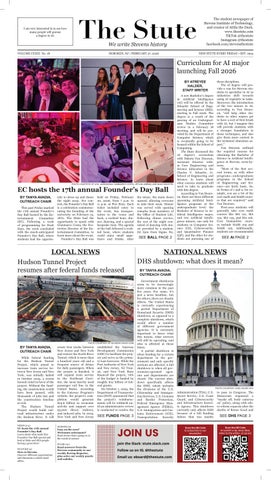
EC hosts the 17th annual Founder’s Day Ball BY TANYA AVADIA, OUTREACH CHAIR This past Friday marked the 17th annual Founder’s Day Ball hosted by the Entertainment Committee (EC). Following a week of programming for Duck Days, the week concluded with the much-anticipated Founder’s Day Ball, where students had the opportu-
nity to dress up and dance the night away. For context, the Founder’s Day Ball is a celebration commemorating the founding of the university on February 15, 1870. The Stute had the opportunity to speak with Gianmarco Costa, the Festivities Director of the Entertainment Committee, to learn more about the event. Founder’s Day Ball was
held on Friday, February 20, 2026, from 7 p.m. to 11 p.m. at Pier Sixty. Each ticket included entry to the event, bus transportation to the venue and back, a cocktail hour, dinner, dancing, and a special keepsake item. The agenda of the ball followed a cocktail hour, where students could enjoy small appetizers and drinks. After
LOCAL NEWS Hudson Tunnel Project resumes after federal funds released
PHOTO COURTESY OF NZ.NEWS.YAHOO.COM
BY TANYA AVADIA, OUTREACH CHAIR While federal funding for the Hudson Tunnel Project, which aimed to increase train service between New Jersey and New York, was initially halted in October 2025, a recent lawsuit ruled in favor of the project. Without the funding, the construction would have been paused, with thousands of jobs lost and the construction timeline at risk. The Hudson Tunnel Project would build railroad infrastructure under the Hudson River. It will
create four tracks between New Jersey and New York and restore the North River Tunnel, which is more than a hundred years old and a frequent source of delays for daily passengers. When the project is finished, it will expand train service in the Northeast Corridor, the most heavily used passenger rail line in the United States. According to the Gateway Program’s website, the project’s completion would generate $19.6 billion in economic activity and support over 95,000 direct, indirect, and induced jobs. In 2019, New York and New Jersey
NEWS (2-3)
SCIENCE (6)
EC hosts the 17th annual Founder’s Day Ball Learn about what made this Founders Day Ball special and look at Stute and SGA people having a great time! FEATURE (4)
How to Stevens Discover different opportunities and discounts a school email offers.
Easy on the eyes? Welcomes astronauts? Read about what’s going on in the world of science. PULSE (10)
Read answers from the Stevens community to our weekly Roving Reporter, plus solve our weekly puzzle and sudoku.
established the Gateway Development Commission (GDC) to facilitate the project and serve as the primary loan borrower. While the Port Authority of New York and New Jersey, NJ Transit, and New York State financed the project, 70% of the budget is funded by roughly $12 billion of federal grants. On October 1, 2025, the Department of Transportation (DOT) announced that the project’s reimbursements will be withheld until an administrative review is conducted to resolve the
SEE FUNDS PAGE 3
the mixer, the main doors opened, allowing everyone to take their seats. Dinner was served with opening remarks from members of the Office of Student Life. Following dinner service, the rest of the night consisted of dancing with music provided by a student, DJ Zain from Sigma Nu,
SEE BALL PAGE 2
A new Bachelor’s degree in Artificial Intelligence (AI) will be offered by the Schaefer School of Engineering and Science (SES), starting in Fall 2026. The degree is a result of the passing of an Undergraduate Studies Committee review in a February 18 meeting, and will be provided by the Department of Computer Science, which is eventually going to be housed within the School of Computing. The Stute discussed the AI degree’s curriculum with Dakota Van Deursen, Assistant Director within Core Engineering and Science Education in the Charles V. Schaefer, Jr. School of Engineering and Science, to learn about what courses students will need to take to graduate with this degree. According to Van Deursen, there are three different upcoming Artificial Intelligence programs at the undergraduate level: the Bachelor of Science in Artificial Intelligence major, and two Artificial Intelligence minors, one only for students in Computer Science (CS), Cybersecurity, and Quantitative Finance (QF), and the other for students not pursuing any of
these disciplines. The AI degree will provide a way for Stevens students to specialize in AI as industries shift towards using AI regularly in tasks. Moreover, the introduction of the two minors in AI, according to Van Deursen, “will help other students in other majors get to have a sort of first brush with AI, but I imagine this will provide students with a stronger foundation in those techniques, and also give them more context in the technical education aspect.” Van Deursen outlined the required courses for obtaining the Bachelor of Science in Artificial Intelligence at Stevens, term-byterm. “Most of the first several terms, as with other programs—undergraduate programs in the School of Engineering and Science—are fairly basic. So, in Terms of 1 and 2, for example, you see a lot of the core math and HASS courses that are required,” said Van Deursen. First-year students will generally take core math courses like MA 121, MA 122, MA 125, and MA 126. Core humanities courses include HASS 103 and HASS 105. Additionally, students are recommended
SEE AI PAGE 2
NATIONAL NEWS DHS shutdown: what does it mean? BY TANYA AVADIA, OUTREACH CHAIR Government shutdowns seem to be increasingly more common in the past few years. For some, it’s just a news headline, but for others, there are drastic effects. The United States is currently experiencing a partial Department of Homeland Security (DHS) shutdown, as opposed to a complete shutdown, which would affect a number of different government agencies. It is extremely important to know what this means, what services will still be operating, and who is affected at these times. A partial shutdown is when funding for a certain department in the government and only specific sections are affected. A full shutdown is when all government-operated agencies and departments are closed. The current shutdown specifically affects the DHS, which includes the divisions of the U.S. Citizenship and Immigration Services, U.S. Customs and Border Protection, Federal Emergency Management Agency (FEMA), U.S. Immigration and Customs Enforcement (ICE), Transportation Security
PHOTO COURTESY CASE.HOUSE.GOV
Administration (TSA), U.S. Secret Service, U.S. Coast Guard, and Cybersecurity and Infrastructure Security Agency. This shutdown currently only affects DHS because of a bill funding failure that was unable
to pass in Congress. The Democrats requested a “masks off, body cameras on” policy, along with other reform requests after the deaths of Renee Good and
SEE DHS PAGE 3
Friday, February 27
2
News BALL
Masthead Volume CXXIII No. 18
CONTINUED FROM PAGE 1
Executive Board
EDITOR-IN-CHIEF.............................JIYA JAISINGHANI ‘27 BUSINESS MANAGER.....................................FIONA SHI ‘27 MANAGING EDITOR.................................TIANNA SPITZ ‘27 LAYOUT EDITOR...............................EILIYAH SAROWAR ‘28 OUTREACH CHAIR..................................TANYA AVADIA ‘25 DIGITAL MANAGER..........................CHARMY KOTADIA ‘27 SECRETARY.....................................JOSEPHINE CHOONG ‘28
Editorial Board
NEWS EDITOR........................................... CLAIRE DEANS ‘29 SCIENCE EDITOR..................................RIYANA PHADKE ‘27 OPINION EDITOR.........................................ITAI GELLER ‘26 SPORTS EDITOR..................................CAMRYN WINANT ‘28 FEATURES EDITOR ...........................PRISHA VAGVALA ‘28 HEAD COPYEDITOR..............................TASHA KHOSLA ‘25
Operations Board
HEAD PHOTOGRAPHER.......ISABELLE VILLANUEVA ‘26 ARCHIVES LIASON....................................ISABELLA ZIV ‘25 ASST. SOCIAL MEDIA...............................CHRISTINE YI ‘29 DELIVERY BOY.........................................JONATHAN LAI ‘28 ASST. LAYOUT EDITOR.............................SHREYA ROY ‘27 ASST. LAYOUT EDITOR....................BRADY SANSOTTA ‘29 ASST. BUSINESS MANAGER........JOSH BODENSTEIN ‘29
Staff & Contributors Atreyee Halder Isabella Fama Kevin Matias Sean Palermo Disha Gohil Anna Dabrowski Vedhesh A. Kamaraj Jeylan Jubran Charles Beall
Tanya Avadia Madison Heller Abigail Thomas Brooke Nagurka Dominic Souza Chris Kalish Sydney Leung Wesley Yu Noah Wachtel
Gianmarco Costa
Contact Us
GENERAL.........................................EBOARD@THESTUTE.COM EDITOR-IN-CHIEF.........................EDITOR@THESTUTE.COM ADVERTISING.............................BUSINESS@THESTUTE.COM OFFICE.................................UNIVERSITY CENTER ROOM 216B
Corrections NOTICE A MISTAKE? Email us at eboard@thestute.com.
Disclaimer
All opinions and editorials reflect the views of their respective author(s). No Part of The Stute may be reproduced in any form, in whole or in part, without the written consent of the Editor-in-Chief. Cited references of The Stute are permitted.
Policy on Letters to the Editor
enjoying desserts laid out buffet style, and taking memorable photos. The night concluded with students picking up commemorative drinkware. The overall theme for the event was ruby and rose gold, which was displayed through the table covers, floral arrangements, lighting of the venue, and more. In terms of planning, most of the logistical decisions were made by the Office of Student Life, specifically Danielle Eisenberg and Stephanie Hios. The venue, which was different from the previous year, primarily to accommodate more attendees, was booked shortly after the Founder’s Day Ball 2025. The specific decisions on the theme and menu were made throughout the Fall 2025 semester. According to Costa, EC’s main contribution was designing the logo and promoting the event. The timeline for this started back in August 2025 and accelerated after the conclusion of Winter Wonderland at the end of 2025. When asked about his favorite part of the event, Costa shared how he really enjoyed seeing the
AI
CONTINUED FROM PAGE 1 to take Science I, a core science course, in the first term. “In Term 3 is the first, like, AI-specific course. This is pretty standard also for undergraduate courses in SES, where in Term 3, there’s one course that’s offered that, like, is an introduction to the material. So, for example, BME [Biomedical Engineering] has an ‘Intro to BME’ course in Term 3. AI will have a new course called CS 367 that’s ‘Introduction to AI,’” explained Van Deursen. “And then that’s also the prerequisite for a couple of other of the AI-specific courses as well.” Additionally, Term 3 includes the remaining science core courses, namely Science II and Science Lab. According to Van Deursen, Term 4 will include a new course, CS 368, which will teach students about ‘Data Management and Privacy in AI.’ In Term 5, students will be able to choose between HST 381, HSSC 371, or
attendees’ first reaction as they walked into the venue. Seeing them stunned by the ambiance and taking pictures together felt really fulfilling for Costa. In addition to that, Costa defined his second favorite memory as the end of cocktail hour, which indicated that food was going to be served soon after. When asked about his overall thoughts on
how the event went, he stated, “The event is always something that students across all class years look forward to attending, and it grows every year. I have attended the event since the 2024 edition, when it was held at the Liberty Science Center, and I can say that without a doubt, this year’s edition was by far the best in all aspects.”
PHOTO COURTESY OF GIANMARCO COSTA
HPL 455. Term 5 also consists of graduate-level courses like ‘Human-centered AI’ and ‘Machine Learning,’ both from the Department of Computer Science. “The rest of the Terms are pretty much like the other programs within the CS department–very elective-heavy, both technical and general electives, and then also the humanities, are heavily weighted towards Terms 7 and 8,” said Van Deursen. In addition to the general core courses and new AI courses, there is overlap with some courses from the Computer Science major. The program also includes the SUCCESS (Stevens Undergraduate Core Curriculum: Essential Skills for Success) courses, which give students essential skills for college and life beyond, like technological literacy, informational literacy, communications, leadership, ethics, and more. The courses are: a ‘First-Year Experience’ course, the ‘Foundations’ series, and three ‘Frontiers of Technology’ courses. When asked what class, if he were a student and could take any course in this program, he would
take, he said, “I haven’t seen the syllabus for ‘Human-centered AI,’ but just from the name, it sounds like the one I’d be more interested in, because it seems to me, just from name alone, like it would interface more closely with some of the applications aspect, and how that works, like, how AI interfaces with humans. The ‘Intro to AI’ course would probably be the more reasonable one for me to start with, though, because I know nothing, and it would be more helpful to get me up to speed.” According to Van Deursen, the AI program aligns with Stevens’ goals established in the 2032 Strategic Plan. As industries increasingly demand AI knowledge from employees, including college students and college graduates, introducing the major within the context of current events works to proactively prepare students for industry placement. “I mean, as an alumnus, I’m excited to hear that there are new programs being introduced that are more in line and in keeping with some of the market trends,” said Van Deursen ‘19 M.S. ‘20.
All members of the Stevens community are able to submit a Letter to the Editor to be published in The Stute. Letters must refer either to a piece published in The Stute or to The Stute in general and must be between 400 – 800 words in length. Submit letters to editor@thestute.com with your name and title (when applicable) or using our Google form. For writers who wish to write a Letter to the Editor anonymously, please see our policy on anonymity. The Editorial Board reserves the right to choose whether or not to publish a submitted Letter to the Editor based on a majority rule vote, and additionally reserves the right to edit letters for clarity or request authors to revise. Provided that the author approves the final version, The Stute reserves the right to edit letters according to our copy editing procedures, defined in our policies.
Policy on Op-Eds
All members of the Stevens community are able to submit a standalone opinion piece (otherwise known as an Op-Ed) to be published in The Stute. Op-Eds must be between 400 – 800 words, but longer submissions will be considered on a case-by-case basis. To submit an OpEd please email eboard@thestute.com with your name and title (when applicable) or using our Google form (tinyurl.com/submit-t0-stute). For writers who wish to write an Op-Ed anonymously, please see our policy on anonymity. The Editorial Board reserves the right to choose whether or not to publish a submitted Op-Ed based on a majority rule vote, and additionally reserves the right to edit Op-Eds for clarity or request authors to revise. Provided that the author approves the final version, The Stute reserves the right to edit Op-Eds according to our copy editing procedures, defined in our policies.
FULL LIST ON thestute.com/policies
tinyurl.com/stutesubmit
PHOTO COURTESY OF STEVENS.EDU
Friday, February 27
3
News FUNDS
CONTINUED FROM PAGE 1 government shutdown in October 2025. Despite this, construction hadn’t come to a full halt. Since the funding freeze, they finished the Tonnelle Avenue bridge, mixed over a hundred columns in the Hudson Riverbed, and procured two tunnel boring machines. However, on January 27, the GDC announced that all available funding and credit have been exhausted, and if federal funding doesn’t resume, construction must pause, which would result
DHS
CONTINUED FROM PAGE 1 Alex Pretti by immigration officers. With this being said, ICE is still fully operational due to its separate funding and not relying fully on DHS’s budget bill. Agents already have their funding allocated which allows them to continue to operate and leave the department fully operational, even though the shutdown was caused by their actions. The list of operations that are ongoing may sound foreign if you’re unaware of different departments in the government. It is important to acknowledge that even though many operations are still open and running,
in an immediate loss of nearly 1,000 jobs. On February 3, the GDC filed a lawsuit against the DOT and stated that the “DOT has breached its disbursement obligations under those agreements to the tune of over $205 million by repeatedly failing to timely reimburse GDC for project costs without identifying any contractual basis for withholding funds.” GDC noted that pausing construction puts thousands of jobs at risk and increases the chance that the North River Tunnel will shut down. Another lawsuit was filed by the lawyers of New York and New Jersey, sharing similar concerns. According to a court filing, the lawyers stated that “whatever
its shifting stated reasons, federal officials publicly confirmed that DOT had suspended funding to punish New York officials for opposing presidential demands.” U.S. District Judge Jeannette Vargas ruled that withholding the federal funds would harm the public interest and ordered that the project’s payments be released. While the federal government appealed the order, the effort expired on February 19. The first installation of $30 million was repaid on February 13. On February 18, the GDC reported that the $205 million withheld had been repaid, contractors were contacted, and construction would resume shortly after.
all workers in these departments are going without pay. Funding resumes once the shutdown is over, but there is no way to tell how long shutdowns are anticipated to last; sometimes they’re days, sometimes longer than a month. Coast guard missions can be expected to be abandoned or suspended, federal disaster response will be slowed down, and air travelers will expect delays, according to NPR. Government workers within the DHS aren’t the only ones impacted; there are long-lasting effects on everyone in the country. Some federal workers will work without any type of compensation, immigrant families will be delayed in their processing, travelers will experience more wait times at airports, and local and
state governments that depend on DHS for funding and grants. For New Jersey residents, this means a couple of different things. TSA workers at Newark Airport, one of the busiest airports in the country, will see many of the effects mentioned before. Coast Guard members stationed at any of the multiple facilities in the state will continue to work without pay, and operations will continue with financial strain. Many towns, especially coastal towns, rely on FEMA for flood grants and disaster recovery, and these can be expected to be slowed down or paused. One of the most pressing issues will be the immigration services that will be affected, such as applications for green cards, work authorization, naturalization in-
PHOTO COURTESY OF GOTHAMIST.COM
terviews, and asylum processing. There won’t be instant effects right in front of our eyes during a shutdown, but there will certainly be lasting effects. Systems are slowed down, workers face
unnecessary strain, and citizens are deeply affected. A shutdown is more than just a government status; it is a call for immediate action to be taken in our country’s government.
PHOTO COURTESY OF NLC.ORG
WINTER OLYMPICS 2026 COUNTRY
GOLD
SILVER
BRONZE
TOTAL
18
12
11
41
12
12
9
33
10
6
14
30
8
10
8
26
5
7
12
24
8
9
6
23
NORWAY
UNITED STATES
ITALY
GERMANY
JAPAN
FRANCE
SUBSCRIBE TO OUR NEWSLETTER
Friday, February 27
4
Feature
HOW TO STEVENS Things I wished I knew before joining an e-board BY JEYLAN JUBRAN, OPINION COLUMNIST I did not grow up dreaming about being on an executive board; I actually did not know what an e-board was before coming to college. I did not have a five-year leadership plan. I did not feel “ready.” In fact, I joined the Society of Women Engineers (SWE) e-board because of a last-minute nomination. And it changed my life. If you are even slightly considering running for an e-board position in any club, here are the things I genuinely wish someone had told me. 1. They’re Just Students. Passion > Experience. This might sound obvious, but it wasn’t to me. Before joining the e-board, I imagined executive boards as these hyper-qualified, ultra-polished, born-leader types. People who had
done everything, knew everything, and never doubted themselves. They’re just students. Yes, some have experience. Yes, some seem confident. But most of them are figuring it out in real time. The difference isn’t some magical resume line — it’s passion. Experience can be taught. Systems can be learned. Emails can be drafted and redrafted. Passion? That’s the fuel. If you care about the mission of a club, that already makes you more qualified than you think. 2. A Last-Minute “Why Not?” Can Change Everything. I joined the SWE e-board because someone nominated me and I thought, “Okay… why not?” It was not a strategic move. It was not calculated. It was impulsive. And it became one of the most transformative decisions I’ve made in college. E-board didn’t just give me a title. It gave me confidence I didn’t
know I had, real leadership experience (not just group projects), professionalism that translated into internships and interviews, and the ability to navigate institutional systems. Depending on the club, you suddenly learn how to work with administrators, plan large-scale events and logistics, write formal proposals, speak publicly, and most importantly, handle conflict/ manage people. You start understanding how your university actually works — the behind-the-scenes systems most students never see. That exposure alone is priceless. 3. It’s Way More Rewarding Than You Think. This is the part I truly did not expect. I assumed e-board would feel like work. Another responsibility. Another thing on my plate. But it never feels like a chore. There is something surreal
about mentoring someone and watching them grow because you introduced them to this side of campus. Seeing someone find community because of an event you planned. Watching a first-year student become confident enough to run for leadership. It’s insane. It’s not just “club stuff.” It’s impact. You stop thinking about yourself and start thinking about building something bigger, and that shift alone changes you. 4. Just Nominate Yourself. Let’s talk about nominations. Everyone self-nominates. Everyone. You are not “cocky” for putting your name down. You are not overstepping. You are not being dramatic. Put your name in. If you change your mind, you can remove it later. That door is open. But you usually can’t add your name after the deadline. That’s the part peo-
ple forget. The risk of embarrassment is tiny. The risk of missing out on something that could transform your college experience? Much bigger. 5. You Will Become Better — Period. E-board will stretch you. You will learn to communicate better. You will learn to handle uncomfortable conversations. You will learn how to advocate for yourself and others. You will become more polished without even realizing it. It turns you into a better version of yourself. Not perfect. Not fearless. Just better. And the best part? You’re still “just a student” while doing it. So if you’re thinking about it— even a little—this is your sign. Just do it. Nominate yourself. Take the chance. Figure it out along the way. You might look back and realize it changed everything.
Realistic guide to food on campus
Resources Shopping smart also means & tips for commuters BY JOSHUA BODENSTEIN, for students looking for something satisfying without the Manhattan thinking beyond one-night meals. ASSISTANT BUSINESS MANAGER
There’s a shared understanding among students that campus food isn’t exactly the highlight of university life. It’s not terrible, it’s not amazing — it simply exists somewhere in the middle, reliably functional and occasionally surprising. Accepting that reality is the first step toward eating well at Stevens without overspending or overthinking every meal. Pierce Dining Hall, despite its mixed reputation, is a resource that should absolutely be used if you have meal swipes. You’ve already paid for them, and convenience counts for more than we like to admit. The trick is adjusting expectations. Not every visit will be memorable, but it will be fast, filling, and close to your next class. Many students make the mistake of rationing swipes as if they’re rare collectibles, only to panic later when dozens remain unused. If you’re on a higher meal plan, using swipes freely is often the smarter financial choice. Even stopping in for something small—a drink, fruit, or a quick plate—can stretch your budget elsewhere. Of course, nobody wants dining hall food for every meal, every day. That’s where Hoboken saves the day. The area around campus offers plenty of options that won’t wreck your bank account if you’re intentional. Spots like Mochi Tori, Mashed Burgers, and Toast x Bowl have become staples
price tag. What many people don’t realize right away is that student discounts often apply only when ordering in person, and are more plentiful than you think. It’s an easy detail to miss, especially when delivery apps feel so effortless. Look around Hoboken, see if places you know have student discounts, and you may be quite surprised. That doesn’t mean avoiding delivery entirely. Grubhub dollars are meant to be used and enjoyed. They’re perfect for late nights, heavy workload weeks, or moments when leaving your desk feels impossible. The smarter move is to be selective — use Grubhub dollars when discounts aren’t available or when convenience genuinely outweighs cost. Saving them strategically prevents that end-of-term scramble to spend remaining balances on food you didn’t actually want. For students with access to a kitchen, particularly in UCC Towers, groceries become the foundation of survival. Here, discipline matters more than culinary ambition. It’s easy to walk into Whole Foods with good intentions and leave with an empty wallet and a single aesthetically pleasing meal. ACME, by contrast, rewards practicality. Signing up for their rewards program feels trivial until the coupons and member pricing quietly reduce your total week after week. Over time, that difference is significant.
Food that lasts multiple days— pasta, rice, eggs, frozen items, and simple proteins—consistently delivers better value than anything designed for a single sitting. Cooking doesn’t have to become a weekend-long production. Preparing a few basics ahead of time can transform stressful weekdays into manageable ones. When deadlines stack up, having something ready in the fridge is often the difference between staying on budget and defaulting to expensive takeout. Budgeting for groceries, especially under a tight limit, becomes less about restriction and more about rhythm. Students who succeed tend to develop an instinct for what they’ll realistically eat, what will stretch, and what simply isn’t worth the cost. Hunger has a way of sabotaging financial judgment, turning snacks into splurges and convenience into regret. Experience, eventually, teaches restraint. In the end, eating well at Stevens isn’t about finding perfect food — it’s about balance. Use the dining hall for what it is: convenient and prepaid. Explore Hoboken with an eye for discounts. Treat Grubhub dollars as a tool, not a reflex. Shop with intention. Cook when it makes sense. None of these strategies are glamorous, but together they make campus dining far more manageable. Because while campus food may never be extraordinary, your approach to it absolutely can be.
with a variety of brands to offer student-exclusive discounts. Brands include Princess Polly, H&M, Urban Outfitters, ASOS, Logitech, Fenty Beauty, and many more. All you have to do is verify your student email address, and you’ll be able to access discounts ranging from 10% to 30% off or other savings offers. The savings don’t stop at online shopping and streaming subscriptions. Being a student also gives you access to museums and other cultural institutions at a discounted rate, sometimes even completely free. The Metropolitan Museum of Art offers Pay-What-You-Wish admissions for NY, NJ, and CT students, bringing admission costs down to as low as a penny. The Museum of Modern Art (MoMA) and The Frick Collection both offer student tickets for $17 instead of the regular $30, and the Brooklyn Botanical Gardens offers $16 student tickets instead of the regular $22. Museums all over the country offer discounts; just make sure you double-check their website before your visit. Moving on to dining, a lot of retailers offer student discounts but
do not openly advertise them. You can always ask in person to check whether a location participates in student discounts, but here are a few spots around campus you can count on: 1. Impostos Pizza - 10% student discount 2. Toast x Bowl - 10% student discount + free drink 3. Jefferson’s Coffee - 10% student discount 4. Muteki Ramen - 10% student discount 5. Quality Pizza Co. - 10% student discount 6. Mashed - 10% student discount Ultimately, making the most of your student status requires a bit of proactive effort. With so many discounts and resources available, you should make sure to review your options and determine which perks best fit your lifestyle and budget. What works for one student may not be the best fit for another, so taking the time to explore platforms like Student Beans, UNiDAYS, and the Stevens Library’s online resources ensures you’re getting the most value from your .edu email address.
.EDU perks BY FIONA SHI, BUSINESS MANAGER Being a college student can be tough with textbooks, takeout meals, and bus fares adding up fast. But here’s something they don’t always mention during orientation: your @stevens.edu email unlocks discounts and perks that can save you serious money, both online and right here in Hoboken. A few popular student deals include Amazon Prime for students, which offers a six-month free trial and a $7.49/month membership deal instead of the usual $14.99/ month, Hulu with ads for just $1.99/ month, and HBO Max with ads for $5.49/month. Through the Stevens Library, students can access sources such as the New York Times and the Washington Post for free until their graduation year. Stevens students can also utilize LinkedIn Learning for free, gaining access to thousands of courses ranging from Excel skills to public speaking. For a comprehensive list of available deals, two websites to check out are StudentBeans.com and UniDays.com, both of which partner
BY KEVIN MATIAS, CONTRIBUTOR Commuters—despite the pile of inconveniences they seem to experience—truly get the best of both worlds. Part of their day, including mine, is spent at Stevens, going to class and engaging with different clubs. The other half is spent at home and sleeping in our own proper dorms: our rooms. Nevertheless, this life isn’t without its challenges. Not only is the long distance between our homes and school exhausting, but the lack of a meal plan can leave us hungry. Not having a bed or a proper room within a half-mile radius can lead to weariness. Even if we have a car, the late 9:15 p.m. start for most clubs on Wednesdays is a dealbreaker for those relying on a bus/train schedule to get home. And hence the big question: How can I maximize the college experience as a commuter? Fortunately, if you are a commuter, you are not as deep in the trenches as you might think. Being aware of tips and your resources is key in making the most out of your time in Stevens, so let’s get into them!! If you drive to campus, avoid parking at noon. Getting to class more towards the morning or later in the evening would be advisable to find a spot. I remember my first day of class when I was searching for a spot, and ended up making countless loops in Babbio and nearby lots. It was not until an hour later that I managed to find a spot behind Castle Point, after much irritation. Knowing when peak hours are in Hoboken is essential, and being aware of the parking gems such as Castle Point (my lifesaver), North Lot, River Lot, and of course, 8th Street Lot are crucial in case something comes up. In addition, ensure you find the best places to put your belongings and relax. Of course, there are the commuter lockers in Pierce Building and Babbio (as long as you don’t lock your items out, as I have), and in your car if you drive. If you bring some homefood, or even if you simply want a place to relax, I recommend Babbio’s 5th floor. There is a fridge to place any perishable food, a microwave, and a sink to clean anything up. A coffee machine is there for your use, as well as a water fountain. If you’re looking for somewhere nice to eat—away from the chaoticness of UCC (which also has micro-
waves)—or even some quiet space to chill, this would be your place. There is also a balcony with a stunning view of the city, and as the cold wraps for the spring, it should be reopened once again. Just because you don’t have a meal plan doesn’t mean you should starve. Get on DuckLink more often, if you haven’t already, because everything you need to know about campus life is on there. That being said, you’ll be able to find all the events hosting free food. Like seriously, clubs would appreciate your attendance more than staying for the full event. Catch up on all the free food — no matter how long you stay. There are plenty of delicious eats around Hoboken, but save some money and find out when free food is given out!! One of my earlier concerns at the beginning of the year was how commuters establish meaningful relationships. I was under the impression that commuters simply went to class and then home, and I realized that part of maximizing the college experience is to stay on campus as much as you’re able to — as long as you don’t have any other responsibilities outside of campus, of course. Stay after class more and join different clubs; meet new people. I don’t regret the effort I put in, especially during the beginning of my first semester, because I’ve met incredible people who have now become my friends. Even when some clubs are way past your time limits, always feel free to reach out to them and learn more about them. Never feel you are missing out because one club happened to be too late. As always, part of the college experience is engaging in activities outside of class. Don’t let your college years be defined by the amount of time you spend on campus only; explore around (and take advantage of the Stevens Shuttle)! While it may be harder because you don’t live on campus, find some time to explore. Discover new eateries in Hoboken, shop around the variety of stores, go rock-climbing, go to church, or find what else Hoboken has to offer past Washington Street — I promise you there is so much more! EC hosts events in New York, especially, and taking advantage of these events will enhance your time here! Don’t let your commute hinder your time at Stevens. With the right effort and knowledge, you’ll have the best couple of years of your life.
PHOTO COURTESY OF STEVENS.EDU
Friday, February 27
5
PHOTO COURTESY OF STEVENSDUCKS.COM SHOT BY JOESIMON.PHOTOGRAPHY
Sports
Men’s Lacrosse takes a 10 lead win against Springfield College BY CAMRYN WINANT, SPORTS EDITOR On Saturday, February 21, the Men’s Lacrosse team walked away with an 18-8 win over Springfield with the help of a hat trick from graduate student Will Labartino, and a double hatty from sophomore Jack Tenaglia. Following them were sophomore Adam DeCristofaro and senior Matthew Pergola, both with two goals each. Labartino and Pergola started the game on fire, opening up scoring with Pergola first off a Labartino assist, followed by a goal
from Labartino, putting them up 2-0 in the first three minutes. Springfield was able to get two points up on the board, but the Ducks responded, and by the end of the first quarter, DeCristofaro and first-year Ryan Jack both scored to keep their lead up by two. Springfield fought in the second quarter, opening up scoring with one goal, but Pergola and Tenaglia responded with two goals just 30 seconds apart, pushing the score to 6-3. The Ducks wrapped up the scoring in the second with goals from firstyear Lucas Long and junior Con-
nor Moore, notching Long’s first career goal. The Ducks went into the second half of the game up 8-3, but Springfield managed to open up scoring for the third quarter with two goals to trim the Ducks’ lead to 8-5. By the end of the third quarter, Springfield had managed to put up one more point, but Tenaglia had scored a hat trick, allowing them to leave the quarter with a comfortable lead of 116. Still on fire, Tenaglia scored again, starting the fourth, followed by two goals by Labartino, only 33 seconds apart. Spring-
field got one on them, and the Ducks responded with the next four from Tenaglia, DeCristofaro, junior Jackson Penn, and graduate student Chris Ciccarello. In the final seconds, Springfield put one more goal on the board, but it was fruitless as the Ducks walked away with the 18-8 win. This win gave the Ducks an early-season record of 2-0, following their win against Dickinson College on Saturday, February 14. They hope to continue this win streak at their game against SUNY Oneonta on Saturday, March 7 at 1 p.m. in Oneonta, NY.
ON DECK IN SPORTS FRI, FEB 27 WRESTLING NCAA Regionals - Day 1 Ithaca, NY 10 a.m. WOMEN’S AND MEN’S TRACK AND FIELD MAC Indoor Championships Day 1 Reading, PA 12:15 p.m.
SAT, FEB 28 WOMEN’S AND MEN’S BASKETBALL MAC Freedom Championship TBD WOMEN’S FENCING NIWFA Championships Madison, NJ 9 a.m. WOMEN’S AND MEN’S TRACK AND FIELD MAC Indoor Championships Day 2 Reading, PA 9:30 a.m. WRESTLING NCAA Regionals - Day 2 Ithaca, NY 10 a.m. BASEBALL Rutgers University - Newark Newark, NJ 11 a.m. WOMEN’S LACROSSE Gettysburg College Gettysburg, PA 1 p.m.
SUN, MAR 1 MEN’S FENCING MACFA Championships Madison, NJ 9:30 a.m. BASEBALL United States Coast Guard Academy (DH) Hoboken, NJ 11 a.m.
TUE, MAR 3 BASEBALL Montclair State University Montclair, NJ 3 p.m. MEN’S VOLLEYBALL New York University New York, NY 7w p.m. PHOTO COURTESY OF @STEVENSDUCKS ON INSTAGRAM
STEVENS SCOREBOARD DATE
WED, FEB 18 FRI, FEB 20 SAT, FEB 21
SUN, FEB 22
TEAM
MEN'S BASKETBALL WOMEN'S BASKETBALL BASEBALL MEN'S AND WOMEN'S TRACK AND FIELD WOMEN'S LACROSSE MEN'S VOLLEYBALL MEN'S TENNIS WOMEN'S BASKETBALL MEN'S VOLLEYBALL MEN'S LACROSSE MEN'S BASKETBALL BASEBALL BASEBALL MEN’S FENCING WRESTLING
OPPONENT
LOCATION
SCORE
LEBANON VALLEY COLLEGE LEBANON VALLEY COLLEGE DICKINSON COLLEGE WEST POINT TUNE UP
AWAY HOME AWAY AWAY
L (72-88) W (54-49) W (3-2) COMPLETE
ROGER WILLIAMS UNIVERSITY WHEATON COLLEGE VIRIGNIA WESLEYAN UNIVERSITY FDU-FLORHAM WENTWORTH INSTITUTE OF TECHNOLOGY SPRINGFIELD COLLEGE FDU-FLORHAM THE CATHOLIC UNIVERSITY OF AMERICA SALVE REGINA UNIVERSITY TEMPLE OPEN MIDEAST FUTURES EVENT
HOME AWAY AWAY HOME AWAY HOME HOME AWAY AWAY AWAY AWAY
W (21-6) W (3-0) W (6-1) W (73-65) W (3-0) W (18-8) W (87-73) L (2-3) L (4-19) 3 LOSSES 2ND
Friday, February 27
6
Science Beauty may be both easy on the eyes and the brain BY SEAN PALERMO, SCIENCE WRITER Imagine a vibrant sunset — the light slowly passing the horizon in a symphony of color before revealing a stunning, starry sky. As it turns out, beautiful imagery such as this, according to a study reported in the scientific journal PNAS Nexus in December, may in fact be easier on the brain through a lessened consumption of energy compared to other varieties of images and scenes. While it is of only modest mass compared to the rest of the body, the brain is the most energy hungry organ in it — using about 20% of the body’s total energy and 44% of that energy being used to power its visual system. When our eyes are actively viewing a particular scene or image, a series of electrical and chemical activities requiring both glucose and oxygen to function are triggered. While the simple act of viewing doesn’t typically feel like a daunting task, this exchange of energy for information has been suggested by evolution to be an area adapted to avoid the wasting of energy based on certain images such as the use of heuristics — mental shortcuts that focus on the use of feeling to guide
decision-making. In order to test their hypothesis developed from this evolutionary basis that a liking to certain aesthetics are inversely related to the metabolic cost of neutral representations (the energy spent on viewing said image), researchers Tikai Tang, William A. Cunningham, and Dirk B. Walther from the University of Toronto launched a study utilizing both artificial neural networks and human subjects. To analyze the energy consumed in the visual process, the researchers turned to an MRI dataset where four individuals viewed 5,000 images while being actively monitored — the measurements of oxygen consumption throughout the brain acting as indicators of metabolic activity. In addition to this data, images were run through the artificial neural network known as VGG19—a convolutional neural network model that aims to mimic the layers of the visual cortex of the brain—that was measured for metabolic cost based on the number of neurons activated to when presented the series of images. Results from these exercises were put into context through aesthetic ratings of the images
that were collected from 1118 participants, recruited using Amazon Mechanical Turk, who responded in an online survey and were asked to score each picture on a scale of five. The metabolic cost estimates were compared to these survey results to reveal that, in both the case of human and neural network data, the effort required to process images was inversely proportional to their aesthetic ratings — supporting the team’s initial hypothesis. In fact, not only images that were deemed to be more pleasing but also those that featured less complicated aspects were subject to greater energy efficiency — backing the “processing fluency” theory in psychology that describes how information processed quicker generates a greater positive response. The results were found to be most significant in higher-level visual regions of the brain such as the fusiform face area and its equivalent on the neural network (responsible for recognizing faces), suggesting energy savings occur mostly at these more advanced stages of visual process as opposed to catering toward lower-level functions such as edge and contrast detection. What this study helps begin
to illuminate is how our brains value certain images: While a pure white wall may be efficient to look at due to its simple nature, that lack of complexity also makes it difficult to generate interest. According to these results, an “interesting” image or scene is one that both has relative simplicity and degree of information to give way to certain complexity that may derive the feeling of awe in appreciating it as something beautiful. Beyond this, a previous study demonstrated that people also tend to like faces and even cars that are closer to the average rather than
those that were more unique — a phenomenon explained by the idea that outliers require the brain to spend more energy to update internal models of what both cars and faces look like. While the inherent qualities of what makes particular images or scenes “beautiful” are not yet quite defined by this study, further research may seek to better understand both this as well as the dynamic between cognitive rewards that are derived from taking greater energy to understand certain, more complex images that have the ability to outweigh its simple visual costs.
PHOTO COURTESY OF PSYPOST.ORG
ISS Welcomes Crew-12 BY DISHA GOHIL, SCIENCE WRITER On February 14, 2026, the International Space Station (ISS) welcomed four new astronauts of the Crew-12 mission, restoring the crew’s full strength after the ISS was left with only three astronauts following an evacuation. The Crew-12 mission consists of two NASA astronauts, Jessica Meir and Jack Hathaway, French astronaut Sophie Adenot from the European Space Agency, and Russian cosmonaut Andrey Fedyaev. “We have so many countries represented, so many backgrounds, so many disciplines, and we are so excited to be here and to get to work,” Meir said at the ISS welcome ceremony. In early January 2026, one astronaut aboard the ISS began experiencing a serious health issue which required immedi-
ate attention. Because of this, the astronaut, along with three other crew members, was evacuated, making this NASA’s first medical evacuation in 65 years of human spaceflight. This caused a temporary shortage of crew members, which impacted ISS’s operations. This evacuation delayed research projects and tasks such as spacewalks.This medical issue emphasized the vulnerability of long-term spaceflights, as detailed by AP News. It shows that astronauts can face health challenges during their missions despite rigorous training and health checks. It also emphasized the importance of reviewing emergency protocols set by space agencies in case such events occur to allow for operations to continue. With the arrival of these astronauts and their diverse expertise, the ISS is able to continue its operations and important research. Jessica Meir is a ma-
rine biologist and NASA astronaut who returned for her second mission aboard the ISS. She is known for participating in the first all-female spacewalk, and her research relates to how space affects living organisms. Jack Hathaway is a captain in the US Navy who has extensive experience in spaceflight and leadership. Military helicopter pilot Sophie Adenot will work alongside other astronauts to conduct research and maintain the ISS’s complex systems. Former Russian military pilot Andrey Fedyaev has previously spent time on the ISS. His experience in piloting and his technical expertise will be beneficial in keeping the system running smoothly. The diverse backgrounds of these astronauts will not only enhance the crew’s strength, but also allow them to conduct research in various fields to contribute to scientific advancements.
INTERESTED IN SCIENCE JOURNALISM? Join our Science writing team! Reach out to Riyana Phadke, Science Editor (rphadke@stevens. edu) for more information – No experience necessary to write • thestute.com/category/science –
PHOTO COURTESY OF SCEINCEALERT.COM , AP/JOHN RAOUX AND SPACEX
Friday, February 27
7
Opinion THE STUTE EDITORIAL
Oh, the gala… If you have been keeping up with my latest editorials, you are familiar with The Stute X SGA Alumni and Student Gala happening on February 27, 2026 (this week!). I am mixed about my feelings towards the gala. My first thought is that this is a major stepping stone for The Stute. We constantly promise our alumni that we will invite them more often, but up until now, they have mostly been empty promises. When I see our alumni, I see the same love I have for this organization, reflected in them. It is comforting to know that this feeling will never go away. And honestly, I do not want it to. I do not want to forget the tireless nights of layout, or the laughter in the full Stute Office, or even the smell of a freshly printed issue. And when I see our alumni talk
about their time in The Stute, I know they haven’t forgotten. They smile as proudly as I am sure they did when they were in our positions. I am proud that we have a large number of alumni showing up this Friday, and I hope to get the chance to speak with most of them. My second thought is that I am terrified. Half of those alumni know exactly what it is like to be Editor-in-Chief, and they know I am stressed. I fear you can see every wrinkle of stress on my face. I want this gala to go beautifully, from our green and gold decorations to the food and desserts. Stressed cannot even begin to describe the truth of how I feel. My last thought is that this is the last big event before the elections. From the way that it looks, I might be around another year,
but the e-board, I have come to love and trust, will not be. They are the only reason this gala is happening. I saw them all take a deep breath the minute I suggested bringing the SGA onboard and hosting something that, from what we know, has never happened. I do not know what I would do without them. But, the beauty of The Stute is that we are always changing and evolving, and I cannot wait to see what our future holds. This gala is about reminiscing, loving, and learning. To reminisce about the best of times and worst of times, share our common love of The Stute, and learn about our community. To any Alumni that is reading this while at the gala, thank you for coming back. Thank you for making us what we are today and guiding us. You are a part of our com-
MIND OF A FRESHMAN
BY CLAIRE DEANS ‘29 This past weekend, I unexpectedly had to leave school for a family emergency. I had a ton of responsibilities that I needed to manage, but it was my family. Being away from school is hard because I can’t be everywhere I wish all at once. I grew up in the type of family where we did everything together. We had family dinners, movie nights, dance parties, and so much more. We are the type of family where everyone sits in the living room together, watching tv, playing games, doing homework, and everything in between. The only time spent apart was at school or activities, but if there was a game or performance, you saw all of us there. We would drive each other crazy with
Jiya Jaisinghani ‘27 EILIYAH SAROWAR FOR THE STUTE
Editor-in-Chief
SENIORITIS
Thank you for being there the chaos and the sound but it felt like home. Now it’s hard being apart from them and knowing I can’t drop everything for them as I used to. The second I used to get a text you saw me spring up, get my keys, and drive wherever I was needed. Now I have to wait for train times and know I won’t be there before it’s too late. Dealing with this kills me. Knowing that I’m an hour and a half drive to them but trains and delays separate us by five hours. Thankfully, I’ve met some really great people here at Stevens that are there for me, no questions asked. When I found out that my mom was in the hospital, I panicked. I was ready to pack my bag and leave at 1 a.m. I didn’t know what I could do, but I needed to
munity that is not seen enough, and we hope to change that. To many more moments like this one.
Grey days
do something. My friends persuaded me to stay until I knew more information. I panicked a lot and then started studying for the exam I had the next day. I stayed for the exam, and after learning she needed surgery, I hopped on the next train. I still had responsibilities for clubs and schools left unattended, but I had to go home. Thanks to my friends on campus, everything is going to be okay. There are some really great people here, people who offered to watch my print for engineering, people who helped me weigh the pros and cons of leaving, people who showed up for me, no questions asked. Thank you to those people and thank you to this campus for bringing them to me.
PHOTO COURTESY OF HFM MAGAZINE
BY ANNA DABROWSKI ‘26 And now we have arrived at my least favorite season, “grey days.” The six week period of disturbingly colored street slush. I trek to campus carefully to avoid the piles of snow along the road margins that have seen far better days. The sky has been painfully dull for months now, but I know we have a few more weeks before the arrival of spring. You can feel the energy that the grey days bring, a certain melancholy associated with the in between. The magic associated with winter is long gone; what remains are tensions pulling in opposite directions. Some cling to winter, it’s easier to stay inside and know that you aren’t missing the world. When it gets dark be-
COMIC CORNER BY BROOKE NAGURKA
fore seven, you can pretend to ignore the things you are avoiding. It is easier to say no, and there is comfort in that. But as the daylight creeps a few minutes closer every day, there is a mixture of anxiety and excitement battling to take the center stage. When the sun comes out, we see each other more, we wear less clothing, life tends to “lay us out to dry,” everything moves faster; the sentiment of “I’ll worry about that come spring” haunts your mind as you wonder if it is really time to figure out that summer internship, or dare I say your life plan. The arrival of spring speeds up life, and the end of the semester comes tumbling at you at speeds you believed were impossible — you thought you had more time. Some days, I beg for spring to come; I am ready for what’s next. I am lucky to have my post-grad plans figured out, and my remaining weeks here feel like the lingering epilogue of a story that has been finished. Other days, I mourn the fact that next year I will not see the spring goslings swimming in the fountain, and students
lying out on the lawn on the first warm day. I wonder if the 91 days until graduation will be substantive. Will I remember the last 90 or so days the most, or will my memories of college gravitate towards a certain year or chapter in my life? Can I be changed anymore? I have already changed so much. Sometimes I think of my first-year self and deem that persona incompatible with the life I have built. I think about decisions I made during other seasons of grey days, and the branches that have forked out to represent every version of my life. Is this regret? Almost never. It’s hard to regret decisions and even mistakes that have led to such an epilogue, brimming with content, but these are simply the things we must ponder during the grey days.
PHOTO COURTESY OF WIKIPEDIA
Friday, February 27
8
Opinion BOOK OF THE WEEK
A review of The Bean Trees
BY MADISON HELLER ‘27 For me, reading a wellloved book that I’ve turned to time and time again feels like meeting up with an old friend. Even if things haven’t changed much since you’ve last seen her, the new details you learn are refreshing, and her presence comforting. In contrast, reading a new book feels a lot like a
FOODIE FINDS
first date. You judge based on the cover and a brief synopsis, and you’re really hoping for the best, but sometimes things just don’t work out. A few years ago, I had a “first date” with a book that I was not hopeful for; it was literary fiction, and I was a teenager who thought anything that didn’t include magic and dragons was categorically boring. But from the first page, I was completely hooked. I want to recommend The Bean Trees by Barbara Kingsolver as motivation for tepid genre fiction enthusiasts to have a crack at something new. The Bean Trees was my first real introduction to literary fiction that was outside of school reading and introduced me to Barbara
Kingsolver, who is one of my favorite contemporary authors. I love Kingsolver so much that my senior thesis is about her latest novel, Demon Copperhead, which I’ve reviewed previously. The Bean Trees is about a woman named Taylor who moves out west and, in the process, unexpectedly adopts an abandoned baby girl, whom she names Turtle. The novel generally is about the struggles Taylor faces with settling herself in a new place while caring for her daughter, her own struggle to accept herself as a mother, and learning to conceive of a real future for herself. I think reading literary fiction is different from reading genre fiction. Not in some pretentious way where
Ranking matchas in Hoboken
BY PRISHA VAGVALA ‘28 1. Bluestone Lane Bluestone Lane is probably one of the first matchas I’ve tried in Hoboken, and boy, was it heavenly. It was just perfectly creamy yet earthy, and a bonus point because Bluestone is consistently adding new flavors seasonally. The one I like is the strawberry matcha coconut cloud drink, which is just creamy, earthy, fresh strawberry puree strawberry deliciousness in a cup. The matcha itself is the right green color, and they use ceremonial grade matcha, which they often top with cold foam in their flavored matcha drinks. In the past, they have done Banana Cream, Strawberry Cheesecake, and Blue Lavender Cloud Matcha. I love a good flavored matcha, hence why I put Bluestone first. The only drawback is that Bluestone is a bit expensive. 2. Toast x Bowl Genuinely, the matcha itself is probably the best out
one is better than the other, but rather, I feel like there’s much less pressure to dazzle and astonish the audience. When I read fantasy or science fiction, I’m often caught up in the world, in the unfamiliar. The technology/ magic and the strange place with unfamiliar peoples and cultures captivate my imagination and attention, and often at the cost of my caring about the characters or the adventure they’re on. Of course, it’s not a hard and fast rule, that’s just where my attention drifts, because when an author chooses to tell a story in a world different from ours, there tends to be a good reason for it. Literary fiction then feels closer to home. I may have never lived in Arizona, but I can
understand where Arizona fits in my conceptions of our world. My mind draws from what it already knows to place these fictional people in my own world — it’s intimate, and it makes me care about the characters much more. In my experience, a real setting makes characters feel more real to me, and I care about real people’s problems. It’s that feeling afterwards, when you’re processing a story, and the thought hits you that there are probably people who are just like that, who went through similar problems, who maybe are still going through it, and perhaps aren’t as lucky as our main characters of these stories so often are. The Bean Trees by Bar-
bara Kingsolver is a great work of literary fiction, and is honestly a real tear-jerker of a book, which for me is a plus. I fully recommend this book to anyone who’s interested with no reservations about it.
PHOTO COURTESY OF AMAZON
GIRL(ISH) TALK
Half the population and of all the options, even better matcha at Hidden Grounds yet half the data than Bluestone. I got mine is a bit more earthy and sweetened with oat milk, and it was super creamy, not overly sweet, just subtle with that rich umami matcha flavor. Whenever people say they don’t like matcha, I really wish they could try the Toast x Bowl matcha because it is exactly how a proper matcha should taste. The only downside was the amount of ice in my drink, since there was honestly way more ice than matcha, so you have to drink it fast before it gets watered down. This matcha felt like I was drinking melted matcha-flavored ice cream. I will probably be making Toast x Bowl my regular go-to spot, and on top of that, I got a student discount, which makes it even better. 3. Hidden Grounds At Hidden Grounds Coffee, I literally saw the barista hand-whisk the matcha in front of me using ceremonial-grade matcha, which is how you know they make it authentically and with good quality. I usually get the lavender matcha and prefer it hot because somehow the lavender flavor is way more prominent. The texture was perfect, and the color was too. It felt smoother and more fluid overall. My only complaint about the iced matcha was the ice, since it came as one big unsnapped block fused together. The
subtle compared to other places. If you want a really strong matcha flavor, though, I would recommend Toast x Bowl. 4. Bwè Kafe I used to get matcha only from Bwè all the time, but after trying these other places, I kind of stopped going. Bwè has a good classic matcha with a strong flavor. I’ve gotten it iced and hot, and both times the matcha flavor was consistent. I will say, though, that sometimes it feels like the milk flavor overpowers the matcha, regardless of what milk you choose. The matcha flavor is strong but more in a grassy way, as people call it. Overall, I think this matcha is a solid classic. 5. Jefferson’s Coffee When it comes to matcha from Jefferson’s, I would not say it is their strong suit. The matcha powder was clumping into bits at the top, so I would end up drinking straight powder clumps. I stirred it with a spoon a bit more, and it was fine, but I just did not think the matcha was very well made. Good matcha is supposed to be whisked with water first, so I do not know why there were still bits. If you are looking for a quick cheap matcha to pick up, I would say this is the place, but it was not super high quality.
BY TANYA AVADIA ‘26 Now that I’m a senior, a lot of people, including myself, are always asking the question “What are you doing after graduation?” I am very grateful to have a job lined up but I know that there are still many whose post grad plans are filled with ambiguity. A lot of my friends from home are premed or pre-dental and for them their next steps include going to med or dental school, which I think is awesome. The healthcare professions are so vital to our society, and I have a lot of respect for anyone who chooses that path. That being said, my friends and I would be the first to agree that the industry needs a lot of work, especially when it comes to women’s health. I’m very thankful for the advancements we’ve seen in the medical field, but unfortunately, for decades, the “average patient” studied
was almost never a woman. One of the given reasons for this was “protection.” In 1977, the Food and Drug Administration (FDA) created a policy to exclude women who had reproductive potential from Phase 1 and Phase 2 of clinical trials. This came as a response to a drug called “thalidomide,” which was prescribed to pregnant women for morning sickness and resulted in many birth defects and even deaths of their newborn babies. While the intention was there, this policy was interpreted broadly by pharma companies and resulted in the exclusion of women when it came to drug testing until 1933 when Congress overturned this policy and mandated that women be included. Despite this change, research on the female body is still decades behind. The lack of study and research on the female body can have dire consequences for women. For instance, symptoms for certain medical conditions show up differently based on sex, body fat percentage, enzyme activity, and hormonal differences. This makes diagnosis difficult for women and makes them feel ignored or misinterpreted. Additionally, certain issues that impact women disproportionately such as endometriosis or
Polycystic Ovary Syndrome (PCOS) are essentially placed on the back burner when it comes to funding. This again makes diagnosis difficult and prolongs the pain these women have to endure. The male body has typically been considered the norm in medicine and even when it comes to crash testing and medical device testing, female anatomy is usually not utilized. This again puts women at a greater risk of injury or misdiagnosis compared to their male counterparts, even when they make up half of the population. Overall, we are moving in the right direction, slowly but surely. Awareness is growing on the importance of women’s healthcare, and pharmaceutical companies, researchers, doctors, and scientists are all adapting. However, this does not negate the work that has yet to be done. Inclusion alone does not guarantee equity. There needs to be meaningful analysis, funding prioritization, and institutional accountability so that women can get the healthcare they require. I sincerely hope that all my fellow premed folks have an opportunity to consider this and contribute to the upscaling of the healthcare industry for everyone.
ed track and field athlete, but was actually a deeply emotional tale about how they briefly lost the sense of community it brought them in search of glory. When I started watching, I thought
it was all quite silly; when it concluded, I was astonished. In that brief moment, it felt like my mind had expanded. I imagine that with art, the realization will feel the same.
ARTIST SPOTLIGHT
What is it that we really want from art?
BY ITAI GELLER ‘26 I think it’s funny that whenever I have a busy week, I end up writing a thoughtful piece — the kind that’s less of an analysis and more of a conversation. It’s really a shame because I want to write something more informed, and I’m definitely critical of myself for not having the energy to do that. Anyway, I was recently thinking about the strange dynamic we have with other people when we go to a gallery, an exhibit, or a show, and it led me to this much larger concept. We walk past each other blindly, our sole aim to analyze
that painting, sculpture, or installation from a different angle or lighting. Sometimes we rest and just take in the expansiveness of the space, or, alternatively, we plant ourselves squarely in front of a painting and gaze on blankly. In some cases, we question entirely why we came, while others move excitedly from one piece to the next. It’s almost like being at a silent disco — you are either really enjoying the song that’s playing, or you don’t, but still dance along because everyone else is. It seems like we all ingest art with intent, but the reason certainly differs from one person to the next. Ultimately, the overarching question I have is this: What is it that we really want from art? I think I’ve asked myself this question often because I truly enjoy practicing art, but only when I feel like I’m making progress or have inspiration. I’ll give an example: Very recently, I was asked by our executive staff
to create a digital design for a tote bag we intend to provide at The Stute x SGA Alumni and Student Gala this week. I was really excited about taking on that challenge, so I poured upwards of 10 hours into creating the design. It certainly proved worthwhile; the design came out great, and I was very satisfied with the outcome. What was strange to me was that I felt so invested in creating that design, yet I have two of the most detailed works I’ve created just sitting in my queue, untouched and incomplete. Thinking about it, the difference became clear. When I was asked to work on The Stute’s tote design, I was excited at the possibility that others might be able to appreciate it and how it was sort of emblematic of our institution and organization. Meanwhile, those other designs are a product of more deeply personal feelings that needed to be illustrated in the moment, but are
no longer present. As time has progressed, I’ve realized that what I really want from art isn’t escape, but rather a deeper appreciation for a medium that is shared amongst others. Yet, what others desire from art varies widely. Some pursue it to invoke a new emotion, while others prefer the detachment it provides them. Some use it as a vehicle for establishing a community, while others appreciate it in isolation. Some incorporate it as a catalyst for rebellion, while others use it as an instrument of continuity. Obviously, I can’t know what others think unless they explicitly tell me. These are just common trends. I, however, do have a theory: At the moment, we won’t know exactly what we want from art, but once we no longer have it, we will learn its value. The other night I watched this animated film that—on the surface—seemed to tell a simple story about a gift-
EILIYAH SAROWAR FOR THE STUTE
Friday, February 27
9
Opinion THE THINKING FRAME
Inglourious Basterds: where words kill before bullets
BY VEDHESH ANANDHAN KAMARAJ ‘28
There are hard-hitting war movies, such as Saving Private Ryan, Fury, and 1917. Then there is Inglourious Basterds. This movie is not about battles, strategy, or even historical accuracy. Instead, it is about conversations — people sitting at tables playing cards, drinking milk, talking in riddles. Quentin Tarantino, the director, takes the quiet parts of a war and makes them the loudest. If you remember Inglourious Basterds, chances are the first thing that comes to mind isn’t the gunfire or the
explosions. It is the opening scene: Colonel Hans Landa, the infamous “Jew Hunter,” is having a “polite” conversation with a French farmer. This tense scene speaks many volumes and is one of the most expertly crafted scenes Tarantino has ever written. It’s not violent or loud — It’s terrifying. There’s no blood or chaos, just unbearable tension. The film begins with Hans Landa, a Nazi officer specializing in finding Jews, arriving at French farmer Perrier LaPadite’s house to investigate a runaway Jewish family. What starts as a polite conversation quickly changes to a display of control when Landa asks to switch to English from French, knowing that LaPadite is less comfortable in the language and that the runaway family below the floorboards can’t understand. From that moment, language became Landa’s weapon. Cinematographer Robert Richardson knows how to make the scene feel suffocating. He re-
inforces Landa’s dominance by giving him lingering shots to balance charm and menace. When the camera does float below the floorboards to reveal the Jewish family, we realize that they’ve been there the whole time, listening and praying that they are not discovered. And LaPadite finally cracks when Landa calmly but threateningly asks: “You are sheltering enemies of the state, are you not?” The inevitable gunfire feels both shocking and tragically predetermined. That opening scene is not an introduction, but a statement to the wild ride the audience will go on for this movie. Tarantino shows us that a war film is not only about the battlefields and groundbreaking combat sequences. This war film is where conversations are the battleground. The war is waged on tables where the winner is chosen in the pauses between conversations. This dynamic repeats later in the movie. In the un-
derground tavern, an American spy slips up and holds up the wrong sign for three, leading to a bloody shootout between the Basterds and the Germans and resulting in heavy losses on both sides. In a later scene with Shosanna (one of the girls who escaped from the first scene) and Hans Landa, he orders the strudel with cream as a silent test of her Jewish identity, since the cream would not be kosher. It’s as if Landa is a hunter waiting for his prey to take the bait. Tarantino stretches these conversations until they’re unbearable, forcing the audience to lean in and anticipate the inevitable explosion of violence. What makes Inglorious Basterds even more intriguing is that Tarantino rewrites history itself. In Tarantino’s version, Hitler doesn’t die in a bunker in Berlin but in a hail of gunfire, fired upon by two of the Basterds. They continue shooting long after he’s dead, with the theater burning down with the rest
of the Nazi high command. Cinema itself becomes a weapon that ends the war in Tarantino’s universe. In the end, Inglourious Basterds is less of a classic war film and more about a film that shows the stories behind the frontlines. From the opening scene with Hans Landa’s intimidation to the rewriting of history in the burning theater, Tarantino
can drive up profits and lead to innovations that later make their way into society in less destructive forms. And ultimately, growing up in places that idolize war and national pride can beget more suffering — Putin, for instance, came of age with USSR education that celebrated its “everything for victory” in World War II (or, to them, the Great Patriotic War), which killed some 10 million Soviet soldiers and civilians. Ideologues will not give up easily. But, seriously, at what cost? Mass death and destruction, in the end, affects us all and our posterity. We lose many people we love— the most painful loss—but also many scientists, artists, leaders, comedians, innovators, doctors, and nurses. Even for those who live,
their passion and creativity is spent on the war effort. Gessen interviews many people in the article, wondering how their energy, enthusiasm, kindness, would be used in times and places of peace instead. In this peace, we for sure can still find ways to make all those advances of war—technological, patriotic, civic—without having to ravage a city, raze natural landscapes, and build ever more resources for the sole purpose of harming other humans. Would it be so unreasonable to use these resources instead for building houses? Improving infrastructure and healthcare? Funding public spaces and preserving nature? Call me crazy and naive, but I do not think this is impossible. Treaties and poli-
cies in the past have ensured lasting peace, prevented nuclear proliferation, brought aid to the most acutely suffering — and why not call for all this again? It begins with speaking out against violence perpetrated by the state, in both domestic and foreign theaters — we have an exceptional responsibility to do this, given the U.S.’s largest military and police force in the world. This is not to shame any of those dutifully serving our country — instead, a call to reorient society’s appetite for destruction, so people can lead lives without worry of whether they will need to harm someone else in their line of work. And on the world stage — never discount the need to call for peace. By this, I mean a true peace, where
shows that words, performance, and cinema itself are as deadly as any weapon. This movie is about people who wield power, how they hold it, and their ultimate demise. Inglourious Basterds reminds us that movies don’t have to follow the traditional rules of film, but they can succeed by breaking and rewriting them.
PHOTO COURTESY OFEMPIRE
FOR MATH’S SAKE
The severe toll of war
BY CHARLES BEALL B.S. ‘23 & PHD STUDENT February 24 marked the four year anniversary of a full-scale invasion that Russia launched on Ukraine. As of writing, the fighting there continues without an end in sight. War has ravaged other parts of the world, in areas of land as small as Gaza, or as large as the Democratic Republic of Congo and Sudan. Increasingly, other
parts of the world ratchet up their defenses, and displays of military might – from greater military spending in Germany, to the U.S. engaging in lawless imperialist escapades, to China seemingly biding its time (for now) while its nuclear arsenal expands and sights on Taiwan narrow. Why, exactly, does it all have to be like this? I think M. Gessen’s recent article in the New York Times about Ukraine tries thoughtfully to answer this unanswerable question. In some ways, the heroism and patriotism of war promote a grand purpose and camaraderie, powerful things in a human existence that can sometimes feel lonely and insignificant. In others, war showcases creativity and ingenuity — something that
FROM CUBICLES TO CAMPUS
Talking about a bad co-op without tanking your interview
BY JEYLAN JUBRAN ‘27 For my summer interns, co-op students heading into fall rotations, and even my full-timers right now, we’ve all had a bad experience. If you’re part of the lucky few who haven’t yet, heyyy, enjoy it while it lasts. But for most of us, at some point, something goes wrong. A project falls apart. A team dynamic is off. A role isn’t what you were promised. A workplace just… isn’t it. And whether you like it or not, that experience is probably going to come up in an interview. There’s a way to talk about a bad co-op or internship experience that shows growth, maturity, and self-awareness. And then there’s a way that immediately turns off every interviewer in the room. The difference isn’t what happened
to you — it’s how you talk about it. So how do you explain a bad experience honestly, without sounding bitter, unprofessional, or like you’re blaming everyone else? What Not to Say (and What to Say Instead) When interviewers ask about a difficult co-op or internship experience, they’re not trying to trap you. They’re listening to how you reflect, communicate, and take responsibility. And this is where a lot of people— yes, even adults with 30+ years of experience—get it wrong. I’ve watched this exact topic quietly move candidates down the “cons” list, not because the experience was bad, but because of how it was explained. Blaming People Instead of Describing the Situation What not to say: “My manager didn’t know what they were doing, and the team was super disorganized.” This immediately puts the interviewer in an uncomfortable position. Even if it’s true, it sounds like you’re pointing fingers rather than reflecting.
What to say instead: “The experience pushed me to become more proactive in situations where structure wasn’t clearly defined. I learned how to ask better questions and take more ownership of my work.” Turning the Interview Into a Vent Session What not to say: “The environment was really toxic, and I just didn’t feel supported.” Words like toxic might feel accurate, but without reflection, they come across as emotionally charged and unresolved. What to say instead: “The experience helped me understand how important communication and team dynamics are to my work style, and it clarified the kind of environment where I do my best work.” Focusing Only on What You Didn’t Like What not to say: “I didn’t enjoy the role — it wasn’t what I expected.” This leaves the interviewer wondering whether you adapted at all. What to say instead: “While the role wasn’t what I initially expected, it helped me refine my inter-
ON SHUFFLE
Recently played
ests and better understand the type of responsibilities I’m looking for moving forward.” Sounding Defensive or Resentful What not to say: “I wasn’t given enough guidance, so it was hard to succeed.” Even if guidance was lacking, this framing sounds like the outcome wasn’t in your control. What to say instead: “The experience taught me how to seek feedback more intentionally and become comfortable navigating ambiguity.” The Bottom Line A bad co-op or internship experience won’t hurt you in an interview. How you talk about it will. Interviewers aren’t expecting you to pretend everything was perfect — they’re listening for maturity, self-awareness, and growth. If you can explain what went wrong without blaming people or sounding bitter, you immediately stand out. And trust me, that’s something a surprising number of candidates— regardless of experience level—still struggle to do.
fighting ceases and neither side licks its wounds resentfully before the chance to resume fighting again. Binding countries to this, and teaching peace rather than conflict, will eventually bring about the day when violence is the aberration. “The thin-lipped armorer, Hephaestos, hobbled away, Thetis of the shining breasts Cried out in dismay At what the god had wrought To please her son, the strong Iron-hearted man-slaying Achilles Who would not live long.” – W.H. Auden This article is dedicated to Captain Thomas R. Beall, Ph.D.
BY ABIGAIL THOMAS ‘26 As a proud Apple Music user, I am always grateful for the playlists that come out of using the app. You hear a lot of people talk about Spotify playlists and how niche they can get. I’m just happy with my Apple Music recently played playlist that is made just for me, based on my most recent preferences. Here are some songs from my recently played playlist. The first song is called “Shooting Star” by Audrey Hobart. Audrey is a new artist who is up and coming. She is credited on Gracie Abrams’ songs as she is one of the geniuses behind her music. This song is from her debut album and is truly a gem. It reminds me of the debrief you have with your friends the morning after a night out together. My favorite line is “I fill in the gaps and give it an arc” because I feel like it perfectly explains
what it feels like to try and make a dull situation seem like an amazing experience. The next song is called “Totally” by the band Inhaler. Led by the iconic musician Bono’s son, this Irish band is an intense pop-influenced group. One of my favorite songs is “Totally” because of the contagious chorus and striking vocals. I think this song is super easy to listen to. I know this sounds silly, but some songs require so much out of the listener. This is not one of those songs. The final song is called “Girl I’ve Always Been” by Olivia Rodrigo. This song is just a classic one of Rodrigo’s songs off of her deluxe album Guts. Using the same chord progression as Simon and Garfunkel’s “Mrs. Robinson,” this song packs a punch of nostalgia and wit. Olivia Rodrigo is one of those artists who is incapable of writing a bad song. My recently played playlist is full of some of my favorite songs ever. It is a weird combination of genres and artists. I am a true creature of habit so this playlist is consistently on shuffle.
Friday, February 27
10
Campus Pulse
Christopher Thelisme ‘29
Luis Emilio Amezquita Zapata ‘29
Sara Patino-Gallego ‘29
“‘End of Time’ by Beyoncé”
“‘Novacane’ by Frank Ocean”
“‘Stateside’ by PinkPantheress and Zara Larson”
ROVING REPORTER By Isabelle Villanueva
“‘Recoil’ by venturing”
“What song do you have on repeat?”
“‘Love’ by Keyshia Cole”
Samantha Cardo ‘28
Lieu Butler ‘29
Quinn Reilly ‘29
Austin Keeth ‘29
Erik Hoxhaj ‘28
“‘Sweet Thing’ by Chaka Khan”
“‘Stick Season’ by Noah Kahan”
“‘SloLove’ by Janet Jackson”
Puzzle Page
Chris Kalish Kings Tour
Mini Crossword Across: 1. These are red, violets are blue 6. Main course 7. Nuts of oak trees 8. Healed 9. Takes notice of
Down: 1. Stretch, for the purpose of grabbing 2. At the correct time, in a theater show 3. A place for purchasing, or the act of holding onto 4. Made a mistake 5. Initiates delivery
Traverse each square one by one in any of the eight directions (like a king in chess) to spell out the answer. The starting and ending squares are bolded. Every letter will be used exactly once. The clue below the grid designates the lengths of each word.
H
C
T
A
A
A
M
L
T
E
T
Caffeinated Beverage [6-5] *Puzzle instructions by Stephen Pachucki
Hidden Links
Chain Reaction
Inspired by the British game show Only Connect, the goal of this puzzle is to find the hidden connection between four seemingly abstract clues. Each answer will use trivia, wordplay, logic, or some combination thereof. The solution is always more specific than “nouns”, “places”, etc. What do the following have in common?
Each of the six clues on the right leads to a two-word phrase or compound word. Insert each answer into two of the boxes on the right. At the end, you will have an interlocking chain of six phrases.
Jackson
Pierce
Garfield
Cleveland
Time
Learning
Gun
Florence +
Spear
Fly
Bait
Net
*Puzzle instructions by Stephen Pachucki
Sudoku Difficulty: Difficult
Clues: 1-2. Home of the Doritos Locos Tacos 2-3. Pants that get wider past the knees 3-4. Expression said at the end of a toast 4-5. Residential area of a city 5-6. Primary building used for local government
T___ B___ B______ U_ T___ H___
*Puzzle instructions by Stephen Pachucki
ANSWERS TO LAST WEEK’S PUZZLES CROSSWORD
KINGS TOUR
Martha Bayard CHAIN REACTION Mario Party Foul
HIDDEN LINKS Beyoncé, Jay-Z, Kanye West, Lady Gaga → All won ten Grammys Allen, Robertson, Electric, Phillips → Types of Screwdrivers Apple, Orange, Cranberry, Grape → Types of popular fruit juices
Ball Out Side