O’bagel raised their prices and got rid of the jalapeno cheddar cream cheese.....so annoying
We write Stevens history VOLUME CXXIII No. 24
HOBOKEN, NJ | APRIL 24, 2026
The student newspaper of Stevens Institute of Technology, and creator of Attila the Duck. www.thestute.com TikTok @thestute Instagram @thestute facebook.com/stevensthestute NEW STUTE EVERY FRIDAY • EST. 1904
Holding Stevens Accountable BY THE STUTE
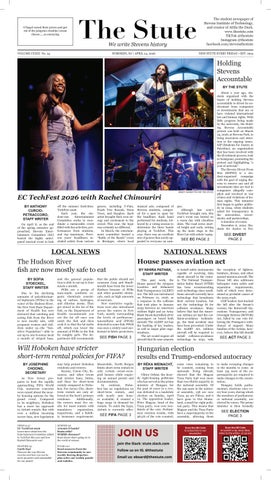
EC TechFest 2026 with Rachel Chinouriri BY ANTHONY CURCIOPETRACCORO, STAFF WRITER On April 8, as the end of the spring semester approached, Stevens Entertainment Committee (EC) hosted the highly anticipated musical event to kick
off the summer festivities: TechFest 2026 Each year, the student-run Entertainment Committee works to coordinate a memorable event filled with fun activities, performances from students, and top musicians. Previous years’ headliners included artists from various
genres, including T-Pain, Peach Tree Rascals, Neon Trees, and Dayglow. Each artist brought their own energy and excitement to the crowd. This year, the hype was certainly no different. In March, the entertainment committee hosted a “Battle of the Bands” event in Bissinger, where local
LOCAL NEWS The Hudson River fish are now mostly safe to eat BY SOFIA STOECKEL, STAFF WRITER Due to the declining amounts of polychlorinated biphenyls (PCBs) in the water of the Hudson River, the New York State Department of Health has now declared that catching and eating fish from the River is now mostly safe, with pregnant women and children under 15—the “Sensitive Population”—able to eat up to one 8-ounce meal a month of striped bass,
and the general population is able to eat up to four meals a month. PCBs are a group of man-made, synthetic organic chemicals consisting of carbon, hydrogen, and chlorine atoms. They get stored in the fat of the fish, so the Department of Health recommends you cut the fat off once you catch the fish and then cook it so that the fat melts off, which can lower the amount of PCBs in the fish by roughly 50%. The department still recommends
that the public should not consume Carp and Smallmouth bass from the lower Hudson because of PCBs and other possible chemicals, such as high amounts of mercury. New restrictive regulations were also introduced across the waters in New York, mostly surrounding the levels of perfluorooctanesulfonic acid (PFOS) detected in some fish. PFOS was once a widely used surfactant in fabric protectors,
SEE FISH PAGE 3
Will Hoboken have stricter short-term rental policies for FIFA? BY JOSEPHINE CHOONG, SECRETARY As New Jersey prepares to host the rapidly approaching FIFA World Cup, numerous concerns were raised about the nearby housing options for the grand event. Compared to its neighbors, Hoboken has a more lax approach to Airbnb rentals. But with over a million incoming soccer fans, new legislation
may help protect Hoboken residents and renters. Kearny, Union City, Secaucus, and other towns had stricter bans, limits, and fines for short-term rentals compared to Hoboken. For Jersey City, shortterm rentals are only allowed at the host’s primary residence. Additionally, the owners must live onsite for most rentals with mandatory registration, inspections, and a liability insurance requirement.
NEWS (2-3)
SCIENCE (6)
FEATURE (4)
PULSE (10)
EC TechFest 2026 Learn more about how the Entertainment Committee added to TechFest this year and how Rachel Chinouriri was! Earth Day! Discover the way Stevens recycles and how you can be more proactive and sustainable for our planet!
Artemis II lands? Brain cells? Wildlife diseases? Read about what’s going on in the world of science. Read answers from the Stevens community to our weekly Roving Reporter, plus solve our weekly puzzle and sudoku.
Meanwhile, North Bergen limits short-term rentals to only certain owner-occupied houses while requiring an annual permit and documentation. In contrast, Hoboken has no regulations on short-term rentals, and with nearly 300 houses available, it created a huge surge in demand for rentals. To catch the hype, Airbnb is currently offer-
SEE FIFA PAGE 3
musical acts, composed of Stevens students, competed for a spot to open for the headliner. Each band performed for students, followed by a voting session to determine the three bands playing at TechFest. This year, there was an excellent mix of genres that surely appealed to everyone on cam-
BRADY SANSOTTA FOR THE STUTE
pus. Although last year’s TechFest brought rain, this year’s event was hosted on a warm day with cloudless skies. The road crews started bright and early, setting up the main stage in the River Lot with artists’ equip-
SEE EC PAGE 2
About a year ago, students organized with the hopes of holding Stevens accountable to divest its endowment from companies or investments that are or have violated international law and human rights. With little progress being made by the university, the Holding Stevens Accountable protest was held on March 25, 2026, at Stevens Park, to bring awareness and attention to the ongoing issues. SJP (Students for Justice in Palestine), an organization that has been involved with the divestment process, took to Instagram, promoting the protest and highlighting “a year of activism”. The Stevens Divest From War (SDFWI) is a student-organized campaign with the goal of urging Stevens to remove any and all investments that are tied to companies allegedly complicit and involved in war crimes and violations of human rights. This initiative first began to gather publicity in 2024, when students asked for transparency in the universities, investments, and partnerships. A timeline of events: December 6, 2024: Students for Justice in Pal-
SEE DIVEST PAGE 2
NATIONAL NEWS House passes aviation act BY NIHIRA PATHAK, STAFF WRITER This past week, the House passed the Airspace Location and Enhanced Risk Transparency (ALERT) Act. The bill was introduced on February 21, 2026, as a response to the collision that took place in January 2025 between an American Airlines flight and an Army Black Hawk that killed all 67 passengers on board both aircraft. The ALERT Act has the backing of key leaders, as well as major pilot organizations. The act would require all aircraft that fly near airports
to install safety instruments capable of receiving data about aircraft in the vicinity. The National Transportation Safety Board (NTSB) has been recommending such technology since 2008. Some aircraft currently have technology that broadcasts their current location, but not the technology fit for collision avoidance. Many believe that had the American Airlines jet had the collision-avoidance technology, the fatal accident may have been prevented. Under the ALERT Act, military aircraft will be required to install collision-avoidance technology by 2031, with
the exception of fighters, bombers, drones, and other special-mission aircraft. The House bill also addresses helicopter route safety and separation requirements, both of which were determined as probable causes of the 2025 crash. GOP leaders fast-tracked the bill after the Senate’s version, the Rotorcraft Operations Transparency and Oversight Reform (ROTOR) Act, failed by one vote following the Pentagon’s withdrawal of support. Many families of the victims, however, believe this bill should
SEE ACT PAGE 3
Hungarian election results end Trump-endorsed autocracy BY RÉKA WEINACHT, STAFF WRITER Viktor Orbán, the heavily right-leaning politician who has served as the prime minister of Hungary for the past 16 years in a row, was defeated in a landslide election on Sunday, April 12. The opposition leader, Péter Magyar, head of the Tisza party, won over twothirds of the vote. Preliminary election results, with 98.9% of the vote counted,
some votes remaining to be counted, coming from nationals living abroad, showed that the Magyar Tisza Party had won more than two-thirds majority in the national assembly. Of the 199 seats in the national assembly, 138 are now Tisza, 55 are Fidesz, and 6 have gone to Our Homeland, a small far-right political party. This means that Magyar and the Tisza Party have a supermajority in the assembly, allowing them
to make sweeping changes in the months to come. At least 133 seats of the supermajority are required to make changes to the constitution. Hungary holds parliamentary elections once every four years, during which the members of parliament, or national assembly, are elected by voters. The prime minister is then formally
SEE ELECTION PAGE 3
Friday, April 24
2
News Masthead Volume CXXIII No. 24 Executive Board
EDITOR-IN-CHIEF.............................JIYA JAISINGHANI ‘27 BUSINESS MANAGER.......................CAMRYN WINANT ‘28 MANAGING EDITOR.................................TIANNA SPITZ ‘27 LAYOUT EDITOR.......................................CLAIRE DEANS ‘29 OUTREACH CHAIR................................ISABELLA FAMA ‘29 DIGITAL MANAGER.........................CHARMY KOTADIA ‘27 SECRETARY.....................................JOSEPHINE CHOONG ‘28
Editorial Board
NEWS EDITOR...................................JOSH BODENSTEIN ‘29 SCIENCE EDITOR..................................RIYANA PHADKE ‘27 OPINION EDITOR.........................................ITAI GELLER ‘26 SPORTS EDITOR..........................MILAGROS CARBAJAL ‘28 FEATURES EDITOR ...........................PRISHA VAGVALA ‘28 HEAD COPYEDITOR..............................TASHA KHOSLA ‘25
EC
CONTINUED FROM PAGE 1 ment for the show Students arrived at 5 p.m. to get involved in the opening activ‑ ities leading up to the show. Each student received two carnival-style tickets to claim free food and en‑ try into the show. To accompa‑ ny the show, the EC created fun events, including the Duck Market — a vendor-style event featuring a photo wall, student stands, gift baskets, and face painting. Similar to previous years, EC gave out free TechFest-themed t-shirts, bejew‑ eled ducks, and mini stuffed ani‑ mal cows on a keychain. The food provided included different kinds of brick-oven pizza, tacos, brown‑ ies, and blondies.
The opening acts lined the stage from 5:30 to 7:30 p.m., showcas‑ ing the top-voted songs performed at Battle of the Bands. ANGELID‑ IS, composed of members from diverse musical backgrounds, fo‑ cused its energy on creating a fu‑ sion of heavy-hitting metal and groove. Eve Godin Band, formed this year by freshman Eve Godin, brought an alternative vibe to the show. The band Jorts carried an indie presence to the stage to match the mood of the headlining artist. After the opening band took to the stage, the students were ready for the final headliner performance to begin at 8:00 p.m. The indie art‑ ist from the UK, Rachel Chinouriri, brought the energy and performed her most popular songs, from old to new, including songs like “The Hills” and “Can We Talk About
Isaac?”, among many others. The duration of the main show was approximately one hour, conclud‑ ing at 9:00 p.m. While there was not as large a crowd as in previous years, Chinouriri won the hearts of the audience. Students could be seen dancing with each other and simply enjoying the show that Chi‑ nouriri put on. TechFest Director Mollie Good, a 4/4 Science, Technology and So‑ ciety major, who has led the event for the past three years, reflected on the night. “Planning and host‑ ing TechFest this year was one of the highlights of my year,” Good said. “It’s always a lot of work and planning, but super rewarding to see it all come together. Thank you to EC for helping me plan, and thank you to WCPR, SUMAC, and AEC for all of their help with the amazing student openers!”
Operations Board
HEAD PHOTOGRAPHER.......ISABELLE VILLANUEVA ‘26 ASST. SOCIAL MEDIA...............................CHRISTINE YI ‘29 DELIVERY BOY.........................................JONATHAN LAI ‘28 ASST. LAYOUT EDITOR.............................SHREYA ROY ‘27 ASST. LAYOUT EDITOR....................BRADY SANSOTTA ‘29 ASST. LAYOUT EDITOR..........................KAILEY SUPAN ‘29 ASST. LAYOUT EDITOR..................EILIYAH SAROWAR ‘28
Staff & Contributors Brooke Nogurka Anthony Curcio-Petraccoro Disha Gohil Fiona Shi Chris Kalish Vedhesh A. Kamaraj Jeylan Jubran Wesley Yu Sabrina DePaulis Nihira Pathak Sydney Leung Reka Weinacht Charles Beall Sofia Stoeckel Anna Dabrowski Tanya Avadia Alessandra Nieto Sean Palermo Jack MacDonnell Abigail Thomas Madison Heller Dom Souza Atreyee Halder
Contact Us
GENERAL.........................................EBOARD@THESTUTE.COM EDITOR-IN-CHIEF.........................EDITOR@THESTUTE.COM ADVERTISING.............................BUSINESS@THESTUTE.COM OFFICE.................................UNIVERSITY CENTER ROOM 216B
Corrections NOTICE A MISTAKE? Email us at eboard@thestute.com.
Disclaimer
All opinions and editorials reflect the views of their respective au‑ thor(s). No Part of The Stute may be reproduced in any form, in whole or in part, without the written consent of the Editor-in-Chief. Cited refer‑ ences of The Stute are permitted.
Policy on Letters to the Editor
All members of the Stevens community are able to submit a Letter to the Editor to be published in The Stute. Letters must refer either to a piece published in The Stute or to The Stute in general and must be be‑ tween 400 – 800 words in length. Submit letters to editor@thestute.com with your name and title (when applicable) or using our Google form. For writers who wish to write a Letter to the Editor anonymously, please see our policy on anonymity. The Editorial Board reserves the right to choose whether or not to pub‑ lish a submitted Letter to the Editor based on a majority rule vote, and additionally reserves the right to edit letters for clarity or request authors to revise. Provided that the author approves the final version, The Stute reserves the right to edit letters according to our copy editing procedures, defined in our policies.
Policy on Op-Eds
All members of the Stevens community are able to submit a stand‑ alone opinion piece (otherwise known as an Op-Ed) to be published in The Stute. Op-Eds must be between 400 – 800 words, but longer sub‑ missions will be considered on a case-by-case basis. To submit an OpEd please email eboard@thestute.com with your name and title (when applicable) or using our Google form (tinyurl.com/submit-t0-stute). For writers who wish to write an Op-Ed anonymously, please see our policy on anonymity. The Editorial Board reserves the right to choose whether or not to pub‑ lish a submitted Op-Ed based on a majority rule vote, and additionally reserves the right to edit Op-Eds for clarity or request authors to revise. Provided that the author approves the final version, The Stute reserves the right to edit Op-Eds according to our copy editing procedures, de‑ fined in our policies.
FULL LIST ON thestute.com/policies
tinyurl.com/stutesubmit
BRADY SANSOTTA FOR THE STUTE
DIVEST
CONTINUED FROM PAGE 1 estine (SJP) held an on‑campus demonstration. The event was organized to raise awareness on campus about the ongoing conflict in Palestine. SJP noted that “its goal was to provide an educational and respectful platform for these discussions”. February 28, 2025: The SGA read a proclamation supporting the SDFWI, with a proposal titled “Proposal for Stevens Institute of Technology’s Divestment and Dis‑ sociation from Violations of Inter‑ national Law and Human Rights.” Both called upon the Stevens Board of Trustees, where one of the writ‑ ers of both the proclamation and proposal, recent Stevens alumnus James Hooker, expressed “the school’s $318 million endowment funds scholarships and research, and therefore students deserve to know that their funding is coming from ethical places.” A student pe‑ tition in favor of SDFWI was also being shared, which at the time had 518 undergraduate signatures, of which 497 supported the initia‑ tive. A discussion to address both was held, where the SGA decided to temporarily table the bill. March 7, 2025: The proclama‑ tion failed to pass for a second time. The proclamation was up‑ dated with changes. 22 senators voted in favor, 12 against, and 2 abstained, which did not meet the ⅔ requirement. Despite this, SD‑ FWI shared that they will contin‑ ue to advocate and continue their demands. May 2, 2025: It was announced university-wide that the Letter from the Student Body (LSB) was officially passed. Following this, the letter was delivered to the
Board of Trustees and President Favardin, who, at the time, did not receive a response. September 21, 2025: A re‑ sponse was finally received, where the Board and President acknowl‑ edged the efforts being made, the issues were discussed, but ulti‑ mately, the divestment could not be implemented for several rea‑ sons. The Investment Policy State‑ ment was updated to better reflect more respected ethical values. The protest was held to high‑ light a year of student organizing centered on university account‑ ability, in which students orga‑ nized multiple divestment initia‑ tives and strong student support. The protest also focused on a list of demands, which also tied in sanctuary-type protections for students in relation to privacy and immigration-related concerns. A student involved in the pro‑ test planning and demands spoke to The Stute on the condition of anonymity while divestment ef‑ forts continue, stating, “Since the protest in March, we have not seen much change on the policy end, but we have been able to set up a meeting with members of admin‑
istration who we were unable to previously, a trend we hope will continue in the future. However, we would like to further build up pressure to work on efforts to tan‑ gibly implement our proposals in a timely way, as we do believe they are far more urgent and necessary than the current delaying and dis‑ missal patterns would like to have them seem.” The university coor‑ dinated with Stevens Campus Po‑ lice, as well as Hoboken first-re‑ sponders, with an ambulance on standby during the protest. Organizers will continue to push for ethical investments. The Holding Stevens Accountable pro‑ test reflects the growing move‑ ment in Stevens’s student body and the nationwide call to univer‑ sities for moral transparency. Al‑ though the next steps are not set in stone, they are centered around working with the administration and building overall efforts. Prog‑ ress has been made in aligning the student communities behind the proclamation’s goals, but advo‑ cates will continue to emphasize student influence over university partnership and financial invest‑ ments.
PHOTO COURTESY OF SJP
Friday, April 24
3
News FISH
CONTINUED FROM PAGE 1 firefighting foams, and chemical mixtures. The contaminant levels in Mid-Hudson fish still did not change, so fishing is not recommended in that area. The lower amount of chemicals in the water truly shows how nature can bounce back from any hazard, with the Department of
FIFA
CONTINUED FROM PAGE 1 ing a bonus of $750 for new hosts within the FIFA event zone. According to Airbnb, the searches for stays in host cities have increased an average of 80% compared to last year. However, Hoboken’s lack of policies on short-term rentals drew criticism from affordable housing advocates in Hoboken. Cheryl Fallick, an association spokesperson and a member of Hoboken’s rent-leveling board, argued that it disincentivizes affordable housing. The lack of clear regulations will drive lower-income renters out and turn rent-controlled apartments into pseudo-hotels. Fallick stated that Hoboken should only allow short-term rentals for certain sit-
Health working to remove harmful chemicals from the water. The Department of Health continues to monitor and address harmful contaminants to help protect public health. Each year, the department updates the public about concerns about contaminants on their website. As always, the public should be cautious with fish consumption and always listen to the New York State Department of Health on health advisories in their area.
be strengthened, arguing that collision-prevention technologies are not market-ready and may take years to be so. The collision took place over the Potomac River, near the Ronald Reagan Washington National Airport, and was the deadliest air disaster in over 20 years. Accord-
uations, like when the owner is on-site in their own apartments or for a limited number of days if the owner is away. Hoboken Councilmember Joe Quintero, a lawmaker working on the new short-term rental legislation, stated that he and other city officials are attempting to enact these policies before the FIFA World Cup. ”The reality is that these short-term rentals are going to happen, and so what we want to do is take this market out of the gray zone,” Quintero said, “If we don’t have clear rules set, it will be the Wild West.” Quintero claimed that he wanted to prohibit rent-controlled apartments from being refurbished as shortterm rentals and to impose taxes on Airbnbs and similar listings. “That is a revenue source that we can and should avail ourselves of if we have the opportunity,” he said.
This isn’t the first time these regulations have been debated. In 2021, the Hoboken City Council members attempted to pass an ordinance that would block shortterm rentals in rent-controlled properties. Penalties for this violation would be up to $2,000 for each offense. Its attempted passing brought into light that a Hoboken City Council member was renting out his apartment during COVID-19 travel restrictions. However, the ordinance itself was never passed and instead was tabled over its possible impacts on affordable housing. The lack of funding from Congress led to security and transit problems, which are other causes of concern with FIFA. Ultimately, only time will tell how these issues will be handled and whether or not stricter regulations for short-term rentals will be beneficial for Hoboken’s community.
ACT
CONTINUED FROM PAGE 1
Coachella 2026: Out with the new, in with the old BY SABRINA DEPAULIS, STAFF WRITER This year’s Coachella Valley Music and Arts Festival brought together an unexpected but well-balanced blend of iconic veterans and today’s rising stars. Two weekends in the Californian desert managed to make the past feel as urgent as the present. While the headliners were exciting, the legacy of the weekend was cemented by the guests who chose to share their stage with. A modern pop concert turned into an homage of shared history. The theme of “legacy” announced itself early. On Friday night, headliner Sabrina Carpenter stunned the crowd by inviting Madonna to perform the 1990 classic “Vogue” and the unparalleled “Like a Prayer.” Standing side by side in matching blonde hair, Carpenter and Madonna performed
less like a duet and more like a reflection of one another. The guest appearance also marked Madonna’s 20th anniversary of her own set and debut at Coachella. In a nod to her own history, Madonna even wore the same vintage Gucci jacket from her personal archives. Madonna’s presence is a passing of the torch and confirmation of the pop lineage, highlighting a reverence for performers who built the stage in the first place. The trend continued with Addison Rae’s high-energy set. While she is a definitive face of the new digital age of stardom, she grounded her performance by bringing out Olivia Rodrigo. Acknowledging the power of pop collaboration, they performed “Headphones On” before debuting Rodrigo’s new single “Drop Dead.” This nostalgia was not just limited to guest appearances. In a move that felt both meta and
surprisingly intimate, Justin Bieber utilized the massive festival screens to bring out an “old” version of himself. In playing vintage footage of his 12-year-old self, Bieber turned his set into a living timeline, serving as a reminder for his audience that grew up alongside him. A striking visual of growth, Justin displayed a digital excavation of his own history while inviting the crowd along with him. As the sun set over the Ferris wheel, it is clear that Coachella’s purpose goes further than the latest and greatest. In honoring the artists and moments that paved the way, the festival is finding a new rhythm. It turns out that the best way to move forward in the desert is to occasionally look back. The music of the past continues to provide a backbone for today’s trends and the connection we need.
THE FOLLOWING IS AN OP-ED
OP-EDS REPRESENT THE VIEWS OF THE GUEST WRITER FROM WITHIN THE STEVENS COMMUNITY AND ARE SUBMITTED TO THE STUTE FOR PUBLICATION. THEY DO NOT REFLECT THE VIEWS OF THE STUTE ITSELF.
Stevens History of Protest How Our Past Calls Us To Action BY ANONYMOUS STEVENS STUDENT Thanks to documents recently recovered by Stevens Amnesty, we have newfound insight into the history of protest at Stevens - Let’s take a trip through Stevens in the ‘60s and ‘70s and compare it to our present. October 10-15, 1969 - The Moratorium to End the War in Vietnam was a nation-wide demonstration rejecting America’s involvement in South-East Asia. Students, faculty, and staff called for the cancellation of classes to organize teach-ins and engage in solidarity with demonstrators across the country. The Student Council unanimously passed a resolution supporting a boycott of classes. Faculty submitted a resolution calling for “the prompt, rapid, and complete withdrawal of the United States forces [from Vietnam]” (Resolution). Despite classes remaining in session, almost 200 Stevens students demonstrated their solidarity by assembling on Palmer Lawn. April 22, 1970 - The First Earth Day: The Stevens Student
Council organized the creation and distribution of Earth Day pamphlets warning of the devastating “Pollution Bomb” that awaits if we don’t work to combat it right now (50 years later, we are still making the same plea). “We’re students at STEVENS INSTITUTE OF TECHNOLOGY who want to see technology used for the benefit of man - to make the quality of life better” (Pamphlet). May 7, 1970 - The Stute reports a major campus protest in solidarity with the killing of four and wounding of nine unarmed students by the Ohio National Guard at a Kent State University anti-war demonstration. President Davis’ response was blunt: “I do not feel that the Institute as such should take any stand in connection with political or social issues” (The Stute). He later arrived at the sit-in, attended by 300-400 students, and was confronted with the students’ demands. On the day of the strike, students were met with armed police ordering their dispersal. A vote was taken to demand “that all war research at Stevens be immediately and permanently removed.” Students pre-
sented their demands at Dr. Davis’ office. “The reply was negative and Davis left for lunch” (Stute). Students were told that they were interfering with the office and that a court injunction was being sought against them. September 23, 1970 - The Stevens Free Press was first published in order to publicize the views of Stevens students and call meetings supporting the anti-war movement. The first issue describes how Stevens handles over $1.5 million worth of war research contracts annually. Rookie numbers, compared to the present! Fast forward 50 years - The recent surge of student organizing on Stevens campus in response to the ongoing genocide in Palestine, the Trump administration’s Gestapo, ICE, and rampant hate speech on campus, has to date, operated within the rules of the system – awaiting approval for flyers and being cattled into a cage at our first demonstration, under a surveillance system, while cops in riot gear train nearby. More recently, a protest in reContinued on thestute.com
ing to the helicopter’s route, its maximum altitude was to be 200 feet; the crash occurred at an altitude of nearly 300 feet. According to the Justice Department, an air traffic controller did not comply with an order from the Federal Aviation Administration (FAA). The NTSB reported the crash was a result of a “multitude of errors” and “systemic issues across multiple organizations”. In December 2025, the Justice Department ruled that the federal government
was liable in the crash. Efforts to prevent such crashes have been ongoing; in 2022, members of an FAA working group urged moving helicopter traffic away from airports and establishing airborne hot spots, or high traffic areas. The efforts were rejected because they were labeled as too political. As the bill goes to the Senate, there is hope that the ALERT Act will pass the Senate as seamlessly as it passed the House, bringing justice to the victims’ families.
ELECTION
uproar over a scandal involving Fidesz’s presidential pardon of a man convicted of covering up child sex abuse. The end of Orbán’s regime is not just a big moment for Hungarians, but an impactful event on the world stage as well. The former prime minister had close ties with both Russia and China, pointing to their dictatorships as role models for successful countries. He has consistently supported Vladimir Putin during the war with Ukraine, trying to prevent or slow down EU sanctions against Russia. He is an ally of Donald Trump, who has viewed Orbán as a great example of conservative government. According to PBS News, U.S. Vice President J.D. Vance even personally visited Hungary a few days before the elections in support of Orbán. Magyar’s victory last Sunday is going to push Hungary in a new direction, as he has pledged to rebuild Hungary’s relationships with the EU, Ukraine, and the North Atlantic Treaty Organization (NATO). Magyar’s promises also involve reversing the corruption and patronage system of NER, as well as specifically improving the healthcare and education systems in Hungary. He has also said that he wants to institute a two-term limit for prime ministers in Hungary. Sunday night saw people in Budapest jubilantly celebrating in their homes and on the streets, chanting and waving Hungarian flags, toasting with champagne. Public sentiment is very hopeful for the new leader, even those who voted for him only because they wanted to vote against Orbán, rather than a direct desire to support Magyar. The inaugural session of parliament and the start of his term are expected to occur on or before May 12.
CONTINUED FROM PAGE 1 elected by the national assembly — this is typically the leader of the majority party after parliamentary elections. As Hungary has no term limit like the United States, Orbán has been in power for the past sixteen years, a term that has been marked by increasing corruption and gerrymandering, the practice of manipulating electoral district lines to give one political party an unfair advantage. Public sentiment in Hungary has increasingly turned against Orbán in recent years, and there has been increasing frustration with his policies, domestic and international. As reported by the British Broadcasting Corporation (BBC), during his speech in front of the parliament in Budapest, the Hungarian capital, Magyar said, “Together, we brought down the Orbán regime. Together we liberated Hungary.” Orbán’s regime has been called an “electoral autocracy,” says the BBC, and corruption ran rampant as Orbán funneled money to his cronies through a system of patronage called Nemzeti Együttműködés Rendszere (NER) and appointed his friends to powerful positions. According to the Cato Institute, the Corruption Perceptions Index ranked Hungary very close to China, Cuba, and South Africa—shocking for a country in the European Union (EU). The media became less and less free after Orbán’s election in 2010 as the government took control of large portions of public television and journalism. The Fidesz government spoke of LGBTQ rights as a threat to children and banned adoption by same-sex couples. In 2024, there was a domestic
Friday, April 24
4
Feature
EARTH DAY
Five things you do at Stevens that are secretly bad for the planet BY TASHA KHOSLA, HEAD COPYEDITOR
friends, listening to music on your route, or biking.
With work, extracurriculars, and other responsibilities, thinking about environmental impact may be the least of a student’s worries. After all, many Stevens students do recycle, thrift their clothes, and (usually) remember to turn their lights off. Still, there are a few things that students do that aren’t the best for the planet.
3. Dumping Dorm Furniture May is approaching, signaling the end of the semester. During that time, students are trying to pack up their belongings to prepare for their move-out day. As you sit there wondering if it’s too late to become a minimalist, you may be planning which pieces of furniture you can throw out. Rather than dumping your perfectly good furniture in a landfill, consider reaching out to local thrift stores to see if they will take it off your hands. Other alternatives include reaching out to fellow students who are looking to furnish their apartments, selling it on Facebook Marketplace, or asking someone if they’d be willing to help you move it out.
1. Wasting Food When you’re on a meal plan, it can be tempting to simply throw away one meal in exchange for another. We’ve all picked out something from the comfort station or placed an order at Yella’s before realizing that the texture is wrong, the taste is different than expected, or that we just don’t like the item. However, according to the Environmental Protection Agency (EPA), “Food waste is the single most common material landfilled and incinerated in the U.S., comprising 24 and 22 percent of landfilled and combusted municipal solid waste, respectively.” U.S. college campuses are responsible for much of that food waste, with students wasting around 3.6 million tons of food a year. Instead of piling your plate with a bunch of foods you probably won’t touch, take a moment to really think about what you actually will eat. At Pierce Dining Hall, you can always ask for a smaller portion and go back for more if you end up enjoying it. At the UCC Marketplace, customize your order so you can avoid dissecting your meal. 2. Ordering a Stuber Instead of Walking One of the highlights of Hoboken is its walkability. Although ordering a Stevens Shuttle (a.k.a. a Stuber) or even an Uber or Lyft may feel like an easier option, remember that you really can just take a walk. If walking isn’t something you enjoy, try walking with
4. Fast Fashion Hauls According to Business Insider, “Fashion production makes up 10% of humanity’s carbon emissions, dries up water sources, and pollutes rivers and streams.” The aim of fast fashion is to produce clothing as quickly as possible to keep up with trends. The issue is that companies use cheap materials like polyester that can take around 200 years to decompose. With fast fashion, once trends shift, consumers throw out their clothes, leaving 92 million
tonnes of textile waste per year to sit in landfills for years to come. If you have any clothes from Shein, Cider, or Fashion Nova sitting in your closet, don’t throw them away just yet. Keep rewearing them and donate them when you’re done. The next time you need a quick outfit for a themed party or special event, consider borrowing from a friend, checking out a local thrift store, or purchasing something you know you can wear again. 5. Using AI There is no denying that AI has become more normalized, as demonstrated by its integration into so many apps and services we use. Still, AI usage has detrimental impacts on the environment, such as increasing greenhouse emissions and depleting water resources. Instead of using AI as a shortcut, manage your time better, seek help from your professors and TAs, and utilize other course resources such as textbooks and lecture notes. Although it feels like AI is everywhere, remember that you have the choice on whether or not you use it. Sustainability may feel like the least of your worries, but we all must do our part to protect our planet. By reassessing our day-today activities, we can make changes to ensure we are not hurting the environment.
On April 9, 2026, on the UCC 2nd floor, high school and middle school students, Nihal Tammana, Pavit Thakkar, Nithya Tammana, and Ritvik Mohanty, came to Stevens to promote using battery bins around campus to safely recycle batteries. The founder of the nonprofit organization Recycle My Battery, Nihal Tammana, said he founded the organization after hearing about a major lithium-ion battery explosion at a waste disposal plant in California on the news. Since then, he has built a team of over 1,000 youth volunteers across multiple countries to promote education and the habit of properly recycling batteries. These youth leaders have been visiting college campuses, schools, and offices to promote the use of proper battery disposal bins for safe disposal. One youth leader, Pavit Thakkar, proposed the idea of tabling and promoting this initiative of battery recycling bins around campus to Dr. Sara Klein, Vice President for Student Affairs, during a Dr. Martin Luther King Jr. event. From there, they tabled on the UCC 2nd floor, gaining traction from passersby. They kept the event engaging with prizes like stickers, straw sets, batteries, and more, along with a battery bin and a spin wheel to win a prize. They also gave an overview of the problem and proposed solutions for recycling on campus, starting with the question, “Where do your batteries end up?” That question points to a large issue about battery waste overall. Annually, Americans throw away more than 3 billion batteries, which is about 180,000 tons of hazardous waste. More than 15 bil-
BY ALESSANDRA ZULUETA NIETO, CONTRIBUTOR After spring cleaning and decluttering, clothes need to go somewhere. Donating them ensures nothing goes to waste. When looking in and around Hoboken, there are three standout options. 1. St. Mary Advocates Thrift Shop 536 Garden St., Hoboken, NJ 07030 Relying solely on the work of volunteers and donating their profits to both a scholarship and various charitable funds, St Mary’s is by far one of the best places to donate clothes and miscellaneous items. Donations accepted include clothing, small housewares, shoes, jewelry, and of course, time. All donations are carefully sorted through before hitting the store floor. Small kitchen appliances are checked to ensure they work, clothes are checked for any stains or snags, and higher ticket items have their authenticity verified. Anything that doesn’t pass inspection is recycled, so nothing is wasted. Store hours are Wednesday, 11 a.m. to 3 p.m., Thursday, 12 to 5 p.m., Friday, 2 to 6 p.m., and Saturday, 12 to 4:30 p.m. Occasionally, additional hours on Sunday or Monday are announced on their Instagram page. 2. Hoboken Homeless Shelter 300 Bloomfield St., Hoboken, NJ 07030 Supporting the community through both food and resources to help get people back on their feet, the Hoboken Shelter is a bastion of hope. While food is one of the first things to come to mind when donating to a shelter, clothes are also
needed to best help the shelter’s guests. Donations can be made any day of the week, from 9 a.m. to 9 p.m. Items accepted are shoes, seasonally appropriate clothes, and backpacks. A comprehensive list of other needed items is posted on their website. Of course, donations of time are also greatly appreciated, with volunteering opportunities revolving around manning the three different shifts for mealtimes. Any donations contribute directly to the benefit of the local community. 3. St. Lucy’s Emergency Shelter 619 Grove St., Jersey City, NJ 07310 Serving to help others through feeding the hungry and providing housing to the homeless, St Lucy’s Emergency Shelter is part of the Catholic Charities of the Archdiocese of Newark. While not being directly situated in Hoboken, it’s not too far, being a roughly 31-minute walk from campus. Tucked away in their parking lot is a donation bin, one of several sprinkled across the state. Accepted donations include gently used clothing, linens, sheets, towels, shoes, and small household appliances. It is requested that items be either bagged in a clear plastic bag or placed in a box. All items donated to them will be sold, and all proceeds from this will be used to fund any of their 86 programs for the needy. Any donations to any of the listed places above will serve to help people, with items that otherwise would have just been taking up space. Instead of cluttering up a closet or sitting in boxes, your clothes could make a tangible difference for someone.
Does Stevens actually recycle? BY FIONA SHI, STAFF WRITER PHOTO COURTESY OF @STEVENSDUCKS ON INSTAGRAM
Recycle My Battery initiative spotlight BY PRISHA VAGVALA, FEATURES EDITOR
Top three places to donate clothes in/near Hoboken
lion batteries are carelessly thrown away each year, causing pollution and fire accidents. Improper recycling can lead to severe environmental pollution, safety risks like explosions and fires, and wasted resources, since toxic materials like lead, cadmium, and lithium-ion can leak into soil and waterways when disposed of improperly, harming human health and potentially leading to incidents like the lithium-ion battery explosion in California. To address this issue, they are working to bring solutions directly to campus by planting battery bins in all the dorms to give students a clear idea of how to safely dispose of batteries. Even before these boxes are available, there are many ways to responsibly recycle batteries, such as battery banks located at local Staples stores and Home Depots. Their website explains the importance of understanding the impact of improper recycling and being educated, including knowing what type of batteries you are dealing with. Household batteries like alkaline batteries, which are made
of relatively non-hazardous materials, can be thrown in the trash, though it is still better to use battery bins when possible. Car batteries should be disposed of at auto parts retailers or hazardous waste collection sites. Rechargeable and lithium-ion batteries must be taken to a hazardous waste collection site. As a general practice, it is better to place everyday batteries in proper battery bins or battery banks. Recycle My Battery promotes a petition to reduce battery waste by getting manufacturers on board with recycling, which has garnered 3,592 signatures as of April 21, 2025. This initiative is important because it expands awareness of the dangers of improper battery recycling from the 1% who know about it to educating 35 million more people about battery recycling. Through the efforts of the Recycle My Battery initiative, members aim to hold businesses and manufacturers accountable for the environmental impact they have, while encouraging stronger incentives for more sustainable recycling practices.
PHOTO COURTESY OF MISAYO IDOWU
At Stevens, you often hear that the university does not recycle and that everything is dumped into the same place. It’s a persistent myth that causes student cynicism, but this, in fact, is not the case. Stevens does recycle, but an institution can only be as green as its community. Stevens has single-stream recycling, which means all recyclable items are combined, transported to approved facilities, and then sorted for proper recycling. Accepted items for recycling include dry and clean paper, cardboard, glass, types 1 and 2 plastics, and aluminum. However, noncompliance from the student body has caused many bins to become contaminated, cancelling out existing recycling efforts. “Student habits [is one of the] biggest obstacles, as students will unknowingly contaminate recycling with food waste and other non-recyclable material, making the whole batch unrecyclable,” said Olivia Conner-Bennett, Sustainability and Transportation Coordinator. When a single contaminated item ends up in a bin, the whole load risks being rejected by the processing facility, and everything ends up in landfills. While the problem isn’t entirely preventable, it can absolutely be
managed and improved, starting with each student taking just a few extra seconds before throwing anything away. Recycling bins on the lower campus are accompanied by signs detailing where to place different types of trash. For even more guidance, the university recommends using Recycle Coach, a free app and website that tells you instantly how and where to dispose of any item correctly. “Be aware of what can and cannot be recycled, which you can check with the Recycle Coach app,” Conner-Bennett shared. A quick search before you toss can reduce contamination rates, meaning fewer rejected loads and more material actually making it to recycling facilities. Stevens absolutely recycles, but it may be difficult without the support and compliance of the student body. Before you toss something out, make sure you’re aware and select the right bin for your trash! Check the posted signs, take a few seconds to think, or open Recycle Coach if you’re unsure. When in doubt, toss it out in the grey bins and keep the blue ones for clean, dry, and accepted recyclables only. The myth that the university doesn’t recycle will only disappear when our habits catch up to our intentions! Let’s make that happen!
Friday, April 24
5
PHOTO COURTESY OF STEVENSDUCKS.COM. SHOT BY DAVE JANOSZ
Sports
Ducks rally for wild MAC Freedom win over King’s, 11-10 BY MILAGROS CARBAJAL SPORTS EDITOR The Stevens Institute of Technology Baseball team secured an 11-10 win over King’s College (PA) in a tightly matched Middle Atlantic Conference (MAC) Freedom opener on Friday, April 16, at Dobbelaar Field. The game featured seven multi-run innings and 27 total hits, with the Ducks completing a late comeback to take the victory. Stevens got off to a powerful start, as junior Chip Krese opened the game with a home run to right
field. He would repeat the feat in the second inning, following a solo shot from first-year Vinnie Stigliano, helping the Ducks take a 4-3 lead after an early threerun inning from King’s. On the defense, junior Quinton Sterling made an impact early with a catch at the wall in right field, which prevented an extra-base hit and potentially saved a run. After a quiet stretch in the third and fourth innings, King’s tied the game in the fifth with bases-loaded groundouts. Senior Dylan Fishbough was hit by a pitch and reached base, advancing to third on a groundout, and
scored on a single from first-year Veer Wadhwani for a 6-4 lead, but the Monards jumped back in front, and the momentum shifted again. They scored four runs in the sixth and added two more in the seventh to build a 10-6 advantage. Despite the deficit, Stevens remained composed in the final innings. After cutting into the lead in the seventh, the Ducks delivered their biggest moment in the eighth. With bases loaded up and without putting the ball in play, graduate student Griffin Zitko singled up the middle to bring in two runs, narrowing the
will return this Saturday, April 25, to host TCNJ and Lebanon Valley
College. The matches will be held on the Bayonne Tennis Courts,
On Saturday, April 18, the Men’s Tennis team fell to Haverford College after earning a win against DeSales University in Middle Atlantic Freedom Conference play. In the doubles, the Ducks fell in all three matches. Junior Samvid Andhare, senior Max-William Kanz, first-year Renat Kramin, and sophomore Dhaivik Chenemilla all lost with scores of 6-4. Additionally, junior Tristan Wroe and first-year Ian Batra fell 6-2. Stevens ended doubles down 3-0. Following that were the singles matches, where the Ducks persisted. Despite their efforts, they were knocked down in five of their matches. However, they were able to leave the singles round with one point from Andhare with a 6-4, 6-3 win. Even with the win, the Ducks took losses from Wroe, Chenemilla, Kanz, Kramin, and Batra, which pushed Haverford further in the lead. The match ended at 6-1, in favor of Haverford, but the Ducks
DATE
WED, APR 15
THU, APR 16
FRI, APR 17
SAT, APR 18
FRI, APR 24 WOMEN’S AND MEN’S TRACK AND FIELD Penn Relays Philadelphia, PA TBD WOMEN’S AND MEN’S TRACK AND FIELD Rick McCorkle Invitational Ewing, NJ TBD BASEBALL Fairleigh Dickinson University Hoboken, NJ 7 p.m.
score to 10-9. After another walk loaded the bases, sophomore Edward “E.J.” Balewitz Jr. dropped a single into right field, scoring Sterling with the game-tying run. Next, Adam Barrington lifted a sacrifice fly to bring home Zitko and put Stevens back in front, 1110. In the ninth, sophomore Connor Herlihy set the Monarchs down in order, sealing a hardfought comeback win for Stevens. The Ducks return to play again this Saturday, April 25, against Fairleigh Dickinson University at 12:00 p.m. and 2:30 p.m. in Madison.
Men’s Tennis falls to Haverford College BY CAMRYN WINANT, BUSINESS MANAGER
ON DECK IN SPORTS
SAT, APR 25 WOMEN’S AND MEN’S TRACK AND FIELD Penn Relays Philadelphia, PA TBD WOMEN’S AND MEN’S TRACK AND FIELD Rick McCorkle Invitational Chester, PA TBD MEN’S GOLF MAC Freedom Championship Lebanon, PA TBD MEN’S TENNIS TCNJ Bayonne, NJ 10 a.m.
with the Ducks facing TCNJ at 10 a.m. and Lebanon Valley at 2 p.m.
BASEBALL Fairleigh Dickinson University Madison, NJ 12 p.m. SOFTBALL FDU-Florham Union, NJ 1 p.m. WOMEN’S AND MEN’S LACROSSE DeSales Univeristy Center Valley, PA 1 p.m. WOMEN’S AND MEN’S TENNIS Lebanon Valley College Bayonne, NJ 2 p.m. BASEBALL Fairleigh Dickinson University Madison, NJ 2:30 p.m. PHOTO COURTESY OF STEVENSDUCKS.COM
TEAM
STEVENS SCOREBOARD
SOFTBALL MEN'S TENNIS SOFTBALL MEN'S LACROSSE WOMEN'S LACROSSE BASEBALL MEN'S VOLLYBALL MEN'S VOLLEYBALL MEN'S AND WOMEN'S TRACK AND FIELD MEN'S TRACK AND FIELD MEN'S AND WOMEN'S TRACK AND FIELD MEN'S AND WOMEN'S TRACK AND FIELD
OPPONENT
LOCATION
SCORE
DREW UNIVERSITY (DH) ARCADIA UNIVERSITY DREW UNIVERSITY (DH) MISERICORDIA UNIVERSITY MISERICORDIA UNIVERSITY KING'S COLLEGE MIT EDICOTT VS. LANCASTER BIBLE COACH POLLARD INVITATIONAL
AWAY AWAY AWAY AWAY AWAY HOME HOME HOME AWAY
W (7-3) W (7-0) W (3-1) W(23-5) W(10-2) W(11-10) L (0-3) L (0-3) 22ND (WOMEN)
PAUL DONAHUE INVITATIONAL COACH POLLARD INVITATIONAL
AWAY AWAY
COMPLETE COMPLETE
PAUL DONAHUE INVITATIONAL
AWAY
COMPLETE
Friday, April 24
6
Science Welcome home: the end of the historic Artemis II mission BY SEAN PALERMO, SCIENCE WRITER On April 10, 2026 at 8:07 p.m. Eastern Time, the four astronauts crewed on the Artemis II lunar flyby mission splashed down off the coast of San Diego in the Pacific Ocean. At an altitude of 7.6 kilometers, the Orion capsule released its 11 parachutes to slow down to about 30 km/h before the splashdown, where, once in the water, five orange airbags of helium were deployed to maintain the capsule’s upright position and enable the astronauts to emerge onto a large raft dubbed the front porch. From there, they made their way back to Houston’s Johnson Space Center by helicopter, boat, and airplane — ending the historic 10-day Artemis II mission. When Orion finally descended below 17,000 miles from the planet’s surface, Commander Reid Wiseman would remark on the nearing Earth by saying how “there’s a great blue hue to it” — that “it’s beautiful.” As it turns out, the process of reentering the atmosphere proved to be Orion’s most distressing test yet — touching it for the first time since launch at 7:53 p.m. at an altitude of approximately 122 kilometers, moving over 38,000 km/m. Briefly after doing so, friction from the atmosphere would heat the Orion heatshield to nearly 2800° Celsius (approximately 5072° Fahrenheit) and create a layer of superheated plasma that would block communication between the crew and mission control for about 6 minutes.
The succession of deployments of the capsule’s 11 parachutes was launched at various altitudes designed to slow it from 325 mph and then 130 mph before the initiation of the three main chutes stretching a combined 80 yards (73 meters) to achieve a 17 mph splashdown. After landing in the Pacific Ocean, a USS John P Murtha recovery crew would retrieve the astronauts in boats that were used to approach the Orion’s inflatable porch attached to its hatch — navy personnel assessing the crew before transferring them to the navy ship by helicopter. The journey around the moon, timed at 9 days, 1 hour, and 32 minutes, brought the four crew members farther into space than any other humans have before at 252,756 miles — more than 4,000 further than the former record set by the Apollo 13 crew in April of 1970. Additionally, it makes the astronauts Reid Wiseman, Victor Glover, Christina Koch, and Jeremy Hansen the first to successfully return to Earth from the moon since the Apollo 17 mission in December 1972, joining the exclusive club of only 24 others who have ever done so. Despite timing just over 9 days, the mission is officially recorded as a 10-day mission due to the blast-off day being treated as “flight day one”. During the mission itself, the team evaluated Orion’s life support systems, radiation detectors, next-generation spacesuits, and tested other operations crucial to future deep-space missions that are set to be launched under the wider plans of the Artemis series that intend to
establish a permanent presence on the moon and Mars — the former already having plans of a $20 billion base to be built within a decade. Currently, it is unclear how this crew will have a role in these future phases of the program, though Wiseman and Hansen are expected to be involved in the training of future mission crews. NASA claims it will begin applying the data gathered from Artemis II such as how the flight hardware and emergency system capabilities performed in preparation for the future of the program. After the astronauts had returned, a late-night press conference was held to discuss the conclusion of the mission. During this, NASA’s associate administrator Amit Kshatriya would say how “53 years ago, humanity left the moon. This time we return to stay. Let us finish what they started. Let us focus on what was left undone. Let us not go to plant flags and leave, but to stay with firmness in our purpose, with gratitude for the hands who built the machines and with love for the ones that we carry with us.” Nicky Fox, associate administrator of NASA’s science mission directorate, would sum up the significance of the mission during a briefing with reporters the week the team returned by noting how “our four Artemis II astronauts, Reid, Victor, Christina and Jeremy, took humanity on an incredible journey around the moon and brought back images so exquisite and brimming with science, they will inspire generations to come.”
How the wildlife trade carries disease-causing pathogens BY DISHA GOHIL, SCIENCE WRITER The wildlife trade encompasses a lot, from pet sales to food and furs. However, a study from Science estimates that nearly half of traded wildlife carry at least one pathogen that can cause diseases among humans, making this the first to quantify the role of traded wildlife in pathogen transmission. Several disease outbreaks in humans have been linked to traded wildlife, such as the Ebola epidemic and the COVID-19 pandemic. However, complete data on pathogens in the wildlife trade have only recently emerged in response to the COVID-19 pandemic. The study is the “first global quantitative evidence of that link”, says Jérôme Gippet, an ecologist at the University of Fribourg in Switzerland. To understand the role that wildlife trade has had on pathogen transmission, Gippet and his colleagues combined over 40 years of records from three wildlife-trade data sets with CLOVER, a dataset that lists various pathogens found in different species. The team focused on mammalian species because of their key role in the wildlife trade and their history of transmitting pathogens to people. The team then created models to predict the risk of pathogen spread through trade interactions, accounting for various circumstances that can influence transmission, such as the proximity of the animals to human communities and how the species are used. The team discovered that of 2,079 traded mammal species, around 41% shared at least one transmissible
pathogen with humans, compared to 6.4% of nontraded animals. The trade of live animals increases the likelihood of pathogens being spread from animals to humans as well. On average, a species shares an extra pathogen with humans every decade that it is present in the wildlife trade. Not all pathogens humans encounter lead to COVID-scale pandemics or outbreaks. Some do not harm humans or are not capable of human-to-human transmission. However, any increase in exposure to pathogens increases the risk of a virus or bacterium developing into something more concerning. Regulating this trade is difficult since different countries and cultures have distinct definitions of “wild” animals. However, Arinjay Banerjee, a virologist at the University of Saskatchewan, suggests asking communities to improve hygiene and safety at wildlife markets to decrease the risk of pathogen transmission. Increasing global disease surveillance and using predictive models to determine which pathogens should be a research priority is a way to prepare for potential disease outbreaks. The authors of the study hope their research inspires more preparation. “It’s easy to kind of fall into the trap that if you were to magically stop the wildlife trade tomorrow, then there wouldn’t be more pandemics,” says Jonathan Kolby, an applied research ecologist at the Smithsonian’s National Zoo & Conservation Biology Institute. “But even if you erased all of that, we’re still left with this massive, massive domestic and international trade in domesticated animals, which is often also a source of zoonotic pathogens.”
Emperor penguins and extinction BY JACK MACDONNELL, STAFF WRITER
PHOTO COURTESY OF THEGLOBEANDMAIL.COM
Some of the same brain cells are activated when perceiving and imagining objects BY ATREYEE HALDER, SCIENCE WRITER Miraculously, our brain is able to recall images of things we had seen in the past in a way that still feels real. A study led by Cedars-Sinai Health Sciences University, published in the journal Science on April 9, found some insights that gets us closer to understanding this unique behavior of the brain. In the study, 16 adults with epilepsy, a brain condition causing repetitive seizures, had electrodes temporarily implanted in their brains to diagnose their seizures. They were asked to view a series of images of faces and objects. Then, a subset of these participants was asked to imagine the same images from memory. During this process, researchers recorded the electrical activity of hundreds of individual neurons in each participant’s brain. They mainly focused on brain activity in the ventral temporal cortex (VTC), an area of the brain involved in identifying and categorizing visual stimuli. When the participants were viewing the images, neurons, or brain cells, specifically those situated in the fusiform gyrus, an area of the brain crucial for high-level visual processing, especially for faces, were activated. For 80% of the visually responsive neurons recorded in the study, the researchers determined which features of the images triggered their responses, revealing their neural code, or neural patterns. Later, when participants were
imagining the images, roughly 40% of those neurons reactivated using the same code, recreating the pattern of activity that occurred when they initially viewed the images. “We generate a mental image of an object that we have seen before by reactivating the brain cells we used to see it in the first place,” said Ueli Rutishauser, PhD, director of the Center for Neural Science and Medicine and professor of Neurosurgery, Neurology and Biomedical Sciences at Cedars-Sinai Health Sciences University, and the study’s joint senior author. “Our study revealed the code that we use to re-create the images.” Mental imagery is our brains’ ability to create percepts, emotions, and thoughts in the absence of external stimuli. It allows us to make art, mentally rehearse actions and outcomes, recall previous experiences, and imagine new ones. However, uncontrolled mental imagery can lead to mental health conditions including anxiety, schizophrenia, and post-traumatic stress disorder. Fortunately, this study may lead to further investigation to provide relief from them. “Further insight into this neural process has the potential to open pathways toward developing new therapies for post-traumatic stress disorder, obsessive-compulsive disorder, and other mental conditions that involve uncontrolled vivid imagery,” said Adam Mamelak, MD, director of the Functional Neurosurgery Program and professor of Neurosurgery at Cedars-Sinai, and co-author of the study.
Artificial intelligence (AI) played an important role in this study, as well. “Advanced artificial intelligence tools were critical to our investigation at all stages,” said Varun Wadia, PhD, a postdoctoral scientist in Rutishauser’s laboratory and first author of the study. “We used deep visual neural networks to create numerical descriptions of objects so that we could understand the neurons’ code. We then verified the code by using generative AI to create never-before-seen images and correctly predict the brain’s responses to these images.” The research builds on the work of Doris Y. Tsao, PhD, of the University of California, Berkeley, who is co-senior author on the study. She identified the neural code for object recognition in nonhuman primates. The current study reveals that the same neural code is present in humans and that it explains visual imagination. “These findings support the idea that imagining and seeing share a common neural code and may have important implications for understanding psychiatric disorders marked by disruptions in mental imagery and reality discrimination,” said Hermon Gebrehiwet, DrPH, program officer at the National Institutes of Health. Avenues for future research include what triggers the neural reactivation the investigators found, and how memories lead to reactivation of just the right subset of neurons needed.
The iconic ruler of the Antarctic, the Emperor Penguin, has unfortunately had its reign loosened by the greatest threat of all: climate change. Recently, the emperor has officially been moved onto the endangered species list, putting it at its most vulnerable it’s ever been. With rising global temperatures, satellite data shows that once massive and secure ice shelves have been reduced in size and break apart into even smaller chunks. The penguins rely on large breeding grounds to house their chicks, and that task is becoming more difficult than ever. Emperor penguins typically have chicks in very large batches every breeding season; the entire colony lays their eggs in unison. With their breeding grounds being disrupted, the majority of the colony may find their living conditions unsuitable for chicks, leading the birds to skip a breeding season. On top of breeding issues, the chicks that are hatched are being raised on more sparse chunks of ice. Chicks don’t possess the waterproof feathers and swimming skills that their parents exhibit, so being around the frigid waters of the Antarctic is a very dangerous threat to them. Drowning and freezing to death are becoming unfortunately common problems for the hatchlings, who are used to living away from the water that has now encroached their ter-
ritory. The rising tides have forced them into the water far too soon. Unfortunately, rising tides aren’t the only things threatening the birds; food shortages have also been an ongoing issue. Overfishing has been devastating to krill populations, leaving many colonies with dwindling food sources. Oil spills, plastic pollution, and fishing nets can also impact the local ocean life, on top of the fact that they can kill the penguins directly. The plight of these birds is a clear indicator of how fragile not just the Arctic is, but any of the planet’s ecosystems. With the damage humans have caused to the penguins’ food, environment, and lifestyle, the birds are being pushed to their limits more and more. Their future is becoming less reliant on their ability to persevere and more on global action to slow and reverse the damages of climate change. Many countries are attempting to reduce their carbon footprint, and there are many safeguarded areas being made to ensure a safe space for the penguins to thrive. The satellites used to discover breeding failures are also being used to study different facets of penguin behavior to better understand how we can help them passively. These efforts are great, but if we want to save this beautiful species from extinction, it will take a lot more action. Without help, one of nature’s most iconic animals may no longer be an icon of the Arctic, but rather an icon of the cost of climate change.
PHOTO COURTESY OF ANTARCTICA.GOV.AU
Friday, April 24
7
Opinion THE STUTE EDITORIAL
Missed GBMs and Florence + the Machine I feel terrible when I miss meetings. I genuinely enjoy being there and speaking with all of the staff. I find those meetings not only about the newspaper, but about us. It is time for us to relax, maybe eat, and talk about our lives. It is at those meetings that I am able to see beyond my computer and the articles: I see the writers and editors who make this happen every week. I feel connected and accomplished after the GBMs, like I am reminded of exactly why I do what I do. Those events are easily the best part of my job. I have missed three General Body Meetings (GBMs) recently. I regret not going, but I do not regret why I missed them. The first week, I chose to study instead. I had an important midterm coming up, and I am glad I took the time for myself and for school. Sometimes it is hard to
separate school from the newspaper, and I can think of many moments where I have given less attention to my academic obligations for The Stute. When I sat down and looked at the exam in front of me, I knew I had made the right decision in not attending that week’s GBM. The second week, I fear I was sick. I would have done anything to attend the event, as we had catered Wingstop and were making dirt cups for Earth Day. I had helped set up, but knew I had to leave and could not stay and mingle. All day, I had been feeling drowsy and dizzy. By the time I woke up the next morning, I had to skip all my classes and rely on DayQuil to get me through. I blame the fact that I live in a college dorm room on a floor with all guys. I am the Resident Assistant (RA), and I had heard my resi-
dents coughing the week before. I should have taken more precautions, but I got cocky. I believe only a couple of days before contracting my illness, I had said to a friend, “This is great, I have not gotten sick this semester!” Yeah, I am still recovering. If you hear me coughing, you now know why. This past week, I had the opportunity to see Florence + The Machine in concert instead of attending our weekly meetings. I obviously went! It was brilliant. There are some artists who hold a special place in your heart. Their music keeps you warm when everything else around you is cold. It is their art that you can greet like an old friend when it finds its way on your playlist again. It is their music that holds your memories of times that were better and worse. Florence + The Machine is that for me.
MIND OF A FRESHMAN
BY CLAIRE DEANS ‘29 I am currently writing this on Wednesday, April 22, for the issue coming out this Friday. For those of you who don’t know, that is really bad. The due date for opinion articles is on Sunday evening. That is one way to put into perspective the absolute chaos that has been ensuing as we approach the semester’s end. Seeing as this will be the last you hear from me in the Mind of a Freshman column, I would like to reflect on the past year that I have had. I started my journey here at Stevens on Stute Weekend 2025. I was presented with the opportunity to write an opinion article and apply to be one of the columnists for the column you’re reading now. I was looking for a community, and so I went to The Stute meetings, knowing that
Jiya Jaisinghani ‘27
Editor-in-Chief
SENIORITIS
Year one in the books I would see at least a few friendly faces. It was at that first meeting that I learned of an opening for another opinion writer, and I proposed The Language of Flowers as a potential column. I wanted so badly to become closer to the members of the e-board whom I had met just a few weeks prior. So, I took on a ton of articles and took any opportunity I saw open up. This quickly escalated as I wrote more and began writing for all the different pages. The first article that I took at an actual meeting was about the new DEI laws and how Stevens was adapting to these protocols. I anticipated it to be simple as I was just going to contact a few different people in administration and continue from there. It was then that I learned that it wasn’t going to be nearly as easy as I had anticipated. I kept on being redirected, and as I tried learning more, I hit more roadblocks. I worked closely with Tianna—our managing editor—as she directed me through the process. In the end, that article had been postponed through three issues, and I only ever got one quote to use, meaning I couldn’t write anything on the topic.
I am a crier, but I have never been emotional at a concert. I, embarrassingly, was in tears for half of the time I was there. I was feeling every emotion you could feel; it was the peak of the semester for me. Thank you to whoever controls the seating chart in the Entertainment Committee (EC) for giving me dead-center seats at Madison Square Garden. The concert transformed my entire soul—yes, that is dramatic—and I absolutely mean it. You just had to have been there. So, yes, Stuters. I, Jiya Jaisinghani, have missed the last few events. I do apologize for my absence and promise that for the last two meetings of the semester, I will be there! I have been on a rollercoaster ride for these last few weeks, and it has finally come to an end. For now, I can focus on The Stute.
All the things I don’t regret It was at that point that I swore off writing news articles. Time went on, and as the semester passed, I navigated my start to college the best I could, making many mistakes along the way. It was around the time I came back to school to rush a sorority with my friends that Jiya—our editor-in-chief— reached out to me asking me to be The Stute’s news editor. I was torn because I wanted to be more involved, but I sucked at mitigating bias. I said yes despite my worries, and I did not do the best job. I did my best to learn and improve, but it was still nowhere close to where I would have liked my skill to be. Unfortunately, I never completely got a hold of being the news editor, but I’m getting to see Josh Bodenstein—news editor—rise to the occasion. I wound up running for e-board as the Layout Editor, and good news: I got it! I’ve done the layout for the past couple of issues. I’ve certainly made a lot of mistakes along the way, and I’m learning more and more as I go along. It’s been nerve-wracking, but it’s been very worth it. So to The Stute, thank you for a great first year. I can’t wait for many more.
PHOTO COURTESY OF FREEPIK.COM
BY ANNA DABROWSKI ‘26 It’s the last thirty seconds of senior year, many find the overwhelming sense of nostalgia nauseating, a constant muggy feeling in the background of every final class, club meeting, or late-night side quest. When I breathe in though, my lungs are not burdened by this. I find myself fully embracing the next stage of my life. I think when this muggy feeling does come, it is accompanied by regret. Regret is a natural part of life, and it is easy to get lost in it. However, when reflecting on my time at Stevens, there is very little that I regret. I don’t regret trying a ton of different things. At times I felt very spread thin, between four different campus jobs, various internships, and commitments to volunteerism. There are times when I wondered if my excessive commitments were worthwhile, and now I can confidently say that most of them taught me valuable lessons in life. Even my most negative experiences taught me how to professionally deal with difficult bosses, how to navigate the excessive social hi-
COMIC CORNER BY BROOKE NAGURKA
erarchy and sentiments of conformism within Greek life, as well as how to quite literally stand on business and defend my beliefs and what is right within intense, organized structures and bureaucracy. Some of my most difficult experiences to navigate during college were some of the most important. I’ve learned how to sit in discomfort and how to work with it instead of avoiding negative feelings. I don’t regret all of the relationships I have made at Stevens. We all make friends and lose them, fall into love with people and back out again. We have people who are only in our lives for a defined window, and we have friends who stay the mile. I do not regret any of the connections I have made at Stevens, because every single one of them has taught me about life and people. It is easy to say, “I wish I had never met so and so,” but we rarely reflect on the lessons we learn from situations that have ended poorly. I am now a much better judge of character, I am intentional with the people I let into my life, and it is far easier to assess red flags as a seasoned 22-year-old than a brighteyed 18-year-old who desperately wanted to see the good in everyone. Most importantly, I do not regret speaking my mind. There have been times in college when I have had to call out discrimination, harmful ideology, and systemic structures. I am the annoying woke friend — the one who makes sit-
uations difficult. What is happening in the world right now is not normal, despite how much we try to ignore it and hide behind the idea of politics being a “difference of opinion that we must respect.” I do not regret standing against the rampant acts of discrimination that are championed by the current administration, and subsequently by a large portion of the student body on this campus. I am not afraid to call people out, and I do not regret the countless times I have had to do it when others wish to remain silent to keep the peace. It’s scary and uncomfortable, don’t get me wrong, but I would rather be slightly uncomfortable now than extremely uncomfortable thirty years down the line when my kids ask me what I did during this period of democratic backslide. Nothing would make me more uncomfortable than to have to say that I “peacefully coexisted” with those who support the acts of this administration. That’s not to say that there is anything I don’t regret, perhaps I will get into that in a later piece, but I always ask myself, “If I could push a button right now to reverse [blank decision], would I do it?” Most of the time, the answer is no.
PHOTO COURTESY OF ADOBESTOCK.COM
Friday, April 24
8
Opinion FOODIE FINDS
Reflections on the can immediately tell that The pesto sauce was thick they use good quality in- and bright green, and they National Academies’ gredients and put skill into drizzled it over the pizza the pizza they are making. pie in a crisscross pattern, Report on STEM Education I’ve gotten Napoli’s for which allowed every bite to
Hoboken’s favorite Napoli’s
BY PRISHA VAGVALA ‘28 Hey fellow foodies! Today I’m back with Stevens’s favorite, Napoli’s, a classic Hoboken pizzeria. I think many who read this article have likely already tried Napoli’s, so instead, I’ll give a little history brief before diving into how extraordinary Napoli’s is. Frank Volpe originally worked at his family’s restaurant— Lombardi’s Pizzeria in SoHo, New York City— for 12 years before deciding to open his own pizzeria. In 2007, Volpe opened Napoli’s in Hoboken, drawing on inspiration from Lombardi’s. What makes Napoli’s special is the warm environment with tall brick walls and an open kitchen where you can see the pizzas being placed in the pizza ovens. They are then served on a stand fresh, hot, and steaming, which is the best way to eat them. With pizza, it’s really easy to taste how fresh it is, and with Napoli’s, you
FOR MATH’S SAKE
takeout during a cold day, and when eating after it’s gone cold, I’m telling you this pizza is meant to only be enjoyed when they serve it right out of the ovens. The cold pizza was okay, but you can taste the flavor much better when you sit down and eat there in the dimly lit environment. The crust of the pizza is always well-baked, the slices are huge, and the pizza itself is very thin. The pizza sauce is not too tangy from the tomatoes, but not artificially sweet. Instead, it is very fresh, like you are eating a garden salad. The mozzarella is also creamy, delicate, and really melty; you get some of the best cheese pulls with Napoli’s pizza. The classic order is their margherita pizza, which comes with a thin layer of tomato sauce, melted mozzarella cheese, and fresh basil on top. I thought that was good on its own, but then my friend recommended getting the pesto sauce on top, and it was absolutely game-changing. The creamy pesto added so much flavor and richness with the right taste that adds so much to the hot margherita pizza already.
have the perfect amount of pesto. Other than the margherita pizza, I have tried their chipotle chicken slice, which was super delicious. The sauce they have over their pizza is smoky and has a nice peppery flavor that tastes so good with chicken. The closest thing I’d describe the sauce as is like a buffalo sauce. The chicken was alright, it was on the drier side, but I believe that’s due to the firebaked oven, and the pizza itself, like in true Napoli’s fashion, was delectable. There was one time I got their garlic bread to-go, and it wasn’t that nice. There was a strong garlic flavor, which I loved, but the bread was super hard and tough to eat. To be fair, this was the same day we walked a long time in the cold before we ate our Napoli’s pizza and garlic bread. The service itself in Napoli’s is super sweet, and even though the pizza takes some time to make, it’s because it’s being made fresh and hot with good ingredients, and the first bite makes it all worth it. Everyone I’ve met at Stevens loves Napoli’s, and I’ll just say that’s for a reason.
PHOTO COURTESY OF UBER EATS
I recently came across one of the many reports published by the National Academies of Sciences, Engineering, and Medicine (NASEM): this report, released last year, is titled “Transforming Undergraduate STEM Education: Supporting Equitable and Effective Teaching.” I haven’t been able to really dive into the full report, but its summary, principles of equitable and effective education, and major recommendations already offer a lot to write about and reflect on. The point of the report is that, while STEM education has made major strides in the past several decades, aspects of it remain inequitable and ineffective. Some of these aspects include barriers to entry and lingering discrimination that adversely affect underrepresented groups, rigidity in program curricula at odds with the unpredictable nature of how students navigate through STEM education, and a lack of professional development that perpetuates ineffective teaching and grading practices. I’ll highlight one small part of the report that I think is a microcosm of these main problems and— serendipitously—is about mathematics education! It
concerns the mathematics courses that practically all STEM programs are required to take. I am a strong proponent of all people learning some mathematics, and particularly for other STEM programs, this I feel is necessary, not just for the mathematical modeling prevalent in science and engineering, but for the critical thinking and creative problem-solving that underlie a mastery of mathematical concepts. However, the report notes that offering “remedial” courses for students deemed not up to snuff for the standard required mathematics courses creates an inequitable environment, where those starting in remedial courses have fewer opportunities to take advanced courses later on. This limits future pathways, and also may deter students from continuing in a STEM program — particularly if the teaching is ineffective in these first courses at the college level. Many of us also know all too well how the big lecture-hall format of these core mathematics courses isn’t ideal either. The report champions such reforms as active learning environments (rather than passive learning through lectures), assessments that better test student growth (rather than traditional exams, which reflects a regressive view of a mastery “curve” that students often do not neatly fall into), and continued professional development and rewards for strong teachers (rather than treating instructors as secondary to research faculty). This makes sense especially for mathematics, where coming up with one’s own strategies to solve problems, with the help of a supportive teacher and
engaged peers, is far more fulfilling and valuable than learning a formula that only works in a few special cases. This creativity and persistence should also be the primary ways students are assessed. Particularly in my graduate education, I’ve experienced many times where I didn’t get everything right with a proof or problem on assignments, but still received positive feedback for thinking critically or putting forth some clever ideas. This should be reflected at the undergraduate level too. More broadly, higher education faces a moment that, in my view, calls for bold, comprehensive reform. Universities will need to think critically about how to offer high-quality education and research opportunities despite hostility from the federal government, a growing skepticism of the value of a college degree, and the increasing ubiquity of AI as students outsource work (and with it, critical thinking) to LLMs. I would argue that the path forward is to return to the basics of education. Promote in-class learning through problem-solving with just pencil and paper or markers and a whiteboard, limiting the use of AI models for assignments. Have students talk to each other rather than listen idly to the instructor. Let students participate in research from the beginning to further build STEM creativity and learn new things on the fly. I could write about many other ideas, but ultimately, we will need to see new ideas actually put into practice to keep universities thriving as institutions and producing graduates adept to solve the great challenges facing the modern world.
why I love this song so much. It reminds me that healing isn’t linear, and there is no timeline to getting back to yourself. The next song is quite the opposite. It is called “Free Now” by Gracie Abrams. Similar first names, but totally different messages. This song completely takes me back to junior year, like wow. I think of this song as a retrospective diary entry. It comes from an all-knowing point of view. It is the feeling of seeing a person and a situation for what it truly is. The build-up to the end captures the unexpected feeling of release. From a
totally removed place, Gracie isn’t sad anymore, she’s wiser, maybe still a little achy, but she’s better now. Free, if you will. This last song has been on repeat for me recently. Whether walking to class or going for a run, I’ve been reaching for this song first. “Weird” by Hana Eid is a song I found last year. I added it to every one of my playlists, played it too much, so I got too used to it, stopped listening to it, and found it again! That is typically what happens when I like a song too much — I play it on repeat until I can’t anymore. Anyways, to me, this song speaks to
the idea of wanting someone to want you without you actually wanting them. I’m not sure if that makes any sense, but it does to me. It is like acknowledging that you want someone so bad to like you and to want you and all of those things, while knowing deep down that it’s not for the right reasons. I could probably write an entire article about this song and its significance, but I’ll refrain. The cool thing about music is that the music itself will remain the same, but its meaning and impact is constantly changing — and I think that is beautiful.
BY CHARLES BEALL B.S. ‘23 & PHD STUDENT
ON SHUFFLE
Reminiscing and listening
BY ABIGAIL THOMAS ‘26 I have been the most sappy, nostalgic version of myself recently. I know it has to do with graduation quickly approaching and all of the beginning-of-theends starting up. Music has a deep, almost mystical
PHOTO COURTESY OF SPOTIFY
power to transport us back to a specific point in time. I recently rediscovered a playlist of mine that I created last May during a time of formative turmoil in my life. It was the culmination of personal conflicts and chaotic occurrences, so being who I am, I created a cleverly named playlist in which I will not share the title because it requires a lot of context. Just know it is very funny. Here are three songs I found that transported me back to last year: The first song is “The Neighborhood” by Grace Enger. I discovered Grace’s music on TikTok during
my sophomore year. I was scrolling, and one of her songs caught my attention. I posted a cover of it, which she saw and commented on! It was a very exciting moment. Anyways back to this song, it’s such a classic for me. She sings about how she thought she would be over a certain situation after a certain amount of time, but she was still working through it. I think we can all relate to this feeling. It’s like wishing you were over something because enough time has gone by, but you’re still in the thick of it. It’s such a vulnerable confession to make, and I think that’s
PHOTO COURTESY OF GENIUS
PHOTO COURTESY OF SPOTIFY
Friday, April 24
9
Opinion ARTIST SPOTLIGHT
Goodbye Artist Spotlight
BY ITAI GELLER ‘26 I started writing Artist Spotlight for The Stute as a biweekly columnist in the opinion section in September 2022 when I joined Stevens as an undergraduate in the Class of 2026. What many people don’t know is that Artist Spotlight was actually conceived in 2021, when I first started writing for my high school’s newspaper as a quarterly contributor. Unlike The Stute, my high school newspaper was primarily run by one of the educators working in our English language department — student staff were numbered, and publications were few and far between. I often reflect
on a disagreement I had with this teacher, particularly concerning how seriously he took deadlines. I still remember saying, in a response to one of his emails, “Respectfully, this isn’t The New York Times.” While I’m certain they were well aware of this fact, I’ve learned that their frustration wasn’t misplaced. The level of coordination and effort that goes into producing a new issue of The Stute on a weekly basis is unfathomable from the outside looking in. Our writers, copyeditors, layout staff, business development team, section editors, managing editor, and editor-in-chief work like a well-oiled machine on a week-to-week basis to make sure that every Friday morning, a Stevens student can excitedly pick up a new issue of The Stute. I didn’t truly understand the complexity of this process until I became the editor of the Opinion section in March 2025, a title I will also soon leave behind. When I initially started writing Artist Spotlight
for The Stute, the working dynamic between an editor and a writer was still foreign to me. I saw our section editor simply as an entity that would occasionally materialize in my Slack inbox to remind me that— yet again—I had missed my submission deadline by upwards of 24 hours. At the time, I was still adjusting to the intensity of college academics and would frantically write all of my articles the night before they were due in the Davis first floor common room. My lack of time management skills—coupled with shifting interests and priorities—introduced a rather low point for my writing. I still had ideas for material and artists I was interested in writing about, but the format for Artist Spotlight was static: I would describe an artistic genre, introduce a related artist, speak about their significance, and then close out the article with an analysis of my favorite piece from their portfolio. Rinse and repeat. With time, I began to lose touch with the purpose of
my column — submissions felt more like homework assignments than pleasurable creative pursuits. At the same time, I was rapidly growing as an artist, taking advantage of my newfound independence and school iPad to delve into the world of digital art. While digital art can lack a certain level of authenticity, I began to love just how forgiving it was, a factor which reignited an eager creativity that I hadn’t felt for a long time. Towards the end of my sophomore year, an acquaintance from my fraternity mentioned that a friend of his—who happened to be one of my editors at the time—enjoyed my column, but was concerned about my late submissions. At first, it was certainly hard to hear, but with maturity, I progressively realized the importance of meeting deadlines — a message that I fear was lost on me as a result of my less-than-ideal experience with my high school newspaper. Proportionally, I was maturing as an academic, and my passion for engineering
increasingly took over my interests. A more thorough approach to my schoolwork was suddenly accompanied by Artist Spotlight articles with heightened exposition, thematic exploration, and an improvised format. I feel this improvement is best reflected in articles such as “Revisiting Renoir in the age of excess”, “Outside the viewfinder: An observation of the pitfall of still life painting”,” A more human medium”, and “Silent Canvas: The misunderstood truth of the photorealist reality.” In 2025, Artist Spotlight almost became ancient history! Let me tell you how I ended up reaching a milestone of over 40 Artist Spotlight articles for The Stute — spoiler: It was anything but a solo effort. Heading into senior year, I wasn’t sure if I was prepared to continue contributing to the opinion section. I had recently transitioned into the Opinion Editor position and was concerned about the additional workload I would accrue if I continued
to maintain my column. By the end of the summer, we had yet to fill our final spot on the opinion staff, so I reluctantly agreed to continue writing, despite feeling what can best be described as senioritis. Thankfully, my new position as an Opinion Editor revitalized me! I owe most of this newfound energy to our editor-in-chief and managing editor—who entrusted me with the role of Opinion Editor and helped me during my most severe creative drought—as well as my amazing opinion writers whose dedication and creative spirit consistently reminded me of the impact of our section. Feeling trusted in this role gave me the confidence I needed to actively engage my writers, while simultaneously producing my best work in Artist Spotlight. This column and The Stute have been a defining aspect of my time at Stevens, and I will miss both equally. Wow this sucks, and I can’t believe I’m finally saying it: Goodbye Artist Spotlight, and thanks for tuning in!
pher Łukasz Żal shoot the film with long and unhurried shots that grip the audience. There is no rush in the camera as it captures the little things like light through trees and other quiet details. This patience is intentional, as grief does not move quickly. The contrast between Agnes’ world and Shakespeare’s world are also drastically different. His London is dark, enclosed, lit by candles, and crowded. Her Stratford is open, green, alive, and inviting. Zhao uses the divide to express how they are working through their grief and how their surroundings reflect their emotions. One of them is surrounded by people but still feels alone. The other is isolated and still rooted in anguish. In the end, Hamnet is not a film about Shakespeare’s genius or legacy. It is about two people carrying a shared loss in different ways and how the world around them reflects back as a result. The audience won’t be able to look away from that divide when Zhao’s camera is on. Her ability to capture a fiction-
alized history of a well-beloved playwright is what makes this film feel less like
a story and more like a life actually lived.
ly getting Vitamin D, you fantasize about how nice it would be if this sun, this weather, this moment lasts forever. However, the thing is that it can’t. I know at least for me, I am very ambitious, and as nice as it would be to slow down, it raises this dilemma of being behind. Of course, taking a break doesn’t mean you don’t ever get up again, but in a system that very much rewards and requires hard work, taking some time off does come at a cost. For example, with the school work that unfortunately needs to get done, spending all my time outdoors would have consequences on my academic performance. However, that doesn’t mean you always have to operate at the speed of light. I think
the beauty of spring is that it forces you to slow down to appreciate nature. I also think that if moments like this lasted forever, they would lose value, as they wouldn’t be as fun anymore. My solution is to make time for living in the present, where you can balance out your life. For example, this past week, my friends and I went to Central Park for a picnic on Monday. None of us had class before 6 p.m., so we were able to spend the entire day there and return in the evening. That respite was very much needed, and then when I did go to class, I was in a significantly better mood. Overall, I encourage people to make the most of this time, and as hard as it is to be pushed back indoors, having to do work, try to fit
THE THINKING FRAME
Hamnet: grief written in art
BY VEDHESH ANANDHAN KAMARAJ ‘28 Films that adapt William Shakespeare’s work focus on staying true to his words that changed literature forever. Hamnet, adapted from the novel of the same name by Maggie O’Farrell, focuses on a fictionalized story of what inspired Shakespeare to write what would become his most celebrated work. Directed by Chloé Zhao in 2024, the film doesn’t treat Shakespeare as a genius to be admired. The film treats him as a father and husband who processes grief in a different way from his wife, and a man who makes his pain into public art. At the heart of the film stands Agnes, who completely takes over the story.
While Shakespeare builds his reputation in London, Agnes stays behind in Stratford and raises their children, runs the household, and holds the family together. She is unconventional and deeply connected to the world around her in ways that other people in her life barely understand. When tragedy strikes her family, Agnes’s grief is not quiet. She carries it openly and visibly. Jessie Buckley plays the character with complete dedication, and every scene with her feels alive and real. Agnes is not a supporting character in her husband’s story: She is the story. Shakespeare processes grief entirely differently. He pushes himself into work, into his plays, into one place he feels most in control. Where Agnes expresses her grief loudly, he channels it into his work. He pushes his actors in London to great lengths as a way to process. He distances himself from his wife and daughter and from the full weight of what they went through. The gap between them after the tragedy is not loud. It is quiet, two people carrying weights that pull them fur-
ther apart rather than toward each other. The film’s most powerful connection is between the family’s loss and the writing of Hamlet. Shakespeare does not tell Agnes that he is writing the play from their grief. She only finds out after she is told by her stepmother. She travels to London to find the performance that brings out their pain on stage. It is one of the most devastating scenes from the film. Agnes does not react with comfort or gratitude. She is confronted with the fact that her husband found a way to preserve what they lost, but did it alone, without her permission, and into something that is celebrated and public. The play serves as an eternal memorial to their grief. Visually, Hamnet is a striking movie set in the English countryside. Zhao uses the English countryside as an extension to Agnes’s feelings. Wide open fields and dense forests reflect Agnes’s isolation, her connection to nature, and the distance between her and Shakespeare in London. Zhao and cinematogra-
PHOTO COURTESY OF IMDB
GIRL(ISH) TALK
The sustainability of a soft life
BY TANYA AVADIA ‘26 With the weather getting nicer and the sun staying out longer, I yearn to frolic the fields. I really enjoy spending time outside and find myself looking for any excuse to do so. For example, instead of walking at my normal hustle pace and taking the quickest, most efficient route, I find myself walking slowly and stretch-
ing my walks by taking the longer routes. Despite it not being the most effective use of my time, I really enjoy doing this. By slowing down, I have noticed so much more than I have ever noticed when I am in a rush. I pay attention to not only the sounds of the birds chirping but what those birds look like. I notice not just the beautiful sunset view but how the reflection of the sunset looks on different buildings in the NYC skyline. Overall, I appreciate this time of year because I live more presently in the moment. However, it also leads me to think why can’t I sustain this? Even now, I am forced back inside due to classes, school work, and my actual responsibilities all of
which are valid, but sometimes I cannot help but dream about living a slow life. How fun would it be if I could sleep in all the time, take long walks all I wanted, and truly live in the moment? Unfortunately, being a full-time student in the month of April means projects, homework, and upcoming finals keep you preoccupied. On top of that, when you are a college senior like me, there’s this invisible clock ticking, telling you to make the most of your time so you say yes to every plan with friends, and essentially, the hustle never stops. Don’t get me wrong, I love being busy and working towards my goals but I will admit it is exhausting. So when the weather turns good, and you’re actual-
in those moments where you can live in the present.
PHOTO COURTESY OF FREEPIK.COM
Friday, April 24
10
Campus Pulse
Lucas Vanzelli ‘26
Marco Caceres ‘29
Emily Lossman ‘28
“Cigarettes After Sex, Troye Sivan, Miley Cyrus.”
“Malcolm Todd, Daniel Caesar, The Strokes.”
“Grateful Dead, Sleep Token, Pink Floyd.”
ROVING REPORTER
By Brady Sansotta and Rachel Choi
Jennah Elghamrawi ‘28
Annika lachica ‘28
“Ateez, Sade, Rihanna.”
“What’s your dream Coachella lineup?”
John Flores ‘28
Kimberly larios ‘26
Misayo Idowu ‘29
“Sza, Ariana Grande, BTS.”
“The Weeknd, TXT, Tame Impala.”
“Drake, The Weeknd, Clarent.”
“Dave, Kendrick Lamar, Jorts.”
Puzzle Page
Dominic Souza Hidden Links
Kings Tour Traverse each square one by one in any of the eight directions (like a king in chess) to spell out the answer. The starting and ending squares are bolded. Every letter will be used exactly once. The clue below the grid designates the lengths of each word.
Inspired by the British game show Only Connect, the goal of this puzzle is to find the hidden connection between four seemingly abstract clues. Each answer will use trivia, wordplay, logic, or some combination thereof. The solution is always more specific than “nouns”, “places”, etc. What do the following have in common?
T
N
L
U
C
O
N
N
I
Fall
Gate
Shed
Bottle
E
N
L
Taurus
Mustang
Puma
Bronco
Arthur
George
Martha
Clifford
L NY NJ Infrastructure [7-6]
*Puzzle instructions by Stephen Pachucki
*Puzzle instructions by Stephen Pachucki
Cryptolist
Chain Reaction
The following list has been translated using a basic substitution cipher. For example, if E represents T in one word/phrase, it will represent T in all the words/phrases in the list. No letter maps to itself. The list is alphabetized. Hint: start guessing things in the category and see if any of the letter patterns match up.
Each of the six clues on the right leads to a two-word phrase or compound word. Insert each answer into two of the boxes on the right. At the end, you will have an interlocking chain of six phrases.
Fictional Dogs
OPB DEF
MTPGGSBF
DTEWQ
LSSGQ
DBPOZ LBPGGPZ
RMSSDQ-FSS RZSSKQ
*Puzzle instructions by Stephen Pachucki
*Puzzle instructions by Stephen Pachucki
Sudoku
8 8
8 8
4 4
2 2
7 7
4 4
2 99 2
4 99 4
1 55 77 1 6 44 33 6 9 9
7 7
8 8
7 33 7 9 9
8 55 22 8 1 77 1
CROSSWORD
2 2
P____ H__ T____ S___ C____
WORD WALL - Express
7 7
- Water - Hard
6 6
- Bath - Hat
9 33 88 9 8 8
R_______
ANSWERS TO LAST WEEK’S PUZZLES
2 2 9 9
R
CHAIN REACTION Fried Chicken
KINGS TOUR
Finger
2 2
•• First First select select a a number/operator number/operator and and than than apply apply itit to to a a sudoku sudoku cell. cell.
B
F
O
R
E
Paint
T
A
B
E
W
Roller
H
E
T
O
L
Blade
Painting [3-5-2-5]
Tower of Babel
3 3
6 99 6
Difficulty: Hard
Clues: 1-2. STEM student assignment 2-3. Origami accessory made from the Stute 3-4. Three consecutive goals scored by the same player 4-5. Dude Perfect 5-6. Countdown timer used in a variety of sports
Runner