EDITOR | SIJIL JINDANI NEWS@THESTRAND.CA
02 NEWS & POLITICS
No more speed cameras? Doug Ford to abolish automated speed enforcement EMMANUELLA NWABUOKU ASSOCIATE NEWS & POLITICS EDITOR
D
oug Ford has proposed to ban and remove Automated Speed Enforcement (ASE), colloquially known as speeding cameras. Ford argues that speed cameras are simply tax grabs, while some city mayors argue their removal will undo their safety efforts in school zones. Between both arguments is the university’s student body,
argued that this move “would reverse years of progress on safety in school zone[s]” and “endanger lives.” Instead, the mayors proposed alternatives like warning tickets after first offences, and corresponding the cameras’ operation times with the days of operation for schools and community use times. The mayors add
drive. The fines go from $3 for less than 20 kilometres per hour, to $9.75 for over 50 kilometres per hour. Students are one of many groups with precarious finances, and often feel they run on limited time. According to researchers Tania Blanksby and Ryan Naylor, students spend on average 4.5 days per week on campus,
CREDIT//CHIARA ZEHNDER
composed of both drivers and pedestrians. Doug Ford stands against speed cameras because he views them as “cash grabs.” He claims the speed cameras fail at their intended purpose: slowing traffic down. He commented in the Guardian, “I will stand in an area where you want to calm the traffic, and I’ll show you how to calm the traffic instantly. It’s not that they don’t know how to do it. They don’t want to do it because it’s a cash grab.” Ford’s claims to protect Ontario residents from institutional and bureaucratic exploitation is seen in other proposed bills as well: Bill 33 with school boards and Bill 60 with hospitals. This initiative targets the perceived exploitation by city offices through ineffective speed cameras. Contrary to Ford’s assertions, however, a July 2025 study by SickKids and Toronto Metropolitan University showed that speed cameras’ existence reduced speeding by 45 percent. Moreover, while pushing for fewer speed cameras, Ford seemingly advocates for “Cameras on Crime,” an initiative to counter car theft. This leads one to ask: is it the camera, the taxes, or something else entirely? Ford argues that the two initiatives are differentiated by resident consent. He argues that if residents do not wish to install community security cameras, the project will not move forward. Ford’s promises are framed as benefiting Ontarians, but many municipal leaders have expressed their disagreement. The mayors in the districts where Ford intends to remove the speed cameras have urged him against it. In a letter addressed to the Ford government, they
that if Ford intends to continue with his initiative, he is to cover the bill. They request that the province reimburse them for the cost of installing and upkeeping the speeding cameras. Additionally, they ask that the Ford government cover the additional policing costs from removing the camera and the cost for installing road bumps. It remains uncertain whether the Ford government will continue forward. If they do, Ontario residents can only wonder where the reimbursement funds will come from. Where does the University of Toronto’s student body stand on this discourse? As of 2018, the number of teens aged 15-24 receiving their license dropped 20 percent in Alberta, with likely similar rates for Ontario. This statistic implies a significant percent of the student body are pedestrians. While domestic students may be familiar with traffic laws, the same may not be true for international students. According to the University of Toronto’s 2024-25 Fall Enrollment, international students made up 29.3 percent of the student body. People navigate new countries’ social and legislative laws through their home country’s perspective. Different countries have different traffic laws—some nations may be more lenient towards jaywalking than Canada, whereas others may not—thus making international students and immigrants accident-prone as motorists and pedestrians. Speed cameras provide protection for those unaware of Ontario driving culture as well as those who are aware. Concurrently, the speed cameras pose a financial problem for the students who do
spending approximately 14 hours studying and 51 minutes on average travelling to and from campus. While the study focuses on STEM students, the figures are likely similar for all students. They constantly have to tackle due dates, presentations, and professors who might not tolerate tardiness. Hence why these fines and cameras are certain to affect these students’ financial and academic positions. But should their concerns trump other students’ safety? The financial effects of these cameras should not be understated, but neither should the safety risks that come with removing them. While Ford’s argument that the cameras are simply cash grabs has been refuted, his focus on residents’ finances is important, particularly when Canada is in an economic low point. Simultaneously, cameras address important safety concerns, particularly in spaces predominately occupied by children, the elderly, or newcomers. These are the people most likely to be negatively affected if Ford were to continue with his plan. Email us at design@thestrand.ca and we will use this space to advertise your friend’s boyfriend’s dogshit nu-gaze post-post-punk band. Email us at design@thestrand.ca and we will use this space to advertise your friend’s Vyvanse drop-shipping startup. Email us at design@thestrand.ca and we will use this space to advertise your freind’s Hinge profile into new deserts of sexual impotence for no charge.
@STRANDPAPER THE STRAND | 16//OCT//2025
NEWS & POLITICS 03
Western nations extend symbolic gestures of recogntion to Palestinians Deviation from US stance still reinforces Western-centrism SIJIL JINDANI NEWS & POLITICS EDITOR
I
n late September, Canada joined a host of European and North American nations in announcing their decision to recognise Palestine as a sovereign nation. In an effort led by French President Emmanuel Macron, these countries reiterated their support for a two-state solution and underlined the need to take action “in the face of the growing horror in the Middle East.” Recent reports by the United Nations have confirmed that Gaza is being intentionally starved, that aid is being barred from entering, and that Israel’s actions in the region constitute a genocide against Palestinians. It is within this context that powerful G7 countries have, for the first time, joined the majority of the world in recognising Palestine as a state. This recognition comes with caveats, and statements by several of these Western nations outline the conditions under which they are willing to tolerate Palestinians’ right to sovereignty. Canadian Prime Minister Mark Carney’s statement requires the Palestinian Authority (PA) to “demilitarise the Palestinian state” if one takes shape. Under international law, states have a right to self defence, a right that Israeli politicians have repeatedly cited to justify actions in Gaza. A truly sovereign Palestinian nation-state would need to grant this right to Palestinians as well. Predicating their support on Palestinians’ willingness to forgo this basic right is a clear reminder that these nations are Israel’s allies, and that the move towards recognition serves their own political aims. Many of these countries have experienced domestic and international condemnation for their complicity with Israel. According to a recent BBC article, Western nations may have been left with no choice but to distance themselves from Israel’s actions, in order to preserve their image as champions of human rights. Moreover, this move needs to be considered within the context of Donald Trump’s tariffs and his comments about annexing Canada (among other places), and the consequent increase in patriotic sentiment within the country. The decision to pursue recognition is a clear “split between Washington and its European allies,” as well as Canada. This deviation may be more politically viable now than in previous years because demonstrating autonomy from the US is favourable in the current political climate. An article published by the Institute for Research on Public Policy in July 2025 argued that recognizing a Palestinian state was a good opportunity for Canada to “assert its sovereignty” and prove to “the world we stand apart from Trump’s America.” Since this move was “part of a coordinated international effort,” it carried relatively fewer risks while enabling nations to demonstrate that they are not subservient to the US. Under these circumstances, sanctioning the establishment of a disarmed Palestinian state, with the additional requirement of banning the resistance from participating in elections, appears to be a fairly safe course of action. The move is significant enough to boost the participating nations’ images without necessitating practical action. Additionally, recognition by these countries, no matter how symbolically significant, does not change the official status of Palestine at the United Nations, where it continues to be considered a non-member observer state. A change in UN status is something the Palestinian Authority has pursued for years, an objective that has been aggressively thwarted by Israel and the US. America’s permanent security council seat and accompanying veto power effectively ensures that the US position on the matter is the officially accepted one. An analysis by the Middle East Monitor contends that recognition from former great powers and American allies awards a higher degree of external legitimacy to Palestinians, placing them on more equal footing with Israel as the Western world begins perceiving Palestinians as sovereign. This could provide diplomatic leverage; it should be noted that Trump’s ongoing peace talks with Hamas, which are believed to have sidelined several of Netanyahu’s demands, picked up following the wave of recognition. Increased legitimacy may also encourage “more concrete actions” by world leaders, according to Amjad Iraqi, a senior analyst for the International Crisis Group NGO. This may eventually put enough pressure on the US to extend recognition as well, paving the way for official statehood at the UN. However, even if Palestine’s UN status were to change, it is questionable whether this would protect Palestinians against the violence and dispossession they have experienced for decades. Statehood would give Palestine more legitimacy and agency within multilateral institutions, and there would be an increased expectation for Israel to comply
with international law. Regardless of this, however, Israel would continue to enjoy the political and financial backing of the US and its allies. Further, establishing a state under the conditions that Canada and other Western nations have put forth would likely mandate the disempowerment of the Palestinian armed resistance, whose existence and actions provide Palestinians with a level of political leverage that a recognised but demilitarised state may not. This state would also be governed by the Palestinian Authority, which is internationally palatable but domestically unpopular. Despite providing “direct commitments to Canada and the international community on much-needed reforms,” the PA is considered by many Palestinians to be “corrupt, autocratic and ineffective.” The weakness of the PA has been linked to Netanyahu’s own efforts over the years to bolster Hamas as a rival to the PA, to prevent the establishment of a strong, centralised authority in Palestine. Thus, even if Palestine did become an official UN member state, it would be set up for failure, as its leadership and institutions would be weak, divided, and underdeveloped, and its armed resistance would be disempowered. It would not have the tools or positionality to navigate the European colonial statist international order. Simultaneously, the existence of a Palestinian state, framed as a ‘conclusion’ to the current crisis, would serve to reinforce the normativity of the state-centric system, a system that actively sidelines other forms of sovereignty, as it has done so to Palestinians attempting to exercise their right to self-determination through resistance movements for decades. While recognition of Palestine’s statehood confers some symbolic benefits to Palestinians, it does not necessarily address the colonial dispossession that is at the root of the ongoing crisis. In fact, it reinforces the very colonial systems that have enabled Palestinians’ oppression for decades. It also appears to be the only viable political strategy for Western leaders, who are under pressure to act and have few choices as the humanitarian crisis worsens in Gaza. While a divergence from the US view may indicate an increase in potential future support for Palestine from Canada and European countries, it also underscores the enormous powers of the US, whose dominance over the international system and almost unconditional support for Israel will likely continue to dictate the trajectory of this crisis.
CREDIT//ASH HAYES
Israel’s government approved the US-brokered ceasefire on October 9th, 2025. Later that day, Israeli warplanes struck Khan Younis. Mousa Abu Marzouk informed Al Jazeera that Israel had not violated the ceasefire, but that the Israeli military still controls 50% of Gaza’s territory, which would not be acceptable in the future. Trump claims that an exchange of captives will occur on Monday.
EDITOR | SOFIJA STANKOVIC & KARIM ARIF EDITORS@THESTRAND.CA
04 EDITORIAL
Superstition… ain’t the way? Foolish daughter challenges the very wise Voltaire SOFIJA STANKOVIC EDITOR-IN-CHIEF
“Elle est la faiblesse du Genre-Humain, & telle sa perversité, qu’il vaut mieux sans doute pour lui d’être subjugué par toutes les superstitions possibles, pourvu qu’elles ne soient point meurtrieres, que de vivre sans Religion. L’homme a toujours eu besoin d’un frein; & quoiqu’il fût ridicule de sacrifier aux Faunes, aux Sylvains, aux Naïades, il était bien plus raisonnable & plus utile d’adorer ces images 154 fantastiques de la Divinité, que de se livrer à l’athéisme. [...] La superstition est à la Religion ce que l’Astrologie est à l’Astronomie, la fille très-folle d’une mere très-sage. Ces deux filles ont long-temps subjugué toute la terre.”
V O L U M E 6 8 editor-in-chief
sofija stankovic
managing editor
karim arif
editors@thestrand.ca editors@thestrand.ca business manager
tan tan jongrengpian
business@thestrand.ca web managers
web@thestrand.ca
andrew xu nour gatti
news
sijil jindani
news@thestrand.ca
“Such is the feebleness of humanity, such is its perversity, that doubtless it is better for it to be subject to all possible superstitions, as long as they are not murderous, than to live without religion. Man always needs a rein, and even if it might be ridiculous to sacrifice to fauns, or sylvans, or naiads, it is much more reasonable and more useful to venerate these fantastic images of the Divine than to sink into atheism. […] Superstition is to religion what astrology is to astronomy: the foolish daughter of a very wise mother. These two daughters, superstition and astrology, have subjugated the world for a long time.” - Voltaire (S’il est utile d’entretenir le Peuple dans la superstition? from Traité sur la tolérance, 1763)
I
n Voltaire’s Treatise on Tolerance, he explains away superstition—from the Latin superstitio, literally meaning “standing over” (in awe? Standing deathly still?), defined as an ignorant fear of the unknown or mysterious—as something of a pacifier for our feeble, perverse little minds in the absence of established religion. Counterfeit money when there is no good money, acorns when we have no bread. A snack to stave off hunger discarded upon the deliverance of a proper meal. Naturally, it’s no surprise a man writing in the Enlightened Age would denounce seemingly irrational beliefs—broken mirrors, black cats, evil things coming in threes. Knocking on wood, lucky numbers, warm-up rituals, wishing on shooting stars, lucky pennies. It’s easy to write these off for having no basis in fact, to point and laugh at your cautious companions for drawing connections between wildly unrelated events, grasping for some semblance of control over their fate. Nevertheless, there’s no harm in stuffing your belongings in lockers labeled with multiples of seven for every exam, nor in dribbling a ball three times before making a free throw. If your friends find delight in crystals and Tarot, then who should deny them the indulgence? Why cackle at caution? ‘Old Wives’ Tales’ has always carried some pejorative meaning. And while Voltaire wasn’t entirely wrong to point out the danger of organizing your life around weak correlations—for instance, did you know that former First Lady Nancy Reagan arranged her husband’s appointments based on the recommendations of her LA-based astrologer, Joan Quigley?—superstitions aren’t always the language of fools. Contrary to popular belief, psychological surveys show that most people engage in some kind of superstition (more often people wearing lucky socks to a big game than gasping in horror at a stray black cat crossing their path). You might even think of the oh-so-ridiculous Snapchat or Instagram chain messages—send this to 10 friends or else! weaving their way through your feed. Behavioral psychologist Stuart Vyse highlights some curious cases in his book, Believing in Magic: the Psychology of Superstition, of Red Sox fans blaming decades of bad luck and losses at MLB championships on The Curse of the Bambino, yet (amusingly) attributing victories to the team’s own merit. Gamblers lay waste to their savings every day, paying and playing expecting their luck to turn. Many parents (particularly now, when certain media personalities falsely link Tylenol use with autism) prefer homeopathic and naturopathic medicines to vital vaccines and tried and true treatments. But of course, in the rush to debunk alternative medicines with your Midwestern suburban mom in mind, we forget non-Western systems of healing. Indigenous practices, acupuncture, and Ayurvedic medicine—and many more anthropologists would certainly be better qualified to explain—could easily be written off as “superstitious practices” by dominant powers. We miss manifestations of gender norms across the centuries, or laypeople understandings of pregnancy—don’t sit at the corner of the table, else you’ll never marry. Don’t sit on cold concrete, it’s bad for your fertility! When marriage and childbearing was once the be all end all, naturally wisened old women were whispering precautions. With those crumbs for consideration, think: How has the label of “superstition” been used by dominant religions to illegitimize alternate belief systems? What are the dangers of seemingly “irrational” systems of beliefs? When do superstitions spiral into conspiracies? How does “respect your elders” become “she’s off her rocker?” Sit tight, warm yourself beside a cackling fire, let grandma tell you a tale.
opinions
romina emtyazi
opinions@thestrand.ca features
lia iannarilli
features@thestrand.ca science
yaocheng xia
science@thestrand.ca arts and culture
bosko garaca
culture@thestrand.ca poetry
zoe deligianis
poetry@thestrand.ca stranded
stranded@thestrand.ca copyediting
max friedman-cole amy yang
copy@thestrand.ca design
design@thestrand.ca
patrick ignasiak olivia tsoi
photo
chiara zehnder
visuals@thestrand.ca illustration
jessie yang
visuals@thestrand.ca jersey myke-tomlinson erin asaba krapook iewwongcharoen
social media
@strandpaper
associate editors
features parisa frotan
opinions julia mccarthy
arts and culture sophie esther ramsey sofia terese glantz
science shivantika shegar
news emmanuella nwabuoku photo vacant
copy
stranded christina pizzonia poetry reina van leeuwen web vacant
editors
makena guindon, natalie contardi, dinah oldfield, miranda blair, haley tangente, true
hystad, victoria zalewski, justine leman, tianyi li, harman banga, danica mae cueto, amal abdullaeva, eunsae lee
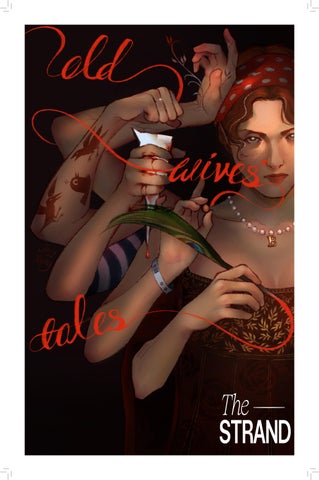
cover illustration jessie yang
The Strand has been the newspaper of record for Victoria University since 1953. It is published 8 times a year with a circulation of 800 and is distributed in Victoria University buildings and across the University of Toronto’s St. George campus. The Strand enjoys its editorial autonomy and is committed to acting as an agent of constructive social change. As such, we will not publish material deemed to exhibit racism, sexism, homophobia, transphobia, ableism, or other oppressive language.
Turn the page and lend your ear to a sage. @STRANDPAPER WWW.THESTRAND.CA
@STRANDPAPER THE STRAND | 16//OCT//2025
OPINIONS 05
Breaking the silence My grandmother, or Why I write SILAS BUSBY STAFF WRITER
M
y grandmother is at once a beloved and mysterious figure in my life. She’s the sort of person who can keep a secret for a lifetime or share it at the right moment, to everyone’s surprise. Given that she is a Métis woman and was born in 1950, this has served her well, but her silence came at great personal cost. Many people can relate to the agony of hiding behind façades for safety, but few among us can imagine having to do so for 65 years. Silence like that comes from a place of shame, and much is lost to its placid infinity. Silence is so dangerous that it can kill a memory, a language, a history, even a whole person if left unchecked. I’m constantly aware of these carbon monoxide silences, yet I’ve found myself keeping some of my own. I suppose I should start by saying that the long silence of my family did not start with my grandma. There have been no fluent speakers of Cree in my family for the past four generations. As a language, Cree has been lucky in that it has thus far avoided the twin threats of radical and gradual language death, which loom over many Indigenous languages in Canada. Ethnologue, a global linguistic encyclopedia, assigns it an Expanded Graded Intergenerational Disruption Scale (EGIDS) status of five for “Developing,” which means that it is generally considered safe—for now. The EGIDS scale measures disruptions in the transmission of language from one generation to the next, along with the sociopolitical factors that support or disrupt that transmission. Factors such as the level of institutional support the language has, the amount of opportunities to use the language outside the home, the economic opportunities tied to language competence, and social attitudes towards the language all play a part in a parent’s decision to transmit one language to their child over another. When the intergenerational transmission of a language is disrupted in favour of another language at a societal scale, this is called ‘language shift,’ which can ultimately result in language death. What we lose with language death is more than a code of meaning; we lose stories as they were originally told. We lose expressions, unique jokes, songs, prayers, culture, identity, and community. My grandma’s family began shifting away from Cree before she was born. She never got to inherit much of who she was, and what she did inherit, she hid for safety from violence and shame until the world had changed enough for her to breathe out again. As I grew old enough to understand what this meant, I began to realise that I had a responsibility to be a listening ear for anything that she might be able to share, to carry her memory and the memory of her foremothers forward, so that the world might remember what it tried so hard to forget. Listen, I did.
I still listen to her for hours when I’m in town, and I call home when I can, but something changed when I came to university. Very quickly, I learned that I had to be selective in sharing stories and in discussing what those stories mean to me. In such settings, people can be very quick to objectify or prod the storyteller, or even signal disapproval of them when they encounter a story they’ve never been told before. That’s not a bad lesson to learn in and of itself—discretion is a valuable skill. I fear, however, that I tend to take things beyond discretion. Although my reasons are different and my silence on the matter is less complete, I have been increasingly hesitant to speak about my identity as Métis, more reluctant to share my family’s history, and less willing to explain the reasons I do the things that I do. What good does it do for me to have these stories if I do not tell them? Stories like my grandma’s need people who will tell them, learn from them, and share the insights they glean from them. They need to be represented in the public imaginary for them to mean anything. If you ask me why I write my opinion pieces on a day when I’m feeling generally gregarious, I might tell you that it’s because I have too many opinions and writing one down from time to time keeps me sane. This is mostly true. I do have too many opinions, and writing them down does keep me sane. Occasionally, though, I write to tell a story. Sometimes, these stories generate a bit of a buzz. It seems that this is at least somewhat correlated with the times I talk about being Métis. I shouldn’t be surprised by this, and I suppose I should even appreciate it, even if it scares me and some of the attention is disrespectful or objectifying. It is important to the survival of these stories, points of view, and experiences that I continue to break the silence around them when I can. My grandma was born in a small town called Wabamun, about forty-five minutes west of Edmonton. It sits on the shore of a lake with the same name. The name comes from the Cree word wâpamon, which translates to “mirror” according to the itwêwina Plains Cree Dictionary. In many ways, listening to my grandma’s stories and experiences has been like gazing into a lake and seeing a little more of her in my distorted reflection. I don’t know if Wabamun Lake is as glassy as it once was when someone first thought to compare it to a mirror. I can guarantee that there weren’t smokestacks and oil refineries towering in the distance. Still, I think of that lake, my grandma, and the person I’ve become every time I see my reflection in a body of water. I hope that one day, I’ll be able to pass that on to someone. Maybe I’ll even learn Cree.
Oral Tradition in Kenya’s Gikuyu Tribe JULIA MCCARTHY ASSOCIATE OPINIONS EDITOR
T
his month’s issue had me reflect on the value of stories, lessons, and practices passed down within families and cultures, particularly through women’s conversations. These “wives’ tales” can transcend the passage of time and nurture a legacy of profound, and at times eccentric traditions, that generations of people live their lives internalizing. When thinking of some of the wives tales told to me when I was younger, many stemmed from my grandmother, who, coming from an Irish Catholic background, has a plethora of tips and tricks passed down through the women of our bloodline; some of which I still use today. It wasn’t until I was hosting a dinner party for friendsgiving and burnt my wrist on a pan that I thought of the age-old trick of applying butter to my burn. Some of my friends were confused by this; what I considered a common home remedy turned out to be a folk myth. Despite its inefficiency in treating burns, something I discovered later on, I still felt an obligation to uphold this tradition of treating my burn like my grandmother would when I was a little girl. I reflected on this deep respect for familial tradition and heritage while exploring matrilineages around the world, specifically in Africa. The Kikuyu tribe in Central Kenya situates itself as a prime example of female influence embedded in the everyday social norms of a community. This tribe entertains a rich legacy of honouring moth-
ers and wives, with due emphasis placed on the creation story of this group. It is believed that Mumbi (Creator of the Universe) offered nine daughters to Kikuyu, placing them at the head of the tribe, to serve as leaders, administrators and familial authoritative figures. This unconventional system of matriarchal dominance is the very foundation of this community, despite its eventual transition to a patriarchy. This critical cultural story has woven its way into every aspect of social dynamics within the community, serving as a cornerstone of female presence and dignity through the practice of oral storytelling and omnipresent customs passed down through the females of each generation. “Wives’ Tales,” while serving as funny traditions, stories or even as home burn remedies, can be interpreted as so much more. Without their presence in various cultures around the world, years of tradition and cultural traditions are lost, or remain unexplained. Remaining curious about the origin of these stories can enlighten centuries-old social practices. The stories of our mothers, grandmothers, and great-grandmothers demonstrate lineages of struggle, gender dynamicism, and can even serve to explain the origins of culture, such as Mother Nature, and the women of the Kikuyu Kenyan tribe demonstrate best.
EDITOR | ROMINA EMTYAZI OPINIONS@THESTRAND.CA
06 OPINIONS
Life hack: use my referral link How the Internet is lying to you about making your life better EDWARD PHILLIPS CONTRIBUTOR
CREDIT//RUOXI LIANG
O
ftentimes, when misinformation enters the public conversation, it’s on a systemic or platformed scale, be it from the government, fake news sources, or fudged medical or academic resources. We see it in niche communities’ claims about vaccines and Tylenol singlehandedly causing autism or in the politicization of shooters’ motives and backgrounds. I think what we often fail to consider, or even actively notice, is lower-stakes misinformation infiltrating our consciousness through small but constant messaging in the digital sphere. I remember coming across the Spiders Georg meme as a kid, an overexaggerated joke explanation for the dubious factoid that we, on average, swallow three spiders in our sleep every year. The post claimed that the fictional being, Spiders Georg, was actually responsible for the creation of this average, as he eats thousands of spiders in his sleep while living in a cave. I believe Spiders Georg is a harmless bit that came from an era of the Internet where things were more, well, human. The Internet wasn’t so blatantly commercial in 2013 when Spiders Georg originated. Much of current online misinformation is politically driven, while also having an aspect of ‘rage baiting’ or ‘engagement farming’ attached to it—the practice of saying anything to get a reaction in order to have people arguing with each other in their comment section. Many creators now purposefully curate content with the intent of provoking those who disagree with them to post angrily in their comments. That, in turn, leads to people who agree with the initial content defending it and arguing back. In a time when engagement farming and rage baiting have become profitable, what is our modern-day Spiders Georg? What kinds of commonplace misinformation may not tangibly affect us, yet still leaks into our understanding of culture and sense of self? Personally, I see two distinctive versions of this kind of misinformation. The first is more in the background. If you use any of the slot-machine style, short-form content scrolling apps like TikTok, YouTube Shorts, or Instagram Reels, you’re likely familiar with viral sitcom clips sharing the vertical space with some ASMR-adjacent DIY craft or mobile game. So many of these crafts look terrible, are dangerous to use, are simply impossible, or entirely falsified. I have seen people mix cleaners that would inevitably create mustard gas, claim to fill holes in their floor with sunflower seeds and superglue, and flip food by turning the pan instead of just using a spatula. These ‘life hacks’ are only to provide
an additional visual stimulus, and if they were to be recreated, they would be useless, damaging, or even dangerous. The second version is the poorly hidden advertisements for cheap, dropshipped products disguised as daily time-savers or miracle products. These are everywhere. The next time you’re scrolling and are seemingly blessed with the visage of a real person on your timeline, take a closer look: check what product they’re using and click on their account—you will see a link to what they are selling. Recently, these short-form video apps have implemented their own in-app ways to sell these products. TikTok Shop lets creators tag featured products directly in videos, a feature now mirrored by YouTube and Instagram. Both these life hacks and these hidden ads are examples of video content we are taught to passively ignore, as we are meant to focus instead on the Family Guy funny moments sharing the screen, or the beautiful influencer in her beautiful home who just so happens to be enjoying Bub’s Swedish candy with a handy link in the lower left-hand corner. But this constant bonus content is passively entering our psyche. Being advertised to isn’t new, but the viral onslaught of being sold to without being directly told we are consuming advertisements is. Social media companies are constantly seeking new ways to sustain monetization on short-form platforms. As short-form video platforms integrate AI, the next step in this process has already begun. Much of the digital advertising space is being both created and consumed by AI, and the social media landscape is soon going to be covered by it just the same. The ultimate expression of this is the recently announced fully AI social media platform, Vibes, by Meta. Announced just last week, Vibes is a platform where users can post videos created and edited with their AI software. The announcement of Vibes was quickly followed by OpenAI’s Sora—a conceptually- similar app to Vibes—and the implementation of AI video creation tools on TikTok, YouTube, and X. The outcome of this will be a supposed “social media” platform with nothing but generative AI-produced slop. Whether you can claim this is either “social” or even real “media” is, in my opinion, highly debatable. There is no human element besides Vibes’s nebulous prompting, and I doubt they will provide a way to confirm the identity of who is behind the prompts, users, or brand. As annoying as constant online sales pitches can be, at least their products leave you with something tangible, however useless it may be. In the case of Vibes, what is there to gain or worthy of passing along to viewers? Being lied to and told our lives could be made easier by actual products, or that there is a single purchasable solution to life’s problems at least offers the illusion of self-improvement. . Given that we are accustomed to being sold to constantly, as draining as it may be, we can potentially learn to recognize and avoid being entrapped in subtle marketing for TikTok garbage. At the very least, that human element of a real person trying to exploit us has a face for us to be annoyed at. Vibes even strips that from us. If every layer of something is a lie, down to the process of its inception, then there is nothing to possibly gain from it.
MOVIES Sans Solei: Chris Marker Zen for Film: Nam June Paik Universal Language: Matthew Rankin The Beast: Bertrand Bonello Standard Time: Michael Snow Surface Tension: Hollis Frampton Teenage Hooker Became Killing Machine: Nam Gee-woong
@STRANDPAPER THE STRAND | 16//OCT//2025
SCIENCE 07
Tales of the megalodon Could the monster shark still live? JIAXIN SHI CONTRIBUTOR
A
lone fisherman stands on a puny boat rocking out at sea, accompanied by chilling bass music in the background. As he points to the shore, the camera zooms in on a whale carcass with its tail completely severed. The video fades to black, and thick, serif letters fill the screen: “A bite that size couldn’t have come from any known shark.” The text then claims that local marine biologists identified the attacker as a megalodon. This describes a clip from Discovery Channel’s documentary, Megalodon: The Monster Shark Lives, an ostensibly scientific documentary on the extinct otodus megalodon, also known as the megalodon. It was the largest fish ever known, with data analysis suggesting that adults averaged 10.2 metres in length and that the largest specimens could reach up to 17.9 metres. Their bite was equally impressive, with the largest known fossilized tooth measuring 17.8 centimetres—nearly three times the length of modern white shark teeth—and a bite diameter of three metres. Their fossils have been found in the waters surrounding all continents except for Antarctica. These records indicate the shark lived 23 million to three million years ago, from the early Miocene to the end of the Pliocene Epoch. A popular theory is that the megalodon has survived and remains at large. However, this is unlikely, given the megalodon was a coastal shark that mostly inhabited the shallow areas close to shore. These areas are very well documented and often frequented by humans. If the megalodon remained alive, sightings would be common. The existence of such an apex predator would also affect the entire ocean food chain. Modern whales, for example, are thought to
have evolved to their gargantuan size after the megalodon’s extinction, with no large predators to hunt them anymore. In addition to physical sightings, scientists would have found prey animals with megalodon bite marks. Of course, no such evidence has been found. We would also expect to find teeth, as sharks continuously shed them throughout their lifetime. However, no megalodon teeth have been discovered since they disappeared from the fossil record over three million years ago. These signs all point to the megalodon being well and truly extinct. In the face of all this evidence, people continue to believe in its existence and report megalodon “sightings.” One such case turned out to be a school of small fish as opposed to one large fish, and another case was speculated to be a basking shark—a filter-feeding shark that is nearly the size of a double-decker bus. What is it about these bygone creatures that charms us so? Is it simply the novelty factor, the sheer wonder and amazement for an animal which we’ve never seen before? Or is it due to its sheer size and ferocity? Whatever the reason, perhaps instead of wasting our time speculating about extinct species of the past, we should focus on those in the present. There are thousands of wondrous species that are endangered today, and if we are not careful to preserve them, they will not live to see tomorrow. They could very well become the next megalodons: beautiful specimens preserved in the fossil record which our descendants can only dream and fantasize about.
Prions An immortal pathogen MARK N. METRI CONTRIBUTOR
F
unerary cannibalism, pathogens both immortal and fully lethal, rapid and relentless psychosis, insomnia, starvation. Prions may occupy the same space in pop culture as Casey Anthony and plane crash dissections. Real-life horror stories permit us to feel a sort of safe terror. For many of us, a typical Saturday night involves copious amounts of fast food accompanied by spooky video essays about the loss of human life. This kind of lapse in empathy requires us to believe that whatever is experienced by the human subject of the video is extremely unlikely to impact us or our loved ones. True crime has been criticized for inciting this alienation; in the effort to dramatise tragic events, the genre ultimately trivialises them. This could also be true for prions. On that account, it is good for our hearts that we get serious and learn about prions. I know, very boring. But, in the words of David Lynch, “Fix your hearts or die”. In 1982, Stanley Prusiner identified the “proteinaceous infectious particle,” which he coined “prions.” This was a paradigm shift. Before Prusiner’s discovery, all pathogens were believed to carry some form of nucleic acid, RNA or DNA. Prions do not. Pathogens need to replicate to survive, and nucleic acids are really the only way for a virus or another pathogenic organism to stably replicate itself. This does not apply to prions. Before 1982, diseases like Kuru and Creutzfeldt–Jakob disease (CJD) were known as “slow viruses” due to their potential for long incubation periods before rapid disease onset. Prusiner demonstrated that these pathogens were effectively immortal; he subjected them to treatments that destroy nucleic acids and showed that they retained their infectiousness. Prusiner linked the prion protein (PrP) to these diseases. PrP, the protein that causes CJD, Kuru, and fatal familial insomnia (FFI), is expressed in all our brains. You might be terrified or, at the very least, confused if you don’t know anything about protein folding. In short, when your proteins are made, they fold into complex structures which directly inform their function. PrP can generally exist in two
main forms. The common, healthy form is cellular prion protein (PrPC). The scary one is scrapie prion protein (PrPSC), named after a prion disease affecting sheep. In general, prion disease occurs when PrPC misfolds, adopting a PrPSC conformation. PrPSC is thought to act as a template for the healthy PrPC to misfold. In other words, PrPSC is infectious. You can develop prion disease in a few ways: inheritance through mutations in the PRNP gene; infection by exposure to PrPSC in a lab, a factory, or on your plate; or sporadic cases, caused by the spontaneous misfolding of PrPC. To make life hard for scientists, sporadic prion disease doubles as the most common and confusing form. Much of today’s research into prion disease involves studying the structures of PrPC and PrPSC, the conditions that favor misfolding, and how exactly PrPSC causes the brain to devour itself. Prions kill fewer than 100 Canadians each year, so what is the use in dedicating time and public resources to study them? I’ll offer two related justifications. First, PrP is not the only protein that spreads its own misfolding. Alpha synuclein, associated with Parkinson’s Disease (PD) and Dementia with Lewy Body (DLB), and amyloid beta, associated with Alzheimer’s Disease (AD), are both well-expressed proteins that have been shown to sporadically misfold and propagate in the brain in a prion-like fashion. PD, DLB, and AD are significantly more common than CJD, Kuru, and FFI. This leads into my second point. Studying the way PrP misfolds and destroys brain tissue will lead to collateral discoveries about broadly applicable topics, such as neuroinflammation and cell death, thereby improving our understanding of how the brain functions and how to protect ourselves from neurodegeneration.
EDITOR | BOSKO GARACA CULTURE@THESTRAND.CA
08 ARTS & CULTURE
Living in a fantasy “Playing house” in the ROM’s European exhibit AMY YANG SENIOR COPY EDITOR
What is the point of a mueseum? What is the point of a mueseum? CREDIT//AMY YANG
P
ray tell, what is the point of a museum? Is it to learn about a foreign culture, brought to you, laid out before your feet? Is it to remind yourself that history still exists—that it’s real—to “ooh” and “ahh” at all the pretty things before you return to a real life someplace else? Or is it to play house? The Royal Ontario Museum (ROM) has been Victoria’s neighbour for over a century. It stands imposing and grand on the other side of Avenue Road, fitting right into the landscape of our historical campus. Many first years go on field trips there. Orientation parties are held beside the dinosaur fossils, next to the East Asian displays. However, just upstairs, tucked into the third floor of the Weston Family Wing, is a glistening treasure that makes all else seem bleak. Despite having one of the largest collections of Chinese artefacts outside of China, something is lacking in the China exhibit on the first floor of the ROM. A similar deprivation can be observed in the Korea, Greece, Rome, and Egypt exhibits. Upon first walking into the East Asian wing, there is simply too much to see. Everything is piled in a labyrinth of tall displays, innumerous versions of each item lined up behind murky, bizarrely green-tinted glass. The entire space is dimly lit (though I understand some objects may be sensitive to light, sometimes it’s like the ROM is afraid of its electricity bills). Beautiful porcelain vases are hidden on bottom shelves, tapestries near decay from the lack of eyes that feed them (because that is how history survives—when you interact with it and create a space for it in your mind). It incites aimless wandering. It’s almost designed to be forgotten. Hunting for object labels is like a scavenger hunt. Placards beside glass cases give vague descriptions about the periods and the art styles, but I can never tell where one period ends and another begins. I know more about who curated these objects than what they are or where they’re from. According to the ROM website, “some artworks are so unique to ROM, there are none other of their kind on display in the world, not even in China.” Is this a fact to be proud of? Many of the Chinese artefacts were excavated from Chinese soil by Canadian United Church missionaries in the early 1900s, a period of vast turmoil in all of China, when laws on the exportation of culturally significant artefacts had not been created. Objects were bought for cheap and shipped to the ROM by the thousands before Chinese locals even knew they existed. All this
treasure was acquired for very little money—it’s displayed like it too. Two floors up, double doors open into the John David & Signy Eaton Court. A mosaic on the ground paints an image of the globe, and you’re greeted by what is almost an altar, with wings branching off on each side. In the dim room, gold artefacts glisten against red velvet. The display cases are in-lit, beautiful and consistent. Turn to the right and you will see a map ready to guide you through Europe: Evolution of Style. A winding path from room to room leads you in linear fashion from the Medieval Ages to modern times. Little booths play period music along the way. Statues on their altars glow beneath spotlights. Clear glass cases are framed by polished wood—framed, as art should be. Arches and colours divide each era as the wallpapers and flooring change for each display. Silver is polished and shining, especially beautiful pieces are illuminated, arrangements are tastefully made, and everything radiates intention. The space helps tell a story as much as the artefacts themselves. The lighting feels like the halos in Baroque paintings, brushing every artefact in a stroke of divinity. The most impressive feature is the vast displays—the lifesize recreations—of living spaces, from Tudor bedrooms to Rococo dining rooms. Pieces like chests, chairs, writing desks, and sewing kits are placed in context, creating spaces using period-accurate materials that showcase not just how artefacts look, but how they were lived with. Small items are used to imitate life, like coins tossed on nightstands, napkins askew on dining tables, and religious figurines sitting on fireplace mantels. Dresser drawers are half open, for animation but also display. The attention to detail is astounding. Some rooms show out-of-period artwork that was popular at the time, like the Greek vase sitting in the Neoclassical display. Whereas objects in the Chinese collection are labelled scientifically (though often lacking details), most of the artefacts on display here are not labelled at all. Where the China exhibit is meant as education for the West on the East, this collection is equally for education as for pleasure. It offers a window into a bygone life, representing a fantasy, a European ideal, that was never attainable for most of the people viewing it now. You are immersed not just into a past life, but into the past life of the most wealthy and privileged people at the time. The result is breathtaking. After witnessing both sides of what the ROM can do, there is no help but feeling like the different intentions that went into these exhibits are value judgements of what is important, what is beautiful, and what is worthy of remembrance. One shines, because it is allowed to. One will be remembered, because it evokes emotion in its viewer. The European exhibit is not just a display; it is an experience. It tells a story not through placards, but through space, ambiance, and lighting. Context is given not through labels, but what can be considered a performance. Imagining yourself in those curated rooms, fantasising about that ideal life, playing house—this is a performance, and it is one that is remembered. The more ‘foreign’ artefacts of the ROM fall victim to cultural and political sensitivity, but there is a line between carefulness and neglect. Beautiful artefacts from all corners of the world deserve to be remembered as the ROM’s European collection is.
because it is allowed to CREDIT//AMY YANG
@STRANDPAPER THE STRAND | 16//OCT//2025
ARTS & CULTURE 09
Nuit Blanche 2025 The city comes alive with colour and messages of resistance and hope SOFIA TERESE GLANTZ ASSOCIATE ARTS & CULTURE EDITOR
O
PROTECT THE SACRED VOICE
n Saturday, October 5, 2025, from sunset to sunrise, Nuit Blanche once again illuminated the streets of Toronto with works of public art. This year, artists from across Canada and the world exhibited works in downtown Toronto, Etobicoke, and York, answering the call to “translate the city.” Downtown, artists responded to the theme through the eyes of their communities. Works of art evoking the diversity of the city—from Indigenous communities to residents of Chinatown and beyond—tell the story of Toronto through the perspective of those who have fought for their place in this city. Among the most thought-provoking works were the Indigenous pieces flanking City Hall. Installations 18 and 16, PROTECT THE SACRED VOICE and FOR THE YOUTH, respectively, surrounded the base of institutional power within the city, clearly stating that the voices of Indigenous communities will not be erased. PROTECT THE SACRED VOICE, a printmaking projection by Portland-based artist Demian Dine’Yazhi, projected the phrase “English is a foreign language! Maintaining beauty requires resistance! Love revolution!” across the doors of City Hall, prompting viewers to think about the language used to create the policies debated and codified within the building. The print’s bright orange colouring and 70s-style fonts drew the audience in, creating a dialogue between the people and their institutions. South of City Hall, a pink pulsating light tempted the audience into the enclave housing FOR THE YOUTH, a rotating performance piece hosted by local Indigenous youths. FOR THE YOUTH rejected any stillness. Between the performances, viewers stood within a circle of pink, red, and orange rotating, patterned lights. Faded photos of Indigenous figures outlined the space. The spotty film photography invited questions about the erasure of Indigenous peoples in the history of Toronto.
CREDIT//SOFIA TERESE GLANTZ
calling on everyone to protect and uplift our Indigenous children CREDIT//CHIARA ZEHNDER
These questions perfectly preluded the performances by Indigenous youth that took place throughout the night. Each performance featured a call-to-action drum circle, “calling on everyone to protect and uplift our Indigenous children,” according to the official description. Within the circle of photographs, a dancer performed the “round dance,” a ceremonial dance associated with healing and renewal. Every aspect of the performance was carefully planned, including the dress worn by the dancer: “It’s a healing dress, and there’s a really big story behind it. It’s about a girl who was really sick, and her grandma and her father made the dress and wanted her to dance…She made it fully around the circle and cheered for her. That’s why the dress is healing,” dancer Waubgenesse Butler explained. The performance, dedicated to Indigenous youth, beautifully combined resistance, hope, and recognition to translate the city’s past into its future, perfectly answering the theme of this year’s Nuit Blanche. Walking down Dundas, the scene came alive with food trucks, crowds, and music. At the corner of Dundas St. West and McCaul, The People’s Dancefloor brought together the themes of community present throughout every artwork in the downtown installations. The People’s Dancefloor, a mixtape created by various artists, projected music videos throughout the night, inviting people to dance, sing, and mingle. Although few danced in the free and fearless way the installation demanded, The People’s Dancefloor was still able to achieve the sense of community it aimed for, and that defined the theme of Nuit Blanche 2025. Translating the City asked the artists to describe the role each person plays within the complexities of the city. Some artworks dealt with the past, others invited hope for the future. But The People’s Dancefloor focused on the present—who do we share this city with, and how can we, for one night, cross the divide together and dance?
EDITOR | LIA IANNARILLI FEATURES@THESTRAND.CA
10 FEATURES
Wake up sheeple? How “crunchy” ideals can go hand-in-hand with right-wing politics AVA FEIR CONTRIBUTOR
T
he term ‘sheeple’ has become popular within many communities to denote groups who are seemingly “brainwashed” by any large institution. But who really are the “sheeple”? And what are they expected to believe when they “wake up”? According to psychoanalyst Manfred Kets de Vries, “Sheeples are commonly docile, compliant, easily persuaded, and inclined to follow the crowd.” In his article “Are You a Sheeple?”, he explains how in times of perceived danger, human brains are wired to imitate those around them rather than seek out the best course of action as an individual. Moreover, he details how easily this phenomena can be taken advantage of. Many leaders have gained power by exploiting this knowledge, and are able to convince millions to believe in conspiracies and propaganda. These theories can gain traction at an extreme rate before they are able to be debased or flagged for misinformation. A 2018 MIT study found that false news is 70% more likely to be retweeted than factual news. But even if they are flagged, there are still believers who may think they’re on the ‘fringe’ of society and know the truth, unlike everyone else. The fringe often represents extreme far-right beliefs, ranging from things that are generally considered conspiratorial or pseudoscientific, to outright white supremacy and radical misogyny. A Southern Poverty Law Center article states, “The Alternative Right, commonly known as the ‘alt-right,’ was a set of far-right ideologies, groups and individuals whose core belief was that ‘white identity’ is under attack by multicultural forces using ‘political correctness’ and ‘social justice’ to undermine white people and ‘their’ civilization. The movement adopted the ‘alt-right’ label to strategically soft-pedal their racist and antisemitic beliefs.” Within alt-right fringe groups on the internet, there is a vast spectrum of beliefs, and differences in what these groups actually distrust. The term ‘crunchy,’ which may seem like a banal internet term, is often associated with mommy bloggers who reject processed food and screen time in favor of “natural” lifestyles for their children. Yet in the same breath, these parents denounce hospital births and medications, promote drinking raw milk, and often endorse restrictive homeschooling. Crunchy Tiktok has become an ecosystem in which health influencers are truth-tellers, while doctors and scientists are trying to keep secrets from the public to make you sick. In this realm of the internet, ‘Big Pharma’ is the enemy, and holistic remedies (often extremely expensive and dangerous) are the key to health, no matter the severity of the issue. These creators say that they are leading the best possible lifestyle for their and their children’s health. They believe that they’ve awoken and emerged from the supposed herd mindset that is the canon of science and healthcare. But by their own logic, these creators may too be victims of the ‘sheeple’ mentality. For Tiktoker Laura (@iamlevelingup), who has made many different videos on the dangers of the “crunchy cult,” it was all too easy to
go from waning the best for your children to supporting fringe conspiracies. She explains how she fell into the crunchy movement and describes the anxiety she felt as a new mother in a state of uncertainty: “You start looking for these accounts that have the tagline and you don’t necessarily recognize any of the dog whistles,” she says. “And then it goes from cloth diapering to toxins, and before you know it, you’ve ended up at flat earth theories.” She is also outspoken about how inaccessible the crunchy lifestyle is, stating “And this is a sticking point for me because the crunchy lifestyle is so rooted in being white. If people of color did not take their kids to the doctor and didn’t vaccinate them, CPS would be there. But white people are getting away with this every single day.” The target for much of the content is the vulnerable, as Laura showcases in her account. It’s no coincidence that these conspiracies are often perpetuated by mothers, who genuinely believe that they are doing the best for their children. What began as a push for a toxic-free lifestyle has spiralled into the “Make America Healthy Again” movement. This slogan comes from Trump’s Secretary Robert F. Kennedy Jr. in the Department of Health and Human Services, a well-known conspiracy theorist. His target audience and biggest supporters consist mainly of mothers, many of whom consider themselves “crunchy.” In an interview with the Guardian, Mikayla Page, mother to a three-year-old, explains “It’s nice to have somebody backing you up, especially a male [such as Kennedy], because I feel like sometimes men take longer to catch on to these things since they don’t have a maternal instinct… it’s nice to have someone like Robert Kennedy and Trump to see these issues.” Despite his track record of promoting conspiracy and pseudoscience, including outlandish claims that a child’s gender identity can be impacted by chemicals in the water, fearmongering surrounding the evils of food dye, the necessity of more organic ingredients, or erroneously claiming that manufacturers are “poisoning” the nation’s children, continues to appeal to crunchy moms and anyone questioning the medical field. The term ‘sheeple’ is often overused in the media (ironically and unironically) to refer to anyone adhering to mainstream political beliefs. But “waking up” from so-called government brainwashing only to fall into fringe Facebook groups and influencer pyramid schemes isn’t the act of individualism or health awareness that people think it is. Just because the majority of scientists believe something, doesn’t make you a critical thinker for believing the opposite. Truly “waking up” is forming your own opinions and beliefs that are based on engaging with research from reputable, non-biased sources, not baseless social media posts. The fact that the hashtag #MAHA has been used in over 224 000 Tiktoks is extremely concerning, and it indicates a worrisome growth in conspiratorial beliefs. This paradigm of the herd mindset only leaves the sheeple more vulnerable to looming predators.
Gin will make you blind!
Piecing together the metaphysical enigma that is my grandmother’s life BRIDGET BOWLES CONTRIBUTOR
“Y
’know, my mother always told me that gin would make you blind, and that’s also what Äiti (Äiti means “mother” in Finnish, but has become synonymous in our family with my great great grandmother’s name) said to her, so I’ve never touched a drop of the stuff in my life!” My grandma has said something like this to me at least a hundred times in the last five years. Typically followed by an assurance along the lines of, “Besides, we’re Finns. We drink vodka.” It’s actually quite a funny thing for her to say. First of all, because I myself am visually impaired regardless of any occasional consumption of
gin, and secondly, because I cannot bring myself to believe that the cosmopolitan phenom of a woman that is my grandmother has never even tried gin. However, regardless of validity, “gin will make you blind” is the sort of story that I have been fortunate enough to inherit from the woman, dating back to conceptions of foreign “North American” alcohols from my ancestors a century ago when they first arrived in Northern Ontario. Maybe Äiti did not think that gin would literally make you blind, but a fear of losing her family and culture in a strange new land is a sort of blindness all the same. Stories like this are the sort of childhood oddities that have been
@STRANDPAPER THE STRAND | 16//OCT//2025
FEATURE 11
reawakened by my grandma’s progressing dementia in the last few years. They cut through the fog of her mind and keep both memory and our family together and alive; both now and across generations. There are people who would disregard the stories my grandma tells as “old wives’ tales” or delusions, and, to an extent, that is fair. Most of the stories she tells through the haze of her dementia are outright ridiculous. She claims to have known Doug Ford as a baby: “He was a scoundrel back then too, I’ll tell you that!” While hilarious and poignant, that is simply untrue. Other stories of hers create inconsistencies in her life. For example, she used to hate tattoos—all tattoos. Cut to about three years ago, we were out for dinner and she struck up a whole conversation with the waiter about how much she loved her tattoos and how they reminded my grandma of others she had admired while travelling throughout South East Asia. I didn’t know she had been to that part of the world—maybe she hasn’t. Still, it was remarkable! There is also the opposite phenomenon, where she is now unable to remember or explain some past detail of her life that I discover. For instance, I spent the summer after first year cleaning out her old house that she had just moved out of after 30 years. I found so many rarities, oddities, precious family heirlooms, and more, but certainly one of the most unique findings was that the sole occupant of the top drawer of her desk was a pristine pocket-sized edition of Chairman Mao Zedong’s Little Red Book. Why on earth…? I was speechless. It was hilarious; it was senseless. Our family had fled to Canada from war with the U.S.S.R.. But, of course, when I asked her about it, she had no words. “Why would I own communist literature? You didn’t find that in my house!” All this to say: my grandma’s stories can be insane. Undertaking the task of trying to piece together a coherent narrative of her life can feel like trying to catch a cloud and pin it down. But I don’t think any of her stories should be disregarded. They paint a complete picture of the woman. Occasionally, in a way that can be easily spun into a factual and chronological account of her life, but, more interestingly, in a way that captures the true essence and spirit of who she is: a vivacious, cuttingly funny, wickedly intelligent, unceasingly kind, and excellent story-teller of a woman. Of course, a factual and abridged account of Lynda’s life could go something like this: In the spring of 1944, while her husband was off fighting German U-boats in the war, my great grandmother, a Finnish immigrant who had come to this country fleeing a different war, gave birth to my grandma. They lived in a neighbourhood of fellow immigrant families in Thunder Bay, Ontario, with no running water or electricity. My grandma took in at least one of every kind of stray animal she could find
and convinced her mother to let them into the house. Across the street from the cacophony of dogs, cats, canaries, turtles, lizards, rabbits, hamsters, fish, and mice, Äiti ran a boarding house for Finnish woodsmen who would regularly tear apart the whole neighbourhood in drunken stupours. Lynda lied about her age to get her first job at fourteen (selling different lengths of wire), and eventually had saved up enough to leave her life of roughin’ it in the Northern Ontario bush behind. She moved to Goderich, Ontario, on the southeastern shore of Lake Huron where she drove a bookmobile. That’s also where she met her first husband, a magazine photographer who would use her as a model in his beauty and fashion shoots. Eventually, she left Goderich and her husband for Toronto, got a job with the airlines, and met my grandfather while travelling in the Caribbean. They had a couple of kids and lived wherever his work took them. They had a fair amount of money, a fair amount of happiness, and a lot of fun: she claims she could spy on Pierre Trudeau and his “mistress” from their house across the street while living in Montreal in the 80s—almost all of the stories from my dad’s childhood are her pulling these sorts of shenanigans. They finally settled down (relatively speaking) in the suburbs outside Toronto, where she became the Grandma in the Grandma’s house that I knew. Still wild, letting me tag along on her travels and adventures, but settled into “Grandma life” nonetheless. But an account like this of my grandma’s life can only scratch the surface of the depths of her character without the added colour of how she tells her story. What she has constructed, even amidst the fog of dementia in this late stage of her life, is a vibrant mosaic of an oral history of both herself and our family. And yes, some of that mosaic can be surmised as “old wives’ tales” along the lines of gin-blindness and baby Doug Ford, but that’s still an accurate assessment of who she is, the people she came from, and the people she has raised up in this world. The stories we have are who we are throughout all time and memory, so maybe gin won’t make you blind, but why shouldn’t we say it does?“the surface of the depths of her character without the added colour of how she tells her story. What she has constructed, even amidst the fog of dementia in this late stage of her life, is a vibrant mosaic of an oral history of both herself and our family. And yes, some of that mosaic can be surmised as “old wives’ tales” along the lines of gin-blindness and baby Doug Ford, but that’s still an accurate assessment of who she is, the people she came from, and the people she has raised up in this world. The stories we have are who we are throughout all time and memory, so maybe gin won’t make you blind, but why shouldn’t we say it does?
Super slick smooth productions Eletronic dance music albums and eps PATRICK IGNASIAK DESIGN EDITOR
S
am Barkers new album, Stochastic Drift, released this April. He co-founded Leisure System, who do a lot of curatorial work for Berghain. His solo work is notoriously ‘percussion-less,’ which is something of a misnomer — there’s no consistent bass drum through line, but even his ambient tracks, like “The Remembering Self,” are composed with wide shakes and collisions. It’s almost dub. It definitely isn’t dub. It’s excessively rhythmic, as in, Barker demonstrates virtuosic control over clouds of sounds and their logical relations. Listen to his 2018 track “Cascade Effect” and its tightly-bound chord stabs in their polyrelationship between envelope and orientation. Very fine modular synthesis. Very danceable. Objekt is, at this point, a popular and highly-regarded performer. He’s made a few club anthems. Your friend who moonlights as Toronto’s fourth-worst stutter house DJ might already be telling you to listen to Objekt. A couple of his mixes have been received positively at Rebel. That’s ok. It’s uptempo bass music with a precise manipulation of sounds and an outside-time structure, and it’s some of the best. “Worm Dance” uses a hybrid breakbeat as a function to determine the density of field recordings. I’ve been listening to Obsidian Tide, a multiaritist album put out by Scopavik in March to celebrate the label’s tenth year of operation. Lots of minimal arrangements with slightly displaced spatial boundaries and surface discontinuities. This just means heavy modulation and heavy
repetition, but I also think this just means micro-, meso-, and macro-scales of canonical drum synthesis initiates a dancefloor disorientation common in these forward-thikning techno styles. Lots has already been said about the outputs of similar record labels, like Hypnus and Semantica. Worth looking into. I love 89! Gloom, an ep by Commodo and Gantz released by Ilian Tapes this May. It’s a super subdued and intuitive dubstep record with an immediate osmotic alteration of the hips. The sonorous material is gyrational in its specific inhumanity — this is seriously sexy music. Lots of heterogeneity in this track that’s clarified by a subterranean intensity which is fully present and intimate. I would be extremely happy to hear this preformed. Rabit’s label, Halcyon Veil, put out SAUSHA’s debut ep: Sausha. I’m imagining that someone reading this somewhen and somewhere else has been to Pep Rally and enjoys that New York reggeaton mash-up sound, and I’m imagining that said person would also enjoy her assembly of industrial and hardcore samples into an image-figure of anonymous darkroom hand and mouth stuff. There are obscure sensations in these variations that I think locates the now-here of youth’s disconnected local experiences. Meaning, we’ll be pretending in ten-or-so years that we’ve always listened to SAUSHA, similar to how today we’re starting to pretend we’ve always been listening to Joeyy.
EDITOR | YAOCHENG XIA SCIENCE@THESTRAND.CA
12 SCIENCE
Grandma was wrong (this time) The truth behind these common old wives’ tales MEADOW MACDONALD CONTRIBUTOR
W
e grew up hearing many tales portrayed as facts, which we took to be real, that might just be true. From what really happens if you swallow gum, to what cracking your knuckles actually does to you, we will debunk and explore the history of common tales you may have been told by your grandma, along with any scientific basis they may have. 1. Chewing gum stays in your stomach for seven years if you swallow it!
Everyone has heard the tale that if you swallow a piece of chewing gum, it will be stuck in your stomach for seven years—presumably because of how sticky chewing gum is. While the origin of this myth is unknown, it is true that gum moves through your digestive system just as quickly as any other food. While not designed to be swallowed and impossible for your body to digest, gum moves harmlessly through your digestive system and will come out in stool (after an appropriate amount of time has passed). 2. You need to eat carrots to have good vision! This myth was originally popularised by World War II propaganda rumours that carrots gave fighter pilots sharp and precise vision. When, in fact, newly invented radar systems were responsible for their precision, not the orange vegetable. The benefits to vision from eating carrots will not be seen unless someone is deficient in vitamin A, which carrots happen to be loaded with. Be careful with this myth; eating too many carrots will turn your face orange due to the large amounts of beta-carotene present in the vegetable! 3. Cracking your knuckles will cause you to get arthritis! While it makes a satisfying noise to some, there is actually some backing to this tale. Though studies find no correlation between cracking your knuckles and arthritis, some studies have found a correlation between knuckle cracking and joint dislocation and/or ligament damage. Knuckle crackers may even have reduced grip after years of this habit! But, no arthritis. 4. If you shave your hair, it’ll grow back thicker! This tale is tempting to believe, with first-hand anecdotal knowledge. Many of us have experienced that when you shave your legs, it looks darker when it grows back. But really, shaving hair does not make it grow back thicker or darker. Instead, by shaving, a hair is given a blunt tip from the razor, which results in the appearance of darker and thicker hair due to the coarse and stubbly nature of the tip. 5. Don’t go out with wet hair, you’ll catch a cold! You can only get sick from viruses and bacteria; wet hair will not make a difference in the presence of those! In fact, the most effective ways to prevent getting sick are washing your hands and avoiding people who are sick—not avoiding going out with wet hair.
RO TA TIONS 1. Animal Engines BY: Tera Tera 2. the development is People of species BY: Xuan Ye 3. Send in the Clouds BY: Silver Jews 4. Superstition BY: Stevie Wonder 5. 1+1 = 13 BY: Aesop Rock 6. Fried Water Twitches BY: Ziyiz 7. Landslides BY: Smashing Pumpkins 8. Choreomania BY: Florence + The Machine 9. Devil Woman BY: Cliff Richard 10. I Am Streched in Your Grave BY: Sinead O’Connor 11.Puritan BY: Widowspeak 12. Seven Year Ache BY: Rosanne Cash 13. Fear of the Dark BY: Iron Maiden
CREDIT//ESAR CHAUDHRY
CREDIT//KORTNEY CHOW
POETRY 13
@STRANDPAPER THE STRAND | 16//OCT//2025
Dear Aurora VICTORIA WAI KEI LI CONTRIBUTOR
My child, I blessed you with beauty, your mother’s first gift. By then we were old and wrinkled already, knew nothing than to toil and trouble in curses of men. I thought beauty could save you. So we spun a childhood like an arras, deep in a forest of sweet soil and honeyed Flora, slumbered in snow-white lies and the lack of a spindle. Be it witch or fairy, whatever but women that they called us. The Fates had another wheel prepared, they do and not even the gods could alter. It is eternal beauty that I see in your eternal sleep. Beauty that I forged myself. Beauty that became your epithet. So tell me, my child, when you walked into that light, did you dream of me? My child. I gave you a voice, deep and charming, for I wanted you to spend your waking hours singing instead of screaming. Their cries web the forest. Our sisters’ daughters, too young to be mothers, too faux to be wives and too real to be women. They fall in gusts, in dusts, crawl in the fingernails of the Fauna, roar at the tips of our wands. We, the lucky ones,
CREDIT//KATE CARACCI
have strayed away from a far more gruesome story. Yet the spindle has a quiet art. She, sister too, spun it, and her sister, sister too, sized it— a tiny string of fate. Which, princess or witch? One grows old, roams in a house which once had a child, holds the hands of her sisters. The other sleeps in youth forever. In this fairytale, you barely talk. Your only song ended in a man’s strange promise and a dream told by a chorus. My child, what is this dream I have bestowed upon you? What is this wish? My sisters have told me about the sister whose scissors put an end to all pulses, red or blue. I took away her blades, for a bit, but not the prick of her needle. Did you tell the Erinyes, in the throat of the hell-hound, your fury? Fury of my sisters and me? Did you spit venom out of your veins and curse the king, the court, the old wives’ games? I never wanted you to be brave. I wanted you happy. My mother, too, thought so for me. Merryweather, she named me. And so did the old wives for their babies and their babies’ babies. They carry until they freeze, sleep in pierced fingers of beauties, buried in layers of dreams like blankets of snow. Until all has forgotten— before I wanted you to grow old, I wanted you happy.
EDITOR | MAX FRIEDMAN-COLE STRANDED@THESTRAND.CA
14 STRANDED
Lies I’m going to tell my children Because sometimes the truth is too hard to explain CHRISTINA PIZZONIA ASSOCIATE EDITOR
B
etween astronomical rent and looming threats of another economic recession, I’ll be the first to admit that the likelihood of me being settled down by the time I’m 30 is somewhat slim. But if by some miracle I do manage to move out and meet someone special (a rich, blueeyed computer engineer, perhaps?), I know there will come a day when my future children look up at me, eyes wide and full of hope, and start asking questions about the city they call home. The problem is, while I could never condone outright lying, the longer I spend in Toronto, the more I realize that not even the best PR team could hide the city’s gaping problems fuelled by the complex ugliness of “NIMBYs,” “budget constraints,” and “provincial overreach.” It’s clear that the best way to address my future children’s questions—without sending them into an existential crisis before they’re teenagers— might involve a few lies… or what I’m going to call “creative storytelling:” The Eglinton Crosstown hasn’t been built yet because the city is currently waiting for a family of tortoises to move out. In 2021, rail engineers discovered a family of endangered tortoises nesting near the future Mount Pleasant station. It turns out the Line 5 tracks currently serve as the perfect training route for a tortoise family with eighteen tortoise children—the phrase “slow and steady wins the race” isn’t exactly true, and the tortoises have been using the track to practice their sprints and help secure a win against those hares. Until the tortoises find a better spot to race (Finch perhaps?), they’re staying put, and the LRT will remain incomplete. Delays on public transit happen because TTC drivers are actually undercover agents, helping the police fight crime across the city. The rumours are true: drivers are a key part of the elusive “Toronto Tactical Corps” (TTC), a group dedicated to helping keep the city safe. They use
their extensive network of buses, streetcars and subways to get around the city quickly, predicting crimes before they even happen. While the delays can be annoying (especially when all you want to do is get home and relax), rest assured that a nefarious supervillain was just thwarted by your driver (maybe ask them for their autograph?). Potholes are purposely not filled in due to fears of another racoon riot. Potholes are prime real estate for Toronto’s growing racoon population—they’re racoons’ absolute favourite place to stash their snacks. When the city filled in potholes without their permission back in the 90s, the racoons rioted, raiding garbage cans across the city and sending homeowners into panic. Traumatized by the scheming racoons, the city has chosen to leave the potholes as they are in hopes of appeasing the ever-growing raccoon population. The Ontario Science Centre was shut down because visiting palaeontologists discovered dinosaur bones there. Last year, visiting researchers from the University of Toronto discovered bones from the mythical dinosaur Torontosaurus regalis. T. regalis was thought to have lived in what is now Toronto during the Cretaceous Period, but its existence had never been confirmed—until last year, that is. In order to complete a proper examination of the bones and maintain the integrity of the dig site, the Science Centre was closed permanently—and will eventually become a condominium to house future paleontologists. Truth be told, I don’t know how believable these lies really are. But child or not, I think we could all do well to take a moment and forget about the cold, harsh reality of the world we live in, and choose to embrace the whimsy.
You can lead a horse to water But can you make it drink? NATALIE RADULOVIC CONTRIBUTOR
Y
ou can lead a horse to water, but you can’t make it drink, the old adage goes—but is that really true? According to University of Tolfetano hippologists, here are the top ten ways you can make your horse drink:
horse will feel as if it’s not alone in not drinking the water. Cows, however, are different. If you don’t hold them back, they will immediately start peer pressuring your horse to drink the water. (As is common knowledge, horses are too insecure to resist conformity.)
1. Stop horsing around—if you don’t act serious, your horse won’t think you’re serious about you wanting it to drink the water. 2. If it’s a gift horse, look it in the mouth—it will get self-conscious about its poor oral hygiene and start drinking water to cover up the smell of its halitosis. 3. “I’m so hungry I could eat a horse” isn’t just an expression—it’s a threat. Tell your horse that you’ll bring over a ravenous person unless it drinks the water. 4. Horses care about their well-being a lot, as can be inferred from the phrase “as healthy as a horse.” To use this to your advantage, you should surround your horse with junk food to scare it into getting closer to the water. (Once it’s been stuck for a while, with nowhere to escape, it will become dehydrated and be forced to drink the water.) 5. The phrase “hold your horses” is advice you should follow—releasing horses will just reaffirm your horse’s hesitancy to drink, as now your
6. You should beat a dead horse to let your own horse know that if it doesn’t drink the water, it will be next. 7. Make it a water-drinking contest and invite a dark horse to the competition—the dark horse will win suddenly and unexpectedly, which will motivate your horse to get better at drinking water (be warned, a Karate Kid-style training montage will ensue). 8. Get off your high horse! (Intoxicated horses don’t want to drink water if they’re being sat on—it makes them paranoid.) 9. Bring a Trojan horse filled with many little horses. At night, they will come out of the larger Trojan horse and ambush your actual horse, forcing it to drink water. 10. Last but not least, ask your horse why it doesn’t want to drink the water! (You should always get your info straight from the horse’s mouth.)
STRANDED 15
@STRANDPAPER THE STRAND | 16//OCT//2025
Max’s tangentially-related music corner A not-exactly-thematic overview of some of the year’s releases MAX FRIEDMAN-COLE STRANDED EDITOR
T
here exists an old wives’ tale that says a composer is destined to die after releasing their ninth symphony. I know very little about the truth behind this tale, but I am grateful to it nonetheless, since it serves as the tenuous bit of thematic linkage I need to dedicate a significant chunk of Stranded to my music opinions. As such, here comes my breakdown of some interesting recent releases. You’ll love it, as long as you can forget what this issue is supposed to be about. Wednesday – Bleeds Music to overdose on cough syrup in a forest to. Wednesday’s Bleeds is countrified shoegaze that breaks refreshingly from most country music in that it depicts life in a small town as almost entirely undesirable. It’s also sort of an intraband breakup album between the lead singer and lead guitarist: imagine Rumours if Stevie Nicks wrote all the songs and Lindsey Buckingham had to express his anger only through fuzzy guitar solos. One to spin: “Wound Up Here (By Holdin’ On).” Geese – Getting Killed
“I was in love, and now I’m in hell,” says Geese frontman and bellowing soothsayer Cameron Winter on “Bow Down.” He’s right, if hell means having a billion smug RateYourMusic guys pretending that your new album isn’t amazing because they want to be contrarian about Pitchfork giving it a 9. Getting Killed sees Geese graduating from the psych-rock hero worship and LSD-cowboyisms of their first two albums and embracing an ethos more inspired by Winter’s superlative solo work. It’s weird, it’s heartfelt, it rocks. There’s not much more you could want, except for producer Kenny Beats to have thrown in a “woah, Kenny” at some point. One to Spin: “Long Island City Here I Come.” Car Seat Headrest – The Scholars One of last decade’s best and most acclaimed indie rock bands returns with an ambitious rock opera about a fictional university. Unfortunately, the listener seems to need a university degree of their own to parse what the hell is going on without the liner notes, which are included only in the gatefold of the album’s vinyl release and not otherwise published. On the one hand, this is a pretty funny vinyl sales strategy in its shamelessness, but on the other, it completely hamstrings the album as a work of art. Imagine Taylor Swift’s hilariously indulgent four-different-colours Midnights vinyl release, but if you didn’t have all four colours, the album played with all the proper nouns removed. Without context, the listener is left to stumble through the record’s assemblage of promising-but-shaggy songs, never quite knowing what’s going on. For a band that so eloquently translates the emotions of confusion and insecurity to song, this may be intentional – but that sure doesn’t make it work. One to Spin: “Gethsemane.” Stereolab – Instant Holograms on Metal Film It’s a Stereolab album, guys. Do you like synthy lounge jazz? Do you like left-wing political radicalism? If you answered yes to both questions, you’ll love it. If you answered no to either, you’ll almost certainly find it intolerable. For the past few decades, Stereolab has been very sonically consistent. Though they began with a rougher punk edge, every album post-Emperor Tomato Ketchup has sounded like someone gave Burt Bacharach access to Pro Tools and a copy of Das Kapital. It’s a sonic and lyrical formula that’s almost guaranteed to divide opinion, but I’m an absolute sucker for it, and I will continue to be so until the members of Stereolab either hang up their vibraphones or perish while fighting in some revolution or another. One to Spin: “Melodie Is a Wound.”
CREDIT//ESAR CHAUDHRY
EDITOR | ZOE DELIGIANIS POETRY@THESTRAND.CA
16 POETRY
Milk comes when the bell rings The lives of 83 Robinson Street IVY MORGAN CONTRIBUTOR
The floorboards have something to say; they moan and carry on while she tries to work. That tune she hums quiets their cries. Flour. Water. Mix. Feeling risky, she takes two grains of salt. Mix again. They taste like tears. Like suffering, like crying, like floorboards creaking. Asking for a break. Her cotton, her white purity strangles her favourite pastime: gazing up at the cracks in the ceiling. Murmurs make way, and muted mumblings of histories, painting stories on walls, light through stained glass windows tall enough to taunt her dampened dreams. Leaving a kidnapped life. Her hopes linger with a lakeview on top of a turret. The milk comes when the bell rings. Open the grate at the top of the door for a peak at the man, who breathes fresh air. Watch him leave, to live. No thought for her time stuck between bricks. Poke holes, seep through the present and into the future. Eyes widen through the grate, help, a lie to God that this house is a home, that life could mean more than a wafer thin excuse for a waxed and sealed invitation. She’ll wait for her free pass. Her chance at heaven.