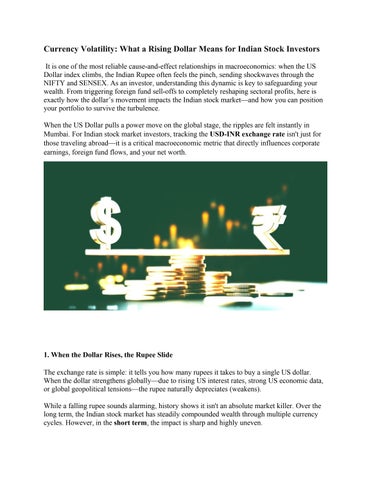
Currency Volatility: What a Rising Dollar Means for Indian Stock Investors It is one of the most reliable cause-and-effect relationships in macroeconomics: when the US Dollar index climbs, the Indian Rupee often feels the pinch, sending shockwaves through the NIFTY and SENSEX. As an investor, understanding this dynamic is key to safeguarding your wealth. From triggering foreign fund sell-offs to completely reshaping sectoral profits, here is exactly how the dollar’s movement impacts the Indian stock market—and how you can position your portfolio to survive the turbulence. When the US Dollar pulls a power move on the global stage, the ripples are felt instantly in Mumbai. For Indian stock market investors, tracking the USD-INR exchange rate isn't just for those traveling abroad—it is a critical macroeconomic metric that directly influences corporate earnings, foreign fund flows, and your net worth.
1. When the Dollar Rises, the Rupee Slide The exchange rate is simple: it tells you how many rupees it takes to buy a single US dollar. When the dollar strengthens globally—due to rising US interest rates, strong US economic data, or global geopolitical tensions—the rupee naturally depreciates (weakens). While a falling rupee sounds alarming, history shows it isn't an absolute market killer. Over the long term, the Indian stock market has steadily compounded wealth through multiple currency cycles. However, in the short term, the impact is sharp and highly uneven.
2. The FPI Connection: Foreign Portfolio Investors (FPIs) are a massive liquidity engine for Indian equities. When the dollar strengthens, two things happen that make them nervous:
Shrinking Dollar Returns: FPIs invest in rupees but measure their returns in dollars. If the Indian stock market gains 12% in a year, but the rupee depreciates by 5% against the dollar, the investor’s actual return shrinks to roughly 7%. Flight to Safety: A strong dollar usually correlates with the US Federal Reserve keeping interest rates high. When US bonds offer high, risk-free yields, foreign funds often sell their emerging market assets (like Indian stocks) and pull their cash back home to safety.
FPIs sell stocks: They convert their Rupees to Dollars to take them home Dollars spikes The Rupee weakens further More FPIs panic and sell.
Demand for
3. Sector Rotations: A fluctuating currency acts as a double-edged sword. It creates clear corporate casualties, but it also creates massive profit centers. The Winners (Export-Heavy Sectors) Companies that earn in dollars but spend in rupees get an immediate, effortless margin boost when the dollar rises.
Information Technology (IT): Giants like TCS, Infosys, and Wipro price their overseas tech contracts in USD. When those dollars are converted back into a weaker rupee, revenues instantly look inflated. Pharmaceuticals: Indian generic drug manufacturers exporting heavily to the US and Europe experience similar margin expansion. Textiles & Auto Components: Any contract manufacturer exporting goods abroad becomes more globally price-competitive.
The Losers (Import-Dependent Sectors)
On the flip side, companies that buy raw materials from abroad find their input bills skyrocketing. Oil & Gas / Paints / Chemicals: India imports over 80% of its crude oil, which is priced strictly in USD. A weaker rupee means local Oil Marketing Companies (OMCs) and paint manufacturers (who use oil derivatives) face severe margin compression. Aviation: Airlines pay for aircraft leases, maintenance, and aviation turbine fuel (ATF) primarily in dollars. A rising dollar hammers their profitability.
Aviation & Consumer Electronics: Components like microchips and smartphone screens become significantly costlier to import, forcing companies to either absorb the loss or pass the cost to consumers, risking lower demand 4. Inflation and the RBI A strong dollar creates what economists call "imported inflation." Because essential commodities like oil, fertilizers, and electronic components cost more rupees to import, the general cost of living in India pushes upward. To combat this inflation and defend a rapidly falling rupee, the Reserve Bank of India (RBI) typically responds by keeping domestic interest rates elevated or dipping into its foreign exchange (Forex) reserves to buy rupees. High interest rates make corporate borrowing expensive, which can temporarily cool down high-growth sectors like Banking, Real Estate, and Auto.