
From
From
Beutler Marketing Group
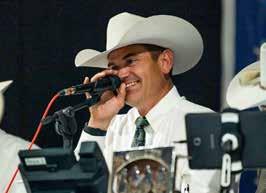
BMG, ring service
Bloomfield Livestock
Brit America Mgmt. Group
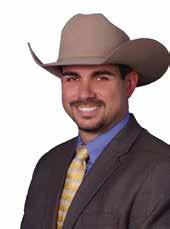
Carter, Dustin - Auctioneer
Conover, Auction & Insurance
Cummings, Charly - Auctioneer
Curless, Brian - Auctioneer
Goggins, Greg - Auctioneer
Hawkeye Breeders
Hoop Beef System
JDH Auction Enterprises
Layton Auction Services
Livestock Digital
Livestock Digital, horse promo
Lowderman, Cody - Auctioneer
Lowery, Matt - Auctioneer
Machado, Rick - Auctioneer
Millborn Seeds
Olympic Genetic Center
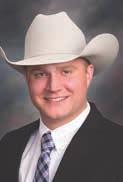
Printz, Matt - Auctioneer
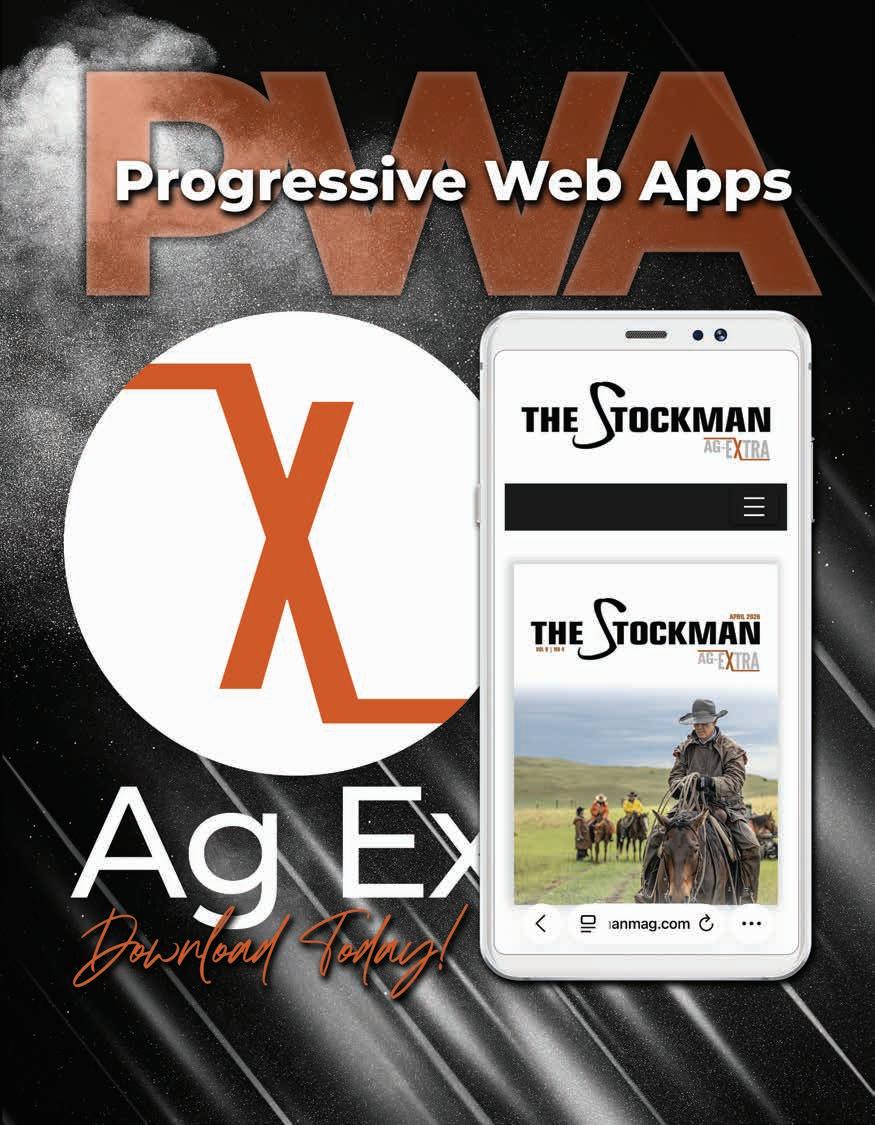
Progressive Web Apps
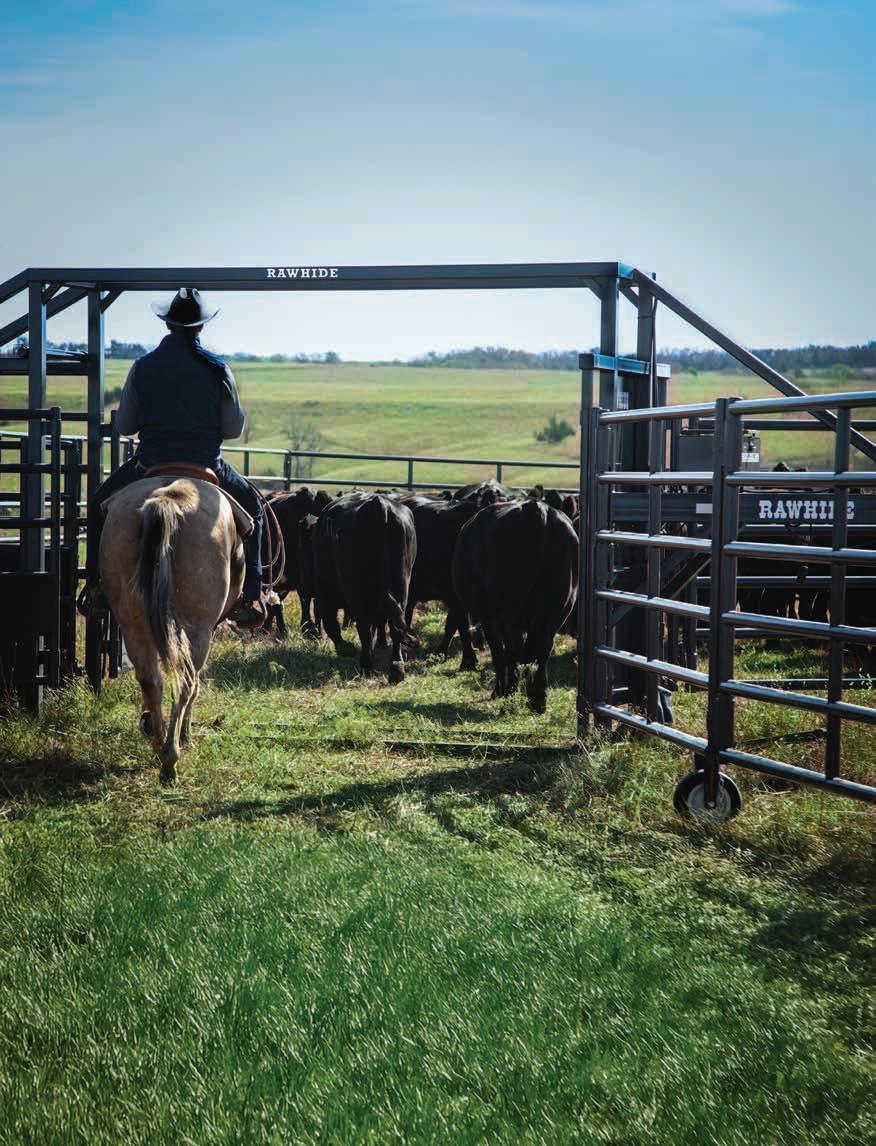
Rawhide Portable Corral
RCO Pest Control
Safety Zone Calf Catchers

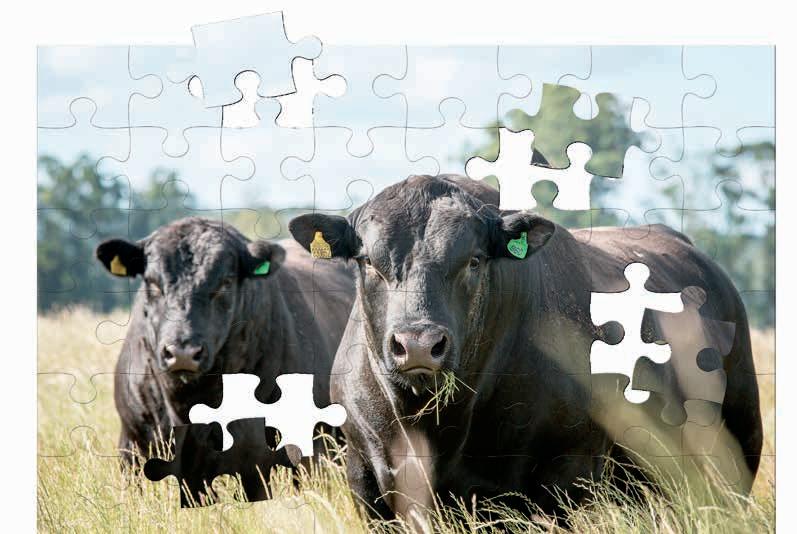








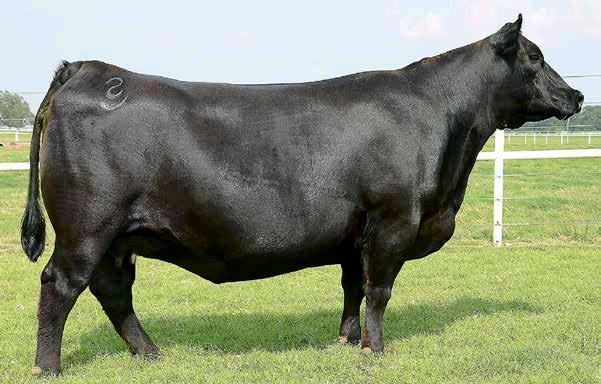
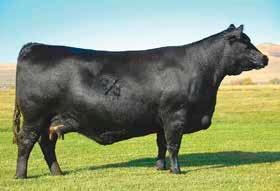

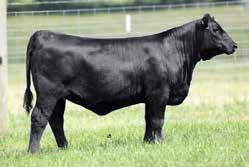






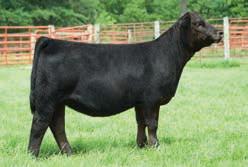
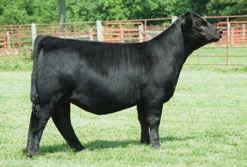
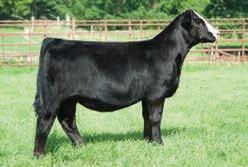
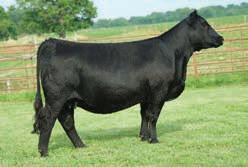
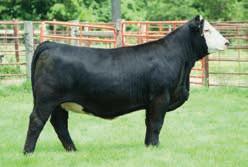
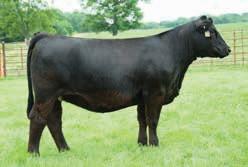
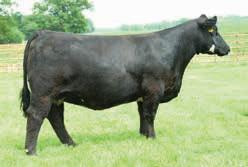
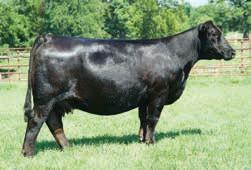
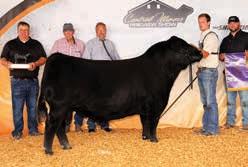




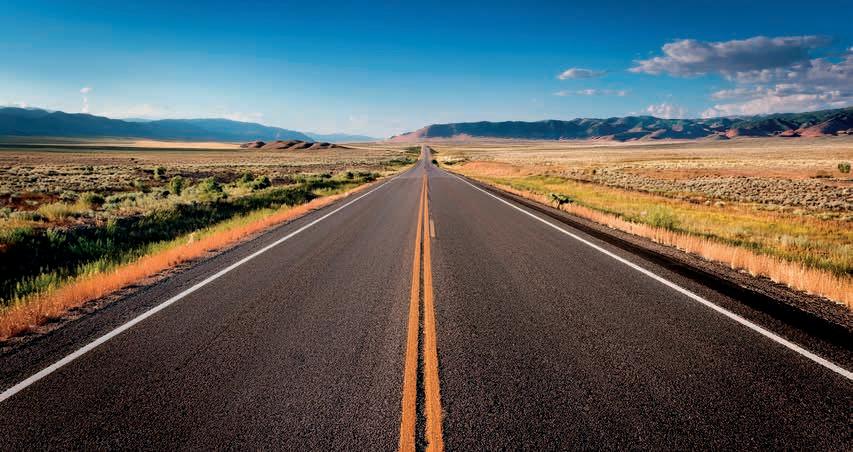
From one truck to a nationally respected business, the Lathrop family spent more than seven decades delivering livestock - and peace of mind.
tep into any Angus showcase sale across the country, and the most well-known person in the room might come as a surprise. Instead of the breeder with the most banners or the producer with the hottest genetics, the person everyone wants to know is Randy Lathrop, truck driver and longtime owner of Lathrop Livestock Transportation.
“When we go to events like the stock show in Denver or Cattleman's Congress in Oklahoma, there is not a person in that entire facility
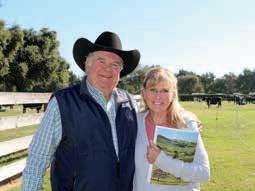
that Randy doesn't know. He’s a staple in this industry,” said Tyler Bixby, co-owner of Lathrop Livestock Transportation.
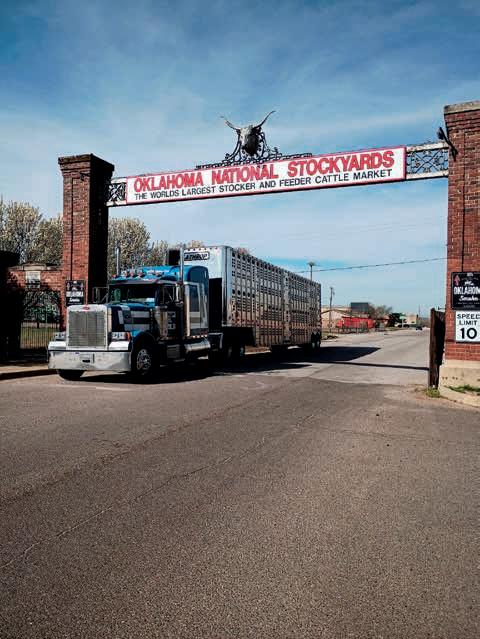
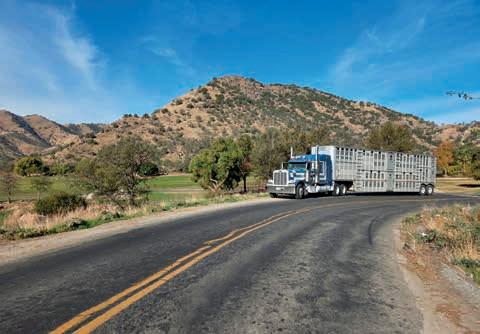
For more than 75 years, the Lathrop family made certain purebred producers’ cattle arrived at their new homes in excellent condition and in a timely manner. Cattle producers across the country have entrusted the Lathrop family with the safe, efficient, and careful handling and transport of their animals from coast to coast, into Canada, and to
an export center in Mexico.
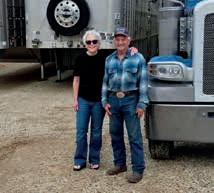
Randy and Peggi Lathrop, siblings from Dundee, Illinois, have spent more
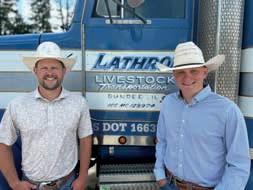
than 50 years operating Lathrop Livestock Transport. Last May, Randy and Peggi sold the company to another family duo, cousins Evan and Tyler Bixby.
“The relationships that Randy has developed and the trust that he's cultivated with producers is unmatched,” said Evan Bixby, co-owner of Lathrop Livestock Transportation. “These producers have put a lot of trust in Randy and Peggi to work as a team, to be able to run efficiently, and be organized. It's a lot to keep track of.”
Randy and Peggi dedicated their lives to a sector of the cattle industry that rarely gets attention or accolades. They worked around the clock to make it possible for producers to market their animals to most parts of the world.
The two made a strong team. Randy built the business’s customer base, while also logging countless miles in a big rig, hauling cattle to their new owners. Peggi managed the logistics - scheduling routes, communicating with drivers, and working with customers.
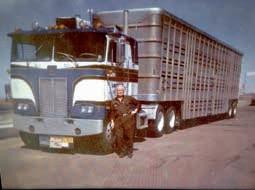

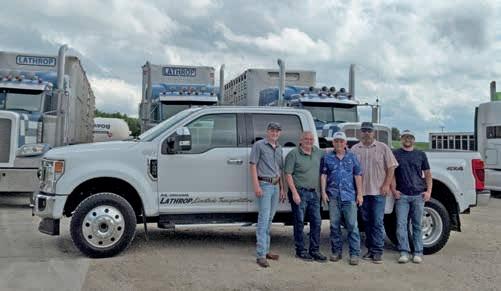
Transportation truck driver George Kogianes praises Peggi for her dedication to the industry and her staff. “Peggi was a boss and a mother to her employees. She would call us every morning and ask how we were doing. And she would always ask how our family was doing,” George said.
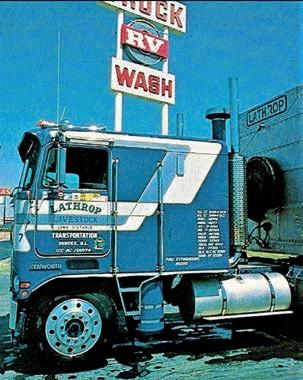
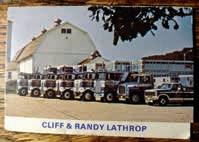
Randy and Peggi’s father, Cliff Lathrop, started the trucking company in 1951 after accepting an offer to haul purebred cattle across several states with multiple stops and deliveries along the route.
“I remember my dad saying, ‘You know, this isn’t a bad gig at all.’ So,
that's how he got concentrated into expanding the business,” Randy Lathrop recalled.
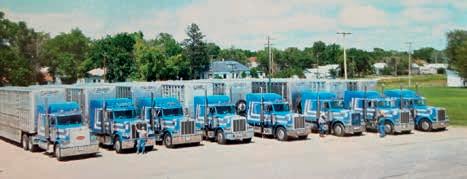
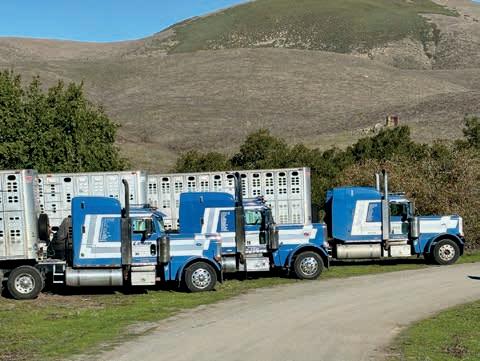
Lathrop Livestock Transportation started with one truck and
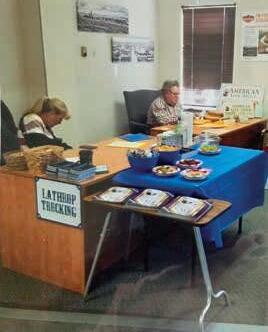
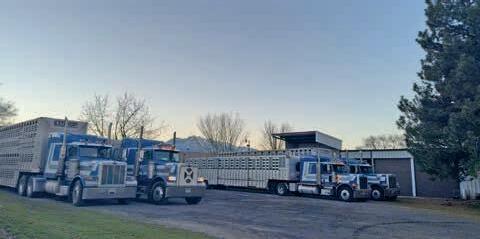
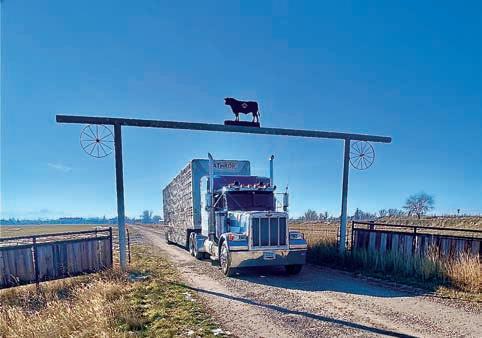
grew to a fleet of 10. As the trucking business expanded, new opportunities followed.
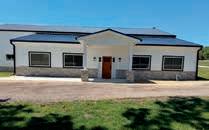
The family increased operations to include a USDA-approved quarantine center. Lathrop Export Center has served as a hub for animals moving through Chicago’s O’Hare International Airport since the 1970s.
“The American Hereford Association wanted to send a bunch of Hereford heifers to Hungary. The USDA out of Chicago asked if we'd be interested in assisting, because they thought there'd be a future in the export business,” Randy explained. “I'm the fourth generation on the farm, so we ended up using the farm as an export facility because we are only 30 miles from O’Hare field.”
The Lathrop family continues to operate its export facility from its multi-generational farm. Though typically, the Lathrops prepare cattle, pigs, and horses for export, occasionally their quarantine facility houses exotic animals. “We've had some giraffes. We've had some
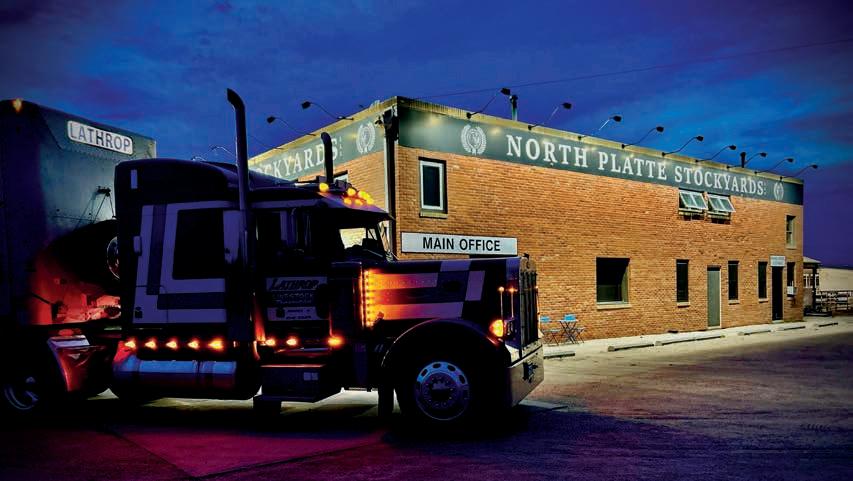
dancing bears from Russia - a lot of different things,” Randy said.
Behind the scenes, another member of the family helped to keep the operation running smoothly. Through the years, Randy’s wife, Holly, played an integral role in both the transportation and quarantine center. Holly traveled with Randy to sales, organizing the cattle entrusted to Randy to transport, then passing the information on to Peggi to put loads together. Holly also had the unenviable job of securing insurance for animals being transported.
Every load required meticulous planning. Sale schedules, delivery times, weather, biosecurity, border crossings, animal welfare, customer communication, and countless phone calls all had to align before a truck ever hit the road. Producers weren't simply hiring a trucking company - they were placing years of breeding decisions and major financial investments in someone else's hands.
The Lathrops shy away from taking credit for the lasting impact they’ve had on the purebred cattle industry. Instead, they shine the spotlight on their drivers. “I think one thing that I can say that I'm proud of is that we've had a lot of drivers that have been with us for 30, 40 years or longer,” Randy shared.
The last driver Randy’s dad hired, was Ed Albert, known as “Hooter,” a dairy farmer from northern Wisconsin. “Ed told my dad, ‘I’ll give you one year.’ And he ended up working for us for 42 years,” Randy said. “And you want to know how he got his nickname? He was cleaning out the trailer and he said, ‘Hoo! It’s hot in here!’ So, we nicknamed him Hooter,” Randy said with a chuckle.
Another driver, Curtis Hedrick, dedicated 35 years to hauling cattle
for Lathrop Livestock Transportation before retiring and returning full-time to his farm in Michigan.
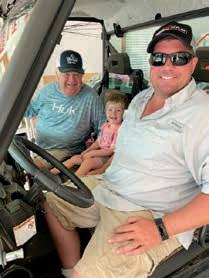
After 40 years with Lathrop Livestock Transportation, truck driver George Kogianes is still putting in the miles. He attributes his longevity with the company to the Lathrops’ leadership as well as the kindness of clients.

He’s an unsung hero in his own right, yet George is adamant about expressing gratitude for what the Lathrops have done for the cattle industry. “They [Randy and Peggi] made it feel like a family operation, and I like the customers and the way our customers always think positive,” George Kogianes said.
Those in the livestock transporta-
tion industry admit it can be a bit of a thankless business. Hauling cattle with hefty price tags, navigating inclement weather, coordinating stops for animal care and rest, spending weeks away from family, and handling vehicle repairs are just a few of the daily pressures associated with the job.
“What not a lot of people see is these drivers are dedicating their lives to moving these cattle. They're sacrificing time at home, as well as time with their kids and wives,” Tyler explained. “They're in the truck, and moving these cattle across the country. It's a sacrifice that they're willing to make to make sure that this industry's working.”
One can imagine the responsibility - and pressure - that comes with transporting purebred animals. At times, the price tag for the cattle cargo tops $1 million. Thus, trust is critical.
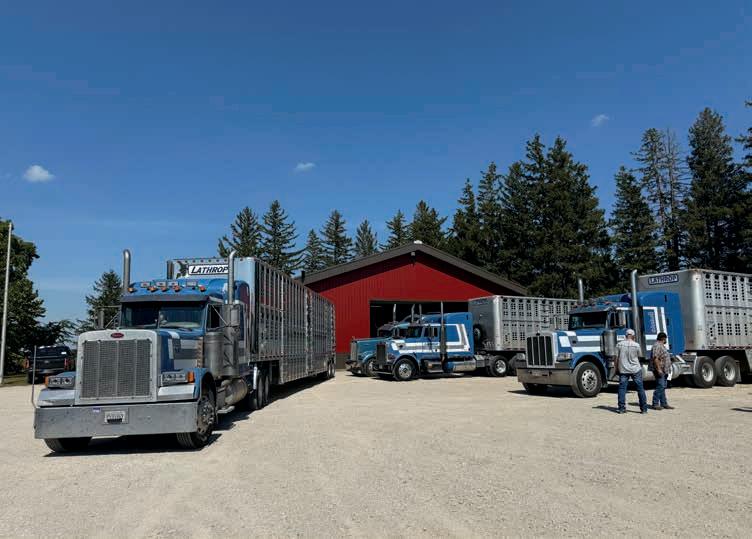
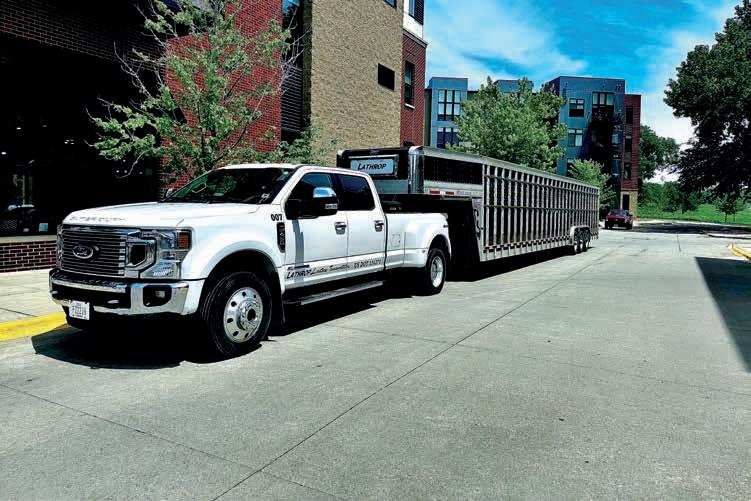
Through decades of treating animals with exceptional care, Lathrop Livestock Transportation earned that trust from buyers and sellers. “How we handled livestock is probably what helped our reputation the most,” Randy said.
After more than five decades, Randy and Peggi knew the company's future depended on finding someone who valued relationships as much as logistics. Lathrop Livestock Transportation’s new owners are committed to the same level of care and service the Lathrops have provided through the decades. Randy mentored Evan and Tyler
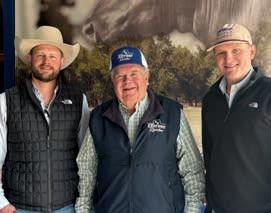
for a year before they took over the business.
“We were able to work with him, discuss growing the business, and learn what their values were. We plan to continue the legacy of what they have built and keep their name going,” Evan shared.
For more than seven decades,
the Lathrop family didn’t just move livestock - they carried the trust of an entire industry. Today, that legacy continues with every mile traveled and every load delivered, connecting cattle operations, strengthening relationships, and keeping the cattle industry moving forward.
learn more lathroptrucking.com















- Runs for 7 days on social media
- Maximum of 60 words, no images
- Will generate an average of 1,000 views

Introductory Rate:
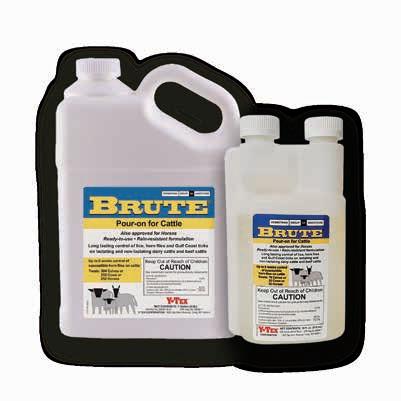
A fall application of BRUTE ® Pour-on for Cattle hits resistant flies hard now, so they don’t come back to bite next spring. Proven to control flies for up to six weeks, BRUTE delivers fast-acting, long-lasting protection without the added cost of an insect growth regulator. Treat this fall and set your herd up for a cleaner, healthier spring.

Kacie McCarthy, Nebraska Extension Cow-Calf Specialist
T.L. Meyer, Nebraska Extension Educator University of NE - Lincoln, UNL Beef beef.unl.edu
SUniversity research you can use.
Smarter heifer development for long-term productivity.
etting replacement heifers up for cowherd longevity is more than achieving a first pregnancy. It requires building females that remain productive within the constraints of their production environment (forage resources, climate, and management).
Research across a range of development systems demonstrates that similar pregnancy rates can often be achieved under both traditional and extensive management programs. This suggests producers have flexibility to reduce development inputs while maintaining acceptable reproductive outcomes. However, one factor consistently drives long-term success: early conception during the first breeding season.
Heifers that conceive within the first 21 days of their initial breeding season calve earlier, have more time to recover postpartum, and remain in the herd longer. These females also wean more pounds of calf over their lifetime compared to later-conceiving counterparts. As a result, early conception is one
of the most important predictors of lifetime productivity and retention.
While early conception is critical, achieving it depends on how well the heifer development program aligns with the production environment.
A successful heifer development program must match the resources and constraints of the production system. Factors such as forage availability, climate, and management intensity all influence reproductive performance. Research comparing intensive (drylot) and extensive (range-based) development systems has shown similar pregnancy rates, indicating that high-input systems are not always necessary.
The key is not maximizing inputs but developing heifers in a way that reflects the conditions they will experience as mature cows. Developing heifers under conditions similar to the production environment helps ensure they are capable of maintaining performance when resources are limited. Within the context of environmental fit, nutritional management, particularly
protein supplementation, plays a critical role in supporting reproductive success.
Nutritional strategies during development influence both shortterm reproductive success and longterm cow performance. Mulliniks et al. (2013) evaluated spring-born heifers developed under three strategies: range-developed with either low or high rumen undegradable protein (RUP) supplementation and drylot-developed heifers targeting higher rates of gain.
Heifers developed on range with higher RUP supplementation exhibited greater retention in the breeding herd through five years of age compared to both low-RUP and drylot-developed heifers. These results suggest protein type, not just level of nutrition, plays an important role in supporting reproductive success in forage-limited environments.
Even with appropriate development and nutrition, one of the greatest challenges in cowherd productivity occurs after first calving, when young females must balance growth, lactation, and rebreeding.
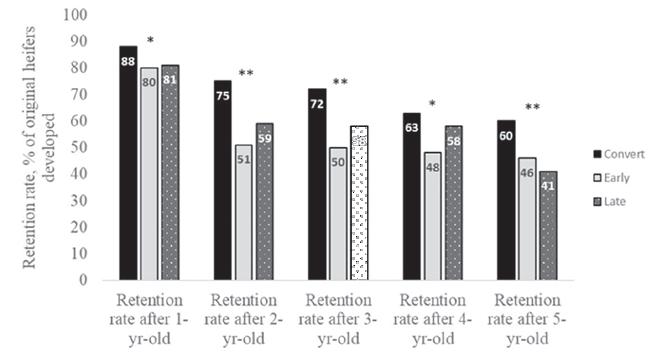
Figure 1. Retention rate of converting March-born heifers (Convert) into a May-calving herd compared to May-born heifers. May-born heifers were retrospectively grouped into 2 groups: heifers born in the first 21-d of calving as a heifer calf (Early) or heifers born after the 21-d days of calving as a heifer calf (Late). Published data from Goodnight et al., 2025.
Birthdate and age at first calving play an important role in longterm reproductive performance. In a May-calving system, Goodnight et al. (2025) compared March-born heifers (“Convert”) to May-born heifers born either early or late in the calving season.
After five years, a greater proportion of March-born females remained in the herd, with no difference observed between early- and late-born May heifers (Figure 1). These results suggest age at first calving, rather than position within the calving season, has a greater influence on retention. Heifers that are older at first calving are typically better equipped to meet the nutritional demands of lactation and rebreeding, particularly in limited-resource environments.
This advantage becomes especially important in young cows. Two- and three-year-olds often struggle to consume enough energy during early lactation, which can delay return to estrus and reduce pregnancy rates. In contrast, more mature cows can maintain intake more effectively, even when forage crude protein falls below 7%.
From a management perspective, incorporating older replacement heifers from earlier-calving herds or
incorporating March-born heifers into May-calving systems can improve rebreeding success, increase retention, and support long-term herd productivity. If you are retaining replacements, this means prioritizing heifers born earlier in the calving season. When purchasing replacements, particularly for summer-calving systems, it may involve sourcing heifers from earlier-calving herds, such as March-calving operations. In both cases, older females are better prepared to meet the demands of lactation and rebreeding, resulting in improved retention and productivity.
Reduced pregnancy rates in 2and 3-year-old cows are a concern for beef producers. These young females are still growing while also lactating, which increases their nutrient requirements. In many systems, especially when forage quality declines during the breeding season, young cows are unable to consume enough feed to meet these nutrient requirements.
This limitation often results in delayed return to estrus and lower pregnancy rates. Addressing this challenge requires both nutritional management and strategically selecting females more likely to suc-
ceed under these conditions. Evaluate factors that influence a heifer’s readiness at first calving including birthdate and selection criteria that matches your operations’ goals.
Body condition score (BCS) at the start of the breeding season is one of the most influential factors affecting reproductive performance. Cows entering the breeding season at a BCS of 5.0 or greater have improved pregnancy rates, calf survival, and weaning weights (Cooke et al., 2021).
Adequate body condition supports earlier return to estrus and increases the likelihood of maintaining a yearly calving interval. Over time, these advantages translate into greater pounds of calf weaned per cow exposed. Management strategies that maintain body condition, particularly in young cows, are critical for overcoming the challenges associated with rebreeding and sustaining long-term productivity.
Long-term cowherd performance comes from managing heifer development as part of the whole system. Early conception, environment, nutrition, age at first calving, and body condition all work together to influence whether a female stays productive.
Develop heifers under the same conditions they’ll face as cows, prioritize early-born and early-conceiving females, maintain body condition, and use protein supplementation strategically.
Programs built around these principles improve rebreeding success, increase cow longevity, and produce more pounds of calf over time, especially in forage-limited systems.
Courtesy University of NE - Lincoln, UNL Beef
Interviews with the authors of BeefWatch newsletter articles become available throughout the month of publication and are accessible at: www.go.unl.edu/podcast.
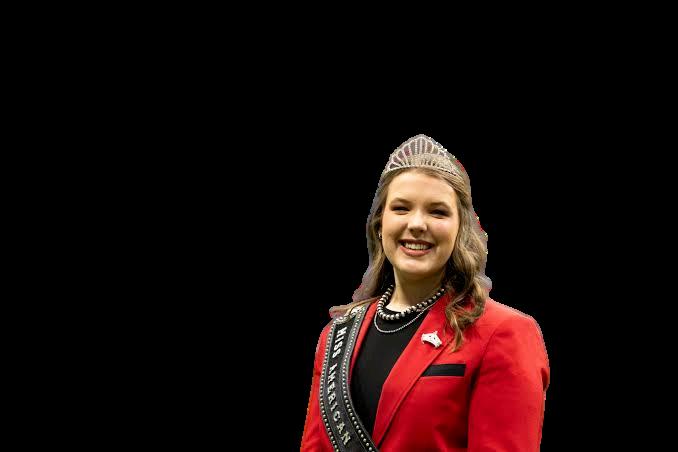
Cheyenne Houk

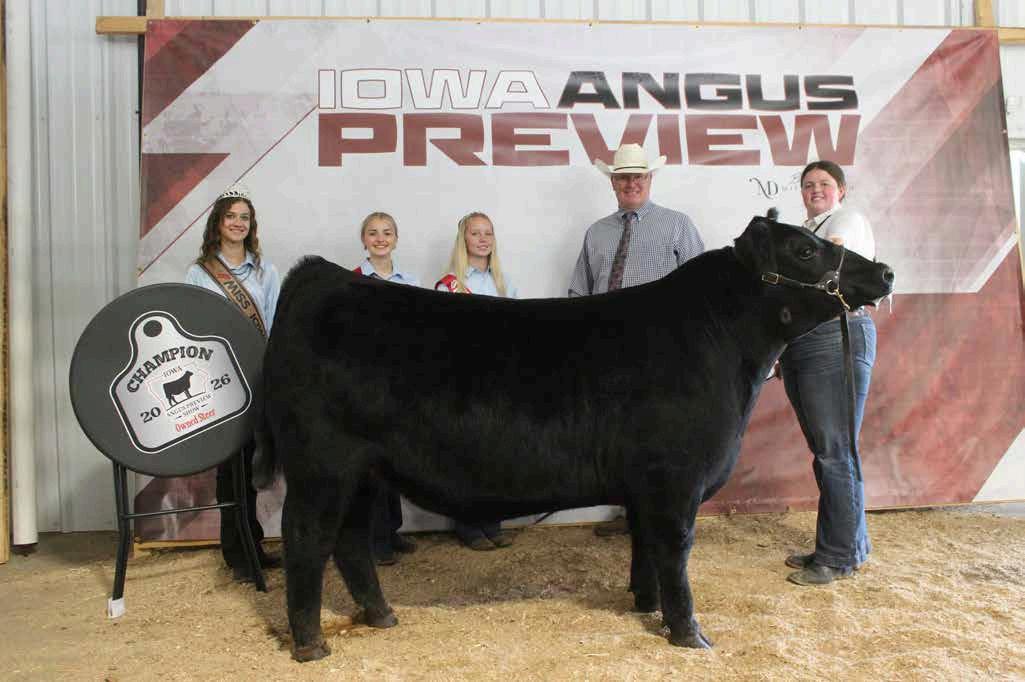
This annual steer show brings together celebrity showmen and youth cattle exhibitors to spotlight some of Iowa’s finest steers while raising vital funds for the Ronald McDonald H es of Iowa .

tion is proud to sponsor one of the erful event , ensuring the state’s largest cattle breed is well represented and reminding everyone that the Angus industry cares.

RONALD MCDONALD HOUSE CHARITIES
These house in Iowa reduce the financial burden on families of seriously ill and hospitalized children by providing them with a place to stay at no cost and assistance with meals and travel costs

medical challenges while honoring the deep-rooted Angus values of care and generosity. You’re supporting more than just an Angus steer you’re strengthening the legacy of the Angus cattleman.
Donations of $500 or larger will have their logo placed on the back of the Team Angus t-shirt .
Checks can be made out to and sent to Iowa Angus: 804 Kale Rd, Boone, IA 50036 or via credit card online
Viewing catalogs on the go has never been so easy.

THE NATIONAL WESTERN SELECTS MAKAYLA HOFFMAN AS EXECUTIVE DIRECTOR OF AGRICULTURE EVENTS & COMPETITIONS

Denver, CO – The National Western is pleased to announce the hiring of MaKayla Hoffman as its new Executive Director of Agriculture Events & Competitions. Hoffman will join the organization on August 3.
Hoffman brings extensive experience in agricultural event management and livestock competitions through leadership roles with Superior Livestock Auction and Express Ranches.
Throughout her career, Hoffman ...
Read this story here!

The 2026 breed association junior national shows drew thousands of competitors throughout the summer. Juniors and their families gathered at events across the country for a week filled with cattle shows, educational competitions, leadership development, and lasting memories. Turn to page 35 for a look at some of the junior nationals’ highlights and results.

Functional forage and pasture.
contributed article by Justin Fruechte, Product Expert - Ag Millborn, Brookings, S.D. millbornseeds.com
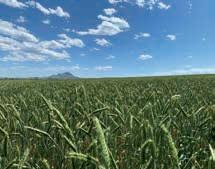
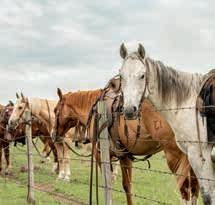
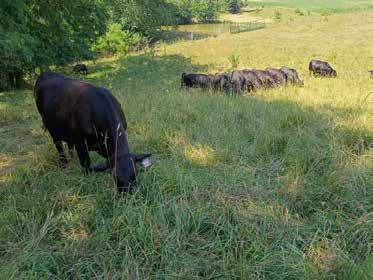
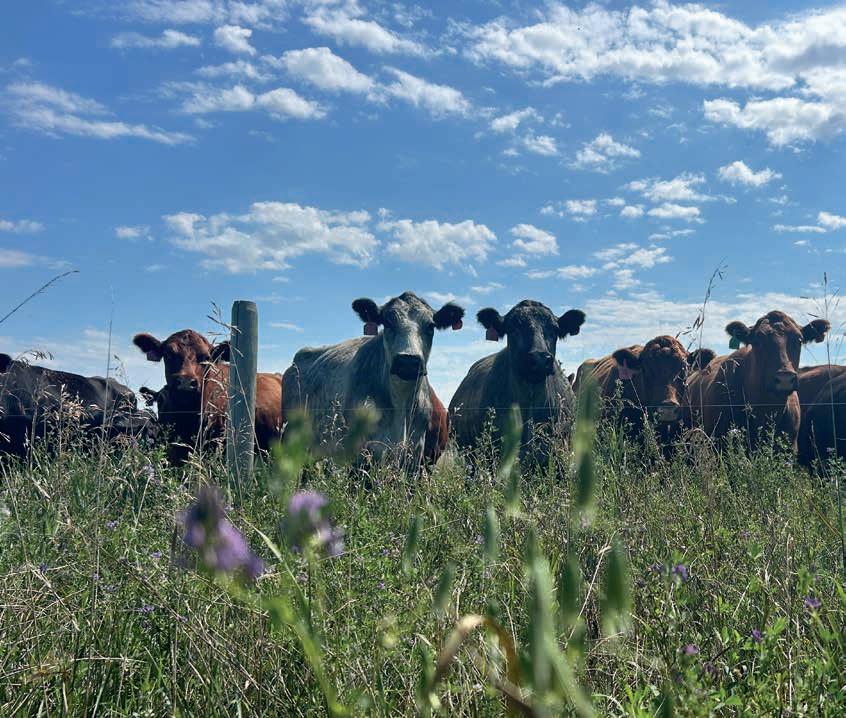
n the Midwest, we typically have an abundance of grass until mid-July, less available forage during July and August, and a good supply of crop residue from late October through December. September is when cows start reaching over loose barbed wire fences for tall grass in the ditch, as regrowth in cool-season pastures is sparse and short. Couple this with fast-growing calves nursing cows that are losing condition, and you have a restless herd. Not only does performance stall in this scenario, but pastures are also typically overgrazed, setting them back for next spring.
Filling this grazing gap requires an annual forage system. Finding the right planting window in conjunction with your crop rotation takes a bit of planning. Ideally, if you want to graze forage in September or October, you should be planting it in July or August. So, what system can you develop that provides the greatest return per acre while adding bonus grazing acres before weaning and moving cattle to crop residue?
When developing a grazing forage mix, diversity is key. Symbiotic relationships form among multiple species, resulting in improved growth and higher yields. It's similar to the
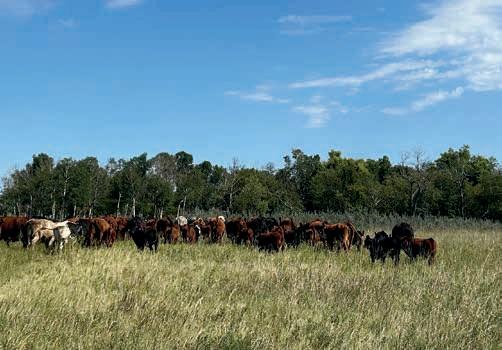
heterosis achieved by crossing a Simmental bull with an Angus cow. Combining brassicas with grasses delivers that same kind of complementary performance. Along with producing more forage, a diverse mix also fits better into most crop rotations.
The reason this combination performs so well is because the grasses provide the bulk of the dry matter and roughage in the diet, while the brassicas complement them by offering higher quality forage with greater digestibility. The species also work together throughout the grow-
ing season. Warm-season grasses explode with growth in August, but are terminated by the first frost. Brassicas, on the other hand, are frost tolerant and remain green even under snow cover. Together, these species can produce 3 to 4 tons per acre of dry matter, with crude protein levels of 13 to 15 percent.
The brassica species best suited for grazing include turnips, rapeseed, and radishes. If you're looking for some of the newest and best-per-
forming options on the market, consider Winfred, Hunter, or Pasja brassicas, Barkant turnip, and Graza radish. These improved varieties typically produce more foliage and higher overall yields.
Successfully incorporating an annual grazing mix into your crop rotation can be accomplished by planting it as a standalone crop for the season or as a double crop. When double cropping, plant it following a small-grain harvest, but be sure to get it seeded before the end of summer.
We've seen numerous suc-
cess stories from producers who dedicate acres specifically to forage production. In those situations, crops that regrow after harvest work especially well. They can provide a hay or baleage cutting early in the season, followed by regrowth that supplies valuable grazing during the late-summer forage slump.
The nutritional boost this strategy provides can make a significant difference for your cow herd. If you have cow-calf pairs preparing to wean in early November, this forage system delivers an excellent opportunity to maintain performance leading up to weaning. Keep your
calves gaining and move your cows onto crop residue in good body condition by grazing a high-quality forage mix throughout September and October.
Photos courtesy Millborn learn more millbornseeds.com
Millborn, Brookings, S.D.
The team of folks at Millborn have roots that run deep in farming, agriculture, and in the overall respect for the landscape. They opened their doors in 1987 and continue to walk alongside farmers, ranchers, and landowners across thousands of acres throughout the Midwest.

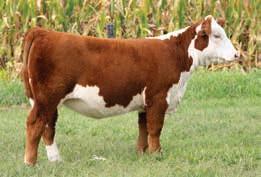

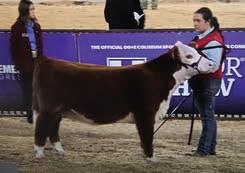
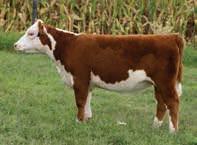
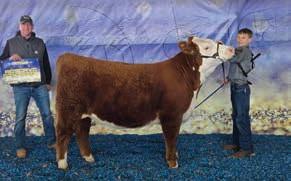


44th
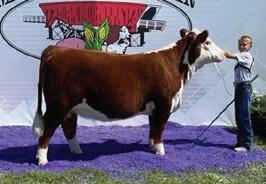
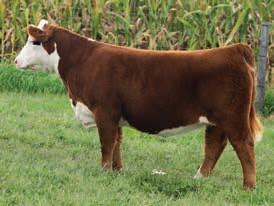
Our Annual Bull and Bred Heifer Sale is February 13, 2027 at the new ranch. Lunch is at 11:00 with the sale starting at 1:00pm. Bulls sell first with bred heifers to follow.
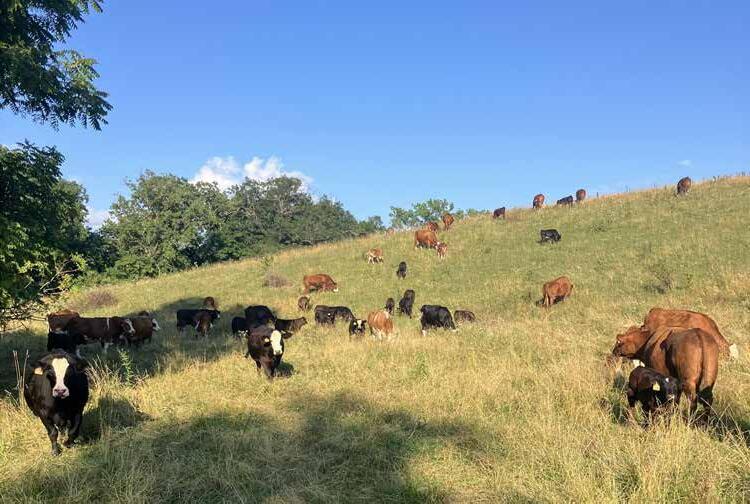
After 43 years of selling Bulls and Bred Heifers in Brandon, IA, we have now moved everything south to our new ranch in Russell, IA. This has made it possible to manage our operation all in one place which has always been the goal. So, we would like to invite you to join us on August 30th, at 12:00pm, for lunch and to take a look at our program in its new home. The Bulls for our next sale will still be on the cows so you can have a firsthand look at our Fleckvieh females in their working clothes. The Lucas County Cattlemen will be here grilling lunch for everyone.
For 44 Years we have strived to make the best. That starts with our females that are highly fertile and great uddered. They produce our highly sought-after bulls, highly marketable replacement heifers and high gain feeder cattle. Our cattle are always good footed, easy fleshing, and adapt to many environments as they are sold across the country from Arizona to Wisconsin.
-Bulls are kept free of charge until April 15th. 1/3 of payment due on sale day with the balance due on delivery. First year breeding guarantee-
SUNDAY, AUGUST 30TH, 2026
LUNCH IS AT 12:00 PM



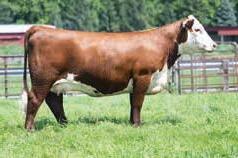

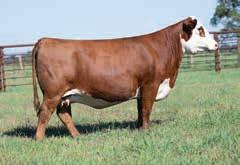
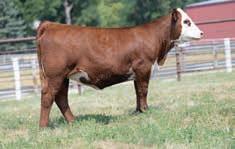
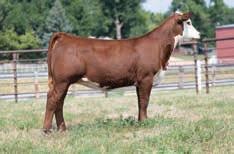



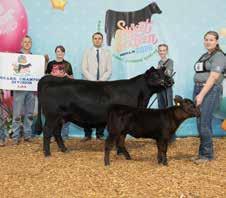
Norfolk, Neb. • June 15-19, 2026
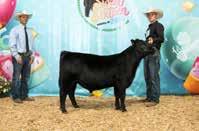
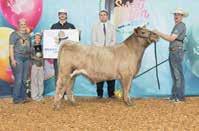
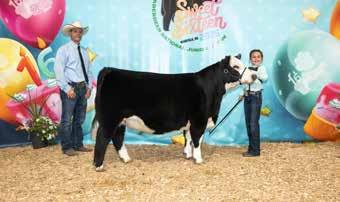
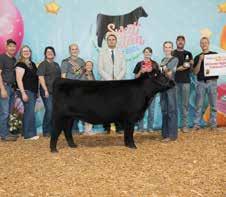
Grand Champion Overall Steer - Caleb Weyh
Reserve Grand Champion Overall Steer - Karay Henson
Grand Champion Fullblood Cow/Calf Pair - Saydee Hammonds
Reserve Grand Champion Fullblood Cow/Calf Pair - Winston Anthony
Grand Champion Percentage Cow/Calf Pair - Hadley Reinken
Reserve Grand Champion Percentage Cow/Calf Pair - Coy Erdmann
Grand Champion Fullblood Heifer - Saydee Hammonds
Reserve Grand Champion Fullblood Heifer - Aspen Stroud
Grand Champion Percentage Heifer - Caleb Weyh
Reserve Grand Champion Per centage Heifer - Ava Somers
Grand Champion Bred and Owned Fullblood Bull - Winston Anthony
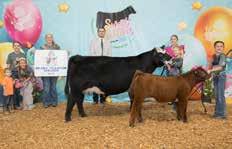
Reserve Grand Champion Bred and Owned Fullblood Bull - Carson Beverlin
Grand Champion Bred and Owned Percentage Bull - Angus Dean
Reserve Grand Champion Bred and Owned Percentage Bull - Abbey Torbert
Grand Champion Bred and Owned Fullblood Heifer - Winston Anthony
Reserve Grand Champion Bred and Owned Fullblood Heifer - Marshall Effertz
Grand Champion Bred and Owned Percentage Heifer - Hadley Reinken
Reserve Grand Champion Bred and Owned Percentage HeiferCaleb Weyh
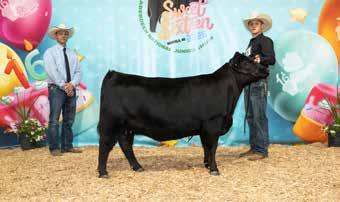
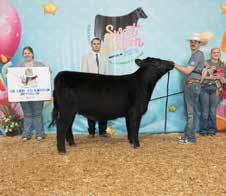
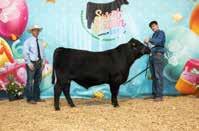

JUNIOR NATIONAL RESULTS
June 12-18, Grand Island, Neb.
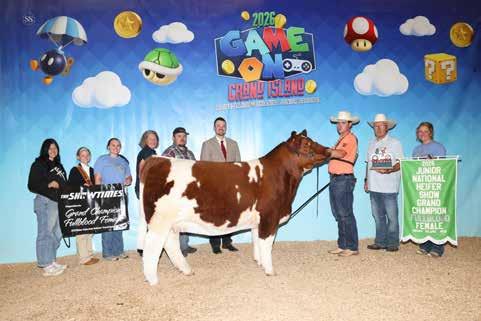
Grand Champion Fullblood
Maine-Anjou Female - Tyler Loudon, Iowa
Reserve Champion Fullblood
Maine-Anjou Female - Maddix Small, Kan.
Grand Champion Prospect Steer - Berkley McKay, Okla.
Reserve Champion Prospect Steer - Quinn Cowley, Okla.
Grand Champion Bred & Owned Prospect Steer - Berkley McKay, Okla.
Reserve Champion Bred & Owned Prospect Steer - Kamden McKay, Okla.
Grand Champion Bred & Owned
Maine-Anjou Bull – Kastyn Dorsey, Texas
Reserve Champion Bred & Owned Maine-Anjou Bull – Caddo Craft, Okla.
Grand Champion Progress Steer - Kinley Petzold, Texas
Reserve Champion Progress Steer - Knoxx Sells, Neb.
Grand Champion Bred & Owned Progress Steer - Koy Moonen, Okla.
Reserve Champion Bred & Owned Progress Steer - Koy Moonen, Okla.
Grand Champion Bred & Owned Mainetainer Bull - Andrew Meier, Tenn.
Reserve Champion Bred & Owned Mainetainer Bull - Oaklyn Plamp, S.D.
Grand Champion Bred & Owned Maine-Anjou FemaleBerkley McKay, Okla.
Reserve Champion Bred & Owned Maine-Anjou FemaleBerkley McKay, Okla.
Grand Champion Bred & Owned Mainetainer Female –Hadley Dunklau, Neb.
Reserve Champion Bred & Owned Mainetainer Female –Abree Belcher, Iowa
Grand Champion Bred & Owned Maine Angus Female –Katy Pryor, Iowa
Reserve Champion Bred & Owned Maine Angus Female – Koy Moonen, Okla.
Grand Champion Owned
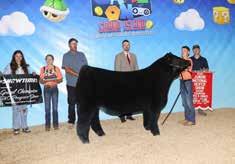
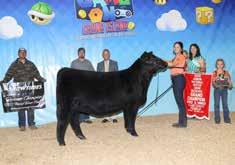
Maine Angus Female – Sloane Curtin, Iowa
Reserve Champion Owned Maine Angus Female – Jake King, Colo.
Grand Champion Owned Maine-Anjou Female – Braden Taber, Iowa
Reserve Champion Owned Maine-Anjou Female – Berkley McKay, Iowa
Grand Champion Owned Mainetainer Female – Carlee Clark, Okla.
Reserve Champion Owned Mainetainer Female – Jacee Parrish, Texas
June 12-18, Grand Island, Neb.
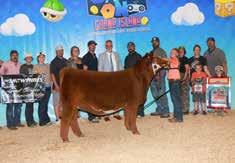
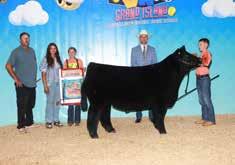
Grand Champion Prospect Steer - Hudson Cromwell, Texas
Reserve Champion Prospect Steer - Quinn Cowley, Okla.
Grand Champion Bred & Owned Prospect Steer - Berkley McKay, Okla.
Reserve Champion Bred & Owned Prospect Steer - Kamdyn McKay, Okla.
Grand Champion Progress Steer - Reagan Rodgers, Mo.
Reserve Champion Progress Steer - Knoxx Sells, Neb.
Grand Champion Bred & Owned Progress Steer - Koy Moonen, Okla.
Reserve Champion Bred & Owned Progress Steer - Koy Moonen, Okla.
Grand Champion Bred & Owned Chianina Bull - Tyler Loudon, Iowa
Reserve Champion Bred & Owned Chianina Bull - Khyler Marshall, Okla.
Grand Champion Bred &
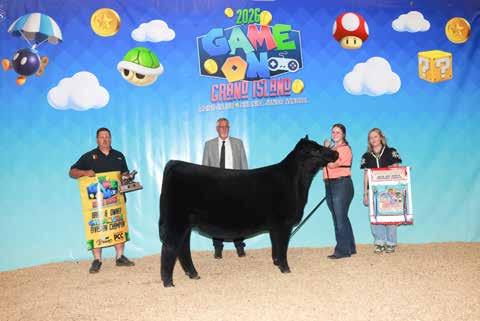
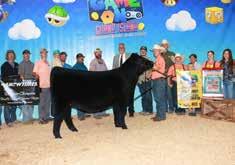
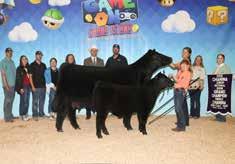
Owned Chiangus Bull - Luke Jennings, Ohio
Grand Champion Bred & Owned Chi-Composite BullOaklyn Plamp, S.D.
Reserve Champion Bred & Owned Chi-Composite Bull - Sophia Shobe, Mich.
Grand Champion Bred & Owned Chianina Female - Payton Rodgers, Mo.
Reserve Champion Bred & Owned Chianina Female - Bret Pembrook, Okla.
Grand Champion Bred & Owned Chi-Composite FemaleBlayne Dunklau, Neb.
Reserve Champion Bred & Owned Chi-Composite FemaleOaklyn Plamp, S.D.
Grand Champion Bred & Owned Chiangus Female - Lauren Kelly, Ind.
Reserve Champion Bred & Owned Chiangus Female - Berren Strope, Neb.
Grand Champion Chiangus Female - Riley Rhodes, Ill.
Reserve Champion Chiangus Female - Kennedy Arthur, Okla.
Grand Champion Chianina Female - Cambria Cook, Calif.
Reserve Champion Chianina Female - Brooklyn DeBerry, Texas
Grand Champion Chianina Cow/Calf Pair - Hadley Dunklau, Neb.
Reserve Champion Chianina Cow/Calf Pair - Brilee Bell Breckenridge, Okla.
Grand Champion Chi-Composite Female - Copeland Paulsen, Iowa
Reserve Champion Chi-Composite Female - Berkley McKay, Okla.
Grand Champion Chi-Composite Cow/Calf Pair - Hannah Yingst, Ohio
Reserve Champion Chi-Composite Cow/Calf Pair - Scott Swanek, Minn.

GELBVIEH JUNIOR NATIONAL
June 21-26, Grand Island, Neb.

Entry & Ownership Deadline May 15 | Late Entry Deadline May 22
Grand Champion Bred and Owned Balancer Bull - Lexi Rittenhouse, Ohio
Meals Provided Each Day Free Hay for All Exhibitors 13 Contests: Team & Individual Travel Scholarships Available
Reserve Grand Champion Bred and Owned Balancer Bull - Kyson Thiel, Okla.

Grand Champion Bred and Owned Balancer Female - Sam Gravely, Tenn.

Entry Information
Lodging Details
Reserve Grand Champion Bred and Owned Balancer FemaleBraylen Schaeffer, Ind.
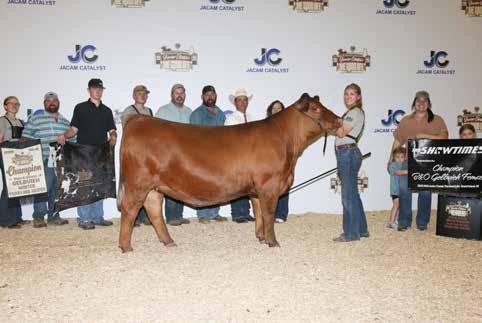
Grand Champion Bred and Owned Gelbvieh Female - Jessie Lowe, Mo.
Grand Champion Prospect Steer - Joseph Tollett, Kan.
Premium Book
Show Live Stream Contest Details Judges
Schedule QUESTIONS? CONTACT

Grand Champion Balancer Female - Braylen Schaeffer, Ind.

Reserve Grand Champion Bred and Owned Gelbvieh Female - Jessie Lowe, Mo.
Reserve Grand Champion Prospect Steer - Lincoln Brannon, Okla.
Supreme Market Animal - Kale Taubenheim, Neb.
Reserve Grand Champion Balancer Female - Gabrielle Tebo, Ind.
MARTHA MOENNING
MEMBER AND YOUTH ACTIVITIES COORDINATOR
303 465 2333 | WWW
GELBVIEH ORG | MARTHA@GELBVIEH ORG
Grand Champion Gelbvieh Female - Jessie Lowe, Mo.
Reserve Grand Champion Gelbvieh Female - Corbin Lowe, Kan.

Grand Champion Gelbvieh Bred and Owned Bull - Sam Gravely, Tenn.
Grand Champion Feeder Heifer - Bo Nowack, Mo.

Reserve Grand Champion Gelbvieh Bred and Owned Bull - Gage Swindler, Mo.
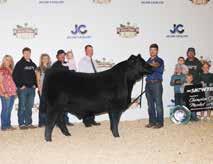
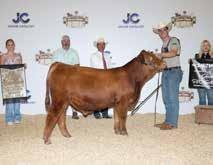
Reserve Grand Champion Feeder Heifer - Lilyan March, Mo.
Grand Champion Market Heifer - Anna Altman, Minn.
Reserve Grand Champion Market Heifer - Avarie Hightower, Kan.
Reserve Grand Champion Market Steer - Ava Larson, Minn.
Junior Showmanship, top 3: Cogan Schilling, Kan.; Anna Altman, Minn.; Blair Buehler, Neb.
Intermediate Showmanship, top 3: Easton Bose, Neb.; Elsie Stutzman, Kan.; Kaycee Brown, Kan.
Senior Showmanship, top 3: Jessie Lowe, Mo.; Spencer Walahoski, Neb.; Braxton Murray, Okla.
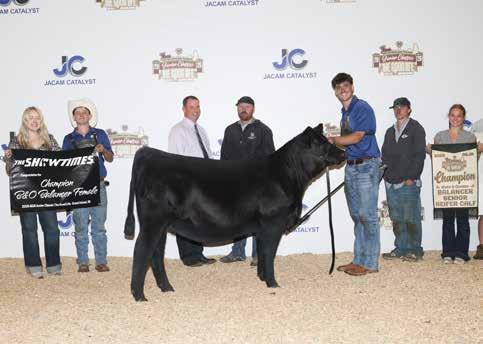
July 4-10, Madison, Wis.
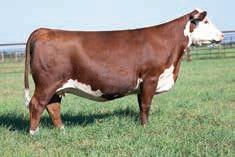
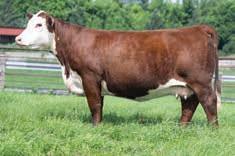
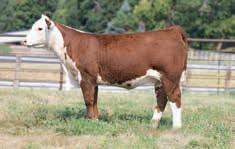
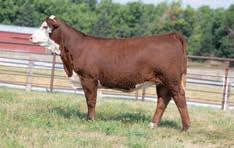
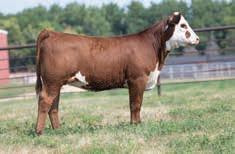
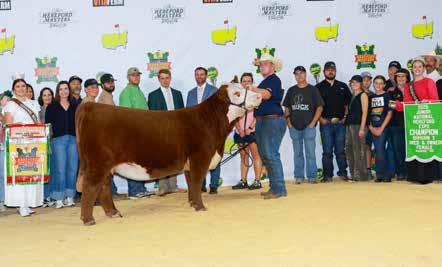
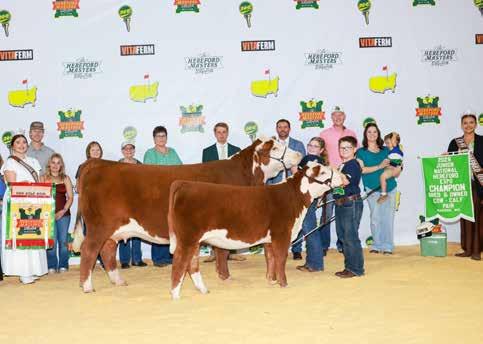
The VitaFerm® Junior National Hereford Expo (JNHE), "The Hereford Masters in Madison," welcomed young people from 44 states and 2 Canadian provinces to the Alliant Energy Center in Madison, Wis., July 4-10, 2026. The event provides educational and leadership opportunities for National Junior Hereford Association (NJHA) members along with the chance to exhibit their Hereford cattle on a national stage. NJHA is one of the most active junior livestock programs in the country with more than 4,200 members who are developing important skills through their Hereford cattle projects.
Champion Bred and Owned Cow/Calf Pair - Easton and Kaytlyn Harfst, Mich.
Reserve Champion Bred and Owned Cow/Calf Pair - Clayton Heins, N.D.
Champion Owned Cow/Calf Pair - Nora Leigh Werk, Minn.
Reserve Champion Owned Cow/ Calf Pair - Adalynn Grace Blankenship, N.Y.
Grand Champion Cow/Calf Pair - Easton and Kaytlyn Harfst, Mich.
Reserve Grand Champion Cow/ Calf Pair - Clayton Heins, N.D.
Grand Champion Steer & Bred-and-Owned Steer - Delaney Figge and Tyree E Figge, Kan.
Reserve Grand Champion SteerLogan Cady, Md.
Reserve Grand Champion Bredand-Owned Steer - Logan Cady, Md.
Grand Champion Bred-and-
Owned Bull - Cruz Colyer, Idaho
Reserve Champion Bred-andOwned Bull - Henley and Beckett Barber, Texas
Grand Champion Bred-andOwned Female - Grady and Hudson Carter, Okla.
Reserve Grand Champion Bredand-Owned Female - Tuck and Nash Lowderman, Ill.
Horned Champion HeiferHarper Rose Starnes, Ala.
Horned Reserve Champion Heifer - Kennedy Jean Hoffman, Neb.
Polled Champion HeiferLandry Allan, Texas
Polled Reserve Champion Heifer - Grady and Hudson Carter, Okla.









Health & Reproduction questions answered and explained.
contributed article by Dr. Joshua Beutler, DVM Pender Veterinary Clinic, Pender, Neb. penderveterinaryclinic.com
Strategic health protocols set up calves for strong starts.
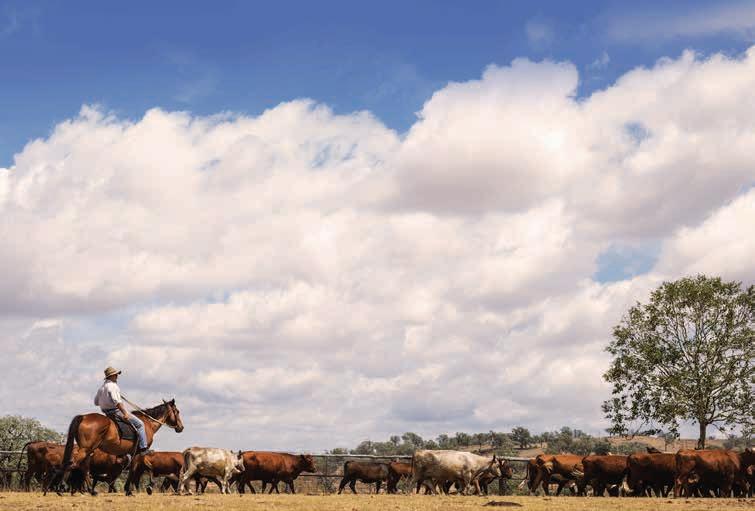
arly weaning calves - typically between 120 and 150 days of age (sometimes younger) - has become a valuable management tool for beef producers aiming to reduce feed costs and protect cow body condition. When paired with a welltimed vaccination program, early weaning positions calves for strong health and steady gains while easing pressure on the cow herd.
The practice is especially useful during drought, periods of high feed costs, or when cows enter summer in thin condition and need relief from lactation demands. Removing the calf early can reduce a cow’s nutritional requirements by as much as 25 to 30 percent, allowing her to maintain or regain condition heading into fall.
The success of early weaning depends heavily on one critical factor: calves must have adequate immunity before facing the stress of separation, diet changes, and a new environment. A front-loaded vaccination protocol ensures calves are protected well in advance of weaning.
Calves require approximately 14
to 21 days to develop protective immunity after receiving vaccines. In traditional weaning systems, producers often administer vaccinations a few weeks before fall weaning. With early weaning, that timeline must shift forward. The objective is straightforward - vaccinate early enough that calves enter the weaning pen already protected, even if it means working cattle during the hottest part of the year. Low-stress vaccination techniques are important not only for calves but also to reduce stress on cows and limit the risk of early embryonic loss.
A sound early-weaning vaccination program begins at branding, when calves are 6 to 12 weeks old. This initial round typically includes:
• A respiratory vaccine covering IBR, BVD Types I and II, PI3, and BRSV
• A clostridial 7-way vaccine
Additional preventive measures - such as intranasal vaccines for younger calves or a pinkeye vaccine - may also be used.
The booster vaccination is the most important component of early-weaning health and should be administered roughly 21 to 30 days before weaning. This second round typically includes:
• A booster dose of the MLV respiratory vaccine
• A clostridial booster
• A Mannheimia haemolytica product
In areas where Histophilus somni is a concern, it is commonly added as well. Other immune-supporting products, such as Endovac or trace mineral supplements like Multimin, may also be incorporated.
Even with proper vaccination, early weaning can be stressful if not handled carefully. Low-stress handling is equally important to calf health. Calves should be:
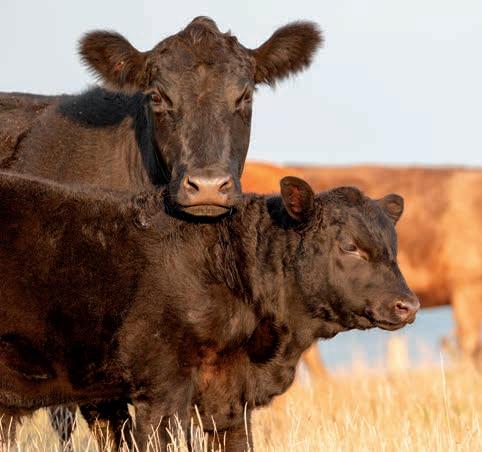
• Moved quietly and kept in familiar groups
• Placed in a clean, well-ventilated pen
• Provided fresh water and high-quality grass hay
A starter ration containing 14 to 16 percent protein helps calves transition smoothly from milk to solid feed. Avoiding mud, dust, overcrowding, and loud handling significantly reduces the risk of respiratory disease. New maternal bovine appeasing substances applied topically have shown promise in reducing stress and improving the transition during weaning.
Daily - sometimes twice-daily - monitoring during the first 10 to 14 days post-weaning is essential. Calves should be observed for:
• Appetite
• Breathing
• Posture
• Overall behavior
Early-weaned calves can adapt quickly, particularly when the environment is calm and consistent. Their ability to thrive depends heavily on consistent feed, clean water, and minimal disruptions during the adjustment period.
In Nebraska, early weaning is commonly used during dry summers or when pastures decline in quality. Producers often vaccinate in July before August early-weaning, aligning immunity with seasonal stress. MLV respiratory vaccines perform well in the region’s summer conditions.
These programs reward producers who invest in health, nutrition, and low-stress management, and early-weaned calves often fit neatly into their marketing and management plans.
Early weaning can be a powerful management strategy - reducing feed costs, protecting cow condition, and improving calf health - but only when immunity is built ahead of stress. A well-timed vaccination protocol, combined with low-stress handling and consistent nutrition, ensures calves transition smoothly and maintain strong performance.
For producers facing feed shortages, declining pasture quality, or cows needing nutritional relief, early weaning offers a practical, research-supported solution that strengthens both calf and cow outcomes.
learn more penderveterinaryclinic.com
Dr. Joshua Beutler is an owner and veterinarian at Pender Veterinary Clinic in Pender, Nebraska. He is a 2016 graduate of Iowa State University.











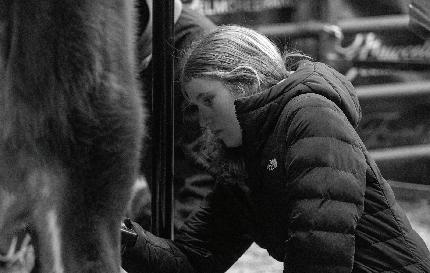
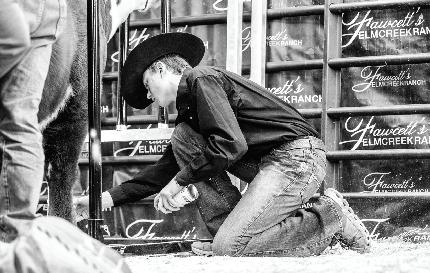
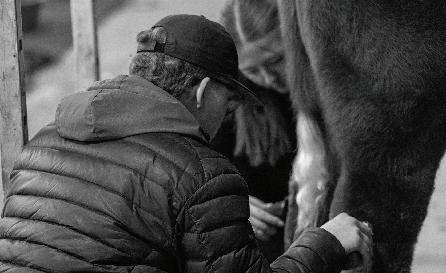
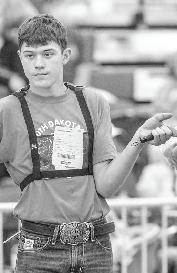
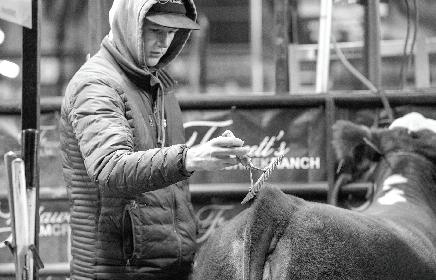
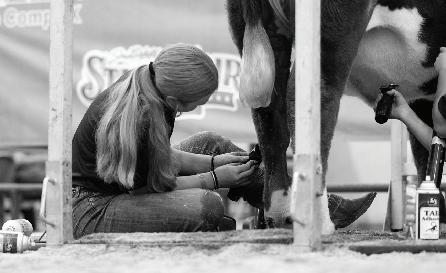
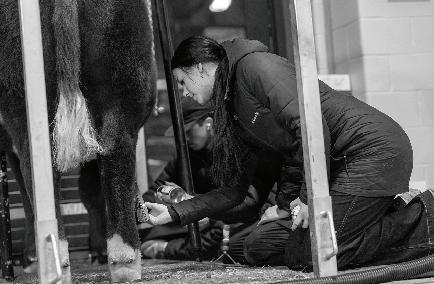
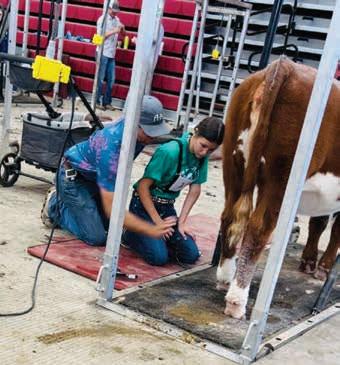
At FECR, we aren’t just building winners — we’re building future leaders.
We believe every junior deserves an opportunity to succeed, regardless of budget or experience.
Here, hard work, dedication, and character matter more than banners.
Our juniors become family, and family means everyone matters, everyone contributes, and everyone has the chance to grow. The banners may fade, but the lessons, friendships, and memories last a lifetime.




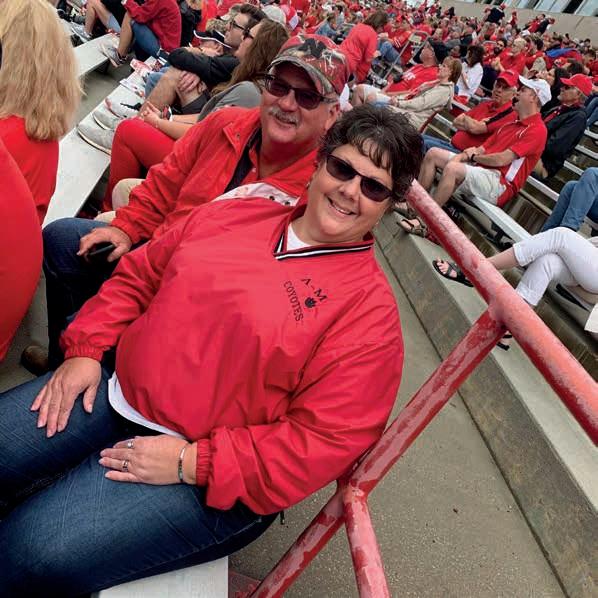
I was raised mostly in the horse industry. I broke and rode primarily 2and 3-year-olds growing up, as my father seemed to always trade or sell them before they could get to be any older. My family raised and showed horses. We also held horse sales annually in Broken Bow, Nebraska, as well as Kansas, and Iowa. We traveled around many states trading and selling horses. My father (Tom Eberle) was a partner of Broken Bow sale barn when I was young, along with his brother, Jerry, and others. It’s quite interesting as it is now run by my cousin Todd Eberle, and it is
Tim grew up raising and showing cattle and by chance we met and our worlds meshed. Our children grew up with both horses and cattle, however early on as a family, we decided it was easier to just do one of those in the show world. Showing cattle was our vacation when our kids were growing up – that seemed to be our extra time together. Our children also participated in the carcass contests in 4-H, so they learned what was needed for the end product put on
Our operation has evolved over time. Tim and I had an eye for attractive made cattle. We found this was our way to produce and share our love of functional, attractively made, profit-oriented cattle with our fellow cattlemen. This also seemed to keep us busy and our children out of trouble. We currently maintain a herd of cows consisting of registered Angus and registered Simmental cattle located in the great Sandhills of Nebraska. In 2027, we will celebrate 100 years on our family’s ranch. We hold an annual bull and heifer sale the first Saturday in March, and as anyone in this type of business knows that keeps everyone busy and moving.
Who taught you to cook, and what’s the first thing you remember making?
My maternal grandmother gave me my inspiration for cooking. I spent a lot of time growing up on my grandparents’ farm. I was lucky enough to enjoy time outside helping the men with all the farm duties and then I got to spend wonderful time in the kitchen. I had the best of both worlds –what more could I ask for as a child. Hershey brownies is one of the first recipes I remember making. I was making gravy by the time I was 8 years old, which is quite funny as it seems there are so many people who do not have this cooking skill mastered, my older sister included. When Tim and I were first married and having neighborhood brandings, I was usually the one asked to make the gravy. I always thought that was kind of odd at the time but as I found out, it was not.”
What is your favorite cut of beef and why?
I find a good roast to be one of the best cuts of beef. There are so many ways to fix it, and they usually are all exceptional. The roast beef left over can then be made into beef and noodles, beef salad, etc.
What is your "signature dish" that everyone expects you to bring?
Wild Rice Casserole which is a family recipe that has been passed down for several generations.

Kristi Mason
1 ½ lb. seasoned pork sausage
½ c. celery (chopped)
1 T. onion (chopped)
1 c. wild rice
1 can cream of mushroom soup
1 soup can of milk
1 can mushrooms
Step 1: Brown seasoned pork sausage, celery, and onion (or more to taste), then drain off fat. Step 2: Cook wild rice and add with cooked sausage; add cream of mushroom soup, can of mushrooms including its juice, and milk. Step 3: Be sure to mix well, place in a casserole dish, cover it, and bake for 1 ½ hours at 350 degrees Fahrenheit. Step 4: Stir halfway through cooking and add water if it seems dry. This casserole is even better the next day.
Kristi Mason
Brownie Ingredients:
1 c. sugar
¼ c. soft oleo (margarine)
4 eggs
1 can Hershey chocolate syrup
1 c. flour
½ c. chopped nuts (optional)
Frosting Ingredients:
1 1 /3 c. sugar
6 T. margarine
6 T. milk
½ c. chocolate chips
Brownie Directions: Step 1: Mix well all ingredients, then pour into a greased jelly roll pan or cookie sheet with sides. Step 2: Bake at 350 degrees Fahrenheit for 25 to 30 minutes.
Frosting Directions: Step 1: Bring to rolling boil the sugar, margarine, and milk. Boil one minute at full boil. Step 2: Remove from heat, add chocolate chips, and stir until completely melted and frosting begins to thicken. Pour over brownies and spread completely.
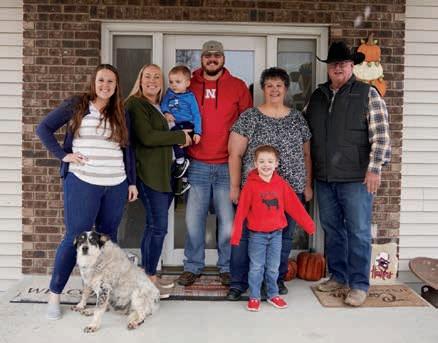
Kristi Mason
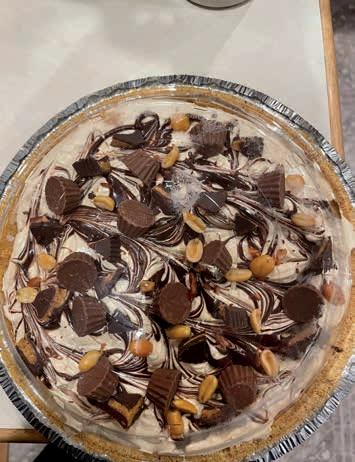
1 chocolate or graham cracker crust (9 in.)
8 oz. cream cheese (softened)
¾ c. powdered sugar
½ to ¾ c. chunky peanut butter

6 T. milk
8 oz. container Cool Whip
Reese’s Peanut Butter Cups (chopped)
peanuts (chopped)
Step 1: Mix first four ingredients with a mixer, then add the Cool Whip until well-blended. Step 2: Pour mixture into the crust and drizzle with chocolate fudge, cut through with a knife to make a marbled look. Step 3: Chop regular Reese’s Peanut Butter Cups and sprinkle on top along with a few peanuts. Chill 24 hours for it to set. This recipe can also be frozen.
Note: This is a big hit at our neighborhood brandings and for bake raffles while our kids were in school.


Kristi Mason
5 c. raw rhubarb (chop into small pieces, or pulse in a food processor)
4 c. sugar
1 can raspberry pie filling 2 small boxes of raspberry Jell-O
Step 1: Cook rhubarb and sugar until rhubarb is tender. Add pie filling and cook six to eight minutes. Step 2: Add raspberry Jell-O. Stir until thoroughly dissolved. Step 3: Pour into hot jelly jars with ¼-inch head space; wipe rims and put on hot lids, place on towel and cover with one as well until you see that they have sealed. If jars do not seal, once cooled, place in the fridge to use. Makes seven jars.

What first got you started making jams and jellies?
“
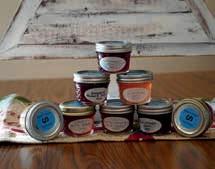
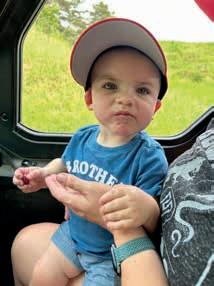
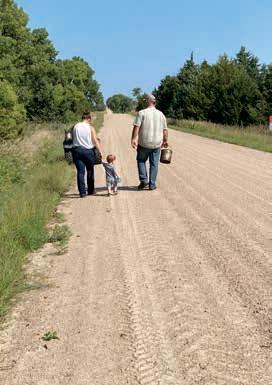
My mother-in-law always made jelly, and it was something my husband enjoyed and it grew from there. I now make about 85 jars of jelly, jams, and butters to have for the ladies that come to our bull sale. It seemed like something fun for them to take home and enjoy since the men bring home caps, gloves, etc. I have noticed however, everyone that has taken some in the past look for their favorites the next year and on occasion look for new ones that have been added. I do appreciate the gals who bring back empty jars and ask for a refill, it makes my day to see the smiles. My family also gets in on the fun and grandkids get to help pick fruit later in the summer. We pick wild plums, chokecherries, wild grapes, elderberries, etc. I make my jellies, jams, and butters in the fall and into the winter. It tends to heat up the house for sure, but WOW! – the smells.
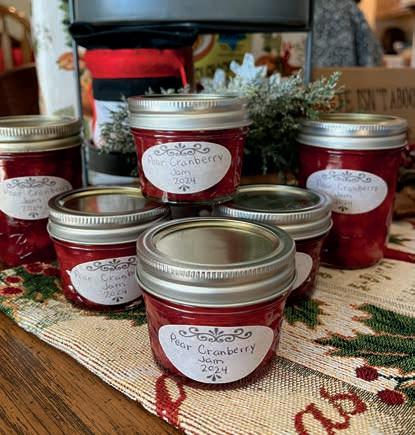
PEAR RASPBERRY JAM
Kristi Mason
2 c. coarsely chopped peeled ripe pears (about 3 medium)
2 c. fresh or frozen raspberries

What’s your favorite fruit to work with, and why?
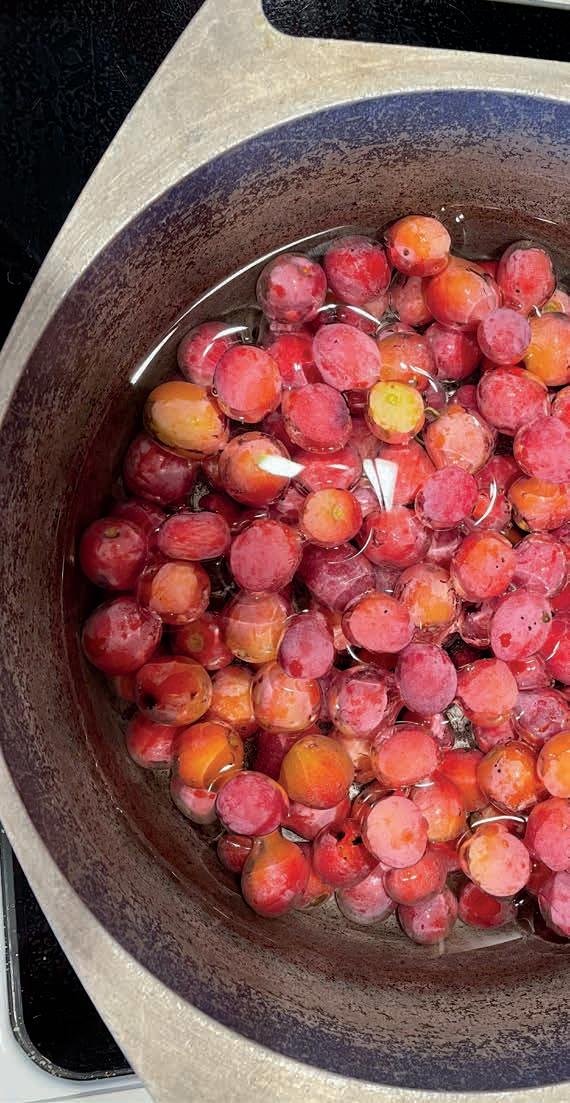
Wild grapes are one of the fruits I like to go out looking for the most. They are not the easiest to find that is for sure. The grapes like to hide underneath the leaves as a natural way to fend off birds and such.
learn more masonangussimangus.com
for printable recipes stockmanmag.com
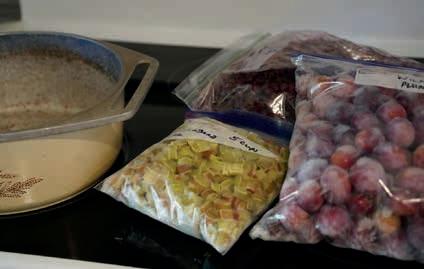

6 c. sugar 2 T. bottled lemon juice
1 to 1 1/2 tsp. orange zest (finely grated) 1 pouch (3 oz.) liquid fruit pectin
Step 1: In a Dutch oven, combine the first five ingredients; bring to a full rolling boil, stirring constantly. Quickly stir in the pectin; return to full rolling boil. Step 2: Boil for one minute, stirring constantly. Remove from heat; skim off foam. Step 3: Ladle hot mixture into hot half pint jars or size you like to make, leaving ¼-inch headspace. Step 4: Wipe rims and place hot lids on to seal. Process for 10 minutes in a boiling-water bath canner. Makes six half pint jars.
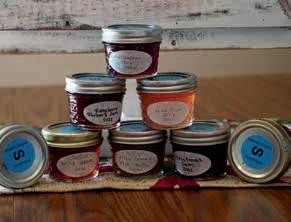


Kristi Mason
5 c. grape juice (ran through jelly cloth)
7 c. sugar
Sure-Jell pectin ½ T. butter
Step 1: Place juice with 1 box of Sure-Jell pectin in an 8-quart saucepan. Bring to a full boil, then add the sugar plus the half tablespoon of butter. Step 2: Return to rolling boil and boil for one minute. Step 3: Remove foam and ladle into hot jars, leaving ¼-inch head space; wipe rims and place hot lids and rings to seal. Place on towel on the counter and towel on top. If jars do not seal, once cooled, place in fridge to use. Makes eight jars.
ANNUAL SALE: Saturday, March 6, 2027
Broken Bow Livestock, Broken Bow, Neb.



Stay connected. See the latest. Wherever you go, it goes.



contributed article by Roman Schooley Bloomfield Livestock Market, Inc., Bloomfield, Iowa bloomfieldlivestockiowa.com
Summer is in full swing as heat settles across the Midwest. The high temperatures are affecting not only livestock but also the fat cattle market. Since July 4, cattle prices have seen some setbacks and the markets are feeling the pressure.
Feeder calf markets are hanging in there, with demand for 500- to 600-pound steers remaining very active. Larger steers are down $10 to $15 due to a sluggish fat cattle trade.
The demand for replacement females is still strong if the right group presents itself. Numbers are historically low this time of year, but come mid to late August, many grass yearlings will enter the trade. I expect many farmers will be ready to buy yearlings to fill their lots.
Demand should get somewhat better as barbecue season continues through August and September. The CME Index is holding at $370.32, down $8 to $10 from the summer highs.
Fat cattle trade is coming off historic highs, with many cattle previously trading in the $260 range. Here as of late, the August board sits at $231. The cash trade is still holding at $2.45 in the country. Drug-free auction fats are ranging from $253 to $262.
A
With many of the Big Four packers closing plants around the country, it will be hard to keep the trade competitive come fall. We should also see a gap in placements toward the end of the year. Most of the cattle were placed early due to the lack of rain in the South and West. Box beef cuts are ranging from $373 for Choice and $364 for Select cuts. Demand has weakened, causing the boxed beef prices to move sharply lower.
Stock cows and bulls have not been tested by the market. Seasonal heat across the Midwest keeps many of the stock cows from entering the market. We will likely need to wait until fall for runs to pick up. However, if you’re in a drought area, you may be able to select a few females.
Slaughter cows and bulls have stayed very strong throughout the summer. Fed cows are trading in the $1.85 to $2.00 range. Big
heavy-muscled bulls will still bring $2.40 to $2.65. Breeding bulls are still very valuable as many breeders have sold out this spring. If rains continue to come in the Heartland, cows will be a very popular asset. I pray you continue to have a blessed summer, and if you’re in need of moisture, I hope you will get plenty! As always, if you have any marketing needs, feel free to contact me or one of my representatives for help.
Roman Schooley, Bloomfield, Iowa
Roman Schooley owns Bloomfield Livestock Market and Schooley Cattle Co. in Bloomfield, Iowa. As president of Schooley Cattle Co., Roman leads the breeding decisions of the seedstock operation which consists of 550 registered Simmental and Angus cows. Schooley Cattle Co. utilizes IVF to produce breed leading genetic advancement. The company hosts an annual production sale the first Friday in February at the ranch; selling 18-monthold and yearling bulls and a select group of open and bred heifers. Roman also owns and assists in the operations at Bloomfield Livestock Market which primarily serves producers in Iowa, Missouri, and Illinois. He and his wife, Elizabeth, have three children: Hannah (23), Haven (20), Houstin (17), and one grandson, Weaver (2 months).






















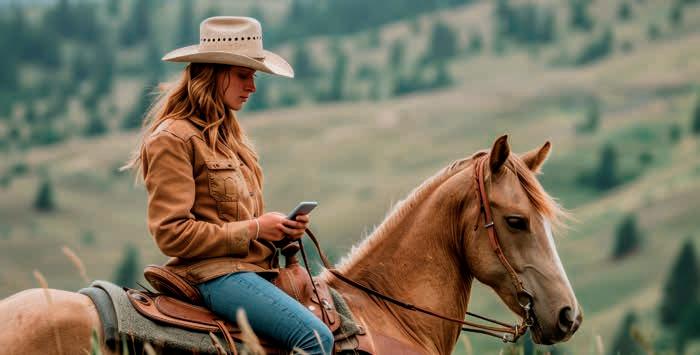
Likes and followers are passive signals. Visibility is intentional.
Livestock Digital runs paid digital campaigns through META and Google - placing client messages directly in front of targeted cattle producers based on geography, interests, and behavior.
Our campaigns :

1. Reach beyond existing followers
2. Appear across multiple placements - not just a page feed
3. Are built to drive real actions, not vanity metrics
In 2025, Livestock Digital recorded over 18 million views on campaigns and posts. 97.6% of those were non-followers. Effective marketing isn’t about popularity... It’s about precision.
As summer turns toward fall, we pause to acknowledge the individuals whose work often happens out of sight, yet remains essential to the success of our industry. Behind every strong calf crop and every progressive breeding program are individuals who give their time, expertise, and often evenings away from their own families so producers can continue doing what they do best.
There are so many people working quietly behind the scenes - AI technicians on the road, veterinarians adjusting their schedules to urgent calls, farm and ranch wives tirelessly cooking meals and coordinating schedules, and trucking companies who are committed to safely transporting cattle across the country. (Our feature on Lathrop Livestock Transportation on page 10 highlights one example of that quiet dedication.) The commitment is steady, professional, and deeply appreciated.
It's fitting that this note accompanies our inaugural Stockman Breeder's Showcase. As we highlight the herds and genetics shaping the future, we recognize that such progress is only possible because of the dedicated individuals supporting producers every step of the way.
To all who serve quietly and consistently - thank you. Your work strengthens operations, communities, and the future of the cattle business.
publication date materials due
August/September 2026 July 25
October 2026 September 7
November 2026 October 7
December 2026 November 7
January 2027 December 7
February 2027 January 7
March 2027 February 7
April 2027 March 7
May/June 2027 April 7
rate/issue
two page spread $2195
full page $1195
half page $695
business card $250 double card $450
premium pages and ring service call for a quote
MAKAYLA FLOWER, Editor and Graphics makayla@stockmanmag.com 605-690-6050
KIM BANKS, Online Editor and Graphics kkbanks@frontiernet.net 507-530-0914
CHERYL KEPES, Editor Assistant and Writer cheryl@stockmanmag.com 417-766-0990
MARIA OPHEIM, Social Media riawbr@gmail.com 507-828-1374
The Stockman hereby expressly limits its liability resulting from any and all misprints, errors and/or inaccuracies whatsoever in the advertisement and editorial content published by The Stockman and its said liability is here by limited to the refund of the customer for its payment for said advertisement, or the running of the corrected advertisement, or editorial notice. Notification by the customer of any error must be made within 30 days of the distribution of the magazine. Advertising copy received after the deadline may not be returned for proofing. Changes to advertising copy made after the deadline date will be allowed only if time permits, and will incur the appropriate charges according to time and materials involved in the changes. The opinions or views expressed in the editorials are those of the persons interviewed in the article and not The Stockman magazine. The Stockman does however reserve the right to edit or refuse all material which might be objectionable in content. No material or part thereof may be reproduced or used out of context, without prior specific approval of a proper credit to The Stockman
HEIDI SORENSEN ROHRIG, Ad Sales Coordinator hsorensenrohrig@gmail.com 661-900-6004
JOHN KUELPER, Ad Sales johnkuelper47@gmail.com 309-582-6335
JAN FORD, Ad Sales jford17879@aol.com 208-340-2024
CHRIS BEUTLER, CEO beutlerworkplace@outlook.com 402-380-8244
LANETTE FRYE, COO lanettepfrye@gmail.com 406-855-3173
Functional forage and pasture.
contributed article by Justin Fruechte, Product Expert - Ag Millborn, Brookings, S.D. millbornseeds.com
If there's one thing every producer knows, it's that farming and ranching don't come with many guarantees. Weather changes. Markets swing. Input costs fluctuate. While you can't control those variables, you can build a forage system that's better prepared to handle them.
One of the best ways to reduce risk is by diversifying your forage program. Instead of relying on a single crop or harvest window, a mix of perennial and annual forages gives you more opportunities to produce quality feed, no matter what the season brings.
I often get asked the question about whether to plant annuals or perennials for the most or best feed. The answer is simple: both have a place.
Perennial forages like alfalfa and perennial grasses are the foundation of many successful operations. Once established, they provide dependable production year after year without the expense and labor of annual planting. Alfalfa delivers the high-quality, high-protein hay many livestock operations depend on, while also contributing nitrogen and improving overall soil health.
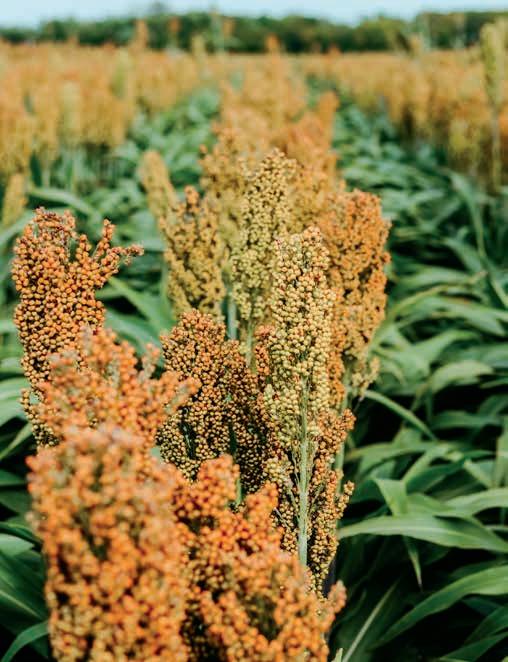
Annual forages bring a different advantage: flexibility. They often produce impressive yields, allow you to adjust your cropping plans each season, and give you another tool to respond to changing weather or feed needs. They also add valuable diversity to corn and soybean rotations, helping break pest and disease cycles, suppress weeds, and support healthier soils.
One of the biggest opportunities for many livestock producers comes after corn or sorghum silage harvest in September. That's an ideal time to seed winter triticale, cereal rye, or forage winter wheat. These crops establish in the fall, take advantage of winter moisture and early spring rains, and provide
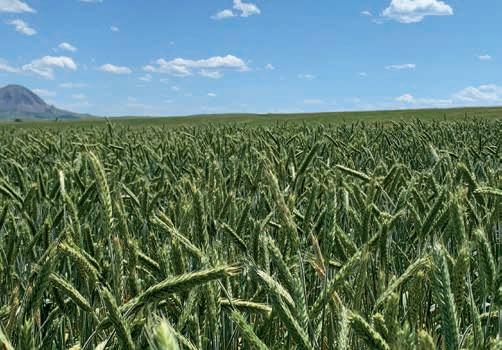
high-quality forage weeks before most spring-planted crops are ready. Whether you're grazing, chopping silage, or putting up hay, they help fill an important gap in the forage calendar.
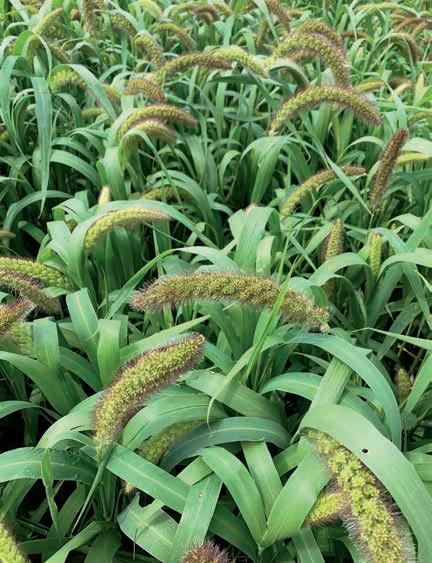
If you're looking to add feed later in the season, there are plenty of options there, too. Summer annuals like millet or forage sorghum can quickly produce quality forage, giving you another chance to respond when conditions (or your feed inventory) change.
The producers who consistently come out ahead aren't necessarily the ones chasing the highest yield every year. They're the ones building systems that perform across a wide range of conditions. By combining dependable perennial forages with strategically placed annuals, you can spread risk, improve soil health, extend your harvest windows, and create a more reliable forage supply year after year.
Photos courtesy Millborn learn more millbornseeds.com
Millborn, Brookings, S.D.
The team of folks at Millborn have roots that run deep in farming, agriculture, and in the overall respect for the landscape. They opened their doors in 1987 and continue to walk alongside farmers, ranchers, and landowners across thousands of acres throughout the Midwest.