B1
SUNDAY, JULY 16, 2017 Adelle Chua, Editor
Opinion
Joyce Pangco Pañares, Issue Editor
mst.daydesk@gmail.com
JAPAN MAY CRIPPLE ITS CASINOS
EDITORIAL
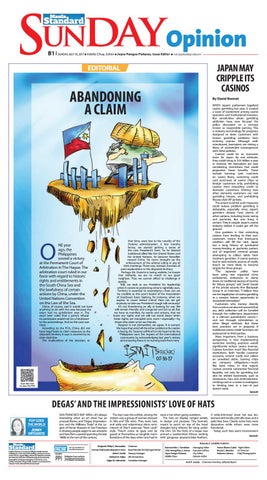
ABANDONING A CLAIM
O
By David Bonnet WHEN Japan’s parliament legalized casino gambling last year, it created a wave of excitement among casino operators and institutional investors. But sensitivities about gambling addiction have now focused the policy discussion on a concept known as responsible gaming. This is industry terminology for programs designed to deter customers with known gambling problems from entering casinos. Although wellintentioned, lawmakers are risking a litany of unintended consequences with these policies. Casinos could be an economic boon for Japan. By one estimate, they could bring in $25 billion a year in revenue. Yet lawmakers are now considering restrictions that could jeopardize those benefits. These include banning cash machines on casino floors, restricting credit card purchases of casino chips to foreign customers only, prohibiting casinos from extending credit to domestic customers, limiting how often domestic customers can visit gambling houses, and prohibiting Macau-style VIP junkets. The extent to which such measures could reduce problem gambling is debatable, especially since Japan’s gamblers already have plenty of other options, including horse racing and pachinko. But one thing is certain: They’d cripple Japan’s casino industry before it could get off the ground. One problem is that restricting casinos from lending to their own customers means that third-party creditors will fill the void. Japan has a long history of syndicated money-lending at pachinko parlors, and of organized criminal groups attempting to collect debts from insolvent gamblers. If casino patrons had to seek outside sources of credit, they’d be more likely to become targets for these groups. “The Japanese police have been using new organized crime exclusionary ordinances to clamp down on traditional sources of income for Yakuza groups,” said David Suzuki of the private security firm Blackpeak Group in an interview. “I believe they see the legalization of casino gambling as a massive, historic opportunity to resuscitate themselves.” Customers who borrow directly from a casino can also rest assured that any debt collection will be handled through the collections department or a relevant jurisdiction’s courts— and not through intimidation or other illegal methods. But these best practices are in jeopardy if traditional casino credit functions are outsourced to third parties. More important, from a business perspective, is that implementing restrictive lending practices would significantly reduce casino revenue. Casinos function much like financial institutions. Both handle customer accounts, extend credit and collect on unsettled debts. Gaming chips are company obligations—much like bank notes. In that regard, casinos provide substantial financial liquidity, not only for gambling but also for related businesses, such as restaurants, bars and entertainment. Limiting cash in a casino is analogous to limiting beer in a bar—it just doesn’t work.
that time, were lost to the novelty of the Duterte administration. A few months hence, we started getting a sense of the new President’s bent. As he blasted traditional allies like the United States and the United Nations, he became friendlier toward China. He never brought up the enforcement of the arbitral ruling in any of their meetings. There was, instead, mention of joint explorations in the disputed territory. Perhaps Mr. Duterte is being realistic; he knows that militarily, we are no match to our giant neighbor. Thus we cannot afford to challenge it openly. Still, we look to our President for leadership when it comes to protecting what is rightfully ours. Territory is essential to sovereignty—how can we be credible as this year’s leader of the Association of Southeast Asian Nations, for instance, when we appear to cower before China? How can we get anybody to take our President’s tough talk seriously? It’s not threatening an ally or looking for war. We will remain friendly and congenial and fair to all. But we have to manifest, by words and actions, that we know our rights and we will not stand down when these rights are trampled over even—especially—by those who claim to be our friends. Respect is not demanded, we agree. It is earned. We hope that amid all the other problems the nation is facing, Mr. Duterte will find it in his heart to let the Philippines earn the respect of the international community by acknowledging last year’s victory and ensuring there is no turning back from here.
NE year ago, the Philippines scored a victory at the Permanent Court of Arbitration in The Hague. The arbitration court ruled in our favor with regard to historic rights and entitlements in the South China Sea and the lawfulness of certain actions by China, under the United Nations Convention on the Law of the Sea.
China, of course, said it would not have anything to do with the case because the court had no jurisdiction over it. The court later ruled that a party’s refusal to participate would not be a hindrance to the proceedings. And so the case was tried. According to the PCA, China did not have legal basis to claim resources to the disputed territory it says is covered by its nine-dash line. The implications of the decision, at
Scan this icon to view the PDF
Turn to B2
DEGAS’ AND THE IMPRESSIONISTS’ LOVE OF HATS POP GOES THE WORLD JENNY ORTUOSTE
SAN FRANCISCO BAY AREA—It’s always interesting when an art show has an unusual theme, and “Degas, Impressionism, and the Millinery Trade” at the Legion of Honor Museum in San Francisco is drawing people eager to see artworks and hats from a period spanning the late 1800s to the turn of the century.
The day I saw the exhibit, among the visitors was a group of women dressed in ‘40s and ‘50s retro. They wore hats and wide and voluminous skirts reminiscent of Dior’s post-war “New Look” style. They’d come to gaze and be gazed at themselves as tangible manifestations of the days when one had to
wear a hat when going outdoors. The hats on display ranged widely in design and purpose. Tiny bonnets meant to perch on top of the head dangled long ribbons for tying under the chin. On the front of a toque was pinned a taxidermied African starling with gorgeous peacock-blue feathers.
A wide-brimmed straw hat was festooned with lovely pink silk roses and a pale blue bow. Clearly some hats were decorative while others were more functional. Today, such hats seem inconvenient Turn to B2
Rolando G. Estabillo Publisher ManilaStandard
Published Monday to Sunday by Philippine Manila Standard Publishing Inc. at 6/F Universal Re Building, 106 Paseo de Roxas, corner Perea St., Legaspi Village, Makati City. Telephone numbers 832-5554, 832-5556, 832-5558 (connecting all departments), (Editorial) 832-5554, (Advertising) 832-5550. P.O. Box 2933, Manila Central Post Office, Manila. Website: www.thestandard. com.ph; e-mail: contact@thestandard.com.ph
ONLINE
can be accessed at: manilstandard.net
MEMBER
PPI
Philippine Press Institute The National Association of Philippine Newspapers
Benjamin Philip G. Romualdez Former Chief Justice Reynato S. Puno Anita F. Grefal Baldwin R. Felipe Edgar M. Valmorida
Chairman Board Member & Chief Legal Adviser Treasury Manager OIC-Ad Solutions Circulation Manager
Ramonchito L. Tomeldan Chin Wong/Ray S. Eñano Joyce Pangco Pañares Adelle Chua
Managing Editor Associate Editors City Editor Opinion Editor
Emil P. Jurado
Honor Blanco Cabie Night Editor Romel J. Mendez Art Director Roberto Cabrera Chief Photographer
Chairman Emeritus, Editorial Board
Opinion
B2
SUNDAY, JULY 16, 2017 mst.daydesk@gmail.com
DEGAS’...
From B1
and useless affectations. But they were once essential to one’s wardrobe and conveyed prestige and status as designer handbags do now. As the Impressionists and Degas veered from the historical themes popular during the time and became interested in portraying daily life, hats were included in their works because they were worn by everyone. Degas’ pastel portraits of friends Zacharie Zacharian and Henri Rouart show them wearing bowlers, the chapeau of choice of the intelligentsia and worn by Jose Rizal and other ilustrados in Europe before the Revolution. Another Degas portrait depicts his fellow artist Mary Cassatt wearing a mannish triangular hat. Berthe Morisot’s “Eugene Manet on the Isle of Wight” (1875) portrays her husband wearing a straw boater and looking out the window at a woman and young girl, both also wearing hats. Degas, Pierre-Auguste Renoir, and some of their other contemporaries were also, according to one of the museum captions, interested in the “materiality of hats”—their ribbons, trimmings, and artificial flowers. Degas, says his friend Paul Gauguin, “dared go into ecstasies in front of milliner’s shops,” while Renoir was described as being “obsessed” with hats, and on at least one occasion designed a hat himself. They considered millinery an art form. Tellingly, these artists also depicted the milliners themselves. Some are shown weary and haggard, as in Degas’s “The Milliners” (ca. 1882 to before 1905), perhaps after a night shift, or even ill from “Mad Hatter’s disease,” mercury poisoning (the chemical was used in curing felt). The exhibit’s centerpiece, Degas’s “The Millinery Shop” (ca. 1879 to 1886), shows a milliner— “modiste”—sitting on a chair, working on a peach hat, a pin between her lips, more hats on a table beside her. Also portrayed in these artworks was the hierarchy in that particular industry—from the “premiere” (designer) and her “seconde” to the “petit mains” (“small hands”—the workers) and “trottins” (apprentices who delivered hats to customers). Jean Beraud’s “Paris, rue du Havre” (1882) depicts what is likely a trottin walking along a boulevard with hatboxes in hand. James Tissot’s “The Shop Girl” (ca. 1883 to 1885) portrays the interior of a milliner’s, with a girl holding the door open while gazing straight at the viewer, the “customer.” These works bring to mind Juan Luna’s oils “Lady at the Racetrack” (ca. 1880s) which shows a woman wearing a black or midnight blue straw hat at a racecourse in Madrid, and “The Parisian Life” (1892), depicting a woman in a dark-colored bonnet in a café, three men seated at a nearby table. These works from the same time frame would not have looked amiss at the Legion of Honor’s exhibit. “Degas, Impressionism, and the Millinery Trade” is a fascinating look at a facet of Belle Epoque culture. The hats and artworks are not only artifacts of visual and applied art, beautiful and worthy in themselves, but they also serve as documentation. As such, they help us visualize and understand the period’s norms and conventions that governed one’s personal appearance and acted as indicators of social identity. They remind us how much we are creatures of our time and place. Dr. Ortuoste is a California-based writer. Follow her on Facebook: Jenny Ortuoste, Twitter: @jennyortuoste, Instagram: @jensdecember, @ artuoste
JAPAN... From B1 Combined with the proposed limits on domestic gambling and VIP junkets, the government would thus be inhibiting most of the casino industry’s key business segments. This will severely compromise the ability to generate cashflow, discourage institutional investors from committing the billions of dollars of capital needed to get major integrated resorts off the ground, and undermine the industry’s ability to create new jobs and boost economic activity. These measures would reduce potential gambling revenue by up to 50 percent. In short, the government would be forfeiting most of the potential benefits that casinos could bring to Japan— before anyone has even broken ground. A better approach is to try to address potential problems without needlessly scaring off investors and operators. For one thing, regulators should take a holistic view of the costs and benefits of casinos, and recognize
MAIL MATTER
EVERYMAN
COSPLAY IS NOT CONSENT By Alex Alcasid COSPLAYERS (“costume players”) are everywhere nowadays. They are the people you see at the mall dressed as anime characters or superheroes. While it may be a surprise to run into someone looking like they jumped out of a cartoon into real life, cosplayers are just people enjoying their hobby. There are several anime and pop culture conventions held in the country every year. Some focus on showcasing toys and collectibles, others celebrate Japanese culture or video games. These conventions are attended by cosplayers who wear costumes and wield props to represent their favorite characters. Cosplay is different from dressing up in a costume for Halloween, as conventions and cosplay events are not limited to one day a year. With the rise and exposure of the “Pastor Hokage” culture, wherein a number of Facebook groups share photos of women without their consent and trade pornography with each other, cosplayers have come forward with their own tales of sexual harassment. A July 7 post on the Facebook page “Catcalled in the Philippines” shared the experience of a female cosplayer during the Philippine Toys, Hobbies, and Collectibles Convention (Toycon) held last June 30 to July 2. The cosplayer said that a man dressed as Mario from the Nintendo games and his friends asked for a picture with her. They took close-up
pictures of her breasts, and “Mario” hugged and touched the cosplayer and her friend without permission. According to cosplay etiquette, while asking cosplayers for pictures is accepted, touching them without consent is not okay. There are those who bashed the cosplayer for wearing revealing costumes. As in all cases of sexual harassment, the clothes have nothing to do with it. The clothes the victim wears are not responsible for a pervert sliding their hands up the victim’s thigh. One of my friends, dressed as the courtesan Ran Mao from the anime Kuroshitsuji, wore a mini skirt with a slit to the hip and high stockings. Since that was the character’s costume, my friend dressed the same way to represent her. While she and her boyfriend were resting, a group of teenage boys came up to them and asked for a picture with only the girl. It is bad etiquette in the cosplay community to take pictures of cosplayers without their permission, or to bother them for pictures while they are resting and eating, but the two relented since the group of boys were rowdy and wouldn’t leave them alone. As my friend posed for a picture with the group crowded around her, she felt a hand slide up her thigh and squeeze her behind twice. Her boyfriend saw her becoming uncomfortable and told the boys that they were done. The group left, calling both of them rude and selfish, as if they were entitled to do whatever they wanted.
THIS is to clarify news report which came out in your newspaper entitled “DOTr expects to issue new vehicle plates in September” dated July 8, 2017. The Land Transportation Office would like to put on record that our chairman, Assistant Secretary Edgar C. Galvante, has not issued any statement that vehicle plates will be made available by September. What he did mentioned was that these will be available by the end of the year. This clarification is being issued so that you can rectify the inaccuracy committed by your reporter. The deficit in the license plates started two years ago when the Commission on Audit issued a notice of disallowance against the LTO’s five-year contract with Power Plates Dev’t. Concept and Dutch company Knieriem BV Goes. The Land Transportation Office is presently addressing this issue and we are working on improving the security features of the car plates to be issued to protect our clientele.
In another instance, a male cosplayer dressed in a leather suit and helmet was posing for pictures when he felt someone slap him on the behind and run away into the crowd. Even if it was meant as a joke, the act was unwanted. The man was left defenseless, confused, and upset. “Cosplay is not consent.” These are words repeated on signs at conventions in an effort to stem sexual harassment of the cosplayers. Sexual harassment in the cosplay community is not that different from the Pastor Hokage culture. The perpetrators believe they are free to do whatever they want, say whatever they like, because their victims are a captive audience. In the case of cosplayers, because they are in public, they don’t want to make a scene and cause more trouble and draw negative attention. The people being shamed and objectified in the Pastor Hokage Facebook groups aren’t even aware of the “pastors’” actions until they start receiving solicitations for sex in their Facebook private messages. Just because cosplayers decide to go out in public dressed as fictional characters, whether skimpily or otherwise, does not mean they can be taken advantage of. Just because someone takes a liking to a woman does not mean the woman’s pictures are free to be reposted and sexualized. Everyone deserves respect.
Respectfully yours, WENG C. OCFEMIA Consultant for Media LTO
Alex Alcasid, 25, is a writer and animation student who cosplays in her free time.
THE GLORY OF BEING BAFFLED BY ‘GAME OF THRONES’ By Stephen L. Carter ALLOW me to confess a shameful secret: I am constantly losing track of “Game of Thrones” characters. This debility afflicts me particularly during the long winters between seasons. When someone who vanished from the story years ago suddenly reappears, I don’t shout, in the manner of the true Throner, “There he is!” I’m more likely to frown and say “Who’s that again?” and reach for my iPad. “Game of Thrones,” which returns for its seventh season this weekend on HBO, is the most complex and convoluted television show in the history of the medium. That complexity is half the fun. And fun it is. Last season, the show averaged 7.7 million live viewers per episode—10.6 million when we include those who viewed it on other media within seven days. Total viewers per episode averaged in excess of 23 million. The season finale drew a 4.4 rating in the 18-to-49 demographic advertisers love, a figure that beat every scripted show on broadcast or cable except “Empire” and “The Walking Dead.” “Game of Thrones” is special. No other scripted show generates an online community of a richness and depth usually reserved for bigscreen franchises with “Star” in the title. Apart from the Super Bowl, nothing else on television sparks parties where fans expert and casual mingle as they await every twist and turn. The show has been called, with reason, the last bit of television monoculture. People watch it, and discuss it, and argue about it; and
that they can increase oversight at any time. Placing arbitrary stipulations on casino operations at the outset of the license application process will only discourage global gaming companies from investing in Japan in the first place. Macau—which in recent years has rolled out increasingly sophisticated regulations, while remaining the world’s top gambling hub—offers an example of how a more flexible approach can work. Likewise, adopting a framework to address problem gambling similar to those that have worked in Las Vegas and Singapore—through public education, funding for addiction treatment and prevention, training for casino workers, and other prudent measures—could allow people to sensibly enjoy casinos in Japan without destroying the industry’s proven business model. To date, operators have expressed unbridled enthusiasm at the prospects for casino gambling in Japan. But that will quickly change if these proposed measures are put in place. Japan should be careful not to kill off its casino industry before it even has a chance. Bloomberg
in a certain age and cultural cohort, those who would rather skip it are left out of the conversation. But millions of us outside the cohort also tune in. Why do we watch, captivated? Part of the reason is that everyone else watches. Potential viewers – younger ones particularly – do not want to be left out. But there are other reasons. Many fans cite the complexity of the worldbuilding, both in the books and in the television show. And the world-building is indeed a delight, even when one spots the holes. (How can the society exist with only one bank? Why don’t the various would-be conquerors loot it?) Other viewers point to the constantly shifting alliances ... and betrayals. The sets are remarkable. (At $10 million per episode, they had better be.) There are wonderful villains (Tywin Lannister) and wonderful antiheros (Tyrion Lannister). And White Walkers. And dragons. There are the constant surprises— particularly the willingness to kill off major characters, not just minor ones, often without warning. If you miss an episode you might miss a major death. This technique, pioneered by “The Sopranos,” has become a staple of so-called “prestige” television drama (“Breaking Bad”; “Sons of Anarchy”). But “Game of Thrones” has raised the killing of characters to an art form, setting up sequences in which fan favorites are cut bloodily and suddenly from the story. Still, I bet I’m not the only fan who can’t keep all the storylines and characters straight. I am always confusing
the Maesters. I have only the vaguest memories of Dontos Hollard and the High Septon. If I want to know what “valar morghulis” means, I have to look it up. I am aware that Gendry is still rowing but I have trouble remembering that the place he escaped from is called Dragonstone. (I also used to forget which Clegane was which, but I finally have that one straight.) And none of this matters—not to me, and not to all of the other millions of viewers who don’t have the map of Westeros committed to memory and can’t quite recall all the clues in Bran’s visions. For some of us, not being able to keep track is part of the fun. “The Sopranos” never called upon viewers to hold in their minds the details of more than perhaps a dozen characters in any given season (except, arguably, the last). The number who really mattered at any moment of “Breaking Bad” (or in the first season of “The Handmaid’s Tale,” say) was even smaller. But in “Game of Thrones,” the viewer never knows which long-vanished cast member will suddenly show up to save the day or ruin it. (Lancel Lannister, for instance.) Over six seasons, the total number of named “Game of Thrones” characters is—wait for it—553. How many of these should be considered major characters? Estimates range from around 50 to around 150. It’s preposterous to think that many of those who are attending this weekend’s kickoff parties can tell them all apart. On the contrary, most of the record number of view-
ers expected for the season opener are surely more like me. The impossibility of keeping track of everything and everyone is a feature, not a bug. I enjoy the way that I am constantly surprised. The plot, too, is of such stupefying complexity that hardly anybody can reasonably claim to be following it all. We know that everyone is battling over the Iron Throne, and that anyone who gains it probably has but little time to live. The rest is betrayal and blood, blood and betrayal, and, every now and then, character growth. (Brienne of Tarth.) But in truth, there’s no real need to keep track. The twists and turns, the swords and the legends, the angry diatribes and snappy dialogue all work even if you don’t remember who’s who. If I should happen to tune in halfway through some longforgotten episode from Season 2, I would be engrossed at once. There are blind spots. Too much rape, for one thing. Too much talky exposition about details from the books. Too much effort put into trying to get us to root for a character who in Season 1 threw a child out the window in an effort to cover up his own incest. Yet, that said, “Game of Thrones” remains the most remarkable television phenomenon of our time. I’m excited that Season 7 is about to begin, and sorry that Season 8 will be the last. I will never remember all the characters but I will never forget the experience. Television’s golden age will surely outlast “Game of Thrones.” But I don’t think we’ll ever see a show like this again. Bloomberg
THERE’S RUMBLING ON THE RIGHT OVER TRUMP By Albert R. Hunt A POLITICAL brawl is brewing in Washington that doesn’t involve Republicans fighting Democrats or liberals battling conservatives. It’s a conflict within the political right about whether to start putting some distance between conservatives and President Donald Trump. The clash has intensified with the revelation this week that the president’s son and son-in-law, Donald Trump Jr. and Jared Kushner, met with a Russian lawyer during the 2016 presidential campaign in hopes of getting dirt on Hillary Clinton. The Justice Department and committees in both houses of Congress are investigating the Trump campaign’s connection to Russian efforts to undermine the Democratic candidate. One set of conservative elected officials and influential media figures wants to find a way to start withdrawing support from Trump, worrying that the drumbeat of revelations about his team’s contacts with Russia could derail their policy agenda. The contrary view is that Trump’s continued popularity with Republican voters gives them a chance for substantive
achievements if they stick with him, whatever his deficiencies. The issue is further complicated by what Republicans in close contact with the White House describe as a dysfunctional presidency. White House Chief of Staff Reince Preibus, they say, now focuses mainly on directing the Republican National Committee, which he used to head, and which is described as impotent. Kushner, who has been given a wide policy portfolio, is distracted by investigations into the Russia probe. Chief Strategist Steve Bannon, the nationalist adviser, is seen as the keeper of the hard-core flame, but not as a manager capable of curtailing the chaos, at times bordering on panic, afflicting this presidency. One closely connected conservative says the president’s functional chief of staff is Trump himself. If true, that would be as self-destructive as a doctor diagnosing his own serious illness or a lawyer defending herself in a big case. Many conservatives are sticking with Trump. Representative Ted Yoho of Florida dismissed the significance of the meetings with the Russian lawyer, saying he might have done the same thing. Senator Orrin
Hatch of Utah called the story “overblown.” The right-wing media, spearheaded by talkradio host Rush Limbaugh and Fox television anchor Sean Hannity, are attacking Trump critics, especially Republicans. But there are cracks. The New York Post, owned by the conservative power broker Rupert Murdoch, editorially called Trump Jr. “an idiot.” A story on the Fox News website charged that the junior Trump’s meeting will provide fodder for the Justice Department investigation led by special counsel Robert Mueller, predicting that “much of it will be unhappy for the president,” and asking, “What else is the campaign hiding?” Conservative journalists – the Trump right disparages them as the elites – like columnist Charles Krauthammer and David French of National Review, suggested that emails between Trump Jr. and a gobetween for the Russian lawyer show that Trump associates at least tried to assist Russian efforts to aid the campaign. That complicates the efforts of Trump allies like Newt Gingrich to discredit Mueller, and undercuts the president’s charge that the investigation is a partisan “witch hunt.” Bloomberg
World INDIA NEW HEAD OF STATE FROM LOWEST CASTE NEW DELHI—India’s next president will emerge from the Dalit caste -- a community so marginalized they were once known as “untouchables” -- with the victory of the ruling party candidate set to strengthen Prime Minister Narendra Modi’s grip on power. Ram Nath Kovind, 71, is hot favorite to be elected Monday by national and state lawmakers to become titular head-of-state as the candidate of Modi’s Bharatiya Janata Party (BJP). It will be only the second time, after President K.R Narayanan, who served from 1997 to 2002, that a member of the downtrodden caste has assumed the post. The result will be announced Thursday. And for Modi, with one eye on reelection in 2019, it will send an important message to a key, long disdained electoral group. Dalits, who number around 200 million, are among the poorest communities in India and have traditionally been relegated to activities on the margins of society. Despite legal protection, discrimination is rife and Dalits are routinely denied access to education and other opportunities for advancement. AFP
‘NO COMPLAINING’: POPE FRANCIS TAKES ON MOANERS
B3
SUNDAY, JULY 16, 2017 mst.daydesk@gmail.com
6 WOUNDED IN EGYPT RESORT STABBING C
AIRO, Egypt—An attacker wounded six female tourists when he attacked them with a knife on a beach in Egypt’s Red Sea resort town of Hurghada on Friday, the interior ministry said. The assailant has been arrested and is being questioned to determine his motives, the ministry said in a statement. Their nationalities were not immediately clear, but at least one of the tourists is a dual Ukrainian-Russian national, according to Russian media citing the consulate in Egypt. The ministry said the assailant swam to the beach before attacking the tourists. In January 2016, three tourists in Hurghada were wounded in a stabbing attack by two assailants with apparent Islamic State group sympathies.
Hurghada is one of Egypt’s most popular beach resorts, especially with Ukrainians and European tourists. Security has been boosted in tourist resorts around the country, as the industry provides Egypt with much needed revenues. An Islamic State group bombing of a Russian airliner carrying holidaymakers from a south Sinai resort in 2015 killed all 224 people on board and decimated the country’s tourism sector. Russia suspended all flights to Egypt in response and has yet to resume them. IS has been waging a deadly in-
surgency based in the north of the Sinai Peninsula that has killed hundreds of policemen and soldiers. Meanwhile, in Jeddah, Saudi Arabia, Saudi Arabia on Friday hailed the Iraq government’s recapture of Mosul city from Islamic State group jihadists, stressing its solidarity with Baghdad in combating “terrorism” despite their rocky relations. The kingdom “congratulates the Iraqi government and people for recapturing Mosul city and liberating it from the Daesh terrorist organization,” the foreign ministry said in a statement, using the Arabic acronym for IS. The statement carried by SPA state news agency stressed that Riyadh “stands by Iraq and its efforts to combat extremism and terrorism in all its form, as well as its financing.” Iraq declared victory in Mosul this week after a nearly nine-month battle that ravaged the city and took a heavy toll on residents and security
forces. Riyadh and Baghdad have made efforts to improve their bumpy relations, with Iraqi Prime Minister Haider al-Abadi, a Shiite, visiting the predominantly Sunni kingdom last month. Saudi Foreign Minister Adel al-Jubeir travelled to Baghdad in February for talks with Abadi, on the first visit of its kind since 2003. Saudi Arabia has long expressed concern about Shiite Iran’s “interference” in the region, including through Iraq’s paramilitary Hashed al-Shaabi which has played a major role in fighting IS. Saudi Arabia cut ties with Iran in early 2016 after years of strained relations. Although Saudi Arabia officially supports the fight against the Sunni jihadists of IS, Iraq and some other countries have argued it needs to do more to help defeat the terrorists. AFP
VATICAN CITY—Pope Francis carries the weight of the world’s poor and suffering on his shoulders: the last thing he needs is people turning up at his apartment for a whining session. “Vietato lamentarsi” (no complaining) reads a sign in Italian hung on the door to Pope Francis’s private rooms in the Vatican that was given to him by a psychologist, according to a religious expert close to the pontiff. Psychologist Salvo Noe, author of motivational guides, gave it to Francis at the end of an audience on Saint Peter’s Square last month, journalist Andrea Tornielli said on the “Vatican Insider” website. “I will put it up on my office door where I receive visitors,” the pope is said to have promised with a smile. But in the end he chose to hang it at the entrance to his modest living quarters in the Santa Marta hotel in the tiny state. The Argentine often tries to buck up gloomy believers by telling them to cast off their melancholy and stop grumbling. The sign’s small print warns offenders “are subject to developing a victim complex, resulting in a lowering... of their capacity to solve problems.” AFP
AFGHAN ISIS LEADER KILLED IN US STRIKE WASHINGTON—US forces have killed the head of the Islamic State group’s Afghanistan branch, the Pentagon said Friday, marking the third time in a year the franchise has lost its leader. Abu Sayed was killed in a July 11 strike in Afghanistan’s northeastern province of Kunar on the headquarters of IS-Khorasan Province (IS-K), which also killed additional jihadists, the Pentagon said in a statement. “You kill a leader of one of these groups and it sets them back,” Pentagon chief Jim Mattis told reporters. “It’s obviously a victory on our side in terms of setting them back. It’s the right direction.” First emerging in 2015, IS-K overran large parts of Nangarhar and Kunar provinces, near the Pakistan border, but their part in the Afghan conflict had been largely overshadowed by the operations against the Taliban. Afghan and US forces had killed Abu Sayed’s two predecessors atop the group’s Afghan branch -- Hafiz Saeed in July 2016 and Abdul Hasib in late April of this year, the Pentagon said. Hasib and other top militant commanders were killed in a joint raid by US Army Rangers and Afghan special forces. At the time, the US military had said Hasib’s death would “help reach our goal of destroying them in 2017.” “We will continue until they are annihilated. There is no safe haven for ISIS-K in Afghanistan,” said General John Nicholson, who leads US Forces-Afghanistan. Pentagon officials say the group now numbers fewer than 1,000 in Afghanistan. AFP
BURNED. The charred exterior of the Marco Polo Building is pictured after a fire broke out on the upper floors in Honolulu, Hawaii, on Friday. At least three people were killed and a dozen injured when a massive fire tore through a 36-story apartment complex in Honolulu, local media reported. AFP
ITALIAN HAMLETS STRUGGLE WITH ‘HUMAN WAREHOUSES’
RAHMAN ROCKS. Bollywood music composer and singer AR Rahman performs at IIFA Rock Friday at the MetLife Stadium in East Rutherford, New Jersey during the 18th International Indian Film Academy Festival. AFP
CONETTA, Italy—They used to be sleepy hamlets on Italy’s sun-baked Padan Plain. But two years with hundreds of asylum seekers packed into overcrowded centers dubbed “human warehouses” are taking their toll -- on both migrants and villagers. Inside vast white tents erected in a former military zone on the outskirts of the tiny village of Conetta, some 1,400 men from across Africa while away their days, packed onto endless rows of bunks as the temperatures rise. Many escape for a few hours to cycle around the area: they are met with hostile banners calling for them to leave. “I used to call this place a modern lager,” Cona mayor Albero Panfilio told AFP, referring to concentration camps. The commune of Cona includes the little village of Conetta. “After two years this is (still) a place where human beings are squashed in together, with no hope for the future. “Now I call it a human warehouse. The migrants arrive, they don’t know where to put them, they have a warehouse, they dump them here.” The asylum seekers were treated “like garbage”, he added. Panfilio says the 190 residents in Conetta have also suffered. Among several protest messages scrawled on sheets and hung up in the village square, one reads simply “Repatriate the migrants”. Around 10 kilometers away (6.2 miles) in Bagnoli di Sopra, some 700 migrants are crowded into another former military base. There are more barbed wire fences among the endless fields of soybean and corn, and no access to journalists. Mayor Roberto Milan said the residents there had held sitins demanding the migrants be removed, but to no effect. “The tension is great, there’s a lot of hostility. There are many of them and it’s not possible to create ties (with the local population). That leads to mutual distrust,” he told AFP by telephone. AFP
B4
SUNDAY, JULY 16, 2017 Cesar Barrioquinto, Editor / Jimbo Gulle, Issue Editor
World
mst.daydesk@gmail.com
BEYONCE UNVEILS PHOTO OF TWINS: BOY SIR, GIRL RUMI
This handout photo provided by the Shenyang Municipal Information Office shows Liu Xia (right, in black), wife of Liu Xiaobo, and family members standing next to the late Nobel laureate’s body at a funeral parlor in the Chinese city of Shenyang, Liaoning province, on Saturday. Liu’s body was cremated after a private ceremony attended by his wife and friends, two days after the dissident lost a battle with cancer while in custody. AFP
CHINA CREMATES BODY OF DISSIDENT LIU XIAOBO S
HENYANG, China—The body of China’s late Nobel laureate Liu Xiaobo was cremated Saturday after a private ceremony attended by his family, as Beijing faces international pressure to let the dissident’s wife leave the country.
Liu’s remains were incinerated “in accordance with the will of his family members and local customs” in the northeastern city of Shenyang, said Zhang Qingyang, an official from the municipal office. Officials released photos showing his wife, the poet Liu Xia, with her brother, and two of Liu Xiaobo’s brothers in front of the body, which was covered with white petals and surrounded by flowers at a funeral home. Zhang also said “friends” were
at the ceremony, but Amnesty International’s China researcher Patrick Poon told AFP that he did not recognise any of the row of non-family members in the official photo and people close to the Liu couple identified at least one “state security police officer” among them. Chinese dissident artist critic Ai Weiwei, who lives in Berlin, tweeted a photo of the funeral and called the display “disgusting” and a “violation” of the deceased.
China’s government faced a global backlash for denying the democracy advocate’s wish to be treated abroad. After his death, the United States and European Union called on Beijing to free Liu Xia, who has been under house arrest since 2010, and let her leave the country. “As far as I know, Liu Xia is in a free condition,” Zhang said, though it was unclear whether she was released as he did not answer questions about her whereabouts. Authorities have severely restricted Liu Xia’s contact with the outside world and Jared Genser, a US lawyer who represented the Nobel Peace Prize winner, said she has been held “incommunicado” since her husband’s death. “The most preposterous thing is that even during his cremation and funeral he still was not
free. And now it’s been passed on to his wife, who will continue to lead on that same freedom-less existence,” Hu Jia, a Beijing-based activist and family friend, told AFP. Liu was jailed in 2008 after co-writing a petition calling for democratic reforms. The veteran of the 1989 Tiananmen Square pro-democracy protests was sentenced to 11 years in prison for “subversion” a year later. He died of multiple organ failure at a Shenyang hospital on Thursday at age 61, more than a month after he was transferred from prison due to late-stage liver cancer. At his funeral, Mozart’s Requiem was played and Liu Xia “fixed her eyes on him a long time, mumbling to say farewell,” Zhang said, adding that she was “in very low spirits.” AFP
‘BEING AMERICAN ALMOST AN EMBARRASSMENT’ NEW YORK—JPMorgan Chase chief executive Jamie Dimon ripped into the political gridlock in Washington and said Friday that they dysfunction threatened US economic prospects. “It’s almost an embarrassment to be an American citizen traveling around the world and listening to the stupid shit we have to deal with in this country,” Dimon said on a conference call with analysts. Dimon, who is a member of President Donald Trump’s business advisory council, said the US will have trouble accelerating growth about its 1.5 to 2.0 percent trend if it fails to come together in favor of pro-business policies. “I was just in France, in Argentina, Israel, Ireland. We met with the Prime Minister of India and China and it’s amazing to me that every single one of those countries understands that practical policies to promote business growth is good for the average citizens of those countries for jobs and wages,” he said. “And somehow in the great American free enterprise system, we no longer get it.” Dimon, who also is chairman of the Business Roundtable lobbying group, reiterated his call to reform the US tax code to make it more competitive compared to other nations. He also railed against excessive regulations that impede building of bridges and other key infrastructure. “We have become one of the most bureaucratic, confusing litigious societies,” he said. “It would be much stronger growth had we made intelligent decisions to end that gridlock.” Meanwhile, US officials said Friday they plan to confiscate $144 million in corruption-tainted assets of Nigerian oil executives found in the United States including an $80 million yacht the “Galactica Star.” AFP
BASTILLE DAY. French President Emmanuel Macron (left) greets his predecessors Francois Hollande and Nicolas Sarkozy during a commemorative ceremony marking the first anniversary of a jihadist truck attack which killed 86 people in Nice, southern France, on Bastille Day, Friday. Bastille Day celebrations were tinged with mourning, as the Mediterranean city of Nice paid tribute to the victims of the attack claimed by the Islamic State group. AFP
NEW YORK—Pop diva Beyonce unveiled her newborn twins to the world on Friday, posting a glamorous photo on Instagram and announcing their names. “Sir Carter and Rumi 1 month today,” reads the caption on the photo, which focuses much more on the 35-year-old yummy mummy than the little ones. That wording puzzled many people on social media -- is the first child named Sir Carter or simply Sir, Carter being the last name of their rapper father JayZ? Others wondered about the gender of the babies. Beyonce’s mother Tina Knowles cleared it all up later in her own Instagram post: one twin is a boy named Sir, period, and Rumi is a girl. “So Happy my baby shared a photo of her babies with the world,” Tina Knowles wrote. “Proud grandma hello Sir Carter and Rumi Carter... boy and girl what a blessing.” In the photo, Queen Bey is shown barefoot, standing on a lawn with the ocean in the background. Towering over her is a large display of colorful flowers. AFP
TRUMP TO APPEAL NEWEST SETBACK TO TRAVEL BAN WASHINGTON—US Attorney General Jeff Sessions blasted a Hawaii federal court Friday for weakening the Trump administration’s travel ban on six mainly Muslim countries, pledging to again take the case to the Supreme Court. Sessions said Federal Judge Derrick Watson was undermining national security and improperly micromanaging presidential powers when he ruled to expand the definition of “close family relationships” which determines which people with family in the United States can be excepted from the 90-day-ban. Watson said Thursday the government’s definition of “close family” was too narrow. He said “common sense”, as well as accepted US practice, means that grandparents, grandchildren, aunts, uncles, nieces, nephews and cousins should be included for exceptions. But Sessions said the Hawaii court was overstepping its powers. AFP
CASTRO: DONALD’S STANCE A ‘SETBACK’ IN US-CUBA TIES HAVANA—Cuba’s president said Donald Trump’s hardline stance towards the country was a “setback” in relations with the United States after ties were gradually restored in 2015. Raul Castro criticized Trump’s partial rollback of his predecessor Barack Obama’s rapprochement with the communist island in comments ahead of the second anniversary of Havana embassy’s reopening in Washington on July 20. “The announcements made by the current president... mean a setback in bilateral relations,” Castro said Friday in remarks broadcast on state television at the closing of the first session of Cuba’s parliament. The remarks came after Trump last month stood before a crowd of anti-Castro activists in Miami’s Little Havana and announced tightened rules for Americans traveling to Cuba, banned ties with a military-run tourism firm and reaffirmed the existing US trade embargo. He framed his measures as a move against a “cruel and brutal” regime, saying progress on bilateral relations would hinge on concessions related to human rights. AFP