Road map for integration of logistics’ services
E1
FRIDAY, APRIL 27, 2018 advertise@manilastandard.net
SPURRING THE GROWTH OF THE LOGISTICS’ INDUSTRY By Darwin G. Amojelar
T
HE country’s strong domestic economy and the growth of e-commerce have attracted local conglomerates to enter into the logistics’ industry. Pangilinan-led Metro Pacific Investments Corp., Henry Sy’s SM Investments Corp and Dennis Uy’s Chelsea Logistics Holdings Corp. are expanding their business into logistics for future growth. MPIC acquired a number of small logistic firms, while SMIC and Chelsea have taken in the 2GO Group Inc., the country’s largest shipping and logistics company. Metro Pacific ventured into the logistics and distribution business in May, 2016 when it acquired the assets of mid-sized corporate logistics provider Basic Logistics as it saw a strong demand for logistics services in the country. It then formed a new company called Metro Pacific Movers Inc. in a joint venture with the shareholders of Basic Logistics to provide logistics, shipping, freight forwarding and ecommerce services. In January, 2017, Metro Pacific through its subsidiary Premier Logistics Inc. acquired some of the assets and business of Ace Logistics worth P280 million. “We want to build up a significant substantial logistics group … I think it’s a very basic need of the country, to have a more efficient logistics’ infrastructure because the cost of moving goods back and forth between Manila and for example, Mindanao, is, we understand more expensive than moving the goods from here to Europe for example. That’s something we should cure,” Pangilinan said. In 2014, the World Bank reported a lower logistics performance index (LPI) for the Philippines, 57th out of 160 countries, down from 44 out of 155 countries in 2010 . The country was behind Singapore, Malaysia, Thailand, Vietnam, and Indonesia in 2014. The logistics’ sector – part of transportation and storage under the Philippine Standard Industrial Classification (PSIC) – contributed 6.1 percent to the country’s economic growth during the third quarter of 2014. The sector’s impact on economic growth is certainly extensive considering logistics’ cost, according to the Department of Trade and Industry (DTI), accounts for 24 percent to 53 percent of the wholesale price of goods in the country. Pangilinan said its new venture will complement with its existing businesses. “The group as a whole moves quite a bit of goods and equipment throughout the country so this will help the group as well in facilitating how we operate. PLDT, Meralco, the tollways and to some extent, Maynilad and so forth,” he added. Metro Pacific committed to invest P5 billion in the logistics’ business over a five-year period. Chelsea, meanwhile, is working toward becoming the prime mover of vital goods, cargoes and passengers in the Philippines and eventually a regional player by expanding organically and creating synergies with 2Go Group Inc. and affiliates within the Udenna Group. Udenna started its shipping business in 2006 through Chelsea Shipping Corp. to support the operations of the country’s leading independent and fastest-growing oil company, Phoenix Petroleum Philippines, Inc. It currently has the largest tanker fleet in terms of capacity with a total of 39,271.64 gross registered tonnage. Chelsea acquired a 28.15-percent indirect economic interest in 2Go Group in March and subsequently took over its management. Chelsea also acquired Worklink Services,
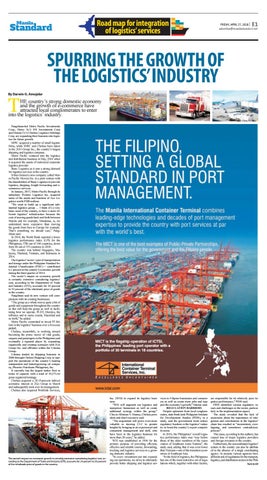
MICT is the flagship operation of ICTSI, the Philippines’ leading port operator with a portfolio of 30 terminals in 18 countries.
The sector’s impact on economic growth is certainly extensive considering logistics’ cost, according to the Department of Trade and Industry (DTI), accounts for 24 percent to 53 percent of the wholesale price of goods in the country.
Inc. (WSI) to expand its logistics business. “WSI will augment our logistics and manpower businesses as well as create additional synergy within the group,” Chryss Alfonsus V. Damuy, Chelsea president and chief executive said. “The acquisition will prove even more valuable in steering CLC to greater heights by bringing in an experienced and competent management and staff, who have been in the logistics business for more than 20 years,” he added. WSI was established in 1994 for the primary purpose of providing efficient, effective and reliable courier, forwarding, trucking and logistics services to a growing domestic industry. “In every investment put into expanding our operations, we strive to ultimately provide better shipping and logistics ser-
vices to Filipino businesses and consumers as well as create more jobs and support the economy’s growth,” Damuy said. REGULATION BARRIERS Despite optimism from local conglomerates, state think tank Philippine Institute for Development Studies (PIDS), in a study, said the government must reduce regulatory burdens in the logistics’ industry to boost the country’s export competitiveness. In 2016, the Philippines’ overall logistics performance index was “way below those of the older members of the Association of Southeast Asian Nations”, the study said, adding that it was even lower than Vietnam—one of the transition economies in Southeast Asia. “In the field of logistics, the Philippines has one of the most restrictive set of regulations which, together with other factors,
are responsible for its relatively poor logistics performance,” PIDS said. PIDS identified various regulatory issues and challenges in the sector, particularly in the implementation aspect. The study revealed that the lack of awareness about the importance of integration and coordination in the logistics’ chain has resulted in “inconsistent, overlapping, and sometimes contradictory policies”. This issue, according to the authors, has caused loss of major logistics providers and foreign investors in the country. Furthermore, the uncoordinated logistics’ system in the country can also be attributed to the absence of a single coordinating agency. At present, various agencies have different sets of regulations for the transport, logistics, and distribution sectors in the PhilTurn to E4
E2
FRIDAY, APRIL 27, 2018 advertise@manilastandard.net
CHELSEA LOGISTICS HOLDINGS CORP. Sustaining PH logistics’ momentum Led by their eclectic Chairman Dennis Uy, this leading logistics provider is geared towards delivering excellent shipping and logistics services with “burning passion” from the front lines to the head office.
C
HELSEA Logistics Holdings Corp. (CLC), the shipping business segment of Udenna Corporation, plans to sustain the company’s momentum in the next years through organic growth and further strategic acquisitions of logistics and shipping companies. ASSERTIVE FROM THE GET GO In 2007, Chelsea Shipping Corp. (CSC), a subsidiary of Chelsea Logistics Holdings Corp. (CLC), started its commercial operations in the shipping industry. CSC was initially established to serve the requirements of its sister company, Phoenix Petroleum Philippines, Inc., and CSC has attained a name for itself in the petroleum hauling industry as a reliable service provider. In fact, the company has grown to be one of the top five (5) petroleum tankers in the country. In December 2016, CLC purchased the entire outstanding stock of Trans-Asia Shipping Lines, Inc. (Trans-Asia) and its four subsidiaries. Trans-Asia, one of the leaders in the field of cargo handling, passage, and route development, has played a key role in the development of trade between Cebu and Cagayan de Oro.
On March 27, 2017, CLC acquired all of Udenna Investments BV’s (UIBV’s) outstanding capital stock through a share swap agreement with Udenna Corporation, wherein Udenna Corporation transferred to CLC 18,200 UIBV shares. In exchange, CLC issued 775,384,615 new common shares from its authorized and unissued capital stock in favor of Udenna. UIBV was incorporated on August 25, 1994. UIBV owns 80% economic interest in KGLI-NM, a domestic corporation incorporated on August 8, 2008, and which holds 39.85% economic interest in NENACO. KGLI-NM acquired such interests in NENACO on May 13, 2008. NENACO, in turn owns 88.31% of 2Go. NENACO acquired its interests in 2Go on December 28, 2010. Hence, CLC has a 28.15% indirect economic interest in 2Go. NENACO and 2Go Group, Inc. are the largest supply chain enterprise and end-to-end solutions provider in the Philippines. On November 8, 2017, CLC acquired 100% of the issued and outstanding capital stock of Worklink Services, Inc. (WorkLink). WorkLink, established in 1994, is a company engaged in courier, forwarding, trucking and logistics services. WorkLink, established in 1994, is a company engaged in courier, forwarding, trucking and logistics services. This acquisition together with the on-boarding of WSI’s experienced management team and employees will reinforce CLC’s end-to-end transport services. Simultaneously, on November 9, 2017, the Philippine Competition Commission (PCC) ruled in favor of the company’s purchase of Starlite Ferries, Inc. (Starlite), a shipping company based in Batangas City that operates a fleet of 14 roll-on/rolloff (RORO) ferries in the ports of Batangas, Calapan, Caticlan, Odiongan, Puerto Galera and Roxas. The acquisition of SFI opened the group to the Batangas trade route. THE NEXT PHASE AND BEYOND In 2018, the medium-range tanker purchased by the company called “MT Aristotelis” and a number of cargo vessels and tugboats are scheduled for delivery. These vessels are expected to generate substantial revenues for CLC. Similarly, the company will continuously explore opportunities in acquiring other shipping and logistics companies, adding
value to the existing group fleet, and synergies to the Udenna Group as a whole. Chelsea Logistics, with its amiable leader Dennis Uy, hopes to ride the “Build, Build, Build” mentality of the present administration. With the growth objectives of the government, there is a need for more and better shipping and logistics support, and CLC aims to provide these. They also plan to continuously upgrade their fleet not only in terms of number but also by acquiring newer vessels. With these new vessels, the company says they will be able to expand to new routes and destinations, thus serving more Filipinos spread across the archipelago. GROWTH, INNOVATIONS, AND PLANS For this year, CLC aims to expand and further enhance its logistics services offerings through acquisitions of additional delivery trucks and land parcel for warehouse development, and enhancement of the overall inventory management and delivery systems for faster and efficient service. And as the company has promised, they have vowed to support the strides the government has done in terms of growth not only in the Philippines but also in the region. CLC’s focus on improving passenger transport throughout the country’s islands supports the ASEAN 2020 vision of connecting the region in terms of technological advancement and transportation development. While on the logistics’ side, the fast changing pace of the e-commerce business is expected to significantly change the landscape of the logistics/transport business in the Philippines. Chelsea Logistics is not one to be outdone. According to the company, they are preparing their fleet and technology to ensure that the company is able to keep up with these changes. In the Group, new technology for improvement of inventory management was introduced during the year and other system enhancements are underway to update its technology. WorkLink recently acquired new software program which will enable it to make efficient and faster delivery of cargoes. On the shipping side, Chelsea Shipping Corp. (CSC), has adapted the ORCA Maritime Solutions as its main shipping system. In 2018, Trans-Asia and Starlite will gradually move to ORCA Maritime Solutions platform to ensure the consistency and efficient access to parallel information within the group. With respect to payment facilities, the group engages banks and payment providers for online-based Turn to E4
E3
FRIDAY, APRIL 27, 2018 advertise@manilastandard.net
ROYAL CARGO, INC. Helping shape future of PH logistics
By Peter Paul Duran
T
HE Philippines boasts of an array of natural resources that has enticed countless tourism ventures and garnered robust economic development in recent years.
But more than the beaches, the rich raw materials, and the hardworking workforce, what the country can really be proud about is its strategic location situated at the heart of a busy, rumbling logistics crossroads. According to reports, the Philippine freight and logistics market is expected to reach a market value of USD 60.22 billion by the year 2023- all thanks to bullish multi-national and local logistics companies at the forefront of this exponential growth. One such company making strides in the booming industry is Filipino multi-national company (FMC) Royal Cargo, Inc., which, in recent years, has steadily risen from the ranks and is now the largest turnkey endto-end logistics provider in the Philippines. FROM HUMBLE BEGINNINGS TO LOGISTICS ROYALTY During its inception 40 years ago, Royal Cargo was founded originally by a Filipino and owned by a German company which had to deal with adversity early on in order to enjoy what it can boast of now: a front runner in specialized logistics solutions for international and local clients. But what success Royal Cargo savors today can’t be highlighted without mention of the many assiduous men and women who have worked behind the scenes to bring Royal Cargo onto the pedestal where it is right now. The name that crops up most importantly in FMC’s list of secrets behind its success, is Royal Cargo’s Group CEO Michael K. Raeuber, who along with substantial knowledge base and inviting mind towards innovations in the logistics industry, says treating your people well would incur long-
term loyalty that would catapult any business model to great heights, much similar to how they did. THE MAN BEHIND THE SCENES “As Albert Einstein said 80% perspiration and 20% inspiration. Hard work and vision is our main ingredient for success,” said Raeuber in an email to Manila Standard when asked how they plan to sustain and spur further growth. And when it comes to hard work and vision, there’s really no lacking in that area for this amiable exec. In fact, he was the recipient of the Jones Lang Lasalle (JLL) Expatriate Executive of the Year title at the Asia CEO Awards in 2015. The award is given to a non-Filipino who achieved success while overseeing a business enterprise within the Philippines. “(It takes) measurable and visible success, ethical behavior in business and a heart for your people, most of all your staff,” said Raeuber. “Also, love of your job, challenges of the game, and your environment (is essential),” he added as the feat required awardees to have made a strong contribution to the development of the country’s economic capabilities- and Raeuber definitely fit the mold. But the meteoric ascent of the company wasn’t without turbulence from lift off, so to speak. SLOW START “We encountered labor issues in the early stages which included a failed venture into food processing, which was killed by the wrongly reported presence of bird flu in the Philippines,” explained the CEO, Turn to E4
One company making strides in the booming industry is Filipino multi-national company (FMC) Royal Cargo, Inc., which, in recent years, has steadily risen from the ranks and is now the largest turnkey end-to-end logistics provider in the Philippines.
Royal Cargo’s Group CEO Michael K. Raeuber: Hard work and vision is our main ingredient for success. (It takes) measurable and visible success, ethical behavior in business and a heart for your people, most of all your staff.
E4
FRIDAY, APRIL 27, 2018 advertise@manilastandard.net
SPURRING...
CHELSEA...
From E1
From E2
ATI port
ippines—Land Transportation Franchising and Regulatory Board and Land Transportation Office for road transport, Maritime Industry Authority and Philippine Ports Authority for maritime transport, and Civil Aviation Authority of the Philippines for air transport, among others. This remains to be a hindrance for prospective investors to do business in the country as “there are many regulations and business licenses covering all aspects of logistics services under the jurisdiction of different government agencies,” the authors explained. Maritime transport is one of the most important modes of transport in international trade especially for archipelagic countries like the Philippines. However, the poor quality of port management in the country has led to higher logistics’ costs on the part of service providers. In terms of the logistics’ industry, the authors noted the lack of effective enforcement of important regulations on the part of implementing agencies. An example of this is the continuous operation of old and outdated delivery trucks and vehicles in the country. The same issues persist in the local government level, with different local government units (LGUs) implementing “varied, inconsistent, and unpredictable regulations”, the authors pointed out. These regulations include the use of different stickers for passage to different areas, inconsistency of operating permits, and different number coding schemes between cities and provinces. REGULATORY REFORMS To address this regulatory issue, the authors proposed that the Department of Transportation, along with Congress, should disallow the collection of pass-through fees in LGUs to prevent abuse of authority from happening in the grassroots. The authors also suggested “intro-
ducing more foreign competition and improving access to the most efficient transport and logistics service providers” to accelerate the country’s overall trade performance. The study also recommended the creation of a lead agency to oversee the sector and ensure “that the flow of information between relevant stakeholders is maintained” and is responsible for getting the full cooperation and support from other government agencies involved. TRAFFIC CONGESTION The Export Development Council’s Networking Committee on Transport and Logistics also said a major logistics’ concern is the traffic congestion near Manila ports. Hence, the Terminal Appointment Booking System (TABS) is implemented by port operators in Manila to help ease port traffic. TABS regulates the number of trucks plying Metro Manila, going to and from the ports, avoiding the recurrence of port congestion and addressing corruption and extortion of some brokers/fixers. Trucks registered under TABS are exempted from the Metropolitan Manila Development Authority truck ban at limited hours. To further reduce logistics’ costs in the domestic shipping, the efficiency of the roll-on, roll-off (Roro) network will be enhanced by the recent approval of Executive Order 204, expanding the Roro network policies to chassis Roro (Charo). With Charo, the cost of cargo handling will be lesser by 15 percent to 20 percent. It will allow truckers to be more productive since their trucks will not go with the container in the Roro vessels anymore. For air transport, the Dual Airport Policy, such as Ninoy Aquino International Airport (Naia) and Clark Airpot, is very critical for the logistics’ industry.
payment schemes. On the marketing side, CLC is currently tapping and exploring social media for advertisements in promoting all the business segments of the group. The group is actively engaged in the social media spectrum and has been introducing ways to entice young travelers, such as loyalty programs, budget-friendly promo packages, and strict implementation of environmental laws in the vessels. All of these to tap into an emerging market- Millennials and the Generation Z. On another note, CLC has considered
the highest priority of this group age that is – convenience. They have ensured that all their vessels have complete amenities and luxuries on board similar to a hotel. Additionally, with the online facilities, the ease in booking is already at the fingertips of customers, while the company says they have been partnering with hotels and other hospitality establishments in promoting their fleet of passenger lines in order to provide better service. ALL SET IN LEADING THE WAY As per the company, they believe that they have the following competitive
strengths: First, CLC has a classed-fleet and an established preventive maintenance system and dry-docking program, which ensure optimal machinery performance and hull quality of their vessels. Second, CLC has the largest tanker fleet by tonnage amongst the five major tanker players in the industry with a total GRT of 41,303 tons and third, CLC has solid industry fundamentals and is the leading shipping and logistics company in the country based on market share and courier network coverage. Certainly, there’s no denying Chelsea Logistics is one step ahead of the pack.
ROYAL...
From E3
RCI is adept in providing specialized, cost-effective and high quality logistics solutions in terms of: (1) Clinical research and development (with owned equipment and facilities), (2) domestic and international freight forwarding, (3) projects and heavy lift, (4) customs brokerage, (5)erection and installation, (6) liquid transportation, (7) warehousing and distribution, (8) shipping agencies and trucking services (above), as well as (9) business process outsourcing.
adding that the NPA-led destruction of some of their equipment in a hostage situation in Mindanao were some of the early birth pains of the MNC. Having started as a representative of the German forwarding company Hermann Ludwig back in 1975, Raeuber then formed Royal Cargo Corporation three years later as a joint venture with the same company. “This cooperation continued for about 25 years even after Hermann Ludwig was sold to Calberson/Geodis,” he explained. RENEWED VIGOR “In early 2001, I left the management of Royal Cargo for five years in the hands of my partner Elmer Sarmiento and my second son Christian Kurt Raeuber after we sold parts of the Royal Cargo business to Deutsche Post/ DHL and invested to proceeds back in a JV with Deutsche Post,” he added. After five more years, Raeuber then sold his shareholding in this venture and returned to managing Royal Cargo Inc., together with a team of loyal managers and staff, led by Mr. Sarmiento and augmented by his sons Andrew and Sebastian Raeuber. “Upon my return we aggressively expanded into other, mostly Asian, locations making us the only truly Philippine-owned Logistics multinational logistics company,” he said. At the same time, they are “heavily invested in infrastructure and equipment in the Philippines and developed many different services, both of which are now the backbone of our success.” Currently, RCI is adept in providing specialized, cost-effective and high quality logistics solutions in terms of: (1) Clinical research and development (with owned equipment and facilities), (2) domestic and international freight forwarding, (3) projects and heavy lift, (4) customs brokerage, (5) erection and installation, (6) liquid transportation, (7) warehousing and distribution, (8) shipping agencies and trucking services, as well as (9) business process outsourcing. Moreover, Royal Cargo now operates in 14 countries and likewise has 13 global offices in the U.K., U.S.A., China, Hong Kong, Singapore, Cambodia, Vietnam, Malaysia, Indonesia, Thailand, Guam, Palau, and Taiwan. LITTLE TWEAKS “This industry is exciting in itself and never boring. Being in a solutions business, we do not sell a “commodity,” but the design and deliver results meeting the expectations of customers getting cargo to where and when it is needed,” said Raeuber, who is motivated to continue having an active role in the com-
pany even after four decades. But despite turning every stone and knowing seemingly all the tricks of the trade, the CEO says there are still challenges that need hurdling. “The challenge really is motivating people to work as a team while yet assuming responsibilities, even liabilities,” he said. “It’s challenging but very rewarding when successfully done.” According to Raeuber, the biggest accomplishment for him was surviving in a very competitive environment and developing strategies which answered the demands and requirements of their customers. In truth, he was primarily engaged in a P1.2 billion expansion translating into the construction of a warehouse and cold storage facility along Plaridel Bypass Road in Bulacan to complement their existing logistics facility in southern Luzon. The project also resulted in the purchase of a vessel for domestic freight operations, as well as massive cranes for heavy lift and erection services. CUT ABOVE THE REST RCI offers differentiated services based on massive investment, says Raeuber, and while they have significant competition, he feels that these companies can’t follow Royal Cargo on value of investments done and the accumulated experiences and know-how of their people. “We have to think about beyond the services we now provide, even if we are already much differentiated from our direct competitors,” explains the CEO in baring the other leverages the company has over the other logistics providers. “We compete with our local knowledge as well as regional presence and meanwhile similar size of doing business. In the Philippines, our company is meanwhile bigger in many aspects than most foreign competitors,” he said. VISION FOR THE FUTURE Asked what preparations they have planned to address the growing demand in domestic logistical services especially now that the Philippines and the whole of ASEAN gears up for its vision for the year 2020. The Group CEO claims to be a pioneer of logistics/freight forwarding in the Philippines, but more than that, he likes to be remembered as a fair and compassionate leader- one who has paved the way for Royal Cargo to tread the past 40 years with much success and the next four decades and beyond. “We are not afraid of the future and will help shape it,” he vowed.