Missed your copy of Manila Standard? Call or text our Circulation Hotline at 0917-8848655 or email: circulation@manilastandard.net
VOL. XXXIV • NO. 95 • 1 SECTION 4 PAGES • P18 • FRIDAY, MAY 29, 2020 • www.manilastandard.net • mst.daydesk@gmail.com
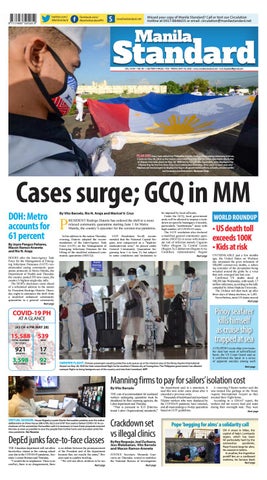
FLAG DAY. Navy men unfurl the Philippine tricolor during a flag-raising ceremony in Imus, Cavite on May 28, 2020 as the nation celebrates Flag Day. The occasion also marks the Battle of Alapan that took place on May 28, 1898 led by Gen. Emilio Aguinaldo, who displayed the Filipino flag for the first time. Flag Day is celebrated from May 28 to June 12 each year and Filipinos are encouraged to display the flag in all government offices, schools, private homes and business establishments. Norman Cruz
Cases surge; GCQ in MM
DOH: Metro accounts for 61 percent By Joyce Pangco Pañares, Macon Ramos-Araneta and Rio N. Araja
HOURS after the Inter-Agency Task Force for the Management of Emerging Infectious Dieseases (IATF) recommended easing community quarantine protocols in Metro Manila, the Department of Health said Thursday the country posted 539 new cases, the country’s highest single-day tally. The DOH’s disclosure came ahead of a scheduled address to the nation by President Rodrigo Duterte Thursday night to announce the shift from a modified enhanced community quarantine to a general community
By Vito Barcelo, Rio N. Araja and Maricel V. Cruz
P
RESIDENT Rodrigo Duterte has ordered the shift to a more relaxed community quarantine starting June 1 for Metro Manila, the country’s epicenter for the coronavirus pandemic.
In his address to the nation Thursday evening, Duterte adopted the recommendation of the Inter-Agency Task Force (IATF) on the Management of Emerging Infectious Diseases for the lifting of the modified enhanced community quarantine (MECQ).
IATF Resolution No.40. recommended that the National Capital Region, now categorized as a “high-tomoderate-risk area,” be placed under General Community Quarantine beginning June 1 to June 15, but subject to some conditions and limitations to
be imposed by local officials. Under the GCQ, local government units will be allowed to impose a lockdown on specific barangays if needed, particularly “problematic” areas with high number of COVID-19 cases. The IATF resolution also declared a modified general community quarantine (MGCQ) in areas with moderate risk of infection namely Cagayan Valley (Region 2); Central Luzon (Region 3); Calabarzon (Region 4-A); Cordillera Administrative Region Next page
WORLD ROUNDUP
• US death toll exceeds 100K • Kids at risk UNTHINKABLE just a few months ago, the United States on Wednesday surpassed the grim milestone of 100,000 coronavirus deaths, a sobering reminder of the devastation being wreaked around the globe by a virus that only emerged late last year. Confirmed US deaths stood at 100,396 late Wednesday, with nearly 1.7 million infections, according to the tally compiled by Johns Hopkins University. The 24-hour toll shot back up after three days of sharp declines, to 1,401. Nevertheless, most US states moved Next page
Next page
Pinoy seafarer kills himself as cruise ship trapped at sea
COVID-19 PH AT A GLANCE
(AS OF 4 PM MAY 28)
15,588
539
921
17
3,598
92
TOTAL NUMBER OF CASES
DEATHS
RECOVERIES
NEW
NEW
NEW
SWEEPER FLIGHT. Chinese passengers wearing protective suits queue up at the check-in area of the Ninoy Aquino International Airport on May 28, 2020 for their commercial flight to the southern Chinese city of Guangzhou. The Philippine government has allowed sweeper flights to bring foreigners out of the country and into their homeland. AFP
A FILIPINO cruise ship crew member died last week of self-inflicted harm, the US Coast Guard said as it confirmed the latest in a series of apparent suicides among such Next page
Manning firms to pay for sailors’ isolation cost By Vito Barcelo
THE cost of accommodation for sea-based workers undergoing quarantine must be shouldered by their manning agencies, the Labor department said Thursday. “That is pursuant to ILO [International Labor Organization] standards,”
VIRTUAL SESSION. House Majority Leader Martin Romualdez presides over the online deliberation on three House bills 6709, 6623 and 6707 that seek to ‘defeat COVID-19’. As cochairman of the committee, Romualdez said it is necessary to have these proposals enacted into law as soon as possible to save the people from further harm and starvation amid the virus pandemic. Ver Noveno
DepEd junks face-to-face classes THE Education department will not allow face-to-face classes in the coming school year due to the COVID-19 pandemic, Secretary Leonor Briones said Thursday. “I would like to emphasize: There is no conflict, there is no disagreement, there
is no debate between the pronouncement of the President and of the department because they are exactly the same,” Briones said in a public briefing. “We will not allow children to be too Next page
Crackdown set vs illegal clinics By Rey Requejo, Joel Zurbano, Jess Malabanan, Vito Barcelo and Macon Ramos-Araneta JUSTICE Secretary Menardo Guevarra on Thursday vowed to mobilize the National Bureau of Investigation Next page
the department said in a statement. It said this new order came about after it amended a previous order. Thousands of land-based and sea-based Filipino workers who were displaced by the COVID-19 pandemic have returned, and all must undergo a 14-day quarantine based on IATF guidelines.
A returning Filipino worker said she was treated like garbage at the Ninoy Aquino International Airport as they awaited their flight home. According to a GMA-7 report, the workers did not receive food and water during their overnight wait. They were Next page
Pope ‘begging for alms’ a solidarity call ON A street in Milan, the capital of Italy’s Lombardy region, which has been hit particularly hard by the coronavirus pandemic, Pope Francis begs for alms, his cassock in tatters. In another, the Argentine pontiff lies on a cardboard mattress, his famous black
Next page
A2
News
FRIDAY, MAY 29, 2020
mst.daydesk@gmail.com
Bayanihan law draws support By Macon Ramos-Araneta and Maricel V. Cruz
and economic growth, is staggering. “Thus, this moment of history is touted to be man’s darkest hour and perhaps, the bleakest period in this generation’s lifetime,” he said. Zubiri said the extension will allow the President to continue to exercise the realignment of items in the national budget and other powers granted to him under the law to be able to provide emergency support for vulnerable groups and individuals, expand medical resources to fight COVID-19, and finance emergency initiatives to keep the economy afloat. The measure seeks to amend the sunset provision of the law limiting its effectivity to only three months. A similar bill has been filed in the House of Representatives. The Bayanihan law was approved by
Congress in an hours-long special session on March 23. Duterte signed the measure into law on March 25. Among the additional powers granted to the President under the law was the authority to grant a P5,000 to P8,000 cash assistance per month for two months to some 18 million lowincome households. Duterte, for a limited period, was also granted powers to reallocate government funds to measures against COVID-19. The House of Representatives’ Defeat COVID-19 Ad Hoc Committee (DCC) on Thursday endorsed for plenary approval three bills and two resolutions that will reset the economy with a three-year P1.5-trillion stimulus program by creating jobs through infrastructure spending and boost public health.
gathering activities remain prohibited. Roque said the IATF has also proposed a general concept of identifying zones with COVID-19 cases. A “critical zone” refers to an area with more than 20 cases; a “containment zone” means that there are between one and 19 cases in the area; a “buffer zone” refers to an area with no cases but one that is contiguous with localities with cases; and “outside of buffer zone” refers to areas outside of the buffer zones without confirmed cases. With no vaccine yet, the number of COVID-19 cases in Metro Manila is expected to rise once the shift to a GCQ gets underway, Roque said. He advised the public to observe physical distancing and to always wear a face mask in public places to avoid the spread of the contagious disease. More outdoor activities will be allowed once the National Capital Region, the country’s economic center, shifts to GCQ next week, he said. “To make sure that the public would follow the guidelines under the new normal, the government is increasing fines for people who breach the new guidance, with the new penalties ranging from P1,000 to P10,000 with imprisonment,” he said. “If many of us remain stubborn, many would catch COVID-19. We will be like other countries which saw an increase in COVID-19 cases after
relaxing restrictions because people did not comply with health standards,” he added. Roque warned that should this happen, the President would have no choice but to return stricter levels of quarantine in Metro Manila. Roque said the government is working to avoid a second wave of infections because the Philippines has limited capacity in hospitals. He said Metro Manila has a total bed capacity of only 13,457, a bed capacity of only 9,468 for isolation, 1,963 ventilators, 1,303 intensive care unit beds and 2,686 ward beds. He warned that hospitals could be overwhelmed if the country experiences a huge increase in infections. Interior Secretary Eduardo Año said traveling from one GCQ area to another would still be limited to availing of essential goods and services, but said quarantine passes would no longer be needed. He said checkpoints would ensure travelers were going out to procure the necessary goods and services. Año said buses operating at 50 percent capacity would be allowed to operate in areas under general community quarantine. The Department of Transportation said Thursday it would take the opportunity to not only address the risks of COVID-19 transmission, but also to modernize the country’s transport system.
two months on Thursday, prompting a re-imposition of a series of social distancing measures. Museums, parks and art galleries in the Seoul metropolitan area will all be closed again for two weeks from Friday, said health minister Park Neunghoo, while companies were urged to re-adopt flexible working practices, among other measures. “We have decided to strengthen all quarantine measures in the metropolitan area for two weeks from tomorrow to June 14,” he said. The country has been held up as a global model in how to curb the virus and has begun to ease restrictions, but is now rushing to contain new infections as life returns to normal. Officials announced 79 new cases
Thursday – taking its total to 11,344 – with most fresh infections from the densely populated Seoul metropolitan area. It was the largest increase since 81 cases were announced on April 5.
workers trapped at sea because of the coronavirus pandemic. The 32-year-old Filipino worker on a ship called Scarlet Lady, the only cruise ship owned by Virgin Voyages, died of “apparent self-harm,” the Coast Guard told AFP. The Florida-based company founded
by British billionaire Richard Branson expressed its condolences over the death of its employee but gave no details of what happened. The ship was to have made its maiden voyage in March but it was canceled because of the pandemic, so the vessel has been in limbo off the coast of Florida ever since, with its crew trapped on board. A specialized blog called Cruise Law News, which first reported the latest
death quoting anonymous sources on the ship, said it was not clear exactly when the Filipino man died. It said he worked as a cleaner in the ship’s living quarters for guests. The ship docked in Miami Friday for the body to be taken away, the blog and the Miami Herald reported. In May alone, at least six cruise ship crew members around the world died of causes not related to the pandemic. Five of them were apparently cases of suicide. AFP
out of harm’s way. League of Provinces of the Philippines president and Marinduque Gov. Presbitero Velasco Jr. said he thought starting the school year in August was close to one another.” Local officials said Thursday the too early. Quirino Gov. Dakila Carlo Cua, presopening of schools must be postponed for the next few months to keep children ident of the Union of Local Authorities
of the Philippines, said he was amenable to postponing the opening of classes for up to a year if needed. League of Municipalities of the Philippines president Chavit Singson, mayor of Narvacan, Ilocos Sur, said the safety of the children must be upheld. Assistant Minority Leader and ACT
Teachers Rep. France Castro has filed House Bill 6832 mandating mass testing, contact tracing and infection prevention protocols and disease surveillance measures for the safe reopening of schools. She has also filed House Bill 6837 or the Doctors and Nurses in Schools Act.
Crackdown... From A1
Last month, police also raided a medical clinic in Parañaque City and arrested a 44-year-old Chinese woman treating COVID-19 patients. In Angeles City, police raided a threebed medical clinic shortly after an entrapment operation was conducted against the owner of a pharmacy along Volga Street in Anunas village here on Thursday. A 66-year old Chinese physician and his son were arrested for operating without a permit, and the police said the clinic had been operating for more than a year. The Bureau of Immigration, meanwhile, has placed on its alert list the two Chinese nationals caught operating an underground hospital for COVID-19 patients in Pampanga last week.
WO senators on Thursday filed separate bills to extend the validity of the Bayanihan to Heal as One Act, giving President Rodrigo Duterte more time during which he can realign appropriations under the national budget to mitigate the impact of COVID-19 pandemic.
T
Senate President Pro Tempore Ralph Recto and Senate Majority Leader Juan Miguel Zubiri both want to extend the validity of the law until Sept. 30 to allow the government to further pursue its efforts to contain the spread of the new coronavirus and provide stimulus as the economy starts to open up. In seeking for an extension, Recto acknowledged that the Philippine would need to address another challenge posed by the pandemic, the problem of uncer-
tainty and the lack of business confidence. He noted that uncertainty in times of a pandemic affect the minds of policy makers, business owners and ordinary citizens alike. “The dramatic and unexpected impact on the economy has dampened the confidence of business in its ability to survive and eventually, turn around,” Recto said. He said the impact of the COVID-19 pandemic, both in terms of human life
Manning... From A1
Cases surge... From A1
also stationed in a hot area near the depot of broken items in Terminal 2. “Para kaming basura dito na tinapon lang. Wala kaming kain mula pa kagabi. Kahapon pa kami dito,” Arlyn Tonquerido said. “Kami ang bayani na tinatawag nila? Mamamatay kami sa gutom, hindi kami mamamatay sa COVID.” The Filipino workers are on their way home after weeks in various quarantine centers in Metro Manila. Almost all of them had to endure the long wait for the COVID-19 test results before getting cleared to return to their home provinces. They said they were willing to be on standby until their flight became available, but expressed their wish not to be overlooked or neglected. “Pinabayaan lang kami. Wala namang OWWA na naka-ano sa amin. Kung ano talaga gagawin namin, wala,” Gretchen Lizada-Taganile said. “Kami pa ‘yung gumawa ng idea para magkaroon kami ng flight. Tumawag kami sa LGU tapos nag-lista kami ng pangalan. Kasi ‘yung sabi ng ano, kung aabot kami sa quota, bibigyan nila kami ng flight,” Ronie Pales said. Jell Macabutas added: “Ang panawagan ko naman po sa OWWA, kung puwede po sana, i-accomodate po ng maayos ‘yung OFWs para sa susunod hindi na po mangyayari itong insidente na ‘to kasi dumadami at dumadami po kami.” Between 5,000 and 6,000 Filipino seafarers who have been tested negative with the RT-PCR (real-time reverse transcription polymerase chain reaction) and whose certificates have been released by the Philippine Coast Guard are still waiting to go ashore and return home, according to recruitment and migrant expert Emmanuel Geslani. “Manning agencies of the 18 cruise ships still in Manila Bay are now arranging their disembarkation from their cruise ships either by docking the ship itself on Pier 15 or fetching them by small boats so they can go home,” Geslani said. He said the more than 5,000 seafarers were part of the 24,000 Filipino workers who had been languishing aboard cruise ships while waiting for the results of their PCR tests from Coast Guard personnel. The OWWA, Department of Transportation, and the Coast Guard have so far sent home 10,000 Filipino workers through flights mounted by Philippine Air Lines and Air Asia to the major cities in the Visayas and Mindanao, while the other workers boarded buses at the PITX for Northern Luzon, Cagayan Valley, Central Luzon, Bicol and Batangas.
(CAR); Central Visayas (Region 7) except Cebu City; Zamboanga Peninsula (Region 9); Davao Region (Region 11); and Caraga (Region 13), Ilocos (Region 1); Mimaropa (Region 4-B); Bicol (Region 5); Western Visayas (Region 6); Eastern Visayas (Region 8); Northern Mindanao (Region 10); Soccsksargen (Region 12); and Bangsamoro Autonomous Region in Muslim Mindanao (Barmm). These areas are currently placed under a GCQ. Minimum health standards musts still be observed in areas under the MGCQ or GCQ. Presidential spokesman Harry Roque said that in areas under the GCQ, selected manufacturing and processing plants will be allowed to operate with a maximum of 50 percent of their workforce. The mode of transportation in Metro Manila, however, will be limited to company-provided shuttle services, point-topoint vehicles, taxis, Transport Network Vehicle Services, and tricycles. He said mass transportation by way of city trains will be allowed on a limited basis. Residents of GCQ areas will be allowed to go out of their residence except for those aged below 21 and those 60 and older to limit infections. Mass
World... From A1 toward reopening restaurants and businesses, cheered on by President Donald Trump, who is eager to see the economic pain of the crisis mitigated as he seeks re-election. The US capital Washington will ease its lockdown from Friday. But Trump’s top infectious diseases expert Anthony Fauci warned against “leapfrogging” guidelines in order to open more quickly. “That’s really tempting fate and asking for trouble,” Fauci told CNN.
Largest spike in Sokor South Korea reported its biggest spike in coronavirus cases in nearly
Pinoy... From A1
DepEd... From A1
and the Bureau of Immigration to crack down on the illegal medical clinics operating in the country. “It seems that clandestine medical clinics catering mostly to foreign nationals have sprouted and have been operating without proper authority,” Guevarra said in a text message to reporters. “Considering that they are not being supervised by the government, it is possible that the health of people who seek treatment in these illegal facilities is being compromised.” Guevarra made his statement after the Philippine National Police busted two un-
licensed clinics suspected of treating and testing foreigners, including Chinese nationals, for the COVID-19 disease. On May 19, police raided Villa no. 628 of the Fontana Leisure Park in Clarkfield, Pampanga, on suspicion the villa was turned into a makeshift clinic accommodating Chinese nationals seeking medical treatment for COVID-19. One patient was reportedly found during the raid and was transferred to a hospital. And the Makati police this week raided the Goldstar Medical Clinic and Pharmacy Corp. in San Antonio after they received complaints of medical waste clogging the drains. The authorities arrested Chinese doctor David Lai, 49, and his assistant Liao Songhua, who uses the alias Bruce Liao, 41.
86m kids at risk of poverty The economic consequences of the COVID-19 pandemic could push as many as 86 million more children into poverty by the end of 2020, a joint study by Save the Children and UNICEF showed. That would bring the total number of children affected by poverty worldwide to 672 million, an increase of 15 percent over last year, the two aid agencies said in a statement. Nearly two-thirds of those children overall live in sub-Saharan Africa and South Asia. AFP
Pope... From A1
briefcase under his head as a pillow. Next to him someone has stuffed banknotes into a red cup reading “charity.” Another of Italian activist AleXsandro Palombo’s new works shows the Madonna and Child begging. Palombo said his works were a call for solidarity in the face of a sharp rise in poverty caused by the coronavirus lockdown. Last month, the Organization for Economic Cooperation and Development forecast that 27 percent of Italians could fall into poverty were they to forego three months of income, in a report based on 2018 data.
5.2 quake jolts north Luzon By Rio N. Araja A MAGNITUDE 5.2 earthquake rocked San Fernando, La Union yesterday at 1:15 p.m. Intensity 4 was felt in San Fernando, Caba and Balaoan in La Union; Labrador and Bolinao and Dagupan City in Pangasinan. Intensity 3 was felt in Urdaneta City and Villasis in Pangasinan; Baguio City; Quezon City; Marikina City; and Obando, Bulacan. The movement was also felt in the cities of Valenzuela, Navotas, Pasay, Parañaque and Manila.
DOH:... From A1 quarantine (GCQ) for Metro Manila. Thursday’s record surpassed the 538 cases reported on March 31. Of the total number of new cases, the National Capital Region accounted for 61 percent or 330 cases. On Tuesday, the country recorded 350 new cases. The figure went up to 380 on Wednesday. The DOH attributed the sudden spike in the number of new cases to the results from the swab tests on repatriated overseas Filipino workers, calling it an “artificial rise.” However, repatriated OFWs only accounted for about 10 percent or 55 cases out of Thursday’s total number. Health Undersecretary Maria Rosario Vergerei, meanwhile, said a backlog of 3,683 test results would be reduced to zero in two to three days. Testifying in the hearing of Senate health committee, Health Secretary Francisco Duque III said the backlog was 5,700 test results, but Vergerei said this had already been reduced. She attributed the backlog to the lack of laboratory supplies, especially those coming from international suppliers. She said there were some laboratories that encountered supply problems such as the Bicol laboratory because of a typhoon. The Lung Center of the Philippines, she said, was back to its full capacity only this week after it also faced supply problems. Vegerei said they met with laboratories last Monday and instructed them to reduce the backlog in two to three days as ordered by the Office of the President. At present, she said the country has 43 COVID-19 laboratories, 23 of which are public. Also, in the same hearing, Duque defended the DOH from tirades that it was slow in approving laboratories for COVID-19 testing. He maintained the DOH has been very strict in proficiency testing. But Vergerei said the government is continuously ramping up the country’s COVID-19 testing capacity. She also said the country would need more than P11.7 billion to hire and retain enough contact tracers for the COVID-19 outbreak in the country. “When we computed and considered the proposed qualifications of contact tracers, we saw that we would need P11.7 billion in three months,” she said. “We have an existing 38,000 plus contact tracers. And we still need 95,000 plus contact tracers,” she added. She the Philippines would need more than 120,000 contact tracers to meet the goal set by the World Health Organization (WHO). Earlier, the DOH said the ideal ratio set by the WHO is one contact tracer for every 800 people in the country. Contact tracers are the ones who track down close contacts of confirmed COVID-19 cases, ensuring that suspect cases are isolated and tested. Ideally, she said, contact tracers should be from the medical profession like a nurse or an “allied medical professional” or at least a graduate or undergraduate of an “allied medical course.”
“Today, more than ever, we need to be aware of the needs of others, of those who are going through or are about to go through a moment of extreme need,” he said in a statement. “Each one of us can make a difference by helping the most fragile families, and all those who have now fallen into poverty. This is the time to understand that the future is about generosity and solidarity,” he said. Palombo, 46, who has lived in Milan for 30 years, is renowned for colorful, reflective and irreverent works and uses satirical art to raise awareness of social and cultural issues. Among his most important works are “Disabled Disney Princesses” and “The Simpsons Go To Auschwitz.” AFP
News
FRIDAY, MAY 29, 2020 mst.daydesk@gmail.com
‘Pinoys prayed more during quarantine’ A S THE country was reeling from the effects of the COVID-19 pandemic, most Filipinos turned to prayer and slowed down on vices during community quarantines in Metro Manila and other parts of the country, based on a nationwide study.
Researchers of the PhilCare Community Quarantine Wellness Index saw this silver lining amid the restrictions of movements imposed by the government to prevent the spread of the disease. The study, which aimed to determine the state of Filipinos’ wellness while in community quarantine, revealed that of 800 respondents, eight out of ten (76.7%) said they prayed at least more frequently than they did before the community quarantines. Trailing behind were other practices like watching TV, spending time online, learning new things, and doing hobbies; while others said they often engaged in physical and mental exercises. Meanwhile, six out of ten respondents
(60.9%) said they much more rarely drank beer, wine, or liquor products compared to before; while half (50.4%) said they much more rarely smoked. The survey was first administered via phone calls to 400 randomly-selected respondents from May 11-14—the final stretch of the extended enhanced community quarantine in Metro Manila and several other areas. Another 400 were interviewed from May 16-20— the first days of the modified enhanced community quarantine in the metro and other areas. “The community quarantines and the pandemic as a whole have altered the way we live, which shocked many Filipinos. This survey provided us the opportunity to take a deeper dive into their sentiments
and behaviors when it comes to health and wellness,” said lead researcher Dr. Fernando Paragas of the College of Mass Communication at the University of the Philippines Diliman. “The ongoing pandemic naturally makes everyone feel helpless. What’s good about the findings is that we saw how Filipinos turned to spirituality— which is a positive coping mechanism —in order to deal with the anxiety. It is interesting that vices only played a minor role in helping Filipinos through the ordeal of quarantine,” said PhilCare Associate Medical Director Dr. Ultra Tan. While many Filipinos have expressed becoming more prayerful, many have also indicated their fears of returning to work with the ongoing pandemic. Six of ten respondents (60.1%) particularly said they were not comfortable about going back to their offices, similar to the study’s preliminary results. Nearly all respondents, however,
are most concerned with the health of their loved ones (95.9%), a po sible “second wave” of COVID-19 (94.1%), and contracting the disease itself (93.6%). “We believe that the findings of the PhilCare Community Quarantine Wellness Index serve an eye-opener to employers and policymakers on how responsive they should be towards their respective stakeholders given that our way of life has dramatically changed. With these learnings, we hope to work together with various sectors in order for us to continue living healthy even amid the pandemic,” said PhilCare President and CEO Jaeger L. Tanco. “The survey’s results just affirm our belief that we need to be responsive to the needs of the times, from the products and services we offer to being in step with our customers’ sentiments, both online and offline,” said PhilCare Vice President for Sales and Marketing Raymund Tiangco.
IN BRIEF DOJ defers arraignment of teacher Mas THE arraignment and pre-trial of teacher Ronnel Mas who allegedly offered a P50million reward to anyone who could kill President Duterte has been deferred to June 25, the Department of Justice said on Thursday. Prosecutor General Benedicto Malcontento, head of the DOJ’s National Prosecution Service, said that the arraignment and pre-trial of the 25-yearold Mas was supposed to have been held yesterday (May 28), but was rescheduled to next month due to a pending motion to quash filed by the accused. “The arraignment and pre-trial on inciting to sedition in relation to the anticybercrime law of Mas was “reset to June 25. Accused filed a Motion to Quash,” Malcontento said in a text message to reporters. The case against Mas was filed before Judge Richard Paradeza, of the Olongapo City Regional Trial Court (RTC) Branch 72, who allowed him temporary liberty after posting a P72,000 bail. Rey E. Requejo
Manila builds 4 more quarantine centers MORE quarantine facilities are now being constructed in the City of Manila to cater to persons who are suspected or probable of being infected with COVID-19, Mayor Francisco ‘Isko’ Domagoso said on Thursday. Four quarantine facilities have already been built amid the COVID19 pandemic in the nation’s capital. The following quarantine facilities are currently being used by patients who tested positive in the rapid test or have been reported to have symptoms of COVID-19: Delpan Quarantine Facility, Araullo High School, Tondo High School, and T. Paez Elementary School. The local government is targeting to open eight more facilities in the nation’s capital. The Arellano High School quarantine facility is scheduled for turn-over on Thursday afternoon. Willie Casas
DAR gives support to women farmers THE Department of Agrarian Reform is extending its livelihood assistance to women-farmers in Sultan Kudarat, Mindanao to help mitigate the impact of coronavirus disease 2019 (COVID-19) on farming households. Its project called “The PaSSOver: ARBOld Move to Heal as One Deliverance of our Farmers from Covid-19 Pandemic” or ARBOld Move project will provide support to 1,200 women-agrarian reform beneficiaries with livelihood activities, especially in food production, such as egg and poultry production and hog fattening, based on their preferences and capability to ensure food sufficiency, provincial agrarian reform program officer Rodolfo Alburo said. To kickstart the project in Sultan Kudarat, Alburo said the ARBOld Move project has already provided livelihood activities to 15 women-beneficiaries in the province. Rio N. Araja
Masbate province, town get food packs THOUSANDS of homes, specifically 21,329 families, in Masbate province and in Aroroy town, have received relief packs from the Phil. Gold Refining & Processing Corp., which had earlier earmarked P16.8 million to support the anti-COVID19 efforts of the province and the municipality which hosts PGPRC’s mining site. The firm also turned over an ambulance unit to the Masbate Provincial Health Office through the Office of the Governor, and another unit is set to be delivered in the next few weeks. PGPRC owns and operates the processing plant of the Masbate Gold Project located in the municipality of Aroroy, which has stimulated the local economies and has created jobs for people in Masbate, particularly in Aroroy. PGPRC had already disbursed P12 million (from the P16.8 million), specifically for funding support directed at Aroroy’s rural health units and including medical frontliners, which received weekly food packs, plus food relief pack 6,398 families in eight impact barangays, and 14,931 families from 33 neighboring barangays.
BLOOD FOR LIFE. Active personnel of the Philippine Army participate in the second wave of the bloodletting activity conducted on May 27 at Fort Bonifacio in Taguig City. Held in coordination with the Philippine Blood Center, the activity collected an additional 139 bags which will benefit Army personnel and their dependents, civilian human resource, and other authorized civilians in cases of emergency.
House okays bill Lawmaker supports ABS-CBN bid on proposed for renewal of 25-year franchise Parent-Teacher Community Act By Maricel V. Cruz
THE House of Representatives has approved on final reading House Bill 6139 or the proposed Parent-Teacher and Community Association Act. The bill, principally authored by Majority Leader and Leyte Rep. Martin Romualdez and his wife, Party-list Rep. Yedda Marie Romualdez of TINGOG SINIRANGAN, aims to promote the welfare and rights of children by harnessing the synergy of parents, school officials and teachers, and the community in the youth’s upbringing and development. The bill amends Article 77, Chapter II of Presidential Decree 603, also known as “The Child and Youth Welfare Code,”that require government and private basic education schools to organize a PTCA. In the authors’ explanatory note, they said that synergetic relations between home and school in child development become even more prominent in light of studies showing that such collaboration leads to a well-rounded, stable, and sociable person. Hence, it is imperative that an integrative and coordinative mechanism for a total children and youth development program involving parents and teachers, among others, be institutionalized and enhanced. “The PTCAs shall serve as a powerful voice for the welfare of school children, a relevant tool for engagement by their families and the communities that they live in, and a strong advocate for basic education,” the Majority Leader said. The bill mandates the PTCA to undertake the following duties and functions: (a) create a development program for children; (b) ensure the full cooperation of parents, teachers, and other community stakeholders in the efficient implementation os said development programs; (c) consult the children at all times, through their student councils in the planning and implementations of projects and programs; (d) serve as an avenue for local stakeholders to address children’s concerns in schools and communities; (e) assist the municipal and other local authorities and school officials in the implementation of PTCA activities; (f) raise awareness and support the implementations of the school’s child protection issues and policies; and (g) assess the implementation of basic education programs, among others. Maricel V. Cruz
ONE of the congressmen supporting the renewal of the franchise to operate of the ABS-CBN Broadcasting Corp. on Thursday took the cudgels for the shuttered radio-broadcast network which allegedly committed “flagrant violations“ and so its franchise should not be renewed. Rep. Rufus Rodriguez of Cagayan de Oro responded to the allegations of Deputy Speaker Rodante Marcoleta during the joint hearing of the House committees on legislative franchises and on good governance and accountability last Tuesday. Marcoleta claimed that ABS-CBN “deliberately and with impunity violated the conditions of its previous legislative franchise, more so our laws and the Constitution,” specifically citing, among others, the constitutional 50-year limit of legislative franchises. Rodriguez said Marcoleta was wrong. “Every grant of franchise by Congress has a limit of 50 years. It is not cumulative. Congress can give 50 years in one instance and it can be extended for another 50 years and so on. However the practice is to give 25 years every instance or issuance. The Constitution is very clear,” said Rodriguez. Marcoleta also raised during the Tuesday hearing that Congress should deny the
franchise application of ABS CBN for its clear violation of the constitution requiring 100 percent Filipino ownership and management of mass media companies. He said ABS CBN’s former president Mr. Eugenio “Gabby” Lopez III was an American citizen when he took the helm of the company in 1986 as director, then president and then chairman in the later years. “It was only in 2000 that he petitioned for recognition of Filipino citizenship and was issued a certificate of recognition as a Filipino citizen in 2002.” But in his defense for the ABS-CBN, Rodriguez said “Gabby Lopez is a dual citizen of the Philippines and The United States.” Rodriguez said Lopez was born to Filipino parents in 1952 in the US. “He is therefore a Filipino by birth under the jus sanguinis citizenship under our 1935 Constitution. He is also a US citizen under its jus soli citizenship. Being a Filipino citizen his ownership of ABS CBN shares before and now is valid, legal and conforms to the Constitutional mandate of 100 percent Filipino ownership of mass media.” The ABS-CBN is expected to present its side and answer point by point the allegations raised by Marcoleta when the joint panel resumes its hearing next week.
MENTAL HEALTH. Dr. Rolando Cortez, chief of the National Center for Mental Health, told senators during Thursday’s virtual public hearing on May 28, 2020, that there was a significant increase in mental health ailments among Filipinos since the lockdown declaration in Luzon and other areas last March. “Before Covid-19, we get around 60 to 80 calls in our hotline. Now, we receive almost 300 to 400 calls per month. There are a lot of people who want to communicate during a crisis. Most suffer from anxiety and depression because of the lockdown,” Cortez said. Senate Photo
A3
PH court convicts American online sex offender for trafficking By Willie Casas A PHILIPPINE court recently convicted an American for large-scale qualified trafficking of persons three years after he was arrested on allegations of sexually abusing children and selling footages of the abuse online. “May 26, 2020 will be a date that will long be remembered as David Timothy Deakin will go down as the first foreig ner to be convicted for trafficking offenses through online proceedings in the Philippines,” said a statement from the International Justice Mission issued on Thursday. Deakin was declared guilty of largescale qualified trafficking in persons and was sentenced to suffer the penalty of life imprisonment and a fine of P 2 million, IJM said. He was also ordered to pay each victim the amount of P 500,000 representing moral damages and an additional P 100,000 as exemplary damages as civil indemnity for his crimes. Judge Irineo P. Pangilinan, Jr. rendered the decision thru video conferencing from Branch 58, of the Regional Trial Court in Angeles City, Pampanga. The high-profile case grabbed the national headlines two years ago as the actual arrest was even reported by local and international media outfits, putting the crime of online sexual exploitation of children in the global spotlight. Despite being a tech savvy offender, Deakin was still caught thru global cooperation efforts with foreign law enforcement. On April 20, 2017, operatives of the National Bureau of Investigation AntiHuman Trafficking Division led by its chief, Lawyer Janet Francisco, arrested American citizen Deakin in his rented house in Angeles City, Pampanga where he was found in possession of hard drives containing child sexual exploitation materials, sex toys and drug-use paraphernalia. A referral from the US Federal Bureau of Investigation revealed that Deakin was sexually abusing Filipino children, recording the abuse and selling it to foreign customers online. “Let this sentence be a message to OSEC criminals: this is a war you can’t win. We at NBI-AHTRAD and NBI as a whole, are strongly pursuing those who abuse our children and exploit them through the internet. You will not get away with this,” said Francisco, referring to the unfolding of events that followed Deakin’s arrest. She commended her unit and the entire National Bureau of Investigation working together as a team to get the job done.
Lopez Group extends aid for PGH testing THE Philippine General Hospital has accepted an offer from the Lopez Group to help the state hospital increase 10 times its capability to test for the virus SARSCoV-2, the causative agent of the dreaded coronavirus disease (COVID-19). Within the month, the Lopez-controlled First Gen Corporation and ABSCBN Corporation will complete an ongoing donation of P46 million worth of new machines and lab equipment that will expand the hospital’s COVID-19 testing capacity from 150 to 1,500 tests per shift. The donated equipment will allow more automation and increase the volume of testing. Under a newly-signed agreement between First Gen and the University of the Philippines, First Gen is allowing PGH through UP the free use of a system of laboratory machines for conducting tests known as reverse transcriptase polymerase chain reaction (RT-PCR). PGH is administered by UP, a state university. The RT-PCR test is a two-step process of first extracting the viral genetic material of SARS-CoV-2 from a patient’s virus-infected cells and then testing to confirm the presence of the virus by detecting it through PCR. The ‘chain reaction’ of PCR makes it easier to detect viral genetic material if it is present. ABS-CBN, on the other hand, is donating to PGH several units of a fully integrated automated molecular diagnostics platform, known as BD Max. This particular system combines the two processes of extraction and testing for the presence of the highly contagious virus and shortens the testing period from four hours to just two (2) hours. “We are grateful to the Lopez Group for helping us fulfill our expanded role as a COVID-19 Referral Center. Armed with the right technology for detection, we can stay ahead of this virus through testing, isolation and treatment,” said PGH Director Dr. Gerardo D. Legaspi.
Ray S. Eñano, Editor Roderick T. dela Cruz, Assistant Editor business@manilastandard.net extrastory2000@gmail.com
A4 FRIDAY, MAY 29, 2020
Business
PSE INDEX
Thursday, May 28, 2020
46.44 PTS. 5,570.22
TOTAL VOLUME 2,809,230,244 TOTAL TRADES 89,983 TOTAL VALUE 4,471,448,023.24 ADVANCES 113 DECLINES 75 UNCHANGED 39
F oreign E xchange R ate Bangko Sentral ng Pilipinas • THURSDAY, MAY 28, 2020
Currency
Unit
US Dollar
Peso
United States
Dollar
1.000000
50.5930
Japan
Yen
0.009285
0.4698
UK
Pound
1.226400
62.0473
Hong Kong
Dollar
0.128964
6.5247
Switzerland
Franc
1.033378
52.2817
Canada
Dollar
0.727061
36.7842
Singapore
Dollar
0.704275
35.6314
Australia
Dollar
0.661600
33.4723
Bahrain
Dinar
2.651113
134.127
Saudi Arabia
Rial
0.266347
13.4753
Brunei
Dollar
0.701804
35.5064
Indonesia
Rupiah
0.000068
0.0034
Thailand
Baht
0.031397
1.5885
UAE
Dirham
0.272272
13.7751
Euro
Euro
1.100700
55.6877
Korea
Won
0.000808
0.0409
China
Yuan
0.139509
7.0582
India
Rupee
0.013175
0.6666
Malaysia
Ringgit
0.229991
11.6359
New Zealand
Dollar
0.618300
31.2817
Taiwan
Dollar
0.033350
1.6873 Source: BSP
Vista Land’s net income rose 10% to P11.6b in 2019
By Jenniffer B. Austria
VISTA Land & Lifescapes Inc., the country’s largest home builder owned by the Villar Group, said Thursday net income climbed 10 percent in 2019 to P11.6 billion as its commercial leasing and residential businesses delivered strong results. Vista Land said in a statement consolidated revenues grew 7 percent to P44.4 billion from P41.5 billion last year. Leasing income went up 20 percent to P8.5 billion, while revenues from real estate increased by 3 percent to 32.8 billion. “We are pleased with the company’s 2019 performance as both our leasing and residential businesses provided steady growth. Revenue growth from our existing investment properties of about 1.5 million square meters continues to be strong,” said Vista Land chairman Manuel Villar Jr. The group’s residential business recorded reservations sales of P78.5 billion in 2019 after launching projects with total sales of P38.5 billion. These new projects consisted mostly of affordable housing and Camella Condo Homes projects. “The start of 2020 has been challenging with the occurrence of a series of unforeseeable events, especially the COVID-19 pandemic. Vista Land will refocus on optimizing its existing portfolio of investment properties as well as utilize its current land bank of about 3,000 hectares,” Vista Land president and chief executive Manuel Paolo Villar said. “We saw that demand for affordable housing persists and homebuyers, most of which are end-users, remain committed to completing payments. Vista Land also is taking advantage of its geographic reach. We have a presence in 147 cities and municipalities across the country and generate over 50% of our revenue outside Metro Manila,” he said.
Store closure led to Jollibee’s P1.8-b loss in first quarter RESTAURANT operator Jollibee Foods Corp. incurred a net loss of P1.79 billion in the first quarter, a reversal of the P1.46-billion profit in the same period last year as the coronavirus pandemic resulted in the temporary closure of many of its stores here and abroad. Jollibee said in a disclosure to the stock exchange system-wide sales, a measure of all sales both from company-owned and franchised stores, rose 1.6 percent in the first three months to P55.1 billion. The fast-food company posted an operating loss of P1.3 billion in the first quarter, compared to an operating income of P2.1 billon a year ago. Jollibee chief finance officer Ysmael Baysa said the company would likely incur even higher losses in the second quarter when the full impact of the lockdowns on the businesses would be felt. Baysa also expects the business to start recovering in the third and fourth quarters at a very slow pace. “Our strong balance sheet will enable us to withstand this storm, even in the worst-case scenarios. However, we have to rationalize and re-design our business structure, to adapt to the new economic conditions and changed consumer behavior brought by the pandemic and emerge as a stronger business and organization in 2021,” Baysa said. Jollibee announced plans to spend P7 billion to overhaul its global business structure to adapt to new economic conditions and changing consumer behavior. The changes include rationalization of existing stores, store network, supply chain facilities and management support group structure. It will also include building drivers of revenue growth including food-to-home and offices, takeout and drive-thru. Jenniffer B. Austria
IN BRIEF
FDC posted P3-b earnings in 3 months KAAGAPAY’S FUNDRAISING. Project Kaagapay, a fundraising initiative that began in April to provide personal protective equipment for the country’s healthcare community, raises almost P92 million in cash donations and receives in-kind donations worth almost P27 million, reaching 70 hospitals and medical centers in Metro Manila and other provinces and distributing over 200,000 PPE sets for beneficiaries. Kaagapay was launched by the Philippine Disaster Resilience Foundation, Zuellig Pharma, ABS-CBN and Metro Drug as part of the private sector’s efforts to curb the spread of the COVID-19 pandemic through collective action.
Foreign fund managers pulled out $660m in April By Julito G. Rada
F
OREIGN fund managers pulled out more than $600 million from the Philippine equity and bond markets in April amid the uncertainty caused by the coronavirus pandemic. Data from the Bangko Sentral ng Pilipinas showed that registered foreign portfolio investments yielded net outflows of $660 million in April, following net withdrawals of $961 million in March. Gross outflows reached $1.3 billion in April while gross inflows amounted to only $627 million during the month, according to the BSP. “The $627-million registered investments for the month reflected a 34.3-percent decline from the $954 million figure in March 2020 and is also the
lowest recorded monthly gross inflows since July 2010,” it said. About 91.2 percent of investments went to PSE-listed securities mainly to holding firms, property companies, banks, food, beverage and tobacco firms and telecommunication companies while the remaining 8.8 percent went to investments in peso government securities. The United Kingdom, the United States, Singapore, Hong Kong and Switzerland were the top five investor countries for the month, with combined a share of 85.5 percent. Outflows in April were lower compared to the $1.9 billion recorded in March. The BSP said that in the first four months, hot money transactions yielded net outflows of $2.1 billion resulting from the $6.3-billion gross outflows and $4.2-billion gross inflows. This was a reversal of the $37-million net inflows observed in the same period last year, brought about by uncertainties such as to the impact of the COVID-19 pandemic to the global economy and
financial system, and other key events earlier in the year such as the geopolitical tensions between the US and Iran trade negotiations between the US and China and renegotiation of the contracts of the country’s water concessionaires. Transactions for all investments (PSE-listed securities, peso government securities, and other investments) resulted in net outflows in the four-month period. Registration of inward foreign investments with the BSP is optional under the liberalized rules on foreign exchange transactions. The issuance of a BSP registration document entitles the investor or his representative to buy foreign exchange from authorized agent banks and/or their subsidiary/affiliate foreign exchange corporations for repatriation of capital and remittance of earnings that accrue on the registered investment. Without such registration, the foreign investor can still repatriate capital and remit earnings on his investment but the foreign exchange will have to be sourced outside the banking system.
COVID-19’s impact on remittances seen temporary BANGKO Sentral ng Pilipinas Governor Benjamin Diokno expressed optimism that remittances will recover from the adverse impact of the COVID-19 pandemic. Diokno said in a presentation titled “Transitioning Towards the New Economy Post-COVID” during an online forum Wednesday that money sent home by Filipinos working overseas were on a steady growth path and contributed to domestic economic expansion. Diokno cited the latest data showing cash remittances rose 4.6 percent in the first two months of 2020 to reach $5 billion. “With its strong contribution to consumption expenditure, we understand the growing concern on how the COVID-19 pandemic will impact on future remittances flows into the country,” Diokno said. He said the BSP was closely monitor-
ing the latest reports from the Philippine Overseas Employment Administration, Department of Labor and Employment and the Foreign Affairs Department on the deployment of OFWs, displacement and repatriation status. The World Bank predicted that global remittances would decline by about 20 percent in 2020, with inflows to East Asia and Pacific expected to drop 13 percent, on the lower inflows from the United States, the largest source of remittances to the region. “However, it is important to point out that crisis or no crisis, Filipinos abroad continue to send remittances to their families at home. It would appear that OFW remittances have an altruistic character. Furthermore, the adverse impact of COVID-19 on remittances may be temporary,” Diokno said. The Bangko Sentral trimmed its
growth forecast for remittances this year to a “conservative” 2 percent, slower than its previous forecast of 3 percent, taking into account the impact of the pandemic to the employment of overseas Filipino workers. Money sent home by Filipinos working overseas rose 2.5 percent in February to $2.36 billion from $2.301 billion a year ago, at a time when countries were bracing for the global impact of the coronavirus disease 2019 pandemic. The February expansion was slower than the 6.6-percent growth posted in January 2020. This brought the Januaryto-February cash remittances to $5.006 billion, up 4.6 percent from the $4.784 billion in the same period last year. Cash remittances rose 4.1 percent to an all-time high of $30.133 billion in 2019 from $28.94 billion in 2018, according to the BSP. Julito G. Rada
FILINVEST Development Corp. said Thursday net income grew 8 percent in the first quarter to P3 billion from P2.8 billion in the same period last year amid the coronavirus pandemic. FDC said in a disclosure to the stock exchange it was able to post a respectable net income growth on strong performance of banking subsidiary EastWest Bank and cost control measures implemented across the group. FDC said first-quarter consolidated revenues declined by 2 percent while costs declined 27 percent. Operating expenses increased 27 percent on provisions for losses made by EastWest Bank in anticipation of the economic fallout resulting from the effects of COVID-19. “We are in unprecedented times. The events continue to unfold, and we cannot ascertain the full impact of the disruptions brought about by the COVD-19 pandemic. The government declared an enhanced community quarantine in mid-March to give the Philippines time to build up its health care arsenal,” FDC president and chief executive Josephine Yap said. Jenniffer B. Austria
Grab seeks to resume operations by June 1 GRAB Philippines said it is eyeing to resume operations by June 1 with the introduction of GrabProtect for enhanced safety and hygiene standards. “Safety has always been at the core of what we do at Grab and while we understand that the public health situation remains to be fluid and ever-changing, we will continue to introduce innovations and policies that would protect and support the lives and livelihoods of every Filipino,” said Grab Philippines president Brian Cu. “We have made significant strides on safety, and we will not shy away from making more meaningful contributions to put our passengers, and driver-partners at ease as we move towards the New Reality,” Cu said. Metro Manila is expected to be placed under the general community quarantine by June 1. Grab Philippines said it was doubling its safety and hygiene standards to minimize risks of the spread of COVID-19 for its mobility service. Darwin G. Amojelar
Power rate likely to rise starting June THE Independent Electricity Market Operator of the Philippines assured the public of sufficient power supply to meet the expected increase in demand in June as government slowly lifts restrictions to allow more businesses to operate. IEMOP, however, warned that electricity prices may go up as demand increases on increased economic activity. IEMOP chief operating officer Robinson Descanzo said that with the implementation of modified enhanced community quarantine on May 16 and the transition to general community quarantine by June, electricity demand would likely increase as commercial and industrial establishments reopen. “Our assumption for June more or less, supply is more stable. One, because of the entry of more production from hydros, number two temperature is going down in June unlike during summer. We know that the generators have problems during high temperatures. But historically for June, temperature is lower and the entry of hydro helps,” Descanzo said. Alena Mae S. Flores
San Miguel’s profit plunges 91% to P1.1b
SM’S DONATION. Mandaluyong City Mayor Menchie Abalos (right) receives the donation of COVID-19 test kits from SM Foundation through SM Supermalls’ Ian Mathay. The 200 test kits worth close to P5 million is good for 2,400 tests and is in support of wider access to testing. This forms part of SM Foundation’s donation efforts of over P270 million for hospitals and local governments to support the country’s fight against COVID-19.
CONGLOMERATE San Miguel Corp. said Thursday net income fell 91 percent in the first quarter to P1.09 billion from P12.82 billion in the same period last year as the coronavirus pandemic weighed on its overall business. San Miguel said first-quarter revenues declined by 15 percent to P214 billion from P250.9 billion a year earlier while operating income dropped 62 percent to P11.72 billion from P31.1 billion. “During these difficult times, we remain steadfast in our commitment to ensure that there is enough food for every Filipino. It is our goal to provide nourishment and safety especially to the most vulnerable communities,” said SMC president and chief operating officer Ramon Ang. “The road to recovery may be long. However, over the last 130 years, we successfully overcame many challenges. We remain confident that with our strong
fundamentals and ability to deliver good and affordable products to our consumers, we will overcome this once again,” he said. The group’s food and beverage subsidiary San Miguel Food and Beverage Inc. reported a 20-percent decline in income to P5.8 billion. Sales of beer and spirits were affected by the enhanced community quarantine and the imposition of liquor bans across key cities. The beer business posted consolidated revenues of P28.4 billion, down 18 percent from the same period last year. Volumes for San Miguel Brewery Inc. went up by single digits in the first two months while the March volumes experienced a drop given the implementation of the ECQ and the resulting liquor bans. Ginebra San Miguel Inc. also had a good start in the first two months when sales volumes rose 15 percent. It ended the quarter with 14-percent decline.
Jenniffer B. Austria