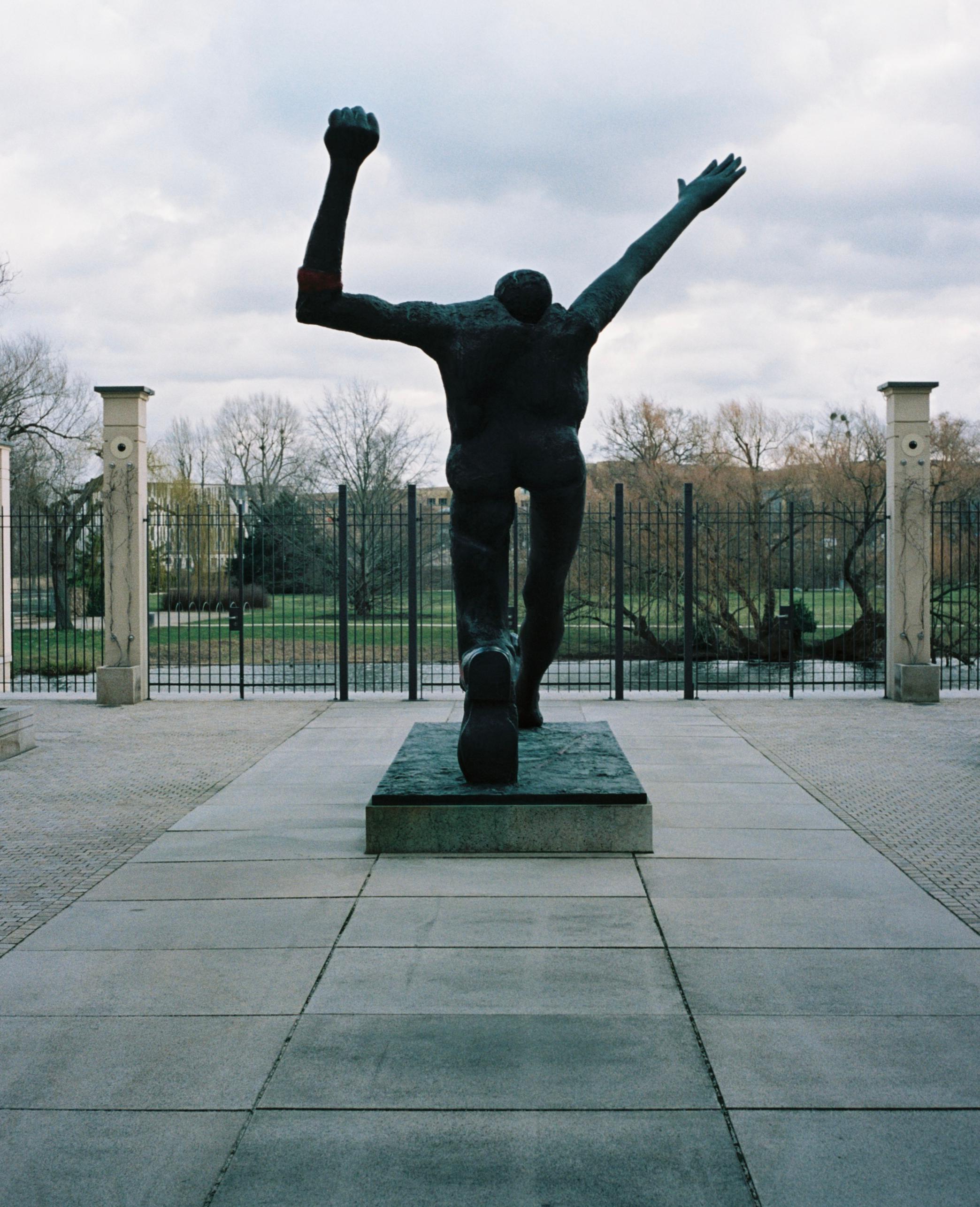
EDITION 03/24 A STUDENT LED MAGAZINE AUSTRIA AND DENAZIFICATION PAGE 4 RUSSIAN POLITICAL OPPOSITION IN SUPPORT OF ISRAELI OCCUPATION PAGE 12 IN THE CROSSFIRE: US-IRAN PROXY WAR ON IRAQI SOIL PAGE 14
INTRO
Looking at global politics, we tend to find ourselves amidst conflicting sides. We just need to log into our accounts on social media, read daily news or a newspaper article and suddenly we are divided by “color and feathers.” The experiences from our different lives and the opinions we form from them separate us. Let‘s keep our fingers crossed and hope that everything that was divided can be gradually and slowly put together, healing the wounds of our divided world.
As you flip through the pages of this magazine, you will soon realize the central theme of this edition is “being pushed over the edge.” When can we shout “this is enough!” ? As we put this magazine together, our central goal was bringing respect and deference into the discussions we have as we voice our disagreement, dissatisfaction, and disappointment. We hope you, dear readers, will carry this respect into difficult debates that life might bring towards you.
Besides sharing creative projects, pieces of writing, and photography, our intention for the magazine is to embrace the possibility to take The Stand and to take your stand in moments of injustice. Just like all of our brave writers and artists were able to, we hope you will overcome the feeling of vulnerability and take that stand.
It may be challenging to allow yourself to slow down and read with courage and grace but we hope the work of our contributors will inspire you to do so.
We wish you pleasant reading,
 Alexandra Pavlovičová. Editor in Chief
Sarah Hinteregger Assistant Editor in Chief
Alexandra Pavlovičová. Editor in Chief
Sarah Hinteregger Assistant Editor in Chief
AUSTRIA AND DENAZIFICATION MARLENE MASSEN
TRANS KIDS ARE NOT PROFESSIONAL ATHLETES GLYNNA NATHAN
RUSSIAN COMMUNITY AT CEU CONTINUE TO FEEL IMPACT OF ‘UNDESIRABLE’ DESIGNATION BY PUTIN REGIME ABRAHAM ARMSTRONG
RUSSIAN POLITICAL OPPOSITION IN SUPPORT OF ISRAELI OCCUPATION N.K
IN THE CROSSFIRE: US-IRAN PROXY WAR ON IRAQI SOIL CAN MORALIOGLU
LOSE WEIGHT WITH THIS SIMPLE TRICK MARTIN SCHARINGER
POETRY
SASHA & J.Ö.
DR. STRANGELOVE
GRABBING VIENNA BY THE BALLS LORELEI BONNET-GONNET
This country has a problem with right wing extremism and it seems like the public is rather unfazed. How much scandal is needed for public outcry?
In November 2023, German-speaking right-wing hardliners came together to plot their vision of ‘ethnopluralism’ in Potsdam, in a villa only eight kilometres west of where the Wannsee Conference was held in 1942. United by their eugenicist, racist worldview, the attendees convened on ‘remigration’, the idea of deporting refugees, foreigners and everyone not deemed ‘assimilated’ into exile ‘somewhere’ in Africa. In 1940, Nazi Germany contemplated a similar idea, the Madagascar Plan of 1940, according to which Jewish Europeans were to be forcibly relocated to Madagascar.
After the investigative network Correctiv published this revelation on the so-called Düsseldorfer Forum in early January, protests in the name of democracy, humanity and cultural diversity followed, first in Germany, then in Austria.
The term ‘remigration’ is a social science expression that has been instrumentalized by the Freedom Party of Austria (FPÖ), the most renowned party representing the interests of the political far-right in Austria. Right-wing ideology has had a substantial influence on the political culture since the Holocaust, which Austria currently faces a resurgence of. The country's response to Nazism and right-wing ideology since the end of World War II reflects a scandalous passivity in addressing xenophobic sentiment.
Austria made up 8.8%* of the German Reich’s territory. Correspondingly, around 8.8%* of the members of the National Socialist German Workers’ Party (NSDAP) were Austrians. According to the historian Kurt
Bauer, the percentage of Austrian perpetrators directly involved in the crimes of the Holocaust, those in Adolf Eichmann’s ‘inner circle’, was higher. This included doctors working in concentration camps (14.9%), high-ranking Schutzstaffel (SS) officials (11.2%) and those working at the Mauthausen concentration camp (15.95%). In the aftermath of World War II, Austria insinuated itself as the first victim of Nazi Germany, an interpretation of events that ignores Austria’s propagation of far-right, antisemitic ideology, although confronted with more institutional opposition. The Austrian Deutsche Nationalsozialistische Arbeiterpartei (DNSAP) and bearer of the Swastika since 1920 was conflicted on the extent to which Hitler was to be accepted as ultimate leader, which led to its fragmentation in 1926. Consequently, the Austrian NSDAP - Hitlerbewegung emerged and recognized Hitler as their ‘Führer’. At the state elections 1932 in Vienna and Lower Austria the party achieved a breakthrough, garnering 17.4% and 14.1% of the vote, respectively. In response to the Tausend-MarkSperre imposed by Germany intended to weaken Austria’s economy, a series of terror attacks were committed by Nazi functionaries and the NSDAP across the country in protest, which led to Engelbert Dollfuss banning the party in 1933. Consequently, the Austria Legion of the NSDAP was founded as a paramilitary unit accommodating Austrian Nazis in Bavaria. However, with the annexation of Austria by NaziGermany in 1938, also known as ‘Anschluss’, the party was formally reinstituted. Whilst it is true that Austria as a sovereign country fell victim to the Nazi regime, Hitler’s troops were welcomed by cheering crowds sharing the same ideology all over the country, an annexation that faced no resistance.
Since the end of World War II in 1945, the breeding ground for far-right ideology in Austria has not been confronted sufficiently. The denazification in Austria was a half-hearted undertaking, one that was only procured as a simple formality under pressure of the occupying forces.
The Prohibition Act of 1947 constituted the judicial foundation for the denazification process. This entailed a ban of the NSDAP and the exclusion of its members from national elections. This ban, however, only lasted until 1957. It also required the registration of all former members of the NSDAP and warranted legal measures of varying degrees. 90% of the former Austrian NSDAP members were ordinary party members and mostly faced fines. These ‘mildycharged’ were generally amnestied a year later, in 1948, for reasons of national reconciliation and shortage of skilled workers, which led to their reintegration as full members of society. In 1957, general amnesty was passed and thus the denazification basically came undone. Anti-communism commanded international attention and Austria’s impartiality in the Cold War, which had been implicit to its liberation from occupation of the allied forces, contributed to a lack of accountability for the denazification. The victimisation, explicitly mentioned in the Moscow Declaration of 1943, was an ascription recognized by the allied forces.
Many influential Nazi protagonists continued political activity after 1945, publically channelling right-wing ideology. Austrian involvement in Nazi war crimes either served as a reason for solidarity amongst people trying to oddly reconcile with their national identity, but ignoring shared responsibility, or fostered political distrust. This phenomenon was evident in the case of Kurt Waldheim, former general secretary of the United Nations and chancellor of Austria from 1986 to 1992, who faced heavy allegations before and after his election campaign. He had been stationed as a linguistic interpreter in Saloniki at the time when Adolf Eichmann ordered the deportation of approximately 42,000 Jews within four weeks, of which he claimed to have known nothing. Despite the peu à peu revelation of his participation in Nazi crimes that sparked international outrage, he won the elections. The Austrian majority (49.6%) confessed to him. Statements such as his - that he was merely fulfilling his duty as a subordinate soldier - are common. The denazification in Germany and Austria was initially procured under the pressure of the international community and not out of a genuine attempt of rectification. Victimising oneself as a perpetrator to shirk responsibility exposes the lack of moral reflection both during and after the Holocaust.
Another example was Richard Hochreiner, former SA-officer and leader of a regional Volkssturm unit, who commanded
a Nazi Werewolf unit to kill nine Hungarian Jews in mid-May of 1945, after the Nazis had surrendered. He managed to evade jurisdiction until 1961, when he was sentenced to seven years in prison, but was acquitted three months later through a nullity complaint.
Still, he was elected mayor in Sankt Michael with the votes of the FPÖ and the Social Democratic Party (SPÖ). Many Nazis managed to pursue a political career. Waldheim was not the only Austrian politician involved in Nazi crimes. The lack of responsibility and honest reflection, the unwillingness to face Nazism as a collective culprit permeated Austrian society. This attitude is referred to as Opferthese, the German word for ‘victim theory’. Only in 1991 did Austrian chancellor Franz Vranitzky formally acknowledge Austria’s culpability for the Holocaust.
The political landscape in Austria has been characterised by far-right sentiments for years. The FPÖ was founded in 1956 by party chairman Anton Reithaller, former SSBrigadeführer, incarcerated for three years only. His party gave far-right sentiment an official platform, only a few years after the end of WWII. Since its establishment, the party has repeatedly engaged in the trivialization of the Holocaust. Scandals have become the FPÖ’s strong suit. An example of political ignorance for the gravity of the Holocaust is the Kreisky-Peter-Wiesenthal affair. In 1970, SPÖ-Chancellor Bruno Kreisky appointed four former members of the NSDAP as his ministers. In 1975, it became public that FPÖ chairman Friedrich Peter had been an SSofficer. Chancellor Bruno Kreisky overlooked this fact, expecting poor election results without the FPÖ to depend on to form a coalition. Instead of acting upon the surfaced facts, Kreisky turned against Simon Wiesenthal, the man who had come forth with these claims. He accused him, a Jewish Holocaust survivor and Nazi hunter, of having been a Gestapo agent. Kreisky had to pay a fine for this defamation. Later in 1995, John Gudenus, another former member of the FPÖ, publicly questioned the existence of gas chambers, something he repeated in 2005. In 2006 he was finally sentenced to a year in prison, according to the Prohibition Act, the exact legislation he seeked to abolish in 1992. All this time he had been a member of the
federal council (1990-92;1996-2005).
Despite blatant evidence of far rightwing sentiment within the party, it is popular, especially in Lower and Upper Austria. Remarks such as “Of course there were good sides to Nazism, but we all don’t acknowledge those anymore” by Wolfgang Zanger, FPÖ member of the national council, made in an ORF-Interview in 2006 have no substantive consequences. On January 27th, INSA-Austria published a representative poll according to which the FPÖ would have received 31%, the greatest share of votes in a hypothetical national election, despite its tarnished reputation from the Ibiza affair of 2019 that resulted in the country's first vote of no confidence for the SPÖ and FPÖ government, elected in 2017. The far-right is politically thriving.
In Germany, the Correctiv revelation has caused public debate on the role of the AfD and its conformity with the constitution. In Austria, a similar effect seems to require more scandal, despite numerous preceding incidences of judicial misconduct and evidence of blatant racism. The Düsseldofer Forum is not an exceptional case, it just became extremely publicised.
In order to prevent history from repeating itself, one must first recognize what and how it happened, as well as putting legal and institutional defence mechanisms in place. Austria never properly recognized its participation in the crimes of the Holocaust, nor did it pursue introspection of the responsibility it did admit to. Racists and anti-Semites held and hold powerful positions in this country. When Herbert Kickl, current leader of the FPÖ, refers to the ‘fortress Austria’ that must be protected through ‘zero asylum’ policies, he is imagining a world compartmentalised into extreme homogeneity, divided by arbitrary differences in human beings. These differences, whether religious, cultural or regarding ability, must not be used to strip people of their dignity. Denying responsibility and involvement in the Holocaust is equivalent to not understanding the extent to which malice and hate can account for horrifying breaches of humanity.
*Taschwer, Klaus. (2022, January 17) Gab es wirklich überproportional viele österreichische NS-Täter? Der Standard. www.derstandard.de/story/2000132832160/ gab-es-wirklich-ueberproportional-viele-oesterreichischens-taeter.
With constant human rights violations coming out of the United States, it’s hard to keep up with all the horrifying legal action being taken against trans people for existing—and maybe distraction is the intention. In the United States, a huge wave of draconian bills banning gender-affirming care for transgender youth have been introduced and passed since 2020. In 2023 alone, 600 bills across 49 states were introduced, and 87 bills passed in 25 states.
Already in 2024, there are 424 bills under consideration, and two have already passed in Ohio and Utah. The new law in Ohio (OH HB68) will go into effect in April 2024, banning genderaffirming care for trans youth and preventing healthcare providers from encouraging or helping people leave the state to access care. The bill also bans transgender women and girls from competing in school and university sports in Ohio.
This is just one example of bans against trans youth participation in sports. As of February 2024, transgender youth are banned in 24 states from playing on team sports to different extents (this extends all the way from elementary school recreational sports to intramural sports at community colleges, and in some cases to D1 sports at private universities). Although framed as a question of “fair play,” prohibiting middle schoolers from playing recreational softball is fundamentally a problem of discrimination and fearmongering.
Of course, these anti-trans bills go much further than simply banning children from playing sports. Trans children and adults, up to 26 years old in some states, are being robbed of their access to healthcare and bodily autonomy, books on queer history and
education are being banned, and transphobia is becoming legally legitimized.
Since the 2020 anti-trans wave, I’ve also seen a major increase in media coverage about transgender exclusion and the question of “fair play” in professional sports There is a new spotlight on professional sports, namely the Olympics, for discrimination against trans women specifically. This is true and important to have conversations about. At the same time, when we look for solutions, we must maintain some distinction between trans children being banned from pick-up basketball and trans professional athletes in an already highly segregated and flawed sports industry. They are not the same conversation.
Trans pro athletes are being banned from competition because some sports leagues argue that transgender women have an unfair advantage over cisgender women due to higher levels of testosterone, larger lung capacities, and larger and stronger bones. The current science maintains that, although some trans women have a biomedical advantage over cis women, it‘s not a black and white issue Being better at sports (of which there are many kinds that require different physical feats) does not immediately follow from having high testosterone levels, and undergoing hormone replacement therapy (HRT) can lead to athletic disadvantages However, there is a massive lack of research on the effects of HRT relating to sports performance, and different advantages will present differently across sports. This time it really is a complicated issue, and you’ll be hard pressed to find a conclusive answer from any good faith „side.”
More broadly, though, I find bringing in the argument of “fairness” only when it relates to trans participation is a little out of context. Yes, maintaining meaningful competition is important in high stakes, elite sports. At the same time, the industry is based on inequality of opportunity and high entry barrier. Considering the cost of entry is the cost of dedicating your life to expensive training for long-term, hypothetical profit, I think the conversation of fairness is much broader than the transgender inclusion debate. Many people also question the gender-based segregation structure of sports in general. Making professional sports fair might require a bit more thought and restructuring than simply excluding people who are too strong.
Regardless of the solutions for the professional sports world, the arguments for what is fair in Olympics sports are being unfairly equated to what is fair for recreational play. Of course, there are points in which professional sports and children’s sports issues overlap— given that if you ban trans kids from playing sports at school, the next generation of trans pro athletes won’t exist. However, the American public is alarmingly not making a difference between trans girls’ inclusion in schools and trans women’s inclusion in the professional sports industry. This has serious negative consequences for trans youth–the vast majority of whom won’t go on to play college D1 sports, never mind professional.
When it comes to children playing sports, or recreational sports in general, the point is not to gather the best players in the world to compete, like it is in the Olympics. When I played co-ed badminton in high school, none of us were the best in the country or most physically perfect specimens to break world records. We were ranked in gendered groups, with the girls and boys having separate rankings blackboards. When we played all together in mixed teams, our clear star player happened to be a girl.
Is this because all women are naturally better at playing badminton because they are on average more lithe and agile? I would venture a “no,” given that all women don’t have cookie cutter bathroom-door-sign bodies or the same hormone levels. If we were to put the top 100 women badminton players in a lineup, we might then see physical similarities because people excel at sports that their bodies are compatible with, regardless of their sex. However, it’s not enough to have the “right” body or “right”
amount of testosterone—you still have to be good at the sport.
Thankfully for High School Me on the JV badminton team, there was no need to measure everyone’s grip strengths and femur lengths because none of us were good enough for it to make a difference. Children’s bodies and hormone levels simply do not need to be part of the conversation for recreational sports—and aren’t many contact sports divided into weight categories anyway?
If it’s so dangerous to play co-ed contact sports without weight categories, why is there silence about how dangerous American football is? If soccer is apparently so dangerous, why are there only now worries about safety? Kids have always hit puberty at different times, grown into adult-sized bodies over single summers, and returned to their same gendered, youth sports leagues without worry.
We live in a time when International Transgender Day of Visibility is no longer a day to celebrate for some, but instead a horrifying reminder of how hyper visibility by itself can be exhausting, violating, and discriminating. Finding solutions to the Olympic problem of trans discrimination is hugely important, but please leave the kids out of it.
Russian students at CEU continue to feel the personal and professional consequences of the university being designated as an ‘undesirable’ institution by the Putin regime.
In October 2023, CEU joined a list of over 100 organisations deemed a threat to Russian national security in accordance with a 2015 law that handed Russian prosecutors unprecedented extrajudicial power to declare foreign organisations ‘undesirable’ and close their domestic operations.
According to the Russian Prosecutor General’s office, the decision was made because of the university’s role in ‘shaping the global media anti-Russian agenda’, as well as its efforts to discredit the ‘special military operation’ in Ukraine, following the full-scale invasion in February 2022. Fines and lengthy prison sentences can be administered to individuals who maintain any form of affiliation with branded institutions, creating uncertainty for Russian members of the CEU community and the parents of students who may be funding their studies.
In a statement released shortly after the official designation, the university responded that it ‘condemns the decision and rejects the accusations’ of the Russian Prosecutor General’s Office, viewing it as ‘a serious restriction of our freedom to cooperate with Russian institutions and individuals’, as well as putting ‘Russian students and employees of CEU at risk of political persecution’. While hopeful that the decision will be reversed, the university has terminated all cooperation with Russian partners and is no longer promoting its degree programmes in the country.
The Stand has spoken to students,
whose names have all been changed, about the impact of the law on their lives over the last months, as well as their feelings about the official response of the university.
Darya, a PhD student who currently feels unable to return home to visit her mother in hospital, suggests that the ‘undesirables’ law serves two functions in the Russian legal system. Firstly, it provides an additional tool with which Russian prosecutors can pursue individuals perceived to be a threat to the regime, such as the civil rights activist Anastasia Shevchenko – the first person in Russia to be charged in accordance with the new legislation.
In addition to these targeted political attacks, however, the law can be used in a more arbitrary fashion to help police and security services fulfil monthly targets for reports and arrests, including via random document checks at the border.
The deliberately vague wording of the legislation also makes it unclear at what point an individual might be prosecuted, and what behaviour necessarily constitutes ‘affiliation’. Maria, an MA student in her last year of study, says that it is this uncertainty that has been most difficult to adjust to: “If you're not interesting for Russian authorities, then probably you can live peacefully. But the thing is that you never know when and how it will affect you… Just constantly being under risk and constantly being worried… The worst thing (is) that you cannot control it because (it is) a decision that was made from above about you, about your life”.
One first-year student described feeling ‘dumb’ for taking precautions such as going back through old Facebook and Instagram posts in order to erase all mention of CEU from
their digital footprint, knowing it was unlikely that anyone would notice. But ‘you are studying at a university where it is illegal to study…(and so) you always think that you’re putting yourself in more and more danger’.
This sense of precariousness has been felt even more keenly by PhD students, whose links with CEU are often much harder to conceal. Students may have published under the name of CEU or attended conferences while representing the university, information which is impossible to erase completely – many have also taken public anti-war stances. This, in addition to the sensitive topics with which PhD students often grapple with in their research, may all increase the risk of being targeted.
The legislation has also made planning for the future much more difficult for students, both in regards to their careers and where they will live once finished with their studies. Graduating MA students will be unable to show their diplomas to potential employers in Russia due to their affiliation with CEU, so may be forced to look for a career elsewhere, while others have expressed concerns about returning to work for civil society organisations in the country, fearing that they will also be placed on the ‘undesirables’ list in the near future.
Returning home therefore no longer feels like an option for many students, and the exceedingly restrictive asylum system in Austria has created an uncomfortable situation for students who do not possess dual-citizenship, or have a job secured for when they graduate. Nor does everyone have the money to stay in the country on a ‘Job-Seeker’ visa.
It is against this backdrop that frustrations have grown with some aspects of the response of the CEU administration to the plight of its Russian community. In particular, students have criticised a perceived lack of urgency in the immediate response, as well as a reluctance to assist individuals in finding solutions.
Maria argues that the university should have been better prepared considering its recent history and that the Open Society Foundation’s long-term place on the undesirables list should have been a warning to the CEU administration. She also argued ‘it seemed that the university wasn't very much interested in finding…. solutions. But it's also…understandable to some degree because they do not know the context that much. In the first days, (it was) not taken
that seriously at all’. Sasha concurs, ‘for me, it seemed like everything was happening really slow’.
Since October, CEU has taken a number of measures to address the issue. A Student Union newsletter circulated on the 7th of February stated that the university has been working ‘tirelessly’ to get the best possible outcomes for students, including providing financial aid and the opportunity to transfer to other Austrian institutions to complete their studies. The university has broadened the use of the emergency fund for Russian students to use, especially those who are unable to return home and are facing extra utility costs, in addition to psychological support offered to impacted students.
Meetings with human rights lawyers –independent from CEU – were also organised to help provide guidance to students and staff, while representatives of the CEU administration have pointed to the list of precautionary measures distributed on the 17th of October, a day after the leadership became aware of the designation, in response to accusations of slowness on behalf of the institution.
One of the primary complaints among students who feel unsatisfied with the response has been the purported reluctance of the administration to assist with applications for humanitarian visas. While it is unlikely that most Russian students will reach the threshold of being at risk of ‘suffering serious harm’ in accordance with the narrow criteria laid out by the Austrian asylum system, CEU students may be eligible to apply for a humanitarian visa in Germany (among other places) if they can prove they have a connection with a trusted institution in the country, such as an NGO.
Some students had therefore hoped that the university would assist with reaching out to partner institutions, including through OSUN and the CIVICA university network, to provide an affiliation that could help support the visa application process. CEU is seen as being in an especially strong position to provide institutional support because of its myriad links to European academic institutions and civil society groups.
But Darya, amongst others, has felt disappointed at the apparent diffidence of the university in taking the initiative to reach out to organisations who could vouch for students in their application process: ‘these (humanitarian) visas give a lot of protection and…opportunity
to stay in the country for up to five years. It's a good opportunity and we had the conversations with CEU administration about this. We have the money. We have the connections to make it feasible, but no. It's a failure of administration.’
The Pro-Rector for External Relations at CEU has subsequently asserted that the university reached out to all of the CIVICA partner institutions, who promised their support, but is ‘not aware of any of our Russian students contacting them to date’.
CEU administrative staff have further stated that the leadership has offered to write letters in support of students applying to partner institutions, but that ‘CEU as an institution cannot offer support for 'humanitarian visa' applications in any country or political asylum applications here or elsewhere’.
Katalin Horvath, The Director of Student Services at CEU, said she understood the uncertainty facing Russian students, but remained sceptical about the idea that the university should be responsible for locating organisations that could provide an affiliation, or that CEU possesses any particular influence that would enable it to encourage other institutions to vouch for its students.
N.K.
Ms. Horvath stated that CEU could recommend people, and write tailored letters that explain the situation of its Russian students, whilst maintaining that it could not ‘place’ them anywhere, and that individuals are expected to take the initiative to reach out to external organisations.
Maria shares some of the frustrations with the response of the university, but reflects ‘this is just a situation where there is no solution, actually. We can blame the university. We can blame the country. We can blame ourselves for not coming back or staying here, but the thing is that there is no right or wrong.’
A last concern, expressed by Darya, is that the treatment of CEU and similar institutions by the Putin regime could act as a blueprint for other authoritarian systems who might also choose to target foreign organisations perceived as hostile. ‘It’s a dangerous precedent because autocrats really easily learn from each other…It goes beyond CEU... It’s really a political case. Turkey can do the same, Pakistan can do the same’. As such, they argue, it is important for CEU to respond effectively for the sake of its own students, in addition to the democratic values that the university is intended to uphold.
“You are simply brain-washed. They are defending your homeland.” This was not what I expected to hear from my former classmates when I went back to Moscow in December. This kind of narrative has become in a certain sense triggering - this is what Russian propaganda has been trying to persuade me of for the last two years of the war on Ukraine. It told me I don’t see the whole picture: Russian soldiers are the defenders, not the aggressors. But this time, it is not Russians who are being accused of ignorance and misunderstandingit is the Jewish people who consciously stand up against the Israeli government committing horrific war crimes in Palestine. Now, it’s the Jewish people being “brainwashed”; it’s the Israeli Defence Forces (IDF) protecting the Jewish people’s “homeland”.
I realised that it is incredibly important for me to stay conscious about how one-sided my perspective on political matters was becoming: it is not possible for anyone to fully understand the real order of things in Russia, while existing in a relatively safe political space abroad. And this kind of political separation is what a lot of Russians, who decided to emigrate, have been
experiencing. Since October 7th, I’ve been reading twitter posts by prominent oppositional Russian politicians, realising the presence of a certain consensus about the Israeli-Palestinian conflict: the IDF are acting in line with the interests of Jewish Israelis, and, therefore, their actions are morally justified. I knew that Maxim Katz, Mikhail Khodorkovskiy, and many other famous politicians opposing Putin’s regime immediately expressed their absolute support for Israel. But already somewhat problematic political figures, who fled Russia several years ago, could never provide a perspective on how the majority of anti-Putinist Russians actually perceive this conflict.
Through talking to people I used to study with, as well as my ex-professors, I discovered another dimension of this conflict. In my social bubble we all condemn the Kremlin’s actions on a purely moral basis - killings of innocent civilians are absolutely unacceptable and the humanitarian crisis that Russia caused in Ukraine never stopped horrifying us. This was the reason for me to assume I was on the same page with people who I thought shared my values. Pain from knowing that those, who you had ultimate respect and love for, align themselves with something that you consider to be utterly inhumane was something I already went through after the Russian army invaded Ukraine. Still, not something that I expected to encounter talking about Israel’s war crimes against 1.7 million of displaced civilians, who are no less innocent than Ukranians who our own government has been continuously torturing for the past 2 years.
I realised that assuming the willingness to oppose the oppressive regime of the Russian government equals willingness to fight one’s own intrinsic xenophobia was actually idealistic. We might hate the state for discriminating against us as queers; we might hate the state for killing those who look like us; we might hate the state for brutally torturing those of us who oppose it. But this rhetoric never included fighting our idea of the inferior - when the Russian political left put itself in opposition to the Soviet heritage, when they did everything possible to prove to everyone they are ready to “evolve” , and when they eventually went blind to the xenophobia of the “West” that they so much admired, their enthusiasm to appropriate the narrative of the “uncivilised Muslim” started to shine through.
But it was always there. There are thousands of Muslim immigrants from Central Asia in
Moscow, who are disadvantaged not only in the legal and economic senses, but primarily due to everyday racism that has become so normalised that even the most “progressive” of us fail to recognize it in our own behaviour. But it does go far beyond personal experience - it is those political discourses that Russians have been exposed to during the last century that have stimulated the development of racist narratives. It was the Soviet Union with its anti-semitism and tendency to oppress the Other. Now, those who consciously oppose themselves to sociocultural heritage of the past have appropriated Western racism and islamophobia. “Have you seen what those barbarians did in Tel-Aviv? They chose to support Hamas themselves, it is for them to bear the responsibility for their actions” - this is what justifies the massacre in the eyes of Russian oppositioners and those who admire them; they chose to follow the “Democratic West”.
What scares me is how blind they have gone to these Western logical and moral fallacies. Once you question their stance on Israel, you are suddenly accused of siding with Putin’s murderous regime. And it has absolutely nothing to do with so many of these politicians being Jewish themselves - to equate Zionism and Jewishness is actually incredibly antisemitic a priori. It is the informational hegemony of the West that perverts their perception - the West supports Ukraine, the West supports Israel. Disapproval of the latter excludes the former.
I am not disappointed, because it’s not unexpected of the Russian opposition to be making those claims; nor am I discouraged, because I see Jewish people resisting Zionism - I see their struggle and their compassion for change. But I remain puzzled. Waking up every day to a new complication of an already unbearable set of political catastrophes has a disgusting consequence: we all go numb to the horror happening all around us, and it is a result of being constantly overwhelmed. But as fearful as we get, there is no point when giving up becomes acceptable. There is no point at which we exhaust every single opportunity for redirecting our power and resources to fight oppression and horror - at least this is what I want to believe. Becoming confused by the millions of interpretations is what navigates us towards the illusion of helplessness. Our biggest struggle then is not to let this confusion occupy our brains to the extent at which we are unable to realise political action.
In the ongoing saga of the US-Iran proxy war, Iraq has emerged as a pivotal battleground. The latest maneuver, orchestrated by the US Central Command (CENTCOM) on 7 February 2024, resulted in the targeted killing of a commander from the Shiite militia group, Kataib Hezbollah. This tactical move came hot on the heels of an assault on a US military base in Jordan on 2 February 2024, claiming the lives of three American soldiers. Since then, Washington has executed over 80 attacks, directing its focus on Iran-backed forces in both Iraq and Syria. These developments compel a critical reevaluation of the trajectory of the ongoing proxy conflict between the US and Iran.
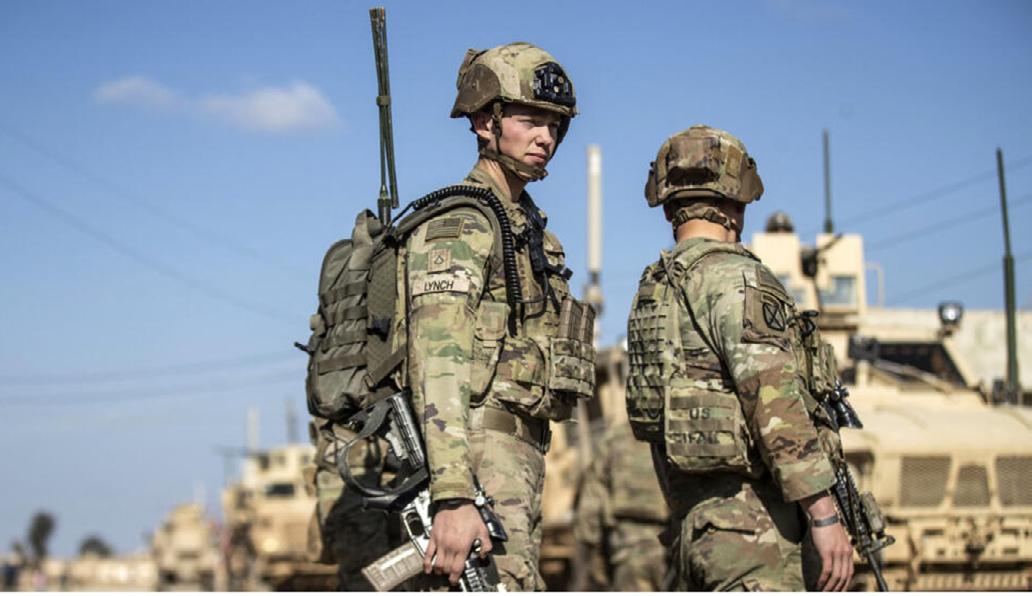
At the heart of these far-reaching consequences lies Iraq, often referred to as the "miniature of the Middle East" because its social fabric mirrors the diversity of almost
every ethnic and religious group in the region. Geopolitically, Iraq commands a central position, bordered by regional powerhouses Türkiye, Iran, and Saudi Arabia, with access to the resource-rich Persian Gulf. This geopolitical centrality has historically made Iraq a focal point for both regional and global influences, characterized by a persistent lack of stability. From the British occupation and postOttoman rule in 1918 to continuous external influences and the tumultuous era of Saddam Hussein, Iraq's journey has been marked by a series of conflicts and interventions, shaping its role as a crucible of instability.
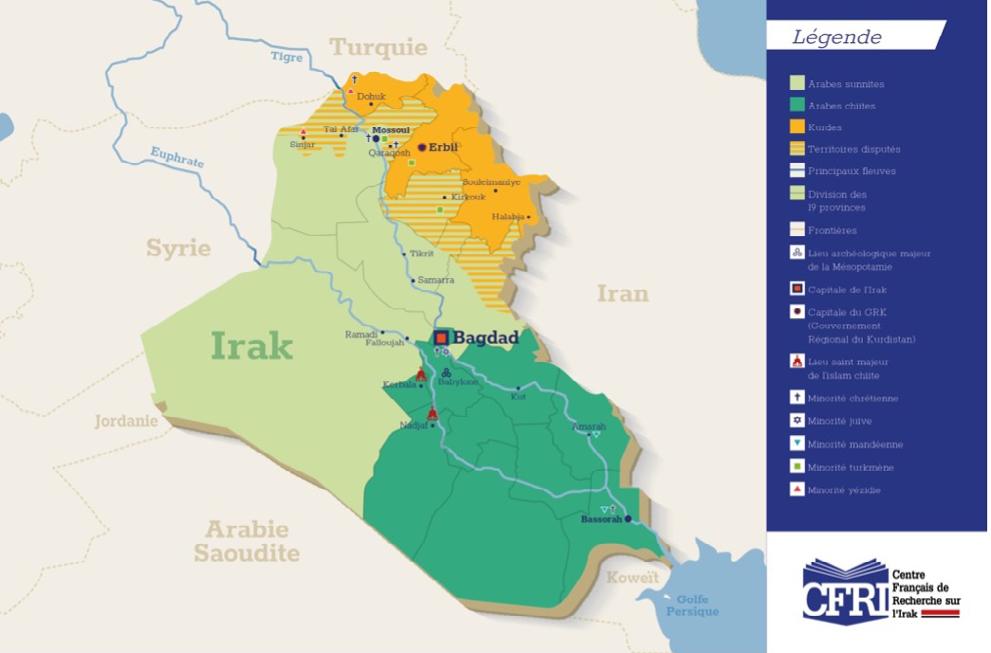
In the contemporary landscape, Iraq has transformed into the epicenter of fully-fledged proxy wars. Since 2003, sectarian divides have laid the foundation for the rise of Shiite militia groups, notably shaped by Iranian influence. Extending beyond military and security dimensions, these groups have extended their sway into political and administrative realms, amplifying Iran's footprint in Iraq.
Iraq, in essence, has become Iran's operational base, with a proactive response to any perceived threat. This tension plays out through attacks on US interests by Shiite militias, countered by US operations against these groups. However, the effectiveness of these back-and-forth strikes is uncertain, as the US does not directly target Iran, and Iran does not claim responsibility for militia attacks. This controlled escalation hints at a nuanced dance between the US and Iran, both aware that a direct conflict does not align with their current interests.
As the November 2024 US presidential elections approach, the value placed on every American soldier's life in Iraq intensifies. With this, the question arises: Why would Iran intervene directly in a conflict not inherently its own? Iran grapples with security concerns amid protests and targeted assassinations, as evidenced by the recent terrorist attack during the ceremony marking the 4th anniversary of the death of Qasem Soleimani, the Commander of the Islamic Revolutionary Guard Corps Quds Force, on 3 January 2024.
The nation finds itself at a sociological tipping point, grappling with the complex challenges of consolidating domestic politics. Iran is concurrently facing significant issues related to internal security, marked by heightened protests and targeted assassinations of authorities. The recent terrorist attack during the commemoration of Qassem Soleimani serves as a poignant indicator of the prevailing situation.
The confrontations between Iraqi militias and the US, along with their responses, appear to be a small-scale conflict. Even with some casualties, there has not been much change or deterrence. The US admits it cannot stop the influence of Iran-friendly groups in Iraq, affecting their social, political, economic, and military power.
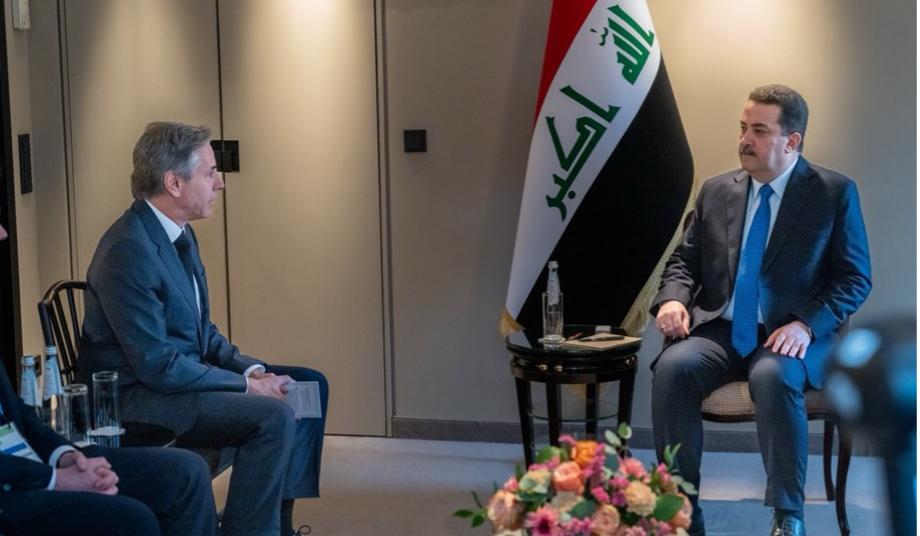
Mohammed Shia' Al Sudani, the newly appointed Prime Minister, embodies a pragmatic and rational approach, navigating a subtle balance between the US and Iran. The Kata'ib Hezbollah Militia, one of the groups
closest to Iran in Iraq, declared a suspension of actions to preserve Iraq's interests, underscoring the equilibrium achieved under Sudani's leadership.
The statement from Kata'ib Hezbollah, "We are suspending our actions so as not to harm the Iraqi state," serves as an indication of the balance provided by Sudani.
The integration of militias into the political sphere also creates a favorable scenario. It can be argued that the objective is not legitimization but rather domestication. There is an endeavor to guide groups with inclinations toward radicalization in social and political movements to a reasonable platform and assume a legitimate responsibility. However, this dilemma raises the question: Is the state becoming militarized, or are militias becoming more state-like?
Amidst the current crossfire between the US and Shiite militia groups in Iraq, a deeper struggle is unfolding, shaping the fate of Iraq and the broader Middle East. Yet, a resolution to this controlled conflict does not appear on the horizon. If tensions in Iraq intensify, the grip on control could slip away. In a full-scale war, Iran might suffer more, but others will not remain unharmed either. Where the proxy war in Iraq is headed remains uncertain, but its consequences will be undoubtedly important for the region.
Are you looking for means to make your favourite jeans fit again? Are you contemplating how to make them curves less curvy? Do you still want to snack some snacks and not sacrifice your dental health along the way? Well, struggle no more, simply click on this link, purchase my one-of-a-kind limited offer and for just $99.99 you can seal the deal of your lifetime. Start freeing yourself from all physical ailments today by making use of my patented life-coaching program, this is totally not a fraud.
Such and similar pitches from countless “life coaches‘‘ can be found on every website and in every magazine that proudly admits its own shadiness. Not to be misunderstood, I am a life coach myself – one does not have to undergo accredited training before acquiring the title. However, since the administration of CEU gave a broad hint not to commercially promote such and similar myself (I ain’t a big fan of involuntary exmatriculations), I went ahead and unearthed my well-intentioned and noncapitalist self. Alas, I dissociate myself clearly and unequivocally from all such and similar “life coaches” by setting the precedent and revealing this simple trick before any paywall or commercial break: Ice.
Please do not confuse ice with its (usually grossly overpriced) step sibling ice cream. Though both share the parental trait of coldness, comparing said abomination of frozen liquids to the purest rock in existence (yes, ice is technically a rock) is a greater folly than mistaking honey water for the nectar of the gods. But where Tantalos on Mount Olympus was needed, a simple freezer in your kitchen is sufficient. Grab yourself an ice cube tray, for it is your key to divine pleasure.
Even as I write these lines, I must admit that I sense ridicule in you, dear reader. Employ the words of a certified life coach in whatever fashion you desire, though I ask you to refrain from judgement until the end. Moving on, one of the more obvious reasons for snacking on ice cubes for starters: only if you chew on ice,
you literally make a mockery of snacking, taking it ad absurdum. Instead of ever-expanding your daily caloric intake, every cube consumed cuts back on your ever-tormenting weight gain coefficient. By forcing (but in a nice way) your body to warm up the ice, thus postponing impending hypothermia, you simply burn calories.
Pertaining to temperature, to modern society ice cubes are but means to cool down those nice tropical cocktails (umbrella included) offered at your nearest tiki bar to ward off any summer heat. However, it is cheaper (and healthier) to simply bypass the intermediary of „alcoholic mixed drinks“. But ice cubes are not only fit for drinks and droughts. By snacking on them throughout the year you effectively build up resistance against temperature fluctuations. Well, yes, your cold-sensitive thermoreceptors in your mouth will go slightly numb, but so will the rest of your body. Shivering in winter?
Shadows of the past!
On a completely different and unrelated note, please enjoy an inserted friendly reminder to drink enough water. The average adult should have a water intake of roughly 2 to 3 litres a day. This is genuinely just a kind reminder. (to be frank, it is beyond me how this can in any way be related to chewing on frozen water...)
Up for last, my most brazen take so far. Eating ice cubes is beneficial for your dental health. Even in your inconsolable incredulity you, dear reader, must agree that chocolate, for example, gets trapped in and between your teeth during consumption, promoting the formation of caries. Rejoice, for ice cubes are once more salvation in times of need. As you crush them with your teeth, perpetually shredding them into smaller and smaller crystals, they get stuck in your set of teeth instead. But this residue has no sugar and melts away by the second.
This article may read lightheartedly, it‘s only intention seems to be to elicit a smile. But I am dead serious, I even became a life coach for this matter. This simple trick featured on annoying pop-ups and tedious Instagram banners does indeed exist. Snacking on ice cubes has an incredible array of positive effects, starting with your health and ending with your wallet. Not to mention the taste, but I guess this is up to oneself. I have been benefiting from ice cubes for many years now, but today you too can give it a go and start to be cool as well.
Sometimes I am afraid of sleeping. “I must not fall asleep,” I say. The moon shines too bright waiting, my dreams get feverish and rave.
I walk - keeping the action of hope awaken, until I stumble over my words: “Wont let my night of sleep be taken!” But while the body barely exists, the mind is still wide awake begging the demons: take a break! Pack all the failures, shames and doubts, fears of missing out-s, or judging crowds. and finally set me free.
a lifetime lost in a pile of clothes
While worrying about what to wear, you took your last breath.
I forgot about the pile of clothes, Instead of caring about my image, I have lost my youth.
I keep searching for the sweater you lent me, I keep searching in the pile of clothes. I am rummaging through your echoing absence. I keep searching full of hopes, for my friend to be back home.
With all my hopes forlorn, the heart is torn, the heart is torn apart. Now, what I wear only is grief, and what I do only is mourn.
Time is dead for me, but it comes back to life, while you don't.
I lost you in the blink of an eye, there is no rationale. You lost your breath. Now for your presence, I know I'd surrender mine.
ode by (j. ö.)
hundreds of tiny red stars light up the horizon, as i feel my chest fall and rising faster and faster oh, you sweet-sour jester, time.
you are mine for a moment to have and to hold and this present is endless
i love you senseless
render me defenseless, you city preluded by emerald-green fields, you know my heart beats for you with every step I take along the Danube; i can’t help but bow to the grandeur of your stature as you decree the sound of music and command my heart to use it as its muse, if i could only cross this unforgiving distance, all of my existence would be contained in you, my fate was ordained and it’s tied a noose on my loose soul so, let me rest in you,
to me, the rest is you.
hold the rope, then, take it, i won’t entertain it; your coy nonchalance: keep the rhythm and the melody in balance, and allow me to be the author or your etude, hogy hozzád írjak minden szót, s betűt, s hadd, hogy vérezzek érted: nem beszélem a nyelvedet, de remélem, megérted, hogy akkor is szeretlek, ha szívemet sérted.
to me, the rest is you. even if the rest is few, let my life play on the grand screen of your cinema, my one true love, Vienna.
“The only Valentine’s date option I had this year was going out with a PhD student. I’m not there yet, sorry”
First of all, we must address the obligatory anti-Valentine's Day discourse. Need I say more? Apparently. Valentine’s Day is the commodification of intrapersonal relationships and love—one of the last beacons of authenticity we have left to cling to. Moreover, it’s a heteronormative, relationship hierarchy-creating, monogamyencouraging, stupid hysteria I implore you to stop celebrating. Now that I’ve said everything that a PhD student would say to lay you down gently on their IKEA twin bed, let’s address the real issue at hand—your respect for institutional hierarchies.
One’s degree level is in no way indicative of one’s wisdom, ascendancy, or sexual allure. Don’t you see the symbolic violence manifested in culture capital accumulation seeping into your oh-so-individual dating preferences? The only thing stopping you from dating a PhD student is your BA complex (assuming you are indeed a BA student). Your personal worth is not determined by two or three letters. And I’m sure you could get anyone from a dungaree-wearing barista to a tenured senior professor at prestigious institution of choice if you really put your mind to it. Ignore the education discourse. Go forth and conquer that TA of yours (who is acting rather inappropriately??) This is what I would've said if we weren’t talking about CEU PhDs.
Although the PhD students of CEU have a noble cause, since I’m not a tankie (!) I don’t believe that the ends justify the means. This means being @meme.ceu on Instagram, which I wholeheartedly hope is a PsyOp seeking to discredit the PhD students’ movement. This page represents everything wrong with Millennial access to the Internet. It’s overflowing with Ryan Reynolds, MINION MEMES (!!!), Friends references, and other bottom of the comedic Mariana Trench invertebrates.
You say you are not there yet. Please don’t let this “yet” materialize. The risk of going on a date with someone involved with this unfunny, deep-water content is too great. Not being there means you’re moving in the right direction. Keep it up.
Love, Dr. Strangelove
Vienna balls are a season. January through February, the palaces and ballrooms of Vienna fill with the heavy steps of graduating Matura students, alumni, and the illustrious debutantes of the Austrian social scene. They mix and mingle with the ticket-buying plebe on the wooden dance floors of inner district palais. My persona of the night was that of a smooth social surfer, used to the scene and blazé to the beauty and performance of the balls, limbs carefully packaged in a dress borrowed from a friend, out of a selection otherwise dubbed as Christmas tree adjacent, or resembled important staples from my Grandmother’s closet. So, in my non festive pine, un-grandma like dress, I slipped into the crowd, leaving my jacket at the wardrobe, where an old professor with a stunning mustache assessed the incoming dancers with icy judgment. Around me, the sculpted walls of a first district palace, the diffuse light above reflected gently in the windows that skirt the entire room. Despite sporting the telltale signs of an oncoming cold, I soldiered through the evening, rubbing my nose whenever it threatened to dribble in a way no doubt frowned upon by the etiquette hungry elite. The palace unfolded as a maze around its guests, one room where a juvenile DJ wove Rihanna to Avicii seamlessly, while the upstairs rooms, accessible through gargoyled stairs, were home to classical orchestras that played up a Strauss storm. Midnight is not the marker of a lost glass shoe or a pumpkin carriage, but does set the scene for the dance routine performed by the graduating class. As my group exited the building, a girl no older
than 16 came up to me and grinned sheepishly, speaking in a rapid German I could only smile dumbly back at. An Austrian friend guffawed and sent her on her way with an apologetic, if not a little mocking, wave before turning to me with a wicked grin.
« She was asking for some of your coke! ». Now let me clarify. I, in fact, was not in possession, or ever was, of said substance during that evening. It turned out, my repeated nose rubbing had been read as a symbol of a doped evening, and not the threat of a sneeze that it truly was. In my efforts to cosplay the upper-middle class of Vienna, I had done my work too well, and had truly blended into the crowd of inebriated teenagers celebrating their graduation. My insider investigation stopped there, as did my attempts to properly dance the valse (unsuccessfully, and with no little amount of embarrassment.)
Now, though my own investigation can be turned into a punchline, it cannot be said the same of all balls in Vienna. There is an appealing section of them that exist under a blanket of champagne, dresses and expensive cologne, but it is impossible to discuss them without addressing their bigoted relative, the Akademikerball.
Every year, one of Vienna’s longest lasting traditions of protest occurs as opposition to the happening of the Akademiker Ball, a name that divests from the fact that it has been dubbed by many newspapers as the « Far-right » ball by excellence. It lies at the intersection of many of the far-right forces of Austria, with close ties to the Freiheitliche Partei Osterreichs
or Freedom Party of Austria (the national conservative and right wing populist party) as well as the Viennese Burschenschaften or « brotherhoods » (essentially fraternities) that have an extensive history of problematic behavior including fencing rituals that are hoped to leave participants scarred, and the finding of song books that included lyrics praising the Holocaust. Not exactly a sparkling resume for the groups that have produced many of the leaders of the FPO, such as Heinz-Christian Strache, the previous ViceChancellor of Austria and previous chairman of the FPO, that resigned after his involvement with the infamous Ibiza affair, in which he and another FPO politician appeared on tape to be discussing the corruption and underhand activities of their party. Although both denied the corruption allegations, Strache was later convicted of corruption, so his word is not what one could call reliable (or particularly original, considering many of his fellow partisans have also been convicted on similar charges). This ball has become a status symbol for right-wing parties not only in Austria but everywhere, with guests such as Marine LePen, a legacy of rightwing politics that has skirted themes of antisemitism, xenophobia, homophobia and other bigoted, constrictive and inconsistent so called « phobias ». The Akademiker Ball’s history is inherited from hundreds of years of consistent conglomerations of parties such as the FPO, which feast not on champagne, spritzers or amuse bouches but rather on consistently exclusionary tactics, fighting for a power that rests upon an altar of corrupted, fascist rhetoric.
Now, all of this can be found by only dusting the surface, and I would encourage all of you to investigate the seemingly endless rotten roots of far-right rhetoric attached to this event, and to even participate in the protests if you feel so inclined. The consistent protection and attendance of this event is upsetting, but the consistent participation and attendance of the protest is hopeful. While my ball experience ended on a high (pun intended) note, I can only hope that the Akademikerball will fall far lower than it already has.
Sources:
• “France: the neo-fascist danger is real” by AntiCapitalist Resistance.org
• “Der Akademikerball und die FPO: Was ist das Problem am Wiener Ball?” By Moment.At
• “Austria’s far right fraternities brace for protests at annual ball” by The Guardian
• All you need to know about this evening’s Akademikerball by Metropole.at
• “Protests at Vienna’s far-right “Academics Ball” by DW
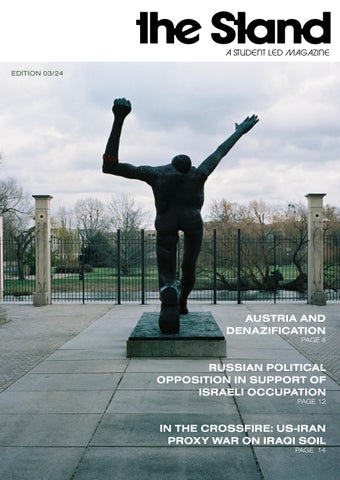
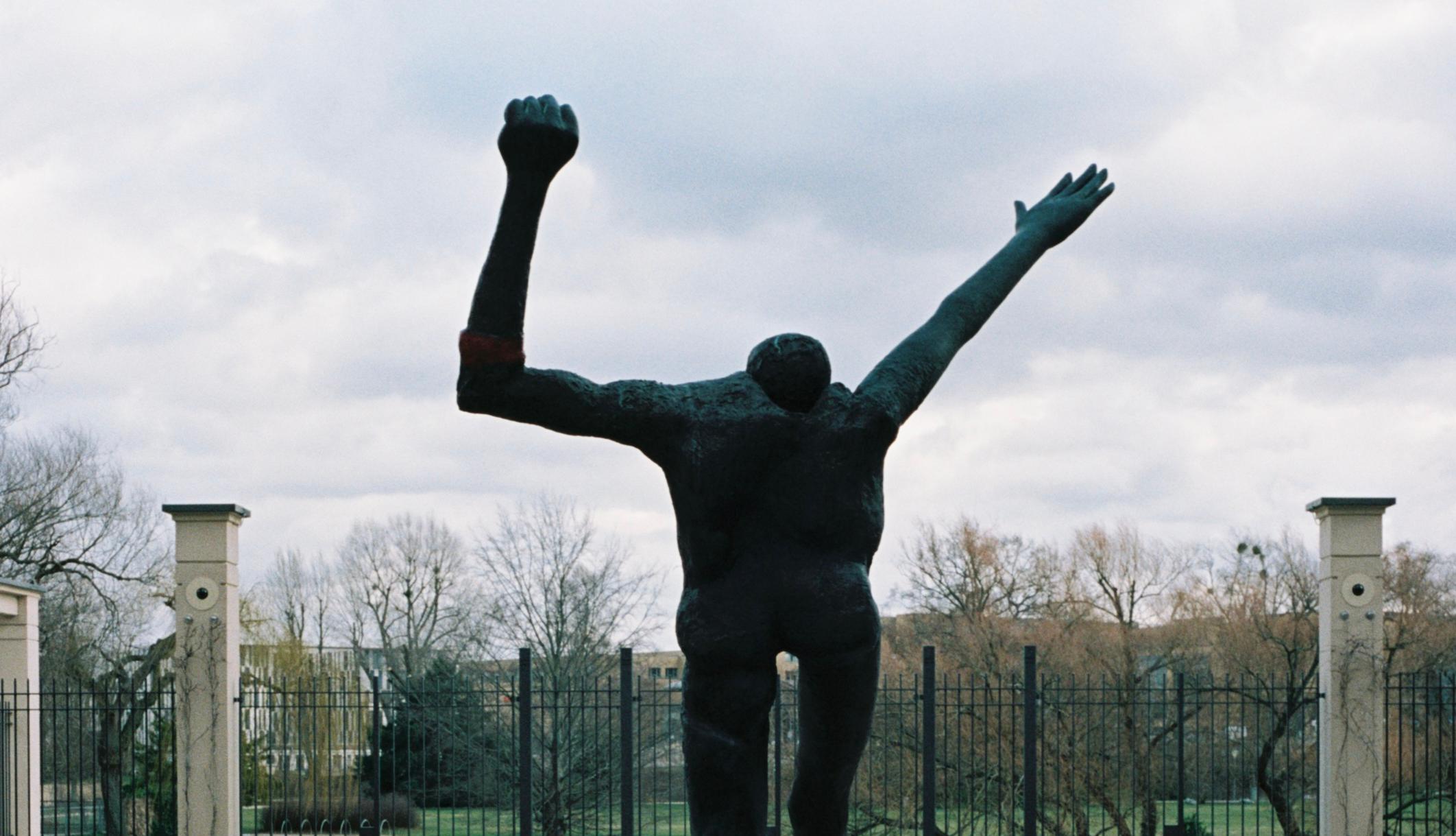
COVER PHOTO: JAKOB KAYSER
The Step of the Century (Der Jahrhundertschritt) by Wolfgang Mattheuer in the Barberini, Potsdam