





By Nina Culver Splash contributor
Ridgeline High School science teacher Krista Andrizzi-Larsen had the unique opportunity to participate in a scientific research trip to the Antarctic earlier this year and now finds herself eager to share all she learned about rising temperatures and contaminants found in Arctic waters.
She spent most of her days on the trip bundled in warm clothing, using DIY lab equipment on the boat to filter water samples for microplastics and, in one case, watching a whale swim away with an expensive scientific instrument.
The road to Antarctica was long. Andrizzi-Larsen, a science teacher for
decades, found herself unsure of her future. She even considered quitting teaching. “I honestly was struggling with the changes in public education in general after the pandemic,” she said.
She decided that she wanted to find out if she still had the spark, the love of learning that drove her to teach her students. “I applied for this pie in the sky fellowship through the University of Maine,” she said.
She was selected to join a 3-year study of climate changes in polar regions with the goal of creating environmental science curriculum. She would be working under Seth Campbell, a science professor at the University of Maine and Director of Academics and Research for the Juneau Icefield Research Program in Alaska.
In early 2025, the Federal government cut the funding for the final year of the fellowship. But Campbell said he wasn’t going to stop the work and intended to still travel to Antarctica for research. He invited Andrizzi-Larsen along.
The catch was that with the funding cut, each participant had to pay their own way. Andrizzi-Larsen said the $20,000 price tag gave her pause, but in the end she decided to take a summer job to earn extra money and also took out a loan that she’s still repaying.
“The answer is yes,” she said. “That’s a bucket list trip. I worked on a farm to earn money.”
Andrizzi-Larsen said she believes in the science and the work was still important. “The research still had to happen,” she said. “This was my way of walking the walk. This wasn’t a vacation, this was an expedition to bring back important information.”
Andrizzi-Larsen said their work only touched a fraction of Antarctica, which is almost as large as the entire United States. The research team spent most of their two weeks on the peninsula. “We traveled by ship for 14 hours a night from location to location,” she said.
There were a mix of scientists on the trip in addition to educators like Andrizzi-Larsen. The team was looking at changes in ice on land and at sea as well as the condition of ocean waters. It’s difficult to get permits to do research in Antarctica and AndrizziLarsen said the U.S. government forbade the team from bringing back any samples from land.
Rules governing research on Antarctica are strict. Researchers must stay away from penguins and only let their feet touch the ground. AndrizziLarsen accidentally violated the last rule when she slipped and fell after

stepping in penguin feces. She tore the MCL in both her knees and is still determining if she will need surgery.
“That was my souvenir that I didn’t want,” she said.
Water was checked for salinity and temperature. In testing the ocean waters, Andrizzi-Larsen said she found microplastics. “There was evidence of it in the Arctic waters of the Southern ocean,” she said. “I found them in the Strait of Magellan.”
One of the instruments used to measure water quality was a YSI, which the scientists would drop into the ocean on the end of a fishing line. All went well, until the day a whale bit down on the instrument and the line started running out rapidly. “We had to cut the line and we lost a $2,000 probe, but we didn’t want to hurt the whale,” she said.
Andrizzi-Larsen said she is often asked about reports that the Earth’s temperature has risen by one degree in the last century and whether it’s really that important. She said it is, because that single degree can determine whether precipitation falls as snow or rain.
As an example, Andrizzi-Larsen points to juvenile penguins, who are covered in downy feathers that are not supposed to get soaked. Rain instead of snow can be the difference between life and death in a climate that also includes heavy winds, she said.
“You’re soaking wet in Arctic winds,” she said. “We got to go on our ship, but the juvenile penguins are dying of hypothermia because it’s too warm.”
Andrizzi-Larsen said she was often in awe while she was in Antarctica. “The pictures don’t do it justice,” she said. “You don’t understand the enormity because it’s just so vast.”
Overall, Andrizzi-Larsen considers the trip a success. The team learned important information and she said she wants to continue working with Campbell and develop the curriculum the now cancelled fellowship was funded for. “We did some amazing science,” she said. “I definitely found



















This year, students earned state and national recognition in academics, career and technical education, leadership, athletics and the per forming ar ts. Highlights include top state honors through Washington HOSA and FBLA, and national distinction for CyberPatriots. As graduation approaches, these achievements re ec t the dedication of our students and the unwavering suppor t of our staff and families. We are incredibly proud of our 1,135 graduates in the Class of 2026— our future leaders.
Congratulations as well to our caring, committed educators and staff for helping make this an award-winning distric t with improved academics and a 94.2% graduation rate. Learn more...
The Educational Oppor tunity Projec t at Stanford University recognized C VSD as among Washington’s Distric ts on the Rise in both math and reading.
Seven C VSD schools were recently recognized by the Washington School Recognition Program for their work suppor ting students' growth and academic achievement.
McDonald Elementar y became one of four Washington schools to receive a National Distinguished Schools Award for exceptional student per formance and academic growth.
Superintendent John Parker was honored with a Rober t J. Handy Most Effec tive Administrator Award for large distric ts by the WA Association of School Administrators

Why register your sale? $20* buys you a listing in The Liberty Lake Kiwanis Annual Yard Sale Guide, as well as includes your listing in our online interactive map - helping shoppers find your sale! These fees help support Kiwanis to put on future events.

June 20th 9 am - 5 pm
Register by June 5th to ensure your listing is in the printed guide. Sales registering after June 5th will still be added to the virtual yard sale map to help shoppers find you.
Continued from page 2
the spark. Environmental science is my passion.”
She’s already worked some of what she learned into her classes. The students in her environmental science class are studying microplastics, while others want to know what makes Arctic ice sometimes look blue. She also hosted a community presentation about her trip and what she learned and is open to hosting more or speaking to community groups.
Anyone interested in hosting a presentation by Andrizzi-Larsen can contact her via email at klarsen@cvsd. org.
Q: What led you to want to become a science teacher?
A. I was always a curious student. I wanted to know why things happened or how they worked. My dad instilled that in me. My mind is always going, trying to find more efficient ways to do things or how to communicate an idea better. It's not intended to be critical in a negative way, but to help make things easier for others. My passion is to help people understand that science is in almost every part of our lives. We use the scientific method almost every day.
Q: What was your reaction when you learned you had been selected for the University of Maine fellowship?
A. I was so excited! I honestly had applied because I was questioning if I still had the passion for education. Teaching during/post pandemic has been the hardest part of my career. Society's expectation of education is different now, and we have lost some of the fundamental important life skills of actively engaging in in-person school. The same level of education can't be reached from a screen. Students actively participating in discussions, labs and activities with other students "IRL," as the kids say, is essential to development of not only academic skills, but social, life skills. Being in school is so important, not only for that individual student, but for their peers. Classroom activities and learning are delayed or altered when too many students are absent. We all learn better together!
Q: What was a typical day like on your research trip to Antarctica?
A. We would join together for a morning briefing (which could change from the plan from the night before
due to weather or seas). We would then break off into groups of 8-10 and load zodiacs from the ship to our research location on the continent. There was one day that we had to cancel a landing because the penguins had taken over the entire area! It was our responsibility to keep a safe distance from wildlife and to not impede on or affect their lives. We would return for lunch and then repeat the process for our afternoon expedition. Each evening, we would have a recap of the day's learning and tentative plans for the next day.
Q: What did you learn on your trip?
A. I learned that I still want to keep learning! It was reinforced by the amazingly talented scientists and professionals that I had the opportunity to learn that Environmental Science is the key to understanding our planet. The "big 3" (Biology, Chemistry and Physics) usually get ranked as being the "important" sciences. But Environmental Science weaves in those 3, as well as Ecology, Geology, Atmospheric Science, Hydrology/ Oceanography, Engineering, Anthropology, Economics, Political Science and Ethics. It's not just one subject. These disciplines are the pillars of sustainability. And as individual fields, if they are not all looking to work together and understand each other, sustainability cannot be reached.
Q: What one thing that your team learned on the trip do you want to pass on to people?
A. That we are only one species on this planet out of millions, which does not make us more important than any other. The Earth is a connected ecosystem. A change on one side of the planet will eventually make its way to affect everyone and everything. One of my favorite ways of thinking is to approach life as eco-centric instead of ego-centric. Asking yourself how your actions will affect others is important, whether it is emotional or ecological.
Q: Why is science important?
A. Science is important because it reminds us that we are never done learning. We should always be in the process of asking questions and learning more in every aspect of our lives. When a scientific theory evolves or is proven wrong, it means we continue to investigate at a deeper level and are passionate to understand something more accurately. It is the very foundation of scientific process.





By Nina Culver Splash Contributor
The Liberty Lake City Council had a busy month in May, finalizing several individual elements of the large-scale Comprehensive Plan update that has been in progress for nearly two years.
The first of those was the 2026 Parks, Recreation, Open Space and Trails Plan, which has been in the works for the last year. It was previously updated in 2015, said Parks and Recreation Director Jen Camp. “A lot of things have changed since then,” she said.
Camp said her staff held several meetings surrounding the update and also sought input at the Farmer’s Market and other events. “We had a lot of engagement through this process,” she said.
The number one request people made was for a pool, Camp said. “We heard that more than anything,” she said.
The updated plan calls for several short-term and long-term projects, including a feasibility study about a possible pool or community center. Replacing the playground equipment at Pavillion Park is on the short-term list of projects to be completed by 2031. Residents indicated they want playground equipment for toddlers and more swings, Camp said. “That playground is in desperate need of repair,” she said.
The short-term list also includes shade structures at Orchard Park and Pavillion Park, replacing the splash pad at Pavillion Park, planting more trees at Orchard Park and Pavillion Park and adding electrical power to the park shelters at Orchard Park.
Suggested long-term projects
include upgrading the restrooms at Pavillion Park, adding a community garden at Orchard Park, development of Town Square Park and new playground equipment and a new splash pad at Rocky Hill Park. It’s also anticipated that the city, based on rising population numbers, will need a new community park, Camp said.
Information about the city’s Sidewalk Master Plan was presented by Shareefa Abdulsalam, a project manager with SCJ Alliance. The consultants helped develop rating criteria strategies to indicate which sidewalks are in most need of repair, Abdulsalam said.
Most of the sidewalks in Liberty Lake are in good shape except for those in the older residential areas, she said. “A lot of damage to sidewalks in Liberty Lake is because of maturing tree roots,” she said.
If there is only minor displacement, sidewalks can be ground down and resurfaced. But if the buckling is more than two inches, the sidewalk has to be replaced, she said. Each potential sidewalk project was scored and 69 percent of them fell in the minor repair category. Another 22 percent were rated moderate and the final 10 percent were rated severe. The city is also missing sidewalks in some areas.
The next issue is how to pay for sidewalk repairs and additions, said Finance Director Kyle Dixon. The city council could create a targeted revenue stream, such as a utility tax, or rely on grants, he said. A neighborhood could also request the creation of a Local Improvement District (LID), but the process to create one is lengthy.
“It is not a quick fix by any means and it is reliant on neighborhoods coming forward,” Dixon said of the LID option.
Dixon said he estimates the city would need $1 million to fix the high priority sidewalks.
In other business, the council voted unanimously to approve funding recommendations from the Lodging Tax Advisory Committee. The city collects a two percent tax on nightly hotel stays in Liberty Lake, which is set aside to fund programs and activities that promote tourism in

The City of Liberty Lake is creating new logo options for city council to consider changing the design to something more vibrant and modern.
the city. Overall, eight organizations requested a total of $240,000 and the committee recommended allocating $188,000.
Councilwoman Linda Ball, who sits on the committee, said the group was happy to see so many applications this year. “We had more asks than we had money,” she said. “We did our best to be fair to everyone.”
The funding allocations include $7,350 to the Liberty Lake Police Foundation for the 2026 Cops, Cars and Cruisers event; $2,800 to the Friends of the Liberty Lake Library for the 2026 Summer Soiree; $30,000 to the HUB Sports Center for various events; $27,000 to the Liberty Lake Kiwanis for various events; $35,000 to the Liberty Lake Centennial Rotary Club for the 2026 Rotary in Motion RIM Ride; $24,000 to TAC at the Lake for the 2026 season; $57,000 to Visit Spokane for photo and video collection at the Farmer’s Market; and $5,000 to Spokane Sports for the high school state golf championship in Liberty Lake.
Councilwoman Annie Kurtz asked why Visit Spokane was recommended to receive Lodging Tax money when the group already receives money from the city. Dixon said the funding is for additional work. “This is a separate bucket of money for the Farmer’s Market and a couple other things,” he said.
In the second meeting of the month the council voted to fix an error made when assigning
city council members to new committees. They voted to remove councilwoman Summer Darrow from the Finance Committee and replace her with Kurtz.
The council also continued its discussion on updating the city’s logo. A community meeting was held in April and a community survey was done to confirm input given during the community meeting, said City Administrator Mark McAvoy. The survey generated over 300 responses.
Community feedback indicates that the logo is too confusing or busy, feels antiquated and tired, the color palette isn’t vibrant and fonts are inconsistent and hard to read. Among those who took the survey, 58 percent agreed, McAvoy said.
Residents were also asked what they wanted to see in the new logo. By number of responses, mountains came in first. However, Liberty Lake itself came in third in terms of numbers but more people ranked it as their number one choice, McAvoy said.
The council agreed to have staff create two or three conceptual designs to bring to the community to get additional feedback before the council makes a final decision.
Community Development Director Any Mullerleile presented a draft of the city’s Comprehensive Plan Update. She praised the work done by the previous Development Director, Lisa Keys, who wrote many of the goals and policies added to the document over the last two years.
“We tried to make the whole document easier,” she said.
The council voted to send the lengthy document to the Washington State Department of Commerce for the required review before final approval.
“This thing is so good,” said councilman Rick Klingler. “It certainly was a good read.”
In other business, the council also approved resurfacing the Orchard Park tennis courts, voted to allow city staff to apply for a grant for the Pavillion Park playground renovations and voted to approve the 20 year Capital Facilities Plan.


The Liberty Lake Police Department is stepping up community education efforts throughout the start of this summer on the use of golf carts, e-bikes, and motorized scooters in public areas – just before expanded enforcement of the existing regulations pertaining to those vehicles will be starting on July 1.
During the April 28 town hall that packed the Trailhead Golf building’s Rotary Room, Chief Damon Simmons and Deputy Chief Darin Morgan announced that the LLPD is boosting its efforts this spring to improve more understanding of what the regulations are.
The current awareness campaign includes a new “Micromobility Vehicles” sub-page of resources that’s now part of the LLPD’s website. There, area residents can find information about each type of vehicle, links to the state laws and
Learn about the volunteer and service organizations around the Liberty Lake community by coming to the Volunteer & Service Expo on Thursday, June 18, from 5 to 7 p.m. at the Trailhead Golf Course’s Rotary Room.
The Expo is an opportunity to visit with members of local service organizations to find out what they do for the area, how they might be able to assist in some of your own interests, and how you might be able to become the newest volunteer with a group that connects well with your own passions.
You can find the list of participating organizations on the city’s homepage at www. libertylakewa.gov.
municipal codes that regulate their use, and materials from the April 28 town hall. Additionally, new signs have begun appearing at city parks to help people know what the rules are for using motorized vehicles at those public sites.
At the town hall, Morgan said this education effort is the first of a threephase operation from the LLPD. The second phase is a current period of more proactive warnings that officers will be giving to violators to
help them understand the rules.
Then, effective July 1, violations of the safety, location, age requirement, and speed laws related to these devices may result in vehicle impounding or towing contractor fees that would need to be paid by drivers or their parents.
“The main reason for all this is that we’re just trying to make this community safe,” Morgan informed the town hall crowd.

Liberty Lake’s popular Touch A Truck event is adopting an expanded name, some additional features, an earlier month, plus a return to its original location for its 2026 edition.
This year the event is happening at Town Square Park and is being staged on Friday, June 5 – more than a month earlier from its usual appearances in recent years at Orchard Park.
Organized this time by the city’s Parks and Recreation Department, the redubbed “Touch A Truck: Wheels & Meals” will still feature its trademark attractions of service vehicles and heavy equipment machines for all ages of visitors to enjoy and explore. But, for
2026, the event is shifting into a late afternoon event, running from 3 to 7 p.m., which will better accommodate after-work schedules for families.
The Touch A Truck portion will run from 3 to 6 p.m. Food trucks will be serving customers on site from 4 to 7 p.m. – perfect for a Friday dinner outing. And live music will be performed from 5 to 7 p.m., featuring singer-songwriter and guitarist Rachel Broadhead of Spokane.

Liberty Lake’s annual Fourth of July festivities at Pavillion Park will be expanded this year to also commemorate the city’s 25th anniversary. “Founders & Fireworks” will take place from 2 to 10 p.m. that Saturday and will incorporate several popular features from the longtime Barefoot in the Park event traditionally held in August. The celebration is expected to include live music, family activities, food vendors, community entertainment, and a spectacular fireworks finale. Watch for complete event details and schedules in the July edition of The Splash.
The Liberty Lake Better Together organization will debut its new rock garden – with goat statue – at Pavillion Park on Wednesday, June 3, at 1 p.m. The public is invited to the special opening ceremony to see the debut of this addition at the park containing student-decorated rocks at the property’s northeast corner near the intersection of Molter and Country Vista Drive.





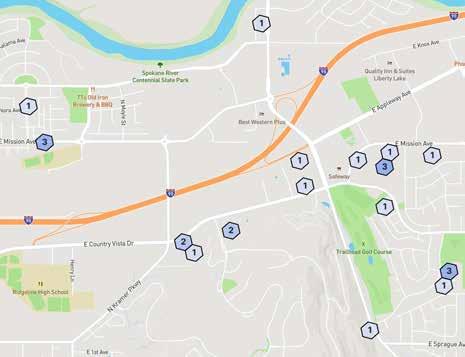
suspect, and several hundred dollars worth of personal and professional items were stolen.
• 2026-88003242: Between 3/26 and 4/18, a front license plate was stolen from a resident’s vehicle. The plate was subsequently entered into NCIC as stolen. The case is currently closed pending new information.
Splash news sources
Significant Cases BURGLARY
• 2026-88003883: On 4/20, a residential burglary occurred on E Colony Ct. The suspect was charged with DV – Possession of Stolen Property 2D after stolen property from the burglary was traced directly to him through GPS tracking, security footage, a stolen
vehicle connection, and his own text message admissions.
• 2026-88003871: On 4/20, an E-Bike valued at $2,500 was stolen from an attached garage on N Cirque Ln. An Apple AirTag on the bike led officers to a known problem address. A search warrant was obtained and executed, the bike was recovered and returned to the victim, and two individuals were arrested.
VEHICLE PROWL
• 2026-88003983: On 4/22, a vehicle prowl occurred at The Villas at Big Trout. The victim’s unlocked vehicle was entered by an unknown
• 2026-88003957: On 4/23, a surveillance camera captured an unknown male stealing a delivered package from the front porch, with a white four-door sedan potentially connected to the suspect.
• 2026-88003957: On 4/19, a surveillance camera captured an unidentified female stealing an Amazon package from a residential front porch. The suspect was partially disguised, limiting identification efforts.
• 2026-88003812: Between 4/18 and 4/19, an E-Bike was stolen from outside Big Trout Lodge. The bike’s lock was cut and taken.
ARRESTS:
LLPD made 16 arrests in April, including the individuals from the
burglaries listed above.
• 2026-88003847: On 4/19, during a suspicious person contact at E Mission Ave & N Glenbrook Rd two subjects were found to have active warrants and were taken into custody. A search incident to arrest on the male yielded presumptive fentanyl and drug paraphernalia. The female was arrested on her outstanding warrant and additionally cited for providing a false name to officers.
• 2026-88003898: On 4/21, a male subject was arrested for DVPOV after he signed a “Declaration: No Weapons to Surrender” form –falsely claiming he had no firearms – while a second undisclosed firearm was simultaneously being recovered from his apartment by officers.
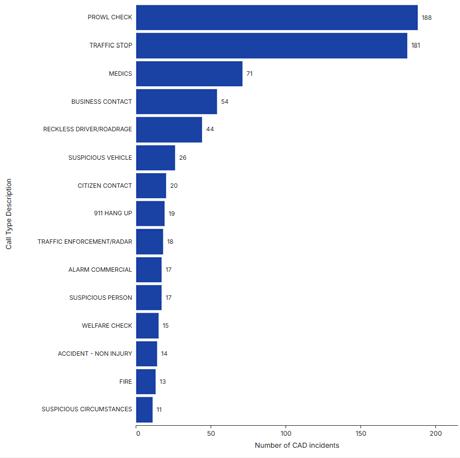
The Liberty Lake Police Department would like to remind everyone to keep your belongings secured in your homes. Items left unsecure or left inside vehicles in plain view can attract vehicle prowlers. A quick guide to the recent town hall meeting for micro-mobility is attached for reference. Stay safe and take care of each other.

























Ridgeline































Gavin



Colton


Kaycie
Birdie



Rahni



Tatum


Abby

Katelyn

Breelynn
Tearstin Adamson • Ava Alderman
• Elisa Aliu • Hunter Allen • Russell Allen •Saegan Allen • Jackson Allison
• Kailey Allison • Akayla Almquist • Keegen Altermatt • Maelia Amen • Evan Anderson • Joaquin Anderson • Saige Anderson • Sawyer Anderson • Caden Andreas • Hailee Argaw • Eric Artemenko
• Carson Atwood • Xian Au • Kaedyn
Aurand • Olivia Avery • Joel Ballinger
• Summer Barney • Chris Bashaw • Marjorie Baumgartner • Mckinley Bell
• Beatrice Beykirch • Payton Bigham • Sophia Bigner • Aidan Bjorklund • Victoria Blagikh • Svetlana Blagikh • Christopher Blake • Kyler Blanchard • Liam Bokma
• Meghan Bollinger • Kalina Bolter • Andrew Bota • Natalie Bradbury • Natalie Braesch • Ethan Braid • Andrew Branum
• Gracie Brickner • Grace Brinkmann • Grant Brito • Zachary Brockway • Teigan Bronec • Brooke Broom • Cole Brower • Dillan Brower • Ryleigh Brumwell • Ava Brunstetter • Dixie Bushman • Reagan Butler • Emma Caldwell • Quintan Call
• Kailyn Carl • John Carle • Matthias
Carpinteyro • Alexa Carpinteyro-Flores
• Jamai Carrol • Gretchyn Carter • Tj Carter • Joel Carver • Owen Carvo • Sarah Chappell • Miguel Choate • Brynlee Christensen • Rachel Christensen • Melodi Clark • Joshua Clements • Serenity Cline
• Quincy Coder • Allison Coman • Sofia Combs • Rolin Coney • Riley Connolly • Alexander Corona • Hayleigh Cromwell • Chloej Cross • Abby Crowe • Madilyn Crowley • Spencer Crowley • Caiden Crum • Tessa Currin • Sydney Davey • Josie Davis • Rory Davis • Samantha Day • Madison Devenere • Mya Donnell • Nick Duggan • Matthew Ehlers • Jayden Elledge • Toby Emmerson • Matt Enriquez
• Eleanna Faith Espiritu • Brodie Evans
• Rhett Ferguson • Jago Fernandez • Jenna Fleeman • Jakob Ford • Malia Forsyth • Jessica Fox • Nathan Fox • Emma Frankenberg • Maia Frederick • Adisen Frieling • Parker Fuhriman • Noah Garcia • Cameron Gardner • Brandon Genovese • Alaiyah Gentry • Ashiyah Germany • Eva Gertsen • Sydney Giblette • Matthew Gillespie • Ethan Gingras • Joseph Gionfriddo • Carissa Glenn • Elyssa Goldsberry • Timothy Goode • Anthony Goodwin • Pace Greenup • Nelson Gribble
• Christopher Gulin • Kaden Haddox • Adison Hamry • Chloe Hamry • Kara Hanchor • Avery Hanley • Maggie Hardesty
• Ayden Hardy • Jayden Harrington • Mylee Hatch • Tandrup Hauge • Thatcher

June 6, 2026 at 9:00 am
McCarthey Athletic Center, 801 N Cincinnati St, Spokane, WA 99258
Hemphill • Amie Henry Sutherland • Joel Hernandez • Dylan Herrera • Avery Heskett • Jackson Hieb • Carter Hill • Lola Hill • Peyton Hill • Mikayla Hill • Lance Hilton • Dylan Hively • Jacob Hosig • Ty Hudson • Jack Huettl • Joshua Hunt • William Hutyler • Morgan Hymas • Piper Irmer • Danicka Ivanovitch • Xavier Jacobo • Brody Jacobs • London Jeffries • Caitlyn Jensen • Isabella Johns • Alannah Johnson • Danielle Johnson • Jaysa Johnson • Kyler Johnson • Reily Johnson • Ella Johnston • Brendelin Jokdru • Jeshua Jolley • Shayla Jones • Trevor Jones • Addie Julian • Joseph Keller • Tyson Kelley • Joshua Kelly • Jayden Kenney • Camdon Kidd • Jace Knoll • Rhiannon Knowles • Alivia Kolve • Tate Krohn • Muskan Kumari • Elliana Lain • Scarlett Lambert • Claire Lamoreaux • Nicholas Lansford • Oleg Laptev • Jaxon Lashbrook • Mylie Lau • Ashley Lazcano • Eduardo Lealcardenas • Jayson Lejjena • Skylar Lewis • Valeria Lievano • Abigail Lind • Jade Livingston • Keoni Lizama • Juliana Lozko
• Michael Lundell • Charles Lynn • Zachary Lytle • Michael Macall • Eric Malyshevskiy • Maleena Martinez • Charlotte Mason • Hunter Mason • Ciana Masterson • Colten Masterson • Jake Mateer • Riley Mayhle • Kirsten Mcdevitt • Madalynn Mchenry • Isabella Mckenna • Piper Mckoon • Eilean Mclaurin • Alyssa Mcswain • Silas Merino • Emmalee Merker • Drae Miken • Jaden Misner • Anna Mitrofanov • Ranea Moen
• Daniel Moore • Makenna Moore • Nathan Moore • Nadia Morales • Mia Morgen • Sara Morris • Quinn Mueller • Gracie Munro • Skyla Nemitz • Morrigan Nguyen • Ethan Nielsen • Jackson Norton • Alex Nozdrin • Emmett
Nygren • Henry Nygren • Katya O’Bannan • Grace Obergh • Aspen Ocker • Elizabeth
O’Connell • Aiden Oey • Francesca Olsen • Addison O’Neil • Isabella O’Neil • Riley Owens • Ellie Paget • Summer Parks
• Payton Patrick • Mateu Peneluppi • Cristhian Perez • Natasha Perez • Ethan Persicke • Emma Phan • Olivia Phipps • Yevhen Piankovskyi • Reagan Platner • Justice Plumb • Corey Plumley • Siera Pollock • Teaghan Powell • Brody Presho • Evangeline Price • Alinah Ramos • Bryghtan Ramos • Preston Ramsey • Mckenna Rangel • Jade Rasmussen • Blaine Reeves • Jordan Renken • Drake Renzi • Karl Reynolds • Cheyenne
Richardson • Talene Rivera • Aiden Roda • Gabriela Rodriguez • Ruggy Rodvold • Abigail Role • Aubrey Root • Joshua Rose • William Rose • Kali Rothrock • Emily Rountree • Audrey Ruchert • Michaela Ruff • Ethan Ruiz • Ethan Rumpler • Jasmine Russell • Caitlin Sachtjen • Natalie Sadlowski • Maximiliano Salazar De Santiago • Abigail Savage • Lexi Schreiber • Brayden Schultz • Ella Score • Ryan Scoville • Abbygayle Seiden • Sienna Shadd • Zackary Shapland • Jonah Shelton • Byron Sherman • Brooklynn Shipka • Gracin Siegel • Haedyn Siegel • Nora Sims • Sophia Sine • David Sitton • Colton Skinner • Troy Slack • Aiden Smith • Calvin Smith • Teagan Smyth • Josephine Snyder • Ryley Snyder • Addison Spear • Landon Spinning • Keagan Spruill • Zaltana Stensgar • Anthony Sternod • Abbigail Stevens • Gina Stroot • Kennedy Stuart • Isabella Stuck • Emerson Stuhlberg • Hailee Suhl • Alina Sushkova • Emily Swavely • Makayla Sweeney • Gabriella Tamayo • Adrianna Tarver • Sierra Tate • Katelyn Taylor • Zackery Taylor • Johan Texta Rosas • Jonah Thompson • Emily Totino • Savanah Tyler • Tatum Unruh • Riley Usab • Frederick Van Amburg • Vivian Van Buren • Alexis Vanhook • Jack Vigliotta • Joseph Vigliotta • Benjamin Wartinger • Myah Weed • Christian Weimer • Kendra Wesley • Alivia Wheeler • Audrey White • David Wiberg • Asher Willmann • Austin Wilson • Ysabelle Witcher • Nolan Wohl • Quinn Wood • Colin Woodbridge • Ava Worley • Kaila Zener • Ethan Zeng
Mailee Akers • Carson Faller • Bridger Fobes • Hudson Horst • Judah Mann • Caleb Robison






By John McCallum Splash contributor


The Ridgeline boys soccer team and the girls golf team both claimed District 6 titles in competition in May. The boys defeated Walla Walla in their second appearance in the title match while the girls outstroked Mt. Spokane to win their third title in three years.
The boys golf team also came up big, placing second behind a strong Cheney team, which not only won the district championship but also a 3A state title.
The Falcons went 3-5 in their final Greater Spokane League regular season and District 6 playoff games — falling a couple wins short of a second consecutive 3A state tournament berth.
Ridgeline closed the regular season with a doubleheader sweep of last place Cheney, followed by a split of games with 4A Ferris and a doubleheader loss to ninth-ranked, GSL and District 6 champion Gonzaga Prep — a Bullpups team that was still alive in the 4A playoffs, facing a semifinals matchup with top-seed and second-ranked Richland May 29.
The finish game third-place Ridgeline (12-6) a No. 5 seed into the district tournament where they traveled to No. 4 Southridge from the Mid-Columbia Conference. The Suns held the Falcons to three hits in their 9-0 win.
Knocked into the consolation round and a battle for the third and final district seed to state, Ridgeline hosted No. 9 seed Walla Walla on May 12. Down 9-3 in the bottom of





the seventh, the Falcons scored two runs but came up short, losing 8-5 and ending their season at 12-9.
Ridgeline closed their GSL season by going 2-3 over their last five league games, earning wins against Central Valley and 4A Mead. Finishing fourth among the league's 3A schools, the Falcons received a seventh seed to districts where they opened at second-seed Kennewick.
The Lions rallied from 10-7 down with eight runs in the bottom of the fourth en route to their 15-12 win. Ridgeline was led offensively by two home runs each from Paisley Dobyns and Sadie Chavez.
In the bracket for the third and final berth to state, the Falcons faced sixth-seed Southridge, falling 9-4 to the Suns and ending their season at 11-10 overall.
Ridgeline All-GSL selections were first-team Millie Dobyns (catcher) and Ava Nevills (outfielder), second team Persais Triplet (outfielder), Aaliyah Yeldon (pitcher) and Quincy Coder (outfielder) and honorable mention Kadence Barcus (utility).
Golf
The Falcon girls captured their third straight District 6 crown while the boys placed second in competition May 12 at Downriver Golf Course in Spokane. The girls led with 730 strokes total, 27 ahead of runner-up Mt. Spokane while the boys finished with 585 strokes, 29 behind district and the eventual 3A state champion Cheney.
Both teams advanced to state competition May 19-20, with the girls playing at Deer Park Country Club while to boys competed at Indian Canyon.
Sawyer Anderson and Chloe Hamilton led the Ridgeline girls at districts, both tying for second at 176 strokes, with Morgan Quesnell tied for fourth two strokes back, Taylor Boast 12th at 192, Ellie Mulligan in a four-way tie for 13th at 194.

www.hubsportscenter.org

Liam Severs was fifth for Ridgeline boys at districts at 140, followed by Sawyer Haggerty in 10th at 146, Bryce Duer tied for 12th at 148, Jack Bafus tied for 16th at 153 and Jaxon Folkins 18th at 154.
Neither team placed in state competition as only three players made the second day cut. Haggerty and Severs were in a seven-way tie for 27th overall at 148 strokes, with Duer in a four-way tie for 42nd at 152.
Hamilton led the Falcon girls, placing in a four-way tie for 51st at 176, with Boast tied for 57th at 178 and Quesnell 59th at 179. Boast shot a new personal record 87 on day one to qualify for day two.
"Our first true building year since the school opened showed positive growth through all levels of the program which bodes well for next year and beyond,” head coach Danny White said.
Hamilton was an All-GSL second team selection.
The Falcons captured their first District 6 championship on their way to their third straight 3A state tournament appearance. Ridgeline got second-half goals from Beckam Lopez and Dylan Ferguson to down Walla Walla 2-0 in the title game — their second straight appearance in the championship match.
The Falcons finished the regular season winning three of their final four games, capturing the GSL 3A crown — third overall — and earning a top seed to districts. In the playoffs, Ridgeline edged eighth seeded North Central 1-0, and down No. 5 Mt. Spokane 4-1 to advance to the title game with the Blue Devils.
Ridgeline lost to CV 4-1 in last year’s district title game.
The Falcons magic couldn’t hold in the state tournament, however. Ridgeline received a No. 9 seed and bye into the second round on May 22, where they traveled to Mercer Island High School to face No. 8 Lakeside, where the Lions
eliminated the Falcons 1-0.
Ridgeline finished at 6-1 in the GSL, 10-3-3 overall.
The Ridgeline boys team went 3-7 in match play but finished strong by winning three of their final five matches. The Falcons placed fourth overall at District 6 competition, finishing behind Walla Walla, Southridge and district champion Central Valley.
The Falcons doubles team of Jackson Hieb and Grand Brito not only won sub-districts but also a District 6 title, defeating University’s Colton McArthur and Samuel McConnel 6-4, 4-6, 6-4.
In the state tournament at the Vancouver Tennis Center, Hieb and Brito lost their opening-round match 6-2, 6-3 to a duo from Mercer Island High School, names not available. The Falcon pair rebounded with 6-3, 6-4 win over a Mountain View High School team – advancing to Saturday competition.
“This is the farthest a Ridgeline boys tennis player has made it in the school's history,” head coach Marc Mowrer said.
In consolation bracket action Saturday, Hieb and Brito were defeated 6-3, 6-4 by a Shorecrest duo, ending their state run.
Three Ridgeline seniors made All-GSL teams: Hieb as first team, Brito second team and Owen Phillips honorable mention.
The Ridgeline girls went 6-3 in match play; finishing tied with Mt. Spokane for fourth in District 6 competition. The Falcons qualified the doubles team of Mia Longo and Stella Taylor for state, the pair losing in the district title match to Hermiston’s Aspyn Inners and Catherine Doherty, 61-6-3.
At state in Vancouver, Longo and Taylor lost their opening match 6-1, 6-0 to a Sammamish High School team. In the consolation bracket, the Falcons ended their run with a 3-6, 7-6 (7-5), 4-6 loss to Mt. Spokane’s Addy VanWert and Bella Morris.























By Ross Schneidmiller Liberty Lake Historical Society
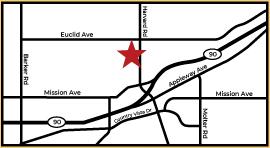
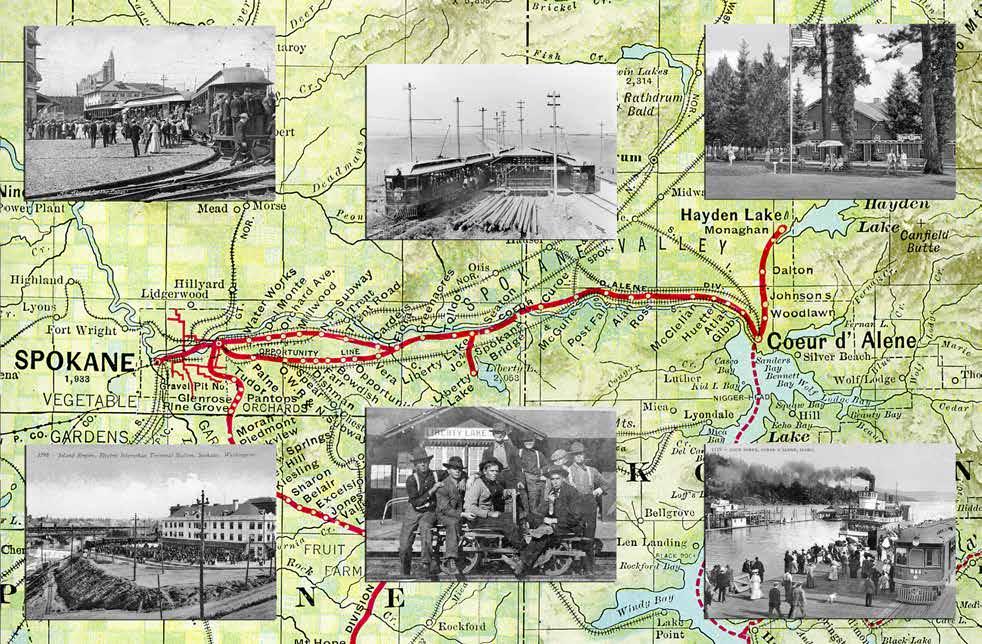
In the spring of 1904, R. G. Dennison put in a stage line from the Coeur d’Alene & Spokane Electric Railway to the MacKenzie Hotel on Liberty Lake. On weekends, Dennison would meet the trains at the station near what is now the intersection of Harvard and Mission. During the week, when stages were not at the station, there would be a team of animals ready at his barn, only a stone’s throw away, to pull the patrons to the lake.
Liberty Lake and the stage line proved so popular that first
summer, President F. A. Blackwell of the railway company decided to build a spur line into the lake. Originally it was thought that construction would begin in 1905 but plans were delayed as greater things were in store for the railway and Liberty Lake.
In February of 1906, Blackwell joined forces with J.P. Graves who was president of the Spokane Traction Line & Spokane Terminal Company. Those two companies operated 160 miles of lines in Spokane and down through the Palouse. All three companies were consolidated into the Spokane & Inland Empire Railroad Co. The Coeur d’Alene & Spokane retained its name and operated as a division after the consolidation.
Encouraged by ticket revenues from lakegoers, the company decided to build major resorts along the shores of Hayden and Liberty with rail lines to each. Tracks were
laid to Hayden Lake in 1906 and the Bozanta Tavern and Golf Links (now the Hayden Lake Country Club) were in full operation six years later.
The S&IERR continued to expand with construction work on various extensions of the system in the spring of 1907. As part of a much larger order, steel rails were purchased from the Carnegie Steel Co. of Pittsburg for the 2.3-mile spur line to Liberty Lake. Grant Smith & Co. secured the contract to prepare the rail beds and install the track. They in turn hired a group of locals known as the “Liberty Lake Dirty Eight,” who were appropriately nicknamed for performing manual labor in the community.
After completion, the officers of the railroad company made arrangements to open the Liberty Lake branch for traffic on Saturday, June 15, 1907. However, on account of the annual picnic of the
Congregationalist churches of the city, the railroad agreed to open the line a day early. Two special trains of three coaches each were arranged to journey to the lake with an estimated 600 passengers while another 400 would arrive by other means. Then the event was postponed a day because it was feared the ground would be too damp from recent rains for the comfort of the children (and our grandparents told us they walked uphill both ways). The church group only needed one special train as 11 regular trains ran each way between the city and the lake on that Opening Day!
Regular train service and special trains for large groups would become common over the 21 years that the spur line ran to the lake. By 1909, the railroad company finished the 35-acre Liberty Lake Park on the lake’s west side complete with facilities to accommodate groups in the thousands.



By Nina Culver Splash Contributor
Liberty Lake Police Chief Damon Simmons made a report to the Liberty Lake City Council during a recent meeting on the status of the automatic license plate readers in use inside city limits after the passage of Senate Bill 6002.
The new law went into effect as soon as it was signed, said Simmons, and his department has worked to make sure they’re in compliance with the new law that governs the use of the system and how long the information is retained. “We’ve taken this seriously,” he said.
The cameras, mounted on poles throughout the city, scan license plates on cars that drive past. Pictures of the car, but not the driver, used to be retained for 30 days and police officers can search the system either for a specific license plate or the make and model of the car. The system also sends out automatic alerts if a car has been reported stolen, matches a missing persons report or is associated with someone who is wanted for a serious crime.
Some departments have stopped using the system after the new law passed and Simmons said he considered whether he should keep the system or get rid of it. “We felt it was reasonable for us to give it some time,” he said. “It’s been a great tool. We didn’t want to jump the gun and just cut it off.”
Simmons said he has been coordinating closely with Flock Safety to make changes to the system as required by law. The law restricts where police departments can get the information accessed by the Flock cameras. They are allowed to use the Washington State Department of Licensing database as well as the Washington State Criminal Information Center (WASIC) database maintained by the Washington State Patrol.
For some reason, Simmons said, the National Crime Information Center (NCIC) database was left off the list of allowed databases by the state legislature. That has had the effect of extremely limiting information available to the system, which means that alerts will no longer pop up if a scanned license plate matches an out-of-state stolen vehicle or wanted criminal.
“We can still use it to search,” he said. “Right now if a stolen vehicle drives through town, we won’t get an alert because that database is not in use.”
Simmons said the Washington State Patrol is working to integrate the NCIC information into WASIC, but that process can’t move forward until the NCIC database is finished migrating to the cloud. Simmons said there is no estimate on when that will be. “There’s no timeline on that,” he said. “We’re waiting on NCIC.”
Simmons said officers can still access the NCIC database on their laptops, it just can't be used by the automated Flock system.
The new state law mandates that the Flock camera systems cannot be used for immigration enforcement, which is not a problem, Simmons said. “We didn’t have to worry about that,” he said. “We have never done that.”
The law also states that the cameras cannot be near schools, courthouses, places of worship of immigration facilities. “There’s two cameras that could violate this section and we’ve already made arrangements to move those cameras,” Simmons said.
The photos taken by the cameras can now only be kept for 21 days instead of 30. Simmons said shortening the time is not ideal because in some cases it can take up to a week for a case to be assigned and an investigation to begin. Liberty Lake also doesn’t have many detectives and if one is out for a week, it can also slow down the process.
“Our investigators have a lot of cases,” he said. “Twenty-one days, it gets a little tight.”
The Flock system can no longer be used to help investigate misdemeanor crimes, Simmons said, only gross misdemeanors and felonies. He said his officers weren’t using the system for misdemeanors very often, so he doesn’t expect that to impact investigations.
All police departments who continue to use the Flock cameras have to register their system with the Attorney General’s Office, which includes providing information about each camera and its location. Departments are also required to submit their policies regarding the use of Flock cameras and submit an annual report on the usage of the system.
Simmons said he’s prepared to meet all the requirements and already monitors usage of the system. He can see who accessed the system, when they accessed it and what they
searched for. Those using the system must also document the reason for the search and what criminal case it is connected to.
Councilwoman Annie Kurtz said she appreciated the report. “I appreciate your measured response to this,” she said.
Simmons has said previously that the Flock system, in use since 2023, has led to more than two dozen arrests and the recovery of multiple stolen vehicles. The city council approved $65,000 in funding to maintain the Flock system in January.
Before turning your system on...
1. Turn system on slowly to avoid breaks
2. Check for broken heads and leaks — a broken one can waste 25,000 gallons in six months!
3. Consider our climate:
• Spring is a rainy season (March-June)

• Water between 7p and 9a to avoid evaporative losses
• Turn o system during high winds
• Established lawns only need 1.5” per week — www.epa.gov/watersense

www.libertylake.org
www.epa.gov/watersense/outdoor/ watering_tips.html














By Senior Airman Matthew Arachikavitz
Splash news sources
For some, it’s that moment of silence before the sudden, violent roar of a jet shattering the sky. For others, it’s the unmistakable smell of jet fuel on a hot afternoon. People attend air shows for many reasons, but very few understand the massive amount of logistical work required to host an event of this magnitude.
“The scale of planning an air show is immense,” said Maj. Karianne Ernisse, SkyFest 2026 air show director. “It is akin to packing for a weekend trip, but instead of just your family, you’re packing for 100,000 people.”
If you have ever struggled to zip a heavy suitcase shut, imagine trying to pack an entire active military flight line. Instead of clothes, you are fitting in dozens of historic aircraft, food vendors, medical tents and tens of thousands of moving spectators.
The process typically begins with complex logistical requests submitted to agencies like the Secretary of the Air Force Public Affairs and the Federal Aviation Administration, with some

Members
break into localized discussion groups to coordinate targeted logistical requirements following an air show planning meeting at Fairchild Air Force Base, Washington, May 6, 2026. These planning sessions unite key personnel from across the wing to ensure seamless integration of aerial displays and ground support operations.
approvals required up to two years in advance. Even before the current air show is over, planning for the next one has already begun.
The 2026 air show directors and project officers are already coordinating the initial steps for SkyFest 2028. This forward-leaning approach ensures that when the 2028 team is eventually selected in 2027, they will inherit a solid foundation and be positioned for immediate success.
The air show director serves as the central orchestrator and interagency liaison for all planning, coordination and execution. That individual is directly supported by air and ground operation directors who oversee everything from airfield preparation, security and force protection to emergency response planning and performer management and welfare.
“If there is any way to describe the execution of this team, it is almost as if it is an orchestra,” said Capt.

Jessie Reeves, SkyFest 2026 ground operations director. “Everyone plays their own instrument, nobody else can play it but them, and the melody doesn’t sound right unless everyone plays together.”
Airmen from nearly every career field across the installation contribute to the massive effort in their own unique ways.
According to Reeves, ground operations involve a massive web of responsibilities required to support the base infrastructure. These tasks range from posturing security forces and staging medical and fire personnel to finalizing communication plans. He highlighted that the most relentless hurdle has been faced by the Geobase team at the 92nd Civil Engineer Squadron. Because the air show is a constant moving target, the Geobase team must iterate the map to the nth degree, making changes nearly every single week leading up to the event.
“Before a single aircraft arrives, our team of Airmen and civilians must be prepared to execute coordinated efforts spanning a wide range of responsibilities,” said Capt. Pablo Frias, Skyfest 2026 air operations director. “From booking performer lodging, to arranging food vendors and even partnering with local, state and federal agencies. [These steps] are vital to ensuring a safe and successful event for all participants.”
To truly grasp the scale of the event, consider the sheer volume of details that must be locked in before a single aircraft even lands.
According to Ernisse, the extensive checklist includes finalizing landing
permits, securing sponsorships, and mapping out precise parking plans. Airmen and civilian personnel must negotiate latrine contracts, coordinate the staging of medical support, and ensure lodging and rental cars are booked for everyone involved. Even the communication plans must be rigorously established, with radios ready and frequencies cleared, to safely accommodate a sudden surge of up to 120,000 guests in a single weekend.
Simultaneously, the flight line becomes a highly choreographed puzzle. Maintenance and logistics readiness Airmen manage the arrival, parking and servicing of dozens of static and performing aircraft. Every aircraft, from massive cargo planes to nimble fighter jets, requires specific fuel grades, specialized ground equipment and precise spacing. It takes tens of thousands of gallons of jet fuel and a dedicated team of transient
alert personnel working around the clock just to keep the show moving.
Even the simplest tasks are magnified. Force Support Squadron personnel must orchestrate the feeding and welfare of the performers, distinguished visitors and the hundreds of military and civilian volunteers who act as the lifeblood of the event. Every bottle of water, every vendor contract and every parking space is the result of months of meticulous calculation.
Beyond the logistics, the ultimate payoff is the connection to the public.
“Hosting an air show allows us to show gratitude to the Inland Northwest community that supports Team Fairchild day in and day out,” said Maj. Ernisse. “We couldn’t complete our mission without their help, and SkyFest is a small way we can show the community our appreciation.”















Grant Brito is a senior at Ridgeline High School whose accomplishments reflect exceptional dedication, leadership, and versatility. He has maintained a 4.0 GPA while excelling in academics, athletics, and the arts. Grant serves as drum major of the Ridgeline Regiment Marching Band and principal saxophone in Ridgeline’s Wind Ensemble, Jazz Band, and Pep Band. As varsity tennis captain, he recently won the District Championship title in doubles with partner Jackson Hieb. This year alone, Grant competed at the State level in Tennis, Knowledge Bowl, Alto Saxophone Solo, and Chess. His rigorous academic schedule included four years of zero-hour Jazz Band and 11 AP classes, earning him AP Scholar with Distinction honors. Recognized as Ridgeline’s 2026 GSL Scholar Athlete of the Year and a Liberty Lake Kiwanis Scholarship recipient, Grant plans to study mechanical engineering at Georgia Tech.

Kali Rothrock is an exceptional senior at Ridgeline High School who has combined academic excellence with an impressive commitment to athletics, leadership, and service. She has maintained a 4.0 GPA while competing in soccer, golf, basketball, and track and field. In just two track seasons, she earned GSL First Team honors, was named Jumper of the Year, and qualified for state in the 200, 400, triple jump, and long jump. Kali is also active in National Honor Society and Fellowship of Christian Athletes, while completing four years of Spanish and challenging herself through College in the High School courses. Outside of school, she volunteers at 2nd Harvest Food Bank and helps host neighborhood outdoor movie nights. After graduation, she plans to study business and marketing at Point Loma Nazarene University, possibly minor in Spanish, and compete on the school’s track and field team.

Blue Stiley is an inspiring example of resilience, creativity, and purposedriven success. From an early age, he demonstrated remarkable initiative, turning opportunities into meaningful achievements while learning valuable lessons about entrepreneurship, discipline, and perseverance. His journey has included martial arts, international study in Japan, and careers in modeling, acting, writing, and motivational speaking. Along the way, he has embraced challenges as opportunities for growth, building confidence, authenticity, and meaningful connections with others. Stiley’s message is both practical and encouraging: success does not follow a single path, and each person must discover their own journey. His story reflects the power of hard work, mentorship, and a positive mindset, while inspiring others to pursue lives filled with purpose and possibility.



EDITOR/PUBLISHER Ben Wick ben@libertylakesplash.com
CO OWNER Danica Wick danica@libertylakesplash.com
Nina Culver, John McCallum
The Liberty Lake Splash P.O. Box 363 Liberty Lake, WA 99019
Phone: 509-242-7752 www.libertylakesplash.com
The Splash is published monthly by or before the first of each month. It is distributed free of charge to every business and home in the greater Liberty Lake area. Additional copies are located at drop-off locations in Liberty Lake and Otis Orchards.
The Splash is brought to you by
Submitted materials
Publishing House
Announcements, obituaries, letters to the editor and story ideas are encouraged. Submit them in writing to editor@libertylakesplash.com. Submissions should be received by the 15th of the month for best chance of publication in the following month’s Splash.
Subscriptions
Liberty Lake residents receive a complimentary copy each month. Subscriptions for U.S. postal addresses outside of the 99019 ZIP code cost $20 for 12 issues. Send a check and subscription address to P.O. Box 363, Liberty Lake, WA 99019. Subscriptions must be received by the 15th of the month in order for the subscription to begin with the issue printed the end of that month.
Correction policy
The Splash strives for accuracy in all content. Errors should be reported immediately to 509-242-7752 or by email to editor@libertylakesplash.com. Confirmed factual errors will be corrected on this page in the issue following their discovery.
Advertising information
Display ad copy and camera-ready ads are due by 5 p.m. on the 15th of the month for the following month’s issue. Call 509-242-7752 for more information.
Advertising integrity
Inaccurate or deceptive advertising is never knowingly accepted. Complaints about advertisers should be made in writing to the Better Business Bureau and to advertise@libertylakesplash.com. The Splash is not responsible for the content of or claims made in ads. Copyright © 2024
All rights reserved. All contents of The Splash may not be reproduced without written permission of the publisher.
”Cathcart for County Auditor”
Having already endorsed Carmela Conroy for our US Representative, I shouldn’t endorse anyone else this cycle—shouldn’t attempt being kingmaker. But the Spokane County Auditor race, determining our elections administrator, is too important, especially when our state’s “top two” system can produce tricky, unintended results--the top two August Primary Election votegetters, regardless of party, advance to the November General Election,
Although I’ve often disagreed with Spokane City Council member Michael Cathcart policy-wise, as Spokane County Auditor I believe he’d have the integrity to administer completely fair and nonpartisan elections, and that’s by far what’s most important.
Most significantly, retiring Spokane County Auditor, Democrat Vicky Dalton, agrees and has endorsed Cathcart who’s filed as Republican. Dalton has administered elections with the utmost integrity for 28 years. Since 2006 she’s been the only Democrat holding countywide office in Spokane County--no other Democrat has won a countywide election in 20 years.
Bob McCaslin Jr., Republican opposing Dalton in 2022, lost by only 0.55%, and is clearly a President Trump-worshiping MAGA cult member. If he’d been elected there’d been very valid concern that elections would be rigged—in favor of MAGA candidates. Same for new Republican candidate Dale Whitaker, former Executive Director of far-right “We Believe, We Vote”, and Spokane Turning Point Church member. Clearly Whitaker is MAGA.
Democrat Dalton still “wholeheartedly” supports Cathcart (recent personal communication) after the last-minute May 6 entry into the race by Callie Gee, filing as Democrat.
Please vote Michael Cathcart for Spokane County Auditor.
Norm Luther
The Splash is committed to serving Liberty Lake through excellent community journalism. We can’t do it at all without you, our readers, and we can’t do it for long without support from our advertisers. Please thank our business partners and look to them when offering your patronage.
Our sincere appreciation to the following businesses for their foundationalpartnershipswithTheSplashanditspartnerpublications:



By John McCallum
Splash contributor
For the fourth time since 2015, the entire state of Washington has been placed under a drought declaration by the Department of Ecology.
While that might seem odd given fast flowing waterways, abundant green foliage and episodes of rain, the declaration isn’t about what you see now — but what experts see later this summer. That vision is for below normal precipitation coupled with above normal temperatures combined with a below normal, fast melting snowpack caused by the fourth warmest winter since 1895.
And while projected drought conditions will heavily impact agricultural parts of the state, local officials are concerned about consequences it will have on the Spokane River and the Spokane-Rathdrum Prairie Aquifer — the area’s sole clean water source.
“It’s a complex topic,” Amy Sumner, Spokane County Aquifer Protection Area Water Resource Manager said.
“Most of our concerns have been around the Spokane River.”
It’s the fourth consecutive year and seventh out of the past 10 that portions or all of the state have been placed under drought declaration — issued April 8 — due to deteriorating mountain snowpack conditions, projected lower than normal precipitation along with above average temperatures from May to September.
“Without enough snow in the mountains, we must prepare for widespread shortages and challenges across our state,” DOE Director Casey Sixkiller said in a news release. “Issuing a drought emergency now helps water users prepare for what is likely to be a very difficult summer.”
Gathering data, statewide conditions
People often associate drought with being “dry.” Particularly in Eastern Washington where summers are normally dry and hot.
DOE statewide drought lead Caroline Mellor said there’s more to drought than just dry.
“Drought specifically means compared to normal,” Mellor said. “Drought is defined in our state law as water supply.”
The legal threshold for drought declaration in Washington is expectations of having less than 75% of normal water supply for the forecast period and the potential this may cause undue hardship for water users and the environment. A lot of information goes into this process,

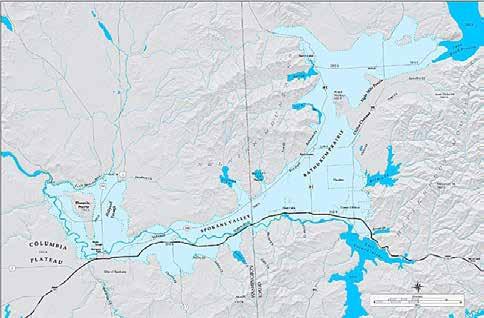
The Spokane-Rathdrum Prairie Aquifer is shown above. The aquifer encompasses roughly 370 miles and holds approximately 10 trillion gallons of water.
beginning with data collected by Natural Resources Conservation Service’s snow telemetry, or SNOTEL, stations.
According to the NRCS, “a standard SNOTEL site measures and records hourly data on snow depth, snow water equivalent, precipitation, air temperature, soil moisture, and soil temperature.”
This data is combined with other atmospheric and environmental information and used by a number of organizations including the NRCS, the National Oceanic and Atmospheric Administration and the Washington State Climate Office at the University of Washington in making drought recommendations to the state.
The SNOTEL stations provide measurements of snowpack in what is called “snow water equivalent” or SWE. SWE is water content obtained if an area’s snowpack melted instantly.
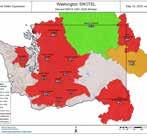
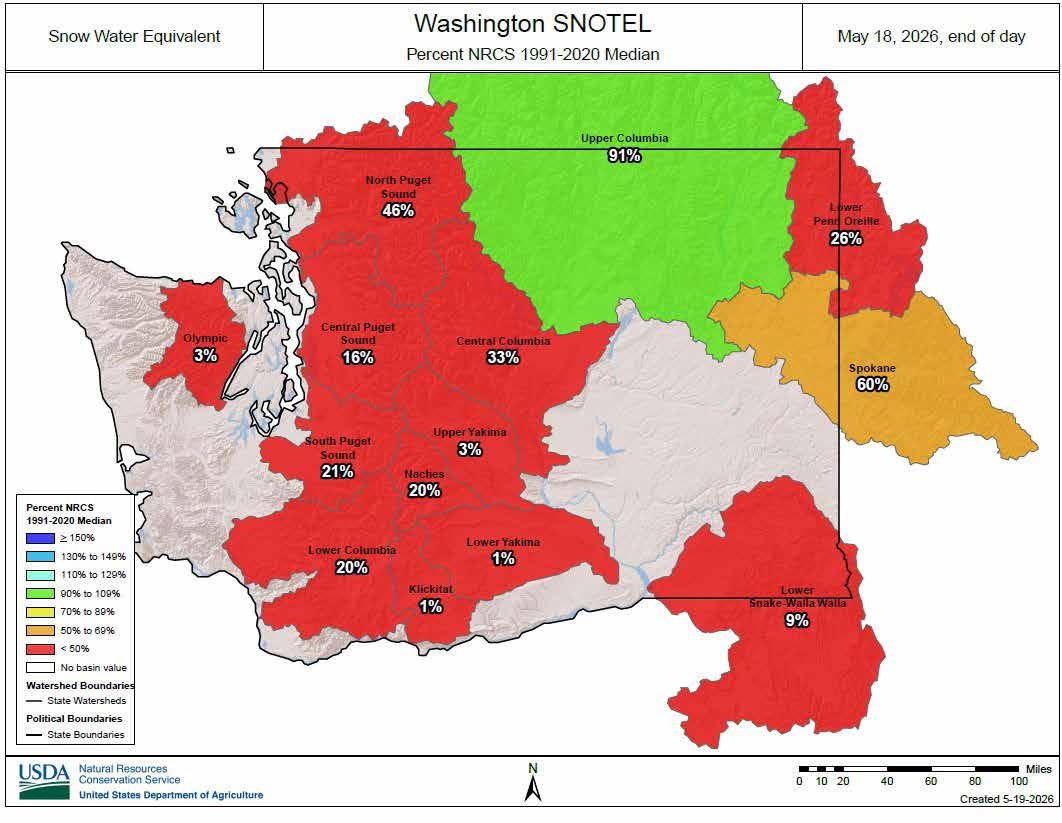
Statewide SWE measurements as of April 1 were 52% of normal — just over half where they should be this time of year. As of May 1 — the end of the normal snow accumulation season — those levels were at 42%, and in a May 21 interview, Mellor at DOE said they stood at 24%.
Nine of the 14 basins, areas fed by mountain snows, snow levels are well below normal or worse. Only three — Spokane, Upper Columbia and North Puget Sound — are at below normal.
Local snow and water levels
Of local concern are the Lower Pend
Oreille and Spokane basins, with their snowpacks contributing to water in Lake Pend Oreille and Lake Coeur d’Alene respectively. Both lakes are major sources for the Spokane-Rathdrum Aquifer, with the smaller but deeper Lake Pend Oreille holding approximately 14.3 trillion gallons of water while the larger and shallow Lake Coeur d’Alene holds approximately 738 million gallons of water.
As of May 1, snowpack levels in the Lower Pend Oreille Basin were well below normal at 49% of median, higher than April’s 45% thanks to late season snows. In the Spokane Basin, however, May levels were 50% of normal, down from 56% in April.
Lake Coeur d’Alene is also the source for the Spokane River. Sumner at Spokane County said the river accounts for about 43% of aquifer water, with regional lakes making up 30% and the balance coming from other streams and local runoff.
To that end, the state water forecast has been helped by higher than normal precipitation in the basins. Statewide precipitation was 107% of normal May 1, down 2% from April although precipitation in the Lower Pend Oreille Basin was at 98% of normal while the Spokane Basin was at 109%.
Unfortunately, most fell as rain in the mountains and since it occurred during the October to May timeframe, it runs off and is not around in the hotter months when it’s needed most. At lower levels, some precipitation percolates down into
aquifers.
A tale of two “rivers”
To understand how the drought data affects the Spokane River and the Spokane-Rathdrum Aquifer, perhaps it’s best to know how those two bodies act and interact.
According to the Washington State University Extension, the aquifer encompasses about 380 square miles and holds approximately 10 trillion gallons of water. While often described as an underground river, the aquifer is actually a collection of porous soils like sand and gravel laid down thousands of years ago as flood waters from Glacial Lake Missoula tore through the region — an episode referred to as the Ice Age Floods.
It’s estimated 650 million gallons of water flow through the aquifer daily, covering between 30-60 feet per day depending upon the soil. That water is the only source of drinking water for 90% of the populations of Spokane and Kootenai counties.
According to a 2007 water budget study done by Washington and Idaho,
about 948 cubic feet per second (cfs) of water crosses the state line into Washington daily, with the aquifer gaining an additional 429 cfs from local sources for a total of 1,377 cfs.
But there’s a catch. The study noted Washington uses 1,375 cfs of aquifer water daily.
“This means only about 2 cfs provides a buffer,” Sumner said. “Of course, this is from the 2007 model, and there is uncertainty and error, but this is clearly a reason to think about conservation now, especially given population growth and development on both sides of the state line.”
Sumner said an updated model is being completed by the city of Spokane, Spokane Aquifer Joint Board (SAJB) and Idaho Washington Aquifer Collaborative (IWAC) that will hopefully provide “a different understanding of the water budget.”
Talking to each other
There is also a connection between the Spokane River and the aquifer. The portion from Lake Coeur d’Alene to
around Barker Road in Spokane Valley is known as a “losing reach” because the aquifer level sits at about 400 feet below the surface which results in the river losing water to the aquifer.
This portion of the river in time of drought can go almost dry — or completely dry as it did last year. With lower than normal snowpacks, Sumner said they are already seeing lower river flows than at this time in 2025, leading to the river at the losing reach potentially drying up earlier.
As the aquifer flows west, it gradually rises and breaks the surface and intersects with the river around Sullivan Road, an area Sumner referred to as a “gaining reach.” From here until about Nine Mile Falls, the river and the aquifer intersect frequently.
“The Spokane River and the aquifer talk to each other a lot,” Sumner added.
Both Sumner and Ecology’s Mellor said surface waters are impacted more during droughts than groundwater, but the latter shouldn’t be taken for granted either. As surface waters slow and grow shallow they heat up, which can
impact fish and other wildlife using the waterways.
And as the surface water declines the amount seeping into the aquifer also begins to slow.
“It takes a little bit longer to see that in our groundwater than our surface water,” Sumner said.
Sumner also said groundwater monitoring indicates the aquifer levels have been stable over the past 20 years, but further study such as the one being developed through the IWAC is needed.
“That’s backwards looking,” she said of current data. “Great, but it’s not a future projection.”
The drought declaration opens up resources water purveyors and users can access to help address impacts. The declaration, which remains in effect until April 1, 2027, enables DOE to take actions such as issuing emergency water permits, temporarily approve transfers of water rights as long as those rights are in the same water shed or basin and provide funding to public entities “to help alleviate drought hardships.”
DOE is making $3 million available for the latter via emergency response grants. Mellor said a 50% match is required for a grant application and funding must be specifically used for impacts caused by the drought.
If conditions worsen, water use restrictions could be imposed, something DOE nor Spokane County is involved in.
“Water use reductions are made at the local level by the water provider,” Mellor added.
Sumner said the best way to address water supply is through conservation, especially during the summer when usage jumps almost 400%. Installing more efficient sprinkler heads, irrigating during cooler periods of the day and understanding how much water specific soils require are some steps people can take.
Some larger water users are already looking at such measures.
“Currently, we’re evaluating our irrigation control system to ensure we are following best practices to conserve water this year as we maintain roadside swales, numerous roadside grassy areas and parks,” Spokane Valley Communications Manager Jill Smith said in an email.
“People are starting to understand there are impacts,” Sumner said about preserving water supply.