We are a collaborative of local artists from the IE, seeking to bring visibility to issues in our community that often go unseen. We hope to encourage more conversations surrounding topics at the intersection of the environment, labor, and social justice.
El Espacio Un espacio entre nosotros. Un espacio para todos nosotros. Fall 2023
A space between us. A space for all of us.
Somos una colaboración de artistas locales de IE, que busca dar visibilidad a los problemas de nuestra comunidad que a menudo pasan desapercibidos. Esperamos animar a más conversaciones sobre temas en la intersección del medio ambiente, el trabajo y justicia social.
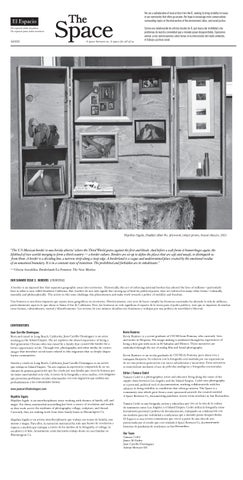
Hipólito Sigala, Daddy’s Alter #1, plywood, inkjet prints, found objects, 2021
“The U.S-Mexican border ‘es una herida abierta’ where the Third World grates against the first and bleeds. And before a scab forms it hemorrhages again, the lifeblood of two worlds merging to form a third country — a border culture. Borders are set up to define the places that are safe and unsafe, to distinguish us from them. A border is a dividing line, a narrow strip along a steep edge. A borderland is a vague and undetermined place created by the emotional residue of an unnatural boundary. It is in a constant state of transition. The prohibited and forbidden are its inhabitants.”
—Gloria Anzaldúa, Borderlands/La Frontera: The New Mestiza OUR SUMMER ISSUE 3. BORDERS | FRONTERAS A border is an imposed line that separates geographic areas into territories. Historically, this act of enforcing national borders has altered the lives of millions—particularly here in what is now called Southern California. But, borders do not only signify the carving up of land for political power, they are enforced in many other forms—culturally, mentally, and philosophically. The artists in this issue challenge this phenomenon and make work towards a politic of mobility and freedom. Una frontera es una línea impuesta que separa áreas geográficas en territorios. Históricamente, este acto de hacer cumplir las fronteras nacionales ha alterado la vida de millones, particularmente aquí en lo que ahora se llama el Sur de California. Pero, las fronteras no solo significan el reparto de la tierra para el poder político, sino que se imponen de muchas otras formas, culturalmente, mental y filosóficamente. Los artistas de este número desafían este fenómeno y trabajan por una política de movilidad y libertad.
CONTRIBUTORS Juan Carrillo-Dominguez
Kevin Ramirez
Born and raised in Long Beach, California, Juan Carrillo-Dominguez is an artist working in the Inland Empire. His art explores the shared experience of being a first-generation Chicano who was raised by a family that crossed the border for a better opportunity in life. Through text, photography, and other media, he creates images that introduce social issues related to this migration that so deeply shapes Latinx communities.
Kevin Ramirez is a recent graduate of CSUSB from Pomona, who currently lives and works in Hesperia. His image-making is mediated through his experiences of being a first gen with roots in El Salvador and Mexico. These narratives are embodied through the use of analog film and found photographs.
Nacido y criado en Long Beach, California, Juan Carrillo-Domínguez es un artista que trabaja en Inland Empire. “Su arte explora la experiencia compartida de ser un chicano de primera generación que fue criado por una familia que cruzó la frontera por un mejor oportunidad en la vida. A través de la fotografía y otros medios, crea imágenes que presentan problemas sociales relacionados con esta migración que moldea tan profundamente a las comunidades latinas.
www.juancarrillodominguez.com Hipólito Sigala Hipólito Sigala is an interdisciplinary artist working with themes of family, self, and magic. For them, matriarchal storytelling has been a source of revelation and wealth as they work across the mediums of photography, collage, sculpture, and thread. Currently, they are making work from their family home in Bloomington Ca. Hipólito Sigala es un artista interdisciplinario que trabaja con temas de familia, uno mismo y magia. Para ellos, la narración matriarcal ha sido una fuente de revelación y riqueza a medida que trabajan a través de los medios de la fotografía, el collage, la escultura y el hilo. Actualmente están haciendo trabajo desde su casa familiar en Bloomington Ca.
Kevin Ramirez es un recién graduado de CSUSB de Pomona, pero ahora vive y trabajaen Hesperia. Su relación con la fotografía está mediada por sus experiencias de ser una primera generación con raíces salvadoreñas y mexicanas. Estas narrativas se materializan mediante el uso de películas analógicas y fotografías encontradas.
Editor | Tamara Cedré Tamara Cedré is a photographer, artist and educator living along the route of the supply chain between Los Angeles and the Inland Empire. Cedré uses photography as a personal, political tool of documentation, working collaboratively with her subjects to bring visibility to conditions that often go unseen. The Space is a community zine which grew from a state sponsored artwork she created entitled A Space Between Us, documenting pandemic stories from residents in San Bernardino. Tamara Cedré es una fotógrafa, artista y educadora que vive en la ruta de la cadena de suministro entre Los Ángeles y el Inland Empire. Cedré utiliza la fotografía como herramienta personal y política de documentación, trabajando en colaboración con sus modelos para dar visibilidad a condiciones que a menudo pasan desapercibidas. El Espacio es una revista comunitaria que creció a partir de una obra de arte patrocinada por el estado que creó titulada A Space Between Us, documentando historias de pandemia de residentes en San Bernardino.
Our Team Tamara Cedré James M Dailey Juan Carrillo-Dominguez Adrian Metoyer III
Juan Carrillo-Dominguez, Love Letters, 1994
Juan Carrillo-Dominguez, From Zacatecas to Long Beach, Photographs of my father aged 21-23
JUAN CARRILLO-DOMINGUEZ LOVE LETTERS | CARTAS DE AMOR These are postcards that my father sent my mother while he was working in the States and she was still living in Zacatecas. It intrigued me how the depiction of this pristine landscape in Idaho was “preserved” by uprooting indigenous peoples from their land, but now was being visited by my father, after having to leave his home. He frequently visited friends and family in Idaho who had also immigrated, most of whom were field laborers, before settling in Long Beach. My father has always associated land with potential, belonging, and sustainability. But, this cross-border communication, these love letters sent by mail, say so much about his 1600-mile migration to California; to where and who he is now. He has sacrificed so much. Estas son postales que mi padre le envió a mi madre mientras él trabajaba en los estados y ella aún vivía en Zacatecas. Me intrigaba cómo se “preservaba” la representación de este paisaje natural en Idaho al desarraigar a los indígenas de su tierra, pero ahora estaba recibiendo la visita de mi padre, después de tener que dejar su hogar. Con frecuencia visitaba a amigos y familiares en Idaho que también habían emigrado, la mayoría de los cuales eran trabajadores agrícolas, antes de establecerse en Long Beach. Mi padre siempre ha asociado la tierra con el potencial, la pertenencia y la sostenibilidad. Pero, esta comunicación transfronteriza, estas cartas de amor enviadas por correo, dicen mucho sobre su migración de 1,600 millas a California; dónde y quién es él ahora. Ha sacrificado tanto.
Juan Carrillo-Dominguez, Scars from my father’s fall, A Knee Full of Screws and Staples, 2022
Juan Carrillo-Dominguez, My father’s first job as a landscaper in this country, Recovering from Knee Surgery, 1992
Juan Carrillo-Dominguez, My Father’s Welcome & Naturalization, 2000
Kevin Ramirez, Alcanzar, analog photographs, 2022
Hipólito Sigala, El Valle de Sombre de Muerta, photographic collage, 2021
La frontera me sigue, Siempre está cerca de mí. Mis padres lo cruzaron, Pero siempre está allí. Oportunidades son pocas, Pero vamos a sobrevivir. En Estados Unidos Somos libres según en este país, Pero la frontera me sigue Y no me siento feliz. Ilegales, inmigrantes, indocumentados. Son nombres que nos ponen Dentro la misma tierra Que pertenecía a mis antepasados. Que fue robada, Por los mismos que pusieron la frontera. La misma frontera. Que siempre me sigue a mí. The border follows me It is always near me. My parents crossed it, But it is always there. Opportunities are few But we will survive. In the United States We are free supposedly in this country, But the border follows me And I don’t feel happy. Illegal, immigrant, undocumented. The Areborder me names theyfollows give us It is always me. within the same near land My parents crossed it, Which belonged But is always there. toit my ancestors. that was stolen Opportunities few By the sameare ones But whoweput thewillborder. survive. In the sameUnited The border. States We areThat free always supposedly in this follows me. country, But the siempre border follows me Que me sigue a mí. And I don’t feel happy. Illegal, immigrant, undocumented. Are names they give us within the same land Which belonged to my ancestors. that was stolen By the same ones who put the border. The same border. That always follows me. Que siempre me sigue a mí.
THE BORDER LA FRONTERA by Juan Carrillo-Dominguez
We are a collaborative of local artists from the IE, seeking to bring visibility to issues in our community that often go unseen. We hope to encourage more conversations surrounding topics at the intersection of the environment, labor, and social justice.
El Espacio Un espacio entre nosotros. Un espacio para todos nosotros. Fall 2023
A space between us. A space for all of us.
Somos una colaboración de artistas locales de IE, que busca dar visibilidad a los problemas de nuestra comunidad que a menudo pasan desapercibidos. Esperamos animar a más conversaciones sobre temas en la intersección del medio ambiente, el trabajo y justicia social.
A HARVEST OF EMPIRE UNA COSECHA DE IMPERIO “By 2050, a majority of Americans will no longer trace their ancestry to Europe, one-third will trace their ancestry to Latin America. U.S. economic and political domination over Latin America has always been—and continues to be—the underlying reason for the massive Latino presence here. Quite simply, our vast Latino population is the unintended harvest of the U.S. empire.” “Para 2050, la mayoría de la gente ya no hará un seguimiento de su ascendencia a Europa, yun tercero rastreará su ascendencia a Latinoamérica. El dominio económico y político de los Estados Unidos sobre Latinoamérica siempre ha sido, y continúa siendo, la razón subyacente de la presencia masiva de latinos aquí. Sencillamente, nuestra vasta población latina es la cosecha no intencionada de imperio americano”.
An Image of Juan’s warehouse ID badge
An image of Juan’s father’s warehiouse ID
—Juan Gonzalez, Harvest of Empire
CONTINUE THE CONVERSATION CONTINUAR LA CONVERSACIÓN Read through this year’s issues surrounding the theme of land by visiting our website. Lea los números de este año relacionados con el tema de la tierra visitando nuestro sitio web.
An image of Juan’s grandfather’s Bracero ID
Visit us on the web to continue the conversation at www.thespacezine.com Visítenos en la web para continuar la conversación en www.thespacezine.com
FROM THE ARCHIVE | DEL ARCHIVO Research suggests that the new fieldwork is warehouse work with 80% of Latinx laborers making up the logistics workforce in Southern California— many of whom are immigrants.* 86% of logistics workers in Riverside and San Bernardino counties earn less than the basic living wage, making the supply chain not only environmentally detrimental to the frontline communities in its vicinity but also the quality of life for its workers.*
Las investigaciones sugieren que el nuevo trabajo de campo es el trabajo de almacén con el 80 % de los trabajadores latinos que componen la fuerza laboral de logística en el sur de California, muchos de los cuales son inmigrantes.* El 86 % de los trabajadores de logística en los condados de Riverside y San Bernardino ganan menos de lo básico. Salarios, haciendo que la cadena de suministro no solo sea dañina para el medio ambiente para las comunidades de primera línea en sus cercanías, sino también para la calidad de vida de sus trabajadores.*
Warehouse Workers Research Center www.warehouseworkers.org
Inland Coalition for Immigrant Justice www.ic4ij.org
Califronia Immigration Youth Justice Alliance www.ciyja.org
WWRC organizes groups of workers standing for living wages, safe workplaces, secure employment, and strong communities. In solidarity with unions, in partnership with the immigrant rights movement, aligned with efforts for criminal justice and the principles of environmental justice, we bring workers together to develop new and effective strategies for organizing in the strategic nodes of the supply chain.
ICIJ is composed of over 35 organizations that serve the immigrant community in the Inland Empire. The ICIJ coalition engages in policy advocacy, community organizing, and education, and rapid response to ICE and border patrol operations. We are collectively changing the narrative of the one million immigrants who live, thrive, and are a foundational part of the fabric of the IE.
CIYJA creates a space for intersectional, system-impacted undocumented and refugee immigrant youth across California with an emphasis on underserved QTBIPOC communities.
WWRC organiza grupos de trabajadores que abogan por salarios dignos, lugares de trabajo seguros, empleo seguro y comunidades fuertes. En solidaridad con los sindicatos, en colaboración con los derechos de los inmigrantes movimiento, alineado con los esfuerzos de justicia penal y los principios de justicia ambiental, reunimos a los trabajadores para desarrollar nuevos y estrategias de organización efectivas en los nodos estratégicos de la cadena de suministro.
ICIJ está compuesto por más de 35 organizaciones que sirven a la comunidad inmigrante en Inland Empire. La coalición IC4IJ se dedica a la promoción de políticas, la organización y educación comunitarias, y la respuesta rápida a las operaciones de ICE y de la patrulla fronteriza. - “Estamos cambiando colectivamente el narrativa del millón de inmigrantes que viven, prosperan y son una parte fundamental de la tejido de la IE.”
CIYJA crea un espacio para jóvenes inmigrantes indocumentados y refugiados interseccionales afectados por el sistema en todo California con énfasis en QTBIPOC desatendidos comunidades.
*Allen, Nicholas. 2010. “Exploring the Inland Empire: Life, Work, and Injustice in Southern California’s Retail Fortress.” New Labor Forum 19(2): 36-43. Retrieved October 15, 2012. Allen 2010: 40. *According to a 2019 report released by Economic Roundtable, a Los Angeles-based nonprofit.