h
Collegedale News 5
Sports 7
Opinion 8
Religion 8
Lifestyle 9
The Southern Accent Update of the Week, page 4 Student voting participation at Southern
Volume 82 Issue 7
The Student Voice Since 1929
Pressing Issue, page 2 Students raise concern amid national conversation regarding Title IX
October 29, 2026
Collegedale, Tennessee
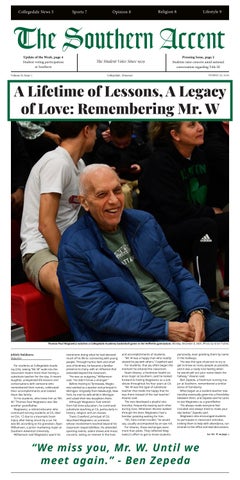
A Lifetime of Lessons, A Legacy of Love: Remembering Mr. W
Thomas Paul Wagtowicz watches a Collegedale Academy basketball game in the Hefferlin gymnasium. Monday, December 8, 2025. (Photo by Grant Tuttle).
Jehiely Balabarca Reporter For students at Collegedale Academy (CA), seeing “Mr. W” walk into the classroom meant more than having a substitute teacher for the day. It meant laughter, unexpected life lessons and conversations with someone who remembered their names, celebrated their accomplishments and treated them like family. To his students, who knew him as “Mr. W,” Thomas Paul Wagtowicz was like another grandfather. Wagtowicz, a retired educator who continued serving students at CA, died on Oct. 12 due to a traumatic brain injury after being struck by a car. He was 84, according to his grandson, Ryan Williamson, a junior marketing major at Southern Adventist University. Williamson said Wagtowicz spent his
retirement doing what he had devoted much of his life to: connecting with young people. Through humor, faith and small acts of kindness, he became a familiar presence to many, with an influence that extended beyond the classroom. “He was so outgoing,” Williamson said. “He didn't know a stranger.” Before moving to Tennessee, Wagtowicz worked as a teacher and principal in Michigan. Originally from Newburgh, New York, he met his wife while in Michigan and raised their two daughters there. Although Wagtowicz had retired from full-time education, he continued substitute teaching at CA, particularly in history, religion and art classes. Travis Crawford, principal of CA, described Wagtowicz as someone whose involvement reached beyond his classroom responsibilities. He attended sporting events, talent shows and music concerts, taking an interest in the lives
and accomplishments of students. “Mr. W was a happy man who readily shared his joy with others,” Crawford said. For students, that joy often began the moment he entered the classroom. Noah Alvarez, a freshman health science major at Southern, said he looked forward to having Wagtowicz as a substitute throughout his four years at CA. “Mr. W was the type of substitute teacher that made me happy that he was there instead of the real teacher,” Alvarez said. The two developed a playful relationship, frequently teasing each other during class. Whenever Alvarez walked through the door, Wagtowicz had a familiar greeting waiting for him. “Oh, here comes trouble,” he would say, usually accompanied by an eye roll. For Alvarez, those exchanges were more than jokes. They reflected Wagtowicz's effort to get to know students
personally, even greeting them by name in the hallways. “He was the type of person to try to get to know as many people as possible, and it was a really nice feeling when he would yell out your name down the hallway,” Alvarez said. Ben Zepeda, a freshman nursing major at Southern, remembered a similar sense of familiarity. What began as a student-teacher relationship eventually grew into a friendship between them, and Zepeda said he came to see Wagtowicz as a grandfather. “He always made everyone feel included and always tried to make your day better,” Zepeda said. Wagtowicz also encouraged students to participate in classroom activities, inviting them to help with attendance, run errands to the office and lead discussions.
“We miss you, Mr. W. Until we meet again.” - Ben Zepeda
See Mr. W on page 3
If you would like to be a contributor, contact Chloe Smith at chloegsmith@southern.edu
2 | Thursday, October 29, 2026
NEWS
Southern students raise concerns amid national Title IX conversation Chloe Smith Editor-in-Chief Julie Herter Copy Editor Kyla Wetmore Collegedale Editor An alleged gang rape of a female student at Cornell University has sparked national outrage, leading to renewed scrutiny of Title IX programs on college campuses. The backlash has also been seen at Southern Adventist University, with students expressing concerns about the Title IX program, particularly some female students who are uncomfortable with cases being reviewed and decided by a man. A recent incident involving the Title IX coordinator’s personal Instagram account has also caused a stir online. What is Title IX? According to the U.S Department of Education and Southern’s official Title IX policy, Title IX is a federal law passed in 1972 that prohibits sex discrimination in education programs and addresses sexual harassment and violence along with other forms of sex-based discrimination. “[Title IX] addresses gender-based discrimination and sexual violence (whether student to student, student to employee, or employee to employee),” Southern's policy states. “Sexual violence includes attempted or completed rape or sexual assault, as well as sexual harassment, stalking, voyeurism, exhibitionism, verbal or physical sexuality-based
threats or abuse and intimate partner violence.” According to Southern’s current Sexual Assault and Title IX Policy, sexual harassment can be reported by anyone, at any time, to the Title IX coordinator by email, phone, online form, mail or in person at the Title IX office during business hours. Southern receives close to 50 Title IX reports a year, according to Dennis Negrón, vice president of Student Development and Title IX coordinator. Cornell University On Sept. 18, The Cornell Daily Sun, a student-run newspaper, released an article regarding a lawsuit over an alleged gang rape. On October 28, a second article revealed the defendants' punishments after Cornell’s Title IX procedures determined that two of the seven defendants sexually assaulted Jane Doe. “Two defendants were expelled, two defendants were suspended and issued disciplinary probation, one defendant was issued a persona non grata, and two defendants were issued no-contact orders, ‘educational modules,’ and ‘reflection papers,’” the article stated. According to Cornell’s Procedures for Resolution of Reports Against Students Under Cornell University Policy 6.4 for Acts of Sexual and Related Misconduct, the university collects information from respondents and complainants, can conduct hearings using three-person decision-making panels and decides cases based on whether the action was more likely than not to have happened—a similar procedure to Southern’s. “I won't say that something
like what happened at Cornell wouldn't happen here,” Negrón said, “but in the history during the time that I've been Title IX coordinator, I don't see that that would ever happen.” Negrón recognized the complexities of Title IX cases. “There’s always going to be somebody that’s not happy,” Negrón said. “Whether it's the respondent who's not happy about being found responsible for violating, or the complainant as a result of the respondent not being found responsible.” How Southern Processes Title IX Cases Negrón discussed in an interview with the Accent how Southern handles reports of sexual harassment and misconduct under the university’s Title IX policy. He said he helped write the policy after becoming vice president for Student Development around 2014. “We had a lawyer look at the policy that I wrote, and they made some recommended changes to it, and we've had a Title IX coordinator since then,” said Negrón. Negrón said he became Title IX coordinator in 2020, with two coordinators preceding him since 2014. Southern also has three Title IX deputy coordinators for student-related cases: Joey Tolbert, Lunelle Bertresse and Renita Moore. Brenda Flores-Lopez serves as a deputy coordinator for employee-related cases. If the deputy coordinators are notified of a report of sexual harassment, they report the case to the Title IX coordinator. Employees of Southern, including student leaders,
are required to file a report if they hear an allegation of sexual harassment or assault, according to Southern’s Sexual Assault and Title IX Policy. Some leadership roles in the Office of Ministry and Missions, mental health counselors and on-campus medical providers are considered confidential employees, meaning reports made to them are not shared with the Title IX coordinator without the complainant's permission, according to the sexual assault and Title IX policy. Tolbert, facilities manager for Student Development, described what happens after someone fills out a report. “When you are filling out a report, [it’s] sent in to the Title IX coordinator, which is Dr. Negrón,” Tolbert said. Then, Negrón decides which of the four Title IX deputies will complete an intake with the complainant, according to Tolbert. Negrón said the deputy contacts both the complainant, the person who says they experienced the alleged conduct, and the respondent, the person accused of the conduct. Tolbert explained how she approaches interviews. “I just listen, and I take the notes, and I tell them I am like Switzerland, like I am not taking a side on this,” she said. After the interviews, the reports are sent back to Negrón for review, and he determines whether the allegations rise to a potential violation of Title IX, Negrón explained in an interview. “I have four female [deputies], primarily because both men and women tend to be more comfortable talking to females,” he said. “And 95% of
Stigma around Title IX male complainant cases According to Dennis Negrón, vice president of Student Development and Title IX coordinator, men often find it difficult to report to Title IX. “There is a stigma with men reporting,” said Negrón. “This is a national portrait, and whether or not it's true of Southern, I would assume so, but men are less likely to report because it's difficult for a significant number of men to admit that they are victims of sexual assault or sexual harassment. Men tend to be more secretive about that sort of objectionable activity, and it’s basically what they’ve been taught.” In an interview with the Accent, a male Title IX complainant described his experience at Southern. “There was a case that happened where it wasn't really taken seriously,” he said. “It was misconduct, stalking [and] things that were very inappropriate.” According to the complainant,
the case did not go to a hearing, and a no-contact order was put in place. “I went to the deputy [and] I told her everything,” he said. “The deputy has to give all of the cases to Negron, and it wasn't taken to the level of, ‘We should probably do something.’ It was just a no-contact order and not something bigger.... And then that was basically it and it never really got brought back up.” The complainant said he hoped there would be a follow-up. “I have gotten no emails,” he said. “There hasn't been any notice or email at all.” Following the outcome, the complainant reflected on how his gender affected the case. “There have been some instances that people have come up to me and been like, ‘If it was the other way around, then he would have cared because it feels like the men are not heard,’” he said. “It certainly can feel that way
Southern Accent
The Accent encourages readers to write articles and voice their opinions. However, the views expressed do not necessarily reflect the opinions of the Accent, the Southern Adventist University or the Seventh-day Adventist Church. For any questions, comments and article submission information, email the editor at chloegsmith@southern.edu For all advertising inquiries, email alvajohnson@southern.edu.
at times, to where the side of the woman is heard before the man, or it's not treated as serious because it's a man who's saying that it's affecting them.” Negrón responded to the complainant’s comments. “If anyone ever feels less than because of the way we handled their case, then I would be extremely apologetic in that situation, because one of the things that we strive to do is make every person who brings in a case feel important, and that we are taking them seriously,” he said. “So, the first thing I would say to that that student, is, ‘I'm sorry that our actions made you feel as though your case as a male was less important than a report from a female. Our goal is always to treat every case importantly and give it its due diligence.’” The complainant said he hopes bringing attention to this stigma can help create change. “I just hope that through
Editor-in-Chief Chloe Smith
Lifestyle Editor Maddie Schmidt
Managing Editor Sienna Escobar
Sports Editor Ava-Caroline Schmidt
Assistant Managing Editor Gabrielle Young
Opinion Editor Leif Bromme
Photo Editor Katie McConnell
Circulation Manager Ian Francis
Social Media Management Gianelli Banuchi Jenna Fortune
Layout Manager Nyah Jackson
[this conversation], guys won't be afraid to speak up about it because it's a big thing,” he said. “Through this, I have felt that my struggles don't really matter as much because it wasn't treated as something that mattered. But I feel as though if it's something as serious as Title IX, it should be heard because everyone has a voice.” The complainant encouraged others going through similar situations to keep pushing. “Don't think that what you are going through is less than just because they said it's not, because it's valid what you feel [and] it's valid that you're talking about it, because it was something serious that you had to go to them in the first place.” The Accent tried to find a wide variety of student perspectives but was unable to interview complainants of other cases due to privacy.
national cases are male-on-female assaults.” Negrón explained that if students wish to speak with a male, he will step in. He said after an investigation is complete, a case may proceed to an informal resolution or a hearing, based on his evaluation of the case. The option for an informal resolution occurs before it has been decided if a student has violated Title IX policies. “Before the hearing, I can tell if it looks like the two parties would like to try to resolve this without going to a hearing,” he said. Negrón explained the process of an informal resolution. “Basically, I sit down with each party separately and say, ‘How do you hope to resolve this issue?’” Negrón said. “Sometimes I'll have a complainant say, ‘I would like for this person to just be suspended for a period of time, and then I'll be happy, and then just to leave me alone for the rest of the time that I'm here.’” If no agreed-upon resolution is reached, the case goes to a hearing. “In the hearing [conducted] over Zoom, each party has to have an advisor, and that advisor actually is involved in the cross-examination, so the complainant cannot talk to the respondent,” Negrón said. The complainant’s advisor asks the respondent questions, and the respondent's advisor asks the complainant questions. Three Southern employees serve as decision-makers on the hearing panel. Negrón explained how the individuals are chosen. “There are eight employees who are doing staggered 2-year terms,” he stated. “Every year, four go off and four come on.” According to Negrón, all employees are eligible to be decision-makers, with his responsibility being to appoint a diverse group. “If a case goes to a hearing, the parties are shown the eight names and asked if they know any of them [and] in what capacity,” he said. “If there are no conflicts of interest, I choose the three on the panel based on experience and numbers of cases recently involved in.” According to the Sexual Assault and Title IX Policy, section 6.4.2, the decision-makers must not include the Title IX Coordinator or investigator and should be trained and impartial. They determine whether the actions discussed meet Southern’s standard of proof after listening to the case and asking questions, according to Negrón. “In a criminal court, they have to prove things beyond any doubt,” Negrón said. “For us, [the standard is], did it more likely than not happen, which is the civil court standard of proof.” According to Negrón, this standard is called the preponderance of the evidence and is used by See Title IX on page 3
Web Management Eri Jorge Jeziel Gomez Reporters Jehiely Balabarca Rebecca Walwyn Lydia Campbell Lillie Domenech Madeleine Miyashiro Collegedale Editor Kyla Wetmore Collegedale Managing Editor Asher LeVos
Collegedale Layout Manager Malcolm Maynes Copy Editors Julie Herter Lauren Sahly Hadassah Nazarenus Layout Designers Katherine Damian Flores Jewell Hewitt Staff Sponsor Alva James-Johnson
3 | Thursday, October 29, 2026
For more related news, visit our website at southern-accent.org
NEWS Mr. W Continued from page 1 Anastasia Schober, a freshman nursing major at Southern, had Wagtowicz as a substitute throughout all four years of high school. Initially, she said, she saw him as an older teacher who enjoyed talking. As she got to know him, however, she appreciated his willingness to listen and offer guidance. “He was kind of like everyone's grandpa at CA,” Schober said. She remembered speaking with him about personal concerns, including relationships, and receiving advice without feeling judged. His stories about his own marriage were particularly meaningful to her. Now in college, Schober said she has a deeper appreciation for the lessons he shared, especially those about love and relationships. His commitment to students continued long after they graduated. Each May, Wagtowicz wrote a personal note to every graduating senior at CA, according to Crawford. Inside each envelope, he placed a $2 bill, believing they were unusual enough to become meaningful keepsakes.
Title IX Continued from page 2 most Title IX offices under federal Title IV regulations from 2020, including Cornell University. “Each office chooses its standard of proof,” he stated. “That choice was not always the case. Before 2020, all offices had to use preponderance of the evidence. Then, the 2020 federal government regulations allowed universities to choose.” According to the 2020 legislation, universities can choose between the preponderance of the evidence standard and a “clear and convincing standard.” According to Cornell Law School, the clear and convincing standard is harder to meet. As a result, it could make it more difficult for a complainant to prove they were harmed. When asked how it is decided that a violation is more likely to have occurred than not, Negrón said the investigation determines the decision. Negrón said once a person is found to have violated Title IX, consequences range from warning to dismissal. He also added that cases of rape result in dismissal and banning from campus, with no exceptions. Regulations do not allow for police contact unless a complainant chooses to do so. “We never take agency away from a complainant,” he said. According to Negrón, Title IX records are kept separately from other student records and remain confidential. In addition to documentation considerations, Tolbert described the care the Title IX office takes with cases. “We have to follow the steps as close as possible because if we misstep, then... there could be lawsuits,” Tolbert said. According to Tolbert, students may request a no-contact order (NCO) at any point in the process, including while information is still being gathered. With Negrón’s authorization, Tolbert said she can put the orders in place immediately and coordinate with Campus Safety and professors to limit contact between students. Social Media Sparks Concern Regarding Title IX Leadership On Saturday, October 24, the app Fizz, an anonymous posting platform, flooded with screenshots of a video repost that was made on what appears to be Negrón’s public Instagram account. The post featured AI content of a woman lying on a bed dressed in suggestive clothing. Isabella Dixon, a junior English and communication major, described her surprise when she saw the video.
Sometimes the envelopes would be decorated with stickers reflecting the students' interests. A basketball player might receive a basketball sticker, while a student involved in music might find a musical note. He also kept a scrapbook filled with graduation invitations from students over the years. Williamson remembered his grandfather's determination to collect those cards, sometimes continuing to ask former students for them long after graduation. His generosity was often accompanied by a sense of humor that students and family members remembered well. Crawford recalled that Wagtowicz enjoyed sharing historical facts and sometimes arrived in the classroom wearing a crown. He also celebrated his birthday by distributing Little Debbie snacks to the school community, a tradition Zepeda remembered from his years at CA. According to Williamson, Wagtowicz was equally playful around family. Growing up in Michigan, Williamson and his brother spent summers visiting their “I look on Instagram, and I'm like, ‘Oh, that's borderline AI pornography,’” Dixon said. “There were posts everywhere on Fizz. I was really shocked to see something like that out on a public Instagram page.” When asked about the repost, Negrón said that it was not his doing, and he was made aware of the situation by students and faculty. Negrón said that although others can see the video, he is unable to see any reposts on the user interface of his own account. He shared a screenshot with the Accent of his account showing, “There are no reposts to show.” When asked why the repost has not been taken down, Negrón said he plans to show HR how his account appears on his end. “I want to show them, ‘Hey, this is my account [and] you can see that there are no reposts,’” he said. “’Yes, someone is saying that I've reposted these things, but there's nothing there.’” Negrón said he has faced online scrutiny from students on multiple occasions. “I mean, this is Fizz, where ugly things are being said,” he said. “There have been ugly things that were said to me on SAU Confessions, other things that have been said to me on [Yik Yak]. I've ignored it. They've gone away.” When asked what his plan was going forward, Negrón said he would look into the situation further once he returned from a recent trip. “Well, I'm not going to do anything until I get to campus, because I'm not on campus, and I’m going to talk to HR first before I do anything,” Negrón said. He said administration has not contacted him regarding the repost on his account. However, other VPs and concerned individuals have reached out. “All I know is that over the last couple days, several people, both students and employees, have reached out to me and said, ‘Your Instagram account must have been hacked,’” Negrón said. “I think that's the only way because, first of all, I don't repost. I hardly use my own account to even update things that are happening in my personal life.” Gary Sewell, associate vice president of Information Technology, described ways an online account can be hacked. “You can get [hacked] through a phishing email,” said Sewell. He explained that users can be sent an email, click to verify their account and potentially cause their account credentials to be sent as part of the phishing email. According to Sewell, password leakage often leads to accounts being hacked.
grandparents. During one visit, Williamson helped remove carpeting from their house in exchange for a small gift. After completing the work, he persuaded his grandfather to buy him a $70 Lego set instead of the approximately $20 item they had originally discussed. Wagtowicz never let him forget it. Williamson also remembered trips to a local ice cream shop, Christmas celebrations and a birthday tradition where his grandfather increased his monetary gift by a dollar each year to match his age. For Williamson, those memories reflected a man who valued family, enjoyed making people laugh and maintained a strong relationship with God. One of Wagtowicz’s daughters, Melisa Williamson, spoke of her father’s ongoing support for his family. “God could have never given me a better dad,” she said. “He wanted everyone to feel important. He showed up at every program he could for my sister, my kids and myself.” His faith was also central to the way Wagtowicz interacted
CATEGORY Rape Sexual Harrassment Stalking Inappropriate Touching Dating Violence Fondling/Groping Domestic Violence Gender Discrimination Attempted Rape Voyerism Unfdefined Verbal/Online Harrassment Coercion Kidnapping Grooming a minor
with others. “One thing he would want his family and friends to know is that he loved Jesus and he wants us all to love Jesus too,” Melisa Williamson said. Zepeda recalled that Wagtowicz sometimes set aside the planned lesson to share worship thoughts or offer advice from his own experiences. Schober similarly remembered the way his patience and encouragement reflected his Christian beliefs. According to Williamson, a former student reached out to tell him about a message Wagtowicz had shared during what became his final substitute teaching assignment. Wagtowicz told the class that when he died, he wanted to see all of them in heaven. Williamson said he was struck by the fact that students remembered those words and continued carrying his grandfather's messages with them. Following Wagtowicz's passing, students at CA signed a large card for his family and shared memories of him in their classrooms, Crawford said. “He will be greatly missed, and frankly, things at that
2020 10 10 9 4 1 2 1 -
2021 1 15 7 2 1 2 -
2022 4 15 12 9 1 1 1 -
school will seem off without him,” Zepeda said. Melisa Williamson said her Christian faith givers her hope of reuniting with her father someday. “To live without him is unimaginable,” she said, “but knowing that I will see him again and we get to be together, praising our Lord and Savior in Heaven someday is priceless.” Williamson said his grandfather's life demonstrated that age does not diminish a person's ability to influence younger generations. “Even though you're like 84 and you're out of high school, you can still make such a big impact on younger generations,” Williamson said. For Alvarez, that impact will remain part of how he remembers his high school years. “He really was one of my highlights of my high school experience, and I will carry his memory with me for the rest of my life,” Alvarez said. And for Zepeda, the legacy of Mr. W is inseparable from the joy, encouragement and faith he shared with students. “We miss you, Mr. W,” he said. “Until we meet again.”
2023 14 13 11 3 3 1 1 1 -
2024 9 9 5 3 2 1 5 -
2025 10 16 3 4 9 3 11 6 2 1
Southern Adventist University Title IX statistics provided by Dennis Negrón. (Graphic by Katie McConnell).
“One of the biggest things is it usually comes down to passwords,” he said. “You’ve got to make sure that number one, you have a multi-factor authentication set up. ... Second thing is, make sure that your passwords are strong and that you're not reusing passwords across multiple systems. If one of your passwords were to get leaked, then they're going to try that password on every system to see if they can get in with that.” Dixon offered her opinion regarding Negrón’s account. “I think that if he got hacked, that's a bit of a stretch,” she said. “First of all, did he get hacked by a Southern student or some random person who just happened to be on the web? If they did, why would they repost one video with objectionable content, and then go on about their day? If there's nothing else amiss, why would someone hack into an account just to do that? That doesn't entirely make sense to me.” There has also been widespread national discussion regarding people reposting content by accident. According to a New York Times article, the Instagram repost feature was added in August, and users have complained about instances of unknowingly hitting the button. Cornell University Sparks Conversation Tolbert said that, on a personal level, cases like Cornell’s can prompt a desire for immediate action in those who hear about them. However, complainants retain control over many key decisions in the process, and respecting those choices is important, even when others would prefer a different response. “I don't know all of the information from the Cornell [case],” Tolbert said. “I don't know what was said in those rooms, and I don't know what supportive measures were offered to Jane
Doe. There's so much that I don't know, and so people will, especially on social media, jump onto a bandwagon because everybody wants their version of justice to be met.” Canale, a student, said the Cornell case sparked anger in her. “Just realizing more how the system is not in our favor, and that if there's no rules, I can't basically trust anybody, and it's just me on my own, and I have to be even more worried about my safety,” she said. Dixon said it is good that the Cornell case has brought up important conversations, because it has become normalized to let incidents go. She recalled a personal experience of sexual harassment. “I didn't really know what to do with that, and it seemed really scary and intimidating to have to report that because, well, what if they don't believe me?” she said. “Then what if there's some sort of retaliation? It's really scary to be a woman who's trying to stay safe in a situation where you can file a complaint, but it's not guaranteed that anything will actually happen.” Negrón Defends His Reputation Negrón responded to those questioning his leadership. “I have a reputation for integrity, and I've continued to have that reputation,” he said. “I've had a significant number of students, both complainants and respondents in the past, who have thanked me afterwards and said, ‘I appreciate the way your office, not just you, but everyone who works with you handled my case.’ We've had respondents say the same thing, that while they didn't agree with the results, at least they felt like they were treated fairly. I stand by my integrity.” Tolbert also spoke about Negrón’s integrity. “I knew Dr. Negrón as a dean, because I was a student at Southern when he was a dean, and I have now worked with him as a work colleague and
as Title IX coordinator,” Tolbert said. “There has never been anything that would make me doubt his integrity, [or] his ability to do his job.” Tolbert also mentioned his approach with students. “We've sat through a lot of meetings with students who are going through really difficult times,” she said, “and he's always supportive and kind and prayerful.” Resources for Students According to Tolbert, every step of the Title IX process is dictated by the complainant, and they may choose to stop at any point. “If a person's been through a trauma, they've already been robbed of their own ability to make a choice, right?” Tolbert said. “So, what we want to do with Title IX is make sure that they know that they are making these choices.” She said students are offered support resources during the initial intake process, including TalkCampus teletherapy, which is available at no additional cost for students and can be accessed at any time. Students can also receive help connecting with campus counselors or seek confidential support from chaplains. Additionally, Title IX can offer assistance with contacting law enforcement authorities if requested by the complainant. Negrón shared a message for students who are considering reporting potential Title IX violations. “I believe that our department has shown that we will take every single case [and] treat it respectfully,” he said. “Every single person who comes to our office, whether it's my office or a deputy's office, will be treated with respect, and we will believe and verify. Now, oftentimes we can believe but can't verify, but we are going to listen to every single report, and we're going to believe, and then we are going to work on verifying. My team works hard on that.”
4 | Thursday, October 29, 2026
If you would like to be a contributor, contact Chloe Smith at chloegsmith@southern.edu
NEWS
Campus welcomes generations of alumni Deanna Touchard Contributor This past weekend, hundreds of alumni returned to Southern Adventist University for alumni weekend. Some alums found campus quite different from when they graduated decades ago. For others, only a few years had passed since graduation. Cheryl Torres, director of Alumni Relations, and John Boone, assistant director of the department, were the minds behind planning and running this year's Homecoming Weekend. They planned more than 50 events for returning alumni. “We try to make it really fun and interesting, while leaving that space to be able to reconnect,” Boone said. One event particular to this year was a book signing with Susi Hasel Mundy, author of “A Thousand Shall Fall.” The book covers the story of how Mundy’s mother and father survived and resisted Nazi pressure in Germany during World War II. According to Torres, Mundy graduated from Southern 60 years ago. “This book signing is part of the English Department open house, where people can meet her, and we’re giving away some complimentary copies of her book and making that special,” Cheryl Torres, director
of Advancement, said before the event. Alumni also had an opportunity to tour the newest addition to Southern’s campus, the Ruth McKee School of Business. Alongside chatting with old friends, alumni could attend three workshop sessions on topics like faith and family life, artificial intelligence, nutrition and even plant-based cooking demonstrations. According to Boone, Homecoming workshops are meant to appeal to younger returning alumni in particular. “The message we try to share with students about Homecoming Weekend is that it’s not just, 'Hey we have a room open; come and talk to people you might recognize,’ which to a lot of the younger generation is intimidating,” Boone said. “We were trying to do events that add value in and of themselves and add a platform or an excuse to reconnect with people.” Organizers also held a Saturday night “movie night,” where alumni could snack on popcorn and soda while watching a compilation of the best student work over the past 20 years. The presentation included updates on where those students are now. On the last day of Homecoming Weekend, alumni and community members attended
a car show with antique or classic cars, as well as other activities such as pony rides. According to Boone, after a brief pause during the time of the COVID pandemic, the event returned in 2023 and continues to be a hit. “We don’t turn anyone away,” Boone said. “Anyone who wants to can bring a car, but they’re typically antique, classic kind of cars.” Torres added that other types of vehicles are welcome as well. “We also have a local family that owns a lot of antique
tractors, and they’ll bring those too,” Torres said before the event. In addition to the car show, other Homecoming Weekend events were organized around campus clubs or certain graduating years. Tammy Watson, a professor in the School of Journalism and Communication and a Southern alumna, said she attended an event for the 1990s to early 2000s. “[It was a] cozy event, with s’mores, a fire and snacks at the Student Park,” Watson stated. Jacinta Rome, also a Southern
alumna, said she attended an alumni breakfast hosted by the Black Christian Union club (BCU). “This was my second time attending this event,” Rome stated. “I was impressed by the warm atmosphere of the students and excited to see BCU thriving.” Rome shared her thoughts about the weekend as a whole. “Alumni weekend can be a valuable weekend for alumni to reconnect, share memories and updates on their current lives,” Rome stated.
Southern Adventist University Homecoming weekend attendees listen to a live broadcast provided by the WSMC. Saturday, October 24,2026. (Photo by Katie McConnell).
Student voting participation at Southern Lydia Campbell Reporter As the midterm elections approach, students at Southern Adventist University shared their perspectives on voting within their demographic. Gianna Tetelepta, a freshman nursing major from New Jersey, said she sees voting as a good thing for young people to participate in. “I think it’s important that we all vote,” Tetelepta said. “Our voice matters, whether we think it or not; it makes a difference even in local elections and presidential elections." Other students echoed the idea that voting is important, even if they don't know a lot about politics. Madeline Cho, a sophomore speech-language pathology major from Tennessee, said, “I think it’s definitely really important. I personally am not very invested or know a lot about politics and stuff, but I think people who do vote, I have a lot of respect [for them]." For some students, the voting process is straightforward. Destiny Lassiter, a freshman mechanical engineering major from Tennessee, explained how she registered and plans on voting this year. “When I got my driver’s license this past spring, [I was asked], do you want to register to vote? And I was like, yes. So, they helped me do that," she said. " [I'll] probably be going to a polling place. I know my mom’s planning on going, so I’ll probably go with her.” Lassiter said that in her opinion, Southern students are more likely to vote than not. "I think because we realize that things aren’t working, and we want to make a change,” Lassiter said. “And one of the best ways we know how to do that is to vote.” Alexandria Reid, a junior nursing major from Florida, shared her opinion on why students should vote. “I think as a citizen, it is very important to vote because it determines how your life is going to be within this economy,” Reid said.“Depending on who you vote for, you see certain
things changing within communities, within your society. And I think it’s just really important for you to be involved with your government, since you are going to be living in that system.” Reid voted early this year and explained how she did it once she learned that it was possible in her county. “I just went in when it was available, and I voted earlier," Reid said. "I just did it when I had the opportunity to.” However, she said she doesn't know if students are more likely to place their vote or simply voice their opinions. “I think we’re more likely to have an opinion, but we may not take the time to put our opinions to actions and vote," she said. "I feel like a lot of people have opinions on the politics of the country, but I'm not sure if people our age are actually going out of their way to go and put a ballot in. Also, they should take the time to know who [they’re] voting for; do some background knowledge.” Marshall Beaven, a senior political science major, said being a college student doesn't affect why he votes, but how. “I would say in regard to being a college student, I really tend to be very politically minded, so I don’t necessarily know that my degree or current position has too much effect on it, aside from just how I am voting,” Beaven said. “The struggles of voting are that you might be too busy to remember to vote.” Beaven believes that students have enough resources to make an informed decision. “I generally try to look up the candidates and such. So even if I have a general idea of who I’m voting for, I still like to check," he said. "We [college students] have a lot of sources, whether it’s FiveThirtyEight and also Ballotpedia. There are resources where you can check voting records and what different candidates' policy positions are. You can actually look up and see who you’re voting for. It’s just a matter of knowing where to look.” Professor Brice Bowrey, an associate professor in the History and Political Science
Department, explained his thoughts on student voting participation and potential barriers. “[Students] have most likely moved from where they are from, which means they need to be registered to cast a mail-in ballot or they need to be re-registered in the place that they go to college,” Bowery said. “So, I would think that there's a lot of systemic barriers to voting. Also, I think when we are younger, we are less likely to be thinking about these issues and less inclined to think that voting matters, even if we might have very strong opinions." Bowrey said students have abundant access to information due to the new knowledge they are exposed to daily. He believes that voting is important for this age demographic. "I'm not going to pretend that voting is going to solve
everything or that voting is the only avenue or even perhaps the most effective avenue to political change that we might want to see,” Bowrey said. “But I do think that it’s a very obvious and visible avenue to bring about the world that you might want to see. I think that you might underestimate how much it matters, but even single votes can make a difference." Bowrey noted that voting doesn't take a lot of effort, but changes should be made to help college students be more likely to vote, such as putting polling places at universities. "I think that the process is kind of intimidating,” he said. “I think information that explains the process, policies or procedures [could] help simplify the process... not just for college students but for everyone." The National Study of Learning, Voting, and Engagement
(NSLVE), the United States’s largest study of college and university student voting from Tufts University, found that in 2024, 76% of college students registered to vote, compared to the 83% in 2020. Also, 53% of students in 2024 participated in voting, compared to 66% in 2020. November 3rd is the official election day across the U.S., when voters can vote in local and state elections. To vote, citizens over the age of 18 must register. Once registered, voters can participate either in person at a polling place or by submitting a mail-in ballot. All voters must bring a valid ID, like a driver's license or passport, and follow the instructions on their ballot before submitting. Students can look up registration deadlines, ballot rules and polling locations on vote.gov or their state's election office website.
An “I Voted” sticker sits on a thank you note from a county intended for the voter to wear. Wednesday, October 21, 2026. (Photo by Asher LeVos).
5 | Thursday, October 29, 2026
For more related news, visit our website at southern-accent.org
COLLEGEDALE NEWS Crafting a community through Collegedale activities Melea Hwang Contributor “Hey Hookers!” echoes throughout the West Room in Collegedale’s city hall each Tuesday. The 20 to 30 women who proudly call themselves the Happy Hookers Yarn Club bring their own crocheting, knitting, or weaving projects and spend time together, sharing stories and snacks. Some knit or crochet blankets, baby stockings and Christmas decorations. Others make hats, sweaters and other clothing. At a recent gathering, a few proudly donned their own creations. Cindy Blair, a Collegedale resident who has been attending Happy Hookers for two years, described the group’s regular activities. “Some people work on their own projects; some people work on things to donate,” she said. “There are so many talented people, and everybody has their expertise, so we learn from each other.” The Happy Hookers is just one example of the many programs offered by Collegedale Parks and Recreation. The activities consist of six clubs: four meet weekly, one biweekly and one monthly. Christina Clark, the department supervisor, and Logan McDaniel, the program specialist, lead Parks and Rec. Clark and McDaniel work to bring the Collegedale residents exciting events and engaging activities. “Our programs and events are brought to life from either staff brainstorming and/or community members who have voiced their interests in different hobbies, skills or simply the desire to try or learn something new,” Clark stated. Friends & Fun is another longstanding program, meeting Wednesdays from 10 a.m. to 12 p.m in the West Room at city hall. Community members aged 50+ come to enjoy socialization and a variety of activities. One prolific member is 97-year-old Delores “Della” Worley, the matriarch of the group. She’s been a faithful attendee since moving to Collegedale last October. “If Della’s not here, we call [her daughter] immediately and say, ‘Where’s your mom?’” said Rebecca Clark, another Collegedale resident and Christina Clark’s mother. Other members of Friends & Fun said they enjoy hearing Worley’s stories, such as her retellings of growing up in the Great Depression. Many of them have read the book she authored about her husband’s adventures as a young man. “I just enjoy watching everyone,” Worley said. “I can’t see to
(Graphic by Jewell Hewitt)
read, but I can see what’s going on and listen to their stories.” The Friends & Fun group enjoys a wide variety of weekly activities, such as bowling, bonfires and volunteering. Most recently, they had indoor archery, crafts and a visit to White Oak Mountain Coffee. “It gets everybody out of the house,” Rebecca Clark said. “Nobody should ever be home alone.” At the recent Happy Hooker meeting, chatter filled the room as the women caught up and exchanged advice. At one end of a table, new attendees learned their first stitches, while on the other end, experienced members finished complex projects. Diane Riddle, who has been a member for over six years, wore a top she made about a year ago. She discussed her love for making clothes and explained her creative process. “One of the reasons I like to crochet is I like to have a vision in my head and then find yarn and see what it looks like when you’re finished,” Riddle said. “Because usually, even if you’re hesitant about the way it’s going to look when you’re done, usually, it turns out beautiful. It’s creating, and it’s so cool when you’re out and about and then someone says, ‘Wow, did you make that?’ and it’s like, ‘Yes!’” Riddle and other members emphasized how much the club loves to see newcomers each week. Andrea Hernandez, a first-time attendee, was learning her first stitches at a table nearby. She said that she liked crocheting so far. “I think it’s more complicated than I thought, but it’s really nice,” she said. Jan Rutherford, another member of two years, recounted one of the Happy Hooker’s favorite traditions: birthdays. Once a month, they hold a celebration for those born that month. “It’s so impressive how people bring all kinds of food,” she said. “Usually, there’s two or three tables of food. Everybody that wants to gives a small gift, and you get all kinds of cute little things; sometimes it has to do with crochet.” Rutherford sat across the table from Shirley Rollins, who always brings the cake. “I’ve been doing it for a hundred years,” Rollins said, “or at least since we started.” “She does a great cake every month,.” Rutherford added. Several members said the group is open to all: men, women, old, young, beginners, professionals and anyone in between. Clark said that the Parks and Rec department’s mission is more than sports or physical activity.
Shaye Moon, Patty Ensign and Cindy Blair chat while crafting together in the West Room in Collegedale’s City Hall. Tuesday, October 20, 2026. (Photo by Katie McConnell).
“Recreation is more than that,” Clark said. “It's learning a new skill, meeting a new friend, having a place to belong, getting outside, creating something or even giving back to someone or the community as a whole.” The Happy Hookers Yarn Club makes an impact on the community, according to Clark. Recently, many members have been creating projects to sell at “Christmas in Collegedale,” the annual holiday market. The proceeds will go to the Forgotten
Child Fund, which purchases Christmas presents for older children who aren’t typically shown preference by donors. Over the years they have also donated their finished projects to hospitals, nursing homes and missionaries in Africa. This camaraderie results in a tight-knit group. Community members can learn more about Collegedale’s clubs on the Collegedale Parks and Recreation website. Online registration is encouraged, particularly to receive weekly newsletters, but walk-ins are always welcome.
McDaniel encouraged the community to reach out with feedback or activities they would like to see at Collegedale Parks and Rec. “This is what recreation looks like in Collegedale,” Clark wrote in an email to CCN. “A place to re-create, to create new, to bring joy, to bring comfort, and to build a stronger and better community for those currently living here, and those who will come after us, because we have made this city the place to be.”
Shaye Moon crochets in the West Room in Collegedale’s city hall. Tuesday, October 20, 2026. (Photo by Katie McConnell).
6 | Thursday, October 29, 2026
If you would like to be a contributor, contact Chloe Smith at chloegsmith@southern.edu
Alumni Car Show
Classic cars fill the lawn behind Brock Hall during Southern Adventist University's annual Alumni Car Show, bringing alumni and visitors together to admire a variety of vintage and modern vehicles. Sunday, October 25, 2026. (Photo by Sheldon White).
Porsche owner Bob Kendall (left) talks with Rusty McKee and Christian Bass about his 2024 Porsche 718 Cayman GT4 RS at a local car show. Sunday, October 25, 2026. (Photo by Sheldon White).
Students Larry Nicholas (left) and Micah Burgins examine the engine of a Chevrolet Chevelle SS during Southern Adventist University's annual Alumni Car Show. Sunday, October 25, 2026. (Photo by Sheldon White).
Owner Bob McGrath shows customer Bret Schlisner under the hood of a 1965 Shelby Cobra Daytona Coupe at a local car show. Sunday, October 25, 2026. (Photo by Sheldon White).
7 | Thursday October 29, 2026
For more related news, visit our website at southern-accent.org
SPORTS
More Than A Game: Southern’s intramural
program versus competitive sports Ava-Caroline Schmidt Sports Editor There are so many aspects of community at Southern Adventist University: classmates, study groups, school-based clubs and organizations such as Student Senate, The Southern Accent, Southern Memories, Student Ministry & Missions, Ignite, SAU News, Student Missions, and Soul-winning and Leadership Training. Then there are the major clubs on campus such as Latin American Club (LAC), Black Christian Union (BCU), Asian Club of SAU, as well as those associated with different majors, such as business, biology, nursing, music, engineering, English, history, psychology clubs and more. Among many of these options for community and activity is Southern’s Intramural Program, where students have the chance to participate in many different types of sports throughout the school year, including the Southern Gym-Masters team. However, there has been the question of “why doesn’t Southern have competitive sports teams?” Other Seventh-day Adventist (SDA) colleges participate in competitive sports such as Andrews University, Oakwood, Walla Walla, Pacific Union College, Washington Adventist and Union University. These different teams have been incorporated into their college activities, such as basketball, softball, soccer, volleyball and baseball for both men and women. They also provide financial aid by giving athletic
scholarships to help students. Southern’s decision not to host competitive sports teams reflects its commitment to making physical activity accessible to a broad range of students through recreational programs. In a written statement, President Shaw’s council and the intramural program explained the university’s approach, emphasizing the importance of physical activity in students’ overall well-being. “Southern Adventist University is committed to the wholistic development of mind, body, and spirit. Recognizing the vital role of physical activity in overall well-being, Southern has designed its intramural program
to engage a broad segment of the student body, encouraging fitness, teamwork, and recreation in a way that aligns with our university’s values. “By focusing on intramural and outdoor adventure activities rather than intercollegiate or interscholastic sports, the university ensures more students have access to the benefits of regular physical activity. Our programming fosters a vibrant, health-conscious campus that supports physical, mental, and spiritual growth. For these reasons, Southern does not promote or host intercollegiate or [interscholastic] sports competitions or programs on the university campus.”
Eve Blanchard, a junior marketing major, supports the idea of adding competitive sports teams while maintaining the intramural program. “I think Southern should have a competitive sports team, because I think that we have some of the best Adventist athletes here on campus and their talent should be shared. I think it would grow school spirit and allow students to share a common pride. However, I would not want to interfere with the intramurals here on campus, because I think that it is important for everyone to have the opportunity to participate in a sport.” If students want something
more hardcore and consistent, they could go for the competitive team, depending on what sport they choose, while some who might just want to play a more low-maintenance game with no pressure could remain in intramurals. For some students, intramurals provide the right balance of recreation and community, while others see competitive sports as an opportunity to showcase the different athletic skills and talent that they have to offer. s these different perspectives continue to shape the conversation, the role of athletics on Southern’s campus remains a topic of interest among students.
Rebecca O’Dell, a senior business administration major, bounces a tennis ball during a double’s tennis match for Southern’s intramurals. Sunday, September 14, 2026. (Photo by Ava-Caroline Schmidt).
Intramural Flag Football Game Results Monday (26th): Wednesday (21st):
•
•
- Noah C Reams vs Kneecap Nibblers = 34 to 18
Men’s A
Men’s B
- China Kitchen vs Bibim Ballers = 14 to 6
- Bibim Ballers vs Super Seniors = 19 to 12
- Kalshi vs Jay n’ em = 19 to 0
- MysticalShadowDestroyers vs The forbidden Ninjas
- Touchdowns before degrees vs Kneecap Nibblers
= 30 to 6
= 39 to 0
- Yum yum yum vs Bokum Ballers = 40 to 0
•
- Goon squad vs Jay n’ em = 19 to 0
Men’s B
- Trader Joe’s Enthusiasts vs The Tailgaters = 7 to 21
- Trader Joe’s Enthusiasts vs jason lee is our qb = 7 to 0
- Old School vs 1st round exits = 1 to 0
- Old School vs The Night Shift = 26 to 6
- Bokum Ballers vs yearners = 0 to 1
- The Tailgaters vs 1st round exits = 27 to 12
- MysticalShadowDestroyers vs The forbidden Nin-
•
jas = 27 to 7
- Punt Intended vs HUDDLE HUNNYS = 6 to 7
- Yum yum yum vs Small Potato Stuff = 0 to 44
- not my name quarterback! vs Touchdown Divas = 6 to 0
Women’s B
- jason lee is our qb vs Noah C Reams = 0 to 1 - Super Seniors vs Zero Ball Knowledge = 1 to 0
Tuesday (27th):
•
•
Women’s B
Men’s A
- not my name quarterback! vs Touchdown Divas = 33 to 0
- Touchdowns before degrees vs Bbq = 26 to 21
- goal diggers vs Sarang Stealers = 0 to 7
- China Kitchen vs yearners = 33 to 0 - Small Potato Stuff vs Just Sports = 39 to 0
Thursday (22nd):
- We’re Washed vs Kalshi = 27 to 26
•
•
Men’s B
Men’s B
- The Night Shift vs Bbq = 9 to 52
- Noah C Reams vs Bibim Ballers = 14 to 6
•
- MysticalShadowDestroyers vs Yum yum yum = 13
Women’s B
- Sarang Stealers vs The Fumble Bees = 0 to 13
to 6
- holy hustle vs Ella’s fellas = 1 to 0
- Old School vs The Tailegaters = 6 to 26
- not my name quarterback! vs HUDDLE HUNNYS = 7 to 0
•
- goal diggers vs Touchdown Divas = 7 to 0
- One of wun vs fufu’s fb team = 7 to 0
- goal diggers vs HUDDLE HUNNYS = 0 to 13
- Game of Throws vs Abusement Park = 33 to 0 •
Women’s A
Women’s B
- The Fumble Bees vs holy hustle = 19 to 0
8 | Thursday, October 29. 2026
If you would like to be a contributor, contact Chloe Smith at chloegsmith@southern.edu
OPINION
Do Christians have the duty to vote? Leif Bromme Opinion Editor What does the Lord require of us? This question is at the core of the Christian experience. The belief in Christ’s life, death and resurrection is important, but what does this mean for our lives? What duties do we have as members of His church? The most obvious answers that come to mind are manifestations of love: generosity, forgiveness and the Fruits of the Spirit. Most wouldn’t place voting anywhere near the top of the list. In the days leading up to the Nov. 3 midterms, it is important to remind Christian voters of their opportunity to live out their faith in the ballot box. Christians have not always agreed on how to approach voting. Some have argued that politics is a worldly system. Christians, after all, should look heavenward rather than place their trust in flawed human systems. Other have pointed out Romans 13:1, which states that “there is no authority except that which God has established.” If God has established our leaders, then what need have we to vote? Is it not just a conflict-ridden distraction from the more important matters of faith? If faith is the action that follows our beliefs, then politics is not incompatible with it. It is inextricable from it. As Christians, we are called not only to look toward heaven, but to polish the world we have until it begins to reflect it. Politics, though flawed, is one of the strongest tools we have to
bring about change. Unfortunately, many Americans choose not to vote. According to BallotPedia, only 63.9% of those eligible voted in the 2024 presidential election. The 2022 midterms drew even less voters, with only 46.2% represented. A First Liberty study leading into the 2024 election found that only 51% of people of faith were likely to vote. Respondents gave several reasons for their reluctance to vote. Some believed that inaction was favorable to two undesirable candidates. Others favored neutrality on principle. Many of those polled were simply not interested in politics or elections. Christian apathy toward voting means surrendering an opportunity to shape our society. Elections cannot resolve every injustice, but they help determine how our communities respond to the needs of their most vulnerable members. For Christians, that makes voting an opportunity to make our world more Christlike. There is a difference, however, between a Christlike society and a Christian society. Many Christians have become politically motivated, throwing their vote behind what they describe as Christian values. Emphasizing their denominational beliefs, some seek to impose a morally specific system over a religiously diverse nation. This Christian Nationalist approach overlooks both the Constitution’s Establishment Clause and one of the oldest and most important Christian values: free will. Even in the Garden of Eden,
God provided an opportunity for humans to choose between sin and righteousness. Christians may disagree about the moral boundaries of public policy, but we should be wary of using government to compel religious observance or enforce doctrine simply because it is ours. A society that reflects Christ must take seriously the freedom of conscience that allows people to choose what they believe. Within the framework of individual freedom, however, there is a space – even a need – for action-minded Christians to work towards a country that is Christlike in its values.
Jesus’ life made those values abundantly clear. He healed the sick, welcomed outsiders, supported those whom society rejected and challenged religious leaders who prioritized rules over human need. Even in the face of persecution, His response inspired those around Him to reject violence and vindictiveness in favor of empathy and tolerance. His example points followers towards a politics of honesty, hospitality, justice and peace. It is unrealistic to expect a society where these values are fully realized. It is equally irresponsible not to strive for one. Each individual is import-
ant. In the same way that we serve as the hands and feet of Christ in the church, our votes serve as the tools of governance. In both the spiritual and civic realms, we are part of something much larger than ourselves. Take your place in that work. As you vote this coming week, remember that you bring with you not only your political beliefs, but the reflected character of Christ. Remember the words of Micah 6:8. “He has shown you, O mortal, what is good. And what does the Lord require of you? To act justly and to love mercy and to walk humbly with your God.”
A student sits in a chapel pew facing the pulpit. Monday, October 26, 2026. (Photo Illustration by Christine Lee).
RELIGION
The Office of Ministry and Mission digital board receives an upgrade Byard Parks Contributor The Student Missions digital touch board in the Bietz Center has received a refresh that is both fascinating and educational. The purpose of the software remake is to turn the board from just a recruiting tool to a learning experience. Christian Bunch, who was the Student Mission (SM) Director in 2019, came up with the idea of having a digital board in the then-planned Bietz Center where people could see an ever-changing view of Student Missionaries around the world. Steve Manoukian, the next SM Director, inherited the dream and in 2021, hired Miro Manestar, a Southern Adventist University student at the time, to write the software and with the help of Southern IT. In 2022, the dream came to life and sits near the OMM entrance in the student center. With the arrival of Pastor Byard Parks to the SM Director role came the idea that the board could also serve a larger purpose. “The needs of the world are vast, and there is a lot of research done that is meant to assist Christians in praying bigger, daring more and using a vast number of careers in missions to reach the edges of where Christ has not yet been preached,” Parks said. “During the summer of 2025, I commissioned Miro Manestar to reprogram the board with important global mission additions. The purpose is [to] provide an engaging tool,” Parks said, “to help students and visitors ponder and dream about their
role in the huge task of global missions and the actual state of countries yet needing creative career missionaries.” The new update includes a spinning globe where every country, when touched, pops up with current data about the state of Christian missions in the country. The data is linked to the global database managed by the “Joshua Project” – which tracks ethnic groups, languages, cultures and religious backgrounds. It also has
a meter showing the progress of the gospel in that country. Many ethnic groups and even whole countries like Yemen and Bhutan register totally red on the gospel progress meter. The board also has some unique maps like “State of Protestantism Globally.” Another map, titled “Unreached** and Unengaged”, shows places where there is no Christian presence, and no Christian church is even working on solving that problem. In other
words, it shows the hardest “remaining task” of missions. On the spinning globe, you will see candles scattered over the whole world. Touch a candle, and the face of a current Southern Student Missionary will pop up. This is a reminder that we are lights in the world and a tribute to John Keith Falconer, a Scottish missionary to Yemen in the 1800’s, who said, “I have but one candle of life to burn, and I would rather burn it out in a land filled with
darkness than in a land flooded with light.” (Falconer was a Cambridge scholar who died at age 30 reaching as a missionary.) Come to Bietz and interact with the board to learn something new! ** “Unreached” is generally defined as less than 2% evangelical Christian and less than 5% Christian adherents.
A person selects Egypt on the recently refreshed OMM mission board located in the Bietz Center for Student Life at Southern Adventist University. (Photo courtesy of source).
9 | Thursday October 29, 2026
For more related news, visit our website at southern-accent.org
LIFESTYLE
The version of you that exists only in college Maddie Schmidt Lifestyle Editor Think about the person you were before college. What did you like? What were you afraid of? What did you imagine your life would look like? Now think about who you are today. Maybe some things haven’t changed much, but other aspects might have surprised you. College has a way of introducing us to parts of ourselves we didn’t know were there and giving us room to explore who we are along the way. This change we go through in our college years comes from the freedom to explore. Far away from the familiar environments we’ve known for years, we have opportunities to try new things, develop unfamiliar interests and overcome things we once found intimidating. Nora Stevens, a sophomore culinary arts major, explained that she has become more outgoing since entering college. “I used to be more reserved and stayed in a bubble,” Stevens said, “but college has helped me become more open and engaged with others.” Arianna Lemont, a freshman nursing major, shared that college has provided her the opportunity to grow her perspective. “College has exposed me to new people and experiences that have helped me look at life differently,” Lemont said. Beyond the ways we grow socially, students often discover hobbies or goals that help shape their identity. Michael Hongo, a senior biochemistry major, explained that he never knew he would enjoy tutoring until trying it in college.
“Since coming to college, I’ve discovered that I have a passion for tutoring,” Hongo stated. “It’s one of the greatest feelings to help someone and see them succeed.” Stevens also discovered a new interest after becoming a college student. “A hobby I’ve picked up since starting college is journaling,” Stevens said. “I started because I had so much going on and wanted to relieve stress, but it has turned into something I really enjoy, especially because it gives me a way to look back on my experiences.” Lemont realized that her priorities and goals began to shift when she entered college. “Now that I’m in college, I’m beginning to understand the importance of having faith in my life,” Lemont said. “I’ve realized that having a relationship with Jesus is something I genuinely want to prioritize.” Oftentimes, the things we learn to enjoy or the experiences we have in college would shock our younger selves. Lemont explained that her newfound motivation to grow her spiritual life would surprise her younger self. “My high-school self would be surprised to see me becoming more interested in my faith and learning to trust God.” Hongo shared that his younger self would be surprised to find out that he has taken up running as a hobby. “I’ve always told myself I’d never get into running because it looked too hard,” Hongo stated, “but it’s become one of my favorite forms of exercise and stress relief.” Part of what makes these
experiences and discoveries meaningful is that they belong to a particular time in our lives. The circumstances that allow us to become these new versions of ourselves won’t necessarily remain the same. The small things that make up our college lives, such as rooming with people you might not have known a year ago, spontaneously getting food at midnight, making friends with people you may not have met otherwise and staying up until two in the morning talking about life, won’t stay with us forever. We’ll have to move on to a different season. Lemont explained that, after her college years are over, she will miss the little moments she shares with others. “Once college is over, I’ll miss the spontaneous plans, late night conversations and everyday memories with friends,” Lemont said. Hongo explained that the community he has found in his life group will be missed after college. “Life group is one of the best parts of my week that I always look forward to, and I’ll definitely miss it after graduating,” Hongo stated. “Life group is always a nice way to recuperate after a long week of school and just reconnect with others and with God.” Even though there are certain things we will look back on and wish we could experience again, there are other things we can hope to carry with us even after this season of life. Lemont expressed a desire to keep pursuing her relationship with God, even after college is behind her.
“After college, I want to carry my faith with me and continue putting God first, even as life changes,” Lemont said. Hongo expressed a similar desire to keep God as a priority in his life after discovering the positive impact He has had on his life in college. “Consistent devotions everyday have been so impactful on keeping a positive attitude in everything I do,” Hongo stated. “I hope that I always keep God as a rock and anchor in my life.” Our college years help us to discover more about ourselves and can help us to build the foundations of our identity in a short amount of time. Lemont explained that college has shown her that she still has a lot to learn about herself. “College has taught me that I am someone who is still discovering who I am and what I want my life to stand for!” Hongo expressed that this
season of life has helped him to find his identity in God. “College has taught me that I am someone who is loved by God,” Hongo stated. Stevens said that since she started college, she has realized how wide her horizon actually is. “College has taught me that I am someone who can do more than I ever imagined.” The people we’ve met and the experiences we’ve had can continue to shape us long after this season of our life ends. And after moving on to a new phase of life, we will make even more discoveries about ourselves. Growing up isn’t about finding one final version of ourselves and holding onto it forever. It’s about recognizing that each season brings out something new in us and that every version has something to teach us.
Students throw a birthday party in a Southern Village apartment. Saturday, October 3, 2026. (Photo by Lily Murphy).
GAME
Southern Fun Facts! Across 1. Religious affiliation of the university 5. Southern’s mascot’s name 6. City where southern is located Down 2. Southern’s state 3. Southern has nearly 40 miles of hiking and biking ____ 4. Southern’s current president’s first name
Created by Katherine Damian Flores and Nyah Jackson
10 | Thursday October 29, 2026
If you would like to be a contributor, contact Chloe Smith at chloegsmith@southern.edu
CHATTER Today — 29 46 - 74
• • • •
Last Day for 40% Refund Last Day to Drop A Class Last Day to Receive a “W” Grade 11:00am Convocation: Child Impact, Tom Evans @ Iles P.E. Center 5:00pm Kickball Tournament Captain’s Meeting @ Hulsey Wellness Center 7:30pm Build and play a working Pipe Organ!@ Ackerman Auditorium
• •
Friday — 30 • • • • • •
Saturday — 31 54 - 73
• •
•
SOAP: Rock Climbing Trip @ off Campus 7:00pm Evensong: Collegedale Academy Opus @ Collegedale Church of Seventh-day Adventists 8:00pm Evangelistic Resource Center Futsal Tournament @ Iles P.E. Center
•
47 - 77
SOAP: Rock Climbing Trip @ off Campus Payday: Hourly/Students Payday: Salary 6:30pm Vespers: Vision Trips @ Collegedale Church of Seventh-day Adventists 6:49pm Sunset 7:30pm AfterGlow @ Collegedale Church of Seventh-day Adventists 8:30pm Vespers: Vision Trips @ Collegedale Church of Seventh-day Adventists
Sunday — 1 • •
December Senior Deadline for Correspondence/Transients/Incompletes Standard Time
58 - 65
Monday — 2 58 - 67
• • •
•
Floor Hockey Begins @ Iles P.E. Center Progress Grades Due for December Graduating Students 3:30 pm - 5:00 pm Undergraduate Curriculum Committee @ Wright Hall 9:00 pm Graduate Students and Southern Scholars Pre-Registration
Tuesday — 3 • • •
Wednesday— 4 59 - 71
•
Kickball Tournament @ Hulsey Wellness Center 11:00 am STAT: Lunch & Learn @ Presidential Banquet Room 9:00 pm Senior Pre-Registration (94 earned hours)
58 - 69
5:00 pm 3-on-3 Basketball Captain’s Meeting @ Hulsey Wellness Center
Down 2. Tennessee 3. Trails 4. Ken Across 1. Adventist 5. Forrest 6. Collegedale
MASTER’S DEGREE IN COUNSELING Let Us Help You Help Others Southern’s counseling program provides practical knowledge combined with clinical experience. Scheduled for Your Convenience Hybrid and online options support your work-life balance. Designed for Your Success Southern’s CACREP-accredited programs prepare students for state licensure Grounded in Christian Principles The training you receive at Southern will be grounded in Christian principles and designed to prepare you for work in a variety of settings. Master of Science in Counseling • Clinical Mental Health Counseling • School Counseling This program qualifies for the 20% Graduate Tuition Discount for Recent Alumni! To learn more about the program, admissions requirements, application deadlines, and more, scan this code or visit southern.edu/gradcounseling.
1.800.SOUTHERN • southern.edu/graduatestudies