h
Collegedale News 5
Sports 7
Opinion 8
Religion 8
Lifestyle 9
The Southern Accent Update of the Week, page 2 Dean Pennington retires after more than 13 years
Volume 82 Issue 6
The Student Voice Since 1929 Collegedale, Tennessee
Pressing Issue, page 4 SA Senate reviews election rules
October 22, 2026
LAC Night honors resilience with student-written play “Hijo”
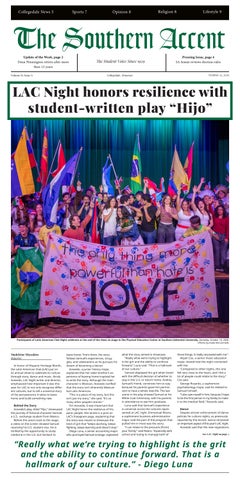
Participants of Latin American Club Night celebrate at the end of the show on stage in Iles Physical Education Center at Southern Adventist University. Saturday, October 10, 2026. (Photo by Katie McConnell).
Madeleine Miyashiro Reporter In honor of Hispanic Heritage Month, the Latin American Club (LAC) put on its annual show to celebrate its culture through story, dance and music. Ainsly Acevedo, LAC Night writer and director, emphasized how important it was this year for LAC to not only recognize different cultures, but to tell a universal story of the perseverance it takes to leave home and build something new. Behind the Story Acevedo’s play, titled “Hijo,” showcased the journey of fictional character Samuel, a U.S. exchange student from Mexico. Before the actors took to the stage, a video on the screen showed Samuel receiving his U.S. student visa. He is thrilled by the opportunity to study medicine in the U.S. but hesitant to
leave home. From there, the story follows Samuel’s experiences, struggles, and celebrations as he pursues his dream of becoming a doctor. Acevedo, a junior history major, explained that her older brother’s experience of leaving home inspired her to write the story. Although the main character is Mexican, Acevedo clarified that the story isn’t inherently Mexican but Latin American. “This is a piece of my story, but this isn’t just my story,” she said. “It’s so many other people’s stories.” For Acevedo, it was important that LAC Night honor the resilience of Hispanic people. She wrote in a post on LAC’s Instagram page, explaining that the story was meant to showcase the kind of grit that “keeps working, keeps fighting, keeps learning and doesn’t stop.” Diego Luna, a senior accounting major who portrayed Samuel onstage, explained
what the story aimed to showcase. “Really what we’re trying to highlight is the grit and the ability to continue forward,” Luna said. “That is a hallmark of our culture.” Samuel displayed this grit when faced with the difficult decision of whether to stay in the U.S. or return home. Andres, Samuel’s friend, convinces him to stay because his parents gave him permission to have a whole new life. The last scene in the play showed Samuel at his White Coat Ceremony, with his parents in attendance to see him graduate. Luna said that Samuel’s experience is universal across the cultures represented at LAC night. Emmanuel Rivero, a sophomore business administration major, said the part of the program that pulled him in most was the story. “I can relate to the pressure [from] your family,” said Rivero, “especially with school and trying to manage both of
those things. It really resonated with me.” Aliyah Cox, a senior music education major, shared how the night connected with her. “Compared to other nights, this one felt very close to the heart, and I felt a lot of people could relate to the story,” Cox said. George Rosardo, a sophomore psychobiology major, said he related to Samuel himself. “I also saw myself in him, because I hope to be the first person in my family to make it to the medical field,” Rosardo said. Dance Despite stricter enforcement of dance policies for culture nights, as previously reported by the Accent, dance remained an important aspect of this year’s LAC night. Acevedo said that the new regulations See LAC Night on page 3
“Really what we’re trying to highlight is the grit and the ability to continue forward. That is a hallmark of our culture.” - Diego Luna
If you would like to be a contributor, contact Chloe Smith at chloegsmith@southern.edu
2 | Thursday, October 22, 2026
NEWS
Dean Pennington retires after more than 13 years Sienna Escobar Managing Editor Southern Adventist University Residence Life staff and students said goodbye to Associate Dean Susan Pennington as she moved into retirement after more than 13 years of service. According to Lisa Hall, dean of students and director of Residence Life, Pennington was primarily in charge of student housing and running the associated software during her time at Southern. At one point, she managed all of Talge, Thatcher and Thatcher South dorms. Eventually, as the number of students grew, Pennington transitioned to overseeing just Thatcher and Thatcher South. On top of these responsibilities, Pennington had weekly office hours when she was available to help students in person. According to Hall, Pennington's duties included a large variety of tasks. “The extra hours housing requires to stay on top of emails during the summer, working through challenging roommate issues, parents who were upset about something regarding their student, having to occasionally plunge a toilet, taking a student to the ER in the middle of the night -- the list is lengthy,” Hall stated in an email to the Accent. According to Pennington, she graduated from Southern with a degree in management and had no intention of ever serving as a dean. After over 25 years working as an accountant, she happened upon a listing for a temporary dean job and felt impressed to apply. “Being a dean was all God led!” Pennington stated in an email to the Accent. “I had never thought about being a dean!” After working as a temporary or part-time dean for some time, Pennington quit her accounting job and began working full-time at the residence halls. “I fell more in love with being a dean and the residents,” she stated. “Over a year later and [after] many prayers, Southern offered me the full-time dean job.” ".... There are no words that can adequately say how much I loved the residents and being a dean,” she added. According to fellow deans and student Residence Life workers, Pennington brought a sunny spirit to her work environment. “Dean Pennington doesn't know any strangers,” Associate Dean Chamra Anthony said. “You walk in, and she's just talking and happy and very sanguine.” Nema Ogal, a senior chemistry major and residents’ assistant (RA) who worked with Pennington, shared similar feelings. “She is so trustworthy,” Ogal said. “You can confide in her.” Despite the different conflicts and disciplinary actions Pennington had to address with residents, Ogal said she seemed to view all students with an attitude of grace and impartiality. “She treated everyone the same, and she was so authen-
tic,” Ogal said. “She just genuinely saw them holistically.” Makenzie Martz, a junior elementary education major and a student dean who worked with Pennington, said she valued Pennington’s example as a Christian. According to Martz, Pennington would make a point of praying with all the RAs who were on duty when she was working in the evenings. “She modeled Jesus so well, and she's such a role model for how I want to interact with young people someday because I looked up to her so much,” Martz said. According to Anthony, Pennington’s last day of work was Oct. 2. On Sept. 28, an email sent to residents of Thatcher and Thatcher South dorms and Southern Village informed students of Pennington’s retirement and invited them to a goodbye reception being held for her.
Southern Accent
The Accent encourages readers to write articles and voice their opinions. However, the views expressed do not necessarily reflect the opinions of the Accent, the Southern Adventist University or the Seventh-day Adventist Church. For any questions, comments and article submission information, email the editor at chloegsmith@southern.edu For all advertising inquiries, email alvajohnson@southern.edu.
The RAs and Dean Sara Chase also planned a surprise party for Pennington on her last Thursday shift at the dorms, according to Anthony. The RAs set up a pickleball court in the center courtyard of Thatcher, since Pennington is well-known for her love of pickleball among friends and coworkers. Ogal recalled the party and laughed about the results of playing against Pennington. “Dean Pennington will destroy you guys at pickleball,” Ogal said. “All of us got to play her [and], of course, lose.” According to Hall, Pennington’s position will be filled by Chase and Associate Dean Mary Neri. Chase will be taking over management of the Thatcher and Thatcher South desk areas while Neri moves into the housing role that Pennington occupied. Chase, a Southern alumna, worked as a student dean in
college and joined the Residence Life staff this school year after spending nearly 20 years as a high school dean. According to Hall, Chase has shadowed multiple deans to become familiar with all their different roles. Chase said one of the biggest differences from working at an academy is the sheer number of students and new names to learn. At the same time, she said meeting people is one of the most rewarding aspects of her job. “A deaning job is predictably unpredictable: there's certain things you have to do each day, but you also don't know what's going to happen each day,” Chase said. “Building those relationships and hoping that along the way I can have some sort of positive impact-- really, just show Jesus [and] get to know people -- that's the fun part.” Reflecting on her time at
Southern, Pennington also found relationships to be among the most rewarding aspects of her job. She brought up times she had bonded with students over Chik-fil-A, offered a hug during personal tragedies or medical emergencies or spent time with students who came into her office just to say "hi.” “I loved the hugs, prayer time and conversations with the residents,” Pennington stated, “RA worships on Thursday nights I absolutely loved! ... Being able to openly talk about God [and] praying every day for God’s Wisdom and to show His love to the residents.” Pennington stated that she plans to spend more of her time now with her elderly mother, husband, children and grandchildren. She and her husband like to try local restaurants in the Chattanooga area, she said. And, of course, she plans to play more pickleball.
Susan Pennington holds an ice cream cone in Liverpool, England. Monday, August 10, 2026. (Photo courtesy of source).
Editor-in-Chief Chloe Smith
Lifestyle Editor Maddie Schmidt
Managing Editor Sienna Escobar
Sports Editor Ava-Caroline Schmidt
Assistant Managing Editor Gabrielle Young
Opinion Editor Leif Bromme
Photo Editor Katie McConnell
Circulation Manager Ian Francis
Social Media Management Gianelli Banuchi Jenna Fortune
Layout Manager Nyah Jackson
Web Management Eri Jorge Jeziel Gomez Reporters Jehiely Balabarca Rebecca Walwyn Lydia Campbell Lillie Domenech Madeleine Miyashiro Collegedale Editor Kyla Wetmore Collegedale Managing Editor Asher LeVos
Collegedale Layout Manager Malcolm Maynes Copy Editors Julie Herter Lauren Sahly Hadassah Nazarenus Layout Designers Katherine Damian Flores Jewell Hewitt Staff Sponsor Alva James-Johnson
3 | Thursday, October 22, 2026
For more related news, visit our website at southern-accent.org
NEWS LAC Night Continued from page 1 did not discourage her because she wanted to bring the same quality often seen in dance to her story and music. “[The choreographers] have just done so well, despite the challenges that have been presented with these new rules from administration,” said Acevedo. “They have been a very good example of the grit that I’ve been writing about, and despite the adversity, despite the challenge, they have picked themselves up and said, ‘Okay, let’s rework things. Let’s brainstorm. Let’s continue forward because this night will happen no matter what.’” For some audience members, the dances were the most anticipated aspects of the night. Melanie Gonzalez-Jimenez, a sophomore accounting major, said she was most excited for the dances. “I find that dancing is such a great way of representing culture,” Gonzalez-Jimenez said. “So, I’m very excited.” Sayana Gonzalez, a junior elementary education major, said that dance is not just an expression but a foundation of her heritage; removing dance, she said, would take away a key aspect of her culture. “Dance shows principles of family and how we love to live life to the very fullest,” Gonzalez said. “It shows different things that we really value in the Latino Hispanic community.” Gianelli Banuchi, a junior public relations major and leading actress in LAC Night, shared her perspective. “I think [dance] is such a beautiful thing, because it’s our way of sharing our culture with the world,” Banuchi said. Music According to Acevedo, the play was originally called “Niño,” inspired by a song by Milo J, an Argentinian singer and rapper. Acevedo said that lyrics from “Niño” were quoted throughout the night. Many of the program’s songs were chosen because of their role in the story, according to Acevedo. For instance, “HUMBE” by Fantasmas was featured when Samuel had to decide
whether to return to Mexico or stay in America. “People know it, and they know the pain of it in the way [that] the lyrics are very beautiful and very reminiscent,” Acevedo said. “It relates a lot to the story that I have.” LAC Night also featured a live band of saxophones, trombones, trumpets, piano, bass and drums. Before the show began, the band played familiar songs, such as “Vivir Mi Vida,” by Marc Anthony, “Bidi Bidi Bom Bom,” by Selena and “Chiquitita (Spanish Version),” by ABBA. According to Rosardo, the band’s director, the preshow setlist featured 12 songs, all carefully selected to represent the cultures at LAC night. “As a group, we chose [these songs] because they were songs that we felt represented our culture well, and they were songs that we’ve grown up listening to and that we’ve connected with our entire lives,” Rosardo said. Lisett Blandón, a previous graduate of SAU, shared how the music made her feel. “A lot of these songs that they’ve played are by Selena,” Blandón said. “They are songs that I grew up listening to. They represent a lot of my childhood.” Rosardo said that although Acevedo gave his band full creative freedom for the pre-show, she had a specific vision for the outro. She requested the song “BAILE INOLVIDABLE” by Bad Bunny to be played, explaining that it encapsulated their music style. For many students, the live band and selection of songs were more an expression of their culture than a source of entertainment. Felipe Da Silva, a junior finance major and keyboardist for LAC night, said music blends cultures together. “Music is a universal language,” said Da Silva. “It’s one of the few ways that you’re able to simultaneously blend with other cultures just by listening to something. And I think it’s very beautiful how everybody [can] come together and play so many different cultures with the same instruments. It just shows how much of a vessel of culture music can be.” Luna expressed the importance of music.
Gianelli Banuchi, a junior public relations major, talks with Diego Luna, a senior accounting major, after performing a dance at LAC Night. Saturday, October 10, 2026. (Photo by Katie McConnell).
“Music provides a medium for [everyone] to be able to articulate themselves in a way that words won’t allow them to do,” he said. Real Stories For Banuchi, every aspect of the program showcased the story of Latin American culture.
“Each song tells a story, each dance tells a story and our play is telling a story,” she said. “So I think that it’s very important to educate people and show people why we are so proud of being who we are.” According to Luna, the story of Samuel hits close to home for many Southern students.
“[Acevedo] really wanted to write a story that’s representative of what a lot of students on campus have to go through,” he said. “So, this really isn’t fiction. This is actually based on real students that are close to all of us. And for a lot of us, it’s our own story.”
Gianelli Banuchi, a junior public relations major, chats with Diego Luna, a senior accounting major, at a desk during a study scene at LAC Night. Saturday, October 10, 2026. (Photo by Katie McConnell).
4 | Thursday, October 22, 2026
If you would like to be a contributor, contact Chloe Smith at chloegsmith@southern.edu
NEWS
Office of Ministry and Missions starts a new peer-to-peer Bible study program Isabella Lagos Contributor Between late-night study sessions and academic stress, finding a space for authentic spiritual connection can feel difficult with piling assignments and overwhelming responsibility. Although the Office of Ministry and Missions (OMM) is traditionally known for organizing mission trips and outreach programs, it has launched a peerto-peer Bible study aiming to change the narrative of lacking spiritual connection. According to student coordinators Sylvia Fiess and Skylar Perla, the ministry pairs students one-onone, giving personal Bible studies, aiming to make spiritual growth increase through peer connection. “They hired us to be able to work together,” said Perla, a senior theology major, referring to his partnership with Fiess. “Just realistically [being] able to open the campus up to studying with each other, being able to build connections and being able to open up the Word and just talk to Jesus." The roots of the peer-to-peer initiative trace back a few years.
Originally, the idea was sparked by a student initiative under the Student Association (SA), which launched a similar concept. When that school year concluded, the framework was brought to OMM and Manuel Gomez, associate chaplain, who helped shape it into what it is today. Now entering its third year, Perla and Fiess said the system relies heavily on flexibility and student autonomy. When a student signs up to receive studies, coordinators connect them with a student instructor, and the pair then coordinates their own meetings. If students wish to become an instructor, they must go to the OMM office and speak with student leaders. According to Perla and Fiess, Bible study pairs meet once a week at a time and location of their choosing, whether that is in a dorm, a campus building or even off campus. The pairs generally begin using the “Journey Bible Studies” series, which provides a foundational baseline specifically tailored to college students. However, flexibility is encouraged, allowing them to pivot or study books such as the Gospels, Acts or books in the Old Testament if their relationship leads them there.
Fiess, a junior psychology-clinical major, provided details about the training sessions hosted by OMM each semester that briefs student instructors on how to foster spiritual mentorship. “In that training, we go over the study set that we use and what it entails to be a Bible study instructor,” said Fiess. “In that way [we] try to not only give them a little bit more information about what the position looks like but also make sure that they're aware of the resources available to support them as a student leader.” For student leaders like sophomore elementary education major Kaylee Cushing, the program offers a unique sense of mutual accountability and shared growth. Unlike traditional Sabbath school or classroom settings, Cushing said, peer-to-peer studies close social gaps. Students connect with peers who understand university stress and campus life firsthand. Cushing admitted she was initially nervous about leading a one-on-one study due to her lack of experience. However, after praying and placing her trust in God, she met her contact and discovered that
A student reads in Galatians along with a speaker in Collegedale Seventh-day Adventist Church. Tuesday, October 6, 2026. (Photo by Katie McConnell).
her partner was excited about her relationship with God and wanted to find someone to talk about it with. “It was just so cool to see how God immediately answered my request,” Cushing said. “He blessed me so much by having me meet this girl who is amazing and on a very similar journey as me, so that I can be so blessed by it.” As Fiess, Perla and other
student leaders look toward the future, they explained their goal to make peer-to-peer discipleship a main concept on campus, ensuring that every student has a space to be known, supported and led closer to Christ. Students interested in joining or receiving studies can scan the QR code featured during vespers or visit the OMM office to get connected.
SA Senate reviews election rules Rebecca Walwyn Reporter Editor’s note: Due to the nature of our campus, some Accent staff members are also employed in other on-campus organizations. We chose to quote Asher LeVos, Collegedale Community News managing editor, in the context of his role as Student Association parliamentarian. To avoid conflict of interest, LeVos did not contribute to the writing or editing of this article. Southern Adventist University’s Student Association (SA) Senate is reviewing its election procedures after discovering its current process may be in violation of existing Senate bylaws. Currently, SA senator positions are filled by appointing select students. However, questions were raised about the possibility of letting the student body elect them directly. Senators discussed the issue during an Oct. 8 Senate meeting, when they considered a proposal on how student elections and voting districts could work on campus. The Senate is scheduled to meet again on Thursday, Oct. 22, to reopen and possibly vote on the proposal. During this time, senators will have the opportunity to suggest changes before a decision is made. “The 2025-26 Student Association Senate team identified this problem but did not have time to solve it,” stated Asher LeVos, a sophomore history major and SA parliamentarian. “This year, the Bylaws Committee has taken another look at it and has proposed to Senate a solution for how voting and districting could function.” In an interview, Dennis Negrón, vice president of Student Development, explained that the Bylaws Committee examined the bylaws last year and the Elections Manual this year. “Members realized the current selection process did not match the written rules, and we need to do something about it,” Negrón said. What is the Senate? The SA Senate is the legislative branch of Southern’s student government. According to
the SA Constitution, the Senate is responsible for representing students, reviewing SA policies and making decisions about funding and campus projects. Students are divided into districts based on their academic departments. Those districts are then divided into smaller groups, with one senator assigned for around 90 students. Senators are responsible for representing students’ interests and concerns in their precincts by bringing them up in Senate meetings. According to the SA Bylaws, senators are expected to attend meetings, serve on committees, review funding requests and stay connected with the students they represent. They are also required to email meeting minutes to their constituents shortly after the Senate meetings. The Senate meets every other week, and its meetings are open to SA members and university students. According to Southern’s SA website, Senate positions are filled through an interview and selection process conducted by the SA Executive Cabinet. However, the SA also has an Elections Manual that outlines procedures for electing senators. The difference between those two processes is now part of the Senate’s discussion. The SA Constitution includes a process for appointing senators at the beginning of each semester. Under Article VI, Section 6, the SA executive vice president makes legislative appointments after consulting with the parliamentarian and executive secretary. However, the publicly available Elections Manual states that Senate elections must take place within the first four weeks of the school year. It also outlines requirements for students seeking to become candidates, including obtaining signatures from a minimum of 20 members of the precinct they wish to represent. LeVos explained that senator’s elections are already included in the SA’s governing rules. “Because Senator elections are already on the books, they will not be removed unless a new proposal from the Bylaws Committee is brought to
Senate and wins a 2/3 majority vote,” LeVos stated. This means the current discussion is not simply about introducing new senate elections; instead, senators are reviewing how the existing election requirements could be put into practice. “The proposal under discussion was created to define the boundaries of how voting and districting could take place at Southern,” LeVos stated. Although the Constitution includes an appointment process, questions remain about how that process relates to the election requirements in the Elections Manual. How Long Has This Been an Issue? Questions remain regarding how long senators have been appointed rather than elected, as well as why the current process continued. According to reporting notes provided by Senator Don Lloyd, the issue may have been known within the Senate for approximately 10 years. Negrón clarified that earlier Senate action had not been recorded, and there were no on-record changes made to the Constitution or bylaws. According to Negrón, under Martha Freire, executive vice president, and Moses Meyer as president, changes were made as to how senators were selected during the 2016-2017 school year. Negrón said he did not recall if elections were in place before that year but knows they have not happened or been addressed since. Lloyd’s notes also identified Negrón as the person who brought renewed attention to the election procedures. LeVos confirmed that the issue was identified by the 2025–26 Senate team but was not resolved before the end of that school year. The Bylaws Committee has since returned to the issue and developed a proposal for senators to consider. According to the SA Bylaws, the committee is responsible for reviewing the Constitution, bylaws and Elections Manual each year and recommending changes when necessary. The committee also
helps oversee SA elections. When asked why the inconsistency had continued, Negrón said senators had been carrying out their work, but that area had not been given attention. “The Election Manual can be overlooked very easily,” he said. “Senators aren’t reading the documents.” Negrón said he and Alexis Grentz, director of Student Life and Activities, decided to review a part of senators’ orientation. LeVos, who serves as parliamentarian, leads the Bylaws Committee. His responsibilities include advising the Senate on its governing documents, helping organize Senate procedures, and reviewing the rules that guide the SA. According to LeVos, the committee’s current work could help clarify how senators are selected and how students participate in the process. LeVos said the upcoming meeting will also allow senators to make changes to the proposal before voting. “An initial discussion took place this week,” LeVos stated, “and in two weeks Senate will vote on the proposed solution, with the ability to make amendments.” If the proposal is approved, it could provide clearer instructions for organizing Senate elections and determining which students vote for particular representatives. The timing of future elections and
the details of how students would participate have not yet been confirmed. Student Opinions The Senate’s discussion raises questions about how students feel about the current appointment process and whether they would prefer to elect their representatives. According to Lloyd, students are currently able to voice opinions by directly emailing their senator as well as Senate surveys included in post-meeting emails. Though students can communicate with their senators, the current selection process does not give them the same direct role in choosing representatives as an election. Narden Jean-Jacques, a sophomore construction management major, said he is concerned that student's voices are not being represented. “At my old school, Fletcher [Academy], students got to vote in who represented them,” Jean-Jacques said. “We voted for most of our student government positions, and I think we should be able to do that here too.” When preparing for the upcoming vote, LeVos offered students a recommendation. “As parliamentarian, I highly encourage all students to read the Election Manual and share their comments or concerns with their Senator.”
A laminated copy of Robert's Rules of Order and a gavel sit on a table in the Bietz Center for Student Life at Southern Adventist University. Tuesday, October 20, 2026. (Photo illustration by Katie McConnell).
5 | Thursday, October 22, 2026
For more related news, visit our website at southern-accent.org
COLLEGEDALE NEWS
CPD and Collegedale Academy hold impaired driving simulation event April Lin-Ao Contributor On Monday, Oct. 5, an impaired driving simulation was held at Collegedale Academy by the Collegedale Police Department (CPD). According to a press release from the CPD, the Arrive Alive Tour was held at Collegedale Academy and gave students firsthand experience of how impairment can affect a person’s ability to drive, inhibiting reaction time, coordination, judgment and vehicle control. According to the Arrive Alive Tour’s website, participants in the simulation get into a real vehicle as the driver and wear a virtual reality headset. Sensors
are connected to the vehicle’s gas and brake pedals, enabling the participant to experience impaired driving with no real-life consequences. Corderio Eatmon, Collegedale Academy’s school resource officer (SRO), led the event. Eatmon’s role centers on keeping everyone on campus safe, ensuring that daily operations run smoothly. He also teaches the Drug Abuse Resistance Education (D.A.R.E.) curriculum to eighth graders at Collegedale Academy’s lower campus. Eatmon explained that he has organized the Arrive Alive simulation for four years at the academy, with the program coming to the school every two years. “I first encountered the
concept through a social media post indicating that a few deputies were using the program at the Hamilton County Sheriff’s Office,” Eatmon stated in an email to CCN. Wanting to implement a similar approach for Collegedale Academy, he contacted a deputy and asked how he might apply it there. “Ever since that time, I have tried to implement the program every two years,” Eatmon said. The simulation is designed for junior and senior classes, according to Eatmon, who hopes that the hands-on simulation will help them learn about the dangers of impaired driving. “I hope the effect helps students recognize how hazardous
it is to drive while intoxicated by drugs or alcohol, along with the risks of distracted driving while texting,” he said. “If this encourages them to reconsider future choices, I will have achieved a great result.” Eatmon added that high schoolers are not the only target audience for the Arrive Alive program, explaining that the simulation could also serve college campuses and local residents. “I strongly believe the Arrive Alive Tour can benefit community members,” he said. "It shows potential consequences of operating a motor vehicle while intoxicated or under the influence of drugs.” Gisele Garza, a senior at Collegedale Academy, says that it
was her first time participating in the simulation. “I thought it was pretty cool and more difficult than expected,” Garza stated in an email to CCN. “I thought that the delayed reaction time it gave you was the hardest part to deal with, and it really showed how certain substances can affect your driving.” According to the CPD’s press release, Chief Jack Sapp stated that education and prevention are important in keeping a community safe. “We hope the experience students had with the Arrive Alive simulator will stay with them and help them make responsible decisions when they are behind the wheel,” Sapp stated.
A student at Collegedale Academy crashes in the simulator. Monday, October 5, 2026. (Photo courtesy of source).
(Graphic by Jewell Hewitt)
6 | Thursday, October 22, 2026
If you would like to be a contributor, contact Chloe Smith at chloegsmith@southern.edu
L AC Night 2026
Kerwin Archibald, a freshman graphic design major, dances with Mitchell Nino, a senior health science major, during the South American dance section of LAC Night. Saturday, October 10, 2026. (Photo by Katie McConnell).
Gabi Ramirez, a junior nursing major, performs Samba for the Sur Americano dance section of LAC Night. Saturday, October 10, 2026. (Photo by Katie McConnell).
Dancers performing the Caribe complete their finishing move during the Caribbean dance section of LAC Night. Saturday, October 10, 2026. (Photo by Katie McConnell).
A crowd is tightly gathered together surrounding the pre-show band for LAC Night. Saturday, October 10, 2026. (Photo by Katie McConnell).
7 | Thursday October 22, 2026
For more related news, visit our website at southern-accent.org
SPORTS
Flagged & Fired Up: Southern’s flag football intramurals are in full swing this semester Ava-Caroline Schmidt Sports Editor As the season of fall starts to spread over Southern Adventist University’s campus, flag football has been added to the list of sports for students to participate in this semester. There are now not only futsal and double tennis matches taking place, but flag football games as well. Between fields three and four, two newly installed metal poles have sparked questions among students. According to Troy Walker, Southern’s intramural director, the poles put between the fields are one of four new scoreboards that will be built for intramurals. Walker does not know exactly when all of the boards will be finished, but he is hopeful that the first one being put into place will be running before flag football playoffs. Intramural flag football has been set with women’s and men’s teams. For the women’s, there are six teams in A league and nine teams in B league. For the guys - since there are 28 teams overall - they have been divided into four divisions. Unlike regular college football, flag football on campus is designed to be a more laid back, less competitive version of football, so students can spend more time enjoying the playing instead of stressing about the result of the game. Some subtle differences between regular football and flag football include the number of players required on the field. Traditionally, there would be eight players on the field, but for Southern, a minimum of four rostered players is
required to play a game, but a starting total of seven players constitutes a team. Regular flag football games have a timespan of 20 minutes with three-minute half times on the field in order to play, and of course, one of the main questions talked about is the Southern Intramural flag football rules, especially with regard to screening and blocking. According to Southern’s flag football sports rules, players must use proper footwork to stay in front of their opponents. Contact must be made with open hands within the oppo-
nent’s frame, below the head and above the waist. Arms and elbows may not be extended or locked, and grasping, holding or encircling players is not allowed from opposing teams. Walker expressed that he hopes “above all things that everyone has a great experience, maybe meet a new person or two and make a new friend or two.” The intramurals program is also doing a trial run with some new flags. “We knew going in that the new flags would be harder to pull, but that’s a way it probably should be, with more of an empha-
sis on flag-pulling as a defensive football skill,” Walker said. Walker added that he hopes the use of the new flag system will be a positive experience for everyone involved. Two students who play for the same team, “Punt Intended,” were asked the question, “What comes to your mind when you hear the term flag football?” Abby Zinke, a sophomore business administration major, commented on the fact that it’s a great way to connect with friends and play a sport that everyone loves. Her teammate Teagan
Randall, a junior business administration major, added that flag football is more of a classic sport than others. She called it a great fall activity and a way for people to experience something fun and new if they have not played before. Instead of studying in the library or your dorm room, bring a few friends, your laptop and a blanket and go to the outdoor track to watch your fellow classmates play. Not only will it be an opportunity to get some work done, but it will also be a social time to spend with friends and watch your peers compete.
Josh Root, a junior nursing major and the quarterback for his team, “Forbidden Ninjas,” receives the football while his teammate, Joshu Roberts, a junior film major, runs toward him during a play for an intramural flag football game. Thursday, October 8, 2026. (Photo by Ava-Caroline Schmidt).
Intramural Flag Football Game Results Monday (12th): • Men’s - Kneecap Nibblers vs MysticalShadowDestroyers = 6 to 12 - The Night Shift vs Small Potato Stuff = 0 to 45 - Zero Ball Knowledge vs China Kitchen = 0 to 45 - Bbq vs jason lee is our qb = 1 to 0 - Jay n’ em vs Trader Joe’s Enthusiasts = 0 to 1 - We’re Washed vs Haysacks = 45 to 0 - Just Sports vs Old School = 18 to 13 • Women’s A - Slim Brady’s vs Game of Throws = 20 to 0 - fufu’s fb team vs One of wun = 0 to 6 - ken shawties vs Abusement Park = 19 to 0 • Women’s B - holy hustle vs The Fumble Bees = 6 to 25 - HUDDLE HUNNYS vs Touchdown Divas = 12 to 19 Tuesday (13th): • Men’s - Kneecap Nibblers vs Bokum Ballers = 6 to 15 - Just Sports vs Bibim Ballers = 12 to 6 - Goon squad vs The forbidden Ninjas = 18 to 6
- Jay n ‘em vs Haysacks = 27 to 25 - Zero Ball Knowledge vs Old School = 6 to 25 - We’re Washed vs Tailgaters = 21 to 0
- Bbq vs Yum yum yum = 7 to 19 - Touchdowns before degrees vs yearners = 1 to 0 - Kalshi vs Shalom Yahweh = 27 to 12 - Super Seniors vs 1st round exits = 20 to 15 - The Relentless vs Noah C Reams = 12 to 20 • Women’s A - fufu’s fb team vs ken shawties = 0 to 19 Monday (19th): • Men’s - Goon squad vs Bokum Ballers = 20 to 0 - Super Seniors vs China Kitchen = 6 to 20 - Touchdowns before degrees vs MysticalShadowDestroyers = 25 to 6 - The Relentless vs Yum yum yum = 0 to 1 - Shalom Yahweh vs The Tailgaters = 13 to 7 - We’re Washed vs Jay n’ em = 1 to 0 - 1st round exits vs Bibim Ballers = 1 to 0 • Women’s A - One of wun vs Game of Throws = 1 to 0 - Abusement Park vs Slim Brady’s = 1 to 0 • Women’s B - not my name quarterback! vs Sarang Stealers = 12 to 0 - Ella’s fellas vs Punt Intended = 0 to 1
8 | Thursday, October 22. 2026
If you would like to be a contributor, contact Chloe Smith at chloegsmith@southern.edu
OPINION
Letter to the Editor: Back to Brock Nathan McKee Contributor There’s a beautiful new building that recently opened at Southern Adventist University named after my great-grandmother, Ruth McKee. As one enters Southern’s campus, the sight of it is certainly impressive, with level upon pillared level leading up to the round apex of the edifice, and beyond that, to the vaulted sky. This fall semester, business faculty and students moved into this new building, the Ruth McKee School of Business. I’m confident that the fine programs inhabiting this building will delight, inspire and equip business students as they prepare for meaningful careers. Nonetheless, as they leave behind decades of memories at Brock Hall, I hope their departure isn’t permanent. I hope they make it back to Brock. Yes, Brock Hall, which -- though it lacks the iconic columns -- is home to faculty who could tell you from whence those columns came. The columns represent a legacy passed down to us from centuries and millennia past. In them, we see Egyptian Karnak set in seas of sand, the Athenian Parthenon and Rome’s Augustan Forum. One sees them grounding Hereford Cathedral’s Norman vaults and lining Oxford’s cloisters. They bring to mind the noble halls of English Peers and our own Capitol Hill. These worlds and more are opened up at Brock whenever its professors teach the humanities or students open up old books to read. It might not be an obvious
choice for many, going back to Brock. Isn’t the point of education to prepare for our career? So, why waste time on history, writing, languages and literature and stack upon dusty stack of books, unless there’s some specific need or outcome? The answer to these questions depends entirely on the time horizon of our goals. If all we have in mind is the first few years after college, on getting a decent job and making a decent living, then the natural conclusion is probably not to bother with the humanities. If, however, one is thinking about the next fifty or more years, the answer changes. Occupational education, by necessity, focuses on the occupational part of life. If the goal of education is occupational, once one’s career is well established, then what? When this part of life is secured, what will we do with the other parts that, together, make up the whole thing? Indeed, it’s rare that the other parts of life leave our occupations alone. In business, for instance, holistic thinking should challenge and inform major decisions. The business decision to reduce one’s workforce is confronted by the human impact on people’s livelihoods. The business decision to build a warehouse is confronted by the human impact of seeing yet another mass of concrete and sheet metal and one less jolly woodland. The business decision to change jobs is confronted by the human impact of moving away from friends and a community. These sorts of decisions, when correctly considered, require expanding our vision
beyond the business impact and one’s occupational life. They make us look at the whole of life and compel us to consider how, in view of that whole, we should act. An earnest study of the humanities can help us get used to considering this wholeness in all its complexity. When studying medieval Europe, for instance, one cannot afford to focus on just one aspect of society but must consider the development of the whole over a long period of time. The politics of kings, queens and noble families, emerging towns, family and village life, agriculture, guilds, trade, literature and the medieval church must be studied together to understand the period’s history. As another example from literature, in the “Iliad,” Homer’s most moving passages reveal more than just the feats and sufferings of warriors, but the impact of war on the whole society: Andromache, begging Hector not to return to battle, thus abandoning her and her child to the dreaded day of captivity, or later Priam bartering with the enemy for his son’s corpse. In addition to the whole of society, the humanities are concerned with the whole individual, as felt, for example, when reading Wordsworth’s “Daffodils,” which shows how natural beauty can fascinate the entire human soul. These are only a few examples of how the humanities have a way of dealing with the whole of life, and a close study of the literature they encompass has a lasting effect on the whole person. Studying the humanities also has a profound effect on our
leisure time, driving us to spend more time cultivating our minds by reading good books and less time streaming or scrolling. In addition, when we travel to culturally significant places like Florence and walk, for example, through the Uffizi Gallery or dell’Academia in the midst of that ancient city, how will we comprehend the scenes from history and classical myth depicted in paintings and sculptures if we haven’t studied the humanities? Moreover, during such travel and throughout life, will we be able to immerse ourselves in another culture by speaking a language that, while foreign to us, is another person’s mother tongue? Only by learning another language, an important part of the humanities, can we ever experience this. All these examples point to a deeper truth about the purpose of education. Of course, part of our education should prepare us for an occupation. That’s why we have the Ruth McKee School of Business and many other excellent career-oriented programs
across campus. Nonetheless, the higher goal of education is to cultivate and improve the human soul, and engaging with the humanities at Southern is a great way to kickstart this lifelong process. Indeed, if we were only concerned with this life, we’d stop at the humanities. But at Southern, we’re about Transforming Lives for Eternity, which means encouraging students not only to read good books, but also to make the Bible the supreme good book in their lives, the one to which they return again and again as they walk in living faith with Jesus. So, hear me, business students, in whose shoes I walked more than a dozen years ago. Enjoy your new building and study well your trade. But also look across the parking lot and field every now and then, the place from whence you came, and spend some time there studying history, writing, languages and literature: the humanities. In sum, I hope you make it back to Brock.
An aerial view of Brock Hall. Tuesday, October 20, 2026. (Photo illustration by Katie McConnell).
RELIGION
From Finding Community to Creating It: Discipleship through LifeGroups Gwendolyn Loney Contributor When sophomore biology-biomedical major Bethel Onyekachi first became involved in LifeGroups at Southern Adventist University, she was looking for a place to connect with others and grow spiritually. What she did not expect was that the community she found would eventually lead her to become a LifeGroup leader and, later, a coach helping other students navigate their own leadership journeys. Onyekachi’s LifeGroup, called “The Fold,” focused on meaningful discussion of Bible stories and common questions her members had. For Onyekachi, the transition from participating in a LifeGroup to leading one came with unexpected challenges. Although she was passionate about bringing people together, Onyekachi often found herself worrying about attendance and whether she was doing enough to make her group successful. Fortunately, she had someone walking alongside her. Onyekachi and junior international development major Leighvanni Kennedy had originally connected as roommates, but their friendship developed a new layer when Kennedy became Onyekachi’s LifeGroup coach. “It was such a relief to have a LifeGroup coach because I knew her, and it was easy to talk to her,” Onyekachi said. “She gave such helpful tips. I felt like my LifeGroup thrived because of my relationship with Leighvanni.” When Onyekachi became discouraged about the number of students attending her
group, Kennedy encouraged her to reconsider what successful leadership looked like. “[Kennedy] told me not to stress if I didn’t have any members coming because it wasn’t about me,” Onyekachi said. “It was about who God led to my LifeGroup.” For Kennedy, coaching Onyekachi was also a learning experience. She remembers feeling nervous when she first accepted the LifeGroup coaching position and questioned whether she was prepared to guide other students in their spiritual lives. Rather than coming to Onyekachi’s LifeGroup meetings
as someone who already had everything figured out, Kennedy viewed their time together as an opportunity for both of them to grow. As the year progressed, their conversations went deeper than just LifeGroup activities. Rather, they encouraged each other and developed a friendship through their experiences together. Toward the end of the school year, Onyekachi asked Kennedy what being a LifeGroup coach actually involved. At the time, Onyekachi was just interested in the responsibilities, but Kennedy saw that the interest might be deeper.
Having watched Onyekachi’s dedication to her members and her passion for building community, Kennedy prayed for an opportunity to bring up the possibility of Onyekachi applying to be a coach. Onyekachi was hesitant at first. “I was really nervous, and I felt like I had imposter syndrome because I’m still navigating and walking with God through my own spiritual life,” Onyekachi said. Despite her uncertainty, she decided to take the chance and apply for the position. Now serving as a LifeGroup coach, Onyekachi has the opportunity
to offer other leaders the same support she once received. Her journey reflects the purpose behind LifeGroups of creating a community where students are not only supported in their own spiritual growth but are encouraged to help others grow as well. For Onyekachi, finding a community eventually became an opportunity to create one. And for Kennedy, helping a friend recognize her potential became an opportunity to see that community continue growing through someone else.
Members of the LifeGroup, “The Fold,” pose for a picture during their weekly meeting. Monday, December 1, 2025. (Photo by Samuel Francis).
9 | Thursday October 22, 2026
For more related news, visit our website at southern-accent.org
LIFESTYLE
Rediscovering the joy of having hobbies Maddie Schmidt Lifestyle Editor I have always considered myself someone who loves hobbies. Since I was a kid, I have particularly loved drawing. I noticed, however, that since starting college, that hobby slowly began to fade into the background. This last summer, I finally opened my sketchbook again. My art had previously brought me so much joy, and I felt like I was revisiting a version of myself that I had forgotten existed. Somewhere between our deadlines, exams and plans for the future, the things we do simply because we enjoy them can start to disappear. Reading becomes something assigned for class. Free time becomes time to catch up on work. Even the activities that once brought us joy can start to feel like luxuries we can’t afford. But since rekindling my love for drawing, I have discovered a new appreciation for hobbies. For students, hobbies can be a way to reconnect with a part of themselves that exists beyond their academic responsibilities, future careers and ever-growing to-do lists. Ainsley White, a freshman allied health major, explained that her hobby of photography is playing an important role in her life, especially as a young adult. “I’ve been drawn to photography at this point of my life because everyone I know is going through such special moments of their life,” White said. “People are graduating, finding their significant other, getting engaged, having weddings, and I want to be able to capture
those special moments.” White further explained that she particularly enjoys the creative outlet that photography gives her, which is something she struggles to find in her dayto-day college life. “With being so busy and wrapped up in classes,” White said, “being able to have something to look forward to like taking photos and sitting down to edit them allows me to take a break from being overwhelmed and gives me the chance to be creative.” Ella Cheeks, a sophomore allied health major, also expressed her appreciation for the creative outlet that her hobby, embroidery, has given her. “Having embroidery as a hobby allows me to be creative,” Cheeks said. “School and jobs don’t always leave room for that. With embroidery, I can turn my brain off and just enjoy the process. Other responsibilities require more of my attention and I feel like I always need to be one step ahead in order to not fall behind.” Aaron Hanson, a sophomore biophysics major, explained that playing the piano and the organ helps him to feel anchored despite his hectic schedule. “At this particular point in my life, I am busier than I have ever been in my entire life,” Hanson stated. “Being able to squeeze in a little time each week to play the piano and the organ really helps me to get through each day. We all need something to ground us when we are busy and to give our minds a moment to rest.” Keaton Drake, a sophomore psychology major, expressed that he feels similarly about
playing the electric guitar and bass. “Guitar and bass are definitely ways that I try to reconnect with the parts of myself that get lost in the busyness of life,” Drake said. “College takes up so much of my time—so much so that sometimes I forget to just do things for myself.” Beyond the struggle of our stressful school schedules, our time spent on social media has affected the time spent on our hobbies. On one hand, Drake explained that we often don’t realize how much time we spend on social media that we could be dedicating to our hobbies instead. “We spend so much time on our phones and on social media that we simply run out of time for hobbies,” Drake stated. “That includes me; I know I should be practicing, but instead, I catch myself scrolling.” On the other hand, Cheeks explained that sometimes the fact that we live so much of our lives on social media could also be a motivator for young adults to pursue their hobbies. “I think people are probably becoming more interested in hobbies again because a lot of us feel like we need to always be doing something,” Cheeks said, “and a hobby at least makes it so we aren’t scrolling.” This productivity culture that makes us as students feel like we can never truly have downtime is part of what makes our hobbies feel so relieving. Cheeks explained that hobbies give us a way to relax and de-stress without feeling lazy. “Hobbies can allow you to feel productive when, in the end, it doesn’t really matter,”
Cortney Lowman, a senior graphic design major, draws in her sketchbook. Tuesday, October 6, 2026. (Photo illustration by Maddie Schmidt).
Cheeks said. “Everything I do in other areas needs to show results, but even though I want results in embroidery, there aren’t any real stakes to it. I don’t get a grade attached to my hobby, only my own satisfaction.” Drake explained that the only expectations placed on our hobbies are the ones we place on ourselves. “Learning guitar is a way for me to do something simply for the sake of getting better, because I want to,” Drake said. “I get to make little improvements and feel proud of myself because no one is expecting anything from me. I can get better at my own pace, and I can enjoy the process.” Not only do our hobbies live outside the expectations of others, but they give us the space to live outside the expectations of others as well. Hanson explained that our hobbies allow us to figure out
who we are. “Having a hobby gives you an identity that you place on yourself,” Hanson stated. “When you have a hobby simply to satisfy your own curiosity and for your own enjoyment, you put your purest self into the hobby, which is reflected in the results.” Investing in a hobby is about more than finding something to do with the time between classes and assignments. It’s about remembering that there are parts of ourselves worth nurturing outside of what we study and what we accomplish. The things we enjoy don’t have to lead somewhere. A half-finished drawing, a book read purely for pleasure or an instrument played for no audience can be worthwhile in its own right. Sometimes, the activities we set aside as life gets busier are the very things that remind us of what makes life enjoyable in the first place.
GAME
Baking with the Accent Down 1. Sweetener made by bees 2. Small bite-sized cake 3. Mix quickly 5. White liquid 7. Measure ingredients
Across 4. Dough raiser 6. Cake topper 7. Baked batter
Created by Katherine Damian Flores
10 | Thursday October 22, 2026
If you would like to be a contributor, contact Chloe Smith at chloegsmith@southern.edu
CHATTER Today — 22 46 - 72
•
Student Missions Emphasis Week @ Various Times and Locations Alumni Homecoming @ Various Times and Locations 11:00am Convocation: Ellen G. White/ Adventist Heritage, Dr. Merlin Burt @ Collegedale Church of Seventh-day Adventists 3:30am - 5:00pm Graduate Curriculum Committee @ Wright Hall 7:00pm Student Association Senate @ Bietz Center for Student Life 7:30 pm Recital: General #2 @ Ackerman Auditorium
• •
• • •
•
• • • • •
Saturday — 24 46 - 71
Friday — 23
•
10:00pm SOAP: Hiking Trip @ Wright Hall Alumni Homecoming @ Various Times and Locations
•
Student Missions Emphasis Week @ Various Times and Locations Alumni Homecoming @ Various Times and Locations 6:57pm Sunset 7:00pm Vespers: Student Missions @ Iles P.E. Center 8:00pm Star Watch @ Hickman Science Center 8:30pm Missions Expo @ Collegedale Church of Seventh-day Adventists
45 - 72
Sunday — 25 •
Alumni Homecoming @ Various Times and Locations
43 - 70
Monday — 26 46 - 69
• •
4:00 pm - 5:00 pm Physical Therapy Month Celebration @ Promenade 7:30 pm Recital: General #3 @ Ackerman Auditorium
Tuesday — 27 • •
Wednesday— 28 52 - 72
• • •
4:00 pm - 5:00 pm Physical Therapy Month Celebration @ Promenade 8:30 am - 12:00 pm Lecture: Blind Descent, Florence Oliver Anderson Series @ Iles P.E. Center
45 - 72
4:00 pm - 5:00 pm Physical Therapy Month Celebration @ Promenade 5:00 pm Floor Hockey Captain’s Meeting @ Hulsey Wellness Center 7:30 pm Recital: General #4@ Ackerman Auditorium
1. Honey 2. Cupcake 3. Stir 5. Milk 7. Cup Across 4. Yeast 6. Icing 7. Cake
MASTER’S DEGREE IN SOCIAL WORK Facilitate Positive Change in People’s Lives Southern’s Master of Social Work program prepares you for excellent service and leadership positions. 100% online program Classes meet synchronously via Zoom every other Sunday. With careful planning, you can complete a bachelor’s degree AND a master’s degree in five years! Master of Social Work The MSW program from Southern equips you with effective intervention tools to serve a wide variety of people in need. This program qualifies for the 20% Graduate Tuition Discount for Recent Alumni!
To learn more about the program, admissions requirements, application deadlines, and more, scan this code or visit southern.edu/MSW.
1.800.SOUTHERN • southern.edu/graduatestudies