h
Collegedale News 5
Sports 7
Opinion 8
Religion 8
Lifestyle 9
The Southern Accent Update of the Week, page 2 More Than a Class: Inside Southern's evangelism program S.A.L.T
Volume 82 Issue 5
The Student Voice Since 1929
Pressing Issue, page 4 Persistent Problem: Campus additions cause parking issues
October 8, 2026
Collegedale, Tennessee
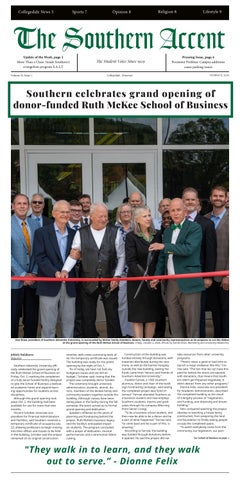
Southern celebrates grand opening of donor-funded Ruth McKee School of Business
Ken Shaw, president of Southern Adventist University, is surrounded by McKee family members, donors, faculty and community representatives as he prepares to cut the ribbon at the grand opening of the Ruth McKee School of Business. Friday, October 2, 2026. (Photo by Daniel Zhao, Marketing and University Relations).
Jehiely Balabarca Reporter Southern Adventist University officially celebrated the grand opening of the Ruth McKee School of Business on Friday, Oct. 2, marking the completion of a fully donor-funded facility designed to give the School of Business a dedicated academic home and expand learning opportunities for students across disciplines. Although the grand opening took place Oct. 2, the building had been available for use for more than two months. Vincent Schober, associate vice president for Financial Administration and Facilities, said Southern received a temporary certificate of occupancy July 23, allowing professors to begin moving into their offices and classes to be held in the building. Schober said the project remained on its original construction
timeline, with crews continuing work after the temporary certificate was issued. The building was ready for the grand opening by the night of Oct. 1. “As of today, we have not had any budgetary issues and are still on budget,” Schober said, noting that the project was completely donor funded. The ceremony brought university administrators, students, alumni, donors, members of the McKee family and community leaders together outside the building. Although classes have been taking place in the facility during the fall semester, the event served as its formal grand opening and dedication. Speakers reflected on the years of planning and fundraising behind the project, Ruth McKee’s business legacy and the facility’s anticipated impact on students. The program concluded with a prayer of dedication, musical performances and a ceremonial ribbon cutting.
Construction of the building was funded entirely through donations, with materials distributed during the ceremony, as well as the banner hanging outside the new building, stating the funds came from “donors and friends of Southern Adventist University.” Franklin Farrow, a 1993 Southern alumnus, donor and chair of the building’s fundraising campaign, said seeing the completed project was “kind of surreal.” Farrow attended Southern as a business student and now employs Southern students, interns and graduates through his company (Morning Point Senior Living). “To be a business school student, and then now be able to be a donor and be a part of what happened,” Farrow said, “to come back and be a part of this, is amazing.” According to Farrow, the building was funded through donations before it opened. He said the project did not
take resources from other university programs. “There’s never a good or bad time to launch a major endeavor like this,” Farrow said. “The fact that we can have this paid for before the doors are opened with donations, that means that Southern didn’t get impacted negatively. It didn’t detract from any other programs.” Dionne Felix, associate vice president for Academic Administration, described the completed building as the result of a lengthy process of “negotiation, and funding, and dreaming and dream building.” Felix compared watching the project develop to watching a house being constructed, from preparing the land and foundation to finally seeing people occupy the completed space. “To watch everybody come from the community, our legislators, our partSee School of Business on page 3
"They walk in to learn, and they walk out to serve.” - Dionne Felix
If you would like to be a contributor, contact Chloe Smith at chloegsmith@southern.edu
2 | Thursday, October 8, 2026
NEWS
Food services navigate longer wait times for students Deanna Touchard Contributor For students trying to grab lunch between classes, a trip to the Dining Hall, The Garden and CK2 can take longer than expected. Lines at these eateries can stretch far outside the entrance and even spiral around outside during busy periods, leaving students wondering if they should wait in line and be late to class or skip lunch all together. Lunchtime is always a busy period for campus eateries, with most classes getting out right before noon and classmates texting their friends asking where they’re going to eat lunch. Sheila Bame, the front-ofhouse manager in the cafeteria, said she loves to see the cafeteria busy. “We are seeing more people consistently come through the cafeteria and prepping more food for each meal,” Bame said. “It is a positive thing for us to see students, staff and outside guests coming in to experience our cafeteria.” Laurie Worth, food services director, explained how the lines may be tied to having less eatery options available through Southern’s meal plan this year. “Typically, we do have a time period that we know that it’s going to be super busy,” said Worth. “But I do think that there’s more volume due to the fact that there [are] less places to eat.” Due to the recent closure of The Kayak and the removal of the Village Market from the meal plan, there has been a greater influx of students at the
three main eateries on campus. “It has definitely been an adjustment,” stated Linda Perez, The Garden manager, in an email to the Accent. “We are serving more students than we did in previous semesters, so we have to be prepared to make more meals. We try to hire student employees to help us, but that has also been a challenge because it can be difficult to find students who are available to work early in the morning or during lunch hours.” With lunch lines being lengthy this semester, there have been frustrations among students who don’t have time to grab a meal. For Daria Terikova, a sophomore elementary education major, grab-and-go options are often her solution. “I probably either won’t eat, or I’ll go grab a snack from a vending machine, because I really like grabbing and going,” said Terikova. Lunchtime isn’t the only busy time in the cafeteria. “We always have a busy time period, and it’s usually on the hour when classes get out at 8 or 9 or 10 o’clock [in the morning],” Worth said. The cafeteria can track how many people come in half-hour increments. This helps the staff gauge what times might be busiest and how much they need to prepare in advance, according to Worth. When comparing the numbers to September last year, Worth noted the increase. “Overall, for the month of September we served an average of 308 more people every day,” Worth stated. “We also had two days in Septem-
ber when we served over 1,000 people for lunch.” There are questions circulating campus regarding plans to combat these long lines. “I’m curious to see if they’ll bring back The Kayak or the VM now that there are more people in the cafeteria,” said Ethan Valdez, a junior allied health major. According to Worth, there are not many options for major changes due to space limitations. “We’re very limited in what we can do based on space,” Worth said. “We don’t have room for another register or another serving line [in the cafeteria].” She said the cafeteria has new hours this semester and is open most of the day. According to Mandy Starr,
CK2 manager, her team has worked to reduce wait times. “While it took a few weeks at the beginning of the semester to train our new student workers, we can now clear a rush quickly,” she stated. Starr explained how new changes have improved the process. “We added a third register, which has significantly reduced wait times,” she stated. “We have also expanded our Grab & Go offerings for students. ... In addition, I hired several extra student employees to ensure we are fully staffed during our busiest meal periods, particularly lunch and supper. We also added a third vending machine.” The Garden is also consider-
ing new changes to its offerings. “We would like to add breakfast grab-and-go options, and we may start offering those next semester,” Perez said. “Other than that, our kitchen has limited space and equipment, so it’s difficult for us to add more meals or options.” Worth said she hopes students find ways to adapt to the longer lines. “We’re doing the best that we can to keep up with the lines, but I’m also hoping that students can look at their schedule and go, ‘Okay, where can I be a little more flexible?’” she said. “Students are having to adjust to a new normal, and food services are also having to adjust to a new normal.”
A line of students waiting for The Garden extends out of the eatery, down the hall, across the lobby of the fourth floor of Wright Hall, all the way to the Advancement office. Tuesday, October 5, 2026. (Photo courtesy of source).
More Than a Class: Inside Southern's SALT program Raquel Delgado Contributor Every Tuesday and Thursday afternoon, pairs of Southern Adventist University students head out into the community not just for a grade, but to build relationships. They knock on doors, offer Bible studies and invite people to evangelistic meetings at local churches. This fieldwork, known as Practicum, has been happening at Southern since 2011, according to Douglas Na'a, director of Southern’s Soul-winning and Leadership Training (SALT) program. Practicum is a class offered to students participating in SALT at Southern. SALT is a semester-long evangelistic training program in partnership with It Is Written that offers fully accredited college classes, a Bible worker certification and hands on training, according to Southern’s website. The class Practicum was created when John Bradshaw, the founder of SALT and president of It Is Written, and Alan Parker,
a pastor and professor in the School of Religion at Southern, came together with a shared vision. "Both wanted something evangelistic," said Na'a, who joined in August 2017 after years as a pastor with an evangelistic focus. Each semester, the program partners with a different local church, and students work in whatever area that church calls home. This year, the program partnered with Collegedale Church of Seventh-day Adventists. Past partners include churches in Ringgold, Cohutta, Bowman Hills and more. According to Na’a, at the end of the semester, some students decide to get rebaptized or focus on missions. He also said the impact goes beyond the students. “Churches experience revival; churches experience more evangelistic focus and outward focus,” Na’a said. However, Na'a said, one of the challenges for SALT is normalizing missions on campus. His goal is for evangelism to
Southern Accent
The Accent encourages readers to write articles and voice their opinions. However, the views expressed do not necessarily reflect the opinions of the Accent, the Southern Adventist University or the Seventh-day Adventist Church. For any questions, comments and article submission information, email the editor at chloegsmith@southern.edu For all advertising inquiries, email alvajohnson@southern.edu.
feel like a given at Southern; not an afterthought, but just "that's what we're doing." According to students who have taken the course, the experience is hands-on from day one. Samuel Calvelage, a sophomore theology major who completed SALT last fall, described the program as a 16-week evangelism training course that certifies students in Bible working. "It teaches you everything about evangelism, from friendship evangelism to evangelistic preaching, to Bible working, to door-to-door, to giving Bible studies—all kinds of the realm of practical theology," Calvelage said. Calvelage mentioned a sense of community as a reason to join SALT. "It's a great community,” he said. “Every single person that comes with SALT is there because they've seen God work in their life, and they want to share that with others." Aidan Sammons, a junior See SALT on page 4
Editor-in-Chief Chloe Smith
Lifestyle Editor Maddie Schmidt
Managing Editor Sienna Escobar
Sports Editor Ava-Caroline Schmidt
Assistant Managing Editor Gabrielle Young
Opinion Editor Leif Bromme
Photo Editor Katie McConnell
Circulation Manager Ian Francis
Social Media Management Gianelli Banuchi Jenna Fortune
Layout Manager Nyah Jackson
Elizabeth Rivas shares a devotional message with the participants in Collegedale Church of Seventh-day Adventists. Tuesday, October 6, 2026. (Photo by Katie McConnell).
Web Management Eri Jorge Jeziel Gomez Reporters Jehiely Balabarca Rebecca Walwyn Lydia Campbell Lillie Domenech Madeleine Miyashiro Collegedale Editor Kyla Wetmore Collegedale Managing Editor Asher LeVos
Collegedale Layout Manager Malcolm Maynes Copy Editors Julie Herter Lauren Sahly Hadassah Nazarenus Layout Designers Katherine Damian Flores Jewell Hewitt Staff Sponsor Alva James-Johnson
3 | Thursday, October 8, 2026
For more related news, visit our website at southern-accent.org
NEWS
Progress of the Ruth McKee School of Business building is shown with aerial photograph of the worksite at Southern Adventist University. Tuesday, May 13, 2025. (Photo by Katie McConnell)
Progress of the Ruth McKee School of Business building is shown with aerial photograph of the worksite at Southern Adventist University. Tuesday, May 13, 2025. (Photo by Katie McConnell)
School of Business Continued from page 1 ners, it just was an amazing event,” she said. Some of the work behind the completed building is not visible to those walking through it. Schober said more than 200 piers extend to bedrock beneath the School of Business to support its foundation because the soil underneath could not adequately support the building. A Dedicated Home for Business Students The building’s name recognizes Ruth McKee, co-founder of the family business that became McKee Foods. For Brittany McKee East, McKee’s great-granddaughter, the dedication brought particular significance. East said recognition of her family’s business history has often centered on O.D. McKee, despite Ruth McKee’s role as a co-founder. “I’m proud,” East said. “I think it’s great to recognize her.” East said she also appreciates what the new facility provides for current students. “I really like that the School of Business now has a home,”
she said. That distinction is already noticeable to students who previously took business courses in shared academic spaces. Matthew DeOliveira, a senior accounting major, previously attended business classes in Brock Hall, where the program shared space with the English Department and the History and Political Sciences Department. He said having a dedicated facility has created more opportunities for business students to interact between classes, study together and visit professors. “I finally feel like we have a place on campus,” DeOliveira said. “It was built for us.” Andrew Cornelius, a senior accounting major and vice president of the Business Club, estimated that he spends approximately 30 hours in the building each week. Nearly all of his classes are held there, and the Business Club uses a dedicated room for meetings and office work. Cornelius pointed to the lobby’s stock ticker, study spaces and fourth-floor auditorium among the building’s features. He has also noticed students
from outside the School of Business using the facility. “I see a lot of non-business majors come in here to study,” Cornelius said. Prince Atama, a senior health and wellness major, is one of them. Atama is taking accounting, marketing and management courses in the building this semester. He said he spends about fifteen hours a week there and often remains after class to study. “You really focus because it’s quiet,” he said. Opportunities beyond the School of Business Farrow said he hopes that cross-disciplinary use continues. He pointed to nursing students learning management skills and music majors studying music management as examples of ways business education could complement other fields. “There [are] so many cross-collaborations that can happen among the various departments,” Farrow said. “This allows us to do so many things, not just for the School of Business.” Farrow also said the facil-
ity could help the program respond to a professional environment that is changing rapidly, particularly with developments in artificial intelligence. He said students need exposure not only to established business concepts but also to developments that may be only weeks old. “The speed that we can deliver that knowledge is [going to] be a differentiator for us,” Farrow said. Despite the new building and changing technology, Felix said she hopes one element of Southern’s business education remains unchanged- its emphasis on mission and service. “I hope that remains cemented in its core, in its purpose and its anticipated outcomes,” Felix said. The goal, she said, is for students to understand that their education is more than preparation for a grade or career. “They walk in to learn, and they walk out to serve,” she said. Looking beyond Campus Collegedale Commissioner Laura Howse said she hopes the impact of the building eventually reaches the surrounding community.
“The city and the university work together to make things great for the community,” Howse said. “When we are partners and we support each other, then I think great things happen.” She hopes some School of Business graduates choose to remain in the area, establish businesses and create jobs. “I’m really looking forward to [when] graduates from the School of Business stay in town and invest in our city and create new businesses and new jobs for the rest of our community,” Howse said. During the ceremony, senior cyber security major Chase Slikkers said the building’s long-term impact will ultimately extend beyond its physical features. “The impact is more than the physical structure,” Slikkers said. He mentioned conversations with professors that go beyond homework and into students’ personal relationships with God, adding that those relationships can inspire students “to do hard things, push outside of [their] comfort zone and explore what missional business looks like.”
An aerial photograph shows the crowd exceeding the tents provided gathers at the grand opening of the Ruth McKee School of Business at Southern Adventist University. Friday, October 2, 2026. (Photo by Katie McConnell)
4 | Thursday, October 8, 2026
If you would like to be a contributor, contact Chloe Smith at chloegsmith@southern.edu
NEWS
Persistent Problem: Campus additions cause parking issues Rebecca Walwyn Reporter Chloe Smith Editor-in-Chief Julie Herter Copy Editor Recent changes to Southern Adventist University’s campus, including the additions of the Mountain Cottages and Ruth McKee School of Business, have further complicated a persistent parking issue on campus. Tom Verrill, senior vice president of Financial Administration, acknowledged the difficulties. “The new Ruth McKee School of Business building has resulted in some parking issues, from the perspective that there are not enough spots near the building for everyone inside the building to park,” Verrill stated. Cassidy Seralde, a junior business administration major, said that parking availability at the business building is dependent on multiple factors. “It definitely depends on the time that you get over there,” said Seralde. “For me, I have an electric vehicle, so I’m able to park in the charger, but for people who have a normal car, it is a lot harder, especially with a lot of visitors that they had over the past week.” When asked how the issue could be alleviated, Seralde said there should be more parking options around the business building. “I feel like [the parking lot] should be bigger considering how big the building is and how many students have classes in there,” she said. Verrill explained that such issues are common occurrences for many universities. “This is natural on a university campus, as it is impossible to have enough parking spots at each building for all who use the building at peak times,” he stated. “This requires students to park once on campus in areas that are available and walk to their various classes.” Verrill explained that the cottages have also caused parking issues, offering some alternatives. “Parking spots were added near the [cottages], but there are not enough for every resident,” Verrill stated. “There is typically ample parking in the parking lot near Campus Safety and the lot near WSMC, and there are stairs from both of these lots up to the cottages.” Naomi Ann Martinez, a junior theology major, said she enjoys living in the cottages, but the lack of parking spaces has worsened her experience. "At night, you won’t find parking at the top [next to the cottages],” said Martinez, “so
SALT Continued from page 2 theology major, explained how the SALT program works. "You take a handful of classes centered around theology, spiritual life and evangelism and then you get hands-on experience going door-to-door, giving Bible studies, hosting evangelistic series and preaching," Sammons said. "It's not just learning the material in class; you're applying the material. ...You're not only learning about ministry, but you're getting to do ministry and make an impact in people's lives." Jeanyvah Desarmes, a senior religious studies major who completed the SALT program in fall 2024, said she didn't want to join at first. "Some people think it's for people who love religion, who are on fire," she said. "In my
your only options are WSMC or the Campus Safety lot, and both options are so dark at night.” Outside of the newly developed areas on campus, students and faculty also face similar challenges. Students say finding a space on campus can often take longer than expected, especially near busy academic buildings such as the McKee Library and Beitz Student Center. For students trying to get to class on time, even a few extra minutes spent looking for parking can make a difference. “If you don’t know ahead of time how much parking there is, and it affects what time you get to class, it can be hard, especially if you have a test or presentation,” said Seralde. Commuting Students Commuting freshman nursing student Adriel Lewis shared his concerns about not being able to find parking spots. “There are times when I'm trying to find parking near my class, and it takes me an additional 10 minutes to find parking,” he said. “It ends up not being at all near my classes, and then I'm late, which is disruptive.” Lewis also expressed a desire for more commuter-only parking, so that commuters are not sharing with faculty, on-campus students and community members. Jaden Gibbs, a junior business administration major who also commutes to Southern, shared similar concerns. “The most convenient place to find parking is probably either behind WSMC by Brock Hall or usually the parking spaces by the business building, but those are usually full,” Gibbs said. Residence Halls According to Dennis Negrón, vice president of Student Development, one of the main causes of parking congestion for commuter students is due to students in the residence halls who drive to their classes. “The reason is that residents of Talge and Thatcher move their cars to academic buildings throughout the day,” Negrón stated. “This is not a privilege allowed on any university or college campus in the U.S. Once we figure out how to keep residential students in their lots, the parking issues on campus will be alleviated significantly.” In agreement with Negron, Verill explained that students should leave vehicles in residence hall parking lots. “Residence hall students already have designated parking near the center of campus, and therefore should not have any parking issues,” Verrill stated. Samuel Knowlton, a sophopersonal life, I didn't really like theology and religion." However, during her first semester, God kept bringing up SALT, according to Desarmes, until she finally asked for a sign. "When I finally decided to do it, my parents wanted me to graduate as soon as possible," she said. "But Dr. Parker and the SALT staff were willing to work with me and format my schedule so it wouldn't push me back. The Lord provided." Going on a SALT mission trip to the Dominican Republic, Desarmes added, brought everything together. "SALT really does help prepare you for the things that can happen in ministry, and then the mission trip kind of shows you [a] taste of ministry," she said. However, Desarmes is aware that not everyone on campus sees SALT that way.
An aerial view of the Thatcher Hall, Talge Hall and Wright hall parking lots stemming off from Taylor Circle at Southern Adventist University. Tuesday, October 6, 2026. (Photo by Katie McConnell).
more biology major and Talge resident, said that he does not have an issue with leaving his car at the dorm. “I can always find a spot behind Talge, and I'm fine walking anywhere else on campus from there,” Knowlton said. Freshman nursing major and Thatcher Hall resident Isabealla Willams-Marlow said she believes students residing in the dorms should be able to drive to classes. “Sometimes you have a class in a building across the campus and 10 minutes to get there,” Williams-Marlow said. “That’s really an issue when teachers take attendance seriously. It is also based off of the weather because if it is really hot, cold or rainy, walking to class can take longer and is a lot harder.” Patric Zabala, a freshman nursing major who lives in Talge Hall, said he thinks the current parking regulations are unfair. “We park in one place for at most an hour and get a ticket for $25, when there was nowhere else to park,” Zabala said. With the grand opening ceremony of the Ruth McKee School of Business taking place on Oct. 3, students were told in an email sent by Negrón that they had to move their cars during the event. Zabala commented on the scarcity of space during events. “We can only park behind Talge and when there is an event and administration tells us we can move our cars other places, but it is not enough, where are we supposed so go?” Zabala said.
increased from $45 to $55 in the last two years. “It’s really unfortunate that they’re raising prices for parking permits but not helping with parking,” said Lopez. “It just doesn’t make sense.”
Southern Village According to an email sent on Sept. 2 on behalf of campus safety to Southern Villages residents, the university is aware of the lack of parking in Southern Village Proper. The email offered alternative solutions, such as parking in an overflow
lot at the lower stateside apartments or at the Collegedale Church of Seventh-day Adventists. "Finding parking can be really frustrating,” said Bryanna Lopez, a junior nursing major and Southern Village Proper resident assistant. “It’s just hard because then you have to rush even more in the morning and it’s just harder to be able to come home and actually relax.” According to Lopez, alternative parking options do not benefit all residents equally. “I think parking in the church is really convenient for the buildings that live in the front,” Lopez said, “but it’s not very beneficial to people who live in the back end.” According to Negrón, there are often cars parked in Southern Village that are not permitted to be there, further adding to the issue. “We have done a survey of cars parked in SV [Southern Village] after hours and found many cars that should not be parked there,” Negrón stated, “so we’re not sure how bad the problem at [Southern Village] is.” When asked what she felt could alleviate the problem, Lopez suggested adding more parking spaces. “I really don’t know what else could fix it besides buying more plots of land,” she said. “There’s certainly got to be more spots that we can add parking.” Lopez also expressed frustration with changes in parking permit costs. According to the campus parking permit portal, undergraduate student vehicle permits are $55 per semester for Fall and Winter, and $15 for the summer term; graduate students are $25 per semester, and additional vehicles are $10 per additional vehicle. According to billing statements sent to students each semester via email, undergraduate permit prices have
"Some Southern students have [looked at] SALT as a little mini-Biblical cult, but I want them to know that the people who do SALT love the Lord,” she said. “They have a genuine love for the Lord, and they want to
grow in His love and find a better way to be a better evangelist and witness for Him." Na'a said that while SALT is a university program, it is about more than teaching techniques. “We go beyond the mind; we
also challenge the heart,” Na’a said. “The program challenges students' faith and then pushes them to apply it in the real world.”
Administrative Response According to Verrill, the number of parking permits issued by campus safety should account for parking spaces available on campus at any given time. “We issued about 2500 parking permits this fall, including students, employees, and guests,” Verrill said. “It needs to be understood that not all of these cars are on campus at the same time. We have about 2800 parking spaces on campus if you include the upper Collegedale Church lot, and about 2450 without this lot. This excludes parking at the Village Market and the ball fields. This is sufficient for the number of cars that are on campus at any one time.” Verrill acknowledged that not all students are able to park in their ideal locations and made some recommendations for parking alternatives. “There tends to be enough parking on campus, however the spots may not be as close to the building where students have classes as they would like,” Verrill stated. “There is always parking available during the week at the Collegedale Church, near the Virginia Apartments, and near WSMC. These are just a few minutes’ walk from the center of campus.” Beyond parking alternatives, Verrill said efforts to improve parking access for commuters remain ongoing. “We continue to see if there are better ways to manage parking on campus,” Verrill stated. “We are committed to making sure commuters have sufficient parking opportunities when they arrive on campus.”
Students sit in small groups in Collegedale Church of Seventh-day Adventists discussing praise and prayer requests after getting back from afternoon outreach in the community. Tuesday, October 6, 2026. (Photo by Katie McConnell).
5 | Thursday, October 8, 2026
For more related news, visit our website at southern-accent.org
COLLEGEDALE NEWS
Sip Social: Young entrepreneur turns her health passion into business Lillie Domenech Reporter At only 20 years old, Grayson Jenkins started her own business. Sip Social, a health drink store located in Collegedale, Tennessee, opened in May 2026, according to Jenkins in an interview with the Accent. Sip Social specializes in sugar-free energy drinks, protein shakes, protein coffees and many more beverages, according to Jenkins. Emery Hinds, an employee at Sip Social, said she sees the business as a community. "It's almost like a family," Hinds said, "Everyone just comes together. ... It's very [uplifting] and positive.” Sara Casar, a regular customer at Sip Social, described the business as a friendly place that brightens her day. "It's the little things that make your day better," Casar said, "like talking to them when they are making your drink...
[Jenkins] is really friendly.” For Jenkins, health became a passion when she got a job at Spring City Nutrition in high school. "I just needed a summer job," Jenkins said. "I loved the drinks because they were tasty and healthy [and] then it turned into a career. It was nice that I could start a career over stuff that I love.” Jenkins was ultimately led to start Sip Social through her college journey. "I knew [after working at Spring City Nutrition] that that's what I loved and something I wanted to make a career out of," Jenkins said, "But my parents just weren't on track with it at first, so I went to college." According to Jenkins, while she was in college, the owners of Spring City Nutrition went on vacation for a month and left her to run the store. "I was ordering the inventory and making the schedule and literally doing it all," Jenkins
said. "And then I was like, ‘You know what? I bet [the owners] are really living life... I would like to do that.’" Jenkins said her grandmother has been a major supporter of her dream to open a health drink store. "She drinks the orange creamsicle shake every day, so she believed in the product. She saw what it could do," Jenkins said. "She saw the success in the store I was working at already, so I asked her for money and she said, ‘yes.’" Jenkin's grandfather also provided financial support for her store so she would not have to take out a loan from the bank, Jenkins said. "I got lucky," she said. The store has had more success than Jenkins initially expected. "It's better every day. I'm more blessed than I was anticipating," Jenkins said. "... You're always nervous because you never know if it's going to turn
out, so I'm thankful.” According to Jenkins, Faith has been a big part of the process. "I wouldn't have any of this if it wasn't for God," she said. "I grew up in church, and I always believed in God. The older I got, the more real-life problems I went through, and the more I relied on Him.” Sip Social often has Christian music playing in the background along with posters and decorations with Bible passages. Jenkins said she wants everyone who visits the business to see stickers featuring Bible verses on the cups. “If they don't know God, it can be a reminder or a reason to start believing," Jenkins said. "Or maybe it's something someone needed to hear that [day]." Buddy Summitt, a regular customer at Sip Social, explained one of the reasons why he comes back. "It's a good environment,”
Summitt said in an interview with the Accent. “I like the vibe; the good Christian music, and the staff are super friendly. The staff knows everyone's names. It feels personal.” Cesar also enjoys the Christian atmosphere in the store. "The worship music makes you actually be in the moment," she said. Jenkins feels that she is much like other people her age. "I feel like I'm a regular 21-year-old girl for the most part," Jenkins said, "I just have this as my job." For young people looking to start their own business, Jenkins offered a word of advice. "You can do anything if you stay focused and put your mind to it," she said. "Remember to always be a servant of God before anything else, and He will bless you.”
Drinks and various mix-ins sit on a decorative table inside Sip Social next to the order counter with a neon sign display of the shop's logo. Thursday, September 17, 2026. (Photo by Isa Baez).
(Graphic by Jewell Hewitt)
6 | Thursday, October 8, 2026
If you would like to be a contributor, contact Chloe Smith at chloegsmith@southern.edu
grand opening
The School of Business faculty members stand in front of the new business building. Friday, October 2, 2026. (Photo by Christine Lee).
Chase Slikkers, senior business major, gives a speech representing the students of the business department and shares the impact The School of Business gave them. Fridaym October 2, 2026. (Photo by Christine Lee).
Members of Bel Canto and Die Meistersinger gather on the balcony of the Ruth McKee School of Business to lead out a song for the crowd gathered for the opening of the new building at Southern Adventist University. Friday, October 2, 2026. (Photo by Daniel Zhao, Marketing and University Relations).
Ken Shaw, the president of Southern Adventist University, speaks to the crowd gathered under the tents at the opening of the Ruth McKee School of Business. Friday, October 2, 2026. (Photo by Photo by Daniel Zhao, Marketing and University Relations).
7 | Thursday October 8, 2026
For more related news, visit our website at southern-accent.org
SPORTS
Pickleball and popsicles bring the health science students together Ava-Caroline Schmidt Sports Editor “Pickleball and Popsicles” was a health science social event that took place on September 27, at 7 p.m. on Southern Adventist University’s tennis and pickle ball courts. The event featured recreational pickleball with drinks such as Gatorade, soda, water and lemonade, as well as snacks like candy, chips, bars, and of course, popsicles. It was an event that brought health science students and anyone they wanted to invite out for an evening of competition, food and community. Abby Luong, a junior health science major, organized the event as part of an effort to create more opportunities for students in the major to connect. Luong also held a raffle throughout the night where any health science major who came to the event would get a ticket and be in the running for a prize. At the end of the night, the winner of the raffle was Kenzie Hall, a junior Health Science major, who won the prize of a small speaker. The event was designed to give health science students an opportunity to socialize outside of the classroom. The major does not currently have an official student club, leaving many students connected to organizations associated with other academic and pre-professional programs. “Many of us usually get grouped in with the biology or
chemistry majors because of our common pre-professional tracks, but there are definitely some big differences between our majors,” Luong said. “We usually just float around to different groups because in the past, there hasn’t been an organized health science club or anything.” Luong hopes pickleball will be the first of several activities that bring health science students together. She plans to continue organizing monthly events that could include badminton and other recreational games.
“We want to grow a community that we health science majors can call our own,” Luong said. “While it’s not an official club, we want to give opportunities to get together and build relationships with casual social events throughout the semester.” For senior health science major Katie Hamilton, pickleball was a natural choice for the event. Hamilton said she was unsure of what she wanted to study when she first came to Southern. After meeting Randy
Bishop, an Allied Health adviser, she found guidance as she explored her academic path. Bishop’s enthusiasm for pickleball eventually encouraged Hamilton to try the sport out for herself. Hamilton said she came to enjoy not only playing pickleball but also the sense of community surrounding the sport. “When I think of Allied Health, health science and community, I think a lot about pickleball because it seems like we love pickleball a lot,” Hamilton said. “We do tourna-
ments in the gym and stuff too. So yeah, I saw the email and I was like, ‘Oh, I love pickleball and I love the health science community.’” With plans for more events throughout the semester, Luong hopes the gatherings will help health science students develop connections within their own major. For now, the combination of pickleball, popsicles and friendly competition is giving students - health science majors especially - a place to start and find a group of their own.
Katie Hamiton, a senior Health Science major, and Nya Walker, a junior liberal arts education major, do a paddle tap during a pickleball game at the Health Science “Pickleball and Popsicles” event. Sunday, September 27, 2026 (Photo by Ava-Caroline Schmidt)
Intramural Futsal Game Results Tuesday (29th): • Men’s - AFC Richmond vs Madring = 9 to 1 - Yaho FC vs Green FN = 8 to 6 - Haramball FC vs Fry baggers = 9 to 9 - FC Arcadia vs Los cracks = 4 to 12 • Women’s - Sporty Psychos vs Messi but cute = 0 to 1 - Playing futsies vs Footsies = 3 to 4 • Co-Ed - Hand Ball FC vs The problem = 15 to 4 - Sam Wins vs No Manches United = 9 to 15 Wednesday (30th): • Men’s - Los Patrones vs Mmmm Matcha = 1 to 0 - Sauna Shooters vs Nick Martin = 8 to 5 - Krakow vs F.C. Gordinhos = 6 to 9 - Joga Bonito vs Monarcas FC = 4 to 7 Thursday (1st): • Co-Ed - Cancino Crew vs Sam Wins = 14 to 1 - For Vibes vs Los Frijoleros = 13 to 3 - No Touch United vs benchwarmers = 16 to 5
- Hand Ball FC vs Net Results = 10 to 7 Monday (5th): • Men’s - Perfectly Aged vs pernas de pau = 11 to 8 - Haramball FC vs FC Arcadia = 4 to 8 - Tooties FC vs Shalom Yahweh = 2 to 0 - Sauna Shooters vs Krakow = 11 to 9 • Co-Ed - For Vibes vs No Touch United = 5 to 11 - Hand Ball FC vs Cancino Crew = 11 to 4 - Evelin and friends vs Phut = 2 to 8 - The problem vs No Manches United = 12 to 6 Tuesday (6th): • Men’s - AFC Richmond vs Yaho FC = 4 to 8 - Los Patrones vs Madring = 6 to 5 - Perfectly Aged vs Los cracks = 4 to 8 - Tooties FC vs F.C. Gordinhos = 0 to 1 - pernas de pau vs Mung Cup = 7 to 10 - Shalom Yahweh FC vs thomas n em = 0 to 1 • Co-Ed - benchwarmers vs Evelin and friends = 0 to 1 - Los Frijoleros vs Phut =
8 | Thursday, October 8. 2026
If you would like to be a contributor, contact Chloe Smith at chloegsmith@southern.edu
OPINION
When creativity becomes artificial Leif Bromme Opinion Editor Technology has never been predictable. A 1963 congressional report shows that firsthand. After discussions about the rise of automation and technological growth, this prediction was put forth: “The theory is that, in the long run, mechanization will mean largely a shift from blue-collar to white-collar jobs.” To an extent, this prediction occurred. Factories grew more efficient as machines grew more complex. The science-fiction vision of the future, however, complete with robotic butlers and high-tech infrastructure, has yet to come to fruition. The world we are warming to today feels like the opposite of the 1963 prediction. The most recent technological boom, Artificial Intelligence (AI), has quickly seeped into fields once thought of as unassailably human. With one command, Open AI programs such as ChatGPT can generate an image that would’ve taken an artist or photographer hours to create. Image generators can fine-tune everything from style and medium to color and proportion. This is often perceived as a new revolution of creativity. Now, anyone can access and create art with ease. Should this practice be viewed as an expansion of art, or a cheapening of it? Before answering that question, it is important to define what art is. While the definition of visual art is far from concrete, Thoughtco breaks
it down into three categories: mimesis, formalism and expression. Mimesis, or representative art, is intended to portray a subject as realistically as possible. Formalism, championed by 18th century art theorist Immanuel Kent, saw value in art solely based on aesthetics like harmony, symmetry and form rather than intrinsic meaning. Expression is another perspective, viewing art as a vehicle for the unique perspective of its creator. An argument can certainly be made that AI can create art of the first two kinds. Image generation has reached incredible heights. Many results are nearly indistinguishable from reality. If formalism is the priority, then AI is also quite capable. Image generators can create satisfying and beautiful pieces, aligned with aesthetic standards. There are applications for this type of content. AI is commonly used to develop quick graphics for PowerPoints, concept art for books and visual aids for personal projects. These uses are individual, practical and often make life more efficient. When AI replaces human expression, however, the implications become complicated and the line between types of art grows blurry. In the absence of an AI-generated image for a PowerPoint, a student would likely use a stock image – something taken by a photographer or created by a graphic designer with artistic intention. If a parent chose to make their child a storybook
with AI, they may create a more technically excellent product. In the long run, however, it would lack the spark of individualism that turns objects into beloved treasures. Restaurant menus, textbook diagrams, birthday cards – using AI for these tasks may not raise many ethical questions, but it does replace human art, which has the potential to truly elevate the mundane. Professor Brice Bowry of the History and Political Studies department offered a contrasting perspective. “I resist the idea that AI-assisted outputs cannot be creative or expressive,” said Bowry. “I believe that if you leverage your existing expertise and act with intentionality, the output can be incredibly expressive.” According to Bowry, he utilized AI tools to generate the monogram used as his profile picture on several digital platforms – a process that involved an extensive drafting phase and brainstorming phase. “The process took several hours,” said Bowry. “[It] involved researching reference imagery for ideas, writing prompts, learning new terminology to increase prompt specificity, and iterating between different AI tools. Most importantly, it required reflecting on what imagery would best represent my self-concept.” Bowry also explained how he used AI to generate slides for class using custom workflows and agent skills. “In some cases,” he said, “I actually spend more time
making them than I did before AI, but the results are ten times better than anything I could have achieved alone, regardless of how much time I invested.” Bowry raises an interesting point; responsible use of AI on an individual level, even in explicitly “expressive” fields, can enhance your existing capabilities rather than replace them. In commercial spaces, however, AI has grown at a rate that does not indicate thoughtful preparation behind each work of art. According to The Week, over half the books published in 2025 and sold on Amazon contained AI-generated text. While many of these books were not mainstream, some were more prominent. Mia Ballard’s Shy Girl and Jerry Falade’s Call Me, I’ll Hide the Body both faced highly publicized controversies around suspected AI usage. Artificial art has also permeated the music world. After years of AI artists flooding playlists, Spotify announced this
year that they had removed over 75 million artificial tracks. Many of these books and songs masquerade as human-made, while others are open about their source. These waves of AI-generated content do not exist in a vacuum. They both pull from existing, uncredited human art and jeopardize the careers of artists whom they compete with. Professor Bowry’s experience with AI assistance shows us that artistic vision can coexist with new technologies. If we aren’t careful, however, we may turn our own creativity against ourselves. In the interest of efficiency, it is all too easy to generate content that imitates human sources irresponsibly. Using AI to create a quick illustration for a PowerPoint is no sin against art. Still, our accelerating usage of this tool raises serious questions about what art is, where it should be implemented and how serious we are about protecting its integrity.
ChatGPT generates an image on a laptop, showcasing one of the many ways AI technology is growing. Monday, October 5, 2026. (Photo illustration by Sheldon White).
RELIGION Still In My Pajamas: My student missionary experience Collin Emde Contributor Imagine it is 6:00 a.m. on your only day off as a tired missionary. You’ve promised your boys a trip into town to swim in the sticky Bolivian heat of the Amazon. Suddenly, a frantic woman runs onto the orphanage grounds, shouting Spanish too fast to understand. Leonel, one of your boys, rushes downstairs. As she speaks, his eyes fly wide open. He turns to run. “Chico, ¿qué pasó? (What happened?)” you ask. He slams his hands together. “Carro uno, carro dos… BOOM! (One car, another car… BOOM!)” A head-on collision, just down the road from your home in the Amazon. You wake Sean, the campus nurse, and he’s out the door with his stethoscope in seconds. You and Leonel fill buckets of water, hop the fence and haul the buckets half a mile, still in your pajamas. Two cars sit crushed in half waiting for you. Dozens of people stand around watching; yet nobody helps. In the green car, a woman is pinned beneath the dashboard, her legs torn open and both femurs broken. Then she says, “Please, can you call my mother?” You pull out your phone, but she can’t remember the number. Nearby, you help Sean pin down a drunk driver with a snapped femur and multiple other broken bones. You’re a business major, not a paramedic, but today, that doesn’t matter. Cars eventually take the victims into town to receive correct treatment. Afterward, you grab brooms and sweep the road with Leonel
and Sean. Then, you remember you still have a day full of swimming ahead. Somehow, you wouldn’t want it any other way. Student Missions defines a huge part of who I am. My year in the Amazon still feels like a dream, as if I closed my eyes, lived something intense, and opened them back home at Cannon Coffee in Apopka, Florida. The experiences I had while on my mission year shaped me culturally and spiritually in ways I’ll carry for life, and research backs this up. In a 2004 study of 3,723 students who went abroad, author Mary Dwyer found that students who stayed a full year in their destination of choice were twice as likely to form lifelong friendships with locals and two to three times as likely to change their career plans. She concluded, “Clearly the greatest gains across all outcome categories are made by full-year students.” Put simply, “Lasting relationships take time to develop.” Scripture tells the same story. Daniel was carried off to a foreign land and learned its language and literature, and the king found him “ten times better” than all his advisors (Daniel 1:17-20). God didn’t bless Daniel in spite of where he was placed. He blessed him through it. If you feel a tug on your heart toward something hard and far outside your comfort zone, don’t ignore it. Go, and stay long enough for it to change you. Paul says “Stand firm in faith, be courageous, be strong. And do everything with love” (1 Corinthians 16:13-14). The discomfort is temporary. What God builds in you through it lasts a lifetime.
Collin Emde carries Leonardo, a resident at Familia Feliz, on his shoulders in Bolivia for the last time. Saturday, April 20, 2024. (Photo by Sean Slabbert).
9 | Thursday October 8, 2026
For more related news, visit our website at southern-accent.org
LIFESTYLE
When Home Isn’t Safe: Recognizing domestic violence Mikaela Maloney Contributor Domestic violence is never an easy topic to discuss. It can be sensitive and difficult to share openly for some. Many may prefer to put the discussion far from them due to the discomfort it causes. However, according to The Hotline, the reality is that domestic violence, including intimate partner violence, affects more than 12 million people yearly. One in four women and one in seven men in the U.S. have been victims of physical violence by their partner. It must be noted that domestic violence is not limited to intimate partner violence and can be experienced within families or even close friends. Many experience rape, physical violence and stalking from partners or acquaintances, as well as psychological and emotional threats. These statistics are staggering, and yet according to the Bureau of Justice Statistics, only about half of the cases are reported. Someone you know has likely been a victim of domestic violence in their lives. What can be done about something so horrendous? And how can we be better sources of support? Many domestic violence hotlines are available, with The Hotline reporting that around 1.2 million people contact them for help every year. If someone feels unsafe, they provide ways to safely navigate the hotline website without leaving traces on one’s search history. Southern Adventist University also provides free
confidential counseling and support services, as well as referrals for students who may need help navigating life when their ability to function has been impacted. They strongly encourage individuals to call 911 immediately if he or she is in a life-threatening situation. Southern also encourages students to contact campus safety for help or to escort them if they feel unsafe at any point. There are clear resources accessible to individuals, yet some still feel that they are not enough, and cases remain unreported. According to the Stepping Stone Shelter organization, the most common reasons such incidents are not reported are fear of judgement and retaliation, not fully realizing how bad the situation is, post-traumatic stress disorder (PTSD), a lack of faith in the justice system and self-blame. It must be made abundantly clear that domestic violence is never the victim’s fault. This is an idea that many victims struggle with, that they are the ones to blame for any emotional, psychological or physical trauma. We should never perpetuate that stigma as it greatly affects those who have endured it. When asked if he would feel safe reporting acts of domestic violence and if he thought he would be heard, one anonymous Southern student responded, “I would probably not feel entirely safe reporting it, depending on the nature of the abuse. And unfortunately, I think the odds of me being taken seriously would probably be low, given that I am a guy.”
Two more anonymous students stated, “Even if something were to happen, I don’t feel like anyone would actually do anything about it,” and “I don’t really know… I feel like I’d be afraid to report someone I live with. Because if I’m not believed, and there’s a chance I wouldn’t be, the person would probably find out and make things worse.” Alle Jackson, a psychology major with a focus on family systems said, “I probably wouldn’t feel safe reporting, and it’s a toss-up on whether
I’d be heard or not… really depends on who’s working on the other end that day.” Nestor Perez, a sophomore music education and voice major, said yes, he would feel safe, but he still was not sure if he would be heard. “I know there’s a lot going on right now,” he said, “… but I pray that as a Christian college, an Adventist college, that we are heard and that we are protected, and that we feel safe to go and report if something like this ever happens.” As community, friends and
loved ones, we have a duty of love to hear those around us. We have a duty to care for them and help them get the support and safety they need to be at peace. We are called to be compassionate and to “learn to do good; seek justice, rebuke the oppressor; defend the fatherless, plead for the widow” (Isaiah 1:17). We never know what someone may be facing or dealing with on their own. So let us share the love of God to others, learn to do good and seek justice for them.
A banner honoring domestic violence awareness month hung up at Daniells Hall. Friday, October 2, 2026. (Photo by Maddie Schmidt)..
GAME
Hispanic Heritage Month Down 1. Language spoken in most Hispanic countries 3. Able to speak two languages 5. Term for people from Latin American Across 2. Fast, energetic Latin music style 4. Differences that make people unique 6. People with roots in Spanish-speaking countries 7. History and traditions passed down through generations 8. Beliefs, art and customs of a group Created by Katherine Damian Flores
10 | Thursday October 8, 2026
If you would like to be a contributor, contact Chloe Smith at chloegsmith@southern.edu
CHATTER Today — 8 56 - 83
• • •
No Trips Permitted Social Work SWIP Trip@ Off Campus Town Hall: Board of Trustees Report @ Lynn Wood Hall 11:00am - 1:00pm Convocation: Meet the Firms@ Iles P.E. Center 11:00am - 3:00pm Notes of Kindness/ National Depression Screening Day @ Various locationsr 3:30am - 5:00pm Graduate Curriculum Committee @ Wright Hall 7:00pm Student Association Senate @ Bietz Center for Student Life
• •
• •
Friday — 9 • • • •
59 - 82 6:30pm Vespers: Anna Bennett @ Collegedale Church of Seventh-day Adventists 7:14pm Sunset 7:30pm AfterGlow @ Collegedale Church of Seventh-day Adventists 8:30pm Vespers: Anna Bennett@ Collegedale Church of Seventh-day Adventists
Saturday — 10 61 - 70
• •
No Trips Permitted 9:00pm – 11:00pm Latin American Cultural Night @ Iles P.E. Center
Sunday — 11 • •
No Trips Permitted 7:30pm Concert: Wind Symphony @ Ackerman Auditorium
65 - 77
Monday — 12 63 - 77
•
Nothing Scheduled
Tuesday — 13 •
Nothing Scheduled
58 - 82
Wednesday— 14 58 - 81
•
Nothing Scheduled
Across 2. Salsa 4. Diversity 6. Hispanic 7. Heritage 8. Culture Down 1. Spanish 3. Bilingual 5. Latino
MASTER OF BUSINESS ADMINISTRATION An MBA with an Integrative, Experiential, Christ-Centered Approach Southern’s Master of Business Administration degree helps you acquire the skills you need to be successful in today’s workforce—based on the biblical principles of honesty, integrity, and high ethical standards. It’s convenient All classes are online. Full- and part-time tracks are available, and the MBA can be completed in as little as one year. With careful planning, you can complete a bachelor’s degree and a master’s degree in five years. It’s affordable Southern’s competitively priced program is a valuable investment in your future This program qualifies for the 20% Graduate Tuition Discount for Recent Alumni!
To learn more about the program, admissions requirements, application deadlines, and more, scan this code or visit southern.edu/mba.
1.800.SOUTHERN • southern.edu/graduatestudies