h
Collegedale News 5
Sports 7
Opinion 8
Religion 8
Lifestyle 9
The Southern Accent Update of the Week, page 4 Beyond the Classroom: Inside Disability Support Services
Volume 82 Issue 4
The Student Voice Since 1929 Collegedale, Tennessee
Pressing Issue, page 2 Southern reemphasizes dress code expectations
October 1, 2026
Cultural clubs navigate new 100-year requirement for dancing at annual events
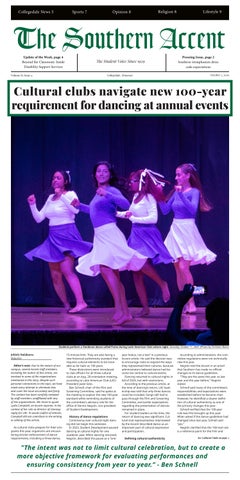
Students perform a Honduran dance called Punta during Latin American Club culture night. Saturday, October 11, 2025. (Photo by Christian Bass).
Jehiely Balabarca Reporter Editor’s note: Due to the nature of our campus, several Accent staff members, including the author of this article, are involved in some of the organizations mentioned in this story. Despite such personal connections to the topic, we have made every attempt to eliminate bias and cover the issue accurately and fairly. The content has been carefully reviewed by staff members unaffiliated with any of the organizations. We chose to quote Lydia Campbell, an Accent reporter, in the context of her role as director of choreography for LAC. To avoid conflict of interest, Campbell did not contribute to the writing or editing of this article. As cultural clubs prepare for their programs this year, organizers are encountering stricter enforcement of dance requirements, including a three-dance,
15-minute limit. They are also facing a new historical authenticity standard that requires cultural elements to be traceable as far back as 100 years. These distinctions were introduced to club officers for all three cultural clubs at an Aug. 28 orientation meeting, according to Latin American Club (LAC) President Jaziel Soto. Ben Schnell, chair of the Film and Screening Committee, said he spoke at the meeting to explain the new 100-year standard while reminding students of the committee's advisory role for the office of Dennis Negrón, vice president of Student Development. History of dance regulations Controversy over cultural-night dancing did not begin this semester. In 2023, Student Development paused dancing at cultural nights for one academic year. When dancing returned, Negrón, described the pause as a “one-
year hiatus, not a ban” in a previous Accent article. He said the decision was to encourage clubs to expand the ways they represented their cultures, because administrators believed dance had become too central to cultural events. Dancing returned to cultural nights in fall of 2024, but with restrictions. According to the previous article, at the time of dancing’s return, LAC leadership was told that only three dances could be included. Songs still had to pass through the Film and Screening Committee, and earlier expectations regarding the presentation of dances remained in place. For student leaders at the time, the return of dancing was significant. Cultural club representatives interviewed by the Accent described dance as an important part of cultural expression and participation. Defining cultural authenticity
According to administration, the committee regulations were not technically new this year. Negrón told the Accent in an email that Southern has made no official changes to its dance guidelines. “They are the same this year as last year and the year before,” Negrón stated. Schnell said many of the committee’s responsibilities and expectations were established before he became chair. However, he identified a clearer definition of cultural authenticity as one of the primary changes this year. Schnell verified that the 100-year rule was first brought up this year. When asked if the dance guidelines had changed since last year, Schnell said “yes.” Negrón clarified that the 100-real rule is a reference point for the Film and See Cultural Clubs on page 3
"The intent was not to limit cultural celebration, but to create a more objective framework for evaluating performances and ensuring consistency from year to year.” - Ben Schnell
If you would like to be a contributor, contact Chloe Smith at chloegsmith@southern.edu
2 | Thursday, October 1, 2026
NEWS
Southern reemphasizes dress code expectations Lydia Campbell Reporter Faculty and students have felt a noticeable shift this semester as Southern places renewed pressure on enforcing its dress code. A beginning-ofthe-year email sent by Dennis Negrón, vice president of Student Development and Title IX coordinator, reminded the student body that “all students are expected to maintain compliance with the university dress code while on campus and during official university events.” Bob Young, senior vice president of Academic Administration, explained that the current push was prompted by concerns about the inconsistent application of the longstanding policy. “Over time, students have expressed in surveys and other feedback that one of their concerns is not necessarily the existence [of] the dress code itself but the perception that it is applicated unevenly,” Young stated. “Consistent application also supports one of Southern’s institutional goals: providing a safe nurturing learning community characterized by integrity and mutual respect. The emphasis has therefore been on consistency rather than increased strictness.” Young emphasized that a part of Southern's mission is to “transform lives for eternity,” which includes having a dress code. “As part of that mission, the
university seeks to provide a distinctly Christian learning community that supports students’ spiritual, intellectual, social, and physical development,” he stated. “The dress code is one aspect for a broader framework of community expectations designed to foster modesty, professionalism, personal responsibility, and respect for others.” According to Southern’s student handbook, the university’s dress code emphasizes modesty, neatness and professional appearance. The policy includes general and gender specific requirements for all students, such as wearing shoes and shirts in public spaces and maintaining clean, neat hairstyles. The handbook also lists items that are not allowed, including tank tops, loungewear, torn clothing, tight or revealing styles and jewelry. Students who wear jewelry may be fined. Additional rules apply to the Hulsey Wellness Center, where tops with sleeves, closed‑toe shoes and modest workout attire are required. Jayla Rucker, a freshman biology research major, noted that some faculty emphasize professionalism when it comes to dress. "My professor from Jump Start in personal finance [talked] to us about how sometimes people from certain professions come and sit in his lectures,” Rucker said. “I feel like it's important for holding an image of the school in general."
Enforcement Currently, the university does not have a formal system that tracks the enforcement of dress code. Young addressed how enforcement is measured, expanding on the lack of a system by explaining how students should be dress-coded. “Administrators remain attentive to feedback received from students, faculty, staff, and survey data,” he stated. “Recent communications to faculty and employees, in harmony with employee policy 1550, emphasized that conversations regarding dress code concerns should always be conducted discreetly, kindly, respectfully, and with good judgment, sensitivity, and tact. Employees are encouraged to avoid embarrassing or humiliating students and to approach concerns in ways consistent with Southern's Christian values.” While enforcement expectations have increased campus-wide, some areas, such as the Hulsey Wellness Center, report no changes to their existing guidelines. Judy Sloan, dean of the School of Health and Kinesiology, said the dress code for the facility remains consistent. “The dress code in the Hulsey Wellness Center is the same as it has been in the past,” stated Sloan. “A dress code should not have to be ‘enforced.’ Ideally, it would be followed as part of respectful employment or in this case as a respectful student choosing to gain a great academic education at Southern
Adventist University.” Student response Rucker said she hasn't noticed much enforcement of the dress code so far. "I feel like, from what I've seen, it hasn't been enforced,” she said. “But I feel like at the start of the semester, they did send emails and stuff." Danyil Rynzhuk, a sophomore theology major, expressed concern about students disregarding the policy. "We have a dress code that a lot of students don't follow, unfortunately, which is not okay,” Rynzhuk said. “So, my opinion is, I think we should start following the dress code." Savannah Herr, a freshman psychology major, questioned whether some parts of the dress code still make sense. "One of the [policies] said makeup must be natural in appearance, and it was saying that any types of jewelry [are] still prohibited,” Herr said. “But I just don't think that that's necessary because I feel like that's kind of outdated. I know some Adventist schools are getting rid of their no-jewelry rule. So, for it to still be a rule at a college, when it's adults, I just don't think that's necessary." Online reaction Many online users reacted on Fizz, a discussion app for college students that allows anonymous posts. A student who said she had been dress-coded for wearing jewelry in her religion class
included a photo of an email she received from her professor with the caption: "I've never been more rage baited in my entire life.” One user commented on a related post, stating "That [dress code] kinda good though. This is an Adventist school, and some people are wearing really [inappropriate] clothes like be fr [for real]." Religious context Professor Esteban Hidalgo, a professor in the School of Religion, explained why dress code enforcement might feel different this year. "When written standards are frequently overlooked, students naturally begin to assume that those standards are optional,” Hidalgo said. “Under those circumstances, a renewed effort to apply an existing standard can feel like the introduction of a new rule, even when the underlying expectation has been present for some time.” Hidalgo added that he hopes students will take their own initiative to follow the principles of the dress code for themselves. “A Christian university has failed in its educational mission if students graduate merely knowing how to avoid getting dress coded,” he added. “We want students to become Christians capable of exercising mature judgment long after Southern no longer has any authority over what they wear.”
Students read a handout from Professor Mills McArthur, wearing various styles of clothing, in Brock Hall room 3009. Wednesday, April 15, 2026. (Photo by Katie McConnell).
Southern Accent
The Accent encourages readers to write articles and voice their opinions. However, the views expressed do not necessarily reflect the opinions of the Accent, the Southern Adventist University or the Seventh-day Adventist Church. For any questions, comments and article submission information, email the editor at chloegsmith@southern.edu For all advertising inquiries, email alvajohnson@southern.edu.
Editor-in-Chief Chloe Smith
Lifestyle Editor Maddie Schmidt
Managing Editor Sienna Escobar
Sports Editor Ava-Caroline Schmidt
Assistant Managing Editor Gabrielle Young
Opinion Editor Leif Bromme
Photo Editor Katie McConnell
Circulation Manager Ian Francis
Social Media Management Gianelli Banuchi Jenna Fortune
Layout Manager Nyah Jackson
Web Management Eri Jorge Jeziel Gomez Reporters Jehiely Balabarca Rebecca Walwyn Lydia Campbell Lillie Domenech Madeleine Miyashiro Collegedale Editor Kyla Wetmore Collegedale Managing Editor Asher LeVos
Collegedale Layout Manager Malcolm Maynes Copy Editors Julie Herter Lauren Sahly Hadassah Nazarenus Layout Designers Katherine Damian Flores Jewell Hewitt Staff Sponsor Alva James-Johnson
3 | Thursday, October 1, 2026
For more related news, visit our website at southern-accent.org
NEWS Cultural Clubs Continued from page 1 Screening Committee, not an official change to the dance policy. “Professor Schnell is the new chair of the committee,” Negrón said. “That 100-year rule is really not part of the protocol. Basically, what he asked me was, ‘When I'm screening material for cultural night, I’m thinking about 100 years is a good time to determine if something is cultural,’ and I said, ‘That's fine.’” According to Negrón, there was some concern from other faculty about using a historical timeframe to evaluate the performances. “Dean Anthony came to me and said, ‘This 100-year rule is problematic because there are some countries that are not even 100 years old,’” Negrón said. "I said, ‘That's a good point. That's why it's not a policy; it is like a reference.’” According to Schnell, cultural authenticity had previously been part of the review process, but there was not always a consistent understanding of how it should be applied. Over the summer, he said the Film and Screening Committee and Student Development discussed the need for greater clarity and consistency when evaluating planned performances. “The result was the adoption of a historical authenticity guideline that looks at whether a dance style or cultural expression has roots within the culture prior to the modern era,” Schnell said. The committee evaluates both appropriateness and cultural authenticity, he said. Appropriateness considers whether a performance aligns with Southern’s mission and expectations as a Seventh-day Adventist institution, while authenticity considers its connection to the culture being represented. “The intent was not to limit cultural celebration,” Schnell said, “but to create a more objective framework for evaluating performances and ensuring consistency from year to year.” Cultural clubs react Student leaders from the Black Christian Union (BCU), Asian Club and Latin American Club (LAC) told the Accent that expectations communicated this school year have affected how they approach dancing, music and other elements of their programs. Ian Bermudez, a senior health science major, Asian Club vice president and Asian Night director, said Asian Club learned about the guidelines during the cultural club orientation meeting. He understood that administrators wanted to see more traditional aspects of the cultures and less emphasis on modern developments. “I was a little shocked when the new guidelines were given to us during the meeting,” Bermudez said. When he shared the information with the Asian Club’s leadership, he said their reaction was also one of surprise. The guidelines have required Asian Club to change its format, including the number of students who will be able to participate in dances. However, Bermudez said he does not view those adjustments entirely negatively. “We’ve had to change up our format and outline for this year’s Asian Night; however, I believe that we’re evolving into something better,” he said. “We’re creating new, fresh and fun ways that we can showcase Asian culture that don’t rely on dancing.” The historical emphasis has presented a different challenge for BCU. A BCU officer familiar with cultural night planning, whom
the Accent granted anonymity due to concerns about repercussions, said BCU learned about the historical requirement after preparations for its program had already begun. According to the officer, organizers had planned around a three-dance limitation but learned after the school year began that cultural elements would also need to meet the 100-year historical standard. “We were so shocked,” the officer said, adding that organizers often begin preparing before the academic year starts. The timing required BCU to reconsider portions of its program, according to the officer. A larger concern was whether reaching a century into the past could accurately represent the cultures of current BCU members. “What we have today is culture,” the officer said. “We don’t have to go back 100 years to have culture.” Part of the difficulty, the officer said, is the range of cultures represented within BCU. The organization includes students with Black American, African and Caribbean backgrounds, among others. The officer also questioned how easily students can find documentation of some cultural expressions dating back to the 1920s. “I think, yes, that is a foundation,” the officer said. “Everything builds off of each other throughout the years, [but] I don’t think going back that far represents us today.” Bermudez said he found more room within the historical framework for Asian Club dances. “Asian cultures are well preserved, and the history can be dated back many years,” Bermudez said. “We have lots of different avenues to share our culture and history.” However, he stopped short of saying that makes Asian Club’s task easier than that of other cultural organizations. “I’m not sure we have an easier time meeting the requirements than the other cultural clubs,” he said. LAC cultural night As the first cultural organization preparing a cultural night for the school year, LAC has a limited period after students return to campus to organize participants, rehearse and prepare material for review. LAC is also the first club to test any new or clarified dancing restrictions for the year. Lydia Campbell, LAC’s director of choreography, said this year’s restrictions have affected their choreography. “We can’t include as many people as we used to,” Campbell said. “Now we’re turning people away from a night that’s supposed to showcase their culture.” Melina Swaisgood, a senior mechanical engineering major and an LAC assistant choreographer, also expressed concerns over the effects on participation. “I think this year provided a lot less opportunity for involvement just because of certain restrictions on how many dances we could have [and] how many people could come on and off stage during those different dances,” she said. Swaisgood added that the choreographers were able to work within the approval and safety requirements. “I think that the dances at their heart don't have anything inherently bad,” she said, “and if something doesn't get approved, the nature of the dance is what it is, so at that point, it's preference [of the committee members].” Campbell said the historical expectation surprised her. “You need to understand that a student’s culture is different from their parents’ culture, than from their grandparents', their great-grandparents’,”
Students perform at LAC Night 2025. Saturday, October 11, 2025. (Photo by Christian Bass).
Campbell said. “My culture is not the same as my parents’ culture.” Committee response Schnell acknowledged that cultural identity is not static. “Cultural identity is complex, particularly in a globalized world where traditions evolve, and communities influence one another,” he said. “We recognize that many students experience their culture through both their ancestral heritage and their American experience.” Schnell said the historical guideline was not intended to invalidate those identities. “The historical authenticity guideline was adopted not because contemporary cultural expressions are invalid,” he said, “but because the committee needed an objective way to distinguish between cultural representation and popular entertainment.” Schnell said the guideline emerged through discussions involving the Film and Screening Committee and Student Development leadership. As implementation has continued, he said, administrators have also received feedback from students and cultural organizations. “Student feedback is valuable because it helps us understand how policies are experienced by those participating in these events,” Schnell said. “I expect those conversations to continue as we evaluate how the guidelines function in practice.” He also emphasized that the committee is not intended to define students’ identities. “My responsibility is to help administer policies that have been entrusted to the Film and Screening Committee while treating students respectfully,” Schnell said. For the BCU officer, the current framework has raised a more fundamental question about the purpose of cultural nights. “Who is BCU Night for?” the officer asked. “Is it for the committee? Or is it for students?” The officer said the concern is not that history should disappear from Cultural Night, but that emphasizing history will overshadow the culture students are currently living. “This is just giving [like] a history project,” the officer said. “You want us to tell history more than celebrate our actual culture.” Dancing within a religious institution Schnell said balancing students’ expression and institutional policies is part of the committee’s responsibility, as Southern is both a university and a faith-based institution. “Students choose Southern knowing that it operates within a distinct religious tradition and set of community expectations,” he said. “At the same time, cultural nights are valuable opportunities for students to share and celebrate their heritage with the broader campus community.” He said the goal is not to choose between those priorities but to allow both to coexist. Schnell also said the current framework can continue to be evaluated as administrators see how it operates and receive
feedback. “I do not think it is wise to assume that any guideline should remain permanently unchanged,” he said. Swaisgood said that, as a Seventh-day Adventist, she does not believe there is anything inherently wrong with dancing. For her, dancing is a personal and lifestyle choice, similar to the way people choose different dietary restrictions for themselves. Soto said that he understands the process the committee has to go through to provide a venue for cultural dancing on campus. “I understand what administration is doing [with] these rules, so everybody involved at Southern can win something out of it,” Soto said. "I'm grateful administration has worked with us to be able to have dances.” Communication challenges One of the main issues brought up by cultural club officers was gap in written and spoken communication. Alexis Grentz, director of Student Life and Activities, said that cultural club leaders were given access to an online planning binder for cultural nights as of the orientation meeting at the start of the school year. According to Ainsly Acevedo, junior history major and LAC Night director, she had access to a version of the document before the start of school. However, the guidelines she was referencing only included regulations from previous years, such the three-dance and 15-minute restrictions. Acevedo, Soto and Campbell said that there was no written documentation of the new 100-year limitation during their process of planning the LAC Night performance, including during their presentation for the screening committee. Soto said that having dance regulations clearly indicated in writing would be an important adjustment so that clubs could have a better understanding in advance of future cultural nights. Grentz clarified that due to technical issues, the updated planning document clearly stipulating the 100-year rule had not been made available to cultural club officers as of the writing of this article. Grentz allowed the Accent to review the updated document in an interview. She said she is working to make it available to cultural club leaders and eventually public. The update included a section that stated, “Any dance numbers must use music in the style of traditional folk music from their culture, utilizing the musical styles and instruments available before 1900. The music does not need to have been composed before 1900 – it could have been composed yesterday – but it must be written in the musical style of that era.” Acevedo verified that the handbook she had been referencing did not contain this update. She expressed surprise at seeing the added information in the unpublished version. “I got access to this [original document] at the initial
meeting, but I don't have access to the one [the Accent saw],” Acevedo said. “I would love to know when she added that tab because from what it seems like, on the run-through night, the committee itself did not know its own rules as well. There were so many conversations afterwards, trying to get clarification on ‘What does traditional mean? What does 100 years ago mean in context of every single culture?’” Grentz explained that she was actively creating the cultural night planning document at the beginning of the school year. She said that she was slowed down by technical issues, such as usage limitations with Claude, the artificial intelligence tool she used to build the document. The 100year rule was added to the document roughly a week ago, Grentz said, and trouble with permissions on the document had prevented any of the cultural club leaders from being able to see it. “I would have saved so much stress if I just knew, written down, what was feasible and what wasn’t,” Acevedo said. “We just didn’t have that. I genuinely don’t want to break rules.” Sharing culture According to Soto, working through limitations has made the LAC community stronger. “Our community has always learned to adapt, create and move forward despite the barriers in front of us,” Soto said. “Every single problem that we have and every single upset, there's always something and someone who has helped us to go through those. ... It just demonstrates how resilient [we are] and how important culture is for us.” For Bermudez, attending a cultural night is ultimately about what students and visitors encounter there. “I want people to see all the Asian cultures showcased as unique, intricate and beautiful,” he said. “Every culture is different and has so many interesting features that we can’t fit into one night.” Swaisgood said that to her, cultural nights had two main purposes: providing a space for people to express their own culture and allowing other students to interact with a culture that might be new to them. “I think it serves to give people of that culture a space to express something that they love,” Swaisgood said. “You can’t really perform without an audience, right?” As part Puerto Rican, Swaisgood said that her childhood was heavily rooted in music and dance, and that for her, dancing is a way to tap into warm memories, especially after a rough week. “It's very freeing -- I think that dance is the most pure physical expression of joy,” Swaisgood said. “That's how I felt this past week with LAC practices: even with everything going on that's crazy, LAC gave me a chance to hit pause and just dance and remind myself that I'm living life.” Other Accent staff wrote and reported on this article.
4 | Thursday, October 1, 2026
If you would like to be a contributor, contact Chloe Smith at chloegsmith@southern.edu
NEWS
Students complete handwritten transcription of the Bible Bella Lagos Contributor Filling two full shelves in Barry Tryon’s office at Hackman Hall lies a rare literary archive: an entire Bible, handwritten by more than 1,100 college students in more than seventeen languages. What started as an experimental classroom assignment fifteen years ago is officially wrapping up its final pages this semester. For Tryon, a professor in the School of Religion, the goal was never to just begin a student project, but rather to force a fast-paced generation to pause, pull out a pen and engage with ancient text in a deeply personal way. “I think it slows us down,” Tryon said. “When you’re copying it, you have to look word for word and check your sentence structure. It’s one small way of forcing you to slow down as you’re working with the Word of God.” The inspiration for the project originated back in Tryon’s high school days, when he attended a youth festival where thousands of teenagers transcribed the entire Bible
in two-and-a-half days. Years later, while teaching general education religion courses, he decided to adapt the concept to help students appreciate how scripture was preserved over centuries. Each semester, Tryon divides chapters from a book of the Bible among his students from Life and Teachings of Jesus and Christian Spirituality. To help students stay organized while writing, Tryon provided custom lined paper with dedicated margin space for verse numbers. Students were told to begin each new verse on a new line and sign their name to the chapter. Tryon drew inspiration from “The Book of Kells,” a famous 9th-century illuminated manuscript. He also had students illustrate their designated chapter with their own artwork, reflecting its passage. “I wanted students to use both sides of their brain...the artistic side and the logical side, and drawing would do that," Tryon said. "...it would just add a little color and diversity to their project." This semester, students in Tryon’s classes are writing 2 Kings, the final pages of the
handwritten Bible. The assignment permitted students to write in any Bible translation or language. Over the years, the pages have accumulated text in Latvian, Chinese, Japanese, Korean, Spanish and Portuguese, among others. For students like Keren Sampaio, a sophomore double majoring in culinary arts and fine arts, the project was a chance to connect with scripture in her native language. "I believe writing everything down by hand really helped my brain process," Sampaio said. “I could actually process and think [about] my words and actually review what I learned in that chapter... It was a great experience." For Sampaio, contributing in her native language made the experience more meaningful. "I was able to do it in my native language," Sampaio said. "I wrote it in Portuguese. So, I feel like I was able to contribute, but also leave a special mark in that Bible, and I'm so excited." Though writing errors were common, Tryon treated any mistake as a teaching moment
rather than a flaw. “I want them to experience it,” Tryon said. "I show them how to correct it by putting a line through it. There are mistakes, but it doesn't change the content of their chapter. They may get a couple words mixed up or [I may] have to draw a line through because they got a word out of order, but it doesn't change the meaning of their
passage." This semester, the final chapters will be turned in, completing the long-term project. The plans for preservation are still being finalized, with thoughts of digitizing it upon completion. For now, the project’s legacy remains in the quiet hours students spent putting pen to paper.
Professor Tryon reads through Bible chapters handwritten by students for his "Scribe for a Day" project. Monday, September 28, 2026. (Photo by Christine Lee).
Beyond the Classroom: Inside Disability Support Services Melea Hwang Contributor Located in a corner on the third floor of the Bietz Center for Student Life is the Disability Support Services (DSS) office. There, Jahnil Ancheta is singlehandedly responsible for countless students receiving the help they need for an enriched college experience. DSS is an on-campus resource which “facilitates equal access to Southern's learning community for students who have documented disabilities or suspected learning differences,” according to their website. After moving from a position in Admissions to now being DSS coordinator, Ancheta was faced with a challenge. “I think for some reason DSS was just not super well known on campus,” she said. “It’s really easy in this role to get stuck here in the office and… hard to get out on campus because you’re so busy managing the day-to-day stuff.” Ancheta said she is striving to be intentional about making connections across campus. She works to forge partnerships with departments and relationships with professors, all to give the students the experience they deserve. “I have to partner with faculty and staff to ensure that students with disabilities have access,” she said. While she works with the students to create an accommodation plan, it’s the professors who implement it. This networking has been vital to her growth of DSS, according to Ancheta. On the DSS website, a disability is defined as “a condition that can substantially impact your ability to think, eat, breathe, walk, work, see, speak, learn, etc.” According to their website, DSS has services in place to assist students with psychiatric, physical and medical disabilities. Students may not realize these services extend to temporary disabilities as well, such as concussions or broken legs, according to Ancheta. Axel Orellana, a junior mass
communication media production major, was surprised to learn about the services offered for temporary disabilities. “I had no idea,” Orellana said. “I thought it was [only] for people that had learning disabilities that they’ve grown up with. I think that it should be promoted more. It’s necessary for temporary things, because accidents happen all the time.” DSS can help guide students through everything from sports injuries to surgery recovery. Many students said that they are only familiar with DSS services related to testing accommodations, such as extended time, a quieter environment or speech-to-text add-ons. These accommodations are some of the most frequently used services, according to Ancheta. For Orellana, though DSS is mentioned in each of his classes’ syllabi, it is not something he ever gave much thought. “It’s a part that I always just skim over [in] the syllabus, so it’s not something I have seen much about.” Ancheta said accommodations can look like any number of things- emotional support animals, service animals, changes in housing or meal adjustments. According to Ancheta, one of the most underutilized resources offered at the DSS office is the sensory room- a small, enclosed space, furnished with fidget toys and a massage chair. This room is not just for those with sensory difficulties, but for anyone experiencing overstimulation or in need of anxiety regulation. Ancheta recommends it as a resource before or after tests, adding that faculty and staff can use the room as a retreat. Many students hesitate to seek accommodation because of the strenuous process it might entail, according to Ancheta. In the past, this has been the case, but the program has been refined. The system has recently been streamlined through a new application portal called “Accommodate.” Following a link on the DSS page of Southern’s website, students can apply for services. They will need to
The Disability Support Services office at Southern Adventist University provides resources and accommodations for students with disabilities. The office is located on campus at the Bietz Center, 3rd Floor, Suite 3900. Monday, September 28, 2026. (Photo by Sheldon White)
submit documentation and medical forms, then book an intake meeting with Ancheta to formulate a reasonable accommodation plan. “It’s called the interactive process, where we collaborate to come up with a reasonable accommodation plan … that honors both the student’s needs and the integrity of the curriculum.” Ancheta said. Being the only staff member of her department comes with limitations and advantages, Ancheta said. She employs five student workers, who manage the front desk and proctor tests. “It is rewarding and challenging at the same time,” Ancheta said. “Rewarding, in that it's nice to have the opportunity to create and update and change things… Challenging, in that the work is heavy sometimes, and it can be a little lonely. But
not in a way that I am discouraged by, necessarily. It just comes with the job. But I love when there's the vibrancy of the students that come in to test that I build relationships with, or my student workers.” One of her student workers is Ella Schwartz, a senior psychology major. Schwartz’s job includes proctoring and scheduling tests, prescreening students for accommodations and corresponding with parents and faculty. She spoke about the impact she’s seen DSS have on students. “[Students] come in seeming so distraught, and they want a meeting with Janhil, and we set it up and get it all taken care of,” Schwartz said. “Then, towards the end of the semester, seeing how calm they are when they come in for their test, they’ve got it under control
[and] they feel okay again.” Schwartz also explained how the online application system aids professors. “Obviously [professors] can’t see confidential information, like what the diagnosis is, but they can see students requesting tests with [DSS],” Schwartz said. “They can upload the tests, give instructions for how to proctor a test, stuff like that.” Acheta emphasized the confidential nature of the requests. “Accommodations are not on your transcripts,” she said. “No one know has to know except the professor.” According to Ancheta, this privacy is central to the services her office provides. Being able to articulate needs to their professors is a tool she seeks to sharpen in students. “I just want students to know we’re here,” Ancheta said.
5 | Thursday, October 1, 2026
For more related news, visit our website at southern-accent.org
COLLEGEDALE NEWS The Spot Creamery opens new location in Collegedale April Lin-Ao Contributor Located along Ooltewah Ringgold Road sits The Spot Creamery, an ice cream shop that opened in May of this year. In the building, black-andwhite checkered tiles span the floor. Brightly painted canvases with Bible verses hang along the walls, and a few arcade games sit by the creamery’s entrance. The ice cream shop has an array of Hershey’s ice cream flavors to offer, along with nondairy options and Italian ice. The Spot Creamery in Collegedale is the second location that owners David and Deedra Bryant have opened, after their first location in Ringgold, Georgia. In an interview with the Accent, the Bryants recalled
memories of The Spot Creamery’s roots. In 2018 to 2019, they began a nonprofit organization in Ringgold called The Spot. The Spot’s mission was to provide a place for the youth of their town to come together and find community. “We started the nonprofit because we felt led by the Lord,” Deedra Bryant said. In the early stages of trying to start The Spot, a donor gave the Bryants a year’s worth of rent to pay for the space in which The Spot would be operating. The donor had an allotted amount of money that he wanted to give and had been looking for the right recipient. “There were lots of obstacles that we would not have gotten through while we were setting it up without [God] working it all out,” Deedra Bryant explained.
Fast forward a few years to 2022, and the Bryants opened The Spot Creamery in Ringgold, with the same mission: for people to congregate, connect and find community. “We had the nonprofit for two years,” said Deedra Bryant. “It became hard to get volunteers, so then we decided to turn it into a business where the youth could still come and hang out. That’s when The Spot Creamery came about.” She explained that a previous ice cream shop had been closed down for some time in Ringgold, which in part prompted the Bryants to open the creamery. Bryant also shared her approach to hiring employees for the creamery. She explained that she wants to give a chance to those starting out, especially
teenagers who are looking for work. Lela Tolbert, a worker at the creamery, said she appreciates her job at The Spot Creamery as a high schooler. “It’s pretty good pay for a starting job,” she said. “The atmosphere is really nice.” Tolbert also described the shop as a cozy area, making it a place for people to come and hang out at or even read. Samantha Blackburn, a junior English major at Southern Adventist University, recalled her experience at the creamery. “I went with a big group late at night, and there was one person working there,” she said. “[The creamery] had lots of options with ice cream. I don’t know if they were happy with the size of the group and the time of night, but I would go again just with a smaller
group and not so late.” Another student, Caryn Panjaitan, a senior in psychology, described her visit to The Spot Creamery. “It was a really cute place,” she said. “It had fun decorations and I liked the vibe of the place. There were a lot of flavors, and I tried a lot of them. I felt bad because I kept asking the guy, ‘Oh, I can I have a sample?’” As The Spot Creamery was being formed, the Bryants said their main intention was to find community behind their business. “Just like the Ringgold location, we would like this to be a place where the community can gather in a peaceful atmosphere and have a treat,” she said.
Inside The Spot Creamery in Collegedale. Monday, September 21, 2026. (Photo by Katie McConnell).
(Graphic by Jewell Hewitt)
6 | Thursday, October 1, 2026
If you would like to be a contributor, contact Chloe Smith at chloegsmith@southern.edu
All-Night Softball
”LPC” and “Southern Breeze” teams from the girls division, give each other high fives after a tough match during Southern’s intramural all-night softball tournament. Saturday, September 26, 2026. (Photo by Ava-Caroline Schmidt).
Nick Veal, a senior accounting major, pitches for his team during Southern’s Intramural all-night softball tournament. Saturday, September 26, 2026. (Photo by Ava-Caroline Schmidt).
Nic Johnson, a senior automotive service major, hits a ball toward center field during Southern’s intramural all-night softball tournament. Saturday, September 26, 2026. (Photo by Ava-Caroline Schmidt).
“JaydenPak&em” men’s softball team shares a moment of prayer during Southern’s intramural all-night softball tournament. Saturday, September 26, 2026. (Photo by Ava-Caroline Schmidt).
7 | Thursday October 1, 2026
For more related news, visit our website at southern-accent.org
SPORTS
For the Love of the Game: All-Night Softball brings attention and energy this semester Ava-Caroline Schmidt Sports Editor Southern Adventist University’s annual all-night softball tournament returned to the Summit Softball Complex, bringing students, parents and local community members together for a night of competition that lasted into the early morning. This year, Troy Walker, director for Southern’s Intramurals, added a new all-star game aspect for the guys and girls before the actual tournament. Walker reached out to the softball team captains and asked them to recommend their four best players. The selections were divided into East and West teams for both the men’s and women’s divisions. These all-star games began at 8:15pm, with the East women’s team and the West men’s team winning the matches. At 9pm, the regular games started, and the countdown of the tournament outcomes had begun. Throughout the softball season, there were two divisions in one main league for the girls, while the guys had four divisions across an A & B league. Therefore, during the tournament, all the leagues are combined into two main groups: guys and girls. For the tournament, the women’s league was double elimination all the way up to the championship match, where the winner of the winner’s bracket goes against the
“winner” of the loser’s bracket for the title. As for the men’s tournament, because of the number of teams, they were single elimination until there were eight remaining teams. Those eight last standing teams then played double elimination for the rest of the tournament. Their final was the same as the girls, a single championship game. The all-night softball tournament is a place where students, parents and locals can come to play, watch and have a fun experience. Brenda Garcia, an enrollment management employee for Southern and a mom to two of the athletes competing in the tournament, said, “Seeing a community getting together and enjoying a good time, in a healthy way,” was great to witness. It’s not only about being a part of the health message but also being a part of a community by playing sports that is very special. And it was not just players on different teams. Refs and scorekeepers swapped roles, going from writing down the score to trying to score a run for their team. “Honestly, it’s kinda fun… it is definitely kind of stressful sometimes, especially this softball tournament more so than normal. Score keeping is a little bit more intense.” said Marli Mitchell, a junior history major, who has been scorekeeping for intramurals since her freshman year. Mitchell added that one of
the reasons for the intensity and fast-paced routine of the night was that during the regular softball season, games are 55 minutes, whereas for the tournament they are 30 to 35 minutes. The final games concluded early the following morning. Team Base-ically Tired beat the Bat Biddies team in the women’s championship game with an 11-0 win at 6:35am, while Team Griggs won the guys division, beating the G-REG team 11-5 at 6:45am. Both winning teams had come up from the
loser’s bracket – which is also called the secondary bracket. In a double-elimination tournament, that is where teams go after their first loss - to win the final for their divisions, proving that resilience, determination, prayer, trust, caffeine and never giving up can change the outcome. Rebecca O’Dell, a senior business administration major, said that the final was tons of fun. “I played with a lot of people that I’m friends with and that I play other intramurals with, so it made the games full of good
energy and not a lot of pressure,” O’Dell said. O’Dell went on to say that she was excited for the win since this is her last year, along with a lot of her other teammates. One of her teammates’ parents flew all the way from California to watch and support. “I was so excited and happy that her family got to witness her win.” O’Dell said, highlighting that the all-night softball gives players, families, officials and scorekeepers an opportunity to compete while spending the night together as a community.
Aiden Lee, a junior biology major, pitches for his team “RG Kings,” during a game against their opponent, “G-REG,” during Southern’s Intramural all-night softball tournament. Saturday, September 26, 2026. (Photo by Ava-Caroline Schmidt).
Intramural Softball Game Results Thursday (17th): • Men’s B - Hit and Run vs JaydenPak&em = 8 to 5 - How Ju Know? vs Moneyballers = 0 to 2 • Women’s - Pitch Perfect! vs Bunt cakes = 2 to 0 - hits and giggles vs Bat Biddies = 6 to 21 - softball team vs The Batties = 5 to 7 - LPC vs she ball = 3 to 3 - JYPapis vs FOUL PLAY = 0 to 2 - BAT INTENTIONS vs Outta Your League = 2 to 0 - league of their own vs Base-ically Tired = 12 to 14 Monday (21st): • Men’s A - Crash outs vs MLB YoungBoy = 25 to 14 • Men’s B - Big Ballers vs La Santa Trinidad = 0 to 2 - Fearless Penguins vs How Ju Know? = 2 to 0 - Old School vs Shiesty Denny = 7 to 6 - Lone Pairs vs tuff valley = 17 to 4 - Diamond Girls vs RG Kings = 14 to 18 - JaydenPak&em vs Moneyballers = 5 to 4 • Women’s - Southern Breeze vs hits and giggles = 17 to 2
Tuesday (22nd): • Men’s A - MLB Youngboy vs Hitmen = 14 to 19 • Men’s B - doot doot six7 vs Touse Moggers = 2 to 0 - Shalom Yahweh vs The Sandlot = 10 to 1 - Hit and Run vs La Santa Trinidad = 3 to 4 - Shiesty Denny vs Lone Pairs = 2 to 13 - Diamond Girls vs Old School = 6 to 15 - RG Kings vs tuff valley = 16 to 11 - The Night Shift vs 2 strikes 1 bat = 16 to 5 • Women’s - JYPapis vs Bunt cakes = 7 to 8 Thursday (24th): • Women’s - hits and giggles vs LPC = 4 to 0 - Bunt cakes vs Outta Your League = 2 to 0 - JYPapis vs Pitch Perfect! = 0 to 2 - Handball vs she ball = 0 to 2 - league of their own vs Southern Breeze = 7 to 17 - softball team vs BAT INTENTIONS = 7 to 4 - The Batties vs FOUL PLAY = 4 to 13 - Bat Biddies vs Base-ically Tired = 11 to 1
8 | Thursday, October 1. 2026
If you would like to be a contributor, contact Chloe Smith at chloegsmith@southern.edu
OPINION
Why practical education matters Leif Bromme Opinion Editor For years, home economics was a staple of the United States education system. The class was originally for women and taught household skills like cooking, sewing, budgeting and childcare. Kaltman Law explains that until the 1972 introduction of Title IX, which integrated gender-segregated courses, men took a class called Industrial Arts. There, they learned trade skills like carpentry, metalworking and mechanics. Through the years, both classes helped to prepare students not just for employment, but for the demands of daily life. Home economics and industrial arts both eventually disappeared from course catalogues in the decades following gender integration. Pittsburg Parents newsletter explains that part of this decline was due to the prioritization of Science, Technology, Engineering and Math (STEM) fields. Instead of maintaining expensive culinary or sewing rooms, schools chose to invest in their STEM courses. Despite integration, the gender division may have also associated these classes with outdated domestic roles. Many of these changes, however, align with a societal change of pace. Until recently, it was essential to be able to cook consistent healthy meals; now, one can subscribe to a meal service, use DoorDash or eat fast food. Rather than learning to mend damaged clothing, most simply order new items online. Have we stopped teaching life skills
because other options are available, or have these options fed on a generation that lacks life skills? The decline of Home Economics also occurred here at Southern Adventist University, where Summerour Hall originally contained the department. According to a 1989 issue of the Southern Columns, students could graduate with a degree in home economics until that same year, when its courses were dissolved or divided between other departments like Health Science and Culinary Arts. In 2014, Summerour Hall was officially redesigned and rededicated for the schools of Education, Psychology and Counseling. Deborah Duerksen, a 1982 graduate of the Home Economics program, explained what types of courses were involved in the degree. “I took nutrition, psychology, dressmaking and pattern-making classes,” said Duerksen. “We had classes with a pretend house and a dining room table. You had to make menus, decorate, feed people and have a banquet night.” In addition to daily classes, the major included experiential labs. “They had labs for cooking and sewing,” said Duerksen, “and things like how to budget and do laundry. [The course also included] relationship things; we discussed the stages you go through in life and the decisions you must make.” After graduating, Duerksen worked as a dean and home economics teacher at Cedar Lake Academy (now Great Lakes Academy) and Forest
Lake Academy before stepping away from work in 1986. “I thought about getting my master’s degree after 1986,” she explained, “But I couldn’t be a full-time teacher. They didn’t have those [home economics] programs anymore.” Duerksen argued that society places a higher value on courses that translate to money-making careers. “Homemaking skills don’t have as much of a monetary value,” she said. “But if you don’t know how to sew on a button, you have one less outfit. If your legs aren’t the same size as everyone else’s, it may be harder to find pants. You can pay someone to hem or tailor or make curtains, but having those skills saves a lot of money and makes it more unique to what you want. But our society is ‘use it, break it, throw it away’. It’s not built to repair or reuse.” While this piece of history
is forgotten by most Southern students, Duerksen presented ample reason to prioritize practical education courses like home economics and industrial arts. Some people are taught skills like cooking, maintenance, and clothing care by their parents. Some are not. Even with family preparation, there is a stark difference between handling life as a student and adjusting to the practical demands of adulthood. Bringing back home economics as a simplified general education course rather than a full degree would help students better prepare for those demands. While past iterations of the program have focused on recipe development, the new course could emphasize affordable eating, meal planning and meal preparation – skills more relevant to our modern world. The class could also help students with cleaning, organi-
zation, bills, household management, household maintenance and basic childcare. As a general education course, it could also work with the existing personal finance course to teach students helpful budgeting and investment tips for adulthood. Some might view home economics as an outdated field – one deemed irrelevant in modern society. That same modern society treats adulthood as a major hurdle. The internet is filled with young adults coping with “adulting”: paying bills, managing finances, planning meals, organizing a life independent of school and family. Perhaps by reprioritizing practicality in our education, we can help reduce the pain of that transition to adulthood. School won’t just be a place where we are taught to work, but a place where we are taught to live.
Home Economics section of the 1970s Memories yearbook. Tuesday, September 29, 2026. (Photo illustration by Katie McConnell).
RELIGION
Beloved: Students respond to God’s love at the semesterly Week of Worship Manuel A. Gomez Contributor Southern Adventist University students gathered in Collegedale Church from Sept. 21-25 for Fall Week of Worship, a five-day campus worship experience centered on one word: “Beloved.” Guest speaker Richie Halversen, director of Church Growth and Revitalization for the Southern Union Conference, spoke throughout the week about God’s love, grace and the invitation to live from an identity rooted in Him. Halversen frequently connected biblical stories with his own experiences, including his struggle with addiction and the impact it had on his life and family. For many students, his vulnerability made the messages feel personal. “Hearing him talk about his addiction, how it affected his marriage and how his wife stayed with him through every part of the process made everything feel more real to me,” said Liannet Paneque Pillo, a freshman biology-biomedical major. The week drew some of the strongest Week of Worship attendance in recent years, reaching a high of 912 students on Wednesday. Yet beyond the number of students in the room, many described the experience as an opportunity to slow down, listen and reconnect with God amid a busy semester. For Omaris Mercado, a junior nursing major, one statement captured the heart of the week. “The message that impacted
me the most was when Pastor Halversen said, ‘Real love is not achieved, it is received,’” Mercado said. “It frees me from the responsibility of pleasing God or making Him love me, because He loves me before I do anything.” That idea became a recurring emphasis throughout the week. Through messages such as the story of the prodigal son, Halversen presented God’s love as something that precedes performance rather than something that must be earned. Students were also given opportunities to respond. During one service, students came forward for prayer and anointing. Melina Barros, a junior psychology major, said that seeing students accept the invitation was the most meaningful moment of the week. Isaac Lopez, a junior biology major, described watching students step forward after Halversen’s personal testimony as “very powerful.” The week culminated with eight baptisms throughout the weekend. For Qwentin Bland, a junior computer science major who was among those baptized, Halversen’s message on the prodigal son became particularly significant, leading him to sense God calling him to take the step of baptism. For Carlos Peguero, a sophomore theology major, that response became personal as he watched his friend Isaiah be baptized. “My friend Isaiah got baptized, and we got to pray with him individually and as a group with my other friends,” Peguero said. “Seeing him take that step
just meant a lot.” “Beloved” was also part of an effort extending beyond Southern’s campus. The Office of Ministry and Missions collaborated with the SALT program, the School of Religion, Collegedale Church of Seventh-day Adventists and the Georgia-Cumberland Conference in the first partnership of its kind centered on a shared evangelistic initiative. “Beloved” served as the first phase of that effort, with
a particular focus on Southern students. Halversen will return to Collegedale Church Nov. 7-14, 2026, for the Reveal series, which will continue the initiative with a broader focus on the Collegedale community. For students, however, the impact of the week was often deeply personal. Lana Aiko Merginio, a junior religious education major, described Week of Worship as an intentional opportunity to “pause from the
chaos of the week and rest in God’s love.” Matthew Woodcock, a junior pastoral care major, called it “a chance to slow down and really focus on giving God my struggles of the day.” In that sense, “Beloved” became more than the title of a worship series. It became an invitation to receive a love that, as Mercado reflected, does not have to be achieved. It only has to be received.
Micah Burgin, a sophomore psychology major, hugs Pastor Joseph Khabbaz, the vice president of Spiritual Life and chaplain for Southern Adventist University, after his baptism in Collegedale Seventh-day Adventist Church during Week of Worship. Friday, September 25, 2026. (Photo by Tapo Tsikirai).
9 | Thursday October 1, 2026
For more related news, visit our website at southern-accent.org
LIFESTYLE
The little things that get us through Maddie Schmidt Lifestyle Editor As college students, our week can feel like a blur of classes, assignments, work and responsibilities. But somewhere between Monday and Friday afternoon, most of us have something we look forward to. Maybe it’s a coffee run, a favorite playlist, a weekly dinner or simply an hour to ourselves. These rituals may seem insignificant from the outside, but for us students, they can become small anchors in an otherwise unpredictable week. There’s a difference between routine and ritual. Our routines are what we do and the patterns we follow out of necessity, such as going to class or attending meetings. A ritual, however, is something we intentionally return to because it brings us comfort, gives us something to look forward to or has a special meaning to us. It is a break from our routine and responsibilities and is a moment set aside simply for our enjoyment. Some rituals are a weekly occurrence that help us stay motivated as we go through each week. I started a “Taco Bell Thursday” tradition my freshman year with my two best friends that has stuck around ever since, even now that we’re in our senior year. I look forward to that ritual every week, because I get to connect with my friends, and it reminds me that the weekend is approaching fast. Toby Quillin, a sophomore biology major, hangs out with some old friends at the end of each week.
“One thing that I really look forward to is going out with my high school classmates on Saturday nights,” Quillin said. “We started this tradition last year of going to a fast-food restaurant, hanging out and playing games like Mafia or Chameleon. It definitely helps me to get through my week.” Eve Blanchard, a junior marketing major, also enjoys spending time with friends as one of her rituals. “Every week, I look forward to going to my life group meeting and hiking,” Blanchard stated. “I usually do one of those things weekly.” Alongside the weekly rituals we have are the day-to-day moments that give us a boost of encouragement. Quillin said that his daily ritual is hanging out with fellow dorm friends at the end of each day. “My favorite small part of the day is going to my friends’ room at night,” Quillin said. “I get to relax, do homework, play the piano or have a Bible study with the company of my closest friends. It’s my favorite part of the day.” Blanchard expressed that the daily moments she looks forward to is saying hello to people on the way to class. “My favorite small part of the day is walking from class to class because I enjoy seeing people and being outside,” Blanchard stated. “I could drive, but being outdoors gives my brain a break and it makes me happy to have brief interactions with people throughout the day.” Sometimes, the thing we look forward to most is the time that we get to ourselves. EJ Woy, a sophomore busi-
ness finance major, said that he needs to set aside time for himself to stay motivated throughout the week. “My favorite small part of my week is going on a walk at the track at night,” Woy said. “I’ve realized that having that alone time helps me to not be stressed and to reflect on life.” Woy went on to say that he feels most balanced and recharged when he can stick to this ritual. “If I go a week without that alone time,” Woy said, “I become so exhausted and overwhelmed. It’s a necessity for me to put in my AirPods and take that 20-30 minutes to get away from everything.” Quillin also has a weekly ritual just for himself.
“Every Thursday morning this year,” Quillin said, “I get up early and walk on the Biology Trails or go off campus to go birdwatching. I didn’t realize I was doing it every week when I first started, but it has become an important part of my week.” While all these rituals look different, they serve the same purpose: creating something familiar to return to that reminds us that we are doing just fine. Quillin expressed that his rituals help to keep a balance between his responsibilities. “My little rituals matter to me because it keeps me grounded and gives me certain things to look forward to throughout the week.” Quillin said. “It makes the workload of classes more
bearable and also helps me to have better time management and to take care of myself.” At the time, these rituals probably don’t feel like memories in the making. They are just Tuesday coffee runs, Sunday resets and Friday nights spent with the same people. But as the college years begin to blur together, it may be the ordinary moments we return to in our memories—the familiar places, the repeated traditions and the people that made an ordinary week just a little less stressful. Getting through the week does not have to mean doing anything extraordinary. Sometimes it is simply about having a few little things that make us glad to be there.
Theology major Josue Camarena and chemistry major Luke Kwon enjoy lunch at a table outside The Garden. Friday, September 25, 2026. (Photo by Caleb Kim).
GAME
First Month of School Down 1. One-page summary of your skills 2. Student’s final year of college 3. The ball used in the game; larger then a baseball Across 2. Paper that shows your classes and time 4. Short test 5. Main subject you choose to study Created by Katherine Damian Flores
10 | Thursday October 1, 2026
If you would like to be a contributor, contact Chloe Smith at chloegsmith@southern.edu
CHATTER Today — 1 61 - 86
•
11:00am Convocation: Garrett Nudd @ Collegedale Church of Seventh-day Adventists 3:30pm - 5:00pm Academic Administration Council @ Wright Hall 6:30pm A Taste of Southern@ Iles P.E. Center
• •
Saturday — 3 69 - 78
• •
Board of Trustees Fall Retreat 10:00am – 11:15am French Sabbath School @ Lynn Wood Hall 2:00 pm SOAP: Open Student Cave @ Goliath Wall 7:00 pm Evensong: Southern Steel @ Collegedale Church of Seventh-day Adventists 7:30pm School of Religion: Candidate Recognition Weekend, Adam Chase @ Thatcher Chapel 9:00pm Fall Festival @ Hulsey Wellness Center
• •
•
•
Monday —5 56 - 73
• • •
Friday — 2 • • •
Board of Trustees Fall Retreat 68 - 86 Payday: Hourly/Students 12:00pm Grand Opening Ruth McKee School of Business @ Ruth McKee School of Business 6:30pm Vespers: Joseph Khabbaz @ Collegedale Church of Seventh-day Adventists 7:24pm Sunset 7:30pm School of Religion: Candidate Recognition Weekend, Adam Chase @ Thatcher Chapel 7:30pm AfterGlow @ Collegedale Church of Seventh-day Adventists 8:30pm Vespers: Joseph Khabbaz @ Collegedale Church of Seventh-day Adventists
•
• •
• •
Sunday — 4 68 - 75 Board of Trustees Fall Retreat Social Work SWIP Trip 7:00pm Concert: Symphony Orchestra @ Collegedale Church of Seventh-day Adventists 3:30pm – 5:00pm Undergraduate Curriculum Committee @ Wright Hall
• • •
•
No Trips Permitted Social Work SWIP Trip @ Off Campus Last Day for 60% Refund
Tuesday — 6 Wednesday— 7 53 - 73
• • •
• •
No Trips Permitted Social Work SWIP Trip @ Off Campus
53 - 74
No Trips Permitted Social Work SWIP Trip @ Off Campus 8:30am – 10:30am Pop with the Prez @ Promenade
Across 2. Schedual 4. Quiz 5. Major Down 1. Resume 2.Schedual 3. Softball
Collegedale Community News
Publishing biweekly