2 HIGH DESERT HORSEPOWER
CONTENTS Car Mods
6
A Flood of EVs
15
From rooftop tents to van builds, Central Oregonians love to modify their rides for outdoor adventure.
Central Oregon is going big on electric vehicles. We look at why locals are adopting the EV lifestyle.
Restoration, a Labor of Love 9
Driver’s Ed, Bend Edition
Local car restoration experts do it for the love of cars — and certainly not for the money.
Take a drive with Peter Madsen as he navigates road construction, surly teens and more on Bend streets.
Your License Plate What does your special plate say about your personality?
9 4 HIGH DESERT HORSEPOWER
12
Prep for Fall
18 20
Local mechanics give their advice on don’t-miss car maintenance for the cold season.
ON THE COVER
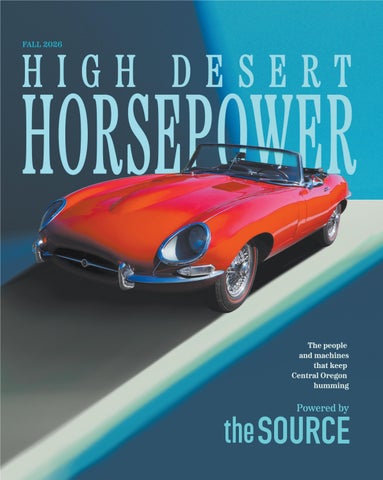
The 1964 Jaguar E-Type Series 1 on our cover is locally owned and it was a pleasure to photograph and drive for this edition. Enzo Ferrari once reportedly said it was “the most beautiful car ever made.” This Open Two-Seater roadster, remains one of the most coveted, collector cars in history. Armed with 265 horsepower, independent rear suspension, and fourwheel disc brakes, this E-Type could effortlessly reach a top speed of 150 mph—offering supercar performance at a fraction of the cost of contemporary Italian rivals. It is a great car to launch our inaugural auto publication.
HIGH DESERT
HORSEPOWER
Welcome to the inaugural edition of High Desert Horsepower — a dedicated space for the love of cars, trucks and everything that powers us from point A to B. This brand-new publication aims to share the stories of the people who keep Central Oregon humming, including tales of some dedicated car restoration experts, the rise of EVs (can you guess how many Cybertrucks Bend has?!), how to prep for cold-weather driving, where to go to modify your rig for outdoor adventure and so much more. We hope you enjoy the ride! Editor in Chief Nicole Vulcan
6
EDITORIAL Editor in Chief Nicole Vulcan Copy Editor Richard Sitts Contributors Dallas Finn Calvert Clayton Franke Wally Hofmann Peter Madsen Cover Jennifer Galler Designers Rise Graphic Design Adrian Galler Sales Chad Barnes Ashley Sarvis Ban Tat Publisher Aaron Switzer
FALL 2026 5
CAMPING WITH THE CAR: IT’S ALL ABOUT COMFORT
Whether camping, road tripping or just driving around town, a few extra additions can add to the experience BY DALLAS FINN CALVERT Drive around Central Oregon a while and you’re sure to see plenty of vehicles with “mods,” or modifications, aimed at adding space for people, pets and property. From kitted-out camper vans to full rooftop tents, awnings and cargo boxes, locals like to add a little extra to their rides.
Storage options Storage and comfort are top priorities for car owners prepping for a getaway in the woods or road tripping with lots of passengers, or even just regular driving at night, say local experts. Matt Massingale, owner of Cascade Rack in Bend, said that “whether you’re camping out of a Subaru or traveling with the family for Thanksgiving,” comfort is key. Along those lines, he said installing a cargo box on a car’s roof or attaching one using a hitch mount is straightforward for most vehicles and provides ample storage. That means bags and sundries aren’t being crammed under peoples’ legs or smooshing them in their seats during a long car ride. “A lot of cargo boxes are bigger than the backs of most hatchbacks, so you get a lot of storage room that way,” said Massingale. There are also bike and kayak racks that can be installed to maximize weekend fun.
6 HIGH DESERT HORSEPOWER
Cargo bags, baskets and platforms are also handy and provide varying levels of storage. Another important facet to consider is comfort while camping. Roof tents are a popular modification and can be installed on many vehicles. Massingale said small-car owners shouldn’t be discouraged, thinking their car is too small for cool modifications like rooftop tents.
Types of vehicles “Most vehicles we end up working on are smaller, more economical vehicles,” he said. “Most of the bigger trucks we do, we’re outfitting for construction and work use. But day-to-day cars are a great platform for traveling and camping. It’s pretty easy nowadays with the array of products out there.” A handy and “support local” offering he pointed to is a Luno mattress, which Massingale said is “easy to toss in” a car for a weekend trip to the woods. Luno, a Bend-based company, has an array of car-camping gear, including a variety of vehicle mattresses, storage solutions and window screens.
New or upgraded lighting Massingale said that new or upgraded lighting is another modification that aids in safety and comfort. Upgraded fog lights are a popular modification as is the installation of additional off-road lights. “We do a lot of lighting modifications, like adding better fog lights,” Massingale said. “As the days get shorter, people start thinking about light.” Gabriel Christian, owner of Import Performance Auto Repair in Bend, said fall is a great time to check all exterior lights to ensure they’re working properly and show no signs of damage. Scratched headlights or dim bulbs can make it hard to see at night, but fixing damage and installing LED lights definitely helps, he said.
Day-to-day cars are a great platform for traveling and camping. It’s pretty easy nowadays with the array of products out there.”
“One thing I’ve had a lot of people overlook is fogging of car lights. The lenses can get fogged and then people complain that they can’t see very good at night,” said Christian, explaining there’s a special tool his shop uses to sand and recoat plastic lights so they’re like new. “People are usually really happy with that because they feel like they can see at night a lot better.”
– Matt Massingale, owner of Cascade Rack in Bend
FALL 2026 7
8 HIGH DESERT HORSEPOWER
Joy Build
THE
OF THE
Three Central Oregon renovators’ roads to classic car restoration BY WALLY HOFMANN
disassembly. When the friend entered a care facility, Kropf helped his daughter sort through and sell the collection — but pointed to one car and told her not to sell it until she knew what it was worth. Months later, he asked for the right of first refusal. When she was ready to sell, he bought it.
For John Prehn, Jeff Michelsen and Wally Kropf, restoring a classic car was never really about the car. It’s about the thousands of hours spent chasing down the right part, the challenge of bodywork and paint done right and the quiet satisfaction of bringing something back to life. Three very different paths — a machinist who hardly ever advertises, a self-taught painter who cut his chops on airplanes and a retired naval aviator turned collector who waited 35 years to restore his rarest find — all arrive at the same place: joy found in the work itself.
Kropf owned the car for about 35 years before finally restoring it, a process that took roughly five years and included a full frame-off rebuild — engine, drivetrain, powdercoated frame and body mounted on a rotisserie for bodywork. A friend with a body shop handled the paint, though Kropf did nearly everything else himself, learning through decades of trial and error rather than formal training.
A rare find, rediscovered
Looking ahead, Kropf worries that modern, computerized vehicles won’t age as well as his classics. Parts for his 1958 Corvette remain nearly 99% available through specialty catalogs — a luxury he doubts today’s electronics-heavy cars will enjoy in three decades.
Wally Kropf’s pride and joy is a 1961 Chevrolet Super Sport — the first year Chevrolet ever built the model, and one of only 142 equipped with the legendary 409 engine that year. By his estimate, fewer than 10 of those original 409 Super Sports survive today. The car found him through an unlikely connection. A friend battling a terminal case of Huntington’s disease had amassed a collection of roughly 160 cars, many in various states of
His restoration philosophy is simple: keep it stock and buy the best car you can afford before you start. “Don’t start on a junker,” he says.
At its heart, though, restoration isn’t about investment for Kropf — it’s about the work itself. “I enjoy working on the cars,” he says. “That’s what keeps me going.”
It’s about the work itself. I enjoy working on the cars. That’s what keeps me going.” – Wally Kropf
FALL 2026 9
From grandpa’s garage to a 1,000-hour build For Jeff Michelsen, the love of old cars started with family and friends. Time spent in his grandfather’s garage, along with a high school buddy whose father restored a 1940 Ford coupe, planted the seed. “I always loved the old cars,” he says, “I just didn’t know how to work on them.” An auto body class his senior year of high school changed that. His first project — a ‘49 Chevy pickup — never even hit the road; he couldn’t afford the insurance and sold it. A torn-apart 1940 Ford pickup followed him into a stint in the Air Force, where his father finished the job and sold it on his behalf. Michelsen actually learned to paint by accident. Hired by a company that modified airplanes, he was asked if he could paint — and said yes, despite having missed that unit in high
I always loved the old cars, I just didn’t know how to work on them.” – Jeff Michelsen
10 HIGH DESERT HORSEPOWER
school. “They taught me how to paint,” he says, starting small before working his way up to full trucks, boats and airplanes. His most personal project, a 1952 Ford F1, took over three decades to complete — bought at 26, finished at 58, delayed by years spent helping restore other people’s cars first. He estimates more than 1,000 hours went into the truck, where he handled the bodywork, welding and frame modifications himself, leaving the engine and drivetrain to specialists. Rather than chase full authenticity, Michelsen blended original style with his own touches — reshaping fenders, chopping the top and lowering the stance for a faster, more custom look. “It’s personal taste,” he says. Looking ahead, he’s skeptical that modern vehicles — built with plastic panels and bonded bodies, rather than welded ones — will ever inspire the same restoration culture. But he’s learned not to bet against nostalgia. “Fifty years go by,” he says, “and all of a sudden they’re desirable.”
50 years of classic car joy in Bend When John Prehn moved to his home in Bend in October 1975, the neighborhood looked nothing like it does today. “We had four or five neighbors, and we waved at them when they went by every day,” he recalls. Now, roughly 50,000 cars pass by daily. The parkway eventually swallowed up his neighbors’ houses entirely — a fitting irony for a man whose life has revolved around cars. Prehn’s love affair with engines started early. Growing up in Southern California, he spent his childhood tearing apart tractors at his father’s rental equipment company and junkyard. By his teenage years, he’d already built a hot-rodded 1955 Chevy station wagon — his “family car” — complete with a custom 301 engine, a custom-ground cam and three carburetors his father never approved of. That passion followed him to Bend, where he built his own machine shop from nothing, digging the pit himself with a contractor friend. What began as a full-service engine rebuild
business eventually narrowed to precision machine work, run solo since 1995. His proudest achievement sits in his garage and is his daily driver: a 1948 Mercury that took 12 years to restore, rescued piece by piece from swap meets after a body man told him to scrap it entirely. He refused. Prehn owned and operated Prehn’s Machinery from scratch, hasn’t advertised in 15 years and hasn’t raised his prices since 2005. “I’m not doing it for the money,” he says. “It’s the funnest thing I’ve ever done in my life.” His advice to aspiring restorers is simple: “You have to find joy in it. You can’t restore a car to sell it — it’s not costefficient. It’s the love of cars.” At 87, with 51 years of marriage to his wife Judy and a car club built from church friendships who share the same joy of classic cars, Prehn sees the real value beyond the garage. “The most valuable part of a classic car is creating joy in great relationships,” he says. “It’s special.”
You have to find joy in it. You can’t restore a car to sell it — it’s not costefficient. It’s the love of cars.” – John Prehn
FALL 2026 11
WHAT DOES YOUR OREGON LICENSE PLATE SAY ABOUT
YOU?
Oregon drivers can pick from about 20 options to personalize their whips BY PETER MADSEN Cars, trucks and that little one-seater Mini that Mr. Bean drives: Our vehicles say a lot about us, whether we’re gearheads, school-function chauffeurs or overlanders ready to tear up Middle Sister like a driver in a Land Rover commercial. Oregon license plates are expressive, as well. Our state’s famous plate, featuring a Douglas fir, is the envy of drivers throughout the country (I just know this). There’s also no surcharge. Pity is, however, that the preceding plate, which showcased the larch tree — the rare conifer that changes colors and sheds its needles — was scrapped. Why? Too many folks, unforgivably, didn’t know what a dang larch tree was. The Dougie took the larch’s place in 1990. Yet, beyond the standard license plate, what do the other special background plates say about us drivers?
Wine Country $ 4 0 SURCHARGE
Funds get funneled toward Travel Oregon, the state’s tourism commission to promote tourism centered on wine and the culinary arts. Regarding these wine plates, I have this tight 10-second comedy bit I’ve been ironing out: If I was a cop, I’d be a crooked cop. Like, I’d really lean into my prejudices. But I wouldn’t be corrupt in the stereotypical ways. No, no. Here’s what I’m talking about: I’d categorically pull over drivers with Oregon Wine Country license plates. I’d saunter up to their vehicle, lean into their unrolled window, and take a long, sommelier-esque whiff of their person. “Mmmm…have you had anything to drink this morning… perhaps a splash of… pinot grigio?” The driver would be flummoxed. “…Mmm, wonderful…let me see… It’s giving a… 2022 vintage, yes?” They’d begin blubbering. “….From an estate in… wait a minute — NAPA VALLEY?!” Cuff ‘em ‘n’ stuff ‘em, folks. [Crickets.] Look, comedy is an art form and I’m still workshopping this one.
12 HIGH DESERT HORSEPOWER
Pacific Wonderland
Salmon
Which license plate do you pick after you’ve already outspent the Joneses on your top-ofthe-line Audi/BMW/Porsche?
A fishy! This salmon plate is an improvement on the previous one, which, as viewed on a vehicle baking at a trailhead during the height of summer, always made my stomach turn. That salmon wasn’t in water! With the new iteration, there’s no misconstruing whether the salmon is alive, instead of dead, discarded and rotting on a boat ramp somewhere.
$100 SURCHARGE
Why, look no further than the Pacific Wonderland plate. It’s comparably unimaginative — our state colors, c’mon — yet it costs four times more than the other specialty plates! Yes, the fees benefit the Oregon Historical Society and the Oregon State Capitol Foundation, but that’s not the real issue here, which is a rizz-less status flex. The aesthete in me, however, does concede that the navy and gold plates do make a black Cayenne pop.
Share the Road $10 SURCHARGE
Yay! Cycling is fun, healthy and saves the planet. But can we do something about how doofy the cyclist looks? It’s a silhouette of someone’s dad riding in Obama jeans. And he’s cross-chaining, which increases wear and tear on the drive train (rookie move). Brainstorm: How about a silhouette of someone’s dentist crushing on, say, a titanium triathlon bike? Wait, no, that would likely inspire even more teenagers to coal-roll our group rides. Proceeds, split down the middle, go toward The Street Trust Community Fund and Cycle Oregon The latter nonprofit designates and maintains scenic bicycle routes throughout the state.
Veteran
$10 SURCHARGE
First instituted in 2008, Oregon’s veteran license plate program was a joint effort between ODVA and the Oregon Department of Transportation, according to the state. No notes. Thank you for your service. (OK one note: You gotta submit your DD-214. No stolen valor, here!)
$30 SURCHARGE
Proceeds go to the Watershed Conservation Operating Fund and Oregon Parks & Recreation Department.
Trailblazers Rip City $ 4 0 SURCHARGE
More like: Trailblazers: R.I.P., City! Amirite? In all seriousness, how sad will Blazers fans be, driving their Subaru WRXs with the fan plates of a team whose billionaire owner rips it from the fabric of Portland — nay, that of the entire state — if Multnomah County Commissioners can’t scrounge $101.6 million for a Moda Center renovation? The surcharge benefits the Portland Trail Blazers Foundation, which funds nonprofits in Washington and Oregon. Springing for Rip City plates will not contribute to the Blazers remaining in said Rip City.
College plates $ 4 0 SURCHARGE
The proceeds of these plates, dedicated to the University of Oregon and Oregon State University, go toward each respective university. (The UO’s benefits its alumni association.) As if either school needs more money.
Cultural Trust $50 SURCHARGE
This is the most realistic (if unintended) depiction of what it feels like to hike while high on mushrooms and ketamine. Surcharge money goes toward promoting the Cultural Tax Credit.
FALL 2026 13
14 HIGH DESERT HORSEPOWER
BOOM IN CENTRAL OREGON
Bend appears to be on par with larger cities in its rate of electric vehicle adoption BY CLAYTON FRANKE The number of electric vehicles registered in Deschutes County has been climbing by the thousands each year. State officials say that trend might be strong enough to continue, even with a loss of federal incentives for buying electric cars. According to the Oregon Electric Vehicle Dashboard, nearly 8,000 EVs are registered in Deschutes County. That number has roughly doubled since 2023, and is up from a just few hundred a decade ago. Deschutes County boasts the fifthhighest ratio of EVs per capita, with 38 per 1,000 people, on par with the state’s largest metropolitan centers. “Compared to a lot of the rest of the United States, it’s very strong adoption trends,” said Jessica Reichers, technology and policy manager with the Oregon Department of Energy. “Deschutes County has adoption trends ranking up there with the rest of the state.”
Implementing EVs
According to the Oregon Electric Vehicle Dashboard, nearly 8,000 EVs are registered in Deschutes County. That number has roughly doubled since 2023, and is up from a just few hundred a decade ago.
While EV trends are strong, according to state reports, the total number of electric cars — about 140,000 — is falling well short of the 250,000 goal the state set for 2025. For the state, implementing EVs — or what the state calls “zero-emission vehicles” — will be critical to meeting goals to reduce greenhouse gas pollution driving climate change. For Deschutes County, the increase in numbers is notable partially because Bend, Central Oregon’s largest city, didn’t even have a public vehicle charging station until the late 2010s, Reichers said. Now there are dozens across the city and more in Redmond, Sisters, La Pine, Prineville and up and down the U.S. Highway 97 and U.S. Highway 20 corridors. FALL 2026 15
DELOREAN RENTAL GUY
16 HIGH DESERT HORSEPOWER
“I haven’t heard any complaints about driving your EV to or from Bend for a very long time,” Reichers said. “That, at least anecdotally, tells me the charging infrastructure is really starting to take root out there.”
More vehicle types
According to Reichers, EV charging stations have expanded across Oregon and helped ease some rural Oregonians’ concerns about owning electric vehicles.
Since 2022, nearly 200 Ford F-150 Lightning trucks have been registered in Deschutes County, along with nearly the same number of Rivian R1T trucks.
Higher salaries
There are 17 Tesla Cybertrucks registered in Deschutes County. Teslas account for about one-third of EVs in the county, a slightly higher proportion than the state. The most popular Tesla in Deschutes County is the Model Y, with more than 1,400 registrations countywide.
Another possible driver of Deschutes County’s EV boom? Higher salaries. Data from across the state shows the two are correlated: counties with higher median incomes usually have higher rates of electric vehicles. Deschutes County has the highest average income of any county in Oregon, at $87,000, about $16,000 higher than the state average, according to data from the Oregon Employment Department and U.S. Bureau of Economic Analysis, reported by the Oregonian earlier this year. The state’s EV dashboard breaks down the price differences. In one example, the average MSRP for an EV is about $37,390, while a gas-powered vehicle is $20,500. According to the dashboard, gas vehicles have a range of about 400 miles per fill-up, while EVs can travel 258 miles in one charge. EVs have more horsepower, while fuel costs for an EV are about 20 cents to every doller spent on gasoline.
Another draw for people in places like Bend and Deschutes County is that there are more vehicle types, like trucks, available as EVs, Reichers said.
Low and moderate-income Oregonians can get $7,500 tax credits from the state through the Oregon Department of Environmental Quality’s Charge Ahead Rebate. But last year, the Trump Administration’s executive orders pulled federal rebates for electric vehicles and halted funding for nationwide charging infrastructure. Oregon saw a big drop-off in EV registrations when the federal rebates expired last fall, Reichers said. But then, gas prices shot up amid the United States’ war with Iran, and registrations started to tick up again. It still remains to be seen what the end result will be, Reichers said. “What we’re waiting on now is to see how these two opposing forces end up affecting the EV market going forward,” Reichers said.
According to Reichers, EV charging stations have expanded across Oregon and helped ease some rural Oregonians’ concerns about owning electric vehicles. FALL 2026 17
DESCHUTES LADDERS AND
With every turn of the ignition key, driving in Central Oregon, however unintended, feels like playing the iconic board game BY PETER MADSEN New construction zones. Road diets and clogged traffic arteries. And then there’re those mother-flipping teenagers on $4000 e-motorcycles. Not for nothing, the mean streets of Bend will keep you on your toes. Whether your great-great-great papaw forded the Deschutes River back when it was called Towarnehiooks, or you just moved here from a Bay Area exurb that’s closer to Modesto than San Francisco, driving in Bend is nutso.
driving up and over Awbrey Butte instead of skirting along Mt. Washington Drive. Ninth Street disappears beyond your dashboard; the gain in elevation angles your vision toward the sky.
Please, lord don’t let a dog run out while AI is recalculating my route Or, imagine this scenario: You’re returning to Bend southbound via the Parkway. You just learned about the locals’ off-ramp at NW Lafayette Avenue that lets you slip past the County building and into downtown. But the notably abrupt turning lane requires you to chop your speed from 45 MPH (that’s only as fast as you were driving on the parkway, riiight?) to next to nothing. Even the most conscientious drivers have slammed on the brakes, lest they barrel-roll into those idling at the stop sign, waiting to merge. Best to stick with the off-ramp at Arizona.
Ever play that board game, Chutes & Ladders?
That brings us to street names
Driving in Bend, circa 2026, is something similar, so let’s call this iteration, “DesChutes & Ladders.” One wrong roll of the dice (or poor prompt by GPS) and you’re quickly
Portland Avenue, Olney and Penn Avenue and Neff Road are same-same-same…same. Greenwood Avenue is Newport Avenue and so is Shevlin Park Road.
18 HIGH DESERT HORSEPOWER
New construction zones. Road diets and clogged traffic arteries. And then there’re those mother-flipping teenagers on $4,000 e-motorcycles.
These multinominal streets are only, like, what — 6 miles long? But the names can be helpful. Shevlin Park Road, for example, takes you to Shevlin Park trailhead. But take Pilot Butte Road to get to Pilot Butte trailhead and you’re lost in the Orchard District. Back on the west side, let’s discuss the shenanigans along Skyliners Speedway. Yes, Skyliners Road is, apparently, where flybys and engine revs are de rigueur just past supper. That’s when, imaginably, the Jaydens of Northwest Crossing have excused themselves from the dinner table and relieved their rad dads of the keys to the Subaru WRX STIs.
Vvvvv-roooom! Pop POPoOpPoPP If my 2005 Subaru Outback 2.5i makes any sound resembling those above, I’m immediately pulling over. What’s a timing belt, again? I can’t get into third gear. Notwithstanding, these acoustic blasts ricochet up and down Skyliner road nightly, until around 11 pm. (Presumably, that’s bedtime.) And, in what would be an unforgivable omission on our imaginary DesChutes & Ladders game board, is the Mt. Bachelor Park & Ride lot. In early September, that was the
staging spot for a crew of about 30 teens and pre-teens for a takeover. After receiving multiple calls, cops from Bend Police Department caught up with the gaggle, many of whom were popping wheels and careening through west-side and downtown Bend streets. Three were cited, two for riding e-motos capable of going as fast as 34 MPH without a license, not wearing helmets, among other infractions. The police impounded one bike, which wasn’t street legal, and removed a stash of bikes connected to the takeover at the request of a homeowner.
Generation Alpha But like most things Generation Alpha, these kiddos didn’t invent street takeovers. They’ve been happening in major cities like Portland and Seattle for decades. They’re common in east coast cities like New York and Baltimore, as well. Yet when presumably affluent teenagers pop wheelies through the intersection of race and class privilege, they deserve to be knocked — figuratively speaking — from their pegs. In passing, dear drivers, give them a wide berth. There’s no telling when an e-moto rider might go rubber side up. FALL 2026 19
KEEP CARS IN
Top Shape THIS FALL WITH THESE
Batteries and fluids are important to check, but they’re not the number one priority this fall BY DALLAS FINN CALVERT As the weather turns cooler and car owners begin making plans for trips to the mountain or to visit loved ones during the holidays, a little time spent checking vital bits on cars can stave off issues and delays. While electrical components, namely the battery and topped-off fluids, are vital to ensure are in good working order, a local expert says there’s one item always on the top of his fall car checklist.
Tips
date. While owners should inspect batteries for signs of corrosion, it’s also important they note when a battery is nearing the end of its life, he said.
“If they’re kind of getting older and it gets into winter, like that first cold snap, we do see a lot of cars towed in because the battery just died,” he said. “Electrical stuff, like sometimes starters, can act up as well, and alternators, but the most common thing is the battery kind of being forgotten about. Then, when it gets cold, it basically just dies, and that’s pretty inconvenient. “Just like a double A battery at home, car batteries only last a certain amount of time, unfortunately,” he added. “If you have a 60-month battery, and you’re six years in on it, I would recommend replacing that before winter.”
Wiper blades When it comes to wiper blades, Central Oregon has “super harsh” conditions that mean they have a very short lifespan. “It’s either cold and dry or hot and dry, and the UV rays we get here are pretty horrible on everything, so wiper blades typically only last a year here,” said Gabriel Christian, owner of Important Performance Auto Repair in Bend. “They get kind of stuck to the windshield in the summer, and then we don’t use them as much, so they get bent over. You want them to be flexible and pliable.”
Batteries Second, but by no means less significant, is ensuring that electrical components are up to snuff. Christian, whose shop is celebrating its 24th year in Bend, said dead batteries are a common issue during the Central Oregon fall as temperatures dip at night. “Basically, when it gets cold, batteries lose a lot of their efficiency,” he said. “That’s typically when they’ll show up bad.” Most car batteries last from five to seven years and have a tag, typically on the battery’s side, that indicates its expiration 20 HIGH DESERT HORSEPOWER
Basically, when it gets cold, batteries lose a lot of their efficiency, that’s typically when they’ll show up bad.”
Christian said that a car that’s slow to start, or sounds like it’s laboring to fire up, can indicate issues with the starter, which a professional should inspect. It also can point to a battery that’s on its last legs or even fluids that aren’t fresh or at optimal levels.
Checking the fluids While it’s important to check coolant levels, Christian said it’s vital that car owners don’t add water, which can freeze inside the radiator, nor mix different types of coolant. Chemical reactions in the different types can cause sludge to build up. “If you get a multi-use coolant from (the auto parts store), and put it in your car, chances are, it’s not going to mix well or perform well,” he said. “It’s better to have a shop take care of it. We have so many different kinds of coolants in the shop now, and you really should not mix them.”
Tip:
Recommends getting all fluids flushed and refilled every 30,000 to 60,000 miles.
He recommends getting all fluids flushed and refilled every 30,000 to 60,000 miles. “In the winter, when it’s below freezing, and you’re asking some drive-train components to all of a sudden start up and start moving down the road, you want decent fluids in there, and not fluids that have 100,000 miles on them,” he said. “It can make a big difference in the summer, too. You want to have clean fluids.”
FALL 2026 21
22 HIGH DESERT HORSEPOWER
FALL 2026 23
Toyota and Sprinter specialists since 2002!
Top quality maintenance and repairs Suspension upgrades Bumpers & accessories Text only line for appointments
(541)378-4920
541-382-9599 • Importperformanceusa.com
24 HIGH DESERT HORSEPOWER