THE FOCUS The Voice of Skyline College, San Bruno, Calif.
The Focus
November 11, 2017
www.theskylineview.com
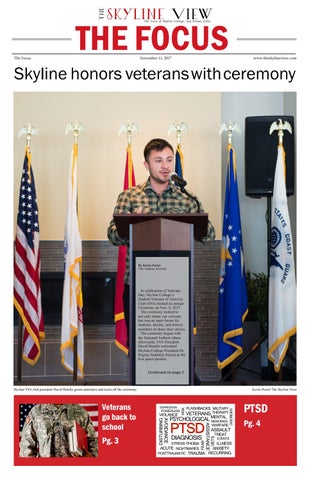
Skyline honors veterans with ceremony
By Kevin Perez
TSV Digital Editor
In celebration of Veterans Day, Skyline College’s Student Veterans of America Club (SVA) hosted its annual Ceremony on Nov. 9, 2017. The ceremony looked to not only honor our veterans but was an open forum for students, faculty, and district members to share their stories. The ceremony began with the National Anthem where afterwards, SVA President David Botello welcomed Skyline College President Dr. Regina Stanback Stroud as the first guest speaker.
Continued on page 2
Skyline SVA club president David Botello greets antendees and kicks off the ceremony.
Veterans go back to school Pg. 3
Kevin Perez/ The Skyline View
PTSD Pg. 4
2
November 11, 2017
The Staff Editor-In-Chief Adreana Estigoy Digital Editor Kevin Perez
The Focus
The Skyline View
A life of adventure
Editor at Large Laurel B. Lujan Staff writers Maitri Desai Simone Ledbetter Cristina Macz Maria Isabel Del Castillo Schmidhuber Staff Photographers Mark David Magat Faculty Advisor Nancy Kaplan-Biegel
Photo Courtesy of Christopher Rochette
By Simone Ledbetter
TSV Staff Writer
Want more news? www.theskylineview.com Or maybe you have news for us? (650) 738-4377 Want to yell at us? theskylineview@gmail.com Or use snail mail: The Skyline View c/o Language Arts Room 8-8110 Skyline College 3300 College Drive
San Bruno CA 94066
It was a cold, winter day. Sunshine enveloped his face. The deck of a ship dipped and rose with the waves beneath him. Christopher Rochette thought about how adults tell you the stories of their lives and how he thought he’d have nothing interesting to tell. But there he was at the front of a large ship as it sailed under the Golden Gate Bridge, revealing the vast ocean he’d never planned on traveling. Rochette was 19-years-old when he left everyone he had ever known or cared for in Worcester, Massachusetts. Rochette is now a veteran of the Coast Guard with the rank of a Sergeant , and is the vice president of Skyline College’s Veteran Resource Center. A week before graduating from high school, he decided to join the Coast Guard under the impression he would stay in Massachusetts, due to a recruiter who believed this would be so. He was a volunteer firefighter then, and was told it would be to his advantage enlist before a becoming full time firefighter. “I never wanted to be in the military per say, and [I] wanted to be a firefighter and civilian,” Rochette says. “I never thought about wearing a uniform and the rules. So for me the idea of saluting or wearing a nice
uniform all the time, I never really liked that. I liked the work, the adventure, and the mission.” Then he thought he was just unlucky, but now sees the experience as one of the best things that has ever happened to him. He was sent to school in Virginia to become a firefighter and welder. Then, onboard a ship called The Sherman, he sailed with his crew to South America, Central America, Asia, Alaska, and all across the Pacific. He now considers the ship his second home. His first patrol was in Alaska, 2004. An 800 foot long ship had split in half with the crew still on it, and the helicopter that had come to it’s rescue was caught in a large wave that pulled it into the ocean. The incident was a shock, as the crew had been expecting a slow day exploring, and Rochette had yet to experience what he described as something you would typically only hear about in the news. Despite the less desirable aspects, Rochette appreciated the sense of adventure and travel that came with serving. It was after his patrol in Alaska that he took up photography as he had regretted not being able to capture the beauty of the snow capped volcanic mountains of the Aleutian Islands. “There’s things that you’re gonna see that you won’t ever
see otherwise, and you might not realize what you saw until after you walked away,” Rochette says, when speaking of what can be shocking when serving in the military. He recalled being called back to the ship, and then hearing an echoey radio voice that sounded as if it were a narrator that were making the announcement. Upon arriving to the given destination for a clean up task after a search and rescue of a helicopter, he saw dark grey, blue waves that looked as tall as a three story home. There he also saw a large red and white lighthouse with its bright beam shining through, and remains that hardly resembled the helicopter they once were. He wondered how anyone could be in that water and survive. Another impactful situation was a grenade thrown onto a ship, and Rochette was one of the men sent to tame the fire. The fire became so large it was incredibly difficult to get on the ship. It was not until afterward when everything was calm, that the men realized if anyone had fallen into the water their gear was heavy enough there would have been no chance of any of them being saved. “I didn’t really think about it being dangerous,” Rochette says. “You just think, you have to put this fire out, we have a mission to do.” Since returning from his service, he has found himself to be more patient and values time on a deeper level. Integration for him was quite easy though for many veterans it’s not. He
found work at a shipyard where he was surrounded by many other veterans, a factor that helped in his transition. His mother, Mary Rochette, agrees he had a fairly easy transition but though it was still him, she did notice slight differences. For one, he had matured a lot. He had also had his eyes opened to how other people live their lives and now aims to help and fight for others. She also mentions that it gave him the confidence to be a leader, and he did things he probably wouldn’t have otherwise such as meeting his wife, teaching photography at a museum, volunteering at Habitat for Humanity, and traveling. “He would never have sworn in front of his mother,” Mary Rochette said with a laugh, when speaking of prior to her son’s service. “Once he got out, he did swear every now and then. He had a bolder sound in his voice. That soft spoken child was gone.” She spoke of how his compassion came through from what he had witnessed, and at times he’d seem sad from certain memories, though he was never depressed. There were also things he would talk about with his father, but not his mother. “In a mother’s words, he’s become a very fine young man who any mother would be proud to have as a son,” Mary Rochette says. “I think the military gave him a great experience, that turned him into the man he is.”
Skyline honors our veterans The Skyline View is a First Amendment Publication. The Skyline View is published bi-weekly during the spring and fall semesters by the journalism students at Skyline College. The Skyline View is a member of the Journalism Association of Community Colleges. Opinions expressed in the paper are those of the writers and should not be interpreted as the views of Skyline College, SMCCCD, the faculty, administrators or the newspaper adviser. Additionally, the paper does not endorse any of the products or services advertised. The Skyline View welcomes Letters to the Editors; letters must include full name, address, and phone number for verification. The Skyline View reserves the right to edit letters for length, libel, clarity, and taste.
President Dr. Stanback Stroud highlighted how Veterans Day is a day for reflection. She also went on and expressed the personal significance of Veterans Day was for her. “The difference between this day and Memorial Day is that were honoring people that serve. Not just the soldiers that have died but people who have served in the military.” President Dr. Standback Stroud said. “All of us have a personal responsibility to supporting the ideals of our personal freedoms.” President Standback Stroud personally thanked our student veterans and shared their academic accomplishments. “96 percent of student veterans
are full time with an average GPA of 3.0,” President Dr. Standback Stroud stated. “Those who aren’t full time have a GPA right around 2.8.” The San Mateo Community College District’s Vice Chancellor, Jose Nuñez was next speaker and explained his gratitude for his time serving in the military. “The army provided me with a myriad of opportunities and instilled in me discipline, respect, teamwork loyalty, attention to detail, endurance, and most importantly a can do spirit,” Vice Chancellor Nuñez said. “While under the service I was able to finish my undergrad and master’s degree.”
Other notable attendees that spoke were Joan Dentler, Field Representative for State Senator Jerry Hill, and Jim Vangele the Skyline College Chief of Public Safety. An open forum followed which allowed Student Veterans, Erik Ferroggiaro, John Uperesa, Christopher Rochette, and David Botello to share their stories. Ferroggiaro recalled nearing the finish of high school and deciding to enlist rather than continue onto college. “I decided it was very important for me to serve the constitution of the United states and protect our bill of rights so we can enjoy the life we have today,” Ferroggiaro said. “I was one of three of my
class to go on active duty.” After all the student speakers the ceremony ended as Gina Ciardella, Program Coordinator of the Veterans Resource Center invited everyone to the VRC for an open house. “I feel honored to work for a college that supports the veterans and military affiliated students at the upmost,” Ciardella reflected. “The amount of support that veterans, military affiliated students, and dependents get at this college and this district is tremendous…It’s an honor every day to work with each and every one of our veterans.”
The Focus
The Skyline View
November 11, 2017
Veterans go back to school By Maria Isabel Del Castillo Schmidhuber Editor at large and Focal Point Editor
Servicemen and Servicewomen who are nearing the finish of their enlistment have several paths they can follow. Some choose to continue the military profession, or return home. Serving in the military opens a great deal of resources when coming home. A great option veterans have is choosing to go back to school through the GI Bill, which covers most if not all of a veteran’s school cost. “Coming back to school after the service felt pretty good,” says Gabriel Garret, a veteran at Skyline College. “I like coming back because it allowed me to explore options outside the military that were offered and expand my horizons and learn new things.” While the option to return to school looks promising, the transition back does not always go smoothly for veterans. When serving in the military, soldiers adopt a set of principles that can carry on throughout
their lives. There is an intense set of rules and expectations loom over soldiers as they serve, but when integrating back into society some find it difficult to adjust to the different lifestyle. “You get a reality check because you aren’t necessarily told what to do anymore. Jake Shaidell, a student veteran from Skyline College elaborates. Time spent serving helps develop certain qualities like punctuality, listening skills, answering questions directly, and asking questions for clarification. These may seem like common social skills, but in the military they are essential and expected. These social skills carry over into various social settings such as college, but most students in college have never carried those expectations. Veterans can find this strange or even frustrating as the social interactions are different to what they have grown accustom to. “Its a little strange because you go from such an intense environment to a much more moderate, low key school environment,” Shaidell says. The way classrooms are structured can be odd at
Creative Commons
first and is something that veterans have to adapt to when coming back to school. Some students have a non-caring presence in the classroom, which can be frustrating to veterans. The military has programs that help those who will be getting out soon and veteran resource centers help after they get out. Skyline College has its very own Veteran Resource Center in Building 2 which is a valuable resource for student veterans. Shaidell explains with certainty that veterans can be mentally fragile when they get out of the military, which can make it easy for people to bring them down. “You need to find the coolest, most ambitious people you can find, Shaidell stated. “Find people who really care about you, that are doing great things, and that have a vision of what they want to do.” Having a positive circle is key to being successful. Veterans after years of service thrive for a team environment which is sometimes difficult to find in college.
Veterans Resource Center helps students veterans adjust By Cristina Macz
TSV Staff Writer
Skyline College hosts its very own Veterans Resource Center which is a valuable tool for veterans that choose to return to school. Through the Veterans Resource Center, veterans and service members are connected to resources that range from housing arrangements to information for educational benefits, health benefits, and employment assistance. Some of the educational benefits consist of being provided with more information about what classes to take, as well as being connected with counselors. The Veterans Resource Center, connects students with employment
opportunities as well as readiness essentials for transferring to colleges. The lounge area at the center promotes community by allowing people to socialize as well as providing a study space, computers, and printers. This a great opportunity for student-veterans to interact with one another and find commonalities. With most student-veterans being between the ages of 24 and 40, the age gap between them and traditional college students can cause a disconnect. The staff in The Veterans Resource Center are aware of the challenges this transition can present. While the difficulties may not be present for everyone, they want students to know they do not stand alone. Gina Ciardella, the Program Services
Coordinator, for the Skyline Veterans Resource Center is there to provide support to these students. “I feel with my role here, I am able to give back to our veteran community, which is near and dear to my heart,” Ciardella said. The staff is also learning, and adjusting to what the students need. The student veterans provide feedback, which allow room for growth and improvement with the services, and classes offered. “51.7 percent of studentveterans complete their degree or certificate in four to five years” the VA estimates. The VA says this rate is similar to other students. “My favorite part is that every day is different,” Ciardella Said. “There’s always opportunities to learn from our students.”
Mark David Magat/ The Skyline View
The Veterans Resource Center is located in Building 2, Room 2350. They are open M-Th 9 a.m.-6 p.m. and Friday 9 a.m. – 12 p.m. They can also be reached at skyveterans@smccd.edu
3
4
The Focus
November 11, 2017
The Skyline View
Creative Commons
By Maitri Desai
TSV Staff Writer
Down the streets of San Francisco, a Diesel truck passes across a man’s gaze. With the distinct smell of the diesel fuel and the way the sun reflects off his eyes, within moments, he is back. He is back in Afghanistan. He can smell, taste, and feel his past, as if it’s right here in front of him as if he’s living it all over again, completely incoherent of his actual surroundings. A 6-block walk to the gym transforms into a battlefield. Like countless others, Steven Schwenka, is a fighter of post-traumatic stress disorder (PTSD). This experience is not unique, and he is not the only one. Since October 2001, approximately 1.64 million U.S. troops have been deployed to Afghanistan and Iraq and at least 20 percent of them have PTSD and/or depression. However, 50 percent of those with PTSD do not seek treatment, says RAND, a center for military health and policy research. The “mission over everything” mentality breeds the mindset of ignoring symptoms and being unwilling to get help, says Schwenka, currently a Psychology major at College of San Mateo.
This branches from the “macho-man” dynamic taught in the military. The military is male-dominated and stands on the motto, -suck it up and move onexplains Schwenka. There is one way to do things and that is how it goes, it’s a controlling environment, says Schwenka, a rifleman who served in the infantry and was deployed to Afghanistan in 2011. This technique of control is good training, but leads to a hesitancy to get help, says Schwenka. “When you get out and have these traumatic experiences and you are still operating through that lens of control, says Schwenka. “It does not treat the problem, it numbs it.” This outlook towards being unwilling to acquire help does not differ with gender, explains Heather Rojaśeverett, currently a Computer Science major at Skyline College. She looked back on a proverb the soldiers survived by, “…you can’t smoke a rock.” “It’s a huge deal for soldiers, because you are trained to be so mentally strong, that for you to think that you have a weakness, such as PTSD, you don’t want to claim it, let alone acknowledge you have it,” says Rojaśeverett, a United States Army Signal Corps Veteran served in Germany 1999 to 2002. This view was shared by Luis Padilla,
a Skyline Alumni currently a Program Services Coordinator at the Veterans Center at College of San Mateo. “You are being told you are warriors, so to accept PTSD is like accepting defeat, to accept that something is wrong with you,” says Padilla, a Marine Corps airborne parachutist. PTSD stems from moral injury, which results from making choices against one’s own morals, explains Padilla who was deployed to Iraq in 2008. As part of the marine corps rifle squad, Schwenka shed his own light on by giving his perspective from a combat veteran standpoint. Pulling that trigger, and having to think about those kinds of actions is from where PTSD symptoms cultivate. Most people haven’t been in a situation where the only option is to kill or get killed, he says. “What is really hard to grapple with, for a lot of combat veterans, is coming to grips with who they’ve harmed,” says Schwenka, a 6-year Marine Corps veteran. As a survival mechanism, the brain flash freezes a memory to let the person know that something is not good. It’s the brain’s way of evolving and letting you know not to do it again, he explains, “You are always going to have it these triggers, it’s just about how you manage them.” The Marine Corps veteran also stated
that the everyday tasks can be difficult to go through due to PTSD. “It’s about how you can mediate those peaks and valleys, because there are going to be days, like walking to the gym and when you think you are fine and everything is good, and all of a sudden you are back,” says Schwenka. Transition to civilian life is not incentivized by the military, as it is not high on their priorities explains Schwenka. Their attention is focused on optimization of resources rather than the well-being or long-term health of the people who are being put back into society. “All the onus is on the veteran to get themselves help and there is no oversight in pushing these people in the right way to get treatment,” he says. Which is why society plays a key role in their journey, explains Schwenka. Rojaśeverett agrees. PTSD is a lifelong journey and not a short phase, Rojaśeverett relates. She says the process is much similar to of losing a loved one. “I feel like the biggest, strongest thing is to be there for them,” says Rojaśeverett. “You can’t take the pain away right away, you have to give them the time.” She says, “With each day, they get one step further from what hurt them and one step closer to hopefully getting better.”
Crisis Contacts CONFIDENTIAL 24/7 CALL CENTER 1-877-WAR-VETS
NATIONAL SUICIDE PREVENTION LIFELINE 1-877-424-3838
THE SOLDIERS PROJECT 1-877-576-5343
Source: Skyline VRC