The
Skyline View The Voice of Skyline College, San Bruno, California
Volume XL- Issue 1
Sept. 1, 2016
www.theskylineview.com
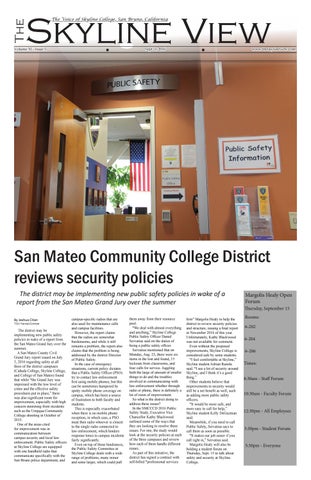
San Mateo Community College District reviews security policies The district may be implementing new public safety policies in wake of a report from the San Mateo Grand Jury over the summer
By Joshua CHan
TSV News Editor
The district may be implementing new public safety policies in wake of a report from the San Mateo Grand Jury over the summer. A San Mateo County Civil Grand Jury report issued on July 5, 2016 regarding safety at all three of the district campuses (Cañada College, Skyline College, and College of San Mateo) found that while “the Grand Jury was impressed with the low level of crime and the effective safety procedures put in place,” there was also significant room for improvement, especially with high concern stemming from incidents such as the Umpqua Community College shooting in October of 2015. One of the areas cited for improvement was in communication between campus security and local law enforcement. Public Safety officers at Skyline College are equipped with one handheld radio that communicate specifically with the San Bruno police department, and
campus-specific radios that are also used for maintenance calls and campus facilities. However, the report claims that the radios are somewhat burdensome, and while it still remains a problem, the report also claims that the problem is being addressed by the district Director of Public Safety. In the case of emergency situations, current policy dictates that a Public Safety Officer (PSO) try to contact law enforcement first using mobile phones, but this can be sometimes hampered by spotty mobile phone coverage on campus, which has been a source of frustration to both faculty and students. This is especially exacerbated when there is no mobile phone reception, in which case, a PSO must then radio whoever is closest to the single radio connected to law enforcement, which hinders response times to campus incidents fairly significantly. Even on top of those hindrances, the Public Safety Committee at Skyline College deals with a wide range of problems, many minor and some larger, which could pull
them away from their resource pool. “We deal with almost everything and anything,” Skyline College Public Safety Officer Daniel Servatius said on the duties of being a public safety officer. Servatius mentioned that on Monday, Aug. 23, there were six items in the lost and found, 15 lockouts from classrooms, and four calls for service. Juggling both the large of amount of smaller things to do and the troubles involved in communicating with law enforcement whether through radio or phone, there is definitely a lot of room of improvement. So what is the district doing to address these issues? In the SMCCCD 2016 Public Safety Study, Executive Vice Chancellor Kathy Blackwood outlined some of the ways that they are looking to resolve these issues. For one, the study would look at the security policies at each of the three campuses and review how each of them handle different issues. As part of this initiative, the district has signed a contract with self-billed “professional services
firm” Margolis Healy to help the district to review security policies and structure, issuing a final report in November 2016 of this year. Unfortunately, Kathy Blackwood was not available for comment. Even without the proposed improvements, Skyline College is considered safe by some students. “I feel comfortable at Skyline,” Skyline student Adrian Ranola said. “I see a lot of security around Skyline, and I think it’s a good thing.” Other students believe that improvements to security would still be a net benefit as well, such as adding more public safety officers. “It would be more safe, and more easy to call for help,” Skyline student Kelly DeGuzman said. Meanwhile, if you need to call Public Safety, Servatius says to call them as soon as possible. “It makes our job easier if you call right in,” Servatius said. Margolis Healy will also be holding a student forum on Thursday, Sept. 15 to talk about safety and security at Skyline. College.
Margolis Healy Open Forum Thursday, September 15 Rooms: 6-202 6-204 6-206 Times: 8:30am - Staff Forum 10:30am - Faculty Forum 12:30pm - All Employees 3:30pm - Student Forum 5:30pm - Everyone
2
The Staff
Interim Editor In Chief Michelle Brignoli
Interim News Editor Joshua Chan Interim Focal Point Editor Gregory Ragaza
News
Canvas to replace WebAccess
Faculty are currently in training to use Canvas, which will be used in all classes in Fall 2017 By Brian Silverman
Interim Opinions Editor Sarah Marasigan Interim Sports Editor Jordan Sweidan Interim Chief Copy Editor Haley Holmes
Staff Writers Vanessa Fitzpatrick, Ryan Love, Rob Pabalate Jr, Jose Sanchez Ad Manager Charles G. Newton Editor at Large Blynn Beltran
Staff Photographers Kevin Perez, Brian Silverman
Sept. 1, 2016
TSV Staff Photographer
The San Mateo County Community College District will be switching from the WebACCESS online course management system to Canvas starting in spring 2017, to improve the online site and make it easier for students and faculty to use. Canvas will have a better designed website, making an overall cleaner webpage. Canvas will also be paired with an app that is better optimized for mobile use. There are forum pages in Canvas as well, so if you have any suggestions to improve the site, you can post it and other users can vote up your post to let the designers of the site know. “With Canvas being a more modern and cloud based system you will be able to access it from more devices,” said Ricardo Flores, Skyline College Instructional Technologist, on the ease of using Canvas.
Brian Silverman/The Skyline View
A presentation about teaching with Canvas
Over the summer, there were around 20 courses that used Canvas as the management system. Now, in the fall, there are more than 150 courses using Canvas to test it out and work out its bugs before it becomes the primary course
management system in the fall of 2017. “I think it could be interesting,” said Jonathan Blakeslee, a Skyline student. “But it’ll take longer for teachers and students to relearn a website.”
To combat that concern, courses will be taught to the faculty each semester to show them how to best use Canvas for their respective classes. Right now there is a six week course for faculty to be able to teach online and hybrid classes. Faculty members can also backup the outlines of the course material used for WebACCESS so when they do migrate to Canvas, there is no need to rebuild an outline from scratch. “Canvas has been well received across other schools nation wide and is being heavily adopted with community colleges,” said Marisa Thigpen, Program Services Coordinator. For the next three years Canvas will be a free service, and a price for future use will be determined at a later date.
Faculty Adviser Nancy Kaplan-Biegel Want more news? www.theskylineview.com Or maybe you have news for us? (650) 738-4377 Want to yell at us? theskylineview@gmail.com Or use snail mail: The Skyline View c/o Language Arts Room 8-8110 Skyline College 3300 College Drive San Bruno CA 94066
Ricardo Flores and Bridget Fischer teaching faculty how to use Canvas
The Skyline View is a First Amendment Publication. The Skyline View is published bi-weekly during the spring and fall semesters by the journalism students at Skyline College. The Skyline View is a member of the Journalism Association of Community Colleges. Opinions expressed in the paper are those of the writers and should not be interpreted as the views of Skyline College, SMCCCD, the faculty, administrators or the newspaper adviser. Additionally, the paper does not endorse any of the products or services advertised. The Skyline View welcomes Letters to the Editors; letters must include full name, address, and phone number for verification. The Skyline View reserves the right to edit letters for length, libel, clarity, and taste.
Brian Silverman/The Skyline View
3 • BART launches BART Perks program to incentivize riders that avoid peak commute times with points used for cash drawings
• Bill AB 1995 authored to allow homeless California Community College students to shower on campus
• San Bruno reports lowest unemployment percentages in the Bay Area out of the entire San Mateo County
Opinions
3 Sept.1, 2016 editorial
Proposed bill blows hot air Last semester, a bill introduced by California Assemblyman Kevin McCarty, D-Sacramento, concerning a campus smoking ban passed from the assembly to the Senate. The bill, AB 1594, states that it would, starting Jan. 1, 2018, “prohibit smoking, including the use of an electronic smoking device, and the use of a tobacco product on a campus of the California State University or the California Community Colleges.” This means that Skyline College and many other campuses will lose their designated smoking areas and begin imposing fines for the “inhaling, exhaling, burning, or carrying any lighted or heated cigar, cigarette, or pipe, or any other lighted or heated tobacco or plant product intended for inhalation, whether natural or synthetic, in any manner or in any form.” Having garnered enough votes to reach the Senate floor, this bill is running on the platform of public health and wellness, with McCarty stating, “The enactment of AB 1594 would ease the problem of secondhand smoke for the non-smoking community at all public higher education institutions. It would focus on a universal policy for all public higher education institutions that aims to create a healthy and safe environment for all.”
To a certain extent, this bill seems more confusing than helpful. With the active decline in smoking across the United States, down to approximately 16.8 percent in 2014, it seems this bill aims to control the additions rather than the tobacco. This would explain the phrasing of “or plant product intended for inhalation” in the definition of what will be fined. It also explains why they would add in a mention of electronic smoking devices instead of specifying devices used for the consumption of nicotine. This bill is coasting its way through votes, but it won’t result in anything more than disgruntled students. Banning campus smoke areas will not cause all of the smokers to suddenly quit, nor will it save nonsmokers from starting. And that extends to the electronic cigarettes as well. The CDC reports that “about 69 percent of middle and high school students were exposed to e-cigarette advertisements in retail stores, on the Internet, in magazines/newspapers, or on TV/movies.” While that may be true, it is also true that those same students were likely subject to an equal or greater amount of ads for unhealthy foods, snacks, candies, and sodas. The American Psychological Association also links food advertisements to childhood obesity.
According to the CDC, approximately 2.4 million middle and high school students were current users of electronic cigarettes. In contrast, according to the CDC, 12.7 million children and adolescents are obese. This bill isn’t controlling commercials or advertisements though. It’s just restricting people that have already succumbed and become addicted to smoking. Campuses never endorsed, sold, or encouraged smoking. Smoking areas merely allowed students to avoid secondhand smoke, avoid inconveniencing other students, and dispose of their specific trash accordingly. In short, this bill is only superficially intended to increase the health and wellness of students. Looking into it, everything seems to point more towards restricting electronic cigarettes, an even smaller issue. And even when mountains of evidence have been pointing towards obesity as the real growing issue, it begs the question why this bill is being passed right now. And this bill is well on it’s way to passing, having hit no bureaucratic snags yet. In the meantime, if health truly is a concern for anyone, stop buying food on campus. Maybe when Doritos and Cheetos stop selling so well, the health of any given campus will rise.
The View From Here With Michelle Brignoli, editor in chief Welcome, once again, to a brand new fall semester. One of the many tasks at hand for college students, faculty, and The Skyline View staff alike is to perfect his or her balancing act. What balancing act, Michelle? Don’t be a fool; this isn’t the circus! Well, yes. Skyline College is not a physical circus; it’s a mental one. Classes are the ticket booth. The entry to the circus is the most essential part: no ticket, no circus. This is the same with any school, not just community college. It’s up to the ticket taker how many folks he decides he can entertain just as it’s up to the student how many units she’s taking per semester. Jobs, internships, extracurricular, and other time demanding activities a student might have are as alike as the variety of showcases a circus must maintain for its audience. It’s no different here at TSV. No one should spring into something without taking the time to be thoughtful in what that person would like to take away from the semester. Because this isn’t only in regards to the responsibility that we have to each other as a
team, nor to our audience as a publication. The main reason it’s necessary to ensure that everyone on staff chooses the role that will best suit them is because of the responsibility that we each have to our own personal self-satisfaction. Staffers and students need to think seriously and realistically about the time that is available to them when taking on new commitments. If a student already has a full class schedule and a job, taking on a full time internship could be detrimental to that student’s success. Lack in success can affect a person’s confidence in continuing to pursue the multiple activities that were planned from the beginning of the semester. Likewise, a lack in morale can affect a trapezist’s performance on the balancing beam. So, what’s my point? Find a balance that not only works for everyone else, but will especially meet your individual needs. Don’t spread yourself thin, and even if you do, don’t be disappointed. Get right back on that beam. Good luck in the ring, and enjoy the show.
Catch more problems than Pokémon By Ryan Love
TSV syaff writer
On Jan. 20, 2009, America was abuzz with excitement. After eight long years of latenight comedy’s treasure trove of hi-jinx, the time had come for a new family to occupy the White House. Along with his promise of “Change We Can Believe In,” Barack Obama brought with him to the world stage one of the most beloved first ladies in recent memory. Since that day, Michelle Obama has lead the fight against childhood obesity, by starting the “Let’s Move!” campaign to encourage kids to eat healthy, exercise, and go outside and play. Unfortunately for her, a free game on smartphones has spread like wildfire and done a better job of getting people to go outside in a little under three months than she has done in almost eight years. For those of you that have not noticed, there has been an epidemic sweeping across the Earth that has people wandering around in droves on city streets, and more obscure places, for the satisfaction of catching a virtual fictional animal. This epidemic is none other than “Pokémon Go,” a game that allows players to catch Pokémon in the real world, in real time. It also allows players to go to various “PokéStops” and collect items that will help them on their never ending quest “to be the very best, like no one ever was.” But that’s about it. No Elite Four, no battling, heck,
there isn’t even a Team Rocket (or generic equivalent) in the game. Just three “teams” that are a failed lackadaisical attempt at recreating the houses in Hogwarts. Now, I will admit, “Pokémon Go” is nothing short of a phenomenon. As a product, it has been a reminder of how good marketing can turn us all into mindless drones that are more focused on what’s on a tiny LCD screen than the fact that our next presidential election will be decided between Deadpool and Dolores Umbridge from “Harry Potter.” But hey, at least you finally found that Dratini, right? Yes, this game might be a fun way to go get some exercise and explore the world while reliving your fondest childhood memories, but it has also become a cancer to society. Car accidents, pedestrians getting hit, armed robberies, and according to a press release by the City of Encinitas, California, two people have even fallen off of a cliff. All of this has resulted from faces being buried in a smartphone. The blissful negligence this game has caused has gone far enough to even force one New York assemblyman to threaten legislation in order to hopefully rid the world of the digital metastasis that has plagued its streets in recent months. In the instant-gratification world we live in, nothing will quench a millennial’s thirst for superficial satisfaction better than “Pokémon Go.” Whether it is showing off a rare monster to someone that does not have it, or pulling out your phone in
Photo Illustration by Kevin Perez/The Skyline View
“Pokémon Go” has taken over as the top gaming app but gives players no sense of accomplishment
order to display your collection of 47 Magikarps that nobody asked to see, there is something for everyone in this game. I’m sure most millennials are happy to play this instead of facing the harsh reality that, according to Bloomberg, college costs are rising faster than the inflation
rate of the US Dollar, not to mention the fact that in 2012 the Federal Reserve reported that 44 percent of college graduates were working a job that does not require a four-year college degree”” But like I said, 47 Magikarps. Fortunately, the hype
surrounding “Pokémon Go” seems to be dying down, as I have not heard people drone on about it in as much deafening frequency as before. With any luck, people are realizing that the best things out in the world to search for and catch cannot be found on a screen.
4
Opinions
Sept. 1, 2016
The consequences of college textbook prices By Joshua Chan TSV interim news editor
Everyone knows that college textbook prices are very high, but there are some things you can do to offset the cost. It’s hardly a secret that college textbooks are extremely expensive, and the fact that they are so expensive poses an even bigger problem: sometimes preventing college students from getting the best education that they can. Common knowledge dictates that buying textbooks has, is, and always will be very expensive. It is still important to note that this isn’t just a recent phenomenon, and at least the costs do make sense when you think about it. Most textbooks are written by many highly educated professionals and textbook production costs can skyrocket thanks to the amount of infographics and images that need licenses for printing in commercial use.. According to the Casper Star Tribune, using data from MooseRoots, the estimated price of textbooks in 1967 was $64.78, which comes out to $472.88 adjusted for inflation. That same set of data then finds that the cost of textbooks now is $1298.00 in 2016. It’s true that inflation has definitely compensated for at least some of the cost of college textbooks, but it’s hardly enough to really overcome the amount of inflation at hand. As the California State Auditor
Report states, “Increases in textbook prices have significantly outpaced median household income, which makes it more likely that some students will forgo or delay attending college because of the financial burden that postsecondary education imposes.” While most of the documentation relating to the cost of textbooks is usually relegated to study of students at four-year universities, there is an even larger impact of these costs onto community college students. Research from Student Public Interest Research Groups finds that while 28 percent of students at a four-year public institution use financial aid to buy textbooks, 50 percent of community college students rely on financial aid to buy textbooks. The same Photo Illustration by Kevin Perez/The Skyline View report also then states that it would take 28 hours to purchase one $200 While textbook prices continue to rise, secondary markets offer better prices textbook at the national minimum wage, and if a student’s textbook total came out to $600, that same Skyline also offers at least some they can be much cheaper due to student would need to work two textbooks for public use as well, if the lower materials costs. Buyextra hours at national minimum they’re needed. ing books online from websites wage for an entire year. In conclusion, the fact that such as Amazon is also a decent Economics professor James college textbooks are expensive is choice, especially since Amazon Koch of Old Dominion University probably not going to change in also offers physical book rentals once said of the textbook market, the near future. However, there are through the mail. Many profes“The textbook market is like the many alternatives to just buysors at Skyline (that I’ve had) are pharmaceutical market: the people ing a textbook from the campus thankfully good about also letting who have the most influence over bookstore, and students now have students use older versions of what is purchased (doctors and a variety of options for obtaining textbooks, and some classes, such professors) don’t have to pay for textbooks needed for their classes. as Math 200, use material from their choices. Students do.” Click the QR code above to OpenStax, an initiative from the There are some things that stuaccess a variety of free, peer Bill and Melinda Gates Foundation dents definitely can do to mitigate reviewed text books! to offer free textbooks for some some of the costs. I recommend college courses. The library at going for ebooks if possible, as
Skyline Speaks
Do you play Pokémon Go? Xaiver Sarria Computer Engineer
“Helps me kill time. Helps me get out of the house. Gives you a reason not to be at home.”
Genalyn Domingo Biotech
“Its slowly dying out for me. Its getting boring.”
Joe Hoyer Elementary Teacher “It’s not a bad game. I’m waiting on trade to be implemented.”
Brianna Dinh Undecided “Yes I have [played Pokémon Go]. It’s a fun game to play. But I don’t play in this area at night.”
5
Focal Point
Sept. 1, 2016
Features
A look into the art of tranquility By Haley Holmes TSV Interim Chief Copy Editor
A first for Skyline is a first for the artist. The installation of the first exhibit of the fall semester is being completed on campus this week. Normally a host to student artists and work, the new exhibit opening on Tuesday, Spet. 6, is that the artist Chan Master Chi Chern. Born in Malaysia, Master Chi Chern was ordained as a Buddhist monk in 1985. Since then, he has graduated from the Chinese Buddhism Research Institute of Fo Guang Shan in Taiwan, and authored more than 60 books on meditation and Buddhism, among numerous other accomplishments. To have his art on display at Skyline is no small feat. “I didn’t think this was an achievable thing,” said gallery coordinator Paul Bridenbaugh. “I first became acquainted with his art about two years ago,” he said, and that is how this exhibit started. Through a lot of communication, Bridnebaugh was able to organize this exhibit and two receptions lead by Master Chern. Though Master Chern has desired the opportunity to display his work in the Bay Area, this is the first time it has been possible. And as Paul Bridenbaugh agreed, the cultural exchange opportunity for Skyline students is incredible. As a renowned teacher of the Chan school of Buddhism, much
if not all of Master Chern’s art involves Chan and meditation. This is evident in the works that will be on display, from the paintings of solitary tranquil figures among hills and waterfalls, to the writings along side them. This exhibit will provide an interesting look into a culture many students may not be familiar with, both visually and beyond. Though the paintings will be accessible to all, the writings on display will be posted in two parts. They will be posted on the walls with the paintings, in the original Chinese with a translation posted next to them. The themes will be similar to those of the paintings, best described by Master Chi Chern in his own writings: “With a glimpse of Chan / One departs from suffering and confusion / They who tread the path / Shall realize enlightenment / Seeing through the clouds of hundreds and hundreds of miles / Uncovering immaculate self from / snow of a thousand mountains.” From Sept. 6 to Oct. 7, the ink and water calligraphy, paintings and writings of Chan Master Chi Chern, as part of his series “Chan, Doing Nothing,” will be on display in the Skyline Art Gallery. On top of that, on September 7 and 9, Master Chi Chern will be on campus giving a talk and painting or calligraphy demonstration. Both of these receptions will be in the Skyline Art Gallery, with live music performed by cellist Yawen Hsu. “He is a renowned teacher,”
Photos by Brian Silverman/The Skyline View
These paintings show the general theme of meditation and solitary tranquility.
said Paul Bridenbaugh. “This is a wonderful opportunity for Skyline.” The reception on Sept. 7 will be from noon to 2 p.m. while the reception on Sept. 9 will be from 7 to 9 p.m. Both events will have tea and refreshments available, and both are free and open to the public.
Bring more than your handy dandy notebook By Gregory Ragaza TSV interim Focal Point Editor
Getting through a semester in college, be it a community college or full university, can be a tremendously difficult battle that not all students may survive. It is made increasingly difficult when the student doesn’t have the adequate “tools” to help them succeed. So here is a list of things that can help you get through the semester, and possibly the rest of your college career. Admittedly some of these items might be “obvious” to some students, yet there are still many of you out there that don’t seem to have some, or worse, any, of these essentials. Backpack/Bag The first item on the list should be apparent to all students. Whether it be a backpack, messenger bag, or any of the large purses some students carry, having something to hold all of your things is an essential part of succeeding in school. It’s a rather baffling sight to see students without a backpack; akin to seeing a worker at a construction site without a hard hat. If you’re a student who doesn’t have some sort of bag, do yourself a favor and get one. Binder/Folder/Notebooks Binders, folders, and notebooks, oh my! You don’t necessarily need to have all of these things, but it does help to have a variation of
them to keep classes separate and organized. When in doubt, you can’t go wrong having a binder, with dividers for each class, and a notebook for your more “note taking” intensive class. Pens/Pencil You ever have a classmate that constantly borrows pens and pencils? What about one that borrows said pen or pencil, and never returns it? The worse part is, they probably don’t have a backpack and will constantly ask for necessities all students should have. Yeah. Don’t be that student. Flash drive Handy little guys. Especially if you have classes that require typing essays, lab write ups, or thesis papers. It’s a great way to keep a lot of your work archived and easily accessible without the hassle of having a ton of paper. Not to mention it gives you an extra copy of your assignements, should anything happen to your computer or other work-related device. Student Planner/Calendar Having a planner or calendar will help any student keep up with due dates and deadlines. It’s a terrible feeling when a professor asks for an assignment, and either you forgot the due date or thought it was on another day. As long as you check your planner on a daily basis, then hypothetically speaking you should never miss a deadline.
Jordan Sweidan/The Skyline View
An inside out view of what the average student should have in his or her backpack.
Phone charger/Power bank Although having an extra charger or power bank is not an essential item like a pen or notebook for school, it’s great item to have in your backpack. It will take away the stress of your phone dying half way through the day. Laptop A laptop might be the least affordable item on this list, but it is also a one of the greatest investment for all students. In most cases you don’t even need a “top of the line” Macbook or PC Laptop, all you need is one that you can browse the web and type your papers on. A laptop can be a
valuable to help you with all your school work. Reusable water bottle A must have for all students. Not only are reusable water bottles money savers, but they are also environment savers too. Most college students are on a very tight budget, buying a cheap reusable water bottle is great way to keep hydrated without spending tons of money on plastic bottles that end up being wasted on the environment. Most, if not all, college campuses have hydration stations to promote reusable water bottles as well, so take advantage of the free resource that is also a necessity.
Recommendations on where to purchase your essentials: +Target +Walmart +Amazon.com +Office Depot +Best Buy
6
Video Games
Focal Point
Sept. 1, 2016
‘Deus Ex’ delivers a successful game after five year long wait By Blynn Beltran TSV Editor at large
It has been five years since the critically-acclaimed “Deus Ex: Human Revolution” was released. With its strong gameplay, interesting future setting and good story, developer Eidos Montreal was hard-pressed to top this gem. So, does this long-awaited sequel deliver a solid experience that fans have been waiting for? The plot is set two years after the events of “Human Revolution” with the world divided into two factions: the augmented and naturals. Our protagonist, Adam Jensen, now works as a counter terrorist for a group called Task Force 29. It is interesting to see Jensen get planted in the middle of this crisis and watch his involvement play out. This sequel can be a great entry for any new players that want to dive in to the game without playing the previous title as well, because the game gives a twelve minute intro that summarizes the events of “Deus Ex: Human Revolution.” In terms of gameplay, the side missions are well made. Some of them are particularly interesting, raging from dethroning a cult leader to getting an item from a mob boss. One particularly tedious thing about this game is that nonplayable characters do tend to drone-on with their dialogue. It’s
Courtesy of Square Enix
Players can choose whether to go “guns blazing” or have a more steallthy experience.
on some conversations couldn’t quite match the dialogue, which was also a problem in the previous game. The gameplay itself was also refined. A more standard cover system was introduced, allowing the player to move around the combat area without being seen or getting shot at. The game’s controls feel slightly smoother than the previous game, but gun play can still be a bit clunky. Taking cover and shooting out of it can be a more reliable option during fire fights.
not that what they are saying isn’t important or interesting, they just talk quite a bit, so be prepared for that. Of course the game still has the wheel-based dialogue system that the previous game had, giving the player freedom to pick and choose his/her interactions with other characters. The game’s graphics have improved a lot as well. Although not mind blowing-ly great, the new Dawn Engine does its job pretty well. There are more well-detailed environments and character animations that are a step up compared to its predecessor. However, the lip-sync animation
Screenshot by Blynn Beltran/The Skyline View
Hitman Episode 4: A short but beautiful experience By Blynn Beltran
Upcoming Video Games Destiny: Rise of Iron
TSV Editor at large
The fourth episode of the new “Hitman” series, “Bangkok,” has finally been released. With previous releases doing pretty well, does this particular episode fit into the “Hitman” package? The Bangkok hotel setting was a great choice for an episode. The sculpted furnishings that appeared in previous installments are back, but with a Thai theme. Gold elephant statues and tall stone pillars are all over the luxury hotel. However, it is a bit disappointing seeing a nice beach backdrop and not be able to play in it. On top of that, there is also a great amount of vegetation. Plants blend well with the setting but it can be a little bit of a hindrance on certain hit opportunities. The upper level of the hotel, where the main target resides, is probably the most impressive part of the entire map. There is an enormous amount of detail in this part of the game. From the littered beer cans, passed out recording crew, and tons of recording equipment; this portion of the hotel looks like it was lived in, to say the least. The gameplay remains the same as previous episodes. Game polish is still all over this level. Small details like checking in at the front desk to gain access to a safe house or pretending to be an exterminator to gas the guests are brilliant. The map is smaller than the other episodes, but this doesn’t take anything from the game. The only
Players can still choose how to approach their missions, with stealth or not. Luckily, there are new weapons and augmentations that can complement your play style. Do you want to use the new Titan invincibility “aug” to wreak havoc on your enemies, or do you want to use the Taser “aug” to safely stun them? It is up to you. The new weapons also come with better customization. You can now pick and choose your weapon attachment; however, any upgrades to weapons are permanent. A crafting mechanic was also introduced, solving the problem of shop keepers being the only way to get certain equipment. There is also a sense of verticality implemented in the game, a result of the better level design. Players can now occassionally use rooftops to gain an advantage against the enemy. This is the sequel that fans have been waiting for, perhaps even more. This is a great successor to the highly praised “Deus Ex: Human Revolution” and would certainly please fans and newcomers alike. “Deus Ex: Mankind Divided” is a great example of how to release a masterful sequel without any form of compromise. The fans’ fiveyear-long wait is over, and the game has delivered an experience to remember.
Sep. 20 Gears of War: 4 Oct. 13 Battlefield 1 Oct. 21 Civilization VI Oct. 21
Screenshot by Blynn Beltran/The Skyline View
The main gameplay is centered around the Bangkok Hotel, an elegantly detailed setting where Agent 47 finds his next ‘hit’.
problem with the gameplay, for the PC at least, was the optimization. This episode probably has the smallest number to NPCs in the episodic series so far; but mid ranged PCs have trouble running this episode much more than the others, so fiddling with the graphics settings is essential. This particular episode was hard for the first few minutes. Getting a disguise early on can be hard if you don’t pay attention, but the rest of the level is somewhat lax. Hit opportunities can be a bit sparse, like the “Marrekesh” episode, but the player will be able to find them if they look around enough.
The story finally starts to ramp up as well, with a juicy revelation about Agent 47’s targets. However, there is still a lack of story elements in the game, especially for the people who aren’t “completionists.” The episodes only have two cuts scenes each (except for the intro episode); one for mission briefing and one at the of end the episode. This can disappoint some fans that love the story elements that “Hitman: Absolution” has to offer. In total, this was another solid entry for the “Hitman” episodic series. Besides some PC hiccups and a little less than good plot supply, this episode still provides a
good amount of gameplay as well as replay-ability. This experience will take you about two to three hours of play time; maybe less if you rush it.
Follow Blynn for more game reviews and game related news. https://twitter.com/Blynnjah http://people.ign.com/realblynnbeltran
The Last Guardian Oct. 25 Titanfall 2 Oct. 28 Call of Duty: Infinite Nov. 4 Dishonored 2 Nov. 11 Pokemon Sun and Moon Nov. 18