LEGIT 3D art gallery Focal Point, page 4
Middlefielder Hazel Alfaro Sports, page 8
Find us on Facebook, Twitter and Instagram
The
Skyline View The Voice of Skyline College, San Bruno, California
Volume XXXVIIII- Issue 2
September 17, 2015
www.theskylineview.com
Drought worsens
Campus officials react to state of emergency as water scarcity rises By Sarah Marasigan
TSV Focal Point Editor
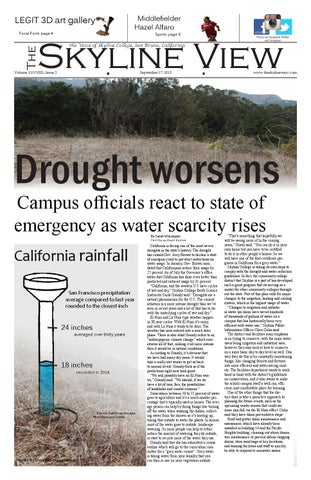
California rainfall San Francisco precipitation average compared to last year rounded to the closest inch
24 inches
averaged over thirty years
18 inches
recorded in 2014
Source: California Neveda River Forecast Center
Photos by Christian Magallanes
California is facing one of the most severe droughts in the state’s history. The drought has caused Gov. Jerry Brown to declare a state of emergency and to put strict restrictions on water usage. In January, Gov. Brown mandated that Californians reduce their usage by 25 percent. As of July the Governor’s office states that California has done even better than predicted and reduced usage by 31 percent. “California, and the western U.S have cycles of wet and dry,” Skyline College Earth Science Instructor Carla Grandy said. “Droughts are a natural phenomenon for the U.S. The current situation is a more intense drought than we’ve seen in recent years and a lot of that has to do with the underlying cycles of wet and dry.” El Nino and La Nina type weather happen in 30 year cycles. With El Nino it’s rainy, and with La Nina it tends to be drier. The weather has now entered into a much drier phase. There is also what Grandy refers to as, “anthropogenic climate change” which exacerbates all of that, making it all more intense then it would be in natural conditions. According to Grandy, it’s obvious that we have had many dry years. It would take a really wet winter to get us back to normal levels. Grandy feels as if the predictions right now look good. “We will possibly have an El Nino winter,” Grandy said. “We should, if we do have a lot of rain, face the possibilities of landslides and coastal erosions.“ Somewhere between 50 to 75 percent of water goes to agriculture and it’s a much smaller percentage that’s typically used in homes. The average person can help by doing things like turning off the water when washing the dishes, collecting water from the shower as it’s heating up; taking that outside to water the plants. In homes, most of the water goes to outside; landscape watering. So more people can help to either reduce the amount of watering they do outside, or start to recycle more of the water they use. Grandy said that she has submitted a course outline which will go to the curriculum committee for a “grey water course”. Grey water is taking water from your laundry that you can then re-use on your vegetation outside.
“That’s something that hopefully we will be seeing more of in the coming years,” Grady said. “You can do it in your own home but you have to be certified to do it in other people’s homes. So we will have one of the first certificate programs in California for a grey water.” Skyline College is taking its own steps to comply with the drought and water reduction guidelines. In fact, the community college district that Skyline is a part of has developed such a good program that its serving as a model for other community colleges throughout the state. Part of this plan calls for major changes to the irrigation, heating and cooling system, which is the highest usage of water. “Changes to irrigation and industrial water use alone have saved hundreds of thousands of gallons of water on a campus that has historically been very efficient with water use,” Skyline Public Information Officer Cheri Colin said. The district and facilities main emphasis is on trying to conserve, with the main water users being irrigation and industrial uses, however they also look at how to conserve on a more basic day to day level as well. One way they do this is by constantly maintaining things, like changing faucets and fixtures into more efficient and water-saving models. The facilities department wants to work hand in hand with the district’s guidelines on conservation, and it also wants to make the school campus itself a well-run, efficient, and comfortable place for learning. One of the other things that the district does is take a proactive approach to planning for future events, such as the upcoming winter season that could see more rain fall via the El Nino effect. Colin said they have taken preventative steps: Roof and gutter drain maintenance and assessment, which have already been installed in building 14 and the Pacific Heights building, cleaning out storm drains, tree maintenance to prevent debris clogging drains, store sand bags at key locations, and training facilities and staff to quickly be able to respond to rainwater issues.
2
Skyline View
The Staff Editor In Chief Jeanita Lyman News Editor Laurel B. Lujan News Designer Michelle Kelly Chief Copy Editor Haley Holmes Focal Point Editor Sarah Marasigan Opinions Editor Michelle Brignoli Sports Editor Jordan Sweidan Multimedia Editor Katelyn Payne Photographers Christian Magallanes Andrew Avilla Multimedia Reporter Blynn Beltran Staff Writers Alexandria Kenyon Gregory Ragaza Amber Wong Gretta Georgiyev Chrystina Chase Joy Marcus Senior Staff Writers Steve perotti Will Nacouzi
Staff Illustrators Clayborne Go Alijandro Berzon
Faculty Advisor Nancy Kaplan-Biegel
Want more news? www.theskylineview.com Or maybe you have news for us? (650) 738-4377 Want to yell at us? theskylineview@gmail.com Or use snail mail: The Skyline View c/o Language Arts Room 8-8110 Skyline College 3300 College Drive
San Bruno CA 94066
The Skyline View is a First Amendment Publication. The Skyline View is published bi-weekly during the spring and fall semesters by the journalism students at Skyline College. The Skyline View is a member of the Journalism Association of Community Colleges. Opinions expressed in the paper are those of the writers and should not be interpreted as the views of Skyline College, SMCCCD, the faculty, administrators or the newspaper adviser. Additionally, the paper does not endorse any of the products or services advertised. The Skyline View welcomes Letters to the Editors; letters must include full name, address, and phone number for verification. The Skyline View reserves the right to edit letters for length, libel, clarity, and taste.
Ride safe or die
theskylineview@gmail.com
Sept. 17, 2015
By Alexandria Kenyon TSV Staff Writer
Do you know what the hardest part of riding a bike is? The Pavement. Maybe you’re not hardcore enough to get into recent health trends such as the Paleo diet or CrossFit, but you may have developed some better eating and exercise habits. Today, more and more people are generally developing a more health-conscious focus. With this new focus, more citizens are feeling the pressure to get in their daily exercise. This could be why more bicyclists have been on the road. Accoing to the Census Bureau’s 2011 American Community Survey, more than 777,000 people use bicycles as a method of transportation. Skyline College has contributed to this number by making improvements for student bicycle commuters. In the 2013 Skyline Sustainability Plan, it was written that the college installed additional bicycle racks on campus to encourage the use of bicycles and public transportation. While bicycle riding can be a great form of transportation and exercise, it is important to be careful. In one study done by the Journal of the American Medical Association, from 1998-2013, bicycle injuries increased 28 percent and hospitalizations from bicycle injuries increased 120 percent. One could attribute these high numbers to the growing number of bicyclists on the road. “I can only guess as to the cause, perhaps more people are biking and more people are texting while driving,” said Emily Risk, a nurse at the Skyline College Health Center. Terri Sofarelli, Skyline College’s physician’s assistant, had similar thoughts.
“I think the numbers are increasing because of two things,” Sofarelli said. “There is an increase in the number of people riding their bikes and there is an increase of distracted drivers and cyclists; they are using hand held devices while driving/riding and less aware of their surroundings.” To prevent injury, Risk said she would advise riders to follow the rules of the road. “Take a free bicycle safety class,” Risk said. “The bicycle coalition in SF has free classes posted on their web site. And most importantly wear a helmet that fits.” “For ways on how people can reduce their risk of being in a bike accident, people should avoid busy streets, light up, take up the whole lane, signal turns, re-think the use of iPhones or music, and ride as if you were invisible,” Sofarelli said. According to the Insurance Institute for Highway Safety, wearing a helmet can reduce the risk of head injury by 85 percent. While wearing a helmet and following the rules of the road can decrease the likeliness of injury or death from riding a bicycle, it still may not be enough. Many city streets were not originally designed with the bicyclist in mind. However, there are many projects being worked on which could change roadways to be more cyclist friendly. Safe Routes to School is a program designed to make bicycling to school a safe choice for children. The project focuses on improving safety and accessibility to schools and educating children on safe bicycling strategies. Grant funding is given to cities so they can implement this program and make the city a safer place to live by combating the issues surrounding bike safety. “Grants fund education and
Bike parked at Skyline bike rack near the bus stop on September 16, 2015. (Laurel B. Lujan/The Skyline View) encouragement of students and parents, assignment of a full time school traffic officer, design and construction of infrastructure improvements, and evaluation of the program for effectiveness. These efforts reduce traffic congestion, pollution, and make cities a better place to live,” said Jocelyn Walker, assistant engineer, who is currently managing this project in San Mateo. Another program concerned with the topic of bicycle safety is Vision Zero. Vision Zero is an initiative to eliminate deaths and serious injuries from roadways by engineering safer streets,
enforcing road laws, and educating the public about pedestrian and bicyclist safety. Vision Zero began in Sweden in 1997 and since then Sweden and other European countries that have taken on the initiative have reduced their traffic fatalities by almost 50 percent. Close to home, cities in San Francisco, San Mateo, and Santa Clara counties have adopted the initiative in a move toward safer streets. With local communities doing what they can to keep bicyclists safe it is now up to bicycle riders themselves to do their part in taking care of their safety. Being healthy does not have to be dangerous.
Free Classes offered by www.sfbike.org Schedule for ongoing classes : Adult Learning to Ride • October 11 @ 10:30 am - 1:30 pm Panhandle Blacktop, East of Basketball Courts, Ashbury Street and Fell Street San Francisco, 94117 • Learn to ride a bike, it doesn’t matter if you’re an adult! • Instructors will work one-on-one to teach the basics of balancing, starting, stopping and steering a bike, as well as proper helmet fit and adjustment. Intro to Urban Bicycling • September 20 @ 2:00 pm - 3:00 pm Bayview Branch Library Community Meeting Room, 5075 3rd Street San Francisco, CA 94124 United States • October 3 @ 2:00 pm - 3:00 pm Sports Basement – Bryant St, 1590 Bryant Street San Francisco, CA United States • October 15 @ 6:30 pm - 7:30 pm Timbuk2 Factory Store, 587 Shotwell Street San Francisco, CA 94110 United States • October 27 @ 7:00 pm - 8:00 pm Sunset Library, 1305 18th Ave San Francisco, CA 94122 United States • Learn the basics of biking in San Francisco at our Intro to Urban Bicycling Workshop. We are offering our onehour course covering bicycling for everyday riding in SF, the rules of the road, route planning and more. • No bicycle is necessary for this class. Traffic Skills 101: Day 1 Classroom • October 3 @ 2:00 pm - 3:00 pm Sports Basement – Bryant St, 1590 Bryant StreetSan Francisco, CA United States • October 10 @ 1:00 pm - 5:00 pm Noe Valley Library, 451 Jersey Street San Francisco, CA 94114 United States • October 17 @ 10:00 am - 2:00 pm Richmond Police Station, 461 6th Avenue San Francisco, CA 94118 United States • Our Traffic Skills 101 is a two part course using the League of American Bicyclist curriculum and covers everything you need to know about biking in the city. The two parts are divided into a Day 1 Classroom course which is a pre-requisite for the 6-hour Day 2 On-Road course below. Traffic Skills 101: Day 2 On-Road • October 25 @ 10:00 am - 4:00 pm Park Police Station, 1899 Waller St San Francisco, CA United States • The Day 2 On-Road course will begin in a car-free space, practicing all the skills you learned in the Day 1 Classroom prerequisite course.
theskylineview@gmail.com
Project truth raises questions
by Laurel B. Lujan and Sarah Marasigan TSV news editor and tsv focal point editor
Project Truth, a Pro-Life group came to Skyline College to promote “the truth,” about abortion. Project Truth tours college campuses in the Bay Area and this is their first time coming to Skyline College. Normally the group would stay two days but due to certain circumstances, they could only promote the project for one day. John Edgar, one of the project coordinators, states their aim is to, “educate students and the humanity of an unborn child and the inhumanity of abortion.” Project Truth believes that our government should not be funding organizations like Planned Parenthood that they believe are pro-abortion. Edgar has stated that most men and women would have a different perception of abortion if they knew the, “truth.” When asked about their stance on Planned Parenthood Edgar said, “Our thing is that Planned Parenthood, has been deceiving women for a long time and they are actually selling baby parts. They actually tell women it’s not a human being.” A computer engineering Major Cici Chagolla, said her opinion on the project, “it’s actually bringing awareness to a lot of people… It’s good to know even though the details are really graphic.” Many other students observing the displays and pamphlets, felt that it told one side of the story, but that there is another side as well and many students did not feel comfortable with project truths take on the subject. Project truth seems to use many graphics and prints that elicit a strong response and seem to hope that the shock value will be enough to get
their message across. This is a very controversial topic that is discussed from the highest levels of government on down. The two sides are much divided and have very strong opinions for both sides of the issue. Skyline College’s response to Project Truth did not seem to be a very favorable one. Human Biology Major Victoria Rodriguez, said in response to the project, “When I met one of the members he was very adamant on trying to compare an unborn fetus to the Holocaust and I thought it was absolutely obscure.” Project truth feels that even though their material may make people uncomfortable and not everyone will agree with them, that they owe it to all the “unborn children” to continue to battle for them. Rodriguez continued, “ He also tried to relate it to slavery and his analogies and how he was trying to empathize with women by comparing male nurses to pregnancy, ...I had a hard time with the information that was given because there were no statistics and he was just saying things like lots of women try to commit suicide after having an abortion and I was like can you give me like a number like that. He responded why would I have that?’” Aside from the graphic photos, shock value is still one way to grab people’s attention, when addressing a controversial topic. Cherie Colin, Director of Marketing, Communications, and Public Relations, said when asked about the group being on Skyline, “ Any group or organization on campus can be here as long as they follow the rules and procedure. Freedom of Speech.”
Sept. 17, 2015
Skyline View 3
Obama pushes for free community college By Amber Wong TSV Staff Writer
The cost of college could soon be free for students attending community colleges in the near future, if President Obama’s proposal regarding paid tuition attains approval by the federal government. Obama first introduced the proposal earlier this January, in an annual State of the Union address. This is a plan in which he hopes to make possible for over nine million students across the country. Some have argued that attending college cost-free would be a poor decision, due to the belief that students would abuse the program, while others have voiced their opinions in regards to an advantageous aspect of the notion. However, Obama’s proposal has a catch – qualifying students must maintain at least a 2.5 grade point average, while continuing to complete an educational program within the college. However, the idea of going to community college for free does not sound rewarding for some people. “Free tuition might make
the job market crash in terms of graduation rates. Many people are going to be attending and I think that it’s actually a reason as to why tuition is being raised over the years, to prevent people from going because there are too many graduates,” said SFSU student Juvilyn Cabilin said. Currently, there are over 7 million students in the United States who attend community colleges, according to a statistic from the American Association of Community Colleges. If the amount of students attending school increases, this can cause enrollment rates to skyrocket, and these factors can lead to an over capacity in community colleges. Cabilin continued, “Also, how would that impact the schools in terms of capacity? It sounds like a good idea, but there are many loopholes and factors that you have to consider before going forward with the decision.” San Bruno resident Irene Crivello pointed out that extending the duration of public school systems could help with this issue. “I think the government
should extend the public high school system by two years, with funding coming from the state,” Crivello said. “It’s a natural extension, and maybe students could have practice jobs for experience, with classes such as financial planning. It would be a good idea because many students don’t survive the first year of college. It’s hard.” The elimination of tuition could have negative impacts on the quality of a student’s education as well. “I think that having free tuition is every student’s dream, but not having to pay fees could also lead to what kind of education the students are receiving. Not having funds for the institution’s resources can be a problem,” SFSU student Benedict Cases said. Up until 1984, community colleges were free in the state of California, but what caused the school systems to revert back to charging fees? Skyline College guidance counselor Kent Gomez mentioned that he thinks this is due to funding costs. “I think it’s due to budget cuts, more money for prisons, which in turn is less funding for colleges,” he said. Gomez also mentioned that he wanted to rid the stigma of community colleges. “The barrier is more on people not understanding the benefits that they could get by attending because it’s cheaper.”
The
Skyline View
Focal Point
Sept. 17, 2015
4
Contemporary art takes shape
Skyline College’s LEGIT 3D Art Exhibit provides an experience featuring a non-traditional and exciting framework By Sarah Marasigan TSV Focal Point Editor
The current gallery exhibit is meant for art unsing recycled and reclaimed materials. This exhibit, like all at Skyline College, stay for a month and are a perfect opportunity to showcase not only the art of the community, but also the talents of our skyline student. The director of the gallery, Paul Bridenbaugh, stated that his original thought was to do something “non tradional that would showcase the art of the skyline students, such as sculpture, digital arts, ceramics, etc”. Mr. Bridenbaugh states that ‘he is very involved in the art community and sees a lot of artists and their work”. Because Bridenbaugh is well known in the art community, whenever he puts on any type of exhibit, he has many artists involved, not only at the school but from the greater community. The exhibit also exposes the art community to many different styles, forms, and materials. In this case, the artists scavenged a lot of the materials and built them into unique art pieces. All of the art works in the gallery use nontraditional materials. For example, artist and exhibitor Michael Arcega, an art professor from San Francisco State University, brings with him an interesting background: he has done a years residency with SF Recology and uses only materials from this dump site. Currently, Arcega is teaching an installation as well as a sculptor class at San Francisco state. He brings to the exhibit a unique take on art and its impact on the community. "This is in power with a lot of contemporary practices. This exhibition is up to date with what the “art world” is having a conversation about. Traditional exhibitions are more and more becoming the “rare thing”. It’s almost like modern art vs contemporary art and this show is pretty contemporary," quotes Arcega. Arcega's view of contemporary vs modern can be seen throughout many of his pieces
shown in the gallery. When it comes to contemporary art, the look tends to change a lot because it is, as Arcega quotes, very "conceptually based." It is routed in a narrative, so the form of the look tends to constantly change. The artists tend to have kind of a conceptual frame work that they follow. Another example of this variety and scope can be seen in the pieces done by artist Jeremiah Jenkins. He feels this show was a little different then the more traditional galleries he has done, as this show only featured four artists. "It's almost like writing a paragraph," Jenkins says, "Every artist puts in their particular piece that helps to build the overall structure." Jenkins also feels that because it was a four person show, there has been much more communication between the artists work and the statements they are trying to make. For many of the artists, especially Jenkins, they got to experiment with many new styles and forms of artwork. "Every piece is new. I'm always stepping out of my comfort zone," he quotes. Technically, when it comes to the way artists create their work, they follow the "found object" sculpture technique, and to many people that can mean coming across different materials and then executing their work. Although for many of the artists in this show, they found that their ideas lead them to the projects and artwork that they decided to create. In this new era of contemporary and post modern art, especially sculpture, what many of the artists seem to describe it as, and what this type of art seems to be now, is finding your language through material, be they objects or other art mediums. Art Installation, Untitled by Dana Hemenway Sweatshop by COLL.EO Preformed by Dana Hemenway Rare Bird by Jeremiah Jenkins (clockwise)
Steven Dans (right) receiving feedback for his audtion from director Kevin Simmers (left)
Focal Point
Sept. 17, 2015
Features
Skyline View
The
5
Science and religion can mix By Sarah Marasigan TSV Focal Point Editor
Continuing the Science in Action weekly lecture series, the fall 2015 semester’s first guest speaker was Jonathan Z. Butler, Ph.D. Butler is a post-doctoral scholar at University of San Francisco. His research mainly focuses on how religion, socioeconomic status, and race and ethnicity can affect one’s health. Within the field of science and research, Butler refers to himself as an underrepresented minority. Steve Weinstein, Director of Science in Action says his main goals for these lectures are “to break down any barriers for minority students who potentially would want to be researchers.” Butler brings with him a unique background with much experience and knowledge of both religion and science. Nick Kapp, Biology Faculty comments, “We need more minorities for research. And so these lectures have shown to be successful in that we have many returning Skyline students we have been inspired to pursue their Ph.D. somewhere in the field of science.” Butler grew up in a lower economic area in Arkansas, with his single mom. He did not grow up with many advantages or very many opportunities as far as school was concerned. In high school, he decided to join what is
known as the JROTC program, where he worked closely with Sergeant Major Joseph Edwards, who Butler strongly believes prepared, him for not only college but life. Shortly after, he joined the Alpha Phi Alpha fraternity, which taught him skill sets he would need for life; things like making resumes and applying for colleges and for jobs. The next summer, Butler joined the academy program at Howard University School of Divinity. There, the dean helped him to receive scholarships to pay for the program. Two professors at the school also helped Butler to be a part of the program, with the stipulation that he maintain at least a 3.0. Butler was very heavily involved in his church, which conveniently was located right across the street from his university. He had a very close relationship with his pastor, Dr. Cosby, who also helped him financially with school and other expenses. At the university, Butler formed ties with one of the faculty members, who got him a job into the president’s office at the campus. Butler stresses the importance of not only taking risks and putting yourself out there, but also the importance of talking to people and gaining mentors. After receiving his bachelor’s degree in marketing, Butler realized he was interested in studying and possibly getting a degree in religion. Through
Tv
one of his peers, whom he met at Howard University, he got accepted into the Ph.D. program for medical sociology, a field that he did not know very much about, however was interested in. In the Ph.D. program, he worked alongside many new people, such as a Flo McAfee, a media consultant who introduced him to new opportunities, for instance, meeting Richard Gillum, a researcher in cardiology and religion, who taught him how to do publications and was an integral part of Butler’s academic and personal life. Through Gillum’s help, Butler was offered a teaching job at San Francisco State University. “These people will help propel you to the next level,” Butler said. Butler’s career has been a series of steps that he climbed with the help and guidance of many exceptional mentors who he gave much recognition to. Butler’s passion, dedication, and commitment got him not only into the career he wanted, but allowed him to venture out into the world and to expand his learning experience. His hopes are not only to spark interest in his particular field for other people, but to also remind people that through networking, risk-taking, and balance, you can achieve your goals.
Christian Magallanes/The Skyline View Jonathan Z. Butler speaks at the first Scence in Action event of the fall semester
Fall 2015 Lecture Schedule “From Venezuela to California – How I Ended Up Working on Steroids”, by Gabriela Monsalve, Ph.D., September 21, 2015 “Understanding the effects of variation in regulatory DNA sequences”, by Aaron Hardin, Ph.D., September 28, 2015 “Why Research is Like Fighting Forest Fires”, by Andrea Burbank, MD, October 5, 2015
video games
Open-world ‘Metal Gear Solid’ installment lives up to anticipation
Game of the year contender enters the ring By Blynn Beltran TSV Staff writer
Creative Commons
“Moonbeam City” comes to Comedy Central By Haley Holmes TSV Chief Copy Editor
Comedy Central has added a new show to their lineup this fall, with the quirky cartoon “Moonbeam City” taking its place right behind “South Park” on Wednesday nights. Created by writer and director Scott Gairdner, “Moonbeam City” follows the ridiculous antics of a bumbling yet somehow completely effective team of police detectives, starring Rob Lowe as “#1 Cop” Dazzle Novak. On the surface, it seems like “Moonbeam City” is an attempt to capitalize on the popularity of the very similar FX show “Archer”. The joke style of both is the same, the animation is similarly strange (though “Moonbeam” is obviously heavily based in 80’s art and pop culture) and the show plots are both equally outlandish and ridiculous, “Moonbeam City” just has police instead of secret agents. Especially in today’s Internet
fueled, zany comedy scene, where things like Adult Swim’s “Rick & Morty” are thriving, “Moonbeam City” fits right in. In the preview episode alone, a drug lord was established on stolen money from one old woman’s purse, rabid dogs were fed cocaine and unleashed in elderly communities, child neglect spiked, and an illegal alien with an unpronouncable name became a pop star over night, all thanks to Dazzle Novak. The episode was ridiculous from start to finish and never stopped being funny. It would seem that “Moonbeam City” is the perfect companion for anyone that finds the shows “Archer” or “Space Dandy” any kind of entertaining. With an impressively all star cast including Rob Lowe, Elizabeth Banks, and Will Forte, “Moonbeam City” is prepped to explode in popularity if it has the right audience. The premiere of the “Moonbeam City” series is Wednesday, Sept. 16 at 10:30 p.m. on Comedy Central, after “South Park.”
This game franchise has proven its prowess through amazing stealth game play, over-the-top set pieces and extremely elaborate plot. The release of this masterpiece ushered in a fresh and final game for the “Metal Gear” saga. “The Phantom Pain” brings the franchise to its first take on an open world game, and it has succeeded with flying colors. Visuals are as top-notch as ever, showing off amazing cut scenes and ingame graphics thanks to the new Fox engine. The world you play in is large but still has restrictions comparable to Monolith’s “Middle-earth: Shadow of Mordor.” The game play mechanics were ripped from “Metal Gear Solid V: Ground Zeroes.” Being an open-world game, it is massive, not just in map scale but choices as well. What I mean by choices is the multitudinous ways you can approach a mission. Do you run in guns blazing, or are you a bit more subtle and skulk around utilizing silent weapons? The game doesn’t punish you for going loud as much as other “Metal Gear” games. It lets players excel through a combination of creativity and skill, making improvising during a situation enjoyable. Almost everything is customize-able and upgrade-able as well: weapons, vehicles, companions,
etc. This is all done through your Mother Base. Unlike the one in “Peace Walker,” there is physicality rather than just an on-screen menu. You get to see your men and greet them in person. There is also a recruiting system that gives you an incentive not to go lethal. It gives you an incentive not to kill soldiers that you meet in the battlefield because you might like what they offer you by looking through their skill set. It’s fun to micro-manage every single thing in the Mother Base, from managing your soldiers, picking which equipment to research, and even upgrading the Mother Base itself. You don’t even have to go to it for you to be able to upgrade it. You can do it while in a mission through your communication device called the iDroid. The A.I. of the game is fantastic as well. It boasts the best companions in a video game and the A.I. enemies are good enough to be challenging. I have just one gripe: the actual Mother Base feels lifeless and hollow. Nothing much is going on, just your soldiers walking around and occasional preset cut-scenes. Ambiance is key and the Mother Base doesn’t have it. Let’s just hope that the multiplayer aspect will redeem another use for our lonely little upgrade hub. Servers are still down at the time of this review. The game still is great when it comes to extreme, sci-fi, cinematic
scenes and set-pieces, but the story was a little underwhelming so far for a “Metal Gear” game. You don’t need to play the other “Metal Gear” games to get the story but it is advised. It is noticeable that Snake is not as talkative as the other games in the series. Other characters carry the weight of the plot more and it succeeds so far. The characters are endearing but most of their stories are in cassette tapes collect throughout the game. It made me genuinely happy and sometimes even heartbroken for them as the narrative unravels. It made me care about them and invested that if ever one of them met their demise, I would tear up. This game doesn’t feel like the game to end the franchise with. “MSG4: Guns of the Patriots” still takes that cake, but what this does is leave a master-crafted “Metal Gear” experience and show that Kojima is top dog. Fifty hours of playing and I still haven’t finished the game (34% completion). I could easily drop another fifty hours playing this game and not even consider multiplayer. This is a game you cannot and must not rush. In conclusion, if you have not picked up this game, buy it now. This is so far the “Game of the Year” of 2015. It is a must have for fans and newbies alike.
Opinions
page 6
Sept.17, 2015
editorial
theskylineview@gmail.com
Campus can do more to conserve Although the heat wave is gone and the Bay Area has been damp for the past few days, California is still in a state of emergency. The campus could take on more conservation measures as far as improvements and fixtures in operational inefficiencies. The district has developed a water efficiency program that is serving as a model for all community colleges to address the drought. As far as Skyline, they have taken on a few conservation measures to ensure improvements for not only the industrial and irrigational use of water, but also improvements for our domestic water usage. Back in Feb. 2013, according to the Sustainability Plan, Skyline’s aim for water conservation was executed through installing an artificial turf on two soccer fields and the baseball field. With the synthetic turf now installed, the District will save approximately 5.8 million gallons of water and 370,000 dollars per year. In addition to eliminating the need for irrigation, Skyline College has been able to reduce the use of air polluting lawn mowers, chemical pesticides and fertilizers, and maintenance labor as a result.
Skyline so far has done their part, as the signs state, by lowering the campus water usage by 25 percent. Other changes on campus have been made by replacing plants with desert plants. Recently, after the first two weeks of
“A few changes can also make a large impact.” school, the fountains in the quad were turned off. Even though it is recycled water, the water does evaporate into the air causing more water to be lost. Compared to the other community colleges in the district, Skyline has made a number of significant and substantial changes as far as water consumption is concerned. However, there are a few things the school could look into, such as checking for leaks in the older buildings and inside the walls. Leaks over time can cause a lot of damage and also waste
water especially with the situation California is now in. A few changes can also make a large impact. These include the reprogramming of the automatic toilets and faucets. According to Dr. Carla Grandy, Earth Sciences Professor, her class has tested the faucets and concluded they run longer than needed for the average person. Also, many times, students and staff members have experienced the automatic toilets going off three times in a row, and even when the stalls are not in use. So from the automatic flushing of toilets and the no touch faucets in the bathroom, it has been acknowledged that these particular things run a lot longer than they should, and are problems that should be addressed. The district and Skyline College still continue and are open to new ways of conserving water. However, even when reduction problems are being recognized, Skyline still must prioritize resources to keep up with maintaining a steady, comfortable learning environment for all students.
Work and school, not fun but necessary by Will Nacouzi TSV Senior Staff Writer
Life is an act of balancing various goals and responsibilities that we have: family, college, work, and anything else that we have or are trying to achieve in our life. That is life, or at least my view of it. In the case of college students, it’s a question of balancing our own set of responsibilities. We do this because, at the end of the day, we all have objectives and goals that we want to achieve in our lives. In short, working while in college is difficult. School means responsibilities for students, and depending on the course material, it can be either easy, hard or a mix of both. Of course, making the situation even worse is the fact that it also depends on the number of units that the student is taking in the semester. Regardless of the difficulty, the fact of the matter is that, at the end of the day, it all ends up as responsibilities for the students who have to meet them and handle them in order to pass the classes to keep their GPA high. Work itself isn’t that different, but it does come with its own set of responsibilities that students
have to deal with on top of school. And unless the student is lucky and already has a job that he or she actually enjoys, jobs for college students are only a means to an end. In other words, work for college students itself is a means of earning money to pay bills, which we all have, and meeting other responsibilities. So much stress really comes down to the balancing act for students. The trick is finding the right balance between the two, or else risk making life difficult. Too much work and school doesn’t leave enough time for rest, homework, or any other activity required by teachers. It also doesn’t leave much time for a personal life or other activities that aren’t related to work or school. In short, working while in college isn’t easy or fun. It doesn’t leave a lot of time for students to have personal lives or meet their college responsibilities and others that they have in their life. Working while in college is difficult and a complete pain, but students often don’t have a choice on the matter. Work must be done.
The View Is there more that we can do to From Here help the homeless? With Jeanita Lyman, editor in chief What is journalism? What is news? These are the very basic questions we’re asked early on in Skyline’s journalism program. They’re becoming increasingly difficult to answer, but one thing is certain about today’s media landscape: There’s a lot of crap out there. When it comes to getting our news, we don’t know who to trust anymore. Regardless of our personal political beliefs, we can all agree that much of what is classified as news in today’s media is typically fear-mongering. It all feels agenda-driven and biased at worst, and trivial at best. As media companies merge into big, shiny, sterilized conglomerates, eating up independent news outlets along the way, the news we’re presented with is increasingly depersonalized and out of touch with what we want or need. We’re constantly faced with the unflattering reflection of what media outlets think we want. Stories about things like hot felons, “blue or black” dresses, poorly-behaved young pop stars, and Donald Trump dominate the headlines. That’s because these stories garner attention, thereby garnering advertisers. That is the only reason they exist. It’s not because they’re the most important topics of our time or nothing else is going on. It’s just
plain business. Good reporting hasn’t fallen by the wayside, and if anything, the internet has made it easier for determined reporters to illuminate and publish important stories. But given that it’s saturated with disconnected, conglomerate-produced material and abhorrently stupid viral content while infused with a minefield of hoaxes, good stories rarely get the attention they deserve. People are completely justified in being skeptical and jaded about the news. The newspaper industry’s conglomeration and gradual absorption into the virtual world have resulted in news coverage turning into something of an awkward circus, and no one is sure what exactly to do. The sobering effect of this is an under-informed population. Despite the vast amount of information at our fingertips, it’s more difficult than ever to find objective coverage of important issues. In a democratic society where we vote on important issues, this is extremely dangerous. A change in the way journalism is done has become inevitable, which is something the industry has realized. But that change is still being defined and it’s not yet clear exactly what direction we’re heading. It will be up to those of us now entering the industry to determine how to move forward.
We should be doing more than simply throwing coins in cups by Michelle Brignoli TSV Opinions Editor
I work in downtown San Francisco, and every time I step in or out of the BART station I find myself apologizing to at least one homeless or less fortunate person who is begging me for food or money. It’s baffling to me how many of these people are able to survive with little to nothing, but what’s even more baffling is that hardly any of us fortunate people with homes and food for ourselves aren’t willing to help. When I can, I’ll offer a snack I might have in my purse. Trust me I know this doesn’t make me a saint, but I can’t help feeling an overwhelming sense of guilt as I walk around the streets of the city on my lunch breaks. Upon expressing the amount of guilt I’ve been feeling for having a large amount of materialistic items myself and not contributing enough, a friend of mine explained to me that I shouldn’t feel bad, because even if I tried, I wouldn’t be able to help all of those less fortunate. When I heard that, it did make me feel less guilty. However, it also infuriated me. Why can’t I help them all? What’s stopping me? Is it because I’m just one person? That’s a ridiculous excuse if you ask me. If it’s one person
against the world, so be it, but something needs to be done about the poor people who can’t get themselves back on their feet. The more I think about it, the more I don’t understand how we, as a community or even as a country, can still let this happen. Because it’s not only in San Francisco that people are suffering. I could travel to any big city in this country and others and find
“Trust me I know this doesn’t make me a saint, but I can’t help feeling an overwhelming sense of guilt as I walk around the streets of the city on my lunch breaks.” a number of people living on the streets. Even rural areas aren’t free of homeless people. Of course there are programs offered to help the less fortunate, such as rent assistance, housing placement services, job assistance, and other short-term, one-time services, but these cater specifically to homeless families. So what about the others? A majority of the homeless who are most difficult to help are
categorized as being “chronically homeless.” What this means is they experience long-term and/ or repeated bouts of homelessness coupled with disability (physical or mental). There is assistance for these homeless people as well, however it must not be working out too well if they’re still considered chronically homeless. There are websites to donate toward helping, foundations to look into, and information that should be known by much more of our population. What more can we do? In an ideal world, we would make shelters better for the people who have to stay in them. We would produce even more programs of assistance for the people who have it the worst out of everyone. In an ideal world, everyone would have a home. Let’s all take a step back the next time we hurry to purchase the next big Apple product or a name brand handbag and think about how someone sitting outside the mall we’re in is going to be sitting there for the rest of the night, week, month, and possibly year, unable to purchase anything they might need to survive.
Sept. 17, 2015 7 Opinions Artistic License You are not lacking in
theskylineview@gmail.com
motivation by Gregory Ragaza TSV Staff Writer
You have probably heard people tell you, “Hey all you need is a bit of motivation.” That is where they are wrong. If you believe them, stop and ask yourself why you think you need motivation. It is not the absence of motivation that is keeping people from their goals and dreams. It is the fact that they need to first have a goal or a dream they want for their future. For example, look at a typical high school student. Many students drift through their four years of high school to graduate. Some will probably tell you they are there because they have to be there. Then they will graduate high school, and feel completely lost in college. Why? Well, because it is ultimately their choice if they want to be in college. The “just getting by” mindset will not get them, or you, through college. Students need to know why they are graduating. Yeah the first year or two can seem rather mindless, going through all the general education courses. But let me tell you; after that second year, students will start to feel that time crunch. Especially the students who are still undecided, or have that goal where they are not even quite sure is what they want. Students will not be motivated to graduate college if they do not even know why they’re doing it.
However, there are those students, maybe you are one of them, who do have aspirations and know what they want. But what is keeping them from graduating? Life. There are just too many things in life that can hinder a student. Finances, living situations, health issues, personal problems, family problems, and relationship problems are a few items on a long list of things that life throws at a student. Plans change, and all students can do is adapt. It is not the end of the world when life throws problems here and there. That is how it always will be. The best thing to do is to keep trucking through, and do not give up. Yes, it’s much simpler said than done. And yes, the worst case scenario is that you fail. In your failure, you have gained knowledge of what you can and can’t do. Now you can either try again, or change your plans. But keep going and don’t stop. You can and will find ways to overcome problems. You are not alone in this world. If you have problems you know you can’t handle by yourself, ask for help. There is no shame in succeeding with the help of others. But do remember that you are never lacking motivation. You have all the motivation in the world at your fingertips. Push yourself when no one else will. Tell yourself what you want and why you want it. At the end of the day, only you can make your dreams come true.
Communication is key: Talking about what The importance of touch in foreplay: Take you like will get you what you want the time to touch your partner before sex In any relationship, communication is one of the important attributes for success. One of the most important topics that always comes up is sex. Surprisingly, many couples are still shy about the subject and beat around the bush to their partner about what turns them on, or what their fantasies are. The more uncomfortable the “talk” is, the fewer orgasms are going to happen. What happens in the bedroom will eventually come into play out of it, affecting the relationship as a whole. Intimacy on all levels is important. Communication, trust, and sex go hand in hand. According to researcher Elizabeth Babin, an expert on health communication at Cleveland State University, conducted a study from livescience.com that confirms that even having a little bit of anxiety about communication can directly affect the relationship’s satisfaction rate. Great communication in
any relationship can lead to a great sex life. If it takes actually sitting down and discussing it, so be it. Trust is important on being able to communicate with your significant other. Never fake a moan or orgasm because that is just going to make your partner think that they are doing a good job. No matter how embarrassing it is, this will benefit both parties in the long run. Happiness is key, and no one actually wants to make their partner miserable. The worst case scenario of bad communication can lead to painful sex. Pain during sex is never a good sign. It does not matter if your partner is getting off thinking you are having fun also, communicate that something is wrong. Nobody wants that. During these times it is best to try new things and to be patient with them. When there is no trust after having broken communication in the relationship it is bound to turn sour. Most likely there will be a small amount of resentment when it comes to
not being honest with one another. This is why it is important to know what makes each other feel good. Knowing the little things about your partner can be the most rewarding. Little by little, this does open the intimacy level beyond the sexual level helping to understand one another. Communication also applies for people who have very casual sex partners. Just because there is little socializing between the bedroom and everyday life does not mean both needs have to be compensated. There does not have to be romance in a relationship to have a greater acknowledgement of ones selves. Awareness of all these things creates respect for each other. Repeat this slogan when the need for courage comes to tell your partner: Never fake a moan, let them know.
The majority of people don’t equate patience with sex. We always tend to think that sex needs to be passionate and quick in order to be good, but that’s not always the case. The same can be said when it comes to foreplay. The majority of men and women think foreplay pertains only to kissing and/or oral sex, but there is much more to it than that. Foreplay also includes simply touching your partner. This can vary depending on the situation and the mood, but it can certainly heighten the situation for both people involved in this carnal moment. If you’re looking to have a soft, intimate night with your partner, start by giving them a massage. This is, of course, a very specific type of massage, not the kind you get from a trainer at your local gym or fitness club, unless you’re into that kind of thing of course. If your
partner is fond of a certain lotion or oil, that’s what you use. Your goal is to get them as relaxed as possible before you get them riled up again. Not only does the act of the massage relax your partner but it shows how much time and energy you are willing to invest when it comes to their comfort and happiness. Chances are this will arouse them more and more as the massage continues because, believe it or not, it’s the thought that counts. On the other end of the spectrum, if you’re looking to have some rougher kind of fun with your partner, who is consenting of course, the right kind of touch can do wonders. A small amount of pressure against their windpipe and running your fingers through their hair and pulling back with increasing amounts of strength are just a few suggestions, but they can have amazing effects in the bedroom, or wherever you may be when the mood for some physical affection strikes you. Sex is very intimate. We all know this, but emphasizing
the aspect of touch can increase intimacy by leaps and bounds. Plus you can feel how your partner is reacting to everything you are doing while you’re doing it through their escalating heartbeat, the tension of their muscles, increased rate of breathing. From here you move on to the more intricate aspects of foreplay. Foreplay is an important aspect of sex, one that is often forgotten and cast aside as we hurry to get to the climactic conclusion of the act. But it shows maturity and prowess when you take the time to warm up your partner the right way. Chances are they will reciprocate wholeheartedly. If they don’t, chances are they’re either in shock or won’t be a very good partner in the long run.
The
Skyline View
Skyline
Sports
Sports
Sept. 17, 2015
8
Upcoming Games
Men’s Soccer Sept. 18 @ College of Marin, 4:00 p.m. Sept. 23 vs. Napa Valley College, 3:30 p.m. Sept. 29 vs. Monterey Peninsula, 2:00 p.m. Oct. 2 vs. De Anza College, 1:00 p.m. Oct. 6 @ Cabrillo College, 2:00 p.m. Oct. 9 @ Hartnell College, 4:00 p.m.
Volleyball
Sept. 18 vs. Ohlone College, 6:30 p.m. Sept. 23 @ Chabot College, 6:30 p.m. Sept. 30 @ Cañada College, 6:30 p.m. Oct. 2 @ College of the Siskiyous, 12:00 p.m. Oct. 9 vs. Monterey Peninsula, 6:30 p.m. Oct. 13 vs. CCSF, 6:30 p.m.
Soccer
Midfielder’s passion ignites team by Gretta Georgiyev TSV staff writer
Away from the soccer field, Hazel Alfaro displays a warm smile and an easy-going disposition. But should you find yourself on a team playing against hers, prepare for a battle. “I am very competitive,’’ Alfaro said. “I have the fight and the will to win a game and will do whatever it takes to win for my team.’’ As a center midfielder on the Skyline College women’s soccer team, this will be Alfaro’s third year in the soccer program and second year playing. “Hazel is very technically gifted as a player and she has been playing the game at a high level for a long time,” Coach Corsigliaf said. “Very confident and makes good decisions on the ball.” Alfaro gives credit to her mom and coach, Daniel Link who have been her biggest inspirations and role models through out her nine years of playing. “My mom has taught me to always be confident, persevere and never give up no matter the cir-
cumstances, and Coach Daniel has definitely helped shape the player I am today,” Alfaro said. “Playing for him on the San Francisco Revolution Club team taught me a lot of technique and concepts and helped me to make a smooth transition into playing college soccer for coach Kevin.” Some of Alfaro’s proudest moments have been her many assists for the Skyline women’s soccer team, as well being a strong force on the defense. Last year, she was named Second Team All League in conference. As a freshman on the team, it was an impressive award to achieve. “Soccer is the only thing that gets my heart racing really fast,” she said. When asked to describe her teammate, Iliana Cabral was quick to respond. “Hazel is a very humble, creative and skillful player,” Cabral said. “She likes to open up and do a lot of great footwork to create an open area for everybody on the team. She is not afraid to go into pressure and take the ball away from the other team.” It is with this kind of determination that Alfaro plans on working
Alfaro (#11) on the defensive against Modesto Junior College’s Tyler Fenton
hard to become a strong team leader this season which, according to her fellow teammate, Janet Sanchez, is a quality Alfaro already possesses. “Hazel is a great leader,” Sanchez said. “She knows exactly what she is doing on and off the field and would make an excellent team captain. We don’t have one right now, but if I were to choose I would definitely pick her.” Regardless of how much praise her teammates have for her, Alfaro emphasized how much of a team
Sports Opinion
TSV Senior staff writer
Anyone who is at all familiar with mixed martial arts (MMA) or the Ultimate Fighting Championships (UFC) knows about Brazilian jiu-jitsu (BJJ). For those who have never heard of BJJ, the main thing you need to know is that it is a self-defense based primarily on throws, joint-locks and choke holds. And it is the most practical martial art you could ever train in. First and foremost this is an opinion. Martial arts is a very large umbrella and there are numerous styles and hundreds of variations of hand-to-hand combat. They all have their strengths and they all have their weaknesses, but from my point-of-view BJJ is the most effective of them all when it comes to self defense. BJJ, which was developed by Helio and Carlos Gracie from the original Japanese jujutsu, is designed to allow for a smaller fighter to incapacitate a larger/
stronger opponent. The techniques themselves take into account the importance of exposed weak spots, such as the throat, as well as the fragility of joints when they're forced to exceed their range of motion. To put it bluntly, you learn how to effectively strangle a larger opponent and how to break arms and/or legs when they're left out too long. I have been training in BJJ for the better part of six years and, while I don't believe I will ever truly master the art as a whole, I am confident in my abilities when it comes to this art-form. And I believe that everyone, regardless of age, gender or past experience, can benefit from learning BJJ. But it will not be an easy process. The most obvious benefit is faith and confidence. Faith in yourself and confidence in your abilities to take care of yourself if something happens that requires physical defense. The hallmark mindset of BJJ is that it is technique, not strength, that dictates
confirmed Alfaro’s talent. “She is certainly a team player who is always looking to make her teammates better and not necessarily herself,” Link said. “She has good camaraderie with her teammates.” Alfaro is hoping to continue her soccer career outside of Skyline. Whether it will be playing recreational soccer or at a four year college, her main goals right now are to stay focused, determined, and to put in the hard work necessary for a great season.
Meathead’s manifesto
Bring on the pain by Steve Perotti
effort the game really is. “Soccer is so much more than just about me individually,” Alfaro said. “It is all about being a team player. It is about coming together and really giving your all. It requires a positive mind-set and a lot of hard work put into practice. You can never give up, no matter how hard it may seem, because if you give up as a player then your teammates will give up as well.” With great assurance and confidence in his voice, Coach Link
Will Nacouzi/The Skyline View
the victor. Does strength help? Of course it does, but it is ultimately the technique that decides the victor/survivor of an altercation. Plus there is the added benefit of fantastic cardio-vascular health as well. BJJ can be high intenesity and if you're in the right environment, with the right teacher and the right teammates, you'll be pushed to harder than you're used to. But it is not an easy process. You will get hurt. Accept that fact now. Your hands will ache, your ears will hurt, your joints may be damaged. But this is part of the journey. Nothing worth having will ever come easy in this life. And it will take time. On average it takes a beginner 10 years to reach the rank of black belt, the rank that recognizes you as being capable of teaching others. And there are belt ranks beyond even black that take a life time to achieve. Will it be easy? Absolutely not. Will it be worth it? Most definitely.
Upcoming men’s basketball games Opponents
Location/Time
Date
San Joaquin Delta College (scrimmage)
Stockton/TBA
Sept. 23
Napa Valley College (scrimmage) College of Alameda
Napa/TBA
Sept. 30
Skyline/5:00 p.m.
Nov. 4
Solano College Tournament
Fairfield /TBA
Nov. 13-15
Mendocino College Tournament
Ukiah/TBA
Nov. 19-21
Proper gym etiquette by Steve Perotti
TSV Senior staff writer
Welcome to Meathead’s Manifesto! The purpose of this column is to be an honest and straight-forward piece of writing pertaining to fitness, nutrition and working-out in general. Keep in mind these are my opinions I am posting and, while some people may not agree with them, many of you will. It is very trendy to be fit right now. Chances are there are a few unfamiliar faces at your local gym these days and, while that's not necessarily a bad thing, it can lead to some very annoying interactions with people. There are rules to going to the gym, everyone knows that, but there are also unspoken rules that every serious lifter/runner is expected to follow. Rule number one: If you're at the gym you're expected to work. The work that you're expected to do can be anything as long as you're serious about it. You know what doesn't qualify as work? Walking around the gym and creeping on people who are there to seriously sweat. The women at the gym don't want to be harassed by some random stooge who thinks they look good in yoga pants. No one wants to have a philosophical debate with you when they're in the middle of lifting a few hundred pounds off the ground. Rule number two: Don't take up space. Unless you're working out at a massive gym packed wall-to-
wall with equipment, chances are you're going to be waiting to use some equipment. That's to be expected. It comes with the territory honestly. But if you're the type of person, man or woman, who will take a five minute break between sets to check your Facebook status or upload a selfie to Instagram, then you need to move on. The only acceptable use of a cell phone when you're using a piece of equipment is to change songs on your music player or to keep track of how much your lifting for your own personal records. That's it. No talking on the phone, no updating of social media and no text arguments with your significant other. If you feel the need to do any of the above, move aside and let someone else work. Rule number three: Don't mock the people who are struggling. If someone is in the gym working diligently towards a goal they should be respected. Not mocked. Don't be that person who sits back and laughs at someone struggling to lift a weight or killing themselves to run a mile under a certain time. They're making progress. They're working hard towards what they want while you sit back like a clown pointing and laughing at them. If you can't respect the work that people are putting into their workouts do everyone a favor and stay home. The gym doesn't need that kind of negativity of your idiotic sense of humor.