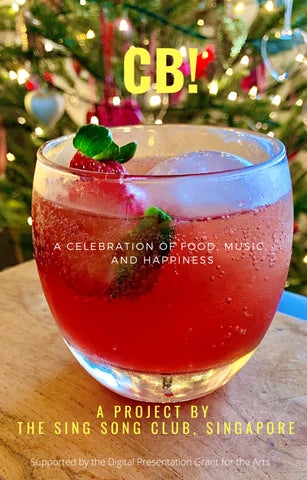
CB! A CELEBRATION OF FOOD, MUSIC, AND HAPPINESS
A PROJECT BY THE SING SONG CLUB, SINGAPORE Supported by the Digital Presentation Grant for the Arts
If you really want to make a friend, go to someone's house and eat with him... the people who give you their food give you their heart. CESAR CHAVEZ
THE SING SONG CLUB, SINGAPORE PRESENTS
CB! A Celebration of Food, Music & Happiness
Photo Credit: Mr Phang Kien Yip
PROJECT OVERVIEW This project is a combination of four big things that bind our collective—friendship, the love of music, the love of cooking, and the getting together to share and partake of the feast. Our best ideas come over the sharing of food, and this digital presentation is a combination of all these. We have devised a programme of 12 songs about food and eating. Accompanying and corresponding with each song is a recipe. We will be cooking these dishes and giving out the recipe as part of the digital presentation. Our hope
WHAT'S INSIDE THIS E-BOOK: Project Overview - 4 About the musicians - 5 CB! Diaries - 9 Programme & Recipes - 17
is that the audience will also try these recipes, possibly cook and eat them while listening to our concert, and in that way, they become part of our collective, as they are also sharing in our feast. As part of the digital concert, there will also be a blog
SCAN TO WATCH THE CONCERT
created where the audience can read about the choice of songs, and our musings and reflections about the Circuit Breaker, and understand how food and music helped us cope during this period. A set of programme notes/diary of sorts. The title CB! was chosen as it wasn’t just a Circuit Breaker for us. It was also a time of cooking and baking.
VIDEOGRAPHER Phang Kien Yip (Bronco Media House)
PRODUCTION MANAGER Ruth Rodrigues
ADRIAN POON, TENOR ARTISTIC DIRECTOR Adrian is Singapore’s most active recitalist. He is the Artistic Director of The Sing Song Club, and together with
What a year it has been! I've missed
Shane Thio, has premiered hundreds of art songs locally, garnering many positive reviews. Notable local premieres include a semi-staged performance of Peter MaxwellDavies’ seminal cycle 8 Songs for a Mad King and the muchneglected cantata La Mort du Nombre by French composer
music making so
Olivier Messiaen. He has also given the world premiere of
much, and can't
especially for Adrian, and Robert Casteel’s Pontianak!.
wait to get back to our Sing Song Club recitals come 2021. Keep happy and positive, and am sending out lots of love to everyone!
Zechariah Goh Toh Chai’s 2 Hainanese Songs, written
His innovative and exciting programming has also been much lauded. A great supporter of local works, Adrian has commissioned and performed the world premiere of works composed by Dr. Zechariah Goh, Dr. Kelly Tang (Cultural Medallion Recipient), Liong Kit Yeng, Juliette Lai and Benjamin Lim. Adrian also worked with the Singapore Lyric Opera in various capacities. He was the Music Director of the company’s sold-out productions of The Reluctant Dragon and Wind in the Willows, and he was the Chorus Master of the well-received production of The Barber of Seville. He was also the Associate Conductor of the SLO Children’s Chorus when it was first formed. Adrian has also performed as a singer with the company on several occasions, including Leonard Bernstein’s Trouble in Tahiti in 2006.
SHANE THIO, PIANO ARTISTIC DIRECTOR Shane Thio received his early music education in Singapore and was awarded an Associated Board Scholarship to study at the Royal Academy of Music in London. At the Academy he won a number of prizes including the Accompanist Award in the Tankard Lieder Competition. He is an inaugural recipient of the 1992 National Arts Young Artist Award, which enabled him to pursue further studies at the Royal College of Music.
A depressing year with hardly any live performances. Looking forward to the next Sing
Shane features regularly with the Singapore Symphony Orchestra as well as with the Magnetic Band, a contemporary music ensemble. He is the resident
Song Club's Lieder
pianist with the Singapore Symphony Chorus and has
Songs of Benjamin
performed and toured with the Singapore Youth Choir. He has been a rĂŠpĂŠtiteur with Singapore Dance Theatre, TheatreWorks and Singapore Lyric Opera. In addition he has worked with The Philharmonic Chamber Orchestra, The Philharmonic Chamber Choir, Singapore Chinese Orchestra and Philharmonic Winds. As an accompanist he has performed numerous concerts with the Sing Song Club and performed recitals with winners of the Long-Thibaud and Paganini International Violin Competitions. He has also been involved with contemporary music series of the Malaysian Philharmonic Orchestra.
Festival--- The Britten.
THE SING SONG CLUB, SINGAPORE The Sing Song Club is Singapore’s only art song collective, dedicated to bringing the rich and wonderful world of this much-neglected genre, through interesting and imaginative programming, to the Singapore public. Founded in 2009 by local musicians Shane Thio and Adrian Poon, The Sing Song Club has produced numerous well-received and well-reviewed recitals, commissioned local composers to create local works and has premiered hundred of songs in Singapore. The Sing Song Club works with not only the best in Singapore, but also strives to involve young, upcoming talent in their concerts, nurturing and encouraging a new generation of local musicians. The Sing Song Club initiated the annual Singapore Lieder Festival in 2011, curating groundbreaking performances such as the complete songs of Francis Poulenc in 2013, as well as the work of 100 English composers in 2014. The festival in 2015 saw the world premiere of new works by local composers specially composed for The Sing Song Club, and 2016’s festival will feature more world premiere of works by Kelly Tang, Zechariah Goh, and Liong Kit Yeng. The Sing Song Club’s ongoing Alphabet Series, a series of 26 innovative programmes, each based in one letter of the alphabet, has also garnered many positive reviews.The Sing Song Club had been consistently performing over the past 8 years, with 28 recitals over 47 nights that saw more than 1000 songs shared with the audience.
One of the best kept secrets in Singapore’s music scene has to be concerts by The Sing Song Club, the nation’s premier exponent of the art song.
THE SING SONG CLUB
THE CB! DIARIES BY ADRIAN POON
Part 1 Hello everyone, and welcome to this digital production by The Sing Song Club, entitled CB!. I am writing this several months after the Circuit Breaker (henceforth referred to as CB), and it is meant to be summarized diary of sorts, a kind of commentary about how and what I felt as an almost out-of-work musician during the lockdown. It will help to set up how and why I created this programme of songs. I’ve had a few months to process/ reflect upon/ journal/ meditate on my anxieties and fears, and I do not wish to sweep these feelings under the carpet and not acknowledge them. The panic attacks, and the mind constantly going round in circles, and the worries that I projected onto myself existed and were very real for me. Some of these feelings were a result of suppressed issues, others were a result of very real day-to-day problems I had to face. I am also not for a moment saying my anxieties have disappeared or that I have processed all my feeling and all is well with the world and with me; my anxiety is still present, but I can now handle it better. I am also writing this to acknowledge that, throughout the whole of CB—and now at this very moment—I have had a lot of help, that there were people who reached out to check in on me to make sure I was ok, and that I was reminded I had enough emotional tools to deal with my anxieties and fears, and most importantly, that I am loved and never alone… but more on this later. I am very grateful that I am healthy and safe, as are all my loved ones. Other people have had it worse. We have to spare a thought for those who have succumbed to this virus, in Singapore and elsewhere, and for those who were seriously ill from it and have recovered, how difficult and scary that journey must have been. Also, for those fighting this at the frontlines—the medical staff at every level—I take my hat off to them for all their hard work, professionalism, and dedication. To all the essential workers who kept us going, making sure shelves remained stocked up and that food and other necessities were readily available, thank you. To the foreign workers, the literal builders of our nation, locked up in the dormitories for months on end, I truly believe we, as a nation, could have dealt with this better, and I am sorry, even if our politicians refuse to apologize and continue not to recognize that you are a part of our community. I admit my mental and emotional state took a beating from March this year. As a freelancer, life is very much feast or famine for me; I earn only when I work. I chose to be a freelancer, I know, and I love that I am in control of my own time and have the ability to choose the work that I want to do, as well as choose when I need to rest and give myself a break. The imposed break of CB (please do not get me wrong, I completely recognize the necessity of the lockdown) is a completely different monster however. This enforced lack of work and the accompanying halt in earning ability was very frightening, made worse by the fact that we could not see the end of it then, that I had very limited savings, and that I still have a mortgage and other bills to pay. I’ve been poor before, but I’ve always had the ability to work my way out of that hole. This time round, with the work taken away, suppressed memories and fears of being poor bubbled to the surface again, and my anxiety-ridden mind made this hole feel like a bottomless abyss, which I have to admit I fell into several times over the past few months. This fear was—is—made worse by the fact that I work primarily in the field of vocal music. I am a singer, a choir conductor, a vocal coach. With this airborne virus killing vulnerable people, my work had to be put on hold, and back then we did not know for how long. I now realize that the inability to make music is one of the reasons why I felt so
low. Shane and I plan our concerts way in advance, and this year we had at least 5 recitals lined up. They all had to be cancelled of course. While I was initially relieved that I now did not need to stress about learning so much new music, a deep sadness quickly took over, because I realized I really wanted to perform the music, to discovery more about them through learning, and experience the joy of being able to put it together with other people. Recently, I met a friend for a catch up over tea (we have not met for a couple of years), and he told me that the beautiful thing about what Shane and I have with The Sing Song Club is the fact that we do not do this for anybody but ourselves, that this is purely a creative bubble for us to bring our programmes and stories to life. To an extent I believe this is true. Both Shane and I share a common belief in music making, and that we want to do things to the best of our abilities, and with integrity. To love the music so deeply and not be able to make it is a difficult thing to swallow. It also did not help that our national newspaper thought it was a good idea to publish an article about what jobs were deemed essential during this period. Artists (all lumped together as we always are) were naturally all the way down at the bottom of this list. If anyone thinks that it is a good idea to remind struggling artists, who are jobless and worrying about money at this moment, that their work is not essential, then you are, in my opinion, heartless, asinine, and devoid of humanity. Shame on the writers and editors who not only commissioned this tone-deaf and stupid poll, but who also thought it was a good idea to publish it. I do not deny that in times of crisis, the arts is not exactly at the top of everyone’s priorities, but to think that it is a good idea to print this article when people are actually suffering, well, that is another matter. We all relied on the arts during the lockdown—we were on Netflix endlessly, read books, listened to music, enjoyed the beautiful graphics created for idiotic newspaper articles, watched the live stream of plays and concerts… the list goes on—to lift our moods, alleviate our boredom, sooth our anxious minds, entertain our difficult children; who do you think created these? The fabulous Vera Lynn, that great voice that soothed millions of souls during the Second World War, died this year. How sad she would be to know that her efforts to raise the morale of troops and civilians during that period of crisis would be thought of as non-essential. One other thing that surprised me was how the isolation during this period affected me. It surprised me because I know I am very much an introvert. I am in essence a very solitary person who guards my privacy and personal space with a vengeance. I can be painfully shy, and I avoid unfamiliar social settings as much as I possibly can. I was in a production a couple of years ago, and throughout the rehearsal process, I was sitting with Shane (who was also the répétiteur) and chatted mostly with him. Another singer from the same production told me a year later (I had become rather friendly with her by then) that she avoided talking to me then because I always looked so judgy… I don’t mean to be of course, but I generally do not enjoy speaking to people I do not know well (I would like to assure you that I do warm up to people after a bit, but I seriously hate small talk). Anyway, I thought the lockdown would be a piece of cake
for me. I got plenty of stuff done during this period—I went for long, long walks, hours on end, and discovered parts of Singapore I had never been to before, and I really enjoyed myself. I stayed home and cooked, did plenty of sewing and knitting, and watched lots of stuff on Netflix and YouTube. The gyms and pools were closed, so I went for runs a few times a week, which was fantastic for me. I love being at home on my own, I get to do stuff that I love, I do not have to socialize… dream come true for an introvert right? Well, yes and no. When eventually the initial lockdown restrictions were lifted, and I could finally meet up with my friends again, it hit me how much I had actually missed our weekly catch up, and that the complete lack of social contact with those I love during the couple of months of CB really affected me in a way I did not expect it to. I had not realized how much I missed having my friends over for dinners, or meeting them over the weekend for our usual mindless banter. I did not know it then, but the isolation affected me deeply and I was actually quite depressed, and I now know I took the company of friends for granted. Thinking back, I realized how even a phone call from a friend during CB could have made me excited; that should have been a sign right? Other signs were there too I think. I know now I was stress eating, A LOT. Having lots of time to bake is great; it is restful and therapeutic for me. Eating the whole lot of baked goods on my own after that? Perhaps that wasn’t such a good idea. I was baking a lot more frequently too, and really just to keep my hands and mind busy, and I believe it became almost obsessive. Drinking also became more frequent. I’m not a drinker. In fact, I hardly, if ever, drink on my own. I have bottles at home yes, but they are reserved for guests. During CB, I found myself craving gin and tonics FREQUENTLY, and unopened bottles (observe the plural) suddenly became half empty. Those who know me will know this is very unlike me. The sugar gave me a temporary high (and an expanded waistline) and the alcohol helped numb something I wasn’t facing head on.
Part 2 This brings me to this particular programme we’ve curated for you today. I need to go back to Phase 1 for a bit. I was forced to do lots of my own cooking during this period. Not that this was a problem of course, because I love pottering about in the kitchen and I do lots of it anyway. I ate out a lot less as I had to save money (no work=no income remember?). I tried to order from small local eateries once or twice a week, just to support local businesses, but I was always conscious about my expenditure. Thinking back, I realize I really should have been kinder to myself, because I did a really good job of cutting back on my expenses. I managed to bring my grocery expenditure down to about $30 a week, and found that I was really good at reinventing leftovers and turning that into completely different meals the next day, wasting absolutely nothing. If I were in the right frame of mind then, I would have probably celebrated that achievement a bit more, but instead I now realize that I became a bit obsessive about it, and contrary to what I believed then, I now know I really did not cope well during that period. Then Phase 2 happened, and we were able to meet up with friends in small groups again. The day Phase 1 restrictions were relaxed, I met up with a couple of friends for tea, at a local coffee shop of course; all three of us are freelance musicians, and I admit I projected my own financial issues onto them. A couple of months after that, I spoke to one of them about my challenges during Phase 1, and he too opened up about his financial difficulties during this period, so I wasn’t alone. Being able to meet up with friends also meant that I could share with them food that I’ve made. There was a bit of a mind shift from this point on for me; I’ve always enjoyed cooking for and sharing food with others, but I think the obsession over my own problems pushed this into some far corner of my mind, and I forgot I could access it. In any case, I started getting friends over to my place for meals more often, and at some point, I also had to admit I’m probably more social than I think I am. Not the small talk type of social, mind you, but I do enjoy having my friends close by.
It was also at this time that the idea of this recital came to me. Cooking is therapy for me; the simple, repetitive actions needed in cooking—chopping, stirring, whipping, basting, slicing—are all for me a kind of meditation. What is also important to me, I realized, is the social aspect of food once all that cooking is done, the process of sharing with others a meal I’ve made. I cook with love and want to share that with my friends. They in turn accept that love without criticism or judgment, but instead with graciousness and support. We enjoy the meal, then leave the table having had a really great time together, the abundance of the meal received fully and gratefully—empty plates, full stomachs and even fuller hearts. In the same way, my closest musician colleagues do the same for me when we make music together. In both, I put myself in a position of vulnerability, and the people most important to me are there to support, encourage and surround me with positivity.
So, that’s how this programme came about. Simply put, I missed cooking for friends, and I missed making music with them too, and I thought it would be a good idea to pair songs and the dishes that I make at home, and then find a way to present them together. For me, both things are joyful, and both make me happy—something I realized I took for granted—and I really wanted to put a recital together that celebrated both. The Sing Song Club has shared food with our audiences before; For Letter S of our Alphabet Series, we performed all three of Schubert’s song cycles back to back, and I baked apricot, cardamom and rosewater cakes for everyone to eat between the cycles (I believed they were served tea towards the end of Winterreise as well), and for our 6th Lieder Festival, our friend Gloria Ang did a live baking show for the audience as part of an inter-disciplinary take on William Shakespeare’s sonnets. For this digital performance however, we can’t physically share the food with you, so we thought we would share the recipes instead. Maybe you can try them out at home and be part of our experience that way. I presented this food/music pairing idea to Shane, and he immediately said yes and was all for it (see what I mean when I say friends will always support you even when you come up with dizzy ideas?). I think the both of us really missed working on songs, and while the digital platform isn’t a medium that we are comfortable with (we are both very fearful of technology in general), we thought we would give this performance a go. We are both very old school that way, and for us, nothing is better than an intimate, live recital, but that’s out of the question now isn’t it? Having this to organize and think about this was a great thing for me in any case. I was able to channel my energies to something productive, and it allowed me the opportunity to reframe my thoughts about my situation. I started writing parts 1 and 2 of this commentary in September. When I revisited the writing in December to start on the editing, I was really surprised by the anger and angst that came across through my words. I acknowledge that and I’ve edited my writing to reflect my new frame of mind. No doubt it will change further as I give myself more time to reflect and process.
Part 3 Given the programme is about the joys of sharing and feasting, a friend suggested we release our digital performance on Christmas Eve. To that end, we’ve chosen 12 songs for you, one for each day of Christmas. We decided to perform only songs in English to do away with the need for translations. As is our usual practice for all our recitals, we wanted to perform songs that are new to us, and we’ve included 6 of them here. We’ve deliberately kept the songs fairly light, all very tonal, but still tried our best to present a programme with a variety of moods and styles. We hope you like our choices. Coming up with the title was a real challenge. We settled for CB! eventually because it best represented what we had in mind when we came up with this concept, and encompassed everything we wanted to talk about in our programme. The Circuit Breaker for one, all the Cooking and Baking I did during this period, the “CookBook” that would accompany this recital, and lastly, the expletive that seemed to have escape our mouths so frequently during the period of lockdown. As I mentioned earlier, both Shane and I aren’t comfortable with the recorded medium and that we value live music making above all else. We thus decided, for this digital project, to record all songs in unedited, single takes in an attempt to preserve that “live” element as much as we can. I think Shane has had enough of cut and paste recordings, and on this matter he was most adamant. As for the recipes, I must first say that I am not a chef. I am an enthusiastic home cook, and love being in the kitchen, but I will not claim to have that much knowledge with regard the culinary arts. I read lots of cookbooks and I love watching cooking programmes on BBC Lifestyle, and that’s about it. The 12 recipes presented here are things that I make for myself, and others, and were chosen because there are connections between them and the songs we wanted to perform. There are lots of desserts here because both Shane and I have a really sweet tooth. These are recipes that work for me. I’m not great with following recipes I have to admit, and I don’t do accurate measurements (unless it’s for baking), and I must say that trying to write these recipes down was quite a challenge for me. I will never claim that they are original creations either; the recipes here are inspired by the various cookery shows I watch and books I read, and are the result of trial and error in my kitchen. I owe plenty to my goddess Nigella Lawson (I LOVE her) and queen Mary Berry (I LOVE her). I have stuff here inspired by Jamie Oliver, Marion Grasby, Rachel Allen, and Stephanie Alexander. My best friends during the lockdown were Netflix and Google, and the latter can be used to find all sorts of recipes you can try, and I did just that. My friend Michael was a great teacher in the kitchen too (he made the best risottos and soups), and watching him cook was such an invaluable lesson.
My mum’s a great cook, and so were my maternal grandmother and great-grandmother. When I was little, we would visit my great-grandmother on the weekends, and various members of the family would drop by throughout the day. There was always food for everyone. Things were particularly lively leading up to Chinese New Year, as all the women of the family would gather in the kitchen and make all kinds of goodies, and they allowed us kids to help out a little here and there. Christmas was another fantastic time. The whole family would gather, family friends would drop by, and there would always be a big pot of chicken curry, another big pot of duck and salted vegetables, and a seemingly endless supply of ngoh hiang. I believe my love for all the domestic arts stem from watching these women work, not always happily I’m sure because I remember lots of sisterly bickering as well, but the work was always performed with pride. They are also part of this feast.
PROGRAMME Shelling Green Peas By Harry Clifton The Tale of the Oyster By Cole Porter Two Little Sausages By Lionel Monckton Henry King By Liza Lehmann Early in the Morning By Ned Rorem The Honeysuckle and the Bee By William Penn
Green Curry Mushy Peas
Soy and Honey Salmon
Sweet Potato Mash
Chive Pesto Pasta
Chocolate Croissant Pudding
Coconut and Honey Banana Bread
Lime Jello Marshmallow Cottage Cheese Surprise By William Bolcolm
Banana, Chocolate and Peanut Butter Chip Muffins
In the Shade of the Old Apple Tree By Egbert van Alstyne
Apple and Cranberry Butterscotch Pudding
Fill a Glass with Golden Wine By Roger Quilter
Mushroom Risotto
Wapping Old Stairs By William Walton
Christmas Sangria
Whenas the Rye Reach to the Chin By Peter Warlock
Rosewater Pavlova
Shelling Green Peas by Harry Clifton
We start off the programme with Shelling Green Peas by the entertainer and song writer Harry Clifton, one of the pioneers of the music hall song. I love peas, and am happy to eat it in every possible way; freshly steamed with a big chunk of butter melted over it and a sprinkling of chopped mint makes a perfect lunch for me. I love it as a mash too. I associate mushy peas with London. I had so much of that lurid green mush with my fish and chips, one of the cheapest meals we could buy then. Speaking of foreign lands, I don’t think both Shane and I can ever express how much we miss Bangkok. We travel there so often, both together and on our own. For Shane’s 60th birthday last year, we surprised him with a trip to his favourite city in August (we told him we were going for a music conference, and even organised rehearsals before the trip so he wouldn’t get suspicious). A month later, I went to Bangkok again with a few friends for a long weekend getaway. It’s such an easy destination to get to, with good shopping, even better food, and excellent hospitality. A fire broke out in Chatuchak market in June last year, destroying 200 shops, and my favourite spice stall there was one of the casualties. It was so terribly sad for me to see the charred remains of the shop. They did the most fantastic curry pastes, conveniently vacuumed packed in single use sachets; every trip to Chatuchak I would buy dozens at a time and freeze them. I’m now down to my last 3 packets of green curry paste... This green curry mushy peas dish was inspired by a recipe by my kitchen goddess Nigella Lawson. She uses creme fraiche, which is not something I have that often in my fridge, so I replace it with butter, which works for me. I made this quite a lot during CB—it’s easy, filling, cheap to make, and my kind of comfort food. More than that, it’s a scent that reminds me of good times with friends in one of my favourite cities, a much needed balm during the lockdown.
GREEN CURRY MUSHY PEAS Ingredients
Directions
1kg frozen garden peas or petits
1. Boil the peas in lightly salted water until tender.
pois
Reserve a cupful of the water. Drain and set aside.
2-3 tbsp green curry paste 50g unsalted butter black pepper and coarse sea salt to taste
2. In the same pot, lightly fry the green curry paste until fragrant. Remove from the heat, add the drained peas to the pot together with the butter, and give everything
a
good
stir
through
until
the
butter
has
melted.
3. Put the peas in a blender, or use a hand blender, and pulse until you get to a consistency that you like. You might want to add a bit of the pea water to thin out the consistency if you wish. I don’t bother.
FEEDS 4 OR 2 VERY GREEDY PEOPLE
4. Season to taste and serve warm.
The Tale of the Oyster by Cole Porter
While I’m happy to have the mushy peas as a dish on its own, the over-eater in me sometimes feels compelled to have it as an accompaniment to something else. Hence this next salmon dish.
I had the freshest salmon I ever tasted in New Zealand. In 2018, a few friends and I went to South Island for a few weeks, driving from Christchurch to Queenstown. On our way from Mount Cook to Lake Tekapo, we dropped by a tiny shop by a glacial lake and bought a freshly caught alpine salmon. All it needed was 20 minutes in the oven with butter, garlic, dill, lemon, salt and pepper, tightly wrapped in foil, and what a fantastic salmon supper it was!
The farmed salmon available in NTUC isn’t as fresh I guess, so I tend to pan fry it with this glaze instead. I think it pairs well with the green curry mushy peas, or the greedy me might also add some roasted or steamed potatoes. The measurements given make a big batch of glaze, good for several meals, and it can be kept in a jar and stored in the fridge. I quite like it with boneless chicken thighs as well.
Why pair this with Cole Porter’s The Tale of the Oyster? Both Shane and I do not eat raw seafood, and we both have a real aversion to schmoozing with high society, so this song seemed particularly suitable for us. We are happy to leave the shellfish at the bottom ocean, and the rich and famous to their yachts and mansions. That’s why we will always be a small song collective, and we prefer it this way to be honest. We get to do what we love, tell the stories that we want, and only work with those who share our vision. That is good enough for us.
Soy and Honey Salmon Ingredients For the glaze: 6 tbsp runny honey 6 tbsp light soy sauce 3 tbsp lemon juice 2 tbsp minced garlic 2-3 large fresh red chillies, finely chopped 1 tbsp oil 1 salmon fillet
Method Place the honey, soy sauce, lemon juice, garlic, and chillies in a jug and mix well. It might be easier to put everything in an airtight jar and give it a good shake. Keep in the fridge for future use. To cook the salmon, heat the oil in a frying pan over a medium flame. Place the salmon skin side up on the pan and cook for about 5-6 minutes. When this is done, flip the salmon over and add about 3 tbsp of the glaze and continue cooking. Keep spooning the glaze over the salmon and cook for another couple of minutes, by which time the salmon will be cooked through and the glaze
would
have
reduced
to
a
thick,
sticky
consistency. Serve immediately, with a bit more of the thickened glaze drizzled over the salmon.
Two Little Sausages by Lionel Monckton I was asked to be part of an online performance a couple of months ago. The company wanted the
songs
to
be
light
hearted,
so
I
chose
Lionel
Monckton’s
Two
Little
Sausages.
We
first
performed this song in 2014 for our 4th Lieder Festival, and I’ve loved it ever since. Due to restrictions in times of COVID19, the recording of the afore-mentioned online performance was very much like a glorified karaoke session, and I had to find an opportunity to make things right and perform this song properly again. The programme today seemed like the perfect opportunity another outing.
Like fish and chips, I love bangers and mash. However, processed meat is not great for us, and we are told to cut down our consumption of it, so I don’t eat sausages as much now (Shane is pescatarian, so it doesn’t affect him much anyway). I cannot, however, give up potatoes. I love the spud like I love my peas, and will have it in every way imaginable.
I found this alternative to mashed potatoes in a Jamie Oliver cookbook. I can’t say I prefer sweet potatoes to regular potatoes, but I love this mash. While his recipe calls for sweet Thai chilli, I use my own chilli jam for my mash instead, which I had to make out of necessity. Firstly, I could not afford to buy my regular chilli jam as I had to cut down on expenses this year, and secondly, it was mostly out of stock anyway during CB... more on this later. In any case, this chilli jam is fantastically easy to make, and lovely to eat as well. I use it both as a condiment and a marinade, so it’s really good value. It never lasts very long in my fridge in any case.
Sweet Potato Mash SERVES TWO GREEDY PEOPLE
The Ingredients For the Chilli Jam: 20g dried chillies 10 large fresh red chillies 1 large red onion 50g young ginger 1 large stalk of lemongrass, finely chopped 4 tbsp oil 125g brown sugar 2 tbsp tamarind paste 2 heaped tbsp minced garlic 2 tbsp light soy sauce 750g sweet potato 50g unsalted butter (optional)
Method
Give your dried chillies a quick rinse, then soak them in boiling water for 15 minutes. Once they have softened, drain them (reserve 125ml of this water though, you’ll need it later) and place in a food processor. Add the fresh chillies, onion, and ginger, all roughly chopped, into the food processor also, together with the finely chopped lemongrass. I think chopping the lemongrass up first helps as it is so fibrous. Pulse until you get a coarse mixture. Do not blend it too finely as you want a bit of texture in the chilli jam. Heat the oil in a wok over a medium flame, then cook the chilli mixture for about 10 minutes, stirring often to avoid burning. Once done, add the sugar, tamarind paste, garlic, soy sauce, and the reserved soaking water. Turn the heat down to low, and let then whole thing simmer away, still stirring often as you do not want the bottom to burn, until the water has evaporated, the sugar has caramelised, and you get a sticky, dark, jammy consistency. This might take about 10-15 minutes. Take off the heat and let cool. Once cool, transfer to a clean, sterilized jar and store in the fridge. To make the mash, peel the sweet potatoes and remove any knobbly bits. Slice them fairly thinly, and put them all in a pot of boiling, slightly salted water. Once the sweet potatoes are soft—it won’t take very long if they are thinly sliced—drain them (again, reserve a cupful of the water), return to the pot, add the butter and 2-3 tbsp of the chilli jam (or however much you want), and mash away, or use a hand blender. If you’d like a smoother mash, you may add the reserved sweet potato water bit by bit till you get your desired consistency. Season with salt and pepper to taste, and serve immediately.
Henry King by Liza Lehmann This programme is about sharing with friends, and a lot of it may seem like it’s all about me making food to share with others. I do not for a moment want you to think that it is all one sided. I am fully aware that I received lots of help during the lockdown, and I am eternally grateful to those who reached out. Quite early on during CB, a friend dropped off a big bag of vegetables from her mom’s garden. Included in this bag was an impossibly large amount of chives. I added it to all my salads, egg Mayo sandwiches, sprinkled it over all my soups, but try as I might, there was no way I could finish it. I did not want to waste any of it, however, and that’s how this chive pesto came about. I use the pesto here with pasta, but it is fantastic in stirfry and fried rice as well. You can store it in a jar and keep it in the fridge, but I find it easier to freeze the pesto in an ice cube tray, and just pop a couple of cubes into the wok whenever I need to use it. Dried pasta was hard to find during the lockdown; I believe I ranted on Facebook quite often about the empty supermarket shelves during CB. One day at Cold Storage, I found the pasta shelves fully stocked with linguine and strangely nothing else, and I bought a few packs of it. I don’t use linguine much, but I could not be choosy right? I ended up making this pasta dish a lot during the lockdown because it was really quick and easy, and also because I had lots of pesto to use up. In the time that it takes the pasta to cook, I can fry up the prawns also, and dinner is ready in 10 minutes. Unlike Henry, we are not likely to die from chewing this “stringy” dish. We first performed this Liza Lehmann song in 2014, again for our Lieder Festival that year, and I’ve enjoyed revisiting it very much. This pastiche of melodrama is probably as close to the Italian operatic tradition as I’d ever get. My taste in opera seems to veer off the beaten track a bit, so if there’s a company out there who wishes to do Rameau’s Platée, please consider me; I did Peter Quince last year, and I dare say I look pretty good in a dress and wig.
CHIVE PESTO PASTA INGREDIENTS
DIRECTIONS
For the pesto:
For the pesto, place chives, ginger and sea salt in a blender or food processor and pulse into a rough paste. Take care not to blend it too smoothly, so pulsing is best. Once done, transfer the paste to a heatproof bowl.
250g chives 50g ginger, roughly sliced 1 tbsp course sea salt 4 tbsp oil 3 tbsp sesame oil
100g spaghetti or linguine 1 tbsp oil 12 large prawns 1 chilli, finely sliced or chopped 1 heaped tsp minced or finely chopped garlic 1 tbsp of oyster sauce 1 tbsp of chive pesto
In a saucepan, heat the oil and sesame oil for a couple of minutes. The oil will be hot enough when small bubbles appear when you stick the end of a wooden spoon or chopstick into the oil. Pour the hot oil over the chive paste. It will sizzle pleasingly. Leave to cool before transferring to a sterilized container to keep in the fridge, or transfer to an ice cube tray and freeze for even longer storage. To make the pasta, prepare a pot of salted boiling water and cook the pasta as instructed on the packet. While the pasta is cooking, heat 1 tbsp of oil in a wok, and then cook the prawns and chilli. When the prawns are nearly done, throw in the garlic and fry it off quickly. Make sure the garlic does not burn as it will turn bitter. Add the oyster sauce and pesto, and heat through. Lower the heat.
Handful of chopped coriander By this time, the pasta should be done. Reserve a cupful of the pasta water as you may need this to loosen the pasta ‘sauce’ later. Once done, drain the pasta and add it to the prawns and stir through until the pasta is well coated. If it seems a bit too thick and sticky, add the pasta water bit by bit until you get smooth, slick, and shiny pasta. Throw in the coriander, mix through, and serve immediately.
The Coffee Shop in Pimlico BY FRANK BELL I am ashamed to admit this Frank Bell song was initially included in our programme only because it mentions cocoa and coffee in the same phrase, and I wanted to include my flourless brownie in this list of recipes. Upon learning the song, it made me miss London so much it resulted in another recipe which we will talk about later. That walk from St James’ Park to Soho is one I’ve taken many many times. I make brownies quite frequently as it is such an easy dessert to whip up, especially when guests are coming over and one is pressed for time. I particularly love this flourless version as it creates a moist, dense, rich, fudgy slice. The coffee I use is an instant espresso powder I first found in the UK. Imagine my surprise when a few years ago I found it on sale at Siam Paragon Food Hall in Bangkok! Needless to say I’ve stocked up on it. The instant espresso also came in useful during CB when dalgona coffee became all the rage. A less domestically-inclined friend was most impressed by this beverage when I made it for him one tea-time during Phase 2. I’m not a huge coffee drinker myself, but this was a fun coffee to make anyway. I found I preferred it with tea instead of coffee, but at over $10 for a tiny jar, freeze dried tea granules do not feature regularly on my shopping list given my limited spending power this year.
Flourless Brownie MAKES 9 SLICES
ingredients 200g unsalted butter 200g dark chocolate, at least 70% cocoa solids 2 tsp vanilla extract 2 tsp instant expresso or coffee granules 200g caster sugar 3 large eggs 150g ground almonds 150g walnuts, roughly chopped
directions Preheat the oven to 170°C. Melt the butter and dark chocolate over low heat in a big saucepan or pot. Leave to cool a little. Line a 24x24cm (or equivalent) baking tin with baking paper. Add the vanilla extract, coffee and sugar into the chocolate/butter mixture and mix well. Add the eggs one at a time and mix well after each one. Add the ground almonds after this and continue mixing. Finally, add the walnuts, give everything a final stir, and that’s it. Tip all this into the baking tin, and place in the oven for about 30 minutes. By this time, the top should be nice and crusty, but there will be a fudgy give underneath if you press it lightly. Remove from the oven, and leave it to cool completely. It might help with slicing if you put it in the fridge for a few hours. Slice into 9 pieces. I find that it is best served with good vanilla ice cream.
Early in the Morning by Ned Rorem My last big trip was in December 2019, when I went to Paris. It was smack in the middle of the massive strike, so I ended up walking everywhere since the metro was closed and the buses were not operating. I started going for long walks during CB as well, and I explored so many parts of Singapore I would never have thought to visit otherwise. I love walking, for hours and hours. My best friend will never fail to remind me that I have a very warped sense of distance and that is why no one is willing to walk with me. Coming back to Paris, with all that walking, I found my daily tea time habit of a croissant and chocolat chaud completely justified. I found a lovely place just behind the Palais Garnier, and would go there every afternoon for my sweet treat. During the lockdown, I ended up shopping at my local supermarket late in the evening, as the bakery inside would sell croissants at a discounted price, and I’d buy up the lot. I’d make myself an egg mayo croissant for lunch the next day (with chives of course), or turn them into a quick cream cheese filled pastry for a tea time snack. This pudding is one of these quick treat recipes to use up stale croissants that have been lying around the kitchen table a wee bit too long. It reminds me of my lovely winter trip to Paris, and I can’t wait to fly again. Ned Rorem’s Early in the Morning is one of his loveliest creations. Shane and I have programmed quite a lot of Rorem’s songs in the past, but we’ve found his music can be quite hit and miss, mostly misses in fact. One has to look carefully to find gems like Early in the Morning. I believe Shane and I first performed this song in 2002, and it’s something we come back to again and again because it’s so beautiful. This programme seemed like a good time to revisit this old friend.
CHOCOLATE CROISSANT PUDDING Serves 2-3 but I’ve been known to finish the whole thing myself in one sitting 1 tbsp demerara sugar 3 croissants 50g dark chocolate 125ml full fat milk 125ml double cream ½ tsp vanilla extract 100g caster sugar 2 large eggs
Preheat the oven to 180°C and grease a small oven-proof dish, about 15cm x 25cm, with butter. Sprinkle half the demerara sugar into the dish, and shake it around gently but firmly and try to cover as much of the buttered surface with sugar as possible. Tear the croissants into pieces and place into the dish. Break the chocolate into small pieces and sprinkle evenly over the croissants, and tuck some in between the torn croissant pieces. Heat the milk, cream and vanilla extract in a saucepan, but do not boil. It’s done when you see little wisps of steam. In the meantime, whisk the eggs and sugar together. When the milk and cream is heated through, pour a little into the egg mixture and whisk quickly to loosen it. Pour this egg mixture back into the saucepan of milk and cream and continue to whisk till combined. Pour this loose custard over the croissant and let it sit for about 10 minutes for maximum absorption. Sprinkle the other half of the demerara sugar evenly over the top, then place it in the oven to cook for 20-30 minutes. There will be a light spring to the touch when the pudding is done. Serve warm, with a big scoop of good vanilla ice cream.
The Honeysuckle and the Bee by William Penn
We last performed William Penn’s The Honeysuckle and the Bee in 2012, with my friend Rebecca Li adding several well-timed buzzes and other interjections. One would think honey-themed songs would be fairly easy to find, but I actually had some trouble finding a suitable one here. During the lockdown, baking banana bread was all the rage right? Rightly so too. I’m sure every household had manky, overripe bananas in their fruit bowls. I made this version with honey out of necessity, because I ran out of caster sugar, and try as I might, I could not find any in the supermarkets, and I wasn’t going to waste my time and join the long queues at Phoon Huat. Which singer does not have honey in their cupboards right? So I used it as a substitute. If anything, I have too much honey at home, and this turned out to be a great way to use it up. I later found a tea cake recipe by baking queen Mary Berry that paired banana and honey also, and I felt really pleased with myself. Adding coconut to banana bread was such a revelation for me (thank you goddess Nigella!). I encourage everyone to try it. I tend to buy large Cavendish bananas, but I’m also aware bananas come in all shapes and sizes, and we all have our own pisang preferences, so I’ve given an estimated weight for the amount of bananas needed here. It really irked me that supermarket shelves were suddenly bereft of flour, yeast, sugar... since when did convenience-loving Singaporeans enjoy doing their own baking so much? A friend’s husband got bored during CB, and decided to do his own baking. To be completely honest, the pictures of his failed attempts really bothered me during lockdown, because, to me, this was just a waste of food. Upon reflection, I think I’ve developed a greater understanding as to why people felt compelled to try things they wouldn’t normally do during CB, like baking for instance, but food wastage still bugs me.
Coconut & Honey Banana Bread
ingredients
procedure 01
200G PLAIN FLOUR 2 TSP BAKING POWDER
PRE-HEAT THE OVEN TO 180°C, AND GREASE
A
900G
LOAF
TIN
WITH
BUTTER.
½ TSP BAKING SODA
02
125G UNSALTED BUTTER, MELTED AND SLIGHTLY COOLED
SIFT THE FLOUR, BAKING POWDER, AND BAKING SODA TOGETHER. SET ASIDE.
4 TBSP THICK SET HONEY 100G CASTER SUGAR
03
2 LARGE RIPE BANANAS (ABOUT 250-300G IN WEIGHT WITHOUT
BEAT THE MELTED BUTTER, HONEY AND SUGAR TOGETHER. ADD THE MASHED BANANAS
SKINS), MASHED
AND
EGGS
AND
CONTINUE
BEATING. ADD THE FLOUR MIXTURE AND
2 LARGE EGGS
MIX UNTIL WELL INCORPORATED. LASTLY,
100G DESICCATED COCONUT
ADD THE DESICCATED COCONUT AND MIX WELL.
04
POUR THE BATTER INTO THE LOAF TIN AND BAKE IN THE OVEN FOR ABOUT 45 TO
05
REMOVE FROM THE OVEN, AND LEAVE IN THE
TIN
TO
COOL
FOR
ABOUT
10
60 MINUTES. CHECK AROUND THE 30
MINUTES. REMOVE THE BANANA BREAD
MINUTE MARK AS YOU MAY NEED TO
FROM THE TIN, AND PLACE ON A WIRE
COVER THE BANANA BREAD LOOSELY WITH
RACK TO COOL FURTHER. BEST SERVED
TIN FOIL IF THE TOP IS BROWNING TOO
WARM, THICKLY SLICED.
QUICKLY.
ONCE
BAKED,
A
SKEWER
THROUGH THE MIDDLE OF THE CAKE SHOULD COME OUT CLEAN.
Lime Jello Marshmallow Cottage Cheese Surprise by William Bolcolm I’ve added another banana recipe here, just in case you’ve only got one manky banana and you don’t know what to do with it. It also requires only one egg. I had such trouble finding my extra-large eggs during the lockdown. For a period of time in fact, early on during CB, I had trouble finding eggs period. This really irritated me. The selfie of one of our members of parliament with trays of eggs in the background further fuelled my irritation. I started posting a series of #oneeggwonder recipes on Facebook, because I could not understand why people would hoard eggs. From my experience, they go bad after awhile right? How much eggs can one person eat anyway? I can’t remember when we first performed this William Bolcom song, possibly for Letter A of our Alphabet Series, or perhaps one of our earlier recitals in 2011. I remember having lots of trouble memorising all the questionable, made-up dishes then, and I still have trouble with the text now. The banana/chocolate/peanut flavour combination mentioned towards the end of the song at least makes sense, and that’s how these muffins came into being. They freeze well too, so don’t worry if you can’t finish them immediately. Just thaw them out and reheat gently in the oven. I’m quite sure I have at least a dozen of these in my freezer at any point of time, all ready for sudden guests.
BANANA, CHOCOLATE AND PEANUT BUTTER CHIP MUFFINS INGREDIENTS 100g ground almonds 100g caster sugar 125g plain flour 2 tsp baking powder 1/8 tsp fine sea salt 75g unsalted butter, melted and slightly cooled 1 large banana approx. 100-125ml full fat milk 1 large egg 75g dark chocolate chips 75g peanut butter chips
DIRECTIONS Pre-heat the oven to 180°C, and line a 12-hole muffin tin with muffin cases. Place the ground almonds and sugar in a large bowl and, using a whisk, break up any lumps and give everything a good mix. Sift the flour into the same bowl, add the baking powder and sea salt, and give everything another mix. Set aside. In a measuring jug, mash the banana, then top this up with enough milk to reach the 250ml mark. Add the egg and the melted butter, and mix well. Add the wet mixture above into the flour mixture, as well as the chocolate and peanut butter chips. Mix until everything is just incorporated, but do not overdo it. A lumpy mixture is ok for muffins. Divide the batter into the 12 muffin cases, and bake for about 30 minutes. When done, the top of the muffins will be nicely cracked and golden brown, and will spring back when pressed lightly with your finger. Remove from oven and let the muffins cool in the tin for about 5 minutes, before removing to a wire rack to cool further. Best eaten warm.
IN THE SHADE OF THE OLD APPLE TREE BY EGBERT VAN ALSTYNE Here’s another #oneeggwonder. I mentioned earlier I had a sudden nostalgia for the UK during CB. I think it was triggered by the cancellation of this year’s Lieder Festival, our tenth one in fact. Who would have thought we would last this long? We had planned to do 3 evenings of Benjamin Britten, and I had already started revising the canticles. Anyway, I had a sudden longing for sticky toffee pudding one day while learning The Coffee Shop in Pimlico, but did not have all the ingredients for it at home, so this butterscotch pudding became my store cupboard alternative. I had a couple of apples in the fruit bowl, and thought they’d be great for cutting through the sweetness, so I added those. The cranberries I added in a later iteration as I thought it would be a nice seasonal touch, given the Christmas Eve launch of this performance. I found several apple-themed songs to fit this recipe, but ultimately decided on this Egbert van Alstyne number. I knew neither the song nor the composer, but am glad I had the score at hand. It is such a pretty ditty. I think the unexpected death mentioned in the second verse is particularly poignant given the current COVID 19 situation. It isn’t just death from the virus, but also the rise in suicides in the past months that make me sad. I admit I was panicking a bit earlier this year when my schools cancelled all classes, and I realised my income would take quite a beating this year. Upon reflection, I’m grateful I had other skills to rely on to earn a bit of extra money, I had a great support network who really helped me through this period, I had a roof over my head, and food in my stomach. I’m very lucky, and I am very grateful for that.
APPLE & CRANBERRY BUTTERSCOTCH PUDDING
INGREDIENTS
DIRECTIONS
100g dried cranberries
1. Preheat the oven to 180°C, and grease a 20cm x 30cm (or equivalent)
250ml apple juice 100g brown sugar 2 tbsp golden syrup 150ml boiling water 125g self raising flour ¼ tsp fine sea salt 100g brown sugar 100g unsalted butter, melted and slightly cooled 200ml full fat milk 1 tsp vanilla extract 1 large egg 2-4 Granny Smith apples or other green apples 2 tbsp of demerara sugar
baking dish with butter. 2. Combine the cranberries and the apple juice. Either leave this in the fridge to soak overnight (the day before baking), OR place in a small saucepan, bring to a boil. Leave it for about a minute, then remove from the heat and let it cool. The cranberries will continue to soak up the apple juice as it cools. 3. In a small saucepan, combine 100g of brown sugar with the boiling water and golden syrup. Leave this on a low to medium heat, stirring gently to dissolve the sugar, and let it gently bubble away while you get on with the other bits. 4. Sift the flour and salt into a mixing bowl, and with a balloon whisk, mix in the other 100g of brown sugar and break up any lumps as best you can. Set aside. 5. In a jug, combine the melted butter, milk, vanilla extract and eggs, and whisk till well combined. Set aside. 6. Peel, core and roughly cube enough apples to cover the base of the baking dish. Drain the cranberries, reserving the liquid, and scatter the cranberries over the apples. Give all this a good mix. Set aside. 7. Pour the milk mixture into the flour mixture, and gently mix till just combined. Pour this batter over the apples and cranberries. 8. Take the syrup off the heat, and gently pour it over the batter (yup, you heard me right, don’t be afraid to do so), in as even a layer as possible. 9. Sprinkle the demerara sugar evenly over the top of all this, then place in the oven to bake for about 30 minutes, or until the top of the pudding has a light spring to it when gently pressed. If it takes longer than 30 minutes, cover the top loosely with a piece of foil so the top of the pudding does not burn. 10. Leave to cool before serving. Best eaten warm with custard, lightly whipped cream, and/or vanilla ice cream. 11. As for the cranberry/apple liquid, try mixing it with dry ginger ale for a lovely Christmassy drink, or add it as a sweetening agent to the Christmas Sangria in the next recipe.
Fill a Glass with Golden Wine by Roger Quilter Roger Quilter’s music is such a staple for us, and I tried very hard to find a song of his to include in this programme. I was so happy when I found this one. It’s so full of pomp isn’t it? So much like Elgar’s music. So very Victorian and British. It’s a gorgeous song, but Quilter’s usual light touch seemed to have taken a holiday here. I tend to approach drinking with a light touch as well, a glass of bubbly at Christmas, an occasional cocktail with friends, and a champagne brunch once a year perhaps, and that’s it really. To drink outside of some kind of celebration is most uncharacteristic of me. Imagine my surprise when I found myself actually buying wine on my grocery run during the lockdown. I wouldn’t say I drank uncontrollably, but I had to stop and reflect upon why I was drinking more than usual. More on this in the separate CB diary that accompanies this recital. Anyway, that last glassful of white wine in the fridge makes the perfect risotto, something I’ve not cooked in ages. All that constant stirring is so time consuming and tiring isn’t it? But it makes a great meal, with plenty of leftovers for later consumption. I used to live with a great cook who made the best risotto, and watching him make this was the best cooking lesson ever. I found dried porcini mushrooms at my local supermarket. $15 for a small container it was! No way was I spending that much on dried fungi given my pared down budget! I ended up making my risotto with dried shiitake mushrooms, since I always seem to have plenty of those at home. A friend gives me a couple of packets every Chinese New Year, and I always have way more than I can ever use. This risotto was such a great way to finally use this up.
Mushroom Risotto Pour 500ml of hot water over the dried shitake mushrooms and let it sit for a few hours until the mushrooms have softened. Once the mushrooms have soften, cut them up into thin strips (as thin as you can manage, don’t stress about it), and set aside. Reserve the water. Cook the fresh mushrooms in a dry pan (without oil) until they are soft. Do this in batches if your pan isn’t big enough to accommodate all 600g of mushrooms. Tip the cooked mushrooms in a bowl, and leave to cool a little while you cook the risotto. Moving ahead a bit, once you’re done cooking
the
risotto,
grate
the
lemon
zest
over
the
mushrooms and add salt to taste. Roughly chop the coriander, add to the bowl of mushrooms, and mix through. Back to the risotto. Bring 1.5l of water to a boil, lower heat, then add the mushroom stock. Pour in the water that the dried mushrooms have been soaking in as well. Leave this stock on a low heat so that it
Ingredients
is gently simmering.
500ml hot water
them. Add the rice, dried mushrooms, and garlic, and stir
50g dried shitake mushrooms 600g mixed fresh mushrooms, sliced Zest of one lemon Coarse sea salt
In another pot, heat up 2 tbsp of oil, then gently fry off the onion and celery till they are soft, and without colouring everything through until all the grains are nicely coated in oil. Add the white wine and keep stirring until the wine is mostly absorbed.
bunch of coriander
Slowly add the stock, one ladle at a time, and keep stirring. Once the rice has mostly absorbed the stock, add another 1.5l boiling water
ladle of stock and repeat.
3-4 tbsp of concentrated mushroom stock 2 tbsp oil
Keep doing this until the rice is tender, with a slight bite to
1 large onion, diced
it. This should take about 30mins of constant stirring, and
2 stalks celery, finely sliced
will use up most if not all of the mushroom stock. Once this
400g Arborio rice
is done, you should get a creamy risotto. Add a good
1 tbsp minced garlic
grinding of black pepper and the butter, and stir everything
100ml white wine
though.
ground black pepper 50g salted butter good grating of parmesan cheese
Turn off the heat, cover the pot with a piece of foil, and clamp the lid tightly shut. Leave the risotto for a few minutes. While the risotto is resting, this is when you zhoozh up the mushrooms as mentioned above. When ready to serve, place the risotto in a dish, top this with the sliced mushrooms, as well as a generous grating of parmesan.
Wapping Old Stairs by William Walton Christmas came early to my home this year, because 2020 was really getting me down. I decided I needed my baubles and fairy lights to cheer me up, so the Christmas tree went up beginning of November. Christmas cooking started then too (alas mostly single portions for myself, although I did have friends come over occasionally), and that means this Christmas cocktail is also ever present in my fridge, now that I’ve taken to drink. I suppose it’s a kind of sangria, but I do have the traditional British Navy ingredients for grog—rum, honey, lemon, and cinnamon—in it too. To me, it’s like a chilled mulled wine, great for our sultry evenings, and so very christmassy. This is the only reason why I have red wine in the house. Like I said, I don’t drink much, but there is always mulled wine and cocktails when I have friends over for Christmas. An alcohol-free version can be made by omitting the rum and honey, and replacing the red wine with pomegranate juice (this will come in useful for a later recipe as well). Shane is famously alcohol-averse, so I make this just for him. And
remember
the
cranberry/apple
liquid
from
the
apple
and
cranberry
butterscotch pudding? You can add this into the pitcher here too, to add a bit more Christmas flavour. Wapping Old Stairs is taken from William Walton’s cycle A Song for the Lord Mayor’s Table , which we performed in 2012 as part of our Letter E concert.
Someone in the audience then took great pains to remind me this cycle was written for a soprano, and meant for a woman to sing. When it comes to the song literature, I care very little for the gender divide. To their credit, my teachers have never made this a big deal as well, and they were happy with my programming as long as I was able to explain why I chose what I chose to sing. I’ve been Schubert’s love-sick Gretchen, I’ve been Weill’s world-weary Nanna, and I’m more than happy to be Walton’s Molly, even though I think she should really get out of this abusive relationship with her sailor boy.
Christmas Sangria Ingredients 6 tbsp rum 4 tbsp runny honey ½ green apple, thinly sliced 1 orange, thinly sliced 1 lemon, thinly slice handful of strawberries, quartered 2 small cinnamon sticks 1 bottle of fruity red wine Juice of 1 orange Dry ginger ale
Mix it up! Place the rum and honey in a pitcher, and mix. Place all the fruit in, and muddle with a wooden spoon, and leave in the fridge to steep. When ready to serve, pour the bottle of wine and orange juice into the pitcher, and give everything a good stir. Fill a glass with ice, pour in desired amount of this ruby red goodness, and top up with ginger ale. Garnish if you wish to be fancy.
WHENAS THE RYE REACH TO THE CHIN BY PETER WARLOCK We end our recital with this little ditty by Peter Warlock. It may be only 36 seconds long, but it sure goes through a lot of key changes. How lucky I am to chance upon this great song! Methinks an evening of Warlock is coming soon... watch this space. When I first saw the phrase “strawberries swimming in the cream”, I was overcome by a sudden desire to make a pavlova. I used to make it so often, and it’s such an impressive dessert to bring to the table. Over the past 6 or 7 years however, I’ve probably made it only a handful of times, and I don’t know why really. I remember I was so nervous the first time I made it, but goddess Nigella made it look so easy, I just had to try it. I’m following Stephanie Alexander’s measurements for the meringue, and this feeds 56 people perfectly, just nice for our Phase 2 limits on guests in our homes*. I thought of adding the rosewater after watching Paul Hollywood’s food journey to Japan, where he ate the world’s most expensive strawberry and said it was rose-scented. I later found a meringue recipe by Nigella where she also adds rosewater, and I felt very pleased with myself again. My friend the great risotto cook also taught me to always eat strawberries with a crack of black pepper and a few drops of balsamic vinegar to bring out the natural sweetness of the berries. I decided to not use the balsamic vinegar for this pavlova, but do give the pepper a try. It really does work. A quick note: I was taught to always use metal implements when making meringues. I never questioned why, but I guess it’s easier to get these grease-free? The presence of grease will mean the egg whites won’t whisk up properly. I find it quite useful to rub my bowl, whisk, and spoon down with some lemon juice before I make my meringues or pavlovas. It’s a kind of pre-meringue ritual for me I guess, and it gives me comfort. *A quick edit here. Now we can have slightly bigger groups with the beginning of phase 3, so you can use 6 egg whites and 300g of caster sugar for a more generously sized pavlova. A bigger pavlova might need longer in the oven, like 1½ hours or just under, so keep an eye on it, but don’t stress. I find 1¼ hours just about right in my oven.
Rosewater Pavlova Ingredients
Method
500g strawberries
1) Quarter the strawberries length-wise and place in a bowl. Add
3 tbsp cranberry or pomegranate juice Good pinch of ground black pepper 4 egg whites 1/8 tsp fine salt 250g caster sugar
the juice and pepper and give everything a good mix. Leave this in the fridge.
2 tsp corn flour 1 tsp white wine vinegar 1/8 tsp vanilla extract ¼ tsp rosewater 300ml double cream
3) Place the egg whites and salt in a mixing bowl, and whisk at high speed until you get stiff peaks.
2) Preheat the oven to 180°C.
4) Turn the speed right down, then add the sugar one spoonful at a time, slowly and serenely as Nigella once said on TV, to the egg whites until you get a glossy mixture. Turn the speed back up, and continue whisking until you get stiff peaks. Once this is done, add the corn flour, vinegar, vanilla extract, and rosewater, and give it another short whisk.
5) Spoon the mixture, gently and slowly, into the middle of a baking tray that has been lined with baking paper. Try to aim
6) Place the pavlova into the oven, and immediately turn the oven down to 150°C, and bake for 1¼ hours. Once this is done, turn the oven off, and
7) When you’r e ready to serve, carefully tip the pavlova upside down (so the bottom is now on top) onto your chosen dish. Peel the baking
for a round, disc-shaped cloud. Using the back of the spoon, try to smooth and flatten the top and sides as best as you can.
leave the pavlova to cool in the oven, with the oven door slightly opened. The shell of the pavlova will crack as it cools, but this is not a problem, so don’t stress about it.
paper off to reveal the marshmallowy bottom, now top. Whip the double cream until thick and airy, but not too stiff. Spread the cream over the top of the pavlova, and then spoon the strawberries over the cream. Spoon the liquid over that, and serve
The Sing Song Club Singapore A project supported by the Digital Presentation Grant for the Arts @thesingsongclub
@thesingsongclubsg
@singsongclub
thesingsongclub